

Submitted:
04 September 2026
Posted:
07 September 2026
You are already at the latest version
Abstract
Food security is one of the greatest challenges facing humanity. The growing demand for food production has generated negative impacts on natural resources, especially soil, highlighting the need for more sustainable agricultural practices. Consequently, a new agricultural revolution based on biological inputs is a promising alternative. Microorganisms stand out due to their beneficial mechanisms for soil health and plant development, and their application in food production systems has gained global prominence. Bioinputs are economically viable and environmentally sustainable, delivering benefits such as increased productivity and environmental preservation, representing alternatives to conventional chemical products, whose costs have increased while effectiveness has decreased over time. Among the microorganisms used in agriculture, Plant Growth-Promoting Rhizobacteria (PGPR) play a significant role by promoting plant growth through biological nitrogen fixation (BNF), phosphate solubilization, phytohormone production, protection against pathogens, and improved water and nutrient uptake. Although legislation and incentive programs have encouraged the adoption of bioinputs across several countries, regulation and implementation challenges remain. Our aim is to present the progress in the adoption of bionputs in countries where this practice is well established, outlining their historical background, current legislation, and incentive initiatives, which can contribute to the quality and sustainability of global agriculture.
Keywords:
sustainable agriculture
; bioinputs
; soil microorganisms
; Plant Growth-Promoting Rhizobacteria
1. Introduction
One of the greatest current challenges facing humanity is the production of food with economic and environmental sustainability. With the release of the 2024 report of The State of Food Security and Nutrition in the World (SOFI), global hunger data were updated, indicating that 733 million people experienced hunger worldwide in 2023 [1].
In 2015, seeking a global response to the world’s most urgent challenges, the United Nations (UN) launched the 2030 Agenda – a comprehensive plan comprising 17 Sustainable Development Goals (SDGs) and 169 targets designed to achieve sustainable development across all dimensions by member countries until 2030. The eradication of hunger, and the promotion of sustainable consumption and production patterns are among the SDGs goals [2], however, humanity remains far from reaching these aims. If current trends persist, 670 million people will still face hunger in 2030 [3].
Feeding an estimated population of 9.7 billion people by 2050 is generating an unprecedented demand for agriculture [4]. The report The State of the World’s Land and Water Resources for Food and Agriculture (SOLAW) provides a comprehensive overview of the global status of natural resources, particularly soil and water. This report focuses on how natural resources are used in agriculture and food production, and highlights that global agricultural systems are at a “breaking point” [5].
Given the growing need for food production, the challenges posed by climate change, pressure on renewable resources, and alarming biodiversity losses, a revolution in agricultural production methods is required [6,7].For this revolution to occur, innovation and adaptation are necessary. One approach that has gained prominence is the use of biological inputs, which can be understood as “inputs of biological origin” [8]. These products stand out for being economically viable and environmentally sustainable. Formulated from microorganism or plant extracts , or from living microorganisms, they can increase crop productivity, quality, and health without negatively impacting agroecosystems [9].
According to the Ministry of Agriculture, Livestock and Food Supply (MAPA), a biological input is defined as: a product, process, or technology of plant, animal, or microbial origin intended for use in the production, storage, and processing of agricultural products, in aquatic production systems or planted forests, that positively influences the growth, development, and response mechanisms of animals, plants, microorganisms, and derived substances, and that interacts with products and with physical-chemical and biological processes [10].In terms of nomenclature, biological inputs have similar biological origin; however, their composition and functionalities differ considerably. MAPA provides the following definitions [10]:
Inoculant: a product, process, or technology containing microorganisms with a beneficial role in plant development.
Biofertilizer: a product containing active components or organic substances obtained from microorganisms or resulting from their activity, as well as their plant- and animal-derived derivatives, capable of acting directly or indirectly on all or part of cultivated plants to increase productivity or improve quality, including processes and technologies derived from this definition.
Biostimulant: a product containing natural substances with different compositions, concentrations, and proportions, which may be applied directly to plants, seeds, or soil in order to increase production, improve seed quality, stimulate root development, promote hormonal balance in plants and faster and more uniform germination, influence plant development, and stimulate cell division, differentiation, and elongation, including processes and technologies derived from the biostimulant.
Soil conditioner: a product, process, or technology that promotes improvement of the physical, physicochemical, or biological activity properties of the soil.
Biological control agent: an organism, defined as a microorganism or natural enemy of natural occurrence, introduced into the environment to control a population or biological activity of another living organism considered harmful.
In this study, the term biological inputs is adopted, according to MAPA’s definition [10].
Interest in prospecting microorganisms for agricultural use has increased significantly in recent years, both for promoting plant growth and for biological pest control, as they represent potential substitutes for chemical products and contribute to environmental preservation [11]. In addition, the declining of chemical products efficacy and the rising costs have driven the market for biological inputs [12].
The goal of this review is to sinthesize key published information on the use of microorganisms as biological inputs in agriculture, highlighting their advancements in countries where this practice is well-established. Also, the study aimsto trace the trajectory leading to current legislation and incentive initiatives for these emerging technologies, ultimately supporting the quality and sustainability of global agricultural production.
2. Functions and Importance of Soil Microorganisms
In a healthy soil, biological communities, such as the Plant Growth-Promoting Rhizobacteria (PGPR), contribute to plant growth by performing several beneficial functions in the rhizosphere [13], the region surrounding the roots under the direct influence of root exudates. Microbial activities in this zone are essential for plants, as they enhance nutrient uptake and provide protection against pathogens [14,15].
The term PGPR was coined by Kloepper and Schroth in 1981 and is defined as a group of bacteria that enhance plant growth and productivity through various growth-promoting substances [16]. Kloepper [17] described three inherent characteristics of these bacteria: (1) high efficiency in colonizing the root surface; (2) the ability to survive, multiply, and compete with local microbiota, at least for the time required to express their plant growth-promoting and protective activities; and (3) the capacity to promote plant growth. They also contribute to maintaining soil health and increasing crop productivity through different mechanisms (Figure 1), including BNF, phosphate solubilization, siderophore production, trace elements sequestration, phytohormone production – such as indole-3-acetic acid, gibberellins, and cytokinins –, soil organic matter mineralization and synthesis , nutrient uptake, crop residues decomposition, and phytopathogens suppression through secondary metabolites that act as antibiotics [18,19,20,21,22,23].
3. Mechanisms of Action of Plant Growth-Promoting Rhizobacteria
Among the main mechanisms of plant growth promotion is BNF, a process carried out exclusively by specific prokaryotes, known as diazotrophs, in which atmospheric N₂ is converted into nitrogenous compounds usable by plants. Regarding their lifestyle, diazotrophic bacteria can be free-living, associate endo- or epiphytically with hosts, or establish symbiotic relationships, such as forming root nodules with leguminous plants [24].
3.1. Biological Nitrogen Fixation (Bnf)
The BNF process involves the expression of genes encoding nitrogenase, the enzyme responsible for reducing atmospheric N₂ to ammonia. The nif gene cluster encodes the nitrogenase complex, among which nifH gene is the most widely used in phylogenetic studies of symbiotic diazotrophs [25].
3.2. Phosphate Mobilization
Microorganism mechanisms involved in soil phosphate mobilization primarily include the release of organic acids (such as acetate, succinate, citrate, and gluconate), pH reduction via proton (H⁺) release, and exopolysaccharide production [30,31,32], alongside the activity of phosphatase and phytase enzymes that mobilize organic phosphate forms [25,33]. Notable among the microorganisms performing these functions are bacteria of the genera Bacillus, Burkholderia, Bradyrhizobium, Enterobacter, Mesorhizobium, Paenibacillus, Pantoea, Pseudomonas, Rhizobium, and Serratia, as well as fungal species of Penicillium and Aspergillus [25].
3.3. Siderophore Production
In agriculture, siderophore-producing microorganisms play a crucial role in promoting plant growth, particularly in soils with low soluble iron (Fe II) availability [34]. They facilitate iron acquisition in the rhizosphere, mitigating stress caused by nutrient deficiency [35]. By mobilizingferric iron (Fe III) through chelation and reducing it to ferrous iron (Fe II), siderophores increase iron availability for plant uptake, mitigating soil micronutrient deficiency, thereby enhancing plant development [36]. Also, through complex signaling pathways, siderophores prime plants to trigger a more effective defense response against future pathogen infections, strengthening their resistance to biotic stresses [37].
Among the bacterial genera known to produce siderophores, Pseudomonas [38,39,40], Bacillus [41,42,43], Nocardia [44], Pantoea [45], and Rhodococcus [46] are widely used in the production of biological inputs for different purposes. However, it is important noting that not all species within these genera possess this characteristic, as it is strain-specific. This highlights the need to prospect for microorganisms with the desired trait, whether isolated from the environment or obtained from culture collections.
3.4. Removal of Trace Elements
Soil contamination by trace elements represents a serious threat and may occur in mining, agricultural, urban, and industrial areas, degrading soil and water resources [47]. Microbial remediation emerges as an essential approach for the recovery of such contaminated areas, making them suitable again for agricultural production and urban occupation, thereby improving human health and promoting ecosystem restoration [48]. Microorganisms can remove these substances from the soil through various mechanisms, such as biosorption, bioaccumulation, biovolatilization, oxidation-reduction, bioleaching, and biosurfactant production [49].
Examples of bacteria involved in trace element removal include Pseudomonas aeruginosa PA1, a mercury (Hg)-resistant strain [50], as well as Bacillus sp. PZ-1 and Pseudomonas sp. I3, which absorb lead (Pb) from wastewater [51]. Additionally, Arthrobacter viscosus can absorb chromium (Cr) and convert toxic Cr(VI) into non-toxic Cr(III) [52]. Fungal genera have also been reported as trace element bioremediators. For instance, Amirnia et al. [53] reported that Saccharomyces cerevisiae 2139 strain removed copper (Cu) from contaminated water sources. Similarly, Penicillium citrinum P2-01, Trichoderma viride P1-01, and Penicillium sp. P3-01 have demonstrated significant potential to absorb and immobilize Cr(VI), effectively removing it from the environment [54].
3.5. Phytohormones Production and Systemic Resistance
Several PGPR strains can alter root architecture and stimulate plant growth due to their ability to synthesize and release plant hormones (phytohormones), such as indole-3-acetic acid (IAA), gibberellins (GAs), cytokinins, and certain volatile compounds [55]. For example, IAA is a key hormone essential for plant growth and development and is produced by many rhizobacteria [56], which synthesize it from tryptophan present in plant root exudates [57]. IAA plays a significant role in plant physiological processes such as cell division, root initiation and differentiation, vascular tissue formation in phloem and xylem, induction of flowering, and fruit development [58]. Genera capable of synthesizing IAA include Pseudomonas, Azospirillum, Bacillus, Burkholderia, and Micrococcus [59].
Phytohormones of the gibberellin group comprise more than 130 described molecules; however, gibberellic acid (GA₃) is the most well-known. They are primarily associated with cell division and elongation in the apical meristem. In addition, they promote seed germination, pollen tube development, and plant flowering [56]. Rhizobacteria that produce GA₃ include Serratia marcescens AL2-16, which induces plant development [60]; Bacillus licheniformis DS3, which stimulates seed germination and increases plant height and biomass in crops such as wheat (Triticum spp.) and maize (Zea mays) [61]; and Azospirillum species, which promotes root growth in maize [62,63]. The fungus Trichoderma harzianum T22 also contributes to maize growth through gibberellin production [64].
Cytokinins are produced primarily by plant tissues, but they can also be synthesized by certain rhizobacteria. These phytohormones stimulate cell division, induce root hair proliferation, and regulate root meristem differentiation [65]. Rhizobacteria capable of synthesizing cytokinins possess enzymes known as cytokinin synthases, which modify precursor molecules into active forms such as isopentenyladenine (iP), zeatin (Z), and trans-zeatin (tZ). Examples of cytokinins-producing rhizobacteria include Pseudomonas fluorescens G20-18, which produces iP and Z to promote plant growth, and Bacillus subtilis IB-22, which produces kinetin and zeatin, enhancing seed germination and plant growth [66].
Abscisic acid (ABA) is involved in several physiological processes, including seed dormancy, drought tolerance, and the regulation of stomatal dynamics. Certain PGPR species are also known to produce ABA, such as Azospirillum brasilense 245, which can regulate plant responses to water conditions and enhance drought tolerance [67]. Similarly, Arthrobacter species enhance plant water-use efficiency and stress adaptation [68], while Bacillus subtilis CGMCC1.4255 improves plant tolerance to water and salt stress [69]. Moreover, these rhizobacteria can indirectly influence plant ABA levels and signaling via microbiome interactions and stress-response modulation [56].
Some examples of PGPR strains reported as potential influencers of plant ABA levels include Pseudomonas fluorescens PBAT-2 [70], Bacillus subtilis IB22 [71], Azotobacter sp. 76A [72], and Enterobacter sp. I-3 [73]. Additionally, Azospirillum brasilense Ab-V5 and Ab-V6 increase drought tolerance in soybean (Glycine max) through different mechanisms [74,75].
Ethylene is a gaseous phytohormone playing a crucial role in various physiological processes, including seed germination, root development, flowering, fruit ripening, and responses to biotic and abiotic stresses. It is produced in response to stress conditions and is referred to as “stress ethylene” [76]. If the stress is severe or persistent, a second, larger peak of ethylene occurs, which can induce processes such as senescence, chlorosis, and abscission, potentially leading to significant growth inhibition and reduced plant survival [77]. The enzyme ACC deaminase, which degrades the ethylene precursor 1-aminocyclopropane-1-carboxylate (ACC) and helps mitigate the negative effects of ethylene, is produced by some PGPR, such as Pseudomonas spp. (P. fluorescens ACP and P. putida GR 12-2), Enterobacter cloacae ZNP-4, Azospirillum spp., Rhizobium spp., Klebsiella pneumoniae, Serratia marcescens, Bacillus subtilis, and Burkholderia phytofirmans PsJN [63,78,79,80,81,82]. ACC deaminase-producing PGPR alleviate stress-induced ethylene effects and promote better plant performance under abiotic stress conditions [83].
Jasmonic acid (JA) is a phytohormone synthesized in response to biotic stress, such as herbivory or pathogen attack, and its signailing can be triggered by several PGPR species. For example, Pseudomonas spp., including P. fluorescens, P. putida, and P. aeruginosa, have been reported to induce JA production in plants as a defense response against insects and pathogens [84]. Additionally, Bacillus subtilis, Bacillus amyloliquefaciens, and Bacillus pumilus induce systemic resistance against pathogens in plants by stimulating JA production [85]. Burkholderia species have also shown JA-inducing activity in plants, contributing to enhanced disease resistance and growth promotion. Similarly, Serratia plymuthica HK9-3 promotes systemic plant resistance as well as induces plant growth [86].
Fungi also play a well-established role in plant growth-promoting mechanisms in agriculture due to their ability to primarily colonize the rhizosphere, and subsequently the aerial parts of plants, exerting beneficial effects on plant development [87]. Among these fungi, Trichoderma spp. promote plant growth by increasing the activity of H⁺-ATPase in the plasma membrane of plant cells – an enzyme required to activate most ion and metabolite transport processes [88,89]. Furthermore, Trichoderma spp. stimulate the production of amino acids, such as γ-aminobutyric acid, which is crucial for responses to biotic and abiotic stresses [90]. They also stimulate the synthesis of gibberellins and oxylipins, which enhance seed germination and root elongation [91]. Additionally, these fungal species contribute to nutrient cycling [92,93] and the bioremediation of pesticide-contaminated soils [94].
Another group of fungi that plays an essential role in both the environment and agriculture is arbuscular mycorrhizal fungi (AMF), which establish symbiotic relationships with a wide range of terrestrial plant species, including agricultural crops [95]. AMF enhance the nutrient absorption capacity of plants, particularly phosphorus, in exchange for carbohydrates and other organic substances produced by the plants through photosynthesis [96,97].
3.6. Biological Control
Among plant growth-promoting mechanisms, pathogen control is a widely explored trait. Biological control can be defined as the use of microorganisms that exhibit antagonistic activity against plant pathogens [98]. These microorganisms act by reducing pathogen activity within host plant tissues and decreasing propagule production. Fungi and bacteria, for instance, trigger plant systemic resistance through the production of antibiotics and siderophores, which inhibit the development of pathogenic agents [99,100]. Moreover, microbial elicitors act as stimulants of plant defense systems, triggering mechanisms that can result in systemic acquired resistance (SAR) and induced systemic resistance (ISR) [101,102]. These mechanisms can be triggered directly by live microorganisms or indirectly via the bioactive molecules they produce [103]. In addition, these microorganisms can establish and proliferate in crop fields, supporting continuous pathogen management and promoting long-term agricultural sustainability [104].
Among the mechanisms of antibiosis, the production of antimicrobial compounds derived from primary and secondary metabolism or low-molecular-weight peptides – such as antibiotics, bacteriocins, siderophores, and secreted hydrolytic enzymes – is noteworthy [105]. Antibiotics such as polymyxin, circulin, and colistin, synthesized by Bacillus spp., are effective against Gram-positive and Gram-negative bacteria, as well as phytopathogenic fungi [106]. Bacteriocins are peptides with bactericidal or bacteriostatic functions that act against closely related species or unrelated strains [107]. The production of siderophores by PGPR directly promotes plant growth by facilitating iron ion acquisition and indirectly promotes plant growth by limiting pathogen proliferation through iron sequestration in the surrounding environment, thereby reducing its availability to phytopathogens [108].
Hydrolytic enzymes secreted by PGPR – such as chitinases, proteases, cellulases, hemicellulases, glucanases, and DNases – can suppress pathogen growth and activity. For example, chitinases produced by Serratia plymuthica C48 inhibit spore germination and growth of Botrytis cinerea [109], whereas those from Serratia marcescens B8 act as antagonists against Sclerotium rolfsii [110]. Similarly, enzymes produced by both Paenibacillus sp. and Streptomyces sp. suppresses Fusarium oxysporum [111]. Additionally, Myxococcus xanthus R31 shows potential for controlling Ralstonia solanacearum in tomato through protease production [112].
Trichoderma spp. are also reported as microbial biocontrol agents, acting through space and nutrient competition, parasitism, antibiosis, siderophore production, and induction of host resistance [113]. These species can parasitize eggs, second-stage juveniles, and adults of phytonematodes [114]. These fungi release organic acids that lower the surrounding pH, creating an unfavorable environment for pathogens [115]. The harzianic acid produced by Trichoderma, exhibits a high affinity for metal ions, particularly iron, enabling fungal development under low nutrient availability and inhibiting pathogen growth through iron competition, as observed with Fusarium oxysporum [116].
Beauveria spp. have shown positive effects against phytopathogenic fungi such as Rhizoctonia solani, Plasmopara viticola, and Pythium myriotylum. The main mechanism of action of these fungi include competition for space and nutrients, mycoparasitism, antibiosis, and induction of plant resistance [117,118,119,120]. Mycoparasitism – i.e., the ability of a fungus to parasitize another fungus – occurs through the production of chitinases and glucanases, which degrade pathogen cell walls, facilitating appressoria formation and hyphal penetration by the biocontrol agent [121]. Metabolites generated by Beauveria spp. activate metabolic pathways responsible for synthesizing signaling hormones, lignin, and reactive compounds, thereby enhancing plant defense response [121,122].
Cladosporium spp. are also relevant biocontrol agents, as species such asC. cladosporioides, C. omanense, and C. oxysporum have fungicidal potential and suppress agriculturally important pathogens, including Phomopsis viticola (grapevine scorch), Pythium aphanidermatum (root rot), and Rhizoctonia solani (root rot). Their mechanisms of action include the production of siderophores – a key competitive strategy against pathogens – as well as hydrolytic enzymes, particularly lipases, proteases, keratinases, chitinases, and cellulases [123,124].
Hydrolytic enzymes secreted by Cladosporium degrade cell wall components of phytopathogenic fungi – which are mainly composed of chitin and proteins – as well as cellulose in oomycetes such as Phytophthora spp., and keratin, a structural component of insects that can serve as pathogen vectors and cause additional crop damage [125,126]. The biocontrol activity of Cladosporium extends to Botrytis cinerea (gray mold), Alternaria alternata (Alternaria leaf spot), Phytophthora infestans (late blight), Alternaria solani (early blight), Fusarium oxysporum, and Fusarium avenaceum (fusariosis) [124,127]. Among bacterial biocontrol agents, several Bacillus spp. are widely used to control fungi, bacteria, nematodes, and phytopathogenic viruses, boosting the biological inputs market and promoting sustainable disease management [128]. Bacillus amyloliquefaciens, B. subtilis, B. licheniformis, B. pumilus, and Priestia megaterium are frequently employed in commercial formulations and they show high efficacy against plant viruses, nematodes, and fungi, including Penicillium digitatum (green mold), F. oxysporum and F. avenaceum (fusariosis), Pythium ultimum (damping-off), Verticillium dahliae (verticillium wilt), Rhizoctonia solani (root rot), and Sclerotium rolfsii (white mold) [129,130].
The antagonistic activity of Bacillus spp. against pathogens is attributed to rapid growth, competition for space and nutrients, the production of volatile organic compounds, antibiotics, hydrolytic enzymes, and siderophores, as well as the induction of systemic resistance in plants and fruits [131,132]. Lytic enzymes produced by Bacillus, such as chitinases, glucanases, proteases, lipases, and cellulases, degrade fungal cell walls [133]. These bacteria also contribute to induced systemic resistance (ISR), a plant defense mechanism functionally similar to systemic acquired resistance (SAR), which is triggered by pathogen infection [128]. ISR strengthens plant cell walls by increasing lignin and callose deposition, and induces the production of proteins such as chitinases and peroxidases, which conferlocal resistance against pathogens [134,135].
Finally, Pseudomonas spp. also play a key role in pathogen control by stimulating ISR [136] and suppressing fungi plant diseases, including damping-off caused by Pythium spp. [137], root rots caused by Fusarium solani [138] and Rhizoctonia solani [139], and foliar blights caused by Phytophthora nicotianae [140]. One of the most effective biocontrol mechanisms of Pseudomonas spp. against soil-borne pathogens is the production of cell wall-degrading enzymes, such as β-1,3-glucanase, protease, cellulase, and chitinase, which directly suppress pathogen proliferation in plant tissues [141,142]. In addition to lytic enzymes, these bacteria produce antibiotics such as pseudomonaquinone, pyocyanin, and fluorescein, which exhibit antimicrobial activity against plant pathogens [143].
In summary, the action mechanisms of various beneficial microorganisms have been extensively explored to develop new biological inputs for agriculture. These mechanisms range from fulfilling plant nutritional demands, thereby increasing the efficiency of chemical fertilizers or serving as their substitutes, to biocontrol. Key microorganisms, their modes of action, and the crops in which they exert beneficial effects are summarized in Table 1.
4. The Evolution of the Use of Biological Inputs
Plant growth-promoting microorganisms were used intuitively long before humans became aware of the existence of microscopic life [200]. The philosopher Theophrastus (372–287 BC), a successor to Aristotle, suggested mixing different types of soils as a strategy to “remedy defects and add soul to the soil.” Although lacking microbiological knowledge at the time, the application of such mixture likely produced positive effects through the introduction of beneficial microorganisms into the soil [201].
At the end of the eighteenth century, the French scientist Jean-Baptiste Boussingault demonstrated that plant growth was proportional to the amount of available nitrogen, establishing a fundamental relationship between nitrogen nutrition and plant productivity [202]. In 1888, Hellriegel and Wilfarth reported the ability of bacteria in plant roots to convert atmospheric nitrogen into forms assimilable by plants, based on studies on the colonization of legume and grass roots by bacteria. In the same year, Martinus Beijerinck pioneered the isolation of these microorganisms [203,204].
Later, in 1890, investigations by Nobbe and Hiltner into the interaction between bacteria and legumes resulted in the development of the first inoculant based on diazotrophic bacteria [14]. In 1896, these scientists described the use of pure cultures of Rhizobium spp. grown in small amounts of gelatinous culture medium and submitted the first patent application for artificial inoculation using pure cultures of microorganisms. In the same year, Nitragin, a Rhizobium spp.-based product, became the first microbial inoculant patented in the United States [205], produced by the country’s first commercial inoculant company, the Nitragin Company [206,207]. From that point forward, the production and commercialization of rhizobial inoculants spread worldwide [208].
In 1897, Alinit – a soil-applied product based on endospores of Bacillus subtilis (initially classified as Bacillus ellenbachensis)– was commercialized as a “bacteriological fertilizer for cereal inoculation” in Elberfeld, Germany [209,210].
In 1904, Lorenz Hiltner coined the term rhizosphere and stated that, although he had not yet been able to apply the results of research at that time, “soil bacteriology will finally provide results, which are not only of explanatory nature, but that will directly affect and determine agricultural practice” [14] (p. 9). In 1978, Kloepper and Schroth [211] proposed the term “rhizobacteria” to describe the soil bacterial community that competitively colonizes the rhizosphere and stimulates plant growth while reducing the incidence of phytopathogens. Kloepper and Schroth [212] coined the name “Plant Growth Promoting Rhizobacteria” and the acronym “PGPR”, and, in studies on potato (Solanum tuberosum), beet (Beta vulgaris), and radish (Raphanus sativus), demonstrated the efficiency of these bacteria in establishing themselves in diverse environments due to their high adaptability, rapid growth rate, and biochemical flexibility, which enables them to metabolize both natural and xenobiotic compounds. Also during the twentieth century, the first report of the use of phosphate-solubilizing bacteria was documented. During the 1950s, in the former Soviet Union, the use of phosphobacterin, a fertilizer containing kaolin rock impregnated with spores of Bacillus (= Priestia) megaterium var. phosphaticum, increased productivity by 50% to 70% in wheat, maize, alfalfa (Medicago sativa), and clover (Trifolium spp.) [213].
Studies on microorganisms for biological control also date back to the nineteenth century. In 1835, Agostino Bassi discovered that a fungus – classified at the time as Botrytis paradoxa – was the causal agent of the disease known as “muscardine” in silkworm (Bombyx mori) larvae, directly associating the microorganism with larval mortality. The fungus was later renamed as Beauveria bassiana in his honor. In 1878, the Russians scientists Élie Metchnikoff and Klassilstchik recommended the application of the entomopathogenic fungus Metarhizium anisopliae as a microbial agent for pest control [214,215]. In 1926, the Canadian scientist George Sanford published an article on the “factors” affecting the pathogenicity of Streptomyces scabies, the bacterium responsible for common scab of potato. Later, in 1931, Sanford and Broadfoot used the term “biological control” for the first time in a study involving Gaeumannomyces graminis, the causal agent of take-all disease in wheat [216].
In 1956, Edward Steinhaus documented the possibility of biological control based on observations of diseased insects. In his review, he cited prominent scientists such as Louis Pasteur and John Lawrence LeConte, who had similarly suggested the use of “insect diseases” to control pests in agricultural crops [217].
In the late 1990s, Mayak, Tirosh, and Glick [218] highlighted the expanding use of bacteria, fungi, protozoa, cyanobacteria, and algae in agriculture. The commercial exploitation of biological processes carried out by these microorganisms is of high interest and practical relevance [219]. From the 2000s onward, numerous studies have reported the activity of beneficial microorganisms applied to soil and crops. Several species of Bacillus, Pseudomonas, Azospirillum, Streptomyces, Serratia, Enterobacter, Azotobacter, Arthrobacter, Bradyrhizobium, Flavobacterium, Mesorhizobium, Alcaligenes, Burkholderia, Rhodococcus, Klebsiella, Trichoderma, and mycorrhizal fungi have been documented as plant growth promoters and suppressors of phytopathogens [101,200,220,221,222,223,224,225,226,227].
The private sector is a key actor in defining and promoting the use of biological inputs. Companies have established trade associations, such as the European Biostimulants Industry Council in Europe and the Biostimulant Coalition in the United States, to actively engage in dialogue with other stakeholders, regulators, and academia. The corporate sector has also supported the organization of international symposia. The First World Congress on the Use of Biostimulants in Agriculture, held in Strasbourg, France, in November 2012, is considered a milestone in the acceptance of the concept of biostimulants within academia [228].
5. Biological Inputs in the Global Context
To reduce the reliance on agrochemicals in agricultural areas, countries where agriculture plays a major economic role have established public policies to encourage the use of biological inputs [229]. Several nations have developed strategies aimed at promoting economic benefits, ensuring food security and environmental preservation [5]. The bioeconomy uses biodiversity to produce commercial goods, generating economic returns, with food, agriculture, and energy acting as its central components [230]. For example, the commercial production and application of rhizobial inoculants can partially or completely eliminate the need for mineral nitrogen fertilizers [231].
European and Latin American countries are the primary consumers of microorganism-based inputs, driven in part by strict legal restrictions on synthetic chemicals, which are increasingly being replaced by biological alternatives [232]. The biological inputs market is experiencing global expansion to meet the growing demand for sustainable food production [22]. According to MarketsandMarkets©, the global biofertilizer market was valued at USD 4.08 billion in 2026 and is projected to reach USD 6.94 billion by 2031. Furthermore, Grand View Research© reports that the BNF segment accounted for 73.3% of the global market revenue in 2025, , and is expected to maintain its dominancethrough 2033, with estimatives of reaching up to USD 4.5 billion by 2033 [233,234].
The main companies participating in the biological inputs market include the Danish companies Novozymes and Chr. Hansen Holding A/S; the Swiss companies Syngenta and Vegalab SA; Rizobacter Argentina SA; the Indian companies T. Stanes and Company Limited, UPL, and IPL Biological Limited; the Canadian company Lallemand Inc; and the Chinese company Kiwa Bio-tech Product Group Cooperation [235].
The increasing use of microorganisms in agricultural production highlights the potential of biological inputs to consolidate sustainable agriculture and food security. Among the factors driving the growth of the biological inputs market are the adoption of precision agriculture and growing societal concern regarding environmental issues and food quality [236].
5.1. Brazil
Brazil is one of the world’s leading food suppliers [237] and a pioneer in South America in developing initiatives to reduce pesticide use and implementing public policies to encourage the adoption of biological inputs [229].
Inoculant production began in 1950, iniciated by the State Secretariat of Agriculture of Rio Grande do Sul for distribution to soybean producers, who until then relied on cultures in liquid and agar media. In 1954, peat was adopted as a carrier for inoculation and, in 1956, the first private company of the country, Leivas Leite, was established in Pelotas, Rio Grande do Sul. The second company, Turfal, was inaugurated 14 years later, in 1970, in Curitiba, Paraná, when soybean expansion had already spread to the state. By 1980, the number of inoculant-producing companies in the country had risen to six, with a production of six million doses, and in 1989, this volume reached 16 million doses [238].
The first study in Brazil on diazotrophic bacteria and non-leguminous plant species documented the association between Paspalum notatum and Azotobacter paspali [239]. By the end of the 1980s, Stein [240] and Freitas [241] evaluated the effects of Pseudomonas fluorescens inoculation on the growth of tomato and coffee seedlings under greenhouse conditions. Later, in 1995, a lecture by Professor Joseph Kloepper at the XXVIII Brazilian Congress of Phytopathology stimulated further interest in plant growth-promoting bacteria [242]. The contributions of Dr. Johanna Döbereiner [243] and Dr. João Ruy Jardim Freire [244] are fundamental to the history of Brazilian research on inoculants. In particular, Döbereiner and Duque [243] highlighted the independence of soybean cultivation in Brazil from nitrogen fertilizers, achieved by optimizing the symbiosis between the legume and rhizobia.
Studies on the use of microorganisms for biological control in Brazil began earlier than those on diazotrophic bacteria. Entomopathogenic microorganisms for biological control include viruses, bacteria, and fungi that parasitize insects, incapacitating them or causing their death [245,246]. Li et al. [247] pointed out that entomopathogenic fungi have been used as biocontrol agents since 1920, mainly through the use of the fungus Metarhizium anisopliae to control sugarcane spittlebugs (Mahanarva fimbriolata and M. posticata). In addition to M. anisopliae, studies on Beauveria bassiana for the control of insect pests also emerged, which later enabled its use over large cultivated areas [245,248,249,250]. The initial milestone in the science of biological control of plant diseases occurred in 1950, with the article “Inactivation of the tobacco common mosaic virus by the filtrate of cultures of Trichoderma sp.” [251]. However, only in 1987 the first commercial product marketed for fungal control was launched by the Brazilian Agricultural Research Corporation (Embrapa). This product was developed by researcher Rosa Maria Valdebenito-Sanhueza from a strain of Trichoderma viride, which was recommended for controlling Phytophthora cactorum in apples (Malus domestica) [252].
In the 1980s, Embrapa also launched the biological control program of Anticarsia gemmatalis (the soybean caterpillar) infected with Baculovirus anticarsia in the state of Paraná. From 1991 onward, private sector companies started to produce and commercialize this bioinsecticide. By the 1998, the soybean area treated with Baculovirus exceeded one million hectares [215,253]. Also in 1991, Wagner Bettiol published the book “Biological Control of Plant Diseases”, an important millestone for biological control in Brazil [254].
In 1985, the first meeting with researchers in BNF and representatives of the inoculant industry took place in Curitiba, Paraná. The initiative, led by Dr. João Rui Jardim Freire, aimed to discuss strain recommendations for legumes. Since then, successive meetings have been held. In 1998, at the VII meeting in Londrina, Paraná, these meetings became official and came to be called the Network of Laboratories for the Recommendation, Standardization and Dissemination of Technology of Microbial Inoculants of Agricultural Interest (RELARE) [255]. Currently, these technical forums are based on discussions about current advances and constraints related to biological inputs. In addition, they act in the establishment of technical standards, strain standardization, and evaluation of new biological products and bioinputs [256]. The most recent edition was the 22st edition, held in August 2026 [257](Embrapa, XXX).
In 1990, the National Association of Producers and Importers of Inoculants (ANPII) was founded, primarily to represent the biological inoculant companies. In 2024, after a process of strategic expansion of its activities and institutional scope, this organization was renamed as National Association for the Promotion and Innovation of the Biological Industry (ANPII Bio), expanding its scope to encompass all biological inputs used in agriculture, including biopesticides [258]. Currently, ANPII Bio is the leading organization representing the agricultural biological inputs sector in Brazil, with more than 50 member companies, including manufacturers and distributors [259].
In 2008, the control of spittlebugs with M. anisopliae reached approximately one million hectares, mainly in sugarcane crops [247]. This practice is among the most relevant and long-lasting in biocontrol programs worldwide and is frequently highlighted by researchers in the field, [260]. In the same year, the Ministry of Agriculture and Livestock (MAPA) registered the first commercial biofungicide Trichodermil®. Its formulation was based on strains of Trichoderma harzianum, which target several plant pathogens, such as Fusarium solani, Pratylenchus zeae, Rhizoctonia solani, Sclerotinia sclerotiorum and Thielaviopsis paradoxa [252].
In 2007, the former Brazilian Association of Biocontrol Industries (ABCBio) was established. Later, in 2020, it merged with major international agrochemical and biotechnological companies investing in biocontrol to form CropLife Brasil. This organization brings together entities leading discussions on innovation in agriculture, including biological control [229].
An important milestone in the history of biological inputs in Brazil was the creation of the National Program for Biological Inputs through Decree No. 10,375 on May 26, 2020. The program aims to meet the growing demand of the agricultural sector by encouraging the use of biologically based inputs in agro-livestock systems and sustainable products. The program is coordinated by MAPA and comprises representatives from public and private sectors [10]. The implementing regulations that will guide the production and use of biological inputs in Brazil are currently under development and are expected to be published soon.
Governmental initiatives, such as the Plano Safra, were instituted in 2002 to foster Brazilian agricultural production. Annually, the federal government allocates resources to finance investments in the industrialization and commercialization of agricultural products [261]. The 2024/2025 Plano Safra encourages the use of biological inputs through the Program for Financing Sustainable Agricultural Production Systems (RenovAgro). Created in 2023, this program is the primary financing line for sustainable techniques, providing credit lines for investments in climate change adaptation and sustainable agricultural practices such as the use and production of biological inputs [262]. The program aims to strengthen more environmentally sustainable production systems by offering incentives, such as interest rate reduction on operating credit of up to one percentage point, thereby rewarding producers who adopt sustainable farming practices [262].
In Brazil, the first law addressing agricultural products was the Fertilizers Law – Law No. 6,894 of December 16, 1980 (amended by Law 12,890/2013) – which regulates the inspection and supervision of the production and trade of fertilizers, soil conditioners, inoculants, stimulants or biofertilizers, remineralizers, and plant substrates intended for agriculture [263,264]. This law also encompasses plant growth–promoting microorganisms, phosphate solubilizers, and nitrogen fixers [265]. While the term “biostimulants” is not explicitly included in the legislation, products with beneficial and stimulating effects for plants are categorized under Decree No. 4,954/2004 as “Biofertilizers” (Art. 2; VI) [266]. The term “biological soil conditioners” is also absent from the legislation. The only reference to “conditioners” is found in Normative Instruction No. 35 of 2006, which establishes standards for specifications, guarantees, tolerances, registration, packaging, and labeling of acidity, alkalinity, and sodicity correctives, as well as soil conditioners intended for agriculture. However, according to the raw material classification in Art. 6, biological inputs are not included in this document [267].
Despite being products of biological origin, biological control agents, follow the Pesticides Law – Law No. 7,802 of July 11, 1989 [268]–,and are governed by the same registration rules as chemical pesticides, including the requirement for a mandatory agronomic prescription. At the end of 2023, the Pesticides Law underwent significant updates. Sanctioned on December 27, 2023, Law No. 14,785/2023 established relevant changes and simplified the registration process for crop protection products, including biological, directly impacting how biological control agents are regulated [269]. Among the implemented changes are a simplified and faster product registration process and incentives to foster the market entry of biological products, which feature differentiated procedures for formulations containing biological control agents [270].
In 2024, the new Biological Inputs Law – Law No. 15,070/2024 – was sanctioned, regulating the production and trade of biological inputs in Brazil. The law exempts biological inputs of low toxicity or ecotoxicity from requiring an agronomic prescription, thereby streamlining their registration and commercialization [271].
Currently, the majority of the biocontrol products registered in Brazil are based on bacteria of the genus Bacillus and fungi of the genus Trichoderma. Bacillus formulations for phytopathogen control account for 48% of total registrations[272]. The main crops using these biological products are soybean, sugarcane, coffee, and cotton [229].
Brazilian legislation on inoculants [264,265,273] establishes a set of minimum requirements for manufacturing companies, including a list of authorized and recommended microorganisms, which already benefit economically important crops such as soybean, maize, wheat, and common bean. The registration of new products containing microorganisms not included in MAPA’s normative instructions for inoculants is granted only after agronomic efficiency trials are conducted in accordance with current regulations [265]. These regulatory aspects, combined with industrial manufacture capacity, have been decisive in driving the widespread production and use of commercial inoculants in Brazil [28,274].
Brazil stands out as one of the largest users of inoculants worldwide, with more than 600 commercial products registered by MAPA. Approximately 75% of Brazilian inoculants are used in soybean and maize, the country’s largest grain crops, and are formulated with elite bacterial strains of the genera Bradyrhizobium and Azospirillum selected thorugh scientific research [275].
Over the years, bioinputs manufacturing technology has advanced significantly, with formulation improvements designed to extend shelf life, enhance stress tolerance, and increase the guarantee cell concentration and purity of commercial products. Adaptations in inoculation methods have also been developed to mitigate the negative effects of seed-applied chemical treatments on inoculated bacteria. For example, soybean inoculation in the sowing furrow, rather than on the seeds, has been technically recommended by Embrapa since 2007 to overcome compatibility issues with chemicals applied to the seeds [276,277].
From the 2009/2010 growing season onward, the Azospirillum brasilense strains Ab-V5 and Ab-V6 were recommended for inoculating maize, wheat, and rice [27,278], representing the first technical recommendation for grass inoculation in Brazil. Also in 2010, the on-farm production movement began to grow among Brazilian producers, which consists of multiplying microorganisms directly on-site for inoculant production. The objective of these biofactories is to reduce expenditures on biological inputs by replicating commercial products . Although there are incentives for these biofactories, the quality control of their products is questionable, as target microorganisms are often absent or at low concentrations, and high rates of contamination – including by pathogenic microorganisms – have been reported [279,280].
From 2013 onward, Embrapa has recommended the co-inoculation process for soybean crops. In this process, Bradyrhizobium and Azospirillum inoculants are combined, resulting in earlier and more abundant nodulation of the plants, as well as higher productivity [222,281].Despite the successful use of Bradyrhizobium and Azospirillum in major grain crops, national and international public-private partnerships have been established among companies to develop new commercial biological products for other crops, based on different microorganisms. In 2018, a commercial product based on the diazotrophic bacterium Nitrospirillum amazonense reached the market for sugarcane. In 2019, an inoculant based on Bacillus subtilis B2084 and Priestia megaterium (= Bacillus megaterium) B119 was launched for maize, aiming to mobilize soil phosphate [282]. Currently, this inoculant is also registered for soybean and sugarcane [283].
In 2021, a multifunctional inoculant for brachiaria pastures, based on a combination of Azospirillum brasilense strains Ab-V5 and Ab-V6 and Pseudomonas fluorescens CNPSo 2719, was launched. This innovative combination increases N, P, and K uptake by 15%, 30%, and 11%, respectively [284]. Also in 2021, a partnership between Embrapa and a private-sector company launched a bioproduct based on Bacillus aryabhattai CMAA 1363, isolated from the roots of mandacaru cactus (Cereus jamacaru). The product attenuates the effects of drought, minimizing risks and enhancing the productive potential of crops [285].
Concerning the biocontrol sector, a baculovirus-based biopesticide for controlling the main maize pest – the fall armyworm (Spodoptera frugiperda) – reached the Brazilian market in 2021, assisting in resistance management in genetically modified crops. This bioinsecticide can be applied to several other crops, such as soybean, sorghum, cotton, rice, pastures, and vegetables, since the registration of these biological products, unlike chemical insecticides, is based on the target pest rather than the crop [286].
The evolution of bioproducts based on new microorganisms and mechanisms of action, as presented here for Brazilian agriculture, opens new opportunities for the use of biological inputs and enhances the efficiency of production systems, since they can increase crop productivity and the use efficiency of agricultural inputs. Figure 2 summarizes the trajectory of biological inputs in Brazil, highlighting key milestones in the consolidation of their use in the country’s agriculture.
5.2. Argentina
In Argentina, the history of adopting biological inputs in agriculture began in 1957 with the use of inoculants – imported from other countries, especially the United States – for legume cultivation, particularly soybean [9]. Between the 1990s and 2000s, there was a marked development of inoculants for soybean cultivation. Consequently, the expansion of national technologies for producing these inputs reduced Argentina’s dependence on imports [287]. In 2011, Resolution No. 264/11 was published, regulating fertilizers and additives in the country. Article 7 of this resolution approved “Application for registration of biological products” form [288].
Through several programs encouraging research and development, the Ministerio de Agricultura, Ganadería y Pesca (MAGyP) has been promoting the adoption of biological inputs. In 2013, through Resolution No. 7/2013, the Advisory Committee on Biological Inputs for Agricultural Use (Comité Asesor en Bioinsumos de Uso Agropecuario – CABUA) was created [289].
During 2015, Resolution No. 256/2015 implemented the Program to Promote the Use of Agricultural Biological Inputs (Programa de Fomento del Uso de Bioinsumos Agropecuarios – PROFOBIO). The objective of the program was to introduce biological inputs to producers and, through financial assistance, help them incorporate these bioproducts into national agricultural production [290].
The Servicio Nacional de Sanidad y Calidad Agroalimentaria (SENASA) is the governmental agency responsible for planning, organizing, and executing programs and activities that regulate the production of safe food for human and animal consumption in Argentina. Affiliated with the National Ministry of Agroindustry, the agency is responsible for implementing national policies related to animal and plant quality and safety, as well as food safety. It also ensures compliance with current legislation in the sector and supervises the import and export of products and by-products of animal and plant origin, food, veterinary medicines, agrochemicals, and fertilizers, among others [3].
In 2017, the Cámara Argentina de Bioinsumos (CABIO) was created to promote the biological inputs sector to support sustainable and efficient agriculture with low environmental impact [287]. In 2019, the Comisión Nacional Asesora en Biomateriales (COBIOMAT) created the Sello Bioproducto Argentino, an official certification granted to Argentine bioproducts made from renewable agro-industrial raw materials that stand out for their potential in sustainable innovation [291].
Bioproducts based on microorganisms, particularly inoculants for nitrogen fixation in soybean, predominate in the Argentine biological inputs market. Through national technology, it has become possible to produce high-quality inoculants within the country, supported by companies offering a diversified portfolio [292].Leading companies in this field also operate in Brazil and other countries, while the rest of the market is composed of small and medium-sized enterprises (Pequeñas y Medianas Empresas – PyMES) that meet local demands but are less technologically advanced [9].
The development and use of biological inputs have taken central stage in modern Argentine agriculture, driven by farmers’ increasing demand for these products. Thus, national institutions have also expanded their research and development of biological inputs for various applications, fostering a close relationship with the private sector. In 2014, the first biological fungicide developed in the country was launched. The product, based on Trichoderma harzianum, controls soil phytopathogens that affect winter cereals, especially wheat. The product was created through an association between the Instituto Nacional de Tecnología Agropecuaria (INTA) and a national private company [293].
In 2020, a biofungicide based on Trichoderma harzianum was registered with SENASA. In 2021, a plant growth–promoting inoculant based on Pseudomonas fluorescens was also registered, followed in 2024 by another similar inoculant based on Bacillus subtilis [294]. Additionally, in 2023, an Argentine private company registered an inoculant for maize silage, sorghum, and pastures, composed of lactic acid bacteria (Lactobacillus plantarum, Pediococcus acidilacticie, Lactobacillus buchneri) [294].
Companies in Argentina reported that some products used as biopesticides are often registered as biofertilizers, since the latter undergo a simpler regulatory process in the country, requirinig less time and resources than biopesticide registration [295].
The development of biological inputs in Argentina has been growing rapidly (Figure 3). By January 2023, the country had registered more than 800 inoculants [295], and by March 2025, 68 biopesticides were registered [296]. Bacillus thuringiensis and Trichoderma sp. were the most frequent used microorganisms for biocontrol [296]. Regarding inoculants, Bradyrhizobium japonicum was the most common, while Bacillus subtilis and Pseudomonas fluorescens dominated plant growth promotion [295].
5.3. India
Research on biological inputs in India began in 1920 with N.V. Joshi, who first isolated Rhizobium from different legumes. In 1939, in rice paddies, Pran Kumar Dey described BNF by cyanobacteria [297], and Bansilal Narayan Uppal reported the performance of Azotobacter in these soils [298]. Years later, in 1956, the first commercial production of biofertilizers in the country was recorded [299]. In 1960, a new non-symbiotic diazotrophic organism, Derxia gummosa, was isolated for the first time by Jensen, Petersen, and Bhattacharyya [300]. Four years later, in 1964, the demand for soybean biofertilizers increased, especially in Madhya Pradesh, the main producing region in central India. In 1979, an inoculant based on Azotobacter chroococcum 9138 received the ISI Standard (now BSI – Bureau of Indian Standards), the national standardization body of India. Subsequently, in 1983, the National Project on Development and Use of Biofertilizers was implemented by the Ministry of Agriculture [298].
The first National Biofertilizer Productivity Award was granted in 1985, and in 1988, the National Facility Center for Cyanobacteria was established at the Indian Agricultural Research Institute (IARI) [298]. In 1990, the National Facility Center for Rhizobium Germplasm Collection was created in the Microbiology Division of IARI by the Department of Biotechnology of the Government of India. Finally, in 2001, the National Center for Beneficial Microorganisms for Agriculture was established in Sultanpur [297].
In 1951, the first Five-Year Plan was initiated by the Indian Planning Commission. This development plan is redefined every five years, and its main objective is to introduce new forms of productive capital, thereby increasing overall economic productivity and, consequently, income and employment opportunities [301]. Since the 10th Five-Year Plan (2002–2007), the Indian government has encouraged the production of biological inputs, inaugurating the National Center of Organic Farming (NCOF) in 2004, along with nine Regional Centers (RCOF) located in Bengaluru, Bhubaneshwar, Gandhinagar, Ghaziabad, Imphal, Jabalpur, Nagpur, Panchkula, and Patna [302].
One of the main objectives of the establishment of these centers is to encourage the production of biological inputs through technical training, technology development, the implementation of quality control systems, technical support for organic and biological inputs, and the development, maintenance, and supply of certified microorganism strains for bioinput production [303].
Between 1992 and 2022, there was a long-term growth trend in the production of biological inputs based on solid carriers—such as lignite, vermiculite, manure, and soil mixtures—which were the only type produced until 2014. Production started at around 2,000 tons in 1992–1993 and reached over 65,000 tons in 2013–2014. Liquid-based biological products were introduced between 2014 and 2015, with an initial production of over four million liters. In subsequent years, liquid bioinput production grew rapidly. By 2021 and 2022, average production reached 42,000 tons for solid-matrix bioinputs and 44,000 tons for liquid-matrix products [304].
Currently, the state of Maharashtra has the largest number of private companies dedicated to biological input production, followed by the state of Gujarat. In the southern region, the state of Tamil Nadu hosts the largest number of public-sector companies, while India’s capital, New Delhi, has the highest number of cooperative units [232].
In 2024, the Lok Sabha – the lower house of India’s bicameral Parliament – published a public response on promoting the use of biological inputs, stating that these products are low-cost and environmentally friendly nutrient sources. Furthermore, they are considered an important component of organic agriculture and Integrated Nutrient Management (INM), which is an agronomic practice that combines the beneficial properties of organic and inorganic sources to reduce the use of chemical fertilizers [305,306].
The Indian Council of Agricultural Research (ICAR) provides training on the use of biofertilizers and organizes awareness programs. In addition, ICAR invests in the development of biological inputs based on efficient microorganisms specific to different crops and soil types to reduce the use of chemical fertilizers in agricultural production [305].
The most commonly used microorganism genera in biological inputs in India include the diazotrophs Bradyrhizobium, Acetobacter, Azotobacter, Azospirillum, Rhizobium, as well as the cyanobacteriumAnabaena azollae. Phosphate solubilization involves strains of Bacillus and Pseudomonas, along with the fungi Penicillium and Aspergillus. Additionally, mycorrhizal fungi act as phosphate mobilizers, Pseudomonas spp. function as plant growth promoters, Frateuria aurantia acts as a potassium solubilizer, and Thiobacillus thiooxidans functions as a silicate solubilizer [307,308,309].
Regardless of all efforts to promote the use of biological inputs in India, several constraints have contributed to their limited adoption in the country. These include poor product quality due to a shortage of skilled labor [310] and the unavailability of ideal solid carrier materials, such as peat. The latter has lead to the development of alternative carriers, such as lignite or charcoal, which are often used without sterilization [311].
Biological inputscommercialized in local markets are often contaminated and present low counts of target microorganisms. In addition, many producers use products unsuitable for their specific crops, resulting in reduced efficacy [312]. There are also difficulties related to transportation, storage, and distribution within shelf-life limits [310], as well as a lack of standardization for packaging, labeling, and pricing [313].
Despite advances in research and the adoption of biological inputs in India (Figure 4), further measures are still required to consolidate their use within the country’s production systems. The government needs to stimulate increased production and formally integrate biological products into agricultural practices. It is essential to establish a regulatory system that monitors product quality to ensure that government support programs are accessible to farmers [314].
5.4. United States
As in the vast majority of countries, the application of microorganisms for agricultural use is not recent in the United States (Figure 5). At the end of the 19th century, the practice known as “soil transfer” became a recommended method for legume inoculation [207]. Later, this method was carried out using soil collected from the rhizosphere and mixed with seeds before sowing [315]. In 1901, Harvey Wiley, the first commissioner of the U.S. Food and Drug Administration (FDA), emphasized the benefits of microorganisms in agriculture and encouraged the use of products containing bacteria that perform BNF either in symbiosis on the roots of host plants or as free-living organisms in the soil [316].
In 1913, archaeologist and historian of Native American culture Arthur C. Parker published a translation of the so-called “corn medicines” in his book The Code of Handsome Lake: “[...] a secret medicine, o'saga'ndă and o'sdĭs’dani. So soak your seed corn in these two medicines before you plant your fields. The medicines grow on the flat lands near streams.” [317] (p. 54). This is considered a likely historical record of the use of microbial biostimulants by the Iroquois, a Native American people. In his 1916 book Iroquois Foods and Food Preparation, ethnologist Frederick Wilkerson Waugh described how the Iroquois cultivated common wild grasses to use their roots. After harvesting, the grasses were rinsed and left in warm water. Subsequently, corn seeds were soaked and partially germinated in the liquid extracted from the grass roots before being sown [318]. Although they were unaware of microscopic mechanisms, the Iroquois used an early method of microbial inoculation to improve the growth and nutrition of their corncrops.
Artificial inoculation, which began in Germany with Nobbe and Hiltner [202], was intensively used from 1930 onward in the United States, where microbial cultures for inoculation were supplied by Agricultural Experiment Stations and commercial companies [319].
In 2023, the Plant Biostimulant Act was introduced to the U.S. Senate, a bill aimed at unifying the approval process for the commercial use of plant biostimulants. Among its primary objectives are: establishing a standardized commercial approval pathway, promoting further research on how these products benefits soil health, removing barriers to market access, and ensuring the safety and efficacy of biological input-based products. The bill also proposes to exclude plant biostimulants from regulation under the Federal Insecticide, Fungicide, and Rodenticide Act [320].
The current legislation provides an official definition of a plant biostimulant as: “a substance, microorganism, or mixture thereof that, when applied to seeds, plants, the rhizosphere, soil, or other growing media, acts to support a plant’s natural processes, independently of the nutrient content of the biostimulant, thereby improving nutrient availability, uptake, or use efficiency, tolerance to abiotic stress, and consequent growth, development, quality, or yield” [320] (p. 2). It also categorizes biological inputs into biopesticides and biostimulants, with biofertilizers included in the latter group [321].
The estimated compound annual growth rate (CAGR) for the U.S. biofertilizer sector was higher than the global rate, at 12.84% compared to 10.9% between 2023–2028 [322]. The country dominates the global biofertilizer market in terms of revenue [323], and sector growth has been driven by the expansion of organic agriculture [324,325].
In 2024, the U.S. biological inputs market was valued at approximately US$ 3.55 billion, encompassing products formulated with diazotrophic bacteria and nutrient mobilizers for phosphorus and potassium. Projections indicate that the market could reach US$ 4.47 billion by 2026, representing a 26% increase over the two-year period [321].
Grain crops, fruits, and vegetables are the primary consumers of biological inputs. The microorganisms most commonly found in commercial products in U.S. include Bacillus, Rhizobium, Azospirillum, phosphate-solubilizing bacteria, and mycorrhizal fungi [322]. Among these, Bacillus is the most prominent genus, with 1,374 patent applications for use in inoculants in 2023, according to the Derwent World Patent Index [102].
The evaluation of microbial control agents (Microbial Control Agents – MCAs) in U.S. is carried out by a specialized unit of the Environmental Protection Agency (EPA). This unit focuses on “biopesticides”, which include semiochemicals, plant extracts, other substances of biological origin, and microorganisms [326].
In the U.S., biological inputs are used primarily in organic and alternative farming models, where they are fundamental to system management. However, their use is expanding and becoming increasingly important within conventional agriculture as well [327]. The U.S. recorded 2,264 patent applications in this sector in 2023, with private companies acting as the lead applicants. This contrasts with other countries, where government agencies, and academic or research institutions serve as the primary patent applicants [102].
5.5. European Union
In the European Union (EU), the first records of the use of microorganisms in agriculture date back to the 1880s in Ukraine, when the biologist Elie Metchnikoff isolated the fungus Metarhizium anisopliae from wheat beetle larvae (Anisoplia austriaca) [328,329]. By the 1920s, the first microbial products for insect pest control were already commercially available, even before the advent of synthetic pesticides [329,330]. During this period, the early industrial development and commercial of microbial biostimulants also took place, as diazotrophic bacteria originating from root nodules were distributed for legume seed inoculation [326,331].
Several biocontrol microorganisms and biostimulants are authorized for organic agriculture in the EU under the Regulation (EC) No. 889/2008 [332]. This inclusion, however, is not equivalent to a marketing authorization, which depends on distinct regulations for biostimulants and Plant Protection Products (PPPs); the latter including biocontrol agents [228].
Microorganisms for pest control are also covered by the common EU regulation for PPPs [333]. This regulation applies whenever the intended purpose is pest control in agriculture; moreover, authorization for new microorganisms and their formulated products is mandatory [326].
The core PPP Regulation (EC) No. 1107/2009 determines that new biologically active substances and their corresponding products may be classified as “low risk” provided that they “do not carry transferable genes for resistance to antimicrobials of importance in human or veterinary medicine”. The evaluation period for a low-risk PPP is shorter, and the authorization is valid for 15 years [334].
In 2018, the European Commission for public health officially published a list of potentially low-risk active substances approved for use in plant protection, emphasizing that the distribution of PPPs containing these substances should be encouraged. It also highlighted that the use of PPPs with low risk to human and animal health, as well as to the environment, should be promoted [335].
For non-EU countries, the regulation of microbial control agents (MCAs) is generally aligned with tradicional pesticide regulatory systems [336]. However, several studies over recent decades suggest that EU regulation is not suitable for microorganisms, thereby serving as a limiting factor for the establishment of MCAs in the European market [337].
In contrast, biostimulants are not historically subject to a unified regulation in the EU, and the regulatory context varies by country. For instance, until 2020, Ireland and the United Kingdom established free market access, whereas France and Hungary still require pre-marketing authorization (similar to PPP regulation) depending on the current regulatory path followed [338,339]. Regulation for plant biofertilizers/biostimulants is also variable and segmented across the EU [338].
Each country controls bioproducts according to its own fertilizer legislation [228]. Nomenclatures and definitions diverge, andregulations are not specifically directed to biological products, but rather to several other products within the fertilizer category [340]. Divergent and poorly understandable regulations are unfavorable, as they may hinder new investments for the advancement of new products. This scenario limits the development of a common market for biological inputs in the EU [326,341].
In the current EU registration process for microbial biological control agents, microorganisms are treated as potentially dangerous. Also, the registration process emphasizes that microorganisms produce toxins and may proliferate and undergo genetic adaptations. The emphasis on such characteristics raises concerns about the environment and its components, rather than highlighting the benefits that microorganisms can bring to the agricultural sector [342]. Studies conducted by Balog et al. [343] and Frederiks and Wesseler [344], comparing registration systems for microbial biological control agents in different countries, revealed that EU regulatory elements delay the advancement and adoption of microbial biological control in Europe.
The EU Regulation (EC) No 2003/2003 [345] established guidelines exclusively for inorganic fertilizers and liming materials. In contrast, Regulation (EU) No 2019/1009 [346] introduced seven Product Function Categories (PFCs), defined according to the functionality of each product: PFC 1 for fertilizers (covering inorganic, organic and organomineral types), PFC 2 for liming materials, PFC 3 for soil improvers, PFC 4 for growing media, PFC 5 for inhibitors, PFC 6 for plant biostimulants, and PFC 7 for fertilizer product blends. In addition, category PFC 6 differentiates PFC 6 (A) – microbial biostimulants from PFC 6 (B) – non-microbial biostimulants [321,346].
According to the Article 3 of the Regulation (EU) No 2019/1009 [346], , biostimulants are defined as:
A product that stimulates plant nutrition processes independently of the nutrient content of the product, with the sole aim of improving one or more of the following characteristics of the plant or its rhizosphere: a) nutrient use efficiency; b) tolerance to water stress; c) quality characteristics; d) availability of nutrients in the soil or rhizosphere.
Despite this turbulent scenario, there have been advances in EU legislation on biological inputs (Figure 6). In 2016 for example, the European Parliament and the Council of the European Union recognized the need of a specific legislative framework for biofertilizers and biostimulants in Europe and published a proposal to amend the existing regulations [347]. These initiatives eased rigid regulations, fostering greater adoption of microbial inputs [348]. In 2022, changes in biostimulant policy took effect with the implementation of harmonized regulations for fertilizer products. Based on their mechanisms of action, biostimulants began to be classified similarly to fertilizer products rather than PPPs. Current fertilizer provisions include resolutions to update PPP policies regarding the attributes that differentiate bioproducts used for pest control from those with stimulatory functions [346].
6. Final Considerations
Empirical knowledge regarding the effect of soil microorganisms on plants has existed since the inception of agriculture. However, it was in the twentieth century that the importance of research on these organisms and the production of biologically based inputs achieved recognition. Considered an alternative to chemical inputs – which in the recent decades have accelerated harm to human health, environmental degradation, and biodiversity loss – biological inputs offer a sustainable path forward for agriculture. Microorganisms capable of promoting plant growth and development or controlling pathogens through substances derived from their metabolism act as true factories for agricultural inputs. Both developed and developing countries are investing in microbiological research that could trigger a new revolution in agricultural production systems. The path toward the solid establishment of bioproducts is taking shape, consolidating key discoveries promoting sustainable practices in the global agricultural sector. Brazil, holding 15–20% of the planet’s biodiversity [349], occupies a prominent position in the race for bioproducts that can help address global agricultural challenges. Public research institutions and private-sector companies have joined efforts to drive innovation and expandtheir market presence in biological inputs.
Although the biological inputs sector is still in its infancy, the path toward effective microbial products is taking shape, and its market is growing rapidly. Despite increasing consumer and legislative demands – alongside many success stories – there is still much to be accomplished, particularly in overcoming inconsistent efficacy under diverse field conditions. This includes complex fundamental research issues that must be addressed to enable the development of efficient microbial tools in agriculture. From now on, clear communication regarding research requirements and the time needed to bring products to market is essential. Properly managing consumer and industry expectations is crucial to avoid frustration and premature termination of promising strategies.
Unrealistic expectations, especially concerning the timelines and resources required from product discovery to commercial application, significantly impact the emerging biological inputs industry. This can lead to reduced investment and public interest, which ultimately will decrease policy support and adoption by agricultural consumers. At least in the short to medium term, biofertilizers and biopesticides should not be reagarded as complete substitutes for chemical fertilizers and pesticides, but rather as components of an integrated strategy for pest control and nutrient supply.
The success of microbial tools in agriculture is currently measured by economic gain – whether through increased productivity, reduced agrochemical application costs, or both. An explicit effort to combine economic, environmental, and social benefits could also help drive the adoption of these products. This is particularly relevant in developed countries, where environmental and social benefits can be promoted by governments through public policies and financial iniciatives.
On the other hand, developing countries – where agriculture is the primary economic and subsistence driver – have the greatest potential to have advantages from the use of beneficial plant-associated microorganisms. Microbial inoculants can make a significant contribution to these regions, as they can be produced locally by small enterprises and applied to small-scale agricultural areas. In addition, they offer a viable solution to the high cost of agrochemicals, fostering job creation and regional economic growth with positive social outcomes.
Overall, a systematic and coordinated effort by all major stakeholders (i.e., researchers, public policymakers, the manufacturing industry, and the agricultural sector) is necessary for the widespread adoption of microbial products in agriculture. Furthering public–private partnerships, multidisciplinary approaches, and long-term investments with realistic timelines and goals will be essential for the growth of the biological inputs sector. All these approaches can drive the adoption of microbial tools as a standard agricultural practice worldwide, while simultaneously contributing to food security, environmental sustainability, and climate change mitigation.
Author Contributions
C.R.B., M.H. and M.A.N.: conceptualisation, data survey, writing – original draft preparation, writing, review and editing of the main text. M.A.N.: project administration. M.H. and M.A.N.: funding acquision. All authors have read and agreed with the final version of the manuscript.
Funding
This research was partially funded by INCT – Microorganisms in Agriculture – MicroAgro (CNPq 408267/2024-0; Fundação Araucária 158/2026), Embrapa project 10.25.06.043.00.00, and CNPq Edital Universal Project 409.801/2023-2.
Data Availability Statement
No new data were created or analyzed in this study. Data sharing is not applicable to this article.
Acknowledgments
The authors thank to Dr. Thaís P. Miranda (National Council for Science and Technology scholar) for critically reviewing and editing the manuscript. Artificial intelligence tools were used only to assist with English language polishing. The authors revised and edited the manuscript, and assume full responsibility for the final content.
Conflicts of interest
The authors declare no conflicts of interest.
References
- FAO; IFAD; UNICEF; WFP; WHO. The State of Food Security and Nutrition in the World 2024 – Financing to end hunger, food insecurity and malnutrition in all its forms; Food and Agriculture Organization of the United Nations: Rome, Italy, 2024; pp. 1–250. [Google Scholar] [CrossRef]
- United Nations; General Assembly. Transforming our world: the 2030 Agenda for Sustainable Development; Resolution A/RES/70/1; United Nations: New York, USA, 2015; pp. 1–36. [Google Scholar]
- Food and Agriculture Organization of the United Nations. FAO South-South Cooperation Gateway. Database. National Service of Agri-Food Health and Quality (SENASA), 2025. Available online: https://www.fao.org/south-south-gateway/database/detail/en/c/284353/ (accessed on 14 August 2026).
- United Nations; Department of Economic and Social Affairs; Population Division. World Population Prospects 2022: Summary of Results; UN DESA/ POP/ 2022/ TR/ NO. 3; United Nations: New York, USA, 2022. [Google Scholar]
- Food and Agriculture Organization of the United Nations. The state of the world’s land and water resources for food and agriculture–Systems at breaking point. Synthesis report 2021; FAO: Rome, Italy, 2021; pp. 1–62. [Google Scholar] [CrossRef]
- Singh, B.K.; Delgado-Baquerizo, M.; Egidi, E.; Guirado, E.; Leach, J.E.; Liu, H.; Trivedi, P. Climate change impacts on plant pathogens, food security and paths forward. Nat. Rev. Microbiol. 2023, 21, 640–656. [Google Scholar] [CrossRef] [PubMed]
- Intergovernmental Panel on Climate Change. Climate Change and Land: an IPCC special report on climate change, desertification, land degradation, sustainable land management, food security, and greenhouse gas fluxes in terrestrial ecosystems; IPCC: Cambridge, UK, 2019; pp. 3–864. [Google Scholar]
- Vidal, M.C.; Saldanha, R.; Veríssimo, M.A. A. Bioinsumos: o programa nacional e a sua relação com a produção sustentável. In Sanidade vegetal: uma estratégia global para eliminar a fome, reduzir a pobreza, proteger o meio ambiente e estimular o desenvolvimento econômico sustentável, 1st ed.; Gindri, D.M., Moreira, P.A.B., Verissimo, M.A.A., Eds.; CIDASC: Florianópolis, Brasil, 2020; pp. 17–484. [Google Scholar]
- Mamani De Marchese, A.; Filippone, M.P. Bioinsumos: componentes claves de una agricultura sostenible. Rev. Agron. Noroeste Argent. 2018, 38, 9–21. [Google Scholar]
- Brasil. Ministério da Agricultura; Pecuária e Abastecimento. Programa Nacional de Bioinsumos–Decreto nº 10.375, de 26 de maio de 2020. Institui o Programa Nacional de Bioinsumos e o Conselho Estratégico do Programa Nacional de Bioinsumos. Presidência da República: Brasília, DF, 2020. Available online: https://www.planalto.gov.br/ccivil_03/_ato2019-2022/2020/decreto/d10375.htm (accessed on 17 August 2026).
- Domenico, P. Effective microorganisms for germination and root growth in Kalanchoe daigremontiana. World J. Adv. Res. Rev. 2019, 3, 47–53. [Google Scholar] [CrossRef]
- De Melo, T.A.; Serra, I.M.R.S.; Nascimento, I.T.V.S. Efeito do extrato hidroalcoólico e do óleo de nim (Azadirachta indica ) sobre o fungo Fusarium oxysporum f. sp. vasinfectum e na resistência induzida de quiabeiros à fusariose. Res. Soc. Dev. 2021, 10, e7110212357. [Google Scholar] [CrossRef]
- Khatoon, Z.; Huang, S.; Rafique, M.; FAkhar, A.; Kamran, M.A.; Santoyo, G. Unlocking the potential of plant growth-promoting rhizobacteria on soil health and the sustainability of agricultural systems. J. Environ. Manag. 2020, 273, 111118. [Google Scholar] [CrossRef] [PubMed]
- Hartmann, A.; Rothballer, M.; Schmid, M. Lorenz Hiltner, a pioneer in rhizosphere microbial ecology and soil bacteriology research. Plant Soil 2008, 312, 7–14. [Google Scholar] [CrossRef]
- Kibbey, T.C.G.; Strevett, K.A. The effect of nanoparticles on soil and rhizosphere bacteria and plant growth in lettuce seedlings. Chemosphere 2019, 221, 703–707. [Google Scholar] [CrossRef] [PubMed]
- Singh, J. S. Plant growth promoting rhizobacteria. Resonance 2013, 18, 275–281. [Google Scholar] [CrossRef]
- Kloepper, J.W. Plant growth-promoting rhizobacteria (other system). In Azospirillum/Plant Associations, 1st ed.; OKON, Y., Ed.; CRC Press: Boca Raton, USA, 1994; pp. 111–118. [Google Scholar]
- Singh, S.; Singh, V.; Pal, K. Importance of microorganisms in agriculture. In Climate and environmental changes: impact, challenges and solutions, 1st ed.; Dixit, Y.C., Trivedi, H., Eds.; Invincible Publishers: Gurgaon, India, 2017; pp. 93–117. [Google Scholar]
- Shameer, S.; Prasad, T.N.V.K.V. Plant growth promoting rhizobacteria for sustainable agricultural practices with special reference to biotic and abiotic stresses. Plant Growth Regul. 2018, 84, 603–615. [Google Scholar] [CrossRef]
- He, X.; Zhang, J.; Ren, Y.; Sun, C.; Deng, X.; Qian, M.; Hu, Z.; Li, R.; Chen, Y.; Shen, Z.; Xia, Y. Poly aspartate and liquid amino acid fertilizer are appropriate alternatives for promoting the phyto extraction of cadmium and lead in Solanum nigrum L. Chemosphere 2019, 237, 124483. [Google Scholar] [CrossRef] [PubMed]
- Kang, S.M.; Khan, A.L.; Waqas, M.; Asaf, S.; Lee, K.E.; Park, Y.G.; Kim, A.Y.; Khan, M.A.; You, Y.H.; Lee, I.J. Integrated phytohormone production by the plant growth-promoting rhizobacterium Bacillus tequilensis SSB07 induced thermotolerance in soybean. J. Plant Interact. 2019, 14, 416–423. [Google Scholar] [CrossRef]
- Verma, M.; Mishra, J.; Arora, N.K. Plant growth-promoting rhizobacteria: diversity and applications. In Environmental biotechnology: for sustainable future, 1st ed.; Sobti, R., Arora, N.K., Kothari, R., Eds.; Springer: Singapore, 2019; pp. 129–173. [Google Scholar] [CrossRef]
- Marks, B.B.; Nogueira, M.A.; Hungria, M. Metabólitos secundários microbianos e sua utilização na obtenção de uma agricultura sustentável: conquistas atuais e desafios futuros. Agronomy 2025, 15, 1350. [Google Scholar] [CrossRef]
- Hungria, M.; Campo, R.J.; Mendes, I.C. Fixação biológica do nitrogênio na cultura da soja; Embrapa Soja: Londrina, Brasil, 2001; Circular Técnica 35. [Google Scholar]
- Gomes, E.A.; Silva, U.C.; Paiva, C.A.O.; Lana, U.G.P.; Marriel, I.E.; Santos, V.L. Microrganismos promotores do crescimento de plantas; Documentos 208; Embrapa Milho e Sorgo: Sete Lagoas, Brasil, 2016. [Google Scholar]
- Hungria, M.; Campo, R.J.; Souza, E.M.S.; Pedrosa, F.O. Inoculation with selected strains of Azospirillum brasilense and A. lipoferum improves yields of maize and wheat in Brazil. Plant Soil 2010, 331, 413–425. [Google Scholar] [CrossRef]
- Hungria, M.; Nogueira, M.A. Tecnologias de inoculação da cultura da soja: mitos, verdades e desafios. In Boletim de Pesquisa 2019/2020; Kappes, C., Ed.; Fundação MT: Rondonópolis, Brasil, 2019; pp. 50–62. [Google Scholar]
- Santos, M.S.; Nogueira, M.A.; Hungria, M. Microbial inoculants: reviewing the past, discussing the present and previewing an outstanding future for the use of beneficial bacteria in agriculture. AMB Express 2019, 9, 205. [Google Scholar] [CrossRef] [PubMed]
- Andrade, S.R.M.; Reis Junior, F.B.; Chagas, J.H. Uso de Azospirillum brasilense na cultura do trigo; Documentos 394; Embrapa Cerrados: Planaltina, Brasil, 2022. [Google Scholar]
- Hamdali, H.; Bouizgarne, B.; Hafidi, M.; Lebrihi, A.; Virolle, M.J.; Ouhdouch, Y. Screening for rock phosphate solubilizing Actinomycetes from Moroccan phosphate mines. Appl. Soil Ecol. 2008, 38, 12–19. [Google Scholar] [CrossRef]
- Rawat, P.; Das, S.; Shankhdhar, D.; Shankhdhar, S.C. Phosphate-solubilizing microorganisms: mechanism and their role in phosphate solubilization and uptake. J. Soil Sci. Plant Nutr. 2021, 21, 49–68. [Google Scholar] [CrossRef]
- Koczorski, P.; Furtado, B.U.; Baum, C.; Weih, M.; Ingvarsson, P.; Hulisz, P.; Hrynkiewicz, K. Large effect of phosphate-solubilizing bacteria on the growth and gene expression of Salix spp. at low phosphorus levels. Front. Plant Sci. 2023, 14, e1218617. [Google Scholar] [CrossRef] [PubMed]
- Vassileva, M.; Serrano, M.; Bravo, V.; Jurado, E.; Nikolaev, I.; Martos, V.; Vassilev, N. Multifunctional properties of phosphate-solubilizing microorganisms grown on agro-industrial wastes in fermentation and soil conditions. Appl. Microbiol. Biotechnol. 2010, 85, 1287–1299. [Google Scholar] [CrossRef] [PubMed]
- Al-Ani, L.; Aguilar-Marcelino, L.; Becerra, A.; Salazar-Vidal, V. Fe-chelating compounds producing fungal communities and their applications. In Recent trends in mycological research; Yadav, A.N., Ed.; Springer: Cham, Switzerland, 2021; Volume 1, pp. 135–158. [Google Scholar] [CrossRef]
- Ghazy, N.; El-Nahrawy, S. Siderophore production by Bacillus subtilis MF497446 and Pseudomonas koreensis MG209738 and their efficacy in controlling Cephalosporium maydis in maize plant. Arch. Microbiol. 2021, 203, 1195–1209. [Google Scholar] [CrossRef] [PubMed]
- Lambrese, Y.; Guiñez, M.; Calvente, V.; Sansone, G.; Cerutti, S.; Raba, J.; Sanz, M.I. Production of siderophores by the bacterium Kosakonia radicincitans and its application to control of phytopathogenic fungi. Bioresour. Technol. Rep. 2018, 3, 82–87. [Google Scholar] [CrossRef]
- Kamath, A.; Sharma, A.; Shukla, A.; Parmar, P.; Patel, D. Fortifying plant fortresses: siderophores in defense against Cercospora leaf spot disease in Vigna radiata L. Front. Microbiol. 2025, 15, 1492139. [Google Scholar] [CrossRef] [PubMed]
- Kannahi, M.; Senbagam, N. Studies on siderophore production by microbial isolates obtained from rhizosphere soil and its antibacterial activity. J. Chem. Pharm. Res. 2014, 6, 1142–1145. [Google Scholar]
- Johnstone, T.C.; Nolan, E.M. Beyond iron: non-classical biological functions of bacterial siderophores. Dalton Trans. 2015, 44, 6320–6339. [Google Scholar] [CrossRef] [PubMed]
- Baune, M.; Qi, Y.; Scholz, K.; Volmer, D.A.; Hayen, H. Structural characterization of pyoverdines produced by Pseudomonas putida KT2440 and pseudomonas taiwanensis VLB120. BioMetals 2017, 30, 589–597. [Google Scholar] [CrossRef] [PubMed]
- Wilson, M.K.; Abergel, R.J.; Raymond, K.N.; Arceneaux, J.E.; Byers, B.R. Siderophores of Bacillus anthracis, Bacillus cereus, and Bacillus thuringiensis. Biochem. Biophys. Res. Commun. 2006, 348, 320–325. [Google Scholar] [CrossRef] [PubMed]
- Saharan, B.; Nehra, V. Plant Growth Promoting Rhizobacteria: a critical review. Life Sci. Med. Res. 2011, 21, 1–30. [Google Scholar]
- Kesaulya, H.; Hasinu, J.V.; Tuhumury, G.N. Potential of Bacillus spp produces siderophores in suppressing the wilt disease of banana plants. IOP Conf. Ser. Earth Environ. Sci. 2018, 102, 012016. [Google Scholar] [CrossRef]
- Hoshino, Y.; Chiba, K.; Ishino, K.; Fukai, T.; Igarashi, Y.; Yazawa, K.; Mikami, Y.; Ishikawa, J. Identification of Nocobactin NA biosynthetic gene clusters in Nocardia farcinica. J. Bacteriol. 2011, 193, 441–448. [Google Scholar] [CrossRef] [PubMed]
- Soutar, C.D.; Stavrinides, J. The evolution of three siderophore biosynthetic clusters in environmental and host-associating strains of Pantoea. Mol. Genet. Genom. 2018, 293, 1453–1467. [Google Scholar] [CrossRef] [PubMed]
- Sah, S.; Singh, R. Siderophore: structural and functional characterization - a comprehensive review. Agriculture 2015, 61, 97–114. [Google Scholar] [CrossRef]
- Huang, L.; Rad, S.; Xu, L.; Gui, L.; Song, X.; Li, Y.; Wu, Z.; Chen, Z. Heavy metals distribution, sources, and ecological risk assessment in Huixian wetland, South China. Water 2020, 12, 431. [Google Scholar] [CrossRef]
- Narayanan, M.; Ma, Y. Mitigation of heavy metal stress in the soil through optimized interaction between plants and microbes. J. Environ. Manag. 2023, 345, 118732. [Google Scholar] [CrossRef] [PubMed]
- Rahman, Z.; Singh, V.P. Biorremediação de locais contaminados por metais pesados tóxicos (THMs): conceitos, aplicações e desafios. Environ. Sci. Pollut. Res. 2020, 27, 27563–27581. [Google Scholar] [CrossRef] [PubMed]
- Yin, K.; Lv, M.; Wang, Q.; Wu, Y.; Liao, C.; Zhang, W.; Chen, L. Simultaneous bioremediation and biodetection of mercury ion through surface display of carboxylesterase E2 from Pseudomonas aeruginosa PA1. Water Res. 2016, 103, 383–390. [Google Scholar] [CrossRef] [PubMed]
- Li, D.; Xu, X.; Yu, H.; Han, X. Characterization of Pb2+ biosorption by psychrotrophic strain Pseudomonas sp. I3 isolated from permafrost soil of Mohe wetland in Northeast China. J. Environ. Manag. 2017, 196, 8–15. [Google Scholar] [CrossRef] [PubMed]
- Hlihor, R.M.; Figueiredo, H.; Tavares, T.; Gavrilescu, M. Biosorption potential of dead and living Arthrobacter viscosus biomass in the removal of Cr(VI): Batch and column studies. Process Saf. Environ. Prot. 2017, 108, 44–56. [Google Scholar] [CrossRef]
- Amirnia, S.; Ray, M.B.; Margaritis, A. Heavy metals removal from aqueous solutions using Saccharomyces cerevisiae in a novel continuous bioreactor–biosorption system. Chem. Eng. J. 2015, 264, 863–872. [Google Scholar] [CrossRef]
- Zapana-Huarache, S.; Romero-Sánchez, C.; Gonza, A.D.; Torres-Huaco, F.D.; Rivera, A.L. Chromium (VI) bioremediation potential filamentous fungi isolated from Peruvian tannery industry effluents. Braz. J. Microbiol. 2020, 51, 271–278. [Google Scholar] [CrossRef] [PubMed]
- Lugtenberg, B.; Kamilova, F. Plant-growth-promoting rhizobacteria. Annu. Rev. Microbiol. 2009, 63, 541–556. [Google Scholar] [CrossRef] [PubMed]
- Kejela, T. Phytohormone-producing rizobacteria and their role in plant growth. In New Insights Into Phytohormones; Ali, B., Iqbal, Eds.; IntechOpen: London, UK, 2024; pp. 1–23. [Google Scholar] [CrossRef]
- Spaepen, S.; Vanderleyden, J.; Remans, R. Indole-3-acetic acid in microbial and microorganism-plant signaling. FEMS Microbiol. Rev. 2007, 31, 425–448. [Google Scholar] [CrossRef] [PubMed]
- Duca, D.R.; Glick, B.R. Indole-3-acetic acid biosynthesis and its regulation in plant-associated bacteria. Appl. Microbiol. Biotechnol. 2020, 104, 8607–8619. [Google Scholar] [CrossRef] [PubMed]
- Naveed, M.; Qureshi, M.A.; Zahir, Z.A.; Hussain, M.B.; Sessitsch, A.; Mitter, B.L. Tryptophan-dependent biosynthesis of indole-3-acetic acid (IAA) improves plant growth and colonization of maize by Burkholderia phytofirmans PsJN. Ann. Microbiol. 65, 1381–1389. [CrossRef]
- Devi, K.A.; Pandey, P.; Sharma, G.D. Plant growth-promoting endophyte Serratia marcescens AL2-16 enhances the growth of Achyranthes aspera L., a medicinal plant. HAYATI J. Biosci. 2016, 23, 173–180. [Google Scholar] [CrossRef]
- Silpa, D.; Rao, P.B.; Kumar, G.K.; Ram, M.R. Plant growth promoting characteristics of Bacillus Licheniformis DS3 isolated from agriculture field soil. Int. J. Sci. Res. Sci. Technol. 2018, 4, 2395–6011. [Google Scholar]
- Cohen, A.C.; Travaglia, C.N.; Bottini, R.; Piccoli, P.N. Participation of abscisic acid and gibberellins produced by endophytic Azospirillum in the alleviation of drought effects in maize. Botany 2009, 87, 455–462. [Google Scholar] [CrossRef]
- Santos, M.S.; Nogueira, M.A.; Hungria, M. Outstanding impact of Azospirillum brasilense strains Ab-V5 and Ab-V6 on the Brazilian agriculture: lessons that farmers are receptive to adopt new microbial inoculants. Rev. Bras. Cienc. Solo 2021, 45, e0200128. [Google Scholar] [CrossRef]
- Akladious, S.A.; Abbas, S.M. Application of Trichoderma harziunum T22 as a biofertilizer supporting maize growth. Afr. J. Biotechnol. 2012, 11, 8672–8683. [Google Scholar] [CrossRef]
- Jing, H.; Strader, L.C. Interplay of auxin and cytokinin in lateral root development. Int. J. Mol. Sci. 2019, 20, 486. [Google Scholar] [CrossRef] [PubMed]
- Kudoyarova, G.R.; Melentiev, A.I.; Martynenko, E.V.; Timergalina, L.N.; Arkhipova, T.N.; Shendel, G.V.; Kuz'mina, L.Y.; Dood, I.C.; Veselov, S.Y. Cytokinin producing bacteria stimulate amino acid deposition by wheat roots. Plant Physiol. Biochem. 2014, 1, 285–291. [Google Scholar] [CrossRef] [PubMed]
- Miransari, M. Soybeans, stress, and Plant Growth-Promoting Rhizobacteria. In Environmental stresses in soybean production: soybean production; Miransari, M., Ed.; Academic Press: Cambridge, US, 2016; pp. 177–203. [Google Scholar] [CrossRef]
- Vanissa, T.T.G.; Berger, B.; Patz, S.; Becker, M.; Turečková, V.; Novák, O.; Tarkowská, D.; Henri, F.; Ruppel, S. The response of maize to inoculation with Arthrobacter sp. and Bacillus sp. in phosphorus-deficient, salinity-affected soil. Microorganisms 2020, 8, 1–20. [Google Scholar] [CrossRef] [PubMed]
- Wang, H.; Wang, S.; He, X.; Xie, M.; Cai, M.; Zhu, Y.; Du, S. A promising product: abscisic acid-producing bacterial agents for restricting cadmium enrichment in field vegetable crops. Food Chem. X 2023, 30, 100795. [Google Scholar] [CrossRef] [PubMed]
- Prakash, N.; Vishunavat, K.; Khan, G.T.; Prasad, P. SA, ABA and Pseudomonas fluorescens elicit defense responses in tomato against Alternaria blight. J. Plant Biochem. Biotechnol. 2021, 30, 13–25. [Google Scholar] [CrossRef]
- Akhtyamova, Z.; Arkhipova, T.; Martynenko, E.; Nuzhnaya, T.; Kuzmina, L.; Kudoyarova, G.; Veselov, D. Growth-promoting effect of rhizobacterium (Bacillus subtilis IB22) in salt-stressed barley depends on abscisic acid accumulation in the roots. Int. J. Mol. Sci. 2021, 22, 10680. [Google Scholar] [CrossRef] [PubMed]
- Silletti, S.; Di Stasio, E.; Van Oosten, M.J.; Ventorino, V.; Pepe, O.; Napolitano, M.; Marra, R.; Woo, S.L.; Cirillo, V.; Maggio, A. Biostimulant activity of Azotobacter chroococcum and Trichoderma harzianum in Durum Wheat under water and nitrogen deficiency. Agronomy 2021, 11, 380. [Google Scholar] [CrossRef]
- Radhakrishnan, R.; Park, J.-M.; Lee, I.-J. Enterobacter sp. I-3, a bio-herbicide inhibits gibberellins biosynthetic pathway and regulates abscisic acid and amino acids synthesis to control plant growth. Microbiol. Res. 2016, 193, 132–139. [Google Scholar] [CrossRef] [PubMed]
- Cerezini, P.; Kuwano, B.H.; Dos Santos, M.B.; Terassi, F.; Hungria, M.; Nogueira, M.A. Strategies to promote early nodulation in soybean under drought. Field Crops Res. 2016, 196, 160–167. [Google Scholar] [CrossRef]
- Freitas, V.F.; Cerezini, P.; Hungria, M.; NOGUEIRA, M.A. Strategies to deal with drought-stress in biological nitrogen fixation in soybean. Appl. Soil Ecol. 2022, 172, 104352. [Google Scholar] [CrossRef]
- Khan, S.; Alvi, A.F.; Khan, N.A. Role of ethylene in the regulation of plant developmental processes. Stresses 2024, 4, 28–53. [Google Scholar] [CrossRef]
- Glick, B.R. Plant growth-promoting bacteria: mechanisms and applications. Scientifica 2012, 2012, 963401. [Google Scholar] [CrossRef] [PubMed]
- Glick, B.R. Bacteria with ACC deaminase can promote plant growth and help to feed the world. Microbiol. Res. 2014, 169, 30–39. [Google Scholar] [CrossRef] [PubMed]
- Esmaeel, Q.; Miotto, L.; Rondeau, M.; Leclère, V.; Clément, C.; Jacquard, C.; Sanchez, L.; Barka, E.A. Paraburkholderia phytofirmans PsJN–plants interaction: from perception to the induced mechanisms. Front. Microbiol. 2018, 9, 2093. [Google Scholar] [CrossRef] [PubMed]
- Singh, R.P.; Mishra, S.; Jha, P.; Raghuvanshi, S.; Jha, P.N. Effect of inoculation of zinc-resistant bacterium Enterobacter ludwigii CDP-14 on growth, biochemical parameters and zinc uptake in wheat (Triticum aestivum L.). Plant. Ecol. Eng. 2018, 116, 163–173. [Google Scholar] [CrossRef]
- Mayak, S.; Tirosh, T.; Glick, B.R. Plant growth-promoting bacteria that confer resistance to water stress in tomatoes and peppers. Plant Sci. 2004, 166, 525–530. [Google Scholar] [CrossRef]
- Sethi, M.K.C.; Hagroo, R.P.; Singh, M.P. Endophytemediatedplanthealth via phytohormonesandbiomolecules. In Microbial endophytesandplantgrowth; Solanki, M.K., Yadav, M.K., Singh, B.P., Gupta, V.K., Eds.; Academic Press: Cambridge, USA, 2023; pp. 151–166. [Google Scholar] [CrossRef]
- Weingart, H.; Ullrich, H.; Geider, K.; Völksch, B. The role of ethylene production in virulence of Pseudomonas syringae pvs. glycinea and phaseolicola. Phytopathol. 2001, 91, 511–518. [Google Scholar] [CrossRef] [PubMed]
- Sah, S.; Krishnani, S.; Singh, R. Pseudomonas mediated nutritional and growth promotion activities for sustainable food security. Curr. Res. Microbiol. Sci. 2021, 2, 100084. [Google Scholar] [CrossRef] [PubMed]
- Miljaković, D.; Marinković, J.; Balešević-Tubić, S. The significance of Bacillus spp. in disease suppression and growth promotion of field and vegetable crops. Microorganisms 2020, 8, 1–19. [Google Scholar] [CrossRef] [PubMed]
- Wang, Y.; Piao, F.; Di, Y.; Xu, J.; Wang, Z.; Wang, T.; Li, P.; Hu, C.; Du, N.; Zhang, T.; Dong, X.; Dong, H.; Shen, S.; Guo, Z. Serratia plymuthica HK9-3 enhances tomato resistance against Phytophthora capsici by modulating antioxidant defense systems and rhizosphere micro-ecological condition. Physiol. Plant. 2024, 176, e14323. [Google Scholar] [CrossRef] [PubMed]
- Mayo Pietro, S.; Campelo, M.P.; Lorenzana, A.; Rodríguez González, A.; Reinoso, B.; Gutiérrez, S.; Casquero, P.A. Antifungal activity and bean growth promotion of Trichoderma strains isolated from seeds/soil. Eur. J. Plant Pathol. 2020, 158, 817–828. [Google Scholar] [CrossRef]
- Klemmed Bjørk, P.; Johansen, N.T.; Havshøi, N.W.; Rasmussen, S.A.; Ipsen, J.Ø.; Isbrandt, T.; Larsen, T.O.; Fuglsang, A.T. Trichoderma harzianum peptaibols stimulate plant plasma membrane H+-ATPase activity. ACS Omega 2023, 8, 34928–34937. [Google Scholar] [CrossRef] [PubMed]
- Yao, S.; Zhou, B.; Duan, M.; Cao, T.; Wen, Z.; Chen, X.; Wang, H.; Wang, M.; Cheng, W.; Zhu, H.; Yang, Q.; Li, Y. Combination of biochar and Trichoderma harzianum can improve the phytoremediation efficiency of Brassica juncea and the rhizosphere micro-ecology in cadmium and arsenic contaminated soil. Plants 2023, 12, 2939. [Google Scholar] [CrossRef] [PubMed]
- Chen, Z.; Wang, Z.; Xu, W. Bacillus velezensis WB induces systemic resistance in watermelon against Fusarium wilt. Pest. Manag. Sci. 2023, 80, 1423. [Google Scholar] [CrossRef] [PubMed]
- Bulgari, D.; Alias, C.; Peron, G.; Ribaudo, G.; Gianoncelli, A.; Savino, S.; Boureghda, H.; Bouznad, Z.; Monti, E.; Gobbi, E. Solid-state fermentation of Trichoderma spp.: a new way to valorize the agricultural digestate and produce value-added bioproducts. J. Agric. Food Chem. 2023, 71, 3994–4000. [Google Scholar] [CrossRef] [PubMed]
- França, D.V.C.; Kupper, K.C.; Magri, M.M.R.; Gomes, T.M.; Rossi, F. Trichoderma spp. isolates with potential of phosphate solubilization and growth promotion in cherry tomato. Pesq. Agropec. Trop. 2017, 47, 360–368. [Google Scholar] [CrossRef]
- Rubio, M.B.; Hermosa, R.; Vicente, R.; Gómez-Acosta, F.A.; Morcuende, R.; Monte, E.; Bettiol, W. The combination of Trichoderma harzianum and chemical fertilization leads to the deregulation of phytohormone networking, preventing the adaptive responses of tomato plants to salt stress. Front. Plant Sci. 2017, 8, 1–14. [Google Scholar] [CrossRef] [PubMed]
- Zin, N.A.; Badaluddin, N.A. Biological functions of Trichoderma spp. for agricultural applications. Ann. Agric. Sci. 2020, 65, 168–178. [Google Scholar] [CrossRef]
- Berruti, A.; Lumini, E.; Balestrini, R.; Bianciotto, V. Arbuscular mycorrhizal fungi as natural biofertilizers: let's benefit from past successes. Front. Microbiol. 2026, 6, 1559. [Google Scholar] [CrossRef]
- Costa, M.M.M.N. Micorrizas: da associação mutualística com algodoeiro aos benefícios; Documentos 296; Embrapa Algodão: Campina Grande, Brasil, 2024. [Google Scholar]
- Veresoglou, S.D.; Chen, B.; Rillig, M.C. Arbuscular mycorrhiza and soil nitrogen cycling. Soil Biol. Biochem. 2012, 46, 53–62. [Google Scholar] [CrossRef]
- Rodrigues, P.; Silva, J.; Alfaia, J.; Souza, J.; Macedo, L. Potencial de biocontrole das leveduras em pós-colheita de citros pela produção da enzima β-1,3-glucanase e atividade killer: uma revisão. Citrus R T 2020, 41, e1056. [Google Scholar] [CrossRef]
- Pinho, R.S.C.; Pozzebon, B.C.; Rodrigues, K.R.R.; Arns, R.B.; Alves, C.A.; Bergmann, M.B. Rizobactérias no controle de Sclerotinia sclerotiorum, e efeitos no desenvolvimento vegetativo de plântulas de soja. Colloq. Agrar. 2020, 16, 110–120. [Google Scholar] [CrossRef]
- Santos, G.; Sánchez-Yáñez, J.M.; Santos-Villalobos, S. Methods for detecting biocontrole plant growth-promoting traits in rhizobacteria. In Methods in Rhizosphere Biology Research; Reinhardt, D., Sharma, A.K., Eds.; Springer: Singapore, Singapore, 2023; pp. 133–149. [Google Scholar] [CrossRef]
- Fukami, J.; Ollero, F.J.; Megías, M.; Hungria, M. Phytohormones and induction of plant-stress tolerance and defense genes by seed and foliar inoculation with Azospirillum brasilense cells and metabolites promote maize growth. AMB Express 2017, 7, 153. [Google Scholar] [CrossRef] [PubMed]
- Oliveira, S.S.; Santos, P.R. Bioinsumos na agricultura: inoculantes; Instituto Nacional da Propriedade Industrial (Brasil) – INPI, Diretoria de Patentes, Programas de Computador e Topografia de Circuitos Integrados - DIRPA, Coordenação Geral de Estudos, Projetos e Disseminação da Informação Tecnológica - CEPIT e Divisão de Estudos e Projetos – DIESP: Rio de Janeiro, Brasil, 2023; pp. 2–62. [Google Scholar]
- Podgórska-Kryszczuk, I.; Pankiewicz, U.; Sas-Paszt, L. Biological control of Aspergillus parasiticus and Aspergillus ochraceus and reductions in the amount of ochratoxin A and aflatoxins in breadby-selected non-conventional yeast. Foods 2023, 12, 3871. [Google Scholar] [CrossRef] [PubMed]
- Chaudhary, R.; Nawaz, A.; Khattak, Z.; Butt, M.A.; Fouillaud, M.; Dufossé, L.; Munir, M.; Haq, I. ul; Mukhtar, H. Microbial bio-control agents: A comprehensive analysis on sustainable pest management in agriculture. J. Agric. Food Res. 2024, 18, 101421. [Google Scholar] [CrossRef]
- Bulgarelli, D.; Schlaeppi, K.; Spaepen, S.; Ver Loren Van Themaat, V.L.V.; Schulze-Lefert, P. Structure and functions of the bacterial microbiota of plants. Annu. Rev. Plant Biol. 2013, 64, 807–838. [Google Scholar] [CrossRef] [PubMed]
- Maksimov, I.V.; Abizgil’Dina, R.R.; Pusenkova, L.I. Plant growth promoting rhizobacteria as alternative to chemical crop protectors from pathogens: review. Appl. Biochem. Microbiol. 2011, 47, 333–345. [Google Scholar] [CrossRef]
- Beneduzi, A.; Ambrosini, A.; Passaglia, L.M. Plant growth-promoting rhizobacteria (PGPR): Their Potential as antagonists and biocontrol agents. Genet. Mol. Biol. 2012, 35, 1044–1451. [Google Scholar] [CrossRef] [PubMed]
- Crowley, D.E. Microbial siderophores in the plant rhizosphere. In Iron nutrition in plants and rhizospheric microorganisms; Barton, L.L., Abadía, J., Eds.; Springer: Dordrecht, The Netherlands, 2006; pp. 169–198. [Google Scholar] [CrossRef]
- Frankowski, J.M.; Lorito, F.; Scala, R.; Schmidt, G.B.; Bahl, H. Purification and properties of two chitinolytic enzymes of Serratia plymuthica HRO-C48. Arch. Microbiol. 2001, 176, 421–426. [Google Scholar] [CrossRef] [PubMed]
- Ordentlich, A.; Elad, Y.; Chet, I. The role of chitinase of Serratia marcescens in biocontrol of Sclerotium rolfsii. Phytopathol. 1988, 78, 84–88. [Google Scholar] [CrossRef]
- Singh, P.P.; Shin, Y.C.; Park, C.S.; Chung, Y.R. Biological control of Fusarium wilt of cucumber by chitinolytic bacteria. Phytopathol. 1999, 1, 92–99. [Google Scholar] [CrossRef] [PubMed]
- Mansfield, J.; Genin, S.; Magori, S.; Citovsky, V.; Sriariyanum, M.; Ronald, P.; Dow, M.; Verdier, V.; Beer, S.V.; Machado, M.A.; Toth, I.; Salmond, G.; Foster, G.D. Top 10 plant pathogenic bacteria in molecular plant pathology. Mol. Plant Pathol. 2012, 13, 614–629. [Google Scholar] [CrossRef] [PubMed]
- Larrea, C.N.M.; Benítez Rodas, G.A.; Sandoval-Espínola, W.J.; Arrúa, P.D.; Lopez-Nicora, H.; Quintana Arrúa, S.A.; Fernández Rios, D.; Arrúa, A.A. Trichoderma as biocontrol agent–in focus. Rev. Soc. Cient. Parag. 2024, 29, 137–171. [Google Scholar] [CrossRef]
- Rostami, M.; Shahbazi, S.; Soleimani, R.; Ghorbani, A. Optimizing sustainable control of Meloidogyne javanica in tomato plants through gamma radiation-induced mutants of Trichoderma harzianum and Bacillus velezensis. Sci. Rep. 2024, 14, 17774. [Google Scholar] [CrossRef] [PubMed]
- Bharti, L.; Yadav, K.; Chaubey, A.K. Trichoderma spp.: approach for bio-control agent. In Challenges in plant disease detection and recent advancements; Bahadur, A., Ed.; IntechOpen: London, UK, 2024; pp. 1–29. [Google Scholar] [CrossRef]
- Cui, H.; Cheng, Q.; Jing, T.; Chen, Y.; Li, X.; Zhang, M.; Xie, J. A newly isolated high-yield siderophores from Trichoderma viride XZ11-1 with high antifungal activity against Fusarium oxysporum and growth-promoting ability in bananas. Res. Sq. 2024, 1, 1–29. [Google Scholar] [CrossRef] [PubMed]
- Mantzoukas, S.; Lagogiannis, I.; Mpousia, D.; Ntoukas, A.; Karmakolia, K.; Eliopoulos, P.A.; Poulas, K. Beauveria bassiana endophytic strain as plant growth promoter: the case of the grapevine Vitis vinifera. J. Fungi 2021, 7, 142. [Google Scholar] [CrossRef] [PubMed]
- Qin, X.; Zhao, X.; Huang, S.; Deng, J.; Li, X.; Luo, Z.; Zhang, Y. Pest management via endophytic colonization of tobacco seedlings by the insect fungal pathogen Beauveria bassiana. Pest. Manag. Sci. 2021, 77, 2007–2018. [Google Scholar] [CrossRef] [PubMed]
- Bahadur, A. The potential of the entomopathogenic fungus Beauveria bassiana to manage insect pests and diseases. Nat. Resour. Conserv. Res. 2023, 6, 1–10. [Google Scholar] [CrossRef]
- Deb, L.; Dutta, P.; Mandal, M.; Singh, S. Antimicrobial traits of Beauveria bassiana against Rhizoctonia solani, the causal agent of sheath blight of rice under field conditions. Plant Dis. 2023, 107, 1739–1756. [Google Scholar] [CrossRef] [PubMed]
- Gupta, R.; Keppanan, R.; Leibman-Markus, M.; Rav-David, D.; Elad, Y.; Ment, D.; Bar, M. The entomopathogenic fungi Metarhizium brunneum and Beauveria bassiana promote systemic immunity and confer resistance to a broad range of pests and pathogens in tomato. Phytopathol. 2022, 112, 784–793. [Google Scholar] [CrossRef] [PubMed]
- Sinno, M.; Ranesi, M.; Di Lelio, I.; Iacomino, G.; Becchimanzi, A.; Barra, E.; Molisso, D.; Pennacchio, F.; Digilio, M.C.; Vitale, S. Selection of endophytic Beauveria bassiana as a dual biocontrol agent of tomato pathogens and pests. Pathogens 2021, 10, 1242. [Google Scholar] [CrossRef] [PubMed]
- Halo, B.A.; Al-Yahyai, R.A.; Al-Sadi, A.M. Biological control of Pythium aphanidermatum induced cucumber and radish damping-off by an endophytic fungus, Cladosporium omanense isolate 31R. Biocontrol Sci. Technol. 2021, 31, 235–251. [Google Scholar] [CrossRef]
- Răut, I.; Călin, M.; Capră, L.; Gurban, A.; Doni, M.; Radu, N.; Jecu, L. Cladosporium sp. isolate as a fungal plant growth promoting agent. Agronomy 2021, 11, 392. [Google Scholar] [CrossRef]
- Bensaci, O.A.; Rouabah, K.; Aliat, T.; Lombarkia, N.; Plushikov, V.G.; Kucher, D.E.; Dokukin, P.A.; Temirbekova, S.K.; Rebouh, N.Y. Biological pests management for sustainable agriculture: understanding the influence of Cladosporium-bioformulated endophytic fungi application to control Myzus persicae (Sulzer, 1776) in potato (Solanum tuberosum L.). Plants 2022, 11, 2055. [Google Scholar] [CrossRef] [PubMed]
- Islam, M.D.T. Current status and future prospects of Cladosporium sp., a biocontrol agent for sustainable plant protection. Biocontrol Sci. 2022, 27, 185–191. [Google Scholar] [CrossRef] [PubMed]
- Pan, F.; Yang, N.; Zhu, X.; Yu, C.; Jiang, M.; Jiang, Y.; Liu, S.; Wu, W.; Liu, Y. Discovery of a natural hybrid polyketide produced by endophytic Cladosporium phaerospermum for biocontrol of phytopathogenic fungus Botrytis cinerea. J. Agric. Food Chem. 2023, 71, 12190–12202. [Google Scholar] [CrossRef]
- Etesami, H.; Jeong, B.R.; Glick, B.R. Biocontrol of plant diseases by Bacillus spp. Physiol. Mol. Plant Pathol. 2023, 126, 102048. [Google Scholar] [CrossRef]
- Alizadeh, M.; Vasebi, Y.; Safaie, N. Microbial antagonists against plant pathogens in Iran: a review. Open Agric. 2020, 5, 404–440. [Google Scholar] [CrossRef]
- Baard, V.; Bakare, O.O.; Daniel, A.I.; Nkomo, M.; Gokul, A.; Keyster, M.; Klein, A. Biocontrol potential of Bacillus subtilis and Bacillus tequilensis against four Fusarium species. Pathogens 2023, 12, 254. [Google Scholar] [CrossRef] [PubMed]
- Dobrzyński, J.; Jakubowska, Z.; Kulkova, I.; Kowalczyk, P.; Kramkowski, K. Biocontrol of fungal phytopathogens by Bacillus pumilus. Front. Microbiol. 2023, 14, 1194606. [Google Scholar] [CrossRef] [PubMed]
- Zhang, N.; Wang, Z.; Shao, J.; Xu, Z.; Liu, Y.; Xun, W.; Miao, Y.; Shen, Q.; Zhang, R. Biocontrol mechanisms of Bacillus: improving the efficiency of green agriculture. Microb. Biotechnol. 2023, 16, 2250–2263. [Google Scholar] [CrossRef] [PubMed]
- Ajuna, H.; Lim, H.; Moon, J.; Won, S.; Choub, V.; Choi, S.; Yun, J.; Ahn, Y. The prospect of hydrolytic enzymes from Bacillus species in the biological control of pests and diseases in forest and fruit tree production. Int. J. Mol. Sci. 2023, 24, 16889. [Google Scholar] [CrossRef] [PubMed]
- Chen, L.; Hao, D.; Dou, K.; Lang, B.; Wang, X.; Li, Y.; Chen, J. Preparation of high water-soluble Trichoderma co-culture metabolite powder and its effects on seedling emergence rate and growth of crops. J. Fungi 2023, 9, 767. [Google Scholar] [CrossRef] [PubMed]
- Li, Z.; Tang, S.; Gao, H.; Ren, J.; Xu, P.; Dong, W.; Zheng, Y.; Yang, W.; Yu, Y.; Guo, J.; Luo, Y.; Niu, D.; Jiang, C. Plant growth-promoting rhizobacterium Bacillus cereus AR156 induced systemic resistance against multiple pathogens by priming of camalexin synthesis. Plant Cell Environ. 2023, 47, 337–353. [Google Scholar] [CrossRef] [PubMed]
- Kannojia, P.; Choudhary, K.K.; Srivastava, A.K.; Singh, A.K. PGPR bioelicitors: induced systemic resistance (ISR) and proteomic perspective on biocontrol. In PGPR amelioration in sustainable agriculture; Singh, A.K., Kumar, A., Singh, P.K., Eds.; Woodhead Publishing: Cambridge, UK, 2019; pp. 67–84. [Google Scholar] [CrossRef]
- Song, Q.; Deng, X.; Song, R.; Song, X. Plant growth-promoting rhizobacteria promote growth of seedlings, regulate soil microbial community, and alleviate damping-off disease caused by Rhizoctonia solani on Pinus sylvestris var. mongolica. Plant Dis. 2022, 106, 2730–2740. [Google Scholar] [CrossRef] [PubMed]
- Sharma, H.; Haq, M.A.; Koshariya, A.K.; Kumar, A.; Rout, S.; Kaliyaperumal, K. “Pseudomonas fluorescens” as an antagonist to control okra root rotting fungi disease in plants. J. Food Qual. 2022, 2022, 5608543. [Google Scholar] [CrossRef]
- Williamson-Benavides, B.A.; Dhingra, A. Understanding root rot disease in agricultural crops. Horticulturae 2021, 7, 33. [Google Scholar] [CrossRef]
- Yang, X.; Hong, C. Biological control of Phytophthora blight by Pseudomonas protegens strain 14D5. Eur. J. Plant Pathol. 2020, 156, 591–601. [Google Scholar] [CrossRef]
- Atalla, S.M.M.; Abdel-Kader, M.M.; El-Gamal, N.G.; El-Mougy, N.S. Using maize wastes, fermented by co-cultures of Trichoderma harzianum and Pseudomonas fluorescens, as grain dressing against maize diseases under field conditions. Egypt. J. Biol. Pest. Control. 2020, 30, 37. [Google Scholar] [CrossRef]
- Masood, S.; Bano, A. Mechanism of potassium solubilization in the agricultural soils by the help of soil microorganisms. In Potassium solubilizing microorganisms for sustainable agriculture; Meena, V.S., Maurya, B.R., Verma, J.P., Meena, R.S., Eds.; Springer: New Delhi, India, 2016; pp. 137–147. [Google Scholar] [CrossRef]
- Shaikh, S.; Yadav, N.; Markande, A.R. Interactive potential of Pseudomonas species with plants. J. App. Biol. Biotech. 2020, 8, 101–111. [Google Scholar] [CrossRef]
- Perin, L.; Baldani, J.I.; Reis, V.M. Diversity of Gluconacetobacter diazotrophicus isolated from sugarcane plants cultivated in Brazil. Pesq. Agropec. bras. 2004, 39, 763–770. [Google Scholar] [CrossRef]
- Romero-Perdomo, F.; Abril, J.; Camelo, M.; Moreno-Galván, A.; Pastrana, I.; Rojas-Tapias, D.; Bonilla, R. Azotobacter chroococcum as a potentially useful bacterial biofertilizer for cotton (Gossypium hirsutum): effect in reducing N fertilization. Rev. Argent. De Microbiol. 2017, 49, 377–383. [Google Scholar] [CrossRef] [PubMed]
- Thomas, L.; Singh, I. Microbial Biofertilizers: types and applications. In Biofertilizers for sustainable agriculture and environment; Giri, B., Prasad, R., Wu, Q.S., Varma, A., Eds.; Springer: Cham, Switzerland, 2019; Volume 55, pp. 1–19. [Google Scholar] [CrossRef]
- Fukami, J.; Nogueira, M.A.; Araujo, R.S.; Hungria, M. Accessing inoculation methods of maize and wheat with Azospirillum brasilense. AMB Express 2016, 6, 3. [Google Scholar] [CrossRef] [PubMed]
- Baldani, V.L.D.; Baldani, J.I.; Döbereiner, J. Inoculation of field-grown wheat (Triticum aestivum) with Azospirillum spp. in Brazil. Biol. Fertil. Soils 1987, 4, 37–40. [Google Scholar] [CrossRef]
- Garcia de Salamone, I.E.; Döbereiner, J.; Urquiaga, S.; Boddey, R.M. Biological nitrogen fixation in Azospirillum strain-maize genotype associations as evaluated by 15N isotope dilution technique. Biol. Fertil. Soils 1996, 23, 249–256. [Google Scholar] [CrossRef]
- Bouton, J.H.; Albrecht, S.L.; Zuberer, D.A. Screening and selection of pearl millet for root associated bacterial nitrogen fixation. Field Crops Res. 1985, 11, 131–139. [Google Scholar] [CrossRef]
- Hungria, M.; Nogueira, M.A.; Araujo, R.S. Inoculation of Brachiaria spp. with the plant growth-promoting bacterium Azospirillum brasilense: an environment-friendly component in the reclamation of degraded pastures in the tropics. Agric. Ecosyst. Environ. 2016, 221, 125–131. [Google Scholar] [CrossRef]
- Lucy, M.; Reed, E.; Glick, R. Applications of free living plant growth-promoting rhizobacteria. Antonie Van. Leeuwenhoek 2004, 86, 1–25. [Google Scholar] [CrossRef] [PubMed]
- Cassán, F.; Bottini, R.; Schneider, G.; Piccoli, P. Azospirillum brasilense and Azospirillum lipoferum hydrolyze conjugates of GA20 and metabolize the resultant aglycones to GA1 in seedlings of rice dwarf mutants. Plant Physiol. 2001, 125, 2053–2058. [Google Scholar] [CrossRef] [PubMed]
- Shahzad, R.; Waqas, M.; Khan, A.L.; Asaf, S.; Khan, M. A.; Kang, S.M.; Yun, B.W.; Lee, I.J. Seed-borne endophytic Bacillus amyloliquefaciens RWL-1 produces gibberellins and regulates endogenous phytohormones of Oryza sativa. Plant Physiol. Biochem 2016, 106, 236–243. [Google Scholar] [CrossRef] [PubMed]
- Correa, O.S.; Montecchia, M.S.; Berti, M.F.; Ferrari, M.C.F.; Pucheu, N.L.; Kerber, N.L.; García, A.F. Bacillus amyloliquefaciens BNM122, a potential microbial biocontrol agent applied on soybean seeds, causes a minor impact on rhizosphere and soil microbial communities. Appl. Soil Ecol. 2009, 41, 185–194. [Google Scholar] [CrossRef]
- Abdallah, D.B.; Frikha-Gargouri, O.; Tounsi, S. Rizhospheric competence, plant growth promotion and biocontrol efficacy of Bacillus amyloliquefaciens subsp. plantarum strain 32a. Biol. Control 2018, 124, 61–67. [Google Scholar] [CrossRef]
- Bai, Y.; D'aoust, F.; Smith, D.L.; Driscoll, B.T. Isolation of plant-growth-promoting Bacillus strains from soybean root nodules. Can. J. Microbiol. 2002, 48, 230–238. [Google Scholar] [CrossRef] [PubMed]
- Rajaofera, M.J.N.; Wang, Y.; Jatoi, Z.A.; Jin, P.; Cui, H.; Lin, C.; Miao, W. Bacillus atrophaeus HAB-5 secretion metabolites preventing occurrence of systemic diseases in tobacco plant. Eur. J. Plant Pathol. 2020, 156, 159–172. [Google Scholar] [CrossRef]
- Ramesh, A.; Sharma, S.K.; Sharma, M.P.; Yadav, N.; Joshi, O.P. Inoculation of zinc solubilizing Bacillus aryabhattai strains for improved growth, mobilization and biofortification of zinc in soybean and wheat cultivated in Vertisols of central India. Appl. Soil Ecol. 2014, 73, 87–96. [Google Scholar] [CrossRef]
- Hashami, S.Z.; Nakamura, H.; Ohkama-Ohtsu, N.; Kojima, K.; Djedidi, S.; Fukuhara, I.; Haidari, M.D.; Sekimoto, H.; Yokoyama, T. Evaluation of immune responses induced by simultaneous inoculations of soybean (Glycine max [L.] Merr.) with soil bacteria and rhizobia. Microbes Environ. 2019, 34, 64–75. [Google Scholar] [CrossRef] [PubMed]
- Biswas, J.K.; Banerjee, A.; Rai, M.; Naidu, R.; Biswas, B.; Vithanage, M.; Dash, M.C.; Sarkar, S.K.; Meers, E. Potential application of selected metal resistant phosphate solubilizing bacteria isolated from the gut of earthworm (Metaphire posthuma) in plant growth promotion. Geoderma 2018, 330, 117–124. [Google Scholar] [CrossRef]
- Boominathan, U.B.; Sivakumaar, P.K. Bacillus megaterium (AUM72)-mediated induction of defense related enzymes to enhance the resistance of turmeric (Curcuma longa L.) to Pythium aphanidermatum causing rhizome rot. Agricultura 2013, 10, 1–8. [Google Scholar]
- Feng, K.; Cai, Z.; Ding, T.; Yan, H.; Liu, X.; Zhang, Z. Effects of potassium-solubulizing and photosynthetic bacteria on tolerance to salt stress in maize. J. Appl. Microbiol. 2019, 126, 1530–1540. [Google Scholar] [CrossRef] [PubMed]
- Weller, D.M. Biological Control of Soil borne Plant Pathogens in the Rhizosphere with Bacteria. Annu. Rev. Phytopathol. 1988, 26, 379–407. [Google Scholar] [CrossRef]
- Bettiol, W.; Kimati, H. Seleção de microrganismos antagônicos à Pyricularia oryzae para o controle da brusone do arroz (Oryza sativa L.). Summa Phytopathol. 1989, 15, 257–266. [Google Scholar]
- Melo, I.S.; Valarini, P.J.; Faull, J.L. Controle biológico de Fusarium solani f. sp phaseoli por Bacillus subtilis isolado da rizosfera do feijoeiro. In Congresso Brasileiro de Fitopatologia Fitopatologia Brasileira; Ilhéus, Brasil, 1995; Volume 20, Supplement 28, p. 342. [Google Scholar]
- Lazzaretti, E.; Bettiol, W. Tratamento de sementes de arroz, trigo, feijão e soja com um produto formulado à base de células e de metabólitos de Bacillus subtilis. Sci. Agric. 1997, 54, 1–2. [Google Scholar] [CrossRef]
- Araújo, F.F.; Silva, J.F.V.; Araujo, A.S.F. Influência de Bacillus subtilis na eclosão, orientação e infecção de Heterodera glycines em soja. Cienc. Rural 2002, 32, 197–202. [Google Scholar] [CrossRef]
- Araújo, F.F.; Marchesi, G.V.P. Uso de Bacillus subtilis no controle da meloidoginose e na promoção do crescimento do tomateiro. Ciênc. Rural 2009, 39, 1558–1561. [Google Scholar] [CrossRef]
- Adam, M.; Heuer, H.; Hallmann, J. Bacterial antagonists of fungal pathogens also control root-knot nematodes by induced systemic resistance of tomato plants. PLoS ONE 2014, 9, e90402. [Google Scholar] [CrossRef] [PubMed]
- Stefan, M.; Dunca, S.; Olteanu, Z.; Oprica, L.; Ungureanu, E.; Hritcu, L.; Mihasan, M.; Cojocaru, D. Soybean (Glycine max [L] Merr.) inoculation with Bacillus pumilus Rs3 promotes plant growth and increases seed protein yield: relevance for environmentally-friendly agricultural applications. Carpathian J. Earth Environ. Sci. 2010, 5, 131–138. [Google Scholar]
- Bobrowski, V.L.; Fiuza, L.M.; Pasquali, G.; Bodanese-Zanettini, M.H. Genes de Bacillus thuringiensis: uma estratégia para conferir resistência a insetos em plantas. Ciênc. Rural 2003, 33, 843–850. [Google Scholar] [CrossRef]
- Vaid, S.K.; Kumar, B.; Sharma, A.; Shukla, A.K.; Srivastava, P.C. Effect of zinc solubilizing bacteria on growth promotion and zinc nutrition of rice. J. Plant Nutr. Soil Sci. 2014, 14, 889–910. [Google Scholar] [CrossRef]
- Hungria, M.; Boddey, L.H.; Santos, M.A.; Vargas, M.A.T. Nitrogen fixation capacity and nodule occupancy by Bradyrhizobium japonicum and B. elkanii strains. Biol. Fert. Soils 1998, 27, 393–399. [Google Scholar] [CrossRef]
- Delamuta, J.R.M.; Ribeiro, R.A.; Ormeño-Orrillo, E.; Melo, I.S.; Martínez-Romero, E.; Hungria, M. Polyphasic evidence supporting the reclassification of Bradyrhizobium japonicum group Ia strains as Bradyrhizobium diazoefficiens sp. nov. Int. J. Syst. Evol. Microbiol. 2013, 63, 3342–3351. [Google Scholar] [CrossRef] [PubMed]
- Delamuta, J.R.M.; Gomes, D.F.; Ribeiro, R.A.; Chueire, L.M.; Souza, R.C.; Almeida, L.G.; Vasconcelos, A.T.; Hungria, M. Genome sequence of Bradyrhizobium tropiciagri strain CNPSo 1112T, isolated from a root nodule of Neonotonia wightii. Genome Announc. 2015, 3, e01482-15. [Google Scholar] [CrossRef] [PubMed]
- Helene, L.C.; Gomes, D.F.; Delamuta, J.R.; Ribeiro, R.A.; Souza, R.C.; Almeida, L.G.; Vasconcelos, A.T.; Hungria, M. Genome sequence of Bradyrhizobium viridi futuri strain SEMIA 690T, a nitrogen-fixing symbiont of Centrosema pubescens. Genome Announc. 2015, 3, e01481-15. [Google Scholar] [CrossRef] [PubMed]
- Gerber, I.B.; Zeidler, D.; Durner, J.; Dubery, I.A. Early perception responses of Nicotiana tabacum cells in response to lipopolysaccharides from Burkholderia cepacia. Plant 2004, 218, 647–657. [Google Scholar] [CrossRef] [PubMed]
- Chung, H.; Park, M.; Madhaiyan, M.; Seshadri, S.; Song, J.; Cho, H.; Tongmin, S.A. Isolation and characterization of phosphate solubilizing bacteria from the rhizosphere of crop plants of Korea. Soil Biol. Biochem. 2005, 37, 1970–1974. [Google Scholar] [CrossRef]
- Cavalcante, V.A.; Döbereiner, J.A. new acid tolerant nitrogen-fixing bacterium associated with sugarcane. Plant Soil 1988, 108, 23–31. [Google Scholar] [CrossRef]
- Muthukumarasamy, R.; Kang, U.G.; Park, K.D.; Jeon, W.T.; Park, C.Y.; Cho, Y.S.; Kwon, S.W.; Song, J.; Roh, D.H.; Revathi, G. Enumeration, isolation and identification of diazotrophs from Korean wetland rice varieties grown with long-term application of N and compost and their short-term inoculation effect on rice plants. J. Appl. Microbiol. 2007, 102, 981–991. [Google Scholar] [CrossRef] [PubMed]
- Boddey, R.M. Biological nitrogen fixation in sugar cane: a key to energetically viable biofuel production. Crit. Rev. Plant Sci. 1995, 14, 263–279. [Google Scholar] [CrossRef]
- Kuan, K.B.; Othman, R.; Rahim, K.A.; Shamsuddin, Z.H. Plant growth-promoting rhizobacteria inoculation to enhance vegetative growth, nitrogen fixation and nitrogen remobilisation of maize under greenhouse conditions. PLoS ONE 2016, 11, 1–19. [Google Scholar] [CrossRef] [PubMed]
- Sapre, S.; Gontia-Mishra, I.; Tiwari, S. Klebsiella sp. confers enhanced tolerance to salinity and plant growth promotion in oat seedlings (Avena sativa). Microbiol. Res. 2018, 206, 25–32. [Google Scholar] [CrossRef] [PubMed]
- Tan, Z.; Xiao-Dong, X.; En-Tao, W.; Jun-Lian, G.; Esperanza, M.; Wen-Xin, C. Phylogenetic and genetic relationships Mesorhizobium tianshanense and related Rhizobia. Int. J. Syst. Bacteriol. 1997, 47, 874–879. [Google Scholar] [CrossRef] [PubMed]
- Koenig, R.L.; Morris, R.O.; Polacco, J.C. tRNA is the source of low-level trans-Zeatin production in Methylo bacterium spp. J. Bacteriol. 2002, 184, 1832–1842. [Google Scholar] [CrossRef] [PubMed]
- Verma, P.; Yadav, A.N.; Khannam, K.S.; Kumar, S.; Saxena, A.K.; Suman, A. Molecular diversity and multifarious plant growth promoting attributes of Bacilli associated with wheat (Triticum aestivum L.) rhizosphere from six diverse agro-ecological zones of India. J. Basic Microbiol. 2016, 56, 44–58. [Google Scholar] [CrossRef] [PubMed]
- Kamran, S.; Shahid, I.; Baig, D.N.; Rizwan, M.; Malik, K.A.; Mehnaz, S. Contribution of zinc solubilizing bacteria in growth promotion and zinc content of wheat. Front. Microbiol. 2017, 8, 2593. [Google Scholar] [CrossRef] [PubMed]
- Pereira, S.I.A.; Castro, P.M.L. Diversity and characterization of culturable bacterial endophytes from Zea mays and their potential as plant growth-promoting agents in metal-degraded soils. Environ. Sci. Pollut. Res. 2014, 21, 14110–14123. [Google Scholar] [CrossRef] [PubMed]
- Kaur, G.; Reddy, M.S. Effects of phosphate-solubilizing bacteria, rock phosphate and chemical fertilizers on maize-wheat cropping cycle and economics. Pedosphere 2015, 25, 428–437. [Google Scholar] [CrossRef]
- Saha, M.; Maurya, B.R.; Meena, V.S.; Bahadur, I.; Kumar, A. Identification and characterization of potassium solubilizing bacteria (KSB) from Indo-Gangetic Plains of India. Biocatal. Agri. Biotechnol. 2016, 7, 202–209. [Google Scholar] [CrossRef]
- Hameeda, B.; Harini, G.; Rupela, O.P.; Wani, S.P.; Reddy, G. Growth promotion of maize by phosphate-solubilizing bacteria isolated from composts and macrofauna. Microbiol. Res. 2008, 163, 234–242. [Google Scholar] [CrossRef] [PubMed]
- Ganeshan, G.; Kumar, M.A. Pseudomonas fluorescens, a potential bacterial antagonist to control plant diseases. J. Plant Interact. 2006, 1, 123–134. [Google Scholar] [CrossRef]
- Kang, S.-M.; Radhakrishnan, R.; Khan, A.L.; Kim, M.-J.; Park, J.-M.; Kim, B.R.; Shin, D.H.; Lee, I.J. Gibberellin secreting rhizobacterium, Pseudomonas putida H-2-3 modulates the hormonal and stress physiology of soybean to improve the plant growth under saline and drought conditions. Plant Physiol. Biochem. 2014, 84, 115–124. [Google Scholar] [CrossRef] [PubMed]
- Yanni, Y.G.; Rizk, R.Y.; El-Fattah, F.K.A.; Squartini, A.; Corich, V.; Giacomini, A.; Brujin, F.; Rademaker, J.; Maya-Flores, J.; Ostron, P.; Vega-Hernandez, M.; Hollingsworth, R. I.; Martinez-Molina, E.; Mateos, P.; Velasquez, E.; Wopereis, J.; Triplett., E.; Umali-Garcia, M.; Anarna, J.A.; Rolfe, B.G.; Ladha, J.K.; Hill, J.; Mujoo, R.; Ng, P.K.; Dazzo, F.B. The beneficial plant growth-promoting association of Rhizobium leguminosarum bv. trifolii with rice roots. Aust. J. Plant Physiol. 2001, 28, 845–870. [Google Scholar] [CrossRef]
- Volpiano, C.G.; Lisboa, B.B.; São José, J.F.B.; De Oliveira, A.M.R.; Beneduzi, A.; Passaglia, L.M.P.; Vargas, L.K. Rhizobium strains in the biological control of the phytopathogenic fungi Sclerotium (Athelia) rolfsii on the common bean. Plant Soil 2018, 432, 229–243. [Google Scholar] [CrossRef]
- Meena, V.S.; Maurya, B.R.; Verma, J.P.; Aeron, A.; Kumar, A.; Kim, K.; Bajpai, V.K. Potassium solubilizing rhizobacteria (KSR): isolation, identification, and K-release dynamics from waste mica. Ecol. Eng. 2015, 81, 340–347. [Google Scholar] [CrossRef]
- Martínez-Romero, E.; Segovia, L.; Mercante, F.M.; Franco, A.A.; Graham, P.; Pardo, M.A. Rhizobium tropici, a novel species nodulating Phaseolus vulgaris L. beans and Leucaena sp. trees. Int. J. Syst. Evol. Microbiol. 1991, 41, 417 426. [Google Scholar] [CrossRef] [PubMed]
- Frugier, F.; Kosuta, S.; Murray, J.D.; Crespi, M.; Szczyglowski, K. Cytokinin: secret agent of symbiosis. Trends Plant Sci. 2008, 13, 115–120. [Google Scholar] [CrossRef] [PubMed]
- Bhattacharyya, P.N.; Jha, D.K. Plant growth-promoting rhizobacteria (PGPR): emergence in agriculture. World J. Microbiol. Biotechnol. 2012, 28, 1327–1350. [Google Scholar] [CrossRef] [PubMed]
- Vessey, J.K. Plant growth promoting rhizobacteria as biofertilizers. Plant Soil 2003, 255, 571–586. [Google Scholar] [CrossRef]
- Nobbe, F.; Hiltner, L.U.S. Inoculation of the soil for cultivating leguminous plants; Patent 570 813, 1896. Available online: https://patentimages.storage.googleapis.com/49/98/c3/5cb3d700750937/US570813.pdf (accessed on 23 August 2026).
- Hellriegel, H.; Wilfarth, H. Untersuchungen über die stickstoffernährung der gramineen und leguminosen; Beilageheft Zu der Zeitschrift des Vereins Rübenzucker, Industrie Deutschen Reiches: Berlin, Germany, 1888; pp. 1–234. [Google Scholar]
- Vieira, R.F. Diversidade e taxonomia de rizóbio. In Microbiota do solo e qualidade ambiental; Silveira, A.P.D., Freitas, S.S., Eds.; Instituto Agronômico: Campinas, Brasil, 2007; pp. 165–193. [Google Scholar]
- Arora, N.K.; Verma, M.; Mishra, J. Rhizobial bioformulations: past, present and future. In Rhizotrophs: plant growth promotion to bioremediation; Mehnaz, S., Ed.; Springer: Singapore, Singapore, 2017; pp. 69–99. [Google Scholar] [CrossRef]
- Voelcker, J.A. “Nitragin” or the use of “pure cultivation” bacteria for leguminous crops. J. R. Agric. Soc. Eng. 1896, 7, 253–264. [Google Scholar]
- Smith, R.S. Legume inoculant formulation and application. Can. J. Microbiol. 1992, 38, 485–492. [Google Scholar] [CrossRef]
- Deaker, R.; Roughley, R.; Kennedy, I.R. Legume seed inoculation technology - a review. Soil Biol. Biochem. 2004, 36, 1275–1288. [Google Scholar] [CrossRef]
- Caron, A. Culture of bacteria, Albert Caron of Haus Ellenbach, Germany, Assignor to the Farbenfabriken in Elberfeld Co. U.S. Patent No 679600. Washington, DC, United States Patent and Trademark Office, 1897.
- Fan, B.; Wang, C.; Song, X.; Ding, X.; Wu, L.; Wu, H.; Gao, X.; Borriss, R. Bacillus velezensis FZB42 in 2018: the gram-positive model strain for plant growth promotion and biocontrol. Front. Microbiol. 2018, 9, 2491. [Google Scholar] [CrossRef] [PubMed]
- Kloepper, J.W.; Schroth, M.N. Plant growth promoting rhizobacteria on radishes. In Station de Pathologie Végétale et Phytobactériologie, Proceedings of the 4th International Conference on Plant Pathogenic Bacteria, I.N.R.A., Route de Saint-Clément Beaucouzé, Angers, France, 1978; Gilbert-Clarey, Tours, France; volume II, pp. 879–882. [Google Scholar]
- Kloepper, J.W.; Schorth, M.N. Plant growth promoting rhizobacteria and plant growth under gnotobiotic conditions. Phytopathology 1981, 71, 642–644. [Google Scholar] [CrossRef]
- Cooper, R. Bacterial fertilizers in the Soviet Union. Soils Fertil. 1959, 22, 327–333. [Google Scholar] [CrossRef] [PubMed]
- Mazzarello, P.; Garbarino, C.; Cani, V. Bassi, Agostino. In eLS; Wiley, J. & Sons, Ltd., 2013. [Google Scholar] [CrossRef]
- Fontes, E. M.; Valadares-Inglis, M. C. Controle biológico de pragas da agricultura; Embrapa Recursos Energéticos e Biotecnologia: Brasília, DF, Brasil, 2020; pp. 1–510. [Google Scholar]
- Baker, K.F.; Cook, R.J. Biological control of pathogens; W. H. Freennan: San Francisco, USA, 1974; pp. 1–433. [Google Scholar]
- Steinhaus, E.A. Microbial control–the emergence of an idea. Hilgardia 1956, 26, 107–160. [Google Scholar] [CrossRef]
- Mayak, S.; Tirosh, T.; Glick, B.R. Effect of wild-type and mutant plant growth promoting rhizobacteria on the rooting of mungbean cuttings. J.Plant Growth Regul. 1999, 18, 49–53. [Google Scholar] [CrossRef] [PubMed]
- Mazid, M.; Zeba, H.K.; Quddusi, S.; Khan, T.A.; Mohammad, F. Significance of sulphur nutrition against metal induced oxidative stress in plants. J. Stress Physiol. Biochem. 2011, 7, 165–184. [Google Scholar]
- Fernández, L.A.; Zalba, P.; Gómez, M.A.; Sagardoy, M.A. Phosphate-solubilization activity of bacterial strains in soil and their effect on soybean growth under greenhouse conditions. Biol. Fertil. Soils 2007, 43, 805–809. [Google Scholar] [CrossRef]
- Ahmad, F.; Ahmad, I.; Khan, M. Screening of free-living rhizospheric bacteria for their multiple plant growth promoting activities. Microbiol. Res. 2008, 163, 173–181. [Google Scholar] [CrossRef] [PubMed]
- Hungria, M.; Nogueira, M.A.; Araujo, R.S. Co-inoculation of soybeans and common beans with rhizobia and azospirilla: strategies to improve sustainability. Biol. Fertil. Soils 2013, 49, 791–801. [Google Scholar] [CrossRef]
- Rathore, A. S.; Gupta, R. D. Chitinases from bacteria to human: properties, applications, and future perspectives. Enzym. Res. 2015. [Google Scholar] [CrossRef] [PubMed]
- Gupta, A.; Gupta, R.; Singh, R.L. Microbes and environment. In Principles and applications of environmental biotechnology for a sustainable future; Singh, R.L., Ed.; Springer: Singapore, Singapore, 2017; pp. 43–84. [Google Scholar] [CrossRef]
- Cui, J.; Bai, L.; Liu, X.; Jie, W.; Cai, B. Arbuscular mycorrhizal fungal communities in the rhizosphere of a continuous-cropping soybean system at the seedling-stage. Braz. J. Microbiol. 2018, 49, 240–247. [Google Scholar] [CrossRef] [PubMed]
- Shahid, M.; Hameed, S.; Zafar, M.; Tahir, M.; Ijaz, M.; Tariq, M.; Hussain, K.; Ali, A. Enterobacter sp. strain Fs-11 adapted to diverse ecological conditions and promoted sunflower achene yield, nutrient uptake, and oil contents. Braz. J. Microbiol. 2019, 50, 459–469. [Google Scholar] [CrossRef] [PubMed]
- Del Carmen, H.; Rodríguez, M.; Evans, H.C.; De Abreu, L.M.; Macedo, D.M.; Ndacnou, M.K.; Bekele, K.B.; Barreto, R.W. New species and records of Trichoderma isolated as mycoparasites and endophytes from cultivated and wild coffee in Africa. Sci. Rep. 2021, 11, 5671. [Google Scholar] [CrossRef] [PubMed]
- Du Jardin, P. Plant biostimulants: definition, concept, main categories and regulation. Sci. Hortic. Amst. 2015, 196, 3–14. [Google Scholar] [CrossRef]
- Goulet, F. Biological inputs and agricultural policies in South America: between disruptive innovation and continuity. CIRAD Perspect. 2021, 55, 1–4. [Google Scholar] [CrossRef]
- OECD. Meeting Policy Challenges for a Sustainable Bioeconomy; OECD Publishing: Paris, France, 2018; pp. 3–195. [Google Scholar] [CrossRef]
- Rodríguez-Navarro, D. N.; Margaret Oliver, I.; Albareda Contreras, M.; Ruiz-Sainz, J.E. Soybean interactions with soil microbes, agronomical and molecular aspects. Agron. Sustain. Dev. 2011, 31, 173–190. [Google Scholar] [CrossRef]
- Gupta, C.; Yadav, M.K.; Meena, V.; Singh, A.; Singh, H.B.; Sarma, B.K.; Singh, S.P.; Hakshit, A. Bio-inoculants as prospective inputs for achieving sustainability: Indian story. Econ. Aff. 2020, 65, 31–41. [Google Scholar] [CrossRef]
- Gran View Research; Inc. Biofertilizers Market (2026-2033). Report ID 978-1-68038-038-5. 2026. Available online: https://www.grandviewresearch.com/industry-analysis/biofertilizers-industry/toc (accessed on 31 July 2026).
- Markets and Markets Research Private Ltd. Biofertilizers market growth and future trends. Report code AGI 2569. 2026. Available online: https://www.marketsandmarkets.com/Market-Reports/compound-biofertilizers-customized-fertilizers-market-856.html (accessed on 31 July 2026).
- Markets and Markets Research Private Ltd. Agricultural biosolutions market by type (biostimulants, biopesticides, biofertilizers, microbial inoculants), crop type (cereals & grains, oilseeds & pulses, fruits & vegetables), mode of application, form and region–Global Forecast to 2029. Report code UCAG-6537. 2024. Available online: https://www.marketsandmarkets.com/Market-Reports/agricultural-biosolutions-market-1430971.html (accessed on 23 August 2026).
- Joshi, S.K.; Guaraha, A.K. Global biofertilizer market: emerging trends and opportunities. In Developments in Applied Microbiology and Biotechnology, Trends of Applied Microbiology for Sustainable Economy; Soni, R., Suyal, D.C., Yadav, A.N., Goel, R., Eds.; Academic Press: London, United Kingdon, 2022; pp. 689–697. [Google Scholar] [CrossRef]
- Saath, K.C.O.; Fachinello, A.L. Crescimento da demanda mundial de alimentos e restrições do fator terra no Brasil. Rev. Econ. Sociol. Rural 2018, 56, 195–212. [Google Scholar] [CrossRef]
- Freire, J.R.J. Research into the Rhizobium/Leguminosae symbiosis in Latin America/Investigación sobre la simbiosis Rhizobium-Leguminosa en América Latina. Plant Soil 1982, 67, 227–239. [Google Scholar]
- Döbereiner, J. Azotobacter paspali sp. n., uma bactéria fixadora de nitrogênio na rizosfera de Paspalum. Pesq. Agropec. Bios. 1996, 1, 357–365. [Google Scholar]
- Stein, R.L.B. Efeito de Pseudomonas spp. fluorescentes no controle in vitro de fungos do solo e no desenvolvimento do tomateiro (Lycopersicon esculentum Mill.). MsC Thesis, Universidade Federal Rural de Pernambuco, Recife, Pernambuco, Brasil, 1988. [Google Scholar]
- Freitas, S.S. Desenvolvimento de plântulas de café pela inoculação de Pseudomonas sp. Rev. Bras. Ciênc. Solo 1989, v. 13, 31–34. [Google Scholar] [CrossRef]
- Luz, W.C. Rizobactérias promotoras de crescimento de plantas e de bioproteção. In Revisão Anual de Patologia de Plantas; Luz, W.C., Fernandes, J.M.C., Prestes, A.M., Picinini, E.C., Eds.; RAPP: Passo Fundo, Rio Grande do Sul, Brasil, 1996; Volume 4, pp. 1–49. [Google Scholar]
- Döbereiner, J.; Duque, F.F. Contribuição da pesquisa em fixação biológica de nitrogênio para o desenvolvimento do Brasil. R. Econ. Rural 1980, 18, 447–460. [Google Scholar]
- Freire, J.R.J.; De Vernetti, F.J. A pesquisa com soja, a seleção de rizóbios e a produção de inoculantes no Brasil. Pesqui. Agropecu. Gaúch. 1997, 5, 117–121. [Google Scholar]
- Alves, S.B. Fungos entomopatogênicos. In Controle microbiano de insetos; Alves, S.B., Ed.; FEALQ: Piracicaba, São Paulo, Brasil, 1998; pp. 289–382. [Google Scholar]
- Saldanha, M.A.; Walker, C.; Quevedo, A.C.; Pedron, L.; Muniz, M.F.B.; Costa, E.C. Caracterização morfofisiológica de fungos entomopatogênicos para o controle biológico de Oncideres impluviata. Cienc. Florest. 2022, 32, 776–792. [Google Scholar] [CrossRef]
- Li, Z.; Alves, S.B.; Roberts, D.W.; Fan, M.; Delalibera, I., Jr.; Tang, J.; Lopes, R.B.; Faria, M.; Rangel, D.E.N. Biological control insects in Brazil and China: history, current programs and reasons for their successes using entomopathogenic fungi. Biocontrol Sci. Techn. 2010, 20, 117–136. [Google Scholar] [CrossRef]
- Borges, M.; Leal, S.C.M.; Tigano-Milani, M.S.; Valadares, M.C.C. Efeito do feromônio de alarme do percevejo verde, Nezara viridula (L.) (Hemiptera: Pentatomidae), sobre o fungo entomopatogênico Metarhizium anisopliae (Metsch.) Sorok. An. Soc. Entomol. Bras. 1993, 22, 505–512. [Google Scholar] [CrossRef]
- Sosa-Gómez, D.R.; Boucias, D.G.; Nation, J.L. Attachment of Metarhizium anisopliae to the southern green stink bug Nezara viridula cuticle and fungistatic effect of cuticular lipids and aldehydes. J. Invertebr. Pathol. 1997, 69, 31–39. [Google Scholar] [CrossRef] [PubMed]
- Oliveira, M.A.S.; Alves, R.T.; Fialho, J.F.; Junqueira, N.T.V. Patogenicidade de fungos entomógenos sobre o percevejo-de-renda da mandioca no Distrito Federal; Circular Técnica, 45; Embrapa Cerrados: Planaltina, DF, Brasil, 2001; pp. 1–2. [Google Scholar]
- Forster, R. Inativação do vírus do mosaico comum do fumo pelo filtrado de culturas de Trichoderma sp. Bragantia 1950, 10, 138–148. [Google Scholar] [CrossRef]
- Morandi, M.A.B.; Bettiol, W. Controle biológico de doenças de plantas no Brasil. In Biocontrole de Doenças de Plantas: uso e perspectivas; Bettiol, W., Morandi, M.A.B., Eds.; Embrapa Meio Ambiente: Jaguariúna, São Paulo, Brasil, 2009; pp. 7–14. [Google Scholar]
- Moscardi, F. Assessment of the application of baculoviruses for control of lepidoptera. Annu. Rev. Entomol. 1999, 44, 257–289. [Google Scholar] [CrossRef] [PubMed]
- Bettiol, W. Controle biológico de doenças de plantas; Documentos 15; EMBRAPA-CNPDA: Jaguariúna, São Paulo, Brasil, 1991; pp. 1–388. [Google Scholar]
- Reunião da Rede de Laboratórios para Recomendação, Padronização e Difusão de Tecnologia de Inoculantes Microbianos de Interesse Agrícola (RELARE). Anais da XIII Reunião da Rede de Laboratórios para Recomendação, Padronização e Difusão de Tecnologia de Inoculantes Microbianos de Interesse Agrícola (RELARE): 2 a 3 de Junho de 2006, Londrina, Paraná, Brasil. Documentos 290; Embrapa Soja: Londrina, Paraná, Brasil, 2007; pp. 11–212. Available online: https://www.alice.cnptia.embrapa.br/bitstream/doc/467366/1/AnaisdaXIIIReuniaodaRededeLaboratoriosparaRecomendacaoPadronizacaoeDifusaodeTecnologiadeInoculantesMicrobianosdeInteresseAgricolaRELARE.pdf (accessed on 25 August 2026).
- Reunião da Rede de Laboratórios para Recomendação, Padronização e Difusão de Tecnologia de Inoculantes Microbianos de Interesse Agrícola (RELARE). Anais da XIX Reunião da Rede de Laboratórios para a Recomendação, Padronização e Difusão de Tecnologias de Inoculantes Microbianos de Interesse Agrícola (RELARE): 30 a 31 de Agosto de 2018, Foz do Iguaçu, Paraná, Brasil. Documentos 310. Embrapa Agrobiologia: Seropédica, Rio de Janeiro, Brasil, 2019; pp. 13–98. Available online: https://www.infoteca.cnptia.embrapa.br/infoteca/handle/doc/1098167. (accessed on 25 August 2026).
- Reunião da Rede de Laboratórios para Recomendação, Padronização e Difusão de Tecnologia de Inoculantes Microbianos de Interesse Agrícola (RELARE); 19 a 20 de Agosto de 2026. Curitiba, Paraná, Brasil. Available online: https://web.cnpso.embrapa.br/relare/ (accessed on 25 August 2026).
- ANPII BIO–Associação Nacional de Promoção e Inovação da Indústria de Biológicos. De ANPII para ANPII Bio: nova identidade reflete crescimento da associação com atuação que abrange todos os insumos biológicos. 2024. Available online: https://anpiibio.org.br/de-anpii-para-anpii-bio/ (accessed on 25 August 2026).
- Barbosa, M. F.; Sales, R. M. M.; Galarza, F. A. D.; Kruger, C. Q.; Fávaro, L. C. L.; Quirino, B. F. Biological resources driving productivity: bioinputs for sustainable plant agriculture in Brazil. Sustain. Microbiol. 2025, 2, qvaf011. [Google Scholar] [CrossRef] [PubMed]
- Parra, J.R.P. Biological control in Brazil: an overview. Sci. agric. 2014, 71, 420–429. [Google Scholar] [CrossRef]
- Brasil. Ministério da Agricultura, Pecuária e Abastecimento. Plano Agrícola e Pecuário. Safra 2002-2003; MAPA: Brasília, DF, Brasil, 2002.
- Brasil. Ministério da Agricultura, Pecuária e Abastecimento. Plano Safra 2024/2025; MAPA: Brasília, DF, Brasil, 2024. [Google Scholar]
- Brasil. Congresso Nacional. Lei nº 6.894, de 16 de dezembro de 1980. Dispõe sobre a inspeção e fiscalização da produção e do comércio de fertilizantes, corretivos, inoculantes, estimulantes ou biofertilizantes, destinados à agricultura, e dá outras providências. Diário Oficial da União–Seção 1, 17 de Dezembro de 1980, p. 25289.
- Brasil. Ministério da Agricultura, Pecuária e Abastecimento. IN SDA Nº 53, de 23 de outubro de 2013. Dispõe sobre os registros do produto e do estabelecimento e o credenciamento de instituição privada de pesquisa. Diário Oficial da União, 23 de Outubro de 2013.
- Brasil. Ministério da Agricultura, Pecuária e Abastecimento. IN SDA Nº 13, de 24 de março de 2011. Aprovar as normas sobre especificações, garantias, registro, embalagem e rotulagem dos inoculantes destinados à agricultura, bem como as relações dos micro-organismos autorizados e recomendados para produção de inoculantes no Brasil. Diário Oficial da União, 13 de Março de 2011.
- Brasil. Ministério da Agricultura, Pecuária e Abastecimento. Decreto nº 4.954, de 14 de janeiro de 2004.
- Brasil. Ministério da Agricultura, Pecuária e Abastecimento. IN SDA Nº 35, de 04 de julho de 2006. Aprova as normas sobre especificações e garantias, tolerâncias, registro, embalagem e rotulagem dos corretivos de acidez, de alcalinidade e de sodicidade e dos condicionadores de solo, destinados à agricultura. Diário Oficial da União, 04 de Junho de 2006.
- Brasil. Congresso Nacional. Lei nº 7.802, de 11 de julho de 1989.Dispõe sobre a pesquisa, a experimentação, a produção, a embalagem e rotulagem, o transporte, o armazenamento, a comercialização, a propaganda comercial, a utilização, a importação, a exportação, o destino final dos resíduos e embalagens, o registro, a classificação, o controle, a inspeção e a fiscalização de agrotóxicos, seus componentes e afins, e dá outras providências. Diário Oficial da União–Seção 1, 11 de Julho de 1989.
- Brasil. Secretaria Especial para Assuntos Jurídicos. Lei nº 14.785, de 27 de dezembro de 2023. Dispõe sobre a pesquisa, experimentação, produção, embalagem, rotulagem, transporte, armazenamento, comercialização, utilização, importação, exportação, destino final dos resíduos e das embalagens, registro, classificação, controle, inspeção e fiscalização de agrotóxicos, de produtos de controle ambiental, de seus produtos técnicos e afins; revoga as Leis nºs 7.802, de 11 de julho de 1989 e 9.974, de 6 de junho de 2000 e partes de anexos de outras leis. Diário Oficial da União– Seção 1, 28 de Dezembro de 2023.
- De Castro, T.S.C.L.; Novais, F.M.; De Paula Júnior, J.C. A nova Lei dos agrotóxicos (Lei n.º 14.785/2023) e bicameralismo: uma análise da atuação do Senado Federal. Rev. Juríd. Eletrôn. 2025, 6, 17. [Google Scholar] [CrossRef]
- Brasil. Secretaria Especial para Assuntos Jurídicos. Lei nº 15.070, de 23 de Dezembro de 2024. Dispõe sobre a produção, a importação, a exportação, o registro, a comercialização, o uso, a inspeção, a fiscalização, a pesquisa, a experimentação, a embalagem, a rotulagem, a propaganda, o transporte, o armazenamento, as taxas, a prestação de serviços, a destinação de resíduos e embalagens e os incentivos à produção de bioinsumos para uso agrícola, pecuário, aquícola e florestal. Diário Oficial da União–Seção 1, 24 de Dezembro de 2024.
- Guimarães, R.; Silva, J.C.P.; Medeiros, F.H.V. Mercado de produtos biológicos: uma visão atual da aplicação no território brasileiro. In International Symposium on Plant Disease Management Plant Health in Tropical Agribusiness, Lavras, Minas Gerais, Brasil; 2019.
- Brasil. Ministério da Agricultura, Pecuária e Abastecimento. IN SDA Nº 30, de 12 de novembro de 2010. Estabelece os métodos oficiais para análise de inoculantes, sua contagem, identificação e análise de pureza. Diário Oficial da União, 12 de Novembro de 2010.
- Bomfim, C.; Coelho, L.; Vale, H.; Mendes, I.; Megías, M.; Ollero, F.; Reis Junior, F. Brief history of biofertilizers in Brazil: from conventional approaches to new biotechnological solutions. Braz. J. Microbiol. 2021, 52, 1–18. [Google Scholar] [CrossRef] [PubMed]
- Campos, S.K.; Dias, J.M.C.D.; Vaz, A.P.A.; Góis, S.L.L.; Zilli, J.E. Inoculantes para nutrição de plantas: contexto global, nacional e o panorama na Embrapa. Documentos 2; Embrapa: Brasília, DF, Brasil, 2024; pp. 13–58. [Google Scholar]
- Hungria, M.; Campo, R.J.; Mendes, I.C. A importância do processo de fixação biológica de nitrogênio para a cultura da soja: Componente essencial para a competitividade do produto brasileiro; Documentos 283; Embrapa Soja: Londrina, Paraná, Brasil, 2007; pp. 11–80. [Google Scholar]
- Empresa Brasileira de Pesquisa Agropecuária. Tecnologias de produção de soja–região central do Brasil. Sistema de Produção, 12; Embrapa Soja, Embrapa Cerrados, Embrapa Agropecuária Oeste: Londrina, Paraná, Brasil, 2008; pp. 11–280. Available online: http://www.infoteca.cnptia.embrapa.br/infoteca/handle/doc/470569 (accessed on 30 August 2023).
- Hungria, M. Inoculação com Azospirillum brasilense: inovação em rendimento a baixo custo. Documentos 325; Embrapa Soja: Londrina, Paraná, Brasil, 2011; pp. 13–36. [Google Scholar]
- Bocatti, C.R.; Ferreira, E.; Ribeiro, R.A.; Chueire, L.M.O.; Delamuta, J.R.M.; Kobayashi, R.K.T.; Hungria, M.; Nogueira, M.A. Microbiological quality analysis of inoculants based on Bradyrhizobium spp. and Azospirillum brasilense produced “onfarm” reveals high contamination with non-target microorganisms. Braz. J. Microbiol. 2022, 53, 267–280. [Google Scholar] [CrossRef] [PubMed]
- Goulet, F.; Fonteyne, S.; Ridaura, S.L.; Niederle, P.; Odjo, S.; Schneider, S.; Verhulst, N.; Van, J. The emergence of microbiological inputs and the challenging laboratorisation of agriculture: lessons from Brazil and Mexico. Agric. Hum. Values 2024, 42, 369–381. [Google Scholar] [CrossRef]
- Chibeba, A.M.; Guimarães, F.M.; Brito, O.R.; Nogueira, M.A.; Silva, R.A.; Hungria, M. Co-inoculation of soybean with Bradyrhizobium and Azospirillum promotes early nodulation. Am. J. Plant Sci. 2015, 6, 1641–1649. [Google Scholar] [CrossRef]
- Oliveira-Paiva, C.A.; Marriel, I.E.; Gomes, E.A.; Cota, L.V.; dos Santos, F.C.; de Sousa, S.M.; Lana, U.G. de P.; Oliveira, M.C.; Mattos, B.B.; Alves, V.M.C.; Ribeiro, V.P.; Vasco Junior, R. Recomendação agronômica de cepas de Bacillus subtilis (CNPMS B2084) e Bacillus megaterium (CNPMS B119) na cultura do milho. Circular Técnica 260; Embrapa Milho e Sorgo: Sete Lagoas, Minas Gerais, Brasil, 2020; pp. 1–19. Available online: https://www.infoteca.cnptia.embrapa.br/infoteca/bitstream/doc/1120362/1/Circ-Tec.-260.pdf (accessed on 25 August 2026).
- Empresa Brasileira de Pesquisa Agropecuária. Bioinsumos. Versão 3.0.7. Aplicativo móvel; EMBRAPA: Brasil, 2025; Available online: https://www.embrapa.br/bioinsumos (accessed on 27 January 2026).
- Hungria, M.; Rondina, A.B.L.; Nunes, A.L.P.; Araujo, R.S.; Nogueira, M.A. Seed and leaf-spray inoculation of PGPR in brachiarias (Urochloa spp.) as an economic and environmental opportunity to improve plant growth, forage yield and nutrient status. Plant Soil 2021, 463, 171–186. [Google Scholar] [CrossRef]
- Empresa Brasileira de Pesquisa Agropecuária. Bactéria encontrada no mandacaru vira bioproduto que promove tolerância à seca em plantas. Notícias, 2021. Available online: https://www.embrapa.br/busca-de-noticias/-/noticia/60941801/bacteria-encontrada-no-mandacaru-vira-bioproduto-que-promove-tolerancia-a-seca-em-plantas (accessed on 08 April 2025).
- Empresa Brasileira de Pesquisa Agropecuária. Embrapa e Andermatt lançam produto biológico para controle de 100% da lagarta-do-cartucho. Embrapa Milho e Sorgo. Notícias. 2021. Available online: https://www.embrapa.br/milho-e-sorgo/busca-de-noticias/-/noticia/63112153/embrapa-e-andermatt-lancam-produto-biologico-para-controle-de-100-da-lagarta-do-cartucho?p_auth=fUoVdqKS (accessed on 15 September 2023).
- Goulet, F.; Hubert, M. Los bioinsumos de uso agropecuario en Argentina: las políticas públicas para acompañar las transiciones hacia una agricultura sostenible. IICA – Instituto Interamericano de Cooperación para la Agricultura. Monitor para la seguridad alimentaria de las Américas, 2020. Available online: https://blog.iica.int/blog/los-bioinsumos-uso-agropecuario-en-argentina-las-politicas-publicas-para-acompanar-las (accessed on 25 August 2026).
- Argentina. Servicio Nacional de Sanidad y Calidad Agroalimentaria. Resolución 264/2011–Reglamento para el Registro de Fertilizantes. Boletín Nacional. 16 Mayo 2011. Available online: https://www.argentina.gob.ar/normativa/nacional/resoluci%C3%B3n-264-2011-182156/actualizacion (accessed on 25 August 2026).
- Argentina. Ministerio de Agricultura, Ganaderia y Pesca. Resolución 7/2013–Comité Asesor en Bioinsumos de Uso Agropecuario (CABUA)–creacion. Boletín Nacional. 16 Deciembre 2013. Available online: https://www.argentina.gob.ar/normativa/nacional/resoluci%C3%B3n-7-2013-223805/actualizacion (accessed on 25 August 2026).
- Argentina. Ministerio de Agricultura, Ganaderia y Pesca. Resolución 256/2015, Programa de fomento do uso de Bioinsumos Agropecuarios (PROFOBIO). Boletín Nacional. 08 Mayo 2015. Available online: https://www.argentina.gob.ar/normativa/nacional/resoluci%C3%B3n-256-2015-246665/texto (accessed on 25 August 2026).
- Argentina. Ministerio de Produccion y Trabajo. Resolucion 33/2019–Comision Nacional Asesora de Biomateriales–encomiendase. Boletín Nacional. 14 Junio 2019. Available online: https://www.argentina.gob.ar/normativa/nacional/resoluci%C3%B3n-33-2019-324289/texto (accessed on 25 August 2026).
- Anlló, G.; Bisang, R.; Stubrin, L. Las empresas de biotecnología en Argentina. Documento de proyecto; Comisión Económica para América Latina y el Caribe (CEPAL)–Naciones Unidas, Chile, 2021. [Google Scholar]
- Formento, A. N. Primer fungicida biológico para semillas de trigo. INTA–Instituto Nacional de Tecnología Agropecuária, 2014. Available online: https://inta.gob.ar/sites/default/files/script-tmp-inta-_fungicida_biolgico_para_semillas_de_trigo.pdf (accessed on 25 August 2026).
- Argentina. Ministerio de Economía. Agricultura, Ganadería y Pesca Senasa. SENASA. Listado oficial de insumos comerciales. 2025. Available online: https://www.argentina.gob.ar/produccion-organica/listado/oficial-de-insumos-comerciales (accessed on 25 August 2026).
- Medina, G.S.; Rotondo, R.; Rodríguez, G.R. Innovations in agricultural bio-inputs: commercial products developed in Argentina and Brazil. Sustainability 2024, 16, 2763. [Google Scholar] [CrossRef]
- Registro Nacional de Terapéutica Vegetal. Servicio Nacional de Sanidad y Calidad Agroalimentaria (SENASA). Dirección de Tecnología de la Información. Available online: https://aps2.senasa.gov.ar/vademecum/app/publico/formulados (accessed on 25 August 2026).
- Hemantaranjan, A. Advances in plant physiology: an international treatise series; Scientific Publisher: Jodhpur, India, 2014; Volume 15, pp. 106–126. [Google Scholar]
- Panda, H. Manufacture of biofertilizer and organic farming; Asia Pacific Business Press Inc.: New Delhi, India, 2011; pp. 1–336 p. [Google Scholar]
- Rai, S.K.; Rai, P.K.; Dayal, A.; Sahi, V.P. The future of agriculture: a sustainable, tech-driven, and resilient revolution. Vigyan Varta Int. J. E-Mag. Sci. Enthus. 2023, 4, 33–37. [Google Scholar]
- Jensen, H.L.; Petersen, E.J.; Bhattacharya, R. A new nitrogen-fixing bacterium: Derxia gummosa nov. gen. nov. spec. Archv. Für. Mikrobiologie 1960, 36, 182–195. [Google Scholar] [CrossRef] [PubMed]
- Singer, H.W. India’s Five-Year Plan: a modest proposal. Far. East. Surv. 1952, 21, 97–101. [Google Scholar] [CrossRef]
- India. Government of India. Planning Commission Twelfth Five Year Plan (2012/2017)/Planning Commission, 2013.
- NCOF, Government of India. Ministry of Agriculture & Farmers Welfare, National Centre of Organic Farming, 2021. Available online: https://ncof.dacnet.nic.in/centre (accessed on 15 ago 2021).
- Patil, M.; Ajayakumar, S.; Suman, L.; Nandita, B.; Priyanka, V. Biofertilizers in India: growth patterns and export competitiveness. Biol. Forum 2024, 16, 256–261. [Google Scholar]
- India. Government of India. Ministry of Agriculture and Farmers Welfare. Department of Agriculture and Farmers Welfare. Lok Sabha unstarred question no. 468 to beans where do the 6th february, 2024. Promoting the use of bio-fertilizers. Available online: https://sansad.in/getFile/loksabhaquestions/annex/1715/AU468.pdf?source=pqals (accessed on 25 August 2026).
- Sukirtee, C.; Malik, K.; Rani, M.; Bhardwaj, A.K. Integrated nutrient management: concept, constraints, and advantages for a sustainable agriculture. J. Nat. Res. Cons. Manag. 2021, 2, 85–94. [Google Scholar] [CrossRef]
- Singh, S.; Singh, B.K.; Yadav, S.M.; Gupta, A.K. Potential of biofertilizers in crop production in Indian agriculture. Amer. J. Plant Nutr. Fertil. Tech. 2014, 4, 33–40. [Google Scholar] [CrossRef]
- Pal, S.; Singh, H.B.; Farooqui, A.; Rakshit, A. Fungal biofertilizers in Indian agriculture: perception, demand and promotion. J. Eco-Friendly Agric. 2015, 10, 101–113. [Google Scholar]
- Mishra, J.; Arora, N.K. Bioformulations for plant growth promotion and combating phytopathogens: a sustainable approach. In Bioformulations: for sustainable agriculture; Arora, N.K., Mehnaz, S., Balestrini, R., Eds.; Springer: New Delhi, India, 2016; pp. 3–33. [Google Scholar] [CrossRef]
- Barman, M.; Srijita Paul, S.; Choudhury, A.G.; Roy, P.; Sem, J. Biofertilizer as prospective input for sustainable agriculture in India. Int. J. Curr. Microbiol. App. Sci. 2017, 6, 1177–1186. [Google Scholar] [CrossRef]
- Borkar, S.G. Microbes as biofertilizers and their production technology; WPI Publishing: New York, USA, 2015; pp. 7–153. [Google Scholar] [CrossRef]
- Mazid, H.; Khan, T.A. Future of Bio-fertilizers in Indian agriculture: an overview. Int. J. Agric. Food Sci. 2014, 3, 10–23. [Google Scholar] [CrossRef]
- Das, D.; Dwivedi, B.S.; Meena, M.C.; Singh, V.K.; Tiwari, K.N. Integrated nutrient management for improving soil health and crop productivity. Indian J. Fert. 2015, 11, 64–83. [Google Scholar] [CrossRef]
- Praveen, K.V.; Singh, A. Realizing the potential of a low-cost technology to enhance crop yields: evidence from a meta-analysis of biofertilizers in India. Agric. Econ. Res. Rev. 2019, 32, 77–91. [Google Scholar] [CrossRef]
- Burlison, W.L.; Sears, O.H.; Hackleman, J.C. Growing alfalfa in Illinois; University of Illinois Agricultural Experiment Station: Urbana, Illinois, USA, 1930; pp. 417–420. [Google Scholar]
- Wiley, H.W. Agriculture in its relations to bacteria and other ferments. J. Frankl. Inst. 1902, 154, 80–90. [Google Scholar] [CrossRef]
- Parker, A.C. The Code of Handsome Lake, the Seneca Prophet. University of the State of New York, Albany, USA, 1913 (Education Department Bulletin, n° 530; Museum Bulletin, n° 163). 1913, pp. 5–148. Available online: https://dn790009.ca.archive.org/0/items/codeofhandsomela01hand/codeofhandsomela01hand.pdf (accessed on 25 August 2026).
- Waugh, F.W. Iroquois foods and food preparation. Canada Department of Mines Memoir 86, Ottawa Government Printing Bureau 1916, 1612. 1–235. Available online: https://dn760107.eu.archive.org/0/items/cu31924101546921/cu31924101546921.pdf (accessed on 25 August 2026).
- Fred, E.B.; Baldwin, I.L.; Mccoy, E. Root nodule bacteria and leguminous plants; [publisher not identified]; Madison, Wisconsin, USA; pp. 1–343.
- United States of America. Senate of the United States. Committee on Agriculture, Nutrition, and Forestry. Plant Biostimulant Act of 2023. To amend the Federal Insecticide, Fungicide, and Rodenticide Act to provide for a consistent definition for plant biostimulants. 118th Congress, 1st session. March 15, 2023. Available online: https://www.congress.gov/bill/118th-congress/senate-bill/802/text (accessed on 25 August 2026).
- Santos, F.; Melkani, S.; Oliveira-Paiva, C.; Bini, D.; Pavuluri, K.; Gati, L.; Mahmud, A.; Torres, M.; Mclamore, E.; Bhadha, J.H. Biofertilizer use in the United States: definition, regulation, and prospects. Appl. Microbiol. Biotechnol. 2024, 108, 511. [Google Scholar] [CrossRef] [PubMed]
- Mordor Intelligence. United States biofertilizer market size & share analysis–growth trends & forecasts up to 2029. 2024. Available online: https://www.mordorintelligence.com/industry-reports/north-america-biofertilizer-market (accessed on 25 August 2026).
- Basu, A.; Prasad, P.; Das, S.N.; Kalam, S.; Sauuco, R.Z.; Reddy, M.S.; El Elenshasy, H. Plant Growth Promoting Rhizobacteria (PGPR) as green bioinoculants: recent developments, constraints, and prospects. Sustainability 2021, 13, 1140. [Google Scholar] [CrossRef]
- Mitter, E.K.; Tosi, M.; Obreg´On, D.; Dunfield, K.E.; Germida, J.J. Rethinking crop nutrition in times of modern microbiology: innovative biofertilizer technologies. Front. Sustain. Food Syst. 2021, 5, 606815. [Google Scholar] [CrossRef]
- Yadav, A.; Yadav, K. Challenges and opportunities in biofertilizer commercialization. SVOA Microbiol. 2024, 5, 1–14. [Google Scholar] [CrossRef]
- Sundh, I.; Del Giudice, T.; Cembalo, L. Reaping the benefits of microorganisms in cropping systems: Is the regulatory policy adequate? Microrganisms 2021, 9, 1437. [Google Scholar] [CrossRef] [PubMed]
- Gindri, D.; Moreira, P.A.B.; Veríssimo, M.A.A. Sanidade vegetal: uma estratégia global para eliminar a fome, reduzir a pobreza, proteger o meio ambiente e estimular o desenvolvimento econômico sustentável; CIDASC: Florianópolis, Santa Catarina, Brasil, 2020; pp. 17–484. Available online: https://repositorio-dspace.agricultura.gov.br/handle/1/239 (accessed on 25 August 2026).
- Van Driesche, R.G.; Bellows, T.S., Jr. Biological Control; Springer: New York, USA, 1996; pp. 1–539. [Google Scholar] [CrossRef]
- Lord, J.C. From Metchnikoff to Monsanto and beyond: the path of microbial control. J. Invertebr. Pathol. 2005, 89, 19–29. [Google Scholar] [CrossRef] [PubMed]
- Sundh, I.; Goettel, M.S. Regulating biocontrol agents: a historical perspective and a critical examination comparing microbial and macrobial agents. BioControl 2013, 58, 575–593. [Google Scholar] [CrossRef]
- Howieson, J. G.; Fox, S. L. Plant growth promotion with microorganisms. In Beneficial microorganisms in agriculture, food and the environment: safety assessment and regulation; Sundh, I., Wilcks, A., Goettel, M., Eds.; CABI: UK, 2012; pp. 138–152. [Google Scholar] [CrossRef]
- European Union. Commission Regulation (EC) No 889/2008 of 5 September 2008 laying down detailed rules for the implementation of Council Regulation (EC) No 834/2007 on organic production and labelling of organic products with regard to organic production, labelling and control. Offic. J. Eur. Union 2008. Available online: https://eur-lex.europa.eu/eli/reg/2008/889/oj (accessed on 25 August 2026).
- Taheur, F.B.; Kouidhi, B.; Al Qurashi, Y.M.A.; Salah-Abbès, J.B.; Chaieb, K. Review: Biotechnology of mycotoxins detoxification using microorganisms and enzymes. Toxicon 2019, 160, 12–22. [Google Scholar] [CrossRef] [PubMed]
- European Union. European Commission. Guidance on the approval and low-risk criteria linked to “Antimicrobial Resistance”- applicable to microorganisms used for plant protection in accordance with Regulation (EC) No 1107/2009, Sante, 2020. Available online: https://ec.europa.eu/food/system/files/2020-11/pesticides_ppp_app-proc_guide_180652_microorganism-amr_202011.pdf (accessed on 25 August 2026).
- European Union. European Commission. Commission notice concerning a list of potentially low-risk substances approved for use in plant protection. Offic. J. Eur. Union. 2018. Available online: https://eur-lex.europa.eu/legal-content/EN/TXT/PDF/?uri=CELEX:52018XC0727(01)&rid=7 (accessed on 25 August 2026).
- Hauschild, R.; Speiser, B.; Tamm, L. Regulation according to EU Directive 91/414: Data requirements and procedure compared with regulation practice in other OECD countries. In Regulation of Biological Control Agents; Ehlers, R.-U., Ed.; Springer: Dordrecht, Netherlands, 2011; pp. 25–77. [Google Scholar] [CrossRef]
- Sundh, I.; Eilenberg, J. Why has the authorization of microbial biological control agents been slower in the EU than in comparable jurisdictions? Pest. Manag. 2021, 77, 2170–2178. [Google Scholar] [CrossRef] [PubMed]
- La Torre, A.; Battaglia, V.; Caradonia, F. An overview of the plant biostimulant legislations in different European Member States. J. Sci. Food Agric. 2016, 96, 727–734. [Google Scholar] [CrossRef] [PubMed]
- Caradonia, F.; Battaglia, V.; Righi, L.; Pascali, G.; La Torre, A. Plant biostimulant regulatory framework: prospects in Europe and current situation at international level. J. Plant Growth Regul. 2019, 38, 438–448. [Google Scholar] [CrossRef]
- Ricci, M.; Tilbury, L.; Daridon, B.; Sukalac, K. General principles to justify plant biostimulant claims. Front. Plant Sci. 2019, 10, 494. [Google Scholar] [CrossRef] [PubMed]
- Purnhagen, K.P.; Wesseler, J.H.H. Maximum vs minimum harmonization: what to expect from the institutional and legal battles in the EU on gene editing technologies. Pest. Manag. Sci. 2019, 75, 2310–2315. [Google Scholar] [CrossRef] [PubMed]
- Köhl, J.; Booij, K.; Kolnaar, R.; Ravensberg, W.J. Ecological arguments to reconsider data requirements regarding the environmental fate of microbial biocontrol agents in the registration procedure in the European Union. BioControl 2019, 64, 469–487. [Google Scholar] [CrossRef]
- Balog, A.; Hartel, T.; Loxdale, H.D.; Wilson, K. Differences in the progress of the biopesticide revolution between the EU and other major crop-growing regions. Pest. Manag. Sci. 2017, 73, 2203–2208. [Google Scholar] [CrossRef] [PubMed]
- Frederiks, C.; Wesseler, J.H.H. A comparison of the EU and US regulatory frameworks for the active substance registration of microbial biological control agents. Pest. Manag. Sci. 2018, 75, 87–103. [Google Scholar] [CrossRef] [PubMed]
- European Union. Regulation (EC) No 2003/2003 of the European Parliament and of the Council of 13 October 2003 relating to fertilisers (Text with EEA relevance). Offic. J. Eur. Union. 2003. Available online: https://eur-lex.europa.eu/eli/reg/2003/2003/oj/eng (accessed on 25 August 2026).
- European Union. Regulation (EU) 2019/1009 of the European Parliament and of the Council. Laying down rules on making available on the market of EU fertilizing products and amending. Regulations (EC) No 1069/2009 and (EC) No 1107/2009 and repealing Regulation (EC) No 2003/2003. Offic. J. Eur. Union. 2019. Available online: https://eur-lex.europa.eu/legal-content/EN/TXT/PDF/?uri=CELEX:32019R1009&rid=1 (accessed on 25 August 2026).
- European Union; European Commission. Proposal for a regulation of the European Parliament and of the Council laying down rules making available on the market of CE marked fertilising products and amending Regulations (EC) No 1069/2009 and (EC) No 1107/2009. Brussels, 2016. Available online: https://eur-lex.europa.eu/legal-content/EN/TXT/?uri=CELEX%3A52016PC0157 (accessed on 25 August 2026).
- Aloo, B.N.; Makumba, B.A.; Mbega, E.R. Plant growth promoting rhizobacterial biofertilizers for sustainable crop production: the past, present, and future. Preprints 2020, 2020090650. [Google Scholar] [CrossRef]
- United Nations; ONU News. Perspectiva Global Reportagens Humanas. Pnuma: Brasil possui entre 15% e 20% da diversidade biológica mundial. 2019. Available online: https://news.un.org/pt/story/2019/03/1662482 (accessed on 25 August 2026).
Figure 1.
Main mechanisms of action of Plant Growth-Promoting Rhizobacteria. The photograph was taken by M.Sc. Helton de Azevedo, and granted permission, and figure originally created by Dr. Camila Rafaelli Bocatti. The figure was exported to a Microsoft(r) Office PowerPoint(r) file, where texts were inserted, all the elements were grouped, and then saved as ".png" figure file.
Figure 1.
Main mechanisms of action of Plant Growth-Promoting Rhizobacteria. The photograph was taken by M.Sc. Helton de Azevedo, and granted permission, and figure originally created by Dr. Camila Rafaelli Bocatti. The figure was exported to a Microsoft(r) Office PowerPoint(r) file, where texts were inserted, all the elements were grouped, and then saved as ".png" figure file.
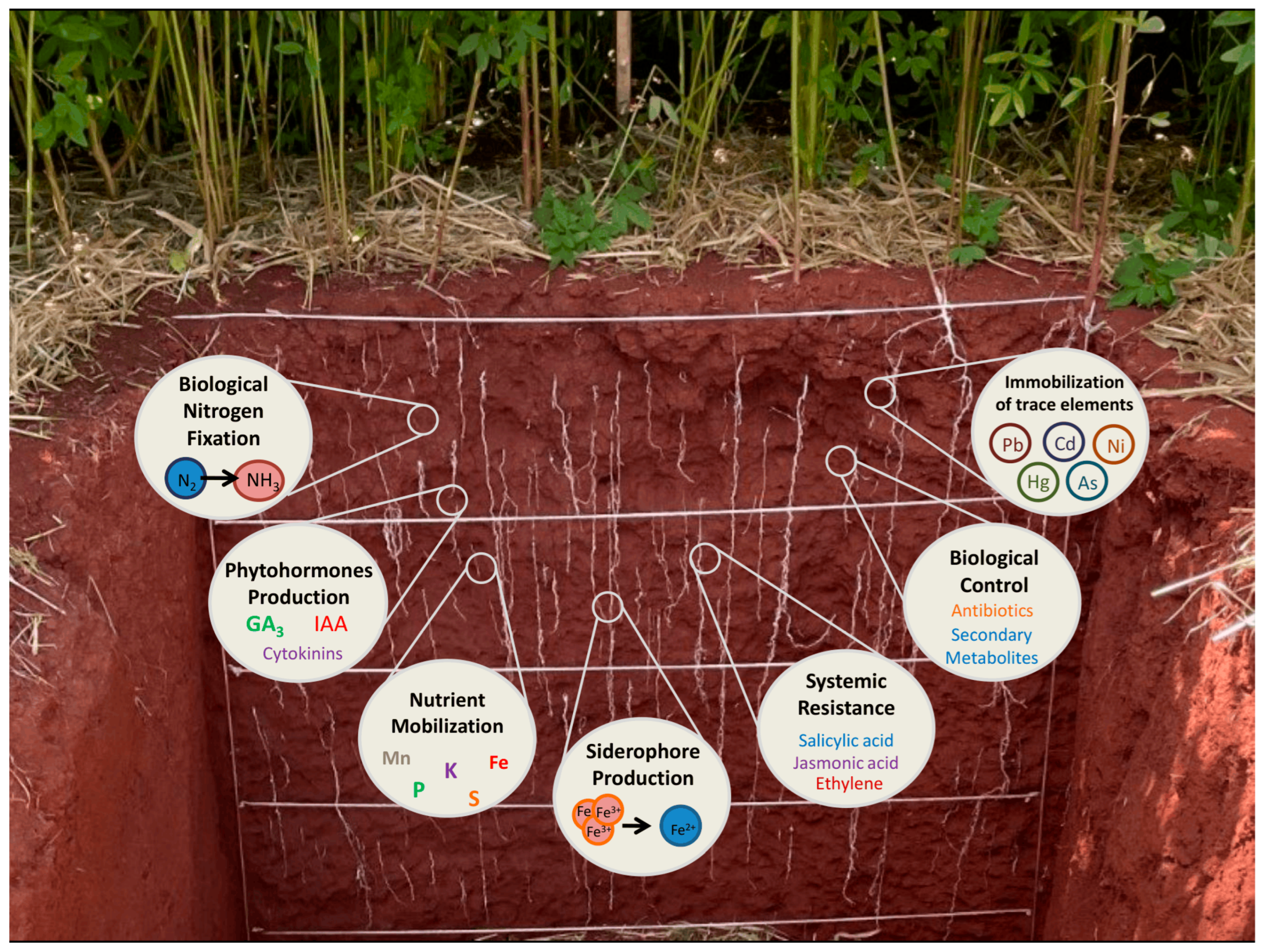
Figure 2.
Summary of the trajectory of biological inputs in Brazil from 1920 to 2024. The globe detaching Brazil was taken from Wikipedia (https://pt.wikipedia.org/wiki/Brasil#/media/Ficheiro:BRA_orthographic.svg), exported to a Microsoft(r) Office PowerPoint(r) file, where texts were inserted, all the elements were grouped, and then saved as ".png" figure file.
Figure 2.
Summary of the trajectory of biological inputs in Brazil from 1920 to 2024. The globe detaching Brazil was taken from Wikipedia (https://pt.wikipedia.org/wiki/Brasil#/media/Ficheiro:BRA_orthographic.svg), exported to a Microsoft(r) Office PowerPoint(r) file, where texts were inserted, all the elements were grouped, and then saved as ".png" figure file.
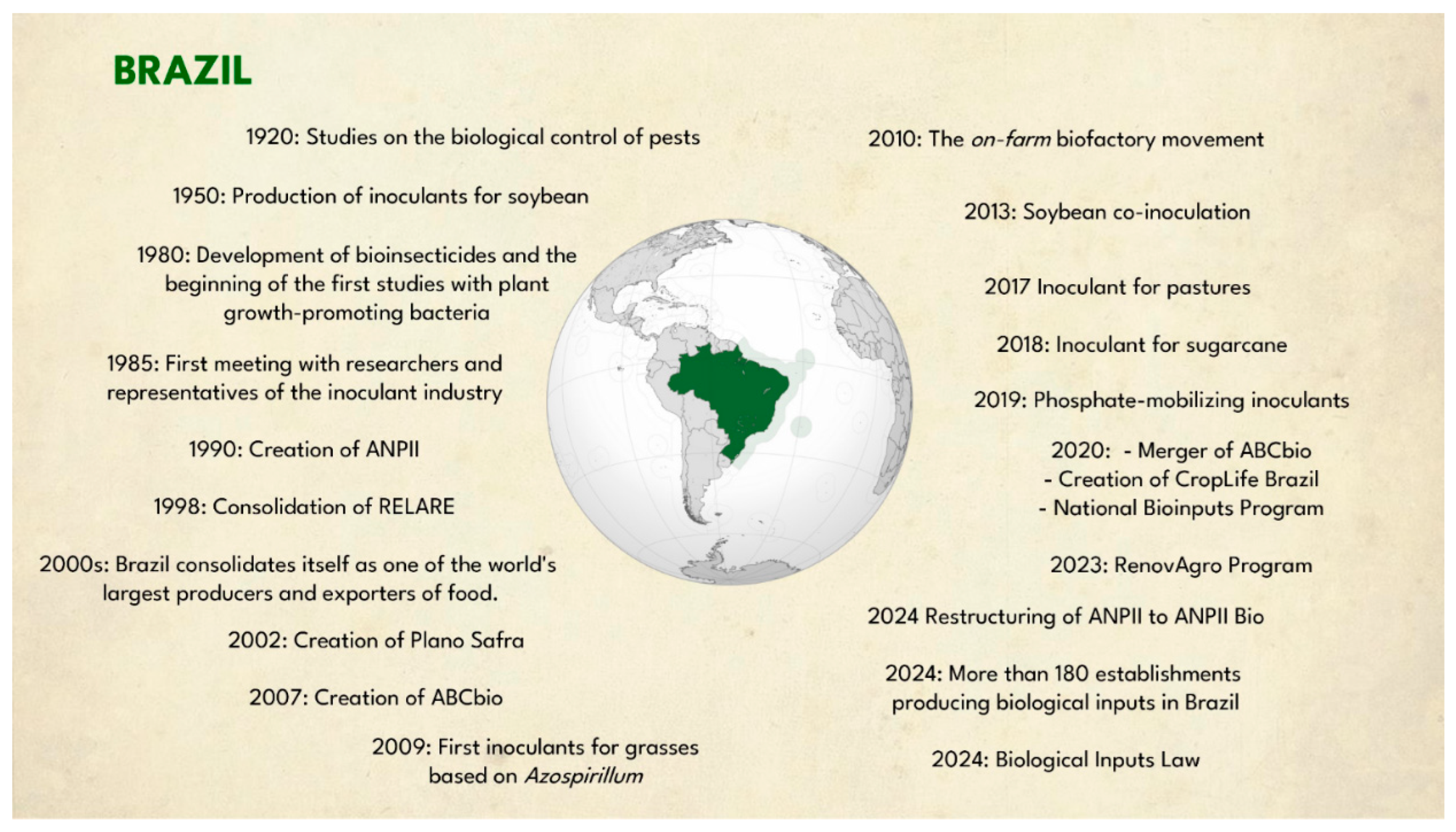
Figure 3.
Summary of the trajectory of biological inputs in Argentina from 1957 to 2025. The globe detaching Argentina was taken from Wikipedia (https://commons.wikimedia.org/wiki/Category:Argentina#/media/File:ARG_orthographic.svg/2), exported to a Microsoft(r) Office PowerPoint(r) file, where texts were inserted, all the elements were grouped, and then saved as ".png" figure file.
Figure 3.
Summary of the trajectory of biological inputs in Argentina from 1957 to 2025. The globe detaching Argentina was taken from Wikipedia (https://commons.wikimedia.org/wiki/Category:Argentina#/media/File:ARG_orthographic.svg/2), exported to a Microsoft(r) Office PowerPoint(r) file, where texts were inserted, all the elements were grouped, and then saved as ".png" figure file.
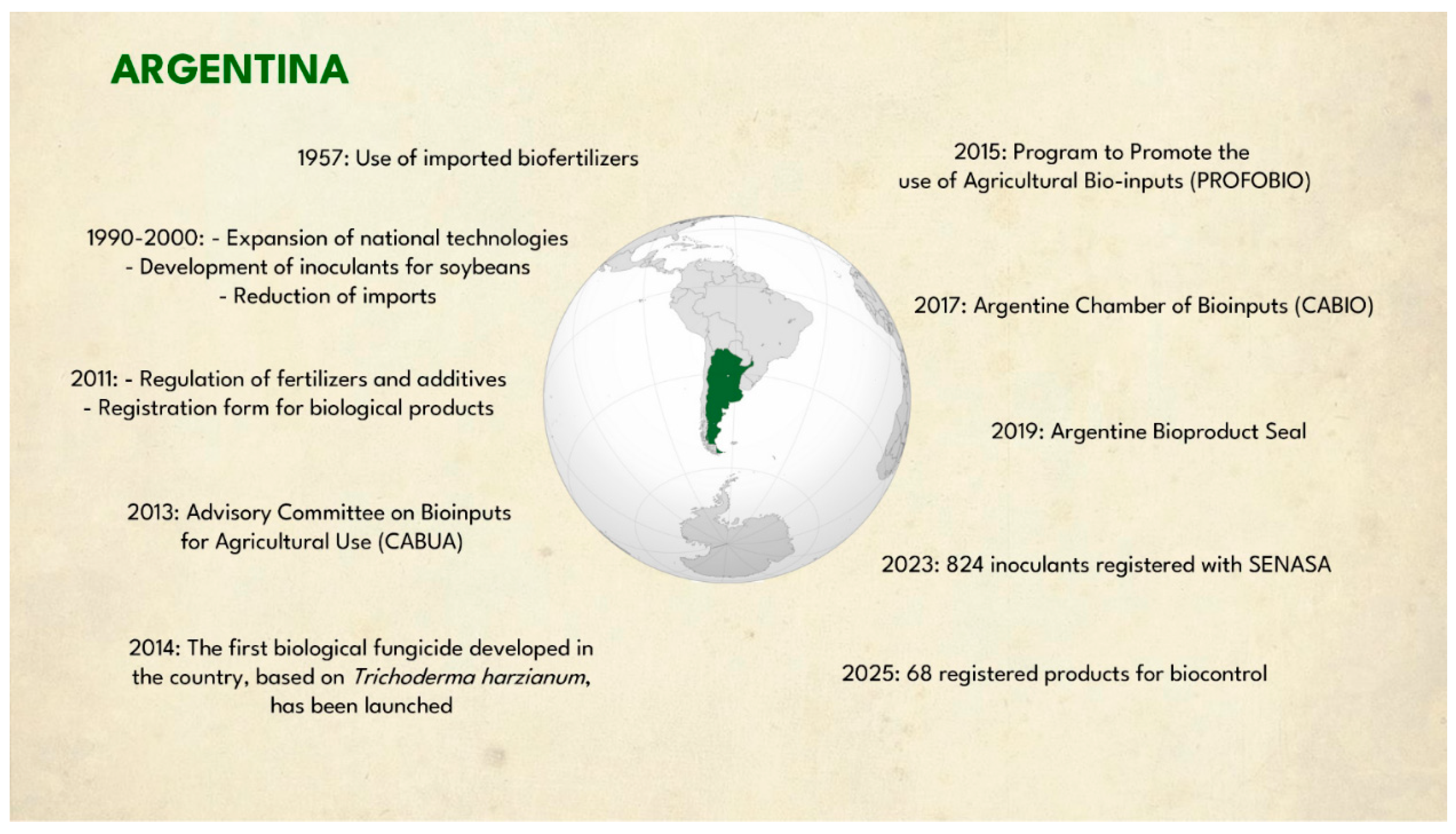
Figure 4.
Summary of the trajectory of biological inputs in India from 1920 to 2024. The globe detaching India was taken from Wikipedia (https://pt.wikipedia.org/wiki/%C3%8Dndia#/media/Ficheiro:India_(orthographic_projection).svg), exported to a Microsoft(r) Office PowerPoint(r) file, where texts were inserted, all the elements were grouped, and then saved as ".png" figure file.
Figure 4.
Summary of the trajectory of biological inputs in India from 1920 to 2024. The globe detaching India was taken from Wikipedia (https://pt.wikipedia.org/wiki/%C3%8Dndia#/media/Ficheiro:India_(orthographic_projection).svg), exported to a Microsoft(r) Office PowerPoint(r) file, where texts were inserted, all the elements were grouped, and then saved as ".png" figure file.
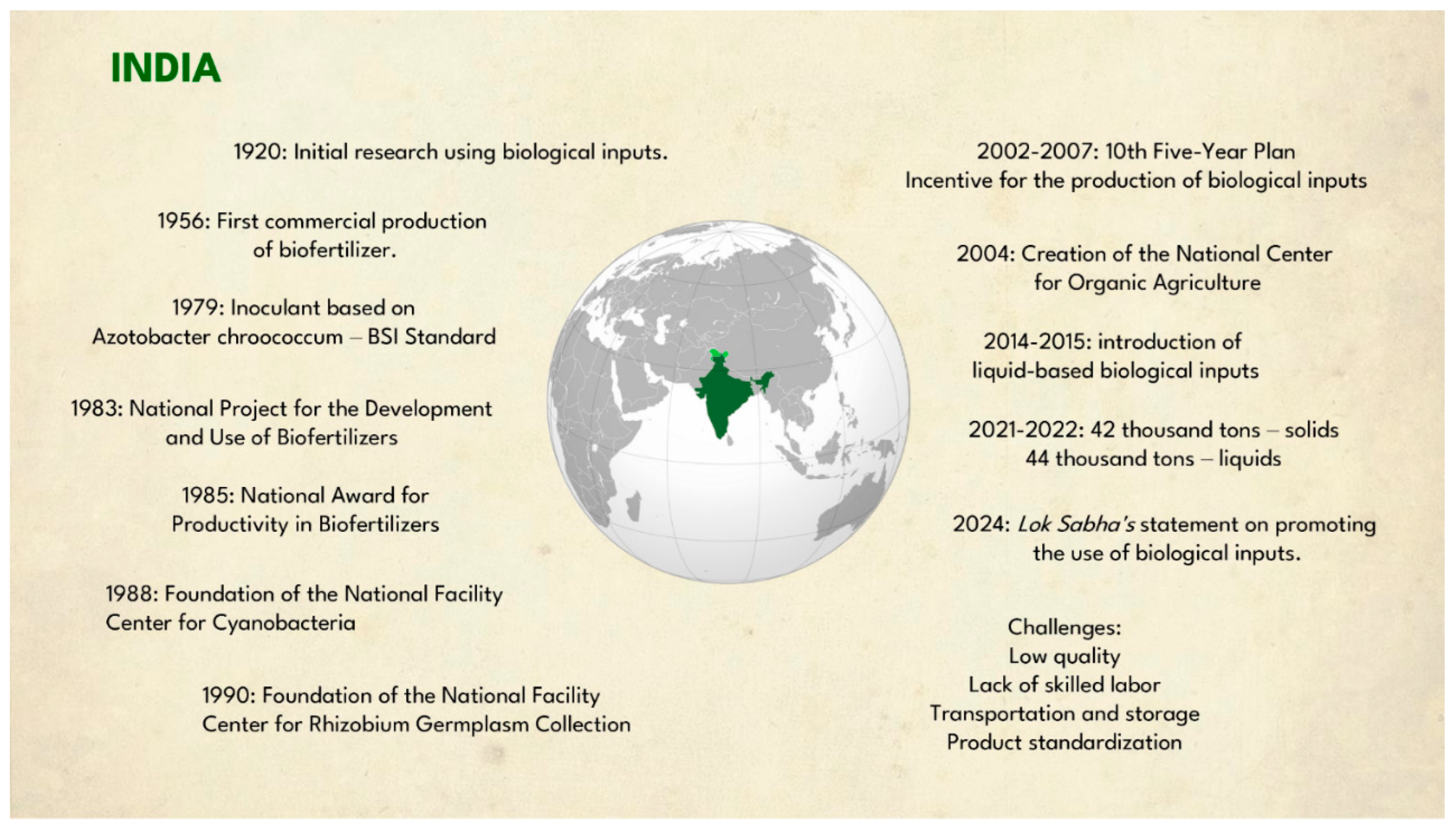
Figure 5.
Summary of the trajectory of biological inputs in the United States from the late 19th century to 2026. The globe detaching The United States was taken from Wikipedia (https://pt.wikipedia.org/wiki/Estados_Unidos#/media/Ficheiro:USA_orthographic.svg), exported to a Microsoft(r) Office PowerPoint(r) file, where texts were inserted, all the elements were grouped, and then saved as ".png" figure file.
Figure 5.
Summary of the trajectory of biological inputs in the United States from the late 19th century to 2026. The globe detaching The United States was taken from Wikipedia (https://pt.wikipedia.org/wiki/Estados_Unidos#/media/Ficheiro:USA_orthographic.svg), exported to a Microsoft(r) Office PowerPoint(r) file, where texts were inserted, all the elements were grouped, and then saved as ".png" figure file.
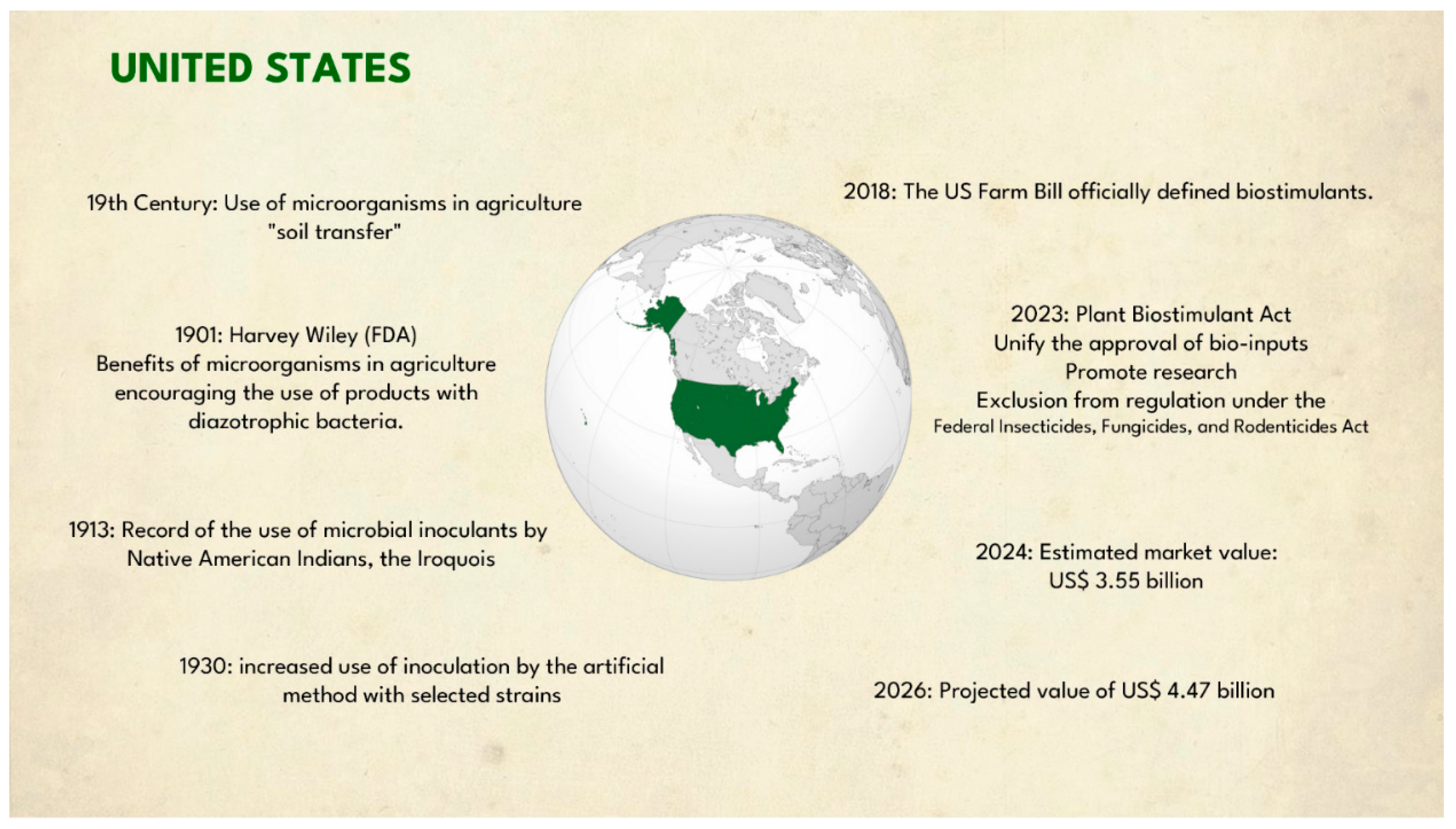
Figure 6.
Summary of the trajectory of biological inputs in the European Union from 1880 to 2022. The globe detaching The European Union was taken from Wikipedia (https://pt.wikipedia.org/wiki/Ficheiro:Global_European_Union.svg), exported to a Microsoft(r) Office PowerPoint(r) file, where texts were inserted, all the elements were grouped, and then saved as ".png" figure file.
Figure 6.
Summary of the trajectory of biological inputs in the European Union from 1880 to 2022. The globe detaching The European Union was taken from Wikipedia (https://pt.wikipedia.org/wiki/Ficheiro:Global_European_Union.svg), exported to a Microsoft(r) Office PowerPoint(r) file, where texts were inserted, all the elements were grouped, and then saved as ".png" figure file.
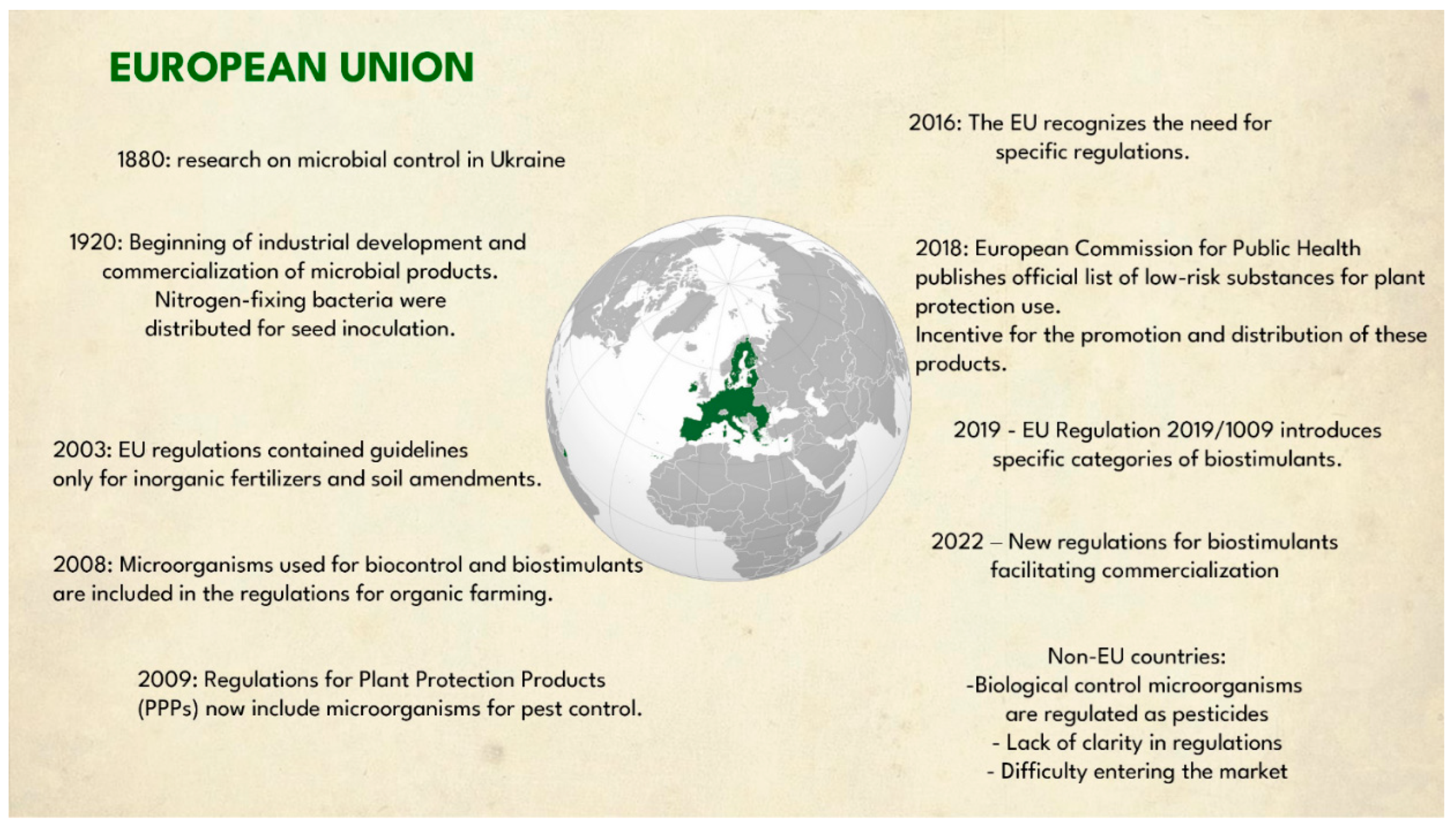

Table 1.
Beneficial microorganisms, some of their mechanisms of action, and agricultural crops in which they are used.
Table 1.
Beneficial microorganisms, some of their mechanisms of action, and agricultural crops in which they are used.
| Microorganism | Mechanism | Crop | Reference |
| Acetobacter diazotrophicus | Biological Fixation of N | Sugar cane (Saccharum officinarum) | [144] |
| Azotobacter chroococcum | Biological Fixation of N | Cotton (Gossypium hirsutum) |
[145] |
| P Solubilization Production hydrolytic enzymes | |||
| Azospirillum brasilense | Biological Fixation of N | Brachiaria spp.; Rice (Oryza sativa); Corn (Zea mays); Wheat (Triticum aestivum) | [146,147] |
| Phytohormone production | Wheat (T. aestivum); Corn (Z. mays); Millet (Pennisetum americanum) |
[148,149,150,151] | |
| P Solubilization | Rice (O. sativa); Corn (Z. mays); Wheat (T. aestivum) | [152] | |
| Azospirillum lipoferum | Gibberellin production | Rice (O. sativa) | [153] |
| Bacillus amyloliquefaciens | Gibberellin production | Rice (O. sativa) | [154] |
| Biological control | Soybean (Glycine max) | [155] | |
| Antibiosis | Tomato (Solanum lycopersicum) | [156] | |
| Bacillus atrophaeus | AIA Production | Soybean (G.max) | [157] |
| Biological control | Tobacco (Nicotiana tabacum) | [158] | |
| Bacillus aryabhattai | Zn Solubilization | Soybean (G. max); Wheat (T. aestivum) | [159] |
| Bacillus cereus | Induced and acquired systemic resistance |
Soybean (G.max) | [160] |
| Bacillus megaterium | P Solubilization | Beanmungo (Vigna radiata) |
[161] |
| Biological control | Cúrcuma (Curcuma longa) | [162] | |
| Bacillus mojavensis | K Solubilization | Corn (Z. mays) | [163] |
|
Bacillus subtilis |
Biological control | Rice (O. sativa); Bean(Phaseolus vulgaris); Wheat (T. aestivum); Soybean (G.max); Cotton (G. hirsutum); Amendoim (Arachishy pogaea); Café (Coffea sp.) | [164,165,166,167,168,169] |
| Induced systemic resistance | Tomato (S. lycopersicum) | [170] | |
| Bacillus pumilus | Gibberellin production | Soybean (G.max) | [171] |
|
Bacillus thuringiensis |
Incorporation of pest resistance genes into plants through genetic engineering. | Soybean (G. max); Potato (Solanum tuberosum); Corn (Z. mays); Tobacco (N. tabacum); Tomato (S. lycopersicum); Rice (O. sativa); Sugar cane (S. officinarum) e Cotton (G. hirsutum) | [172] |
|
Burkholderia vietnamiensis |
Zn Solubilization | Rice (O. sativa) | [173] |
| Bradyrhizobium sp. | Biological Fixation of N | Legumes | [174,175,176,177] |
|
Burkholderia cepacia |
P Solubilization | Tobacco (N. tabacum) | [178] |
| Enterobacter sp., Pantoea sp., Klebsiella sp. | P Solubilization | Spring onion (Allium fistulosum); Pimenta (Capsicum annuum); Sesame (Sesamum indicum); Rice (O. sativa) | [179] |
| Enterobacter ludwigii | Zn Solubilization | Wheat (T. aestivum) | [80] |
|
Gluconacetobacter diazotrophicus |
Biological Fixation of N | Sugar cane (S. officinarum); Rice (O. sativa) | [180,181] |
| Herbaspirillum sp. | Biological Fixation of N | Sugar cane (S. officinarum) | [182] |
| Klebsiella sp. | Biological Fixation of N | Corn (Z. mays) | [183] |
| Systemic acquired and induced resistance | Oat (Avena sativa) | [184] | |
| Mesorhizobium tianshanense | Biological Fixation of N | Soybean (G.max) | [185] |
|
Methylobacterium extorquens |
Cytokinin production | Arabidopsis; Barley (Hordeum vulgare); Corn (Z. mays); Soybean (G.max) | [186] |
| Paenibacillus xylanexedens | Chitinase production | Wheat (T.aestivum) | [187] |
|
Pantoea agglomerans |
Zn Solubilization | Wheat (T. aestivum) | [188] |
|
Pantoea allii |
AIA Production | Corn (Z. mays) | [189] |
| Pseudomonas plecoglossicida | P Solubilization | Corn (Z. mays); Wheat (T. aestivum) | [190] |
| Pseudomonas azotoformans | K Solubilization | Rice (O. sativa); Banana (Musa spp.); Corn (Z. mays); Sorghum (Sorghum bicolor); Wheat (T. aestivum) | [191] |
| Pseudomonas aeruginosa | P Solubilization | Corn (Z. mays) | [192] |
| Pseudomonas fluorescens | Biological control | Rice (O. sativa); Corn (Z. mays); Wheat (T. aestivum) | [193] |
|
Pseudomonas putida |
Resistance to abiotic stresses | Soybean (G.max) | [194] |
| Rhizobium leguminosarum | Gibberellin production | Rice (O. sativa) | [195] |
| Rhizobium phaseoli | AIA Production | Bean (P. vulgaris) | [196] |
| Rhizobium pusense | P Solubilization | Corn (Z. mays), banana (Musa spp.); Tobacco (N. tabacum); Sugar cane (S. officinarum); Guandu bean (Cajanus cajan); Potato (S. tuberosum) | [197] |
| Rhizobium tropici | Biological Fixation of N | Bean(P. vulgaris) | [198] |
| Sinorhizobium meliloti | Cytokinin production | Leguminosas | [199] |
Disclaimer/Publisher’s Note: The statements, opinions and data contained in all publications are solely those of the individual author(s) and contributor(s) and not of MDPI and/or the editor(s). MDPI and/or the editor(s) disclaim responsibility for any injury to people or property resulting from any ideas, methods, instructions or products referred to in the content. |
© 2026 by the authors. Licensee MDPI, Basel, Switzerland. This article is an open access article distributed under the terms and conditions of the Creative Commons Attribution (CC BY) license (http://creativecommons.org/licenses/by/4.0/).
Copyright: This open access article is published under a Creative Commons CC BY 4.0 license, which permit the free download, distribution, and reuse, provided that the author and preprint are cited in any reuse.