

Submitted:
04 September 2026
Posted:
07 September 2026
You are already at the latest version
Abstract
This study examined the impact of nitrogen applied at booting stage on grain yield, protein content, grain N uptake, and nitrogen recovery efficiency (NRE) of common winter wheat (Triticum aestivum L.) in Transylvanian Plain, in the period 2019-2026. The experiment included eight consecutively years, four varieties and, two nitrogen doses: N50 and N100. In the variant of fertilization N50, 50 kg ha-1 nitrogen active substance were applied in autumn before sowing as basic fertilization and in the variant N100, other 50 kg ha-1 nitrogen were applied at the booting stage in addition to the base fertilization. Our research has shown that, compared to other wheat growth stages, applying nitrogen at the booting stage (one week before heading) significantly improved yield and protein content. Nitrogen applied at the booting stage conducted to an increase of yield by an average of 763 kg ha⁻¹ and in grain protein content by 2.24%. The NRE values for all the studied varieties indicate an efficient utilization of nitrogen fertilizers applied at the booting stage, except the years marked by drought in May, such as 2019/2020 or when drought from June is accompanied by scorching heat, such as 2023/2024.
Keywords:
wheat
; booting stage
; nitrogen fertilizer
; yield
; quality
; grain N uptake
; NRE
1. Introduction
Wheat has highly requirements of fertilization due to its poorly developed root system, which has a limited capacity to utilize less soluble soil nutrients; furthermore, the crop absorbs the greatest quantity of nutrients over a short period, from the begining of stem elongation to the milk-ripe stage (April–June, 90–100 days from the total of 250–265 days of growing season) and that is why requiring an adequate supply of nutrients to achieve high yields, because soil reserves alone are insufficient to meet these needs.
Mineral fertilizers represent one of the most important means of increasing winter wheat yields in all cultivation zones in Romania [1,2,3] and worldwide [4,5,6] however, breeding programs can also contribute by developing varieties capable of fully exploiting the conditions created by cultivation technology [7].
The methods and timing of application play an important role in enhancing fertilizer efficiency, the aim is keeping nutrients in the plant’s active root zone as long possible. Based on the timing of fertilizer application, three main methods are distinguished: fertilization before sowing, also known as basic fertilization, fertilization at the time of sowing, and, fertilization during the growing season, also known as supplemental fertilization.
Nitrogen demand presents a challenge because winter wheat is characterized by a long period of vegetative dormancy before the resumption of growth in the spring, a time when the crop has high nitrogen requirements [8,9,10,11].
The use of enhanced-efficiency fertilizers and split-application methods for nitrogen fertilizers can help optimize winter wheat production [12] and minimize nitrogen losses during extreme weather events. Wheat crop performance is substantially influenced by soil nitrogen (N) supply and applied fertilizer rates; managing N supply is a key strategic tool that wheat growers can use to respond to weather variations during the growing season and maximize their profits.
Excessive nitrogen rates are detrimental to wheat under drought and heat stress; not only do they reduce chlorophyll content and the rate of photosynthesis, but they also prolong leaf senescence, hindering the transport of products of photosynthesis to the grains and thereby reducing yield [13,14].
To achieve the objectives research, an experimental plan was developed to monitor the performance of Romanian winter wheat varieties under the new climatic conditions in moderate and low nitrogen application rates. The study is important, given the significant share of winter wheat in both global and national agriculture, as well as the focus of sustainable agriculture on maintaining soil fertility while reducing chemical fertilizer application rates to limit pollution.
2. Materials and Methods
2.1. Experimental Site
ARDS Turda is located at coordinates 46°35’ North latitude and 23°47’ East longitude, and at an altitude of 345–493 m above Adriatic Sea level. The experimental field is located in the western part of the Transylvanian Plain, and the station’s sphere of influence extends across the intra mountain geographical unit known as the Transylvanian Plateau comprising: Transylvanian Plain, Someș Plateau, Târnava Plateau, and Sibiu, Făgăraș, and Brașov depressions, a geographical zone administratively spanning 11 counties. The soil type is Phaeozem with the horizon sequence: Am – Bty – C and a clay-loam texture; it exhibits favorable hydro-physical properties, including a granular structure and high porosity (59% at the surface and 47% at depth), as well as a high water-holding capacity (Cc) of 32% and a wilting coefficient (Co) of 18%. The agrochemical indices are characterized by the following average values: humus content exceeding 2.5%, mobile phosphorus content exceeding 4.5 mg P2O5/100 g of soil, and mobile potassium content exceeding 30 mg K2O/100 g of soil. Soil reaction ranges from slightly acidic to neutral.
2.2. Biological Materials
Every year a number of 150 genotypes are tested for determination yield potential and the efficient use of moderate nitrogen rates under the current climatic conditions of the Transylvanian Plain. The placement in the field of winter wheat genotypes was made in every year according to the model of the balanced square grid, with 25 variants, in 6 repetitions, with the repetition of the basic scheme. The biological material used for this study consisted of four winter wheat varieties developed at ARDS Turda. Winter wheat varieties tested and year of registration:
- -
- Andrada (2012);
- -
- Codru (2015);
- -
- Luminița (2023);
- -
- Georgiana (2025).
2.3. Research Methods in Field
A three factorial (YxNxG) experiment was established to achieve the specified objectives. The yield results were obtained from the national comparative performance trial for the Central-North region, organized annually using balanced square grid; this setup allowed the basic layout from replications 1–3 to be repeated in replications 4–6, thereby enabling differential fertilization with 100 kg ha-1 N (active ingredient) and 50 kg ha-1 N (active ingredient). The Andrada, Codru, Luminița, and Georgiana varieties have been included in this comparative trial over the past eight years. Data on yield (kg ha−1) and protein content (%) were collected annually for these varieties and analyzed using the Polifact software, which enables analysis of variance (ANOVA), F-test calculation, and Duncan’s test for mean comparison. The preceding crop was peas. The experimental factors included: eight years (Y), two nitrogen fertilization rate (N50, N100), and four wheat genotypes (G). The sown plot measured was 7.5 m2 (6 x 1.25), and the sowing density was 550 viable seeds/m2 using a Wintersteiger Plot Seed Drill.
Two types of fertilizers were applied to provide the necessary nitrogen doses for the two fertilization variants: NPK 20:20:0 applied in the autumn before sowing, and calcium ammonium nitrate applied at the booting stage. NPK 20:20:0 fertilizer has the following composition: total nitrogen 20%, comprising 8.7% nitric nitrogen (NO2) and 13.3% ammonia nitrogen (NH4); total phosphorus 20% P2O5. NPK 20:20:0 was applied in the autumn before sowing at a rate of 250 kg ha−1, providing 50 kg ha−1 of active nitrogen and phosphorus, and was incorporated using a rotary tiller. Granular calcium ammonium nitrate (CAN) contain also calcium (CaO, 7%) and magnesium (MgO, 5%) derived from dolomite incorporated during the production process. The total nitrogen content of this kind of fertilizer is 27%, comprising 13.5% nitric nitrogen (NO2) and 13.5% ammonia nitrogen (NH4). It has good water solubility and ensures the availability of the two nutritional forms of nitrogen over an extended period. It was applied by spreading to wheat at booting stage in a dose of 180 kg ha-1, to supply 50 kg ha-1 of active ingredient nitrogen. The timing of nitrogen application at booting stage fell between 10 -15 of May, with the exception of year 2024 (30 of April), corresponding to Zadoks stage 45.
Statistical analysis of yield and protein content was performed using the Polifact software, based on data collected for each variety and fertilization treatment during the period 2019–2026 period, while graphical representation was created using Excel 2013 version.
Protein content determination was performed using the InfraGrain 9500 Analyser and Nitrogen Recovery Efficiency (NRE) was calculated using the difference method:
NRE (%) = (NF100 – NF50) / R, where: NF100 represents the amount of uptake nitrogen in the variant fertilized with 100 kg ha-1 of nitrogen active ingredient (a.i.) and, NF50 is the amount of uptake nitrogen in the variant fertilized with 50 kg ha-1 of nitrogen (a.i.), and R is the nitrogen rate applied at booting stage, specifically 50 kg ha -1 of nitrogen (a.i). The conversion factor for protein content into nitrogen was 6.25.
2.4. Climate conditions
The long-term average temperature (based on 65 years of data collected from the Weather Station of ARDS Turda) for the winter wheat growing season (October 1 – July 10) is 7.6 °C; in contrast, the 2023/2024 season recorded the highest temperature 9.7 °C (an increase of 2.1 °C). Thermal resources during the winter wheat growing season (above 0 °C) over the eight experimental years ranged from 2227 °C (2020/2021) to 2684 °C (2023/2024), as shown by the data presented in Table 1. While we would not normally expect temperatures above 0 °C during the winter months, we observe sum of temperature ˃00C every year in December and January, but especially in February. High temperatures during January and February are dangerous because they allow the winter wheat’s growing season to resume prematurely, leaving the plants vulnerable to the low temperatures that follow.
The average annual precipitation during the winter wheat growing season is 382 mm; June is the wettest month (84.6 mm) and February the driest (19.6 mm). Over the eight-year experimental period, precipitation in the area during the wheat growing season ranged from 268.6 (2023/2024) to 465.3 mm (2025/2026), and monthly distribution are presented in Table 2.
3. Results
3.1. Grain Yield
Analysis of variance of this experiment shows, according to the Fisher (F) test, that the three factors studied: growing season (Y), nitrogen rate (F), and genotype (G) have a significant influence on wheat yield. Factor interactions YxF and YxG also significantly influence winter wheat yield; the calculated F-test values exceed the theoretical values as can see from Table 3. This means that the utilization of nitrogen fertilizers depends on climatic conditions, with lower utilization in dry years and, reaching of the varieties’ yield potential depends on how favorable the climatic conditions are for the winter wheat crop and on nitrogen application. Regarding the effect of the factors, the most favorable year for winter wheat was 2023/2024, when the average yield was 9626 kg ha-1 (a).
As can be seen from the data presented in Figure 1, nitrogen fertilization applied at the booting stage resulted in statistically highly significant yield increases, with the exception of 2019/2020, when the yield increase was distinctly significant (not exceed the LSD 0.1%). As shown by the ANOVA, the effectiveness of nitrogen fertilization applied at the booting stage depends on climatic conditions. Therefore, we will present the climatic conditions that may have acted as limiting factors for winter wheat cultivation and influenced the utilization of nitrogen fertilization applied at the booting stage.
Limiting factors for winter wheat in the 2018–2019 crop season were: drought during the autumn months, especially October, which affected the density of plants and, the drought during the second decade of June and the first decade of July which coincided with the grain-filling phase, resulting in reduced yields across all genotypes. In this year production was with 2350 kg ha-1 lower than the multi-year average (8339 kg ha-1). Because the nitrogen fertilizer was applied in May before the period of drought, it was utilized more effectively, resulting in a yield increase of 802 kg ha-1.
In the second year (2019/2020) drought in October led to delayed emergence and for crops that already emergence a slowdown in the growth rate was registered. Excessively dry conditions in April and May, with a cumulative deficit of 52.4 mm significantly slowing growth and development phases and this period coincided with the stage of floral differentiation, a factor which affected the number of florets per spike. Furthermore, the drought in May and the extremely low temperatures at the beginning of the month led to the appearance of sterile spikelets at the base of spike. Nitrogen fertilization applied at the booting stage resulted in a yield increase of 442 kg ha-1.
In the crop season 2020/2021, October rainfall make difficult field preparation for sowing and the sowing process itself, which began on October 16, approximately 10 days later than in other years. Furthermore, the low temperatures during the second decade of February (-11.3 °C and -11.7 °C on the 12th and 13th), in the absence of snow cover, caused the yellowing of winter wheat leaves in varying degrees, depending on the genotype. Drought and low temperatures recorded in April, significantly slowing growth and developmental stages, an effect reflected in the number of spikelets per spike; meanwhile, June was hot and excessively dry, and these conditions negatively impacted grain growth and filling, thereby affecting yield levels, particularly for late-maturing genotypes. Nitrogen fertilization applied at the booting stage in this year resulted in a yield increase of 683 kg ha-1.
Limiting factors in the season crop 2021/2022 identified by us in condition of Transylvanian Plain were: autumn drought periods between sowing and emergence, which reduced plant density through the loss of second and third order tillers, the drought during winter and at the resumption of vegetative growth, which delayed wheat phenological stages, such as stem elongation, the drought in June and July during the grain formation and filling stage which caused the forced ripening of wheat. Nitrogen fertilization applied in the booting phase resulted in an increase in production by 633 kg ha-1.
Limiting factors for winter wheat season crop 2022/2023 included: prolonged drought during the spring months, with a cumulative precipitation deficit of 64.8 mm over the three-month period, resulting in the loss of second and third order tillers; low temperatures during the months of April and May which affected organogenesis; excessively rainy month of June which favoured foliar diseases (yellow rust, brown rust) and ear diseases (Fusarium head blight). In the season crop 2022/2023 nitrogen fertilization at the booting stage produced the largest increase in yield of 1426 kg ha-1, the fertilization effect being maximized by the rainfall that occurred immediately after application.
During 2023/2024 season crop, we recorded a single period when climatic factors acted as a limiting influence on winter wheat, the lack of precipitation and the high temperatures in June, which accelerated the crop’s ripening. So, the increase in yield due to nitrogen fertilization at the booting stage was only 612 kg ha-1.
We are observing increasingly intense weather phenomena affecting winter wheat crops such as those seen between 6 and 11 April, 2025, when unusually low temperatures for the time of year were accompanied by mixed precipitation and wind gusts that intensified the cold, causing leafs burning of winter wheat which reduce the assimilating leaf area by 10–15%. Yields were lower compared to those recorded in the previous year, and the increase in yield resulting from nitrogen fertilization at the booting stage was 612 kg ha-1.
In the season crop 2025/2026 the prolonged drought during April and May acted as a limiting factor for winter wheat, affecting stem elongation and the formation of yield components. The increase in production due to nitrogen fertilization in booting stage led to an increase in production by 834 kg ha-1.
The response to nitrogen fertilization applied at the booting stage differed among the studied varieties. The average yield of Andrada variety over the eight experimental years was 8557 kg ha−1 at the N100 fertilization level, which was 719 kg ha−1 higher than that of the N50 variant and the largest yield increase resulting from nitrogen fertilizers applied at booting stage was recorded in 2023 (Figure 2) and the smallest in 2020, being not significant.
The average yield of Codru variety was 8515 kg ha−1 at the N100 level fertilization, and in N50 variant 7722 kg ha−1 and the largest yield increase determine by nitrogen fertilizers applied at booting stage was recorded also in 2023 (1726 kg ha-1) and the smallest in 2021 being significant.
Luminița variety registered an average production on variant of fertilization N100 of 8786 kg ha−1, with 796 kg ha-1 higher than variant N50. For this variety as well, nitrogen fertilization at the booting stage determine the greatest increase of yield in 2023.
For the Georgiana variety, nitrogen fertilization at booting stage resulted in a yield increase of over 1000 kg ha-1 in three years, respectively in 2019 (1168 kg ha-1), 2021 (1253 kg ha-1), and 2023 (1102 kg ha-1).
Based on the results regarding the influence of nitrogen fertilization at the booting stage on winter wheat, we can conclude that 2023 was the year when the fertilizer was utilized most efficient, particularly for the Codru and Luminița varieties.
3.2. Protein Content
Nitrogen fertilizers significantly influence the grain protein content of wheat, as can be seen from the data presented in Table 4 regarding the F-test. Nitrogen fertilizer is a key factor in increasing protein content and quality in wheat grain [15,16,17]. Our research has shown that, compared to other wheat growth stages, applying nitrogen at booting stage significantly improved yield and protein content. Given these factors, the most cost-effective nitrogen fertilization methods were searching to minimizing input while maximizing results in terms of both yield and quality for winter wheat. The highest average protein content was determined in 2020, and the difference between the N100 (11.71%) and N50 (9.47) fertilization variants was 2.24%.
Nitrogen plays an important role in the formation of proteins in wheat grains, but high doses can cause environmental pollution, thereby affecting agricultural ecosystems [18]. Excessive nitrogen application not only leads to a waste of resources and economic losses but can also have a negative impact on the environment [19,20,21]. These were the primary reasons why we applied moderate and low doses of nitrogen. But numerous studies have shown an increase in wheat grain protein content as the nitrogen rate increases [5,22].
Applying nitrogen at the booting stage can make the difference between high-quality wheat, with properties suitable for the baking industry with a higher price and lower quality of wheat that fetches a lower price. Romania is recognized for the quality of wheat, which is high demand for export and has recorded a significant surplus of 4–6 million tonnes in recent years, heightened attention must be paid to protein content. Therefore, nitrogen fertilization measures are required to achieve adequate protein content.
In 2019, fertilization at the booting stage resulted in the greatest increase in grain protein content across all varieties, ranging from 3.1% to 4% (Figure 3). The smallest increase in protein content resulting from nitrogen fertilization at booting stage was recorded in 2024, ranging from 0.9% to 1.4%. This was the year in which we were able to highlight the negative correlation between yield and protein content; for the majority of varieties, the highest yields and lowest protein content values were recorded in the N100 fertilization variant.
For the Andrada variety, an average protein increase of 2.40% was achieved by applying a dose of 50 kg ha-1 of nitrogen (active ingredient) at the booting stage. The highest protein content for Andrada was recorded in 2020, with a difference of 1.25% between the two fertilization variants, while the lowest was observed in 2024, year in which the nitrogen dosage proved insufficient to produce wheat that meeting quality standards.
For the Codru variety, the maximum grain protein content was recorded in 2019, with a difference of 3.3% between N100 and N50 fertilization variants, when a quantity of 50 kg ha-1 nitrogen (a.i) was applied at the booting stage in addition to nitrogen fertilization applied in autumn before sowing. On average, the increase in grain protein content resulting from nitrogen fertilization at the booting stage for the Codru variety was 2.17%.
The Luminița variety had an average grain protein content of 11.7% under the N100 fertilization treatment, with a maximum of 12.9% in 2019 and a minimum of 10.2% in 2024. For this variety as well, the 2024 harvest failed to meet the quality standards required by the baking industry, in the condition of moderate nitrogen rates application (100 kg ha-1 N a.i.).
Georgiana is an earlier-maturing variety than the other varieties presented in this study, by approximately 10–12 days. This inherent trait has proven crucial in the new climatic context, because plants reaches physiological maturity two weeks earlier before the June periods of drought and extreme heat, that are becoming increasingly frequent in our region and causing premature leaf desiccation. For the Georgiana variety, the average grain protein content was 11.35% in the N100 fertilization variant and 9.12% in the N50 variant.
We observed in our experiment that the use of moderate nitrogen doses (N100) throughout the winter wheat growing season does not always produce yields that meeting quality standards required by the baking industry, as was the case in 2025 and therefore we recommend increasing the dosage. Other studies present results with nitrogen rates increasing up to 250 kg/ha of active ingredient, but the optimal rate, up to which yield increases is 217 kg ha-1 of N a. i. [23].
3.3. Nitrogen Recovery Efficiency
The results obtained demonstrate that nitrogen management is specific to each cultivar but also depends on the timing of application, the dosage used, and climatic conditions. For the Andrada variety, NRE values range between 46.33 and 115.92%, with an average of 91.32%, the most efficient utilization of nitrogen applied at the booting stage was achieved in the year 2020/2021 and it was less utilized in only two of the eight years, a fact attributed to climatic conditions, as previously explained. NRE values approaching or exceeding 100% can be also attributed to the preceding crop, in our case grain peas which leaves a certain amount of nitrogen in the soil. We observed a higher coefficient of variability for grain nitrogen content in the N50 fertilization variant compared to N100, which may indicate that nitrogen application at the booting stage can contribute to stability of protein content. When comparing the nitrogen uptake with the amount applied, we can see that a significant portion originates from the soil and the preceding crop; this meaning that applying moderate to low rates of nitrogen is the solution for maintaining soil fertility while minimizing soil pollution as much as possible and, also the cultivation of productive varieties possessing superior quality characteristics.

Table 5.
Efficiency of nitrogen application at the booting stage for the Andrada variety
|
Crop season |
Grain Nitrogen N100 (%) |
Grain Nitrogen N50 (%) |
Nitrogen uptake N100 Kg ha-1 |
Nitrogen uptake N50 Kg ha-1 |
N100-N50 Nitrogen uptake Kg ha-1 |
Nitrogen Recovery Efficiency NRE (%) |
|---|---|---|---|---|---|---|
| 2018/2019 | 2.000 | 1.520 | 129.80 | 91.45 | 38.35 | 76.70 |
| 2019/2020 | 2.168 | 1.968 | 176.45 | 153.29 | 23.17 | 46.33 |
| 2020/2021 | 1.840 | 1.424 | 171.82 | 113.86 | 57.96 | 115.92 |
| 2021/2022 | 1.840 | 1.488 | 171.17 | 117.64 | 53.53 | 107.06 |
| 2022/2023 | 1.888 | 1.520 | 160.08 | 110.17 | 49.91 | 99.82 |
| 2023/2024 | 1.616 | 1.392 | 157.93 | 124.68 | 33.25 | 66.50 |
| 2024/2025 | 2.027 | 1.653 | 196.35 | 144.49 | 51.86 | 103.72 |
| 2025/2026 | 1.936 | 1.440 | 174.28 | 117.03 | 57.25 | 114.50 |
| Average | 1.914 | 1.551 | 167.24 | 121.58 | 45.66 | 91.32 |
| Minim | 1.616 | 1.392 | 129.80 | 91.45 | 23.17 | 46.33 |
| Maxim | 2.168 | 1.968 | 196.35 | 144.49 | 57.96 | 115.92 |
| Amplitude | 0.552 | 0.576 | 66.55 | 53.04 | 34.79 | 69.59 |
| Standard deviation | 0.1628 | 0.1866 | 19.116 | 19.544 | 12.63 | 25.27 |
|
Coefficient of Variability (%) |
8.50 | 12.03 | 11.43 | 16.07 | 27.66 | 27.66 |
For the Codru variety, the highest protein content was recorded in the 2018/2019 growing season; 13.6% in N100 variant and 10.3% in N50 variant, with a difference of 3.4% between the two variants of fertilization, which once again underscores the importance of fertilization at booting stage for this variety as well. Regarding nitrogen uptake, the highest values were recorded in the crop season 2024/2025 in both variants of fertilization, when difference between N100 and N50 in protein content was 2.09%. In the 2023/2024 crop season, we observed the lowest grain nitrogen levels for the Codru variety, but due to its high yields, nitrogen uptake was close to the eight-year average in the variant N100 and higher in N50. These results can also be attributed to the varieties develop by ARDS Turda, well adapted to the specific climatic conditions of Transylvanian Plain, especially in 2023/2024 growing season which ended earlier than usual (30 of June). NRE of Codru variety has registered an average value of 87.71%, in two seasons: 2020/2021 and 2022/2023 exceeding 100% as shown data from Table 6.
For the Luminița variety, we recorded three years in which the grain protein content under the N100 fertilization treatment exceeded 12.5%: 2018/2019 (12.90%), 2019/2020 (12.75%), and 2024/2025 (12.56%). This means that, over these years, it responded well to nitrogen fertilization at the booting stage, particularly in the 2018/2019 crop season, when the result was an increase of 3.3% protein content in grain. However, the results regarding protein content obtained with the N100 variant over the other five years indicate that, for this variety as well, the nitrogen dosage must be increased to achieve high-quality yields. NRE of Luminița variety registered an average value of 88.92%, in three seasons: 2020/2021, 2022/2023 and, 2025/2026 exceeding 100% as shown data from Table 7.
The year in which nitrogen fertilization at the booting stage resulted in smaller increases in grain protein content, specifically 1.2% was 2023/2024 for this variety.
For the Georgiana variety, the negative correlation between yield and protein content is confirmed; it is more productive than the other varieties studied but has a lower protein content. The highest NRE value was determined for this cultivar and was 139% as we can see from the Table 8.
4. Discussion
Wheat crop performance is substantially influenced by soil nitrogen (N) supply and applied fertilizer rates; managing N supply is a key strategic tool that wheat growers can use to respond to weather variations during the growing season and maximize their profits. Nitrogen (N) is an essential plant nutrient that affects productivity, nitrogen recovery efficiency (NRE), and rainfall use efficiency (RUE) in wheat, and understanding how N influences wheat yield and quality is important. Increasing nitrogen recovery efficiency (NRE) through the use of appropriate fertilizers and the correct combination of nutrients, as well as timely fertilization to avoid nutrient losses via volatilization and leaching was the primary objective of the research conducted.
Excessive nitrogen rates are detrimental to wheat under drought and heat stress; not only do they reduce chlorophyll content and the rate of photosynthesis, but they also prolong leaf senescence, hindering the transport of photosynthetic products to the grain and thereby reducing yield [13,14]. These studies further indicate that high nitrogen rates—specifically N300 compared to N180—under rain-fed conditions resulted in an average yield reduction for winter wheat of 27.5% and 28.0% in the 2012–2013 and 2013–2014 seasons, respectively. Similarly, the failure to apply nitrogen had negative effects on wheat production. When N is not applied, it is derived primarily from the atmosphere and the mineralization of soil organic matter [24]. Wang et al. [25] show that optimizing the timing of nitrogen (N) fertilizer application results in enhanced efficiency and can maximize winter wheat yield, protein content, and nitrogen use efficiency (NUE).
Excessive nitrogen application, combined with water deficit, has a negative effect on wheat (Triticum aestivum L.) yield in the North China Plain [26]. Excessive nitrogen application not only leads to a waste of resources and economic losses but can also have a negative impact on the environment. Nitrogen application has been shown to increase nitrate (NO3) leaching in the North China Plain [20] and in irrigated Mediterranean areas [19]. In a long-term experiment, Zhang et al. [27] showed that wheat yield varied enormously from year to year across all nitrogen sources and application rates. Recently, Pop et al. [28] presented results from monitoring the influence of N, P, and K mineral fertilization levels on the yield of the Ciprian wheat variety in the Pecica-Arad micro-zone—an area representative of wheat cultivation in the west of the country—and demonstrated that the nitrogen dosage exerted the most significant influence on yield, followed by phosphorus and potassium. The highest wheat yield, 5,851 kg/ha, was achieved with the P40K40N60 fertilization regime. In the Pecica-Arad micro-zone, the protein content obtained with any of the nitrogen dosages (N30–N120) was significantly higher than that of the N0 control. The increase in protein content compared to the N0 control ranged from 2.4% to 4.77%. [25] demonstrate that excessive fertilization is associated with nutrient loss, soil compaction, and poor plant resistance to disease. Other study demonstrated that low nitrogen recovery efficiency (NRE) and excessive nitrogen fertilization have a negative impact on the environment, threatening the sustainability of agriculture.
Numerous researchers have shown that the long-term application of commercial nitrogen fertilizers determine lowers of soil pH [29,30,31,32].
4.1. Grain Yield
ANOVA indicated that growing season, nitrogen rate, and genotype have a significant influence on wheat yield but also factor interactions; this means that the utilization of nitrogen fertilizers depends on climatic conditions, with lower utilization in dry years and, reaching of the varieties yield potential depends on how favorable the climatic conditions are for the winter wheat crop and in the timing of nitrogen application. Of the growing seasons during which the experiments were conducted, two were closely in terms of favorability for winter wheat, according to the Duncan test, 2023/2024 (9636 kg ha-1, a) and 2024/2025 (9261 kg ha-1, b). In the year 2021, when Romania achieved a record wheat production of 11.3 million tones, representing 1.45% of the global output of 775 million tones our results were in accordance with. GEOGLAM (Group on Earth Observations Global Agricultural Monitoring Initiative) awarded Romania an “exceptional” rating for its 2021 harvest, with wheat, barley, and rapeseed crops.
Nitrogen fertilization applied at the booting stage resulted in statistically highly significant yield increases, with the exception of 2019/2020, when the yield increase was distinctly significant (not exceed the LSD 0.1%), because climatic conditions, respectively the drought during the second decade of June and the first decade of July which coincided with the grain-filling phase reduced yields across all genotypes.
Results from Romania [28,33] showed also that climatic conditions (temperature and precipitation) during the growing season play a key role in winter wheat production, and farmers prefer varieties that produce high yields when water is not a major limiting factor, and suffer minimal losses during drought. Future climate scenarios suggest that global warming could be beneficial for winter wheat cultivation in the country; however, productivity and especially quality could be compromised due to the shortening of the growth and grain-filling phonological phases.
We resorted to applying moderate doses of fertilizers for economic reasons as well. In the year 2020 health crisis caused by the coronavirus pandemic led to an unprecedented rise in fertilizer prices, and the economic outcome of wheat cultivation falling short of expectations, due also to the nationwide drought [34]. We calculated the cost of fertilizers applied during Phase I (base fertilization in autumn) and Phase II (at booting stage), resulting in a total expenditure of 370 Euro (250 for Phase I + 120 for Phase II). In 2020, the price of wheat in Constanța Port was 195 Euro per ton, a price that did not account for the high cost of inputs, and especially the rising price of fertilizers. This high price for fertilizers persisted in the following years, prompting wheat growers to use smaller quantities compared to the preceding period.
The response to nitrogen fertilization applied at the booting stage differed among the studied varieties. The average yield of Andrada was 8557 kg ha−1 in the variant of fertilization N100, with 719 kg ha−1 higher than that of the N50 variant and the largest yield increase resulting was recorded in 2023 (1165 kg ha-1) and the smallest in 2020 (349 kg ha-1), being not significant. The average yield of Codru variety was 8515 kg ha−1 at the N100 level fertilization, and in N50 variant 7722 kg ha−1 and the largest yield increase determine by nitrogen fertilizers applied at booting stage was recorded also in 2023 (1726 kg ha-1) and the smallest in 2021 being significant. Luminița variety registered an average production on variant of fertilization N100 of 8786 kg ha−1, with 796 kg ha-1 higher than variant N50. For this variety as well, nitrogen fertilization at the booting stage determine the greatest increase of yield in 2023. For the Georgiana variety, nitrogen fertilization at booting stage resulted in a yield increase of over 1000 kg ha-1 in three years, respectively in 2019 (1168 kg ha-1), 2021 (1253 kg ha-1), and 2023 (1102 kg ha-1). Based on the results regarding the influence of nitrogen fertilization at the booting stage on winter wheat, we can conclude that 2023 was the year when the fertilizer was utilized most efficient, particularly for the Codru and Luminița varieties.
Other results indicate that the genotype, the soil and climatic conditions, the agronomic practices employed, and the interaction of these factors play a key role in wheat grain yield and quality [23,35]. By optimizing fertilization enables high-quality and high-quantity yields, generating economic profits, while reducing environmental risks associated with winter wheat cultivation. The nitrogen rates were higher than those used by us, respectively 150, 200, and 250 kg N ha−1, and calculations showed that the optimal rate was 217 kg N ha−1, yielding 8,251 kg ha−1 [23].
Research indicates that split applications of nitrogen fertilizers in the spring can help optimize winter wheat yields [12] and minimize nitrogen losses during extreme weather events associated with climate change. Production results for winter wheat obtained in previous years at ARDS Turda indicated that splitting the spring nitrogen application into two doses—one at stem elongation and the other at the booting stage—would be a more efficient agronomic strategy; however, results from 2023 demonstrated the need to take into account the drought conditions experienced during March and April.
4.2. Protein Content
Nitrogen plays an important role in the growth of protein in the wheat grain but high input of nitrogen can lead to environmental pollution thus leading to damage of ecosystem and that is why proper nitrogen input is necessary for the wheat crop [4,18].
Applying nitrogen at the booting stage can make the difference between high-quality wheat, with properties suitable for the baking industry with a higher price and lower quality of wheat that fetches a lower price. In 2019, fertilization at the booting stage resulted in the greatest increase in grain protein content across all varieties, ranging from 3.1% to 4%. The smallest increase in protein content resulting from nitrogen fertilization at booting stage was recorded in 2024, ranging from 0.9% to 1.4%.
For the Andrada variety, an average protein increase of 2.40% was achieved by applying nitrogen at booting stage. The highest protein content for Andrada was recorded in 2020, and the lowest in 2024, year in which the nitrogen dosage proved insufficient to produce wheat that meeting quality standards. The maximum grain protein content of Codru was recorded in 2019, with a difference of 3.3% between N100 and N50 fertilization variants, when a quantity of 50 kg ha-1 nitrogen (a.i) was applied at the booting stage in addition to nitrogen fertilization applied in autumn before sowing. Variety Luminița had an average grain protein content of 11.7% under the N100 fertilization treatment, with a maximum of 12.9% in 2019 and a minimum of 10.2% in 2024. For the Georgiana variety, the average grain protein content was 11.35% in the N100 fertilization variant and 9.12% in the N50 variant. We observed in our experiment that the use of moderate nitrogen doses (N100) throughout the winter wheat growing season does not always produce yields that meeting quality standards required by the baking industry, as was the case in 2025 and therefore we recommend increasing the dosage. Other studies present results with nitrogen rates increasing up to 250 kg/ha of active ingredient, but the optimal rate, up to which yield increases is 217 kg ha-1 of N a. i. [23].
4.3. Nitrogen Recovery Efficiency
NRE of Andrada values range between 46.33 and 115.92%, with an average of 91.32%, and the most efficient utilization of nitrogen applied at the booting stage was achieved in the year 2020/2021, when de yield and grain protein content increase with 1165 kg ha-1 and 2.3% due to the nitrogen applied at the booting stage. Comparing the nitrogen uptake with the amount applied, we can see that Andrada is endowed with quality indices and can therefore utilize moderate doses of nitrogen, in our case 100 kg ha-1 active ingredient. With the exception of the 2023/2024 season, when the grain protein content was 10.2% under the N100 fertilization treatment, it exceeded the minimum permissible limit (11%) in the other years The results obtained are consistent with those reported globally and confirm that applying the nitrogen dose prior to heading increases nitrogen use efficiency [22,36]. NRE of Codru variety has registered an average value of 87.71%, and in two seasons: 2020/2021 and 2022/2023 exceeding 100%. NRE of Luminița variety registered an average value of 88.92%, but in three seasons: 2020/2021, 2022/2023 and, 2025/2026 exceeding 100%. The highest NRE value was determined for Georgiana in 2020/2021 and was 139%.
5. Conclusions
The results obtained indicate that nitrogen fertilization is essential for achieving high yields with superior quality indices and split applications of nitrogen fertilizers in the spring increase winter wheat yields and minimize nitrogen losses during extreme weather events associated with climate change.
Applying nitrogen at the wheat’s booting stage results in high NRE values; however, based on results obtained during dry years, specifically during the growth and filling grain phase, the nitrogen dosage must be synchronized and optimized according to climatic conditions.
These results can also be attributed to the varieties develop by ARDS Turda, well adapted to the specific climatic conditions of Transylvanian Plain, but early varieties like Georgiana represent the solution for the future.
The results obtained regarding both yield and grain protein content can be attributed also to the soil fertility of our area and the preceding crop (grain peas); in addition to the applied nitrogen, the peas contributed with nitrogen in soil an input we did not quantify directly but inferred from the nitrogen uptake values in both fertilization variants and the Nitrogen Recovery Efficiency (NRE), which in many cases exceeded 100%.
Author Contributions
Conceptualization, R.K, I.R., D.H., and A.V.; methodology, R.K, I.R., D.H., and A.V.; software, R.K. and I.R.; validation, R.K.; formal analysis, R.K, I.R., D.H. and A.V; investigation, R.K, I.R., D.H., D.M, F.K and A.V.; resources, R.K, I.R., D.H., D.M, F.K and A.V.; data curation, R.K, I.R., D.H., D.M, F.K and A.V.; writing—original draft preparation, R.K.,I.R.; writing—review and editing, R.K., I.R.; visualization, R.K, I.R., D.H., D.M, F.K and A.V and E.F.; supervision, R.K.
Funding
This research was funded by the Ministry of Agriculture and Rural Development, Project ADER no. 1.1.2/29.01.2024: Development of breeding programs and the creation of facultative and spring wheat cultivars.
Data Availability Statement
The original contributions presented in this study are included in the article, and further inquiries can be directed to the corresponding author.
Acknowledgments
I would like to thank my colleagues in the research unit for their support, both in conducting the research and in the preparation of this scientific paper. I would like to express my gratitude to the managing editor of the journal Nitrogen for providing this opportunity.
Conflicts of Interest
The authors declare no conflicts of interest.
References
- Sin, Gh. Partal, E - Influence of rotation and fertilization on wheat and maize yields in the context of climatic variations. AN. I.N.C.D.A. FUNDULEA, VOL. LXXVIII Electronic ISSN 2067–7758. 2010, NR. l. [Google Scholar]
- Lupu, C.; Naie, M.; Pomohaci, T. Effect of nitrogen and phosphorus long-term fertilization on maize kernel yield under conditions of ARDS Secuieni. AN. I.N.C.D.A. Fundulea Electronic (Online) ISSN 2067–7758. 2012, LXXX. [Google Scholar]
- Țînțişan, I. The nitrogen and phosphorus fertilization influence on wheat yield during 48 years of long-term experiments with fertilizers at NARDI Fundulea. AN. I.N.C.D.A. FUNDULEA Electronic ISSN 2067–7758. 2015, LXXXIII. [Google Scholar]
- Holik, L.; Hlisnikovsky, L.; Kunzova, E. - The effect of mineral fertilizers and farmyard manure on winter wheat grain yield and grain quality. Plant Soil Environ. 2018, 64(10), 491–497. [Google Scholar] [CrossRef]
- Panfilova, A.; Gamayunova, V.; Smirnova, I. - Influence of fertilizing with modern complex organic-mineral fertilizers to grain yield and quality of winter wheat in the southern steppe of Ukraine. J. Agric. Sci. 2020, 2, XXXI, 196–201. [Google Scholar]
- Erenstein, O.; Jaleta, M.; Mottaleb, K.A.; Sonder, K.; Donovan, J.; Braun, H.J. Global Trends in Wheat Production, Consumption and Trade. In Wheat Improvement; Reynolds, M.P., Braun, H.J., Eds.; Springer: Cham, Switzerland, 2022; Chapter 4. [Google Scholar] [CrossRef]
- Marinciu, C.M.; Şerban, G.; Gheorghe Ittu, G.H.; Mustățea, P.; Mandea, V.; Păunescu Lazăr, G.A.; Tican, C.; Kadar, R.; Friss, Z.; Săulescu, N.N. A new gene source for high positive deviations of grain protein concentration from the regression on yield in winter wheat. ROMANIAN Agric. Res. Online ISSN 2067‒5720. 2018, NO. 35. [Google Scholar]
- Bhattacharyya, R.; Chandra, S.; Singh, R.D.; Kundu, S.; Srivastva, A.K.; Gupta, A.K. - Long-term farmyard manure application effects on properties of a silty clay loam soil under irrigated wheat–soybean rotation. Soil Tillage Res. 2007, 94, 386–396. [Google Scholar] [CrossRef]
- Haiyan, L.; Pengfei, S.; Xiangze, K.; Yuncheng, L.; Yang, L.; Xiaoxia, W. - Optimal Nitrogen Practice in Winter Wheat-Summer Maize Rotation Affecting the Fates of 15N-Labeled Fertilizer. Agronomy 2020, 10, 521. [Google Scholar] [CrossRef]
- Hou, M.; Yao, N.; Li, Y.; Liu, F.; Biswas, A.; Pulatov, A.; Hassan, I. - Better Drought Index between SPEI and SMDI and the Key Parameters in Denoting Drought Impacts on Spring Wheat Yields in Qinghai, China. Agronomy 2022, 12, 1552. [Google Scholar] [CrossRef]
- Jahan, A.; Ahmed, F. Ahmed - Effect of Drought Stress on Growth and yield of Wheat Genotypes. Bangladesh Agron. J. 2017, 20(2), 97–105. [Google Scholar] [CrossRef]
- Beres, B.L.; Graf, R.J.; Irvine, R.B.; Dnovan, J.T.; Harker, K.N.; Johson, E.N.; Brandt, S.; Hao, X.; Thomas, B.W.; Turkington, T.K.; Stevenson, F.C. - Enhanced nitrogen management strategies for winter wheat production in the Canadian prairies. Can. J. Plant Sci. 2018, 98(3), 683–702. [Google Scholar] [CrossRef]
- Shangguan, Z.P.; Shao, M.A.; Ren, S.J.; Zhang, L.M.; Xue, Q. Effect of nitrogen on root and shoot relations and gas exchange in winter wheat. Bot. Bull. Acad. Sin. 2004, 45, 49–54. [Google Scholar]
- Zhong, Y.; Z. Shangguan, Z. - Water consumption characteristics and water use efficiency of winter wheat under long-term nitrogen fertilization regimes in northwest China. PLoS ONE 2014, 9(6), e98850. [Google Scholar] [CrossRef] [PubMed]
- An, H.Y.; Han, J.-J.; He, Q.-N.; Zhu, Y.-L.; Wu, P.; Wang, Y.-C.; Gao, Z.-Q.; T.-Q. Du, J.-F. Xue- Influence of Nitrogen Application Rate on Wheat Grain Protein Content and Composition in China: A Meta-Analysis. Agronomy 2024, 14, 1164. [Google Scholar] [CrossRef]
- Baligar, V.C.; N.K. Fageria, Z.L. He - Nutrient use efficiency in plants. Commun. Soil Sci. Plant Anal. 2001, 32(7&8), 921–950. [Google Scholar] [CrossRef]
- Erekul, O.; Gotz, K.P.; Koca, Y.O. Effect of sulphur and nitrogen fertilization on bread-making quality of wheat (Triticum aestivum L.) varieties under Mediterranean climate conditions. J. Appl. Bot. Food Qual. 2012, 85, 17–22. [Google Scholar] [CrossRef]
- Kaumudi, Prabha; Naga, Annavarapu Venkata; Murali, Pamarthi. Krishna - Analysis of protein in wheat grain. Int. J. Res. GRANTHAALAYAH 2021, 9(9), 345–359. [Google Scholar]
- Lloveras, J.; Lopez, A.; Ferran, J.; S. Espachs, J. Solsona - Bread-Making Wheat and Soil Nitrate as Affected by Nitrogen Fertilizationin Irrigated Mediterranean Conditions. Agron. J. 2001, 93. [Google Scholar] [CrossRef]
- Qiu, S.; Ju, X.; Lu, X.; Li, L.; Ingwersen, J.; Streck, T.; Christie, P.; Zhang, F. Improved Nitrogen Management for an Intensive Winter Wheat/Summer Maize Double-cropping System. Soil Sci. Soc. Am. J. 2012, 76(1), 286–297. [Google Scholar] [CrossRef]
- Litke, L.; Z. Gaile, A. Ruza - Effect of nitrogen fertilization on winter wheat yield and yield quality. Agron. Res. 2018, 16(2), 500509. [Google Scholar] [CrossRef]
- Blandino, M.; P. Vaccino, A. Reyneri - Late season nitrogen increases improver common and durum wheat quality. Agron. J. 2015, 107.(Issue 2). [Google Scholar] [CrossRef]
- Tabak, M.; Lepiarczyk, A.; B. Filipek-Mazur, A. Lisowska - Efficiency of nitrogen fertilization of winter wheat depending on sulphur fertilization of winter wheat. Agronomy 2020, 10, 1304. [Google Scholar] [CrossRef]
- Bunemann, E.K.; Bongiorno, G.; Bai, Z.; Creamer, R. E.; De Deyn, G.; De Goede, R.; Fleskens, L.; Geissen, V.; Kuyper, T. W.; Mader, P.; Pulleman, M.; Sukkel, W.; Van Groenigen, J. W.; Brussaard, L. Soil quality– A critical review. Soil Biol. Biochem. 2018, 120, 105–125. [Google Scholar] [CrossRef]
- Wang, Z.; Owensa, J.L.; B.W. Thomas, B.; Haoa, X.; Colesc, K.; Holzapfeld, C.; Rahmania, E.; Karimia, R.; K.S. Gille, B.L. Beres - Winter wheat responses to enhanced efficiency granular nitrogen fertilizer in the Canadian Prairies. Can. J. Plant Sci. 2023, 103, 368–388. [Google Scholar] [CrossRef]
- Liu, W.; Wang, J.; Wang, Q.; Ma, G.; Wei, O.; Lu, H.; Xie, Y.; D. Ma, G. Kang - Root Growth, Water and Nitrogen Use Efficiencies in Winter Wheat Under Different Irrigation and Nitrogen Regimes in North China Plain. Front. Plant Sci. 2018, 9, 1798. [Google Scholar] [CrossRef] [PubMed]
- Zhang, Y.; Wang, J.; Gong, S.; Xu, D.; Sui, J. Nitrogen fertigation effect on photosynthesis, grain yield and water use efficiency of winter wheat; Elsevier, 2016. [Google Scholar] [CrossRef]
- Pop, C. I.; Bătrâna, Ş.L.; Imbrea, I.M.; Pop, G.; Botoş, L.F.; Imbrea, F. Wheat Yield Results Under the Influence Of N, P, K Fertilization and Climatic Condition. Sci. Pap. Ser. A. Agron. 2023, 66(1), 528–533. Available online: https://agronomyjournal.usamv.ro/pdf/2023/issue_1/Art70.pdf.
- Carver, B.F.; Ownby, J.B. Acid soil tolerance in wheat. Adv. Agron. 1995, 54, 117–173. [Google Scholar]
- Schroder, J. L.; Hailin, Z.; Girma, K.; Raun, W. R.; C. J. Penn, M. E. Payton Soil Acidification from Long-Term Use of Nitrogen Fertilizers on Winter Wheat. Soil Sci. Soc. Am. J. 2011, 75, 957–964. [Google Scholar] [CrossRef]
- Tang, C. Causes and management of subsoil acidity. SuperSoil 3rd Australian New Zealand Soils Conference, University of Sydney, Australia, 31; 2004. [Google Scholar]
- Kariuki, S.K.; Zhang, H.; Schroder, J.L.; Edwards, J.; Payton, M.; Carver, B.F.; Raun, W.R.; Krenzer, E.G. Hard red winter wheat cultivar responses to pH and aluminum concentration gradients. Agron. J. 2007, 99, 88–98. [Google Scholar] [CrossRef]
- Vidican, R.; Mălinaş, A.; Rotar, I.; Kadar, R.; V. Deac, C. Mălinaş- Assessing wheat response to N fertilization in a wheat-maize-soybean long term rotation thru NUE measurements. Agronomy 2020, 10(7), 941. [Google Scholar] [CrossRef]
- Gherasimescu, L.; Imbrea, F.; Imbrea, I.; Smuleac, L.; Pascalau, R.; Popoescu, C.A.; P. Prus, C. Sălăşan- The Impact of COVID-19 Lockdown on West Romanian Crop Production in 2020. Sustainability 2023, 15, 13605. [Google Scholar] [CrossRef]
- Katatzyna, M.; Cacak-Pietrzak, G.; Feledyn-Szewczyk, B.; T. Szablewski, M. Studnicki - Yield and Grain Quality of Common Wheat (Triticum aestivum L.) Depending on the Different Farming Systems (Organic vs. Integrated vs. Conventional). Plants 2023, 12(5), 1022. [Google Scholar] [CrossRef] [PubMed]
- Raun, W.R.; Johnson, G.V. Improving nitrogen use efficiency for cereal production. Agron. J. 1999, 91. 357–363. [Google Scholar] [CrossRef]
Figure 1.
Annual winter wheat yields based on nitrogen fertilization. LSD 5% - 253, LSD 1% - 350; LSD 0.1% - 485.
Figure 1.
Annual winter wheat yields based on nitrogen fertilization. LSD 5% - 253, LSD 1% - 350; LSD 0.1% - 485.
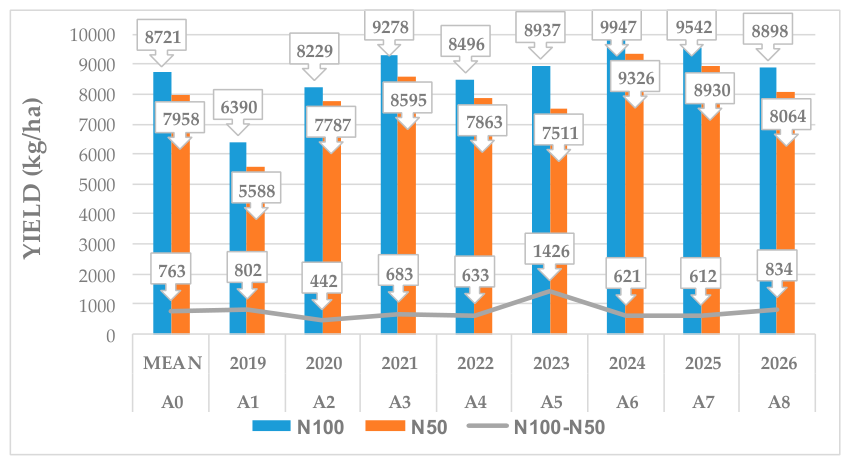
Figure 2.
Response to nitrogen fertilization at the booting stage of studied winter wheat varieties. LSD 5% - 415; LSD 1% - 558; LSD 0.1% - 740 kg ha-1.
Figure 2.
Response to nitrogen fertilization at the booting stage of studied winter wheat varieties. LSD 5% - 415; LSD 1% - 558; LSD 0.1% - 740 kg ha-1.
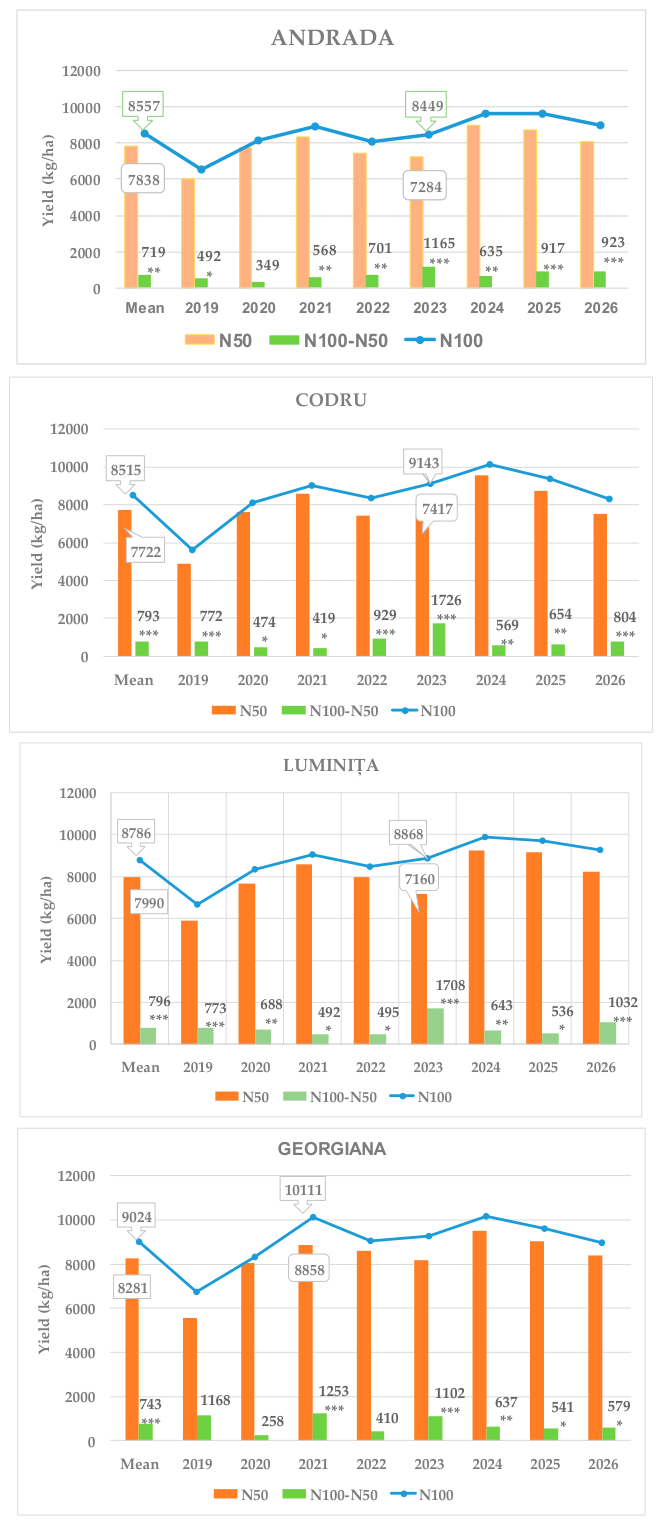
Figure 3.
Protein content of studied varieties depend on nitrogen fertilization. LSD 5% - 0.46; LSD 1% - 0.62; LSD – 0.1% - 0.82.
Figure 3.
Protein content of studied varieties depend on nitrogen fertilization. LSD 5% - 0.46; LSD 1% - 0.62; LSD – 0.1% - 0.82.
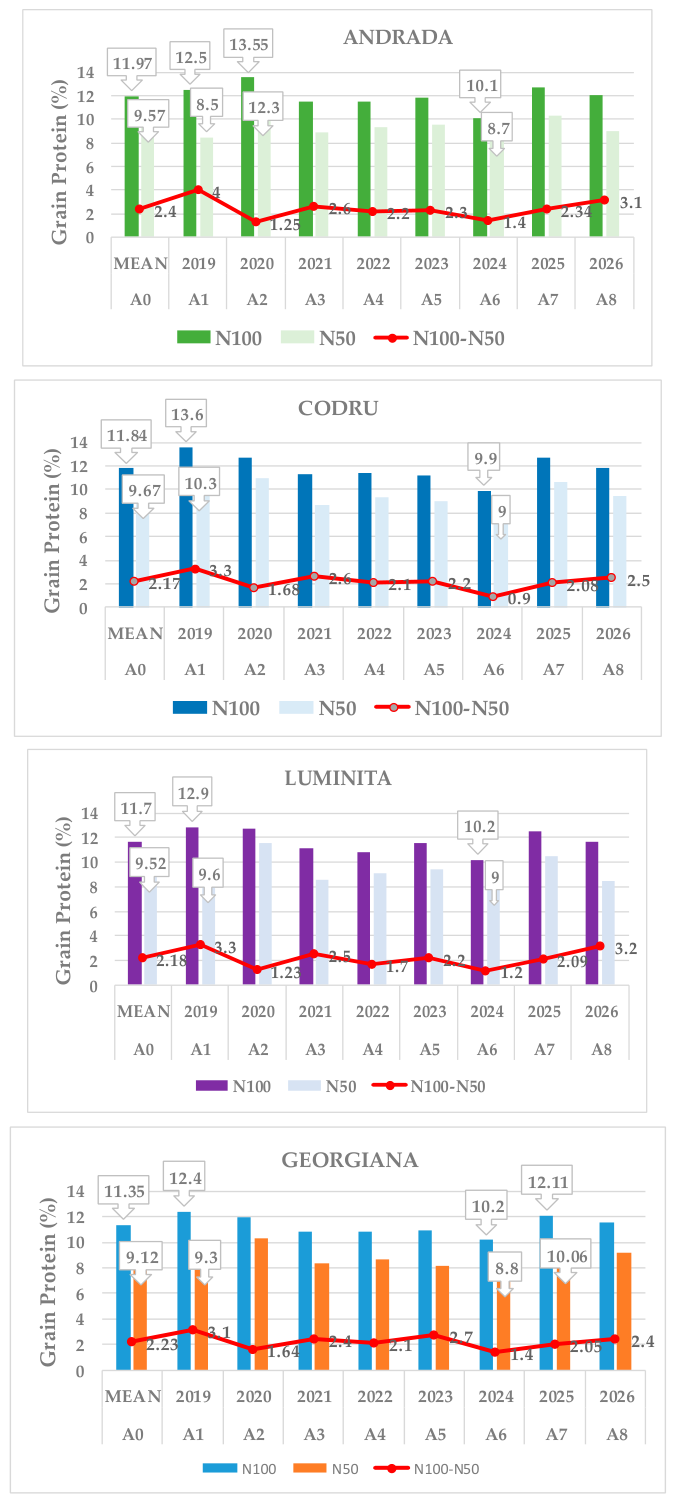
Table 1.
The sum of temperatures ˃00C, monthly and during the entire vegetation period of winter wheat at ARDS Turda.
Table 1.
The sum of temperatures ˃00C, monthly and during the entire vegetation period of winter wheat at ARDS Turda.
| Season crop | The Normal |
2018/ 2019 |
2019/ 2020 |
2020/ 2021 |
2021/ 2022 |
2022/ 2023 |
2023/ 2024 |
2024/ 2025 |
2025/ 2026 |
|---|---|---|---|---|---|---|---|---|---|
| October | 303 | 394 | 419 | 372 | 301 | 384 | 434 | 361 | 305 |
| November | 120 | 179 | 267 | 96 | 132 | 162 | 156 | 91 | 191 |
| December | 0 | 14 | 36 | 84 | 31 | 50 | 38 | 53 | 71 |
| January | 0 | 24 | 0 | 25 | 42 | 87 | 44 | 59 | 18 |
| February | 0 | 58 | 75 | 81 | 61 | 58 | 199 | 29 | 84 |
| March | 136 | 225 | 189 | 102 | 112 | 195 | 272 | 257 | 247 |
| April | 300 | 340 | 309 | 234 | 264 | 264 | 400 | 349 | 301 |
| May | 465 | 421 | 425 | 423 | 505 | 477 | 489 | 402 | 496 |
| June | 540 | 654 | 573 | 594 | 633 | 570 | 652 | 655 | 626 |
| 10 of July | 198 | 212 | 209 | 216 | 230 | 213 | ⁕ | 230 | 198 |
|
Sum of Period Vegetation |
2062 | 2521 | 2502 | 2227 | 2311 | 2460 | 2684 | 2486 | 2537 |
⁕ the growing season ended on June 30.
Table 2.
Monthly distribution of precipitation (mm) during the growing season of winter wheat at ARDS Turda.
Table 2.
Monthly distribution of precipitation (mm) during the growing season of winter wheat at ARDS Turda.
| Season crop | The Normal |
2018/ 2019 |
2019/ 2020 |
2020/ 2021 |
2021/ 2022 |
2022/ 2023 |
2023/ 2024 |
2024/ 2025 |
2025/ 2026 |
|---|---|---|---|---|---|---|---|---|---|
| October | 35.4 | 26.8 | 25.6 | 53.6 | 11.6 | 16.3 | 19.8 | 14.4 | 56.4 |
| November | 28.2 | 29.6 | 28.4 | 17.1 | 20.5 | 43.0 | 43.6 | 19.2 | 52.0 |
| December | 27.6 | 58.3 | 14.2 | 22.5 | 47.9 | 23.6 | 17.8 | 18.5 | 1.6 |
| January | 21.7 | 46.0 | 10.4 | 27.0 | 10.9 | 42.7 | 4.8 | 5.1 | 59.9 |
| February | 19.2 | 14.7 | 37.4 | 16.4 | 5.4 | 27.1 | 9.2 | 3.8 | 22.4 |
| March | 24.3 | 12.3 | 34.0 | 27.3 | 8.3 | 10.8 | 37.7 | 44.8 | 30.7 |
| April | 45.6 | 62.6 | 17.8 | 38.4 | 42.5 | 30.5 | 38.8 | 31.3 | 26.4 |
| May | 69.4 | 152.4 | 44.4 | 80.8 | 82.9 | 33.2 | 60.7 | 98.6 | 68.3 |
| June | 84.6 | 68.8 | 166.6 | 45.0 | 41.8 | 144.5 | 36.2 | 22.4 | 119.0 |
| 10 of July | 26 | 7.6 | 23.0 | 56.7 | 23.1 | 12.4 | ⁕ | 45.2 | 28.6 |
|
Sum of Period Vegetation |
382 | 479.1 | 401.8 | 384.8 | 294.9 | 384.1 | 268.6 | 303.3 | 465.3 |
⁕ the growing season ended on June 30.
Table 3.
ANOVA for yields (q/ha) and effect of factors
| Analysis of Variance | Effect of Factors | |||||
|---|---|---|---|---|---|---|
| Source of Variance | df | MS | F Test |
P- Value | Variable | Yield Kg ha-1 |
| Year (Y) | 7 | 2942.329 | 267.872 | 0.001 | 2018/2019 | 5989 g |
| Fertilization (F) | 1 | 2793.571 | 477.980 | 0.001 | 2019/2020 | 8008 f |
| Genotype (G) | 3 | 270.895 | 49.339 | 0.001 | 2020/2021 | 8937 c |
| Y x F | 7 | 51.585 | 8.826 | 0.1 | 2021/2022 | 8180 ef |
| Y x G | 21 | 48.508 | 8.835 | 0.1 | 2022/2023 | 8224 e |
| F x G | 3 | 1.729 | 0.315 | ns | 2023/2024 | 9636 a |
| Y x F x G | 21 | 10.431 | 1.900 | ns | 2024/2025 | 9261 b |
| Error Y | 14 | 10.894 | 2025/2026 | 8481 d | ||
| Error F | 16 | 5.845 | N50 | 7958 b | ||
| Error G | 96 | 5.490 | N100 | 8721 a | ||
Table 4.
ANOVA for grain protein content (%) and effect of factors.
| Analysis of Variance | Effect of Factors | |||||
|---|---|---|---|---|---|---|
| Source of Variance | df | MS | F | P- Value | Variable | Protein (%) |
| Year (Y) | 7 | 17.624 | 214.353 | 0.001 | 2019 | 11.14 c |
| Fertilization (F) | 1 | 241.383 | 3251.221 | 0.0001 | 2020 | 12.01 a |
| Genotype (G) | 3 | 2.940 | 37.021 | 0.01 | 2021 | 9.91 f |
| Y x F | 7 | 3.019 | 40.657 | 0.1 | 2022 | 10.11 e |
| Y x G | 21 | 0.834 | 10.503 | 0.1 | 2023 | 10.20 e |
| F x G | 3 | 0.137 | 1.725 | ns | 2024 | 9.49 g |
| Y x F x G | 21 | 0.103 | 1.293 | ns | 2025 | 11.45 b |
| Error Y | 14 | 0.082 | 2026 | 10.43 d | ||
| Error F | 16 | 0.074 | N50 | 9.47 b | ||
| Error G | 96 | 0.079 | N100 | 11.71 a | ||
Table 6.
Efficiency of nitrogen application at the booting stage for the Codru variety
|
Crop season |
Grain Nitrogen N100 (%) |
Grain Nitrogen N50 (%) |
Nitrogen uptake N100 Kg ha-1 |
Nitrogen uptake N50 Kg ha-1 |
N100-N50 Nitrogen uptake Kg ha-1 |
Nitrogen Recovery Efficiency NRE (%) |
|---|---|---|---|---|---|---|
| 2018/2019 | 2.176 | 1.648 | 124.45 | 80.49 | 43.96 | 87.92 |
| 2019/2020 | 2.029 | 1.760 | 164.74 | 134.57 | 30.17 | 60.34 |
| 2020/2021 | 1.808 | 1.392 | 165.43 | 107.43 | 58.00 | 116.00 |
| 2021/2022 | 1.824 | 1.488 | 162.41 | 114.47 | 47.94 | 95.88 |
| 2022/2023 | 1.792 | 1.440 | 163.27 | 107.70 | 55.57 | 111.14 |
| 2023/2024 | 1.584 | 1.440 | 160.63 | 137.56 | 23.07 | 46.14 |
| 2024/2025 | 2.038 | 1.704 | 191.94 | 149.12 | 42.82 | 85.64 |
| 2025/2026 | 1.904 | 1.504 | 163.59 | 114.27 | 49.32 | 98.64 |
| Average | 1.894 | 1.547 | 162.06 | 118.20 | 43.86 | 87.71 |
| Minim | 1.584 | 1.392 | 124.45 | 80.49 | 23.07 | 46.14 |
| Maxim | 2.176 | 1.760 | 191.94 | 149.12 | 58.00 | 116.00 |
| Amplitude | 0.592 | 0.368 | 67.49 | 68.63 | 34.93 | 69.86 |
| Standard deviation | 0.1842 | 0.1376 | 18.251 | 21.635 | 11.98 | 23.96 |
|
Coefficient of Variability (%) |
9.72 | 8.89 | 11.26 | 13.34 | 27.31 | 27.31 |
Table 7.
Efficiency of nitrogen application at the booting stage for the Luminița variety
|
Crop season |
Grain Nitrogen N100 (%) |
Grain Nitrogen N50 (%) |
Nitrogen uptake N100 Kg ha-1 |
Nitrogen uptake N50 Kg ha-1 |
N100-N50 Nitrogen uptake Kg ha-1 |
Nitrogen Recovery Efficiency NRE (%) |
|---|---|---|---|---|---|---|
| 2018/2019 | 2.064 | 1.536 | 136.86 | 91.25 | 45.61 | 91.22 |
| 2019/2020 | 2.040 | 1.843 | 170.28 | 141.17 | 29.11 | 58.22 |
| 2020/2021 | 1.776 | 1.376 | 165.33 | 111.29 | 54.04 | 108.08 |
| 2021/2022 | 1.728 | 1.456 | 152.32 | 112.23 | 40.09 | 80.18 |
| 2022/2023 | 1.856 | 1.504 | 164.24 | 107.07 | 57.17 | 114.34 |
| 2023/2024 | 1.632 | 1.440 | 162.51 | 133.47 | 29.04 | 58.08 |
| 2024/2025 | 2.010 | 1.675 | 194.44 | 153.92 | 40.52 | 81.04 |
| 2025/2026 | 1.872 | 1.360 | 173.68 | 113.57 | 60.11 | 120.22 |
| Average | 1.872 | 1.524 | 164.96 | 120.50 | 44.46 | 88.92 |
| Minim | 1.632 | 1.360 | 136.86 | 91.25 | 29.04 | 58.08 |
| Maxim | 2.064 | 1.843 | 194.44 | 153.92 | 60.11 | 120.22 |
| Amplitude | 0.432 | 0.483 | 57.58 | 62.67 | 31.07 | 62.14 |
| Standard deviation | 0.1567 | 0.1628 | 16.602 | 20.527 | 11.998 | 23.995 |
|
Coefficient of Variability (%) |
8.37 | 10.68 | 10.06 | 17.03 | 26.98 | 26.98 |
Table 8.
Efficiency of nitrogen application at the booting stage for the Georgiana variety.
|
Crop season |
Grain Nitrogen N100 (%) |
Grain Nitrogen N50 (%) |
Nitrogen uptake N100 Kg ha-1 |
Nitrogen uptake N50 Kg ha-1 |
N100-N50 Nitrogen uptake Kg ha-1 |
Nitrogen Recovery Efficiency NRE (%) |
|---|---|---|---|---|---|---|
| 2018/2019 | 1.984 | 1.488 | 133.56 | 82.80 | 50.76 | 101.52 |
| 2019/2020 | 1.915 | 1.652 | 159.16 | 133.04 | 26.12 | 52.23 |
| 2020/2021 | 1.728 | 1.344 | 171.55 | 102.05 | 69.50 | 139.00 |
| 2021/2022 | 1.728 | 1.392 | 162.09 | 110.90 | 51.19 | 102.38 |
| 2022/2023 | 1.744 | 1.312 | 162.38 | 107.40 | 54.98 | 109.96 |
| 2023/2024 | 1.632 | 1.408 | 164.90 | 134.76 | 30.14 | 60.28 |
| 2024/2025 | 1.938 | 1.610 | 186.53 | 138.36 | 48.17 | 93.34 |
| 2025/2026 | 1.856 | 1.472 | 166.00 | 123.02 | 42.98 | 85.96 |
| Average | 1.816 | 1.460 | 163.27 | 116.54 | 46.73 | 93.08 |
| Minim | 1.632 | 1.312 | 133.56 | 82.80 | 26.12 | 52.23 |
| Maxim | 1.984 | 1.652 | 186.53 | 138.36 | 69.50 | 139.00 |
| Amplitude | 0.352 | 0.340 | 52.97 | 55.56 | 43.38 | 86.47 |
| Standard deviation | 0.1248 | 0.1213 | 14.743 | 19.220 | 13.830 | 27.637 |
|
Coefficient of Variability (%) |
6.87 | 8.30 | 9.02 | 16.49 | 29.59 | 29.69 |
Disclaimer/Publisher’s Note: The statements, opinions and data contained in all publications are solely those of the individual author(s) and contributor(s) and not of MDPI and/or the editor(s). MDPI and/or the editor(s) disclaim responsibility for any injury to people or property resulting from any ideas, methods, instructions or products referred to in the content. |
© 2026 by the authors. Licensee MDPI, Basel, Switzerland. This article is an open access article distributed under the terms and conditions of the Creative Commons Attribution (CC BY) license.
Copyright: This open access article is published under a Creative Commons CC BY 4.0 license, which permit the free download, distribution, and reuse, provided that the author and preprint are cited in any reuse.