

Submitted:
02 September 2026
Posted:
04 September 2026
You are already at the latest version
Abstract
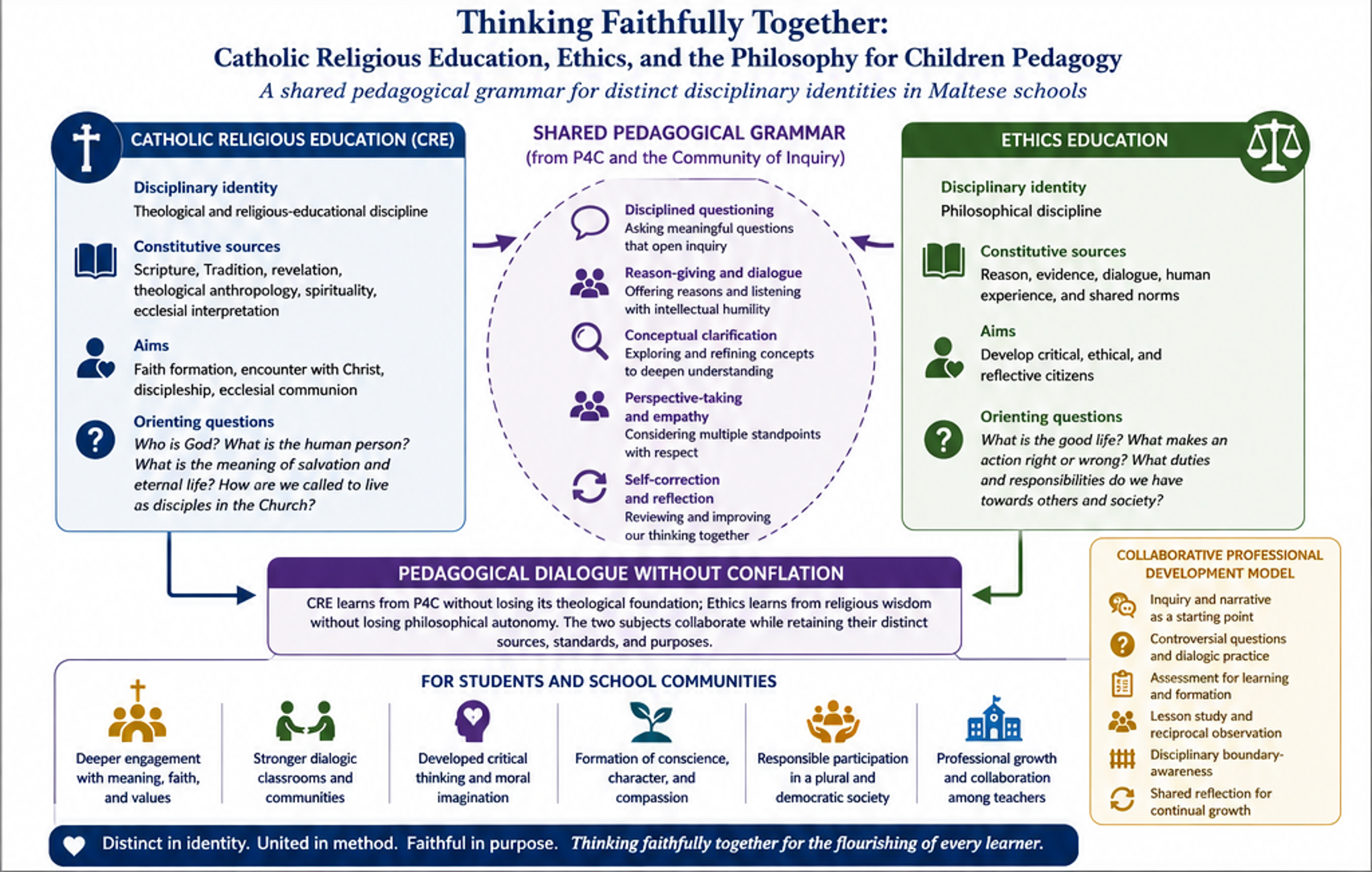
This conceptual article examines whether Catholic Religious Education (CRE) and Ethics in Maltese schools can enter a constructive pedagogical dialogue while retaining their distinct disciplinary identities. Rather than proposing a merger, hierarchy, or shared epistemology, it develops the more limited claim that a critically appropriated Philosophy for Children (P4C) pedagogy and its Community of Inquiry (CoI) may provide a shared pedagogical grammar. The Maltese case is significant because Ethics is institutionally associated with P4C, while recent CRE scholarship calls for more student-centred, constructivist, and existentially responsive approaches. The article therefore treats this proximity as a problem of disciplined borrowing: which dialogical practices can travel across subject boundaries, and what must remain discipline-specific? Drawing on Matthew Lipman and engaging in greater depth with John Dewey, Paulo Freire, Hannah Arendt, and Thomas Merton, it identifies complementary but non-identical resources for experience-based inquiry, dialogical agency, judgment in plurality, and contemplative attention. Their tensions are treated as analytically productive rather than harmonised. Recent empirical and theoretical literature is used to qualify the scope of the proposal. The article then develops implications for classroom practice, assessment, collaborative professional development, and a future empirical research agenda. Its contribution is a framework for pedagogical dialogue that seeks to make CRE more dialogical without treating theological sources as interchangeable with philosophical warrants, and Ethics more open to religiously situated moral worlds without compromising philosophical autonomy.
Keywords:
Catholic Religious Education (CRE)
; Ethics education
; Philosophy for Children (P4C)
; Community of Inquiry
; Malta
; dialogic pedagogy
; theological education
; teacher professional development
1. Introduction: From Curricular Proximity to Pedagogical Dialogue
In Malta, Catholic Religious Education (CRE) and Ethics occupy a distinctive curricular relationship. Both address questions of meaning, value, identity, responsibility, dignity, relationships, community, and the good life, yet they approach these questions from different disciplinary locations. The National Curriculum Framework (NCF) established Ethics as an educational entitlement for learners who do not follow CRE, thereby placing the two subjects in a relationship of curricular proximity that can easily be interpreted socially as rivalry or substitution. Maltese research has consequently asked explicitly whether Ethics and CRE should be understood as competing or complementary subjects.1
This article argues for a different imagination: distinction without antagonism and collaboration without conflation. CRE is a theological and religious-educational discipline; Ethics is a philosophical discipline concerned with moral inquiry, concepts, reasons, and judgment. Their overlap is therefore neither surprising nor evidence that one is redundant. The same human problem can be investigated through more than one disciplined mode of inquiry. What matters is that the distinctive questions, sources, methods, and standards of each subject remain intelligible.
The particular opportunity explored here is pedagogical. In Malta, Ethics teacher education, Philosophy for Children (P4C) and the Community of Inquiry (CoI) are explicitly presented as central to the teaching of the subject. The University of Malta describes P4C as a means of developing reflective and collaborative inquiry in which moral questions are investigated through thinking together, reason-giving, and a search for deeper understanding, meaning, truth, and values. This institutional commitment remains visible in current teacher preparation and recent public professional activity around P4C and ethical imagination in Malta.
At the same time, recent Maltese scholarship in CRE has argued that religious education must move beyond inherited content-centred and predominantly doctrinal models towards approaches that are more student-centred, constructivist, anthropological, and responsive to learners’ existential questions. The convergence is striking. Ethics possesses a developed inquiry pedagogy; CRE is seeking pedagogical forms capable of preserving substantive religious knowledge while involving students more actively in interpretation and appropriation. The central question is therefore not whether CRE should become more like Ethics, but whether CRE can learn from a pedagogy strongly developed within Ethics while remaining unmistakably theological in its content, sources, and purpose.2
2. Conceptual Approach and Scope
This article is best read as a conceptual and pedagogical argument rather than as an empirical evaluation of P4C in Maltese CRE. It brings three bodies of material into conversation: the disciplinary self-understanding of Catholic religious education, the Maltese institutional association between Ethics and P4C, and philosophical accounts of inquiry, dialogue, judgment, and contemplation. The aim is not to derive a single method deductively from Dewey, Freire, Arendt, Merton, or Lipman. Their projects differ in philosophical anthropology, political orientation, accounts of truth, and educational purpose. The argument instead asks what each makes newly visible in the proposed CRE-Ethics dialogue, where each creates tension with Catholic theological commitments, and how those tensions can discipline rather than weaken pedagogical borrowing.
The organising distinction between pedagogical grammar and epistemology is therefore heuristic. ‘Grammar’ names recurring practices through which classroom inquiry is made intelligible - asking questions, giving reasons, testing concepts, listening across perspectives, revising judgments, and attending reflectively to experience. It does not imply that these practices are philosophically neutral. P4C itself carries normative assumptions about reasonableness, participation, and the goods of inquiry. The distinction is useful only if those assumptions remain visible and if CRE and Ethics retain the right to specify different constitutive sources, warrants, and ends. The proposal is consequently one of bounded translation rather than methodological transfer without remainder.
3. Catholic Education, CRE, and Catechesis
The argument requires a precise distinction between Catholic education and CRE. Catholic education names a broad educational vision concerned with the integral formation of the person, the relationship between faith and culture, the communal life of the school, and an anthropology oriented towards truth, freedom, communion, and vocation. CRE, by contrast, is a curricular subject. Recent Maltese scholarship makes this distinction explicitly: Catholic education concerns the wider ethos and educational activity of Catholic schools, whereas CRE refers to religious education as an academic subject taught within the curriculum.3
This distinction is important in Malta because CRE cannot be adequately described as the curricular expression of a Catholic-school ethos. It is taught as a subject within a wider national educational landscape and must satisfy educational criteria proper to a school discipline. It therefore requires disciplinary knowledge, age-appropriate pedagogy, transparent learning outcomes, intellectual integrity, and forms of assessment appropriate to what can legitimately be assessed in a classroom.
CRE must also be distinguished from catechesis. The distinction is not an argument for theological thinness. Rather, it clarifies the educational setting. Catechesis belongs to the Church’s ministry of initiation and maturation in faith; school-based CRE engages religion within the educational institution and therefore addresses learners whose relationships to Catholic faith may differ substantially. The Catholic educational tradition itself has long insisted that religious instruction possesses a distinctive relationship to the wider school curriculum while remaining connected to the Church’s educational mission.
Once CRE is treated as a genuine discipline, dialogue with Ethics becomes less threatening. CRE does not need to claim every moral question as exclusively religious, and Ethics need not define itself as the secular replacement of religion. A question such as forgiveness can be philosophically examined through responsibility, resentment, punishment, justice, and moral obligation. CRE can investigate those same concepts while also engaging biblical narratives, the person and teaching of Jesus, sin, grace, sacramental reconciliation, ecclesial practice, and Christian accounts of mercy. Overlap in subject matter therefore coexists with difference in disciplinary horizon.
4. The Maltese Context: Why Dialogue Matters
The Maltese context gives this discussion unusual urgency. Ethics was introduced in response to an increasingly plural educational environment and the need to provide a curricular alternative for students not following CRE. Research on Ethics education in Malta has described P4C as integral to the subject’s pedagogical identity, with the classroom conceived as a CoI in which students investigate values, assumptions, justice, truth, and related concepts through dialogue and argument. More recent Maltese work shows that questions of cultural diversification, recognition, and students’ attitudes towards Ethics remain live educational concerns.4
The institutional separation of the subjects can nevertheless create an unintended symbolic binary: CRE or Ethics. Such a binary risks being pedagogically misleading. Administrative alternatives do not entail that the subjects must cultivate mutually suspicious professional cultures. On the contrary, the subjects confront many of the same classroom realities: plural convictions, contested moral issues, rapidly changing technologies, fragile attention, social-media discourse, and students who expect to ask why rather than merely receive conclusions.
The opportunity for collaboration is reinforced by current teacher formation. University of Malta study units continue to identify P4C, CoI, critical and reflective thinking, narrative, and collaborative discussion as central methodologies in Ethics education. This makes Maltese Ethics not merely a neighbouring subject but a local reservoir of pedagogical expertise from which CRE teachers can learn without importing an unfamiliar method from an entirely external context.5
The case for dialogue should therefore be framed professionally rather than competitively. CRE teachers bring expertise in Scripture, theology, religious language, spirituality, hermeneutics, ecclesial tradition, and the interpretation of lived experience in the light of faith. Ethics teachers bring expertise in philosophical questioning, moral argumentation, conceptual analysis, and a classroom methodology explicitly organised around inquiry. The educational question is how these strengths can encounter one another while disciplinary ownership remains clear.
5. P4C and the Community of Inquiry as a Pedagogical Resource
Matthew Lipman’s P4C project emerged from dissatisfaction with forms of schooling that postponed disciplined thinking until too late in a learner’s education. Its Community of Inquiry transformed the classroom from a place where individual students simply answer the teacher’s questions into a setting in which learners jointly formulate and investigate questions, give reasons, seek examples and counterexamples, make distinctions, and revise judgments. Recent theoretical work continues to examine rather than merely assume P4C’s foundations, including questions about the relation between critical thinking, judgment, and the normative commitments embedded in communities of inquiry.6
Recent research also strengthens the empirical basis for taking P4C seriously while warning against inflated claims. A 2022 systematic review identified recurring evidence concerning higher-order thinking, safe dialogical environments, democratic discussion, and cultures of thinking, while also documenting implementation challenges. A 2024 review-based causal analysis drew on eighty-three P4C studies and emphasised that outcomes depend on interacting variables rather than on a simple method-effect relationship. These findings support a cautious claim: P4C is a substantial pedagogical tradition with evidence of educational value, but its effectiveness depends on teacher expertise, context, design, and the quality of inquiry.7
For CRE, this caution is an advantage. The case is not that P4C is a pedagogical technology that automatically produces faith, virtue, or theological understanding. It is that the practices cultivated by P4C answer several identifiable weaknesses in transmissive religious education. Students can memorise theological vocabulary without learning to use it intelligently. They can reproduce a definition of conscience without deliberating conscientiously, identify a parable without wrestling with its disturbance of ordinary assumptions, or state a Church teaching without understanding its conceptual and theological grammar. P4C can create the conditions in which knowledge is interrogated, connected, clarified, and appropriated.
Recent research in Religious and Moral Education gives direct support to this possibility. Cameron and Cassidy’s study of collaborative, child-led philosophical inquiry found that children could discuss religious and theological ideas philosophically and construct meaning together; the authors argue that explicitly dialogical philosophical inquiry can open opportunities often missed in ordinary enactments of Religious and Moral Education. This does not establish that the same results will follow in Maltese CRE, but it demonstrates that philosophical inquiry and serious engagement with religious concepts are educationally compatible.8
7. Philosophical Resources in Productive Tension
7.1. Dewey: Experience, Inquiry, and Theological Limits
John Dewey remains indispensable to the genealogy of P4C because he understood reflection as an active, persistent, and careful consideration of beliefs in light of their grounds and consequences. His educational importance lies in the connection between inquiry and experience: learners do not become reflective by receiving conclusions but by encountering problems that interrupt habitual response and demand investigation.11
Dewey’s deeper contribution is not simply that lessons should begin from experience. In How We Think and Experience and Education, experience is educative when it is reconstructed through inquiry and when present activity opens, rather than closes, possibilities for further growth. This matters for CRE because an appeal to ‘student experience’ can otherwise become pedagogically thin: immediacy may be mistaken for authority, and relevance for truth. A Deweyan reading instead requires teachers to transform perplexity into a problem that can be investigated, to connect present experience with inherited meanings, and to ask what consequences follow from competing interpretations. The point of contact with CRE is thus the disciplined reconstruction of experience; the point of tension is Dewey’s pragmatist account of warrant. Catholic theology cannot allow the meaning of revelation to be exhausted by what proves workable within present experience. The proposed model therefore adopts Dewey’s inquiry movement while resisting any inference that experience is self-validating or the final horizon of theological judgment.
Contemporary scholarship continues to find Dewey useful precisely because his account of reflection is relational and contextual rather than merely procedural. Holdo’s recent reconstruction of Deweyan critical reflection emphasises the relationship among practical engagement, social conditions, objects of knowledge, and democratic inquiry. This contemporary reading validates a central Deweyan insight while correcting simplistic versions of “learning by doing”: experience becomes educative through disciplined interpretation.12
CRE can gain substantially from this. Religious education often begins too far from the learner’s actual questions. A Deweyan sensibility asks where perplexity already exists: suffering, identity, scientific explanation, injustice, belonging, death, forgiveness, vocation, or the credibility of religious belief. Yet Catholic CRE cannot make experience the final criterion of theological truth. Experience is a starting point and a site of interpretation; it must also be challenged and enlarged by sources that the learner did not generate. Dewey therefore contributes the movement of inquiry, while theology supplies a thicker account of truth, revelation, and the good than Dewey’s pragmatism alone can provide.
7.2. Freire: Dialogue, Agency, Power, and Ideological Risk
Paulo Freire’s critique of “banking education” remains compelling wherever students are positioned as passive containers for conclusions. For CRE, Freire raises an uncomfortable but productive question: does the classroom form students capable of mature theological and moral agency, or does it reward the reproduction of language whose meaning has never been personally or intellectually appropriated?13
Freire adds a second layer by making dialogue inseparable from questions of agency, authority, and power. His opposition to ‘banking’ education is not adequately captured by replacing lecture with discussion. Dialogical education requires learners to become subjects of inquiry who can name their world and interrogate the social relations within which knowledge is transmitted. For CRE this creates a double demand. It invites scrutiny of pedagogies in which ecclesial language is repeated without understanding, and it also requires honest examination of occasions when religious authority has been communicated coercively or shielded from legitimate questioning. Yet Freire’s language of conscientization cannot simply be imported as a theological norm. If the teacher already knows which political consciousness counts as liberated, dialogue can become strategically managed rather than genuinely open. The value of Freire for this article therefore lies in a criterion of dialogical integrity: authority should be made discussable and reasons should be answerable, while neither teacher nor tradition is disguised as neutral.
Recent scholarship continues to renew Freire rather than treating him as a historical slogan. Studies of Freirean dialogical practice in teacher development show how dialogue can support teacher agency and reflective professional learning, while contemporary work on digital culture argues that Freire’s account of critical and dialogical communication remains pertinent in environments saturated by information.14
CRE should nevertheless appropriate Freire cautiously. Dialogue cannot mean that every theological claim is generated from the classroom’s existing experience, nor should “liberation” be reduced to a predetermined political script. A pedagogy that claims to liberate can itself become ideological if the teacher’s preferred conclusions are concealed within apparently open dialogue. Recent critical readings of Freire continue to expose tensions between emancipatory theory and pedagogical method. For CRE, Freire is most useful when dialogue includes both critique and receptivity: students learn to question power, including religious misuse of power, but also to encounter traditions as possible sources of wisdom rather than only objects of suspicion.15
7.3. Arendt: World, Plurality, Conscience, and Judgment
Hannah Arendt contributes a different warning: the moral danger of thoughtlessness. Her analysis of Eichmann and later account of the life of the mind distinguish thinking from mere cognition or technical problem-solving. Thinking interrupts cliché and creates an interior space in which one asks what one is doing and whether one can live with oneself as the author of one’s actions.16
Arendt complicates both Deweyan continuity and Freirean emancipation by insisting that education also concerns responsibility for a world that precedes the learner. Her account of plurality means that judgment is neither solitary preference nor mechanical rule-application: one learns to consider how a matter appears from standpoints other than one’s own without dissolving responsibility into consensus. Her reflections on education also warn against asking the classroom to function simply as a miniature political arena. Applied to CRE, this introduces an important limit to an overly celebratory account of student voice. Learners need space to question and judge, but they also encounter a religious and cultural inheritance they did not create. The teacher’s authority can therefore be understood less as possession of unquestionable answers than as responsibility for introducing a world of meanings faithfully enough that students can judge it rather than a caricature of it. Arendt’s contribution is especially significant to the article’s account of conscience: perspective-taking enlarges judgment, but judgment remains answerable for the world and for one’s actions.
Arendt’s educational significance has received renewed attention. Rodowick develops an Arendtian account of humanistic education centred on judgment, self-reflection, and the willingness to make one’s judgments answerable to the perspectives of others. Kloeg’s recent work likewise demonstrates the continuing vitality and complexity of Arendt’s philosophy of education, especially her concern with the relation among child, world, private life, and public responsibility.17
For CRE, Arendt can sharpen the formation of conscience. Students should not be trained merely to comply with moral propositions; they must learn to judge particulars, consider perspectives, recognise the temptation of conformity, and take responsibility for action. Yet Catholic moral theology cannot equate conscience with private self-consistency. Conscience requires formation in truth and the good. Arendt therefore helps CRE resist unreflective obedience, while theological ethics prevents interior judgment from becoming self-authorisation.
P4C provides a classroom form for this enlarged judgment. The Community of Inquiry asks students to make reasons public, hear alternatives, and allow their judgments to be tested by others. Recent discussions of Arendt’s thinking emphasise precisely the non-instrumental, meaning-making dimension of thought that contemporary performance cultures easily marginalise. This makes Arendt particularly relevant to CRE classrooms pressured by examination cultures: not everything educationally important can be reduced to efficient answer production.18
7.4. Merton: Contemplative Attention and the Limits of Verbalism
Thomas Merton introduces a dimension easily lost in accounts of dialogic pedagogy: silence and contemplative attention. In New Seeds of Contemplation, Merton’s concern with the false self, interior freedom, and attentiveness to reality challenges educational cultures of constant performance and reaction. His later social writings also refuse any separation of contemplation from responsibility for the world.19
Merton’s role in the framework is deliberately different from that of the three philosophers above. He does not supply a theory of democratic inquiry; he exposes a possible pathology of inquiry when speech, performance, and reaction become ends in themselves. His distinction between the false self and a more receptive mode of attention challenges classrooms in which students learn to display opinions rapidly without dwelling with a text, another person, or their own motives. Contemplation, on this reading, is epistemically and ethically relevant because it interrupts compulsive self-assertion. In CRE, however, contemplative practice cannot be treated as a generic wellbeing technique. Silence may be pedagogically useful to any learner, whereas prayer carries explicitly religious meaning and must be handled with sensitivity to institutional context and students’ positions. Merton therefore contributes a grammar of receptivity that both complements and limits P4C’s verbal dialogism: responsible inquiry includes not only speaking and revising reasons but also learning when to attend before responding.
Contemporary contemplative-pedagogy research does not simply verify Merton’s theology, but it does lend current educational support to the broader claim that reflective silence, attention, and contemplative practices can contribute to self-awareness, concentration, reflective learning, and engagement when used appropriately. Merton therefore adds an important corrective to a P4C model that might otherwise become incessant verbal exchange.20
A P4C-informed CRE lesson need not treat silence as the absence of inquiry. A biblical text may be followed by a period of attention before questions are formulated; a discussion of vocation may include reflective writing; an inquiry into forgiveness may end with an examination of one’s own assumptions and desires. In a religious-education setting, contemplative practices can also open towards prayer where this is appropriate to the educational and institutional context. Merton’s contribution is to remind CRE that intellectual seriousness and spiritual receptivity need not be rivals.
Taken together, these thinkers do not form a seamless philosophical foundation. Dewey foregrounds the reconstruction of experience; Freire politicises dialogue by exposing relations of power; Arendt resists reducing education to either adaptation or emancipation by stressing world, plurality, and judgment; Merton questions the assumption that more speech necessarily means deeper inquiry; and Lipman translates philosophical inquiry into a repeatable classroom architecture. Their disagreements are central to the proposal. Dewey prevents inherited content from becoming inert, Freire prevents dialogue from masking domination, Arendt prevents student agency from becoming educational presentism, Merton prevents inquiry from becoming performative talk, and Lipman prevents the framework from remaining at the level of aspiration. The theoretical contribution of ‘shared pedagogical grammar’ lies precisely in holding these pressures together while allowing CRE’s theological sources and Ethics’ philosophical standards to remain non-interchangeable.
8. Implications for CRE Practice
The first major gain is the quality of questioning. Recent religious-education research demonstrates that teacher questions shape the epistemic possibilities available to students, including whether religion and other domains such as science are presented as artificially siloed or as capable of more nuanced encounter. P4C trains teachers to distinguish questions that merely test recall from questions that open conceptual inquiry.21
Second, P4C can strengthen religious literacy. Theological language requires conceptual work. “Image of God,” “grace,” “conscience,” “freedom,” “hope,” “sin,” “mercy,” and “vocation” are not vocabulary items exhausted by definitions. Students need to explore distinctions and implications. Is hope the same as optimism? Can forgiveness coexist with justice? Is freedom simply choice? What is meant by calling a human being a person? Philosophical questioning can make theological language more precise rather than less theological.
Third, P4C can renew the use of Scripture and narrative. A parable is not pedagogically powerful merely because the teacher explains its moral. It can function as an intellectual disturbance. The Good Samaritan invites questions about neighbour, identity, risk, obligation, prejudice, and the limits of responsibility. The workers in the vineyard provoke questions about equality, generosity, entitlement, and grace. Philosophical inquiry does not replace exegesis; it creates the need for exegesis by allowing students to discover that their first readings are insufficient.
Recent P4C work continues to emphasise narrative, wisdom, and intellectual virtue rather than reducing philosophy with children to generic critical-thinking exercises. This is especially congenial to CRE, whose subject matter is saturated with narrative, symbol, testimony, tradition, and questions of ultimate meaning.22
Fourth, P4C can help CRE engage pluralism without surrendering identity. Students need not personally assent to a Catholic claim in order to understand it accurately, reason about its implications, or compare it intelligently with another worldview. Conversely, Catholic students should be helped to move beyond “because the Church says so” towards an increasingly mature articulation of theological reasons, sources, and meanings. The Community of Inquiry can cultivate the virtues required for such engagement: attentive listening, conceptual charity, reason-giving, humility, and willingness to revise.
Fifth, P4C can deepen assessment. If CRE aims at interpretation, theological reasoning, application, and worldview formation, assessment cannot consist only of factual recall. Dialogue transcripts, reflective journals, source-based theological position papers, portfolios, and concept maps can make development visible. The crucial distinction is between assessing religious understanding and assessing religious conformity. A school subject may assess whether a student represents Catholic teaching accurately and reasons intelligently with its sources; it should not grade personal faith as though assent were a curricular attainment.
9. Reciprocal Learning: What Ethics May Gain from CRE
Although the emphasis here is deliberately on what CRE can gain, healthy dialogue must be reciprocal. Ethics can benefit from CRE’s long engagement with narrative, tradition, symbol, ritual, community, transcendence, virtue, conscience, and ultimate questions. Moral reasoning is not performed by abstract minds without histories or communities. Religious traditions preserve vocabularies and narratives through which persons have interpreted suffering, forgiveness, sacrifice, hope, mortality, and responsibility.
This does not mean that Ethics should become theological. Its philosophical integrity requires that religious premises not simply be imposed as shared premises in a secular ethical argument. Rather, dialogue with CRE can deepen Ethics students’ understanding of the moral worlds inhabited by religious persons and show how ethical disagreement may rest on anthropological, metaphysical, or theological differences deeper than disagreement about a single rule.
Recent scholarship on P4C in ethics supports contextual adaptation rather than one-size-fits-all application. Grad’s 2024 discussion of the Community of Inquiry in ethics emphasises both its dialogical opportunities and the need to attend to challenges and context. Comparative work in moral and civic education likewise suggests that P4C is most defensible when pedagogical principles, curriculum aims, and local conditions are examined together. The same principle should govern CRE-Ethics collaboration in Malta.23
10. A P4C-Informed CRE Lesson Architecture
A P4C-informed CRE lesson can be organised through a sequence that preserves both student agency and theological depth. It begins with a stimulus: a biblical narrative, theological image, testimony, artwork, contemporary case, short film, or passage from Christian tradition. Students first notice what is puzzling, significant, or contested. They formulate questions, compare them, and select or refine one with conceptual and existential depth.
The inquiry then develops through disciplined facilitation. The teacher asks students to define terms, give reasons, produce examples and counterexamples, expose assumptions, identify implications, and consider alternative perspectives. The teacher’s role is not neutral disappearance. P4C scholarship increasingly recognises that communities of inquiry involve substantive judgments about questions, reasons, norms, and facilitation. In CRE, subject expertise is indispensable because theological misconceptions cannot be left unaddressed in the name of student-centredness.24
At the appropriate moment, the teacher introduces disciplinary resources. A question about dignity may require Genesis and the imago Dei; forgiveness may require Gospel narratives and theological accounts of grace; conscience may require Catholic moral distinctions; suffering may require biblical, Christological, and eschatological perspectives. The source is not used to close the discussion but to alter its intellectual landscape. Students then ask what the source clarifies, challenges, or leaves unresolved.
A contemplative or reflective phase can follow: silence, journaling, examination of one’s initial position, or prayer where appropriate. Finally, students articulate a considered response and identify how their thinking changed. The sequence is therefore not “experience instead of content,” but experience-question-inquiry-source-interpretation-reflection-response. It is compatible with the student-centred direction proposed in recent Maltese CRE scholarship while retaining disciplinary content as indispensable.25
11. Collaborative Professional Development Across Disciplinary Boundaries
A plausible institutional implication is shared professional development. CRE and Ethics teachers need not begin by attempting curricular integration. They can begin with a common pedagogical problem: how to facilitate rigorous inquiry among students who bring different assumptions, experiences, and levels of confidence to difficult questions.
Joint professional development could include six strands: constructing philosophically and theologically fertile questions; facilitating CoI; using narrative and cases; handling controversial issues; assessing inquiry and reasoning; and recognising disciplinary boundaries. Teachers could take a common stimulus—for example, artificial intelligence, assisted dying, environmental responsibility, forgiveness after violence, or distributive justice—and separately design an Ethics inquiry and a CRE inquiry. Comparing the two would make both overlap and difference visible.
Recent research on dialogic pedagogy indicates that professional learning is not a matter of simply transmitting an ideal method to teachers. Teachers reinterpret dialogic ideals through the realities, constraints, and knowledge already present in their contexts; productive tensions can contribute to conceptual change. This supports a professional-development model in which Maltese CRE and Ethics teachers inquire into their own practice rather than merely attend technique-focused workshops.26
Lesson Study appears especially promising as a practice-based option. Recent Freirean work has used Lesson Study as a dialogic professional-development intervention in which teachers plan, observe, discuss, and revise practice collaboratively. A Maltese CRE-Ethics version could pair teachers to design parallel inquiries, observe classroom dialogue, analyse student questions and reasoning, and refine the pedagogical moves that either deepen or prematurely close inquiry.
Religious-education professional learning can also benefit from fellowship and knowledge-exchange models that combine subject knowledge with close-to-practice curriculum development. Recent work on inter-religious dialogue in RE shows how teacher fellowship can strengthen specialist knowledge and pedagogical development through collaborative inquiry. For Malta, a professional learning community linking CRE and Ethics specialists could similarly protect subject knowledge while developing a shared language of inquiry.27
Such collaboration would be particularly valuable for CRE teachers formed primarily within transmissive pedagogies. Facilitating inquiry requires professional habits different from lecturing: tolerating productive uncertainty, distinguishing genuine from rhetorical questions, resisting premature answers, recognising conceptual confusion, and knowing when disciplinary knowledge must be introduced. Ethics teachers with P4C formation possess expertise in these areas; CRE teachers possess theological and hermeneutical expertise that can prevent philosophical inquiry from becoming religiously superficial.
Professional development should itself use CoI. Teachers should experience the pedagogy as learners, analyse transcripts or recordings of classroom dialogue, conduct peer observation, and develop shared rubrics for questioning, reasoning, perspective-taking, and dialogical participation. Discipline-specific criteria would then be added: theological accuracy and source-use in CRE; philosophical argumentation and ethical-theory competence in Ethics. Collaboration would thereby strengthen rather than blur disciplinary identity.
12. Discussion: Research Agenda, Limits, and Theoretical Contribution
Malta offers an unusually valuable setting for research because CRE and Ethics coexist institutionally while Ethics has an explicit P4C orientation and CRE is undergoing a documented pedagogical transition. The next stage should therefore be empirical rather than merely programmatic. Studies could examine how CRE teachers understand P4C before and after professional development, how students experience inquiry-based CRE, and whether sustained P4C-informed practice affects theological vocabulary, question quality, reasoning, source interpretation, engagement, and the ability to relate faith to lived experience.
Comparative classroom research could investigate how the same stimulus is treated in CRE and Ethics. Discourse analysis could identify when the two subjects ask similar questions, when disciplinary resources produce different lines of inquiry, and how teachers manage moments when open dialogue encounters authoritative religious sources. Such research would directly test the article’s claim that a shared pedagogical grammar can coexist with distinct epistemologies.
Methodological restraint is particularly important. Increased participation does not prove theological depth; positive student attitudes do not demonstrate improved religious understanding; and improved reasoning does not by itself establish spiritual formation. The 2024 causal review of P4C is especially useful here because it cautions against treating P4C as a simple independent variable with uniform outcomes. Research should therefore combine observation, student work, interviews, discourse analysis, and disciplinary assessments, preferably longitudinally.
The same caution applies to claims about the older philosophical sources. Dewey, Freire, Arendt, Merton, and Lipman are not “validated” in the sense that contemporary studies prove their philosophies true. Rather, recent scholarship demonstrates the continuing explanatory and pedagogical fertility of themes they foregrounded: inquiry grounded in experience, dialogue and agency, judgment and plurality, contemplative attention, and collaborative philosophical reasoning. Their differences should remain visible because those differences help prevent the proposed pedagogy from hardening into an ideology.
The framework also has limits. The distinction between pedagogical grammar and epistemology can clarify disciplinary boundaries, but it cannot settle in advance every classroom dispute about authority, neutrality, or legitimate teacher direction. Nor does conceptual compatibility establish effectiveness. The model should therefore be treated as a set of design hypotheses: that inquiry can be opened without evacuating content, that authoritative sources can be interpreted without being used to terminate questioning, and that professional collaboration can sharpen rather than blur subject identities. These propositions require empirical testing in Maltese classrooms and may need revision across school sectors, age groups, and levels of religious affiliation.
13. Conclusions
The relationship between CRE and Ethics in Malta need not be narrated as a competition for curricular legitimacy. Their difference is educationally valuable. Ethics brings philosophical traditions, moral concepts, argumentation, and a P4C pedagogy explicitly developed through the Community of Inquiry. CRE brings Scripture, Tradition, theology, religious language, spirituality, Christian anthropology, and the interpretation of human experience in the light of faith. A healthy dialogue begins when neither subject needs to become the other.
CRE may nevertheless have especially much to gain from the encounter. P4C can help it become more student-centred without becoming student-defined; more dialogical without becoming relativistic; more questioning without becoming theologically empty; and more intellectually rigorous without reducing faith to philosophy. It can help students move from knowing religious answers to understanding religious claims, from repeating theological language to reasoning with it, and from encountering Catholic tradition as information to encountering it as an intellectually and existentially demanding tradition.
The older thinkers considered in this article remain valuable when read through contemporary scholarship and in mutual correction. Dewey keeps inquiry connected to lived problems; Freire keeps dialogue attentive to agency and power; Arendt protects the moral seriousness of thinking and judgment; Merton protects interiority and contemplative attention; Lipman gives collaborative inquiry a classroom architecture. Recent research on P4C, dialogic pedagogy, Religious and Moral Education, and teacher learning confirms the continuing relevance of these concerns while also exposing their limits and the need for contextual adaptation.
The most realistic next step is therefore professional rather than structural: CRE and Ethics teachers learning together. Joint formation in P4C, questioning, narrative, facilitation, controversial issues, assessment, and Lesson Study could strengthen both subjects while making their differences more intelligible. The deepest educational promise is captured in the title of this article. To think faithfully together is neither to suspend faith for the sake of inquiry nor to suspend inquiry for the sake of faith. It is to create classrooms in which disciplined questioning can become a form of intellectual responsibility and, within CRE, a genuine expression of faith seeking understanding.
Author Contributions
The sole author conceived the study, developed the conceptual framework, conducted the literature-based analysis, and wrote and revised the manuscript.
Funding
This research received no external funding.
Institutional Review Board Statement
Not applicable. This conceptual article does not report research involving human participants or animals.
Informed Consent Statement
Not applicable.
Data Availability Statement
No new data were created or analysed in this study. Data sharing is not applicable to this article.
Conflicts of Interest
The author declares no conflict of interest.
Declaration of Generative AI and AI-Assisted Technologies in the Writing Process
During revision, generative AI was used to assist with language refinement, structural reorganisation, and development of the revised infographic. The author reviewed, verified, and edited the resulting material and takes full responsibility for the content of the manuscript.
References
- Abarejo, Cathlyne. ‘Educating Children for Wisdom’: Reflecting on the Philosophy for Children Community of Inquiry Approach through Plato’s Allegory of the Cave. Childhood & Philosophy 2024, 20, 1–28. [Google Scholar] [CrossRef]
- Ab Wahab; Kaziman, Mohd; Zulkifli, Hafizhah; Abdul Razak, Khadijah. Impact of Philosophy for Children and Its Challenges: A Systematic Review. Children 2022, 9(no. 11), 1671. [Google Scholar] [CrossRef] [PubMed]
- Arendt, Hannah. Eichmann in Jerusalem: A Report on the Banality of Evil; Viking Press: New York, 1963. [Google Scholar]
- Arendt, Hannah. The Life of the Mind; Harcourt Brace Jovanovich: New York, 1978. [Google Scholar]
- Barak, Matan. Educational Ideals and Classroom Realities: Developing Teachers’ Concepts of Dialogic Pedagogy in Real-World Contexts. Teaching and Teacher Education 2024, 138, 104401. [Google Scholar] [CrossRef]
- Brinkmann, Svend. Thinking and the Moral Landscape. Theory & Psychology 2022, 32(no. 2), 217–34. [Google Scholar] [CrossRef]
- Cameron, Ewan; Cassidy, Claire. Collaborative, Child-Led Philosophical Inquiry in Religious and Moral Education. British Journal of Religious Education 2022, 44(no. 2), 172–87. [Google Scholar] [CrossRef]
- Cassar Darmanin, Melanie. Ethics and Catholic Religious Education: Competing or Complimentary Subjects? Master’s diss., University of Malta, 2022. [Google Scholar]
- Castro, Paula; Iannone, Leila Rentroia. Freirean Dialogic Action in Brazilian Public Schools: A Lesson Study Contribution to Teacher Development. Compare: A Journal of Comparative and International Education 2024, 54(no. 1), 112–21. [Google Scholar] [CrossRef]
- Chircop Psaila, Jacqueline. Secondary School Students’ Attitudes towards Ethics Education. Master’s diss., University of Malta, 2024. [Google Scholar]
- Congregation for Catholic Education. The Catholic School. Congregation for Catholic Education; Vatican City, 1977. [Google Scholar]
- Congregation for Catholic Education. The Religious Dimension of Education in a Catholic School: Guidelines for Reflection and Renewal; Congregation for Catholic Education.: Vatican City, 1988. [Google Scholar]
- Dewey, John. Experience and Education; Macmillan: New York, 1938. [Google Scholar]
- Dewey, John. How We Think: A Restatement of the Relation of Reflective Thinking to the Educative Process; D. C. Heath: Boston, 1933. [Google Scholar]
- Figueiredo, Florian Franken. On the Theoretical Foundations of the ‘Philosophy for Children’ Programme. Journal of Philosophy of Education 2022, 56(no. 2), 210–26. [Google Scholar] [CrossRef]
- Freire, Paulo. Pedagogy of the Oppressed; Ramos, Myra Bergman, Translator; Continuum: New York, 1970. [Google Scholar]
- Grad, Iulia. Opportunities and Challenges in Using the ‘Community of Inquiry’ Model in Teaching Ethics. Revista Românească pentru Educaţie Multidimensională 2024, 16(no. 1), 184–94. [Google Scholar] [CrossRef]
- Hand, Michael. Moral Education in the Community of Inquiry. Journal of Philosophy in Schools 2020, 7(no. 2), 4–20. [Google Scholar] [CrossRef]
- Holdo, Markus. Critical Reflection: John Dewey’s Relational View of Transformative Learning. Journal of Transformative Education 2023, 21(no. 1), 9–25. [Google Scholar] [CrossRef]
- John Paul II. Fides et Ratio. Encyclical Letter; Libreria Editrice Vaticana: Vatican City, 1998.
- Jon, Ho Sum. Is the Implementation of Philosophy for Children in Primary School Beneficial to the Moral and Civic Education in Hong Kong? Cogent Education 2024, 11(no. 1), 2313367. [Google Scholar] [CrossRef]
- Kloeg, Julien. Where Is Education? Arendt’s Educational Philosophy in between Private and Public. Journal of Philosophy of Education 2022, 56(no. 2), 196–209. [Google Scholar] [CrossRef]
- Lipman, Matthew. Thinking in Education, 2nd ed.; Cambridge University Press: Cambridge, 2003. [Google Scholar]
- Lipman, Matthew; Sharp, Ann Margaret; Oscanyan, Frederick S. Philosophy in the Classroom, 2nd ed.; Temple University Press: Philadelphia, 1980. [Google Scholar]
- Merton, Thomas. Conjectures of a Guilty Bystander; Doubleday: New York, 1968. [Google Scholar]
- Merton, Thomas. New Seeds of Contemplation; New Directions: New York, 1961. [Google Scholar]
- Mikkola; Eelis Akseli, Jaakko; Perälä, Mika; Hotulainen, Risto; Salmenkivi, Eero; Kallioniemi, Arto. Causal Variables in the Community of Inquiry: Creating a Directed Acyclic Graph of the Effectiveness of the Philosophy for Children Program. International Journal of Educational Research 2024, 127, 102414. [Google Scholar] [CrossRef]
- Ministry for Education and Employment. A National Curriculum Framework for All; Ministry for Education and Employment: Malta, 2012. [Google Scholar]
- Pucci, Bruno; et al. Educating with Paulo Freire: Teaching and Learning on the Digital Culture. Educational Philosophy and Theory 2024, 56(no. 10). [Google Scholar] [CrossRef]
- Rodowick, D. N. An Education in Judgment: Hannah Arendt and the Humanities; University of Chicago Press: Chicago, 2021. [Google Scholar]
- Second Vatican Council. Gravissimum Educationis: Declaration on Christian Education; Vatican City, 1965. [Google Scholar]
- Sultana, Carl-Mario. Religious Education in Transition: From Content-Centred to Student-Centred. Religions 2022, 13(no. 10), 986. [Google Scholar] [CrossRef]
- Svensson, Fredrik. The (Im)possibility of Education: Theory and Method in Paulo Freire’s Pedagogy of the Oppressed and Gayatri Spivak’s Righting Wrongs. Dialogic Pedagogy 2024, 12(no. 1), A1–A15. [Google Scholar] [CrossRef]
- University of Malta. “EDE5018: Teaching Ethics through Philosophy for Children.” Study-unit description. Accessed. (accessed on 18 August 2026).
- University of Malta. “EDE5024: Philosophy for Children and Ethical Living: Comprehensive Tools for Teaching and Learning Ethics in Schools.” Study-unit description. Accessed. (accessed on 18 August 2026).
- University of Malta. Malta Advances Ethics Education with a Spotlight on Philosophy for Children. Newspoint 2025. [Google Scholar]
- Zammit, Lucianne. Shaping the Identity of the New Maltese through Ethics Education in Maltese Schools. Education Sciences 2019, 9(no. 4), 253. [Google Scholar] [CrossRef]
| 1 | Melanie Cassar Darmanin, “Ethics and Catholic Religious Education: Competing or
Complimentary Subjects?” (master’s diss., University of Malta, 2022); Ministry
for Education and Employment, A National Curriculum Framework for All (Malta:
Ministry for Education and Employment, 2012), esp. the sections on Religious
and Ethics Education. |
| 2 | Carl-Mario Sultana, “Religious Education in Transition: From Content-Centred to
Student-Centred,” Religions 13, no. 10 (2022): 986,
https://doi.org/10.3390/rel13100986. |
| 3 | Sultana, “Religious Education in Transition.” |
| 4 | Jacqueline Chircop Psaila, “Secondary School Students’ Attitudes towards Ethics
Education” (master’s diss., University of Malta, 2024); Lucianne Zammit,
“Shaping the Identity of the New Maltese through Ethics Education in Maltese
Schools,” Education Sciences 9, no. 4 (2019): 253,
https://doi.org/10.3390/educsci9040253. |
| 5 | University of Malta, “EDE5024: Philosophy for Children and Ethical Living:
Comprehensive Tools for Teaching and Learning Ethics in Schools,” study-unit
description, accessed August 18, 2026. |
| 6 | Florian Franken Figueiredo, “On the Theoretical
Foundations of the ‘Philosophy for Children’ Programme,” Journal of Philosophy
of Education 56, no. 2 (2022): 210-26, https://doi.org/10.1111/1467-9752.12625; Matthew Lipman, Thinking in Education, 2nd ed.
(Cambridge: Cambridge University Press, 2003), 83-110. |
| 7 | Eelis J. A. Mikkola et al., “Causal Variables in the Community of Inquiry:
Creating a Directed Acyclic Graph of the Effectiveness of the Philosophy for
Children Program,” International Journal of Educational Research 127 (2024):
102414, https://doi.org/10.1016/j.ijer.2024.102414; Hafizhah Zulkifli and colleagues, “Impact of
Philosophy for Children and Its Challenges: A Systematic Review,” Children 9,
no. 11 (2022): 1671, https://doi.org/10.3390/children9111671. |
| 8 | Ewan Cameron and Claire Cassidy, “Collaborative, Child-Led Philosophical
Inquiry in Religious and Moral Education,” British Journal of Religious
Education 44, no. 2 (2022): 172-87,
https://doi.org/10.1080/01416200.2021.2009440. |
| 9 | John Paul II, Fides et Ratio (Vatican City, 1998), nos. 16-20, 31-35. |
| 10 | Michael Hand, “Moral Education in the Community of Inquiry,” Teaching
Philosophy, forthcoming/online record, accessed August 18, 2026; Figueiredo,
“Theoretical Foundations,” 210-26. |
| 11 | John Dewey, How We Think: A Restatement of the Relation of Reflective Thinking
to the Educative Process (Boston: D. C. Heath, 1933), 9. |
| 12 | Markus Holdo, “Critical Reflection: John Dewey’s Relational View of
Transformative Learning,” Journal of Transformative Education 21, no. 1 (2023):
9-25, https://doi.org/10.1177/15413446221086727. |
| 13 | Paulo Freire, Pedagogy of the Oppressed, trans. Myra Bergman Ramos (New York:
Continuum, 1970), 71-86. |
| 14 | Paula Castro and Leila Rentroia Iannone, “Freirean Dialogic Action in Brazilian
Public Schools: A Lesson Study Contribution to Teacher Development,” Compare
54, no. 1 (2024): 112-21, https://doi.org/10.1080/14767724.2023.2290141; Bruno
Pucci et al., “Educating with Paulo Freire: Teaching and Learning on the
Digital Culture,” Educational Philosophy and Theory 56, no. 10 (2024),
https://doi.org/10.1080/00131857.2024.2336025. |
| 15 | Fredrik Svensson, “The (Im)possibility of Education: Theory and Method in Paulo
Freire’s Pedagogy of the Oppressed and Gayatri Spivak’s Righting Wrongs,”
Dialogic Pedagogy 12, no. 1 (2024): A1-A15,
https://doi.org/10.5195/dpj.2024.578. |
| 16 | Hannah Arendt, Eichmann in Jerusalem: A Report on the Banality of Evil (New
York: Viking Press, 1963); Hannah Arendt, The Life of the Mind (New York:
Harcourt Brace Jovanovich, 1978). |
| 17 | Julien Kloeg, “Where Is Education? Arendt’s Educational Philosophy In between
Private and Public,” Journal of Philosophy of Education 56, no. 2 (2022):
196-209, https://doi.org/10.1111/1467-9752.12662; D. N. Rodowick, An Education in Judgment: Hannah
Arendt and the Humanities (Chicago: University of Chicago Press, 2021), 1-20. |
| 18 | Svend Brinkmann, “Thinking and the Moral Landscape,” Theory & Psychology
32, no. 2 (2022): 217-34, https://doi.org/10.1177/1354067X221097125. |
| 19 | Thomas Merton, Conjectures of a Guilty Bystander (New York: Doubleday, 1968),
78-86; Thomas Merton, New Seeds of Contemplation (New York: New Directions,
1961), 34-50. |
| 20 | See, for example, “Contemplative Pedagogy for Positive Engagement in Online
Teaching and Learning in Higher Education,” Teaching in Higher Education 29,
no. 1 (2024), https://doi.org/10.1080/13562517.2023.2280254. |
| 21 | “Teachers’ Use of Questions and the Science/Religion Encounter: Basil Bernstein
and the Impossibility of the Unthinkable,” Journal of Religious Education 72
(2024): 295-309, https://doi.org/10.1007/s40839-024-00245-0. |
| 22 | Cathlyne Abarejo, “‘Educating Children for Wisdom’: Reflecting on the
Philosophy for Children Community of Inquiry Approach through Plato’s Allegory
of the Cave,” Childhood & Philosophy 20 (2024): 1-28,
https://doi.org/10.12957/childphilo.2024.79414. |
| 23 | Ho Sum Jon, “Is the Implementation of Philosophy for Children in Primary School
Beneficial to the Moral and Civic Education in Hong Kong?” Cogent Education 11,
no. 1 (2024): 2313367, https://doi.org/10.1080/2331186X.2024.2313367; Iulia Grad, “Opportunities and Challenges in Using
the ‘Community of Inquiry’ Model in Teaching Ethics,” Revista Românească pentru
Educaţie Multidimensională 16, no. 1 (2024): 184-94,
https://doi.org/10.18662/rrem/16.1/818. |
| 24 | Figueiredo, “Theoretical Foundations,” 210-26. |
| 25 | Sultana, “Religious Education in Transition.” |
| 26 | Matan Barak, “Educational Ideals and Classroom Realities: Developing Teachers’
Concepts of Dialogic Pedagogy in Real-World Contexts,” Teaching and Teacher
Education 138 (2024): 104401, https://doi.org/10.1016/j.tate.2023.104401. |
| 27 | “Shared Space: Promoting Teachers’ Academic Understanding of Inter-Religious
Dialogue through a Teacher Fellowship Model for Religious Education,” Journal
of Religious Education 72 (2024): 35-49,
https://doi.org/10.1007/s40839-024-00226-3. |
Disclaimer/Publisher’s Note: The statements, opinions and data contained in all publications are solely those of the individual author(s) and contributor(s) and not of MDPI and/or the editor(s). MDPI and/or the editor(s) disclaim responsibility for any injury to people or property resulting from any ideas, methods, instructions or products referred to in the content. |
© 2026 by the authors. Licensee MDPI, Basel, Switzerland. This article is an open access article distributed under the terms and conditions of the Creative Commons Attribution (CC BY) license (http://creativecommons.org/licenses/by/4.0/).
Copyright: This open access article is published under a Creative Commons CC BY 4.0 license, which permit the free download, distribution, and reuse, provided that the author and preprint are cited in any reuse.