
Submitted:
02 September 2026
Posted:
04 September 2026
You are already at the latest version
Abstract
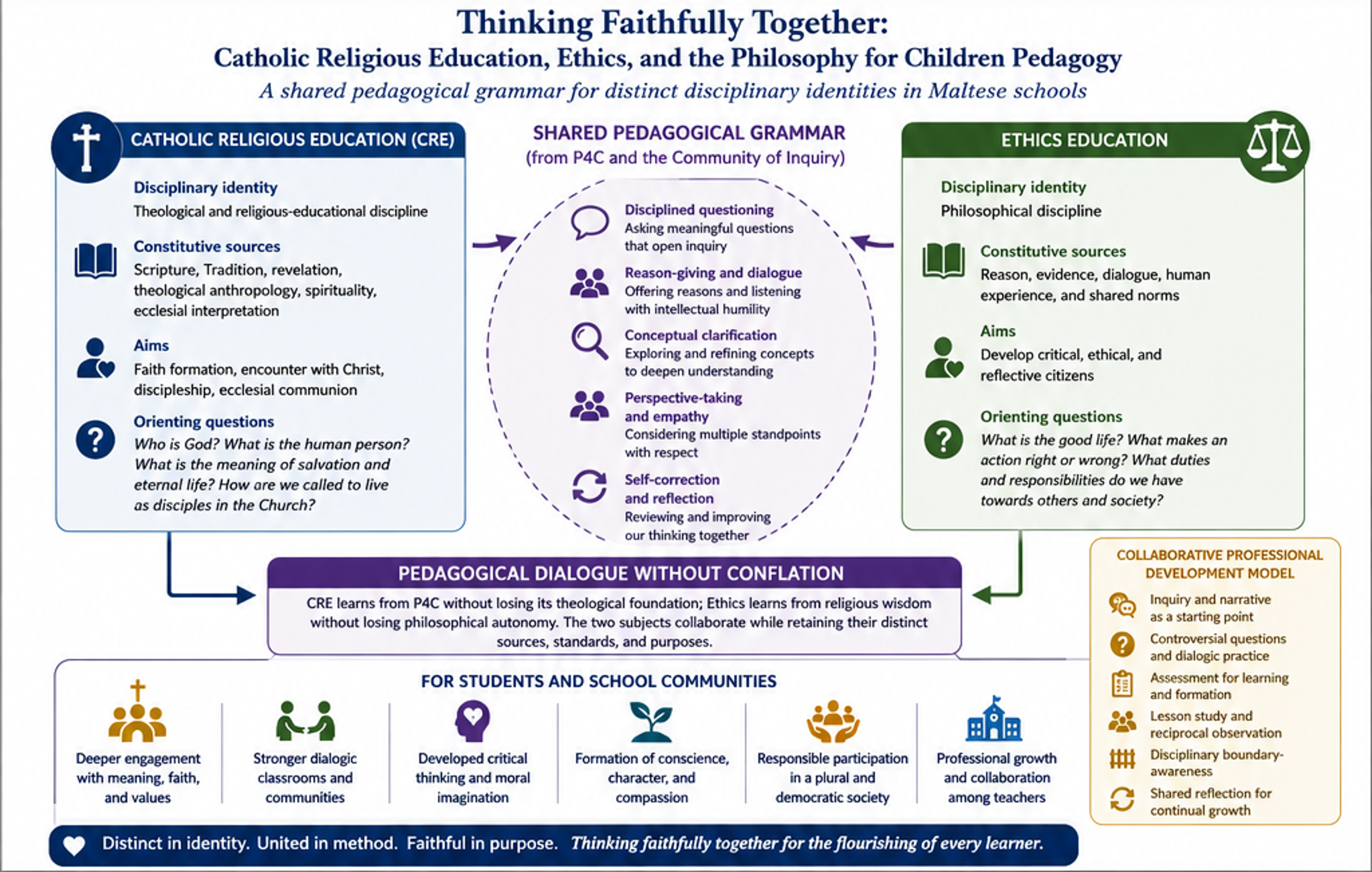
This conceptual article examines whether Catholic Religious Education (CRE) and Ethics in Maltese schools can enter a constructive pedagogical dialogue while retaining their distinct disciplinary identities. Rather than proposing a merger, hierarchy, or shared epistemology, it develops the more limited claim that a critically appropriated Philosophy for Children (P4C) pedagogy and its Community of Inquiry (CoI) may provide a shared pedagogical grammar. The Maltese case is significant because Ethics is institutionally associated with P4C, while recent CRE scholarship calls for more student-centred, constructivist, and existentially responsive approaches. The article therefore treats this proximity as a problem of disciplined borrowing: which dialogical practices can travel across subject boundaries, and what must remain discipline-specific? Drawing on Matthew Lipman and engaging in greater depth with John Dewey, Paulo Freire, Hannah Arendt, and Thomas Merton, it identifies complementary but non-identical resources for experience-based inquiry, dialogical agency, judgment in plurality, and contemplative attention. Their tensions are treated as analytically productive rather than harmonised. Recent empirical and theoretical literature is used to qualify the scope of the proposal. The article then develops implications for classroom practice, assessment, collaborative professional development, and a future empirical research agenda. Its contribution is a framework for pedagogical dialogue that seeks to make CRE more dialogical without treating theological sources as interchangeable with philosophical warrants, and Ethics more open to religiously situated moral worlds without compromising philosophical autonomy.
Keywords:
Catholic Religious Education (CRE)
; Ethics education
; Philosophy for Children (P4C)
; Community of Inquiry
; Malta
; dialogic pedagogy
; theological education
; teacher professional development
Copyright: This open access article is published under a Creative Commons CC BY 4.0 license, which permit the free download, distribution, and reuse, provided that the author and preprint are cited in any reuse.