

Submitted:
03 September 2026
Posted:
03 September 2026
You are already at the latest version
Abstract
Somatic genome editing is emerging as a potential strategy for achieving durable therapeutic effects in cardiovascular disease. This review examines current genome-editing platforms, therapeutic targets, delivery systems, and translational hurdles, contrasting liver-directed and myocardial applications.
CRISPR-Cas nucleases, base editors, and prime editors offer complementary capabilities, enabling durable gene disruption or precise nucleotide correction. However, key translational challenges include unintended alterations, immune responses, irreversibility, dose optimization, long-term surveillance, regulatory requirements, and equitable access. Clinical translation has advanced for liver-directed applications, with single-administration editing of hepatocyte targets including PCSK9, ANGPTL3, and TTR producing decreases in circulating proteins and atherogenic lipids in early-phase studies, although evidence of cardiovascular event reduction and lifelong safety remains unavailable. In contrast, direct myocardial editing remains predominantly preclinical, with studies targeting MYH7 and MYBPC3 pathogenic variants demonstrating proof of concept and disease rescue in selected models, while revealing challenges in cardiomyocyte delivery, spatial coverage, allele selectivity, and tissue-level safety.
Future progress will require integrating target biology, editor selection, organ-specific delivery, and rigorous molecular and clinical outcome assessment. Cardiovascular genome editing is therefore entering clinical translation in selected liver-directed applications, whereas direct myocardial editing remains at an earlier stage, with delivery, safety, and myocardial coverage as major barriers.
Keywords:
cardiovascular genome editing
; liver-directed genome editing
; CRISPR-Cas9
; base editing
; prime editing
; delivery
; cardiovascular disease
; translational medicine
; safety
1. Introduction
Cardiovascular diseases (CVDs) remain the leading cause of death and disability-adjusted life-year (DALY) burden worldwide, accounting for an estimated 19.2 million deaths and 437 million DALYs in 2023 [1]. Elevated low-density lipoprotein cholesterol (LDL-C) remains a major modifiable contributor to this burden, accounting for an estimated 3.6 million deaths and 90.7 million DALYs worldwide in 2023 [2]. Although age-standardized LDL-C-attributable mortality and DALY rates have declined substantially since 1990, the absolute burden attributable to elevated LDL-C has continued to increase, largely driven by population growth and aging [2]. These data underscore the persistent need for effective and durable strategies to reduce cardiovascular risk.
Most established strategies for preventing atherosclerotic cardiovascular disease (ASCVD) require sustained or repeated treatment to maintain their therapeutic effects [3]. The importance of sustained treatment and adherence is illustrated by the SECURE trial, in which a polypill combining aspirin, ramipril, and atorvastatin reduced major cardiovascular events after myocardial infarction compared with usual care [4]. Nevertheless, even intensive lipid lowering does not eliminate residual cardiovascular risk, as demonstrated in the FOURIER trial [5]. Long-acting RNA interference has reduced the frequency of treatment, with inclisiran producing approximately 50% reductions in LDL-C when administered every six months [6]. However, these approaches remain dependent on repeated administration to sustain their effects. This limitation has stimulated interest in single-administration interventions capable of producing durable biological effects after the therapeutic components themselves have been cleared [3].
Therapeutic genome editing offers a fundamentally different approach by permanently modifying an endogenous genomic locus rather than supplying an exogenous gene or transiently inhibiting its transcript [3]. Nuclease-based, base-editing, and prime-editing approaches enable targeted genomic modification through distinct molecular mechanisms [7,8,9,10]. Current clinical development focuses on somatic genome editing rather than intentional modification of the human germline [11]. The permanence of genomic modification is both its principal therapeutic advantage and a major challenge: unlike conventional pharmacological therapies, the effect cannot readily be titrated, withdrawn, or reversed if an unintended genomic alteration produces harm [3]. Accordingly, the therapeutic potential of cardiovascular genome editing depends not only on editing efficiency but also on target selection, tissue specificity, delivery, editing precision, and long-term safety.
The rationale for cardiovascular genome editing is particularly strong when the intended modification recapitulates the biological effects of naturally occurring protective genetic variants. Loss-of-function variants in PCSK9 are associated with lifelong reductions in LDL-C and substantially lower rates of coronary heart disease, providing strong human genetic validation for therapeutic inactivation of this target [12]. Similarly, heterozygous loss-of-function variants in ANGPTL3 are associated with lower LDL-C and triglyceride concentrations and a reduced risk of coronary artery disease [13]. These observations support a genotype-agnostic therapeutic strategy in which disruption of a validated target is intended to reproduce a naturally protective phenotype rather than correct an individual pathogenic variant [3]. A related principle applies to transthyretin amyloid cardiomyopathy (ATTR-CM), in which disruption of hepatic TTR aims to reduce production of the circulating precursor protein responsible for progressive myocardial amyloid deposition [14]. Together, these examples illustrate how human genetic evidence can identify targets for which permanent genomic modification may plausibly translate into durable clinical benefit.
This concept has translated most rapidly into clinical development for liver-directed applications. Early clinical studies of CRISPR-Cas9 editing of hepatic TTR and ANGPTL3, as well as adenine base editing of PCSK9, have demonstrated substantial reductions in circulating disease-related biomarkers following a single administration, with effects persisting during available follow-up [14,15,16]. These studies provide pharmacodynamic proof of concept that liver-directed genome editing can achieve durable modification of clinically validated cardiovascular targets in humans, although cardiovascular-outcome benefit and lifelong safety remain unresolved [3].
In contrast, direct myocardial genome editing remains predominantly preclinical and presents distinct biological and delivery challenges [3]. Experimental studies have demonstrated that AAV-mediated base editing can correct pathogenic variants associated with hypertrophic cardiomyopathy in cardiomyocytes and improve disease-related phenotypes in humanized models [17,18]. However, these studies also highlight the challenges of achieving efficient and selective editing across sufficient numbers of cardiomyocytes while limiting unintended editing and tissue-level toxicity [17]. Unlike the liver, where hepatocytes can be efficiently targeted and secreted proteins provide readily measurable pharmacodynamic readouts, the myocardium represents a substantially more complex target for permanent genome modification. This divergence between liver-directed and myocardial applications represents a central translational question for cardiovascular genome editing.
The 2026 American College of Cardiology scientific statement provided a broad overview of genome-editing platforms, cardiovascular targets, delivery systems, and clinical, regulatory, and ethical considerations [3]. Building on this foundation, the present review examines somatic cardiovascular genome editing through an organ-specific translational framework, focusing on the divergent trajectories of liver-directed and myocardial applications. We evaluate how target biology, editing mechanism, and delivery platform interact to determine clinical readiness and consider the safety, irreversibility, patient selection, regulatory, ethical, and access challenges that must be addressed for durable genomic modification to translate into meaningful cardiovascular benefit. Figure 1 summarizes the aspects described in this review.
2. The Gene-Editing Toolkit in Cardiology
The principal genome-editing platforms differ in the genomic outcomes they produce, the cellular repair processes they recruit, and the therapeutic objectives for which those outcomes are acceptable. In cardiovascular applications, this distinction is decisive. Gene disruption may be appropriate for a dispensable hepatic protein whose reduced expression is beneficial, whereas an inherited cardiomyopathy caused by a dominant-negative allele may require precise, allele-selective correction. Platform selection should therefore begin with the intended biological effect and then account for the sequence context, target cell, and tolerable spectrum of editing products [3]. Section 3 applies these mechanistic distinctions to hepatic and myocardial targets and reviews current clinical and preclinical evidence. Section 4 examines organ-specific delivery, and Section 5 addresses genomic, clinical, regulatory, and ethical risk.
2.1. CRISPR-Cas Nuclease Editing
CRISPR-Cas nuclease editing couples a programmable guide RNA to a Cas nuclease, most commonly Cas9. Guide-RNA hybridization to a complementary DNA sequence adjacent to a compatible protospacer-adjacent motif activates site-specific cleavage of both DNA strands [7]. Repair by non-homologous or microhomology-mediated end joining then generates a distribution of insertions and deletions. When these alterations shift the reading frame, disrupt a splice site, or introduce a premature termination signal, the net result can be durable loss of target-gene function [7].
This outcome is well aligned with cardiovascular targets for which reduced protein production is the therapeutic objective. The first clinical liver-directed programs targeting TTR and ANGPTL3, for example, use nuclease editing to convert transient exposure to editing machinery into sustained suppression of a circulating pathogenic or risk-associated protein [14,15]. In this setting, edited hepatocytes need not carry an identical sequence change, provided that the aggregate population of editing products reliably reduces functional protein expression. Homology-directed repair can, in principle, install a defined sequence in the presence of a donor template, but its dependence on repair pathways that are inefficient in nondividing cells limits its practicality in adult cardiomyocytes [3].
The double-strand break is also the principal mechanistic liability of nuclease editing. In addition to the intended small insertions and deletions, repair can produce larger deletions and complex local rearrangements [19]. Experimental systems have also demonstrated chromosome-scale damage, including chromothripsis, after a CRISPR-Cas9-induced break [20]. These observations do not establish that every detected structural alteration will cause clinical harm, but they show that on-target activity cannot be evaluated solely as the percentage of alleles carrying a desired small insertion or deletion. Nuclease editing is therefore best matched to a therapeutic objective that tolerates heterogeneous loss-of-function alleles; it is less well suited to precise correction of an essential sarcomeric gene when unintended allelic disruption could add a second pathogenic mechanism [17].
2.2. Base Editing
Base editors replace the nuclease-induced double-strand break with chemically directed nucleotide conversion. A catalytically impaired Cas protein exposes a short segment of single-stranded DNA within the RNA-DNA complex, and a tethered deaminase modifies a susceptible nucleotide within that editing window. A nick in the opposite DNA strand biases repair toward retention of the edited base [8,9]. Cytosine and adenine base editors consequently enable complementary transition mutations while avoiding a programmed double-strand break and donor DNA [8,9].
This mechanism supports two distinct cardiovascular strategies. A pathogenic transition mutation can be corrected when the causal nucleotide lies in an accessible editing window, as demonstrated in preclinical MYH7 models [17,18]. Alternatively, a transition can be introduced deliberately to disrupt a splice site or coding sequence, thereby inactivating a therapeutic target; the clinical PCSK9 program VERVE-102 uses this loss-of-function approach [16]. Base editing can thus provide a more uniform molecular product than end-joining-mediated nuclease disruption, but only when the desired nucleotide, strand orientation, protospacer-adjacent motif, and editing-window position are compatible with the selected editor [3]. Nearby susceptible nucleotides may undergo bystander conversion, and a treated cell population may still contain a mixture of intended edits, bystander edits, unedited alleles, and small insertions or deletions [17]. Avoidance of a programmed double-strand break does not make base editing risk-free. Deaminase activity can generate guide-independent DNA changes or transcriptome-wide RNA editing, depending on the editor architecture [21,22]. Protein engineering has reduced these activities, but the relevant product profile must be measured for each editor-guide combination rather than inferred from the platform name alone [21,22]. Base editing presently occupies an intermediate translational position in cardiology: it has produced dose-dependent pharmacodynamic effects in human liver-directed PCSK9 studies, whereas direct cardiomyocyte applications remain confined to preclinical models [16,17,18].
2.3. Prime Editing
Prime editing combines a Cas9 nickase with a reverse transcriptase and a prime-editing guide RNA (pegRNA). In addition to specifying the genomic target, the pegRNA contains a primer-binding sequence and a reverse-transcription template encoding the intended alteration. After one DNA strand is nicked, the reverse transcriptase copies the template into the target locus, and cellular processing resolves the edited and unedited DNA flaps [10]. Because the replacement sequence is templated rather than generated by a deaminase, prime editing can install all base substitutions as well as selected small insertions and deletions without a donor DNA molecule or programmed double-strand break [10].
This broader sequence scope is relevant to cardiomyopathies, in which many pathogenic variants are not compatible with cytosine or adenine base editing. However, sequence flexibility is accompanied by greater molecular complexity. Editing efficiency depends on pegRNA stability, primer-binding and reverse-transcription-template design, local DNA repair, and coordinated delivery of a comparatively large editor and guide system. Manipulating mismatch-repair determinants and stabilizing the pegRNA have substantially improved prime-editing efficiency in experimental systems [23,24]. Even so, performance remains highly locus- and cell-dependent.
Cardiovascular evidence is preclinical. Dual-adeno-associated-virus delivery achieved prime editing in mouse tissues, including editing efficiencies of up to 11% in the heart [25]. In a human induced-pluripotent-stem-cell-derived cardiomyocyte model, prime editing corrected 34.8% of homozygous RBM20 p.P633L alleles and restored RBM20 localization and splicing phenotypes [26]. These studies establish mechanistic feasibility but do not demonstrate efficient editing throughout the adult human myocardium. Prime editing is therefore most compelling when the causal variant cannot be addressed by a transition edit or when a precisely defined sequence outcome is essential; at present, its payload, efficiency, and delivery requirements place it behind nuclease and base editing in cardiovascular clinical development [3,25,26].
2.4. Selecting a Platform for the Therapeutic Objective
No platform is uniformly superior. Nuclease editing offers the most direct route to gene inactivation when heterogeneous loss-of-function alleles are acceptable [14,15,19,20]. Base editing is preferable when a compatible transition can create a defined therapeutic allele without a programmed double-strand break, provided that bystander and deaminase-associated products remain acceptable [8,9,16,17,18,21,22]. Prime editing offers the broadest sequence scope but currently carries the greatest payload and implementation burden [10,23,24,25,26]. The clinically relevant comparison is therefore not simply editing efficiency; it is the proportion of target cells that acquire an acceptable functional outcome, the distribution of unintended products, the durability of the phenotype, and the consequences of residual unedited or incorrectly edited cells [3]. These criteria become especially important when the therapeutic target shifts from a secreted hepatic protein to an essential component of the cardiac sarcomere. Table 1 summarizes the mechanistic suitability and cardiovascular maturity of genome-editing platforms [3,14,15,16,17,18,25,26].
3. Primary Therapeutic Targets and Clinical Progress
The cardiovascular field has advanced along two biologically distinct paths. Liver-directed programs modify hepatocytes to reduce a circulating protein that drives systemic lipid risk or cardiac amyloid deposition [14,15,16,27,28]. Direct myocardial programs instead seek to correct or silence a pathogenic allele within cardiomyocytes [17,18,26,31,32]. The first strategy can benefit from partial editing of a large secretory cell population and can be monitored through a circulating biomarker, whereas the second must contend with an essential, largely nonrenewing target tissue in which spatially heterogeneous editing may itself have functional consequences [3,14,15,16,17,18,31,32]. This organ-specific distinction, more than target prominence alone, explains the present gap between clinical and preclinical development.
3.1. Liver-Directed Clinical Translation
Human studies have so far concentrated on PCSK9, ANGPTL3, and TTR [14,15,16,27,28]. All three genes are expressed predominantly in hepatocytes, and each encodes a circulating protein whose concentration can be measured after treatment [12,13,14,15,16]. The resulting studies provide direct evidence of target engagement and durability, but their small, early-phase designs do not yet establish cardiovascular-event reduction or lifelong safety [14,15,16,27,28] (Table 2).
3.1.1. PCSK9: Reproducing a Naturally Protective Lipid Phenotype
PCSK9 has unusually strong therapeutic validation because naturally occurring loss-of-function variants link lifelong reduction in PCSK9 activity to both lower LDL-C and lower coronary disease risk [12]. In non-human primates, a single systemic administration of a PCSK9 base editor reduced circulating PCSK9 by approximately 90% and LDL-C by approximately 60%, with effects sustained for at least eight months [29]. That experiment established a preclinical bridge between protective human genetics and durable in vivo editing.
VERVE-102 and YOLT-101 now provide independent clinical evidence that adenine base editing can produce substantial, dose-related suppression of PCSK9 and LDL-C after a single administration [16,27]. Their convergent pharmacodynamic effects strengthen the conclusion that the target and editing strategy are technically tractable in human hepatocytes. They do not, however, establish that the observed LDL-C reductions translate into the event reduction expected from chronic pharmacologic lowering. The genetic evidence supports causality, and PCSK9 inhibition has already reduced cardiovascular events in randomized trials [5,12], but permanent editing introduces a distinct safety profile and cannot be assumed to reproduce the benefit-risk balance of a reversible drug. For that reason, early development is appropriately concentrated in patients with severe, inadequately controlled LDL-C-related risk rather than in lower-risk populations [3].
3.1.2. ANGPTL3: Simultaneous Reduction of Atherogenic Lipoproteins and Triglycerides
Loss-of-function variants in ANGPTL3 are associated with lower triglyceride and LDL-C concentrations and reduced coronary artery disease risk [13]. Because the intended therapeutic outcome is loss of protein function rather than correction of a specific pathogenic variant, nuclease-mediated disruption is a logical platform choice. CTX310 produced dose-dependent reductions in circulating ANGPTL3, LDL-C, and triglycerides in its first-in-human study, including marked lipid reductions at the highest tested dose [15].
The program broadens the potential role of editing beyond a single-lipid pathway, but its present evidence remains pharmacodynamic. The 15-participant trial was not designed to determine whether simultaneous reductions in LDL-C and triglycerides improve cardiovascular outcomes, whether the response remains stable over many years, or whether permanent ANGPTL3 deficiency produces consequences not captured during short follow-up [15]. CTX310 nevertheless demonstrates that nuclease-generated, heterogeneous loss-of-function alleles can yield a coherent systemic phenotype when the target is a secreted hepatic protein.
3.1.3. TTR: Reducing the Precursor of Cardiac Amyloid
Transthyretin editing differs from lipid-risk modification because the objective is to reduce production of a pathogenic precursor rather than recreate a population-level protective lipid phenotype. Nexiguran ziclumeran achieved rapid and sustained suppression of circulating transthyretin in patients with ATTR-CM [14]. ART001 subsequently demonstrated durable transthyretin reduction in a small hereditary ATTR cohort, providing additional evidence that the target class is editable in humans, although that study predominantly involved polyneuropathy and cannot be interpreted as evidence of cardiac efficacy [28].
Suppression of circulating transthyretin is a necessary pharmacodynamic step, but it does not directly measure clearance of established myocardial amyloid or recovery of cardiac function. The phase 1 nexiguran ziclumeran study was uncontrolled and was not powered for morbidity or mortality [14]. The ongoing phase 3 MAGNITUDE trial is evaluating whether one-time TTR editing improves clinical outcomes in ATTR-CM compared with placebo [30]. Until randomized outcome data are available, the most defensible conclusion is that TTR editing has achieved durable target knockdown in humans, not that it has been shown to reverse cardiomyopathy or prolong survival.
3.2. Direct Myocardial Editing
Direct myocardial editing poses a different therapeutic problem. Sarcomeric cardiomyopathies often result from variant-specific defects in essential contractile proteins, so simply disrupting the gene may exchange one pathogenic mechanism for another [17,18,31,32]. The editor must reach a sufficiently large and appropriately distributed cardiomyocyte population, distinguish the pathogenic allele when necessary, and avoid creating a contractile or electrophysiological mosaic with uncertain tissue-level behavior [3,17,18]. No peer-reviewed study has yet demonstrated direct in vivo genome editing of human cardiomyocytes in a clinical trial; current evidence is derived from patient-derived cellular systems and animal models [3,17,18,26,31,32].
3.2.1. MYH7: Allele-Specific Correction of a Dominant-Negative Variant
Two complementary studies have established proof of concept for correcting the hypertrophic cardiomyopathy-associated MYH7 p.R403Q variant. Reichart and colleagues used an adenine base editor in a humanized mouse model, whereas Chai and colleagues combined patient-derived cardiomyocytes with a separate humanized mouse model [17,18]. Together, the studies showed that precise correction can preserve or rescue cardiac structure and function while avoiding indiscriminate suppression of the normal MYH7 allele [17,18]. This is an important conceptual advantage for a dominant-negative disease in which the wild-type protein remains necessary.
The experiments also define the principal barriers to translation. The therapeutic design is variant-specific and therefore applies to a narrow molecular subgroup rather than to hypertrophic cardiomyopathy as a single disease. In the Reichart study, the large base-editor payload required dual-vector delivery, ventricular editing reached a plateau despite additional vector exposure, and the additional dose increased bystander editing [17]. A nuclease-based alternative produced dose-dependent toxicity, underscoring the risk of converting a precise correction problem into heterogeneous gene disruption [17]. Moreover, much of the animal evidence concerns prevention or early attenuation of disease. It is not yet known whether correcting an established mutation in an adult human heart would reverse mature hypertrophy, fibrosis, and arrhythmogenic substrate or not. That limitation is an inference from the developmental stage and design of the available models rather than a demonstrated failure of the approach [17,18].
3.2.2. MYBPC3: Restoring Function Across Distinct Variant Mechanisms
MYBPC3 provides a complementary model because many pathogenic variants reduce functional cardiac myosin-binding protein C rather than producing a dominant-negative protein. In a homozygous rat model, neonatal adeno-associated-virus delivery of CRISPR-Cas9 with a repair template corrected 3.56% of mutant alleles, restored cardiac myosin-binding protein C to 2.12% of wild-type abundance, and prevented the severe hypertrophic phenotype [31]. The result suggests that a modest molecular correction can have a disproportionate functional effect in that model. Its translational relevance is nevertheless constrained by neonatal administration, homology-directed repair, and a severe homozygous genotype that does not reproduce the most common adult clinical setting [31].
A later study used base editing to correct the MYBPC3 c.772G>A splice-site mutation in humanized mice and reported attenuation of hypertrophy, fibrosis, and cardiac dysfunction [32]. This work extends myocardial editing beyond MYH7 and illustrates the value of matching the editor to the specific disease mechanism [17,18,31,32]. It does not provide a general solution for the many truncating, splice-altering, and missense variants distributed across MYBPC3 [31,32]. A clinically scalable strategy may ultimately require a portfolio of variant-specific editors or a mutation-agnostic method that restores adequate protein expression without disrupting the normal allele [3,26,31,32].
3.3. Why Hepatic Translation Leads Myocardial Translation
The relative maturity of liver-directed programs is not simply a consequence of earlier investment. PCSK9, ANGPTL3, and TTR are secreted proteins with validated directional effects: lower expression is the intended outcome and circulating protein or lipid concentrations provide rapid measures of target engagement. Partial editing across hepatocytes can aggregate into a therapeutically relevant systemic effect, while heterogeneous loss-of-function alleles may still converge on the same phenotype [3,14,15,16]. These properties permit early trials to test biological activity before enough cardiovascular events accrue for efficacy analysis.
Myocardial targets offer fewer such margins. MYH7 and MYBPC3 encode essential sarcomeric proteins, pathogenic mechanisms vary by allele, and the clinical consequence of nonuniform editing must be understood at the level of the whole organ. A mean editing percentage can obscure regional underexposure, differential editing of the normal and mutant alleles, or small subsets of cardiomyocytes carrying deleterious products. Preclinical success must therefore encompass not only sequence correction but also durable contractile rescue, electrical stability, absence of adverse remodeling, and performance in established disease [3,17,18,31,32].
Across both organ strategies, durable biomarker change should not be equated with durable clinical benefit. The liver-directed trials establish human feasibility but remain small, uncontrolled, and focused primarily on safety and pharmacodynamics [14,15,16,27,28]. The myocardial studies establish biological plausibility but not human deliverability or clinical safety [17,18,31,32].
4. Delivery Systems: Reaching the Target Tissue
For in vivo genome editing, delivery is part of the therapeutic mechanism rather than a separable formulation problem. Meaningful delivery must be assessed at three levels: productive access to the intended cell type, spatial coverage within the target organ, and exposure outside the intended tissue [11,33]. These measures are not interchangeable. Bulk sequencing averages edited and unedited DNA across the sampled tissue and can therefore assign the same percentage to low-level editing distributed across many relevant cells or to high-level editing confined to a small subpopulation. Spatial in situ sequencing has directly shown that editing can vary by cell identity and anatomical region even when conventional tissue-level measurements appear similar [33]. This distinction matters clinically because the therapeutic unit is not an isolated DNA molecule but an edited cell embedded within an organ. A secreted hepatic protein can be altered by the aggregate output of partially edited hepatocytes, whereas direct myocardial therapy must establish an acceptable allelic outcome across enough of an electrically and mechanically coupled cell population to change organ function [3,14,15,16,17,18]. The delivery problem is consequently different in the liver and heart before any difference in editor chemistry is considered.
4.1. Lipid Nanoparticles and the Hepatic Delivery Advantage
Lipid nanoparticles (LNPs) are the most clinically advanced vehicles for in vivo cardiovascular editing. They can co-deliver editor messenger RNA and guide RNA, protect these cargos during systemic administration, and generate a finite interval of intracellular editor production [14,15,16,27,28]. In mice, LNP-mediated co-delivery of Cas9 messenger RNA and an ANGPTL3-directed guide produced liver-restricted editing and durable lipid lowering, establishing that transient exposure to editing machinery can generate a persistent hepatic phenotype [34]. The human TTR, ANGPTL3, and PCSK9 programs described in Section 3 apply the same broad principle, although the lipid composition, guide, cargo architecture, and dose are product specific [14,15,16,27,28].
The hepatic advantage reflects anatomy as well as formulation biology. Fenestrated hepatic sinusoids facilitate particle access, and many ionizable LNPs acquire apolipoproteins after intravenous administration and enter hepatocytes through receptor-mediated pathways. Productive editing nevertheless requires a sequence of additional events such as cellular uptake, endosomal escape, cargo release, editor translation, guide availability, and nuclear access, so organ accumulation alone does not demonstrate delivery of an active editing complex [34,35]. Receptor-directed ligands can strengthen this chain. In low-density lipoprotein receptor-deficient nonhuman primates, incorporation of N-acetylgalactosamine (GalNAc), which engages the hepatocyte asialoglycoprotein receptor (ASGPR), increased ANGPTL3 base editing from approximately 5% to 61%; the pharmacodynamic effect persisted for six months in wild-type nonhuman primates [35]. VERVE-102 extends this strategy to humans through a GalNAc-containing LNP intended to preserve hepatocyte uptake when low-density lipoprotein receptor function is impaired [16].
LNPs offer two further advantages for permanent editing: they can accommodate RNA cargos larger than a single adeno-associated viral vector can package, and they limit the duration of editor expression. A short editing pulse may narrow the interval during which exposure-dependent bystander or off-target products can accumulate, but it does not reverse a genomic change that has already occurred [11]. Moreover, “LNP” is not a biodistribution category. Lipid composition, particle size, surface chemistry, cargo ratio, dose, and route can alter uptake by hepatocytes, Kupffer cells, endothelial cells, and extrahepatic tissues [34,35]. Delivery performance must therefore be established for the final LNP-editor-guide combination rather than inferred from another formulation.
4.2. Adeno-Associated Viral Vectors and the Myocardial Payload Problem
Adeno-associated viral (AAV) vectors remain prominent in preclinical myocardial editing because selected capsids can transduce nondividing cardiomyocytes and sustain transgene expression [40,41]. Persistence is advantageous for gene addition but is not inherently desirable for an editor that needs only a finite period of activity. The limited AAV payload is an additional constraint: the base editor used in the MYH7 hypertrophic cardiomyopathy model and the prime-editing systems evaluated in mice required dual vectors [17,25]. Productive editing then depends on co-transduction of the same cardiomyocyte and successful intracellular reconstitution. Detection of vector genomes or one payload component in cardiac tissue therefore does not establish delivery of a complete editing system.
Cardiac tropism is conditional rather than a fixed rank order among capsids. Engineered AAV2 variants improved the cardiac-to-hepatic transduction ratio relative to AAV9 in mice [40]. In a separate comparison, AAV6 produced greater transduction than AAV9 after intramyocardial administration across rodent and porcine hearts, human induced pluripotent stem cell-derived cardiomyocytes, and human atrial tissue slices [41]. These studies justify capsid engineering and screening in human cardiac systems, but neither demonstrates homogeneous transduction after systemic administration to an adult human heart. Species, route, dose, disease state, pre-existing immunity, and promoter design remain components of the delivery phenotype [3,40,41].
Cardiac gene-addition studies provide useful procedural precedents while also defining the limit of extrapolation. In swine with ischemic heart failure, temporary coronary artery and coronary sinus occlusion with mechanical circulatory support increased AAV6 cardiac uptake and transgene expression compared with conventional intracoronary infusion [42]. A phase 1 study subsequently delivered the cardiotropic AAV2i8 gene-addition therapy AB-1002 by antegrade coronary infusion to 11 patients with nonischemic cardiomyopathy, demonstrating catheter-based procedural feasibility [43]. Neither study evaluated genome editing. Their relevance is narrower but important: capsid, route, vascular dwell time, and procedural conditions jointly determine myocardial exposure, and systemic dose escalation cannot be assumed to compensate for inefficient cardiac delivery [42,43].
4.3. Administration Route and Spatial Coverage
The route of administration changes both the magnitude and the identity of cardiac cells exposed. Peripheral intravenous delivery is operationally simple, but conventional LNPs are strongly diverted to the liver. Systemic myocardial delivery of a cardiotropic LNP was achieved in rodents with apolipoprotein E deficiency or transient apolipoprotein E suppression, illustrating both the potential of nonviral cardiac delivery and the strength of the competing hepatic sink; the cargo in that study mediated RNA interference rather than genome editing [38]. Direct intramyocardial injection increases local concentration but produces focal exposure and requires an invasive procedure. In mice, intramyocardial administration of modified-messenger-RNA LNPs predominantly transfected fibroblasts, endothelial cells, and epicardial cells rather than uniformly targeting cardiomyocytes [36].
More recent work shows why local potency cannot be equated with whole-heart coverage. A 2026 screen identified an optimized LNP that transfected 36% of cardiomyocytes at the injection site and 13% at distal sites in reporter mice, while substantial uptake remained in noncardiomyocyte populations [39]. The formulation delivered adenine base-editor components in a humanized mouse model, but editing was demonstrated in the injected left ventricle rather than throughout the myocardium [39]. A high editing value at an injection site is therefore a regional measurement, not a whole-organ estimate.
Intracoronary administration seeks a compromise between systemic simplicity and focal injection. In normal and ischemia-reperfusion rabbit hearts, intracoronary delivery of reporter-messenger-RNA LNPs produced broader cardiac expression than intravenous dosing and a less focal pattern than intramyocardial administration [37]. Expression nevertheless occurred in cardiomyocytes, endothelial cells, smooth-muscle cells, and fibroblasts, showing that regional delivery does not guarantee cell-type selectivity [37]. Intracoronary and stop-flow strategies also make the delivery procedure part of the product because myocardial exposure depends on coronary flow, perfusion pressure, vector dwell time, and regional tissue state [42]. Preclinical evaluation must therefore reproduce the intended clinical route and report editing by chamber, region, and cell type rather than relying on a single ventricular biopsy or whole-heart mean.
4.4. Emerging Transient Delivery Systems
The preferred long-term profile for myocardial editing would combine cardiac tropism, sufficient whole-organ coverage, and brief intracellular editor exposure. Cardiotropic LNPs may eventually meet that profile, but current evidence is dominated by reporter cargos, RNA interference, local administration, and small-animal models [36,37,38,39]. Engineered virus-like particles offer a complementary DNA-free strategy by packaging editor proteins and guide RNAs as transient ribonucleoprotein complexes. Prime-editor virus-like particles have achieved therapeutically relevant editing in noncardiac mouse models, but adult myocardial tropism, whole-heart coverage, scalable manufacture, and clinical biodistribution remain unestablished [44].
Transient delivery is also expanding the cargo that can be carried nonvirally. An optimized three-component prime-editing LNP achieved a mean 49% edit frequency in bulk mouse liver after one dose and corrected a phenylketonuria model, while producing a shorter exposure profile than AAV delivery [55]. This result is a liver proof of concept, not evidence that the same formulation can reach cardiomyocytes. Its translational value lies in showing that molecular complexity does not require a persistent viral vector. Future myocardial systems will have to combine comparable cargo coordination with cardiac-selective uptake and spatially adequate organ coverage.
4.5. Defining Adequate Organ-Specific Delivery
Delivery adequacy cannot be reduced to the highest mean editing percentage. For a secreted hepatic target, editing a fraction of hepatocytes can produce an aggregate change in circulating PCSK9, ANGPTL3, or transthyretin that is readily measured in blood [14,15,16]. Direct myocardial therapy must instead create an acceptable allelic outcome in enough disease-relevant cardiomyocytes, across the required ventricular and possibly atrial regions, to modify function without generating harmful mechanical or electrical heterogeneity [17,18,31,32]. The necessary corrected-cell fraction will depend on disease mechanism, dominance, intercellular coupling, and the relationship between molecular correction and organ phenotype. Therefore, a liver-derived editing benchmark cannot be transferred to the heart.
An adequate delivery package should establish the proportion and identity of cells reached, regional distribution of acceptable edits, duration of editor exposure, full allelic product spectrum, and permanent editing in non-target organs [11,33]. Liver-directed programs have met enough of these conditions to justify human dose escalation, although clinical-outcome benefit and lifelong safety remain unproven [14,15,16,27,28]. Myocardial programs have rescued disease phenotypes in selected models but have not shown scalable, sufficiently uniform editing of the adult human heart [17,18,31,32]. Delivery is therefore the principal mechanistic explanation for the current organ-specific translational divide, not a downstream engineering detail. Table 3 summarizes the organ-specific criteria used to assess delivery adequacy in cardiovascular genome editing.
5. Safety and Translational Challenges
Permanence changes the standard by which safety must be judged. An infusion reaction may resolve as a carrier is cleared, whereas an intended or unintended genomic alteration may persist for the life of the edited cell [11]. Early tolerability therefore cannot establish long-term safety, and a high on-target percentage cannot compensate for an inadequately characterized product spectrum. The relevant evidence must connect molecular integrity to organ function, dose irreversibility, patient selection, clinical benefit, manufacturing control, and durable governance
5.1. Genomic Integrity and Product Characterization
“Off target editing” is not a single event. Guide-dependent modification at a homologous locus, guide-independent deaminase activity, bystander conversion within the intended editing window, and unintended products at the target locus arise through different mechanisms and require different assays [19,20,21,22,23,24]. Nuclease-induced double-strand breaks can produce large deletions, complex rearrangements, and chromothripsis at the intended locus [19,20]. Base editors can generate guide-independent DNA or RNA changes depending on their architecture, whereas prime editors can generate partial edits and competing repair products despite avoiding a programmed double-strand break [21,22,23,24]. When AAV and a nuclease are present in the same cell, vector sequences may also be captured at the induced break [45]. Reporting the intended edit and a short list of predicted off-target sites is therefore insufficient.
The unit of characterization is the final editor-guide-delivery product. The FDA’s 2026 draft guidance recommends complementary methods for nominating and confirming unintended edits, multiple biological replicates, human cells relevant to the intended and biodistribution-exposed tissues, and conditions that approximate proposed on-target activity [49]. Sequencing must also match the plausible product spectrum: short-read assays can quantify small variants, whereas long-read or orthogonal structural methods may be necessary when double-strand breaks make large rearrangements credible [19,20,49]. Because the guidance is draft and nonbinding, it represents current regulatory direction rather than a legally fixed checklist.
Human genetic diversity belongs within this strategy. A naturally occurring variant can create or remove a protospacer-adjacent motif and thereby change an individual’s off-target landscape. Cancellieri and colleagues demonstrated variant-enabled allele-specific off-target editing and a chromosomal inversion for a therapeutically relevant guide [48]. A reference genome alone cannot therefore represent all clinically relevant genomes. Candidate nomination and confirmation should incorporate population variation, relevant haplotypes, and donor cells spanning the ancestries expected in the treated population [48,49].
Detection must be followed by biological interpretation. A rare alteration in a growth-regulatory gene may carry more concern than a more frequent neutral edit, and the same sequence change may have different consequences in a hepatocyte, cardiomyocyte, endothelial cell, or germ cell. Risk assessment should integrate frequency, genomic context, cell identity, allelic state, persistence, and potential for clonal selection or organ dysfunction [11,49]. No assay can prove that unintended editing is absent; the defensible objective is a convergent, product-specific evidence package with stated sensitivity and residual uncertainty.
5.2. Organ-Level, Immune, and Dose-Related Safety
For liver-directed therapy, suppression of a circulating protein confirms target engagement but does not exclude injury in cell populations that encountered the product. The published TTR, ANGPTL3, and PCSK9 studies reported predominantly mild-to-moderate infusion reactions and transient laboratory abnormalities, but their small cohorts cannot exclude uncommon severe events [14,15,16,27,28]. Clinical interpretation should preserve timing, dose relationship, inflammatory context, intervention, recurrence, and resolution rather than grouping all aminotransferase changes as a uniform platform effect.
The later development of nexiguran ziclumeran illustrates the need for adaptive safety governance. According to a March 2026 sponsor filing, the FDA placed the MAGNITUDE and MAGNITUDE-2 trials on clinical hold after grade 4 aminotransferase elevations and increased bilirubin were observed in a MAGNITUDE participant; the holds were subsequently lifted after protocol changes that intensified liver monitoring, added guidance for short-term corticosteroid treatment, and revised hepatic and cardiovascular exclusion criteria [53]. The filing does not establish causality and should not be interpreted as evidence of a class effect. It does show that pausing rules and mitigation plans must remain responsive after a program enters late-stage development.
Myocardial editing requires a different organ-level safety readout. A whole-heart average can conceal focal overexposure, regional undercorrection, disruption of the normal allele, or editing of conduction-related tissue [17,18,31,32]. Whether editing mosaicism is intrinsically arrhythmogenic has not been established in humans, but the electrical and mechanical coupling of cardiomyocytes makes regional heterogeneity a plausible hazard. Preclinical evaluation should therefore combine regional and cell-resolved sequencing with electrocardiography (ECG), ambulatory rhythm monitoring, imaging, hemodynamics, and histopathology in models that approximate adult cardiac mass and established disease [3,17,18]. Molecular correction without electrical and contractile stability is not a sufficient translational endpoint.
In vivo products may also expose participants to lipid excipients, guide RNA, editor messenger RNA or protein, viral capsid, and bacterial nuclease. Pre-existing antibodies and T-cell responses to commonly used Cas9 orthologs have been identified in humans [46]. Substantial pre-existing humoral and cellular responses to clinically relevant AAV serotypes have also been documented in adult men with hemophilia; prevalence varies by serotype, assay, population, and exposure history [47]. These findings support product-specific immune screening, longitudinal immunomonitoring, and predefined treatment of infusion or organ-directed immune reactions; they also make redosing a platform-specific question rather than a presumed option. Transient delivery must not be confused with transient treatment. Once an edit is established, clearance of the LNP, capsid, messenger RNA, or editor protein cannot terminate its biological effect [11]. The relevant dose-response chain runs from administered dose to cellular exposure, allelic product distribution, pathway change, organ phenotype, and clinical outcome; each link may be nonlinear. Increasing dose may broaden target-cell coverage while also increasing non-target exposure, immune activation, bystander editing, or disruption of a normal allele [17]. The most informative dose is therefore not necessarily the dose that maximizes biomarker suppression.
First-in-human studies should use sequential enrollment, staggered escalation, prespecified pausing criteria, and sufficient observation between cohorts to identify early signals before additional participants receive an irreversible intervention [11]. For PCSK9, ANGPTL3, or TTR disruption, dose selection should seek the lowest exposure that produces a stable, clinically credible pharmacodynamic effect. For myocardial correction, dose must be interpreted against the proportions and spatial distribution of correctly edited, incorrectly edited, and unedited alleles; a higher total percentage may conceal a less favorable product distribution [17,18].
Patient selection should align target validation, disease severity, biological reversibility, and effective alternatives. Human genetics and established pharmacology provide strong directional support for PCSK9 and ANGPTL3, but they do not remove product-specific risk [5,12,13]. Initial enrollment is most defensible in patients with substantial residual risk despite optimized therapy. Expansion toward lower-risk prevention requires a substantially larger safety database because tolerance for irreversible harm decreases as untreated risk falls [3].
Inherited myocardial disease adds a narrower eligibility chain: a pathogenic or likely pathogenic variant, a mechanism compatible with the proposed edit, an editable sequence context, preservation of the normal allele when required, and enough viable myocardium for correction to change the trajectory [3,17,18,31,32]. A variant of uncertain significance cannot justify permanent editing. Timing is also critical: advanced disease strengthens unmet need but may leave fibrosis and remodeling that correction of the initiating variant cannot reverse. Preclinical studies and early protocols must distinguish prevention of disease from treatment of established cardiomyopathy.
Long-term follow-up should be mechanism based rather than defined only by duration. FDA guidance describes risk-based observation that may extend to 15 years for gene-therapy products with plausible delayed effects [50]. Liver-directed surveillance should address persistent hepatic injury and biologically credible consequences of unintended edits; myocardial surveillance should include new arrhythmia, ventricular dysfunction, and structural progression.
Registries can extend observation beyond the original trial, but they require stable funding, interoperable outcome definitions, participant retention, and transfer plans if a sponsor or treatment center ceases participation.
5.3. Clinical Translation and Governance
Biomarkers must be interpreted according to their position in the causal pathway. Reductions in PCSK9, LDL-C, ANGPTL3, triglycerides, or transthyretin establish target engagement but do not themselves demonstrate fewer cardiovascular events, improved function, or longer survival [14,15,16,27,28]. Similarly, correction of a myocardial allele or improvement in an imaging measure supports biological activity without proving net clinical benefit. Later-phase trials should use endpoints meaningful to patients survival, hospitalization, functional capacity, symptoms, rhythm burden, or disease-specific progression, supported by molecular, imaging, and physiological measures [11]. For preventive lipid editing, the long interval between treatment and cardiovascular events makes durable randomized follow-up particularly important.
The regulated product is the complete combination of editor, guide, delivery system, manufacturing process, dose, and route. Changing a guide can alter potency and off-target sites; changing a lipid, capsid, or process can alter cell exposure, impurities, particle attributes, and biological activity [11,49]. Chemistry, manufacturing, and controls must therefore connect identity and purity to a potency assay that reflects the intended mechanism in a relevant human cell system. Split-vector products additionally require control of component ratio and evidence that release testing captures productive co-delivery rather than the presence of each component in isolation.
The FDA’s 2026 draft guidance on leveraging prior knowledge offers a possible path for families of products that share an editor and delivery platform but use different guides [51]. Manufacturing methods, assay platforms, and selected nonclinical data may be leveraged when scientific comparability is established, but guide-specific potency, on-target product spectra, and off-target assessment remain necessary [51]. This distinction is particularly relevant to variant-specific cardiomyopathy programs, for which full independent development of a separate product for every rare allele may be impractical. Regulatory efficiency should remove redundant work without treating a new guide as biologically interchangeable with its predecessors.
Valid consent must explain that administration may be brief while the genomic effect may be lifelong, that long-term risks cannot yet be quantified precisely, and that withdrawal from follow-up cannot reverse the edit [11,52]. Governance should preserve the boundary between treatment and enhancement and apply a stricter benefit-risk threshold as development moves from severe disease toward common asymptomatic risk states. Transparent trial registration, independent oversight, and public reporting of serious signals are particularly important when early biomarker success creates pressure for rapid expansion [52].
Equity begins with evidence generation. Under-representation in genomic datasets and donor-cell panels can leave population-specific off-target sites undetected [48,49]. Trial eligibility based on AAV antibodies, comorbidity, proximity to specialist centers, or capacity for years of follow-up may further narrow representation [47,52]. Protocols should report who is screened out and why, and genomic safety panels should reflect the diversity of the intended population.
A single administration may reduce the burden of chronic dosing while still requiring complex manufacture, specialized infusion or catheter-delivery centers, acute monitoring, and long-term surveillance. Claims of broad cost-effectiveness or equitable access should therefore follow evidence of durable clinical benefit and a credible implementation model. Access is not solely a post-approval pricing question; it shapes trial participation, external validity, and the social legitimacy of exposing participants to irreversible risk [52].
5.4. A Minimum Translational Evidence Standard
The central safety question is not whether unintended editing can be reduced to zero, a standard that no therapeutic platform can demonstrate. It is whether a clinically meaningful effect can be achieved with a sufficiently characterized genomic product, bounded tissue exposure, acceptable acute and organ-level toxicity, and a surveillance system capable of detecting delayed harm. The domains of proof are shared across cardiovascular editing, but their content must be organ specific. The framework integrates molecular, organ-level, clinical, and implementation evidence and is not presented as a regulatory checklist. It is informed by references [3,11,14,15,16,17,18,19,20,21,22,23,24,45,46,47,48,49,50,51,52,53].
Liver-directed programs are closest to this standard because validated target biology, systemic delivery, and measurable pharmacodynamics are aligned, although cardiovascular-outcome benefit and lifelong safety remain unresolved [14,15,16,27,28]. Direct myocardial programs face a higher evidentiary threshold because allele preservation, electrical and mechanical consequences of mosaicism, and rescue options after a harmful edit are less forgiving [17,18,31,32].
Progress should therefore be judged by convergence across target validation, delivery, genomic integrity, organ function, clinical utility, and durable governance, not by maximal editing efficiency in isolation. The minimum evidence required to support clinically defensible cardiovascular genome editing is summarized in Table 4.
6. Future Directions and Conclusion
The next phase of cardiovascular genome editing should move from platform demonstration toward organ-level therapeutic validation. For liver-directed programs, the immediate priority is to translate durable biomarker suppression into evidence of patient benefit through adequately powered clinical studies and sufficiently long follow-up to identify delayed harm. Randomized studies must establish whether one-time TTR editing improves survival, hospitalization, functional status, or disease progression and whether permanent lipid-target editing reduces cardiovascular events with a benefit-risk profile at least comparable to that of effective reversible therapies [14,15,16,30]. Early pharmacodynamic success is an essential bridge to these questions, but not a substitute for demonstrating clinical benefit.
Myocardial translation requires a different sequence of advances, beginning with delivery systems that are validated in human cardiac cells and adult large-animal hearts using the intended therapeutic cargo, route of administration, and disease context. Spatially resolved approaches should quantify editing across cardiomyocyte subtypes and anatomical regions rather than relying on bulk ventricular measurements, and these molecular maps should be linked to rhythm, contractility, remodeling, and exercise-level physiology [33,39]. A candidate should enter human testing only when the distribution of corrected cells, rather than peak local editing efficiency alone, provides a credible basis for whole-organ benefit. Transient, targeted delivery will likely be critical to achieving this goal.
Cardiotropic lipid nanoparticles (LNPs) and engineered virus-like particles offer the possibility of separating the permanence of genomic modification from persistence of the delivery vehicle, although homogeneous adult myocardial editing has not yet been demonstrated [39,44]. The recent demonstration of efficient three-component prime editing after LNP delivery to mouse liver further illustrates the potential of non-viral systems to coordinate complex editing cargos, but translation to the heart will require cardiac-selective uptake, efficient intracellular delivery, clinically feasible administration, and control of extra-cardiac exposure [55].
At the same time, the scope of editing should expand without compromising product-specific evidence. Base and prime editors may enable treatment of pathogenic variants that cannot be addressed through gene disruption, while the first patient-specific in vivo base-editing treatment outside cardiology demonstrates how reusable platform components could support development for ultrarare mutations [54]. This precedent does not establish myocardial feasibility or justify abbreviated cardiac safety evaluation, but it supports regulatory and manufacturing frameworks in which validated platform knowledge can be leveraged while guide-specific potency, on-target products, off-target activity, and organ-level consequences are independently characterized [51,54]. Finally, long-term evidence infrastructure should be established before broad clinical adoption, including harmonized definitions of genomic findings, hepatic injury, arrhythmia, ventricular function, hospitalization, and patient-reported outcomes to enable meaningful comparisons across products and registries. Diverse genomic sampling and transparent reporting of enrollment exclusions will also be essential for both safety and equitable access [48,52]. Somatic genome editing has therefore crossed an important threshold in cardiovascular medicine: durable modification of hepatic targets can now be achieved in humans after a single administration, providing pharmacodynamic proof of concept for PCSK9, ANGPTL3, and TTR, but not yet definitive evidence of reduced cardiovascular events, reversal of cardiomyopathy, or lifelong safety [14,15,16,27,28]. Direct myocardial editing remains preclinical despite encouraging disease rescue in selected MYH7 and MYBPC3 models [17,18,31,32].
The decisive question for the field is consequently no longer simply whether a cardiovascular gene can be edited, but whether an acceptable edited organ can be produced: the right genomic outcome in the right cells and regions, with bounded exposure, preserved organ function, and an irreversible risk justified by meaningful clinical benefit. The liver has provided the first clinically tractable model because target biology, delivery, and pharmacodynamic measurement converge. The myocardium will require the same convergence under substantially less forgiving anatomical and functional constraints. Ultimately, programs that satisfy these organ-specific standards, rather than those reporting the highest isolated editing percentage, will determine whether cardiovascular genome editing becomes a durable therapeutic strategy rather than merely a durable molecular result.
Author Contributions
Conceptualization, J.D. and A.B.; methodology, J.D. and G.K.; writing—original draft preparation, J.D. and G.K.; writing—review and editing, A.B., M.P., and F.G. All authors have read and agreed to the published version of the manuscript.
Funding
This research received no external funding.
Institutional Review Board Statement
Not applicable.
Informed Consent Statement
Not applicable.
Data Availability Statement
No new data were created or analyzed in this study. Data sharing is not applicable to this article.
Acknowledgments
The authors used AI software (Microsoft Copilot 365 and/or GPT-5) responsibly to support English language editing and prepare the graphical figure. Resulting suggestions were critically evaluated and properly modified by the authors, who remain fully responsible for the accuracy, integrity, and final content of the manuscript.
Conflicts of Interest
The authors declare no conflicts of interest.
Abbreviations
The following abbreviations are used in this manuscript:
| AAV | Adeno-associated virus/viral |
| ACC | American College of Cardiology |
| ANGPTL3 | Angiopoietin-like protein 3 |
| ASCVD | Atherosclerotic cardiovascular disease |
| ASGPR | Asialoglycoprotein receptor |
| ATTR-CM | Transthyretin amyloid cardiomyopathy |
| CAD | Coronary artery disease |
| Cas | CRISPR-associated |
| CRISPR | Clustered regularly interspaced short palindromic repeats |
| CVDs | Cardiovascular diseases |
| DALY | Disability-adjusted life-year |
| DNA | Deoxyribonucleic acid |
| ECG | Electrocardiography |
| FDA | Food and Drug Administration |
| GalNAc | N-Acetylgalactosamine |
| LDL-C | Low-density lipoprotein cholesterol |
| LNPs | Lipid nanoparticles |
| MYBPC3 | Myosin-binding protein C3 |
| MYH7 | Myosin heavy chain 7 |
| PCSK9 | Proprotein convertase subtilisin/kexin type 9 |
| pegRNA | Prime-editing guide RNA |
| RNA | Ribonucleic acid |
| TTR | Transthyretin |
References
- Global Burden of Cardiovascular Diseases and Risks 2023 Collaborators. Global, regional, and national burden of cardiovascular diseases and risk factors in 204 countries and territories, 1990–2023. J. Am. Coll. Cardiol. 2025, 86, 2167–2243. [CrossRef] [PubMed]
- GBD 2023 LDL Cholesterol Collaborators. Global burden of elevated LDL-C: Findings from the Global Burden of Disease Study 2023. JAMA 2026. Published online 29 July 2026.
- Ambardekar, A.V.; Bhatt, A.; Hoekstra, M.; Kelly, M.A.; Musunuru, K.; Natarajan, P. Gene editing therapy in cardiovascular disease: 2026 ACC scientific statement: A report of the American College of Cardiology. J. Am. Coll. Cardiol. 2026, 87, 3185–3206. [Google Scholar]
- Castellano, J.M.; Pocock, S.J.; Bhatt, D.L.; Quesada, A.J.; Owen, R.; Fernandez-Ortiz, A.; Sanchez, P.L.; Marin Ortuño, F.; Vazquez Rodriguez, J.M.; Domingo-Fernández, A.; Lozano, I.; Roncaglioni, M.C.; Baviera, M.; Foresta, A.; Ojeda-Fernandez, L.; Colivicchi, F.; Di Fusco, S.A.; Doehner, W.; Meyer, A.; Schiele, F.; Ecarnot, F.; Linhart, A.; Lubanda, J.-C.; Barczi, G.; Merkely, B.; Ponikowski, P.; Kasprzak, M.; Fernandez Alvira, J.M.; Andres, V.; Bueno, H.; Collier, T.; Van de Werf, F.; Perel, P.; Rodriguez-Manero, M.; Alonso Garcia, A.; Proietti, M.; Schoos, M.M.; Simon, T.; Fernandez Ferro, J.; Lopez, N.; Beghi, E.; Bejot, Y.; Vivas, D.; Cordero, A.; Ibañez, B.; Fuster, V. Polypill strategy in secondary cardiovascular prevention. N. Engl. J. Med. 2022, 387, 967–977. [Google Scholar] [CrossRef] [PubMed]
- Sabatine, M.S.; Giugliano, R.P.; Keech, A.C.; Honarpour, N.; Wiviott, S.D.; Murphy, S.A.; Kuder, J.F.; Wang, H.; Liu, T.; Wasserman, S.M.; Sever, P.S.; Pedersen, T.R. Evolocumab and clinical outcomes in patients with cardiovascular disease. N. Engl. J. Med. 2017, 376, 1713–1722. [Google Scholar] [CrossRef] [PubMed]
- Ray, K.K.; Wright, R.S.; Kallend, D.; Koenig, W.; Leiter, L.A.; Raal, F.J.; Bisch, J.A.; Richardson, T.; Jaros, M.; Wijngaard, P.L.J.; Kastelein, J.J.P. Two phase 3 trials of inclisiran in patients with elevated LDL cholesterol. N. Engl. J. Med. 2020, 382, 1507–1519. [Google Scholar] [CrossRef] [PubMed]
- Cong, L.; Ran, F.A.; Cox, D.; Lin, S.; Barretto, R.; Habib, N.; Hsu, P.D.; Wu, X.; Jiang, W.; Marraffini, L.A.; Zhang, F. Multiplex genome engineering using CRISPR/Cas systems. Science 2013, 339, 819–823. [Google Scholar] [CrossRef] [PubMed]
- Komor, A.C.; Kim, Y.B.; Packer, M.S.; Zuris, J.A.; Liu, D.R. Programmable editing of a target base in genomic DNA without double-stranded DNA cleavage. Nature 2016, 533, 420–424. [Google Scholar] [CrossRef] [PubMed]
- Gaudelli, N.M.; Komor, A.C.; Rees, H.A.; Packer, M.S.; Badran, A.H.; Bryson, D.I.; Liu, D.R. Programmable base editing of A·T to G·C in genomic DNA without DNA cleavage. Nature 2017, 551, 464–471. [Google Scholar] [CrossRef] [PubMed]
- Anzalone, A.V.; Randolph, P.B.; Davis, J.R.; Sousa, A.A.; Koblan, L.W.; Levy, J.M.; Chen, P.J.; Wilson, C.; Newby, G.A.; Raguram, A.; Liu, D.R. Search-and-replace genome editing without double-strand breaks or donor DNA. Nature 2019, 576, 149–157. [Google Scholar] [CrossRef] [PubMed]
- U.S. Food and Drug Administration. Human Gene Therapy Products Incorporating Human Genome Editing: Guidance for Industry; U.S. Food and Drug Administration: Silver Spring, MD, USA, 2024; Available online: https://www.fda.gov/media/156894/download (accessed on 13 August 2026).
- Cohen, J.C.; Boerwinkle, E.; Mosley, T.H., Jr.; Hobbs, H.H. Sequence variations in PCSK9, low LDL, and protection against coronary heart disease. N. Engl. J. Med. 2006, 354, 1264–1272. [Google Scholar] [CrossRef] [PubMed]
- Dewey, F.E.; Gusarova, V.; Dunbar, R.L.; O'Dushlaine, C.; Schurmann, C.; Gottesman, O.; McCarthy, S.; Van Hout, C.V.; Bruse, S.; Dansky, H.M.; Leader, J.B.; Murray, M.F.; Ritchie, M.D.; Kirchner, H.L.; Habegger, L.; Lopez, A.; Penn, J.; Zhao, A.; Shao, W.; Stahl, N.; Murphy, A.J.; Hamon, S.; Bouzelmat, A.; Zhang, R.; Shumel, B.; Pordy, R.; Gipe, D.; Herman, G.A.; Sheu, W.H.H.; Lee, I.T.; Liang, K.W.; Guo, X.; Rotter, J.I.; Chen, Y.I.; Kraus, W.E.; Shah, S.H.; Damrauer, S.; Small, A.; Rader, D.J.; Wulff, A.B.; Nordestgaard, B.G.; Tybjærg-Hansen, A.; van den Hoek, A.M.; Princen, H.M.G.; Ledbetter, D.H.; Carey, D.J.; Overton, J.D.; Reid, J.G.; Sasiela, W.J.; Banerjee, P.; Shuldiner, A.R.; Borecki, I.B.; Teslovich, T.M.; Yancopoulos, G.D.; Mellis, S.J.; Gromada, J.; Baras, A. Genetic and pharmacologic inactivation of ANGPTL3 and cardiovascular disease. N. Engl. J. Med. 2017, 377, 211–221. [Google Scholar] [CrossRef] [PubMed]
- Fontana, M.; Solomon, S.D.; Kachadourian, J.; Walsh, L.; Rocha, R.; Lebwohl, D.; Smith, D.; Täubel, J.; Gane, E.J.; Pilebro, B.; Adams, D.; Razvi, Y.; Olbertz, J.; Haagensen, A.; Zhu, P.; Xu, Y.; Leung, A.; Sonderfan, A.; Gutstein, D.E.; Gillmore, J.D. CRISPR-Cas9 gene editing with nexiguran ziclumeran for ATTR cardiomyopathy. N. Engl. J. Med. 2024, 391, 2231–2241. [Google Scholar] [CrossRef] [PubMed]
- Laffin, L.J.; Nicholls, S.J.; Scott, R.S.; Clifton, P.M.; Baker, J.; Sarraju, A.; Singh, S.; Wang, Q.; Wolski, K.; Xu, H.; Nielsen, J.; Patel, N.; Duran, J.M.; Nissen, S.E. Phase 1 trial of CRISPR-Cas9 gene editing targeting ANGPTL3. N. Engl. J. Med. 2025, 393, 2119–2130. [Google Scholar] [CrossRef] [PubMed]
- Vafai, S.B.; Täubel, J.; Ashdown, T.; Patel, R.S.; Diamondali, S.; Cegla, J.; Soran, H.; Bashir, B.; Abitbol, A.; Gaudet, D.; Lauzière, A.; Brunham, L.R.; Newby, D.E.; Nicholls, S.J.; Scott, R.S.; Kerr, J.; Tardif, J.-C.; Lunken, C.; Humphries, S.E.; Karsten, V.; Tyler, P.D.; Zhang, X.; Huniti, N.; Flight, P.A.; Jensen, C.L.; Falzone, R.; Biedenkapp, J.C.; Lister, T.; Stolz, L.E.; Khera, A.V.; Kathiresan, S. In vivo base editing of PCSK9 with VERVE-102 for hypercholesterolemia. N. Engl. J. Med. 2026, 395, 648–659. [Google Scholar] [CrossRef] [PubMed]
- Reichart, D.; Newby, G.A.; Wakimoto, H.; Lun, M.; Gorham, J.M.; Curran, J.J.; Raguram, A.; DeLaughter, D.M.; Conner, D.A.; Marsiglia, J.D.C.; Kohli, S.; Chmatal, L.; Page, D.C.; Zabaleta, N.; Vandenberghe, L.; Liu, D.R.; Seidman, J.G.; Seidman, C. Efficient in vivo genome editing prevents hypertrophic cardiomyopathy in mice. Nat. Med. 2023, 29, 412–421. [Google Scholar] [CrossRef] [PubMed]
- Chai, A.C.; Cui, M.; Chemello, F.; Li, H.; Chen, K.; Tan, W.; Atmanli, A.; McAnally, J.R.; Zhang, Y.; Xu, L.; Liu, N.; Bassel-Duby, R.; Olson, E. N Base editing correction of hypertrophic cardiomyopathy in human cardiomyocytes and humanized mice. Nat. Med. 2023, 29, 401–411. [Google Scholar] [CrossRef] [PubMed]
- Kosicki, M.; Tomberg, K.; Bradley, A. Repair of double-strand breaks induced by CRISPR-Cas9 leads to large deletions and complex rearrangements. Nat. Biotechnol. 2018, 36, 765–771. [Google Scholar] [CrossRef] [PubMed]
- Leibowitz, M.L.; Papathanasiou, S.; Doerfler, P.A.; Blaine, L.J.; Sun, L.; Yao, Y.; Zhang, C.Z.; Weiss, M.J.; Pellman, D. Chromothripsis as an on-target consequence of CRISPR-Cas9 genome editing. Nat. Genet. 2021, 53, 895–905. [Google Scholar] [CrossRef] [PubMed]
- Grünewald, J.; Zhou, R.; Iyer, S.; Lareau, C.A.; Garcia, S.P.; Aryee, M.J.; Joung, J.K. Transcriptome-wide off-target RNA editing induced by CRISPR-guided DNA base editors. Nature 2019, 569, 433–437. [Google Scholar] [CrossRef] [PubMed]
- Doman, J.L.; Raguram, A.; Newby, G.A.; Liu, D.R. Evaluation and minimization of Cas9-independent off-target DNA editing by cytosine base editors. Nat. Biotechnol. 2020, 38, 620–628. [Google Scholar] [CrossRef] [PubMed]
- Chen, P.J.; Hussmann, J.A.; Yan, J.; Knipping, F.; Ravisankar, P.; Chen, P.F.; Chen, C.; Nelson, J.W.; Newby, G.A.; Sahin, M.; Osborn, M.J.; Weissman, J.S.; Adamson, B.; Liu, D.R. Enhanced prime editing systems by manipulating cellular determinants of editing outcomes. Cell 2021, 184, 5635–5652.e29. [Google Scholar] [CrossRef] [PubMed]
- Nelson, J.W.; Randolph, P.B.; Shen, S.P.; Everette, K.A.; Chen, P.J.; Anzalone, A.V.; An, M.; Newby, G.A.; Chen, J.C.; Hsu, A.; Liu, D.R. Engineered pegRNAs improve prime editing efficiency. Nat. Biotechnol. 2022, 40, 402–410. [Google Scholar] [CrossRef] [PubMed]
- Davis, J.R.; Banskota, S.; Levy, J.M.; Newby, G.A.; Wang, X.; Anzalone, A.V.; Nelson, A.T.; Chen, P.J.; Hennes, A.D.; An, M.; Roh, H.; Randolph, P.B.; Musunuru, K.; Liu, D.R. Efficient prime editing in mouse brain, liver and heart with dual AAVs. Nat. Biotechnol. 2024, 42, 253–264. [Google Scholar] [CrossRef] [PubMed]
- Roman, A.; Zimmer, A.; Gotthardt, M.; Steinmetz, L.M.; Kühn, R.; Dang, T. Prime editing corrects the dilated cardiomyopathy-causing RBM20-P633L mutation in human cardiomyocytes. Mol. Ther. Nucleic Acids 2025, 36, 102734. [Google Scholar] [CrossRef] [PubMed]
- Wan, P.; Tang, S.; Lin, D.; Lu, Y.; Long, M.; Xiao, L.; Jiang, Y.; Liao, J.; Ma, X.; Liu, Y.; Yu, W.; Ott, M.; Wang, Z.J.; Wu, Y.; Yang, T.; Xia, Q. In vivo base editing gene therapy for heterozygous familial hypercholesterolemia: A phase 1 trial. Nat. Med. 2026, 32, 1045–1051. [Google Scholar] [CrossRef] [PubMed]
- Jiang, Y.; Huang, L.; Qiu, H.; Yang, S.; Tao, J.; Chen, R.; Hao, Y. Clinical safety and tolerability of in vivo gene editing drug ART001 for ATTR amyloidosis. Front. Med. 2026, 13, 1783921. [Google Scholar] [CrossRef] [PubMed]
- Musunuru, K.; Chadwick, A.C.; Mizoguchi, T.; Garcia, S.P.; DeNizio, J.E.; Reiss, C.W.; Wang, K.; Iyer, S.; Dutta, C.; Clendaniel, V.; Amaonye, M.; Beach, A.; Berth, K.; Biswas, S.; Braun, M.C.; Chen, H.M.; Colace, T.V.; Ganey, J.D.; Gangopadhyay, S.A.; Garrity, R.; Kasiewicz, L.N.; Lavoie, J.; Madsen, J.A.; Matsumoto, Y.; Mazzola, A.M.; Nasrullah, Y.S.; Nneji, J.; Ren, H.; Sanjeev, A.; Shay, M.; Stahley, M.R.; Fan, S.H.Y.; Tam, Y.K.; Gaudelli, N.M.; Ciaramella, G.; Stolz, L.E.; Malyala, P.; Cheng, C.J.; Rajeev, K.G.; Rohde, E.; Bellinger, A.M.; Kathiresan, S. In vivo CRISPR base editing of PCSK9 durably lowers cholesterol in primates. Nature 2021, 593, 429–434. [Google Scholar] [CrossRef] [PubMed]
- ClinicalTrials.gov. A Study to Evaluate Nexiguran Ziclumeran in Participants with Transthyretin Amyloidosis with Cardiomyopathy (MAGNITUDE); NCT06128629; National Library of Medicine: Bethesda, MD, USA, 2026; Available online: https://clinicaltrials.gov/study/NCT06128629 (accessed on 13 August 2026).
- Nie, J.; Han, Y.; Jin, Z.; Hang, W.; Shu, H.; Wen, Z.; Ni, L.; Wang, D.W. Homology-directed repair of an MYBPC3 gene mutation in a rat model of hypertrophic cardiomyopathy. Gene Ther. 2023, 30, 520–527. [Google Scholar] [CrossRef] [PubMed]
- Zhang, Y.; Jiao, S.; Yang, G.; Wang, J.; Yang, X.; Li, Z. Correction of MYBPC3 c.772G>A splice-site mutation by base editing ameliorates hypertrophic cardiomyopathy in humanized mice. Circ. Res. 2026, 138, e327443. [Google Scholar] [CrossRef] [PubMed]
- Janjuha, S.; Haenggi, T.; Chamberlain, T.C.; Rothgangl, T.; Kissling, L.; Wilhelm, M.; Mathis, N.; Boeck, D.; Marquart, K.; Ioannidi, E.; Moon, W.J.; Muramatsu, H.; Vadovics, M.; Pardi, N.; Semple, S.C.; Tam, Y.K.; Schwank, G. Spatial profiling of gene editing by in situ sequencing in mice and macaques. Nat. Biomed. Eng. 2026, 10, 968–979. [Google Scholar] [CrossRef] [PubMed]
- Qiu, M.; Glass, Z.; Chen, J.; Haas, M.; Jin, X.; Zhao, X.; Rui, X.; Ye, Z.; Li, Y.; Zhang, F.; Xu, Q. Lipid nanoparticle-mediated codelivery of Cas9 mRNA and single-guide RNA achieves liver-specific in vivo genome editing of Angptl3. Proc. Natl. Acad. Sci. USA 2021, 118, e2020401118. [Google Scholar] [CrossRef] [PubMed]
- Kasiewicz, L.N.; Biswas, S.; Beach, A.; Ren, H.; Dutta, C.; Mazzola, A.M.; Rohde, E.; Chadwick, A.; Cheng, C.; Garcia, S.P.; Iyer, S.; Matsumoto, Y.; Khera, A.V.; Musunuru, K.; Kathiresan, S.; Malyala, P.; Rajeev, K.G.; Bellinger, A.M. GalNAc-lipid nanoparticles enable non-LDLR dependent hepatic delivery of a CRISPR base editing therapy. Nat. Commun. 2023, 14, 2776. [Google Scholar] [CrossRef] [PubMed]
- Labonia, M.C.I.; Estapé Senti, M.; van der Kraak, P.H.; Brans, M.A.D.; Dokter, I.; Streef, T.J.; Smits, A.M.; Deshantri, A.K.; de Jager, S.C.A.; Schiffelers, R.M.; Sluijter, J.P.G.; Vader, P. Cardiac delivery of modified mRNA using lipid nanoparticles: Cellular targets and biodistribution after intramyocardial administration. J. Control. Release 2024, 369, 734–745. [Google Scholar] [CrossRef] [PubMed]
- Handa, K.; Kawamura, M.; Sasai, M.; Matsuzaki, T.; Harada, A.; Fujimura, L.; Whitehouse, J.; Saito, S.; Komukai, S.; Kitamura, T.; Fujishiro, A.; Hirano, K.; Miki, K.; Miyagawa, S. Effective transcatheter intracoronary delivery of mRNA-lipid nanoparticles targeting the heart. J. Control. Release 2025, 381, 113623. [Google Scholar] [CrossRef] [PubMed]
- Shuvaev, V.V.; Tam, Y.K.; Lee, B.W.; Myerson, J.W.; Herbst, A.; Kiseleva, R.Y.; Glassman, P.M.; Parhiz, H.; Alameh, M.G.; Pardi, N.; Muramatsu, H.; Shuvaeva, T.I.; Arguiri, E.; Marcos-Contreras, O.A.; Hood, E.D.; Brysgel, T.V.; Nong, J.; Papp, T.E.; Eaton, D.M.; Riley, R.; Palanki, R.; Musunuru, K.; Brenner, J.S.; Mitchell, M.J.; Ferrari, V.A.; Mui, B.L.; Semple, S.C.; Weppler, S.A.; Atluri, P.; Margulies, K.B.; Weissman, D.; Muzykantov, V.R. Systemic delivery of biotherapeutic RNA to the myocardium transiently modulates cardiac contractility in vivo. Proc. Natl. Acad. Sci. USA 2025, 122, e2409266122. [Google Scholar] [CrossRef] [PubMed]
- Sun, Y.; Pien, Y.C.; Xiao, Y.; Tan, W.; Sanchez-Ortiz, E.; Durbacz, M.Z.; Chen, Z.; McAnally, J.R.; Zhang, Y.; Li, H.; Chai, A.C.; Chemello, F.; Zhang, F.; Lee, S.M.; Patel, P.; Ramirez, D.M.; Chatterjee, S.; Liu, N.; Olson, E.N.; Siegwart, D.J. A human cardiomyocyte screen identifies optimized lipid nanoparticles for in vivo cardiac gene editing. Proc. Natl. Acad. Sci. USA 2026, 123, e2528477123. [Google Scholar] [CrossRef] [PubMed]
- Rode, L.; Bär, C.; Groß, S.; Rossi, A.; Meumann, N.; Viereck, J.; Abbas, N.; Xiao, K.; Riedel, I.; Gietz, A.; Zimmer, K.; Odenthal, M.; Büning, H.; Thum, T. AAV capsid engineering identified two novel variants with improved in vivo tropism for cardiomyocytes. Mol. Ther. 2022, 30, 3601–3618. [Google Scholar] [CrossRef] [PubMed]
- Wang, J.; Jonker, T.; Cervera-Barea, A.; Dong, Z.; Visser, R.N.; Birza, E.E.; Boender, A.R.; Klerk, M.; Yang, Y.; Visser, J.; Jansen, M.S.; Grootswagers, T.C.; Bart, C.I.; de Jager, S.C.A.; Schrödel, S.; Thirion, C.; Kirzner, O.F.; Tan, H.L.; de Vries, A.A.F.; Sluijter, J.P.G.; Neef, K.; de Groot, J.R.; Christoffels, V.M.; Boink, G.J.J. AAV6 vectors provide superior gene transfer compared to AAV9 vectors following intramyocardial administration. Mol. Ther. Methods Clin. Dev. 2025, 33, 101532. [Google Scholar] [CrossRef] [PubMed]
- Mazurek, R.; Tharakan, S.; Mavropoulos, S.A.; Singleton, D.T.; Bikou, O.; Sakata, T.; Kariya, T.; Yamada, K.; Kohlbrenner, E.; Liang, L.; Ravichandran, A.J.; Watanabe, S.; Hajjar, R.J.; Ishikawa, K. AAV delivery strategy with mechanical support for safe and efficacious cardiac gene transfer in swine. Nat. Commun. 2024, 15, 10450. [Google Scholar] [CrossRef] [PubMed]
- Henry, T.D.; Chung, E.S.; Alvisi, M.; Sethna, F.; Murray, D.R.; Traverse, J.H.; Roessig, L.; Roberts, L.; Reddy, S.; Chen, Y.; Ozkan, T.G.; Webb, S.; Mittal, M.; Ervin, L.; Sadek, H.; Mikhail, S.; Haghighi, K.; Jiang, C.; Samulski, R.J.; Kranias, E.G.; Tretiakova, A.P.; Hajjar, R.J. Cardiotropic AAV gene therapy for heart failure: A phase 1 trial. Nat. Med. 2025, 31, 3845–3852. [Google Scholar] [CrossRef] [PubMed]
- An, M.; Raguram, A.; Du, S.W.; Banskota, S.; Davis, J.R.; Newby, G.A.; Chen, P.Z.; Palczewski, K.; Liu, D.R. Engineered virus-like particles for transient delivery of prime editor ribonucleoprotein complexes in vivo. Nat. Biotechnol. 2024, 42, 1526–1537. [Google Scholar] [CrossRef] [PubMed]
- Hanlon, K.S.; Kleinstiver, B.P.; Garcia, S.P.; Zaborowski, M.P.; Volak, A.; Spirig, S.E.; Muller, A.; Sousa, A.A.; Tsai, S.Q.; Bengtsson, N.E.; Lööv, C.; Ingelsson, M.; Chamberlain, J.S.; Corey, D.P.; Aryee, M.J.; Joung, J.K.; Breakefield, X.O.; Maguire, C.A.; György, B. High levels of AAV vector integration into CRISPR-induced DNA breaks. Nat. Commun. 2019, 10, 4439. [Google Scholar] [CrossRef] [PubMed]
- Charlesworth, C.T.; Deshpande, P.S.; Dever, D.P.; Camarena, J.; Lemgart, V.T.; Cromer, M.K.; Vakulskas, C.A.; Collingwood, M.A.; Zhang, L.; Bode, N.M.; Behlke, M.A.; Dejene, B.; Cieniewicz, B.; Romano, R.; Lesch, B.J.; Gomez-Ospina, N.; Mantri, S.; Pavel-Dinu, M.; Weinberg, K.I.; Porteus, M.H. Identification of preexisting adaptive immunity to Cas9 proteins in humans. Nat. Med. 2019, 25, 249–254. [Google Scholar] [CrossRef] [PubMed]
- Pabinger, I.; Ayash-Rashkovsky, M.; Escobar, M.; Konkle, B.A.; Mingot-Castellano, M.E.; Mullins, E.S.; Negrier, C.; Pan, L.; Rajavel, K.; Yan, B.; Chapin, J. Multicenter assessment and longitudinal study of the prevalence of antibodies and related adaptive immune responses to AAV in adult males with hemophilia. Gene Ther. 2024, 31, 273–284. [Google Scholar] [CrossRef] [PubMed]
- Cancellieri, S.; Zeng, J.; Lin, L.Y.; Tognon, M.; Nguyen, M.A.; Lin, J.; Bombieri, N.; Maitland, S.A.; Ciuculescu, M.F.; Katta, V.; Tsai, S.Q.; Armant, M.; Wolfe, S.A.; Giugno, R.; Bauer, D.E.; Pinello, L. Human genetic diversity alters off-target outcomes of therapeutic gene editing. Nat. Genet. 2023, 55, 34–43. [Google Scholar] [CrossRef] [PubMed]
- U.S. Food and Drug Administration. Safety Assessment of Genome Editing in Human Gene Therapy Products Using Next-Generation Sequencing: Draft Guidance for Industry; U.S. Food and Drug Administration: Silver Spring, MD, USA, 2026; Available online: https://www.fda.gov/media/191966/download (accessed on 13 August 2026).
- U.S. Food and Drug Administration. Long Term Follow-Up After Administration of Human Gene Therapy Products: Guidance for Industry; U.S. Food and Drug Administration: Silver Spring, MD, USA, 2020; Available online: https://www.fda.gov/media/113768/download (accessed on 13 August 2026).
- U.S. Food and Drug Administration. Leveraging Prior Knowledge in the Development of Human Gene Therapy Products Incorporating Genome Editing: Draft Guidance for Industry; U.S. Food and Drug Administration: Silver Spring, MD, USA, 2026; Available online: https://www.fda.gov/media/192810/download (accessed on 13 August 2026).
- World Health Organization. Human Genome Editing: Recommendations; World Health Organization: Geneva, Switzerland, 2021; Available online: https://www.who.int/publications/i/item/9789240030381 (accessed on 13 August 2026).
- Intellia Therapeutics, Inc. Current Report (Form 8-K), filed 2 March 2026; U.S. Securities and Exchange Commission: Washington, DC, USA, 2026. Available online: https://www.sec.gov/Archives/edgar/data/1652130/000119312526084309/d101756d8k.htm (accessed on 13 August 2026).
- Musunuru, K.; Grandinette, S.A.; Wang, X.; Hudson, T.R.; Briseno, K.; Berry, A.M.; Hacker, J.L.; Hsu, A.; Silverstein, R.A.; Hille, L.T.; Ogul, A.N.; Robinson-Garvin, N.A.; Small, J.C.; McCague, S.; Burke, S.M.; Wright, C.M.; Bick, S.; Indurthi, V.; Sharma, S.; Jepperson, M.; Vakulskas, C.A.; Collingwood, M.; Keogh, K.; Jacobi, A.; Sturgeon, M.; Brommel, C.; Schmaljohn, E.; Kurgan, G.; Osborne, T.; Zhang, H.; Kinney, K.; Rettig, G.; Barbosa, C.J.; Semple, S.C.; Tam, Y.K.; Lutz, C.; George, L.A.; Kleinstiver, B.P.; Liu, D.R.; Ng, K.; Kassim, S.H.; Giannikopoulos, P.; Alameh, M.-G.; Urnov, F.D.; Ahrens-Nicklas, R.C. Patient-specific in vivo gene editing to treat a rare genetic disease. N. Engl. J. Med. 2025, 392, 2235–2243. [Google Scholar] [CrossRef] [PubMed]
- Jiang, A.Y.; Cristian, A.; Brooks, D.L.; Feierman, E.R.; Chen, P.Z.; Whittaker, M.N.; Pierce, S.E.; Sakai, H.A.; Chen, H.; Liu, D.; Randolph, P.B.; Li, A.H.; Hsu, A.; Omo-Lamai, S.O.; Tao, Y.A.; Owusu-Amo, B.; Wang, X.; Wang, X.; Musunuru, K.; Liu, D.R. Efficient prime editing in vivo and in vitro using lipid nanoparticles. Nat. Nanotechnol. 2026, 21, 1022–1035. [Google Scholar] [CrossRef] [PubMed]
Figure 1.
Somatic genome editing in cardiovascular disease: platforms, targets and translational progress. Image generated with Microsoft Copilot 365.
Figure 1.
Somatic genome editing in cardiovascular disease: platforms, targets and translational progress. Image generated with Microsoft Copilot 365.
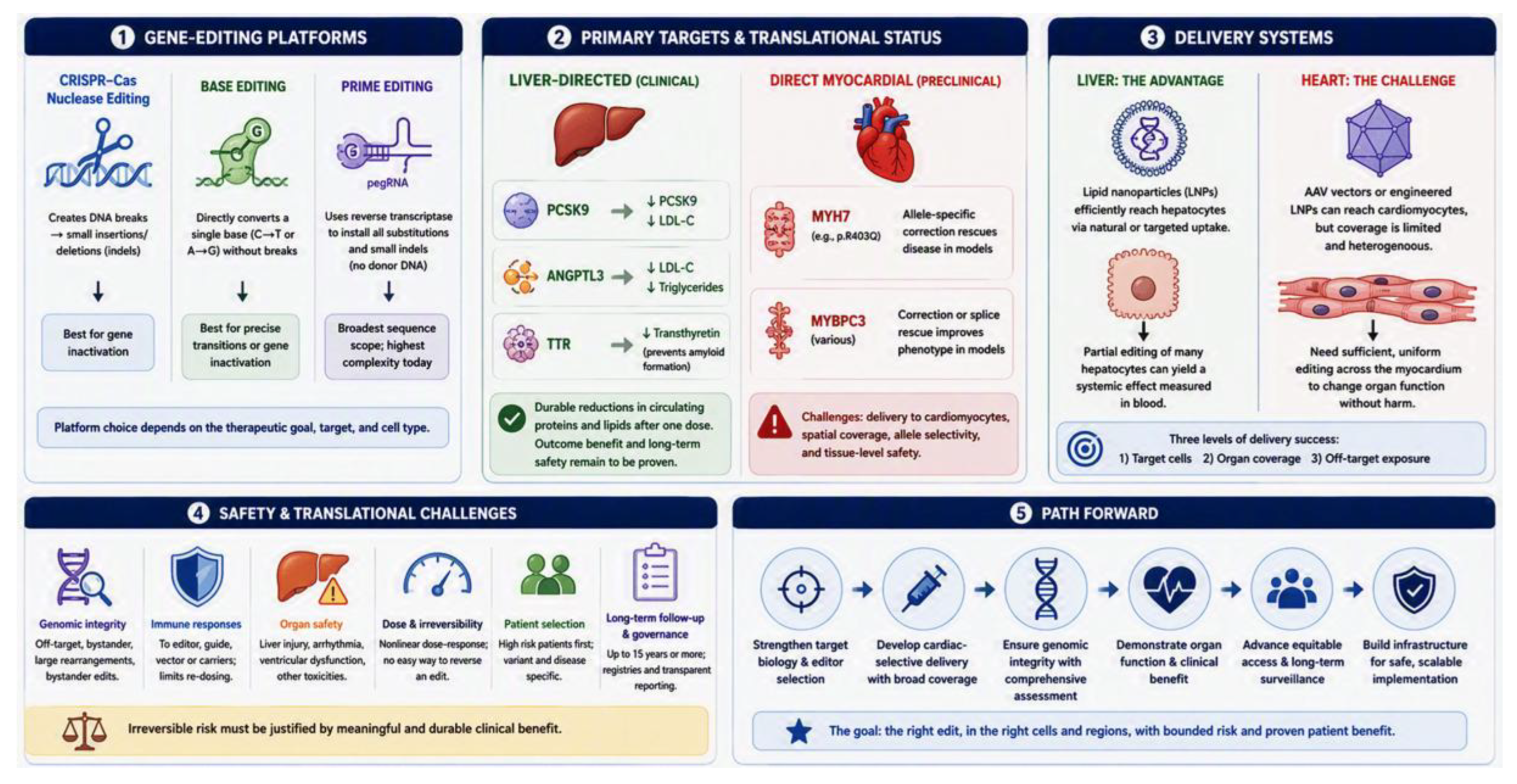

Table 1.
Mechanistic fit and cardiovascular maturity of genome-editing platforms.
| Cardiovascular maturity | Principal mechanistic constraint | Best-aligned therapeutic objective | Programmed DNA event | Platform |
|---|---|---|---|---|
| Clinical liver-directed editing of TTR and ANGPTL3; preclinical myocardial editing | Heterogeneous repair products and possible large structural alterations | Durable disruption of a gene for which loss of function is beneficial | Double-strand break followed by end joining | CRISPR-Cas nuclease |
| Clinical liver-directed editing of PCSK9; preclinical myocardial correction of MYH7 | PAM and editing-window restrictions, bystander editing, and deaminase-associated off-target activity | Transition correction or precise creation of a splice-disrupting or stop-generating variant | Deamination within an editing window, usually with a single-strand nick | Base editing |
| Preclinical cardiovascular studies only | Large multicomponent system, locus-dependent efficiency, and complex delivery | Defined substitutions or small insertions and deletions beyond base-editing chemistry | Nick-directed reverse transcription from a pegRNA template | Prime editing |
Abbreviations: ANGPTL3: angiopoietin-like proteins 3; PAM: protospacer-adjacent motif; PCSK: proprotein convertase subtilisin/kexin type 9; pegRNA: prime-editing guide RNA.
Table 2.
Peer-reviewed human studies of in vivo liver-directed cardiovascular genome editing. Cross-trial comparisons are descriptive only because populations, doses, follow-up intervals, and assays differ.
Table 2.
Peer-reviewed human studies of in vivo liver-directed cardiovascular genome editing. Cross-trial comparisons are descriptive only because populations, doses, follow-up intervals, and assays differ.
| Ref. | Principal interpretive limitation | Main reported pharmacodynamic result | Population and design | Editing platform | Target and therapy |
|---|---|---|---|---|---|
| [16] | Small, uncontrolled study designed for safety and dose finding, not cardiovascular outcomes | Dose-dependent PCSK9 reductions of 51%-88% and LDL-C reductions of 9%-62%; at least 1 year of follow-up in 15 participants | 35 adults with heterozygous familial hypercholesterolemia or premature coronary artery disease; phase 1 dose escalation | Adenine base editing | PCSK9: VERVE-102 |
| [27] | Very small cohort and limited follow-up | At 0.6 mg/kg (n=3), mean PCSK9 and LDL-C reductions of 74.4% and 52.3%, respectively, at week 24 | 6 adults with heterozygous familial hypercholesterolemia; phase 1 dose escalation | Adenine base editing | PCSK9: YOLT-101 |
| [15] | Small cohorts and no comparator or clinical-outcome assessment | At 0.8 mg/kg (n=4), mean LDL-C and triglyceride reductions of 48.9% and 55.2%, respectively, at day 60 | 15 adults with uncontrolled dyslipidemia; phase 1 dose escalation | CRISPR-Cas9 nuclease editing | ANGPTL3: CTX310 |
| [14] | Uncontrolled study; biomarker suppression does not establish improved morbidity or survival | Mean serum transthyretin reductions of 89% at day 28 and 90% at 12 months | 36 adults with ATTR-CM; phase 1 dose escalation | CRISPR-Cas9 nuclease editing | TTR: nexiguran ziclumeran |
| [28] | Not a cardiac-efficacy cohort; open-label study with retrospective registration | More than 80% serum transthyretin reduction at doses above 0.5 mg/kg, sustained for at least 72 weeks | 10 adults with hereditary ATTR amyloidosis, predominantly polyneuropathy; investigator-initiated dose escalation | CRISPR-Cas9 nuclease editing | TTR: ART001 |
Abbreviations: ATTR-CM: transthyretin amyloid cardiomyopathy; LDL-C: low-density lipoprotein cholesterol.
Table 3.
Organ-specific criteria for judging delivery adequacy in cardiovascular genome editing. The table distinguishes evidence of delivery from evidence of therapeutic efficacy. Framework informed by references [3,11,14,15,16,17,18,25,33,34,35,36,37,38,39,40,41,42,43,44,55].
| Evidence needed | Direct myocardial editing | Liver-directed editing | Assessment domain |
|---|---|---|---|
| Cell-type-resolved editing, not carrier accumulation alone | Sufficient access to the disease-relevant cardiomyocyte population | Partial hepatocyte editing may aggregate into a systemic protein effect | Productive cellular access |
| Spatial mapping rather than a single whole-organ mean | Coverage across relevant chambers, regions, and possibly conduction tissue | Lobular distribution matters, although circulating output integrates the effect | Spatial distribution |
| Complete intracellular delivery and duration of editor expression | Large editors may require split AAVs or coordinated transient carriers | Editor mRNA and guide RNA can be delivered transiently in one LNP system | Payload and exposure |
| Target engagement distinguished from clinical efficacy | Allelic correction must connect to electrical, structural, and contractile rescue | Circulating protein or lipid change provides an accessible readout | Functional linkage |
| Carrier, cargo expression, and permanent edits mapped separately | Liver, vasculature, nonmyocytes, conduction tissue, and other organs | Extrahepatic organs and non-hepatocyte liver populations | Non-target exposure |
| Route and delivery procedure included in benefit-risk assessment | Intravenous, intracoronary, or intramyocardial delivery; AAV redosing is constrained | Intravenous delivery; repeat dosing remains formulation specific | Route and redosing |
Abbreviations: AAV: adeno-associated virus; LNP: lipid nanoparticle.
Table 4.
Proposed minimum evidence for clinically defensible cardiovascular genome editing.
| Myocardial emphasis | Liver-directed emphasis | Minimum requirement | Evidence domain |
|---|---|---|---|
| Pathogenic variant, editable mechanism, viable myocardium, and preservation of the normal allele | Tolerability of sustained target loss and residual risk despite standard therapy | Validated causal direction, meaningful unmet need, and biologically plausible disease stage | Target and population |
| Regional and cell-type-resolved whole-heart coverage | Hepatocyte selectivity and systemic biodistribution | Adequate target-cell coverage with bounded non-target exposure | Delivery |
| Mutant and wild-type alleles across relevant cardiac cell types | Relevant human hepatocytes and exposed extrahepatic cells | Intended and unintended on-target products plus guide-dependent and guide-independent activity | Genomic integrity |
| Rhythm, contractility, remodeling, and consequences of regional mosaicism | Hepatic function, clonal signals, and biology of the target pathway | Functional testing linked to tissues in which edits persist | Organ-level safety |
| Balance of correct, incorrect, and unedited alleles across the myocardium | Stable protein effect without unnecessary systemic exposure | Lowest credible biological dose, pausing rules, and mechanism-based long-term follow-up | Dose and surveillance |
| Symptoms, rhythm burden, functional capacity, remodeling, and survival | Cardiovascular events, heart-failure outcomes, function, or survival | Randomized evidence using outcomes meaningful to patients | Clinical utility |
| Variant-specific development pathways and specialized delivery infrastructure | Expansion to lower-risk prevention only after a substantially larger safety database | Valid consent, diverse genomic evidence, durable follow-up, and implementable access | Governance and access |
Disclaimer/Publisher’s Note: The statements, opinions and data contained in all publications are solely those of the individual author(s) and contributor(s) and not of MDPI and/or the editor(s). MDPI and/or the editor(s) disclaim responsibility for any injury to people or property resulting from any ideas, methods, instructions or products referred to in the content. |
© 2026 by the authors. Licensee MDPI, Basel, Switzerland. This article is an open access article distributed under the terms and conditions of the Creative Commons Attribution (CC BY) license.
Copyright: This open access article is published under a Creative Commons CC BY 4.0 license, which permit the free download, distribution, and reuse, provided that the author and preprint are cited in any reuse.