

Submitted:
02 September 2026
Posted:
03 September 2026
You are already at the latest version
Abstract
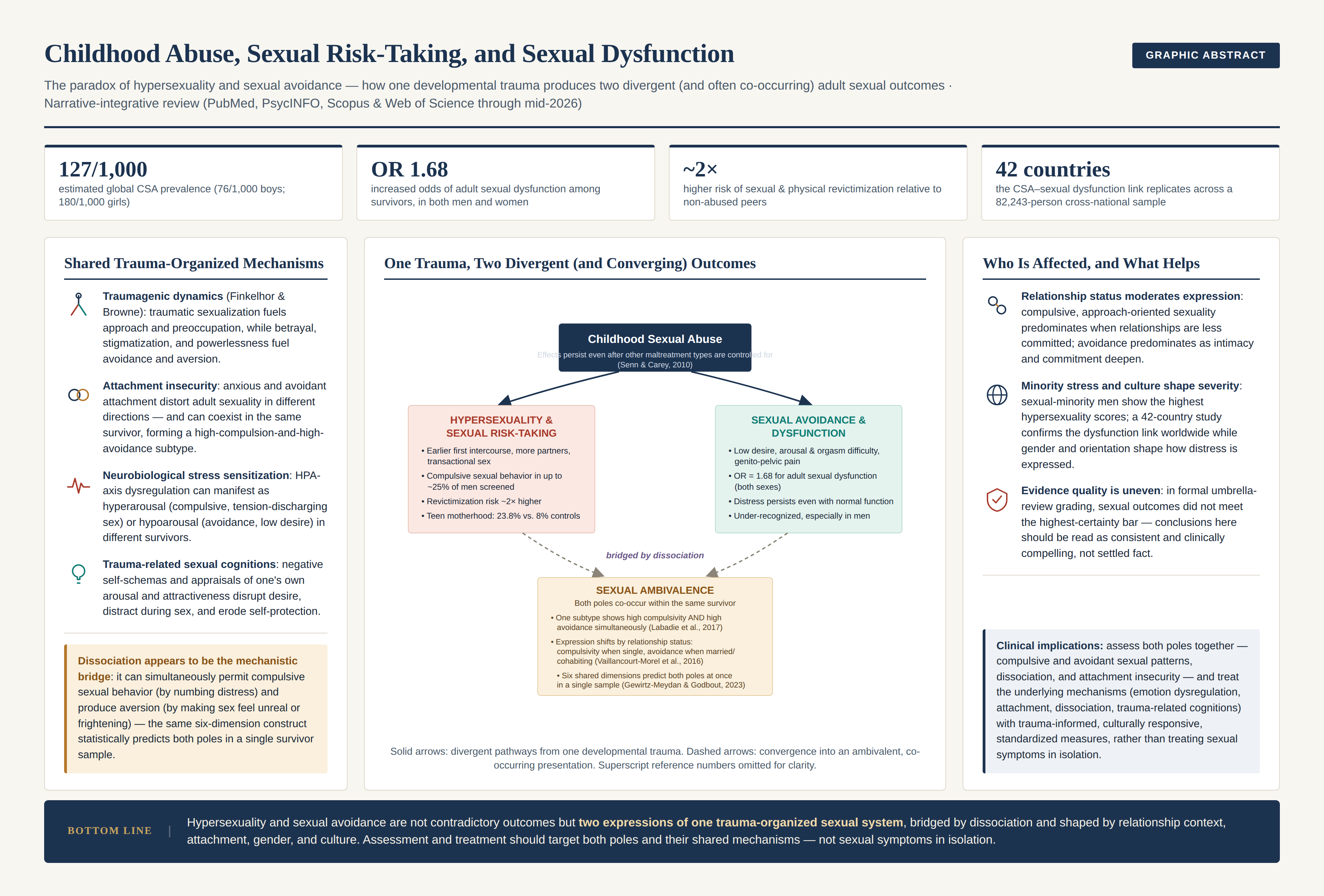
Background: Childhood maltreatment, and childhood sexual abuse in particular, is a potent developmental risk factor for disrupted adult sexuality. Survivors show two divergent yet frequently co‑occurring outcomes: elevated sexual risk-taking and compulsive sexual behavior on one hand, and sexual avoidance and dysfunction on the other. These patterns arise from trauma‑organized alterations in sexual meaning, attachment, emotion regulation, dissociation, and stress‑reactivity. The manuscript highlights that survivors may simultaneously exhibit sexual preoccupation and sexual aversion, forming a state of sexual ambivalence. It also notes that sexual‑minority and gender‑diverse individuals experience compounded risk due to minority stress and sociocultural factors. Objectives: To synthesize four decades of empirical, theoretical, and cross‑cultural evidence explaining how childhood sexual abuse produces both hypersexuality and sexual avoidance; to identify central mediating mechanisms; to evaluate the methodological quality of the evidence base; and to outline implications for trauma‑informed, culturally responsive clinical practice. Methods: A narrative‑integrative review was conducted using peer‑reviewed literature from major scientific databases, supplemented by citation tracking. Priority was given to meta‑analyses, umbrella reviews, prospective cohort studies, and large cross‑national datasets. The review integrates traumagenic dynamics, attachment theory, sexual self‑schema models, neurobiological stress‑reactivity research, minority‑stress frameworks, and cross‑cultural findings. Evidence quality was appraised using established umbrella‑review grading criteria. Results: Childhood sexual abuse uniquely predicts early sexual initiation, multiple partners, transactional sex, revictimization, and other risk behaviors beyond the effects of other maltreatment types. It also increases the likelihood of adult sexual dysfunction, including low desire, arousal difficulties, orgasmic problems, sexual pain, and avoidance. Prospective studies show early emergence and persistence of sexual preoccupation, aversion, and ambivalence. Cluster‑analytic work identifies survivor subtypes combining high compulsivity and high avoidance. Neurobiological findings indicate stress‑system sensitization that can manifest as either hyperactivation or hypoactivation of sexual response. Minority stress, gender identity, and cultural context shape the severity and expression of sexual outcomes. Evidence quality for sexual outcomes is variable, with several associations supported by modest rather than high‑certainty evidence. Conclusions: Hypersexuality and sexual avoidance represent complementary expressions of a trauma‑organized sexual system shaped by dissociation, insecure attachment, emotion dysregulation, and altered stress physiology. These patterns often co‑occur within individuals and fluctuate with relational, cultural, and identity‑related contexts. A comprehensive understanding of this paradox requires integrating psychological, biological, and sociocultural mechanisms. Clinical Implications: Assessment should routinely evaluate both compulsive and avoidant sexual patterns, dissociation, minority stress, and attachment insecurity. Trauma‑informed treatment should address emotion regulation, relational functioning, and sexual concerns within culturally responsive frameworks. Standardized measurement of sexual outcomes is essential for improving evidence quality and guiding intervention.
Keywords:
childhood sexual abuse
; child maltreatment
; sexual risk behavior
; hypersexuality
; sexual compulsivity
; sexual dysfunction
; sexual avoidance
; dissociation
; attachment
; emotion regulation
; neurobiology
; minority stress
; cross‐cultural
; resilience
; measurement
1. Introduction
Child maltreatment is a widespread global phenomenon. Meta-analytic syntheses of self-report studies estimate prevalence rates of 127 per 1000 for sexual abuse (76 per 1000 among boys and 180 per 1000 among girls), 226 per 1000 for physical abuse, 363 per 1000 for emotional abuse, 163 per 1000 for physical neglect, and 184 per 1000 for emotional neglect (Stoltenborgh et al., 2014). These aggregate figures conceal substantial regional variation: in Africa, median rates of physical abuse reach 50.8% among girls and 60.2% among boys, and median neglect rates reach 41.8% and 39.1% respectively (Moody et al., 2018). Estimates of past-year violence against children suggest that a minimum of 64% of 2–17-year-olds in Asia, 56% in Northern America, 50% in Africa, 34% in Latin America, and 12% in Europe experienced some form of violence (Vlahovicova et al., 2017). Sexual abuse is thus a pervasive developmental adversity whose consequences extend far beyond the boundaries of psychiatric diagnosis into the most intimate domain of adult life: sexuality itself.
Among the many sequelae of childhood abuse, sexual outcomes occupy a distinctive position. Sexuality is a developmental domain that is exquisitely sensitive to early relational trauma, and meta-analytic, population-cohort, prospective, and clinical studies converge on the conclusion that CSA accounts for unique variation in deleterious sexual outcomes even after other forms of maltreatment are controlled (Noll, 2021; Senn & Carey, 2010). Notably, however, the direction of the association is not uniform. Some survivors develop sexual avoidance and dysfunction; others develop hypersexuality and risk-taking; and many report both, sometimes simultaneously (Bigras et al., 2020). This review addresses a central paradox in the clinical and empirical literature: how the same developmental insult can produce sexual withdrawal and sexual compulsivity, aversion and preoccupation, avoidance and approach. We examine the epidemiology of sexual risk-taking and sexual dysfunction following childhood abuse, evaluate the evidence for hypersexuality as a distinct outcome, and integrate theoretical models that explain the coexistence of these opposing presentations. We conclude with clinical implications and directions for future research.
1.1. Literature Search Strategy and Scope of This Review
This review synthesizes peer-reviewed empirical and theoretical literature identified through searches of PubMed, PsycINFO, Scopus, and Web of Science (database inception through mid-2026), supplemented by hand-searches of reference lists and citation-tracking of key theoretical papers. Search terms combined variants of child sexual abuse, child maltreatment, and child trauma with sexual risk behavior, hypersexual, sexual compulsiv*, sexual addiction, sexual dysfunction, sexual avoidance, sexual desire, and dissociation. Eligible sources were peer-reviewed, English-language, quantitative or qualitative studies, meta-analyses, systematic or umbrella reviews, and theoretical papers addressing sexual outcomes among survivors of childhood sexual abuse or broader childhood maltreatment; studies restricted to perpetration outcomes, exclusively pediatric (pre-adult) sexual behavior, or non-human samples were excluded. Because the empirical base is heterogeneous in design, sample, and measurement, this remains a narrative-integrative rather than a formal systematic review; nevertheless, priority was given throughout to meta-analyses, umbrella reviews, and large multi-site or cross-national datasets over single small studies, and, where the underlying evidence quality has been formally graded (Hailes et al., 2019), that grading is reported rather than treated as a demonstrated causal fact. Consistent with editorial feedback that an earlier version of this review addressed too narrow a slice of the literature, the present version broadens coverage in four directions: (a) neurobiological and psychophysiological mechanisms; (b) male, sexual-minority, and gender-diverse survivors, previously treated only as a brief limitation; (c) cross-cultural and cross-national evidence, moving beyond a predominantly North American and Western European base; and (d) measurement and methodological quality, including a critical appraisal of how confidently the reviewed associations can be interpreted. Table 1 summarizes the major meta-analyses, umbrella reviews, and large cross-national or person-centered studies on which this broadened synthesis rests.
2. Theoretical Foundations
2.1. The Traumagenic Dynamics Model
The most influential conceptual framework for understanding the sexual sequelae of CSA remains Finkelhor and Browne's traumagenic dynamics model, which identifies four dynamics — traumatic sexualization, betrayal, stigmatization, and powerlessness — as the core of the psychological injury inflicted by abuse (Finkelhor & Browne, 1985). Traumatic sexualization refers to the process by which abuse shapes a child's sexuality in developmentally inappropriate and interpersonally dysfunctional ways: when affection, attention, privileges, and gifts are offered as rewards for sexual behavior, the child may learn to treat sex as the normal currency of care, while the pairing of sexual activity with fear and coercion generates negative and abnormal associations with sexual situations (Joleby et al., 2020). Betrayal — the violation of fundamental trust between children and adults — undermines the capacity for intimate trust and may drive survivors toward either fleeting, non-committal sexual encounters or complete withdrawal from intimacy (Senn & Carey, 2010). Stigmatization distorts the self-concept through internalized negative labels, and powerlessness teaches survivors that they cannot control sexual situations, impairing their ability to refuse unwanted or unprotected sex (Senn & Carey, 2010; Walsh et al., 2009). Because these dynamics operate simultaneously, they can push sexual behavior in opposite directions: traumatic sexualization fuels approach and preoccupation, while betrayal and stigmatization fuel avoidance and aversion — a tension that anticipates the paradox at the center of this review (Noll et al., 2003).
2.2. Attachment Theory
Attachment theory offers a complementary lens. Childhood abuse, particularly when perpetrated by caregivers, disrupts the formation of internal working models of self and others, producing attachment anxiety, attachment avoidance, or both. In a community sample of 96 women, both attachment anxiety and avoidance were associated with aversive sexual affect and cognitions, with attachment anxiety more detrimental to sexual functioning (Birnbaum, 2007). Larger studies extend these findings: among women, attachment avoidance tends to be associated with impairments across all domains of sexual function, whereas anxious attachment is associated with declines in arousal, satisfaction, and orgasm; among men, anxious attachment is associated with multiple facets of dysfunction (Dunkley et al., 2015). Attachment insecurity predicts lower sexual satisfaction at the individual and partner level in married couples (Butzer & Campbell, 2008), and is linked to problems in arousal, lubrication, and sexual pain, as well as erectile problems, in clinical samples (Purcell-Lévesque et al., 2018). Crucially, cluster-analytic work with 324 CSA survivors demonstrates that insecure attachment and sexual problems cohere into identifiable survivor profiles, with one subgroup characterized by elevated attachment anxiety alone and another characterized by high attachment anxiety, high avoidance, high sexual compulsion, and high sexual avoidance simultaneously (Labadie et al., 2017). Attachment theory thus provides a mechanism by which a single traumatic history produces divergent — and co-occurring — sexual outcomes.
2.3. Sexual Self-Schemas and Cognitive-Affective Models
A third strand of theory concerns the cognitive representation of the sexual self. Women with CSA histories view themselves as less romantic and passionate than non-abused women, and show an inverse relationship between romantic/passionate sexual self-schemas and negative sexual affect during arousal — effects that are independent of depression and anxiety (Meston et al., 2006). CSA survivors also report lower sexual self-esteem and poorer sexual adjustment (Bruggen et al., 2006). These self-schemas are not merely descriptive; they are mechanistic. Structural equation modeling indicates that the relationship between child abuse and adult sexual revictimization is partially mediated by sexual self-esteem, sexual concerns, and high-risk sexual behaviors (Bruggen et al., 2006), and early maladaptive schemas in the disconnection/rejection domain fully mediate the relation between childhood emotional abuse and number of sexual partners, while partially mediating the relation for sexual and physical abuse (Roemmele & Messman-Moore, 2011). Together, these frameworks converge on a model in which abuse alters (a) the meaning assigned to sexual behavior, (b) the relational expectations brought to sexual encounters, and (c) the cognitive appraisal of one's own sexual arousal — three pathways that can generate both compulsive approach and phobic avoidance.
2.4. Neurobiological and Psychophysiological Mechanisms
A full account of the paradox must also engage the biological substrate through which early sexual trauma comes to organize adult sexual response. Childhood sexual and physical abuse is associated with lasting dysregulation of the hypothalamic-pituitary-adrenal (HPA) axis: in a controlled study, women with histories of childhood sexual and physical abuse showed exaggerated adrenocorticotropic hormone and heart-rate responses to social stress relative to non-abused women, particularly when the abuse history co-occurred with current depression or anxiety, indicating a sensitized stress-response system that persists into adulthood (Heim et al., 2000). Because sexual arousal depends on a permissive, low-threat autonomic and endocrine state, a chronically sensitized HPA axis provides a plausible physiological bridge to both poles of the paradox: hyperarousal and hypervigilance can manifest either as compulsive, tension-discharging sexual behavior or as a defensively down-regulated, avoidant sexual response, depending on additional psychological moderators. Consistent with this, prospective work in women with histories of childhood trauma finds that a flattened diurnal cortisol slope independently predicts low sexual desire, although the relationship between trauma severity and cortisol output is markedly non-linear — some survivors show blunted cortisol output and others show elevated, highly variable output — and depressive symptoms, more than perceived stress or cortisol per se, emerge as the strongest proximal predictor of hypoactive sexual desire (O'Loughlin et al., 2019). This heterogeneity in stress-axis functioning may itself help explain why some survivors present with hyperactivation (hypersexuality) and others with hypoactivation (avoidance, low desire): the same early adversity appears capable of producing divergent neuroendocrine phenotypes, which in turn shape divergent sexual phenotypes. These findings remain preliminary — sample sizes in this literature are small and mechanisms are inferred rather than directly tested — but they anchor the psychological models described above in an identifiable biological system rather than treating dissociation and emotion dysregulation as purely descriptive constructs.
2.5. Minority Stress, Gender, and Cultural Context: Toward an Intersectional Framework
The theoretical models above were developed largely from research on heterosexual, cisgender women in North America and Western Europe, a limitation that itself constrains how far the paradox can be generalized. Two bodies of evidence argue for an explicitly intersectional extension of the traumagenic, attachment, and cognitive-affective frameworks. First, sexual-minority and gender-diverse survivors appear to experience compounded risk: an updated systematic review of the CSA–compulsive sexual behavior literature identifies minority stress as a documented moderator, alongside post-traumatic stress and depressive symptoms, of the association between abuse history and compulsive sexual behavior (Slavin et al., 2025), and a large psychometric survey using the Hypersexual Behavior Inventory found that sexual-minority men had significantly higher latent hypersexuality scores than heterosexual men, with elevated masturbation frequency, partner counts, and pornography use, while sexual-minority women showed elevated hypersexuality linked more to coping motives than to a distinct orientation-based risk process (Bőthe et al., 2018). Second, culture appears to moderate not only the prevalence but the meaning of abuse-related sexual outcomes: analysis of the International Sex Survey across 42 countries found that childhood and adolescent/adult sexual abuse were associated with elevated sexual distress and sexual function problems worldwide, but that heterosexual and bisexual respondents reported greater sexual difficulties than queer, asexual, and pansexual respondents, and that men and gender-diverse participants showed patterns of dysfunction comparable to women rather than the male-underrepresentation suggested by the historically female-dominated clinical literature (Gewirtz-Meydan et al., 2025). Together, these findings suggest that minority stress, sexual orientation, gender identity, and cultural context are not merely demographic controls but active moderators that shape whether, and how, the trauma-organized sexual system described in this review expresses itself as approach, avoidance, or ambivalence — a theme revisited in Section 4.2 and Section 5.5, and 7.5.
3. Childhood Abuse and Sexual Risk-Taking
3.1. Evidence from Controlled Studies
The association between CSA and adult sexual risk behavior is well documented. A landmark review of controlled studies concluded that CSA is consistently associated with higher rates of sexual risk behaviors, particularly sex trading, a greater number of sexual partners, and earlier age at first intercourse (Senn et al., 2007). Methodological critiques notwithstanding — including inconsistent definitions of CSA and limited examination of gender moderation — the association has proved robust across samples (Senn et al., 2007). More recent syntheses confirm that the sexual risk behaviors most consistently associated with CSA are sex under the influence of alcohol or substances and concurrent sexual partners or infidelity, although findings for sexually transmitted infection diagnosis and unprotected sex have been less consistent (Ménard & MacIntosh, 2021).
Critically, CSA appears to be uniquely associated with sexual risk behavior over and above other maltreatment types. In a study of 414 women attending a publicly funded STI clinic, sexual abuse, physical abuse, psychological abuse, and neglect were each associated with adult sexual risk behavior in bivariate analyses; however, in multivariate analyses controlling for all other forms of maltreatment, only CSA remained uniquely associated with unprotected sex and lifetime number of partners, and there was little support for additive or interactive models (Senn & Carey, 2010). This specificity aligns with the traumagenic dynamics model, which holds that traumatic sexualization — a dynamic hypothesized to be unique to sexual abuse — specifically reconfigures the meaning and function of sexual behavior (Senn & Carey, 2010).
3.2. Adolescent Developmental Trajectories
Prospective longitudinal research demonstrates that the sexual consequences of CSA emerge early and persist. In a prospective investigation of maltreated and comparison girls, sexually abused participants reported being significantly younger at age of voluntary first intercourse, lower birth control efficacy, younger age at first childbirth, and higher rates of teenage motherhood (Noll et al., 2003). This same line of work documented that survivors display distinct patterns of "sexual distortion," including sexual preoccupation, sexual aversion, and a striking combination of the two — sexual ambivalence — defined as preoccupation coupled with aversion (Noll et al., 2003). The multigenerational longitudinal study of Trickett, Noll, and Putnam reported teenage pregnancy rates of 39% among sexually abused females versus 15% among comparisons, and teenage motherhood rates of 23.8% versus 8% (Trickett et al., 2011). Follow-up analyses confirmed that sexual abuse — but not physical abuse or neglect — remained a significant predictor of adolescent motherhood when alternative behavioral, family, and contextual risk factors were controlled (Noll et al., 2018).
These developmental effects extend to revictimization. In a fifteen-year prospective study, abused females were almost twice as likely to experience sexual revictimization (odds ratio 1.99) and physical revictimization (odds ratio 1.96) relative to comparison females, and their revictimizations were more likely to be perpetrated by older, non-peers and to involve physical injury (Barnes et al., 2009). Cross-sectional work similarly finds that CSA survivors are approximately 2.6 times more likely to experience sexual abuse in adulthood (Rellini & Meston, 2010) and twice as likely to have experienced sexual assault since age 14 (Bruggen et al., 2006). Reviews conclude that survivors are more likely to have multiple sex partners, to become pregnant as teenagers, and to experience sexual assault as adults, with proposed mediating variables including low self-esteem, substance use, PTSD, and distorted sexual development (Lalor & McElvaney, 2010).
3.3. Cumulative Adversity and Dose-Response
Beyond CSA specifically, cumulative childhood adversity shows a graded, dose-response relationship with sexual risk outcomes. In a cohort study of an urban minority sample, participants exposed to five or more adverse childhood experiences averaged roughly two more negative health, mental health, and substance use outcomes than those with no ACEs (3.16 vs. 1.18 on a seven-item index), and multiple-ACE groups had substantially elevated odds of three or more poor outcomes (odds ratios 2.75–10.15) and four or more (3.93–15.18) (Mersky et al., 2013). With respect to sexual victimization specifically, individuals reporting a single ACE have 1.77 times the risk of adulthood sexual victimization relative to those reporting none, while those reporting five or more ACEs have 8.32 times the risk (Ports et al., 2015). In the National Longitudinal Study of Adolescent to Adult Health, associations between cumulative trauma and multiple partnerships, sex trade involvement, and STIs were present at all waves but strongest during adolescence, with dose-response-like relationships observed at least once per outcome; parental binge drinking was associated with biologically confirmed STI in young adulthood (adjusted OR = 1.46) and parental incarceration with self-reported STI in adulthood (adjusted OR = 1.70) (London et al., 2017). These findings indicate that while CSA is a uniquely potent predictor of sexual risk, the accumulation of diverse adversities multiplicatively compounds risk — consistent with the notion that the biological embedding of stress, emotion dysregulation, and insecure attachment converge to produce deleterious sexual outcomes (Noll, 2021).
This dose-response pattern is not specific to sexual abuse. A meta-analysis of 19 studies and more than 74,000 participants found that childhood maltreatment broadly — sexual abuse, physical abuse, emotional abuse, and neglect alike — significantly elevated the odds of early sexual initiation (OR = 2.22), multiple sexual partners (OR = 2.22), transactional sex (OR = 3.05), and unprotected intercourse (OR = 1.59), with sexual abuse carrying the largest risk multipliers but no maltreatment subtype conferring immunity from elevated risk (Wang et al., 2019). A 2025 umbrella review of meta-analyses spanning the full spectrum of childhood maltreatment similarly identified sexual dysfunction and sexual risk behavior among more than twenty psychosocial outcomes reliably associated with maltreatment history, while explicitly cautioning that “high-quality evidence is deficient” for sexual outcomes specifically, relative to outcomes such as substance misuse or PTSD (Zhang et al., 2025). Taken together, this literature argues against a CSA-only framing of the paradox: the same traumagenic, attachment, and dose-response mechanisms implicated in sexual abuse specifically also operate, in attenuated form, across the broader landscape of childhood maltreatment, even as CSA remains the single most potent and specific predictor of sexualized outcomes (Noll, 2021; Senn & Carey, 2010).
4. Hypersexuality and Sexual Compulsivity
4.1. Evidence Across Clinical and Community Samples
Hypersexuality — also termed compulsive sexual behavior, sexual compulsivity, sexual impulsivity, or sexual addiction — consists of sexual behaviors, preoccupations, and urges that persist despite repeated and prolonged attempts to control or reduce them, resulting in clinically significant distress or adverse consequences (Slavin et al., 2020). It commonly involves normophilic activities such as masturbation, pornography use, and sex with multiple anonymous partners, pursued at extreme frequency or intensity, and is associated with risky sexual behavior, unwanted pregnancies, STIs including HIV, and a range of psychiatric comorbidities (Slavin et al., 2020).
Histories of sexual abuse have been linked to hypersexuality across clinical and community samples (Slavin et al., 2020). In a sample of 149 adult men, 25.5% screened positive for sex addiction, and discriminant analysis showed that sexual and emotional abuse accounted for the most variance in group differences, with the four trauma subscales explaining 22.3% of variance (Giordano et al., 2024). Yet the evidence is not monolithic: in a survey of 348 users of addiction-support websites, childhood emotional abuse, exposure to pornography, and parental sex addiction — but not childhood sexual or physical abuse — were associated with adult sexual compulsivity (McPherson et al., 2013). This heterogeneity suggests that hypersexuality after abuse is multiply determined and context-dependent.
An updated systematic review examining seventeen studies published through 2024 found that fifteen reported a significant association between childhood sexual abuse and compulsive sexual behavior, and identified three classes of moderators: neurobiological factors such as behavioral inhibition system sensitivity — heightened responsiveness to threat cues, consistent with the HPA-axis sensitization described in Section 2.4; psychological factors, particularly PTSD and depressive symptoms, with depression specifically mediating the CSA–compulsivity link in some samples; and social factors, including gender, minority stress among LGBTQ+ individuals, and the severity and timing of abuse (Slavin et al., 2025). The same review noted that existing research remains predominantly Western, cross-sectional, and inconsistently measured — limitations that motivate the cross-cultural and measurement-focused sections added to the present review (Section 5.5 and Section 8.5).
Latent profile analysis among 806 community adults identified four sexual behavior profiles — hyposexual individuals, hypersexual porn users, porn users, and those within usual ranges — and found that hypersexual porn users had significantly more childhood trauma (emotional, physical, and sexual) and greater PTSD symptoms, anxiety, and depression than other groups (Gewirtz-Meydan, 2022). Notably, hypersexual and porn-user groups endorsed coping and peer-pressure motives for sex, whereas hyposexual individuals scored lowest on all motives for engaging in sex (Gewirtz-Meydan, 2022). This profile structure underscores a central theme of this review: abuse-related sexual problems distribute across a spectrum from hyperactive to hypoactive expression, and both poles are associated with trauma.
4.2. Gender and Sexual-Orientation Diversity in Hypersexuality
Hypersexuality following abuse is not evenly distributed across gender and sexual orientation. In the large-scale psychometric survey described above (N = 18,034), sexual-minority men showed significantly higher hypersexuality scores than heterosexual men on every subscale of the Hypersexual Behavior Inventory, while sexual-minority women's elevated scores appeared to be driven more by coping-oriented motives than by orientation per se, leading the authors to conclude that sexual-minority men may constitute a particularly high-risk group for clinically significant hypersexual behavior (Bőthe et al., 2018). This pattern is consistent with minority-stress accounts, in which the chronic stigma, concealment, and rejection risk associated with sexual-minority status compound the traumagenic dynamics of stigmatization and powerlessness already produced by CSA itself (Slavin et al., 2025). Clinically, this implies that a purely trauma-focused case formulation may be incomplete for sexual-minority survivors unless minority stress is assessed and addressed alongside abuse history — a point developed further in Section 7.5 and Section 8.2.
5. Sexual Dysfunction and Sexual Avoidance
5.1. Meta-Analytic Evidence
The other pole of the paradox — sexual dysfunction — is equally well documented. A meta-analysis pooling data from five bibliographic databases found that adults with a history of CSA experienced a significantly higher proportion of sexual dysfunction than those without (OR = 1.68, 95% CI [1.49, 1.87]), with subgroup analyses showing effects for both men (OR = 1.45, 95% CI [1.05, 1.84]) and women (OR = 1.62, 95% CI [1.42, 1.83]) (Wang et al., 2022). Effect sizes varied substantially with the instruments used and the region of the sample, and the authors concluded that the evidence of an association is conclusive (Wang et al., 2022). Reviews similarly report that CSA may relate to greater sexual dysfunction and lower sexual satisfaction, while acknowledging that associations depend heavily on comorbidities and sample characteristics (Bigras et al., 2020).
5.2. Specific Symptom Presentations
Comprehensive review of the mechanisms linking CSA to sexual health suggests that a lack of positive emotions related to sexuality — rather than the presence of greater negative emotions — is the more relevant pathway to sexual dysfunction among women with CSA histories (Pulverman et al., 2018). This fits with evidence that desire, arousal, lubrication, and orgasm are all compromised in survivors. For example, CSA survivors show lower sexual functioning and higher anxiety in the context of provoked vestibulodynia, the most common subtype of vulvodynia, with childhood maltreatment robustly associated with adult-onset genito-pelvic pain (Corsini-Munt et al., 2016). Hypo-sexuality — self-reported hypoactive sexual desire and/or sexual aversion — is described as a common symptom among female CSA survivors, frequently distressing and often unaddressed in clinical encounters (Wohl & Kirschen, 2018).
5.3. Male Survivors
The evidence in male survivors is comparatively sparse but convergent. A systematic review of twelve studies found that some studies confirm CSA as a risk factor for sexual dysfunction in adult men — including low sexual drive, problems with arousal, difficulties with orgasm, and pain — while others failed to find an association, with wide variability in quality, methodology, and definitions across studies (Gewirtz-Meydan & Opuda, 2020). The authors emphasized that men remain significantly underrepresented in this literature (Bigras et al., 2020; Gewirtz-Meydan & Opuda, 2020).
A 2024 scoping review of 29 empirical studies on institutional child sexual abuse of males — a context involving predominantly male perpetrators, extrafamilial settings, and often extended abuse duration — found that survivors delayed disclosure by an average of 18 to 21 years, that more than 80% met criteria for at least one psychiatric disorder, and that sexual and relationship difficulties were consistently documented, with roughly one-third of participants in one constituent study reporting specific sexual problems; the authors attribute delayed help-seeking partly to gendered stigma, including fear of being perceived as weak or homosexual, that likely also suppresses reporting of sexual dysfunction in clinical settings (Wyles et al., 2024). This institutional-abuse literature complements the community and clinical samples reviewed above and reinforces the conclusion that male sexual dysfunction after CSA is probably underdetected rather than genuinely rare.
5.4. The Distress–Function Disconnect
A distinctive feature of abuse-related sexual dysfunction is the disconnection between physiological function and subjective distress. In a study of women with (n = 105) and without (n = 71) CSA histories, desire, arousal, lubrication, and orgasm interacted with abuse status in predicting sexual distress such that sexual functioning was more weakly associated with distress for women with CSA — they showed higher distress even in the context of good sexual functioning, and this disconnect was more pronounced among women abused by a family member (Stephenson et al., 2012). This pattern implies that the sexual difficulties of survivors are not adequately captured by conventional symptom inventories; the meaning of sex, not merely its mechanics, is what is disrupted — consistent with the cognitive-affective model in which abuse-related appraisals of genital arousal and sexual attractiveness distract survivors during sexual activity (Pulverman, 2017).
5.5. Cross-Cultural Perspectives
Nearly all of the mechanisms described in Section 2 through 5 were derived from North American and Western European samples, raising the question of whether the paradox generalizes globally. The most direct evidence comes from the International Sex Survey, which examined childhood and adolescent/adult sexual abuse in relation to sexual function and distress among 82,243 participants across 42 countries (Gewirtz-Meydan et al., 2025). Both childhood and later-life sexual abuse were significantly associated with elevated sexual distress and sexual function problems across this culturally and economically diverse sample, supporting the cross-national robustness of the CSA–sexual dysfunction association documented in predominantly Western meta-analyses (Wang et al., 2022). Two findings, however, complicate a simple universal model. First, heterosexual and bisexual survivors reported greater sexual difficulties than queer, asexual, and pansexual survivors, suggesting that normative sexual scripts — which may weigh more heavily on individuals oriented toward majority relationship structures — modulate how abuse-related disruption is experienced. Second, men and gender-diverse participants showed levels of sexual dysfunction comparable to women, challenging the assumption, built into much of the clinical literature reviewed in Section 5.3, that abuse-related sexual dysfunction is primarily a women's health issue. The authors call explicitly for “trauma-informed and culturally sensitive interventions” that account for gender identity, sexual orientation, and cultural context rather than a one-size-fits-all trauma-informed sex therapy model (Gewirtz-Meydan et al., 2025). Because this remains largely a single (if very large) cross-national dataset, replication with culturally adapted measures — a need discussed further in Section 8.5 — is an urgent priority before strong claims of universality can be made.
6. The Paradox of Hypersexuality and Sexual Avoidance
6.1. Sexual Ambivalence and Heterogeneous Profiles
The coexistence of hypersexuality and avoidance within the same individual is the empirical core of the paradox. Noll, Trickett, and Putnam documented that sexually abused girls displayed not only sexual preoccupation and sexual aversion but also "sexual ambivalence" — the simultaneous presence of both (Noll et al., 2003). Subsequent person-centered research has confirmed this pattern in adults. Cluster analysis of 324 CSA survivors and 484 non-maltreated participants revealed two distinct survivor profiles: one with elevated attachment anxiety and low-to-moderate avoidance, sexual compulsion, and sexual avoidance, and a second with high scores on all four dimensions — high attachment anxiety, high avoidance, high sexual compulsion, and high sexual avoidance (Labadie et al., 2017). The second profile, in which approach and avoidance coexist at high levels, was associated with more intrusive and extrafamilial CSA, higher rates of psychological maltreatment and witnessed parental violence, and more personal and couple distress (Labadie et al., 2017). These findings indicate that CSA survivors form a heterogeneous population and that the sexual and attachment systems can become simultaneously overactivated and inhibited (Labadie et al., 2017).
6.2. Context-Dependent Expression
The expression of hypersexuality versus avoidance is also context-dependent. In a path-analytic study of 1,033 adults (21.5% reporting CSA), abuse severity was associated with higher sexual compulsivity in single individuals, with both higher avoidance and compulsivity in cohabiting individuals, and with higher sexual avoidance in married individuals, with the moderation model invariant across men and women (Vaillancourt-Morel et al., 2016). The authors proposed that the time course of negative sexual outcomes associated with CSA follows distinct patterns of expression according to relationship status — approach-oriented, compulsive sexuality predominating when relationships are less committed, and avoidance predominating as relational commitment and intimacy demands increase (Vaillancourt-Morel et al., 2016). This relational contingency helps resolve the paradox: hypersexuality and avoidance are not fixed traits but dynamic responses to the intimacy demands of the current context.
6.3. Dissociation as a Bridge
Dissociation provides a further bridge between the two poles. Among 57 adults living with HIV who had experienced CSA, PTSD, dissociative disorders, rape by an intimate partner, duration of CSA, and number of perpetrators were all associated with increased dissociation during sexual behavior, which in turn is likely to increase vulnerability to sexual revictimization and risky sexual behavior (Hansen et al., 2012). CSA survivors use sex for self-affirmation, coping with negative emotions, partner approval, and peer pressure, and these motives are amplified among survivors with high dissociation (Gewirtz-Meydan & Lahav, 2020). Dissociation during sex — feeling disconnected from one's body or the environment — can simultaneously permit compulsive sexual behavior (by disconnecting the survivor from their own distress) and produce aversion (by making sex feel unreal, frightening, or mechanical) (Hansen et al., 2012; Mazinan et al., 2024). Experimental work further shows that alcohol intoxication increases sex-related dissociation and that CSA severity is associated with sex-related dissociation unless attentional control instructions buffer the association (Bird et al., 2016). Traumatized sexuality frameworks describe how dissociation, intrusiveness, shame, pleasing behaviors, interpersonal distress, and hypervigilance manifest during sexual activity, with severe dissociation associated with increased sexual dysfunction and compulsive behavior, and guilt/shame and hypervigilance correlating with greater sexual dysfunction (Gewirtz-Meydan, 2025).
Direct empirical support for dissociation as a bridging mechanism comes from a study of 393 adult CSA survivors that decomposed “traumatized sexuality” into six measurable dimensions: dissociation during sex, intrusive memories, sex-related shame and guilt, people-pleasing behavior, interpersonal distress, and hypervigilance (Gewirtz-Meydan & Godbout, 2023). Dissociation during sex, sex-related guilt and shame, and people-pleasing behavior each predicted greater sexual dysfunction, while dissociation, intrusive memories, and people-pleasing also independently predicted compulsive sexual behavior — meaning the same underlying dimensions statistically predicted both poles of the paradox within a single sample, rather than merely being invoked separately in different studies of avoidance versus studies of compulsivity. The same study found that CSA severity predicted problematic pornography use, especially in combination with hypervigilance or low people-pleasing tendencies, suggesting that pornography may function for some survivors as a way of maintaining sexual engagement while limiting the interpersonal vulnerability that intimate partnered sex requires. This is among the clearest single-sample demonstrations that avoidance and compulsivity are not independent phenomena requiring separate explanations, but two outputs of a shared, measurable trauma-organized sexuality construct.
7. Integrative Mechanisms
7.1. Emotion Dysregulation and Experiential Avoidance
Emotion dysregulation is a leading candidate mechanism linking trauma to both poles of sexual disturbance. In a prospective study of 447 trauma-exposed young women followed over 16 months, baseline PTSD symptoms were positively associated with all emotion dysregulation dimensions at eight months and with risky/impulsive sex at sixteen months; indirect effects showed that nonacceptance of negative emotions and difficulties controlling impulsive behaviors when distressed mediated the link to vaginal sex partners, while difficulties engaging in goal-directed behavior when distressed mediated risky/impulsive sex (Weiss et al., 2019). Experimental evidence supports causality: women with sexual assault-related PTSD who received emotion modulation or impulsivity reduction skills training reported significant reductions in risky behaviors relative to a healthy-living comparison condition, and changes in emotion dysregulation fully accounted for the reductions (Weiss et al., 2014). Within clinical populations, emotion dysregulation is also elevated among inpatients with co-occurring PTSD and substance use disorders, where it is associated with risky behaviors including risky sexual behavior (Weiss et al., 2015). From a functional perspective, risky and self-destructive behavior after trauma has been conceptualized as maladaptive regulatory strategy — a means of escaping emotional distress (Rizeq & McCann, 2021). This account aligns with the earlier contextual-behavioral model of Polusny and Follette, which highlighted experiential avoidance as the core process underlying the sexual problems of CSA survivors (Leonard & Follette, 2002). Notably, survivors may be motivated to engage in sex with multiple partners as a form of tension reduction or experiential avoidance arising from PTSD (Testa et al., 2005).
7.2. Attachment Insecurity
Attachment insecurity operates alongside emotion dysregulation. CSA survivors exhibit significantly higher attachment anxiety and avoidance and lower socio-emotional competence, with attachment avoidance and low emotional competence mediating the relationship between CSA and reduced intimacy and self-disclosure (Pastor-Cerezo & Cuéllar, 2026). The dual-profile structure described earlier — in which attachment anxiety and avoidance jointly load with sexual compulsion and avoidance — suggests that attachment insecurity organizes both the approach and avoidance arms of the sexual system (Labadie et al., 2017). Attachment theory also explains the mechanism of "pleasing behaviors": anxiously attached survivors may prioritize a partner's needs based on early abuse patterns, engaging in sex they do not desire — a behavior that maintains sexual risk while simultaneously eroding sexual satisfaction (Gewirtz-Meydan, 2025).
7.3. Trauma-Related Cognitions and Self-Concept
Trauma-related cognitions about the sexual self complete the mechanistic picture. Negative appraisal of genital arousal and one's own sexual attractiveness during arousal — extensions of Barlow's cognitive-affective model of sexual function — explain the relationship between CSA history and sexual dysfunction, and the content of distraction during sexual activity differs by abuse history (Pulverman, 2017). Survivors' negative sexual self-schemas (Meston et al., 2006), low sexual self-esteem (Bruggen et al., 2006), and disconnection/rejection schemas (Roemmele & Messman-Moore, 2011) each mediate between abuse and later sexual outcomes. The stigmatization dynamic of the traumagenic model — in which negative labels attached to the abused child become integrated into the self-concept — explains how these cognitions form, and how compulsive replications of abuse-learned sexual scripts may be played out in relationships that resemble the original abuse (Noll et al., 2003).
7.4. Revictimization as a Compounding Loop
Finally, revictimization functions as a compounding loop. Sexual and physical revictimization are approximately twice as likely among abused females (Barnes et al., 2009), and revictimization risk rises steeply with cumulative adversity (Ports et al., 2015). Dissociation during sex increases vulnerability to revictimization (Hansen et al., 2012), and survivors' difficulties in establishing intimate relationships — reflected in partner change and affiliation with high-risk partners — further elevate risk (Testa et al., 2005). Each revictimization episode reinforces the trauma-organized sexual system, deepening both avoidance (as a defense) and compulsivity (as a repetition and a regulatory strategy), and progressively entrenching the paradox.
7.5. Sexual Orientation and Gender Identity as Moderating Contexts
A further layer of complexity concerns the relationship between childhood maltreatment and sexual orientation itself, which the traumagenic and attachment frameworks described above do not directly address. Using an instrumental-variable design intended to approximate causal inference in observational data, one study of 34,653 U.S. adults found that childhood sexual abuse predicted modestly increased rates of same-sex attraction, same-sex partnering, and same-sex identity in adulthood, with substantially larger effects in men than in women, whereas non-sexual maltreatment predicted only sexual identity and women's same-sex partnering (Roberts et al., 2013). The authors were careful to note that the causal direction and mechanism remain uncertain and that confidence intervals were wide; the finding should not be read as implying that CSA determines or explains adult sexual orientation, and it says nothing about the sexual orientation of the large majority of survivors, who remain heterosexual. Its relevance to this review is narrower: it suggests that any complete account of post-abuse sexuality must treat sexual orientation and gender identity as potential downstream correlates of trauma exposure for some survivors, not only as pre-existing moderators of risk (as in Section 2.5 and Section 4.2, and 5.5), and it underscores why clinicians should approach questions about orientation and abuse history with particular sensitivity, avoiding both over-attribution and dismissal.
7.6. Resilience, Protective Factors, and Post-Traumatic Growth
The mechanisms reviewed thus far are uniformly deficit-focused, yet a meaningful minority of survivors report positive sexual and relational adaptation, and the omission of this literature risks an unbalanced, purely pathologizing account. Qualitative research on resilience-enabling processes among women survivors identifies group-based peer support, cognitive reframing of self-blaming rumination, active coping strategies (routine, exercise, reciprocal social engagement), and meaning-making — including spiritual practice and a shift toward helping others — as pathways to post-traumatic growth, with survivors describing outcomes such as an altered and more appreciative life philosophy and a “thriver” identity that incorporates rather than denies the abuse history (Walker-Williams & Fouché, 2018). While this literature has not yet been systematically linked to sexual outcomes specifically, it implies that the same mechanisms hypothesized to drive dysfunction and compulsivity — cognitive appraisal, meaning-making, social support, affect regulation — are bidirectional, and that clinical work need not be limited to symptom reduction. Future integration of resilience science with the trauma-organized sexuality model proposed in Section 6 represents an important corrective to a literature that has, to date, almost exclusively studied what goes wrong.
8. Clinical Implications
8.1. Treating Sexual Dysfunction in Survivors
Evidence-based treatment for the sexual problems of survivors is emerging, though it lags behind the descriptive literature. A comprehensive review concluded that mindfulness-based sex therapy and expressive writing treatments are particularly effective for women with CSA histories (Pulverman et al., 2018). A randomized clinical trial of expressive writing in women with CSA histories demonstrated improvements in sexual dysfunction, depression, and PTSD, representing one of only three peer-reviewed reports of psychotherapy with adult CSA survivors showing improvement on a validated measure of sexual function at that time (Meston et al., 2013). Reviews of theory-based approaches identified six therapeutic approaches for treating sexual dysfunctions among CSA survivors with detailed protocols, though only two had been tested in randomized controlled trials (Gewirtz-Meydan, 2020). Because standard treatments for sexual dysfunction have been less effective in abused women, and because the mechanisms of dysfunction differ by abuse history (e.g., negative appraisals of genital arousal), treatment must be tailored accordingly (Pulverman et al., 2018; Pulverman, 2017). The finding that CSA moderates the function–distress association further implies that conventional sexual function outcomes may underestimate treatment need among survivors (Stephenson et al., 2012).
8.2. Treating Hypersexuality and Sexual Risk
Clinical guidance for hypersexuality and risk is comparatively less developed. The identification of distinct behavioral profiles — including hypersexual porn users with high trauma and PTSD burden — argues for directly targeting PTSD symptoms, affective disorders, and motives for engaging in sex rather than sexual behavior in isolation (Gewirtz-Meydan, 2022). Emotion-regulation skills training shows promise for reducing risky behaviors in trauma-exposed women (Weiss et al., 2014), and interventions targeting PTSD symptoms and alcohol use are indicated given the role of alcohol in disinhibiting sexual behavior and increasing sex-related dissociation (Bird et al., 2016; Blais et al., 2023). Because sexual risk reduction interventions may be ineffective in sexual situations where dissociation occurs, prevention efforts should be integrated with mental health care for CSA survivors (Hansen et al., 2012).
8.3. Couples and Relational Interventions
Given the dyadic nature of sexuality, partner-inclusive approaches are important. Childhood maltreatment histories in either member of a couple are associated with lower sexual functioning, lower couple satisfaction, and higher anxiety for both partners, supporting dyadic assessment as part of treatment planning (Corsini-Munt et al., 2016). Longitudinal work with newlywed couples demonstrates that child maltreatment history predicts marital outcomes through mediating pathways consistent with the traumagenic dynamics model, particularly betrayal (DiLillo et al., 2009). Couple therapists working with CSA survivors must attend to traumatic imprints on intimacy and sexuality, and trauma-informed, multi-theoretical frameworks integrating attachment and body-oriented approaches are recommended (Zala, 2012). The contextual dependence of hypersexuality versus avoidance on relationship status (Vaillancourt-Morel et al., 2016) suggests that relational transitions are high-risk periods that merit clinical attention.
8.4. Trauma-Informed Systems and Prevention
At the population level, the graded dose-response relationships between ACEs and sexual risk (Mersky et al., 2013; Ports et al., 2015) and the unique predictive power of CSA (Noll et al., 2018; Senn & Carey, 2010) argue for prevention and early intervention as public health priorities. Universal prevention of child maltreatment, trauma-informed sexual health services, and the recognition that CSA-specific interventions for men remain essentially absent (Gewirtz-Meydan & Opuda, 2020; Wang et al., 2022) are immediate priorities.
8.5. Assessment and Measurement: Toward Standardized, Culturally Valid Tools
A recurring limitation identified throughout this review — and explicitly flagged by recent systematic reviews (Slavin et al., 2025) — is the lack of standardized, validated measurement of both abuse history and its sexual sequelae. On the hypersexuality side, the Hypersexual Behavior Inventory has been validated in large nonclinical samples and shows a stable factor structure spanning control, coping, and consequences across gender and sexual orientation (Bőthe et al., 2019), and the ICD-11's formal recognition of Compulsive Sexual Behavior Disorder has produced a purpose-built diagnostic screening measure, the CSBD-19, validated across multiple languages (Bőthe et al., 2020). A 2026 scoping review synthesizing validation evidence from 22 studies of the CSBD-19 supports its cross-cultural reliability but also identifies inconsistent cut-off scores and uneven validation in non-Western and sexual-minority samples (Engelhardt et al., 2026) — precisely the populations highlighted as underserved in Section 4.2 and Section 5.3, and 5.5. Clinically, this argues for routine use of validated hypersexuality and compulsive sexual behavior screening instruments rather than unstructured clinical impression, paired with validated abuse-history measures and, where relevant, culturally and linguistically adapted versions; for sexual dysfunction assessment, comparable rigor is needed given the demonstrated distress–function disconnect described in Section 5.4, which means standard sexual-function questionnaires alone will systematically underestimate treatment need in this population (Stephenson et al., 2012).
9. Methodological Limitations and Future Directions
Perhaps the most important limitation of this literature is one that narrative reviews such as this one can obscure: when formally graded for methodological quality, much of the evidence linking childhood sexual abuse to specific adult outcomes does not meet criteria for high-quality evidence. An umbrella review applying formal credibility criteria across the psychiatric, psychosocial, and health sequelae of CSA found that only two psychiatric outcomes and one psychosocial outcome met criteria for high-quality evidence, that more than half of the examined associations showed evidence consistent with publication bias (excess statistical significance), that over a third displayed high between-study heterogeneity, and that roughly half had 95% prediction intervals crossing the null — meaning a plausible future study could find no association at all (Hailes et al., 2019). Sexual outcomes specifically were not among the associations meeting the highest evidentiary bar. This does not mean the associations reviewed here are spurious — several, including the CSA–sexual dysfunction meta-analytic effect (Wang et al., 2022) and the CSA-specific risk-behavior findings controlling for other maltreatment types (Senn & Carey, 2010), rest on some of the more rigorous designs in the field — but it does mean that the overall evidentiary confidence with which this review's conclusions should be held is more modest than the volume of citations might suggest, and that individual effect sizes throughout this review should be read as estimates from a heterogeneous, largely retrospective and cross-sectional literature rather than as settled facts.
Beyond this general evidentiary caution, several further specific limitations qualify the conclusions of this review. First, definitions of CSA and of sexual dysfunction vary widely across studies, and effect-size estimates differ substantially depending on the instruments used (Senn et al., 2007; Wang et al., 2022). Second, most research has been conducted with female survivors; men remain significantly underrepresented, and gender-specific mechanisms — including differential associations of attachment anxiety and avoidance with sexual function in men and women (Dunkley et al., 2015) — are incompletely understood (Bigras et al., 2020; Gewirtz-Meydan & Opuda, 2020). Third, the field has not definitively established that the CSA–sexual risk association is causal (Senn et al., 2007), and much of the literature relies on retrospective self-report. Fourth, the heterogeneity of survivors — from those with stable, satisfying relationships to those who avoid intimacy altogether (Testa et al., 2005) — means that group-level associations mask distinct subpopulations; person-centered approaches such as latent profile and cluster analyses represent a promising corrective (Gewirtz-Meydan, 2022; Labadie et al., 2017). Finally, the co-occurrence of hypersexuality and avoidance demands measurement approaches that capture both poles simultaneously, including the assessment of sexual ambivalence (Noll et al., 2003) and context-dependent expression across relationship statuses (Vaillancourt-Morel et al., 2016). Future longitudinal and dyadic studies, with multidimensional measures of sexual health, are needed to test the integrative model proposed here (Bergeron et al., 2022).
Although the present review incorporates additional evidence on male survivors (Section 5.3) and sexual-orientation and gender diversity (Section 2.5 and Section 4.2, and 5.5), transgender and non-binary survivors remain almost entirely unstudied with respect to sexual outcomes specifically, and this gap should be treated as a priority rather than a footnote. Measurement standardization also remains incomplete: as Section 8.5 details, even the best-validated instruments show inconsistent cut-offs and limited validation outside Western, cisgender, heterosexual samples (Engelhardt et al., 2026). Finally, as Section 7.6 notes, the almost exclusively deficit-focused framing of this literature — including, to a large extent, the present review — leaves the substantial minority of survivors who report resilient or growth-oriented sexual adaptation comparatively unexamined; future research that explicitly samples for positive outcomes, rather than drawing only from clinical or at-risk samples, is needed to avoid an overly deterministic reading of the mechanisms described here.
10. Conclusions
Childhood abuse — and sexual abuse in particular — exerts a profound and specific influence on adult sexuality. The evidence reviewed here documents elevated rates of sexual risk-taking, hypersexuality, and sexual dysfunction among survivors, and, critically, demonstrates that these seemingly contradictory outcomes frequently coexist. The paradox of hypersexuality and sexual avoidance dissolves once sexuality is understood as a trauma-organized system: traumatic sexualization and emotion dysregulation drive approach and compulsivity; betrayal, stigmatization, attachment avoidance, and trauma-related cognitions drive aversion and withdrawal; and dissociation permits both, disconnecting the survivor from the distress that each pole generates (Hansen et al., 2012; Labadie et al., 2017; Noll et al., 2003). Context — particularly relationship status — determines which pole is expressed at any given time (Vaillancourt-Morel et al., 2016). Recognition of this paradoxical structure has direct clinical consequences: assessment must capture both poles and their ambivalent coexistence; treatment must address the mechanisms (emotion dysregulation, attachment insecurity, dissociation, and trauma-related cognitions) rather than the sexual symptoms in isolation; and survivors of all genders require trauma-informed sexual health care that neither pathologizes their sexuality nor ignores its suffering (Noll, 2021; Pulverman et al., 2018; Wang et al., 2022).
This model now extends beyond a CSA-only, Western, binary-gendered frame. Neurobiological sensitization of the stress-response system (Heim et al., 2000; O'Loughlin et al., 2019) offers a physiological substrate for the paradox; cross-national data confirm its relevance outside North America and Western Europe while revealing that sexual orientation, gender identity, and cultural context shape its expression (Gewirtz-Meydan et al., 2025); and a nascent resilience literature reminds us that trauma-organized sexuality is not a fixed endpoint (Walker-Williams & Fouché, 2018). At the same time, formal grading of the evidence base counsels humility: much of what is reviewed here, while consistent and clinically compelling, has not yet met the highest bar of methodological rigor (Hailes et al., 2019), and standardized, culturally validated measurement (Section 8.5) remains an unmet precondition for resolving that uncertainty.
References
- Barnes, J. E.; Noll, J. G.; Putnam, F. W.; Trickett, P. K. Sexual and physical revictimization among victims of severe childhood sexual abuse. Child Abus. Negl. 2009, 33(7), 412–20. [Google Scholar] [CrossRef]
- Bergeron, S.; Bigras, N.; Vaillancourt-Morel, M. Child maltreatment and couples' sexual health: A systematic review. Sex. Med. Rev. 2022, 10(4), 567–82. [Google Scholar] [CrossRef]
- Bigras, N.; Vaillancourt-Morel, M.; Nolin, M. C.; Bergeron, S. Associations between childhood sexual abuse and sexual well-being in adulthood: A systematic literature review. J. Child Sex. Abus. 2020, 30(3), 332–52. [Google Scholar] [CrossRef]
- Bird, E. R.; Gilmore, A. K.; Stappenbeck, C. A.; Heiman, J. R.; Davis, K. C.; Norris, J.; et al. Women's sex-related dissociation: The effects of alcohol intoxication, attentional control instructions, and history of childhood sexual abuse. J. Sex. Marital Ther. 2016, 43(2), 121–31. [Google Scholar] [CrossRef]
- Birnbaum, G. E. Attachment orientations, sexual functioning, and relationship satisfaction in a community sample of women. J. Soc. Personal. Relatsh. 2007, 24(1), 21–35. [Google Scholar] [CrossRef]
- Blais, R. K.; Tannahill, H. S.; Davis, K. C. Sexual risk taking among survivors of U.S. military sexual assault: Associations with PTSD symptom severity and alcohol use. J. Sex. Res. 2023, 61(5), 683–90. [Google Scholar] [CrossRef]
- Bőthe, B.; Bartók, R.; Tóth-Király, I.; Reid, R. C.; Griffiths, M. D.; Demetrovics, Z.; Orosz, G. Hypersexuality, gender, and sexual orientation: A large-scale psychometric survey study. Arch. Sex. Behav. 2018, 47(8), 2265–2276. [Google Scholar] [CrossRef]
- Bőthe, B.; Kovács, M.; Tóth-Király, I.; Reid, R. C.; Griffiths, M. D.; Orosz, G.; Demetrovics, Z. The psychometric properties of the Hypersexual Behavior Inventory using a large-scale nonclinical sample. J. Sex. Res. 2019, 56(2), 180–190. [Google Scholar] [CrossRef]
- Bőthe, B.; Potenza, M. N.; Griffiths, M. D.; Kraus, S. W.; Klein, V.; Fuss, J.; Demetrovics, Z. The development of the Compulsive Sexual Behavior Disorder Scale (CSBD-19): An ICD-11-based screening measure across three languages. J. Behav. Addctn. 2020, 9(2), 247–258. [Google Scholar] [CrossRef]
- Bruggen, L. K. V.; Runtz, M.; Kadlec, H. Sexual revictimization: The role of sexual self-esteem and dysfunctional sexual behaviors. Child Maltreatment 2006, 11(2), 131–45. [Google Scholar] [CrossRef]
- Butzer, B.; Campbell, L. Adult attachment, sexual satisfaction, and relationship satisfaction: A study of married couples. Personal. Relatsh. 2008, 15(1), 141–54. [Google Scholar] [CrossRef]
- Corsini-Munt, S.; Bergeron, S.; Rosen, N. O.; Beaulieu, N.; Steben, M. A dyadic perspective on childhood maltreatment for women with provoked vestibulodynia and their partners: Associations with pain and sexual and psychosocial functioning. J. Sex. Res. 2016, 54(3), 308–18. [Google Scholar] [CrossRef]
- DiLillo, D.; Peugh, J.; Walsh, K.; Panuzio, J.; Trask, E. V.; Evans, S. E. Child maltreatment history among newlywed couples: A longitudinal study of marital outcomes and mediating pathways. J. Consult. Clin. Psychol. 2009, 77(4), 680–92. [Google Scholar] [CrossRef]
- Dunkley, C. R.; Dang, S. S.; Chang, S.; Gorzalka, B. B. Sexual functioning in young women and men: Role of attachment orientation. J. Sex. Marital Ther. 2015, 42(5), 413–30. [Google Scholar] [CrossRef]
- Engelhardt, R.; Way, B. M.; Borgogna, N. C.; Jo, D.; Bőthe, B.; Maes, J.; Kraus, S. W. The Compulsive Sexual Behavior Disorder Scale (CSBD-19): A scoping review of validation evidence from 22 studies. J. Sex. Marital Ther. 2026, 52(2), 208–233. [Google Scholar] [CrossRef]
- Finkelhor, D.; Browne, A. The traumatic impact of child sexual abuse: A conceptualization. Am. J. Orthopsychiatry 1985, 55(4), 530–41. [Google Scholar] [CrossRef]
- Gewirtz-Meydan, A. Treating sexual dysfunctions among survivors of child sexual abuse: An overview of empirical research. Trauma Violence Abus. 2020, 23(3), 840–53. [Google Scholar] [CrossRef]
- Gewirtz-Meydan, A.; Lahav, Y. Childhood sexual abuse and sexual motivations – the role of dissociation. J. Sex. Res. 2020, 58(9), 1151–60. [Google Scholar] [CrossRef]
- Gewirtz-Meydan, A.; Opuda, E. The impact of child sexual abuse on men's sexual function: A systematic review. Trauma Violence Abus. 2020, 23(1), 265–77. [Google Scholar] [CrossRef]
- Gewirtz-Meydan, A. Traumatized sexuality: Understanding and predicting profiles of sexual behaviors using childhood abuse and trauma measures. Child Maltreatment 2022, 29(2), 350–63. [Google Scholar] [CrossRef]
- Gewirtz-Meydan, A.; Godbout, N. Between pleasure, guilt, and dissociation: How trauma unfolds in the sexuality of childhood sexual abuse survivors. Child Abus. Negl. 2023, 141, 106195. [Google Scholar] [CrossRef]
- Gewirtz-Meydan, A. Traumatized sexuality – understanding the unique challenges faced by child sexual abuse survivors during sexual activity. J. Sex. Med. 2025, 22. [Google Scholar] [CrossRef]
- Gewirtz-Meydan, A.; Sperber, S.; Nagy, L.; Vaillancourt-Morel, M.-P.; Bergeron, S.; Godbout, N.; Koós, M.; Kraus, S. W.; Demetrovics, Z.; Potenza, M. N.; Bőthe, B. Childhood and adolescent/adult sexual abuse in relation to sexual function and distress: Findings from a cross-cultural study of 42 countries. J. Interpers. Violence Advance online publication. 2025. [Google Scholar] [CrossRef]
- Giordano, A. L.; Hedden, L. E.; Kim, S. W.; Lundeen, L. A.; Lu, Z. Childhood trauma and sex addiction among adult men. J. Addctn. Offender Couns. 2024, 45(2), 221–33. [Google Scholar] [CrossRef]
- Hailes, H. P.; Yu, R.; Danese, A.; Fazel, S. Long-term outcomes of childhood sexual abuse: An umbrella review. Lancet Psychiatry 2019, 6(10), 830–839. [Google Scholar] [CrossRef]
- Hansen, N. B.; Brown, L. J.; Tsatkin, E.; Zelgowski, B.; Nightingale, V. Dissociative experiences during sexual behavior among a sample of adults living with HIV infection and a history of childhood sexual abuse. J. Trauma Dissociation 2012, 13(3), 345–60. [Google Scholar] [CrossRef]
- Heim, C.; Newport, D. J.; Heit, S.; Graham, Y. P.; Wilcox, M.; Bonsall, R.; Miller, A. H.; Nemeroff, C. B. Pituitary-adrenal and autonomic responses to stress in women after sexual and physical abuse in childhood. JAMA 2000, 284(5), 592–597. [Google Scholar] [CrossRef]
- Joleby, M.; Lunde, C.; Landström, S.; Jönsson, L. All of me is completely different": Experiences and consequences among victims of technology-assisted child sexual abuse. Front. Psychol. 2020, 11, 606218. [Google Scholar] [CrossRef]
- Labadie, C.; Godbout, N.; Vaillancourt-Morel, M.; Sabourin, S. Adult profiles of child sexual abuse survivors: Attachment insecurity, sexual compulsivity, and sexual avoidance. J. Sex. Marital Ther. 2017, 44(4), 354–69. [Google Scholar] [CrossRef]
- Lalor, K.; McElvaney, R. Child sexual abuse, links to later sexual exploitation/high-risk sexual behavior, and prevention/treatment programs. ARROW@Dublin Inst. Technol. 2010, 11(4), 159–77. Available online: https://arrow.tudublin.ie/aaschsslarts/49. [CrossRef]
- Leonard, L. M.; Follette, V. M. Sexual functioning in women reporting a history of child sexual abuse: Review of the empirical literature and clinical implications. Annu. Rev. Sex. Res. 2002, 13(1), 346–88. [Google Scholar] [CrossRef]
- London, S. J.; Quinn, K.; Scheidell, J. D.; Frueh, B. C.; Khan, M. R. Adverse experiences in childhood and sexually transmitted infection risk from adolescence into adulthood. Sex. Transm. Dis. 2017, 44(9), 524–32. [Google Scholar] [CrossRef]
- Mazinan, R. G.; Dudek, C.; Warkentin, H. F.; Finkenstaedt, M.; Schröder, J.; Musil, R.; et al. Borderline personality disorder and sexuality: Causes and consequences of dissociative symptoms. Borderline Personal. Disord. Emot. Dysregulation 2024, 11(1), 8. [Google Scholar] [CrossRef]
- McPherson, S.; Clayton, S.; Wood, H.; Hiskey, S.; Andrews, L. The role of childhood experiences in the development of sexual compulsivity. Sex. Addctn. Compulsivity J. Treat. Prev. 2013, 20(4), 259–78. [Google Scholar] [CrossRef]
- Ménard, A. D.; MacIntosh, H. B. Childhood sexual abuse and adult sexual risk behavior: A review and critique. J. Child Sex. Abus. 2021, 30(3), 298–331. [Google Scholar] [CrossRef]
- Mersky, J. P.; Topitzes, J.; Reynolds, A. J. Impacts of adverse childhood experiences on health, mental health, and substance use in early adulthood: A cohort study of an urban, minority sample in the U.S. Child Abus. Negl. 2013, 37(11), 917–25. [Google Scholar] [CrossRef]
- Meston, C. M.; Rellini, A. H.; Heiman, J. R. Women's history of sexual abuse, their sexuality, and sexual self-schemas. J. Consult. Clin. Psychol. 2006, 74(2), 229–36. [Google Scholar] [CrossRef]
- Meston, C. M.; Lorenz, T. K.; Stephenson, K. R. Effects of expressive writing on sexual dysfunction, depression, and PTSD in women with a history of childhood sexual abuse: Results from a randomized clinical trial. J. Sex. Med. 2013, 10(9), 2177–89. [Google Scholar] [CrossRef]
- Moody, G.; Cannings-John, R.; Hood, K.; Kemp, A.; Robling, M. Establishing the international prevalence of self-reported child maltreatment: A systematic review by maltreatment type and gender. BMC Public Health 2018, 18(1), 1164. [Google Scholar] [CrossRef]
- Noll, J. G.; Trickett, P. K.; Putnam, F. W. A prospective investigation of the impact of childhood sexual abuse on the development of sexuality. J. Consult. Clin. Psychol. 2003, 71(3), 575–86. [Google Scholar] [CrossRef]
- Noll, J. G.; Guastaferro, K.; Beal, S. J.; Schreier, H. M. C.; Barnes, J. E.; Reader, J. M.; et al. Is sexual abuse a unique predictor of sexual risk behaviors, pregnancy, and motherhood in adolescence? J. Res. Adolesc. 2018, 29(4), 967–983. [Google Scholar] [CrossRef]
- Noll, J. G. Child sexual abuse as a unique risk factor for the development of psychopathology: The compounded convergence of mechanisms. Annu. Rev. Clin. Psychol. 2021, 17(1), 439–64. [Google Scholar] [CrossRef]
- O'Loughlin, J. I.; Rellini, A. H.; Brotto, L. A. How does childhood trauma impact women's sexual desire? Role of depression, stress, and cortisol. J. Sex. Res. 2019, 56(1), 1–12. [Google Scholar] [CrossRef]
- Pastor-Cerezo, V.; Cuéllar, A. I. From trauma to bonding: The role of attachment in the relationship between child sexual abuse and adult intimacy. J. Child Adolesc. Trauma 2026. [Google Scholar] [CrossRef]
- Ports, K. A.; Ford, D.; Merrick, M. T. Adverse childhood experiences and sexual victimization in adulthood. Child Abus. Negl. 2015, 51, 313–22. [Google Scholar] [CrossRef]
- Pulverman, C. S. The relationship between affective appraisal of physiological sexual arousal and sexual dysfunction among women with a history of childhood sexual abuse. Doctoral dissertation, University of Texas at Austin, Texas ScholarWorks, 2017. Available online: http://hdl.handle.net/2152/63725.
- Pulverman, C. S.; Kilimnik, C. D.; Meston, C. M. The impact of childhood sexual abuse on women's sexual health: A comprehensive review. Sex. Med. Rev. 2018, 6(2), 188–200. [Google Scholar] [CrossRef]
- Purcell-Lévesque, C.; Brassard, A.; Carranza-Mamane, B.; Péloquin, K. Attachment and sexual functioning in women and men seeking fertility treatment. J. Psychosom. Obstet. Gynecol. 2018, 40(3), 202–10. [Google Scholar] [CrossRef]
- Rellini, A. H.; Meston, C. M. Sexual self-schemas, sexual dysfunction, and the sexual responses of women with a history of childhood sexual abuse. Arch. Sex. Behav. 2010, 40(2), 351–62. [Google Scholar] [CrossRef]
- Rizeq, J.; McCann, D. The cognitive, emotional, and behavioral sequelae of trauma exposure: An integrative approach to examining trauma's effect. Psychol. Trauma Theory Res. Pract. Policy 2021, 15(2), 313–21. [Google Scholar] [CrossRef]
- Roberts, A. L.; Glymour, M. M.; Koenen, K. C. Does maltreatment in childhood affect sexual orientation in adulthood? Arch. Sex. Behav. 2013, 42(2), 161–171. [Google Scholar] [CrossRef]
- Roemmele, M.; Messman-Moore, T. L. Child abuse, early maladaptive schemas, and risky sexual behavior in college women. J. Child Sex. Abus. 2011, 20(3), 264–83. [Google Scholar] [CrossRef]
- Senn, T. E.; Carey, M. P.; Vanable, P. A. Childhood and adolescent sexual abuse and subsequent sexual risk behavior: Evidence from controlled studies, methodological critique, and suggestions for research. Clin. Psychol. Rev. 2007, 28(5), 711–35. [Google Scholar] [CrossRef]
- Senn, T. E.; Carey, M. P. Child maltreatment and women's adult sexual risk behavior: Childhood sexual abuse as a unique risk factor. Child Maltreatment 2010, 15(4), 324–35. [Google Scholar] [CrossRef]
- Slavin, M. N.; Blycker, G. R.; Potenza, M. N.; Bőthe, B.; Demetrovics, Z.; Kraus, S. W. Gender-related differences in associations between sexual abuse and hypersexuality. J. Sex. Med. 2020, 17(10), 2029–38. [Google Scholar] [CrossRef]
- Slavin, M. N.; Hewage, S.; Roy, S.; Kraus, S. W. Child sexual abuse and compulsive sexual behavior: An updated systematic review of key findings and moderators. Curr. Addctn. Rep. 2025, 12(1), 52. [Google Scholar] [CrossRef]
- Stephenson, K. R.; Hughan, C. P.; Meston, C. M. Childhood sexual abuse moderates the association between sexual functioning and sexual distress in women. Child Abus. Negl. 2012, 36(2), 180–9. [Google Scholar] [CrossRef]
- Stoltenborgh, M.; Bakermans-Kranenburg, M. J.; Alink, L. R. A.; van IJzendoorn, M. H. The prevalence of child maltreatment across the globe: Review of a series of meta-analyses. Child Abus. Rev. 2014, 24(1), 37–50. [Google Scholar] [CrossRef]
- Testa, M.; VanZile-Tamsen, C.; Livingston, J. A. Childhood sexual abuse, relationship satisfaction, and sexual risk taking in a community sample of women. J. Consult. Clin. Psychol. 2005, 73(6), 1116–24. [Google Scholar] [CrossRef]
- Trickett, P. K.; Noll, J. G.; Putnam, F. W. The impact of sexual abuse on female development: Lessons from a multigenerational, longitudinal research study. Dev. Psychopathol. 2011, 23(2), 453–76. [Google Scholar] [CrossRef]
- Vaillancourt-Morel, M.; Godbout, N.; Sabourin, S.; Briere, J.; Lussier, Y.; Runtz, M. Adult sexual outcomes of child sexual abuse vary according to relationship status. J. Marital Fam. Ther. 2016, 42(2), 341–56. [Google Scholar] [CrossRef]
- Vlahovicova, K.; Meléndez-Torres, G. J.; Leijten, P.; Knerr, W.; Gardner, F. Parenting programs for the prevention of child physical abuse recurrence: A systematic review and meta-analysis. Clin. Child Fam. Psychol. Rev. 2017, 20(3), 351–65. [Google Scholar] [CrossRef]
- Walker-Williams, H. J.; Fouché, A. Resilience enabling processes and posttraumatic growth outcomes in a group of women survivors of childhood sexual abuse. Health SA Gesondheid 2018, 23, 1134. [Google Scholar] [CrossRef]
- Walsh, K.; Fortier, M. A.; DiLillo, D. Adult coping with childhood sexual abuse: A theoretical and empirical review. Aggress. Violent Behav. 2009, 15(1), 1–13. [Google Scholar] [CrossRef]
- Wang, Z.-Y.; Hu, M.; Yu, T.-L.; Yang, J. The relationship between childhood maltreatment and risky sexual behaviors: A meta-analysis. Int. J. Environ. Res. Public Health 2019, 16(19), 3666. [Google Scholar] [CrossRef]
- Wang, S.; Chang, J. J.; Cao, L.; Li, Y.; Yuan, M.; Wang, G.; et al. The relationship between child sexual abuse and sexual dysfunction in adults: A meta-analysis. Trauma Violence Abus. 2022, 24(4), 2772–88. [Google Scholar] [CrossRef]
- Weiss, N. H.; Tull, M. T.; Gratz, K. L. A preliminary experimental examination of the effect of emotion dysregulation and impulsivity on risky behaviors among women with sexual assault–related posttraumatic stress disorder. Behav. Modif. 2014, 38(6), 914–39. [Google Scholar] [CrossRef]
- Weiss, N. H.; Tull, M. T.; Sullivan, T. P.; Dixon–Gordon, K. L.; Gratz, K. L. Posttraumatic stress disorder symptoms and risky behaviors among trauma-exposed inpatients with substance dependence: The influence of negative and positive urgency. Drug Alcohol Depend. 2015, 155, 147–53. [Google Scholar] [CrossRef]
- Weiss, N. H.; Walsh, K.; DiLillo, D. D.; Messman-Moore, T. L.; Gratz, K. L. A longitudinal examination of posttraumatic stress disorder symptoms and risky sexual behavior: Evaluating emotion dysregulation dimensions as mediators. Arch. Sex. Behav. 2019, 48(3), 975–86. [Google Scholar] [CrossRef]
- Wohl, A.; Kirschen, G. W. Betrayal of the body: Group approaches to hypo-sexuality for adult female sufferers of childhood sexual abuse. J. Child Sex. Abus. 2018, 27(2), 154–60. [Google Scholar] [CrossRef]
- Wyles, P.; O'Leary, P.; Tsantefski, M.; Young, A. Male survivors of institutional child sexual abuse: A review. In Trauma, Violence, & Abuse; Advance online publication, 2024. [Google Scholar] [CrossRef]
- Zala, S. Complex couples: Multi-theoretical couples counselling with traumatised adults who have a history of child sexual abuse. Aust. N. Z. J. Fam. Ther. 2012, 33(3), 219–31. [Google Scholar] [CrossRef]
- Zhang, L.; Hu, L.; Chau, P. H.; Wu, C.; Taylor, J.; Choi, E. P. H. Childhood maltreatment and its long-term psychosocial outcomes: An umbrella review of meta-analyses. In Trauma, Violence, & Abuse; Advance online publication, 2025. [Google Scholar] [CrossRef]

Table 1.
Major Meta-Analyses, Umbrella Reviews, and Large-Scale Studies Underpinning This Review.
| Study | Design and Sample | Key Finding |
| Stoltenborgh et al. (2014) | Meta-analysis of global prevalence studies | Global CSA prevalence ≈127/1000; substantial gender and regional variation |
| Hailes et al. (2019) | Umbrella review of meta-analyses on CSA outcomes | Only 2 psychiatric and 1 psychosocial outcome met high-quality evidence criteria; sexual outcomes not among them |
| Zhang et al. (2025) | Umbrella review of meta-analyses, all maltreatment types | Sexual dysfunction among 20+ associated psychosocial outcomes; evidence quality still deficient for sexual outcomes specifically |
| Wang et al. (2019) | Meta-analysis; 19 studies, N = 74,557 | All maltreatment types elevate risky sexual behavior (ORs 1.6–3.1); CSA carries the largest effects |
| Wang et al. (2022) | Meta-analysis pooling 5 bibliographic databases | CSA associated with higher odds of adult sexual dysfunction (OR = 1.68) in both men and women |
| Senn & Carey (2010) | Cross-sectional; N = 414 women, STI clinic | Only CSA — not physical/psychological abuse or neglect — uniquely predicted adult sexual risk behavior |
| Noll et al. (2003); Trickett et al. (2011) | Prospective multigenerational cohort | CSA survivors show sexual preoccupation, aversion, and “ambivalence”; elevated teen pregnancy/motherhood |
| Labadie et al. (2017) | Cluster analysis; 324 CSA survivors, 484 controls | Two survivor subtypes identified; one shows simultaneously high compulsivity AND avoidance |
| Vaillancourt-Morel et al. (2016) | Path analysis; N = 1,033 adults | Relationship status moderates expression: compulsivity predominates in singles, avoidance in married individuals |
| Gewirtz-Meydan & Godbout (2023) | Survey; N = 393 CSA survivors | Six-dimension “traumatized sexuality” construct predicts both dysfunction AND compulsive behavior |
| Gewirtz-Meydan et al. (2025) | Cross-national survey; 42 countries, N = 82,243 | CSA/adolescent-adult sexual abuse linked to sexual distress and dysfunction worldwide; orientation and gender moderate severity |
| Slavin et al. (2025) | Updated systematic review; 17 studies | 15/17 studies confirm CSA–compulsive sexual behavior link; moderators include neurobiological, PTSD/depressive, and minority-stress factors |
| Wyles et al. (2024) | Scoping review; 29 studies, male institutional-CSA survivors | >80% psychiatric morbidity; sexual and relationship problems documented but likely underreported |
| Bőthe et al. (2018) | Psychometric survey; N = 18,034 | Sexual-minority men show significantly higher hypersexuality scores than heterosexual men |
| Heim et al. (2000) | Controlled physiological study | Exaggerated HPA-axis stress reactivity in women with histories of childhood sexual and physical abuse |
Disclaimer/Publisher’s Note: The statements, opinions and data contained in all publications are solely those of the individual author(s) and contributor(s) and not of MDPI and/or the editor(s). MDPI and/or the editor(s) disclaim responsibility for any injury to people or property resulting from any ideas, methods, instructions or products referred to in the content. |
© 2026 by the author. Licensee MDPI, Basel, Switzerland. This article is an open access article distributed under the terms and conditions of the Creative Commons Attribution (CC BY) license.
Copyright: This open access article is published under a Creative Commons CC BY 4.0 license, which permit the free download, distribution, and reuse, provided that the author and preprint are cited in any reuse.