

Submitted:
01 September 2026
Posted:
01 September 2026
You are already at the latest version
Abstract
Nowadays, since the rapid development of artificial intelligence on these days, concerns about severe dependence on large language models (LLM) are increasing in the group of university students. This cross-sectional study aims to examine the underlying association between physical activity and LLM dependence, especially the mediating role of self-control and the moderating role of exploratory learning ability between them. Using the stratified cluster sampling, 602 university students in China were reasonably selected and then completed several standardized measurements including Physical Activity Rating Scale-3, Self-Control Scale, Large Language Model Dependence Scale, and Exploratory Learning Scale. Relevant data were analyzed using SPSS 27.0 and PROCESS Model 59. The present work disclose that physical activity was positively correlated with self-control, yet negatively correlated with LLM dependence, and its direct conditional association with LLM dependence was non-significant, whereas the indirect association through self-control was significant. Exploratory learning ability could influence both the positive association between physical activity and self-control and the negative association between self-control and LLM dependence, and the simple slope analyses showed physical activity was associated with greater self-control, and self-control with lower LLM dependence, only at lower exploratory learning ability. These findings clearly identify self-control as a potential influencing pathway and exploratory learning ability as a boundary condition underlying physical activity and LLM dependence. The models only explained 8.8% of the variance in self-control and 19.6% of the variance in LLM dependence, respectively, indicating limited explanatory scope, due to the research design was cross-sectional and the sample selection was regional, so the discovery should be interpreted as preliminary associations of them rather than causal evidence.
Keywords:
physical activity
; large language model dependence
; self-control
; exploratory learning ability
; the moderated mediation effect
; university students
1. Introduction
Generative artificial intelligence has developed rapidly and is becoming increasingly embedded in everyday life. Among its various applications, large language models (LLMs) now play a prominent role in university students’ learning, daily activities, and research practices (Chang et al., 2024). Their advanced capabilities in text generation, information integration, and problem-solving have made them increasingly important tools for acquiring knowledge and completing academic tasks (Montag et al., 2025; Montag et al., 2024). Despite their potential to improve learning efficiency, the widespread adoption of LLMs has been accompanied by growing concerns about excessive use and dependence. Some university students may struggle to think independently, complete academic assignments, or engage in autonomous inquiry without access to these tools (Teubner et al., 2023). Researchers have likewise become increasingly reliant on LLMs for idea generation and problem-solving (Peterson, 2025), raising concerns that uncritical or excessive use may undermine their capacity for independent and innovative thinking. In higher education, dependence on LLMs for academic writing may be particularly consequential for the development of exploratory learning ability (Qiu et al., 2026; Kasneci et al., 2023).
In this study, LLM dependence denotes the self-reported functional and existential reliance assessed by the Large Language Model Dependence Scale (Li et al., 2025). It is not defined by frequency of use alone, does not imply that all academic reliance is maladaptive, and should not be interpreted as a clinical diagnosis of addiction. Higher scores instead indicate stronger reliance on LLMs for functioning or a sense of psychological security. Such reliance may be associated with weaker independent learning, critical thinking, and exploratory learning, as well as greater academic-integrity risk (Salah et al., 2024; Xie et al., 2022). However, the modifiable factors associated with LLM dependence and the psychological processes that may account for these associations remain insufficiently understood.
1.1. Physical Activity and Large Language Model Dependence
Research directly examining physical activity as a potential protective factor against LLM dependence remains limited. Nevertheless, LLM dependence may share several psychological characteristics with technology addiction (Sun et al., 2026), including impaired control over use, and continued use despite an awareness of its adverse consequences (Liao et al., 2026). This conceptual overlap provides a basis for considering whether established protective factors against behavioral addiction may also be relevant to LLM dependence.
Physical activity is associated with physical and psychological well-being and, in studies of some digital technologies, with lower levels of problematic technology use, including problematic smartphone use (Liu et al., 2019; Ke et al., 2024; Yang et al., 2021; Yang et al., 2022). It may also be associated with stronger self-regulation and self-control (Du et al., 2022). These findings provide an indirect rationale for examining physical activity in relation to LLM dependence as a technology-use outcome; they should not be read as evidence that LLM dependence is the same construct as smartphone addiction or other behavioural addictions. Accordingly, the following hypothesis was proposed:
Hypothesis 1 (H1).
Physical activity is directly and negatively associated with LLM dependence among university students.
1.2. The Mediating Role of Self-Control
Self-Determination Theory provides a framework for linking physical activity with self-control. By satisfying individuals’ basic psychological needs for autonomy and competence, physical activity may enhance intrinsic motivation and the capacity for behavioral regulation (Zhu et al., 2025; Ryan et al., 2024). Self-control refers to an individual’s ability to regulate thoughts, emotions, impulses, and behaviors in accordance with personal goals (Xue et al., 2025). Empirical evidence indicates that physical activity can improve self-control (Dong et al., 2026), with some studies suggesting that self-control increases with physical activity intensity (Li et al., 2018). Regular participation in physical activity may also promote structured routines and healthy dietary habits, which may further strengthen self-regulatory capacity (Liao et al., 2023).
The Interaction of Person-Affect-Cognition-Execution (I-PACE) model further identifies inhibitory control and other executive processes as determinants of potentially problematic technology use (Fabio et al., 2022). Individuals with low self-control may have greater difficulty resisting the convenience and immediate rewards provided by LLMs, increasing their vulnerability to excessive or uncontrolled use. Consistent with this explanation, previous research has demonstrated that self-control can inhibit technology addiction (Sun et al., 2026). Individuals with lower self-control are particularly susceptible to excessive dependence on digital technologies, whereas stronger self-control enables individuals to regulate potentially addictive behaviors more effectively (Turel et al., 2018). Self-control was therefore selected as the mediator because it is theoretically relevant to both the behavioral demands of regular physical activity and the regulation of cognitively convenient digital tools. Physical activity may therefore be associated with lower LLM dependence by strengthening students’ self-control. Accordingly, the following hypothesis was proposed:
Hypothesis 2 (H2).
Physical activity is indirectly and negatively associated with LLM dependence through self-control among university students.
1.3. The Moderating Role of Exploratory Learning Ability
Exploratory learning ability refers to a learning disposition characterized by active exploration, autonomous discovery, and independent thinking (Park et al., 2023). It reflects both an individual’s willingness and capacity to acquire knowledge autonomously (Hong et al., 2026). Individuals with stronger exploratory learning ability typically demonstrate greater problem awareness and stronger intrinsic motivation for autonomous learning (Otermans et al., 2026). They may therefore be more willing to complete learning tasks independently and explore unfamiliar material rather than rely immediately on external tools. By contrast, individuals with lower exploratory learning ability may lack sufficient motivation for independent inquiry (Li et al., 2026). When confronted with complex academic tasks, these individuals may be more inclined to obtain ready-made answers from LLMs and may consequently be more vulnerable to developing LLM dependence.
Exploratory learning ability may function as a distinct learning-context resource that changes the relative importance of physical activity and self-control. Students who are more inclined toward autonomous inquiry may organize their use of LLMs around learning strategies and task demands that are partly independent of general self-control (Solk et al., 2023; Qiu et al., 2025). Under this resource-substitution account, variation in physical activity may be less strongly associated with self-control, and variation in self-control may be less strongly associated with LLM dependence, at relatively higher exploratory learning ability. This proposal concerns relative differences within the observed sample; it does not assume that exploratory learning scores approach the scale maximum or that a psychometric ceiling has been reached. Accordingly, the following hypothesis was proposed:
Hypothesis 3 (H3).
Exploratory learning ability moderates the indirect association between physical activity and LLM dependence through self-control.
1.4. The Present Study
The present study examines the association between physical activity and LLM dependence among university students, as well as the psychological mechanisms underlying this association. Specifically, physical activity is treated as the independent variable, self-control as the mediating variable, LLM dependence as the dependent variable, and exploratory learning ability as the moderating variable. A moderated mediation model is proposed to examine the relationships among these variables (Figure 1). By integrating Self-Determination Theory and the I-PACE model, this study seeks to clarify whether physical activity is associated with lower LLM dependence through enhanced self-control and whether this indirect association varies according to students’ exploratory learning ability. The findings may extend current understanding of the individual and psychological factors associated with LLM dependence and provide an empirical basis for developing interventions that encourage university students to use artificial intelligence tools responsibly.
2. Materials and Methods
2.1. Procedures and Participants
A cross-sectional survey was conducted among full-time undergraduate students at a comprehensive university in Guangzhou, China. As a ’Double First-Class’ university in China, this institution is recognized for its high student caliber and the widespread use of Large Language Models (LLMs). Furthermore, situated in Guangzhou—a city with numerous higher education institutions and a strong alignment with technological advancements—it provides an ideal setting for this investigation. Prior to data collection, informed consent was obtained from all participants. They were assured that participation was entirely voluntary, their responses would remain strictly confidential, and they had the right to withdraw from the study at any time. A stratified cluster sampling method was employed, utilizing public physical education classes as the sampling clusters. The questionnaire was distributed to each participant via the Wenjuanxing platform (https://www.wjx.cn/). The requirements of completion were explained to the participants by research team members before the questionnaires were filled out, and this completion required approximately 10-15 min. All data were confidential. Inclusion and exclusion criteria were established to ensure the rigor of the study. The inclusion criteria were as follows: (1) Chinese nationality; (2) proficiency in Chinese with basic listening, speaking, reading, and writing abilities; (3) full-time undergraduate student status; (4) absence of diagnosed mental disorders; and (5) no prior participation in similar research. Participants who did not meet the inclusion criteria or had reading difficulties were excluded.
To ensure the enough power analysis, the required sample size had been calculated by G*Power software (version 3.1), and a multiple linear regression analysis was utilized in this work with the "F tests" and the specific statistical test "Fixed model, R²deviation from zero". In line with previous research (Wang et al., 2024; Wang et al., 2025), the effect size (f) of 0.25, the significance level (α) of 0.05, and the statistical power (1-β) of 0.95, had been chosen to possess sufficient sensitivity to detect a practically significant effect. Hence, a minimum required sample size of 357 participants had been obtained, but meanwhile, given the potential dropout rate of 20% during the survey, so the final sample size was not less than 500 participants. As a result, the total of 650 university students were recruited from a university in Guangzhou between December 2025 and February 2026. Following the exclusion of 48 participants due to excessively short completion times, incomplete data, or contradictory responses, a valid sample size of 602 was obtained. The effective response rate was 92.6%. The sample consisted of 298 female students (49.5%) and 304 male students (50.5%). Regarding academic majors, 150 students (24.9%) were enrolled in engineering programs, 212 (35.2%) in science programs, 136 (22.6%) in humanities programs, and 104 (17.3%) in medical programs. The mean age of the participants was 20.11 years (SD = 1.54).
2.2. Measures
2.2.1. Physical Activity
The Physical Activity Rating Scale-3 (PARS-3), as revised by Liang (1994), was employed to assess the physical activity level of the participants (Liang, 1994). A 5-point-Likert scale was utilized for the three items of this instrument, and intensity, duration, and frequency of physical activity were evaluated separately. The total amount of physical activity was calculated by the following formula: Exercise amount =Intensity×(Duration-1)×Frequency. The total score for exercise amount ranged from 0 to 100. The test-retest reliability of the scale was 0.82. The Cronbach’s alpha in this study was 0.76.
2.2.2. Self-Control
The Self-Control Scale for Chinese College Students (SCS), revised by Tan Shuhua and Guo Yongyu, was adopted in this study (Tan et al., 2008). A total of 19 items were included in this instrument. Five dimensions were assessed, namely impulse control, work or study performance, healthy habits, moderation in entertainment, and resistance to temptation. A 5-point-Likert scale was employed for scoring. Higher total scores were indicative of greater self-control ability. The internal consistency reliability coefficient was 0.86. The Cronbach’s alpha in this study was 0.83.
2.2.3. Large Language Model Dependence
The scale was selected because its content corresponds to the study’s operational defi-nition of LLM dependence. The Large Language Model Dependence Scale (LDS), developed by Li Zewei, was utilized to assess the level of dependence on large language models among the participants (Li et al., 2025). A 5-point Likert scale was adopted for this instrument. A total of 18 items were included. Two dimensions were measured, namely functional dependence and existential dependence. Higher total scores on the scale were associated with a stronger degree of dependence on large language models. The internal consistency reliability coefficient was 0.89. The Cronbach’s alpha in this study was 0.86.
2.2.4. Exploratory Learning Ability
The Exploratory Learning Scale (ELS), as revised by Feng Xiaobin, was employed to assess the exploratory learning ability of the participants (Feng et al., 2016). A 7-point-Likert scale was adopted for scoring. A total of four items were included in this instrument. Higher total scores were indicative of greater exploratory learning ability. The internal consistency reliability coefficient was 0.80. The Cronbach’s alpha in this study was 0.76.
2.3. Data Analysis
All data were organized using Microsoft Excel 2021, and relevant statistical analyses were also conducted using SPSS 27.0 and the PROCESS macro. Harman’s single-factor test was performed to examine the issue of common method bias before the formal analyses (Aguirre-Urreta et al., 2019). Descriptive statistics and Pearson’s correlation analysis were subsequently employed to examine the relationships among physical activity, self-control, large language model dependence, and exploratory learning ability. Subsequently, PROCESS Model 59 was utilized to analyze the mediating role of self-control and the moderating role of exploratory learning ability underlying physical activity and large language model dependence (Hayes et al., 2020). Product terms were formed from the original, non-mean-centered variables, and all regression coefficients are reported as unstandardized B values. Bootstrapping with 5,000 resamples was also applied to generate 95% bias-corrected percentile confidence intervals to judge the potential significance, and the significance level for this study was set at p < 0.05.
3. Results
3.1. Common Method Bias Analysis
The Harman’s single-factor test was conducted to examine the issue of common method bias in this work (Aguirre-Urreta et al., 2019). The results indicated that six factors with eigenvalues greater than one were extracted, and the variance explained by the first common factor was 25.2%. Given this value was below the critical threshold of 40%, and consequently, no serious common method bias was identified in this study.
3.2. Descriptive Statistics and Correlation Analysis
Descriptive statistics and Pearson correlation analysis were employed to examine the relationships among four variables: physical activity, self-control, large language model dependence, and exploratory learning ability. The results are presented in Table 1. The mean scores on the PARS-3, SCS, LDS, and ELS were (15.51±12.60), (65.87±13.77), (39.79±15.09), and (11.66±1.87), respectively. The Pearson correlation analysis revealed the following associations. Physical activity is significantly correlated with both self-control (r=0.455, p<0.001) and large language model dependence (r=-0.137, p<0.01). A significant negative correlation was observed between self-control and large language model dependence (r=-0.332, p<0.001). A significant positive correlation was found between self-control and exploratory learning ability (r=0.275, p<0.001). A significant negative correlation was identified between large language model dependence and exploratory learning ability (r=-0.250, p<0.001).
3.3. Moderated Mediation Effects Test
PROCESS Model 59 was employed to examine the mediating role of self-control in the relationship between physical activity and Large language model dependence, as well as the moderating role of exploratory learning ability(Hayes et al., 2020). Gender, age, and grade were included as control variables in the analysis. The results are presented in Table 2. Regression analysis with self-control as the dependent variable showed that the overall model fit was significant (R2=0.088, p<0.001). Physical activity was positively associated with self-control (B=0.606, 95% CI [0.061, 1.151], p<0.05), as was exploratory learning ability (B=2.738, 95% CI [1.852, 3.624], p<0.001). The physical activity x exploratory learning ability interaction was negative (B=-0.047, 95% CI [-0.092, -0.002], p<0.05), indicating that the positive association between physical activity and self-control weakened as exploratory learning ability increased. The regression coefficients for gender, age, and grade did not reach statistical significance.
Regression analysis with large language model dependence as the dependent variable, the overall model fit was significant (R2=0.196, p<0.001). Exploratory learning ability, (B=-8.421, 95% CI [-10.889, -5.953], p<0.001) and self-control (B=-1.597, 95% CI [-2.026, -1.168], p<0.001) were negatively associated with LLM dependence. The self-control x exploratory learning ability interaction was positive (B=0.117, 95% CI [0.080, 0.154], p<0.001).
This study constructed a moderated mediation model. The path coefficient results are presented in Figure 2. The direct conditional association between physical activity and LLM dependence was nonsignificant (B=0.204, 95% CI [-0.368, 0.776], p>0.05), and the physical activity x exploratory learning ability interaction for LLM dependence was also nonsignificant (B=-0.018, 95% CI [-0.067, 0.031], p>0.05). Accordingly, H1 was not supported.
Simple slope analysis was conducted to further elucidate the significant interaction effects. The results of the simple slope analysis with self-control as the dependent variable are illustrated in Figure 3. At low exploratory learning ability (M - 1 SD = 9.79), physical activity was positively associated with self-control (B = 0.148, p < 0.05). At high exploratory learning ability (M + 1 SD = 13.53), this association was nonsignificant (p > 0.05). Thus, the negative interaction coefficient reflects attenuation of the positive physical activity-self-control association as exploratory learning ability increased.
For LLM dependence (Figure 4), self-control was negatively associated with LLM dependence at low exploratory learning ability (M - 1 SD = 9.79; B = -0.455, p < 0.001), whereas the association was nonsignificant at high exploratory learning ability (M + 1 SD = 13.53; p > 0.05). The positive self-control x exploratory learning ability coefficient therefore indicates that the negative self-control-LLM dependence association became weaker as exploratory learning ability increased.
4. Discussion
The present study examined the statistical pathway and boundary conditions linking physical activity with LLM dependence. Physical activity had no significant direct conditional association with LLM dependence, so H1 was not supported. Instead, physical activity was indirectly associated with lower LLM dependence through self-control, supporting H2. Exploratory learning ability moderated both component paths: the positive physical activity-self-control association and the negative self-control-LLM dependence association were both weaker at higher exploratory learning ability, supporting H3. The pattern is consistent with a resource-substitution account in which physical activity and self-control are more strongly associated with the outcomes among students with relatively lower exploratory learning ability. These results describe conditional associations in a cross-sectional sample and do not establish temporal, causal, or intervention mechanisms.
4.1. The Association Between Physical Activity and LLM Dependence
Physical activity was not directly associated with LLM dependence, contrary to H1. One possible explanation concerns the distinctive nature of LLM dependence. Unlike behavioral addictions involving mobile phones or the Internet, LLM use is often embedded in learning and academic activities (Montag et al., 2025; Uddin et al., 2025). Students’ reliance on these tools may therefore be shaped by academic pressure, learning habits, and cognitive styles in addition to their general capacity for behavioral regulation (Wang et al., 2025). In this respect, LLM dependence may represent a task-related or cognitive form of dependence rather than a behavior driven primarily by pleasure or emotional gratification (Neihbors et al., 2019).
Although physical activity may improve mood, volitional capacity, and general well-being, these benefits may not be sufficient to reduce reliance on a tool that students perceive as instrumental to completing academic tasks (Akram et al., 2025; Borsati et al., 2025; Meng et al., 2024). The nonsignificant correlation between physical activity and exploratory learning ability (r = 0.085, p > 0.05) further suggests that participation in physical activity is not necessarily accompanied by a stronger disposition toward autonomous and exploratory learning. Physical activity alone may therefore be insufficient to reduce LLM dependence unless its psychological benefits are translated into greater self-regulatory capacity.
Nevertheless, the absence of a direct association does not imply that physical activity is irrelevant to LLM dependence. Rather, the significant indirect association through self-control suggests that its relevance may depend on the psychological resources associated with regular participation in physical activity. This interpretation highlights the importance of distinguishing between direct behavioral associations and indirect psychological pathways. Given the correlational design, however, the present findings should not be interpreted as evidence that physical activity causes improvements in self-control or reductions in LLM dependence.
4.2. Mediation of Self-Control
The results supported an indirect-only mediation pattern in which physical activity was associated with lower LLM dependence through self-control. This finding is consistent with Self-Determination Theory and with broader accounts of self-regulation in technology-use contexts. The I-PACE model is referenced as a framework for technology-related addictive behaviours, not as evidence that LLM use is itself a behavioural addiction (Deci et al., 2012; Brand et al., 2019). Regular physical activity may provide repeated opportunities to follow plans, regulate impulses, and persist despite discomfort, thereby supporting the development of self-control (Li et al., 2026; Fu et al., 2025). It may also strengthen the capacity to delay gratification and help individuals maintain the psychological resources required for goal-directed behaviour (Jiang et al., 2025).
Regular physical activity is also associated with healthier routines, including adequate rest and a balanced diet, which may further support self-regulation (Liao et al., 2023). Consistent participation in exercise may therefore be associated with both stronger self-control and a lower susceptibility to addictive behavior (Chen, 2020). When presented with the convenience and immediate rewards offered by LLMs, students with stronger self-control may be better able to regulate their use, evaluate generated content critically, and persist in independent problem-solving.
Self-control may reduce LLM dependence by enabling students to align their technology use with longer-term academic goals. Individuals with stronger self-control are generally better able to regulate their behavior and persist in effortful, goal-directed activities (Duckworth et al., 2011). In the context of LLMs, they may be more likely to use generated content as supplementary scaffolding while retaining independent evaluation and responsibility. Rather than using LLMs primarily to obtain immediate answers, these students may be more likely to use them selectively as supplementary learning tools. By contrast, students with weaker self-control may be more attracted to immediate and effortless solutions, gradually reducing their engagement in independent thinking.
This interpretation is consistent with emerging evidence that self-regulatory factors may be associated with technology-related overreliance, while the direction and mechanisms of such associations remain to be established (Li et al., 2025; Montag et al., 2025). In a learning environment in which AI-generated answers are readily available, students with lower self-control may be particularly likely to outsource cognitively demanding tasks to external tools (Hendra et al., 2025). Such behaviour may provide short-term efficiency while progressively reinforcing reliance on LLMs. These processes may explain why self-control was associated with both physical activity and LLM dependence and why it constituted the principal indirect pathway identified in the present study.
4.3. Moderation of Exploratory Learning Ability
Exploratory learning ability moderated both stages of the indirect association. The negative physical activity x exploratory learning ability coefficient indicated that the positive association between physical activity and self-control weakened as exploratory learning ability increased. The positive self-control x exploratory learning ability coefficient indicated attenuation of the negative association between self-control and LLM dependence at higher exploratory learning ability. Together, the two interactions support H3 and are consistent with a provisional resource-substitution pattern concentrated among students with relatively lower exploratory learning ability.
The first-stage moderation may reflect differences in students’ baseline self-regulatory resources. A more cautious interpretation is relative resource substitution or contextual heterogeneity. Students with relatively stronger exploratory learning ability may organize learning through autonomous inquiry and task-specific strategies, so physical activity covaries less strongly with self-control in this subgroup. Conversely, physical activity may provide a more salient context for practicing persistence and behavioral regulation among students with relatively lower exploratory learning ability (Yang et al., 2024). For these students, participation in physical activity may provide an additional context in which persistence, behavioral regulation, and resistance to immediate gratification are practiced. Physical activity may consequently be more strongly associated with self-control in this subgroup (Jiang et al., 2025; Jin et al., 2026).
The second-stage interaction indicates that the negative association between self-control and LLM dependence was significant only at relatively lower exploratory learning ability. One possible explanation is that students who engage more readily in active inquiry use learning strategies that partly substitute for general self-control when regulating LLM use (Nguyen et al., 2024). However, the study did not measure LLM-use motives, perceived usefulness, cognitive load, or actual cognitive offloading. The resource-substitution interpretation is therefore provisional and should be tested directly.
By contrast, students with lower exploratory learning ability may have less intrinsic motivation to engage in autonomous learning and may be more inclined to obtain answers directly from LLMs (Wang et al., 2025). Under these conditions, self-control becomes particularly important for resisting the immediate convenience of AI-generated responses. The ability to regulate impulses, tolerate cognitive effort, and delay immediate task completion may help these students avoid excessive reliance on LLMs (Nguyen et al., 2024; Kelly et al., 2017). The protective association between self-control and LLM dependence was therefore most apparent among students with lower exploratory learning ability.
Taken together, these moderation patterns suggest that the indirect association between physical activity and LLM dependence through self-control is concentrated among students with lower exploratory learning ability. This finding has practical implications for intervention design. Programs intended to promote responsible LLM use may be most effective when they combine opportunities for regular physical activity with explicit training in self-control and autonomous learning. Students with weaker exploratory learning ability may represent a particularly relevant target group because they appear more likely to benefit from the self-regulatory resources associated with physical activity.
4.4. Limitations and Future Directions
Several limitations should be considered when interpreting these findings. First, the study employed a cross-sectional survey design. Consequently, the analyses identify statistical associations but cannot establish their temporal or causal direction. Longitudinal studies and structured physical activity interventions are needed to determine whether physical activity precedes changes in self-control and whether these changes subsequently predict reduced LLM dependence. Second, all variables were assessed by self-report, creating risks of recall error, social desirability bias, and common method variance. Harman’s single-factor test did not indicate a dominant factor, but that test alone cannot rule out common method bias. Future studies should incorporate objective physical activity indicators, academic beavior records, teacher reports, and device-based logs of LLM use. Third, the regression models explained relatively modest proportions of the variance in self-control (R² = 0.088) and LLM dependence (R² = 0.196). The proposed model therefore captures only part of the individual and contextual factors associated with LLM dependence, and its explanatory scope should be interpreted accordingly. Fourth, the model included exploratory learning ability as the primary boundary condition but did not account for other potentially relevant factors. The type and intensity of physical activity, academic stress, disciplinary background, prior experience with AI, and problematic smartphone use may influence the observed associations, and then, most outcome variance therefore remained unexplained. Future studies should incorporate a broader range of behavioral, motivational, and contextual variables to clarify the conditions under which self-control is associated with responsible LLM use. Finally, participants were recruited exclusively from universities in the Guangzhou region, limiting the geographical and institutional diversity of the sample. The findings may not generalize to students in other regions, educational systems, institutional tiers, or cultural contexts. Replication with more diverse samples and cross-regional or cross-cultural comparisons is needed to assess the robustness and generalizability of the proposed moderated mediation model.
5. Conclusions
This study examined the associations among physical activity, self-control, exploratory learning ability, and large language model (LLM) dependence among university students. Physical activity was not directly associated with LLM dependence but showed a significant indirect association with lower LLM dependence through self-control. Exploratory learning ability moderated both stages of this indirect association, with the associations involving physical activity and self-control being primarily evident among students with lower exploratory learning ability. These findings identify self-control as a potentially important psychological pathway linking physical activity to LLM dependence and suggest that students with weaker exploratory learning dispositions may constitute a particularly relevant group for initiatives promoting self-regulation and responsible LLM use. Given the cross-sectional design, these findings should be regarded as preliminary evidence of statistical associations rather than causal or intervention effects. Longitudinal and experimental studies are needed to establish the temporal ordering of these variables and determine whether interventions involving physical activity, self-control, and exploratory learning can reduce LLM dependence and support independent learning.
Author Contributions
Conceptualization, Y.W., Y.S.Z., and G.Y.; methodology, Y.W., Y.S.Z., and Y.C.L.; software, Y.W., and Y.S.Z.; validation, Y.W., and L.J.Z.; formal analysis, Y.W., Y.S.Z., and Y.C.L.; investigation, Y.W., and Y.S.Z.; resources, Y.S.Z., and Y.C.L.; data curation, Y.W., and Y.S.Z.; writing—original draft preparation, Y.W., Y.S.Z., and Y.C.L.; writing—review and editing, G.Y., and L.J.Z; visualization, Y.S.Z. and Y.C.L.; supervision, G.Y., and L.J.Z; project administration, G.Y.; funding acquisition, Y.W., Y.C.L., and G.Y. And all authors have read and agreed to the published version of the manuscript.
Funding
This research was funded by the Youth Foundation Project of Humanity and Social Sciences for the Ministry of Education in P.R.China (No.24YJC890061), the Youth Project of National Social Sciences Foundation (No.25CTY032), the Fundamental Research Funds for the Central Universities (No.QNMS2517), the Hundred-Step Ladder Climbing Plan Project of South China University of Technology (No.j2tw202602092), the Students’ Research Planning Program at South China University of Technology (No.X202610561715), and the Innovation Training Planning Program for College Students (No.202610561139).
Institutional Review Board Statement
The study was conducted in accordance with the 1964 Declaration of Helsinki, and also approved by the Institutional Review Board at South China University of Technology (Grant number: SCUT-SPT-2022-003, Approval date: 18 May 2022).
Informed Consent Statement
Informed consent was obtained from all subjects involved in the study, prior to the formal data collection.
Data Availability Statement
The raw data will be made available from the corresponding author on reasonable request due to the ethical restrictions.
Conflicts of Interest
The authors declare no any conflicts of interest in this work.
References
- Aguirre-Urreta, M. I.; Hu, J. Detecting Common Method Bias: Performance of the Harman’s Single-factor Test. ACM SIGMIS Database: The DATABASE for Advances in Information Systems 2019, 50(2), 45–70. [Google Scholar] [CrossRef]
- Akram, H.; Oteir, I. N. A Longitudinal Analysis of Physical Activity in Shaping Language Learners’ Emotional Well-being: A Comparative Analysis Between L1 and L2 Students. BMC Psychology 2025, 13(1), 44. [Google Scholar] [CrossRef] [PubMed]
- Borsati, A.; Giannarelli, D.; Pase, G.; Ciurnelli, C.; Toniolo, L.; Trestini, I.; Avancini, A. A Cross-sectional Study Exploring the Perception of Exercise Oncology in the Italian Population. Frontiers in Oncology 2025, 14, 1430083. [Google Scholar] [CrossRef] [PubMed]
- Brand, M.; Wegmann, E.; Stark, R.; Müller, A.; Wölfling, K.; Robbins, T. W.; Potenza, M. N. The Interaction of Person-Affect-Cognition-Execution (I-PACE) Model for Addictive Behaviors: Update, Generalization to Addictive Behaviors Beyond Internet-Use Disorders, and Specification of the Process Character of Addictive Behaviors. Neuroscience & Biobehavioral Reviews 2019, 104, 1–10. [Google Scholar] [CrossRef] [PubMed]
- Chang, Y.; Wang, X.; Wang, J.; Wu, Y.; Yang, L.; Zhu, K.; Xie, X. A Survey on Evaluation of Large Language Models. ACM Transactions on Intelligent Systems and Technology 2024, 15(3), 1–45. [Google Scholar] [CrossRef]
- Chen, F. Y. The Influence of Physical Exercise on Self-control. Journal of Xi’an University (Natural Science Edition) 2020, 23(1), 95–98+118. [Google Scholar]
- Deci, E. L.; Ryan, R. M. Self-determination Theory. In Handbook of Theories of Social Psychology; Van Lange, P. A. M., Kruglanski, A. W., Higgins, E. T., Eds.; Sage Publications Ltd, 2012; pp. 416–436. [Google Scholar] [CrossRef]
- Dong, J.; Shi, Y.; Wan, B.; Ding, T.; Zhang, Q. Effects of Physical Activity on Anxiety Phenomenon in Vocational College Students–chain Mediation of Self-control and Mobile Phone Dependence. Frontiers in Psychology 2026, 17, 1786180. [Google Scholar] [CrossRef] [PubMed]
- Du, Z.; Zhang, X. Analysis of the Mediating Effects of Self-efficacy and Self-control Between Physical Activity and Internet Addiction Among Chinese College Students. Frontiers in Psychology 2022, 13, 1002830. [Google Scholar] [CrossRef] [PubMed]
- Duckworth, A. L.; Kern, M. L. A Meta-analysis of the Convergent Validity of Self-control Measures. Journal of Research in Personality 2011, 45(3), 259–268. [Google Scholar] [CrossRef] [PubMed]
- Fabio, R. A.; Stracuzzi, A.; Lo Faro, R. Problematic Smartphone Use Leads to Behavioral and Cognitive Self-control Deficits. International Journal of Environmental Research and Public Health 2022, 19(12), 7445. [Google Scholar] [CrossRef] [PubMed]
- Feng, X. B.; Chen, L. Q. A Study on the Relationship Between Quality Management Practices, Organizational Learning and Firm Performance: An Empirical Analysis Based on Manufacturing Enterprises in Zhejiang Province. Management Review 2016, 28(1), 62–72. [Google Scholar] [CrossRef]
- Fu, Y.; Jiang, Y. Analyzing the Effects of Physical Activity on Procrastination Among College Students Using a Chain-of-intermediates Model; Scientific Reports, 2025. [Google Scholar] [CrossRef] [PubMed]
- Hayes, A. F.; Rockwood, N. J. Conditional Process Analysis: Concepts, Computation, and Advances in the Modeling of the Contingencies of Mechanisms. American Behavioral Scientist 2020, 64(1), 19–54. [Google Scholar] [CrossRef]
- Hendra, R.; Habibi, A.; Ridwan, A.; Sembiring, D. A. E. P.; Wijaya, T. T.; Denmar, D.; Widana, I. W. The Impact of Perfectionism, Self-efficacy, Academic Stress, and Workload on Academic Fatigue and Learning Achievement: Indonesian Perspectives. Open Education Studies 2025, 7(1). [Google Scholar] [CrossRef]
- Hong, Y.; Nie, T. Entrepreneurs’ Opportunities: From Exploratory Learning to Entrepreneurial Improvisation. PLoS One 2026, 21(2), e0342551. [Google Scholar] [CrossRef] [PubMed]
- Jiang, Y.; Liu, C.; Yan, J.; Wang, L. The Joint Role of School Adaptation and Physical Activity in the NonlinearEffect of Adolescent Self-control and Mental Health. Scientific Reports 2025, 15(1), 25277. [Google Scholar] [CrossRef] [PubMed]
- Jin, C.; Long, W.; Wang, L.; Liu, Z.; Sun, L. The Mediating and Moderating Effects of Learning Engagement and Physical Activity on the Mobile Phone Addiction and Academic Burnout; Scientific Reports, 2026. [Google Scholar] [CrossRef] [PubMed]
- Kasneci, E.; Seßler, K.; Küchemann, S.; Bannert, M.; Dementieva, D.; Fischer, F.; Kasneci, G. ChatGPT for Good? on Opportunities and Challenges of Large Language Models for Education. Learning and Individual Differences 2023, 103, 102274. [Google Scholar] [CrossRef]
- Ke, Y.; Liu, X.; Xu, X.; He, B.; Wang, J.; Zuo, L.; Yang, G. Self-esteem Mediates the Relationship Between Physical Activity and Smartphone Addiction of Chinese College Students: A Cross-sectional Study. Frontiers in Psychology 2024, 14, 1256743. [Google Scholar] [CrossRef] [PubMed]
- Kelly, C. L.; Crawford, T. J.; Gowen, E.; Richardson, K.; Sünram-Lea, S. I. A Temporary Deficiency in Self-control: Can Heightened Motivation Overcome This Effect? Psychophysiology 2017, 54(5), 773–779. [Google Scholar] [CrossRef] [PubMed]
- Li, C.; Li, L.; Zhang, L.; Wang, Y. The Relationship Between Physical Activity and Mobile Phone Dependence in College Students: The Chain Mediating of Self-control and Social Adaptability. BMC Psychology 2026, 14(1), 140. [Google Scholar] [CrossRef] [PubMed]
- Li, L.; Yang, W.; Jia, H. Effect of Traditional Teaching and Sandwich Combination in Clinical Teaching of Granulomatous Mastitis. Medicine 2026, 105(10), e47762. [Google Scholar] [CrossRef] [PubMed]
- Li, N.; Hong, S. Y.; Hu, G. F.; Yan, C. H.; Peng, C.; Xu, Z. Effects of Physical Exercise and Self-control on Deviant Behavior Among Adolescents. Liaoning Sport Science and Technology 2018, 40(05), 74–78. [Google Scholar] [CrossRef]
- Li, Z.; Zhang, Z.; Wang, M.; Wu, Q. From Assistance to Reliance: Development and Validation of the Large Language Model Dependence Scale. International Journal of Information Management 2025, 83, 102888. [Google Scholar] [CrossRef]
- Liang, D. Q. The Relationship Between Stress Level and Physical Activity Among College Students. Chinese Mental Health Journal 1994, 8(1), 5–6. [Google Scholar]
- Liao, Y. L.; Zhang, S. Q. Psychological Mechanism of Physical Exercise Improving Negative Physical Self Among College Students: The Mediating Role of Self-control. In Proceedings of the 10th China Physical Fitness Training Science Conference (Part 2); School of Physical Education, Nanchang University, 2023; pp. 610–614. [Google Scholar] [CrossRef]
- Liao, H. Y.; Ko, C. H.; Yen, C. F. Problematic ChatGPT Use: Manifestations, Etiologies, and Evaluation. Biomedical Journal 2026, 100998. [Google Scholar] [CrossRef] [PubMed]
- Liu, S.; Xiao, T.; Yang, L.; Loprinzi, P. D. Exercise as an Alternative Approach for Treating Smartphone Addiction: A Systematic Review and Meta-analysis of Random Controlled Trials. International Journal of Environmental Research and Public Health 2019, 16(20), 3912. [Google Scholar] [CrossRef] [PubMed]
- Meng, Y.; Zhu, T.; Chen, W.; Zhou, H.; Tao, L.; Wang, X.; Hu, C. Understanding Physical Activity Among Individuals with Substance Use Disorders Using an Integrated Theoretical Perspective of the Health Action Process Approach and Theory of Planned Behavior. Frontiers in Psychology 2024, 15, 1377430. [Google Scholar] [CrossRef] [PubMed]
- Montag, C.; Ali, R. The Impact of Artificial Intelligence on Societies; Springer, 2024; Vol. 10, p. 178. [Google Scholar] [CrossRef]
- Montag, C.; Yang, H.; Wu, A. M. S.; Ali, R.; Elhai, J. D. The Role of Artificial Intelligence in General, and Large Language Models Specifically, for Understanding Addictive Behaviors. Ann NY Acad Sci. 2025, 1548, 5–11. [Google Scholar] [CrossRef] [PubMed]
- Neihbors, C.; Tomkins, M. M.; Riggs, J. L.; Angosta, J.; Weinstein, A. P. Cognitive Factors and Addiction. Current Opinion in Psychology 2019, 30, 128–133. [Google Scholar] [CrossRef] [PubMed]
- Nguyen, V. H.; Halpin, R.; Joy-Thomas, A. R. Guided Inquiry-based Learning to Enhance Student Engagement, Confidence, and Learning. Journal of Dental Education 2024, 88(8), 1040–1047. [Google Scholar] [CrossRef] [PubMed]
- Otermans, P. C. J.; Kaur, H.; Patrao, A.; Banerjee-Wøien, T. L.; Baines, S. Motivation is Key: Exploring the Role of Motivation on Learning Approaches. Learning: Research and Practice 2026, 12(1), 115–131. [Google Scholar] [CrossRef]
- Park, J. M.; Seo, H. J.; Kim, S. M.; Kang, H.; Lee, S. J. Association Between COVID-19-related Stress and Self-directed Learning Ability Among Korean Nursing Students. Nurse Education in Practice 2023, 69, 103613. [Google Scholar] [CrossRef] [PubMed]
- Peterson, A. J. AI and the Problem of Knowledge Collapse. AI & SOCIETY 2025, 40(5), 3249–3269. [Google Scholar] [CrossRef]
- Qiu, J.; Gao, H.; Xu, Z. Mechanisms and Optimization Strategies of Generative AI Dependence Among University Researchers; Information Studies: Theory & Application. Advance Online Publication., 2026. [Google Scholar] [CrossRef]
- Qiu, W.; Wang, X.; Cui, H.; Ma, W.; Xiao, H.; Qu, G.; Liu, C. The Impact of Physical Activity on College Students’ Physical Self-efficacy: The Mediating Role of Psychological Resilience. Behavioral Sciences 2025, 15(4), 541. [Google Scholar] [CrossRef] [PubMed]
- Ryan, R. M.; Deci, E. L. Self-determination Theory. In Encyclopedia of Quality of Life and Well-being Research; Springer International Publishing, 2024; pp. 6229–6235. [Google Scholar] [CrossRef]
- Salah, M.; Abdelfattah, F.; Alhalbusi, H.; Al Mukhaini, M. Me and My AI Bot: Exploring the’AIholic’Phenomenon and University Students’ Dependency on Generative AI Chatbots-Is This the New Academic Addiction? Research Square, 2024. [Google Scholar] [CrossRef] [PubMed]
- Solk, P.; Auster-Gussman, L. A.; Torre, E.; Welch, W. A.; Murphy, K.; Starikovsky, J.; Phillips, S. M. Effects of Mindful Physical Activity on Perceived Exercise Exertion and Other Physiological and Psychological Responses: Results From a Within-subjects, Counter-balanced Study. Frontiers in Psychology 2023, 14, 1285315. [Google Scholar] [CrossRef] [PubMed]
- Sun, P.; Li, J.; Chen, X.; Cui, M.; Yan, L. The Impact of Maladaptive Perfectionism on AI Dependence Among College Students: The Mediating Role of Self-control and the Moderating Role of Academic Engagement. Acta Psychologica 2026, 263, 106294. [Google Scholar] [CrossRef] [PubMed]
- Tan, S. H.; Guo, Y. Y. Revision of the Self-control Scale for Chinese College Students. Chinese Journal of Clinical Psychology 2008, 16(5), 468–470. [Google Scholar]
- Teubner, T.; Flath, C. M.; Weinhardt, C.; Van Der Aalst, W.; Hinz, O. Welcome to the Era of ChatGPT et Al. Business & Information Systems Engineering 2023, 65(2), 95–101. [Google Scholar] [CrossRef]
- Turel, O.; Brevers, D.; Bechara, A. Time Distortion When Users At-risk for Social Media Addiction Engage in Non-social Media Tasks. Journal of Psychiatric Research 2018, 97, 84–88. [Google Scholar] [CrossRef] [PubMed]
- Uddin, M.; Arfeen, S. U.; Alanazi, F.; Hussain, S.; Mazhar, T.; Arafatur Rahman, M. A Critical Analysis of Generative AI: Challenges, Opportunities, and Future Research Directions. Archives of Computational Methods in Engineering 2025, 1–31. [Google Scholar] [CrossRef]
- Wang, S. Y.; Huang, Y. T. Formation Mechanism and Prevention Mechanism of Inappropriate Use of Generative AI. China Higher Education Research 2025, (11), 24–31. [Google Scholar] [CrossRef]
- Wang, J. F.; Liu, X. X.; Xu, X.; Wang, H. Y.; Yang, G. The effect of physical activity on sleep quality among Chinese college students: the chain mediating role of stress and smartphone addiction during the COVID-19 pandemic. Psychology Research and Behavior Management 17 2024, 2135–2147. [Google Scholar] [CrossRef]
- Wang, J. F.; Li, L.; Wu, Q. M.; Zhang, N.; Shangguan, R. L.; Yang, G. Effects of parental psychological control on mobile phone addiction among college students: the mediation of loneliness and the moderation of physical activity. BMC Psychology 2025, 13(1), 1–12. [Google Scholar] [CrossRef]
- Xie, T.; Pentina, I. Attachment Theory as a Framework to Understand Relationships with Social Chatbots: A Case Study of Replika. 2022. [CrossRef]
- Xue, J.; Dong, P.; Sentian, Y.; Wenzheng, F.; Yuhuan, Z.; Dong, C.; Hongyanjun, L. The Impact of Self-regulatory Fatigue on Suicidal Ideation in Nursing Students: The Mediating Role of Experiential Avoidance and the Moderating Role of Negative Life Events. BMC Psychology 2025, 13(1), 287. [Google Scholar] [CrossRef] [PubMed]
- Yang, G.; Li, Y.; Liu, S.; Liu, C.; Jia, C.; Wang, S. Physical Activity Influences the Mobile Phone Addiction Among Chinese Undergraduates: The Moderating Effect of Exercise Type. Journal of Behavioral Addictions 2021, 10(3), 799–810. [Google Scholar] [CrossRef] [PubMed]
- Yang, G.; Shangguan, R.; Ke, Y.; Wang, S. The Influence of Acute Aerobic Exercise on Craving Degree for University Students with Mobile Phone Dependency: A Randomized Controlled Trial. International Journal of Environmental Research and Public Health 2022, 19(15), 8983. [Google Scholar] [CrossRef] [PubMed]
- Yang, Q.; Zhang, Y.; Li, S. The Impact of Mind–body Exercise on the Quality of Life in Older Adults: The Chain Mediation Effect of Perceived Social Support and Psychological Resilience. Frontiers in Public Health 2024, 12, 1446295. [Google Scholar] [CrossRef] [PubMed]
- Yang, Y. D.; Zhou, C. L.; Wang, Z. Q. The Relationship Between Self-control and Learning Engagement Among Chinese College Students: The Chain Mediating Roles of Resilience and Positive Emotions. Frontiers in Psychology 2024, 15, 1331691. [Google Scholar] [CrossRef] [PubMed]
- Zhu, X.; Niu, H.; Zhu, Q.; Chen, W. Physical Activity and Mobile Phone Addiction Among Chinese College Students: A Chain Mediation Model of Social Anxiety and Loneliness. Frontiers in Psychology 2025, 16, 1545440. [Google Scholar] [CrossRef] [PubMed]
Figure 1.
The hypothesized model of a moderated mediation effect.
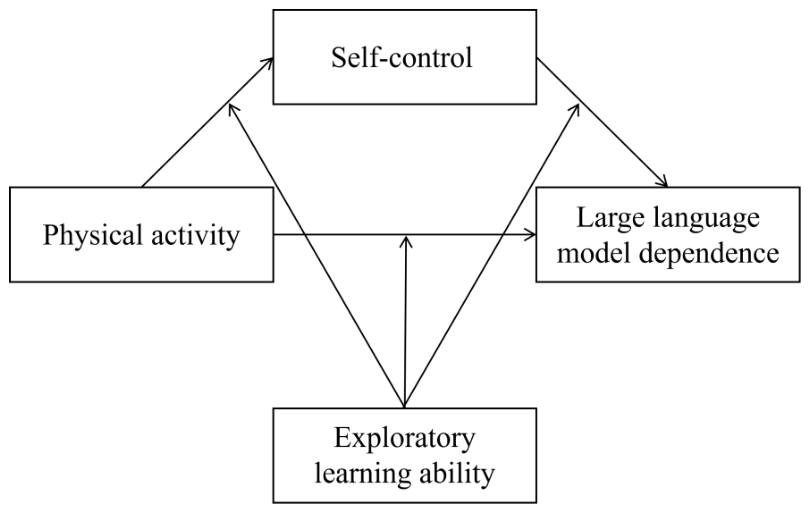
Figure 2.
The path coefficient results among main variables. *p<0.05; ***p<0.001.
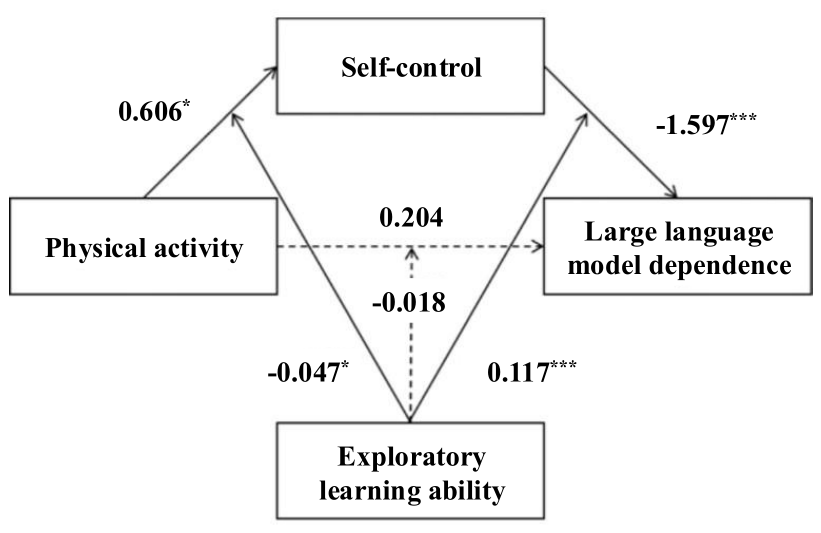
Figure 3.
Simple slope plot depicting the moderating effect of exploratory learning ability on the relationship between physical activity and self-control.
Figure 3.
Simple slope plot depicting the moderating effect of exploratory learning ability on the relationship between physical activity and self-control.
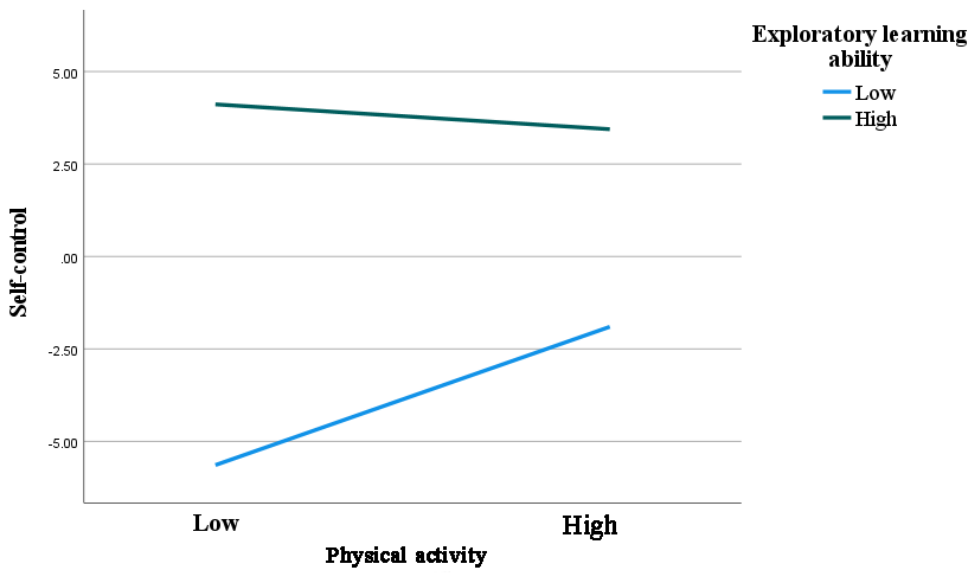
Figure 4.
Simple slope plot depicting the moderating effect of exploratory learning ability on the relationship between self-control and large language model dependence.
Figure 4.
Simple slope plot depicting the moderating effect of exploratory learning ability on the relationship between self-control and large language model dependence.
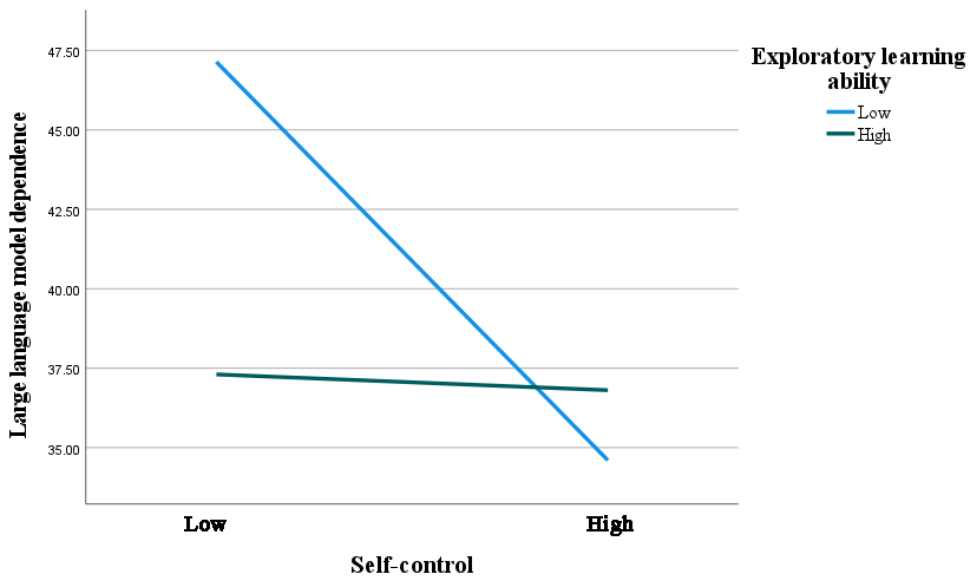

Table 1.
Descriptive statistics and correlation analysis among main variables.
| Variables | M | SD | 1 | 2 | 3 | 4 |
|---|---|---|---|---|---|---|
| 1.Physical activity | 15.51 | 12.60 | 1 | |||
| 2.Self-control | 65.87 | 13.77 | 0.455*** | 1 | ||
| 3.Large language model dependence | 39.79 | 15.09 | -0.137** | -0.332*** | 1 | |
| 4.Exploratory learning ability | 11.66 | 1.87 | 0.085 | 0.275*** | -0.250*** | 1 |
**p<0.01; ***p<0.001.
Table 2.
Testing for moderated mediation effects.
| Outcome variable | Predictive variable | Overall fit index | Significance of regression coefficient | ||||
|---|---|---|---|---|---|---|---|
| R | R2 | F | B | SE | t | ||
| Self-control | Gender | 0.296 | 0.088 | 9.531*** | -1.219 | 1.082 | -1.127 |
| Age | -0.781 | 1.441 | -0.542 | ||||
| Grade | 1.421 | 2.093 | 0.678 | ||||
| Physical activity | 0.606 | 0.278 | 2.179* | ||||
| Exploratory learning ability | 2.738 | 0.452 | 6.062*** | ||||
| PA×ELA | -0.047 | 0.023 | -1.993* | ||||
| Large language model dependence | Gender | 0.442 | 0.196 | 18.025*** | -0.367 | 1.116 | -0.329 |
| Age | -2.439 | 1.484 | -1.643 | ||||
| Grade | 2.588 | 2.157 | 1.201 | ||||
| Physical activity | 0.204 | 0.292 | 0.699 | ||||
| Exploratory learning ability | -8.421 | 1.259 | -6.688*** | ||||
| PA×ELA | -0.018 | 0.025 | -0.743 | ||||
| Self-control | -1.597 | 0.219 | -7.308*** | ||||
| SC×ELA | 0.117 | 0.019 | 5.999*** | ||||
PA = Physical activity; ELA = Exploratory learning ability; SC = Self-control; *p<0.05; **p<0.01; ***p<0.001.
Disclaimer/Publisher’s Note: The statements, opinions and data contained in all publications are solely those of the individual author(s) and contributor(s) and not of MDPI and/or the editor(s). MDPI and/or the editor(s) disclaim responsibility for any injury to people or property resulting from any ideas, methods, instructions or products referred to in the content. |
© 2026 by the authors. Licensee MDPI, Basel, Switzerland. This article is an open access article distributed under the terms and conditions of the Creative Commons Attribution (CC BY) license.
Copyright: This open access article is published under a Creative Commons CC BY 4.0 license, which permit the free download, distribution, and reuse, provided that the author and preprint are cited in any reuse.