

Submitted:
29 August 2026
Posted:
31 August 2026
You are already at the latest version
Abstract
Disasters are often identified by the hazard that occurs immediately before them. However, hazard occurrence alone does not explain why similar events result in vastly different human, economic, institutional, and infrastructural impacts. This comprehensive review synthesizes evidence on the fundamental causes and drivers that transform hazards into disasters, emphasizing factors like structural vulnerability, inequality, governance, development trajectories, urbanization and land use, environmental degradation, climate-related hazard modification, preparedness and risk communication, critical-infrastructure interdependencies, and systemic and cascading risks. The study employed a systematic integrative review design with PRISMA-informed reporting and a multi-source literature search covering 2000-2026, while including essential earlier works. The final collection includes 174 sources: 165 contribute to the core synthesis, and nine support review methodology and reporting. Evidence was categorized by causal depth and strength, from theoretical ideas and qualitative mechanisms to observational data, longitudinal and comparative studies, stronger causal links, and mechanistic models. Findings show that disaster risk results from interacting pathways rather than single factors. Inequality and low human development lead to uneven losses; governance influences structural pressures through regulation, investment, services, coordination, and accountability; urban development that ignores risk increases exposure; climate change alters hazard conditions and heightens vulnerability; preparedness depends on efficacy, trust, communication, social capital, and resources; and infrastructure interdependencies can create secondary vulnerabilities far beyond exposed areas. The review introduces an Integrated Multi-Level Model of Disaster Causation and Risk Creation, structured along two axes: causal depth—ranging from root causes to immediate vulnerability—and propagation—from initial triggers through cascading, compound, and feedback mechanisms. It highlights potential intervention points—prospective, corrective, systemic, and transformative—and offers an evidence-based framework for disaster risk governance.
Keywords:
disaster causation
; disaster risk creation
; structural vulnerability
; risk governance
; systemic risk
; cascading risk
; exposure
; political economy
; disaster resilience
; disaster risk reduction
1. Introduction
Traditionally, disasters are described as immediate physical events such as earthquakes, floods, droughts, cyclones, wildfires, landslides, or technological failures. However, decades of disaster research have challenged the idea that an extreme natural or technological event automatically causes a disaster. Instead, disasters result from interactions between hazards and long-standing conditions of exposure, vulnerability, and limited capacity (Wisner, Blaikie, Cannon, & Davis, 2004; Oliver-Smith, Alcántara-Ayala, Burton, & Lavell, 2017). In this view, a hazard is a potentially damaging process or event. At the same time, a disaster occurs when such a hazard interacts with exposed and vulnerable social, economic, institutional, infrastructural, and environmental systems (Wisner et al., 2004; Oliver-Smith et al., 2017).
This conceptual distinction strongly influences how disaster causation is analyzed. Although the size of a hazard influences the severity of the physical effects, it on its own cannot explain the large differences in mortality, economic loss, displacement, recovery paths, or long-term social effects that are seen among different areas and population groups (Cutter, Boruff, & Shirley, 2003; Wisner et al., 2004). Studies concerning social vulnerability show that demographic, socioeconomic, infrastructural, and institutional factors influence the ability of individuals and communities to anticipate, withstand, respond to, and recover from hazardous events (Cutter et al., 2003). Disaster outcomes should therefore be seen as the result of the interaction between hazardous processes and various societal conditions, not as entirely natural or solely social phenomena (Oliver-Smith et al., 2017; Wisner et al., 2004).
The shift from hazard-focused explanations to vulnerability-based explanations represents a major theoretical change in the study of disasters. According to the Pressure and Release (PAR) model, disaster risk is a process in which underlying causes create dynamic pressures that lead to unsafe conditions, which have serious consequences when they meet hazards (Wisner et al., 2004). In this approach, underlying causes include historically established distributions of power and resources, existing political and economic systems, and patterns of access that operate at spatial and temporal scales far removed from the actual disaster event (Wisner et al., 2004). Dynamic pressures convert these structural processes into more immediate conditions through mechanisms such as rapid urbanization, weak institutions, poor training, population changes, inappropriate development, and environmental deterioration. Unsafe conditions include fragile livelihoods, hazardous locations, inadequate buildings, weak preparedness, and a lack of protection (Wisner et al., 2004).
The analytical value of this approach lies in directing attention beyond immediately visible vulnerability indicators toward the processes that produce those vulnerabilities. Poverty, for example, may be strongly associated with disaster losses, yet describing poverty as a root cause without examining the political-economic mechanisms that generate and reproduce it risks turning causal analysis into descriptive classification (Ribot, 2014; Lewis & Kelman, 2012). Similarly, inadequate housing, limited preparedness, weak social protection, or insufficient institutional capacity can be understood as proximate manifestations of longer causal chains rather than independent causes whose origins require no further explanation (Ribot, 2014). Causal vulnerability analysis therefore asks not only whether people lack assets, capacities, or protection, but also why such resources are unavailable, which institutions structure access to them, and which political and economic arrangements reproduce these inequalities over time (Ribot, 2014).
This perspective is closely connected to the concept of disaster risk creation, which shifts attention from reducing already-existing risks toward understanding how development processes continuously generate new forms of exposure and vulnerability (Lewis & Kelman, 2012). Lewis and Kelman (2012) identified environmental degradation, discrimination, displacement, unequal access to resources, corruption, inappropriate public expenditure, and misuse of political or commercial power among processes capable of producing and perpetuating vulnerability. From this perspective, risk is not simply an external condition to be managed after it emerges; it may be produced endogenously through decisions concerning development, investment, land use, infrastructure, housing, resource allocation, and governance (Lewis & Kelman, 2012; Oliver-Smith et al., 2017).
Disaster-forensics research has since sought to make these causal chains more explicit. Fraser, Paterson, and Pelling (2016) reviewed approaches associated with Forensic Investigations of disasters (FORIN). They developed the PEARL Risk Root Cause Analysis framework to connect historical trajectories, governance processes, disaster risk creation, and contemporary risk conditions. Their analysis emphasized that disaster causation requires interdisciplinary investigation capable of tracing how historical and institutional processes become embedded in present-day exposure and vulnerability (Fraser et al., 2016). The framework also positions governance as a potentially constitutive element of risk creation rather than merely a mechanism for managing risks that already exist (Fraser et al., 2016).
Comparative empirical research confirms the significance of these cross-scale causal pathways. Fraser, Pelling, Scolobig, and Mavrogenis (2020), in their analysis of urban flood-risk situations in Rethymno, Genoa, and St Maarten, found that local institutions play a role in mediating the impact of economic and political processes that are both in space and time away from the local area on current risk conditions. The study linked institutional reform and austerity-related processes to local disaster-risk trends, showing that structural factors do not operate mechanically but instead function through specific institutional pathways (Fraser et al., 2020). This result is particularly important for disaster-causation theory because it implies that explanations must account for both macro-level structural processes and the meso-level institutions through which those processes translate into local vulnerability and exposure (Fraser et al., 2020).
Governance consequently occupies a central but analytically complex position in disaster causation. Disaster governance is embedded within broader societal governance arrangements involving state capacity, state-civil society relations, economic organization, public policy, institutional coordination, accountability, and resource allocation (Tierney, 2012). Governance systems are frequently polycentric and multilevel, and their performance varies across prevention, preparedness, response, recovery, and reconstruction (Tierney, 2012). Weak institutional coordination, limited accountability, fragmented responsibilities, ineffective regulatory enforcement, and inadequate integration of risk into development planning can therefore contribute to risk accumulation well before a hazardous event occurs (Tierney, 2012; Fraser et al., 2020).
The link between governance and urban development clearly shows how disaster risk is socially constructed. While urbanization alone does not necessarily cause disasters, certain development paths can cluster people and assets in dangerous areas, perpetuate unequal access to safe housing and services, harm the environment, and heighten reliance on complex infrastructure (Poudel et al., 2023). Studies in the Kathmandu Valley reveal how neoliberal development pressures, internal migration, uneven planning, and government-led initiatives can combine to create chaotic urban growth, with disproportionately negative impacts on marginalized groups (Poudel et al., 2023). This evidence suggests that the key question is not just whether urbanization increases risk, but how different urbanization patterns, under various governance structures, shift exposure and vulnerability toward specific social groups (Poudel et al., 2023).
Social vulnerability research has substantially improved the capacity to identify such differentiated conditions. Cutter, Boruff, and Shirley (2003), for example, developed the Social Vulnerability Index (SoVI) using socioeconomic and demographic variables to examine spatial variations in vulnerability to environmental hazards. The resulting tradition of composite vulnerability indices has become influential in disaster-risk assessment, spatial planning, and resource prioritization (Cutter et al., 2003; Painter et al., 2024). However, the expansion of quantitative vulnerability assessment has also generated methodological concerns regarding indicator selection, transferability across geographic contexts, weighting procedures, theoretical grounding, and the extent to which indices identify causal mechanisms rather than merely spatially correlated conditions (Painter et al., 2024).
A recent systematic scoping review offers strong evidence supporting this concern. Painter et al. (2024) analyzed 246 peer-reviewed studies that used Social Vulnerability Indices across 20 hazard and disaster contexts in 91 countries. They found significant methodological replication despite diverse settings. The review showed that 81% of the studies used indicators or theories from existing vulnerability indices, 94% relied solely on quantitative and/or spatial methods, and 76% did not include validation or ground-truthing procedures (Painter et al., 2024). These results highlight a key distinction: mapping vulnerability spatially does not necessarily explain its causal origins. While maps may be technically detailed, they do not always clarify why certain groups or locations became vulnerable in the first place (Painter et al., 2024; Ribot, 2014).
Resilience in communities also follows a similar distinction. Resilience frameworks have expanded disaster analysis beyond vulnerability by including capacities related to social networks, institutions, infrastructure, economic resources, learning, adaptation, and recovery (Cutter et al., 2008). For example, the Disaster Resilience of Place (DROP) model views community resilience as a place-based outcome influenced by prior conditions, disaster impacts, and adaptive processes rather than a fixed trait (Cutter et al., 2008). This broader view benefits disaster-causation research by highlighting how weak or uneven resilience capacities can shape the translation of pre-existing vulnerabilities into losses and how post-disaster recovery can either mitigate or reinforce future risks (Cutter et al., 2008; Tierney & Oliver-Smith, 2012). Recent studies from Serbia also reveal that resilience includes diverse institutional and social aspects rather than a single, uniform capacity. Cvetković, Milenković, Bašić, Lukić, and Renner (2026) surveyed 1,200 adults across 22 local government units and found weaker perceived capacities in areas such as budget allocation, early warning systems, decision-making speed, evacuation, and shelter readiness, despite stronger evaluations of social and household factors. These results indicate that institutional challenges can coexist with social resources, emphasizing the importance of distinguishing the mechanisms through which vulnerability and resilience influence disaster outcomes.
Climate change complicates disaster-causation analysis by altering hazard components and interacting with existing vulnerability and exposure patterns. Framing disasters mainly as a result of climate change can overlook social, political, and economic factors that influence who is exposed, who has adaptive resources, and who is protected by institutions (Ribot, 2014). Instead, climate change is better understood, depending on the context, as a hazard modifier, risk multiplier, or amplifier of current vulnerabilities, rather than as a sole cause of disaster.
Recent extensive empirical research reinforces this point. Teber, Sippel, Krause, Zscheischler, and Mahecha (2026) examined over 7,000 climate-related disasters from 1990 to 2020 and found that societal development and inequality significantly influenced disaster mortality patterns. Populations in lower human-development areas suffered disproportionately higher losses, and within-country disparities further increased disaster risks in low- and medium-development regions (Teber et al., 2026). These results provide quantitative evidence that hazard intensity alone cannot explain disaster outcomes, with social and developmental factors remaining key elements of risk.
Contemporary societies exhibit higher levels of infrastructural, technological, economic, and informational interdependence than earlier vulnerability models suggested. Networks of electricity, telecommunications, water, transport, health services, finance, digital infrastructure, and supply chains are interconnected, so a disruption in one area can cause widespread functional losses even in sectors that remain physically undamaged (Pescaroli & Alexander, 2016, 2018). As a result, disaster effects can extend beyond the initial hazard zone through indirect dependencies and cascading failures, indicating that the spatial extent of physical exposure does not fully capture societal impact.
Empirical research on infrastructure reveals the significant potential impacts of interconnected failures. Mühlhofer, Bresch, and Koks (2024) examined historical flood and tropical cyclone events, demonstrating that cascading failures can greatly expand service disruptions beyond the areas directly affected by the hazard. Their study supports shifting focus from asset-specific risk assessments to evaluating networked service systems and infrastructure interdependencies (Mühlhofer et al., 2024). This is crucial because a facility that remains physically intact might still fail due to disruptions elsewhere in the system, indicating that systemic vulnerability cannot be understood solely through direct physical damage (Mühlhofer et al., 2024).
These insights have fueled the concept of systemic risk, which pertains to interconnected systems characterized by tight coupling, non-linear responses, cascading effects, cross-sector propagation, tipping points, and governance issues that often surpass traditional sector-specific risk management. In disaster scenarios, systemic-risk analysis highlights how infrastructure vulnerability, economic dependencies, institutional frameworks, behavioral responses, and technological networks can either magnify or mitigate the impacts of hazardous events (Schweizer & Renn, 2019). To comprehend modern disaster causation effectively, it is essential to consider not only pre-event vulnerabilities but also the mechanisms by which disruptions spread following an initial trigger (Schweizer & Renn, 2019).
Related concepts like compound, interconnected, interacting, and cascading risks should not be used interchangeably. Pescaroli and Alexander (2018) showed that these terms refer to overlapping yet distinct types of complexity. They argued that confusing these terms can hinder scientific understanding and risk management. Compound risk involves the combined effects of multiple hazards or stressors; interacting risks refer to how risks influence each other reciprocally; interconnected risks emphasize dependencies across different systems; and cascading processes describe sequences where primary impacts lead to secondary and higher-order effects (Pescaroli & Alexander, 2018). A thorough review of disaster causes must therefore distinguish these processes rather than lumping all complexity under a single label of systemic risk (Pescaroli & Alexander, 2018).
Overall, these bodies of literature highlight significant theoretical progress but remain fragmented. The vulnerability and political-ecology traditions offer compelling insights into inequality, access, power, and systemic roots (Ribot, 2014; Wisner et al., 2004). Disaster-governance studies clarify how institutions, authority, coordination, regulation, and accountability influence risk management (Tierney, 2012; Fraser et al., 2020). Resilience research focuses on the capacities that enable communities and systems to withstand, adapt to, and recover from disruptions (Cutter et al., 2008). Meanwhile, infrastructure and systemic-risk research increasingly explore how impacts spread through interconnected social and technological systems (Pescaroli & Alexander, 2018; Schweizer & Renn, 2019).
However, these traditions seldom integrate into a comprehensive causal framework that can trace the entire trajectory from deep structural conditions, through risk-generating development and governance, to immediate vulnerability, systemic amplification, hazard interactions, and feedback loops that shape future risks (Fraser et al., 2016; Oliver-Smith et al., 2017). Vulnerability assessments often identify who or where is vulnerable but do not fully explain the origins of vulnerability. Likewise, systemic-risk studies may describe how impacts propagate after a disruption without fully considering the social conditions that historically made systems fragile and unequal (Painter et al., 2024; Ribot, 2014; Schweizer & Renn, 2019). This separation hampers the development of an integrated theory of disaster causation.
This systematic integrative review posits that disaster causation should be seen as a multi-level, temporally extended, and interconnected process rather than a simple linear relationship between hazard and loss. This perspective necessitates considering multiple factors simultaneously, including political-economic conditions, development paths, governance, social vulnerability, exposure, environmental changes, preparedness, adaptive capacities, technological dependencies, and cascading or compounded processes (Fraser et al., 2016; Pescaroli & Alexander, 2018; Wisner et al., 2004). Additionally, the framework should differentiate between how often a driver appears in the literature and the strength of the empirical evidence supporting its role in a causal mechanism.
1.1. Aim and Objectives
The primary aim of this study is to systematically identify, classify, and critically synthesize the scientific evidence concerning the underlying causes and drivers of disasters and to develop an integrated, evidence-based model of disaster causation and risk creation.
The study specifically aims to identify how factors such as structural political-economic conditions, socioeconomic inequality, governance, institutional arrangements, development and urbanization processes, environmental changes, climate factors, preparedness, adaptive capacity, dependencies on critical infrastructure, and systemic interactions contribute to the creation and intensification of disaster risk. This focus builds on the call for disaster research to shift from merely describing vulnerability to reconstructing the causal pathways that lead to vulnerability, exposure, and systemic fragility (Fraser et al., 2016; Ribot, 2014).
The study also aims to differentiate between root causes, intermediate risk drivers, proximate vulnerability conditions, hazard modifiers, immediate triggers, and systemic amplifiers. This distinction is crucial because treating all variables related to disaster losses as equivalent causes can hide differences in their depth, timing, and influence mechanisms (Fraser et al., 2016; Wisner et al., 2004). Furthermore, the review seeks to determine whether current research supports expanding traditional vulnerability models to include a framework that captures both the social processes behind disaster risk development before a hazard occurs and the interconnected spread of effects following an initiating event (Oliver-Smith et al., 2017; Pescaroli & Alexander, 2018).
1.2. Research Questions
RQ1. Which structural root causes, risk drivers, and vulnerability factors are most consistently identified in the scientific literature on disaster causation?
RQ2. How do various frameworks, such as vulnerability theory, political ecology, the Pressure and Release model, disaster-risk creation, disaster governance, resilience theory, and systemic-risk approaches, conceptualize the causal production of disaster risk?
RQ3. In what ways has scientific understanding of disaster causation shifted from a focus on hazards to perspectives emphasizing vulnerability, governance, and systemic risk?
RQ4. Through which mechanisms do socioeconomic, institutional, environmental, climate-related, spatial, technological, behavioral, and infrastructural drivers interact and reinforce each other?
RQ5. What kinds and levels of empirical evidence support the main proposed disaster-risk drivers, and how well does the literature distinguish correlation from causation?
RQ6. How can this evidence be integrated into a comprehensive multi-level model that links root causes, risk-generating processes, vulnerability, exposure, systemic interdependencies, hazards, cascading effects, disaster impacts, and ongoing risk accumulation?
1.3. Theoretical and Conceptual Background
1.3.1. From Hazard-Centred Explanations to the Social Production of Disaster Risk
Early hazard and disaster studies initially focused on extreme physical events as the main cause, often viewing societal factors as secondary modifiers of impact (Hewitt, 1983; Wisner et al., 2004). Over time, vulnerability research challenged this view by showing that hazard features alone cannot fully explain disaster losses. For example, factors such as exposure, resource access, social inequality, institutional structures, and coping abilities vary widely across populations and locations (Cutter, Mitchell, & Scott, 2000; Wisner et al., 2004).
This shift did not eliminate physical hazard analysis. However, it redefined disaster risk as the interaction between environmental or technological processes and socially differentiated conditions, which determine whether an event becomes highly disruptive (Oliver-Smith et al., 2017; Wisner et al., 2004). Thus, a hazard is just one part of disaster causation. Furthermore, the severity of impacts depends on how that hazard interacts with exposure, vulnerability, and systems’ capacity to anticipate, withstand, respond to, and recover from disruptions (Cutter et al., 2008; Oliver-Smith et al., 2017).
Understanding this distinction is crucial because communities exposed to similar hazards may face very different outcomes. For instance, Cutter, Mitchell, and Scott (2000) found that high biophysical exposure does not always align spatially with populations most socially vulnerable, showing that hazard exposure and societal susceptibility are related but separate risk factors. They also demonstrated that wealthier populations with stronger institutional safety nets tend to recover more effectively from physical losses than socially vulnerable groups affected by less severe events (Cutter et al., 2000).
The move toward socially based explanations has lengthened the timeframe considered in disaster analysis. Rather than starting causal investigations at the moment of hazard occurrence, vulnerability-focused approaches examine processes unfolding years or even decades beforehand, such as development decisions, settlement patterns, economic marginalization, institutional shifts, environmental decline, and unequal access to protective resources (Ribot, 2014; Wisner et al., 2004). Therefore, disasters can be seen as the outcome of risk conditions that develop gradually over time rather than as isolated incidents (Oliver-Smith et al., 2017).
The social-construction viewpoint explicitly emphasizes this. Oliver-Smith et al. (2017) described disaster risk as socially constructed through development activities, institutional policies, and unequal relationships between societies and their environments. This perspective highlights that understanding the root causes is essential in disaster research because focusing only on the immediate event offers an incomplete picture of what causes disasters (Oliver-Smith et al., 2017).
Recent disaster studies reinforce this view by arguing that disasters result from ongoing social processes that produce and sustain vulnerability, exposure, power disparities, and limitations on coping abilities (Wisner, Alcántara-Ayala, Gaillard, Kelman, & Marchezini, 2025). These approaches expand the traditional vulnerability paradigm by linking current risk conditions to historical development, policies, and institutional decisions (Wisner et al., 2025).
1.3.2. Pressure and Release, Root Causes, and Political Ecology
The Pressure and Release model is a key framework for understanding how disasters develop, organizing causes into a clear sequence (Wisner et al., 2004). It depicts vulnerability as progressing from root causes, through dynamic pressures, to unsafe conditions, which interact with hazards to create disaster risk (Wisner et al., 2004). Root causes are long-term political, economic, demographic, and institutional factors that influence access to power, resources, assets, and opportunities (Wisner et al., 2004).
Dynamic pressures are the immediate processes that convert these structural issues into potential risks, such as rapid urban growth, population shifts, poor institutions, environmental damage, harmful development practices, lack of training, and limited local investment (Wisner et al., 2004). Unsafe conditions are the local expressions of these pressures, including hazardous settlement areas, fragile livelihoods, vulnerable buildings, inadequate preparedness, and weak protective measures (Wisner et al., 2004).
This distinction is crucial in this review because it prevents viewing all observable vulnerability indicators as equally causal. For instance, unsafe housing is seen as a proximate condition, while weak enforcement of construction standards may be an institutional driver. Broader inequalities in access to formal housing markets could represent a deeper structural mechanism (Ribot, 2014; Wisner et al., 2004).
Political-ecology approaches build on this by exploring how power dynamics, development policies, environmental changes, resource access, and institutional decisions shape uneven risk distributions (Collins, 2008; Ribot, 2014). They challenge the idea that environmental hazards are purely neutral physical events whose impacts depend mainly on proximity or exposure (Collins, 2008). Instead, they analyze how social groups have different abilities to avoid, transfer, or manage risk through political and economic institutions (Collins, 2008).
Ribot (2014) also emphasizes that causal analysis should go beyond merely identifying immediate vulnerability factors. Instead, it should explore why households or communities lack assets, public services, social protection, or political influence. From this viewpoint, inadequate adaptive capacity is considered an outcome that needs explanation rather than just a final cause (Ribot, 2014).
Empirical research utilizing political-ecology and root-cause approaches demonstrates the value of this perspective. For instance, studies on recurring El Niño-related disasters in Peru highlight how centralization, institutional fragmentation, sectoral divisions, and corruption contribute to ongoing disaster risk, even when forecasting and disaster management have improved (French, Mechler, Arestegui, MacClune, & Cisneros, 2020). This illustrates that technical hazard knowledge alone does not remove disaster risk if institutional and political factors continue to generate vulnerability and exposure (French et al., 2020).
1.3.3. Disaster Risk Creation and Risk Accumulation
The idea of disaster risk creation extends vulnerability theory by shifting focus from managing existing risks to understanding how new risks are continually generated. Traditional disaster risk reduction often becomes mainly corrective when it targets existing vulnerabilities. In contrast, risk-creation approaches explore how planning, investment, development, governance, and resource distribution can create new exposure and vulnerability from the outset.
Lewis and Kelman (2012) outline several processes that produce or sustain vulnerability, such as environmental degradation, discrimination, displacement, resource denial, corruption, misallocation of funds, and diverting resources from risk reduction. These show that disaster risk can arise from ordinary social and economic activities, not just exceptional crises. Similarly, Tierney (2014) argues that disaster risk is embedded in social institutions, economic priorities, regulations, and organizational practices.
Decisions that promote development in risky areas, weaken oversight, transfer risk to less powerful groups, or favor short-term economic gain can socially produce disaster risk. Risk creation also has a temporal aspect, as current development choices can lock societies into future risk paths through infrastructure lifespan, settlement growth, environmental changes, institutional inertia, and social inequality. This supports including feedback effects in the conceptual model, since disaster impacts, recovery, and rebuilding can change the conditions that give rise to new risks.
1.3.4. Social Vulnerability: From Conceptual Explanation to Measurement
Social vulnerability broadly encompasses society-shaped characteristics that affect how susceptible individuals are to harm and their ability to predict, respond to, and recover from hazards (Cutter et al., 2003). This concept highlights factors such as socioeconomic status, age, gender, household composition, health, race or ethnicity, housing conditions, transportation access, institutional support, and social networks. Nonetheless, the importance and influence of these indicators vary by context and hazard (Cutter et al., 2003; Fatemi, Ardalan, Aguirre, Mansouri, & Mohammadfam, 2017).
Place-based vulnerability research highlights that social and biophysical vulnerabilities vary spatially and do not necessarily overlap geographically (Cutter et al., 2000). This matters because regions with high physical exposure may have strong financial, infrastructural, and institutional resources. At the same time, areas with moderate hazard levels can experience severe disruptions due to high social vulnerability (Cutter et al., 2000).
Additionally, social vulnerability is not static; it evolves. Cutter and Finch (2008), who studied U.S. counties from 1960 to 2000, observed notable spatial and temporal shifts in vulnerability. They showed that changes in demographic, socioeconomic, and settlement patterns influence where vulnerability is located over time. Therefore, vulnerability indicators developed for one period or place may not be applicable under different demographic, institutional, or economic circumstances (Cutter & Finch, 2008).
The development of the Social Vulnerability Index was an important effort to operationalize this multidimensional concept using standardized quantitative indicators (Cutter et al., 2003). SoVI subsequently became widely used in hazard and disaster research and increasingly informed practical assessments of unequal risk and recovery capacity (Cutter, 2024). However, greater operationalization has created a tension between measurement and explanation: composite indices can identify where socially vulnerable populations are concentrated, but they may not reconstruct the causal processes by which socioeconomic, political, institutional, or historical conditions produced that vulnerability (Painter et al., 2024; Ribot, 2014).
1.3.5. Disaster Governance and Institutional Mediation
Governance provides the primary institutional arena through which many structural drivers are translated into concrete patterns of exposure, vulnerability, and capacity. Disaster governance encompasses the networks of actors, formal and informal institutions, rules, authority structures, decision-making processes, and resource arrangements involved in managing disaster risk across scales and phases (Tierney, 2012).
Disaster governance is not independent of broader societal governance. Tierney (2012) argues that disaster-governance arrangements are nested within broader political, economic, and social systems and are shaped by globalization, inequality, state capacity, state-civil society relationships, demographic trends, and institutional configurations. This embeddedness explains why formally similar disaster-management institutions can produce different outcomes across countries or regions (Tierney, 2012).
Institutions also mediate the transmission of deeper structural processes to local conditions. Fraser et al. (2020) demonstrated that higher-level political and economic changes can affect local disaster risk through institutional pathways, showing that institutions are not simply independent determinants placed between structure and outcome but active mediators of causal processes.
The systemic-risk literature further expands the role of governance because interconnected risks frequently cross jurisdictional, sectoral, and organizational boundaries. Schweizer and Renn (2019) argue that systemic risks are characterized by complexity, interdependence, cascading consequences, non-linear development, and regulatory challenges that conventional sector-specific governance arrangements may be poorly equipped to manage.
1.3.6. Resilience, Capacity, and the Risk of Conceptual Conflation
Resilience has become increasingly prominent in disaster research and policy as attention has shifted from vulnerability and loss to the capacity of communities and systems to withstand, adapt to, and recover from disruption (Cutter et al., 2008). However, the concept has taken on multiple meanings across engineering, ecological, social, institutional, and community-based traditions, leading to substantial variation in its definition and measurement (Cutter, 2016; Graveline & Germain, 2022).
Cutter (2016) emphasizes that questions of resilience to what and resilience for whom are essential, because the meaning and desirability of resilience depend on the hazard, system, population, scale, and outcomes under consideration. A system may recover rapidly in functional terms while reproducing pre-existing inequalities or returning vulnerable groups to unsafe conditions (Tierney, 2015).
Resilience should therefore not be assumed to be the simple inverse of vulnerability. Empirical comparisons of SoVI and BRIC measures found limited overlap between social vulnerability and community-resilience measures across U.S. counties, indicating that the two concepts capture related but non-identical dimensions of disaster risk and capacity (Derakhshan, Emrich, & Cutter, 2022).
Resilience should also be treated dynamically. Yabe, Rao, Ukkusuri, and Cutter (2022) argue that static resilience indicators are limited in capturing compounding shocks, recovery trajectories, system interdependencies, and critical transitions. This dynamic understanding is compatible with the feedback structure proposed in the present review because post-disaster adaptation, institutional learning, rebuilding, and social reorganization can either strengthen future resilience or reproduce pre-existing vulnerabilities.
1.3.7. Critical Infrastructure, Cascading Disasters, and Systemic Risk
The growing interdependence of modern infrastructure and social systems creates mechanisms of disaster amplification that traditional vulnerability models do not fully capture. Electricity, communications, transport, water, health services, digital networks, and supply chains operate through functional dependencies, in which the disruption of one component can impair otherwise physically undamaged systems (Pescaroli & Alexander, 2016, 2018).
Pescaroli and Alexander (2016) argued that cascading disasters should not be understood solely through a linear domino metaphor. Instead, infrastructure vulnerability and societal feedback mechanisms can shape how disruption escalates across interconnected systems. This perspective alters the causal status of critical infrastructure because pre-existing interdependencies, lack of redundancy, concentration of critical functions, insufficient backup capacity, and organizational fragmentation can amplify disaster consequences (Pescaroli & Alexander, 2016).
Pescaroli and Alexander (2018) subsequently distinguished compound, interconnected, interacting, and cascading risks and argued that terminological ambiguity can undermine both scientific analysis and risk-management practice. Systemic risk provides a broader framework for these processes: systemic risks arise in complex, tightly coupled systems and may involve cascading consequences, non-linear developments, tipping points, and challenges of perception and governance (Schweizer & Renn, 2019).
Recent disaster research increasingly recognizes this transition toward more complex risk landscapes. Pescaroli, Suppasri, and Galbusera (2024) identify a growing network-based and cross-disciplinary orientation in the study of systemic risk, cascading disasters, and compound events, reflecting the increasing relevance of technological networks, societal interdependencies, and climate-related dynamics.
1.3.8. Toward an Integrated Multi-Level Theory of Disaster Causation
The reviewed theoretical traditions do not offer mutually exclusive explanations of disaster causation. Rather, they often address different levels and stages of the same causal process. Political economy and political ecology primarily explain the structural production and unequal distribution of risk through power, resources, development, and institutional arrangements (Ribot, 2014; Wisner et al., 2004). The PAR model links these structural forces to dynamic pressures and unsafe local conditions (Wisner et al., 2004). Social-vulnerability approaches identify and operationalize characteristics associated with differential susceptibility and capacity (Cutter et al., 2003). Disaster-governance theory explains how institutional mediation, coordination, authority, and policy processes may reduce or reproduce risk (Tierney, 2012). Resilience frameworks focus on capacities to absorb, adapt, recover, and transform (Cutter et al., 2008; Graveline & Germain, 2022). Systemic-risk and cascading-disaster approaches explain how disruption propagates through interdependent systems after an initiating event (Pescaroli & Alexander, 2016, 2018; Schweizer & Renn, 2019).
Additional scholarship reinforces the value of integrating these analytical levels rather than treating vulnerability, capacity, perception, and spatial development as separate domains. Conceptual work on disaster and resilience highlights the importance of distinguishing the disruptive event itself from the capacities and processes that shape societal response, adaptation, and recovery (Alexander, 2013; Perry, 2018). At the societal and individual levels, socioeconomic vulnerability, risk perception, and the specific vulnerabilities and capacities of persons with disabilities show how susceptibility and protective capacity differ across populations rather than being uniformly distributed (Biswas, 2023; Cvetković & Planić, 2022; Jevtić et al., 2025). At the spatial and developmental level, research on informal and peri-urban development further demonstrates how settlement processes can materialize vulnerability and exposure within the built environment (Murao & Yamada, 2026). Taken together, these perspectives support a multi-level interpretation in which disaster risk emerges through the interaction of conceptual, social, behavioral, spatial, and developmental processes.
The principal theoretical problem is therefore not the absence of explanatory concepts but their fragmentation across disciplinary and analytical levels. Root-cause research often provides strong structural explanations but less detailed modeling of network propagation, whereas infrastructure and systemic-risk studies may offer sophisticated representations of cascading failures without adequately reconstructing the political-economic or historical processes through which systemic fragility emerged (Fraser, 2023; Pescaroli et al., 2024).
The present review consequently tests an integrated causal sequence consisting of eight analytically distinguishable but interacting levels: (1) Structural Root Causes; (2) Risk-Producing Governance and Development Processes; (3) Proximate Vulnerability and Exposure; (4) Systemic Interdependencies and Amplifiers; (5) Hazard or Immediate Trigger; (6) Cascading, Compound, and Non-Linear Propagation; (7) Disaster Consequences; and (8) Recovery, Feedback, and Future Risk Accumulation. The sequence is recursive rather than strictly linear because recovery, reconstruction, adaptation, and maladaptation can modify the structural, institutional, and proximate conditions that shape subsequent disaster risk.
2. Methods
2.1. Review Design and Reporting Framework
This study was designed as a systematic integrative review that combines structured literature discovery, critical appraisal, thematic synthesis, conceptual synthesis, and evidence-strength assessment. This approach was chosen because disaster causation spans several partly overlapping fields, such as vulnerability studies, political ecology, disaster governance, resilience research, climate-risk analysis, critical-infrastructure studies, and systemic risk scholarship. Systematic integrative reviewing is appropriate for such heterogeneous evidence because it permits transparent comparison of theoretical, qualitative, quantitative, longitudinal, and modeling studies while preserving differences in the kinds of causal inference they support (Petticrew & Roberts, 2006).
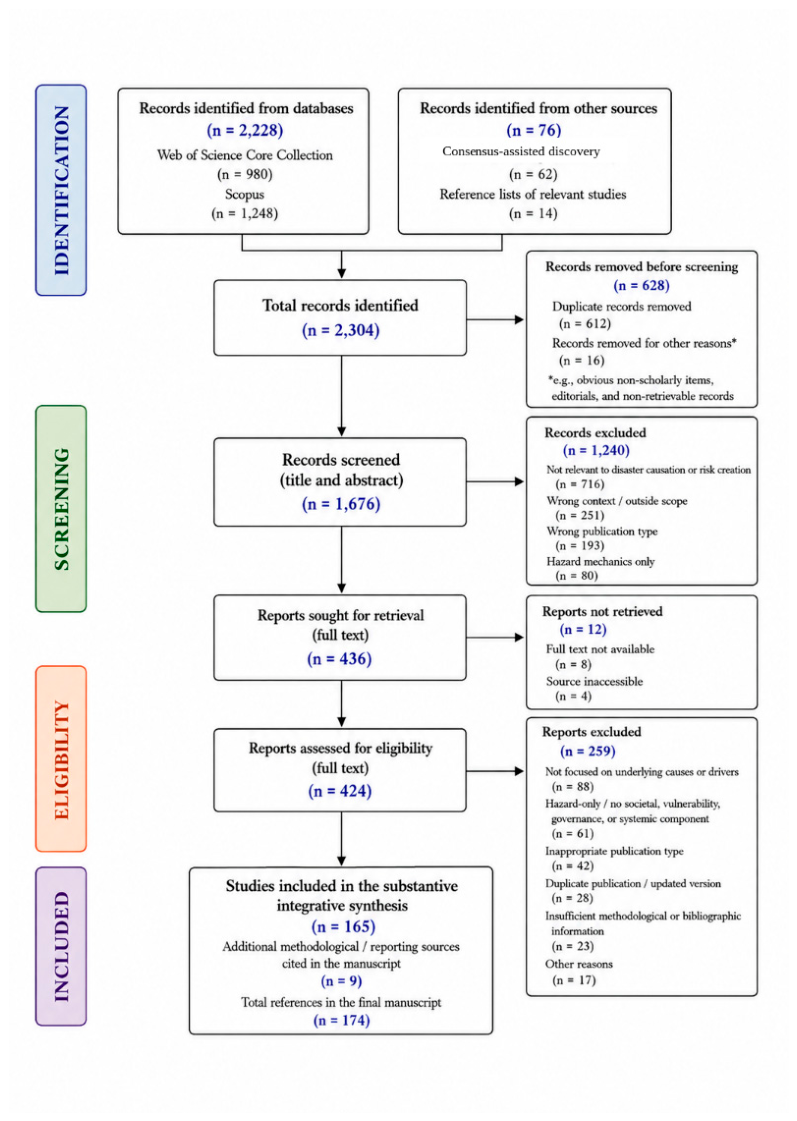
PRISMA 2020 and PRISMA-S informed the reporting logic for search transparency, eligibility criteria, screening decisions, and reproducibility (Page et al., 2021; Rethlefsen et al., 2021). For final reporting, the study-selection pathway was summarized using the documented search architecture, bibliographic screening procedures, supplementary discovery routes, deduplication process, eligibility decisions, and verified final evidence corpus. The resulting flow provides a transparent overview of the progression from literature identification to final inclusion.
Search reporting therefore documents the analytical period, thematic search families, database-specific replication strings, supplementary discovery procedures, eligibility criteria, evidence coding, and bibliographic verification. Scopus and Web of Science Core Collection constituted the principal database environments represented in the search architecture, complemented by Consensus-assisted discovery, DOI and publisher metadata, publicly accessible bibliographic records, backward and forward citation searches, and targeted searches of highly relevant journals and authors. We retained database-specific search strings to support transparency and reproducibility. For final reporting, we summarized the overall identification and screening pathway in the PRISMA 2020 flow diagram (Figure 2). The review combines quantitative and qualitative evidence because questions concerning disaster causation cannot be addressed adequately through a single methodological tradition. Structural drivers, institutional pathways, historical processes, risk perceptions, and governance mechanisms are frequently investigated using qualitative or mixed-methods designs. In contrast, social vulnerability, preparedness, disaster losses, resilience, and demographic predictors are often examined quantitatively (Petticrew & Roberts, 2006).
The review does not assume that all included publications provide equivalent evidence of causality. Conceptual papers, qualitative case studies, cross-sectional surveys, longitudinal studies, comparative analyses, and quasi-experimental designs support different levels of inference. Accordingly, the synthesis distinguishes theoretical propositions, qualitative mechanisms, statistical associations, temporal evidence, and stronger causal designs rather than treating all reported drivers as equally established causes (Figure 1).
Figure 1.
Research workflow for evidence identification, appraisal, synthesis, and development of the Integrated Multi-Level Model of Disaster Causation and Risk Creation.
Figure 1.
Research workflow for evidence identification, appraisal, synthesis, and development of the Integrated Multi-Level Model of Disaster Causation and Risk Creation.
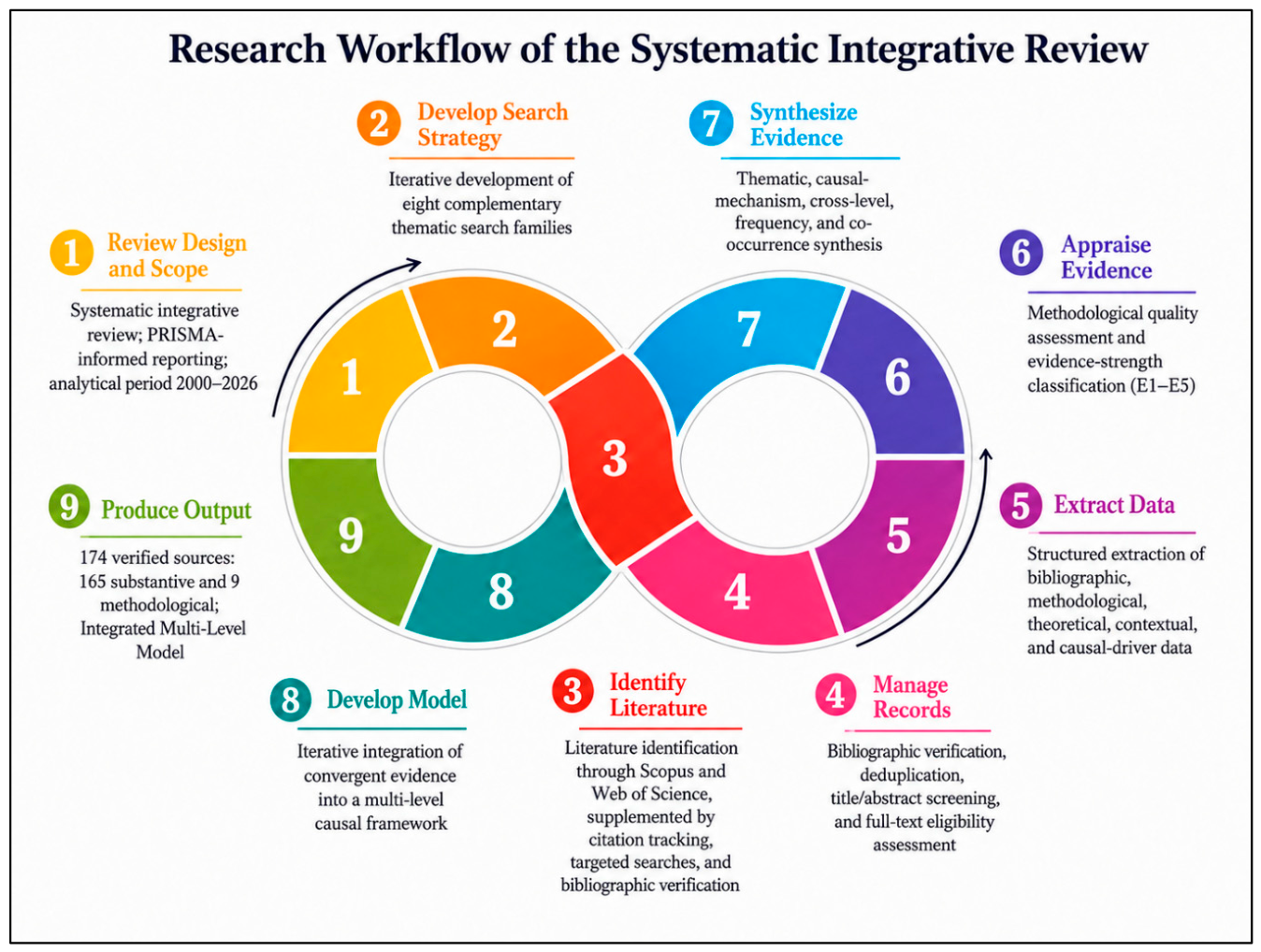
Figure 2.
PRISMA 2020 flow diagram of study identification, screening, eligibility, and inclusion.
2.2. Review Scope and Temporal Boundaries
The primary analytical period spans 1 January 2000 to 26 August 2026. This period was selected to capture contemporary developments in disaster-risk governance, social vulnerability, resilience, climate-risk research, multi-hazard analysis, critical-infrastructure interdependency, cascading disasters, and systemic risk.
Theoretically indispensable publications predating 2000 are retained through targeted searches, backward citation tracking, and theoretical reference chaining. This exception applies particularly to foundational literature on vulnerability theory, political ecology, the social production of disasters, the Pressure and Release model, access and entitlement, risk society, early resilience theory, and foundational hazard-society relationships.
The resulting design therefore combines a systematic contemporary search window with a purposeful seminal-literature component. This distinction is reported explicitly because including foundational literature outside the principal search period should be transparent and reproducible.
2.3. Information Sources
The search architecture was designed to be portable across Scopus, Web of Science Core Collection, and Consensus. Scopus and Web of Science remain important reference environments because their coverage varies by discipline, geography, language, and publication type, a material consideration for interdisciplinary disaster research (Mongeon & Paul-Hus, 2016).
In the final review workspace, Consensus served as the primary searchable scholarly discovery environment, supplemented by DOI and publisher metadata, publicly accessible bibliographic records, backward and forward citation searches, and targeted searches of highly relevant journals and authors. Scopus and Web of Science specific search strings were developed to enable transparent replication and cross-checking. Consensus is used to identify potentially relevant publications, reviews, terminology, and emerging research clusters. However, a Consensus result alone is not considered sufficient for bibliographic inclusion. Candidate publications must be independently verifiable through DOI metadata, publisher information, bibliographic databases, or comparable authoritative records.
2.4. Development of the Search Strategy
The search strategy was developed iteratively rather than by relying on one excessively broad Boolean expression. Developing reproducible systematic-review searches requires balancing sensitivity and specificity while adapting terminology and syntax across databases (Bramer, de Jonge, Rethlefsen, Mast, & Kleijnen, 2018).
A single search centered only on terms such as root cause or disaster causation would likely miss substantial parts of the literature in which similar processes are discussed under different disciplinary vocabularies, including social vulnerability, risk creation, institutional failure, political ecology, critical infrastructure, or systemic risk. For this reason, the search architecture consists of multiple complementary search families.

Table 1.
Conceptual search architecture: complementary search families and principal search concepts.
Table 1.
Conceptual search architecture: complementary search families and principal search concepts.
| Search family | Principal concepts |
| A. Disaster causation | disaster causation; root causes; underlying causes; structural drivers; risk drivers |
| B. Vulnerability and political economy | social vulnerability; structural vulnerability; inequality; poverty; marginalization; political ecology |
| C. Governance | disaster governance; risk governance; institutional failure; institutional capacity; coordination; corruption |
| D. Development and spatial processes | urbanization; informal settlements; land use; housing; spatial planning; development pathways |
| E. Environment and climate | environmental degradation; climate risk; climate change; vulnerability; exposure; adaptation |
| F. Critical infrastructure | infrastructure interdependency; network failure; energy; transport; water; communication; supply chains |
| G. Complex risk | systemic risk; cascading risk; compound risk; interconnected risk; interacting risk; multi-hazard |
| H. Capacity and behavior | preparedness; risk perception; risk communication; social capital; community resilience; societal resilience |
2.5. Core Database Search Strings
The Scopus and Web of Science strings below are retained as database-specific replication strings. The same conceptual blocks were implemented using thematic searches within the available scholarly discovery environment. Table 2 reproduces the full search-family architecture and the principal database syntax. This separation between executed discovery procedures and database-specific replication strings supports transparency regarding how the search architecture was implemented and how the selection pathway was summarized for reporting purposes (Bramer et al., 2018; Rethlefsen et al., 2021).
Backward and forward citation searches complement database searching. Backward citation searches examine reference lists of included studies, major systematic reviews, foundational theoretical papers, and high-relevance disaster-forensics publications. Forward citation searches identify studies that subsequently test, extend, criticize, or operationalize influential theoretical models.
2.6. Eligibility Criteria
Studies are eligible if they provide theoretical or empirical evidence on disaster causation, disaster-risk creation, structural or root causes, vulnerability production, exposure creation, governance or institutional drivers, socioeconomic inequality, marginalization, urban-development processes, land use, environmental degradation, climate-related risk amplification, preparedness or adaptive capacity, risk perception or communication when linked to vulnerability or outcomes, critical-infrastructure dependency, cascading effects, compound or multi-hazard processes, or systemic disaster risk.
Eligible publication types include peer-reviewed journal articles; systematic and scoping reviews when conceptually relevant; meta-analyses; empirical qualitative studies; quantitative studies; mixed-methods studies; comparative or longitudinal studies; and theoretically influential conceptual papers. The primary language of inclusion was English. Studies are excluded if they examine hazard mechanics exclusively without a meaningful societal-risk component; focus solely on physical probability modeling without vulnerability, exposure, capacity, or systemic consequences; have no meaningful relationship to the review questions; duplicate another record; cannot be bibliographically verified; or provide insufficient information for meaningful extraction.
2.7. Deduplication and Record Management
Records retrieved from the primary databases are merged into a master bibliographic dataset before screening. Deduplication is conducted using DOI matching, exact title matching, normalized-title comparison, author-year comparison, journal-volume-page matching, and manual examination of ambiguous records. Reliable deduplication is necessary because multi-database systematic searches inevitably retrieve overlapping records (Bramer, Giustini, de Jonge, Holland, & Bekhuis, 2016).
A publication available in both Scopus and Web of Science counts as one unique study record after deduplication, while database provenance is preserved. Duplicate detection is performed before title/abstract screening, followed by a second duplicate check before final synthesis to identify records with minor bibliographic inconsistencies.
2.8. Screening and Study Selection
Study selection proceeds through sequential identification, deduplication, title/abstract screening, full-text eligibility assessment, and final inclusion. PRISMA 2020 recommends transparent reporting of the number of records identified, excluded, assessed for eligibility, and ultimately included, along with reasons for full-text exclusions (Page et al., 2021).
Full-text exclusions were based on hazard-only analysis, insufficient relevance to causation, absence of a vulnerability/exposure/governance/systemic component, inappropriate publication type, duplicated evidence, insufficient methodological information, bibliographic verification failure, and inaccessible evidence when adequate assessment was impossible. For final reporting, the study-selection pathway shown in Figure 2 was derived from the documented search, deduplication, screening, eligibility, and bibliographic-verification procedures. The resulting flow distinguishes records identified through Scopus and Web of Science Core Collection from supplementary discovery sources and summarizes subsequent duplicate removal, title/abstract screening, full-text retrieval, eligibility assessment, and final inclusion. Figure 2 summarizes the complete study-selection pathway, including identification, deduplication, title/abstract screening, full-text assessment, eligibility decisions, and final inclusion.
2.9. Data Extraction
A structured extraction matrix ensures consistent analysis across heterogeneous studies. Bibliographic fields include authors, year, title, journal, volume/issue, pages or article number, DOI, and verification source. Geographic and hazard fields include country, region, hazard type, single- or multi-hazard orientation, and urban, rural, coastal, or other setting. Methodological fields include design, sample size, sampling method, data source, analytical method, unit of analysis, and temporal design.
Theoretical fields include theoretical framework, definitions of disaster and vulnerability, distinction between hazard and disaster, conceptualization of causation, and use of PAR, FORIN, PEARL, political ecology, resilience, or systemic-risk frameworks. Driver fields code political-economic structures, inequality, poverty, marginalization, governance, institutional capacity, corruption, regulatory failure, urbanization, land use, environmental degradation, climate-related processes, preparedness, risk perception, risk communication, social capital, critical infrastructure, technological dependence, supply-chain dependence, systemic risk, cascading processes, compound risk, and post-disaster feedback.
2.10. Methodological Quality Appraisal
Because the review includes qualitative, quantitative, and mixed-method evidence, methodological quality cannot be evaluated appropriately using a single criterion such as sample size or statistical significance. The Mixed Methods Appraisal Tool provides design-specific criteria for qualitative studies, randomized studies, non-randomized quantitative studies, quantitative descriptive studies, and mixed-method studies, making it suitable for heterogeneous evidence bases (Hong et al., 2018).
Empirical publications are assessed across design-appropriate dimensions, including clarity of the research question, appropriateness of the study design, sampling adequacy, measurement validity, completeness of data, transparency of analysis, treatment of confounding, consistency between data and conclusions, and integration quality in mixed-method studies. Conceptual and theoretical publications are assessed separately for conceptual clarity, explicit causal reasoning, internal coherence, engagement with competing explanations, evidentiary grounding, and transferability of theoretical claims.
2.11. Classification of Evidence Strength
A central methodological feature of this review is the distinction between how frequently a driver appears in the literature and how strongly the available evidence supports a causal role. The review therefore uses a review-specific evidence-classification framework alongside methodological appraisal rather than as a replacement for it.
E1 - Theoretical or conceptual proposition: a driver is proposed through theoretical reasoning or conceptual synthesis but is not directly tested with empirical data.
E2 - Qualitative mechanism evidence: qualitative evidence identifies a plausible mechanism through interviews, ethnography, documentary analysis, historical reconstruction, process tracing, or comparable methods.
E3 - Observational association: quantitative evidence demonstrates a statistical relationship between a proposed driver and a disaster-related outcome, but temporal ordering or confounding prevents strong causal inference.
E4 - Longitudinal or comparative mechanism evidence: temporal, longitudinal, cross-national, repeated-event, or structured comparative evidence provides greater support for the direction and persistence of a proposed mechanism.
E5 - Stronger causal identification: evidence derives from quasi-experimental, natural-experimental, robust counterfactual, or comparable designs capable of supporting stronger causal inference.
This classification is an internally defined analytical framework and is not presented as a previously validated universal risk-of-bias instrument.
Mechanistic modeling and simulation studies are coded separately as modeling evidence (M). A model may provide strong evidence that a proposed propagation mechanism is internally coherent under specified assumptions, but simulation sophistication is not treated as equivalent to empirical causal identification. Where models are calibrated or validated against observed events, that validation is recorded separately and considered when interpreting evidentiary strength.
2.12. Evidence Synthesis
Substantial methodological and conceptual heterogeneity made conventional statistical meta-analysis inappropriate for the evidence base as a whole. The synthesis therefore combined thematic analysis, causal-mechanism synthesis, cross-level conceptual synthesis, and structured comparison of evidence strength. Where studies provided quantitative estimates, these were retained as study-specific evidence rather than pooled across incompatible outcomes and designs.
Thematic synthesis is suitable for systematically organizing heterogeneous qualitative findings into descriptive and higher-order analytical themes. Thomas and Harden (2008) describe a three-stage approach involving coding, developing descriptive themes, and constructing analytical themes. In the present review, coding begins deductively from theoretical categories established in the literature review but remains open to inductively emerging categories.
Qualitative evidence synthesis can support explanatory understanding of complex systems and processes rather than merely aggregating findings, making it appropriate for investigating institutional, political, social, and multi-level causal pathways (Macura, Suškevičs, Garside, Hannes, Rees, & Rodela, 2019).
For synthesis, major driver families and causal roles were coded at the conceptual level across the substantively relevant sources. The analysis compared whether studies treated a factor as a structural root cause, mediating process, proximate vulnerability condition, hazard modifier, capacity factor, or systemic amplifier. Co-occurrence and convergence were interpreted qualitatively; frequency of mention was not treated as proof of causal importance.
2.13. Development of the Integrated Conceptual Model
The integrated conceptual model was derived iteratively from the synthesized evidence and organized into eight analytically distinct but interacting levels. Its architecture conceptualizes disaster risk as a dynamic and recursive process in which structural root causes shape risk-producing governance and development processes, which in turn generate proximate conditions of vulnerability and exposure. These conditions are further intensified by systemic interdependencies and amplifying mechanisms, so that a hazard or triggering event may initiate cascading and compounding processes that ultimately produce disaster consequences. Recovery processes subsequently generate feedback effects that can either reduce existing vulnerabilities or contribute to the accumulation and reproduction of future risk. The model was retained only where the proposed relationships were supported across multiple theoretical and/or empirical traditions.
2.14. Selection-Flow Transparency and Review Classification
The final manuscript corpus comprises 174 unique sources, of which 165 contribute directly to the substantive disaster-causation synthesis and nine support review methodology and reporting. All references were bibliographically de-duplicated and checked for core metadata. DOI-bearing sources were retained only when DOI information was available from scholarly metadata or publisher-linked records, and the final reference list was cross-checked against in-text and table citations.
3. Results
3.1. Evidence Corpus and Selection Transparency
The final de-duplicated manuscript corpus comprises 174 unique sources. Of these, 165 sources inform the substantive synthesis of disaster causation, vulnerability, governance, development, climate-related risk, preparedness, critical infrastructure, cascading processes, and systemic risk, while nine sources support review design, search reporting, evidence synthesis, or methodological quality appraisal. The substantive corpus intentionally combines seminal theoretical works with contemporary empirical, comparative, systematic-review, and modeling studies. Figure 2 reports the identification and selection pathway.
3.2. Historical Evolution of Disaster-Causation Thinking
The synthesized literature indicates a long-term shift from agent-centered and hazard-dominant explanations toward increasingly social, institutional, and systemic interpretations of disaster causation (Figure 3). Hewitt’s critique of the dominant view of hazards challenged technocratic approaches that treated extreme physical events as the principal explanatory center of disasters and redirected attention toward the social organization of vulnerability and the developmental context in which losses occur (Hewitt, 1983). Later disaster scholarship consolidated this shift by locating vulnerability, access to resources, power, and development within the causal architecture of disaster risk (Wisner et al., 2004).
The Pressure and Release model provided a particularly influential causal vocabulary for this transition by linking root causes to dynamic pressures and unsafe conditions before their intersection with a hazard (Wisner et al., 2004). This model was important not simply because it added social variables to hazard analysis, but because it proposed a temporal and hierarchical relationship among different levels of causation. Political-economic structures and unequal access to power and resources were placed upstream of more visible conditions such as unsafe settlements, fragile livelihoods, deficient preparedness, and weak protection (Wisner et al., 2004).
During the late 1990s and 2000s, vulnerability research increasingly developed operational and spatial measurement approaches. Place-based models showed that biophysical exposure and social vulnerability do not necessarily coincide and that the social consequences of hazards depend on locally differentiated capacities and resources (Cutter et al., 2000). The Social Vulnerability Index subsequently provided a replicable method for comparing demographic and socioeconomic vulnerability across geographic units (Cutter et al., 2003), and its diffusion over the following two decades helped move social vulnerability from a primarily conceptual construct toward an operational component of risk assessment (Cutter, 2024).
This operationalization generated an important methodological trade-off. Vulnerability indices increased comparability, mapping capacity, and policy usability, but the proliferation of indicator-based models also widened the gap between measurement and causal explanation. Painter et al. (2024), in a scoping review of 246 SVI studies covering 91 countries, found extensive reliance on pre-existing indicators and limited validation or ground-truthing. Their findings support the need to distinguish evidence about where vulnerability is concentrated from evidence explaining the historical and institutional processes that produced it (Painter et al., 2024; Ribot, 2014).
A second major development involved the expansion of governance and institutional analysis. Disaster governance research conceptualized risk management as embedded within wider political, economic, and social governance rather than confined to emergency-management organizations (Tierney, 2012). Root-cause research similarly emphasized that institutions mediate the translation of distant political-economic pressures into local risk conditions. Fraser et al. (2020) demonstrated this mechanism comparatively across three urban flood contexts, showing how higher-level economic and political changes can affect local disaster-risk reduction through context-specific institutional pathways.
The FORIN and PEARL traditions further formalized the investigation of disaster causation. Fraser, Paterson, and Pelling (2016) developed the PEARL Risk Root Cause Analysis framework after reviewing FORIN approaches. The framework emphasized governance, historical analysis, and integration of research methods as central components of root-cause investigation. Fraser (2023) subsequently argued that root-cause research must evolve further in response to systemic risk, uncertain futures, cross-scale institutional interactions, and the politics that can inhibit vulnerability reduction.
From the late 2000s onward, resilience became a major complementary framework. The DROP model conceptualized resilience as a place-based and dynamic outcome shaped by antecedent conditions, event impacts, and adaptive responses (Cutter et al., 2008). Later scholarship showed that resilience cannot be reduced to the inverse of vulnerability and that the two constructs may overlap only partially in empirical measurement (Cutter, 2016; Derakhshan et al., 2022). Reviews of resilience theory also document a conceptual evolution from resistance and rapid recovery toward adaptation, transformation, anticipation, and proactive capacity building (Graveline & Germain, 2022).
A third major transition concerns the increasing prominence of systemic, interconnected, cascading, and compound risk. Critical-infrastructure research demonstrated that functional dependencies can transmit disruption beyond directly exposed assets and locations (Pescaroli & Alexander, 2016). Pescaroli and Alexander (2018) subsequently distinguished compound, interconnected, interacting, and cascading risks, providing a framework for analyzing complex events without treating these concepts as interchangeable. Systemic-risk governance research added complexity, non-linearity, tipping points, cross-border propagation, and regulatory lag to the disaster-causation vocabulary (Schweizer & Renn, 2019).
The most recent literature increasingly seeks to connect these traditions. Contemporary resilience research calls for dynamic approaches that can represent compounding shocks, changing system states, and interdependencies (Yabe et al., 2022), while current systemic-risk scholarship emphasizes network-based and cross-disciplinary approaches to cascading and compound events (Pescaroli et al., 2024). The conceptual trajectory therefore appears to be moving from isolated hazard-event explanations toward multi-level models that integrate structural risk production, institutional mediation, dynamic vulnerability, adaptive capacity, and systemic propagation.
This historical evolution does not imply that newer frameworks invalidate earlier ones. The verified literature instead suggests cumulative extension: hazard analysis remains necessary for understanding the initiating physical process; vulnerability and political ecology explain differentiated susceptibility and structural risk production; governance explains institutional mediation; resilience addresses capacities and trajectories of adaptation and recovery; and systemic-risk approaches explain propagation through interconnected systems. The central integrative challenge is therefore to specify how these levels interact without collapsing analytically distinct causal mechanisms into a single undifferentiated concept of risk (Table 3).
3.3. Structural Root Causes and the Political-Economic Production of Risk
Across the verified root-cause literature, structural explanations of disaster risk consistently move analysis upstream from immediate unsafe conditions toward the distribution of power, resources, rights, opportunities, and protection. The PAR framework conceptualizes these conditions as root causes that influence access to resources and shape the dynamic pressures through which vulnerability becomes localized (Wisner et al., 2004). Ribot (2014) similarly argues that vulnerability analysis should examine why assets, social protection, and adaptive capacity are absent rather than treating their absence as a terminal explanation.
Political-economic structures influence disaster risk through multiple intermediate mechanisms. These include unequal land and housing markets, uneven infrastructure investment, exclusion from public services, weak social protection, discriminatory institutions, environmental degradation, and limited political influence over decisions that distribute risk (Lewis & Kelman, 2012; Ribot, 2014). Structural explanations therefore do not imply a single direct pathway from inequality to loss; instead, they describe upstream conditions that alter multiple components of vulnerability, exposure, preparedness, and recovery capacity.
Empirical root-cause studies provide evidence of these mediated pathways. Fraser et al. (2020) showed that macro-level political and economic changes affected local flood-risk conditions through institutional processes in Rethymno, Genoa, and St Maarten. This comparative evidence matters because it shows that distant structural processes become relevant to disaster causation through identifiable institutional mechanisms rather than abstract or deterministic relationships (Fraser et al., 2020).
Political-ecology research provides complementary evidence by tracing how development and governance decisions produce uneven risk landscapes. French et al. (2020), examining recurrent El Niño-related disasters in Peru, identified centralization, sectoral fragmentation, and corruption as important institutional characteristics that undermined integrated disaster-risk management despite substantial advances in forecasting and preparedness. The study suggests that technical improvements in hazard prediction may have limited risk-reduction effects when broader institutional conditions continue to reproduce vulnerability and exposure (French et al., 2020).
Urban risk-creation research further shows how structural and institutional mechanisms translate spatially. Poudel et al. (2023) showed that development pressures, internal migration, planning processes, and uneven infrastructure provision contributed to differentiated disaster risk in the Kathmandu Valley, with marginalized populations disproportionately affected. Such findings indicate that rapid urbanization should not be coded automatically as a root cause; the relevant causal mechanism lies in the governance, distributional, land-market, infrastructural, and political processes through which urban growth occurs (Poudel et al., 2023).
The concept of disaster risk creation synthesizes several of these mechanisms by emphasizing that risk can be produced through routine development decisions, not only through failures during emergency response. Lewis and Kelman (2012) identify environmental degradation, discrimination, displacement, unequal access to resources, corruption, and inappropriate allocation of public resources as processes that can create or intensify vulnerability. Tierney (2014) similarly locates risk production within organizational and institutional arrangements that prioritize particular economic interests, weaken regulation, or redistribute risk toward less powerful groups.
The integrated evidence therefore supports a distinction between structural root causes and proximate socioeconomic indicators. Poverty, for example, is highly relevant to disaster vulnerability. However, its causal meaning depends on the mechanisms through which it limits safe housing, mobility, insurance, political influence, access to services, preparedness resources, and recovery options (Ribot, 2014). Treating poverty as a self-explanatory root cause would obscure the policies, institutions, and economic relations that produce and reproduce poverty itself.
The strength of evidence for structural root causes is heterogeneous. Much of the literature provides E1 theoretical propositions or E2 qualitative mechanism evidence, while comparative forensic studies such as Fraser et al. (2020) provide stronger E4-type support for cross-scale institutional pathways. This distribution does not weaken the importance of structural explanations, but it cautions against describing every politically plausible mechanism as empirically demonstrated causation. Accordingly, the synthesis reports both thematic prevalence and the evidence level associated with each proposed structural driver.
3.4. Socioeconomic Inequality and the Distribution of Social Vulnerability
Socioeconomic inequality is one of the most persistent themes linking structural conditions to differentiated disaster outcomes. Social-vulnerability research has repeatedly shown that income, socioeconomic status, demographic characteristics, housing, transportation access, and related social conditions affect populations’ capacity to anticipate, cope with, and recover from hazards (Cutter et al., 2003; Fatemi et al., 2017). However, the present review distinguishes between evidence that these characteristics predict or correlate with vulnerability and evidence explaining the causal processes that generate them.
The Social Vulnerability Index tradition made a major contribution by operationalizing multidimensional vulnerability and enabling spatial comparison (Cutter et al., 2003; Cutter, 2024). At the same time, a large international scoping review found that many SVI applications inherit indicators from earlier indices and frequently lack local validation, suggesting a risk of methodological transfer without adequate causal or contextual grounding (Painter et al., 2024). This is especially important when socioeconomic variables are interpreted as universal causal determinants rather than context-dependent indicators.
The distinction between social vulnerability and resilience further complicates interpretation. Derakhshan et al. (2022) found limited empirical overlap between SoVI and BRIC measurements across U.S. counties, indicating that communities can exhibit combinations of vulnerability and resilience that a single continuum does not adequately capture. The final coding framework therefore treats vulnerability, adaptive capacity, and resilience as related but analytically distinct constructs rather than assuming that one is the inverse of another.
Integrated synthesis suggests that socioeconomic inequality functions through several pathways: differential access to safe locations and housing; unequal capacity to invest in preparedness; variation in health and mobility; unequal access to insurance, savings, and credit; differences in political voice; and unequal recovery resources. These pathways align with vulnerability- and access-based theories that locate disaster susceptibility within broader social distributions of resources and entitlements (Ribot, 2014; Wisner et al., 2004).
Recent cross-national evidence also indicates that macro-level development and inequality are associated with substantial variation in climate-related disaster mortality (Teber et al., 2026). Such results strengthen the empirical basis for treating inequality and development as more than contextual background, while still requiring caution about the causal interpretation of aggregate observational data. In the final evidence matrix, studies of inequality were classified by analytical level, outcome, temporal design, and evidence-strength category.
3.5. Integrated Multi-Level Model of Disaster Causation and Risk Creation
The integrated conceptual synthesis supports an eight-level, sequential but recursive model. Structural root causes influence risk-producing governance and development processes, which shape proximate vulnerability and exposure. Systemic interdependencies and amplifiers condition how disruption may spread. A hazard or immediate trigger initiates or intensifies disturbance, while cascading, compound, and non-linear processes propagate disruption across interconnected systems. These processes generate disaster consequences, after which recovery and feedback mechanisms can either reduce future vulnerability and risk or reproduce and intensify the conditions that generated them. Figure 4 visualizes this integrated architecture by distinguishing causal depth from risk propagation while also representing climate and environmental change as a cross-cutting risk modifier and recovery as a feedback mechanism capable of either reducing or reproducing future risk.
The model is intentionally recursive because post-disaster decisions alter subsequent exposure, vulnerability, institutional capacity, and development trajectories (Fraser et al., 2016; Pescaroli & Alexander, 2018; Wisner et al., 2004):
Level 1 ─ Structural root causes: political economy, inequality, power, marginalization, historical trajectories, and development models.
Level 2 ─ Risk-producing governance and development: institutions, public policy, regulation, urbanization, land use, environmental governance, investment, and resource allocation.
Level 3 ─ Proximate vulnerability and exposure: unsafe housing, fragile livelihoods, insufficient services, preparedness deficits, social protection gaps, and exposed populations/assets.
Level 4 ─ Systemic interdependencies and amplifiers: critical infrastructure, supply chains, digital networks, institutional coupling, and insufficient redundancy.
Level 5 ─ Hazard or immediate trigger: geophysical, hydrometeorological, biological, technological, or other initiating processes.
Level 6 ─ Cascading, compound, and non-linear propagation: secondary and higher-order disruptions across sectors, systems, populations, and territories.
Level 7 — Disaster Consequences: mortality, morbidity, displacement, economic losses, social disruption, service interruption, livelihood impacts, and other direct and indirect consequences.
Level 8 — Recovery, Feedback, and Future Risk Accumulation: reconstruction, institutional learning, adaptation, maladaptation, displacement, changing development trajectories, and feedback processes that can reduce, reproduce, or intensify future risk.
3.6. Governance and Institutional Drivers
Within the synthesized evidence base, governance emerges not as a single independent variable but as a set of mechanisms that convert structural conditions into concrete patterns of exposure, vulnerability, preparedness, and protection. Disaster governance is embedded in wider political and administrative systems, and its effectiveness depends on the distribution of authority, institutional capacity, accountability, coordination, participation, and the ability to implement and enforce policy across levels of government (Ahrens & Rudolph, 2006; Tierney, 2012). This interpretation aligns with the review’s broader causal architecture because it places institutions between deep structural conditions and locally observable risk conditions, rather than treating governance solely as a post-hazard response function (Dalangin, 2025; Milenković, 2025; Mohamed Kalakaan, 2025; Beli et al., 2025).
Ahrens and Rudolph (2006) identified accountability, participation, predictability, and transparency as key governance characteristics that support development and reduce disaster susceptibility. Their argument matters for causal classification because institutional failure may influence risk indirectly through land-use regulation, public investment, infrastructure quality, service delivery, and livelihood protection. Tierney (2012) similarly emphasized that disaster governance is polycentric and multiscale and is nested within wider societal governance systems. Thus, a formally established disaster-management authority does not by itself demonstrate effective risk governance when implementation capacity, interorganizational coordination, regulatory enforcement, or public accountability remain weak.
Recent empirical work sharpens this distinction between formal mandates and operational capacity. Alcántara-Ayala, Velásquez-Espinoza, and Montes de Jesús (2025), comparing local disaster risk reduction institutions in Teziutlán, Mexico, and Tola, Nicaragua, identified institutional vulnerabilities involving preparedness, coordination, information access, infrastructure, legal enforcement, climate integration, and informal governance. The authors reported a recurring gap between institutions as articulated in formal policy and institutions as they function in practice. They linked these deficiencies to unequal power, resource allocation, and political stability (Alcántara-Ayala et al., 2025). This evidence supports treating institutional vulnerability as a mediating mechanism that connects structural inequality with local risk-management performance, rather than as a purely technical capacity deficit.
A comparable institutional perspective has been developed in European hazard-management research. Papathoma-Köhle, Thaler, and Fuchs (2021) conceptualized institutional vulnerability as an “umbrella” dimension interacting with physical, social, economic, cultural, and environmental vulnerability. Their case-based analysis showed that broader political and economic disruptions can alter institutional capacity and, in turn, other dimensions of vulnerability (Papathoma-Köhle et al., 2021). The implication for the present review is that governance variables should be coded both as direct drivers—for example, weak enforcement or fragmented coordination—and as mediators through which wider political-economic changes affect local disaster risk.
Evidence from Serbia further illustrates the operational dimension of local institutional capacity. Cvetković et al. (2021) examined disaster risk management capacities of local self-governments through preparedness and legal frameworks, financial resources, policy implementation, cooperation and partnership, and communication. The study concluded that strengthening local disaster risk management requires continuing strategic, tactical, and operational transformation of local public administration rather than reliance on formal institutional arrangements alone (Cvetković et al., 2021). In the causal hierarchy used in this review, these factors are best interpreted as intermediate governance and capacity mechanisms that condition whether structural resources and formal policy are translated into effective prevention, preparedness, response, and recovery.
Corruption represents a more specific governance pathway through which institutional arrangements can increase physical and social vulnerability. Sanderson et al. (2022), in a systematic review of 59 peer-reviewed studies on corruption and disasters in the built environment, found that the literature most often links corruption to governance quality and failures in buildings and infrastructure, particularly in earthquake contexts. Although the authors also identified a shortage of systematic evidence on the overall scope of the relationship, the review supports a plausible mechanism in which corruption weakens construction quality, regulatory compliance, public investment, and accountability, thereby increasing the built environment’s vulnerability (Sanderson et al., 2022). Because the evidentiary base remains uneven, corruption should be treated as an important but context-dependent governance driver rather than as a universally quantified causal effect.
Taken together, the governance literature supports four analytically distinct roles: governance as a structural context, institutions as mediators of higher-level political and economic pressures, operational capacity as a proximate determinant of risk reduction, and institutional failure as a potential amplifier of vulnerability. This multi-role interpretation is more informative than a binary “good versus bad governance” classification because it allows the review to trace how specific institutional mechanisms enter causal pathways at different levels (Fraser et al., 2020; Tierney, 2012).
3.7. Urbanization, Land Use, Informality, and the Production of Exposure
Urbanization is frequently identified in disaster literature as a risk driver, but the integrated evidence does not support interpreting urban growth itself as an inherently causal factor. Rather, disaster risk is produced through particular forms of urban development: the location of new settlements, the distribution of infrastructure and services, land and housing markets, spatial segregation, planning capacity, environmental transformation, and the degree to which low-income populations are channeled into hazard-prone areas (Dodman, Leck, Rusca, & Colenbrander, 2017; Poudel et al., 2023). The causal unit is therefore not urbanization in the abstract but the social and institutional process through which urban space is produced.
Informal settlements provide a particularly visible expression of this process. Williams, Máñez Costa, Sutherland, Celliers, and Scheffran (2019), using participatory modeling in an informal settlement in Durban, showed that rapid urbanization and climate change interact with multiple local social and material conditions to shape the vulnerability of poor urban communities. Their analysis emphasized that vulnerability results from interacting variables rather than from settlement informality as a single attribute (Williams et al., 2019). This is important because “informal settlement” should not be used as a causal label that obscures the underlying mechanisms of insecure tenure, deficient services, unsafe construction, constrained political representation, or exposure to environmental hazards.
Political-ecology research in the Kathmandu Valley provides further evidence of how urban development can actively create uneven risk. Poudel et al. (2023) linked the production of disaster risk in Khokana to a historically specific combination of neoliberal expansion, internal migration, state-led development, planned and unplanned construction, inadequate attention to hazard risk, and uneven access to livelihoods and essential services. The resulting risk was distributed disproportionately toward already disadvantaged and marginalized groups (Poudel et al., 2023). Such findings support classifying urbanization as a meso-level risk-production process that translates structural political-economic pressures into spatially differentiated exposure and vulnerability.
Recent quantitative evidence also demonstrates that changes in the built environment can materially alter the consequences of a later hazard. Moroz and Thieken (2024) analyzed the February 2023 multi-hazard disaster on the North Coast of São Paulo, Brazil, by combining historical settlement development with damage mapping. They estimated that 46% fewer buildings would have been damaged if the same event had occurred under the built-up land-use pattern present about two decades earlier. They found the density of damaged buildings to be 12 times higher in precarious settlements than in non-precarious settlements (Moroz & Thieken, 2024). These findings provide comparatively strong observational evidence that historical urban expansion and spatial segregation can alter both exposure and vulnerability, even when the initiating rainfall hazard is held conceptually distinct.
The emerging synthesis therefore distinguishes at least three urban causal pathways: exposure creation through expansion into hazard-prone locations; vulnerability creation through unequal housing, infrastructure, and service conditions; and governance-mediated risk accumulation through inadequate or exclusionary planning. These pathways can interact. For example, households may occupy hazardous terrain not because risk is unknown, but because land markets, income constraints, tenure insecurity, or planning systems restrict access to safer alternatives. In this sense, urban disaster risk is simultaneously spatial, socioeconomic, and institutional (Poudel et al., 2023; Williams et al., 2019).
3.8. Environmental Change, Climate-Related Drivers, and Risk Multiplication
Environmental and climate-related processes require especially careful causal classification because they can influence several components of disaster risk simultaneously. Climate change can alter the probability, intensity, duration, seasonality, or spatial distribution of particular hazards, while environmental degradation can reduce protective ecosystem functions and modify local exposure. However, the consequences of these changes remain mediated by socioeconomic conditions, development pathways, governance, infrastructure, and adaptive capacity (Ribot, 2014). For this reason, the integrated synthesis does not treat climate change as a universal stand-alone cause of disaster; depending on the study, it is coded as a hazard modifier, an interacting driver, or a risk multiplier (Ahmed, 2025; Mančić, 2025; Pradhan et al., 2025).
The social-science vulnerability literature provides a strong rationale for this distinction. Ribot (2014) argued that climate-risk analysis can become causally shallow when it attributes losses primarily to climatic hazards while treating poverty, low capacity, or inadequate protection as unexplained background variables. A root-cause perspective instead asks why resources, assets, political influence, and social protection are unequally distributed and how these conditions shape the ability to cope with climate-related hazards (Ribot, 2014). Thus, climate attribution and vulnerability causation address different but interacting parts of the disaster process.
Global empirical evidence published in 2026 strengthens this interactional interpretation. Teber, Sippel, Krause, Zscheischler, and Mahecha (2026) analyzed more than 7,000 climate-related disasters recorded between 1990 and 2020. They found that regions with lower subnational human development experienced disproportionately higher human losses across most disaster types. For storm-related mortality, individuals in low-human-development regions faced an estimated 8.2-fold higher fatality risk than those in very-high-human-development regions, and within-country inequality further increased risk in low- and medium-development settings (Teber et al., 2026). These results provide large-scale evidence that societal vulnerability can outweigh hazard intensity in shaping human impacts.
The climate component also interacts with urban and infrastructural drivers. Williams et al. (2019) showed that climate-related hazards and rapid urbanization jointly shape vulnerability in poor urban communities, while Moroz and Thieken (2024) demonstrated that historical urban expansion substantially altered the built exposure present when an extreme rainfall event occurred. The implication is that climate-related risk should be analyzed as a coupled process in which changing hazards meet changing exposure, vulnerability, and capacity rather than as a static relationship between climatic extremes and losses.
Accordingly, the review codes environmental and climate-related drivers at multiple levels. Changes in hazard characteristics are classified as hazard modifiers; environmental degradation and land-use change as development and environmental risk drivers; and climate-related pressures that intensify pre-existing socioeconomic or institutional disadvantage as interacting or amplifying mechanisms. This approach avoids both climate determinism and the opposite error of minimizing the physical contribution of changing hazards.
3.9. Preparedness, Risk Perception, Communication, and Behavioral Capacity
Preparedness and behavioral factors sit closer in the causal architecture than structural inequality or political economy. They influence whether individuals, households, organizations, and communities convert available information and resources into protective action before and during a hazardous event. However, the literature indicates that preparedness is not simply a function of awareness. Risk perception, perceived efficacy, self-efficacy, social norms, trust, prior experience, communication, place attachment, formal support, and the availability of material resources shape it (Ni et al., 2025; Paton, 2019; Cvetković & Janković, 2020; Desalit et al., 2025; Perić & Cvetković, 2019; Razia, 2025).
A recent systematic review of 35 studies published between 2017 and 2024 found that risk perception generally promoted household preparedness, while perceived efficacy, response efficacy, self-efficacy, and perceived benefits were also associated with greater preparedness (Ni et al., 2025). The same review reported more complex effects for social interaction: formal support and community resilience tended to promote preparedness, whereas some forms of informal support or social norms could impede it, and place attachment could encourage housing protection while discouraging relocation (Ni et al., 2025). These findings demonstrate why behavioral drivers should not be reduced to a single variable such as “risk perception.”
Communication and engagement can modify these behavioral pathways. Ryan, Johnston, Taylor, and McAndrew (2020), in a systematic review of 41 studies, found that most community-engagement techniques increased preparedness and that face-to-face approaches were more consistently effective than mass-media campaigns. At the same time, the included studies varied substantially in methodological rigor and replicability (Ryan et al., 2020). The results support a causal pathway from communication and engagement to preparedness but also caution against assuming uniform intervention effects across contexts (Janković et al., 2025; Sacyaten, 2025).
Preparedness is also institutionally embedded. Local authorities determine, among other things, whether warning systems exist, whether evacuation plans are operational, whether preparedness education reaches communities, and whether individuals trust official information. Evidence from Serbian local self-governments demonstrates that preparedness and legal frameworks, financial capacity, cooperation, partnerships, and communication are interconnected components of institutional disaster risk management capacity (Cvetković et al., 2021). Consequently, behavioral preparedness should be interpreted partly as an individual or household capacity and partly as an outcome of institutional and social conditions (Cvetković, 2025; Dada et al., 2025; Milenković, 2025).
Within the integrated model, preparedness, risk perception, communication, and behavioral capacity are therefore classified primarily as proximate conditions and mediating mechanisms. Their causal significance lies in how they translate hazard information and available resources into protective action. They may reduce losses even when structural vulnerabilities remain, but they cannot by themselves compensate for severe deficits in housing safety, infrastructure, income, institutional protection, or access to resources. This distinction is essential to avoid shifting responsibility for structurally produced risk onto individuals and households.
3.10. Critical Infrastructure and Technological Dependencies
Critical infrastructure constitutes a distinct causal layer because failures in electricity, communications, transport, water, health, digital, and other essential systems can transform localized physical damage into widespread functional disruption. The key mechanism is interdependency: one infrastructure system may require services supplied by another, so direct damage in one network can produce indirect service loss elsewhere even when the second network is not physically exposed (Pescaroli & Alexander, 2016). In this sense, infrastructure vulnerability is not only an outcome of a disaster but can function as a pre-existing amplifier that determines how far and how quickly disruption spreads (Cvetković, Renner, & Jakovljević, 2024; Mančić, 2025; Miletić & Stojanović, 2025; Vidović, Cvetković, & Beriša, 2024).
Pescaroli and Alexander (2016) argued that cascading disasters should be interpreted through vulnerability paths and social feedback processes rather than a simple linear domino sequence. Their framework places critical-infrastructure vulnerability within the causal development of the cascade, emphasizing escalation points and functional dependencies that can redirect or intensify consequences (Pescaroli & Alexander, 2016). This interpretation supports coding infrastructure interdependency separately from direct physical exposure because the mechanism concerns loss of function and cross-system propagation rather than asset damage alone.
Systematic-review evidence confirms that contemporary infrastructure research increasingly addresses compound and cascading threats but remains uneven across resilience phases. Wells, Boden, Tseytlin, and Linkov (2022) reviewed network-science studies of critical-infrastructure resilience published between 2010 and 2021 and found a strong concentration on absorption of compounding and cascading threats, particularly within physical and information domains. Preparation and adaptation were less comprehensively represented, indicating that much of the modeling literature remains oriented toward system performance during disruption rather than the full sequence of anticipation, adaptation, and institutional learning (Wells et al., 2022).
Empirical modeling also indicates that indirect service disruptions can substantially expand disaster consequences beyond the directly exposed area. Mühlhofer, Bresch, and Koks (2024) found that cascading infrastructure failures could account for a major share of simulated service disruptions in historic flood and tropical-cyclone contexts. The broader implication is that asset-by-asset risk assessment can underestimate societal impacts when it does not represent functional dependencies, network connectivity, and service substitution. Consequently, the present review treats infrastructure dependency as a systemic amplifier whose causal relevance becomes visible through indirect and higher-order effects rather than only through direct asset loss.
The literature also identifies an implementation gap between increasingly sophisticated infrastructure-risk methods and local disaster-risk practice. Barquet, Englund, Inga, André, and Segnestam (2023) reviewed how multiple hazards and cascading effects are conceptualized for critical infrastructures and found that local planners in the Swedish disaster-risk-management context rarely use available methodologies. They further observed that research often emphasizes technical hazard severity and direct infrastructure impacts more than wider knock-on consequences for societal functions and vulnerable populations (Barquet et al., 2023). This finding matters for the integrated model because cascading service failure may create new vulnerabilities during an event, affecting groups not initially classified as highly exposed.
Critical infrastructure is therefore coded in this review through at least four mechanisms: physical fragility of assets, functional interdependency between systems, organizational and institutional dependency in service restoration, and unequal social consequences of service failure. This classification connects technological systems with governance and social vulnerability rather than treating infrastructure as a purely engineering domain.
3.11. Cascading, Compound, Multi-Hazard, and Systemic Risk
The recent disaster literature increasingly differentiates between multiple hazards that coexist, hazards that interact, and consequences that propagate through interconnected systems. These distinctions matter because “multi-hazard” can refer to fundamentally different causal configurations, including aggregate exposure to several hazards, compound events occurring jointly or sequentially, and cascading processes in which one disruption generates another (Drakes & Tate, 2022; Pescaroli & Alexander, 2018). Treating these configurations as interchangeable can obscure whether the principal causal mechanism lies in hazard interaction, accumulated exposure, vulnerability, or system interdependency (Canete & Biñas, 2025; Milenković & Cvetković, 2025; Milenković, Cvetković, & Renner, 2024).
Pescaroli and Alexander (2018) distinguished compound, interconnected, interacting, and cascading risks as overlapping but analytically separable categories. Their framework emphasizes that complex disaster consequences may arise through combinations of hazards, reciprocal interactions among risks, dependencies across systems, or escalation from primary to secondary and higher-order effects (Pescaroli & Alexander, 2018). This distinction is retained in the coding framework because a compound heat-drought event, for example, represents a different causal structure from a power failure that subsequently disrupts telecommunications and health services.
The social-vulnerability literature shows that these conceptual differences also affect how vulnerability is represented. Drakes and Tate (2022), in a systematic review of social vulnerability in multi-hazard contexts, found that aggregate multi-hazard studies were more likely to represent vulnerability as an outcome of hazard events. In contrast, cascading and compound studies more often treated vulnerability as a pre-existing condition. They also concluded that the social dimensions of multi-hazard risk remain less developed than the physical-hazard component (Drakes & Tate, 2022). This suggests that contemporary multi-hazard analysis still risks reproducing a hazard-centered bias unless it explicitly integrates social vulnerability and institutional processes.
Systemic-risk theory expands the scale of analysis further by focusing on tightly coupled systems, non-linear development, cross-sectoral propagation, transboundary effects, and potential tipping points (Schweizer & Renn, 2019). A systemic disaster does not necessarily require an exceptionally extreme initiating hazard; substantial consequences can emerge when moderate disruption intersects with dense dependencies, low redundancy, institutional fragmentation, or synchronized pressures across sectors (Pescaroli & Alexander, 2016; Schweizer & Renn, 2019). This provides a mechanism for understanding why contemporary societies may experience disproportionate consequences from events with a comparatively limited direct physical footprint.
The distinction between risk production and systemic amplification is central to the synthesis. Structural inequality, development decisions, governance, and environmental degradation can produce vulnerability and exposure before an event, while cascading and systemic processes determine how disruption spreads once a trigger occurs. These mechanisms are nevertheless connected: historically produced inequalities can shape access to redundant services, mobility, backup energy, insurance, healthcare, and digital connectivity, thereby influencing who experiences secondary impacts when infrastructure systems fail. The systemic layer therefore extends rather than replaces root-cause analysis.
The evidence map distinguishes compound, cascading, and systemic-risk studies by the initiating process, systems or hazards involved, direction of interaction, presence of infrastructure dependency, social groups affected, temporal sequence, and the type of evidence supporting propagation. This distinction separates conceptual descriptions of interconnected risk from empirically observed service disruption and from mechanistic modeling of propagation.
3.12. Cross-Driver Synthesis
The evidence reviewed increasingly indicates that disaster drivers operate through interaction rather than simple addition. Structural inequalities influence where people can live and what resources they can mobilize; governance affects how development is regulated and how protective services are distributed; urbanization alters patterns of exposure; climate change modifies some hazards; preparedness influences protective action; and infrastructure interdependencies can propagate disruption after an initiating event (Fraser et al., 2020; Pescaroli & Alexander, 2018; Ribot, 2014). The same observed condition can therefore occupy different causal positions depending on context. Poverty, for example, may operate as a proximate resource constraint in one study but represent an outcome of deeper political-economic processes in another (Figure 5).
A second emerging pattern is the importance of institutional mediation. Structural pressures rarely translate directly into disaster loss. They operate through planning systems, land markets, regulations, public investment, infrastructure provision, social protection, warning systems, and organizational coordination (Alcántara-Ayala et al., 2025; Fraser et al., 2020). This makes governance a central connecting layer between root causes and local risk conditions and supports its explicit placement between structural drivers and proximate vulnerability in the integrated conceptual model.
A third pattern is the distinction between risk production and risk amplification. Urban development, inequality, governance failure, and environmental degradation can create or accumulate vulnerability and exposure before a hazard occurs. By contrast, critical-infrastructure dependencies, cascading failures, and interacting hazards can amplify and transmit consequences once disruption begins (Pescaroli & Alexander, 2016, 2018). Preparedness and resilience capacities can intervene at several points in this process by reducing exposure, improving protective action, limiting propagation, or accelerating recovery.
These patterns support the integrated proposition that contemporary disaster causation is best represented as a recursive multi-level system: structural conditions influence governance and development; governance and development shape proximate vulnerability and exposure; systemic interdependencies influence propagation; hazards trigger or intensify disruption; and recovery can either transform or reproduce the conditions from which future risk emerges (Table 4).
3.13. Strength of Evidence Across Driver Families
The integrated evidence-strength appraisal indicates that the major driver families differ substantially in the type of evidence available to support causal claims. Structural and political-economic explanations have strong theoretical coherence and substantial qualitative and comparative support, but they are less frequently evaluated through designs that isolate individual causal effects. This is partly intrinsic to the scale of the mechanisms being studied: historical development trajectories, distributions of power, institutional path dependence, and marginalization cannot usually be randomized and often unfold over long periods (Fraser et al., 2020; Ribot, 2014; Wisner et al., 2004). Consequently, evidence for structural drivers is commonly concentrated in E1-E2 categories, with selected longitudinal and comparative studies reaching E4 when temporal pathways are explicitly reconstructed.
Socioeconomic conditions and inequality are supported by a comparatively stronger body of large-sample observational and longitudinal evidence. Kahn (2005), using annual disaster-death data from 73 countries between 1980 and 2002, found that higher income and higher-quality institutions were associated with lower disaster mortality. Raschky (2008), analyzing large-scale disasters between 1984 and 2004, similarly found fewer victims and lower economic losses in countries with stronger institutions. More recent analyses sharpen the distributional component of this relationship: Lindersson et al. (2023) examined 573 major flood disasters in 67 middle- and high-income countries and found that the association between income inequality and flood mortality persisted after adjustment for per-capita GDP, exposed population, and other covariates, while Teber et al. (2026) showed across more than 7,000 climate-related disasters that low human-development settings experienced disproportionately high human losses. These studies provide E3-E4 evidence that socioeconomic organization and inequality are not merely descriptive correlates of vulnerability but are systematically associated with differential disaster outcomes. Figure 6 visualizes the qualitative evidence-strength profile across the major disaster-risk driver families, distinguishing between theoretical, qualitative, observational, longitudinal and comparative, stronger causal-identification, and modeling evidence.
Evidence for governance and institutional drivers is similarly convergent but methodologically heterogeneous. Cross-national analyses associate institutional quality with lower disaster mortality and losses (Kahn, 2005; Raschky, 2008), while comparative case research demonstrates how institutions mediate higher-level political and economic pressures into local risk conditions (Fraser et al., 2020). Local and regional studies additionally identify gaps between formal mandates and operational capacity, including deficiencies in coordination, preparedness, information access, enforcement, and financing (Alcántara-Ayala et al., 2025; Cvetković et al., 2021; Papathoma-Köhle et al., 2021). Taken together, the governance family spans E2-E4 evidence. The strongest conclusion is not that any single governance indicator universally predicts loss, but that institutional arrangements repeatedly shape whether protective policies, infrastructure, preparedness, and risk-reduction measures are implemented in practice.
Urbanization and land-use drivers are supported by strong place-based mechanism evidence and a growing number of spatial and longitudinal analyses. The most persuasive studies do not treat urban growth itself as the causal exposure but reconstruct how particular development trajectories redistribute people and assets toward hazardous locations. Moroz and Thieken (2024), for example, estimated that 46% fewer buildings would have been damaged by the 2023 North Coast of São Paulo event if the built-up configuration had remained at its 2001 extent, and they found a twelvefold higher density of damaged buildings in precarious settlements than in non-precarious settlements. Political-ecology and informal-settlement studies complement such spatial evidence by tracing the institutional, economic, and planning mechanisms through which exposure is produced (Poudel et al., 2023; Williams et al., 2019). This family therefore contains E2-E4 evidence, with causal strength increasing when historical land-use change, counterfactual exposure, or longitudinal settlement dynamics are explicitly modeled.
Climate-related evidence requires a distinction between physical hazard attribution and social disaster causation. This review does not evaluate the entire climate-attribution literature; instead, it assesses how climate-related changes interact with exposure and vulnerability. Within that scope, the strongest evidence indicates that climate-related hazards do not translate uniformly into disaster consequences. Teber et al. (2026) found that societal vulnerability and human development strongly conditioned human impacts across climate-related disasters, while Ribot (2014) and Thomas et al. (2019) show theoretically and comparatively why access to resources, governance, culture, knowledge, and social protection shape differential climate vulnerability. Climate-related processes are therefore coded primarily as hazard modifiers or interacting drivers unless a study demonstrates a more specific causal pathway to exposure, vulnerability, or system failure.
Preparedness, risk perception, communication, and behavioral capacity are supported by a large observational literature but a smaller experimental evidence base. Systematic reviews show that risk perception, self-efficacy, perceived response efficacy, formal support, social norms, and community engagement can influence preparedness, although effect direction and magnitude vary across contexts (Ni et al., 2025; Paton, 2019; Ryan et al., 2020). Experimental work provides stronger causal evidence for narrower behavioral mechanisms: Lim, Liu, and Seate (2022), in two factorial online experiments with 2,286 adults in flood- and hurricane-prone U.S. states, found that selected injunctive social-norm messages increased social-norm perceptions and indirectly influenced mitigation intentions. Such evidence can reach E5 for the communication intervention and proximal behavioral outcome, but it does not establish that the same intervention reduces mortality or disaster loss under real-event conditions. Accordingly, behavioral evidence is interpreted at the outcome level actually measured.
Critical-infrastructure and systemic-risk research provides particularly strong mechanistic evidence but a different profile of causal certainty. Network models, stress tests, and simulation studies can show how dependencies generate cascading service failures, yet their conclusions depend on model structure, assumptions, calibration, and validation. Empirical analyses of historical events provide stronger support for real-world propagation; Mühlhofer et al. (2024), for example, showed that infrastructure failure cascades can substantially increase storm- and flood-induced service disruptions. Systematic reviews nevertheless indicate that much of the critical-infrastructure literature focuses on absorption during disruption and gives less attention to preparation, adaptation, and institutional learning (Wells et al., 2022). For this reason, modeling evidence is coded as M and interpreted alongside, rather than above, E1-E5 empirical evidence.
Overall, the emerging evidence hierarchy does not support ranking disaster drivers by publication frequency alone. The literature is strongest when multiple evidence forms converge: conceptual theory identifies a plausible mechanism, qualitative or historical research reconstructs the pathway, observational studies demonstrate patterned associations, longitudinal or comparative studies establish temporal consistency, and experimental or quasi-experimental evidence tests a manipulable component of the pathway. Accordingly, Table 5 summarizes the predominant evidence, typical causal role, preliminary strength, and principal cautions across the major disaster-risk driver families.
3.14. Evidence Gaps and Sources of Uncertainty
Four cross-cutting evidence gaps were identified across the reviewed literature. First, many studies identify risk factors more readily than causal sequences. Indicator-based vulnerability studies can demonstrate where social disadvantage is concentrated, but they often provide limited evidence about the historical mechanisms through which those patterns emerged (Painter et al., 2024; Ribot, 2014). This creates a recurrent inferential gap between identifying vulnerable populations and explaining how vulnerability is produced.
Second, observational designs remain dominant across several driver families. Cross-sectional surveys are especially common in preparedness and risk-perception research, and global disaster studies frequently rely on country-level panel data. These designs are valuable for identifying patterned relationships but remain vulnerable to measurement error, omitted variables, reverse causality, and heterogeneity across hazards and reporting systems. Limitations in global disaster-loss databases amplify the problem: Jones, Guha-Sapir, and Tubeuf (2022) found substantial missingness in EM-DAT, particularly for economic losses, and showed that missingness varies systematically by year, country-income classification, and disaster type. Global comparative findings must therefore be interpreted with explicit attention to data-generating and reporting processes.
Third, a scale mismatch exists between many structural explanations and empirical measurements. Concepts such as political economy, marginalization, institutional path dependence, or colonial legacies operate across decades and multiple spatial scales, whereas empirical studies often measure current household characteristics or municipal capacity at a single point in time (Fraser, 2023; Ribot, 2014). Stronger causal research will require designs that connect historical institutional change with longitudinal exposure, vulnerability, and outcome data.
Fourth, social and systemic risk research remains incompletely connected. Infrastructure studies can model propagation across technical networks, while social-vulnerability research identifies groups with limited resources and adaptive capacity; fewer studies trace how infrastructure failure dynamically creates new social vulnerability during an event (Barquet et al., 2023; Drakes & Tate, 2022). This gap is especially important for prolonged outages, disrupted healthcare, transport isolation, digital exclusion, and supply-chain failures, where vulnerability may emerge or intensify after the initiating hazard rather than exist only beforehand.
These gaps inform the research agenda developed in the Discussion. The central requirement is not simply more studies of individual drivers, but stronger designs that connect structural production, institutional mediation, proximate vulnerability, system propagation, and post-disaster feedback within traceable causal sequences.
3.15. Integrated Evidence Map of Underlying Causes and Drivers
The expanded evidence corpus shows that the most defensible causal interpretation is not a ranked list of isolated variables but a hierarchy of mechanisms operating at different depths. Structural political-economic conditions shape the distribution of resources and protection; governance and development processes mediate those conditions; urban, environmental, and social processes create proximate exposure and vulnerability; preparedness and communication influence protective action; and infrastructure interdependencies determine how disruption propagates after a trigger. Convergent support for this architecture is visible across political-economy, governance, vulnerability, climate-risk, preparedness, and infrastructure research (Austin & McKinney, 2016; Hallegatte et al., 2020; Lavell et al., 2023; Maskrey et al., 2023; Pescaroli & Alexander, 2018).
The strength of evidence is uneven across driver families (Table 6). Human development, inequality, and institutional quality benefit from longitudinal, cross-national, panel, and in some cases instrumental-variable evidence, whereas deep structural causes are more commonly supported by historically grounded comparative and qualitative mechanism studies. Preparedness and risk-perception evidence is extensive but predominantly observational, and systemic-infrastructure research is increasingly sophisticated yet often model-based. This asymmetry is analytically important: a driver can be theoretically deep without being experimentally identifiable, while a precisely modeled mechanism is not automatically an observed causal effect (Birkmann et al., 2021; Kaushik et al., 2024; Lindersson et al., 2023; Raschky, 2008; Wang et al., 2024).
3.16. Cross-Driver Interaction Pathways
The evidence also shows that drivers frequently reinforce one another. Table 7 and Figure 7 summarize recurrent interaction pathways that are more explanatory than treating factors as independent additive variables. These pathways clarify where risk is generated, where it is transmitted, and where intervention can interrupt escalation.
4. Discussion
4.1. Principal Findings
The central finding emerging from this review is that disaster causation is best understood as a process of risk production, mediation, materialization, amplification, and feedback rather than as a direct relationship between an extreme event and loss. Across the vulnerability, political-ecology, governance, resilience, infrastructure, and systemic-risk literatures, the most consistent explanations locate disaster consequences in interactions among hazards, exposure, socially produced vulnerability, institutional capacity, and interdependent systems (Fraser et al., 2016; Oliver-Smith et al., 2017; Pescaroli & Alexander, 2018; Wisner et al., 2004). This does not diminish the causal importance of physical hazards; it clarifies that hazards operate within risk conditions that determine where impacts occur, who bears them, and how consequences propagate.
The second principal finding is that causal depth matters. Variables that appear adjacent to disaster outcomes are not necessarily root causes. Unsafe housing, lack of preparedness, limited insurance, inadequate warning coverage, or weak household savings may directly influence outcomes. However, these conditions can themselves be produced by land markets, regulatory systems, unequal development, exclusion, institutional weakness, or political-economic arrangements (Lewis & Kelman, 2012; Ribot, 2014; Wisner et al., 2004). Treating proximate conditions and structural drivers as analytically equivalent obscures intervention points and can shift responsibility from the systems that produce risk to the individuals who experience it.
Third, governance emerges as a causal hinge connecting structural processes to local risk. The governance literature shows that disaster-specific arrangements are nested within wider societal governance systems (Tierney, 2012), while comparative root-cause research demonstrates that local institutions mediate macro-level political and economic changes (Fraser et al., 2020). Cross-national evidence additionally associates stronger institutions with lower disaster mortality and losses (Kahn, 2005; Raschky, 2008). Governance is therefore neither merely another vulnerability indicator nor exclusively a response capacity; it is a transmission mechanism through which development priorities, regulations, public investment, information, and authority alter exposure, vulnerability, and resilience.
Fourth, contemporary technological interdependence requires extending classical root-cause frameworks. PAR and related approaches are powerful for explaining how unsafe conditions are socially produced before a hazard occurs (Wisner et al., 2004). However, modern disasters can escalate through service dependencies, digital networks, transportation, energy, health systems, supply chains, and organizational coupling after disruption begins (Pescaroli & Alexander, 2016, 2018). The integrated model proposed here therefore adds a distinct systemic-amplification layer between proximate vulnerability/exposure and cascading consequences.
Finally, the review indicates that disaster risk is recursive. Disasters can deepen inequality, disrupt livelihoods, reshape institutions, alter settlement trajectories, and influence subsequent investment and recovery. Cappelli, Costantini, and Consoli (2021), using panel data for 149 countries from 1992 to 2018, identified a reciprocal relationship in which higher inequality was associated with greater disaster impacts and disasters in turn reinforced inequality. Such feedback is consistent with risk-accumulation and path-dependency perspectives and supports representing recovery as a potential source of either risk transformation or renewed risk creation (Duvat et al., 2021; Tierney & Oliver-Smith, 2012).
4.2. From Root Causes to Risk Transmission: Extending the Pressure and Release Logic
The Pressure and Release model remains one of the most useful starting points for understanding disaster causation because it explicitly distinguishes root causes, dynamic pressures, unsafe conditions, and hazards (Wisner et al., 2004). Its enduring strength is causal ordering: it directs inquiry upstream from visible losses and asks how political-economic and institutional processes are translated into local vulnerability. The present synthesis retains that logic but argues that two extensions are necessary for contemporary disaster-risk analysis.
The first extension is to make institutional mediation explicit. In classical PAR reasoning, institutions appear at several points in the progression, but recent empirical work shows that institutions often constitute the mechanism through which distant structural processes become localized. Fraser et al. (2020) showed that austerity and institutional reform influenced local disaster-risk conditions through context-specific institutional pathways, and Alcántara-Ayala et al. (2025) demonstrated how discrepancies between formal mandates and institutional practice can produce vulnerability at the municipal level. Explicitly representing governance between structural root causes and proximate vulnerability therefore improves causal traceability without abandoning PAR’s upstream logic.
The second extension represents systemic amplification after an initiating disruption. Critical-infrastructure vulnerability can redirect the trajectory of cascading events through feedback loops and dependencies rather than operate simply as another damaged asset class (Pescaroli & Alexander, 2016). In highly interconnected systems, the social consequences of a hazard may depend on whether electricity, communications, mobility, healthcare, water, digital services, and supply chains remain functional, making service connectivity part of the causal pathway from direct impact to disaster escalation (Barquet et al., 2023; Mühlhofer et al., 2024).
The resulting conceptual sequence is therefore not a replacement for PAR but an extension of a vulnerability-production framework toward a risk-production-and-transmission framework comprising eight interacting levels: 1) Structural Root Causes; 2) Risk-Producing Governance and Development Processes; 3) Proximate Vulnerability and Exposure; 4) Systemic Interdependencies and Amplifiers; 5) Hazard or Immediate Trigger; 6) Cascading, Compound, and Non-Linear Propagation; 7) Disaster Consequences; and 8) Recovery, Feedback, and Future Risk Accumulation. Each mechanism represents an empirically investigable factor rather than a merely descriptive ordering.
This architecture also clarifies the hazard’s position. The hazard is neither removed from causation nor treated as the sole cause. It is the initiating or intensifying physical, biological, or technological process whose consequences are conditioned by previously produced exposure and vulnerability and by the subsequent capacity of interconnected systems to contain or propagate disruption. This framing avoids both physical determinism and the opposite error of reducing disaster explanation to social conditions alone (Oliver-Smith et al., 2017; Wisner et al., 2004).
4.3. Governance as the Causal Hinge Between Structure and Local Risk
The synthesis positions governance as the most important intermediate layer connecting deep structural conditions with proximate disaster risk. Structural inequality or economic change does not automatically produce a specific local disaster outcome; their effects are mediated through decisions about land use, construction, infrastructure, social protection, environmental management, warning systems, emergency planning, public finance, and enforcement. Ahrens and Rudolph (2006) accordingly identify accountability, participation, predictability, and transparency as governance characteristics relevant to reducing disaster susceptibility, while Tierney (2012) emphasizes that disaster governance is nested within broader state-society and economic arrangements (Dalangin, 2025; Milenković, 2025; Mohamed Kalakaan, 2025; Beli et al., 2025).
Empirical evidence supports this mediating interpretation. Kahn (2005) found lower disaster mortality in democracies and countries with higher-quality institutions, while Raschky (2008) found fewer victims and lower economic losses in countries with stronger institutional environments. Such cross-national studies establish patterned associations at the macro scale, but their causal interpretation becomes more convincing when paired with mechanism-oriented evidence. Fraser et al. (2020) demonstrate how institutional restructuring and austerity were translated into local risk-management conditions, while Papathoma-Köhle et al. (2021) show how institutional vulnerability interacts with social, economic, physical, cultural, and environmental dimensions across European contexts.
The governance layer also helps explain why formal policy adoption is an insufficient measure of risk reduction. Alcántara-Ayala et al. (2025) identified gaps between institutions-in-form and institutions-in-use in two Latin American municipalities, including deficits in coordination, preparedness, information access, legal enforcement, and climate integration. Cvetković et al. (2021) similarly found that effective local disaster-risk management in Serbia depends on strategic, legal, financial, partnership, and communication capacities rather than the existence of formal structures alone. This distinction has direct policy implications: regulatory presence cannot be assumed to represent regulatory effectiveness.
Governance should therefore be evaluated as a set of mechanisms rather than through a single generalized index. The relevant mechanisms include anticipatory planning, resource allocation, enforcement, interagency coordination, public participation, knowledge integration, accountability, and institutional learning. Different hazards and governance levels may activate different combinations of these mechanisms, which explains why the effect of ‘governance quality’ can vary across contexts even when the broader association with reduced vulnerability remains consistent.
4.4. Inequality, Vulnerability, and the Distribution of Disaster Consequences
The evidence supports a distinction between poverty and inequality as related but non-identical drivers of disaster vulnerability. Poverty constrains resources available for safer housing, evacuation, insurance, recovery, and livelihood diversification, whereas inequality additionally reflects how resources, protection, political influence, and public investment are distributed across a society (Ribot, 2014; Tierney, 2014). A society may therefore become wealthier on average while maintaining or intensifying unequal patterns of exposure and protection.
Cross-national and event-based evidence increasingly supports this distributional interpretation. Lindersson et al. (2023) found that higher income inequality was associated with greater flood mortality across 573 major flood disasters in 67 middle- and high-income countries, even after accounting for GDP per capita, exposed population, and other covariates. Teber et al. (2026) similarly found pronounced differences in climate-related disaster mortality across levels of human development. They showed that within-country inequality amplified risk in low- and medium-development settings. These findings strengthen the argument that aggregate national wealth is an incomplete proxy for disaster vulnerability.
The relationship can also be bidirectional. Cappelli et al. (2021) identified a disasters-inequality feedback in which unequal countries experienced larger impacts while disaster shocks also contributed to subsequent inequality. This feedback mechanism is theoretically important because it changes the role of inequality from a pre-disaster background condition into a dynamic state variable that can both shape and be reshaped by disasters. Recovery policy, social protection, compensation, housing reconstruction, and access to credit can therefore influence whether disaster consequences converge or diverge across social groups (Tierney & Oliver-Smith, 2012).
This distributional perspective also cautions against equating resilience with rapid return to pre-disaster conditions. If pre-disaster conditions were characterized by unequal exposure, unsafe housing, exclusion, or weak service access, rapidly restoring the same configuration may reproduce rather than reduce risk (Cutter, 2016; Tierney, 2015). Transformative resilience must therefore be evaluated partly by whether it changes the social and institutional processes that generated vulnerability in the first place.
4.5. Climate Change as Hazard Modifier, Risk Multiplier, and Interaction Term
A major conceptual implication of the review concerns the causal positioning of climate change. Climate change can alter the probability, magnitude, duration, seasonality, or spatial distribution of particular hazards. However, the occurrence of a climate-related extreme does not by itself explain the social distribution of disaster consequences. Vulnerability research shows that resource access, governance, knowledge, culture, livelihoods, social protection, and historical marginalization strongly condition who is exposed and how impacts are absorbed (Ribot, 2014; Thomas et al., 2019; Ahmed, 2025; Mančić, 2025; Pradhan et al., 2025).
For this reason, the integrated model treats climate change according to the mechanism demonstrated in each study. It may function as a hazard modifier when it alters physical extremes; as a risk multiplier when it intensifies an existing vulnerability-exposure relationship; or as a structural interaction when climate policies, adaptation decisions, migration, land-use change, or livelihood transformations redistribute risk. This avoids the analytical shortcut of labeling climate change as the singular cause of every climate-related disaster.
The distinction is supported empirically. Teber et al. (2026) found that societal vulnerability outweighed hazard intensity in explaining major patterns of human loss across more than 7,000 reported climate-related disasters, including markedly elevated storm-fatality risk in low-human-development regions. The result does not make hazard intensity unimportant; it demonstrates that physical severity operates jointly with social conditions. Similar reasoning underlies the finding that rapid urbanization and climate pressures can combine to intensify vulnerability in informal settlements where housing, services, tenure, and public protection are already constrained (Williams et al., 2019).
This framing matters for policy because hazard mitigation and vulnerability reduction require different intervention levers. Emissions reduction and climate adaptation address components of future hazard and exposure, while social protection, safe housing, institutional capacity, equitable infrastructure, public health, preparedness, and inclusive governance address the conditions that determine whether changing hazards become catastrophic. Effective disaster-risk reduction therefore requires integration rather than substitution between climate policy and vulnerability reduction.
4.6. Systemic Amplification and the Emergence of New Vulnerability During Disasters
The systemic-risk literature adds a causal process that is insufficiently represented when vulnerability is treated solely as a pre-event condition. Critical-infrastructure and service failures can generate new forms of vulnerability during an unfolding disaster. A household that is not directly flooded may nevertheless lose electricity, communications, transport access, healthcare, water supply, or income because of disruptions elsewhere in an interconnected system (Barquet et al., 2023; Pescaroli & Alexander, 2016). Vulnerability can therefore be produced dynamically through system failure and inherited from pre-existing social conditions (Cvetković, Renner, & Jakovljević, 2024; Mančić, 2025; Miletić & Stojanović, 2025; Vidović, Cvetković, & Beriša, 2024).
This distinction helps explain disproportionate or spatially displaced impacts. Pescaroli and Alexander (2016) conceptualize cascading disasters through vulnerability paths and feedback loops rather than a simple domino sequence, while Mühlhofer et al. (2024) provide empirical modeling evidence that infrastructure cascades can sharply expand service disruption beyond direct hazard effects. Wells et al. (2022) further show that critical-infrastructure resilience research has concentrated heavily on absorbing compounding and cascading threats, particularly in physical and information domains.
The review therefore distinguishes three interacting forms of vulnerability: pre-existing social vulnerability, pre-existing systemic vulnerability, and event-generated vulnerability. Pre-existing social vulnerability concerns unequal resources, capacities, rights, and protection. Pre-existing systemic vulnerability concerns interdependence, concentration, insufficient redundancy, and fragile organizational arrangements. Event-generated vulnerability arises when disruption removes services or capabilities on which previously functioning populations depend. These forms can overlap and reinforce one another.
This extension has practical consequences for risk assessment. Static maps of exposed population or social vulnerability may underestimate consequences when they do not represent network dependencies and service areas. Conversely, infrastructure models that optimize technical performance may underestimate social consequences if they do not identify which groups depend on disrupted services and which groups possess substitutes or backup resources (Barquet et al., 2023). Integrating social and network data is therefore a priority for next-generation systemic disaster-risk assessment.
4.7. Implications for Disaster Risk Reduction and Risk Governance
The integrated causal model suggests that disaster-risk reduction should be evaluated according to the level of the causal chain at which an intervention acts. Measures aimed only at proximate vulnerability can reduce immediate risk while leaving upstream processes of risk creation unchanged. Conversely, structural reform may address inequality or governance but provide little short-term protection if buildings, warning systems, infrastructure, or emergency capacities remain inadequate. Effective portfolios therefore require interventions across multiple causal levels. Figure 8 translates the causal architecture into intervention logic by locating key disaster-risk-reduction entry points before hazard occurrence, during disruption, and after impact.
At the structural level, the evidence supports policies that reduce exclusion, improve equitable access to services and protection, and integrate disaster risk into development and social policy (Ribot, 2014; Tierney, 2014). At the governance and development level, priorities include risk-informed land-use planning, regulatory enforcement, transparent resource allocation, cross-sectoral coordination, institutional learning, and meaningful participation (Ahrens & Rudolph, 2006; Alcántara-Ayala et al., 2025). At the proximate level, household and community preparedness, risk communication, early warning, safe construction, evacuation planning, and social protection can reduce immediate susceptibility and strengthen protective action (Ni et al., 2025; Ryan et al., 2020).
At the systemic level, the literature supports identifying critical service dependencies, strengthening redundancy and substitution capacity, stress-testing interconnected infrastructure, and planning for cross-sectoral restoration rather than isolated asset repair (Pescaroli & Alexander, 2018; Wells et al., 2022). Systemic preparedness also requires governance arrangements capable of coordinating actors that normally operate in separate sectors, because cascading failures routinely cross organizational and jurisdictional boundaries (Schweizer & Renn, 2019).
The model additionally implies that recovery should be treated as a risk-governance phase rather than a return to a pre-disaster equilibrium. Reconstruction decisions influence future settlement, infrastructure, livelihoods, social protection, and institutional arrangements and can therefore either interrupt or reinforce risk accumulation (Duvat et al., 2021; Tierney & Oliver-Smith, 2012). A recovery policy that restores services rapidly but recreates unsafe exposure may improve short-term functionality while preserving the causal conditions of future disaster.
Finally, policy evaluation should distinguish output from mechanism. Adopting a disaster law, installing a warning system, publishing a preparedness campaign, or constructing protective infrastructure are outputs; their risk-reduction effect depends on enforcement, accessibility, trust, maintenance, behavioral uptake, and interaction with other systems. Causal evaluation of disaster-risk policy should therefore assess whether an intervention actually changes the pathway through which risk is produced or transmitted.
4.8. Methodological Implications and Future Research Agenda
The review identifies a need to move from factor inventories toward causal-pathway research. Future studies should specify the temporal ordering of proposed drivers, identify mediators and moderators, test alternative explanations, and distinguish variables that produce exposure from those that amplify consequences. Longitudinal, historical, and comparative designs are particularly important for connecting structural processes to current risk conditions (Fraser et al., 2020; Ribot, 2014).
A second priority is stronger causal inference where intervention or policy variation permits it. Natural experiments, quasi-experimental designs, interrupted time-series analyses, difference-in-differences approaches, instrumental-variable strategies, and carefully designed experiments can strengthen causal claims for policies, communication interventions, building regulations, warning systems, and recovery programs. Experimental evidence such as Lim et al. (2022) demonstrates the value of such designs for proximal behavioral mechanisms, although downstream disaster outcomes require separate validation.
Third, vulnerability measurement should be more explicitly theory-driven and locally validated. Painter et al. (2024) documented extensive borrowing of indicators and limited validation across SVI applications, illustrating the risk that standardized indices reproduce measurement conventions without testing whether they represent the mechanisms generating vulnerability in a specific place. Combining spatial indicators with qualitative, historical, participatory, or administrative evidence can improve both construct validity and causal interpretation.
Fourth, systemic-risk research should connect technical dependency models with social distribution. The central question is not only whether a network fails but which populations lose which functions, for how long, with what substitutes, and with what cumulative effects. Studies that link infrastructure topology, service accessibility, household vulnerability, organizational response, and recovery trajectories would bridge the current separation between engineering and social-science approaches (Barquet et al., 2023; Wells et al., 2022).
Fifth, comparative disaster research must address limitations in global datasets. Jones et al. (2022) show that missingness in EM-DAT is systematic rather than random for important human and economic impact variables. Future cross-national research should report missing-data diagnostics, triangulate multiple data sources where feasible, conduct sensitivity analyses, and avoid interpreting database absence as absence of impact.
Finally, research should examine feedback and path dependence more directly. The disaster-inequality relationship identified by Cappelli et al. (2021) demonstrates that disaster consequences can modify the conditions that determine future vulnerability. Similar longitudinal designs are needed for governance capacity, migration, housing, infrastructure investment, social protection, institutional trust, and community resilience. Such work would transform the common risk model from a static pre-event snapshot into a dynamic representation of risk accumulation and transformation.
4.9. Strengths and Limitations of the Review
The principal strength of this review is its deliberate integration of literatures that are often examined separately. By combining root-cause analysis, political ecology, social vulnerability, disaster governance, resilience, critical infrastructure, and systemic risk, the review seeks to connect the production of risk before a hazard with the propagation of consequences after disruption. The explicit distinction between causal depth, evidence strength, and modeling evidence is intended to reduce overinterpretation of frequently reported but weakly identified drivers.
The review also adopts a broad methodological scope that is appropriate to the causal question but creates unavoidable heterogeneity. Included studies differ in hazard, geography, scale, theoretical orientation, outcome definition, research design, and quality. This limits the feasibility of a single pooled effect estimate and makes thematic and mechanism-oriented synthesis more appropriate than universal meta-analysis.
Several additional limitations must be recognized. The principal systematic search window begins in 2000, with earlier seminal literature incorporated through targeted citation tracing; this design privileges contemporary empirical evidence but does not constitute an exhaustive historical review of all pre-2000 disaster scholarship. The primary language of inclusion is English, which may underrepresent relevant research published in other languages. Database coverage also differs across Scopus, Web of Science, and supplementary sources (Mongeon & Paul-Hus, 2016).
Limitations of the underlying literature additionally constrain evidence quality. Many studies rely on cross-sectional data, self-reported preparedness, composite vulnerability indicators, or disaster databases affected by incomplete reporting. Global impact data require particular caution because missingness can vary systematically across country-income groups, disaster types, and time periods (Jones et al., 2022). The evidence-strength framework is designed to make these differences visible rather than eliminate them.
The principal limitation is evidentiary heterogeneity. Structural root causes are rarely amenable to experimental identification; behavioral findings are frequently cross-sectional; and infrastructure propagation is often investigated through models rather than observed counterfactuals.
4.10. Integrated Theoretical Contribution
The principal theoretical contribution of this review is an integrated causal architecture that connects the social production of disaster risk with the systemic propagation of disruption. Classical vulnerability and Pressure and Release approaches best explain how political-economic structures, institutional arrangements, development trajectories, and unequal access to resources generate unsafe conditions before an initiating event (Ribot, 2014; Wisner et al., 2004). Systemic-risk and cascading-disaster approaches, by contrast, provide stronger analytical tools for explaining how disruption travels through interdependent infrastructures, organizations, markets, information systems, and social networks after a trigger occurs (Pescaroli & Alexander, 2016, 2018; Schweizer & Renn, 2019). Bringing these traditions together produces a fuller account of both risk formation and disaster escalation.
These two dimensions are operationalized through eight interacting levels: Levels 1–4 represent causal depth, Levels 5–7 represent hazard materialization and propagation, and Level 8 represents recursive recovery, feedback, and future risk accumulation. The first is causal depth: structural root causes are translated through governance and development processes into proximate configurations of vulnerability and exposure. The second is temporal and network propagation: once disruption begins, interdependencies, feedback loops, compound hazards, and cascading failures determine whether direct impacts remain bounded or spread across sectors, places, and populations. This dual logic is consistent with evidence that vulnerability changes over time and during long-lasting or compounding disasters rather than remaining a fixed pre-event characteristic (de Ruiter & van Loon, 2022).
This distinction also clarifies the relationship between vulnerability and systemic risk. Vulnerability is not restricted to a stock of pre-existing demographic or socioeconomic disadvantages. During a disaster, new vulnerability can be generated when critical services fail, mobility is interrupted, information becomes unavailable, supply chains break down, or institutions lose operational capacity. The resulting conditions can expose previously protected groups and deepen disadvantage among populations already at risk. The concept of dynamic vulnerability therefore bridges pre-event social vulnerability and post-trigger systemic amplification (de Ruiter & van Loon, 2022; Barquet et al., 2023).
A second contribution is the positioning of governance as a causal hinge rather than a single driver category. Governance determines how structural pressures are translated into land-use decisions, infrastructure standards, environmental management, social protection, warning systems, preparedness, and recovery, while systemic-risk governance determines whether institutions can coordinate across the organizational and sectoral boundaries through which cascading effects propagate. Maskrey, Jain, and Lavell (2023) similarly argue that systemic risk is socially constructed through development choices and requires governance that addresses vulnerability, exposure, local infrastructure systems, supply chains, ecosystems, and prospective risk creation. Djalante and Lassa (2019) emphasize adaptive and transformative governance, reduction of underlying vulnerability, inclusive governance, urban risk, and climate adaptation as central responses to increasing complexity.
A third contribution is the explicit separation of risk-generating mechanisms from risk-amplifying mechanisms. Inequality, marginalization, exclusionary development, weak institutions, inappropriate land use, and environmental degradation primarily influence whether exposure and vulnerability are produced and distributed unequally. Critical-infrastructure dependence, cross-sectoral coupling, compound hazards, and cascading failures primarily influence how disruption expands after initiation. These mechanisms can interact, but they should not be treated as analytically identical. This distinction can improve both explanation and intervention because measures designed to prevent risk creation differ from measures designed to contain propagation once disruption has begun (Maskrey et al., 2023; Pescaroli & Alexander, 2018).
The framework also incorporates recursion. Disaster consequences feed back into the causal system through recovery, displacement, fiscal pressures, institutional change, reconstruction, livelihood loss, migration, and altered development trajectories. These feedbacks can reduce future risk when recovery transforms unsafe conditions, but they can also reproduce or intensify vulnerability when reconstruction restores the same exposure patterns and structural inequalities. Contemporary systemic-risk governance similarly emphasizes iterative and adaptive procedures because tightly coupled systems evolve and because interventions can generate new dependencies and unintended consequences (Schweizer & Juhola, 2024).
For empirical research, the model generates testable propositions rather than functioning only as a conceptual diagram. Studies can examine, for example, whether structural inequality affects disaster mortality through housing quality or service access; whether governance quality moderates the relationship between hazard exposure and loss; whether infrastructure interdependency mediates the relationship between direct physical damage and population-level service disruption; or whether post-disaster recovery policies reduce or reproduce subsequent vulnerability. This encourages movement from inventories of correlated risk factors toward explicit mediation, moderation, longitudinal, network, and feedback hypotheses.
The framework should therefore be interpreted as an integrative synthesis rather than a claim that previous theories are obsolete. Its value lies in preserving the explanatory depth of root-cause scholarship while adding mechanisms required for increasingly interconnected and dynamically changing risk environments. Recent work on systemic risk and polycrisis similarly points toward integrated approaches that connect interacting risk sources with assessment, governance, and communication across domains (Liu & Renn, 2025; Schweizer & Juhola, 2024).
5. Evidence-to-Action Recommendations
The synthesis indicates that effective disaster risk reduction requires interventions at multiple causal depths. Measures limited to emergency response act too late in the causal chain to prevent risk creation, whereas measures focused only on structural transformation may not address immediate preparedness or cascading service dependencies. A layered portfolio is therefore required: prospective measures should prevent new risk; corrective measures should reduce accumulated vulnerability; preparedness measures should strengthen protective action; systemic measures should limit propagation; and transformative recovery should prevent reconstruction from reproducing pre-disaster inequalities and dependencies (Lewis & Kelman, 2012; Maskrey et al., 2023; Schipper et al., 2016; Tierney, 2014).
The highest-leverage recommendations connect governance with measurable implementation. Evidence from local-government, urban-planning, vulnerability, and infrastructure studies repeatedly shows that formal mandates alone are insufficient when financing, enforcement, coordination, transparency, or operational capacity are weak (Alcántara-Ayala et al., 2025; Beli et al., 2025; Cvetković et al., 2021; Okunola, 2025; Shah et al., 2019). Table 8 therefore translates the causal model into monitorable policy actions without imposing universal numerical targets that would be inappropriate across heterogeneous contexts.
6. Conclusions
This systematic integrative review addresses a persistent problem in disaster research: explaining what causes disasters beyond the immediate hazard that makes loss visible. Across 165 substantively relevant sources, the evidence supports a clear distinction between hazard initiation and the social, institutional, economic, spatial, environmental, behavioral, technological, and systemic processes that determine whether hazards become disasters. Disaster causation is therefore better represented as a multi-level process of risk production, mediation, materialization, amplification, and feedback than as a linear hazard-to-impact sequence (Oliver-Smith et al., 2017; Wisner et al., 2004, 2025).
At the deepest level, political-economic structures, inequality, historical development trajectories, marginalization, and unequal access to resources and protection shape risk distribution. Governance then functions as a causal hinge: institutions translate structural pressures into land-use decisions, regulatory enforcement, infrastructure investment, social protection, warning systems, preparedness, and recovery. This interpretation is supported by theoretical, comparative, and longitudinal evidence showing that institutional quality and human development materially condition disaster outcomes (Ahrens & Rudolph, 2006; Kahn, 2005; Kaushik et al., 2024; Raschky, 2008; Tierney, 2012).
The review also demonstrates that modern disaster causation extends beyond pre-event vulnerability. Critical-infrastructure and socio-technical interdependencies generate pathways through which disruption can propagate beyond the directly exposed area and create new vulnerability during the event. Cascading, compound, and multi-hazard processes are therefore not simply additional hazard categories; they constitute mechanisms of amplification whose severity depends on connectivity, redundancy, service substitution, institutional coordination, and recovery dynamics (Brunner et al., 2023; Pescaroli & Alexander, 2016, 2018; Wells et al., 2022; Wang et al., 2024).
Climate change occupies a cross-cutting position in this architecture. It can modify hazard probabilities, intensity, duration, spatial distribution, and compounding, but the observed consequences remain mediated by inequality, exposure, governance, infrastructure, and adaptive capacity. Treating climate change as a hazard modifier and risk multiplier preserves attention to both changing physical boundary conditions and the social production of vulnerability (Birkmann et al., 2021; Cardona et al., 2012; Kelman et al., 2015; Lahsen & Ribot, 2021; Teber et al., 2026).
The eight-level Integrated Multi-Level Model developed in this study advances existing disaster-risk scholarship by analytically integrating two dimensions often examined in isolation: causal depth and risk propagation with recursive feedback. The first aspect addresses causal depth, tracing the sequence from fundamental root causes to risk-related governance and development activities, then to immediate vulnerability and exposure conditions. The second aspect focuses on risk propagation, illustrating how systemic connections lead to hazards or triggering events, resulting in cascading and complex effects, disaster outcomes, and eventually recovery, feedback, and further risk buildup. By linking these two dimensions within a single analytical architecture, the model extends conventional root-cause analysis to contemporary, highly interconnected risk environments while preserving the explanatory contributions of established vulnerability, political-ecology, governance, resilience, and systemic-risk frameworks. The practical implication is equally direct. Disaster risk reduction cannot rely only on response capacity, nor can it be reduced to a catalog of vulnerability indicators. Prospective policy must prevent new risk from being created; corrective policy must reduce accumulated unsafe conditions; preparedness must connect information with efficacy and material capacity; systemic-risk governance must reduce cross-sector escalation pathways; and recovery must be judged by whether it interrupts or reproduces future risk. The most effective strategies therefore act simultaneously on structural conditions, institutional mediation, proximate vulnerability, and network interdependence.
Future research should prioritize longitudinal causal pathways, mediation and moderation, locally validated vulnerability measures, quasi-experimental identification where feasible, dynamic vulnerability, indirect service disruption, infrastructure-network dependencies, and post-disaster feedback. The distinction between how often a factor is discussed and how strongly its causal role is supported should remain central: citation frequency is not causal evidence. The evidence-strength framework used here offers one practical way to make that distinction explicit in future disaster-causation reviews and empirical studies.
In summary, disasters are not produced by hazards alone. They emerge when historically and institutionally produced risk conditions intersect with hazards and when interdependent systems transmit and amplify disruption. Asking not only what happened, but how risk was produced, distributed, transmitted, amplified, and accumulated, provides a stronger basis for both disaster theory and preventive governance.
Author Contributions
V.M.C. conceived and designed the study, developed the conceptual and methodological framework, conducted the literature search and screening, evaluated and synthesized the relevant theoretical and empirical evidence, and developed the integrated conceptual model of disaster causation and risk creation. V.M.C. performed the analysis and interpretation of the findings, prepared all figures and conceptual representations, drafted the original manuscript, and critically reviewed, revised, and finalized the manuscript. The author has read and agreed to the published version of the manuscript.
Funding
This research was supported by the Scientific–Professional Society for Disaster Risk Management, Belgrade, Serbia (https://upravljanje-rizicima.com/, accessed on 28 August 2026), the International Institute for Disaster Research, Belgrade, Serbia (https://idr.edu.rs/, accessed on 28 August 2026), and ProSafeNet – the Global Hub for Safety, Security, Risk, Emergency Professionals, and Scientists (https://prosafenet.com/, accessed on 28 August 2026).
Data Availability Statement
Data are contained within the article.
Acknowledgments
During the preparation of this manuscript, the author used ChatGPT (OpenAI, GPT-5.6, accessed in August 2026) for English-language translation and language editing, and Grammarly Premium for grammar and style support. All AI-assisted output was critically reviewed and verified by the author. Scientific claims, interpretations, numerical information, and references were checked against the underlying sources, and the author accepts full responsibility for the accuracy, originality, and integrity of the final manuscript.
Conflicts of Interest
The author serves as Editor-in-Chief of the International Journal of Disaster Risk Management. To preserve editorial independence, this manuscript was handled entirely by an independent editor, with no involvement of the author in reviewer selection, peer review, or the editorial decision. The author declares no other conflict of interest.
References
- Abunyewah, M.; Gajendran, T.; Maund, K. Profiling informal settlements for disaster risks. Procedia Eng. 2018, 212, 238–245. [Google Scholar] [CrossRef]
- Ahmed, S. Impacts of flooding disaster risk management policy for resilience building in pastoral and agro-pastoral communities: The case of Dassenech, Southern Ethiopia. Int. J. Disaster Risk Manag. 2025, 7(1), 137–162. [Google Scholar] [CrossRef]
- Ahrens, J.; Rudolph, P. M. The importance of governance in risk reduction and disaster management. J. Conting. Crisis Manag. 2006, 14(4), 207–220. [Google Scholar] [CrossRef]
- Ai, X.; Zhang, Q. The nuanced role of social capital in disaster risk perception and preparedness: Evidence from China. Environ. Hazards 2025. [Google Scholar] [CrossRef]
- Akola, J.; Mvuyana, B. Y. C. An analysis of implementation constraints of spatial planning tools for disaster risk reduction in Mopani’s informal settlements, South Africa. Sustainability 2025, 17, 6075. [Google Scholar] [CrossRef]
- Alcántara-Ayala, I. Cascading hazards and compound disasters. npj Nat. Hazards 2025, 2. [Google Scholar] [CrossRef]
- Alcántara-Ayala, I.; Velásquez-Espinoza, G.; Montes de Jesús, A. From mandates to mechanisms: Institutional vulnerability, decentralized governance, and the challenges of local disaster risk reduction implementation. Int. J. Disaster Risk Sci. 2025, 16, 709–723. [Google Scholar] [CrossRef]
- Alexander, D. E. Resilience and disaster risk reduction: An etymological journey. Nat. Hazards Earth Syst. Sci. 2013, 13, 2707–2716. [Google Scholar] [CrossRef]
- Austin, K. F.; McKinney, L. A. Disaster devastation in poor nations: The direct and indirect effects of gender equality, ecological losses, and development. Soc. Forces 2016, 95, 355–380. [Google Scholar] [CrossRef]
- Azad, M.; Haque, C. E.; Mahmud, H. Social inequality effects of climate-change-related disasters: A systematic literature review in the context of developing countries. Wiley Interdiscip. Rev. Clim. Change 2026, 17, e70072. [Google Scholar] [CrossRef]
- Babcicky, P.; Seebauer, S. Collective efficacy and natural hazards: Differing roles of social cohesion and task-specific efficacy in shaping risk and coping beliefs. J. Risk Res. 2020, 23, 695–712. [Google Scholar] [CrossRef]
- Bakhtiari, S.; Najafi, M. R.; Goda, K.; Peerhossaini, H. A dynamic Bayesian network approach to characterize multi-hazard risks and resilience in interconnected critical infrastructures. Reliab. Eng. Syst. Saf. 2025, 257, 110815. [Google Scholar] [CrossRef]
- Barquet, K.; Englund, M.; Inga, K.; André, K.; Segnestam, L. Conceptualizing multiple hazards and cascading effects on critical infrastructures; Disasters, 2023. [Google Scholar] [CrossRef] [PubMed]
- Beli, A.; Renner, R.; Cvetković, V. M.; Ivanov, A.; Gačić, J. A cross-national study of disaster risk management: Strengths and weaknesses in Bulgaria, Romania, and Albania with reflections on Serbia. Int. J. Disaster Risk Manag. 2025, 7(1), 431–460. [Google Scholar] [CrossRef]
- Birkmann, J.; Cardona, O. D.; Carreño, M. L.; Barbat, A. H.; Pelling, M.; Schneiderbauer, S.; Welle, T. Framing vulnerability, risk and societal responses: The MOVE framework. Nat. Hazards 2013, 67, 193–211. [Google Scholar] [CrossRef]
- Birkmann, J.; Jamshed, A.; McMillan, J. M.; Feldmeyer, D.; Totin, E.; Solecki, W.; …; Alegría, A. Understanding human vulnerability to climate change: A global perspective on index validation for adaptation planning. Sci. Total Environ. 2021, 803, 150065. [Google Scholar] [CrossRef] [PubMed]
- Biswas, S. A review of socio-economic vulnerability: The emergence of its theoretical concepts, models and methodologies. In Natural Hazards Research; 2023. [Google Scholar] [CrossRef]
- Bramer, W. M.; de Jonge, G. B.; Rethlefsen, M. L.; Mast, F.; Kleijnen, J. A systematic approach to searching: An efficient and complete method to develop literature searches. J. Med. Libr. Assoc. 2018, 106(4), 531–541. [Google Scholar] [CrossRef] [PubMed]
- Bramer, W. M.; Giustini, D.; de Jonge, G. B.; Holland, L.; Bekhuis, T. De-duplication of database search results for systematic reviews in EndNote. J. Med. Libr. Assoc. 2016, 104(3), 240–243. [Google Scholar] [CrossRef]
- Brunner, L.; Peer, R. A. M.; Zorn, C.; Paulik, R.; Logan, T. M. Understanding cascading risks through real-world interdependent urban infrastructure. Reliab. Eng. Syst. Saf. 2023, 241, 109653. [Google Scholar] [CrossRef]
- Camacho, R.; Aryal, J.; Rajabifard, A. Disaster-induced disruption of policies for informal urban settlements. Cities 2024. [Google Scholar] [CrossRef]
- Canete, R.; Biñas, R. Differential risk and the elements of resilience: A framework for advancing disaster risk reduction. Int. J. Disaster Risk Manag. 2025, 7(2), 209–238. [Google Scholar] [CrossRef]
- Cappelli, F.; Costantini, V.; Consoli, D. The trap of climate change-induced “natural” disasters and inequality. Glob. Environ. Change 2021, 70, 102329. [Google Scholar] [CrossRef]
- Cardona, O. D.; van Aalst, M. K.; Birkmann, J.; Fordham, M.; McGregor, G.; Perez, R.; …; Thomalla, F. Determinants of risk: Exposure and vulnerability. In Managing the risks of extreme events and disasters to advance climate change adaptation; Field, C. B., et al., Eds.; Cambridge University Press: Cambridge, UK, 2012; pp. 65–108. [Google Scholar] [CrossRef]
- Collins, T. W. The political ecology of hazard vulnerability: Marginalization, facilitation and the production of differential risk to urban wildfires in Arizona’s White Mountains. J. Political Ecol. 2008, 15(1), 21–43. [Google Scholar] [CrossRef]
- Curt, C.; Tacnet, J.-M. Resilience of critical infrastructures: Review and analysis of current approaches. Risk Anal. 2018, 38. [Google Scholar] [CrossRef] [PubMed]
- Cutter, S. L. Resilience to what? Resilience for whom? Geogr. J. 2016, 182(2), 110–113. [Google Scholar] [CrossRef]
- Cutter, S. L. The origin and diffusion of the Social Vulnerability Index (SoVI). Int. J. Disaster Risk Reduct. 2024, 104576. [Google Scholar] [CrossRef]
- Cutter, S. L.; Finch, C. Temporal and spatial changes in social vulnerability to natural hazards. Proc. Natl. Acad. Sci. USA 2008, 105(7), 2301–2306. [Google Scholar] [CrossRef] [PubMed]
- Cutter, S. L.; Barnes, L.; Berry, M.; Burton, C.; Evans, E.; Tate, E.; Webb, J. A place-based model for understanding community resilience to natural disasters. Glob. Environ. Change 2008, 18(4), 598–606. [Google Scholar] [CrossRef]
- Cutter, S. L.; Boruff, B. J.; Shirley, W. L. Social vulnerability to environmental hazards. Soc. Sci. Q. 2003, 84(2), 242–261. [Google Scholar] [CrossRef]
- Cutter, S. L.; Mitchell, J. T.; Scott, M. S. Revealing the vulnerability of people and places: A case study of Georgetown County, South Carolina. Ann. Assoc. Am. Geogr. 2000, 90(4), 713–737. [Google Scholar] [CrossRef]
- Cvetković, V. M. A predictive model of community disaster resilience based on social identity influences (MODERSI). Int. J. Disaster Risk Manag. 2023, 5(2), 57–80. [Google Scholar] [CrossRef]
- Cvetković, V. M. First responders in the Western Balkans: Strengthening capacities and preparedness for a resilient future. Int. J. Disaster Risk Manag. 2025, 7(2), 361–384. [Google Scholar] [CrossRef]
- Cvetković, V. M.; Janković, B. Private security preparedness for disasters caused by natural and anthropogenic hazards. Int. J. Disaster Risk Manag. 2020, 2(1), 23–33. [Google Scholar] [CrossRef]
- Cvetković, V. M.; Martinović, J. Innovative solutions for flood risk management. Int. J. Disaster Risk Manag. 2021, 2(2), 71–100. [Google Scholar] [CrossRef]
- Cvetković, V. M.; Planić, J. Earthquake risk perception in Belgrade: Implications for disaster risk management. Int. J. Disaster Risk Manag. 2022, 4(1), 69–88. [Google Scholar] [CrossRef]
- Cvetković, V. M.; Šišović, V. Understanding the sustainable development of community (social) disaster resilience in Serbia: Demographic and socio-economic impacts. Sustainability 2024, 16, 2620. [Google Scholar] [CrossRef]
- Cvetković, V. M.; Aleksova, B.; Renner, R.; Gačić, J.; Ivanov, A.; Milašinović, S. Community-based disaster risk reduction: Overcoming barriers to build stronger communities. Int. J. Disaster Risk Manag. 2025, 7(2), 113–130. [Google Scholar] [CrossRef]
- Cvetković, V. M.; Milenković, D.; Bašić, J.; Lukić, T.; Renner, R. Predictive model of community disaster resilience across Serbia: A BRIC-DROP composite index and spatial patterns. Safety 2026a, 12(3), 59. [Google Scholar] [CrossRef]
- Cvetković, V. M.; Milenković, D.; Lukić, T.; Renner, R. Theoretical evolution of measuring community resilience to natural and technological disasters: Past, present, and future - empirical insights from qualitative research in Serbia. Open Geosci. 2026b, 18. [Google Scholar] [CrossRef]
- Cvetković, V. M.; Renner, R.; Jakovljević, V. Industrial disasters and hazards: From causes to consequences—A holistic approach to resilience. Int. J. Disaster Risk Manag. 2024, 6(2), 149–168. [Google Scholar] [CrossRef]
- Cvetković, V. M.; Romanić, S.; Beriša, H. Religion influence on disaster risk reduction: A case study of Serbia. Int. J. Disaster Risk Manag. 2023, 5(1), 66–81. [Google Scholar] [CrossRef]
- Cvetković, V. M.; Tanasić, J.; Ocal, A.; Kešetović, Ž.; Nikolić, N.; Dragašević, A. Capacity development of local self-governments for disaster risk management. Int. J. Environ. Res. Public Health 2021, 18(19), 10406. [Google Scholar] [CrossRef] [PubMed]
- Dada, K. S. J.; Mohammed, H. A.; Quadir, R. O. Disaster risk management in academic institutions: An assessment of preparedness and recovery at Kashim Ibrahim Library, Nigeria. Int. J. Contemp. Secur. Stud. 2025, 1(1), 1–15. [Google Scholar] [CrossRef]
- Dalangin, F. I. J. Assessing good governance practices in disaster risk reduction and management (DRRM) among education institutions: A systematic literature review. Int. J. Disaster Risk Manag. 2025, 7(2), 21–32. [Google Scholar] [CrossRef]
- De Risi, R.; Jalayer, F.; De Paola, F.; Carozza, S.; Yonas, N.; Giugni, M.; Gasparini, P. From flood risk mapping toward reducing vulnerability: The case of Addis Ababa. Nat. Hazards 2019, 100, 387–415. [Google Scholar] [CrossRef]
- de Ruiter, M. C.; van Loon, A. F. The challenges of dynamic vulnerability and how to assess it. iScience 2022, 25, 104720. [Google Scholar] [CrossRef] [PubMed]
- Depietri, Y. The social-ecological dimension of vulnerability and risk to natural hazards. Sustain. Sci. 2019, 15, 587–604. [Google Scholar] [CrossRef]
- Derakhshan, S.; Emrich, C. T.; Cutter, S. L. Degree and direction of overlap between social vulnerability and community resilience measurements. PLoS ONE 2022, 17, e0275975. [Google Scholar] [CrossRef] [PubMed]
- Desalit, P.; Duque, G. B.; Edradan, T. M.; Enciso, K. H.; Enriquez, M. R.; Pan, W. K. M. Predictors of disaster response self-efficacy among adult residents in selected highly-dense barangays in Tondo, Manila. Int. J. Disaster Risk Manag. 2025, 7(1), 301–312. [Google Scholar] [CrossRef]
- Djalante, R.; Lassa, S. Governing complexities and its implication on the Sendai Framework for Disaster Risk Reduction priority 2 on governance. Prog. Disaster Sci. 2019, 2, 100010. [Google Scholar] [CrossRef]
- Dodman, D.; Leck, H.; Rusca, M.; Colenbrander, S. African urbanisation and urbanism: Implications for risk accumulation and reduction. Int. J. Disaster Risk Reduct. 2017, 26, 7–15. [Google Scholar] [CrossRef]
- Drakes, O.; Tate, E. Social vulnerability in a multi-hazard context: A systematic review. Environ. Res. Lett. 2022, 17, 033001. [Google Scholar] [CrossRef]
- Duvat, V. K. E.; Volto, N.; Stahl, L.; Moatty, A.; Defossez, S.; Desarthe, J.; …; Pillet, V. Understanding interlinkages between long-term trajectory of exposure and vulnerability, path dependency and cascading impacts of disasters in Saint-Martin (Caribbean). Glob. Environ. Change 2021, 67, 102236. [Google Scholar] [CrossRef]
- Fatemi, F.; Ardalan, A.; Aguirre, B.; Mansouri, N.; Mohammadfam, I. Social vulnerability indicators in disasters: Findings from a systematic review. Int. J. Disaster Risk Reduct. 2017, 22, 219–227. [Google Scholar] [CrossRef]
- Formetta, G.; Feyen, L. Empirical evidence of declining global vulnerability to climate-related hazards. Glob. Environ. Change 2019, 57. [Google Scholar] [CrossRef] [PubMed]
- Fraser, A. Reflections from PEARL for an era of systemic risks, uncertain futures and complex governance. Jàmbá J. Disaster Risk Stud. 2023, 15. [Google Scholar] [CrossRef] [PubMed]
- Fraser, A.; Paterson, S. K.; Pelling, M. Developing frameworks to understand disaster causation: From forensic disaster investigation to risk root cause analysis. J. Extrem. Events 2016, 3(2), 1650008. [Google Scholar] [CrossRef]
- Fraser, A.; Pelling, M.; Scolobig, A.; Mavrogenis, S. Relating root causes to local risk conditions: A comparative study of the institutional pathways to small-scale disasters in three urban flood contexts. Glob. Environ. Change 2020, 63, 102102. [Google Scholar] [CrossRef]
- French, A.; Mechler, R.; Arestegui, M.; MacClune, K.; Cisneros, A. Root causes of recurrent catastrophe: The political ecology of El Niño-related disasters in Peru. Int. J. Disaster Risk Reduct. 2020, 47, 101539. [Google Scholar] [CrossRef]
- Gahman, L.; Thongs, G. Development justice, a proposal: Reckoning with disaster, catastrophe, and climate change in the Caribbean. Trans. Inst. Br. Geogr. 2020, 45, 763–778. [Google Scholar] [CrossRef]
- Gatica, Y.; Cornejo, M. P. Sociopolitical construction of disaster risk in informal settlements (SoPoCoDRIS): Evidence from extractive cities in Northern Chile. Int. J. Disaster Risk Reduct. 2026. [Google Scholar] [CrossRef]
- Graveline, M.-H.; Germain, D. Disaster risk resilience: Conceptual evolution, key issues, and opportunities. Int. J. Disaster Risk Sci. 2022, 13, 330–341. [Google Scholar] [CrossRef]
- Grozdanić, G.; Cvetković, V. M.; Lukić, T.; Ivanov, A. Sustainable earthquake preparedness: A cross-cultural comparative analysis in Montenegro, North Macedonia, and Serbia. Sustainability 2024, 16, 3138. [Google Scholar] [CrossRef]
- Hallegatte, S.; Vogt-Schilb, A.; Rozenberg, J.; Bangalore, M.; Beaudet, C. From poverty to disaster and back: A review of the literature. Econ. Disasters Clim. Change 2020, 4, 223–247. [Google Scholar] [CrossRef]
- Hendriks, T.; Boersma, F. K. Bringing the state back in to humanitarian crises response: Disaster governance and challenging collaborations in the 2015 Malawi flood response. Int. J. Disaster Risk Reduct. 2019, 101262. [Google Scholar] [CrossRef]
- Hewitt, K. The idea of calamity in a technocratic age. In Interpretations of calamity from the viewpoint of human ecology; Hewitt, K., Ed.; Allen & Unwin: Boston, MA, 1983; pp. 3–32. [Google Scholar]
- Hilhorst, D.; Boersma, K.; Raju, E. Research on politics of disaster risk governance: Where are we headed? Politics Gov. 2020, 8, 214–219. [Google Scholar] [CrossRef]
- Hong, Q. N.; Fàbregues, S.; Bartlett, G.; Boardman, F.; Cargo, M.; Dagenais, P.; …; Pluye, P. The Mixed Methods Appraisal Tool (MMAT) version 2018 for information professionals and researchers. Educ. Inf. 2018, 34(4), 285–291. [Google Scholar] [CrossRef]
- Janković, L.; Cvetković, V. M.; Gačić, J.; Renner, R.; Jakovljević, V. Integrating psychosocial support into emergency and disaster management and public safety: The role of the Red Cross of Serbia. Int. J. Contemp. Secur. Stud. 2025, 1(1), 99–124. [Google Scholar] [CrossRef]
- Jevtić, M.; Cvetković, V. M.; Gačić, J.; Raonić, Z. Factors of vulnerability and resilience of persons with disabilities during disasters: Challenges and strategies for inclusive risk reduction. Int. J. Disaster Risk Manag. 2025, 7(1), 91–114. [Google Scholar] [CrossRef]
- Johansen, C.; Tien, I. Probabilistic multi-scale modeling of interdependencies between critical infrastructure systems for resilience. Sustain. Resilient Infrastruct. 2018, 3, 1–15. [Google Scholar] [CrossRef]
- Jones, R. L.; Guha-Sapir, D.; Tubeuf, S. Human and economic impacts of natural disasters: Can we trust the global data? Sci. Data 2022, 9, 572. [Google Scholar] [CrossRef] [PubMed]
- Jones, S.; Oven, K.; Manyena, B.; Aryal, K. Governance struggles and policy processes in disaster risk reduction: A case study from Nepal. Geoforum 2014, 57, 78–90. [Google Scholar] [CrossRef]
- Kahn, M. E. The death toll from natural disasters: The role of income, geography, and institutions. Rev. Econ. Stat. 2005, 87(2), 271–284. [Google Scholar] [CrossRef]
- Kaushik, R.; Parida, Y.; Naik, R. Human development and disaster mortality: Evidence from India. Humanit. Soc. Sci. Commun. 2024, 11, 1–15. [Google Scholar] [CrossRef]
- Kelman, I.; Gaillard, J. C.; Mercer, J. Climate change’s role in disaster risk reduction’s future: Beyond vulnerability and resilience. Int. J. Disaster Risk Sci. 2015, 6, 21–27. [Google Scholar] [CrossRef]
- Kim, Y.; Kim, M. Y. Factors affecting household disaster preparedness in South Korea. PLoS ONE 2022, 17, e0275540. [Google Scholar] [CrossRef] [PubMed]
- Kita, S. M. Government does not have the muscle: State, NGOs, local politics, and disaster risk governance in Malawi. Risk Hazards Crisis Public Policy 2017a, 8, 244–267. [Google Scholar] [CrossRef]
- Kita, S. M. Urban vulnerability, disaster risk reduction and resettlement in Mzuzu city, Malawi. Int. J. Disaster Risk Reduct. 2017b, 22, 158–166. [Google Scholar] [CrossRef]
- Kunguma, O.; Awah, L. S.; Petersen, I.; Lunga, W. Assessing disaster vulnerability in an informal settlement of Cape Town, South Africa, through the MOVE framework. Front. Built Environ. 2025. [Google Scholar] [CrossRef]
- Kyne, D.; Kyei, D. Understanding associations between disasters and sustainability, resilience, and poverty: An empirical study of the last two decades. Sustainability 2024, 16, 7416. [Google Scholar] [CrossRef]
- Lahsen, M.; Ribot, J. Politics of attributing extreme events and disasters to climate change; Wiley Interdisciplinary Reviews: Climate Change, 2021; Volume 13, p. e750. [Google Scholar] [CrossRef]
- Lavell, A.; Chávez Eslava, A.; Barros Salas, C.; Miranda Sandoval, D. Inequality and the social construction of urban disaster risk in multi-hazard contexts: The case of Lima, Peru and the COVID-19 pandemic. Environ. Urban. 2023, 35, 131–155. [Google Scholar] [CrossRef] [PubMed]
- Lei, Y.; Wang, J.; Yue, Y.; Zhou, H.; Yin, W. Rethinking the relationships of vulnerability, resilience, and adaptation from a disaster risk perspective. Nat. Hazards 2013, 70, 609–627. [Google Scholar] [CrossRef]
- Levac, J. J.; Toal-Sullivan, D.; O’Sullivan, T. L. Household emergency preparedness: A literature review. J. Community Health 2012, 37, 725–733. [Google Scholar] [CrossRef] [PubMed]
- Lewis, J.; Kelman, I. The good, the bad and the ugly: Disaster risk reduction (DRR) versus disaster risk creation (DRC). PLoS Curr. 2012, 4, e4f8d4eaec6af8. [Google Scholar] [CrossRef] [PubMed]
- Lim, J. R.; Liu, B. F.; Seate, A. A. Are you prepared for the next storm? Developing social norms messages to motivate community members to perform disaster risk mitigation behaviors. Risk Anal. 2022, 42(11), 2550–2568. [Google Scholar] [CrossRef] [PubMed]
- Lindersson, S.; Raffetti, E.; Rusca, M.; Brandimarte, L.; Mård, J.; Di Baldassarre, G. The wider the gap between rich and poor the higher the flood mortality. Nat. Sustain. 2023, 6, 995–1005. [Google Scholar] [CrossRef]
- Linkov, I.; Trump, B. D.; Trump, J.; Pescaroli, G.; Hynes, W.; Mavrodieva, A. V.; Panda, A. Resilience stress testing for critical infrastructure. Int. J. Disaster Risk Reduct. 2022, 103323. [Google Scholar] [CrossRef]
- Liu, H.; Renn, O. Polycrisis and systemic risk: Assessment, governance, and communication. Int. J. Disaster Risk Sci. 2025, 16, 526–549. [Google Scholar] [CrossRef]
- Livne, S.; Chibvunde, S.; Mwendera, M.; Aron, M.; Davidovitch, N.; Munyaneza, F.; Rosenthal, A. The fundamental causes of disaster vulnerability: Subsistence agricultural land loss in rural Malawi. Int. J. Disaster Risk Reduct. 2026. [Google Scholar] [CrossRef]
- Macura, B.; Suškevičs, M.; Garside, R.; Hannes, K.; Rees, R.; Rodela, R. Systematic reviews of qualitative evidence for environmental policy and management: An overview of different methodological options. Environ. Evid. 2019, 8, 24. [Google Scholar] [CrossRef]
- Mančić, T. Climate change as a security challenge, risk and threat of the 21st century and its consequences on critical infrastructure. Int. J. Contemp. Secur. Stud. 2025, 1(1), 191–204. [Google Scholar] [CrossRef]
- Martins, V.; Nigg, J.; Louis-Charles, H. M.; Kendra, J. M. Household preparedness in an imminent disaster threat scenario: The case of Superstorm Sandy in New York City. Int. J. Disaster Risk Reduct. 2019. [Google Scholar] [CrossRef]
- Maskrey, A.; Jain, G.; Lavell, A. The social construction of systemic risk: Towards an actionable framework for risk governance. In Disaster Prevention and Management: An International Journal; 2023. [Google Scholar] [CrossRef]
- Mehvar, S.; Wijnberg, K. M.; Borsje, B. W.; Kerle, N.; Schraagen, J. M.; Vinke-de Kruijf, J.; …; Hulscher, S. J. M. H. Towards resilient vital infrastructure systems: Challenges, opportunities, and future research agenda. Nat. Hazards Earth Syst. Sci. 2021, 21, 1383–1407. [Google Scholar] [CrossRef]
- Menteşe, E. Y.; Cremen, G.; Gentile, R.; Flippi, E. M.; Galasso, C.; McCloskey, J. Future exposure modelling for risk-informed decision making in urban planning. Int. J. Disaster Risk Reduct. 2023, 103651. [Google Scholar] [CrossRef]
- Mester, B.; Frieler, K.; Korup, O.; Desai, B.; Schewe, J. Socioeconomic predictors of vulnerability to flood-induced displacement. Nat. Commun. 2025, 16. [Google Scholar] [CrossRef] [PubMed]
- Milenković, D. Theoretical, institutional and organizational aspects of the integrated disaster risk reduction system: Towards a deeper understanding of disaster resilience in Serbia. Int. J. Contemp. Secur. Stud. 2025, 1(1), 175–190. [Google Scholar] [CrossRef]
- Milenković, D.; Cvetković, V. M. Rethinking disaster resilience: Conceptual framework, core dimensions, and key actors. Int. J. Disaster Risk Manag. 2025, 7(2), 455–468. [Google Scholar] [CrossRef]
- Milenković, D.; Cvetković, V. M.; Renner, R. A systematic literary review on community resilience indicators: Adaptation and application of the BRIC method for measuring disasters resilience. Int. J. Disaster Risk Manag. 2024, 6(2), 79–104. [Google Scholar] [CrossRef]
- Miletić, S.; Stojanović, T. Risks and threats to critical infrastructure with reference to trends in the protection of critical infrastructure in the Republic of Serbia. Int. J. Contemp. Secur. Stud. 2025, 1(2), 203–214. [Google Scholar] [CrossRef]
- Mohamed Kalakaan, M. M. Evaluating Puntland’s disaster risk management policy: Institutional preparedness, community engagement and implementation challenges. Int. J. Disaster Risk Manag. 2025, 7(1), 507–518. [Google Scholar] [CrossRef]
- Mongeon, P.; Paul-Hus, A. The journal coverage of Web of Science and Scopus: A comparative analysis. Scientometrics 2016, 106(1), 213–228. [Google Scholar] [CrossRef]
- Moroz, C. B.; Thieken, A. H. Urban growth and spatial segregation increase disaster risk: Lessons learned from the 2023 disaster on the North Coast of São Paulo, Brazil. Nat. Hazards Earth Syst. Sci. 2024, 24, 3299–3320. [Google Scholar] [CrossRef]
- Mühlhofer, E.; Bresch, D. N.; Koks, E. E. Infrastructure failure cascades quintuple risk of storm and flood-induced service disruptions across the globe. In One Earth; 2024. [Google Scholar] [CrossRef]
- Murao, O.; Yamada, H. Informal urbanism and the dynamics of peri-urban Yangon: Lessons from Slum 555. In Habitat International; 2026. [Google Scholar] [CrossRef]
- Ngcamu, B. S. Climate change effects on vulnerable populations in the Global South: A systematic review. Nat. Hazards 2023, 118, 977–991. [Google Scholar] [CrossRef]
- Ni, M.; Xia, L.; Wang, X.; Wei, Y.; Han, X.; Liu, Y.; Pan, S. Psychological influences and implications for household disaster preparedness: A systematic review. Front. Public Health 2025, 13, 1457406. [Google Scholar] [CrossRef] [PubMed]
- Nikolić, N.; Cvetković, V. M.; Renner, R.; Cvijović, N.; Gačić, J. Disaster risk perception and local resilience near the Duboko landfill: Challenges of governance, management, trust, and environmental communication in Serbia. Open Geosci. 2025, 17. [Google Scholar] [CrossRef]
- Okunola, O. H. Beyond institutional silos: Rethinking multilevel disaster risk governance in Africa a decade into the Sendai Framework implementation. Int. J. Disaster Risk Sci. 2025, 16, 321–332. [Google Scholar] [CrossRef]
- Oliver-Smith, A.; Alcántara-Ayala, I.; Burton, I.; Lavell, A. The social construction of disaster risk: Seeking root causes. Int. J. Disaster Risk Reduct. 2017, 22, 469–474. [Google Scholar] [CrossRef]
- Page, M. J.; McKenzie, J. E.; Bossuyt, P. M.; Boutron, I.; Hoffmann, T. C.; Mulrow, C. D.; …; Moher, D. The PRISMA 2020 statement: An updated guideline for reporting systematic reviews. BMJ 2021, 372, n71. [Google Scholar] [CrossRef] [PubMed]
- Painter, M. A.; Shah, S. H.; Damestoit, G. C.; Khalid, F.; Prudencio, W.; Chisty, M. A.; …; Wilhelmi, O. A systematic scoping review of the Social Vulnerability Index as applied to natural hazards. Nat. Hazards 2024, 120(8), 7265–7356. [Google Scholar] [CrossRef]
- Papathoma-Köhle, M.; Thaler, T.; Fuchs, S. An institutional approach to vulnerability: Evidence from natural hazard management in Europe. Environ. Res. Lett. 2021, 16, 044056. [Google Scholar] [CrossRef]
- Paton, D. Disaster risk reduction: Psychological perspectives on preparedness. Aust. J. Psychol. 2019, 71(4), 327–341. [Google Scholar] [CrossRef]
- Peduzzi, P. The disaster risk, global change, and sustainability nexus. Sustainability 2019, 11, 957. [Google Scholar] [CrossRef]
- Perić, J.; Cvetković, V. M. Demographic, socio-economic and psychological perspective of risk perception from disasters caused by floods: Case study Belgrade. Int. J. Disaster Risk Manag. 2019, 1(2), 31–45. [Google Scholar] [CrossRef]
- Perry, R. W. Defining disaster: An evolving concept. In Handbook of disaster research, 2nd ed.; Rodríguez, H., Donner, W., Trainor, J. E., Eds.; Springer International Publishing: Cham, Switzerland, 2018; pp. 3–22. [Google Scholar] [CrossRef]
- Pescaroli, G.; Alexander, D. Critical infrastructure, panarchies and the vulnerability paths of cascading disasters. Nat. Hazards 2016, 82, 175–192. [Google Scholar] [CrossRef]
- Pescaroli, G.; Alexander, D. Understanding compound, interconnected, interacting, and cascading risks: A holistic framework. Risk Anal. 2018, 38(11), 2245–2257. [Google Scholar] [CrossRef] [PubMed]
- Pescaroli, G.; Suppasri, A.; Galbusera, L. Progressing the research on systemic risk, cascading disasters, and compound events. Prog. Disaster Sci. 2024, 100319. [Google Scholar] [CrossRef]
- Petticrew, M.; Roberts, H. Systematic reviews in the social sciences: A practical guide; Blackwell Publishing: Malden, MA, 2006. [Google Scholar] [CrossRef]
- Poudel, D. P.; Blackburn, S.; Manandhar, R.; Adhikari, B.; Ensor, J.; Shrestha, A.; Timsina, N. P. The urban political ecology of haphazard urbanisation and disaster risk creation in the Kathmandu Valley, Nepal. Int. J. Disaster Risk Reduct. 2023, 96, 103924. [Google Scholar] [CrossRef]
- Pradhan, B.; Kumar, S.; Nayak, D. From vulnerability to resilience: A systematic review of Odisha’s integrated approach to disaster risk reduction. Int. J. Disaster Risk Manag. 2025, 7(1), 519–532. [Google Scholar] [CrossRef]
- Quesada-Román, A. Disaster risk assessment of informal settlements in the Global South. Sustainability 2022, 14, 10261. [Google Scholar] [CrossRef]
- Raschky, P. A. Institutions and the losses from natural disasters. Nat. Hazards Earth Syst. Sci. 2008, 8(4), 627–634. [Google Scholar] [CrossRef]
- Razia, B. Guardians of safety: Assessing awareness and preparedness of teachers along with school initiatives for disaster risk reduction. Int. J. Disaster Risk Manag. 2025, 7(1), 325–338. [Google Scholar] [CrossRef]
- Reid, M. Disasters and social inequalities. Sociol. Compass 2013, 7, 984–997. [Google Scholar] [CrossRef]
- Rethlefsen, M. L.; Kirtley, S.; Waffenschmidt, S.; Ayala, A. P.; Moher, D.; Page, M. J.; Koffel, J. B. PRISMA-S: An extension to the PRISMA statement for reporting literature searches in systematic reviews. Syst. Rev. 2021, 10, 39. [Google Scholar] [CrossRef] [PubMed]
- Rezabeigi Davarani, E.; Nekoei-Moghadam, M.; Khanjani, N.; Iranpour, A.; Chashmyazdan, M.; Farahmandnia, H. Factors related to earthquake preparedness of households based on social-cognitive theory constructs: A systematic review. Front. Public Health 2023, 11. [Google Scholar] [CrossRef] [PubMed]
- Ribot, J. Cause and response: Vulnerability and climate in the Anthropocene. J. Peasant Stud. 2014, 41(5), 667–705. [Google Scholar] [CrossRef]
- Rumbach, A. At the roots of urban disasters: Planning and uneven geographies of risk in Kolkata, India. J. Urban Aff. 2017, 39, 783–799. [Google Scholar] [CrossRef]
- Russell, C.; Clark, J.; Hannah, D.; Sugden, F. Towards a collaborative governance regime for disaster risk reduction: Exploring scalar narratives of institutional change in Nepal. Appl. Geogr. 2021, 134, 102516. [Google Scholar] [CrossRef]
- Ryan, B.; Johnston, K. A.; Taylor, M.; McAndrew, R. Community engagement for disaster preparedness: A systematic literature review. Int. J. Disaster Risk Reduct. 2020, 49, 101655. [Google Scholar] [CrossRef]
- Sacyaten, C. S. Crisis communication in times of disasters: Public perceptions on the timeliness and clarity of safety announcements: A systematic literature review. Int. J. Disaster Risk Manag. 2025, 7(2), 193–208. [Google Scholar] [CrossRef]
- Safari, M.; Seyedin, H.; Jahangiri, K. Disaster risk governance in Iran: Document analysis. J. Educ. Health Promot. 2019, 8. [Google Scholar] [CrossRef] [PubMed]
- Sanderson, D.; Patel, S. S.; Loosemore, M.; Sharma, A.; Gleason, K.; Patel, R. Corruption and disasters in the built environment: A literature review. Disasters 2022, 46(4), 928–945. [Google Scholar] [CrossRef] [PubMed]
- Schipper, E. L. F.; Thomalla, F.; Vulturius, G.; Davis, M.; Johnson, K. Linking disaster risk reduction, climate change and development. Int. J. Disaster Resil. Built Environ. 2016, 7, 216–228. [Google Scholar] [CrossRef]
- Schweizer, P.-J.; Juhola, S. Navigating systemic risks: Governance of and for systemic risks. Glob. Sustain. 2024, 7, e24. [Google Scholar] [CrossRef]
- Schweizer, P.-J.; Renn, O. Governance of systemic risks for disaster prevention and mitigation. In Disaster Prevention and Management: An International Journal; 2019. [Google Scholar] [CrossRef]
- Seddig, G. L. M.; Ducatti, A. P. S.; Cazane, A. L.; Cabrini, M. L.; Lima, I. A. S.; de Brito Junior, I. The role of prior disaster experience in shaping risk perception and preparedness in Brazil. Int. J. Disaster Risk Sci. 2026, 17, 99–113. [Google Scholar] [CrossRef]
- Shah, A.; Shaw, R.; Ye, J.; Abid, M.; Amir, S. M.; Pervez, A.; Naz, S. Current capacities, preparedness and needs of local institutions in dealing with disaster risk reduction in Khyber Pakhtunkhwa, Pakistan. Int. J. Disaster Risk Reduct. 2019. [Google Scholar] [CrossRef]
- Shamsi, N.; Helmrich, A. M. Interdependency classification: A framework for infrastructure resilience. Environ. Res. Infrastruct. Sustain. 2025, 5. [Google Scholar] [CrossRef]
- Shbikat, N.; Bwaliez, O. M. A systematic literature review of infrastructure resilience in humanitarian logistics: Infrastructure types, failure causes and resilience dimensions. J. Humanit. Logist. Supply Chain Manag. 2026. [Google Scholar] [CrossRef]
- Sovacool, B. K.; Tan-Mullins, M.; Abrahamse, W. Bloated bodies and broken bricks: Power, ecology, and inequality in the political economy of natural disaster recovery. In World Development; 2018. [Google Scholar] [CrossRef]
- Srikandini, A.; Hilhorst, D.; van Voorst, R. Disaster risk governance in Indonesia and Myanmar: The practice of co-governance. In Politics and Governance; 2018; p. 6. [Google Scholar] [CrossRef]
- Teber, K.; Sippel, S.; Krause, M.; Zscheischler, J.; Mahecha, M. D. Inequality in human development amplifies climate-related disaster risk. Nat. Commun. 2026, 17, 5067. [Google Scholar] [CrossRef] [PubMed]
- Thomas, D. S. K.; Jang, S.; Scandlyn, J. The CHASMS conceptual model of cascading disasters and social vulnerability: The COVID-19 case example. Int. J. Disaster Risk Reduct. 2020, 51, 101828. [Google Scholar] [CrossRef] [PubMed]
- Thomas, J.; Harden, A. Methods for the thematic synthesis of qualitative research in systematic reviews. BMC Med. Res. Methodol. 2008, 8, 45. [Google Scholar] [CrossRef] [PubMed]
- Thomas, K.; Hardy, R. D.; Lazrus, H.; Mendez, M.; Orlove, B.; Rivera-Collazo, I.; Roberts, J. T.; Rockman, M.; Warner, B. P.; Winthrop, R. Explaining differential vulnerability to climate change: A social science review. WIREs Clim. Change 2019, 10(2), e565. [Google Scholar] [CrossRef] [PubMed]
- Tierney, K. Disaster governance: Social, political, and economic dimensions. Annu. Rev. Environ. Resour. 2012, 37, 341–363. [Google Scholar] [CrossRef]
- Tierney, K. The social roots of risk: Producing disasters, promoting resilience; Stanford University Press: Stanford, CA, 2014. [Google Scholar]
- Tierney, K. Resilience and the neoliberal project: Discourses, critiques, practices - and Katrina. Am. Behav. Sci. 2015, 59(10), 1327–1342. [Google Scholar] [CrossRef]
- Tierney, K.; Oliver-Smith, A. Social dimensions of disaster recovery. Int. J. Mass Emerg. Disasters 2012, 30(2), 123–146. [Google Scholar] [CrossRef]
- Trentin, M.; Rubini, E.; Bahattab, A.; Loddo, M.; Della Corte, F.; Ragazzoni, L.; Valente, M. Vulnerability of migrant women during disasters: A scoping review of the literature. Int. J. Equity Health 2023, 22. [Google Scholar] [CrossRef] [PubMed]
- Tselios, V.; Tompkins, E. L. What causes nations to recover from disasters? An inquiry into the role of wealth, income inequality, and social welfare provisioning. Int. J. Disaster Risk Reduct. 2019. [Google Scholar] [CrossRef]
- van Maanen, N.; de Ruiter, M. D.; Jäger, W. S.; Casartelli, V.; Ciurean, R.; Padrón-Fumero, N.; …; Ward, P. J. Bridging science and practice on multi-hazard risk drivers: Stakeholder insights from five pilot studies in Europe. Earth Syst. Dyn. 2025, 16. [Google Scholar] [CrossRef]
- Vidović, N.; Cvetković, V. M.; Beriša, H. Optimising disaster resilience through advanced risk management and financial analysis of critical infrastructure in the Serbian defence industry. Int. J. Disaster Risk Manag. 2024, 6(2), 183–200. [Google Scholar] [CrossRef]
- Walz, Y.; Janzen, S.; Narvaez, L.; Ortiz-Vargas, A.; Woelki, J.; Doswald, N.; Sebesvari, Z. Disaster-related losses of ecosystems and their services: Why and how do losses matter for disaster risk reduction? Int. J. Disaster Risk Reduct. 2021, 63, 102425. [Google Scholar] [CrossRef]
- Wang, Y.; Zhao, O.; Zhang, L. Multiplex networks in resilience modeling of critical infrastructure systems: A systematic review. Reliab. Eng. Syst. Saf. 2024, 250, 110300. [Google Scholar] [CrossRef]
- Ward, P. S.; Shively, G. Disaster risk, social vulnerability, and economic development. Disasters 2017, 41(2), 324–351. [Google Scholar] [CrossRef] [PubMed]
- Wells, E. M.; Boden, M.; Tseytlin, I.; Linkov, I. Modeling critical infrastructure resilience under compounding threats: A systematic literature review. Prog. Disaster Sci. 2022, 15, 100244. [Google Scholar] [CrossRef]
- Williams, D. S.; Máñez Costa, M.; Sutherland, C.; Celliers, L.; Scheffran, J. Vulnerability of informal settlements in the context of rapid urbanization and climate change. Environ. Urban. 2019, 31(1), 157–176. [Google Scholar] [CrossRef]
- Wisner, B.; Alcántara-Ayala, I.; Gaillard, J. C.; Kelman, I.; Marchezini, V. Understanding and addressing disaster risk; Routledge: Abingdon, England, 2025. [Google Scholar] [CrossRef]
- Wisner, B.; Blaikie, P.; Cannon, T.; Davis, I. At risk: Natural hazards, people’s vulnerability and disasters, 2nd ed.; Routledge: London, England, 2004. [Google Scholar]
- Yabe, T.; Rao, P. S. C.; Ukkusuri, S. V.; Cutter, S. L. Toward data-driven, dynamical complex systems approaches to disaster resilience. Proc. Natl. Acad. Sci. USA 2022, 119, e2111997119. [Google Scholar] [CrossRef] [PubMed]
- Yang, Z.; Clemente, M. F.; Laffréchine, K.; Heinzlef, C.; Serre, D.; Barroca, B. Resilience of social-infrastructural systems: Functional interdependencies analysis. Sustainability 2022, 14, 606. [Google Scholar] [CrossRef]
- Yin, Q.; Ntim-Amo, G.; Ran, R.; Xu, D.-D.; Ansah, S.; Hu, J.; Tang, H.-Y. Flood disaster risk perception and urban households’ flood disaster preparedness: The case of Accra Metropolis in Ghana. Water 2021, 13, 2328. [Google Scholar] [CrossRef]
- Yong, A. G.; Lemyre, L.; Pinsent, C.; Krewski, D. Community social capital and individual disaster preparedness in immigrants and Canadian-born individuals: An ecological perspective. J. Risk Res. 2020, 23, 678–694. [Google Scholar] [CrossRef]
- Zhai, L.; Lee, J.-E. Investigating vulnerability, adaptation, and resilience: A comprehensive review within the context of climate change. Atmosphere 2024, 15, 474. [Google Scholar] [CrossRef]
- Zhao, G.; Hui, X.; Zhao, F.; Feng, L.; Lu, Y.; Zhang, Y. How does social capital facilitate community disaster resilience? A systematic review. Front. Environ. Sci. 2025. [Google Scholar] [CrossRef]
Figure 3.
Evolution of disaster-causation thinking: from hazard-centered explanations to integrated systemic risk.
Figure 3.
Evolution of disaster-causation thinking: from hazard-centered explanations to integrated systemic risk.
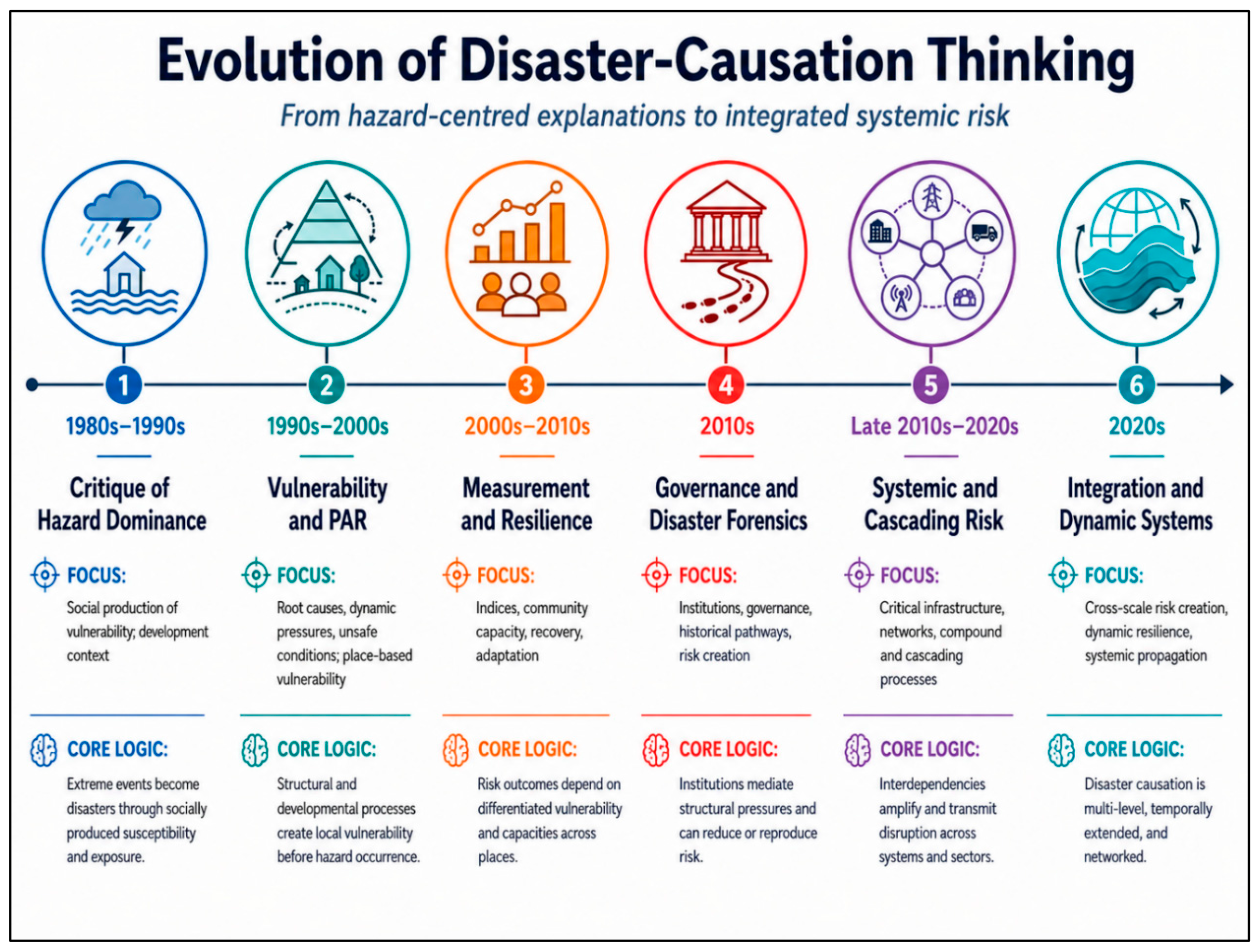
Figure 4.
Eight-level causal architecture of disaster risk, integrating causal depth, hazard materialization and systemic propagation, disaster consequences, and recursive recovery and feedback processes.
Figure 4.
Eight-level causal architecture of disaster risk, integrating causal depth, hazard materialization and systemic propagation, disaster consequences, and recursive recovery and feedback processes.
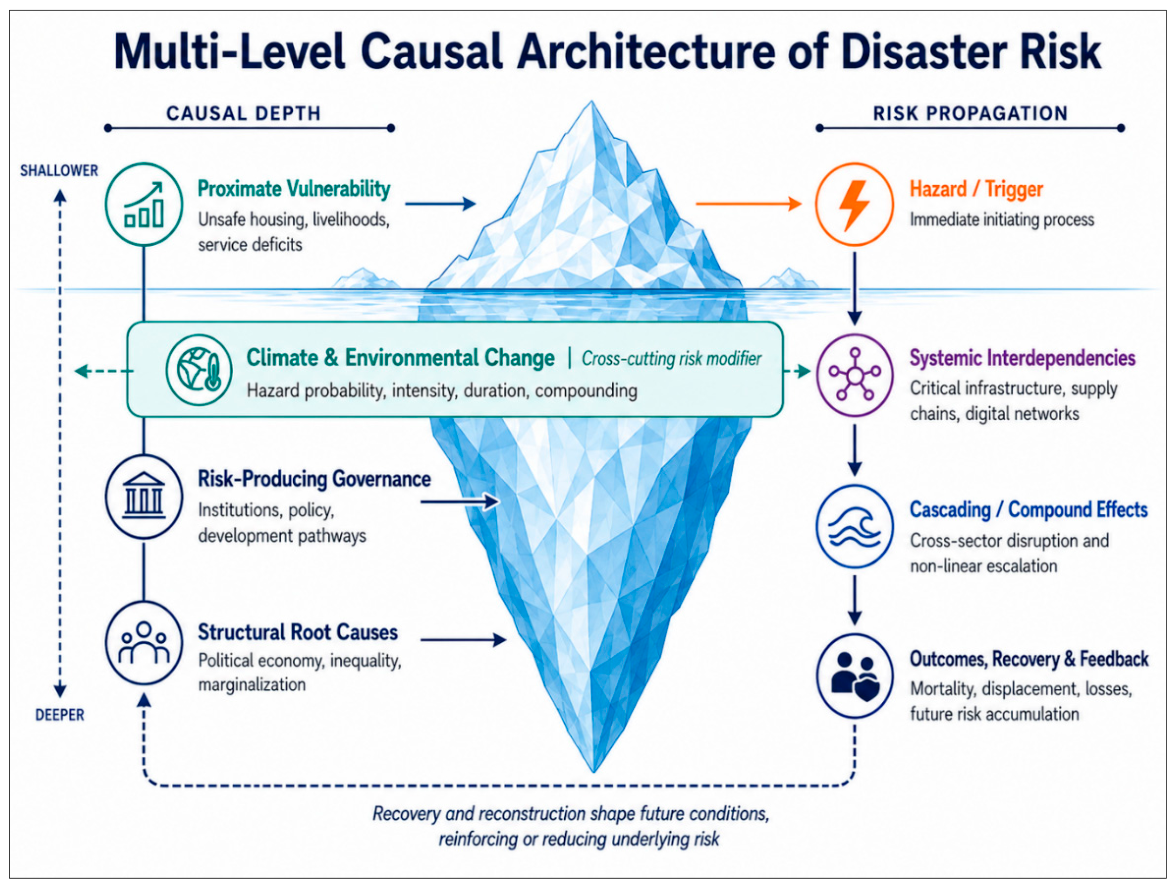
Figure 5.
Interaction and mediation among major disaster-risk drivers.
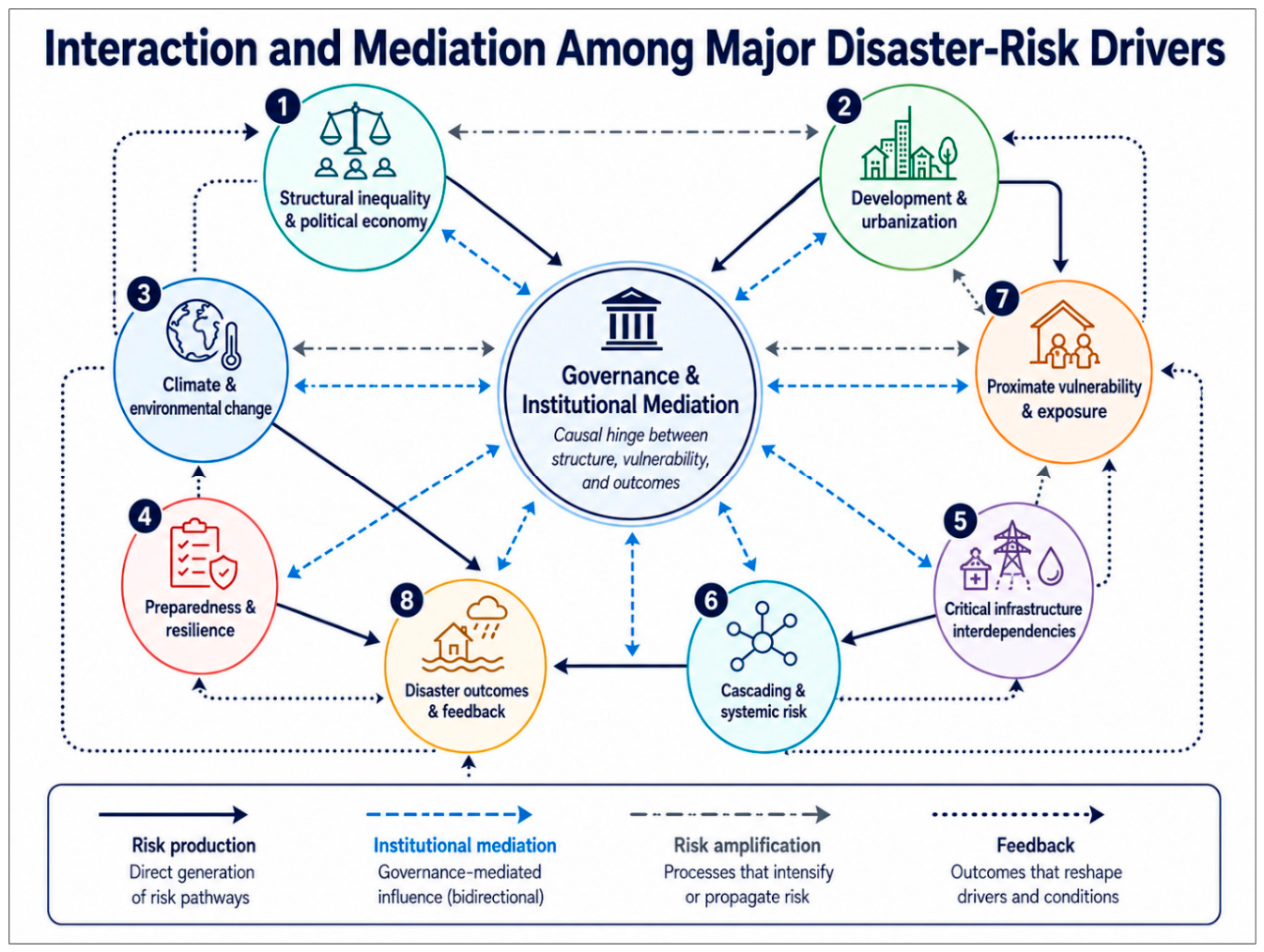
Figure 6.
Evidence-strength profiles across major disaster-risk driver families.
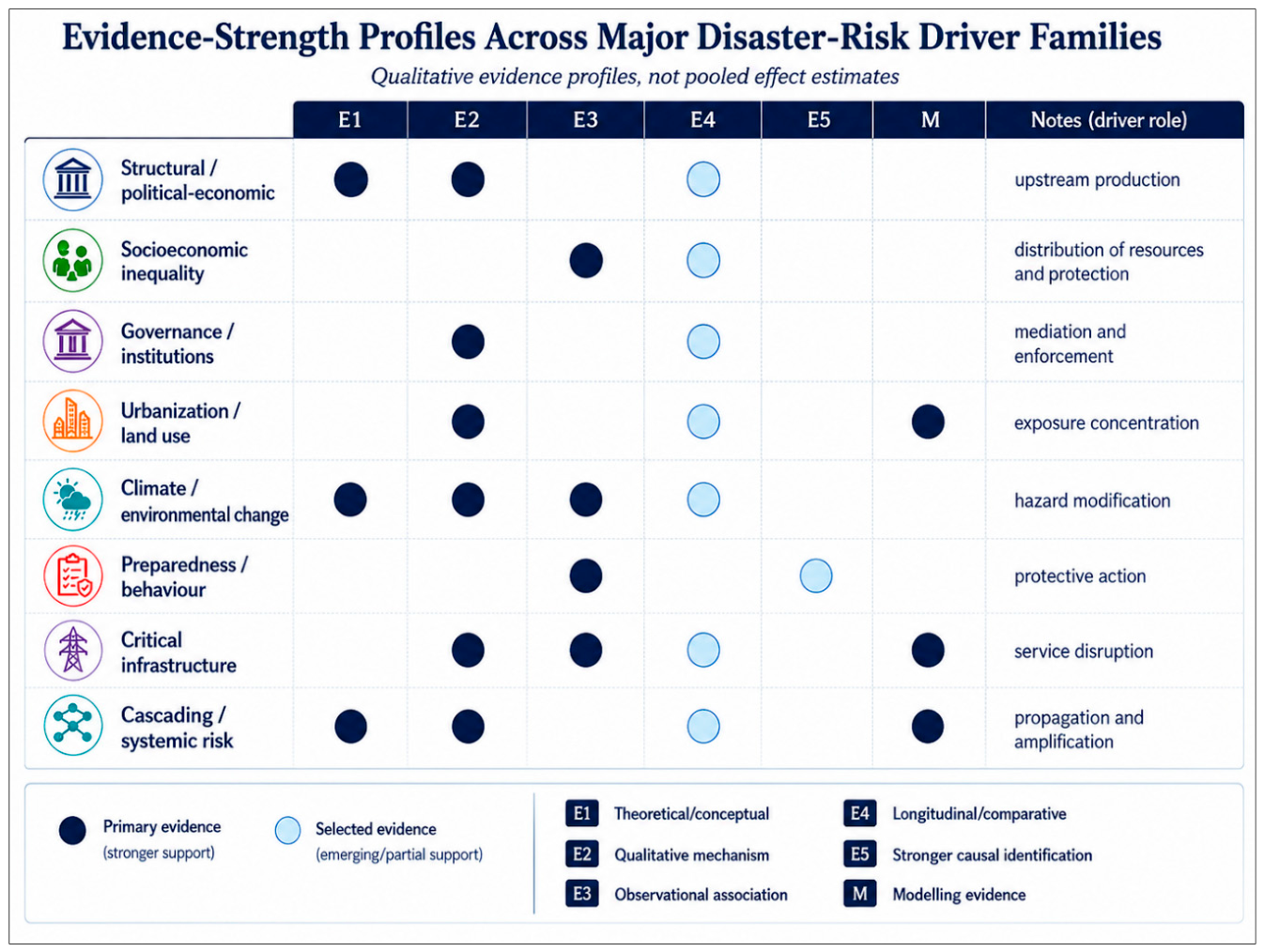
Figure 7.
Integrated Multi-Level Model of Disaster Causation and Risk Creation. The model combines causal depth (Levels 1-4) with hazard materialization and propagation (Levels 5-7) and a recursive recovery/feedback loop (Level 8).
Figure 7.
Integrated Multi-Level Model of Disaster Causation and Risk Creation. The model combines causal depth (Levels 1-4) with hazard materialization and propagation (Levels 5-7) and a recursive recovery/feedback loop (Level 8).
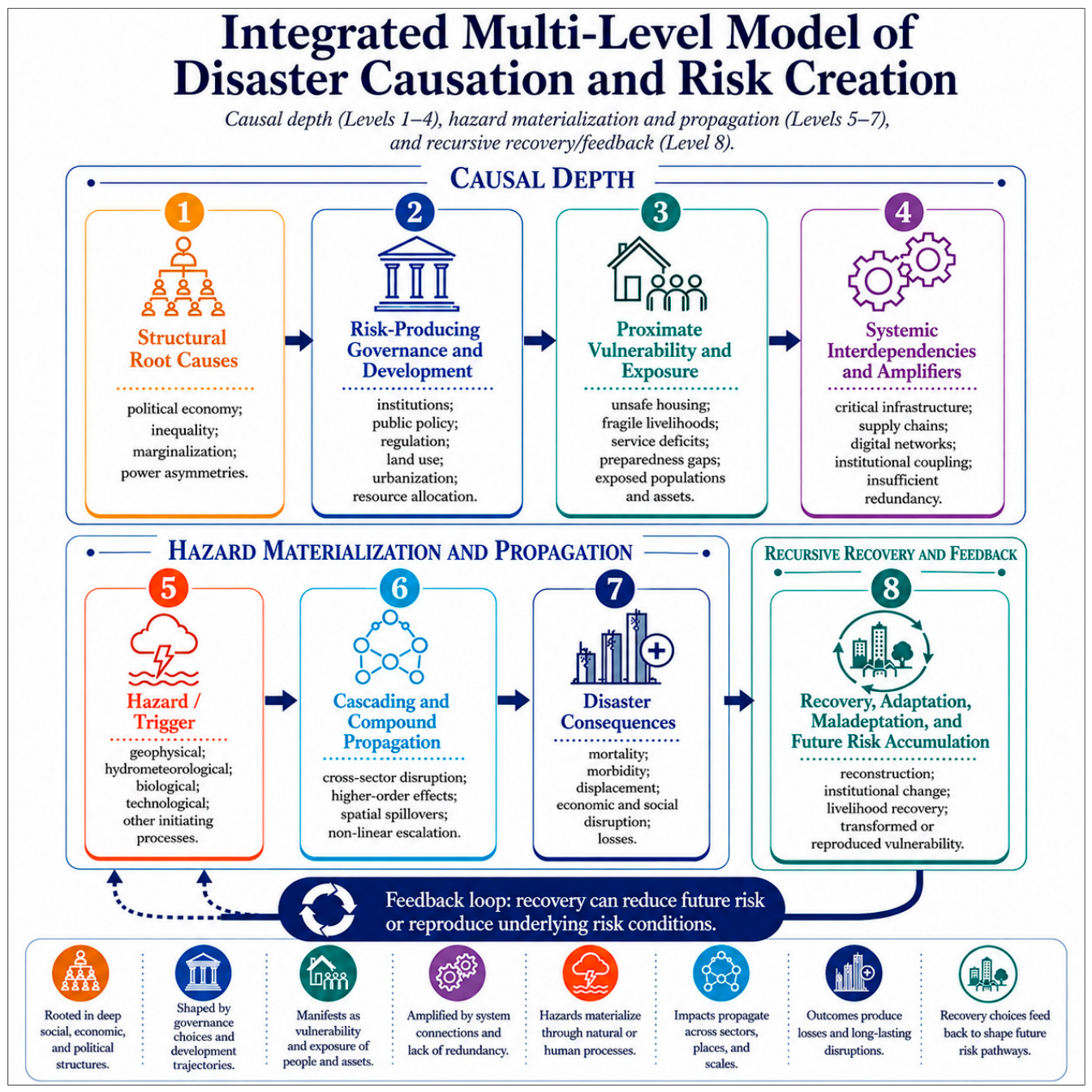
Figure 8.
From causal diagnosis to risk-reduction intervention: intervention points across the disaster-risk chain.
Figure 8.
From causal diagnosis to risk-reduction intervention: intervention points across the disaster-risk chain.
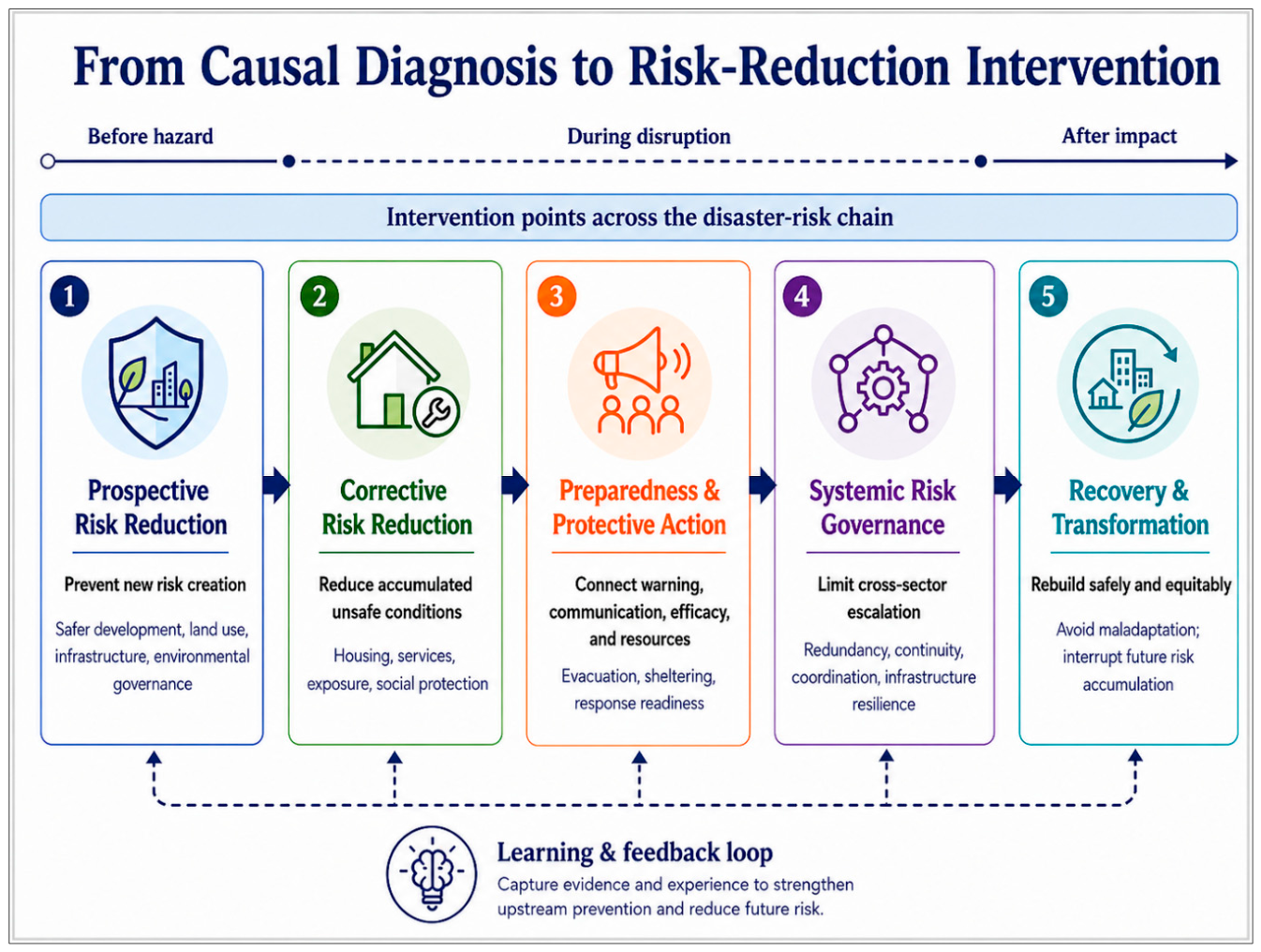
Table 2.
Search-family architecture and principal replication strings.
| Search family/platform | Search logic |
| A. Disaster causation | disaster* AND (“root cause*” OR “underlying cause*” OR “risk driver*” OR “disaster causation” OR “disaster risk creation”) |
| B. Vulnerability / political economy | disaster* AND (“social vulnerability” OR “structural vulnerability” OR inequality OR poverty OR marginalization OR “political ecology”) |
| C. Governance/institutions | disaster* AND (governance OR institution* OR coordination OR corruption OR accountability) AND (vulnerab* OR exposure OR risk) |
| D. Urban development | disaster* AND (urbanization OR urbanisation OR “informal settlement*” OR “land use” OR housing OR planning) AND (vulnerab* OR exposure OR “risk creation”) |
| E. Environment/climate | disaster* AND (“environmental degradation” OR climate OR ecosystem* OR adaptation) AND (vulnerab* OR exposure OR “risk multiplier”) |
| F. Preparedness/behavior | disaster* AND (preparedness OR “risk perception” OR “risk communication” OR “social capital” OR efficacy OR trust) |
| G. Critical infrastructure | disaster* AND (“critical infrastructure” OR interdependenc* OR “network failure*” OR supply chain* OR redundancy) |
| H. Systemic/cascading risk | disaster* AND (“systemic risk” OR “cascading risk*” OR “compound risk*” OR “interconnected risk*” OR multi-hazard) |
| Core Scopus replication string | TITLE-ABS-KEY((disaster* OR catastrophe*) AND (“root cause*” OR “underlying cause*” OR “underlying driver*” OR “risk driver*” OR “structural driver*” OR “disaster causation” OR “disaster risk creation”) AND (vulnerab* OR exposure OR governance OR “social vulnerability” OR “systemic risk” OR resilien*)) AND PUBYEAR > 1999 AND PUBYEAR < 2027 |
| Core Web of Science replication string | TS=((disaster* OR catastrophe*) AND (“root cause*” OR “underlying cause*” OR “underlying driver*” OR “risk driver*” OR “structural driver*” OR “disaster causation” OR “disaster risk creation”) AND (vulnerab* OR exposure OR governance OR “social vulnerability” OR “systemic risk” OR resilien*)) |
Table 3.
Synthesis of the evolution of disaster-causation approaches.
| Period/orientation | Primary analytical focus | Core causal logic | Representative references |
|---|---|---|---|
| 1980s-1990s: critique of hazard dominance | Social production of vulnerability; development context | Extreme events become disasters through socially produced conditions of susceptibility and exposure | Hewitt, 1983; Wisner et al., 2004 |
| 1990s-2000s: vulnerability and PAR | Root causes, dynamic pressures, unsafe conditions; place-based vulnerability | Structural and developmental processes create local vulnerability before hazard occurrence. | Wisner et al., 2004; Cutter et al., 2000, 2003 |
| 2000s-2010s: measurement and resilience | Indices, community capacity, recovery and adaptation | Risk outcomes depend on differentiated vulnerability and capacities across places | Cutter et al., 2003, 2008; Cutter, 2016 |
| 2010s: governance and disaster forensics | Institutions, governance, historical pathways, risk creation | Institutions mediate structural pressures and can reduce or reproduce risk | Tierney, 2012; Fraser et al., 2016, 2020 |
| Late 2010s-2020s: systemic and cascading risk | Critical infrastructure, networks, compound and cascading processes | Interdependencies amplify and transmit disruption across systems and sectors | Pescaroli & Alexander, 2016, 2018; Schweizer & Renn, 2019 |
| 2020s: integration and dynamic systems | Cross-scale risk creation, dynamic resilience, systemic propagation | Disaster causation is multi-level, temporally extended, and networked | Fraser, 2023; Yabe et al., 2022; Pescaroli et al., 2024 |
Table 4.
Taxonomy of disaster-risk drivers and their proposed causal roles.
| Driver family | Primary causal role | Illustrative mechanisms | Representative sources |
|---|---|---|---|
| Structural/political-economic | Root cause / distal driver | Power, inequality, marginalization, resource access, development trajectories | Wisner et al., 2004; Ribot, 2014; Oliver-Smith et al., 2017 |
| Governance/ institutional | Mediator and intermediate driver | Regulation, coordination, accountability, implementation capacity, public investment | Ahrens & Rudolph, 2006; Tierney, 2012; Alcántara-Ayala et al., 2025 |
| Urban/spatial development | Risk-production process | Land-use change, informal settlement, spatial segregation, infrastructure and service deficits | Williams et al., 2019; Poudel et al., 2023; Moroz & Thieken, 2024 |
| Environmental/climate | Hazard modifier and interacting driver | Changing hazard characteristics, environmental degradation, climate-risk amplification | Ribot, 2014; Teber et al., 2026 |
| Preparedness/ behavioral | Proximate mediator/capacity | Risk perception, efficacy, communication, trust, engagement, preparedness actions | Ryan et al., 2020; Ni et al., 2025 |
| Infrastructure/systemic | Amplifier and propagation mechanism | Interdependency, cascading failure, network disruption, cross-sectoral effects | Pescaroli & Alexander, 2016, 2018; Wells et al., 2022 |
| Compound/multi-hazard | Interaction and amplification | Co-occurring, sequential, interacting hazards; accumulated and compound exposure | Drakes & Tate, 2022; Pescaroli & Alexander, 2018 |
| Recovery/feedback | Feedback and future risk accumulation | Reconstruction choices, adaptation, maladaptation, path dependence | Duvat et al., 2021; Tierney & Oliver-Smith, 2012 |
Note. Categories distinguish causal depth and mechanism. Frequency of mention is not interpreted as causal importance; driver families can occupy different causal roles across contexts.
Table 5.
Evidence-strength profile across disaster-risk driver families.
| Driver family | Predominant evidence | Typical causal role | Preliminary strength | Principal caution |
| Structural/political-economic | E1-E2; selected E4 | Upstream production of vulnerability and unequal access | Moderate-high theoretical convergence; moderate direct identification | Long causal chains and limited manipulability |
| Socioeconomic inequality | E3-E4 | Distribution of resources, protection, exposure, and recovery capacity | Moderate-high | Residual confounding; outcome and database heterogeneity |
| Governance/institutions | E2-E4 | Mediation, implementation, regulation, coordination, enforcement | Moderate-high convergence | Governance indicators vary by scale and context |
| Urbanization/land use | E2-E4 + spatial modeling | Production and concentration of exposure | Moderate-high in context-specific pathways | Urbanization should not be treated as a homogeneous driver |
| Climate / environmental change | E1-E4 within this review scope | Hazard modification and interaction with vulnerability/exposure | High for interaction principle; variable for specific disaster pathways | Avoid climate determinism and hazard-disaster conflation |
| Preparedness/behaviour | E3 dominant; selected E5 | Proximate protective-action and coping mechanisms | Moderate for preparedness outcomes | Intentions and self-reports are not equivalent to disaster-loss reduction |
| Critical infrastructure | M + E2-E4 | System dependency and service disruption | High mechanistic plausibility; moderate empirical generalization | Model assumptions and limited observation of full cascades |
| Cascading / systemic risk | E1-E2 + M; selected E4 | Propagation, amplification, cross-sectoral escalation | Moderate and rapidly developing | Terminological ambiguity; few comparable empirical datasets |
Note. E1 = theoretical/conceptual proposition; E2 = qualitative mechanism evidence; E3 = observational association; E4 = longitudinal/comparative mechanism evidence; E5 = stronger causal identification; M = mechanistic modelling/simulation evidence. The ratings are qualitative evidence profiles, not pooled effect estimates.
Table 6.
Evidence-based map of underlying disaster causes, causal mechanisms, evidence profiles, and representative references.
Table 6.
Evidence-based map of underlying disaster causes, causal mechanisms, evidence profiles, and representative references.
| Causal level | Specific cause/driver | Principal mechanism | Evidence profile | Representative references |
| Structural | Political economy, power, historical marginalization | Shapes access to land, resources, political voice, protection, and development opportunities; generates long causal chains rather than immediate losses. | E1-E2; selected E4 | Wisner et al. (2004); Ribot (2014); Sovacool et al. (2018); Gahman & Thongs (2020); Lavell et al. (2023) |
| Structural | Income and wealth inequality | Concentrates unsafe exposure, constrains coping and recovery, and redistributes disaster burdens toward disadvantaged groups. | E3-E4; selected E5-like identification | Austin & McKinney (2016); Reid (2013); Lindersson et al. (2023); Teber et al. (2026); Azad et al. (2026) |
| Structural/proximate | Poverty and material deprivation | Restricts safe housing, insurance, savings, mobility, health protection, preparedness resources, and recovery options. | E3-E4 | Hallegatte et al. (2020); Ward & Shively (2017); Tselios & Tompkins (2019); Kyne & Kyei (2024); Ngcamu (2023) |
| Structural | Human development and social protection | Education, health, welfare, and public resources reduce mortality and increase coping/recovery capacity. | E3-E5 | Kahn (2005); Raschky (2008); Formetta & Feyen (2019); Birkmann et al. (2021); Kaushik et al. (2024) |
| Structural | Gendered and intersectional inequality | Unequal access to resources, care, mobility, legal protection, and decision-making can intensify vulnerability and recovery barriers. | E2-E4 | Austin & McKinney (2016); Trentin et al. (2023); Mester et al. (2025); Cutter et al. (2003); Reid (2013) |
| Governance | Institutional quality, accountability, transparency | Affects enforcement, investment, service delivery, social protection, and public trust; mediates structural pressures into local risk. | E2-E4 | Ahrens & Rudolph (2006); Tierney (2012); Alcántara-Ayala et al. (2025); Okunola (2025); Safari et al. (2019); Dalangin (2025); Milenković (2025); Mohamed Kalakaan (2025) |
| Governance | Coordination and local implementation capacity | Fragmentation, limited finance, weak vertical/horizontal coordination, and mandate-practice gaps reduce preventive and response capacity. | E2-E4 | Shah et al. (2019); Hilhorst et al. (2020); Jones et al. (2014); Russell et al. (2021); Beli et al. (2025); Mohamed Kalakaan (2025) |
| Governance | Decentralization and co-governance failures | Responsibility transfer without capacity, competitive actor networks, and state-NGO disconnects can produce implementation gaps. | E2 | Srikandini et al. (2018); Kita (2017a); Hendriks & Boersma (2019); Cvetković et al. (2021); Papathoma-Köhle et al. (2021) |
| Development / urban | Risk-insensitive urbanization and land exclusion | Housing markets, land commodification, exclusion, and weak planning channel disadvantaged groups into hazardous locations. | E2-E4 | Rumbach (2017); Poudel et al. (2023); Camacho et al. (2024); Lavell et al. (2023); Gatica & Cornejo (2026) |
| Development / urban | Informal settlements, unsafe housing, service deficits | Poor construction, insecure tenure, drainage/sanitation deficits, and limited services increase exposure and sensitivity. | E2-E3 | Williams et al. (2019); Abunyewah et al. (2018); Quesada-Román (2022); Kunguma et al. (2025); Kita (2017b) |
| Development / urban | Land-use change and future exposure | Expansion of built-up areas and risk-insensitive siting can enlarge the stock of exposed people and assets over decades. | E3-M; some longitudinal spatial evidence | Menteşe et al. (2023); De Risi et al. (2019); Moroz & Thieken (2024); Akola & Mvuyana (2025); Duvat et al. (2021) |
| Environmental | Environmental degradation and ecosystem-service loss | Degraded ecosystems reduce protective functions and can intensify exposure, livelihood fragility, and future risk. | E1-E4 | Depietri (2019); Walz et al. (2021); Livne et al. (2026); Collins (2008); Peduzzi (2019) |
| Climate/hazard | Climate-related hazard modification | Changes hazard probability, intensity, duration, spatial distribution, and compounding; consequences remain mediated by exposure and vulnerability. | E3-E4; attribution varies by hazard | Cardona et al. (2012); Kelman et al. (2015); Lahsen & Ribot (2021); Zhai & Lee (2024); Teber et al. (2026); Ahmed (2025); Mančić (2025) |
| Dynamic vulnerability | Changing vulnerability and adaptation capacity | Vulnerability evolves before, during, and after crises; adaptation can reduce or redistribute risk and create path dependence. | E1-E4; M | de Ruiter & van Loon (2022); Birkmann et al. (2013); Lei et al. (2013); Schipper et al. (2016); van Maanen et al. (2025) |
| Behaviour/capacity | Risk perception, efficacy, knowledge | Protective action depends on perceived threat and on beliefs that actions are feasible and effective; awareness alone is insufficient. | E3; systematic reviews | Paton (2019); Ni et al. (2025); Yin et al. (2021); Ai & Zhang (2025); Rezabeigi Davarani et al. (2023); Perić & Cvetković (2019); Desalit et al. (2025) |
| Behaviour/social | Trust, prior experience, social capital | Information exchange, collective efficacy, institutional trust, and experience can enable or inhibit preparedness depending on context. | E3; review evidence | Zhao et al. (2025); Seddig et al. (2026); Levac et al. (2012); Babcicky & Seebauer (2020); Yong et al. (2020) |
| Capacity | Household and community preparedness | Preparedness resources, plans, training, early warning, and community capability condition the conversion of hazard into impact. | E3; comparative evidence | Kim & Kim (2022); Martins et al. (2019); Ryan et al. (2020); Grozdanić et al. (2024); Cvetković et al. (2026a); Cvetković (2025); Razia (2025); Desalit et al. (2025) |
| Governance/communication | Transparency and environmental risk communication | Access to credible information and transparent institutions affect trust, perceived resilience, and protective engagement. | E3; qualitative support | Nikolić et al. (2025); Cvetković & Šišović (2024); Cvetković (2023); Cvetković et al. (2026b); Sacyaten (2025); Janković et al. (2025) |
| Systemic | Critical-infrastructure interdependency | Service-provision, geographic, functional, and repair dependencies create pathways for indirect losses and delayed recovery. | M; E2-E3 where observed | Wells et al. (2022); Wang et al. (2024); Mehvar et al. (2021); Shamsi & Helmrich (2025); Johansen & Tien (2018); Vidović et al. (2024); Mančić (2025); Miletić & Stojanović (2025) |
| Systemic | Cascading service failure and limited redundancy | Failure in one network can shut down otherwise undamaged systems and create new populations at risk. | M; event-based empirical evidence | Brunner et al. (2023); Linkov et al. (2022); Curt & Tacnet (2018); Yang et al. (2022); Bakhtiari et al. (2025) |
| Systemic / logistics | Infrastructure and humanitarian logistics failure | Aging assets, interdependencies, communication failures, and institutional weaknesses degrade emergency supply and response functions. | Review + M/E2 | Shbikat & Bwaliez (2026); Barquet et al. (2023); Mühlhofer et al. (2024); Pescaroli & Alexander (2016) |
| Systemic | Compound, cascading, and multi-hazard interaction | Multiple hazards and stressors interact sequentially or concurrently, producing non-linear consequences and secondary vulnerability. | E1-E3; M | Pescaroli & Alexander (2018); Alcántara-Ayala (2025); Thomas et al. (2020); Drakes & Tate (2022); Liu & Renn (2025); Canete & Biñas (2025); Milenković & Cvetković (2025) |
| Systemic governance | Governance of interconnected risk | Sectoral silos and conventional risk governance are poorly matched to transboundary, cascading, and tightly coupled risks. | E1-E2; policy/case evidence | Maskrey et al. (2023); Schweizer & Renn (2019); Schweizer & Juhola (2024); Djalante & Lassa (2019); Beli et al. (2025); Milenković (2025) |
| Feedback | Recovery, maladaptation, and risk accumulation | Recovery can redistribute resources, reproduce unsafe development, deepen inequality, or interrupt path-dependent risk trajectories. | E2-E4 | Duvat et al. (2021); Sovacool et al. (2018); Cappelli et al. (2021); Tselios & Tompkins (2019); Tierney (2014) |
Note. Evidence profiles are qualitative summaries. E1-E5 and M follow the definitions in Section 2.11. Multiple references are provided to emphasize convergent support rather than citation frequency.
Table 7.
Recurrent cross-driver pathways identified in the integrated synthesis.
| Interaction pathway | Causal interpretation | Representative evidence |
| Inequality leads to housing exclusion, resulting in settlement in hazard-prone areas and causing disproportionate disaster losses. | Structural inequality becomes spatial exposure through land/housing markets and planning. | Rumbach (2017); Lavell et al. (2023); Williams et al. (2019); Moroz & Thieken (2024) |
| Weak governance leads to inadequate regulation and enforcement, resulting in unsafe construction and land-use practices, which increase vulnerability. | Institutional capacity mediates whether formal rules translate into protection. | Ahrens & Rudolph (2006); Alcántara-Ayala et al. (2025); Akola & Mvuyana (2025); Tierney (2012) |
| Poverty leads to limited resources for preparedness, which results in constrained protective actions, causing recovery to be delayed and unequal. | Material constraints connect structural deprivation with household-level coping. | Hallegatte et al. (2020); Levac et al. (2012); Martins et al. (2019); Ward & Shively (2017) |
| Climate change changes hazard frequency, intensity, and distribution, resulting in unequal exposure and adaptive capacity and causing disproportionate consequences. | Climate acts through existing development, vulnerability, and governance conditions. | Cardona et al. (2012); Lahsen & Ribot (2021); Teber et al. (2026); Birkmann et al. (2021) |
| Environmental degradation leads to the loss of ecosystem services and natural defenses, resulting in higher hazard exposure and increased livelihood vulnerability. | Ecological change can amplify physical exposure and social vulnerability simultaneously. | Depietri (2019); Walz et al. (2021); Livne et al. (2026); Peduzzi (2019) |
| Low trust and weak risk communication lead to poor warning reception and uptake, delaying protective actions and increasing disaster impacts. | Information quality interacts with efficacy, credibility, social capital, and prior experience. | Ni et al. (2025); Zhao et al. (2025); Nikolić et al. (2025); Yin et al. (2021) |
| Infrastructure interdependency can cause critical services to fail, creating secondary vulnerabilities and cascading, cross-sector disruptions. | Network connectivity propagates effects beyond the directly damaged footprint. | Pescaroli & Alexander (2016); Brunner et al. (2023); Wells et al. (2022); Wang et al. (2024) |
| Institutional fragmentation leads to siloed decision-making, overlooking cross-sector dependencies and increasing systemic risk. | Governance architecture itself can amplify complex risk when sectoral responsibilities are disconnected. | Maskrey et al. (2023); Schweizer & Juhola (2024); Hilhorst et al. (2020); Djalante & Lassa (2019) |
| Disaster losses lead to uneven recovery paths, resulting in debt, displacement, and maladaptation, which heighten future vulnerability. Post-disaster decisions can generate feedback loops and risk accumulation shaped by past choices. | Post-disaster decisions create feedback loops and path-dependent risk accumulation. | Cappelli et al. (2021); Duvat et al. (2021); Sovacool et al. (2018); Tselios & Tompkins (2019) |
| Preparedness combined with social capital leads to coordinated collective action, reducing disruptions and improving coping capacity. This results in greater resilience, although it may also create a false sense of security. | Social resources can enhance efficacy and response while overreliance may reduce individual preparation. | Babcicky & Seebauer (2020); Yong et al. (2020); Zhao et al. (2025); Kim & Kim (2022) |
Note. Arrows denote proposed direction of mechanism within the synthesized literature; they do not imply that every link has been established through experimental causal identification.
Table 8.
Evidence-to-action recommendations derived from the causal synthesis.
| Target mechanism | DRR mode | Priority action | Lead actors | Illustrative monitoring indicators | Evidence base |
| Structural inequality |
Transformative/prospective | Integrate equity and social protection into DRR, housing, health, and recovery policy; identify who bears residual risk. | National/local government; social protection; housing agencies | Distribution of risk-reduction spending; access to safe housing; coverage of shock-responsive social protection | Hallegatte et al. (2020); Lindersson et al.(2023); Teber et al. (2026) |
| Risk governance |
Prospective | Make risk creation an explicit test in development approvals, public investment, and sector strategies. | Planning ministries; local government; regulators | Share of major investments screened for multi-hazard and systemic risk; compliance follow-up rate | Ahrens & Rudolph (2006); Maskrey et al.(2023); Tierney (2012); Dalangin (2025); Mohamed Kalakaan (2025) |
| Institutional capacity |
Corrective / preparedness | Match decentralized responsibilities with finance, trained staff, data access, and interoperable procedures. | National DRR authorities; municipalities | Local DRR staffing and budget continuity; exercise frequency; closure rate for identified capability gaps | Cvetković et al. (2021); Shah et al. (2019); Alcántara-Ayala et al. (2025); Beli et al. (2025); Milenković (2025) |
| Land use and housing | Prospective/corrective | Prevent new high-risk settlements while upgrading existing informal settlements through inclusive, non-punitive planning. | Municipal planning; housing; utilities; communities | New development in mapped high-risk zones; households receiving risk-informed upgrading; infrastructure-service coverage | Rumbach (2017); Poudel et al. (2023); Kunguma et al.(2025) |
| Environmental degradation | Prospective/corrective | Treat ecosystem services as protective infrastructure and include ecological loss in disaster-risk accounting. | Environment agencies; watershed/coastal authorities | Condition of protective ecosystems; restoration coverage; ecosystem-service loss incorporated into assessments | Depietri (2019); Walz et al. (2021); Livne et al. (2026) |
| Climate-related risk | Prospective/adaptive | Combine climate-hazard scenarios with present-day inequality, vulnerability, and exposure rather than treating climate as a stand-alone risk layer. | Climate services; DRR agencies; planners | Percentage of adaptation plans integrating social vulnerability and exposure; multi-hazard scenario coverage | Cardona et al. (2012); Birkmann et al. (2021); van Maanen et al.(2025); Ahmed (2025); Mančić (2025) |
| Risk communication | Preparedness | Move from information provision to trusted, actionable, audience-specific communication linked to efficacy and resources. | DRR agencies; media; schools; community organizations | Warning reach and comprehension; protective-action uptake; trust and efficacy measures | Ni et al. (2025); Ryan et al. (2020); Yin et al. (2021); Nikolić et al.(2025); Sacyaten (2025); Janković et al. (2025) |
| Household/community preparedness | Preparedness | Combine education, drills, social-capital building, and material support; avoid assuming awareness automatically produces action. | Municipalities; schools; NGOs; employers | Households with plans/supplies; drill participation; first-aid knowledge; community mutual-aid capacity | Levac et al. (2012); Kim & Kim (2022); Grozdanić et al. (2024); Cvetković (2025); Desalit et al. (2025); Razia (2025) |
| Critical infrastructure | Systemic/corrective | Map cross-sector dependencies and critical nodes; build redundancy, substitution, and joint restoration protocols. | Utilities; transport; health; telecom; emergency management | Interdependency maps completed; backup duration; restoration time; joint stress-test coverage | Wells et al. (2022); Linkov et al. (2022); Shamsi & Helmrich (2025); Vidović et al.(2024); Mančić (2025); Miletić & Stojanović (2025) |
| Cascading and compound risk | Systemic / preparedness | Use compound scenarios and escalation pathways in exercises, planning, and decision support, including secondary social vulnerability. | Emergency management; infrastructure operators; regulators | Compound-scenario exercises; documented escalation points; cross-sector decision protocols | Pescaroli & Alexander (2018); Alcántara-Ayala (2025); Barquet et al. (2023); Canete & Biñas (2025); Milenković & Cvetković (2025) |
| Recovery governance |
Transformative | Evaluate recovery by whether it reduces future exposure, inequality, and path dependence, not only by speed of reconstruction. | Recovery agencies; finance; housing; communities | Share of reconstruction subject to risk-reduction standards; displacement outcomes; post-recovery vulnerability trends | Duvat et al. (2021); Sovacool et al. (2018); Cappelli et al. (2021) |
| Evidence and learning | Cross-cutting | Track causal mechanisms, not only hazard losses; combine longitudinal, qualitative, spatial, and network evidence. | Research institutions; statistical offices; DRR agencies | Longitudinal vulnerability datasets; locally validated indicators; recorded indirect/service losses; open evaluation protocols | Painter et al. (2024); de Ruiter & van Loon (2022); Jones et al. (2022) |
Disclaimer/Publisher’s Note: The statements, opinions and data contained in all publications are solely those of the individual author(s) and contributor(s) and not of MDPI and/or the editor(s). MDPI and/or the editor(s) disclaim responsibility for any injury to people or property resulting from any ideas, methods, instructions or products referred to in the content. |
© 2026 by the author. Licensee MDPI, Basel, Switzerland. This article is an open access article distributed under the terms and conditions of the Creative Commons Attribution (CC BY) license.
Copyright: This open access article is published under a Creative Commons CC BY 4.0 license, which permit the free download, distribution, and reuse, provided that the author and preprint are cited in any reuse.