

Submitted:
29 August 2026
Posted:
31 August 2026
You are already at the latest version
Abstract
Suboptimal soils with limited nutrient availability and unfavorable physical properties constrain the productivity of maize–soybean intercropping systems, highlighting the need for sustainable soil fertility management strategies. This study evaluated the effects of different bioameliorant formulations on soil nitrogen availability, nutrient uptake, crop growth, and productivity in maize–soybean intercropping on suboptimal sandy soil. A randomized complete block design with four replications was used to evaluate five formulations: M0, an untreated control; M1, comprising 30% compost, 30% manure, 20% rice husk biochar, and 20% mycorrhizal biofertilizer; M2, containing 20% each of compost, manure, and mycorrhizal biofertilizer with 40% rice husk biochar; M3, containing equal proportions (25% each) of compost, manure, rice husk biochar, and mycorrhizal biofertilizer; and M4, comprising 20% each of compost, manure, and rice husk biochar with 40% mycorrhizal biofertilizer. The results showed that M4 consistently provided the most favorable response, significantly increasing soil nitrogen availability, nutrient uptake, growth, and yield of maize and soybean compared with the control and other formulations. The enhanced performance of M4 was associated with its higher proportion of mycorrhizal biofertilizer combined with organic amendments and rice husk biochar, which collectively improved nutrient availability and acquisition under nutrient-limited soil conditions. These findings demonstrate that bioameliorant mixtures, particularly the M4 formulation, have strong potential to improve nitrogen availability, nutrient uptake, and crop productivity while reducing dependence on synthetic fertilizers in maize–soybean intercropping systems on suboptimal sandy soils.
Keywords:
arbuscular mycorrhizal fungi (AMF)
; bioameliorants
; nutrient availability
; maize-soybean intercropping
; suboptimal land
1. Introduction
Suboptimal land represents an important resource for expanding agricultural production and strengthening food security, but its productivity is frequently constrained by unfavorable physical, chemical, and biological soil properties In the study area, approximately 70% of the soil fraction is sand, accompanied by low organic matter and limited nutrient availability. Such coarse-textured soils have low water- and nutrient-holding capacity, resulting in rapid drainage and nutrient losses that can reduce fertilizer-use efficiency and crop productivity [3]. Nitrogen availability is particularly important because insufficient N supply directly limits vegetative growth, biomass accumulation, and yield formation. Therefore, sustainable intensification of sandy suboptimal land requires integrated soil management strategies capable of simultaneously improving nutrient availability, nutrient retention, and plant nutrient acquisition.
Bioamelioration combining organic amendments, biochar, and beneficial microorganisms offers a promising approach for addressing these constraints. Compost and livestock manure can increase soil organic matter and provide nutrients, while rice husk biochar can improve soil structure, water retention, and nutrient retention, particularly in coarse-textured soils [4]. These functions can be complemented by arbuscular mycorrhizal fungi (AMF), whose extraradical hyphae extend beyond the root depletion zone and increase the effective soil volume explored by plants, thereby enhancing nutrient acquisition, particularly phosphorus and other relatively immobile nutrients [5]. AMF may also contribute indirectly to nitrogen acquisition by improving root nutrient uptake and plant physiological performance. Consequently, combining organic amendments, biochar, and AMF may generate complementary effects that improve the physical, chemical, and biological properties of the rhizosphere and increase nutrient-use efficiency under nutrient-limited conditions [6].
Maize–soybean intercropping provides an additional biological strategy for improving resource-use efficiency. Cereal–legume intercropping can promote complementary utilization of light, space, water, and soil nutrients, while soybean contributes biologically fixed nitrogen through symbiotic associations with rhizobia Previous studies have shown that maize–soybean intercropping can improve resource-use efficiency compared with monocropping, particularly through complementary utilization of environmental resources and biological nitrogen fixation [8]. However, the benefits of intercropping may be restricted on sandy soils where low water- and nutrient-holding capacity limits plant growth and nutrient acquisition. Improving the soil environment through bioamelioration may therefore strengthen the complementarity between maize and soybean and enhance nitrogen availability, nutrient uptake, and crop productivity within the intercropping system.
Previous studies conducted in North Lombok, Indonesia, have demonstrated that mixtures of compost, livestock manure, rice husk biochar, and mycorrhizal biofertilizer can improve soil nutrient availability, plant nutrient uptake, and maize–soybean productivity on suboptimal land [9,10,11]. A formulation containing equal proportions (25% each) of the four components also showed favorable agronomic performance [12]. However, the effectiveness of a bioameliorant mixture may depend strongly on the relative contribution of each component and the dominant soil constraints. A higher proportion of mycorrhizal biofertilizer, for example, may enhance biological nutrient acquisition, whereas greater proportions of organic amendments or biochar may provide stronger effects on nutrient supply and retention. Despite these potential interactions, systematic evaluation of different component proportions in relation to nitrogen availability, nutrient uptake, and crop productivity in maize–soybean intercropping on sandy suboptimal land remains limited.
Therefore, this study aimed to evaluate the effects of different bioameliorant mixtures on nitrogen availability, nutrient uptake, growth, and productivity of maize and soybean under intercropping on sandy suboptimal land, and to identify the formulation providing the most favorable agronomic response. The study hypothesized that combining organic amendments, rice husk biochar, and mycorrhizal biofertilizer in appropriate proportions would improve soil nitrogen availability and nutrient acquisition, thereby enhancing crop growth and productivity. The findings are expected to contribute to the development of adaptive bioamelioration strategies for improving nitrogen management and supporting the sustainable intensification of maize–soybean intercropping on suboptimal sandy soils.
2. Materials and Methods
2.1. Study Site and Experiment Design
The study was conducted from May to August 2026 on suboptimal land in Telaga Wareng Hamlet, West Pemenang Village, Pemenang District, North Lombok Regency, West Nusa Tenggara, Indonesia (8°26′27.6″ S, 116°06′07.2″ E), at an elevation of approximately 5 m above sea level. Laboratory analyses were carried out at the Microbiology Laboratory and Soil Chemistry Laboratory, Faculty of Agriculture, University of Mataram, Indonesia. The study employed standard agricultural and laboratory equipment for crop cultivation, soil and plant sampling, sample preparation, and laboratory analyses. The equipment included cultivation tools, soil and plant sampling implements, a drying oven, analytical balance, sample grinder, soil sieves, pH meter, and laboratory instruments for determining soil physical and chemical properties, plant nutrient concentrations, and mycorrhizal colonization. The biological and agricultural materials consisted of BISI 18 maize seeds (Zea mays L.), Dering 2 soybean seeds (Glycine max (L.) Merr.), the local mycorrhizal isolate MAA01, cattle manure, rice husk biochar, compost, urea, NPK Phonska fertilizer, Green Tonik, and OrgaNeem. Supporting materials included raffia twine, plastic sampling bags, labels, and tissue paper. Laboratory analyses of mycorrhizal colonization used 10% KOH, methylene blue, sucrose solution, distilled water, and filter paper.
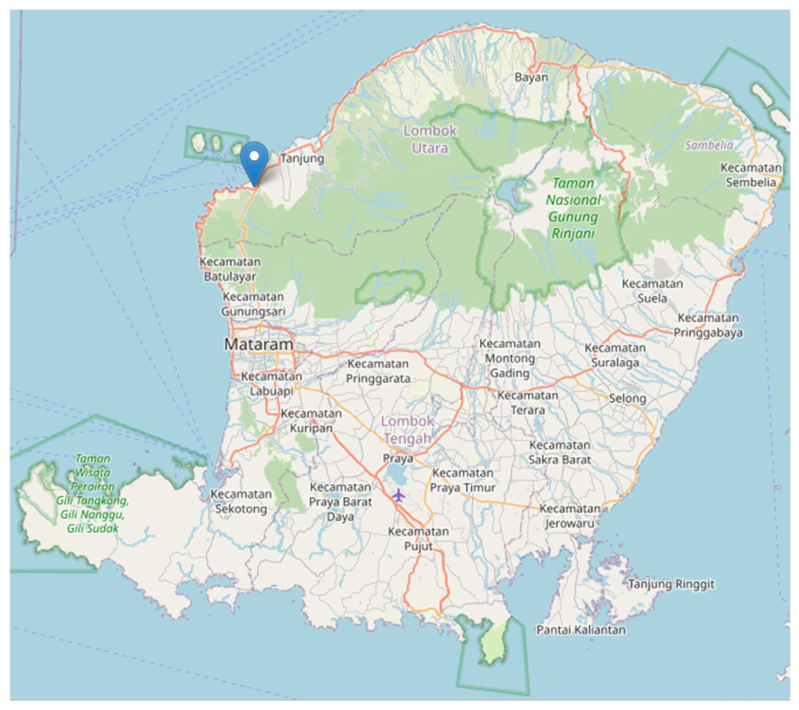
Figure 1.
The site of the field experiment.
The study was conducted as a field experiment using a single-factor Randomized Complete Block Design (RCBD). The experimental factor was the composition of the bioameliorant mixture, consisting of five treatments with three replications, resulting in a total of 15 experimental units. The field layout is presented in Figure 2.
The treatments comprised an untreated control (M0) and four bioameliorant formulations containing different proportions of compost, cattle manure, rice husk biochar, and local mycorrhizal biofertilizer (Table 1).
The formulations were designed to represent different functional emphases of the bioameliorant components. M1 emphasized organic nutrient sources through higher proportions of compost and cattle manure, M2 emphasized the physical amendment component through a higher proportion of rice husk biochar, M3 represented a balanced formulation, and M4 emphasized the biological component through a higher proportion of mycorrhizal biofertilizer. This formulation strategy enabled the comparative evaluation of different bioameliorant compositions in improving crop performance and nutrient uptake under suboptimal soil conditions.
2.2. Experimental Procedures
The experiment began with the collection of initial soil samples before planting. Composite soil samples were collected from the topsoil layer at a depth of 0–30 cm using a diagonal sampling pattern. The samples were air-dried, gently disaggregated, and sieved prior to the analysis of soil physical and chemical properties. The initial soil characteristics analyzed included total nitrogen (N), available phosphorus (P), soil organic carbon (SOC), and soil texture.
Compost, cattle manure, rice husk biochar, and mycorrhizal biofertilizer were used to formulate the bioameliorant mixtures. Before mixing, each material was dried to reduce its moisture content and facilitate homogeneous mixing. The materials were subsequently combined according to the proportions specified for each treatment and thoroughly homogenized.
BISI 18 maize and Dering 2 soybean were planted in an intercropping system. The bioameliorant mixtures were applied according to the assigned treatments. Urea and NPK Phonska were applied as supplementary fertilizers at the predetermined rates and application times according to the crop management protocol. Green Tonik foliar fertilizer was applied as a supplemental nutrient source, while OrgaNeem was used as a botanical pesticide when required to help control crop pests.
Crop maintenance included irrigation, weed management, pest and disease control, and general crop care throughout the growing period. Irrigation was applied as needed to maintain soil moisture conditions favorable for crop growth. Weeds were controlled mechanically according to field conditions. Pest and disease management followed an integrated approach, with OrgaNeem applied as a botanical pesticide when necessary. All maintenance practices were implemented uniformly across experimental units to minimize variation arising from factors other than the bioameliorant treatments.
2.3. Observed Parameters and Data Analysis
The measured parameters included dry shoot biomass per plot; fresh and dry cob weight of maize and fresh and dry pod weight of soybean per plant; dry cob weight, dry pod weight, and shelled grain yield of maize and soybean per plot; mycorrhizal spore density and root colonization at 42 and 92 days after sowing (DAS); plant N and P uptake at 42 DAS; and soil total N, available P, and organic carbon concentrations at 42 and 95 DAS. The data were subjected to analysis of variance (ANOVA) using CoStat software version 6.3. When significant differences among treatments were detected, treatment means were further separated using the Least Significant Difference (LSD) test at the 5% significance level.
3. Results
3.1. Initial Soil Physicochemical Properties
The initial soil analysis showed a very low total nitrogen (N) concentration of 0.01% and a low soil organic matter content of 1.21%, indicating limited nutrient-supplying capacity and poor organic matter status. In contrast, the available phosphorus (P) concentration was classified as moderate (13.82 mg kg⁻¹) according to the soil fertility classification of the Indonesian Soil Research Center, Bogor [13]. The relatively higher initial P availability may have been associated with residual P from previous fertilization practices. These initial conditions indicate that low N availability and limited organic matter were major soil fertility constraints at the study site.
The predominantly sandy soil texture and low organic matter content may have further reduced the capacity of the soil to retain water and nutrients. This limitation is particularly important under the relatively dry climatic conditions of the study area, which has approximately 3–4 consecutive wet months according to the Oldeman climate classification. High sand content promotes rapid drainage and can increase the risk of nutrient losses, thereby reducing nutrient availability to crops. Under these conditions, improving soil organic matter and nutrient retention is essential for maintaining nutrient availability throughout crop growth and supporting effective nutrient acquisition in maize–soybean intercropping.
3.2. Soil Nutrient Status and Plant Nutrient Uptake
Total nitrogen (N), available phosphorus (P), and soil organic carbon (SOC) are important indicators of soil fertility and nutrient-supplying capacity following the application of soil amendments. As shown in Table 2, bioameliorant formulations significantly affected soil total N, available P, and SOC in the maize–soybean intercropping system. Different letter groupings indicate significant differences among treatments based on the 5% Least Significant Difference (LSD) test. Compared with the untreated control (M0), the application of bioameliorant mixtures generally improved the measured soil nutrient and carbon parameters, with the most pronounced and consistent response observed under M4.
The M4 formulation produced the highest values of total N, available P, and SOC at both sampling times. In the maize-associated soil, M4 increased total N from 1.06 to 1.92 g kg⁻¹ at 42 DAS and from 1.26 to 2.28 g kg⁻¹ at 95 DAS. Available P increased from 9.15 to 31.45 mg kg⁻¹ at 42 DAS and from 12.07 to 25.10 mg kg⁻¹ at 95 DAS, whereas SOC increased from 4.05 to 10.55 g kg⁻¹ and from 5.25 to 13.67 g kg⁻¹, respectively. A similar response was observed in the soybean-associated soil, where M4 resulted in total N concentrations of 1.44 and 1.99 g kg⁻¹, available P concentrations of 23.65 and 25.14 mg kg⁻¹, and SOC concentrations of 8.49 and 12.97 g kg⁻¹ at 42 and 95 DAS, respectively. These results indicate that M4 provided the most favorable improvement in soil nutrient status throughout the cropping period.
The increase in soil total N under M4 was primarily associated with the contribution of compost and cattle manure as sources of organic N. These materials supply organic N that can be progressively released through decomposition and mineralization, thereby contributing to the soil N pool during crop growth. Organic amendments can also increase soil organic matter and stimulate microbial processes involved in nutrient cycling [14,15]. The higher SOC observed under M4 further supports the contribution of the organic amendments and biochar to the improvement of soil carbon status. In nutrient-limited sandy soils, maintaining a greater soil organic matter pool is particularly important because it can support microbial activity and improve the retention and cycling of nutrients.
The biological component of M4 may have complemented the effects of the organic amendments. The formulation contained 40% mycorrhizal biofertilizer, the highest proportion among the treatments, which may have enhanced rhizosphere biological activity and plant nutrient acquisition. Arbuscular mycorrhizal fungi (AMF) establish symbiotic associations with plant roots and develop extraradical hyphae that extend beyond the root depletion zone. This increases the effective soil volume explored by plants and is particularly important for acquiring relatively immobile nutrients such as P [16]. Although AMF should not be regarded as a direct source of soil N, their symbiotic association can contribute to more effective nutrient acquisition and improved plant nutritional status. Thus, the superior response of M4 likely resulted from the complementary functions of organic nutrient inputs, carbon enrichment, and biological nutrient acquisition rather than from the mycorrhizal component alone. The increase in available P under M4 can be attributed to several complementary processes, including the decomposition of organic materials, microbial activity, and enhanced P acquisition through mycorrhizal symbiosis. Organic amendments may modify soil chemical conditions and stimulate microbial processes involved in P mobilization, while AMF hyphae can increase access to P beyond the immediate rhizosphere [14,17]. The simultaneous presence of these components in M4 may therefore have improved both P availability in the soil and plant acquisition of P.
The temporal dynamics of available P differed between maize- and soybean-associated soils. Under M4, available P in the maize soil decreased from 31.45 mg kg⁻¹ at 42 DAS to 25.10 mg kg⁻¹ at 95 DAS, whereas soybean-associated soil showed a slight increase from 23.65 to 25.14 mg kg⁻¹ over the same period. This contrasting pattern may reflect differences in crop nutrient demand and rhizosphere processes between maize and soybean. Changes in available P are determined by the balance among P release from organic materials, plant uptake, microbial immobilization, and transformation among soil P pools. Therefore, a decrease in soil available P during the later growth stage does not necessarily indicate reduced effectiveness of the treatment; rather, it may reflect greater transfer of available P from the soil into plant biomass or other soil P pools.
The substantial increase in SOC under M4 reflects the combined contribution of compost, cattle manure, and rice husk biochar as carbon-containing amendments. Compost and cattle manure provide relatively labile organic substrates that can support microbial activity and nutrient cycling, whereas biochar contributes a more persistent carbon fraction that can remain in the soil for longer periods [15]. The combination of these materials may therefore provide both readily decomposable and relatively stable carbon fractions. This complementary carbon supply is particularly relevant to sandy soils, where low organic matter is a major constraint to water and nutrient retention [18]. Improved SOC may also contribute to a more favorable rhizosphere environment for root development and microbial interactions.
The nutrient-status results provide an important basis for interpreting the plant nutrient uptake data. The M4 formulation not only increased soil total N, available P, and SOC but also produced the highest N and P uptake in both maize and soybean (Figure 3). In maize, M4 resulted in N uptake of 13.69 g kg⁻¹, compared with 9.91 g kg⁻¹ under M0, representing a 38.1% increase. P uptake also increased from 1.98 g kg⁻¹ under M0 to 2.49 g kg⁻¹ under M4, corresponding to a 25.8% increase. In soybean, N uptake increased from 16.55 g kg⁻¹ under M0 to 20.65 g kg⁻¹ under M4, representing a 24.8% increase, while P uptake increased from 1.92 to 2.82 g kg⁻¹, corresponding to a 46.9% increase. These results demonstrate that the improvement in soil nutrient status under M4 was accompanied by greater plant nutrient acquisition.
The stronger nutrient uptake under M4 can be explained by the integrated functions of its components. Compost and cattle manure provided organic nutrient inputs, while rice husk biochar likely improved the soil environment and nutrient-retention capacity. Meanwhile, the higher proportion of mycorrhizal biofertilizer may have increased the effective root-soil exploration volume and facilitated nutrient acquisition through AMF hyphae. The combined effects of these components may have improved the continuity between nutrient release in the soil and nutrient uptake by the crops. This mechanism is particularly important in sandy soil, where nutrients can be readily lost through leaching and where the effective root-accessible nutrient pool is often limited.
The response of M4 also indicates that increasing the proportion of one component alone cannot fully explain the observed improvement. Because the treatments differed in the proportions of compost, cattle manure, rice husk biochar, and mycorrhizal biofertilizer simultaneously, the effects should be interpreted as responses to the complete formulations rather than as isolated effects of individual components. Nevertheless, M4 provided the most favorable combination among the formulations tested, suggesting that a relatively high proportion of mycorrhizal biofertilizer, together with organic amendments and rice husk biochar, was effective under the nutrient-limited conditions of the study site.
The close correspondence between improved soil nutrient status and plant nutrient uptake is important for understanding the subsequent effects on crop growth and productivity. Greater N acquisition supports protein synthesis, chlorophyll formation, leaf development, and biomass production, whereas adequate P availability contributes to energy metabolism, root development, and reproductive growth. The enhanced N and P uptake observed under M4 therefore provides a physiological basis for the greater biomass accumulation and yield components observed in the subsequent growth and yield measurements.
These findings are consistent with previous studies showing that integrated bioameliorant applications can improve soil fertility, nutrient acquisition, and crop productivity under suboptimal soil conditions [12,19]. The present study further demonstrates that the relative proportions of bioameliorant components can influence soil nutrient dynamics and plant nutrient acquisition. Among the formulations evaluated, M4 provided the strongest overall response, indicating that the integration of organic amendments, rice husk biochar, and a higher proportion of mycorrhizal biofertilizer can provide complementary benefits for improving nutrient conditions in maize–soybean intercropping on sandy suboptimal soil.
The application of bioameliorant mixtures significantly increased N and P uptake by both maize and soybean compared with the untreated control (M0) (Figure 3). In maize, M4 resulted in the highest N uptake, reaching 13.69 g kg⁻¹ compared with 9.91 g kg⁻¹ under M0, representing a 38.1% increase. The M4 treatment also produced the highest P uptake at 2.49 g kg⁻¹, compared with 1.98 g kg⁻¹ under M0, corresponding to a 25.8% increase. The significantly greater N uptake under M4 is particularly important because the initial soil was characterized by very low N status and low organic matter content. These results indicate that the improved soil nutrient conditions generated by the bioameliorant mixture were accompanied by greater plant nutrient acquisition.
A similar response was observed in soybean. The highest N uptake was recorded under M4 at 20.65 g kg⁻¹, representing a 24.8% increase compared with M0 (16.55 g kg⁻¹). P uptake also reached its highest value under M4 at 2.82 g kg⁻¹, corresponding to a 46.9% increase compared with M0 (1.92 g kg⁻¹). The greater N and P uptake in soybean under M4 indicates that the formulation was also effective in improving nutrient acquisition by the legume component of the intercropping system. The responses of both crops demonstrate that the beneficial effects of bioamelioration were not restricted to a single crop species but occurred across the maize–soybean association.
The greater N uptake under M4 can be interpreted in relation to the improved soil N status observed under the same treatment. Compost and cattle manure supplied organic N that could be progressively released through decomposition and mineralization, increasing the soil N pool during crop growth. The higher SOC under M4 may also have supported microbial activity and nutrient cycling, potentially improving the continuity of N supply to plant roots. In addition, soybean can acquire atmospheric N through biological nitrogen fixation in association with rhizobia, meaning that improved soil and rhizosphere conditions may support both soil-derived and biologically fixed N acquisition. However, because biological N fixation was not directly measured in this study, its contribution to the observed increase in soybean N uptake should be considered as a potential complementary mechanism rather than a quantified treatment effect.
The 40% proportion of mycorrhizal biofertilizer in M4 may have further enhanced plant nutrient acquisition. Arbuscular mycorrhizal fungi (AMF) form symbiotic associations with plant roots and develop extraradical hyphae that extend beyond the immediate root zone. This expanded soil exploration can increase access to nutrients, particularly P, which has relatively low mobility in soil [20]. The contribution of AMF to N acquisition is also possible, although its magnitude depends on fungal identity, host plant, soil nutrient status, and environmental conditions. Therefore, the higher N and P uptake observed under M4 is best interpreted as the result of improved nutrient supply and acquisition associated with the integrated formulation rather than as a direct effect of mycorrhizal inoculation alone.
The effectiveness of M4 was likely reinforced by the simultaneous presence of compost, cattle manure, and rice husk biochar. Compost and cattle manure provided organic matter and nutrients that could be gradually released through decomposition, while rice husk biochar may have improved the physical and chemical environment of the sandy soil by increasing water and nutrient retention [21,22]. These functions are particularly relevant under the study conditions, where high sand content and low organic matter reduce the soil’s capacity to retain water and nutrients. By improving the soil environment, biochar may help maintain a more favorable moisture and nutrient regime around the root system, thereby supporting root activity and nutrient uptake.
The relationship between soil nutrient status and plant nutrient uptake was particularly evident under M4. This formulation produced the highest soil total N, available P, and SOC values and simultaneously resulted in the highest N and P uptake in both crops. Such correspondence suggests that improved nutrient supply was effectively translated into greater plant nutrient acquisition. Nevertheless, soil nutrient concentration and nutrient uptake represent different processes: higher soil nutrient concentrations do not necessarily result in greater plant uptake unless nutrients remain accessible to roots and the plants have sufficient capacity to acquire them. The enhanced nutrient uptake under M4 therefore suggests that the formulation improved not only nutrient availability but also the biological processes governing nutrient acquisition.
The improved nutrient acquisition under M4 was also consistent with the higher mycorrhizal spore density and root colonization observed under the same treatment (Figure 2). Greater AMF development may indicate a more active symbiotic association between the fungi and crop roots, potentially contributing to the enhanced acquisition of relatively immobile nutrients. The increased N and P uptake was subsequently associated with greater biomass accumulation and improved yield components, as presented in the following sections. Thus, the results suggest a functional sequence in which the integrated bioameliorant formulation improved the soil nutrient environment, supported biological nutrient acquisition, enhanced plant N and P uptake, and ultimately contributed to improved crop growth and productivity.
Importantly, the superior response of M4 should be interpreted as the effect of the complete formulation rather than the isolated effect of its 40% mycorrhizal biofertilizer component. The treatments differed simultaneously in the proportions of compost, cattle manure, rice husk biochar, and mycorrhizal biofertilizer; therefore, the experimental design does not allow the individual contribution of each component to be separated. Nevertheless, among the formulations evaluated, M4 provided the most favorable combination of organic, carbon-based, and biological functions for nutrient acquisition under the nutrient-limited sandy soil conditions of the study site.
These findings demonstrate that appropriate formulation of bioameliorants can improve nutrient acquisition in maize–soybean intercropping on suboptimal sandy soil. In particular, the higher N uptake observed under M4 provides direct support for the central role of improved N nutrition in enhancing crop performance. The concurrent increase in P uptake further indicates that the benefits of the formulation extended beyond N supply and involved broader improvements in plant nutrient acquisition. Together, these responses provide a physiological basis for the greater biomass accumulation and crop productivity observed under M4.
3.3. AMF Spore Density and Root Colonization
The application of different bioameliorant mixtures increased arbuscular mycorrhizal fungal (AMF) spore density and root colonization in both maize and soybean compared with the untreated control (M0) (Figure 4). At 42 days after sowing (DAS), maize receiving M4 recorded the highest spore density, reaching 5,553 spores 100 g⁻¹ soil, which was significantly higher than that observed under the other treatments. This response was maintained at 92 DAS, when M4 reached 6,299 spores 100 g⁻¹ soil. At this stage, M4 was statistically comparable with M3 (5,971 spores 100 g⁻¹ soil) but remained significantly higher than M0–M2. In soybean, M4 also produced the highest spore density, with 1,913 and 2,567 spores 100 g⁻¹ soil at 42 and 92 DAS, respectively. At 42 DAS, M4 was statistically comparable with M3, whereas at 92 DAS it was significantly higher than all other treatments. These results indicate that the bioameliorant formulations, particularly M4, promoted the establishment and persistence of AMF propagules in the soil throughout crop development.
Root colonization showed a pattern broadly consistent with spore density. In maize, M4 resulted in the highest root colonization, reaching 90.75% at 42 DAS and 98.25% at 92 DAS, and was significantly higher than M0. In soybean, root colonization under M4 reached 63.54% and 70.22% at 42 and 92 DAS, respectively, although these values were not significantly different from M1–M3. The relatively low colonization observed under M0, particularly in soybean, suggests that the absence of externally supplied mycorrhizal biofertilizer limited the establishment of AMF associations. In contrast, the greater spore density and root colonization observed in the bioameliorant treatments indicate that the inclusion of mycorrhizal biofertilizer supported AMF establishment and symbiotic association with crop roots.
The stronger AMF response under M4 was likely related to its 40% proportion of mycorrhizal biofertilizer, which was the highest among the formulations evaluated. AMF form extensive extraradical hyphal networks that extend beyond the immediate root zone, thereby increasing the volume of soil explored by the plant and facilitating access to relatively immobile nutrients, particularly phosphorus [23,24]. This expanded exploration capacity can complement the root system in acquiring nutrients and may contribute to improved plant nutritional status. The role of AMF is particularly relevant in suboptimal sandy soils, where rapid drainage, low organic matter, and limited nutrient retention can restrict the availability of nutrients within the effective root zone.
The organic and carbon-based components of M4 may have further contributed to conditions favorable for AMF establishment and functioning. Compost and cattle manure supplied organic matter and nutrients, while rice husk biochar may have modified the physical and chemical environment of the soil and provided microsites favorable for microbial communities. Interactions between biochar and AMF have been reported to influence root development, nutrient acquisition, and mycorrhizal colonization [25]. However, the effects of biochar on AMF are context dependent and may vary with soil properties, biochar characteristics, application rate, and environmental conditions. Therefore, the enhanced AMF development observed under M4 should be interpreted as a response to the integrated bioameliorant formulation rather than as an isolated effect of rice husk biochar.
The temporal changes in spore density and root colonization further indicate progressive development of the AMF association during crop growth. In maize, M4 increased spore density from 5,553 to 6,299 spores 100 g⁻¹ soil between 42 and 92 DAS, accompanied by an increase in root colonization from 90.75% to 98.25%. In soybean, spore density increased from 1,913 to 2,567 spores 100 g⁻¹ soil, while root colonization increased from 63.54% to 70.22% over the same period. The concurrent increase in AMF propagule abundance and root colonization suggests that the introduced AMF established and persisted during crop development. The stronger colonization response observed in maize than in soybean may reflect differences in host–fungus compatibility, root system characteristics, root development, or nutrient demand between the two crops.
The greater AMF development under M4 was accompanied by higher N and P uptake in both maize and soybean (Figure 3). This correspondence is biologically plausible because greater root colonization and development of extraradical hyphae can expand the soil volume accessible for nutrient acquisition, particularly for relatively immobile P [26]. Improved P acquisition may, in turn, support plant growth and physiological processes associated with biomass production and yield formation. The contribution of AMF to N acquisition is also possible, although the magnitude of this contribution depends on host–fungus interactions, soil nutrient status, and environmental conditions. Therefore, the higher N uptake observed under M4 should be interpreted primarily as the outcome of the integrated improvement in soil nutrient conditions and plant nutrient acquisition rather than as a direct effect of AMF alone.
The relationship between AMF development and nutrient uptake is further supported by the soil nutrient results. M4 produced the highest soil total N, available P, and organic C concentrations (Table 2), while also producing the highest N and P uptake in both crops (Figure 3). The combination of improved soil nutrient status and greater AMF colonization may have created a more favorable rhizosphere environment for nutrient acquisition. Compost and cattle manure supplied organic nutrients, rice husk biochar potentially improved nutrient and water retention, and mycorrhizal biofertilizer provided an additional biological pathway for nutrient acquisition. These complementary functions may explain why M4 consistently produced the strongest response across soil and plant nutrient variables.
Importantly, the higher AMF colonization and nutrient uptake under M4 should not be interpreted as evidence that the 40% mycorrhizal component alone caused the observed response. Because the experimental treatments differed simultaneously in the proportions of compost, cattle manure, rice husk biochar, and mycorrhizal biofertilizer, the individual contribution of each component cannot be separated using the present experimental design. Instead, the results demonstrate that the integrated M4 formulation—20% compost, 20% cattle manure, 20% rice husk biochar, and 40% mycorrhizal biofertilizer—provided the most favorable combination for AMF establishment and plant nutrient acquisition under the sandy suboptimal soil conditions of the study site.
3.4. Crop Biomass, Yield Components, and Grain Yield
Different bioameliorant mixtures significantly affected dry shoot biomass of both maize and soybean (Figure 5). In maize, M4 produced the highest dry shoot biomass, reaching 5.33 kg plot⁻¹, which was 60.5% higher than the untreated control M0 (3.32 kg plot⁻¹) and significantly greater than all other treatments. A similar response was observed in soybean, where M4 produced 0.72 kg plot⁻¹, corresponding to a 105.7% increase over M0 (0.35 kg plot⁻¹). M3 also significantly increased soybean biomass (0.66 kg plot⁻¹) compared with M0, M1, and M2, whereas M1 and M2 did not differ significantly. These results demonstrate that bioameliorant application improved vegetative biomass production, with the strongest response generally observed under M4.
The greater biomass accumulation under M4 is consistent with the improvements in soil nutrient status and plant nutrient acquisition observed in this study. M4 increased soil total N, available P, and soil organic carbon (Table 2), while also producing the highest N and P uptake in both crops. These responses were accompanied by greater mycorrhizal spore density and root colonization, indicating improved biological functioning of the rhizosphere. The concurrent improvement in soil nutrient availability and plant nutrient acquisition provides a plausible basis for the greater biomass accumulation under M4. In particular, enhanced N acquisition can support chlorophyll formation, protein synthesis, and photosynthetic activity, whereas P is essential for energy transfer and metabolic processes [27]. Together, these functions can increase assimilate production and promote vegetative growth.
The composition of M4 likely contributed to these responses through complementary mechanisms. Compost and cattle manure supplied organic matter and nutrients that could be progressively released through decomposition and mineralization, whereas rice husk biochar may have improved the physical and chemical environment of the sandy soil by enhancing water and nutrient retention. Biochar application has been reported to improve the water-holding capacity of sandy soils and thereby create more favorable conditions for crop growth under water-limited environments [28]. The 40% mycorrhizal biofertilizer component may have further increased the effective soil volume explored by the root system through extraradical hyphae, particularly for relatively immobile nutrients such as P. Thus, the higher biomass observed under M4 is more appropriately interpreted as the result of integrated interactions among organic amendments, biochar, and mycorrhizal biofertilizer, rather than the effect of any single component.
The improvement in vegetative biomass was also reflected in reproductive development (Table 3). In maize, M4 produced the highest fresh and dry cob weights, reaching 333.38 and 93.83 g plant⁻¹, respectively, compared with 220.04 and 46.23 g plant⁻¹ under M0. In soybean, M4 similarly produced the highest fresh and dry pod weights, at 63.41 and 26.63 g plant⁻¹, respectively, compared with 20.96 and 4.43 g plant⁻¹ under M0. The increases in reproductive biomass indicate that the favorable effects of bioamelioration extended from vegetative growth to reproductive development. Greater nutrient acquisition under M4 may have enhanced assimilate production and its allocation to reproductive sinks, thereby supporting cob and pod development.
The stronger reproductive response under the bioameliorant treatments is also consistent with the improved N and P acquisition observed in both crops. Nitrogen availability is closely associated with photosynthetic capacity and biomass formation, whereas phosphorus plays important roles in ATP production, carbon metabolism, membrane function, and reproductive development [29]. Consequently, improved availability and uptake of these nutrients can facilitate the transition from vegetative growth to reproductive development and contribute to greater reproductive biomass. The results therefore support a relationship between improved soil fertility, nutrient acquisition, and crop productivity under suboptimal sandy-soil conditions.
The effects of bioameliorant application were further expressed in grain and reproductive yield (Table 4). Maize dry cob yield increased from 19.96 kg plot⁻¹ under M0 to 31.83 kg plot⁻¹ under M4, representing a 59.5% increase. Although M4 had the highest numerical value and was significantly greater than M0, it did not differ significantly from M1, M2, or M3. In soybean, dry pod yield increased from 1.16 kg plot⁻¹ under M0 to 2.01 kg plot⁻¹ under M4, with M4 statistically comparable to M3 but significantly higher than M0, M1, and M2. These results indicate that bioameliorant application improved reproductive productivity, although the magnitude of the response varied among formulations.
The treatment effect was particularly evident in shelled grain yield. Maize grain yield reached 21.20 kg plot⁻¹ under M4, an 83.4% increase over M0 (11.56 kg plot⁻¹). M4 was significantly higher than M0, M1, and M2, but did not differ significantly from M3. Soybean grain yield showed a marked numerical increase from 0.13 kg plot⁻¹ under M0 to 0.73 kg plot⁻¹ under M4, equivalent to a 461.5% increase. However, M4 was statistically comparable with M2 and M3. Therefore, although M4 consistently produced the highest numerical values across the measured yield variables, the statistical results indicate that M3 and, for some yield parameters, M2 achieved productivity comparable to M4.
The yield response can be linked to the integrated effects of bioamelioration on soil fertility, mycorrhizal development, and nutrient acquisition. The increase in soil total N and available P under M4, together with higher plant N and P uptake, suggests that the treatment improved the availability and acquisition of nutrients required for crop growth and yield formation. The concurrent increase in mycorrhizal spore density and root colonization further indicates that improved biological activity in the rhizosphere contributed to nutrient acquisition [30,31]. In sandy soils, where rapid drainage and limited nutrient retention can constrain crop productivity, the combination of organic amendments, biochar, and AMF may therefore improve the continuity of nutrient and water supply during crop development.
The particularly large numerical increase in soybean grain yield should nevertheless be interpreted cautiously. Soybean productivity in an intercropping system is influenced not only by soil nutrient availability but also by biological N fixation, competition for light and water, root interactions, and crop phenology. Improved P availability and rhizosphere conditions may support biological N fixation and reproductive development, potentially contributing to the observed response [32,33]. However, because these mechanisms were not directly quantified in the present experiment, they should be regarded as plausible explanations rather than demonstrated causal pathways.
The superior performance of M4 can be interpreted in relation to the integrated functions of its four components. The 40% mycorrhizal biofertilizer likely enhanced root–fungus symbiosis and nutrient acquisition, particularly P, while compost and cattle manure supplied organic matter and nutrients. Rice husk biochar potentially improved the physical environment of the sandy soil by increasing water and nutrient retention [34,35]. The resulting improvement in soil nutrient status, mycorrhizal development, and plant nutrient uptake provides a plausible physiological basis for the greater biomass and yield observed under M4.
Importantly, the present experiment evaluated complete bioameliorant formulations, rather than individual components in a factorial design. Therefore, the superior numerical performance of M4 cannot be attributed exclusively to its 40% mycorrhizal biofertilizer proportion. M4 differed from the other treatments in the relative proportions of several components simultaneously. Its response should consequently be interpreted as the outcome of a complementary formulation containing 20% compost, 20% cattle manure, 20% rice husk biochar, and 40% mycorrhizal biofertilizer. The consistency of its performance across soil nutrient status, mycorrhizal development, plant nutrient uptake, biomass, and yield, however, indicates that this formulation provided a favorable combination of nutrient-supplying, soil-conditioning, and biological functions under the experimental conditions.
3.5. Micromorphological Characteristics of Bioameliorants
Scanning electron microscopy (SEM) observations at 2500× magnification revealed distinct differences in the surface microstructure among the bioameliorant formulations (Figure 6). M1 exhibited a relatively dense and compact surface with limited visible pore development. M2 showed a more heterogeneous surface characterized by irregular particles and small pores that were unevenly distributed.
M3, consisting of equal proportions (25%) of compost, cattle manure, rice husk charcoal, and mycorrhizal biofertilizer, exhibited a more heterogeneous and porous surface, with numerous cavities, aggregates, and relatively open spaces. M4, comprising 20% compost, 20% cattle manure, 20% rice husk charcoal, and 40% mycorrhizal biofertilizer, showed a rough and relatively open surface with visible interconnected voids and loosely arranged particles.
Overall, the SEM images showed differences in surface morphology and pore development among the bioameliorant formulations. M1 displayed the most compact structure, whereas M3 and M4 exhibited more open and porous surface features, with M2 showing an intermediate morphology. These morphological differences corresponded to the differences in the relative proportions of compost, cattle manure, rice husk charcoal, and mycorrhizal biofertilizer among the formulations.
3.6. Differentiation of Bioameliorant Composition Based on SEM–EDX Analysis
SEM–EDX analysis revealed differences in the elemental composition of the bioameliorant formulations M1–M4 (Figure 7 and Table 5). Eight elements were detected across the formulations, namely carbon (C), nitrogen (N), oxygen (O), magnesium (Mg), phosphorus (P), potassium (K), calcium (Ca), and zinc (Zn). Oxygen was the dominant element in all formulations, with Mass% values ranging from 39.44 ± 0.59% in M4 to 40.04 ± 0.58% in M1, corresponding to 52.57 ± 0.77–54.91 ± 0.79 Atom%.
Nitrogen was detected in all formulations, with Mass% values of 2.28 ± 0.26% in M4, 2.83 ± 0.28% in M1, 3.73 ± 0.31% in M2, and 4.36 ± 0.34% in M3. The corresponding Atom% values ranged from 3.58 ± 0.41% in M4 to 6.60 ± 0.51% in M3. Among the formulations, M3 exhibited the highest N content on both a mass and atomic basis, whereas M4 showed the lowest N content.
Carbon was detected in M2 and M3, with Mass% values of 2.32 ± 0.19% and 1.46 ± 0.16%, respectively, corresponding to 4.09 ± 0.33% and 2.58 ± 0.28% Atom%. Carbon was not detected (nd) in M1 and M4 under the SEM–EDX measurement conditions. The mineral elements occurred at lower concentrations than O and N. Potassium ranged from 2.24 ± 0.12 to 2.40 ± 0.12 Mass%, while calcium ranged from 1.42 ± 0.10 to 1.94 ± 0.11 Mass%. Magnesium ranged from 0.48 ± 0.05 to 0.58 ± 0.05 Mass%, and phosphorus ranged from 0.33 ± 0.05 to 0.44 ± 0.05 Mass%. Zinc showed the lowest concentration among the detected mineral elements, ranging from 0.12 ± 0.16 to 0.50 ± 0.21 Mass%.
On an atomic basis, K ranged from 1.21 ± 0.06 to 1.35 ± 0.07%, Ca from 0.75 ± 0.05 to 1.06 ± 0.06%, Mg from 0.41 ± 0.04 to 0.53 ± 0.05%, and P from 0.22 ± 0.03 to 0.30 ± 0.04%. Zinc ranged from 0.04 ± 0.05 to 0.17 ± 0.07 Atom%. Overall, the SEM–EDX profiles showed that the four bioameliorant formulations differed in the relative abundance of C and N, whereas O remained the dominant detected element and the concentrations of the mineral elements were comparatively low across formulations.
4. Discussion
4.1. Physicochemical Properties of Sandy Soils Constraining Nitrogen Availability
The initial soil characterization revealed a combination of physicochemical constraints that are unfavorable for nitrogen (N) availability and crop production. The soil at the study site was dominated by a high sand fraction (>70%), indicating a coarse-textured soil with inherently limited capacity to retain water and nutrients. Sandy soils generally exhibit rapid infiltration and drainage, making them more susceptible to water deficits and nutrient losses, particularly under fluctuating rainfall conditions [36]. The low nutrient-retention capacity of such soils can also reduce the residence time of mineral N in the soil, thereby limiting the amount of N available for plant uptake. Field evidence from Indonesia further indicates that sandy and loam-textured soils can have lower gross N mineralization rates and microbial biomass than clay-rich soils under comparable land-use conditions, suggesting that soil texture can influence both N retention and biological N cycling [37].
The low soil organic matter (SOM) content at the study site (1.21%) represents an additional constraint to N supply. Soil organic matter serves as an important reservoir of organically bound N and provides substrates that support microbial activity and N mineralization. Soils with low SOM therefore have a relatively limited capacity to sustain the continuous release of mineral N required for crop growth. Field-based N balance studies have shown that net daily N mineralization can be substantially lower in soils containing less than 3% SOM than in soils with higher SOM contents [38]. This relationship is particularly relevant to the present study because the combination of low SOM and high sand content indicates both a limited N supply pool and limited capacity to retain mineral N once released. Similar constraints have been reported for sandy soils in Lombok, where the application of cattle manure and biochar improved soil fertility indicators in nutrient-poor sandy substrates [39].
The interaction between low SOM and coarse texture may therefore intensify N limitation. A small organic N pool restricts the amount of N potentially released through mineralization, while the low retention capacity of sandy soil increases the risk that mineral N released through mineralization or fertilizer application will be lost from the root zone. Evidence from systematic assessments of biochar-amended sandy soils indicates that improving soil retention properties can reduce mineral N leaching while increasing soil total N and available N [40]. Similarly, the application of organic amendments and biofertilizers can improve nutrient retention and biological nutrient supply in sandy-soil cropping systems [41]. These findings indicate that improving N availability in sandy soils requires more than simply increasing the external supply of N; it also requires improvement of the soil environment responsible for N retention, transformation, and plant acquisition.
The physicochemical characteristics identified at the study site therefore provide a strong basis for the integrated bioamelioration approach evaluated in this study. Compost and cattle manure were incorporated to increase organic matter inputs and provide substrates and nutrients for soil microbial processes, whereas rice husk biochar was included to improve the retention capacity of the coarse-textured soil. Mycorrhizal biofertilizer provided an additional biological component intended to improve nutrient acquisition through plant–fungus associations. Arbuscular mycorrhizal fungi (AMF) can extend the effective soil-exploration zone through extraradical hyphae and have also been reported to reduce nitrate-N losses under certain soil conditions [22]. Thus, the formulation strategy addressed the major limitations identified in the initial soil characterization through complementary organic, physical, and biological functions.
4.2. Enhanced Soil Nitrogen Availability and Plant N Uptake Through Bioameliorant Application
Bioameliorant application improved soil total nitrogen (N) and plant N uptake in the maize–soybean intercropping system, with M4 consistently showing the strongest response. In maize soil, total N under M4 increased from 1.06 to 1.92 g kg⁻¹ at 42 DAP and from 1.26 to 2.28 g kg⁻¹ at 92 DAP. In soybean soil, total N increased from 1.03 to 1.44 g kg⁻¹ at 42 DAP and from 1.28 to 1.99 g kg⁻¹ at 92 DAP. These increases occurred together with higher soil organic carbon (SOC) and available P under M4, indicating that the response to bioamelioration involved coordinated changes in soil fertility rather than an isolated increase in soil N. The concurrent improvement in soil nutrient status was also accompanied by greater plant N uptake, suggesting that the enhanced soil N pool was associated with improved plant N acquisition under the intercropping system.
The increase in soil total N under M4 can be related primarily to the organic inputs supplied by compost and cattle manure, which contributed organic N and carbon substrates to the soil. These materials provide organic N pools that can undergo microbial transformation and contribute to the replenishment of soil N. This mechanism is particularly relevant in sandy soils, where the size and quality of soil organic N pools can strongly influence N availability. Research across 13 sandy soils demonstrated significant relationships between extractable organic N, net N mineralization, and plant N uptake, highlighting the importance of soil organic N reserves for maintaining N supply in coarse-textured soils [42]. Similarly, studies of vegetable-cropped soils have shown that N mineralization is associated with multiple soil organic matter fractions, although the relationships are complex and cannot be explained by a single organic matter pool [43]. Thus, the greater total N observed under M4 likely reflects the accumulation and transformation of organic N contributed by the combined amendment materials.
The role of organic amendments in modifying soil N dynamics is further supported by a meta-analysis using the ¹⁵N pool-dilution technique. Organic amendments were reported to increase gross N mineralization and immobilization, indicating greater turnover of N between organic and inorganic pools following organic inputs [44]. However, the magnitude and direction of these responses varied according to amendment type and soil conditions. Accordingly, the increase in soil total N observed under M4 should not be interpreted as direct evidence of enhanced N mineralization, because N mineralization rates and gross N transformation processes were not measured in the present study. Rather, the results indicate that the integrated amendment increased the soil N pool under the experimental conditions.
The improvement in soil N status was accompanied by greater plant N uptake in both crops. Maize N uptake increased from 9.91 g kg⁻¹ under M0 to 13.69 g kg⁻¹ under M4, whereas soybean N uptake increased from 16.55 to 20.65 g kg⁻¹. M4 also produced the highest P uptake, reaching 2.49 g kg⁻¹ in maize and 2.82 g kg⁻¹ in soybean. The simultaneous enhancement of N and P acquisition suggests that the improved soil environment under M4 supported broader nutrient acquisition by both crops. This response is consistent with the established role of arbuscular mycorrhizal fungi (AMF) in extending the effective soil-exploration zone through extraradical hyphae. A 2024 meta-analysis of 187 studies reported that AMF inoculation increased whole-plant biomass, N concentration, P concentration, N uptake, and P uptake by 47%, 16%, 27%, 67%, and 105%, respectively, with plant N and P responses positively associated with the degree of AMF colonization [45].
The relationship between AMF development and plant N acquisition is particularly relevant to the present findings. M4 produced the highest mycorrhizal spore density and root colonization, together with the highest N and P uptake in both maize and soybean. Greater root colonization may facilitate nutrient acquisition through the additional absorptive capacity provided by fungal hyphae, particularly for relatively immobile P, while improved P nutrition can support physiological processes associated with N assimilation and biomass production. Nevertheless, the present experiment cannot establish a direct causal relationship between AMF colonization and N uptake because fungal nutrient transfer, N mineralization, or AMF-mediated N fluxes were not directly quantified. The observed association should therefore be interpreted as evidence that stronger mycorrhizal development occurred together with improved plant nutrient acquisition under the M4 formulation.
Importantly, the N uptake response under M4 cannot be attributed solely to the higher proportion of mycorrhizal biofertilizer. M4 contained 40% mycorrhizal biofertilizer but also 20% compost, 20% cattle manure, and 20% rice husk biochar. Because the experimental treatments represented complete formulations rather than a factorial design that independently varied each component, the individual contribution of AMF, compost, manure, and biochar cannot be statistically separated. Therefore, the most appropriate interpretation is that M4 provided the most favorable integrated combination of organic, physical, and biological functions for improving plant nutrient acquisition. This distinction is important because attributing the entire N response to AMF alone would exceed the evidence provided by the experimental design.
Rice husk biochar may have contributed to the response by modifying the physical environment of the sandy soil. Meta-analytical evidence indicates that biochar can increase available water capacity in sandy soils by an average of 28.5%, although the magnitude of the response depends on biochar characteristics, particle size, application rate, soil carbon status, and other environmental factors [46]. hese effects are relevant to the present study because the experimental soil contained approximately 70% sand and only 1.21% organic matter [47]. Under such conditions, improvements in water retention may help maintain a more favorable rhizosphere environment and reduce the rapid loss of water and soluble nutrients from the root zone.
The effect of biochar on soil N dynamics, however, is context dependent. A meta-analysis of 131 field experiments reported that biochar increased soil total N, N mineralization, nitrification, biological N fixation, and plant N uptake while reducing N leaching and N₂O emissions [48]. In contrast, another meta-analysis covering 56 studies and 1,080 experimental cases reported an overall decline in soil inorganic N following biochar application, with the magnitude of the response influenced by biochar residence time, pyrolysis temperature, application rate, fertilizer type, and soil pH [49]. These contrasting findings demonstrate that biochar does not exert a uniform effect on N availability across soil and management conditions. Consequently, the positive N response observed under M4 should be interpreted as a property of the integrated formulation under the specific conditions of this study, rather than as evidence that rice husk biochar alone inherently increases soil N availability.
The combined effects of the four components provide a plausible explanation for the superior performance of M4. Compost and cattle manure contributed organic substrates and nutrients, rice husk biochar potentially improved the physical retention environment of the sandy soil, and mycorrhizal biofertilizer enhanced the biological component of nutrient acquisition. The resulting improvement in soil total N was accompanied by higher N uptake in both maize and soybean, while P uptake, SOC, mycorrhizal development, biomass accumulation, and yield also increased under M4. This coordinated response suggests that the effectiveness of M4 arose from complementary interactions among its organic, carbon-based, and biological components rather than from a single nutrient-supplying mechanism.
4.3. Effects of Bioameliorant Composition on AMF Spore Density and Root Colonization
Bioameliorant composition significantly influenced AMF development in both maize and soybean, as indicated by differences in spore density and root colonization. The strongest numerical response was consistently observed under M4, which contained 40% mycorrhizal biofertilizer, compared with 20% in M1 and M2 and 25% in M3. In maize, M4 resulted in 5,553 spores 100 g⁻¹ soil at 42 DAP and 6,299 spores 100 g⁻¹ soil at 92 DAP, whereas soybean recorded 1,913 and 2,567 spores 100 g⁻¹ soil, respectively. The increase in spore density between 42 and 92 DAP suggests that AMF propagules persisted and developed during crop growth, particularly under the integrated M4 formulation.
Root colonization showed a broadly similar pattern. In maize, M4 resulted in 90.75% and 98.25% root colonization at 42 and 92 DAP, respectively, and was significantly higher than the untreated control (M0). In soybean, colonization under M4 reached 63.54% at 42 DAP and 70.22% at 92 DAP; however, these values were not significantly different from those recorded under M1–M3. Thus, although M4 produced the highest numerical colonization in soybean, the statistical evidence does not support a distinct advantage over the other bioameliorant formulations. The stronger treatment response observed in maize therefore indicates that host-specific differences may have influenced AMF establishment and colonization under the experimental conditions.
The greater AMF development under M4 is plausibly related to its higher proportion of mycorrhizal biofertilizer, which provided a greater inoculum input than the other formulations. Nevertheless, inoculum proportion alone does not determine AMF establishment or colonization. AMF responses are influenced by fungal identity, host genotype, nutrient availability, soil physicochemical properties, water conditions, colonization level, and plant carbon allocation [45]. Accordingly, the higher colonization observed in maize than in soybean should be interpreted primarily as a host-specific response rather than as evidence of a specific physiological mechanism. Because the present study did not identify AMF species separately for each host or quantify root traits and carbon allocation, the mechanisms underlying the difference between crops cannot be resolved from the available data.
The concurrent increases in AMF spore density and root colonization are particularly relevant to nutrient acquisition. M4 also produced the highest N and P uptake in both maize and soybean, suggesting an association between stronger AMF development and improved plant nutrient acquisition. AMF hyphae extend beyond the root depletion zone and increase the volume of soil explored by the plant, with particularly important implications for P acquisition because phosphate is relatively immobile in soil. AMF may also contribute to N acquisition, although the magnitude of this contribution depends on the host–fungus association and prevailing soil conditions. The positive association between AMF colonization and plant N and P responses is consistent with previous evidence showing that greater AMF colonization is generally associated with enhanced nutrient uptake [45]. However, the present experiment does not establish a direct causal relationship between colonization and nutrient uptake because AMF activity and nutrient transfer through the fungal pathway were not independently quantified.
The other components of M4 may have further contributed to the favorable conditions for AMF establishment. In particular, rice husk biochar can possess a heterogeneous porous structure that provides potential microsites for microorganisms. SEM-based studies have shown that porous biochar surfaces can provide habitats for microbial communities, including fungi, with hyphal structures occurring both on external surfaces and within larger pores [50]. Changes in soil pore architecture following biochar application have also been associated with shifts in microbial community diversity and structure, including fungal abundance [51]. These observations provide a plausible mechanistic basis for the potential interaction between the carbon-rich component of the M4 formulation and the applied mycorrhizal inoculum.
Nevertheless, the relationship between bioameliorant microstructure and AMF development should be interpreted cautiously. The SEM analysis in this study characterized the physical microstructure of the bioameliorant, whereas AMF development was assessed independently through soil spore density and root colonization. Therefore, the observed porous characteristics cannot be considered direct evidence that the pores caused greater AMF colonization. Rather, the literature supports the possibility that the physical characteristics of biochar and the organic components of the formulation created a more favorable microsite environment for microbial activity, which may have complemented the applied AMF inoculum [50,51].
The temporal increase in both spore density and root colonization further indicates continued AMF development during crop growth. Under M4, maize spore density increased by approximately 13.4% from 42 to 92 DAP, accompanied by an increase in root colonization from 90.75% to 98.25%. In soybean, spore density increased by approximately 34.2%, while root colonization increased from 63.54% to 70.22%. The magnitude of these changes differed between crops, reinforcing the likelihood that AMF development was influenced by host-specific interactions in addition to bioameliorant composition. The relatively greater colonization of maize under M4 may also have contributed to its stronger nutrient-acquisition response, although this relationship remains associative rather than causally demonstrated.
4.4. Impact of Bioameliorant Composition on Crop Yield
The improvements in soil nutrient status and AMF development were accompanied by marked increases in crop biomass and yield under the maize–soybean intercropping system. The M4 formulation produced the highest dry shoot biomass in both crops, reaching 5.33 kg plot⁻¹ in maize compared with 3.32 kg plot⁻¹ under M0, and 0.72 kg plot⁻¹ in soybean compared with 0.35 kg plot⁻¹ under M0. These values correspond to increases of 60.5% and 105.7%, respectively. The consistent biomass response across both crops indicates that the integrated bioameliorant formulation improved conditions conducive to vegetative growth under the nutrient-limited sandy soil conditions of the study site.
The increase in vegetative biomass was accompanied by greater reproductive biomass. Under M4, maize produced fresh and dry cob weights of 333.38 and 93.83 g plant⁻¹, respectively, compared with 220.04 and 46.23 g plant⁻¹ under M0. Similarly, soybean under M4 produced fresh and dry pod weights of 63.41 and 26.63 g plant⁻¹, respectively, compared with 20.96 and 4.43 g plant⁻¹ under M0. The simultaneous improvement in vegetative and reproductive biomass suggests that the favorable soil and rhizosphere conditions associated with bioamelioration supported continued biomass accumulation and assimilate allocation to reproductive sinks. This response is consistent with the greater N and P uptake observed under M4, as adequate acquisition of these nutrients is fundamental to photosynthetic activity, biomass formation, and reproductive development.
The agronomic response was further reflected in grain yield. Maize grain yield under M4 reached 21.20 kg plot⁻¹, compared with 11.56 kg plot⁻¹ under M0, representing an 83.4% increase. Soybean grain yield increased from 0.13 kg plot⁻¹ under M0 to 0.73 kg plot⁻¹ under M4, equivalent to a 461.5% numerical increase. However, these percentage differences should be interpreted together with the statistical comparisons. For maize, M4 produced a significantly higher grain yield than M0, M1, and M2 but was statistically comparable with M3. For soybean, M4 was significantly higher than M0 and M1 but did not differ significantly from M2 and M3. Thus, although M4 consistently produced the highest numerical grain yield, the statistical results indicate that M3 and, for soybean, M2 also achieved productivity comparable with M4. The results therefore support M4 as the most consistently effective formulation, but not as statistically superior to all other formulations for every yield variable.
The positive yield response observed under M4 is consistent with broader evidence for the contribution of AMF to crop productivity. A meta-analysis of 168 studies covering seven cereal crop types reported an overall positive effect of AMF on grain yield, with field inoculation experiments producing an average yield increase of approximately 16%. However, the magnitude of the response varied among crops and environments, and neutral or negative responses were also reported [52]. The present results are therefore consistent with the recognized potential of AMF to enhance crop productivity, while also emphasizing that the magnitude of the response depends on the specific crop, soil, environmental conditions, and bioameliorant formulation.
The maize–soybean intercropping system provides an additional context for interpreting the observed productivity response. A global meta-analysis reported an average land equivalent ratio of 1.32 and an N-fertilizer equivalence ratio of 1.44 for maize–soybean intercropping, indicating substantial potential for complementary resource use and improved nutrient utilization between the two crops [53]. Although the present study did not include corresponding monoculture treatments, and therefore cannot directly quantify the productivity advantage of intercropping itself, the coexistence of maize and soybean provides an important production context in which improved soil N availability and biological nutrient acquisition may support crop performance.
The superior performance of M4 is best understood as the combined outcome of its complementary components rather than the effect of a single amendment. Compost and cattle manure supplied organic matter and nutrients, rice husk biochar potentially improved the physical and nutrient-retention properties of the sandy soil, and mycorrhizal biofertilizer promoted AMF establishment and root colonization. These functions were accompanied by higher soil total N, available P, and SOC, together with greater plant N and P uptake and enhanced AMF spore density and root colonization. The consistency among these independent measurements provides a stronger basis for explaining the observed biomass and yield responses than attributing them solely to the 40% mycorrhizal biofertilizer component.
From a nitrogen perspective, the yield response under M4 is particularly relevant because greater soil N availability and plant N acquisition can support leaf development, photosynthetic capacity, biomass accumulation, and reproductive growth. The concurrent improvement in P availability and uptake may have further supported energy metabolism and nutrient-use processes associated with crop productivity. Nevertheless, the present experiment did not quantify individual N transformation processes, such as mineralization, nitrification, or N losses, and therefore cannot establish which specific N pathway was primarily responsible for the observed yield increase. The results instead demonstrate an integrated soil–plant response in which improved N status occurred together with enhanced P acquisition, AMF development, and crop growth.
4.5. Role of Bioameliorant Microstructure in Nitrogen Cycling and Crop Performance
SEM observations revealed clear differences in the microstructure of the bioameliorant formulations. M1 exhibited a relatively dense and compact structure with limited visible pore development, whereas M3 showed a more heterogeneous and open morphology characterized by numerous pores, cavities, and aggregates. M4 exhibited a rougher surface with interconnected voids and a relatively loose particle arrangement. These structural differences indicate that bioameliorant composition influenced the physical architecture of the formulations and provide a basis for interpreting their potential interactions with water, nutrients, and soil microorganisms.
The relatively open and porous structure observed in M4 is potentially relevant to microbial habitat formation. Biochar is characterized by heterogeneous surfaces and pore networks that can provide microsites for microbial colonization. Previous SEM observations have shown that fungal hyphae can colonize both the external surfaces and larger pores of biochar, suggesting that its porous architecture can provide potential habitats for soil microorganisms [50]. Similarly, experimental evidence indicates that changes in soil pore structure induced by biochar can influence microbial community diversity and composition, with larger pores being associated with greater microbial abundance and fungal occurrence [51]. These findings provide a plausible structural basis for considering the porous characteristics of M4 as complementary to its biological component.
From a soil nutrient perspective, porous structures may influence the microscale distribution of water, dissolved nutrients, organic substrates, and microorganisms. Such microsites can potentially affect decomposition and nutrient transformation by modifying the physical environment in which microbial processes occur. However, the SEM observations in the present study provide structural rather than functional evidence. The analysis did not directly quantify microbial biomass, microbial activity, N mineralization, nitrification, denitrification, N fixation, or N losses. Therefore, the observed M4 morphology should not be interpreted as direct evidence that its porous structure increased the rate of N cycling. Instead, the SEM results support the hypothesis that the formulation created a physical environment potentially favorable for microbial–nutrient interactions.
The microstructure of M4 may also be relevant to the hydrological constraints characteristic of sandy soils. Coarse-textured soils generally have limited water-holding capacity because of their relatively large and poorly connected water-retaining pores. Biochar can modify this physical environment by increasing water retention, although the magnitude of the response depends on soil texture, biochar characteristics, application rate, and particle size. A meta-analysis specifically examining sandy soils reported an average 28.5% increase in available water capacity following biochar application [46]. Other experimental evidence has likewise demonstrated improvements in water-holding capacity following biochar incorporation into sandy loam soils [54]. These findings are particularly relevant to the present study because the experimental soil was dominated by sand and contained only 1.21% organic matter.
Improved water retention can indirectly influence N availability by maintaining a more favorable environment for microbial activity and reducing the rapid movement of dissolved nutrients through the soil profile. Nevertheless, such an effect should be regarded as a potential mechanism rather than a directly demonstrated process in the present experiment. The observed increases in soil total N under M4, together with greater plant N uptake, are consistent with improved soil–plant nutrient relations, but the contribution of water retention to these responses was not independently quantified.
The biological component of the formulation provides another complementary mechanism. AMF develop extraradical hyphal networks that extend beyond the immediate root zone, thereby increasing the effective soil volume explored by the plant. Greater AMF colonization has been positively associated with plant N and P responses across diverse experimental conditions [45]. Consequently, the combination of a porous carbon-containing material and AMF may provide complementary functions: the physical structure may modify the microscale soil environment, while the fungal hyphal network expands the biological capacity for nutrient exploration. This combination is particularly relevant to sandy soils, where rapid drainage and limited nutrient retention can restrict nutrient acquisition by conventional root systems.
The SEM-EDX results further showed that the bioameliorant formulations contained C, N, P, K, Ca, Mg, and Zn, although their relative proportions varied among formulations. Thus, the microstructural characteristics should be considered together with the chemical composition of the amendments rather than interpreted independently. In M4, the relatively open morphology occurred within a formulation containing compost, cattle manure, rice husk biochar, and mycorrhizal biofertilizer. The observed soil and plant responses therefore likely reflect the interaction of physical, chemical, and biological functions rather than a single structural property.
Importantly, the present experiment did not quantify specific structural or microbial parameters such as specific surface area, pore-size distribution, pore connectivity, microbial biomass, extracellular enzyme activity, or rates of N mineralization, nitrification, and denitrification. Consequently, SEM should be regarded as supporting structural evidence, rather than direct evidence of enhanced N cycling. The stronger functional evidence is provided by the independent measurements of soil total N, SOC, available P, plant N and P uptake, AMF spore density, root colonization, biomass, and crop yield. The consistency among these measurements strengthens the interpretation that the integrated M4 formulation improved the soil–plant nutrient environment.
4.6. Elemental Composition and Implications for Soil Nitrogen and Nutrient Availability
SEM–EDX analysis revealed clear differences in the elemental profiles of the bioameliorant formulations M1–M4. The detected elements comprised C, N, O, Mg, P, K, Ca, and Zn, with their relative proportions varying among formulations. These differences indicate that modifying the proportions of compost, cattle manure, rice husk biochar, and mycorrhizal biofertilizer altered the elemental composition of the resulting bioameliorants. Thus, SEM–EDX provides complementary information on the chemical characteristics of the formulations and helps characterize the nutrient elements incorporated into the amendment matrix.
Nitrogen was detected in all formulations, with mass percentages of 2.83% in M1, 3.73% in M2, 4.36% in M3, and 2.28% in M4. The presence of N is consistent with contributions from the organic and biological components of the formulations. However, elemental N detected by EDX should not be interpreted as plant-available N. EDX identifies the elemental composition of the analyzed sample area but does not distinguish among organic N and mineral N forms such as NH₄⁺ and NO₃⁻, nor does it quantify N mineralization or other transformation processes. Consequently, soil total N and plant N uptake provide more direct evidence for evaluating changes in the soil–plant N system.
The EDX results also illustrate why elemental N concentration alone cannot explain plant N acquisition. Although M3 had the highest N mass percentage among the formulations, M4 produced the highest plant N uptake in both maize and soybean. This apparent difference highlights the distinction between elemental N content and biologically available N. Plant N acquisition depends not only on the amount of N present in the amendment but also on its chemical form, mineralization and immobilization processes, retention within the soil, root uptake, and biological interactions in the rhizosphere. Organic amendments can modify gross N mineralization and immobilization and thereby alter internal N cycling in agricultural soils, although the magnitude and direction of these effects depend on amendment characteristics and soil conditions [44].
AMF-mediated nutrient acquisition may provide an additional explanation for the greater N uptake observed under M4. AMF can extend the effective soil exploration zone through extraradical hyphae and facilitate nutrient acquisition beyond the immediate root zone. A recent meta-analysis reported positive effects of AMF inoculation on plant biomass, N concentration, P concentration, N uptake, and P uptake, with nutrient responses generally associated with the extent of AMF colonization [45]. In the present study, the high N uptake under M4 occurred together with greater AMF spore density and root colonization, providing a consistent association between biological development and plant nutrient acquisition. Nevertheless, because the experiment did not separately quantify N transfer through the AMF pathway, this relationship should be interpreted as an association rather than direct evidence of AMF-mediated N transfer.
In addition to N, the detection of P, K, Ca, Mg, and Zn demonstrates that the bioameliorants supplied a broader range of mineral elements. This multi-element composition is relevant to the functioning of the soil–plant system because crop growth and productivity depend on balanced acquisition of multiple nutrients. The M4 treatment, for example, was associated with increased soil available P and the highest plant P uptake in both maize and soybean. The concurrent enhancement of N and P acquisition suggests that the effectiveness of M4 extended beyond N supply alone and involved broader improvement of nutrient acquisition under the nutrient-limited sandy soil conditions.
Carbon is another important component of the elemental profile because organic C can serve as a substrate for microbial activity and contribute to the maintenance or accumulation of soil organic matter. In the present study, the application of M4 was accompanied by higher SOC at both sampling times in soils associated with maize and soybean. These soil measurements provide stronger evidence of changes in soil C status than the C signals obtained from EDX, because SOC was determined directly from the treated soil. The increase in SOC may also provide a more favorable substrate environment for microbial processes involved in nutrient transformation, although microbial activity and N transformation rates were not directly measured in this study.
The relationship between the elemental composition of the bioameliorants and soil fertility should therefore be interpreted at two complementary levels. SEM–EDX demonstrates the presence and relative distribution of major elements within the amendment formulations, whereas soil and plant analyses demonstrate their functional consequences within the soil–plant system. In this study, the elemental information from EDX was accompanied by increases in soil total N, available P, and SOC, together with greater plant N and P uptake, AMF development, biomass accumulation, and crop yield under M4. The convergence of these independent measurements provides stronger evidence of improved soil fertility and nutrient acquisition than the EDX results alone.
5. Conclusions
Bioameliorant application improved soil nitrogen status, nutrient uptake, biomass accumulation, and crop productivity in maize–soybean intercropping on suboptimal sandy soil. Among the formulations tested, M4 (20% compost + 20% cattle manure + 20% rice husk biochar + 40% mycorrhizal biofertilizer) consistently produced the most favorable responses, increasing soil total N, available P, and SOC, as well as AMF spore density, root colonization, and N and P uptake in both maize and soybean. These improvements were accompanied by greater shoot biomass, reproductive biomass, and grain yield. The superior performance of M4 is best attributed to the integrated effects of mycorrhizal biofertilizer, organic amendments, and rice husk biochar, rather than to any single component. Although the study did not directly quantify N mineralization, N retention, or AMF-mediated N acquisition, the consistent responses across soil, mycorrhizal, plant nutrient, and yield parameters demonstrate the potential of M4 as an integrated bioameliorant for improving soil N availability, plant nutrient acquisition, and crop productivity under nutrient-limited sandy soil conditions.
Author Contributions
Conceptualization, W.A. and M.T.F.; methodology, W.A., M.T.F., L.E.S., L.Z. and F.; validation, W.A. and L.E.S.; investigation, M.T.F., L.E.S., L.Z. and F.; formal analysis, L.E.S. and F.; data curation, M.T.F. and L.E.S.; resources, W.A.; writing—original draft preparation, M.T.F. and L.E.S.; writing—review and editing, W.A. and L.Z.; visualization, F.; supervision, W.A.; project administration, W.A.; funding acquisition, W.A. All authors have read and agreed to the published version of the manuscript.
Funding
This research was funded by the Directorate of Research and Community Service, Directorate General of Research and Development, Ministry of Higher Education, Science, and Technology of the Republic of Indonesia, under contract number: SP DIPA -139.04.1.693320/2026.
Data Availability Statement
The data presented in this study are available on request from the corresponding author.
Acknowledgments
The authors would like to thank the DP2M–Ditjen Risbang–Kemendikti-Saintek Republic of Indonesia.
Conflicts of Interest
The authors declare no conflicts of interest. The funders had no role in the study design, data collection, analysis, interpretation, manuscript writing, or publication decisions.
References
- Suriadi, A.; Mulyani, A.; Hadiawati, L.; Suratman Biophysical Characteristics of Dry-Climate Upland and Agriculture Development Challenges in West Nusa Tenggara and East Nusa Tenggara Provinces Biophysical Characteristics of Dry-Climate Upland and Agriculture Development Challenges in West Nusa Tenggara. IOP Conf. Ser. Earth Environ. Sci. 2021, 648, 012014.
- Keesstra, S.; Nunes, J.P.; Saco, P.; Parsons, T.; Poeppl, R.; Masselink, R.; Cerdà, A. The Way Forward: Can Connectivity Be Useful to Design Better Measuring and Modelling Schemes for Water and Sediment Dynamics? Sci. Total Environ. 2018, 644, 1557–1572. [CrossRef]
- Medina, A.; Azcón, R. EFFECTIVENESS OF THE APPLICATION OF ARBUSCULAR MYCORRHIZA FUNGI AND ORGANIC AMENDMENTS TO IMPROVE SOIL QUALITY AND PLANT PERFORMANCE UNDER. 2010, 10, 354–372. [CrossRef]
- Herawati, A.; Syamsiyah, J.; Rochmadtulloh, M.; Susila, A.A. SAINS TANAH – Journal of Soil Science and Agroclimatology Mycorrhizae and a Soil Ameliorant on Improving the Characteristics of Sandy Soil. 2021, 18, 73–80.
- Larney, F.J.; Angers, D.A. The Role of Organic Amendments in Soil Reclamation : A Review. 2012, 92, 19–38. [CrossRef]
- Herawati, A.; Mujiyo; Syamsiyah, J.; Baldan, S.; Arifin, I. Application of Soil Amendments as a Strategy for Water Holding Capacity in Sandy Soils. IOP Conf. Ser. Earth Environ. Sci. 2021, 724, 12014.
- Asmelash, F.; Bekele, T.; Birhane, E. The Potential Role of Arbuscular Mycorrhizal Fungi in the Restoration of Degraded Lands. Front. Microbiol. 2016, Volume 7-2016. [CrossRef]
- Wen, Z.; Chen, Y.; Liu, Z.; Meng, J. Biochar and Arbuscular Mycorrhizal Fungi Stimulate Rice Root Growth Strategy and Soil Nutrient Availability. Eur. J. Soil Biol. 2022, 113, 103448. [CrossRef]
- Xu, Z.; Li, C.; Zhang, C.; Yu, Y.; der Werf, W.; Zhang, F. Intercropping Maize and Soybean Increases Efficiency of Land and Fertilizer Nitrogen Use; A Meta-Analysis. F. Crop. Res. 2019, 246. [CrossRef]
- Gao, C.; El-Sawah, A.M.; Ali, D.F.I.; Alhaj Hamoud, Y.; Shaghaleh, H.; Sheteiwy, M.S. The Integration of Bio and Organic Fertilizers Improve Plant Growth, Grain Yield, Quality and Metabolism of Hybrid Maize (Zea Mays L.). Agronomy 2020, 10. [CrossRef]
- Astiko, W.; Ernawati, N.M.L.; Silawibawa, I.P. The Yield of Maize-Soybean Intercropping on Mycorrhizal Inoculation Treatment and Plant Nutrition Provision in Suboptimal Land North Lombok, Indonesia. IOP Conf. Ser. Earth Environ. Sci. 2022, 1107, 12006.
- Astiko, W.; Fauzi, M.T.; Susilowati, L.E.; Zulkifli, L.; Fahrurozi Improving Nitrogen Availability and Crop Productivity Using Bioameliorants in Maize–Soybean Intercropping on Suboptimal Land. Nitrogen 2025, 6. [CrossRef]
- Eviati; Sulaeman Petunjuk Teknik Analisis Kimia Tanah, Tanaman, Air, Dan Pupuk; 2nd ed.; (Bogor: Balai Penelitian Tanah, Badan Penelitian dan Pengembangan Pertanian, Departemen Pertanian), 2009; ISBN 9786028039215.
- Torres, M.; Moreira, G.; Bhadha, J.; Mclamore, E. Arbuscular Mycorrhizal Fungi as Inspiration for Sustainable Technology. Encyclopedia 2024, 4, 1188–1200. [CrossRef]
- Cozzolino, V.; Monda, H.; Savy, D.; Di Meo, V.; Vinci, G.; Smalla, K. Cooperation among Phosphate-Solubilizing Bacteria, Humic Acids and Arbuscular Mycorrhizal Fungi Induces Soil Microbiome Shifts and Enhances Plant Nutrient Uptake. Chem. Biol. Technol. Agric. 2021, 8, 31. [CrossRef]
- Diacono, M.; Montemurro, F. Long-Term Effects of Organic Amendments on Soil Fertility. A Review. Agron. Sustain. Dev. 2010, 30. [CrossRef]
- Singh, N.; Sachan, K.; G., R.; S., C.; P., M.; Panotra, N.; Katiyar, D. Building Soil Health and Fertility through Organic Amendments and Practices: A Review. Asian J. Soil Sci. Plant Nutr. 2024, 10, 175–197. [CrossRef]
- Zhang, L.; Shi, N.; Fan, J.; Wang, F.; George, T.; Feng, G. Arbuscular Mycorrhizal Fungi Stimulate Organic Phosphate Mobilization Associated with Changing Bacterial Community Structure under Field Conditions. Environ. Microbiol. 2018, 20, 2639–2651. [CrossRef]
- Rahman, G.K.M.M.; Rahman, M.M.; Alam, M.; Kamal, M.; Mashuk, H.; Datta, R.; Meena, R.S. Biochar and Organic Amendments for Sustainable Soil Carbon and Soil Health. In; 2020; pp. 45–85 ISBN 978-981-13-7263-6.
- Ali, A.; Jabeen, N.; Chachar, Z.; Chachar, S.; Ahmed, S.; Ahmed, N.; Laghari, A.; Sahito, Z.; Rasulov, F.; Yang, Z. The Role of Biochar in Enhancing Soil Health & Interactions with Rhizosphere Properties and Enzyme Activities in Organic Fertilizer Substitution. Front. Plant Sci. 2025, 16. [CrossRef]
- Gupta, G.; Dhar, S.; Kumar, A.; Choudhary, A.K.; Dass, A.; Sharma, V.K.; Shukla, L.; Upadhyay, P.K.; Das, A.; Jinger, D.; et al. Microbes-Mediated Integrated Nutrient Management for Improved Rhizo-Modulation, Pigeonpea Productivity, and Soil Bio-Fertility in a Semi-Arid Agro-Ecology. Front. Microbiol. 2022, Volume 13-2022. [CrossRef]
- Qiu, Q.; Bender, S.; Mgelwa, A.; Hu, Y. Arbuscular Mycorrhizal Fungi Mitigate Soil Nitrogen and Phosphorus Losses: A Meta-Analysis. Sci. Total Environ. 2021, 807, 150857. [CrossRef]
- Osman, A.; Fawzy, S.; Farghali, M.; El-Azazy, M.; Elgarahy, A.; Amer Fahim, R.; Maksoud, M.I.A.; Ajlan, A.; Yousry, M.; Saleem, Y.; et al. Biochar for Agronomy, Animal Farming, Anaerobic Digestion, Composting, Water Treatment, Soil Remediation, Construction, Energy Storage, and Carbon Sequestration: A Review. Environ. Chem. Lett. 2022, 20, 2385–2485. [CrossRef]
- Pandian, K.; Vijayakumar, S.; Mustaffa, M.R.A.F.; Subramanian, P.; Chitraputhirapillai, S. Biochar – a Sustainable Soil Conditioner for Improving Soil Health, Crop Production and Environment under Changing Climate: A Review. Front. Soil Sci. 2024, Volume 4-2024. [CrossRef]
- Li, L.; Zhang, Y.-J.; Novak, A.; Yang, Y.; Wang, J. Role of Biochar in Improving Sandy Soil Water Retention and Resilience to Drought. Water 2021, 13. [CrossRef]
- Choudhary, Y.; Mathur, S.; Jajoo, A. Beneficial Networking between AMF and Plants Leads to Improved Stress Tolerance. Discov. Plants 2026, 3, 30. [CrossRef]
- Sun, J.; Jia, Q.; Li, Y.; Zhang, T.; Chen, J.; Ren, Y.; Dong, K.; Xu, S.; Shi, N.-N.; Fu, S. Effects of Arbuscular Mycorrhizal Fungi and Biochar on Growth, Nutrient Absorption, and Physiological Properties of Maize (Zea Mays L.). J. Fungi 2022, 8. [CrossRef]
- Bhupenchandra, I.; Chongtham, S.; Devi, A.; Dutta, P.; Sahoo, M.; Mohanty, S.; Kumar, S.; Choudhary, A.; Devi, E.; Sinyorita, S.; et al. Unlocking the Potential of Arbuscular Mycorrhizal Fungi: Exploring Role in Plant Growth Promotion, Nutrient Uptake Mechanisms, Biotic Stress Alleviation, and Sustaining Agricultural Production Systems. J. Plant Growth Regul. 2024, 44, 6802–6840. [CrossRef]
- Wang, F.; Zhang, L.; Jiachao, Z.; Rengel, Z.; George, T.; Feng, G. Exploring the Secrets of Hyphosphere of Arbuscular Mycorrhizal Fungi: Processes and Ecological Functions. Plant Soil 2022, 481. [CrossRef]
- Ravichandran, K.R.; Mayakrishnan, B.; Thangavelu, M. Multifaceted Role of Arbuscular Mycorrhizal Fungi in Crop Growth Promotion: An Overview. In; 2024; pp. 1–54 ISBN 978-981-97-0299-2.
- Sriraj, P.; Butnan, S. Lasting Effects of the Co-Application of Rice Husk Biochar with Cattle Manure and Compost on Soil and Corn. Soil Sci. Annu. 2024, 75, 1–14. [CrossRef]
- Mishra, S.; Levengood, H.; Fan, J.; Zhang, C. Plants Under Stress: Exploring Physiological and Molecular Responses to Nitrogen and Phosphorus Deficiency. Plants 2024, 13. [CrossRef]
- Etesami, H. Enhanced Phosphorus Fertilizer Use Efficiency with Microorganisms. In; 2019 ISBN 978-981-13-8569-8.
- J. Plant Nutr. 2024, 47, 2494–2510.
- Batool, A.; Li, S.-S.; Dong, H.-J.; Bahadur, A.; Tu, W.; Zhang, Y.; Xiao, Y.; Feng, S.-Y.; Wang, M.; Zhang, J.; et al. Battle of Arbuscular Mycorrhizal Fungi Against Drought Stress: A Gateway to Sustainable Agriculture. J. Fungi 2026, 12. [CrossRef]
- Holanda, S.; Vargas, L.; Granada, C. Challenges for Sustainable Production in Sandy Soils: A Review. Environ. Dev. Sustain. 2023, 27, 53–66. [CrossRef]
- Allen, K.; Corre, M.D.; Tjoa, A.; Veldkamp, E. Soil Nitrogen-Cycling Responses to Conversion of Lowland Forests to Oil Palm and Rubber Plantations in Sumatra, Indonesia. PLoS One 2015, 10, 1–21. [CrossRef]
- Santiago, S.T.; Clark, N.; Leinfelder-Miles, M.; Light, S.; Mathesius, K.; Wilson, R.; Parikh, S.; Savidge, M.; Geisseler, D. Nitrogen Mineralization from Soil Organic Matter under Field Conditions in California Soils. Soil Sci. Soc. Am. J. 2025, 89, e70055. [CrossRef]
- Sukartono; Utomo, W.; Kusuma, Z.; Nugroho, W. Soil Fertility Status, Nutrient Uptake, and Maize (Zea Mays L.) Yield Following Biochar and Cattle Manure Application on Sandy Soils of Lombok, Indonesia. J. Trop. Agric. 2011, 49, 47–52.
- Bekchanova, M.; Campion, L.; Bruns, S.; Kuppens, T.; Lehmann, J.; Jozefczak, M.; Cuypers, A.; Malina, R. Biochar Improves the Nutrient Cycle in Sandy-Textured Soils and Increases Crop Yield: A Systematic Review. Environ. Evid. 2024, 13, 3. [CrossRef]
- El-Akhdar, I.; Shabana, M.M.A.; El-Khateeb, N.M.M.; Elhawat, N.; Alshaal, T. Sustainable Wheat Cultivation in Sandy Soils: Impact of Organic and Biofertilizer Use on Soil Health and Crop Yield. Plants (Basel, Switzerland) 2024, 13. [CrossRef]
- Appel, T.; Mengel, K. Nitrogen Fractions in Sandy Soils in Relation to Plant Nitrogen Uptake and Organic Matter Incorporation. Soil Biol. Biochem. 1993, 25, 685–691. [CrossRef]
- Jegajeevagan, K.; Sleutel, S.; Ameloot, N.; Kader, M.A.; De Neve, S. Organic Matter Fractions and N Mineralization in Vegetable-Cropped Sandy Soils. Soil Use Manag. 2013, 29, 333–343.
- Breza, L.C.; Grandy, A.S. Organic Amendments Tighten Nitrogen Cycling in Agricultural Soils: A Meta-Analysis on Gross Nitrogen Flux. Front. Agron. 2025, Volume 7-2025.
- Wu, Y.; Chen, C.; Wang, G. Inoculation with Arbuscular Mycorrhizal Fungi Improves Plant Biomass and Nitrogen and Phosphorus Nutrients: A Meta-Analysis. BMC Plant Biol. 2024, 24, 960. [CrossRef]
- Ibrahimi, K.; Alghamdi, A.G. Available Water Capacity of Sandy Soils as Affected by Biochar Application: A Meta-Analysis. CATENA 2022, 214, 106281. [CrossRef]
- Chen, C.; Wang, R.; Shang, J.; Liu, K.; Irshad, M.K.; Hu, K.; Arthur, E. Effect of Biochar Application on Hydraulic Properties of Sandy Soil under Dry and Wet Conditions. Vadose Zo. J. 2018, 17, 180101. [CrossRef]
- Zhang, L.; Jing, Y.; Chen, C.; Xiang, Y.; Rezaei Rashti, M.; Li, Y.; Deng, Q.; Zhang, R. Effects of Biochar Application on Soil Nitrogen Transformation, Microbial Functional Genes, Enzyme Activity, and Plant Nitrogen Uptake: A Meta-Analysis of Field Studies. GCB Bioenergy 2021, 13, 1859–1873. [CrossRef]
- Nguyen, T.T.N.; Xu, C.-Y.; Tahmasbian, I.; Che, R.; Xu, Z.; Zhou, X.; Wallace, H.M.; Bai, S.H. Effects of Biochar on Soil Available Inorganic Nitrogen: A Review and Meta-Analysis. Geoderma 2017, 288, 79–96. [CrossRef]
- JAAFAR, N.M.; CLODE, P.L.; ABBOTT, L.K. Soil Microbial Responses to Biochars Varying in Particle Size, Surface and Pore Properties. Pedosphere 2015, 25, 770–780. [CrossRef]
- Yang, C.; Liu, J.; Ying, H.; Lu, S. Soil Pore Structure Changes Induced by Biochar Affect Microbial Diversity and Community Structure in an Ultisol. Soil Tillage Res. 2022, 224, 105505.
- Zhang, S.; Lehmann, A.; Zheng, W.; You, Z.; Rillig, M.C. Arbuscular Mycorrhizal Fungi Increase Grain Yields: A Meta-Analysis. New Phytol. 2019, 222, 543–555.
- Xu, Z.; Li, C.; Zhang, C.; Yu, Y.; van der Werf, W.; Zhang, F. Intercropping Maize and Soybean Increases Efficiency of Land and Fertilizer Nitrogen Use; A Meta-Analysis. F. Crop. Res. 2020, 246, 107661.
- Basso, A.S.; Miguez, F.E.; Laird, D.A.; Horton, R.; Westgate, M. Assessing Potential of Biochar for Increasing Water-Holding Capacity of Sandy Soils. GCB Bioenergy 2013, 5, 132–143. [CrossRef]
Figure 2.
Layout of field experiment.
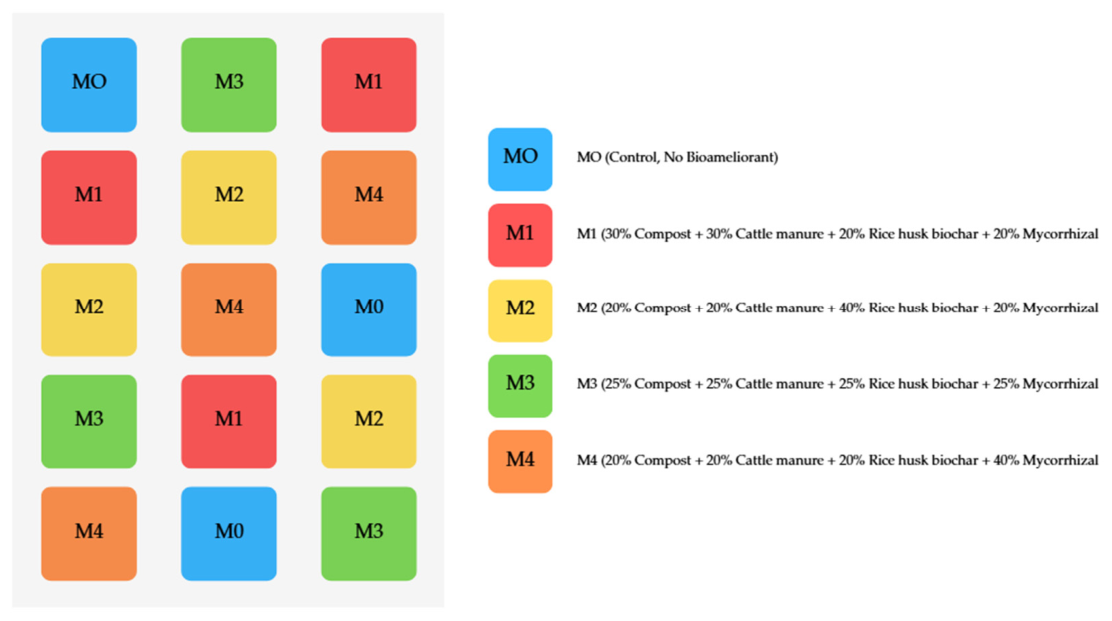
Figure 3.
Nitrogen (N) and phosphorus (P) uptake by maize and soybean under different bioameliorant mixtures at 42 DAS. Bars followed by the same letter are not significantly different according to the 5% LSD test. Treatment descriptions are provided in Table 1.
Figure 3.
Nitrogen (N) and phosphorus (P) uptake by maize and soybean under different bioameliorant mixtures at 42 DAS. Bars followed by the same letter are not significantly different according to the 5% LSD test. Treatment descriptions are provided in Table 1.
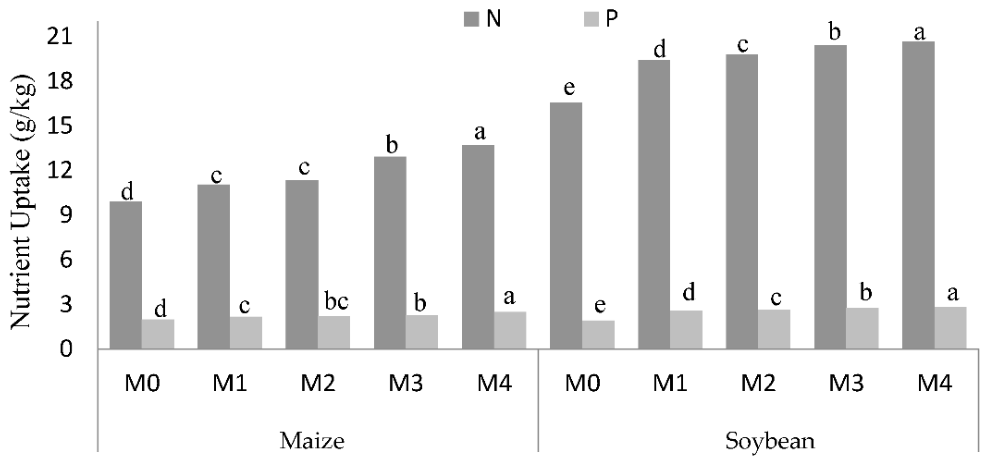
Figure 4.
a. Mycorrhizal spore density (spore 100 g-1 soil) under different bioameliorant mixtures at 42 and 92 DAS. Bars followed by the same letter are not significantly different according to the 5% LSD test. Treatment descriptions are provided in Table 1. b Root colonization by mycorrhizal fungsi (%) under different bioameliorant mixtures at 42 and 92 DAS. Bars followed by the same letter are not significantly different according to the 5% LSD test. Treatment descriptions are provided in Table 1.
Figure 4.
a. Mycorrhizal spore density (spore 100 g-1 soil) under different bioameliorant mixtures at 42 and 92 DAS. Bars followed by the same letter are not significantly different according to the 5% LSD test. Treatment descriptions are provided in Table 1. b Root colonization by mycorrhizal fungsi (%) under different bioameliorant mixtures at 42 and 92 DAS. Bars followed by the same letter are not significantly different according to the 5% LSD test. Treatment descriptions are provided in Table 1.
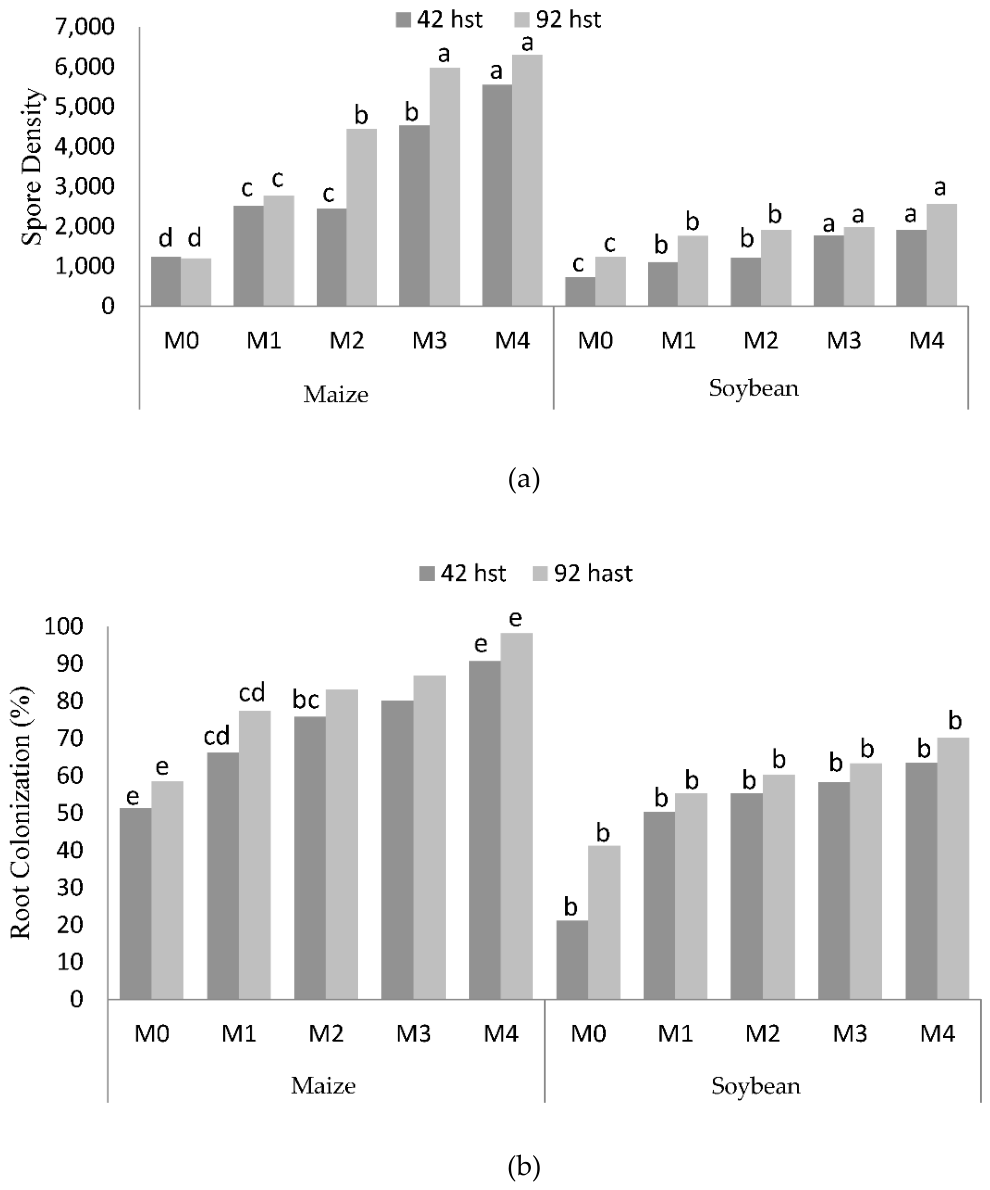
Figure 5.
Dry shoot biomass of maize and soybean under different bioameliorant mixtures. Bars followed by the same letter are not significantly different according to the 5% LSD test. Treatment are provided in Table 1.
Figure 5.
Dry shoot biomass of maize and soybean under different bioameliorant mixtures. Bars followed by the same letter are not significantly different according to the 5% LSD test. Treatment are provided in Table 1.
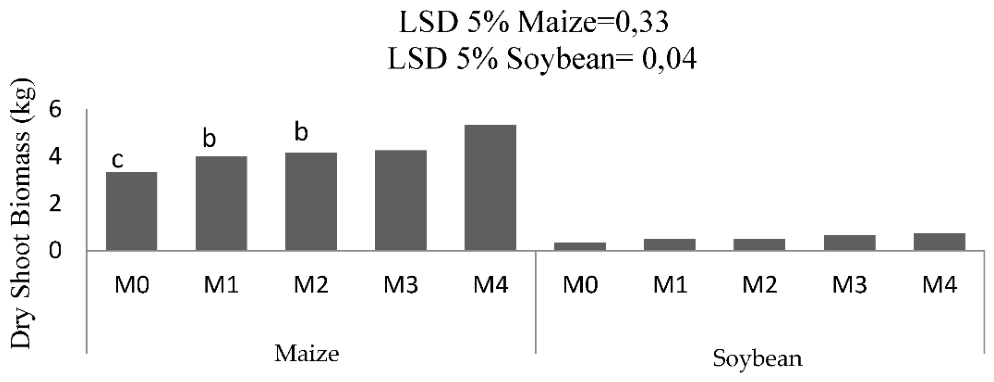
Figure 6.
Visual appearance (top row) and scanning electron microscopy (SEM) images at 2500× magnification (bottom row) of bioameliorant formulations with different compositions: M1 (30% compost + 30% cattle manure + 20% rice husk charcoal + 20% mycorrhizal biofertilizer), M2 (20% compost + 20% cattle manure + 40% rice husk charcoal + 20% mycorrhizal biofertilizer), M3 (25% compost + 25% cattle manure + 25% rice husk charcoal + 25% mycorrhizal biofertilizer), and M4 (20% compost + 20% cattle manure + 20% rice husk charcoal + 40% mycorrhizal biofertilizer).
Figure 6.
Visual appearance (top row) and scanning electron microscopy (SEM) images at 2500× magnification (bottom row) of bioameliorant formulations with different compositions: M1 (30% compost + 30% cattle manure + 20% rice husk charcoal + 20% mycorrhizal biofertilizer), M2 (20% compost + 20% cattle manure + 40% rice husk charcoal + 20% mycorrhizal biofertilizer), M3 (25% compost + 25% cattle manure + 25% rice husk charcoal + 25% mycorrhizal biofertilizer), and M4 (20% compost + 20% cattle manure + 20% rice husk charcoal + 40% mycorrhizal biofertilizer).
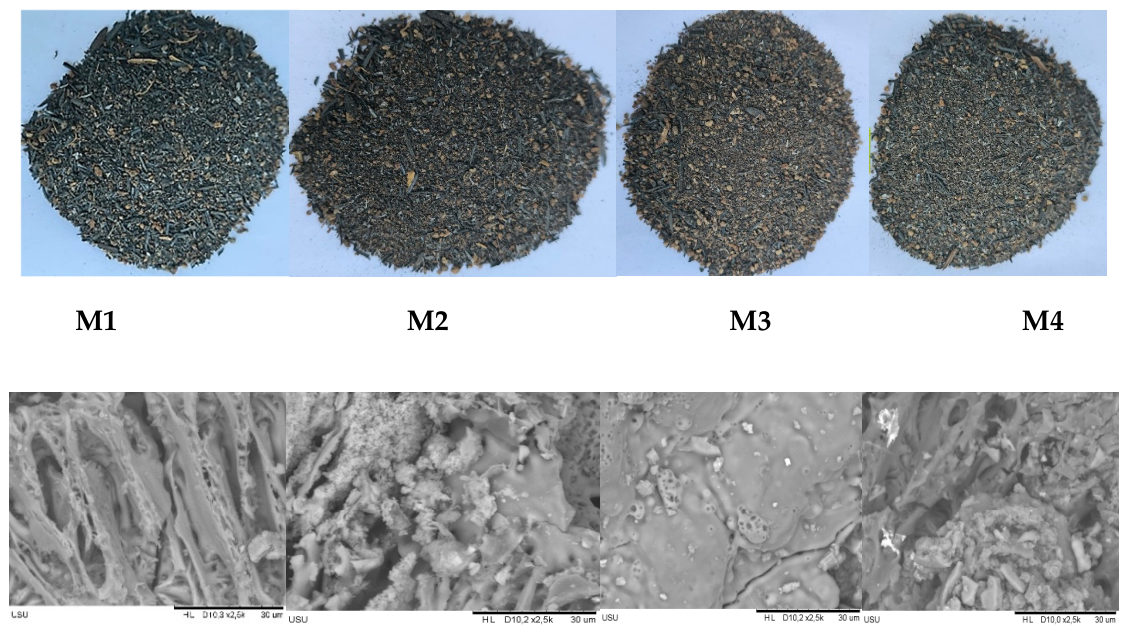
Figure 7.
Mass% and Atom% of elemental components in bioameliorant formulations M1–M4 determined by SEM–EDX analysis.
Figure 7.
Mass% and Atom% of elemental components in bioameliorant formulations M1–M4 determined by SEM–EDX analysis.
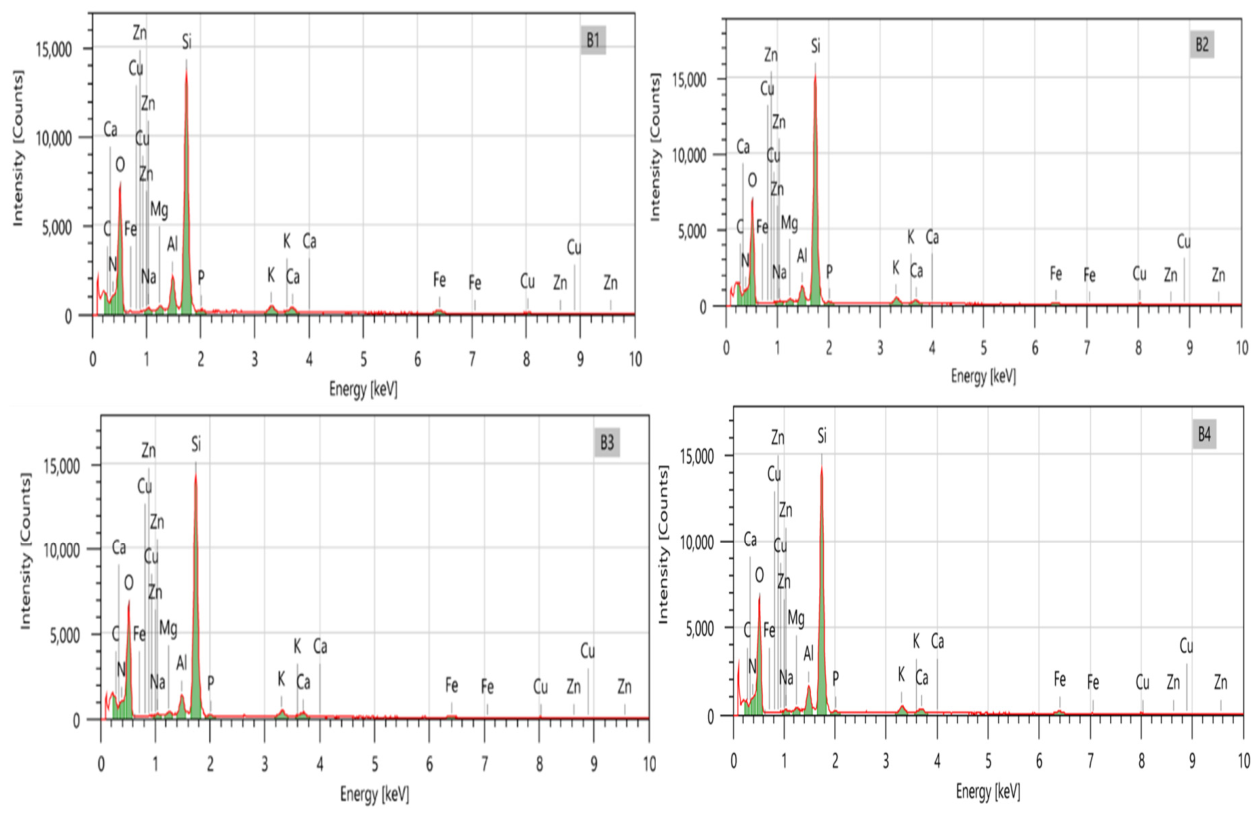

Table 1.
Composition of the bioameliorant mixtures evaluated in the field experiment.
| Treatment | Compost (%) | Cattle manure (%) | Rice husk biochar (%) | Mycorrhizal (%) |
| M0 | 0 | 0 | 0 | 0 |
| M1 | 30 | 30 | 20 | 20 |
| M2 | 20 | 20 | 40 | 20 |
| M3 | 25 | 25 | 25 | 25 |
| M4 | 20 | 20 | 20 | 40 |
Table 2.
Effects of Bioameliorant Mixtures on Soil Total N, Available P, and Organic Carbon under Maize–Soybean Intercropping.
Table 2.
Effects of Bioameliorant Mixtures on Soil Total N, Available P, and Organic Carbon under Maize–Soybean Intercropping.
| Treatment | N (g kg-1) | P (mg kg-1) | C-organic (g kg-1) | |||
| 42 DAP | 92 DAP | 42 DAP | 92 DAP | 42 DAP | 92 DAP | |
| Maize | ||||||
| M0 | 1.06 d | 1.26 d | 9.15 e | 12.07 e | 4.05 d | 5.25 e |
| M1 | 1.28 c | 1.66 c | 15.22 d | 15.40 d | 6.61 bc | 9.43 d |
| M2 | 1.36 c | 1.72 c | 19.59 c | 20.35 c | 7.63 ab | 10.63 c |
| M3 | 1.57 b | 1.83 b | 22.75 b | 23.20 b | 8.76 ab | 12.57 b |
| M4 | 1.92 a | 2.28 a | 31.45 a | 25.10 a | 10.55 a | 13.67 a |
| LSD 5% | 0.11 | 0.10 | 2.07 | 1.19 | 1,41 | 1.15 |
| Soybean | ||||||
| M0 | 1.03 e | 1.28 d | 9.12 e | 11.23 e | 4.13 d | 7.18 e |
| M1 | 1.23 d | 1.66 c | 14.36 d | 14.35 d | 6.10 c | 10.30 d |
| M2 | 1.28 c | 1.73 c | 16.45 c | 19.23 c | 6.67 bc | 10.83 c |
| M3 | 1.38 b | 1.86 b | 19.20 b | 22.12 b | 7.43 ab | 11.54 b |
| M4 | 1.44 a | 1.99 a | 23.65 a | 25.14 a | 8.49 a | 12.97 a |
| LSD 5% | 0.04 | 0.09 | 2.07 | 2.01 | 1.05 | 0.42 |
Table 3.
Fresh and dry cob and pod weight of maize and soybean under different bioameliorant mixtures.
Table 3.
Fresh and dry cob and pod weight of maize and soybean under different bioameliorant mixtures.
| Treatment | Maize cob weight (g plant-1) | Soybean pod weight (g plant-1) | ||
| Fresh | Dry | Fresh | Dry | |
| M0 | 220.04c | 46.23c | 20.96e | 4.43e |
| M1 | 270.04b | 69.23b | 28.73d | 6.50d |
| M2 | 270.38b | 75.06b | 43.28c | 10.60c |
| M3 | 280.06b | 87.06a | 50.26b | 18.63b |
| M4 | 333.38a | 93.83a | 63.41a | 26.63a |
| LSD 5% | 12.65 | 11.34 | 1.26 | 2.37 |
Table 4.
Dry cob yield, dry pod yield, and shelled grain yield of maize and soybean under different bioameliorant mixtures.
Table 4.
Dry cob yield, dry pod yield, and shelled grain yield of maize and soybean under different bioameliorant mixtures.
| Treatment |
Dry cob yield (kg plot-1) |
Dry pod yield (kg plot-1) |
Maize grain yield (kg plot-1) |
Soybean grain yield (kg plot-1) |
| M0 | 19,96c | 1,16d | 11,56c | 0,13c |
| M1 | 23,23ab | 1,46c | 15,30b | 0,40b |
| M2 | 28,06ab | 1,76b | 16,26b | 0,50ab |
| M3 | 29,36ab | 1,96a | 18,56b | 0,63ab |
| M4 | 31,83a | 2,01a | 21,20a | 0,73a |
| LSD 5% | 10,59 | 0,19 | 2,34 | 0,24 |
Table 5.
Mass% and atom% of elemental components in bioameliorant formulations (M1–M4) determined by EDX.
Table 5.
Mass% and atom% of elemental components in bioameliorant formulations (M1–M4) determined by EDX.
| Element | Mass % | Atom % | ||||||
| F1 | F2 | F3 | F4 | F1 | F2 | F3 | F4 | |
| C | nd | 2.32±0.19 | 1.46±0.16 | nd | nd | 4.09±0.33 | 2.58±0.28 | nd |
| N | 2.83±0.28 | 3.73±0.31 | 4.36±0.34 | 2.28±0.26 | 4.43±0.43 | 5.64±0.47 | 6.60±0.51 | 3.58±0.41 |
| O | 40.04±0.58 | 39.73±0.59 | 39.77±0.60 | 39.44±0.59 | 54.91±0.79 | 52.57±0.77 | 52.79±0.79 | 54.27±0.81 |
| Mg | 0.58±0.05 | 0.48±0.05 | 0.57±0.05 | 0.53±0.05 | 0.53±0.05 | 0.41±0.04 | 0.50±0.05 | 0.48±0.05 |
| P | 0.42±0.05 | 0.33±0.05 | 0.44±0.05 | 0.42±0.05 | 0.30±0.04 | 0.22±0.03 | 0.30±0.04 | 0.30±0.04 |
| K | 2.24±0.12 | 2.24±0.12 | 2.33±0.12 | 2.40±0.12 | 1.26±0.07 | 1.21±0.06 | 1.26±0.07 | 1.35±0.07 |
| Ca | 1.94±0.11 | 1.42±0.10 | 1.75±0.11 | 1.71±0.11 | 1.06±0.06 | 0.75±0.05 | 0.93±0.06 | 0.94±0.06 |
| Zn | 0.50±0.21 | 0.22±0.16 | 0.50±0.21 | 0.12±0.16 | 0.17±0.07 | 0.07±0.05 | 0.16±0.07 | 0.04±0.05 |
| Total | 100.00 | 100.00 | 100.00 | 100.00 | 100.00 | 100.00 | 100.00 | 100.00 |
Disclaimer/Publisher’s Note: The statements, opinions and data contained in all publications are solely those of the individual author(s) and contributor(s) and not of MDPI and/or the editor(s). MDPI and/or the editor(s) disclaim responsibility for any injury to people or property resulting from any ideas, methods, instructions or products referred to in the content. |
© 2026 by the authors. Licensee MDPI, Basel, Switzerland. This article is an open access article distributed under the terms and conditions of the Creative Commons Attribution (CC BY) license (http://creativecommons.org/licenses/by/4.0/).
Copyright: This open access article is published under a Creative Commons CC BY 4.0 license, which permit the free download, distribution, and reuse, provided that the author and preprint are cited in any reuse.