

Submitted:
23 August 2026
Posted:
31 August 2026
You are already at the latest version
Abstract
Sunflower (Helianthus annuus L.) is one of the major oilseed crops cultivated in Ukraine, particularly in the southern and steppe regions, where agricultural soils have been affected by military activities and explosive disturbance. These environments expose plants to complex combinations of chemical and physical stressors, including heavy metals, nitroaromatic explosives, perchlorates, soil structural disruption, and thermal and oxidative perturbations. Classical models of plant stress responses largely conceptualize stressors as independent inputs acting through parallel signaling pathways and scaling approximately with stress intensity. Such a framework is insufficient for describing plant responses to combined stress, because multiple stressors converge on shared regulatory, metabolic, energetic, and biophysical networks. In this work, we propose a conceptual model of stress emergence in plants under the action of multiple interacting stressors, termed the Plant Threat Matrix (PTM). Within this framework, the plant is conceptualized as a multistable nonlinear adaptive system that transitions between discrete physiological attractor states—from active growth (S1), through a pre-stress priming window (PSW), moderate adaptive stress (S2), immune–metabolic exhaustion (S3), and ultimately irreversible collapse (CS). The unifying architecture is represented by the SA–JA/ET–ABA–TOR immune–metabolic network, with LLPS-mediated sensing, ABA–TOR antagonism involving the SnRK2→SnRK1→RAPTOR cascade, SOURCE–SINK disruption associated with reduced CWIN activity, and FLZ proteins as candidate modulators of SnRK1 activity. Within this framework, post-explosive contaminants are considered interacting destabilizing factors rather than independent toxicants, capable of driving plants toward chronic immune–metabolic exhaustion through combined oxidative stress, altered phase behavior, protein aggregation, and energetic depletion. The PTM provides a general framework for explaining how interacting stressors can drive transitions between adaptive, exhausted, and collapse states. The framework further provides a basis for phase-oriented agronomic management and for developing quantitative threshold datasets for sunflower and other oilseed crops exposed to combined environmental stress.
Keywords:
Plant Threat Matrix
; immune-metabolic exhaustion
; post-explosive soil contamination
; multistable network
; ABA–TOR–SnRK1
; LLPS
; heavy metals
; FLZ proteins
; phase transition
; SOURCE–SINK collapse
; phytoremediation
; precision agronomy
1. Introduction
Sunflower (Helianthus annuus L.) is one of the major oilseed crops cultivated in Ukraine, with particularly important production areas located in the southern and steppe regions of the country. The ongoing military conflict has affected substantial areas of agricultural land in these regions, creating a new environmental challenge for the continued cultivation of sunflower on soils subjected to explosive disturbance and contamination.
The agronomic and ecological consequences of military conflict extend far beyond direct physical destruction of agricultural infrastructure. Detonation events generate a multicomponent soil contamination profile that no single phytotoxicological framework currently addresses adequately. Explosive blast zones release mixtures of heavy metals from ordnance casings (Pb, Cu, Zn, Cd), nitroaromatic compounds from unreacted explosive charges (TNT: 2,4,6-trinitrotoluene; RDX: cyclotrimethylenetrinitramine), perchlorates from propellant residues, and polycyclic aromatic hydrocarbons from incomplete combustion [1]. These chemical threats co-occur with severe physical disruption of soil structure from pressure waves, and localized thermal shock affecting root meristems and surface tissues. Understanding how plants respond to this complex threat landscape requires a conceptual framework that goes substantially beyond the classical models of plant stress physiology.
Since the 1990s, plant stress biology has built a sophisticated molecular understanding of how individual stressors—drought, salinity, pathogen attack, heavy metal toxicity—activate specific signaling cascades, transcriptional reprogramming events, and metabolic adjustments [2,3]. Yet this body of knowledge shares a fundamental methodological limitation: the overwhelming majority of experimental work imposes single, well-defined stressors under controlled conditions on model organisms, most often Arabidopsis thaliana. The resulting frameworks—PTI (pattern-triggered immunity), ETI (effector-triggered immunity), the ABA signaling cascade, the JA/ET wound response pathway—describe individual response modules with impressive molecular resolution but provide little guidance on how these modules interact under simultaneous, multi-stressor conditions [4,5].
Stressors do not act independently. Rather, they converge on shared regulatory, metabolic, energetic, and biophysical networks within the plant. Therefore, the physiological state of a plant exposed to combined stress cannot necessarily be predicted from its responses to individual stressors considered separately. This limitation is particularly relevant to sunflower production on post-explosive soils, where chemical contamination, physical soil disturbance, oxidative stress, altered water relations, and thermal perturbations may occur simultaneously. The problem revealed by sunflower production in such environments is therefore not simply contamination by individual toxicants, but the simultaneous convergence of multiple stressors on shared plant regulatory networks. A framework capable of describing these interactions is consequently required to explain how plants move between adaptive, exhausted, and collapse states.
The inadequacy of this atomistic approach becomes apparent when considering the biological complexity of post-explosion contamination. Heavy metals disrupt mitochondrial electron transport, generating ROS that simultaneously activate ABA biosynthesis and JA-mediated wound responses, while also interfering with the protein folding machinery that mediates SA-dependent systemic acquired resistance [3,6]. These three hormonal arms of plant immunity—SA, JA/ET, ABA—are not independent: they form an antagonistic network in which SA and JA/ET mutually suppress each other through the NPR1-COI1-JAZ regulatory circuit, while ABA suppresses SA by promoting NPR1 proteasomal degradation [7,8,9]. When all three are simultaneously activated by different contaminant classes, the resulting network dynamics are not predictable from any individual response curve.
This review proposes a conceptual reframing: the plant cell should be understood not as a system executing independent stress programs in parallel, but as a multistable, nonlinear dynamical system that can occupy discrete physiological attractor states, each maintained by interlocking positive feedback loops and separated from adjacent states by critical thresholds [10,11,12,13]. This perspective—which we operationalize through the Plant Threat Matrix (PTM) framework—explains phenomena that linear models cannot: why the same contamination level can yield dramatically different outcomes in plants with different prior states; why partial decontamination does not restore normal physiology; why stress memory shapes vulnerability to subsequent exposures; and why there exists a category of irreversible collapse that no agronomic input can reverse once crossed.
We further integrate emerging insights from biophysics—specifically the role of liquid–liquid phase separation (LLPS) in cellular organization and stress sensing [14] - and from energy metabolism research, particularly the TOR–SnRK1 bistable switch that governs the growth-survival trade-off [15]. Finally, we examine the FCS-Like Zinc finger (FLZ) proteins as candidate modulators of SnRK1 activity under combined stress conditions - a conceptually important but experimentally underexplored regulatory layer that warrants explicit treatment in the context of immune-metabolic exhaustion.
2. From Stress Pathways to State-Transition Biology: Attractors, Hysteresis, and Tipping Points
The dominant conceptual metaphor in plant stress biology remains the stimulus-response pathway: an external perturbation activates a defined molecular cascade, producing a quantitatively proportional physiological output. This metaphor has generated enormous experimental progress but carries implicit assumptions that become liabilities under complex stress conditions. It assumes that responses are graded and reversible, that simultaneous activation of multiple pathways produces additive outcomes, and that return to basal conditions follows removal of the stressor. Each of these assumptions is violated under the chronic multicomponent stress of post-explosion soil contamination.
Dynamical systems theory provides an alternative framework that accommodates these violations naturally. A multistable system has multiple stable equilibria—attractors—each defined by a particular configuration of interacting molecular species [16]. The plant hormonal network, with its multiple mutual inhibitory loops (SA⇔JA, ABA→SA, TOR⇔SnRK1), satisfies the topological requirement for multistability: double-negative feedback is mathematically equivalent to positive feedback and generates bistability when combined with sigmoidal response kinetics [10]. The network does not smoothly interpolate between states; rather, it exists in one state or another, with transitions occurring when a critical variable crosses a bifurcation threshold.
A fundamental property of multistable systems is hysteresis: the threshold for transitioning from state A to state B differs from the threshold for the reverse transition. In the plant hormonal context, this manifests as the well-documented phenomenon that a higher stress intensity is required to enter an ABA-dominant state than to exit it—and vice versa for growth-state re-entry, which requires active TOR reactivation rather than simply stress removal. The molecular basis of this hysteresis is the ABA-induced relocalization of SnRK1α1 from the nucleus to the cytoplasm following SnRK2 activation. In the cytoplasm, SnRK1α1 directly suppresses the TORC1 complex via phosphorylation of RAPTOR, thereby maintaining repression of growth processes even under partial reduction of ABA signaling. As a result, a self-sustaining ABA-dominant state is formed, capable of persisting independently of the initial stress signal. Thus, the nucleocytoplasmic redistribution of SnRK1 serves as a key molecular mechanism of hysteresis during the switching between growth programs and stress adaptation.
Tipping points—bifurcation thresholds beyond which the system transitions irreversibly to a new attractor—are the most clinically relevant property of multistable networks for agricultural management of contaminated soils. Once a plant crosses the threshold from immune-metabolic exhaustion (S3) to collapse (CS), no agronomic intervention can restore the growth state; the cellular machinery for recovery has been destroyed. Identifying these thresholds—in terms of specific contaminant concentrations, durations of exposure, and physiological markers—is therefore the most consequential empirical challenge in applied post-explosion phytotoxicology. The PTM framework developed in Section 3 provides the conceptual map for locating these thresholds.
Critical slowing down—a mathematically predicted phenomenon in which system recovery from perturbations becomes progressively slower as a bifurcation threshold approaches—provides a potential early warning signal for impending state transitions. Near a tipping point, the dominant eigenvalue of the linearized system approaches zero, causing variance and autocorrelation of system variables to increase. In principle, monitoring temporal autocorrelation in plant physiological markers such as chlorophyll fluorescence (Fv/Fm), stomatal conductance, or leaf temperature variability could provide field-applicable early warning of approaching collapse. This remains a knowledge gap requiring systematic experimental validation in plants under combined stress conditions (Figure 1).
3. The Plant Threat Matrix as a Multistable Physiological Landscape
3.1. Conceptual Architecture of the PTM
The Plant Threat Matrix (PTM) operationalises the dynamical systems perspective for applied plant physiology by identifying six functionally distinct physiological configurations through which a plant traverses under increasing or decreasing threat loads [11,12,13]. These configurations are not arbitrary points on a continuous damage scale; each represents a distinct attractor state maintained by specific molecular feedback loops and separated from adjacent states by thresholds that determine transition rates and reversibility. Table 1 summarizes the molecular characteristics, trigger conditions, and dominant signaling features of each state.
3.2. The Pre-Stress Window (PSW) as the Primary Intervention Opportunity
The PSW is the most conceptually important state in the PTM framework for practical management because it represents the only phase in which the plant retains full reversibility at minimal energetic cost. In the PSW, the regulatory network is in a metastable configuration—neither fully committed to growth nor locked into stress programs—with elevated sensitivity to incoming signals. LLPS condensation of sensing proteins (SEU, ELF3, FLOE1) has been initiated, causing partial transcriptional reprogramming toward stress-adaptive genes before detectable hormonal changes [14]. The cell wall integrity sensing system (FERONIA, WAK1-5) is activated, generating Ca2+ transients that prime CDPKs and RBOHD/F but have not yet triggered the full ROS burst associated with S2 entry.
The PSW corresponds to a Bifurcation Sensitivity Window (BSW)—a temporal interval during which the regulatory system is closest to the separatrix between the growth (S1) and stress (S2) attractors, and therefore maximally responsive to external inputs. Stochastic modeling of bistable genetic circuits predicts that inputs applied near bifurcation points require significantly less magnitude to redirect trajectory than inputs applied far from the threshold. This principle, while theoretically established for simpler gene networks [10,16], has not been directly validated in planta under post-explosion contamination conditions and should be treated as an informed hypothesis requiring experimental testing.
3.3. Immune-Metabolic Exhaustion (S3) and the Collapse Transition
The S3 state—immune-metabolic exhaustion—is the most critical configuration for understanding chronic yield losses under post-explosion contamination conditions. It is characterized by ABA hyper-dominance (>200 nM, based on threshold values for Arabidopsis), near-complete TOR suppression, cytoplasmic relocalization of SnRK1, collapse of the SOURCE–SINK system due to CWIN suppression, and progressive stiffening of LLPS condensates. A plant may persist in the S3 state for extended periods under chronic sublethal contamination, appearing visually green and intact while completely losing its capacity for yield formation—a physiological phenomenon sometimes referred to as “green drought.”
The transition from S3 to CS (collapse state) is the critical tipping point in the PTM landscape. It is marked operationally by: the appearance of TUNEL-positive cells indicating DNA fragmentation; activation of vacuolar processing enzyme (VPE) with caspase-like specificity; irreversible membrane depolarisation; and the transition of LLPS condensates from dynamic gel phases to amorphous protein aggregates that cannot be cleared by autophagy [14]. Once in CS, the cell has lost its energy-generating capacity, its proteostasis machinery, and its membrane integrity. At the tissue and organ level, CS manifests as necrotic lesions, root collapse, and chloroplast dismantling. Recovery from CS is impossible at the cellular level; ecosystem-scale recovery requires elimination of the contamination source and microbiome reconstruction.
4. The SA–JA/ET–ABA–TOR Multistable Hormonal Network and Its State Dynamics
4.1. Architecture of the Four-State Hormonal Attractor System
The SA–JA/ET–ABA–TOR network forms the molecular architecture of the PTM attractor landscape. Four principal attractor states exist within this network, each defined by a dominant hormonal axis and maintained by a specific positive feedback loop: (i) the TOR-growth state, in which T6P→SnRK1↓→TOR↑ positive feedback maintains anabolic programs [17,18]; (ii) the SA-dominant state, in which SA→CAT2 inhibition→H2O2→ICS1→SA feedback sustains SAR [19]; (iii) the JA/ET-dominant state, in which JA-Ile→COI1→JAZ degradation→MYC2→LOX feedback reinforces wound-response programs [20]; and (iv) the ABA-dominant state, in which ABA→PYR/PYL→PP2C inhibition→SnRK2→NCED3→ABA feedback creates a self-sustaining survival configuration [21].
These four attractors interact through mutual inhibitory connections that generate the multistability property. SA and JA/ET are mutually antagonistic through NPR1–COI1 cross-suppression [7,22]. ABA suppresses SA through SnRK2-dependent proteasomal NPR1 degradation [9]. TOR suppresses ABA through direct SnRK2 phosphorylation and inactivation [18]. The bidirectional nature of these antagonisms creates the multiple stable equilibria characteristic of a multistable system. Under post-explosion conditions, the specific contamination profile determines which attractor the plant initially occupies and how rapidly it transitions between states.
4.2. ABA-Dominant State as the Central Switch Under Environmental Stress
The ABA-dominant state is the configuration most strongly induced by the combined stressors of post-explosion soil contamination, making it the central focus for understanding immune-metabolic exhaustion. ABA biosynthesis from NCED3/NCED9 in vascular tissue is activated by ROS, osmotic perturbation, and thermal signals, all of which are simultaneously present in post-explosion soils [21,23]. The operational signature of the ABA-dominant state is: elevated endogenous ABA (>50 nM for sub-maximal, >200 nM for maximal SnRK2 activation); active SnRK2.2/2.3/2.6 kinase signaling; SnRK1α1 cytoplasmic relocalisation; transcriptional upregulation of RD29A, RAB18, NCED3, and LEA genes through AREB/ABF transcription factors; and stomatal closure [21].
The hysteresis of ABA-TOR transitions has specific practical implications for post-explosion agriculture. Entry into the ABA-dominant state occurs at approximately 50–200 nM ABA (based on PYL4/5/8 receptor affinity data in Arabidopsis); exit from the state requires ABA reduction below approximately 20–30 nM AND active T6P-mediated SnRK1 inhibition to restore TOR [17]. In heavy metal-contaminated soils, where bioavailable metal concentrations persist for years to decades and continuously activate NCED3, the exit threshold may be functionally unreachable without active decontamination. This creates chronic ABA-dominant trapping—the molecular basis of S3 immune-metabolic exhaustion. These threshold values are established for Arabidopsis under single-stressor conditions; their equivalents for wheat, maize, and sunflower under post-explosion combined contamination represent a critical knowledge gap.
4.3. TOR–SnRK1 as the Energetic Backbone of State Transitions
The TOR–SnRK1 bistable switch determines which side of the growth-survival boundary the plant occupies at any moment. TOR (Target of Rapamycin) is a conserved serine/threonine kinase that integrates photosynthate availability, amino acid status, and growth hormone signals to promote anabolism. In its active form, TORC1 phosphorylates S6K1/2 (stimulating ribosome biogenesis and mRNA translation), E2F transcription factors (promoting cell cycle entry), and ATG13 (suppressing autophagy) [15,18]. SnRK1, the plant orthologue of yeast SNF1 and mammalian AMPK, is activated by falling ATP/AMP ratios and by ABA-dependent signals, and reciprocally suppresses TOR through RAPTOR phosphorylation. The mutual antagonism of TOR and SnRK1 creates the bistability that underlies the growth-survival switch.
Trehalose-6-phosphate (T6P) plays a structurally central role in this switch. T6P—whose concentration tracks photosynthate availability through the sucrose pool—directly binds the catalytic KIN10 subunit of SnRK1, blocking T-loop reorientation and preventing GRIK1-mediated activation [17]. This establishes a direct molecular connection: high sucrose→high T6P→SnRK1 inhibition→TOR activation→growth. Disruption of SOURCE–SINK balance under post-explosion stress—whether through ABA-mediated stomatal closure reducing photosynthesis or through CWIN suppression reducing sink sucrose cycling—lowers T6P, removes SnRK1 inhibition, and drives the system toward the survival attractor. Paul et al. [24] demonstrated in wheat field trials that exogenous DMNB-T6P application at the grain-filling stage increased yield by 17% under drought, providing proof-of-principle that T6P-mediated TOR reactivation is agronomically accessible.
5. Liquid–Liquid Phase Separation as a Biophysical Layer of Stress Adaptation
5.1. LLPS Principles and Stress Condensates
Liquid–liquid phase separation (LLPS) is the process by which proteins and nucleic acids bearing intrinsically disordered regions (IDRs) spontaneously demix from the surrounding solution to form a concentrated, liquid-like condensate phase [14]. Biological condensates—including stress granules, P-bodies, and transcriptional hubs—concentrate signaling components, exclude others, and accelerate or decelerate specific reactions, providing a rapid, membrane-independent mechanism for reorganizing cellular biochemistry. In the stress response context, condensates allow much faster reorganization of signaling complexes than transcriptional induction and are fully reversible under transient stress conditions.
Three LLPS-competent proteins are particularly relevant to the PTM framework in the context of post-explosion contamination. SEUSS (SEU), a transcriptional co-repressor that undergoes nuclear LLPS under osmotic stress driven by molecular crowding, forms condensates that reprogram ABA-responsive gene expression before detectable ABA elevation—functioning as a pre-hormonal stress sensor [14]. ELF3, the circadian clock component and photoreceptor integrator, undergoes reversible LLPS at temperatures above 27–30 °C, with ELF3 condensation promoting ABA-state gene expression and suppressing growth programs—relevant to the thermal stress component of explosive detonation [14]. FLOE1, an IDR-containing protein that forms cytoplasmic condensates upon hydration and dissolves upon dehydration, directly couples tissue water status to ABA signaling sensitivity, with implications for plants in compacted post-explosion soils where hydraulic conductivity is impaired.
5.2. Adaptive vs. Pathological Condensates: The Phase Rigidity Syndrome
Under moderate, transient stress, LLPS condensates are adaptive: they concentrate stress-response machinery, sequester growth-promoting mRNAs, and protect RNA from degradation. These adaptive condensates are characterized by high internal fluidity (measured by FRAP half-time), dynamic exchange of components with the surrounding solution, and reversibility upon stress removal—the condensate dissolves and its components resume their solution-phase functions.
Under severe or chronic stress—the condition of post-explosion soil contamination—condensates can transition from adaptive liquid phases to pathological gel or solid states. This “phase rigidity syndrome” is driven by multiple mechanisms: (i) ROS-mediated oxidative cross-linking of IDR regions in condensate-forming proteins [3]; (ii) heavy metal coordination with histidine and cysteine residues in IDRs, causing irreversible coordination bonds that rigidify the condensate matrix; (iii) depletion of ATP, which normally serves as a biological hydrotrope maintaining condensate fluidity (knowledge gap: this mechanism has been demonstrated in mammalian cells but not directly validated in plant cells under post-explosion conditions); and (iv) accumulation of misfolded proteins that co-partition into condensates and nucleate aggregation. Rigid, gel-phase condensates impair RNA trafficking, prevent dynamic exchange of signaling proteins, and promote pathological protein aggregation—all features of the S3→CS transition in the PTM framework.
The reversibility boundary between adaptive and pathological condensates is a critical conceptual and practical threshold. It corresponds to the biophysical equivalent of the S3→CS tipping point in the PTM landscape. Detection of condensate gel transition using biophysical methods (FRAP, single-molecule tracking) in plant cells under defined contamination conditions would provide a molecular diagnostic for impending collapse. This is identified as a priority research direction (Figure 2).
6. Heavy Metals and Post-Explosive Soils as PTM Destabilizers
6.1. Chemical Complexity of Post-Explosion Soil Contamination
The phytotoxicological profile of post-explosion soils differs fundamentally from conventional industrial contamination in three respects. First, the contaminant mixture is multicomponent: detonation of a single explosive device releases heavy metals from the casing and fragments (Pb, Cu, Zn), energetic compounds from unreacted explosive material (TNT, RDX, PETN), propellant residues including perchlorates, and combustion products. Second, the spatial distribution is heterogeneous and non-uniform, creating contamination hotspots at former ordnance locations embedded in a matrix of less-contaminated soil. Third, physical soil disruption accompanies chemical contamination: pressure waves compact soil layers, disrupt aggregate structure, and alter hydraulic conductivity, while thermal effects sterilize soil sections and destroy mycorrhizal networks [1,25]. Table 2 summarizes the network entry points and PTM trajectories associated with each major stressor class.
6.2. Heavy Metal-Induced ROS Overload and Membrane Damage
Lead and cadmium displace essential metal cofactors in the active sites of superoxide dismutase (SOD), catalase (CAT), and ascorbate peroxidase (APX), directly impairing the antioxidant machinery responsible for ROS homeostasis [6,26]. Simultaneously, these metals disrupt the thylakoid membrane, uncoupling electron transport from ATP synthesis and generating excess electrons that reduce O2 to superoxide. Copper at elevated concentrations (above 50 μM in soil solution) drives Fenton-type reactions through Cu2+→Cu+ redox cycling, producing the highly reactive hydroxyl radical (•OH) directly from H2O2. This generates a self-amplifying ROS cascade that rapidly overwhelms the residual antioxidant capacity.
From a PTM perspective, this ROS overload functions as a multi-pathway stressor: it activates NCED3 (ABA biosynthesis), promotes SA accumulation through ICS1-dependent pathways, induces JA through OPDA synthesis from lipid peroxidation, and impairs TOR activity by oxidizing cysteine residues in the RAPTOR scaffold [3,27]. The simultaneous activation of all three hormonal immune arms—SA, JA/ET, and ABA—through a single shared mechanism (ROS overload) is the key feature that makes heavy metal stress fundamentally different from biotic stresses, which typically engage only one or two hormonal arms. This simultaneous engagement of all three arms overwhelms the mutual buffering interactions of the hormonal network and drives the plant toward the S3 state far faster than single-pathway stressors.
6.3. Nitroaromatic Compounds: Redox Enzyme Inhibition and Network Conflict
TNT and RDX are reductively transformed in plant tissues by nitroreductases and cytochrome P450s to hydroxylamine and amino metabolites that form stable covalent adducts with thiol groups in cysteine residues [1]. The cellular thiol pool—of which glutathione (GSH) is the principal soluble component—is thus progressively depleted. GSH depletion has three major network consequences: it impairs the ascorbate-glutathione cycle responsible for H2O2 detoxification; it reduces the total capacity for phytochelatin synthesis (which requires GSH as substrate); and it impairs S-nitrosoglutathione (GSNO) buffering, altering NO/ROS ratios and destabilizing the fine-tuned redox signaling that distinguishes stress warning signals from toxic events. The consequence is amplified oxidative damage to proteins, lipids, and nucleic acids, accelerating the progression from S2 to S3 to CS.
7. Metal-Binding Buffering Systems and Their Exhaustion Under Chronic Exposure
7.1. Phytochelatins and Metallothioneins: First-Line Metal Chelation
Plants deploy two principal families of metal-chelating peptides and proteins to buffer cytoplasmic metal ion activity: phytochelatins (PCs) and metallothioneins (MTs). Phytochelatins are enzymatically synthesized from glutathione by phytochelatin synthase (PCS1, PCS2) and form stable coordination complexes with Cd, Pb, Cu, and As through their γ-Glu-Cys repeat units [6,28]. The PC–metal complexes are actively transported into the vacuole by the ABCC-type transporter HMT1/AtABCC1/2, where they associate with sulfide ions to form high-stability PC-metal-sulfide (HMT) clusters. Metallothioneins are small, cysteine-rich proteins transcriptionally induced by Zn, Cu, Cd, and other metals through Zn-responsive elements, providing a complementary, protein-based chelation system [28].
A critical constraint on these buffering systems is their dependence on the glutathione pool and on continued gene expression. Under TNT/RDX co-exposure, GSH depletion by nitroaromatic thiol adduct formation directly impairs phytochelatin synthesis—an emergent effect of combined contamination not predicted from individual stressor responses. This is a specific example of the PTM principle that combined stressors generate emergent cellular vulnerabilities through shared molecular substrates. As the buffering capacity for metal chelation is exhausted, free metal ion activity in the cytoplasm rises, shifting the dose-response relationship toward catastrophic thresholds at which direct enzyme inhibition, protein misfolding, and DNA damage accelerate the S3→CS transition.
7.2. Vacuolar Sequestration and Tonoplast Transporter Function
The central vacuole serves as the principal long-term storage compartment for metal–PC complexes, enabling the cytoplasm to maintain low free metal ion activity even when total cellular metal content is high [28]. This vacuolar sequestration depends on proton gradient-driven transport across the tonoplast: the vacuolar H+-ATPase (V-ATPase) and H+-pyrophosphatase (V-PPase) generate the electrochemical gradient that drives ABCC transporter-mediated HMT complex import. Under severe heavy metal stress, the V-ATPase itself is a target of metal toxicity through inhibition of its catalytic subunits by Cu2+ and Cd2+ (knowledge gap: precise IC50 values for V-ATPase inhibition by post-explosion metal mixtures in crop species have not been determined). Disruption of the proton gradient also collapses vacuolar pH, impairing the stability of HMT complexes and potentially releasing metal ions back into the cytoplasm—a collapse mechanism that is self-amplifying and contributes to the irreversibility of the CS state (Figure 3).
8. FLZ Proteins as Candidate Hidden Regulators of SnRK1 Activity Under Stress
This section presents FLZ proteins as speculative but mechanistically plausible regulators of SnRK1 function under combined stress conditions. The evidence base is established for FLZ-SnRK1 interactions under standard metabolic conditions [29] but has not been experimentally tested in the context of heavy metal or post-explosion contamination. All interpretations involving FLZ function under contamination stress are explicitly hypothesis-level and require experimental validation.
FCS-Like Zinc finger (FLZ) proteins are plant-specific regulators identified through their interaction with the SnRK1 complex. Jamsheer et al. [29] identified Arabidopsis FLZ genes as differentially regulated by sugars, cellular energy status, and TOR pathway activity, positioning them as context-dependent modulators of the SnRK1–TOR decision. Subsequently demonstrated that FLZ6 and FLZ10 directly interact with SnRK1 and repress its kinase activity in an energy-dependent manner, providing a mechanism by which sugar status could modulate the sensitivity threshold of SnRK1 activation independently of the T6P pathway.
The relevance of FLZ proteins to post-explosion stress is speculative but conceptually important. If FLZ proteins normally buffer SnRK1 activity near the threshold between growth and survival states, then their post-translational modification or degradation under heavy metal or oxidative stress could lower this threshold, making cells more susceptible to entering the ABA-dominant attractor at sub-maximal stress intensities. Heavy metals are known to affect zinc finger domain integrity through competitive coordination; the FLZ domain itself (FCS: Phe-Cys-Ser) contains conserved cysteine and histidine residues that could theoretically be affected by competing metal binding (knowledge gap: no experimental data exist on heavy metal effects on FLZ domain structure or FLZ–SnRK1 interaction in planta).
If validated, FLZ protein perturbation by post-explosion metal contamination would represent a “hidden regulatory layer”: a mechanism that modulates the PTM trajectory without directly activating canonical stress signaling pathways, and therefore invisible to approaches that monitor only hormonal or ROS markers. The implication for stress diagnostics is that measuring FLZ protein levels, post-translational modification status, and SnRK1 interaction affinity in contaminated plant tissues could provide a novel category of threshold biomarkers for imminent S2→S3 transition. We flag this as a priority for experimental investigation, with the caveat that the hypothesis requires building from first-principles validation (FLZ metal sensitivity) before agronomic application can be considered.
9. Plant Immune-Metabolic Exhaustion: Chronic Stress Lock-in and Loss of Adaptive Plasticity
Immune-metabolic exhaustion—the S3 state in the PTM framework—is qualitatively distinct from acute stress adaptation. It represents a chronic, self-sustaining physiological configuration from which the plant cannot escape through normal homeostatic mechanisms. Three molecular mechanisms converge to create and maintain the S3 lock-in: (i) sustained ABA-dominant signaling through the SnRK2→SnRK1→TOR repression cascade, which persists even when the initial stress signal moderates; (ii) LLPS condensate rigidity, which impairs the dynamic reorganization of signaling complexes needed to exit the ABA-dominant attractor; and (iii) SOURCE–SINK collapse through CWIN suppression, which eliminates the T6P signal that is necessary for TOR reactivation and growth-state re-entry.
The SOURCE–SINK collapse mechanism deserves particular attention because it establishes a vicious cycle that is self-amplifying at the whole-plant level. Under ABA dominance, cell wall invertase (CWIN) activity in reproductive organs is suppressed through the induction of cell wall invertase inhibitor proteins (CWIN-INH) and through TOR-dependent reduction of CWIN promoter activity [30]. Suppressed CWIN activity reduces sucrose cycling in the apoplast, lowering T6P production and removing SnRK1 inhibition, which further suppresses TOR. Reduced TOR activity further upregulates CWIN-INH and reduces CWIN expression, completing the circle. In contaminated soils, where ABA is continuously maintained above threshold by metal-activated NCED3, this cycle cannot be broken by removing the stress signal and becomes a defining feature of the S3 state. Xu et al. [31] demonstrated in rice and tomato that prime-editing the CWIN promoter to introduce a heat-stable element (HSE) increased yield by 25–33% under thermal stress—proof that CWIN is an actionable target for breaking this cycle, though its application to post-explosion contamination scenarios requires separate validation.
The loss of adaptive plasticity in S3 is manifested at multiple organizational levels. At the molecular level, the LLPS condensate phase shift from liquid to gel reduces the responsiveness of the sensing apparatus to new signals: the plant’s ability to distinguish between different stress qualities is impaired, and it enters a generalized survival mode that is suboptimal for any specific threat. At the cellular level, autophagy—initially upregulated during S2 as a productive recycling mechanism—becomes pathological in S3, degrading organelles and proteins at a rate that exceeds the cell’s capacity for new synthesis under TOR suppression. At the physiological level, the plant loses the capacity for the stomatal reopening and photosynthesis recovery that are necessary for post-stress growth resumption. The net result is a plant that appears to be alive but has effectively lost the ability to generate yield.
10. Practical Implications: Phase-Aware Diagnostics, Interventions, and Agroecosystem Restoration
10.1. PTM-Based Diagnostic Framework
The PTM framework implies a specific diagnostic logic: the appropriate intervention depends not on the identity of the stressor but on the current physiological state of the plant. This requires a panel of state-specific biomarkers that can distinguish S1, PSW, S2, S3, and CS configurations under field conditions. Current technology does not provide a complete such panel, but several candidates are accessible. Fv/Fm (chlorophyll fluorescence yield) provides a rapid, non-destructive proxy for photosystem II integrity that decreases progressively from S1 through CS. Stomatal aperture and leaf temperature differentials track ABA-TOR balance—plants in S3 show elevated leaf temperature from stomatal closure combined with reduced internal carbon assimilation. Phytochelatin content in root extracts provides a quantitative index of metal buffering capacity utilization. CWIN activity in reproductive tissues, measurable from microsamples by enzyme assay, directly reports SOURCE–SINK status. None of these individually identifies PTM state; the diagnostic power emerges from their combination into a multi-variable state classifier, an approach that requires machine learning tools to operationalize at scale.
10.2. Intervention Timing and Phase-Aware Agronomy
Table 3 summarizes the phase-appropriate intervention strategies for each PTM state in the context of post-explosion contaminated soils. The fundamental principle is that the same compound (e.g., cytokinin spray) has qualitatively different effects depending on PTM state: in PSW, it extends the growth-state attractor basin and prevents S2 entry; in S3, it may be unable to overcome the SnRK1 cytoplasmic lock-in; in CS, it is irrelevant. This state-dependence explains the high variability of biostimulant responses documented in field trials (coefficients of variation commonly exceeding 30–50%), which likely reflect variable PTM states at application time rather than variable product efficacy.
10.3. Post-War Agroecosystem Restoration: Ecosystem-Scale PTM Considerations
Agroecosystem restoration after conflict-related contamination requires operating simultaneously at three organizational levels: the plant cell (PTM state management), the individual plant (state-aware agronomic inputs), and the soil ecosystem (microbiome reconstruction and contaminant elimination). The microbiome dimension is particularly consequential because plant growth-promoting rhizobacteria (PGPR) and arbuscular mycorrhizal fungi (AMF) function as external regulators of the SA–JA/ET–ABA–TOR network, moderating ABA accumulation, providing ISR through JA/ET priming, and improving nutrient status that activates TOR [32]. Post-explosion soils lose this regulatory partnership through direct physical destruction of hyphal networks, selective elimination of metal-sensitive microbial taxa, and nitroaromatic compound toxicity to soil nitrifiers [25]. Restoration of functional microbiome consortia—particularly AMF for phosphorus acquisition and PGPR for ABA moderation—should be treated as a mechanistic intervention in the plant’s signaling network, not merely an agronomic soil health measure.
Phytoremediation strategies for metal-contaminated post-explosion soils should incorporate PTM-state management to maximize effectiveness. Hyperaccumulator plants used for metal extraction (e.g., Noccaea caerulescens for Cd and Zn) will themselves be subject to PTM state transitions under the contamination loads they are selected to accumulate [33,34]. Maintaining hyperaccumulators in the S2 rather than S3 state—through microbiome support, antioxidant supplementation, and LLPS-priming agents—would extend the period of active metal uptake before physiological collapse limits transport activity. This represents an application of PTM biology to phytoremediation optimization that has not been experimentally addressed.
11. Future Directions
The conceptual synthesis presented here identifies several priority research directions whose resolution is necessary for both basic understanding and practical application. First, quantitative ABA threshold calibration in crop species under combined contamination is the most urgent empirical gap. Genetically encoded ABA biosensors (ABAleon, ABACUS) should be deployed in wheat, maize, and sunflower roots under defined post-explosion contamination profiles to determine actual threshold concentrations for S2 and S3 entry in agriculturally relevant species. These data would allow calibration of PTM-based diagnostic tools for field application.
Second, the LLPS phase rigidity syndrome requires direct experimental characterization in plant cells under post-explosion stress. Cryo-electron tomography of roots from contaminated-soil-grown plants, combined with FRAP analysis of fluorescently tagged SEU, ELF3, and stress granule markers, would provide structural evidence for condensate gel transition and allow mapping of the condensate phase diagram under contamination-relevant conditions. This is a biophysical experiment that requires specialist infrastructure but has high conceptual payoff.
Third, the FLZ protein hypothesis (Section 8) requires validation from first principles: metal-binding assays on recombinant FLZ proteins; co-immunoprecipitation of FLZ–SnRK1 complexes from metal-stressed plants; and genetic tests (flz mutants) for altered sensitivity to metal-induced S2→S3 transition. If validated, FLZ proteins would represent a new category of regulators linking metal perception to energy-state decisions.
Fourth, mathematical modeling of the SA–JA/ET–ABA–TOR network as a multistable dynamical system—analogous to the ODE framework developed by Khablak et al. [11] - should be extended to include LLPS condensate dynamics as a biophysical state variable and parameterized for post-explosion contamination inputs. Such a model could generate testable predictions about bifurcation threshold positions and sensitivity window durations under specific contamination profiles, providing a quantitative foundation for risk assessment in contaminated agricultural zones.
Fifth, digital twin approaches to plant physiology—integrating real-time sensor data on chlorophyll fluorescence, leaf temperature, stomatal conductance, and root exudate composition with machine-learning-based PTM state classifiers—offer a route to field-scale implementation of phase-aware agronomy. Development of such systems requires interdisciplinary collaboration between plant biologists, biophysicists, sensor engineers, and agricultural data scientists. The PTM framework provides the biological architecture that gives these digital twin systems predictive rather than merely descriptive power (Figure 4).
12. Conclusions
Post-explosion soil contamination confronts plant physiology with a challenge that its linear, pathway-centered conceptual tradition is not equipped to address. The coexistence of heavy metals, nitroaromatic compounds, perchlorates, physical shockwave damage, and thermal stress in a single contaminated field means that multiple independent entry points in the SA–JA/ET–ABA–TOR hormonal network are simultaneously engaged. The emergent behavior of this network under combined activation—simultaneous SA, JA/ET, and ABA signaling with ROS overload—is not predictable from any individual pathway response and cannot be managed by interventions designed for single-stressor agriculture.
The multistable, nonlinear dynamical systems perspective offers a coherent alternative. Plants traverse discrete physiological attractor states—S1 (growth), PSW (pre-stress), S2 (moderate stress), S3 (immune-metabolic exhaustion), CS (collapse), and R (recovery)—separated by bifurcation thresholds that are determined by the cumulative state of the SA–JA/ET–ABA–TOR network and its biophysical substrate (LLPS condensate phase behaviour). The ABA-dominant state, entered when NCED3 is persistently activated by metal-induced ROS, becomes chronically self-sustaining through the SnRK2→SnRK1→TOR repression cascade and the SOURCE–SINK collapse through CWIN suppression—establishing the molecular basis of immune-metabolic exhaustion that underpins chronic yield loss in contaminated fields.
The practical implications are clear. First, PTM state at the time of agronomic intervention determines its efficacy; interventions designed without regard to plant physiological state will continue to show high field variability. Second, the PSW is the highest-leverage management window, where minimal inputs can redirect network trajectory. Third, microbiome reconstruction is a mechanistic intervention in the hormonal network, not merely a soil health measure. Fourth, irreversibility—the CS state—cannot be addressed by agronomic inputs and requires elimination of the contamination source as a prerequisite. Fifth, the priority knowledge gap is the quantitative threshold data for PTM state transitions in crop species under combined contamination: without these data, neither diagnostic tools nor intervention protocols can be rationally calibrated.
The PTM framework proposed in this work fundamentally redefines plant stress biology by shifting the paradigm from linear stress-response models toward a phase-oriented physiology of adaptive states. Within this conceptual architecture, the physiological condition of a plant is determined not only by genetic regulation, but also by the biophysical state and phase plasticity of intracellular protein condensates. LLPS-mediated condensates emerge as central regulators of PTM states, integrating biophysics, ROS biology, metal toxicity, cellular energetics, phase transitions, and plant immunity into a unified adaptive network.
Our analysis suggests that the interaction between heavy metals, ROS accumulation, and LLPS dysregulation may represent a previously underappreciated mechanism underlying plant degradation in post-explosive contaminated environments. Under chronic stress conditions, progressive ATP depletion, oxidative overload, and condensate rigidification drive the transition from adaptive liquid-like assemblies toward irreversible gel-like pathological states associated with immune–metabolic collapse. Thus, LLPS condensates function not merely as passive stress markers, but as dynamic sensors and regulators of cellular fate.
A central implication of the PTM model is the identification of physiological intervention windows. The PSW phase and early S2 state represent critical periods during which the adaptive system remains highly plastic and potentially reversible. In contrast, the S3 state constitutes a tipping point beyond which the efficiency of agronomic or physiological interventions declines sharply. This establishes the conceptual basis for PTM-oriented agronomic management aimed at preventing irreversible phase transitions before systemic collapse occurs.
Accordingly, future anti-stress strategies should focus on the development of LLPS-stabilizing interventions, including osmoprotectants, antioxidants, metal-binding systems, and modulators of the TOR–SnRK1 axis capable of preserving condensate fluidity and adaptive buffering capacity. Such approaches may enable artificial expansion of the adaptive reserve under prolonged multiplex stress conditions characteristic of post-war agricultural landscapes.
The PTM framework additionally opens the way toward predictive and AI-assisted agriculture. Modern monitoring systems should evolve beyond purely morphological assessment toward adaptive precision agriculture based on biophysical biomarkers. Early diagnosis of PSW states may be achieved through monitoring of LLPS dynamics, condensate fluidity, cytoplasmic viscosity, chlorophyll fluorescence, and spectral indices such as NDVI and PRI. Integration of these parameters into dynamic digital twins could allow simulation of nonlinear state trajectories, identification of hysteresis effects, and prediction of tipping points preceding crop collapse.
Particularly important within this architecture are FLZ (FCS-Like Zinc Finger) proteins, which may function as scaffold regulators controlling condensate assembly/disassembly and modulation of SnRK1 signaling. Their involvement in LLPS-mediated chromatin organization further suggests a potential role in transgenerational stress memory, enabling plants to preserve adaptive information across generations exposed to toxic environments. Loss of FLZ-mediated regulation under chronic contamination conditions may therefore accelerate transition toward immune–metabolic exhaustion.
The practical implications of this framework extend beyond stress physiology alone. Restoration of agroecosystems affected by ecocide and post-explosive contamination cannot rely exclusively on mechanical soil remediation. Instead, successful rehabilitation will require what may be termed biophysical reanimation — the restoration of cellular phase plasticity and adaptive buffering mechanisms. In this context, PTM-oriented strategies, LLPS priming, and phase-state diagnostics become central tools for ecological recovery.
Ultimately, the PTM concept transforms agronomy into a predictive systems discipline grounded in nonlinear biology. If we learn to measure, model, and preserve adaptive reserves at the level of molecular fluidity and condensate dynamics, it may become possible not only to recultivate damaged lands, but to restore their biological resilience and long-term productivity. Understanding the “language of phases” within plant cells may therefore become one of the key foundations for future food security and ecological rehabilitation in anthropogenically damaged environments.
The scientific and humanitarian urgency of this agenda is substantial. An estimated four million hectares of agricultural land in Ukraine and adjacent regions are affected by conflict-related contamination, with analogous situations developing in other conflict zones globally. A mechanistically grounded, state-based framework for understanding and managing plant responses to this contamination is not an academic luxury but a prerequisite for food security in post-conflict agroecosystems.
Author Contributions
Conceptualization and design, S.H. Khablak and L.M. Bondareva; literature analysis and critical evaluation, S.H. Khablak, L.M. Bondareva, Y.V. Kolomiiets, Y.A. Abdullaieva and V.M. Spychak; writing—original draft preparation, S.H. Khablak; writing—review and editing, L.M. Bondareva and Y.V. Kolomiiets; supervision, S.H. Khablak. All authors have read and agreed to the published version of the manuscript.
Funding
This research received no external funding.
Institutional Review Board Statement
Not applicable.
Informed Consent Statement
Not applicable.
Data Availability Statement
No new data were created or analyzed in this study. Data sharing is not applicable to this article.
Acknowledgments
During the preparation of this manuscript, the author(s) used Claude (Anthropic, 2025–2026) for grammar checking, style editing, and English-language formulation. The authors have reviewed and edited the output and take full responsibility for the content of this publication.
Conflicts of Interest
The authors declare no conflicts of interest.
References
- Corredor, D.; Duchicela, J.; Flores, F.J.; Maya, M.; Guerron, E. Review of Explosive Contamination and Bioremediation: Insights from Microbial and Bio-Omic Approaches. Toxics 2024, 12, 249. [Google Scholar] [CrossRef]
- Zhu, J.K. Abiotic Stress Signaling and Responses in Plants. Cell 2016, 167, 313–324. [Google Scholar] [CrossRef] [PubMed]
- Mittler, R.; Zandalinas, S.I.; Fichman, Y.; Van Breusegem, F. Reactive Oxygen Species Signalling in Plant Stress Responses. Nat. Rev. Mol. Cell Biol. 2022, 23, 663–679. [Google Scholar] [CrossRef] [PubMed]
- Rivero, R.M.; Mittler, R.; Blumwald, E.; Zandalinas, S.I. Developing Climate-Resilient Crops: Improving Plant Responses to Stress Combination. Plant J. 2022, 109, 373–389. [Google Scholar] [CrossRef] [PubMed]
- Zandalinas, S.I.; Mittler, R. Plant responses to multifactorial stress combination. New Phytol. 2022, 234, 1161–1167. [Google Scholar] [CrossRef] [PubMed]
- Clemens, S.; Ma, J.F. Toxic Heavy Metal and Metalloid Accumulation in Crop Plants and Foods. Annu. Rev. Plant Biol. 2016, 67, 489–512. [Google Scholar] [CrossRef] [PubMed]
- Spoel, S.H.; Johnson, J.S.; Dong, X. Regulation of Tradeoffs Between Plant Defenses Against Pathogens with Different Lifestyles. Proc. Natl. Acad. Sci. USA 2007, 104, 18842–18847. [Google Scholar] [CrossRef] [PubMed]
- Koornneef, A.; Pieterse, C.M.J. Cross-Talk in Defense Signaling. Plant Physiol. 2008, 146, 839–844. [Google Scholar] [CrossRef] [PubMed]
- Ton, J.; Flors, V.; Mauch-Mani, B. The Multifaceted Role of ABA in Disease Resistance. Trends Plant Sci. 2009, 14, 310–317. [Google Scholar] [CrossRef] [PubMed]
- Ferrell, J.E.; Ha, S.H. Ultrasensitivity Part I: Michaelian Responses and Zero-Order Ultrasensitivity. Trends Biochem. Sci. 2014, 39, 496–503. [Google Scholar] [CrossRef] [PubMed]
- Khablak, S.H.; Bondareva, L.M.; Dolia, M.M.; Spychak, V.M.; Lykholat, T.Y.; Sklyar, T.V.; Lykholat, Y.V. Integrative Model of Plant Immunity to Pathogens and Stresses: A Multilevel Signal-Metabolic Network. Regul. Mech. Biosyst. 2025, 16, e25175. [Google Scholar] [CrossRef]
- Khablak, S.H.; Bondareva, L.M.; Lykholat, T.Y.; Sklyar, T.V.; Lykholat, Y.V.; Spychak, V.M.; Abdullaieva, Y.A. Jasmonate–Ethylene (JA/ET) Signaling – Metabolic Defense System in the Integrative Model of Plant Immunity Against Phytophagous Insects. Regul. Mech. Biosyst. 2026, 17, e26013. [Google Scholar] [CrossRef]
- Khablak, S.H.; Bondareva, L.M.; Abdullaieva, Y.A.; Spychak, V.M. From Stress to Growth Dominance: Hormonal Switches, Energy Sensing, and the Concept of Regulatory Agronomy in Plants. Plant Horm. 2026, 2, e017. [Google Scholar] [CrossRef]
- Liu, Q.; Liu, W.; Niu, Y.; Wang, T.; Dong, J. Liquid–Liquid Phase Separation in Plants: Advances and Perspectives from Model Species to Crops. Plant Commun. 2024, 5, 100663. [Google Scholar] [CrossRef] [PubMed]
- Baena-González, E.; Hanson, J. Shaping Plant Development Through the SnRK1–TOR Metabolic Regulators. Curr. Opin. Plant Biol. 2017, 35, 152–157. [Google Scholar] [CrossRef] [PubMed]
- Strogatz, S.H. Nonlinear Dynamics and Chaos, 2nd ed.; Westview Press: Boulder, CO, USA, 2015. [Google Scholar] [CrossRef]
- Morales-Herrera, S.; Paul, M.J.; Van Dijck, P.; Beeckman, T. SnRK1/TOR/T6P: Three Musketeers Guarding Energy for Root Growth. Trends Plant Sci. 2024, 29, 1066–1076. [Google Scholar] [CrossRef] [PubMed]
- Dobrenel, T.; Caldana, C.; Hanson, J.; Robaglia, C.; Vincentz, M.; Veit, B.; Meyer, C. TOR Signaling and Nutrient Sensing. Annu. Rev. Plant Biol. 2016, 67, 261–285. [Google Scholar] [CrossRef] [PubMed]
- Vlot, A.C.; Dempsey, D.A.; Klessig, D.F. Salicylic Acid, a Multifaceted Hormone to Combat Disease. Annu. Rev. Phytopathol. 2009, 47, 177–206. [Google Scholar] [CrossRef] [PubMed]
- Browse, J. Jasmonate Passes Muster: A Receptor and Targets for the Defense Hormone. Annu. Rev. Plant Biol. 2009, 60, 183–205. [Google Scholar] [CrossRef] [PubMed]
- Cutler, S.R.; Rodriguez, P.L.; Finkelstein, R.R.; Abrams, S.R. Abscisic Acid: Emergence of a Core Signaling Network. Annu. Rev. Plant Biol. 2010, 61, 651–679. [Google Scholar] [CrossRef] [PubMed]
- Leon-Reyes, A.; Du, Y.; Koornneef, A.; Proietti, S.; Körbes, A.P.; Memelink, J.; Pieterse, C.M.J.; Ritsema, T. Ethylene Signaling Renders the Jasmonate Response of Arabidopsis Insensitive to Future Suppression by Salicylate. Mol. Plant-Microbe Interact. 2010, 23, 187–197. [Google Scholar] [CrossRef] [PubMed]
- Qin, X.; Zeevaart, J.A.D. The 9-cis-Epoxycarotenoid Cleavage Reaction Is the Key Regulatory Step of Abscisic Acid Biosynthesis in Water-Stressed Bean. Proc. Natl. Acad. Sci. USA 1999, 96, 15354–15361. [Google Scholar] [CrossRef] [PubMed]
- Paul, M.J.; Watson, A.; Griffiths, C.A. Trehalose 6-Phosphate Signalling and Impact on Crop Yield. Biochem. Soc. Trans. 2020, 48, 2127–2137. [Google Scholar] [CrossRef] [PubMed]
- Patyka, M.; Wang, R.; Honchar, A.; Patyka, T.; Khablak, S. Modulation of the Rhizosphere Microbiome Structure and Optimization of Beneficial Functions in Winter Wheat Induced by Bacillus subtilis: A Metagenomic and Phenotypic Study. FEMS Microbiol. Ecol. 2025, 101, fiaf097. [Google Scholar] [CrossRef] [PubMed]
- Gill, S.S.; Tuteja, N. Reactive Oxygen Species and Antioxidant Machinery in Abiotic Stress Tolerance in Crop Plants. Plant Physiol. Biochem. 2010, 48, 909–930. [Google Scholar] [CrossRef] [PubMed]
- Sandalio, L.M.; Rodríguez-Serrano, M.; Romero-Puertas, M.C.; del Río, L.A. Role of Peroxisomes as a Source of Reactive Oxygen Species (ROS) Signaling Molecules. Subcell. Biochem. 2013, 69, 231–255. [Google Scholar] [CrossRef] [PubMed]
- Hall, J.L. Cellular Mechanisms for Heavy Metal Detoxification and Tolerance. J. Exp. Bot. 2002, 53, 1–11. [Google Scholar] [CrossRef]
- Jamsheer, K.M.; Sharma, M.; Singh, D.; Mannully, C.T.; Jindal, S.; Shukla, B.N.; Laxmi, A. FCS-Like Zinc Finger 6 and 10 Repress SnRK1 Signalling in Arabidopsis. Plant J. 2018, 94, 232–245. [Google Scholar] [CrossRef] [PubMed]
- Ruan, Y.L.; Jin, Y.; Yang, Y.J.; Li, G.J.; Boyer, J.S. Sugar Input, Metabolism, and Signaling Mediated by Invertase: Roles in Development, Yield Potential, and Response to Drought and Heat. Mol. Plant 2010, 3, 942–955. [Google Scholar] [CrossRef] [PubMed]
- Xu, G.; Yuan, M.; Ai, C.; Liu, L.; Zhuang, E.; Karapetyan, S.; Wang, S.; Dong, X. uORF-Mediated Translation Allows Engineered Plant Disease Resistance Without Fitness Costs. Nature 2017, 545, 491–494. [Google Scholar] [CrossRef] [PubMed]
- Thirkell, T.J.; Charters, M.D.; Elliott, A.J.; Sait, S.M.; Field, K.J. Are Mycorrhizal Fungi Our Sustainable Saviours? Considerations for Achieving Food Security. J. Ecol. 2017, 105, 921–929. [Google Scholar] [CrossRef]
- Lombi, E.; Zhao, F.J.; Dunham, S.J.; McGrath, S.P. Phytoremediation of Heavy Metal-Contaminated Soils: Natural Hyperaccumulation Versus Chemically Enhanced Phytoextraction. J. Environ. Qual. 2001, 30, 1919–1926. [Google Scholar] [CrossRef] [PubMed]
- Raskin, I.; Ensley, B.D. (Eds.) Phytoremediation of Toxic Metals: Using Plants to Clean Up the Environment; John Wiley & Sons: New York, NY, USA, 2000; ISBN 9780471192541. [Google Scholar]
Figure 1.
The plant physiological state landscape under post-explosion stress. The three-dimensional potential landscape depicts six attractor states (S1, PSW, S2, S3, CS, R) as valleys separated by energy barriers representing bifurcation thresholds. Arrows indicate stress-driven (red) and recovery-driven (green) trajectories. The deepening of the S3 valley under combined contamination illustrates the mechanism of immune-metabolic exhaustion lock-in. The flattening of barriers between S3 and CS under chronic ROS overload represents the phase rigidity syndrome. ABA concentration isolines are shown on the horizontal plane; CWIN activity on the depth axis.
Figure 1.
The plant physiological state landscape under post-explosion stress. The three-dimensional potential landscape depicts six attractor states (S1, PSW, S2, S3, CS, R) as valleys separated by energy barriers representing bifurcation thresholds. Arrows indicate stress-driven (red) and recovery-driven (green) trajectories. The deepening of the S3 valley under combined contamination illustrates the mechanism of immune-metabolic exhaustion lock-in. The flattening of barriers between S3 and CS under chronic ROS overload represents the phase rigidity syndrome. ABA concentration isolines are shown on the horizontal plane; CWIN activity on the depth axis.
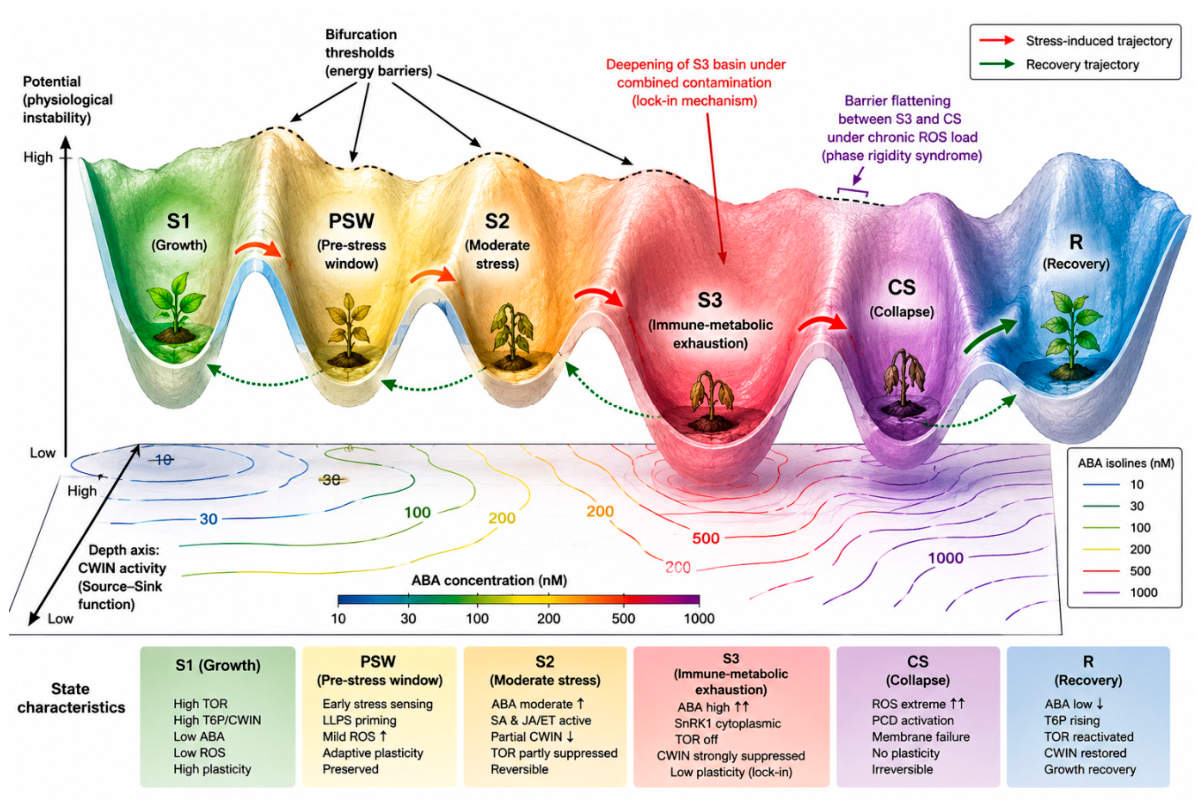
Figure 2.
Adaptive vs. pathological LLPS condensate dynamics under increasing stress intensity. Left panels show fluorescence recovery after photobleaching (FRAP) curves for adaptive (fast recovery, t½ < 10 s), transitional (slow recovery, t½ 30–120 s), and pathological gel-phase (no recovery, t½ > 300 s) condensates of a representative IDR-containing stress protein. Right panel shows the phase diagram of condensate behaviour as a function of protein concentration, ATP availability, ROS level, and metal ion concentration, with annotated regions corresponding to PTM states S2, S3, and CS. Arrows indicate trajectories under acute (reversible) and chronic (irreversible) contamination scenarios.
Figure 2.
Adaptive vs. pathological LLPS condensate dynamics under increasing stress intensity. Left panels show fluorescence recovery after photobleaching (FRAP) curves for adaptive (fast recovery, t½ < 10 s), transitional (slow recovery, t½ 30–120 s), and pathological gel-phase (no recovery, t½ > 300 s) condensates of a representative IDR-containing stress protein. Right panel shows the phase diagram of condensate behaviour as a function of protein concentration, ATP availability, ROS level, and metal ion concentration, with annotated regions corresponding to PTM states S2, S3, and CS. Arrows indicate trajectories under acute (reversible) and chronic (irreversible) contamination scenarios.
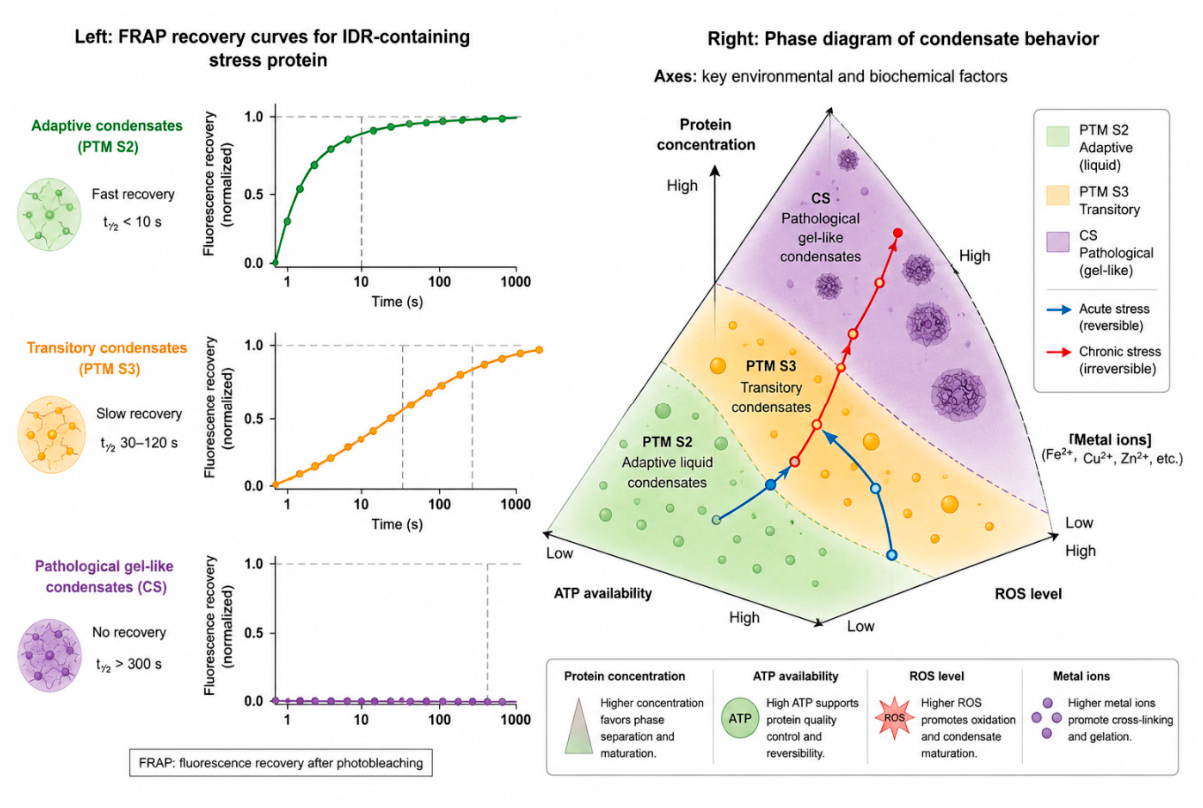
Figure 3.
Metal-binding buffering capacity and immune network exhaustion under increasing cumulative metal load. The graph plots four parameters as a function of total accumulated metal content in root cells: residual glutathione pool (blue), phytochelatin synthesis rate (green), free cytoplasmic Cd2+ activity (red), and SnRK1 nuclear fraction (orange). Vertical dashed lines indicate the S2/S3 and S3/CS transition thresholds based on PTM framework predictions. The key feature shown is the collapse of the glutathione-phytochelatin buffering system at the S3 threshold, after which free metal activity rises exponentially. Data for the phytochelatin and glutathione curves are based on published Arabidopsis data; the crop-equivalent thresholds are extrapolated (requires experimental validation in field species).
Figure 3.
Metal-binding buffering capacity and immune network exhaustion under increasing cumulative metal load. The graph plots four parameters as a function of total accumulated metal content in root cells: residual glutathione pool (blue), phytochelatin synthesis rate (green), free cytoplasmic Cd2+ activity (red), and SnRK1 nuclear fraction (orange). Vertical dashed lines indicate the S2/S3 and S3/CS transition thresholds based on PTM framework predictions. The key feature shown is the collapse of the glutathione-phytochelatin buffering system at the S3 threshold, after which free metal activity rises exponentially. Data for the phytochelatin and glutathione curves are based on published Arabidopsis data; the crop-equivalent thresholds are extrapolated (requires experimental validation in field species).
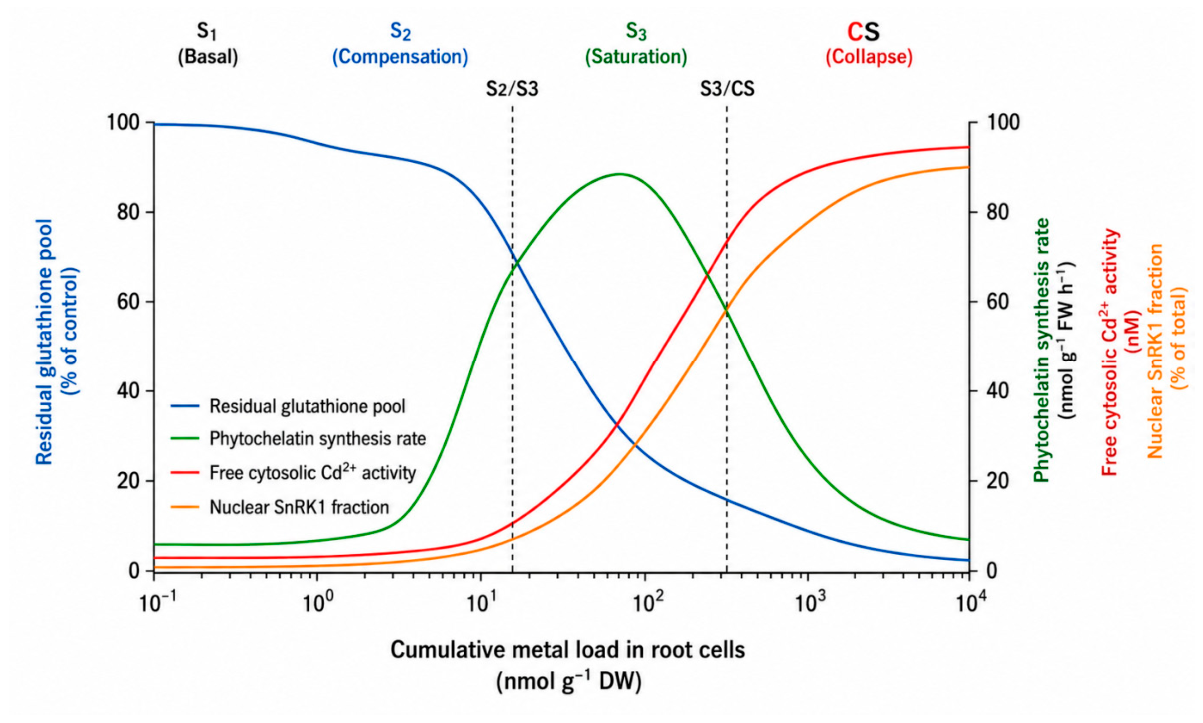
Figure 4.
Proposed digital twin architecture for PTM-state monitoring in post-explosion contaminated fields. The schematic shows data flow from field sensors (multispectral imaging, leaf temperature, stomatal conductance probes) and laboratory assays (CWIN activity, ABA concentration in sap, phytochelatin content) through a machine-learning PTM-state classifier to an agronomic decision engine. The decision engine outputs state-specific intervention recommendations (see Table 3) timestamped to the plant’s current phase, together with a risk score for S3 entry within the following 7-day window. The classifier layer is trained on experimentally validated PTM state signatures; the risk model integrates weather forecast data, contamination level, and microbiome status. This represents a forward design that currently lacks validated training datasets for post-explosion contamination scenarios.
Figure 4.
Proposed digital twin architecture for PTM-state monitoring in post-explosion contaminated fields. The schematic shows data flow from field sensors (multispectral imaging, leaf temperature, stomatal conductance probes) and laboratory assays (CWIN activity, ABA concentration in sap, phytochelatin content) through a machine-learning PTM-state classifier to an agronomic decision engine. The decision engine outputs state-specific intervention recommendations (see Table 3) timestamped to the plant’s current phase, together with a risk score for S3 entry within the following 7-day window. The classifier layer is trained on experimentally validated PTM state signatures; the risk model integrates weather forecast data, contamination level, and microbiome status. This represents a forward design that currently lacks validated training datasets for post-explosion contamination scenarios.
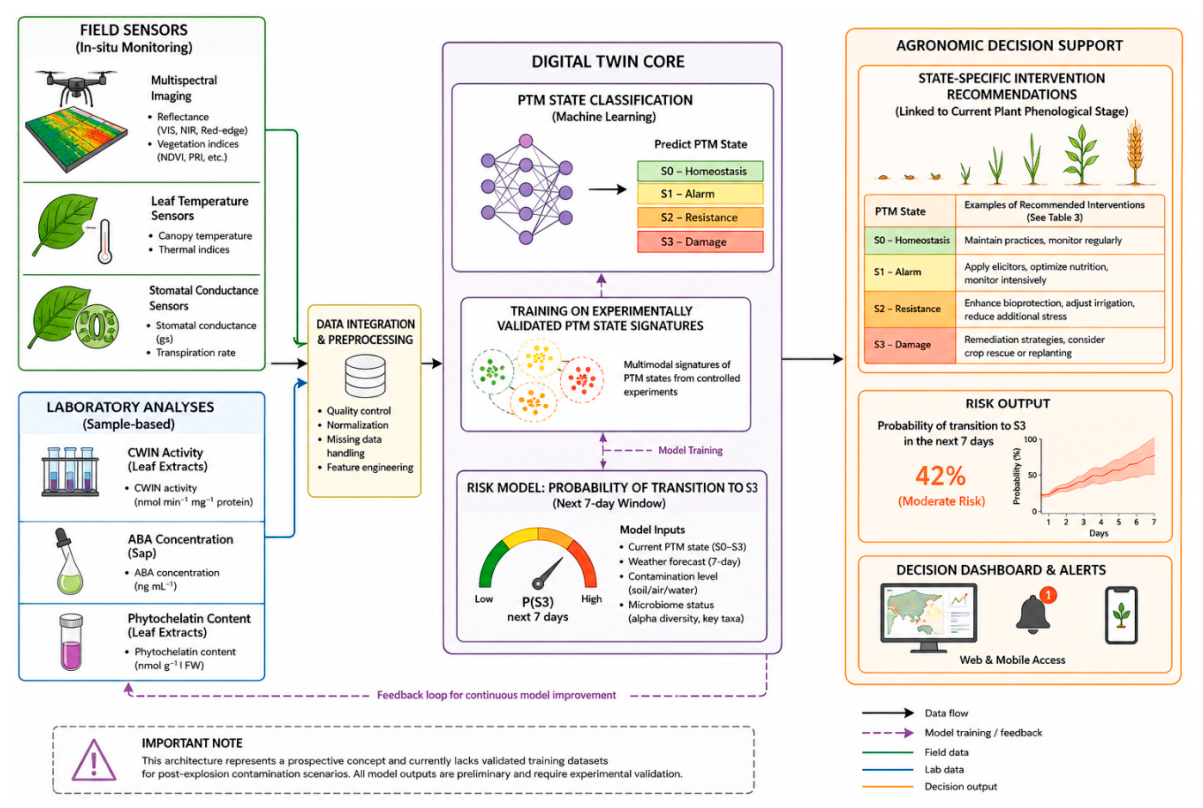

Table 1.
PTM physiological states: attractor labels, triggers, dominant signaling, and key physiological features.
Table 1.
PTM physiological states: attractor labels, triggers, dominant signaling, and key physiological features.
| State | Attractor Label | Trigger Conditions | Dominant Signaling | Key Physiological Features |
| S1 | TOR-growth | Optimal C/N, light, low ABA (<5 nM) | TOR↑ T6P↑ SnRK1↓ auxin/GA/BR/CK↑ | Maximal photosynthesis; anabolism; cell division; low basal ROS |
| PSW | Pre-stress window | Mild ROS rise; LLPS condensate initiation (SEU, ELF3) | Mixed TOR+ABA; OSCA/FERONIA sensing | First intervention window; LLPS-primed; reversible if treated |
| S2 | Moderate stress | Moderate contamination; biotrophic or necrotrophic signal | SA or JA/ET dominant; partial TOR suppression | Active adaptive reprogramming; autophagy induction; stress memory |
| S3 | Immune-metabolic exhaustion | Chronic combined stress; ABA >200 nM; ROS overload | ABA↑↑ SnRK1↑ TOR↓↓; SA-JA conflict | CWIN collapse; catabolism; LLPS rigidity; yield suppression |
| CS | Collapse state | Supra-threshold toxicity; LLPS gel transition | VPE+; caspase-like PCD; TOR off; ABA hyper-dominant | Irreversible membrane damage; cell death; agroecological collapse |
| R | Recovery / stabilization | Stress removal + active reactivation | T6P↑ CK/GA; SnRK1↓; epigenetic priming | Regenerative programs; microbiome-supported; state-memory consolidation |
Table 2.
Post-explosion stressor classes: primary molecular targets, network entry points, and predicted PTM trajectories.
Table 2.
Post-explosion stressor classes: primary molecular targets, network entry points, and predicted PTM trajectories.
| Stressor | Primary Molecular Target | Network Entry Point | Key Molecular Response | PTM Trajectory |
| Heavy metals (Pb, Cd, Cu, Zn excess) | Thiol groups; mitochondrial ETC; chloroplasts; proteasome | ROS burst → NCED3↑ → ABA; phytochelatin synthesis | HSP70/90↑; autophagy; vacuolar sequestration; ABA-dominant state | S1→PSW→S2→S3(→CS) |
| Nitroaromatic (TNT, RDX) | Redox enzymes; thiol adducts; DNA damage; GST system | JA/ET → ROS → ABA (chronic shift) | MAPK3/6↑; GST/GPX↑; GSNO formation; JA-SA conflict; ABA exhaustion | S1→S2→S3→CS |
| Perchlorates (ClO4−) | SLAC1 anion channel; NR competitive inhibition | ABA signaling dissociation (ABA↑ but stomata dysregulated) | Altered K+/anion flux; SnRK2 decoupling; redox imbalance | S1→PSW→S2 |
| Physical shockwave | Cell wall; mechanosensors FERONIA/WAK; PIEZO; CNGC | Ca2+ wave → ROS → JA rapid synthesis | FERONIA→MPK6↑; LOX/AOS↑; callose deposition; JA-SA initiation | S1→PSW→S2(→S3) |
| Thermal shock (detonation heat) | PSB D1 subunit; HSFA2/HSP101; ELF3 LLPS | ABA+SA synergy; ELF3 condensation | HSP101↑; ELF3 phase condensation; stomatal closure; autophagy↑ | S1→S2 (acute) |
| Combined chronic contamination | Multi-target; systemic exhaustion of all antioxidant pools | ABA hyper-dominant; SA-JA irresolvable conflict; TOR off | LLPS gel transition; SOURCE-SINK collapse; SnRK1 cytoplasmic reloc. | S2→S3→CS |
Table 3.
Phase-aware intervention framework for post-explosion contaminated agricultural soils.
| PTM Phase | Diagnostic Marker | Optimal Intervention | Molecular Target | Expected Outcome |
| PSW | SEU/ELF3 condensates; early Ca2+ transients; mild ROS↑ | LLPS-priming agents; PGPR inoculation (Bacillus volatiles); sub-threshold ABA | LLPS dynamics; SnRK1 sensitization; epigenetic priming | Prevent S2 entry; strengthen resilience; no yield cost |
| S2 (early) | PR1/RD29A co-elevation; partial CWIN suppression (20–40%) | Seaweed extract (CK+auxin); silicon amendments; antioxidant precursors | Moderate ABA-TOR balance; ROS buffering; SLAC1 function | Maintain S2 without S3 progression |
| S2→S3 boundary | CWIN <50% baseline; LLPS partial rigidity; ABA >200 nM | T6P precursor (DMNB-T6P) foliar; K+ fertilization; AMF inoculation | TOR reactivation; SOURCE-SINK restoration; SnRK1↓ | Reverse S3 entry; restore partial yield |
| S3 | ABA >500 nM; SnRK1 cytoplasmic; TUNEL partial+ | N management in RSW (12–72h post-stress); CK spray; phytochelatin inducers | SnRK1 relocalisation reversal; TOR reengagement; PC-metal chelation | Stabilize S3; prevent CS entry; partial recovery |
| CS | TUNEL+; VPE↑; PCD; membrane collapse | Phytoremediation rotation; soil amendment (lime, biochar); microbiome transplant | Eliminate contamination source; rebuild soil ecosystem | Ecosystem rehabilitation; no in-season crop recovery possible |
| Recovery (R) | T6P rising; CYP707A active; ABA <30 nM; stomata reopening | TOR-stimulating biostimulants; balanced N-P-K; precision irrigation timing | T6P-SnRK1-TOR positive loop restoration; epigenetic priming of growth genes | Accelerate growth-state recovery; consolidate stress memory |
Disclaimer/Publisher’s Note: The statements, opinions and data contained in all publications are solely those of the individual author(s) and contributor(s) and not of MDPI and/or the editor(s). MDPI and/or the editor(s) disclaim responsibility for any injury to people or property resulting from any ideas, methods, instructions or products referred to in the content. |
© 2026 by the authors. Licensee MDPI, Basel, Switzerland. This article is an open access article distributed under the terms and conditions of the Creative Commons Attribution (CC BY) license (http://creativecommons.org/licenses/by/4.0/).
Copyright: This open access article is published under a Creative Commons CC BY 4.0 license, which permit the free download, distribution, and reuse, provided that the author and preprint are cited in any reuse.