

Submitted:
28 August 2026
Posted:
31 August 2026
You are already at the latest version
Abstract
The Bullet Cluster is widely regarded as direct empirical evidence for non baryonic dark matter. We test the Mezzi framework, which poses the "missing mass"problem as a "missing area", where a distant observer measures the baryonic density correctly but integrates it over compressed coordinates, underestimating the true mass. We correct the apparent compression via a nonlinear Area Jacobian, built from direct ray tracing of the vacuum flow along the Light’s trajectory and governed by a single universal constant, C≈ 377derived in a previous study on the 175 SPARC rotation curves. The resulting True Frame convergence map reproduces the observed strong lensing regions (κ≥ 1) centered on the collisionless galaxies, with an overall mass correction of η≈ 4.5, without dark matter or modified gravity. The code is available at https://github.com/Brahim-Benaissa/Mezzi_Bullet_Cluster
Keywords:
Mezzi effect
; Bullet Cluster
1. Introduction
The Bullet Cluster (1E 0657-56) provides an iconic test case for probing the fundamental nature of gravity. It is a post collision system in which X-ray emitting gas has been spatially offset from the collisionless stellar mass (Markevitch et al., 2004). The gravitational lensing observations, on the other hand, reveal that the convergence peaks, which trace the deepest gravitational potential wells, align with the collisionless galaxies rather than with the gas (Cha et al., 2025; Cho et al., 2026). In the standard CDM paradigm, this spatial decoupling is interpreted as direct empirical evidence for dark matter halo (Clowe et al., 2006).
However, the persistent inability to directly detect dark matter particles (Aalbers et al., 2023, 2024; Adari et al., 2025), alongside challenges on galactic scales motivates the investigation of alternative theoretical frameworks (Bullock & Boylan-Kolchin, 2017; Williams et al., 2025). The Modified Newtonian Dynamics (MOND) is the most successful alternative to dark matter on galactic scales. It reproduces the rotation curves and key empirical scaling relations, such as the Radial Acceleration Relation (RAR) and the Baryonic Tully Fisher Relation (BTFR), without dark matter (Famaey & McGaugh, 2012; Milgrom, 1983; Mistele et al., 2024). However, it faces limitations at the cluster scale, where it underpredicts the gravitational field (Famaey et al., 2024; Kelleher & Lelli, 2024).
This discrepancy is highlighted in a recent analysis by (Famaey, 2026), based on the updated JWST gravitational lens models of the Bullet Cluster (Hernandez, 2026; Rihtaršič et al., 2026). Famaey demonstrates that, under MOND, the observed baryonic matter falls short of explaining the lensing observation. An ad hoc residual missing mass component centered on the galaxies is required for it to come close to the observed convergence map. (Zhang et al., 2026) analysis argues that a revised baryon budget from stellar remnants can account for the MOND strong lensing in the Bullet Cluster cores. However, theorists must be careful here, because such revision of the baryon budget can be self defeating on the galaxy scale.
In this paper, we test the Mezzi effect, a novel phenomenological framework that tackles the mass discrepancies problem without invoking dark matter or modifying gravity (Benaissa, 2025, 2026), against the mass model of the Bullet Cluster presented by (Famaey, 2026). In this framework, the problem of the “missing mass” is seen as “missing area”. The observer integrates the true frame density over a compressed coordinate grid, leading to an underestimation of the true mass. This framework was recently tested against the Spitzer Photometry and Accurate Rotation Curves database (Lelli et al., 2016). Using a single universal dimensionless parameter , the model predicts the observed rotation curves of 175 galaxies (with an RMS residual of km/s), and reveals the empirical RAR and the BTFR can emerge from geometric projection effects.
While the foundational SPARC analysis validated the Mezzi framework within the simplified, 1D, spherically symmetric, and isolated environments of individual galaxies, the Bullet Cluster poses a more complex topological problem. Generalizing the framework to this system requires abandoning the assumption of isolation and spherical symmetry. Instead, the cluster is modeled as a 3D asymmetric post collision system. The Mezzi effect here is driven by the superposition of the total Newtonian potential generated by all discrete baryonic components. Consequently, the theory’s kinematic accumulation integral must be evaluated via direct 3D ray tracing along the light’s trajectory.
The paper is structured as follows: Section 2 details the discrete baryonic mass model of the Bullet Cluster. Section 3 outlines the generalized 3D Mezzi metric, the ray tracing integration of the vacuum flow, the line of sight projection of the metric field, and the geometric reconstruction of the true frame mass. Section 4 evaluates the True Frame gravitational lensing, contrasting the true frame convergence maps against observed JWST strong lensing profiles and MOND predictions. Section 5 presents the component level mass analysis, revealing the hierarchical, non linear mass correction factors localized within the deepest stellar potential wells.
2. Discrete Baryonic Mass Model of the Bullet Cluster
We adapt the analytic, three dimensional mass model, based on the structural parameters outlined in recent JWST supported lensing analyses (Famaey, 2026; Rihtaršič et al., 2026). The starting point is a baryonic baseline that represents the observed frame. This baseline is then subjected to the geometric corrections of the proposed framework.
2.1. Plummer Sphere Formalism
The baryonic mass model is defined by (Famaey, 2026). It represents the cluster as a discrete superposition of multiple analytic mass profiles. For a discrete component i with mass and scale radius , centered at spatial coordinates , the 3D Newtonian gravitational potential is:
We use the 3D volume mass density derived via Poisson’s equation, :
where .
For gravitational lensing and projected mass calculations, the projected surface density at a 2D radial distance from the component’s center:
2.2. Gas Components with No Taper Formulation
The bulk of the cluster’s observed baryonic mass resides in the X-ray emitting intracluster gas. The primary gas distributions of the main cluster and subcluster are modeled as smooth, massive Plummer spheres. The main gas component is centered at kpc with a mass of , while an extended secondary component traces the bulk of the subcluster gas at kpc.
The Famaey (2026) model utilizes a superposition of a positive Plummer sphere () and a negative mass taper () centered at kpc. However, The Mezzi effect formulation is driven by the depth of attractive gravitational potential wells, the theory at this form is not compatible with negative mass components. To maintain fidelity to the mass model geometry while adhering to the positive mass, we replace the taper mechanism with a Flat Positive formulation.
We replace the original pair with two positive Plummer spheres, each with a mass of and a scale radius of kpc. Offset by kpc along the x-axis (centered at 620 and 720 kpc). Figure 1 illustrates this gas surface density, , as a function of the X position along three distinct spatial slices ( kpc) that cross the subcluster. The original Famaey model produces a distinct double peaked profile. The Flat Positive model produces a wide flat topped morphology of the gas distribution.
2.3. Collisionless Stellar Components
The stellar mass distribution is represented as follows:
Brightest Cluster Galaxies (BCGs): The three most massive galaxies (BCG1, BCG2 in the main cluster, and BCG3 in the subcluster) are modeled as individual massive Plummer spheres (, kpc). BCG1 defines the origin of the coordinate system .
Cluster Galaxies: The remaining cluster members are modeled as discrete Plummer spheres with a uniform mass () and a small scale radius ( kpc). A subset of 83 of these galaxies is snapped to exact catalog coordinates from spectroscopic observations. The total stellar mass is conserved at .
The total observed Newtonian potential, , and the total observed projected surface density, , are the linear superpositions of all individual components:
This total potential serves as the inputs for the geometric reconstruction framework detailed in the following section. The spatial configuration of these discrete Plummer components is illustrated in Figure 2. It highlights the spatial decoupling of the diffuse gas components from the collisionless stellar mass.
3. The 3D Mezzi Metric
The Mezzi framework suggests that observed mass discrepancies in gravitational systems arise from a coordinate misinterpretation. In this section, we generalize this framework from isolated spherical systems to three dimensional environments.
3.1. Vacuum Flow and Metric Compression
The Mezzi framework models the vacuum as a compliant medium exhibiting a radial kinematic flow toward gravitational potential wells. Operating within standard Newtonian gravity to define the source potential ( at all points), we generalize the 1D Painlevé-Gullstrand formulation from the initial 1D formulation, where the inward flow velocity is , to a 3D scalar field.
The total gravitational potential at any point is treated as the linear superposition of N discrete baryonic components:
where , , and are the mass, position, and scale radius of the i-th component. The local free fall velocity of the vacuum field, , generated by this superposed potential, is defined as:
Building on the 1D kinematic accumulation integral established in the initial Mezzi framework (Benaissa, 2026), we generalize the concept for 3D environments. As an electromagnetic wave propagates from a source to a distant observer, it traverses the superposed vacuum flow field and accumulates the kinematic drag of this inward flow along its trajectory, resulting in a geometric distortion of the observed coordinates.
We perform a ray tracing integration along the light’s path from the emission point to the observer. The 3D kinematic accumulation factor, , is defined as:
where c is the speed of light, is the distance to the asymptotically flat observer frame, and R is the radial distance from the cluster centroid to the point of evaluation. The term represents the radial path length from the cluster centroid to the incremental integration step along the light’s trajectory. The ratio represents the local fractional distortion per unit distance, and the exponential function translates this cumulative kinematic drag into a geometric scaling factor, mirroring the mechanics of the 1D model but applied to a 3D line of sight integration.
In the 1D Mezzi framework, the dimensionless constant C (empirically determined to be ) represents the universal Compliance of the vacuum. Drawing an analogy to continuum mechanics, it governs the efficiency with which the accumulated kinematic flow (acting as a history dependent stress) translates into an observable geometric distortion (strain). We define the 3D Mezzi scale factor, , by applying this universal compliance to the 3D kinematic accumulation:
Because the accumulated flow integral corresponds to a within a gravitational well, the term is negative resulting in . In regions of deep gravitational potential, drops below unity, signifying that the 3D volume measured by the distant observer is an apparent, compressed projection of the true frame volume, governed by the relationship:
Truncating the simulation box prematurely halts integration in a region of non-zero flow. This produce an artificially elevated , driving toward unity and underestimating the geometric compression. To address this, an analytical tail correction is applied. By assuming a monopole profile beyond the simulation boundary, the remaining fractional distortion is analytically integrated to the distant observer, ensuring the complete evaluation of and along the entire light trajectory.
In asymptotically flat regions where and , the observed coordinates align with true physical coordinates. Consequently, the Mezzi framework requires no External Field Effect (EFE) to enforce asymptotic flatness or to prevent infinite mass accumulation at the boundaries of the simulation box (Chae et al., 2022). Because the underlying source potential is Newtonian, it decays to zero at large distances (), ensuring stable boundary behavior without artificial constraints.
A remark on the theoretical status of this construction. In standard relativity, the Painlevé-Gullstrand flow is a coordinate representation of a static spacetime. A relabeling of coordinates cannot alter invariant observables. The Mezzi framework departs from this, the vacuum flow field of Eq. 7 is posited as a physical kinematic of a compliant vacuum medium, in the spirit of analogue gravity models in which river type flows carry genuine, invariant wave signatures (Visser, 1993, 1998). Under this premise, the divergence between the observer frame and the True Frame is a physical effect probed by invariant observables, not a gauge artifact (Rovelli, 1991). We further note that the framework modifies neither the field equation nor the force law: the total potential is generated by baryons alone through Poisson’s equation, and no mass component is introduced. What is modified is the observation operator mapping true coordinates onto observer coordinates, a category of effect with established precedent in standard relativity, such as the distinction between luminosity and angular diameter distances (De Vicente, 2020; Hartnett & Oliveira, 2007).
3.2. Line of Sight Projection and the Area Jacobian
In the observer frame, the local metric compression modifies the spatial line element such that an observed coordinate interval corresponds to a true physical depth . Because proper length is an additive geometric quantity, the total true physical depth of a column is the arithmetic sum of the true lengths of its constituent segments:
The effective 2D scale factor must reproduce this exact total true physical depth over the total observed path , to preserve the variational principle of lensing, Fermat’s Principle of Least Time (Rashed, 2019), Enforcing the geometric consistency condition returns the path length weighted harmonic mean:
This projection is the geometric composition law for scale factors arranged in series, analogous to the effective refractive index of a multilayered optical medium. It is a deterministic, parameter free operation. It acts along the z-axis, excluding the transverse coordinates . It is a reversible geometric mapping, distinct from empirical spatial smoothing.
Because acts as a volumetric scaling factor, the true physical volume is recovered by . Assuming isotropic local scaling, the 2D projected area scales as the power of the 3D volume. We define the 2D projected Area Jacobian, , using the line of sight projected scale factor:
Since in the cluster potential, . This indicates that a single observed pixel corresponds to a larger true physical area in the source frame, formalizing the underestimation of spatial extent and, consequently, the underestimation of integrated mass by the distant observer.
We emphasize that the exponent of Eq. 13 is not a tunable projection choice, but a direct consequence of the two defining axioms of the framework: is, by construction, a volumetric scaling factor, (Eq. 10), and the local scaling is isotropic. Under these axioms, dimensional consistency uniquely requires each linear dimension to scale as , and each projected area as ; the exponent of Eq. 13 is the line of sight projected expression of this local requirement (Kaiser & Squires, 1993; Paranjape & Singh, 2008). Likewise, the harmonic mean of Eq. 12 is not one choice, it is the unique effective scale factor satisfying the geometric consistency condition , and it is formally identical to the series composition law for the effective refractive index of a multilayered optical medium (Born & Wolf, 1964; Zhou et al., 2024).
3.3. Recovering True Baryonic Mass
The mass recovery operates on the principle of approximate surface brightness invariance. In the weak field regime (), specific intensity is conserved along null geodesics. Because the stellar mass to light ratio is a local property of the stellar population, the surface mass density inherits this approximate invariance:
This principle dictates that the local baryonic density of the cluster is measured correctly by the distant observer; the apparent mass discrepancy arises from the geometric misattribution of the coordinate metric. The observer integrates the correct density over a compressed area. Therefore, the true differential mass element must be evaluated using the true, decompressed area:
We use the true area element , where is the 3D projected Area Jacobian derived in Section 3.2, to evaluate this integral over the observer’s compressed 2D grid. This allows us to define the "Effective True Frame Surface Density", which represents the true physical density mapped onto the observer’s compressed coordinates:
The total true baryonic mass within an observed aperture bounded by radius is calculated by integrating this effective density over the observed grid:
Because in the cluster potential, the true mass exceeds the observed mass. The revealed mass is not created mass; it is the existing baryonic density field recovered by correcting the metric distortion:
The global mass correction ratio quantifies this geometric bias:
Because is a non linear function of the superposed gravitational potential, clusters with deeper potential wells exhibit smaller values, driving J higher and increasing . This differential scaling predicts that the apparent mass discrepancy is largest in the densest regions of the cluster, defining the missing mass as missing area rather than missing baryons.
3.4. 3.4 Computational Implementation
We utilize a 3D Cartesian computational box spanning Mpc. We employ a dual focus adaptive stretched grid, the 2D sky plane and the 1D line of sight axis are constructed using the inverse cumulative distribution function of dual Gaussian density profiles centered on the main cluster (BCG1) and the subcluster (BCG3).
This adaptive grid utilizes pixels in the 2D plane and 2000 planes along the line of sight, achieving sub kiloparsec resolution in the cluster cores and smoothly stretching to kpc at the box edges. Because the gravitational lensing pipeline requires a uniformly spaced grid for Fast Fourier Transform operations, a uniform proxy grid is generated. The adaptive Mezzi convergence maps are interpolated onto this uniform grid, cropped to kpc, corresponding to a constant resolution of kpc/pixel for high resolution strong lensing analysis. The resulting lensing observables are interpolated back to the original adaptive grid.
The analytical tail correction is applied, for radii beyond the half box size, the total potential is integrated in a monopole analytical profile, . The 3D metric compression scale factor, , is evaluated with direct ray tracing. For each cell on the adaptive grid, rays are shot outward in 30 polar () and 60 azimuthal () angular bins. Along each ray, the kinematic accumulation integral is evaluated by integrating the vacuum flow velocity along 300 log-spaced radial path lengths.
We perform this projection by integrating the path length weighted harmonic mean of across the 2000 adaptive z-planes. We accumulate the inverse compression weighted by the physical cell depth at each plane.
4. True Frame Gravitational Lensing
For comparison with the baseline baryonic model (Famaey, 2026) and the underlying JWST lensing observations (Rihtaršič et al., 2026), we adopt the constant critical surface density:
The proposed framework can theoretically approach the solution from two distinct pathways: "Mass Revelation" and "Curvature Correction". While conceptually distinct, they are mathematically identical.
4.1. 4.1 The Mass Revelation view
The primary conceptual foundation of the Mezzi effect is that the “missing mass” problem is a “missing area”. In this approach, the observer correctly measures the local baryonic surface density , but integrates it over a compressed coordinate grid. We reconstruct the Effective True Frame Surface Density, , by correcting the observed mass density using the Area Jacobian:
The True Frame convergence, , is then obtained by normalizing this reconstructed true mass density using the constant :
Standard analyses integrate the true frame baryonic density over a compressed coordinate area, leading to a severe underestimation of the integrated mass. The lensing signal is corrected because the true physical mass distribution is more massive than the observed frame suggests.
4.2. 4.2 The Curvature Correction view
In this view the gravitational lensing is mapping the true area to the observed area. We begin with the standard observed Newtonian convergence, , which assumes no missing mass:
Because the convergence is a dimensionless measure of geometric distortion, the compressed coordinate grid distorts the lensing geometry. In this Curvature Correction view, the baseline convergence is scaled by the geometric Area Jacobian:
This asserts that the observed light bending distortion is geometrically corrected by the curvature of the compressed vacuum space. The lensing effect is corrected by the metric distortion, without needing to invoke the mass distribution.
4.3. Mathematical Equivalence
While these two views stem from different physical interpretations, one focusing on the revelation of the mass and the other on the correction of the geometry, they are identical. By substituting the definition of into the Curvature Correction equation, we find:
Due to the linearity of the transformation, correcting the baryonic surface density prior to normalization is equivalent to evaluating the baseline convergence then applying the geometric scaling factor. Thus, .
This algebraic equivalence highlights the consistency of the Mezzi framework. For the remainder of this analysis, we evaluate this unified True Frame convergence, .
4.4. Macroscopic Lensing Response
Figure 3 maps the resulting True Frame convergence () across the Bullet Cluster. The visualization contrasts the faint, shallow baseline of the observed baryonic mass with the True Frame contours, demonstrating the emergence of the strong lensing regions () around the collisionless stellar components.
The True Frame convergence () contours shows that the Mezzi framework is able to generate the localized strong lensing regions associated with the collisionless stellar components. Consistent with the deepest stellar potential wells at the locations of the BCG1, BCG2, and BCG3.
The MOND framework fails to generate the strong lensing threshold based on the baryons only model, reaching at BCG1 and BCG2. An ad hoc residual missing mass component is added, specifically, two Plummer spheres totaling centered on the galaxies (Famaey, 2026). In the standard CDM paradigm, these localized strong lensing peaks are interpreted as evidence of dense dark matter subhalos surrounding individual cluster galaxies.
Figure 3.
True Frame convergence map () of the Bullet Cluster. The background color scale and solid black contours represent the geometrically corrected convergence (), highlighting strong lensing centered on the galaxies. The faint dashed gray contours denote the baryonic baseline (). The inset displays a zoom around BCG3.
Figure 3.
True Frame convergence map () of the Bullet Cluster. The background color scale and solid black contours represent the geometrically corrected convergence (), highlighting strong lensing centered on the galaxies. The faint dashed gray contours denote the baryonic baseline (). The inset displays a zoom around BCG3.
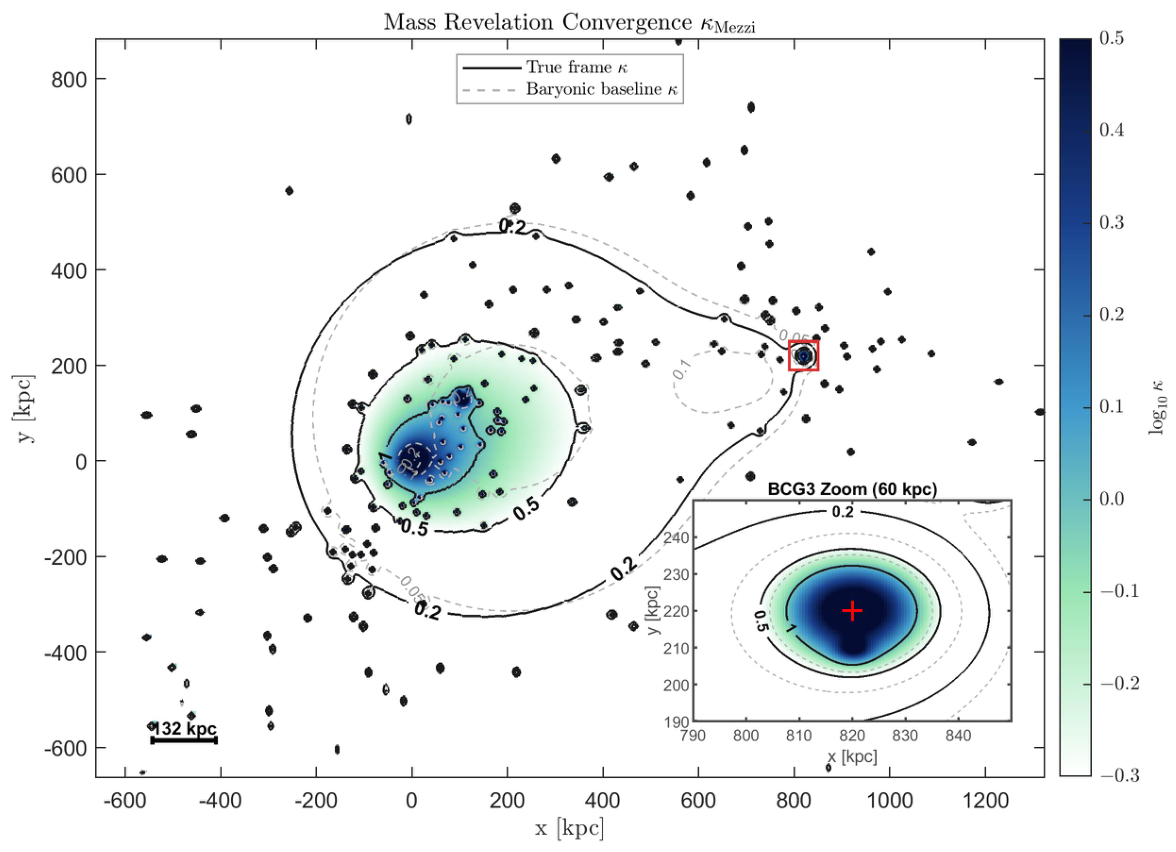
The proposed framework interprets this observational signature as a direct consequence of the Mezzi effect. The deepest stellar wells experience extreme apparent coordinate compression, standard analyses severely underestimate the mass in these regions by integrating over a compressed geometry. The correction of the coordinates scales the local baryonic surface density above the critical threshold , producing the observed “subhalo” lensing effect without requiring additional mass, or modification of the gravitational law.
The model presents a specific limitation regarding the spatial extent of the convergence contours. Notably, the region generated around the subcluster BCG3 is smaller than observed in the JWST (Rihtaršič et al., 2026). Furthermore, the weak lensing contour () lies spatially too close to BCG3, and does not reproduce the wider, more extended region seen in the observational maps. This feature, however, is not specific to the True Frame reconstruction, the baryonic baseline exhibits the same behavior at contour level . These discrepancies are likely due to the simplified nature of the baryonic mass model. Future iterations incorporating higher resolution mass distributions may resolve them.
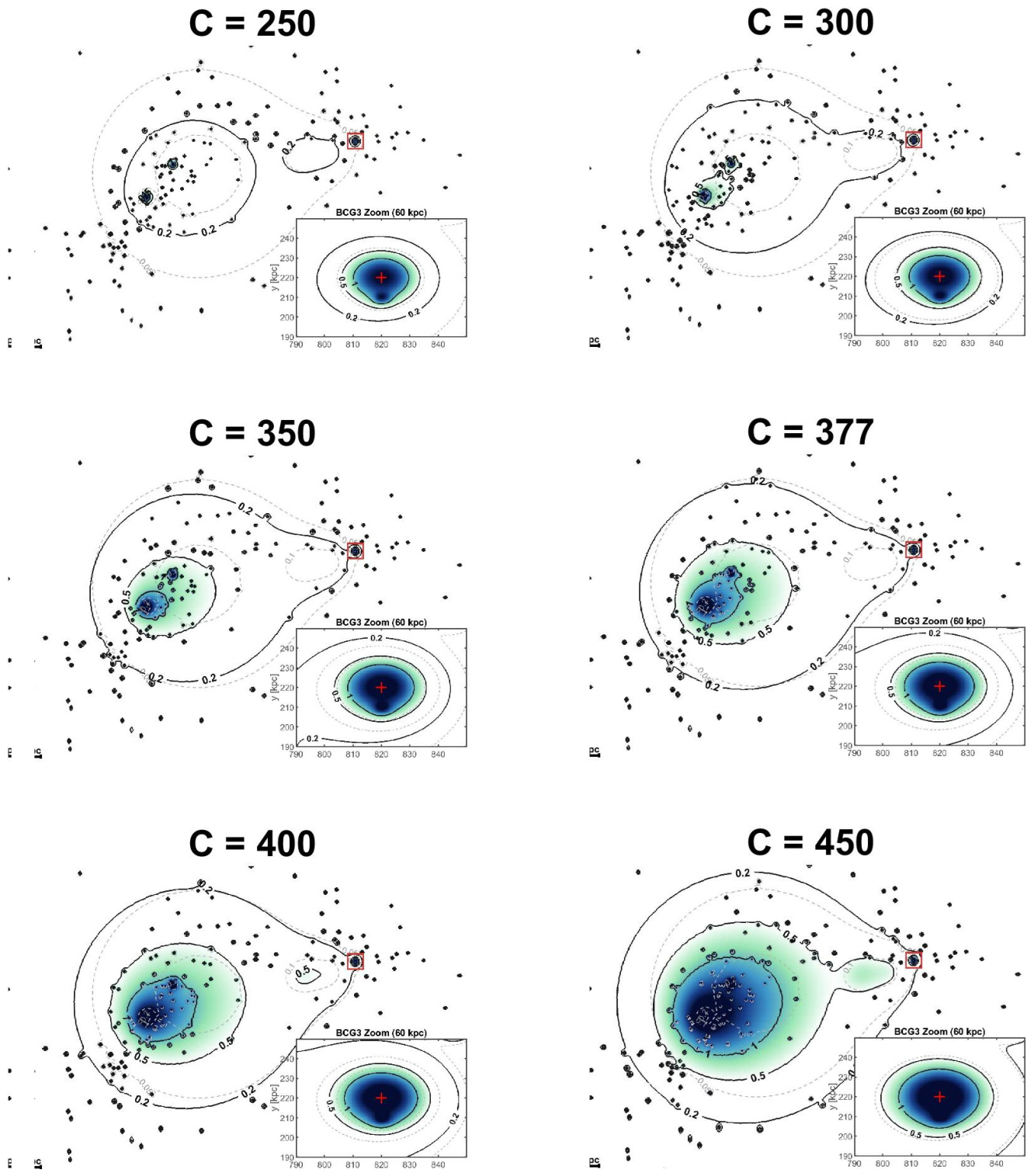
We evaluate the True Frame convergence map across a range of values (), as shown in Figure 4. Lower values of C (250, 300) correspond to insufficient metric correction. On the other hand, higher values (400, 450) over correct the coordinate grid, resulting in an extension of the spatial morphology of the lensing map. The result corresponding to provides the closest match to the observed convergence profile.
In the foundational development of the Mezzi framework (Benaissa, 2026), the value of this dimensionless compliance constant is empirically derived from fitting the scaling relations across the 175 SPARC galaxies. The C constant, in this work is generalized to a 3D asymmetric cluster environment to test it in the problem of the strong gravitational lensing. The consistency of the 377 value reinforces the theoretical proposal that C is not a fitting parameter, but an intrinsic, scale independent property of the vacuum.
5. Components Mass in The True Frame
To illustrate the component level mass correction, J is evaluated at the centers for the 216 compact galaxies (Plummer radius kpc). For the diffuse gas clouds and massive BCGs, J is integrated across their Plummer profile on the simulation grid. The overall cluster mass is derived by applying the Jacobian to the combined surface density map of all components, integrated across the full simulation grid.
Figure 5 maps the components along the x-axis based on their X position within the lensing map. It lays out the mass correction factor across the Bullet Cluster, with the Overall Cluster mass correction factor of plotted at the center of the system. At the outskirts of the cluster system, the potential well is shallow; the mass correction for galaxies is modest, ranging from to . The diffuse gas components, which span large physical areas, experience moderate correction ranging from to , with the Main Gas component corresponding to a correction.
The deepest stellar potential wells correspond to severe metric compression. BCG 1, sitting at the origin of the main cluster, undergoes a mass correction of . The compact galaxies surrounding it correspond to varying degrees of correction, reaching up to for the galaxy at the core. kpc from the center, the correction factor drops to , and by kpc, it falls further to . This decay is a consequence of the framework’s dependence on the local gravitational potential depth. Because the Newtonian potential well is steepest at the center of the dense region, the apparent metric compression is maximum according to the proposed phenomenology.
Standard analyses fail to account for this geometric compression, leading to a severe underestimation of mass at the core. As the distance from the dense stellar core increases, the potential well flattens out, reducing the kinematic distortion and correspondingly diminishing the geometric mass correction. Therefore, the mass correction is not a uniform halo, but a localized, density dependent response that tracks the topography of the underlying gravitational potential. BCG 3 experiences a mass correction, and its surrounding galaxies average around . This reflects the subcluster’s shallower, less dense gravitational potential well.
Because the Area Jacobian J scales the observed 2D area, the true physical radius of a component must scale with the square root of its mass correction (). For the Overall Cluster, a mass scaling of corresponds to a radial scaling of . However, for BCG 1 at the cluster core, the radial scaling reaches around .
These results contrast with MOND applied to the same mass model (Famaey, 2026), which provides a and mass boost at 300 kpc from BCG1 and BCG3, respectively. As noted by Famaey, this boost is insufficient, failing to produce the observed strong lensing threshold ().
Figure 5.
Component mass comparison. The observed baryonic mass is in gray circles and the True Frame mass is in colored triangles. The x-axis represents the X position of the component in kiloparsecs. The color of the True Frame markers indicates the correction factor (). Non tagged components represent the 216 discrete galaxies.
Figure 5.
Component mass comparison. The observed baryonic mass is in gray circles and the True Frame mass is in colored triangles. The x-axis represents the X position of the component in kiloparsecs. The color of the True Frame markers indicates the correction factor (). Non tagged components represent the 216 discrete galaxies.
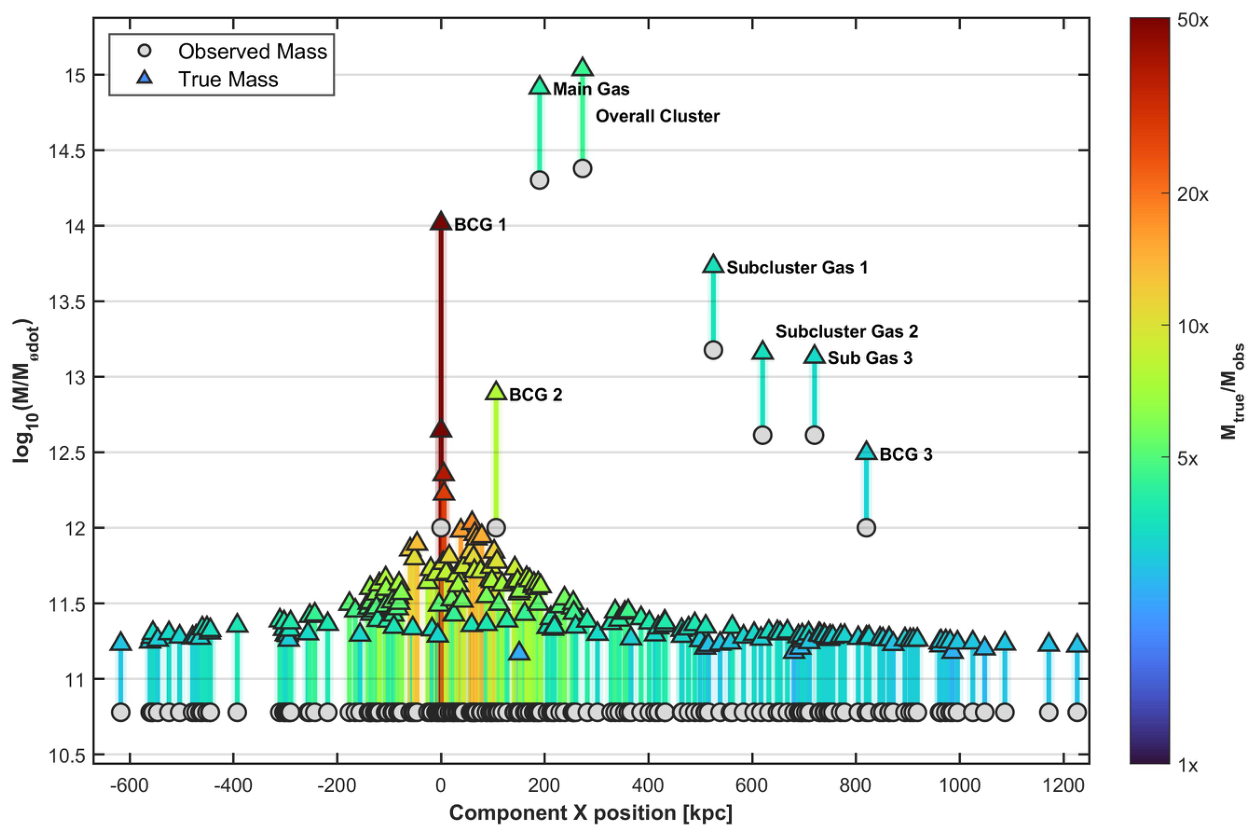
To match the JWST observations, MOND requires an ad hoc, enclosed mass augmentation of at BCG1 and at BCG3. The Mezzi framework, on the other hand, is based on direct geometric correction. Unlike the addition of extended dark matter halos in CDM or the baryon tracing force modifications of MOND, the Mezzi mass correction is localized based on the depth of the Newtonian potential well.
The baryonic mass, when integrated over its true frame area, is sufficient to generate the observed lensing. The geometric correction creates the local surface densities () required to push the convergence above the threshold and produce the offset lensing peaks, without needing the large, extended mass multipliers demanded by MOND or CDM.
6. Conclusion
In this work, we extend the Mezzi framework, a geometric framework that resolves mass discrepancies without invoking dark matter or modifying the gravitational force law, from the 1D, spherically symmetric, isolated environments of individual galaxies to a 3D asymmetric system. By applying this framework to a discrete baryonic mass model of the Bullet Cluster, we tested whether the Bullet cluster’s iconic “missing mass” problem can be reinterpreted as a “missing area”.
The results demonstrate that standard Newtonian gravity, when evaluated over the geometrically reconstructed “True Frame,” reproduces the gravitational lensing signatures of the Bullet Cluster. We see localized strong lensing regions () around the collisionless stellar components (the BCGs), the signature spatial decoupling of the lensing peaks from the gas. The consistency of the reinforces the universality of the vacuum compliance constant.
These findings challenge the necessity of non baryonic matter in explaining the Bullet Cluster’s dynamics. By preserving standard General Relativity and Newtonian dynamics in the True Frame, the Mezzi effect demonstrates that what observers perceive as a mass deficit is a severe mass underestimation due to integrating standard density over a geometrically compressed coordinate grid.
References
- Aalbers, J.; Akerib, D.; Akerlof, C.; Al Musalhi, A.; Alder, F.; Alqahtani, A.; Alsum, S.; Amarasinghe, C.; Ames, A.; Anderson, T. First dark matter search results from the LUX-ZEPLIN (LZ) experiment. Phys. Rev. Lett. 2023, 131(4), 041002. [Google Scholar] [CrossRef] [PubMed]
- Aalbers, J.; Akerib, D.; Al Musalhi, A.; Alder, F.; Amarasinghe, C.; Ames, A.; Anderson, T.; Angelides, N.; Araújo, H.; Armstrong, J. First constraints on WIMP-nucleon effective field theory couplings in an extended energy region from LUX-ZEPLIN. Phys. Rev. D. 2024, 109(9), 092003. [Google Scholar] [CrossRef]
- Adari, P.; Bloch, I. M.; Botti, A. M.; Cababie, M.; Cancelo, G.; Cervantes-Vergara, B. A.; Crisler, M.; Daal, M.; Desai, A.; Drlica-Wagner, A. First direct-detection results on sub-GeV dark matter using the SENSEI detector at SNOLAB. Phys. Rev. Lett. 2025, 134(1), 011804. [Google Scholar] [CrossRef] [PubMed]
- Angus, G. W.; Shan, H. Y.; Zhao, H. S.; Famaey, B. On the proof of dark matter, the law of gravity, and the mass of neutrinos. Astrophys. J. Lett. 2007, 654(1), L13–L16. [Google Scholar] [CrossRef]
- Benaissa, B. Resolving galactic rotation curve discrepancies through a proposed relativistic observation effect; 2025. [Google Scholar]
- Benaissa, B. On the Observer-Frame Interpretation of Radial Coordinates in Gravitational Potentials. 2026. [Google Scholar] [CrossRef]
- Born, M.; Wolf, E. Principles of optics; Pergamon Press: Oxford, 1964; Vol. 6. [Google Scholar]
- Bullock, J. S.; Boylan-Kolchin, M. Small-scale challenges to the Λ CDM paradigm. Annu. Rev. Astron. Astrophys. 2017, 55, 343–387. [Google Scholar]
- Cha, S.; Cho, B. Y.; Joo, H.; Lee, W.; HyeongHan, K.; Scofield, Z. P.; Finner, K.; Jee, M. J. A high-caliber view of the Bullet Cluster through JWST strong and weak lensing analyses. Astrophys. J. Lett. 2025, 987(1), L15. [Google Scholar] [CrossRef]
- Cho, B. Y.; Jee, M. J.; Joo, H.; Cha, S.; HyeongHan, K. Joint JWST–DECam Lensing Reveals that the Bullet Cluster Is a Minor Merger. Astrophys. J. 2026, 1005(1), 28. [Google Scholar] [CrossRef]
- Clowe, D.; Bradač, M.; Gonzalez, A. H.; Markevitch, M.; Randall, S. W.; Jones, C.; Zaritsky, D. A direct empirical proof of the existence of dark matter. Astrophys. J. Lett. 2006, 648(2), L109–L113. [Google Scholar] [CrossRef]
- De Vicente, J. On the luminosity-angular distances relation for an expanding universe. arXiv 2020, arXiv:2003.05307. [Google Scholar]
- Famaey, B. On the residual missing mass of the Bullet Cluster. arXiv 2026, arXiv:2605.10022. [Google Scholar]
- Famaey, B.; McGaugh, S. S. Modified Newtonian dynamics (MOND): Observational phenomenology and relativistic extensions. Living Rev. Relativ. 2012, 15(1), 10. [Google Scholar] [CrossRef] [PubMed]
- Famaey, B.; Pizzuti, L.; Saltas, I. D. On the nature of the missing mass of galaxy clusters in MOND: the view from gravitational lensing. arXiv 2024, arXiv:2410.02612. [Google Scholar]
- Hartnett, J. G.; Oliveira, F. J. Luminosity distance, angular size and surface brightness in Cosmological General Relativity. Found. Phys. 2007, 37(3), 446–454. [Google Scholar] [CrossRef]
- Hernandez, X. A consistent MOND modelling of the Bullet Cluster. arXiv 2026, arXiv:2604.10811. [Google Scholar]
- Kaiser, N.; Squires, G. Mapping the dark matter with weak gravitational lensing. Astrophys. J. 1993, 404, 441. [Google Scholar] [CrossRef]
- Kelleher, R.; Lelli, F. Galaxy clusters in Milgromian dynamics: Missing matter, hydrostatic bias, and the external field effect. Astron. Astrophys. 2024, 688, A78. [Google Scholar] [CrossRef]
- Lelli, F.; McGaugh, S. S.; Schombert, J. M. SPARC: Mass models for 175 disk galaxies with Spitzer photometry and accurate rotation curves. Astron. J. 2016, 152(6), 157. [Google Scholar] [CrossRef]
- Markevitch, M.; Gonzalez, A. H.; Clowe, D.; Vikhlinin, A.; Forman, W.; Jones, C.; Murray, S.; Tucker, W. Direct constraints on the dark matter self-interaction cross section from the merging galaxy cluster 1e 0657–56. Astrophys. J. 2004, 606(2), 819–824. [Google Scholar] [CrossRef]
- Milgrom, M. A modification of the Newtonian dynamics as a possible alternative to the hidden mass hypothesis. Astrophys. J. 1983, 270, 365–370. [Google Scholar] [CrossRef] [PubMed]
- Mistele, T.; McGaugh, S.; Lelli, F.; Schombert, J.; Li, P. Radial acceleration relation of galaxies with joint kinematic and weak-lensing data. J. Cosmol. Astropart. Phys. 2024, 2024(04), 020. [Google Scholar] [CrossRef]
- Paranjape, A.; Singh, T. Explicit cosmological coarse graining via spatial averaging. General. Relativ. Gravit. 2008, 40(1), 139–157. [Google Scholar] [CrossRef]
- Rashed, R. Fermat et le principe du moindre temps. Comptes Rendus. Mécanique 2019, 347(4), 357–364. [Google Scholar] [CrossRef]
- Rihtaršič, G.; Bradač, M.; Desprez, G.; Harshan, A.; Martis, N. S.; Willott, C. J.; Asada, Y.; Sarrouh, G. T.; Cornil-Baiotto, C.; Biviano, A. Mapping dark matter in the Bullet Cluster using JWST imaging and spectroscopy. Astron. Astrophys. 2026, 710, A207. [Google Scholar] [CrossRef]
- Rovelli, C. What is observable in classical and quantum gravity? Class. Quantum Gravity 1991, 8(2), 297–316. [Google Scholar] [CrossRef]
- Visser, M. Acoustic propagation in fluids: An unexpected example of Lorentzian geometry. arXiv 1993, arXiv:gr-qc/9311028. [Google Scholar]
- Visser, M. Acoustic black holes: Horizons, ergospheres and Hawking radiation. Class. Quantum Gravity 1998, 15(6), 1767–1791. [Google Scholar] [CrossRef]
- Williams, L. L.; Hjorth, J.; Skillman, E. D. Addressing the core-cusp and diversity problem of dwarf and disk galaxies using cold collisionless DARKexp theory. J. Cosmol. Astropart. Phys. 2025, 2025(08), 052. [Google Scholar] [CrossRef]
- Zhang, D.; Haghi, H.; Asencio, E.; Banik, I.; Zonoozi, A. H.; Cha, S.; Cho, B. Y.; Joo, H.; Kroupa, P.; Lazutkina, A. Baryonic mass budgets in the central regions of the Bullet Cluster and their consistency with strong lensing in MOND. Phys. Rev. D. 2026, 114(2), 023001. [Google Scholar]
- Zhou, C.; Wu, H.-Y.; Salcedo, A. N.; Grandis, S.; Jeltema, T.; Leauthaud, A.; Costanzi, M.; Sunayama, T.; Weinberg, D. H.; Zhang, T. Forecasting the constraints on optical selection bias and projection effects of galaxy cluster lensing with multiwavelength data. Phys. Rev. D. 2024, 110(10), 103508. [Google Scholar] [CrossRef]
Figure 1.
Comparison of the subcluster gas surface density profiles between the original Famaey model and the adapted Flat Positive model. The gas surface density (in ) is plotted against the X-position (in kpc) for three distinct line of sight slices at kpc (blue), kpc (orange), and kpc (green). Solid lines represent the original Famaey model. Dashed lines represent the Flat Positive model. The dotted vertical line marks the center of the subcluster gas at kpc.
Figure 1.
Comparison of the subcluster gas surface density profiles between the original Famaey model and the adapted Flat Positive model. The gas surface density (in ) is plotted against the X-position (in kpc) for three distinct line of sight slices at kpc (blue), kpc (orange), and kpc (green). Solid lines represent the original Famaey model. Dashed lines represent the Flat Positive model. The dotted vertical line marks the center of the subcluster gas at kpc.
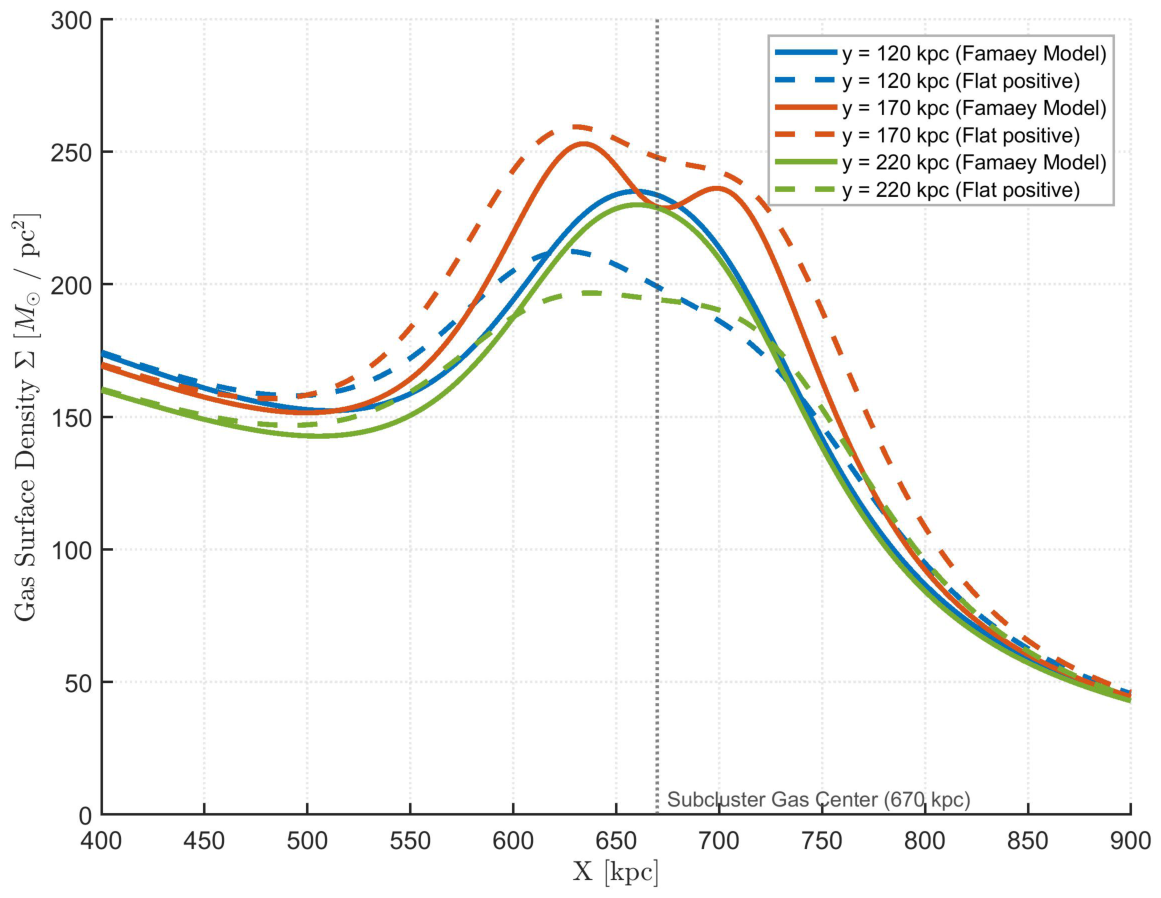
Figure 2.
Spatial topology of the discrete baryonic mass model for the Bullet Cluster. The plot displays the x-y sky plane projection of all modeled components in kpc. Large semi transparent circles represent the smooth intracluster gas components (blue for the main cluster gas, green for the subcluster gas components). Solid filled circles denote the Brightest Cluster Galaxies (blue for the main cluster BCG1 and BCG2; green for the subcluster BCG3). Small dots represent the individual cluster galaxies (blue for the main cluster, green for the subcluster).
Figure 2.
Spatial topology of the discrete baryonic mass model for the Bullet Cluster. The plot displays the x-y sky plane projection of all modeled components in kpc. Large semi transparent circles represent the smooth intracluster gas components (blue for the main cluster gas, green for the subcluster gas components). Solid filled circles denote the Brightest Cluster Galaxies (blue for the main cluster BCG1 and BCG2; green for the subcluster BCG3). Small dots represent the individual cluster galaxies (blue for the main cluster, green for the subcluster).
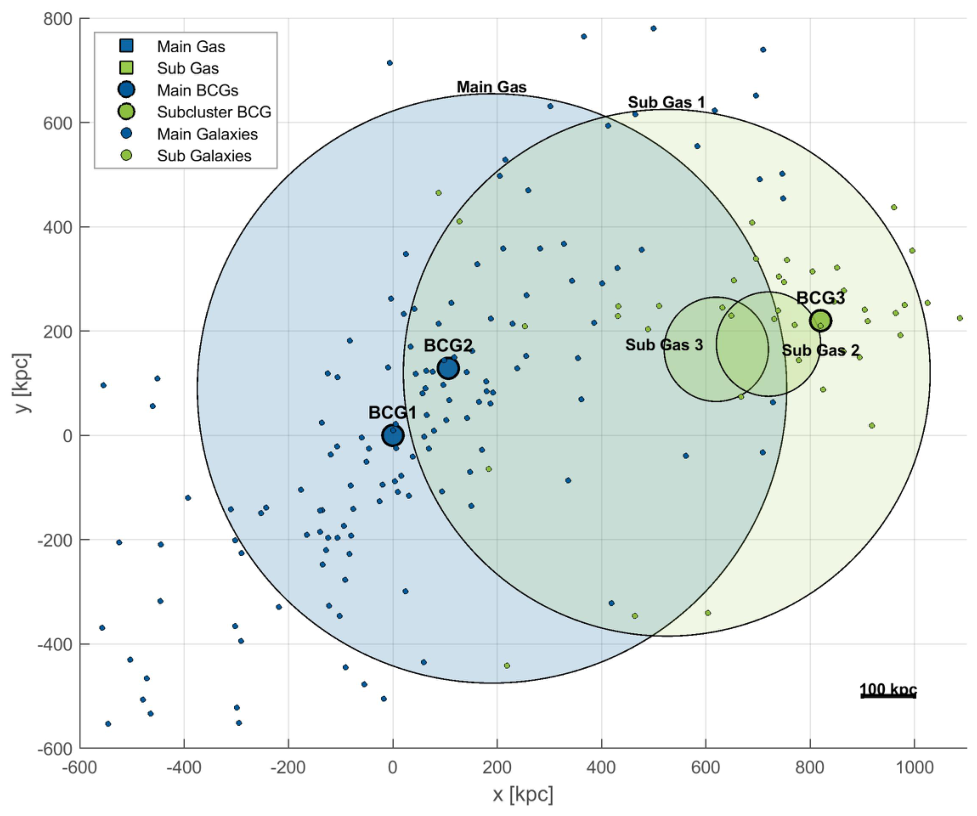
Figure 4.
Sensitivity of the convergence map to varying values of compliance constant C (250, 300, 350, 377, 400, and 450). It shows the convergence maps without the axis, the settings are the same as in Figure 3.
Figure 4.
Sensitivity of the convergence map to varying values of compliance constant C (250, 300, 350, 377, 400, and 450). It shows the convergence maps without the axis, the settings are the same as in Figure 3.
Disclaimer/Publisher’s Note: The statements, opinions and data contained in all publications are solely those of the individual author(s) and contributor(s) and not of MDPI and/or the editor(s). MDPI and/or the editor(s) disclaim responsibility for any injury to people or property resulting from any ideas, methods, instructions or products referred to in the content. |
© 2026 by the authors. Licensee MDPI, Basel, Switzerland. This article is an open access article distributed under the terms and conditions of the Creative Commons Attribution (CC BY) license (http://creativecommons.org/licenses/by/4.0/).
Copyright: This open access article is published under a Creative Commons CC BY 4.0 license, which permit the free download, distribution, and reuse, provided that the author and preprint are cited in any reuse.