

Submitted:
30 August 2026
Posted:
31 August 2026
You are already at the latest version
Abstract
A graph-theoretical framework for quantum mechanics is developed in which observables and symmetry operators are incorporated into a single complete bi-coloured graph. The proposed Symmetry/Observables Quantum Graph (SOQG) treats Hamiltonians, observables, conserved quantities, and unitary symmetry transformations on equal footing as operators acting on a common Hilbert space. The vertices of the graph represent operators, while the colours of the edges are determined by their commutation relations: commuting operators are connected by maroon edges and non-commuting operators by teal edges. The resulting structure constitutes a finite Ramsey graph that provides a combinatorial representation of operator compatibility. The formalism is applied to several representative quantum systems, including a particle in a central potential, a charged particle in a uniform magnetic field, and a particle in a homogeneous external field. In each case, monochromatic cliques identify maximal compatibility sectors containing both observables and symmetry operators, thereby revealing the interplay between conserved quantities and dynamical symmetries. It is further shown that coloured-graph automorphisms generally differ from the physical symmetry group of the underlying quantum system, leading to the notion of second-order graph symmetry. The SOQG is proved to be invariant under simultaneous unitary transformations of all operators and therefore represents intrinsic properties of the operator algebra rather than a particular Hilbert-space representation. The graph-theoretical structure is analysed using Ramsey theory and the Mantel–Turán extremal theorem, which provide rigorous conditions for the appearance of mutually compatible and mutually incompatible operator subsets. The framework is subsequently generalized to parameter-dependent Symmetry/Observables Quantum Graphs (PSOQGs), whose compatibility structure changes as external parameters modify the underlying commutation relations. For magnetic translation operators, the magnetic flux through the elementary translation cell induces a flux-controlled colour-switching transition between commuting and non-commuting compatibility sectors, accompanied by changes in the graph automorphism group. The proposed framework establishes a direct connection between operator theory, symmetry, graph theory, and extremal combinatorics, providing a new structural perspective on quantum systems.
Keywords:
quantum mechanics
; bi-coloured graphs
; observables
; symmetries
; parametric graphs
1. Introduction
Graph-theoretical methods have become an important tool in modern theoretical physics [1,2,3,4,5]. Graphs are widely used for describing quantum networks, many-body systems, quantum information processing, contextuality, and operator algebras [1,2,3,4,5]. In parallel, symmetry methods remain one of the principal organizing principles of quantum mechanics. Symmetry operators determine conservation laws through Noether-type arguments, classify stationary states, and generate the invariant structures of quantum systems [6,7,8,9,10,11]. Nevertheless, observables and symmetry transformations are usually studied within different mathematical frameworks. Observables are treated as self-adjoint operators representing measurable quantities, whereas symmetry transformations are represented by unitary or anti-unitary operators acting on the Hilbert space [6,7,8,9,10,11].
The present work proposes a unified graph-theoretical description in which observables and symmetry operators appear on an equal footing. Every vertex of the graph represents an operator acting on the same Hilbert space, irrespective of whether the operator corresponds to a measurable observable, a Hamiltonian, a conserved quantity, or a symmetry transformation. The edges are coloured according to the commutation relations between operators. Commuting operators are connected by maroon edges, whereas non-commuting operators are connected by teal edges. The resulting object is a complete bi-coloured Ramsey graph referred to as the Symmetry/Observables Quantum Graph (SOQG). This graph enables a new framework for the problem of Cohen-Specker contextuality [12,13].
Unlike conventional compatibility graphs employed in quantum contextuality, the proposed construction incorporates genuine symmetry operators together with observables into a single combinatorial structure. Consequently, compatibility sectors may simultaneously contain conserved quantities and symmetry transformations. The graph therefore provides a representation of the operator algebra that complements the conventional Hilbert-space formulation by revealing structural properties that are not immediately visible from the algebra itself.
Several graph-theoretical concepts naturally emerge within this framework. Complete commuting subgraphs identify maximal compatibility sectors, graph automorphisms reveal structural symmetries of the operator compatibility pattern that need not coincide with physical symmetries of the underlying quantum system, and extremal graph-theoretical results such as the Mantel–Turán theorem provide rigorous conditions guaranteeing the existence of mutually compatible or mutually incompatible operator subsets [14,15,16,17,18,19,20]. The approach is representation-independent because simultaneous unitary transformations preserve the commutation pattern and therefore preserve the graph up to isomorphism.
The formalism is illustrated for several fundamental quantum systems, including a particle in a central potential, a charged particle in a uniform magnetic field, and a particle moving in a homogeneous external field. Particular attention is devoted to magnetic translation operators, where the compatibility graph becomes parameter dependent. In this case variations of the magnetic flux induce colour-switching transitions in the graph, producing a new class of parameter-dependent Symmetry/Observables Quantum Graphs whose structural transitions are governed by the magnetic translation algebra.
The principal objective of the paper is therefore not to reformulate quantum mechanics but to introduce a new combinatorial language for analysing operator compatibility, symmetry, and conservation within a common mathematical framework. This language establishes a direct connection between operator theory, graph theory, and Ramsey-type combinatorics, and suggests new structural invariants for quantum systems beyond those provided by the operator algebra alone.
The paper is organized as follows. Section 2 introduces the Symmetry/Observables Quantum Graph (SOQG) framework and formulates its basic definitions. The formalism is then applied to several representative quantum systems, including a particle in a central potential, a particle in a central potential described in spherical coordinates, a charged particle in a uniform magnetic field, and a particle in a homogeneous external field. The graph-theoretical properties of the resulting SOQGs are analysed in terms of monochromatic cliques, graph automorphisms, second-order graph symmetries, Ramsey theory, and the Mantel–Turán extremal theorem. Subsequently, the framework is generalized to parameter-dependent Symmetry/Observables Quantum Graphs (PSOQGs), where external parameters modify the underlying commutation relations and induce colour-switching transitions in the compatibility graph. Parametric examples include magnetic-translation systems and a quantum particle confined within a deformable spherical well. Finally, the Discussion summarizes the principal structural features of the proposed framework, while the Conclusions outline its significance and possible directions for future research. Several technical results, including proofs of unitary and gauge invariance, the strong commutation properties of the operators considered, the Baker–Campbell–Hausdorff relation for magnetic translations, and an additional example of a particle in a homogeneous field, are collected in the Appendices.
2.1. Definition of Heterogeneous Quantum Graphs
Let us introduce quantum graphs bult from symmetries and observables, considered in the text as symmetries/observables quantum graphs and abbreviated SOQG. Consider the quantum system described by the wavefunction . Let be a Hilbert space and let:
be a finite collection of operators acting on , where consists of quantum observables (self-adjoint operators), and consists of symmetry operators (unitary or anti-unitary operators). The symmetry/observables quantum graph is the complete bi-coloured graph whose vertices are the operators For every unordered pair we define the colouring function :
Thus, maroon edges represent operator compatibility and teal edges represent operator incompatibility. The definition treats all vertices equally. The graph does not know whether a vertex is an observable, a conserved quantity, a Hamiltonian, a symmetry transformation a translation operator. Every vertex is simply an operator acting on the same wavefunction embedded into the Hilbert space This graph is a complete, bi-coloured Ramsey graph. Thus, according to the Ramsey theorem, SOQG built six vertices necessarily contains at least one mono-chromatic triangle, due to the fact that the Ramsey number . Now we demonstrate how the Ramsey theory works, when applied to a variety of quantum systems, described by SOQGs.
2.2. Quantum particle in a central potential
Consider a quantum particle in a central potential :
Since is rotationally invariant, every rotation operator is a symmetry of . The symmetry group of the addressed system is Take the six vertices of SOQG:
Here:
is a genuine symmetry operator of the Hamiltonian, and it is the finite rotation operator about the -axis through an angle . Thus, in the addressed case , . Now we build the bi-coloured SOQG corresponding to the quantum particle in a central potential: the vertices are defined by Eq. 4; the colour of the edges is defined with Eq. 2. Then the commutation relations are: On the other hand: , , It is noteworthy that the commuting operators are strongly commuting, thus, the maroon link correspond to the strong commutation (see Appendix A). Throughout this paper, all observables are assumed to be their standard self-adjoint realizations. Whenever two self-adjoint observables are said to commute, strong commutation (equivalently, commutation of their spectral measures) is intended.
It should be emphasized that the introduced SOQG graph approach treats observables and symmetries on equal footing. Thus, the commutation rule deserves special attention. The commutator means that the time evolution generated by is compatible with the symmetry operation . In other words, the dynamics preserves this symmetry. Indeed, for any state we have:
Since and commute, we have:
Therefore,
This equation says that rotating the state and then letting it evolve gives exactly the same result as first evolving the state and then rotating it. The symmetry generated by is preserved throughout the motion. This is easily generalized for any rotation angle . Indeed, Since we immediately obtain for every angle . Thus, the commutation of with the discrete rotation operator is actually a manifestation of the conservation of angular momentum. The fundamental conserved observable is , whereas represents the corresponding symmetry transformation. For the SOQG framework this is particularly interesting. The maroon edge has a different physical meaning from the maroon edge Both arise from commutation, but: i) edge links Hamiltonian to conserved observable.; ii) edge links Hamiltonian to the symmetry transformation. We conclude that the commutation relation expresses the invariance of the quantum dynamics under the rotation . On the other hand, the time-evolution operator commutes with the symmetry transformation, implying that the rotational symmetry is preserved throughout the motion.
Now we are ready to build SOQG for the quantum particle in the central field depicted in Figure 1. Triangles , in Figure 1 are maroon. The maroon triangles correspond to fully compatible operator sectors. For example, the triangle means that energy, total angular momentum, and the -projection of angular momentum may be simultaneously specified. Physically, this is exactly the standard quantum-mechanical classification of stationary states in a central potential? namely: Moreover, forms a maroon clique: all four operators which mutually commute. On the other hand, triangles , and are teal. An attractive feature of this example is the existence of the maroon clique which has a clear physical interpretation: i) is invariant under rotations; ii) and generate the rotational structure of the system; iii) is the corresponding finite symmetry transformation. Thus, the monochromatic maroon subgraph identifies a compatibility cluster containing both observables and symmetries. This is exactly the kind of structure that cannot appear in the quantum graph built exclusively from observables or exclusively from symmetry operations.
Let us take a close look on the SOQG depicted in Figure 1. The graph is symmetrical relatively to the axis . We call this symmetry “|the second order symmetry”, due to the fact, that this symmetry it is not a symmetry of the underlying quantum system, but a symmetry of the commutation pattern itself. Consider this symmetry in more detail. The second order symmetry axis is . Now look at the remaining four vertices, namely The key observation is that and "see" each member of each pair in exactly the same way. For example: and Thus, from the viewpoint of the axis vertices, and are indistinguishable. Similarly, and Therefore and are also indistinguishable relative to the axis. Consequently, the permutation leaves all incidences with the axis unchanged. In graph-theoretical language, the automorphism suppled by Eq. 9:
preserves the colouring of all edges connecting these vertices to . This is why the pair acts as a symmetry axis of the SOQG. There is an even deeper physical interpretation. The axis vertices are precisely the two operators encoding the rotational symmetry of the problem: The pair represents the conserved quantities generated by that symmetry. The pair represents local kinematical observables transformed by that symmetry. Thus, the graph decomposes into following sectors:
The remarkable fact is that this physical hierarchy appears purely from the colouring of the SOQG. Thus, the SOQG possesses a non-trivial graph automorphism generated by the exchange and , leaving the axis fixed. This automorphism is not a symmetry of the Hilbert space and is not an element of , but a symmetry of the commutation structure encoded by the heterogeneous quantum graph. This is the exact meaning of the second-order symmetry: the physical system has rotational symmetry, while the SOQG itself acquires an additional symmetry of its compatibility structure. Such emergent graph symmetries may provide information about the organization of observables and symmetry operators that is not immediately visible from the operator algebra alone. This implies a hierarchy of symmetries: i) Physical symmetry acts on states; ii) Operator symmetry acts on operators; iii) Graph symmetry, acts on vertices of the SOQG and preserves edge colours. The third level is new. It is not usually discussed in quantum mechanics. Thus, the SOQG reveals a kind of meta-symmetry of the operator algebra. Therefore, SOQGs encode a second layer of organization, beyond the operator algebra itself. Let us define the automorphism group of an SOQG, denoted and compare it with the physical symmetry group of the quantum system. In general,
This is summarized with a following theorem:
Theorem (Graph–Physical Symmetry Distinction).
Let be a heterogeneous quantum graph constructed from a finite set of observables and symmetry operators of a quantum system possessing symmetry group . Then, in general, The group describes physical invariances of the quantum system, whereas describes combinatorial invariances of the operator compatibility structure. Consequently, may contain emergent graph symmetries absent from the physical theory, and distinct quantum systems may generate isomorphic SOQGs. The symmetry group of the graph depicted in Figure 1 is Now let us address the properties of the SOQG depicted in Figure 1 in more detail. Note, that for the central potential, the SOQG is the same for any fixed nonzero angle , if
The maroon relations remain unchanged: Also, for generic fixed , Thus, replacing by does not change the colouring of the graph. The SOQG is angle-independent: An important exception is: gives the identity rotation, so , and then it commutes with everything. In that case the graph changes. Thus, we conclude, that for every fixed nontrivial angle , the replacement leaves the SOQG unchanged. Thus, the Ramsey structure of the HQG is not sensitive to the magnitude of the selected rotation angle, but only to the fact that the operator is a nontrivial rotation about the -axis. occupy exactly the same position in the graph. Consequently, the SOQG performs a kind of structural coarse-graining of the operator algebra: operators that induce the same compatibility pattern become graph-theoretically indistinguishable.
Moreover, SOQG remains unchanged under unitary transformations. Let be a unitary operator acting on the Hilbert space . Define the transformed operators , . Colouring of remains unchanged under unitary transformations (see Appendix B). Physically, this means that the SOQG does not depend on the choice of representation. For example, you may describe the same quantum system in: i) the coordinate representation, ii) the momentum representation, iii) rotated basis, iv) an angular-momentum basis, and the maroon/teal pattern remains unchanged. The graph captures only the algebraic compatibility structure of the operators, which is representation-independent.
Theorem. Unitary Invariance of SOQG.
Let be constructed from a set of operators . Let be a unitary operator and define Then the SOQG generated by is isomorphic to the original SOQG. Consequently, all graph-theoretic invariants of the SOQG are unchanged under unitary conjugation.
Corollary
Gauge Invariance of SOQGs.
Suppose the vertices of an SOQG are physical operators that transform under a gauge transformation according to where is the unitary gauge-transformation operator. Then the SOQG is gauge invariant: every edge preserves its color, and the resulting colored graph is unchanged (up to the identity isomorphism).
Now we perform the Mantel–Turán analysis of the graph [16,17,18,19,20]. Consider SOQG containing n vertices. Let be the number of maroon edges, i.e. commuting pairs. The Mantel-Turan extremal theorem states, that if then the SOQG necessarily contains a maroon triangle: three operators such that Equivalently, if the commuting subgraph of the SOQG has more than edges, then it must contain a triple of mutually compatible operators. For the six-vertex SOQG, (the total number of the links in this case Correspondingly, if is the number of teal edges, i.e. non-commuting pairs in the six-vertices SOQG, and SOQG necessarily contains a teal triangle, i.e. three pairwise non-commuting operators. In the graph depicted in Figure 1 . Therefore, neither the maroon nor the teal subgraph exceeds the Mantel–Turán bound, and the theorem alone does not imply the existence of a monochromatic triangle in either colour in the SOQG, emerging for the quantum particle in the central field. The appearance of specific monochromatic triangles in Figure 1 is due to the commutator algebra inherent to this particular physical problem.
It is noteworthy that numbers remain the same under permutations of the vertices of SOQG. They are also conserved under simultaneous unitary transformations of operators , because commutation relations are preserved under unitary conjugation, as it is already stated.
The symmetry group of the graph depicted in Figure 2 is , and it is different from the symmetry group of the graph, shown in Figure 1 and Figure 2 which is . Let us explain it: Figure 1 treats as one member of the compatible rotational clique, while Figure 2 promotes to a distinguished central vertex. That removes the freedom to exchange with the other three commuting operators. And it is noteworthy that the symmetry of SOQG depicted in Figure 1 and Figure 2 does not depend on the permutation of the vertices within SOQG.
2.3. Quantum particle in a central potential; spherical coordinates.
Now consider motion of the quantum particle in the central potential as it is seen in the spherical coordinates. The Hamiltonian is given by Eq. 12:
The set of vertices is:
Here
is a symmetry operator of the Hamiltonian, where is a real rotation angle about the -axis. Thus, and Consider that describe the state of the particle; whereas labels a symmetry transformation acting on that state. The full list of the commutation relations is:
The graph depicted in Figure 3 contains exactly four maroon triangles: and the maroon complete clique The maroon clique in an SOQG represents a self-consistent physical sector whose observables and symmetry operations can be simultaneously specified. The clique is the rotationally invariant core of the central-potential problem, encoding the dynamics, the conserved angular-momentum quantities, and the rotational symmetry generated by them. The symmetry group of the graph depicted in Figure 3 is and it is independent on the permutation of vertices within the SOQG. SOQG contains the single teal triangle, namely . Now we perform the Mantel–Turán analysis of the SOQG depicted in Figure 3. In the graph depicted in Figure 3 . Thus, the Mantel–Turán forces the appearance of at least one maroon triangle in the SOQG. Indeed, we already mentioned that SOQG contains four maroon triangles. One more example emerging from a quantum particle in a homogeneous field is addressed in Appendix C.
2.4. Quantum particle in a uniform magnetic field
Consider a charged quantum particle (the charge is q, the mass is m) in a uniform magnetic field [21,22,23,24]:
The Hamiltonian is”:
Introduce the kinetic momenta:
Then:
This is the essential algebraic origin of Landau levels. Take the SOQG with vertices Here: is a rotational symmetry about the magnetic-field axis, and is translation along the magnetic field. Now and The full commutation list is: Consider:
Finally, translation along the magnetic field commutes with the transverse kinetic momenta: The commutation relations give rise to the Ramsey graph, depicted in Figure 4.
Consider the second order symmetry of the graph, depicted in Figure 4. For generic , the maroon commuting subgraph has: plus two additional maroon edges Thus is distinguished: it is maroon-connected to all other vertices. But the three vertices have identical colour-neighbourhoods, and the two vertices also have identical colour-neighbourhoods. Therefore, the coloured-graph automorphism group is So the graph has non-trivial symmetries: arbitrary permutations of and exchange of Let us discuss the maroon clique . The clique contains two observables, namely: and two symmetry operators From the graph theoretical points of view these vertices are indistinguishable, i.e. inside the clique the graph completely forgets this distinction. Thus, the conserved quantities and symmetries become indistinguishable. The clique reveals a kind of compatibility equivalence between observables and symmetries.
Now we interpret the clique within the context of quantum contextuality (Kochen–Specker framework [12,13]). In the language of contextuality, the maroon clique means that defines a measurement context. In the Kochen–Specker framework, a context is a set of observables that can be assigned values simultaneously. Since for every pair in , the four operators admit a common eigenbasis Within this basis one may consistently assign values to all four operators simultaneously. The four labels are defined by
Thus: is the energy eigenvalue, is the magnetic quantum number, is the eigenvalue of the rotation operator, is the eigenvalue of the translation operator. Since , an eigenstate of with quantum number satisfies Therefore:
So is not an independent quantum number. It is completely determined by . On the other hand, thus, a momentum eigenstate satisfies: Hence:
Again, is not fundamentally new; it is determined by the -momentum. The graph depicted in Figure 3 and Figure 4 contains For a charged particle in a uniform magnetic field, because translations along are symmetries. Therefore (or equivalently ) is conserved. In this case a more natural basis is . The symbols and merely encode the action of the symmetry operators on the state. In fact, from the viewpoint of representation theory, the clique is telling you that every state can be simultaneously classified by: i) energy , ii) angular-momentum quantum number , iii) momentum along the symmetry axis , while and contribute to the corresponding character phases: The triangle in Figure 4 is teal. This expresses the impossibility of simultaneously fixing the transverse kinetic momenta and the energy. This closed non-commuting triangle is precisely the operator signature of cyclotron motion and Landau quantization. Moreover, in the SOQG of a charged particle, in a uniform magnetic field, shown in Figure 4, every teal triangle contains the pair . This pair acts as the non-commutative core of the graph. The Hamiltonian, the angular-momentum generator, and the finite rotation operator each form a teal triangle with this core because all three operators act on the same Landau-plane degrees of freedom. Consequently, the entire teal sector of the SOQG is organized around the magnetic-field-induced non-commutativity .
We also recognize in Figure 4 the teal cliques and The cliques and are not complete. These four-vertex subgraph contains five teal edges and one maroon edge; edges and are maroon. The rotational symmetry and are conserved within the motion. This is a striking example of the "structural coarse-graining" already discussed earlier in the paper. The operator algebra knows that and are very different objects, but the SOQG sees only their commutation fingerprints and therefore places them in the same graph-theoretic equivalence class.
Now consider the star-shaped graph of the same motion centred about , depicted in Figure 5.
The star-shaped graph of Figure 5 is actually very interesting because it reveals something that is hidden in Figure 4. In Figure 4 all vertices are treated equally. In Figure 5 the Hamiltonian is promoted to the center of the graph, exactly at was done for the central-potential problem in Figure 2. This changes neither the commutation relations nor the physics, but it changes only the visible symmetry of the graph. Now we clearly recognize the symmetry/conservation sector: ll three operators are maroon-connected to and the Landau sector, namely: Both operators are teal-connected to . The vertices still have identical colour-neighbourhoods. Therefore and remains an automorphism. However, is distinguished because it commutes with every other vertex. It is the unique universal maroon vertex. Therefore, the symmetry group of the star-shaped graph is One exchanges and the second exchanges Thus, the symmetry of both graphs depicted in Figure 4 and Figure 5 is exactly the same and it is
2.5. Parametric Ramsey Quantum Graphs
The analysis carried out in the previous Section did not reveal any new physical effect, but only supplied the effective visualization of the problem of the motion of quantum particle in the homogeneous magnetic field. Now we enrich the problem and introduce the new idea of the parametric Ramsey graphs and parameter-induced Ramsey transition. This idea is based on the fact, that an external magnetic field changes the compatibility structure of the operator Ramsey graph by changing commutation relations, hence, operator-compatibility changes in operator space. Define the parametric symmetry/observables quantum graph, abbreviated PSOQG, according to:
where:
As parameter varies, edges may change colour. At critical parameter values: i) monochromatic subgraphs appear/disappear, ii) cliques split, new compatibility/incompatibility sectors emerge.
Consider a charged particle of charge and mass moving in the -plane under a uniform magnetic field: Introduce the vector potential satisfying The kinetic (gauge-covariant) momentum operators are: We re-write the Hamiltonian in the parametric form:
The fundamental commutator is: This commutator yields the Landau-level spectrum
We define magnetic translation operators as follows:
where Because the Hamiltonian depends only on the kinetic momenta, we obtain:
Thus, each magnetic translation is a symmetry of the Landau Hamiltonian. Using the Baker–Campbell–Hausdorff formula for magnetic translations (see Appendix D), one obtains:
Introducing the magnetic flux through the elementary translation cell,
We calculate:
The operators commute only when
namely:
where h is the Planck constant and q is the electrical charge of the particle. Now PSOQG graph may be defined as:
The colour of the edge depends on through Eq. (35):
Consequently, the triangle is a maroon clique only at the quantized flux values Let us compare this colour switching to the appearance of the Landau levels. The connection is indirect but deep. Landau levels arise from the local algebra: Ramsey colour switching arises from the global magnetic translation algebra: Both originate from the same magnetic field , but they describe different structures. Landau quantization reflects the oscillator structure of the kinetic momenta. Flux-controlled Ramsey switching reflects the compatibility structure of the magnetic translation group. In fact, on a periodic system (a magnetic torus or lattice), the condition is precisely the condition under which the magnetic translation group acquires commuting generators and Bloch-type translational symmetry can be restored. Thus, the introduced colour-switching phenomenon is conceptually closer to magnetic Bloch theory and the magnetic translation group than to the existence of Landau levels themselves. This suggests a new Ramsey-type phenomenon: the flux-controlled Ramsey colour switching. Consider a mixed graph, for example:
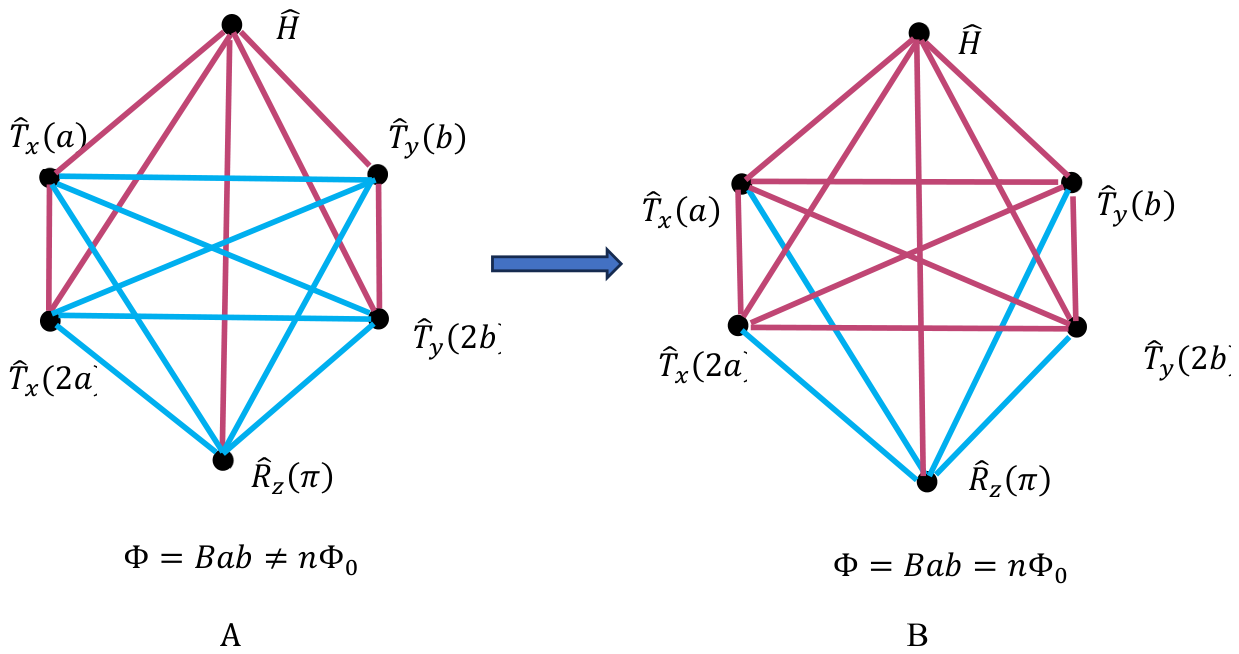
As varies, several translation-translation edges change colour according to the flux enclosed by the corresponding translation loop. Therefore, monochromatic triangles may appear or disappear at special values of . For example, the triangle is maroon when because But for generic flux, the edge becomes teal, so the maroon triangle is destroyed. Thus, the magnetic field can switch a compatible symmetry triangle on and off. Hence, we obtain the magnetic field-dependent symmetries/observables quantum graph, denoted shown in Figure 6. And whatever is the graph according to the Ramsey theorem it will necessarily contain ate least one monochromatic triangle.
We consider two cases, in the first of which and consequently takes place. So: The commuting pairs are: The corresponding is depicted in Figure 6A.
In the second case and In this case, the complete commuting list is: Since , it follows immediately that and . Hence all translation pairs generated by commute simultaneously. Non-commuting pairs are Consider: which implies that the rotation operator does not commute with the finite magnetic translations. The corresponding is depicted in B. In this regime the additional maroon triangles, including the triangle appear.
Let us count the maroon and teal edges in the graphs. We calculate in the , shown in A , whereas in the , shown in B, Thus, appearance of at least one maroon triangle in the corresponding to the case is inevitable. The colour-switching transition is generated by the magnetic-field-dependent commutation relations of the magnetic translation algebra. The role of the Mantel–Turán theorem is to reveal a structural consequence of this transition: once the number of maroon edges exceeds the threshold , the appearance of at least one maroon triangle becomes mathematically unavoidable. The physical meaning of this switching is as follows: at integer flux quanta through the elementary translation cell, translations along two directions become mutually compatible; at non-integer flux, they become incompatible; therefore, the magnetic field controls whether a full commuting symmetry sector exists. We conclude that the magnetic field acts as a control parameter that drives the PSOQG through the Mantel–Turán threshold , transforming compatibility triangles from contingent structures into mathematically unavoidable ones.
Again, the comparison with the Landau levels is useful. Landau quantization originates from the fundamental noncommutativity of kinetic momenta in a magnetic field. In contrast, the Ramsey- Turán colour-switching phenomenon concerns magnetic translation operators and reflects flux-dependent restoration of compatibility within the noncommutative Landau background. The noncommutative magnetic algebra generated by the kinetic momenta produces the predominantly teal compatibility structure of the graph, while integer flux quanta create local maroon compatibility sectors within that noncommutative background.
The transition from Fig. 6A to Fig. 6B represents a second-order symmetry switch of the SOQG. For generic magnetic flux, the graph distinguishes the two magnetic-translation directions and its coloured-graph automorphism group is . At the quantized flux condition , the translation sector becomes fully commuting, and the four translation vertices become graph-theoretically equivalent. Consequently, the automorphism group is enlarged to . This is not a conventional physical symmetry transition, but a symmetry transition of the operator-compatibility graph.
2.6.
for a quantum particle in a spherical well
Consider the quantum particle confined within a deformable spherical well: where The boundary is For , the well is spherical. For , the well is axially deformed. The Hamiltonian is:
with:
This is the central idea of this Section: the deformable boundary conditions lead to the parameter - dependent Hamiltonian. The vertices are: The list of the commutation relations for the non-deformed spherical well () is: . Now define with The colouring rule is . Thus, Now consider the axially deformed well: ( The deformation keeps only axial symmetry. Therefore, but Thus the edge changes colour: And this the only edge, which changes the colour under the deformation of the well, hence The physical meaning is that the second-order symmetry changes: The conserved angular momentum quantum number is lost, but the magnetic quantum number associated with remains meaningful. Thus, we conclude that the deformable boundaries quantum mechanics problems may be treated as the parametric symmetries/observables quantum graph.
2.7. Extension to Infinite Operator Families
The SOQG framework introduced in the present work has been formulated for finite collections of observables and symmetry operators. Nevertheless, the construction admits a natural extension to infinite operator families. Let where is an arbitrary (possibly countably or uncountably infinite) index set of operators acting on a common Hilbert space. The corresponding infinite Symmetry/Observables Quantum Graph is defined by where every unordered pair of vertices is connected by an edge coloured according to Unlike the finite case, Ramsey theory is replaced by the theory of infinite graphs. Classical results of infinite Ramsey theory imply that every infinite complete bi-coloured graph contains an infinite monochromatic complete subgraph. Consequently, every infinite operator family necessarily possesses an infinite mutually commuting sector or an infinite pairwise non-commuting sector.
The finite SOQGs investigated in the present work may therefore be viewed as finite induced subgraphs of a much larger infinite compatibility graph associated with the complete operator algebra of a quantum system. This observation suggests a natural extension of the present framework to operator algebras, Lie algebras of symmetries, quantum field theory, and many-body quantum systems. A systematic development of infinite Symmetry/Observables Quantum Graphs lies beyond the scope of the present paper and will be addressed elsewhere.
2.8. Jacobi Identity and Structural Constraints on SOQGs
The SOQG introduced in the present work is constructed from pairwise commutation relations. These pairwise relations are not independent, since all commutators satisfy the Jacobi identity
Therefore, every triple of vertices of an SOQG is constrained not only by the colours of the three connecting edges but also by the Lie-algebraic consistency of the corresponding operators. For a completely commuting (maroon) triangle, the Jacobi identity is satisfied trivially. For triangles containing one or more teal edges, however, the nested commutators are generally non-vanishing, and the Jacobi identity imposes algebraic relations between them. Consequently, not every arbitrary colouring of a complete graph can arise from a quantum operator algebra. The Jacobi identity acts as a structural compatibility condition restricting the class of realizable SOQGs. For example, for the Landau operators, together with the Hamiltonian , one immediately verifies:
since is proportional to the identity operator. Thus, the teal triangle satisfies the Jacobi identity exactly. The Jacobi identity therefore complements the Ramsey-theoretic description developed in this paper. Ramsey theory determines which monochromatic subgraphs must exist, whereas the Jacobi identity determines which coloured operator graphs are algebraically admissible within quantum mechanics.
3. Discussion
The proposed Symmetry/Observables Quantum Graph (SOQG) provides a unified graph-theoretical representation of observables and symmetry operators acting on a common Hilbert space. Unlike conventional compatibility graphs, the SOQG treats conserved quantities and symmetry transformations on equal footing, allowing both to appear within the same compatibility structures [25,26,27,28,29]. The resulting coloured graph captures the commutation algebra independently of the particular Hilbert-space representation and therefore emphasizes structural rather than representational properties of quantum systems.
A distinctive feature of the proposed SOQG formalism is that it treats observables and symmetry operators on exactly the same graph-theoretical footing. Once represented as vertices of the graph, Hamiltonians, observables, conserved quantities, and unitary symmetry transformations are distinguished solely by their commutation relations rather than by their physical interpretation. Consequently, monochromatic cliques may naturally contain both observables and symmetry operators, revealing compatibility sectors that simultaneously encode measurable quantities and the transformations preserving them. In this sense, the SOQG provides a unified combinatorial representation of the operator structure of a quantum system, in which the traditional distinction between observables and symmetries becomes secondary to their algebraic compatibility. It should be emphasized that the commutation relations are non-transitive. This fact allows straightforward application of the Ramsey theorem [28,29]. From the graph-theoretical point of view, observables and symmetries become members of the same operator algebra and are represented by identical graph objects. Their different physical roles are not imposed a priori but emerge only through the interpretation of the corresponding vertices.
The examples considered in this work demonstrate that graph-theoretical concepts -including graph automorphisms, cliques, Ramsey theory, and Mantel–Turán extremal conditions - admit direct physical interpretations in terms of compatible measurement sectors, symmetry-generated conservation laws, and operator incompatibility. In particular, the introduction of parameter-dependent SOQGs shows that external control parameters may induce transitions in the operator-compatibility graph through changes in the underlying commutation relations.
The present approach does not replace the conventional operator formalism of quantum mechanics. Instead, it complements it by introducing a combinatorial layer that reveals structural properties of operator algebras that are not immediately apparent in the standard formulation. It is expected that the proposed framework may find applications in the analysis of quantum symmetries, quantum information, contextuality, and other problems where compatibility relations play a central role.
Conclusions
A new graph-theoretical framework for quantum mechanics has been introduced in which observables and symmetry operators are incorporated into a single bi-coloured Ramsey graph. The proposed Symmetry/Observables Quantum Graph (SOQG) represents operators as vertices and classifies every pair of operators according to their commutation relations. In contrast to conventional compatibility graphs, the present construction places observables, conserved quantities, Hamiltonians, and symmetry transformations on equal footing, thereby providing a unified description of the operator structure of quantum systems.
The proposed formalism has been illustrated for several representative quantum systems. For a particle in a central potential, the SOQG naturally identifies complete commuting sectors containing both observables and symmetry operators. These monochromatic cliques correspond to maximal compatibility contexts and provide a transparent graph-theoretical representation of rotational invariance. The analysis further reveals the existence of graph automorphisms that characterize the compatibility structure itself rather than the physical symmetry of the underlying quantum system. This distinction leads naturally to the notion of second-order graph symmetry, represented by the automorphism group of the SOQG.
The representation-independence of the construction has also been established. Simultaneous unitary transformations preserve all commutation relations and therefore preserve the SOQG up to graph isomorphism. Consequently, the proposed graphs describe intrinsic properties of the operator algebra rather than properties of a particular Hilbert-space representation.
The application of Ramsey theory and the Mantel–Turán theorem demonstrates that classical extremal graph theory provides rigorous constraints on the existence of mutually compatible and mutually incompatible operator sectors. These results establish a direct mathematical connection between operator compatibility in quantum mechanics and structural properties of coloured graphs.
The framework has been further extended to parameter-dependent Symmetry/Observables Quantum Graphs (PSOQGs), whose edge colours depend explicitly on external control parameters. For a charged particle in a uniform magnetic field, the magnetic flux through the elementary translation cell controls the commutation relations of magnetic translation operators. As a consequence, the compatibility graph undergoes a flux-controlled colour-switching transition. At integer multiples of the magnetic flux quantum, additional commuting sectors emerge, the number of maroon edges exceeds the Mantel–Turán threshold, and the existence of commuting operator triangles becomes mathematically unavoidable. Simultaneously, the coloured-graph automorphism group increases, illustrating a second-order symmetry transition of the operator-compatibility graph.
The proposed SOQG framework therefore complements the conventional operator formulation of quantum mechanics with a combinatorial description of compatibility and symmetry. By combining operator algebra, graph theory, Ramsey theory, and extremal combinatorics within a unified formalism, it provides a new perspective for analysing quantum systems. The approach may be extended to more general quantum models, including many-body systems, lattice Hamiltonians, quantum information settings, and contextuality-based formulations, where the interplay between symmetry and operator compatibility plays a fundamental role.
Appendix A
Strong commutation of addressed operators
Two self-adjoint operators and are said to be strongly commuting if their spectral projection-valued measures commute, i.e. for every pair of Borel subsets . Equivalently, In the present work, a maroon edge joining two self-adjoint observables represents strong commutation. Let us demonstrate it for the central potential. The commuting operators are Here , , and possess the common eigenbasis so they admit a joint spectral resolution. The rotation operator is a bounded unitary function of . Therefore, it automatically strongly commutes with . Since , it also strongly commutes with and . Thus every maroon edge of the clique represents strong commutation.
Appendix B
Symmetry/Observables quantum graph is independent on the unitary transformations.
Theorem. Let be a symmetry/observables quantum graph. For any unitary operator , define Then the transformed graph is isomorphic to SOQG, and Proof:
Let be a unitary operator acting on the Hilbert space . Define the transformed operators
Consider two vertices and . If they commute, then Applying the unitary transformation,
and similarly,
Since ,
Hence: Conversely, Since unitary conjugation is invertible, Therefore the commutation/non-commutation pattern of SOQG is preserved exactly.
Appendix C
Quantum particle in a homogeneous field
Consider a quantum particle in a homogeneous field directed along the -axis:
For example, for a uniform gravitational field, or for a uniform electric field.
The field selects the -direction. Therefore full rotational symmetry is broken, but the system still has: We consider the mixed operator set:
where is a genuine symmetry operator of the Hamiltonian. The colouring rule remains: .
The relevant commutation relations are Consider that the equation and follows from the Baker-Campbell-Hausdorff formula (see Appendix C). Corresponding SOQG is depicted in Figure 7.
Let us perform the Mantel–Turán analysis of SOQG shown in Figure 7. We calculate Since the Mantel–Turán theorem guarantees at least one maroon triangle. Indeed, we recognize numerous maroon triangles in the AOQD, depicted in Figure 7.
Figure 7.
SOQG, emerging for a quantum particle in a homogeneous field directed along the z-axis.
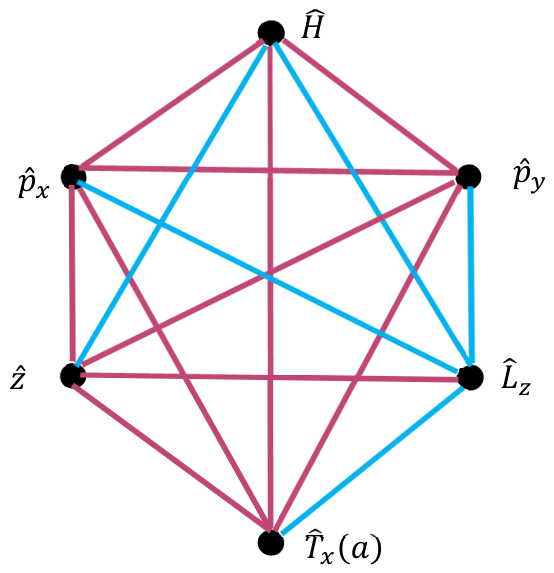
Now we supply the physical interpretation of the graph. The unique symmetry operator represents the surviving translation symmetry perpendicular to the field. It commutes with the Hamiltonian and with the observables , but not with the rotation generator . Thus, the graph explicitly shows that translations along and rotations about generate a non-Abelian subgroup of the Euclidean group. The operators are conserved quantities associated with the residual symmetries of the system. Their predominance of maroon edges reflects the large compatibility sector that remains after symmetry breaking. The coordinate is singled out by the external field. Its only teal edge is with the Hamiltonian, which expresses that the motion along the field direction is dynamical rather than symmetry-generated. At the same time, showing that the field direction is invariant under rotations about the -axis and translations along .
Appendix D
Baker–Campbell–Hausdorff formula for magnetic translations
The Baker–Campbell–Hausdorff (BCH) formula relates the product of two operator exponentials to a single exponential. In its general form it is expressed with Eq. 50:
The series continues with higher nested commutators. Consider the special case relevant to magnetic translations. If commutes with both and , namely Eq. 47 takes place:
then all higher terms vanish and the BCH formula simplifies to:
Equivalently,
This is the form used for magnetic translations.
References
- Kottos, T.; Smilansky, U. Quantum chaos on graphs. Phys. Rev. Lett. 1997, 79, 4794–4797. [Google Scholar] [CrossRef]
- Cabello, A.; Severini, S.; Winter, A. Graph-theoretic approach to quantum correlations. Phys. Rev. Lett. 2014, 112, 040401. [Google Scholar] [CrossRef] [PubMed]
- de Gois, C.; Hansenne, K.; Gühne, O. Uncertainty relations from graph theory. Phys. Rev. A 2023, 107, 062211. [Google Scholar] [CrossRef]
- Xu, Z.-P.; Schwonnek, R.; Winter, A. Bounding the joint numerical range of Pauli strings by graph parameters. PRX Quantum 2024, 5, 020318. [Google Scholar] [CrossRef]
- Wouters, J.; Giotis, A.; Kang, R.; Schuricht, D.; Fritz, L. Lower bounds for Ramsey numbers as a statistical physics problem. J. Stat. Mech. 2022, 033201. [Google Scholar]
- Dirac, P.A.M.: The Principles of Quantum Mechanics, 4th edn; Oxford University Press: Oxford, 1958.
- von Neumann, J. Mathematical Foundations of Quantum Mechanics; Princeton University Press: Princeton, 1955. [Google Scholar]
- 8 Wigner, E.P.: Group Theory and Its Application to the Quantum Mechanics of Atomic Spectra; Academic Press: New York, 1959.
- Weyl, H. The Theory of Groups and Quantum Mechanics; Dover: New York, 1950. [Google Scholar]
- Sakurai, J.J.; Napolitano, J. Modern Quantum Mechanics, 3rd edn; Cambridge University Press: Cambridge, 2020. [Google Scholar]
- Hall, B.C. Quantum Theory for Mathematicians; Springer: New York, 2013. [Google Scholar]
- Kochen, S.; Specker, E.P. The problem of hidden variables in quantum mechanics. J. Math. Mech. 1967, 17, 59–87. [Google Scholar] [CrossRef]
- Budroni, C.; Cabello, A.; Gühne, O.; Kleinmann, M.; Larsson, J.-Å. Kochen–Specker contextuality. Rev. Mod. Phys. 2022, 94, 045007. [Google Scholar] [CrossRef]
- Lovász, L. On the Shannon capacity of a graph. IEEE Trans. Inf. Theory 1979, 25, 1–7. [Google Scholar] [CrossRef]
- Ramsey, F.P. On a problem of formal logic. Proc. Lond. Math. Soc. 1930, 30, 264–286. [Google Scholar] [CrossRef]
- Mantel, W. Problem 28. Wiskd. Opgaven 1907, 10, 60–61. [Google Scholar]
- Turán, P. On an extremal problem in graph theory. Mat. Fiz. Lapok 1941, 48, 436–452. [Google Scholar]
- Bondy, J.A. Murty, U.S.R.: Graph Theory; Springer: New York, 2008. [Google Scholar]
- Diestel, R. Graph Theory, 5th edn; Springer: Heidelberg, 2017. [Google Scholar]
- Biggs, N. Algebraic Graph Theory, 2nd edn; Cambridge University Press: Cambridge, 1993. [Google Scholar]
- Landau, L.D.; Lifshitz, E.M. Quantum Mechanics: Non-Relativistic Theory, 3rd edn; Pergamon Press: Oxford, 1977. [Google Scholar]
- Griffiths, D.J.; Schroeter, D.F. Introduction to Quantum Mechanics, 3rd edn; Cambridge University Press: Cambridge, 2018. [Google Scholar]
- Zak, J. Magnetic translation group. Phys. Rev. 1964, 134, A1602–A1606. [Google Scholar] [CrossRef]
- Zak, J. Dynamics of electrons in solids in external fields. Phys. Rev. 1968, 168, 686–695. [Google Scholar] [CrossRef]
- Simon, B. Representations of Finite and Compact Groups; American Mathematical Society: Providence, 1996. [Google Scholar]
- Godsil, C.; Royle, G. Algebraic Graph Theory; Springer: New York, 2001. [Google Scholar]
- Harary, F. Graph Theory; Addison–Wesley: Reading, 1969. [Google Scholar]
- Bormashenko, E. Ramsey approach to symmetry. Symmetry 2026, 18, 1041. [Google Scholar] [CrossRef]
- Bormashenko, E.; Shvalb, N. Ramsey approach to quantum mechanics. arXiv [math-ph]. 2024, arXiv:2411.02082. [Google Scholar]
Figure 1.
Symmetry/observables quantum graph built for a quantum particle in a central field. The graph is symmetrical relative to the axis
Figure 1.
Symmetry/observables quantum graph built for a quantum particle in a central field. The graph is symmetrical relative to the axis
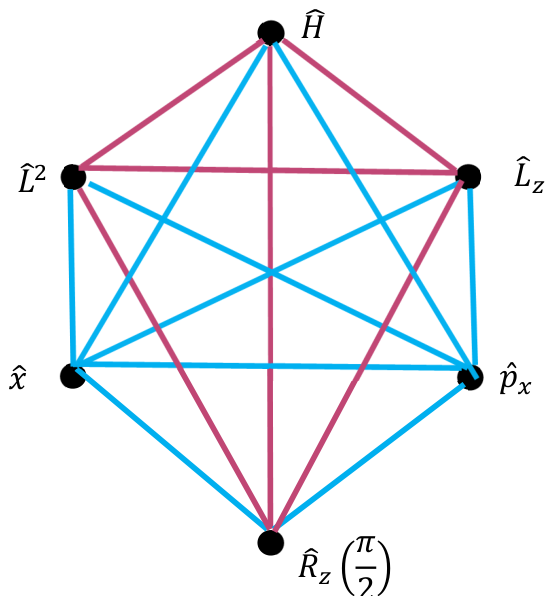
Figure 2.
Star-shaped, - centred SOQG for the quantum particles in the central potential. Vertices are
Figure 2.
Star-shaped, - centred SOQG for the quantum particles in the central potential. Vertices are
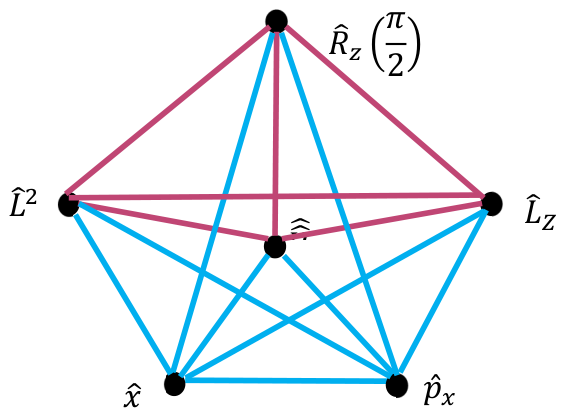
Figure 3.
. SOQG for the quantum particle in the central potential, as it is seen in the spherical coordinates.
Figure 3.
. SOQG for the quantum particle in the central potential, as it is seen in the spherical coordinates.
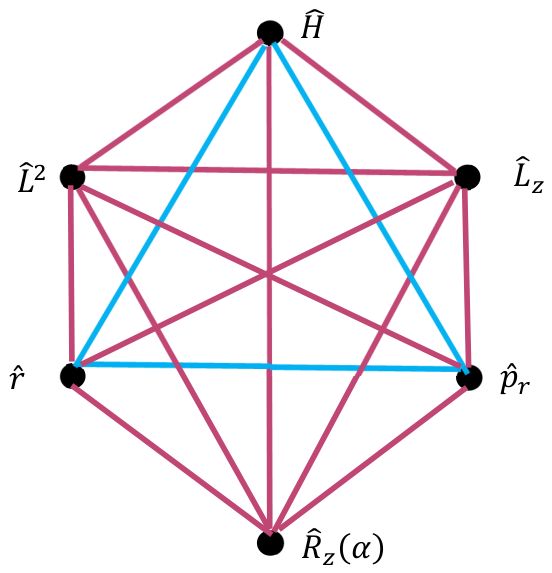
Figure 4.
. SOQG for the quantum particle in a uniform magnetic field B.
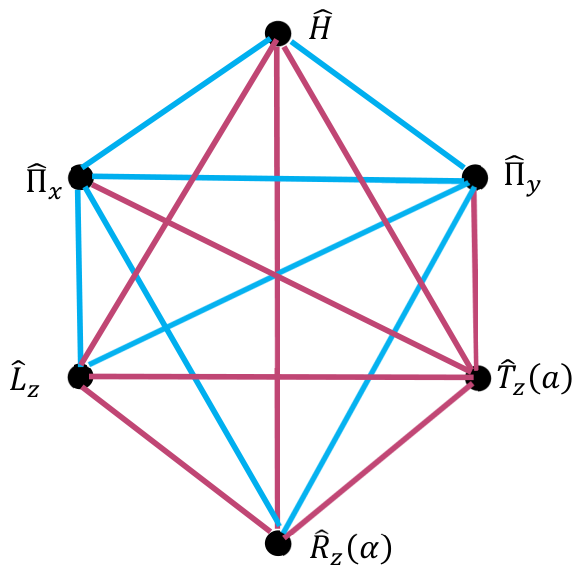
Figure 5.
Star-shaped, - centred SOQG for the quantum particle in a uniform magnetic field B.
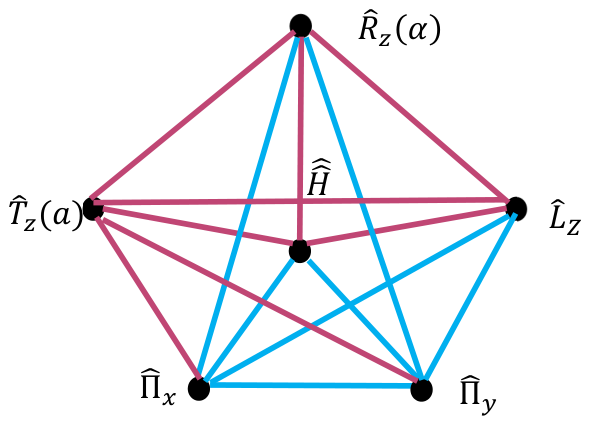
Figure 6.
for a charged particle m, q moving in the magnetic field B. The Ramsey-Turan colour-switching transition is illustrated. A. takes place. B. is true.
Figure 6.
for a charged particle m, q moving in the magnetic field B. The Ramsey-Turan colour-switching transition is illustrated. A. takes place. B. is true.
Disclaimer/Publisher’s Note: The statements, opinions and data contained in all publications are solely those of the individual author(s) and contributor(s) and not of MDPI and/or the editor(s). MDPI and/or the editor(s) disclaim responsibility for any injury to people or property resulting from any ideas, methods, instructions or products referred to in the content. |
© 2026 by the authors. Licensee MDPI, Basel, Switzerland. This article is an open access article distributed under the terms and conditions of the Creative Commons Attribution (CC BY) license (http://creativecommons.org/licenses/by/4.0/).
Copyright: This open access article is published under a Creative Commons CC BY 4.0 license, which permit the free download, distribution, and reuse, provided that the author and preprint are cited in any reuse.