
Submitted:
29 August 2026
Posted:
31 August 2026
You are already at the latest version
Abstract
Dehydration, high salt concentrations and extreme high or low temperatures are just a few of the environmental issues that inhibit plant growth and development. The most significant issue facing agriculture globally is salinity. The amount of land that can be cultivated on Earth is greatly influenced by salinity. In plants, it interacts with osmotic pressure, ionic levels, and the effects of oxidative stress. Plants use defence mechanisms such as antioxidant systems, osmotic control, and ion maintenance of equilibrium to deal with these problems. A strategy that may be able to help with these issues is nanotechnology. Plant resilience is increased by nanoparticles (NPs) through maintaining the efficiency of photosynthesis, regulation of stress-responsive genes, and improvement of antioxidant properties. By preserving photosynthesis, boosting antioxidant capacity, and controlling stress-responsive genes, nanoparticles (NPs) help plants become more resilient. NPs including ZnO-NPs, Fe-NPs and TiO2-NPs, can enhance plant growth and stress tolerance, delivers a cost-effective way and sustainable approach to mitigate salinity stress and increase the output of agriculture. The usage of nanotechnology in farming improves environmental sustainability and helps global food security in addition to addressing salinity-related problems.
Keywords:
nanotechnology
; salinity stress
; photosynthesis
; antioxidant defense
Introduction:
Challenging and unpredictable conditions in the environment may hinder the growth and development of plants. Biotic stressors, such infections caused by bacteria and herbivore attacks, and abiotic stressors, like high temperatures, drought, nutritional deficiencies, too much salt, or toxic soil components, like arsenate, aluminium and cadmium, are examples of these negative factors (Rajput et al., 2021). Among them, one of the biggest issues facing agriculture worldwide is salt stress. It hinders agricultural progress, impacts food supply, and decreases crop growth. According to studies, Salinity affects around one-third of the world’s land used for agriculture. Climate change causes salinity to rise dramatically under stressful conditions. It makes 33% of irrigated agricultural area unsuitable and 20% of all cultivated land (Ludwiczak et al., 2021; Rajabi et al., 2023)
When plants are grown in saline environments, their levels of sodium (Na+) and chloride (Cl−) might rise, with chloride being found to be more toxic (Wang and Huang, 2019). High quantities of these ions can pose a threat to plant survival (Mariyam et al. 2023; Thabet et al. 2021b). It disrupts the osmotic balance, water uptake, nutrient absorption, hormonal regulation and photosynthesis in plants. Additionally, it increases the generation of reactive oxygen species (ROS), including singlet oxygen (1O2), hydroxyl radicals (OH), superoxide radicals (O2-), and hydrogen peroxide (H2O2). This causes cellular damage and eventually cell death. The interaction between signaling molecules and ROS like (Kora and Bhattacharjee, 2020) calcium (Steffens, 2014), jasmonic acid (Qi et al., 2020), ethylene (Piacentini et al., 2020) and nitric oxide (Rui et al., 2020) complicates the plant’s response to salinity stress. Plant growth regulators and external biochemicals have become a less hazardous and viable way to address this problem and lessen the toxic effects of salt stress on plants (Iqbal and Ashraf, 2013; Gurmani et al., 2022).
In agricultural systems, nanotechnology offers a number of opportunities, including improved nutrient use and insect control, which could advance sustainable farming methods (Gupta et al. 2023). It introduces innovative methods to increase output and strengthen resistance among different stresses (Singh et al., 2023f; Vardumyan et al., 2024). Nanoparticles are used in a variety of fields, including wastewater treatment, agriculture, food production, environmental remediation, medicine and biotechnology (Zahra et al., 2020), antimicrobial agents (Islam et al., 2022), environmental monitoring (Rassaei et al., 2011) and functional food additives (Chen et al., 2023). Additionally, various industries, such as chemistry, textiles, optics, pharmaceuticals, culinary arts, biomedicine and agriculture related fields have made substantial use of them (Verma et al., 2019). The technological intrigue surrounding nanoparticles lies in their ability to connect cellular or atomic configurations with large quantities (Khalid et al., 2022). NPs are ultra-small particles that can be manufactured using a variety of chemical, biological and physical techniques. They are usually between one and one hundred nanometres in size (Khan and Hossain, 2022; Salem et al., 2022). By increasing nutrient intake by helping plants absorb and transport minerals and nutrients (Singh et al., 2024), which increases photosynthetic efficiency (Faizan et al., 2021), regulating hormone balance, especially gibberellins and auxins, protecting ROS (Tripathi et al., 2022), which may damage plants, and enhancing stress-responsive gene activity by increasing the expression of genes that help plants to responds to stress (Abideen et al., 2022). Recently, there has been an increasing interest in using several NPs in agriculture due to their advantageous and safe properties. These NPs include Fe3O4, TiO2, ZnO, SiO2, Se-NPs and Cu-NPs (Alabdallah and Hasan, 2021; Hashem et al., 2021). Plants absorb nanoparticles through a number of pathways, the most prevalent of which are their leaves and roots. Many studies, including Tripathi et al. (2017), Paramo et al. (2020), and Vila-Traver et al. (2021), suggest that the size, reactivity, and chemical makeup of nanoparticles may influence how plants respond to them. The ability of nanoparticles, as showed by Zulfiqar and Ashraf (2021), to promote plant development in salt stressed situations is noteworthy. Figure 1 illustrates the physiological and molecular effects of salinity-induced ROS in plants and the protective role of nanoparticles salt tolerance.
Impact of salinity and its response:
Stress on plants can lead to a decline in plant photosynthesis, suppressed enzyme function in affected plants, and hindered growth and maturation processes. This results in decreased agricultural productivity within the damaged regions (Gill and Tuteja, 2010; Heidari et al., 2011; Guidi et al., 2019). The combined impacts of salinity on several characteristics of crops have been the subject of numerous research. This includes problems like nutritional deficiencies(Hussain et al. 2018; Kibria 2019), ion toxicity (Arif et al. 2020), oxidative damage (Liang et al. 2018; Ahmad et al. 2019), disruptions to metabolic processes (Narsing Rao et al. 2019), as well as various changes in biochemical, physiological, and molecular mechanisms (Naz et al. 2019; Khan et al. 2021).
Elevated salt concentrations in the soil reduce root water uptake, causing water scarcity within plant tissues (Ait-El-Mokhtar et al. 2020). This water shortage, combined with osmotic stress, inhibit cell expansion and plant growth (Kravchik et al. 2013; Naz et al. 2021). As a result, plants may exhibit reduced growth, resulting in decreased biomass accumulation and limited shoot and root formation (Kaya et al. 2018; Ahmed et al. 2020; Zafar-ul-Hye et al. 2022; Farooq et al. 2022; Haung et al. 2023).
Salinity results in oxidative stress in plants by inducing the production of reactive oxygen species (ROS) such as superoxide radicals (O2-) and hydrogen peroxide (H2O2) at elevated salt levels. These ROS are responsible for damaging lipids, proteins, and DNA within plant cells. It may cause oxidative stress that disturbs normal physiological processes and result in cell death (Hasanuzzaman et al. 2021; Hossen et al. 2022). Furthermore, elevated quantities of salt can disrupt chlorophyll production and damage its stability, resulting in reduced chlorophyll level. In the end, this reduced the photosynthetic efficiency of plants under salt stress (Ali et al. 2023; Shareef et al. 2020). Various measures were periodically used to lessen the effects of salt stress on plants. These techniques consist both traditional breeding techniques and modern techniques like gene mutation, knock-in and knock-out and gene silencing, etc. Conventional breeding techniques have significantly improved the development of crop stress resistance. However, all of these conventional breeding methods are challenging and have downsides, such as the need for a lot of manpower and energy (Johnson and Puthur, 2021).
Plants have developed defences against the detrimental effects of salinity while maintaining internal equilibrium. Osmotic regulation, ion level maintenance, antioxidant defence, hormonal regulation, and physical reactions are some of these systems. By using these methods, plants can efficiently handle salt stress and lessen its negative effects. Plants respond to salt stress by developing salt glands, altering the structure of their roots, reducing the size of their leaves, and developing succulent tissues (Noor et al., 2023).
Nanotechnology in Agriculture:
The word “nano” is derived from the Greek word for “dwarf,” which describes its tiny size. The breadth of ten water molecules or six carbon atoms is equal into one billionth of a meter, or a nanometre. For contrast, a human hair measures approximately 7000 nanometers wide. Atoms are extremely minute, measuring less than 1 nm, while certain compounds such as specific proteins can be larger than this. Although the origins of nanotechnology can be found in ancient civilizations thousands of years ago, nonetheless, it gained popularity until 1959 when physicist Dr. Richard P. Feynman introduced the idea. When Norio Taniguchi first used the phrase “nanotechnology” in 1974, it quickly spread throughout the world and gained recognition as the next technological breakthrough. Nanotechnology has entered the field of life sciences. It uses the extraordinary nanoscale capabilities seen in biological components within cells, that rise to “nanobiotechnology.” This interdisciplinary field investigates the combined use of nanotechnology with biological systems, offering promise advances in medicine, agriculture, and environmental science (Imran and Ortas 2024).
The main focus of nanotechnology is on materials with at no less than a one dimension much smaller than 100 nm, or nanomaterials. NPs can be classified based on different criteria, such as their origin, dimensionality, form (Khan and Hossain 2022), size (Namakka et al., 2023) or chemical characteristics (Altammar et al., 2023). According to Kolahalam et al. (2019), these nanomaterials may be divided into four groups according to their dimensionalities.
1. Zero-dimensional nanomaterials, often known as 0-D materials, are materials having all three dimensions falling inside the nanoscale range. Common examples in this class include quantum dots and fullerenes.
2. One-dimensional nanomaterials, referred to as 1-D materials, have one aspect that extend beyond the nanoscale. Nanofibers, nanotubes, nanorods, nanohorns and nanowires are a few examples of such materials.
3. Two-dimensional nanomaterials, categorized as 2-D materials, exist in two dimensions beyond the nanoscale. This classification often includes nanofilms, nanolayers and nanosheets (Joudeh and Linke, 2022)
Classification of Nanoparticles:
Organic Nanoparticles:
One type of nanoparticle composed of organic molecules that are 100 nm or less is called an organic nanoparticle (ONP) (Qi and Zhang, 2022). Micelles, dendrimers, ferritin, and liposomes are some of the examples of ONPs. These ONPs are biodegradable and non-toxic. It is important to note that nanocapsules with hollow cores like liposomes and micelles, are sensitive to electromagnetic and thermal radiation, like light and heat. These special qualities render them ideal for biomedical uses, especially in drug delivery applications (Salel and Iyisan, 2023) (Figure 2).
Liposomes, dendrimers, carbon nanomaterials and polymeric micelles are examples of organic nanoparticles, which represents a class of advanced materials. Dendrimers, for instance, nanoscale polymeric molecules that are mostly used in the pharmaceutical and medical industries for task like boron neutron capture therapy and gene transfer. Conversely, liposomes, are spherical structures made of phospholipids that amphiphilic properties because of their both hydrophilic and lipophilic nature. Notably, the phospholipids within liposomes have a unique liquid crystalline transition temperature poperty. Liposomes have been used to enhance dairy products by incorporating vitamins (Kumar and Lal, 2024).
Inorganic Nanoparticles:
They are termed as inorganic nanoparticles since they don’t contain carbon atoms. They are more stable and hydrophilic as compared to organic nanomaterials. (Paul and Sharma, 2022) Typically classified as metal, ceramic, or semiconductor, inorganic nanoparticles are often categorized as particles composed of metals or metal oxides. Polymetallic, bimetallic or monometallic metal nanoparticles are created using metal precursors (Nascimento et al. 2018).
Carbon based Nanoparticles:
Since carbon is the source of carbon nanoparticles (CNPs), they have remarkable electrical and thermal conductivity as well as stability. As they are made of pure carbon, these materials have minimal toxicity, great conductivity, remarkable stability, and environmental friendliness (Jaleh et al., 2022). As a result of their sp2 hybridization, CNPs also show considerable hydrophobicity (Choudhary et al., 2014). Carbon nanomaterials include a variety of forms, including sp2 carbon structures such as fullerene, carbon nanotubes, carbon nanohorns, (graphene quantum dots and graphene), nanodiamonds and amorphous carbon nanoparticles which include, carbon dots, carbon nanoparticles and ultrafine carbon particles (Chen and Haifang, 2016). Anisotropic heat conductivity is significantly observed in carbon-based nanomaterials (Chung et al., 2018).
As a consequence, these nanoparticles are recognized for their notable mechanical qualities, thermal and electrical conductivity, and stability. They are extremely adaptable and effective in a wide range of applications due to their high biocompatibility, anisotropic heat conductivity and low toxicity. In short, metal-based nanoparticles (MNPs) hold a lot of possibilities for usage as agricultural inputs for reducing the adverse effects that different stresses have on crops (Díaz-Parra et al., 2025)
Metal based Nanoparticles:
The process of creating nanoparticles is resizing metals to a nanoscale using either a top-down or bottom-up approach. A few typical examples are Cu, Fe, Zn, Ag and Cd. These small size, nanoparticles possess more atoms on their surface. The surface area to mass ratio is determined by the size and shape of the particles. This influences parameters like UV-visible sensitivity and conductivity. Alteration in surface area can affect a variety of characteristics, including electron affinities, electronic energy levels, phase transition temperature, melting point, magnetic properties, and interactions with organic, biological and polymeric components. Coulomb charging mechanisms and quantum size both affect the charge of nanoparticles (Cheung et al., 2015).
Metal oxide based Nanoparticles:
Metal oxides are produced through the synthesis of the latter to modify the characteristics of metal-based nanoparticles like Iron (II) oxide, Zinc oxide, Aluminium oxide, Iron (III) oxide, and among others. Positive metallic ions and negative oxygen ions combine to generate these ionic compounds. The stability and strength of ionic interactions stem from the electrostatic attractions between the negative oxygen ions and positive metal ions (Devan et al., 2012). The oxides most commonly synthesized include silicon dioxide (SiO2), titanium oxide (TiO2), zinc oxide (ZnO) and aluminum oxide (Al2O3). (Fayad and Dhahad, 2021; Song et al., 2021; Bekele, 2021; Singh, 2021; Bulychev, 2022).
Salinity and Nanotechnology responses at physiological and molecular level:
Nonetheless, a variety of stress factors today affect the majority of agricultural land. The demand for various food resources, including fruits, vegetables, dairy products, and meat, will rise in response to the projected 10 billion lives on the sphere by 2050, placing a new challenge on the farming sector (Kopecká et al., 2023). Cl− and Na+ ions build up in plant cells when salt is present in the environment, which leads to ion imbalance and toxicity (Rajput et al., 2020; Sabrekov et al., 2020). Growth and yield are lowered as a result. Under this situation, improving plant stress tolerance with nanoparticles is becoming a viable and sustainable long-term approach to increase agricultural productivity at a reasonable cost (Rajput et al., 2020).
Nanoparticles (NPs) have been proven for the reason to maintain photosynthetic components,, stimulating plants photosynthesis, and triggering the antioxidant mechanisms to fix ROS-induced harm in chloroplasts and photosystems. Furthermore, NPs increase the amount of chlorophyll in plant cells and trigger the electron transport chain (Forni et al., 2017; Manzoor et al., 2022). Numerous plant physiological mechanisms, such as stress reactions, calcium signaling, hormone control, osmolyte formation, ethylene synthesis, ABA signaling and nitric oxide levels are profoundly affected by those substances. Additionally, they influence the protein expression which response in stress that improve the capacity of plants to survive and adapt in challenging situations by altering signal transduction pathways under drought and salinity stress (Rasheed et al., 2022).
In accordance with the Singh et al., iron oxide nanoparticles may increase trees’ resilience to salt stress by upregulating genes including HKT1, SOS1, and NHX and strengthening the expression of antioxidant enzymes (Singh et al., 2021). Liu et al. discovered that nanoceria treatment increased the expression level of HKT1, a gene associated with shoot sodium exclusion, without impacting SOS1 in enhancing cotton plants’ ability to endure salt stress (Liu et al., 2021b). Shah et al. (2021) found that TiO2 nanoparticles protect chloroplasts by increasing the effectiveness of antioxidant enzymes like CAT, POD, and SOD in response to intense light exposure. Additionally, a different study found that the use of ZnO NPs and Fe NPs could elevate the formulation of GR, SOD and APX genes in four tomato cultivars subjected to different levels of NaCl stress. This leads to enhanced production of antioxidant enzymes, consequently improving key growth parameters such as dry matter percentage, osmotic potential, relative growth rate, proline content, callus formation and shoot development in tomatoes facing salinity stress (Aazami et al., 2021).
In addition to the inevitable leakage of electrons onto O2 from the chloroplast, mitochondria, plasma membrane and electron transport systems, reactive oxygen species (ROS) are also produced by metabolic activity in several cellular regions in plants. When a plant is exposed to salinity, its internal equilibrium is perturbed which increases the generation of ROS (Van Zelm et al., 2020). When exposed to hyperosmotic stressors and ionic imbalances, plant tissues tend to produce more ROS molecules, which may cause intracellular damage (Hasanuzzaman et al., 2020). An excess of reactive oxygen species (ROS) causes lipid oxidation, which produces malondialdehyde (MDA) and negatively affects physiological processes and cellular metabolism. Impaired membrane stability disrupts a number of biological functions, including cellular homeostasis, molecular transport and intracellular signaling (Hasanuzzaman et al., 2019). Salinity-induced nutritional imbalance, hyperosmotic stress, and ionic disruption affect photosynthetic pigment levels, which in turn restrict photosynthetic activity (Ali et al., 2013). Additionally, the excessive generation of reactive oxygen species (ROS) in plant mitochondria, peroxisomes, and chloroplasts is strongly associated with changes in gene expression (Filiz and Kurt, 2021). One well-established method for improving resistance to salt stress is the synthesis of genes encoding antioxidant enzymes (Ismail et al., 2022).
According to several recent research, nanoparticles (NPs) could lower oxidative stress under saline environments by enhancing the enzymatic antioxidant system in a range of plant species. For example, it was discovered that biogenic Au-NPs exhibited this impact on CeO2 on Triticum aestivum L. (Wahid et al., 2022), Zea mays L. (Liu et al., 2022) and Ca-phosphate NPs on Lycopersicon esculentum Mill. (Pinedo-Guerrero et al., 2020), Vicia faba L. (Nasrallah et al., 2022), ZnO nanoparticles on SiO2 on Lycopersicon esculentum Mill. Pisum sativum L. (Faizan et al., 2021), zeolite NPs on Solanum tuberosum L. (Mahmoud et al., 2019), biogenic ZnO-NPs on Abelmoschus esculentus L. (Alabdallah and Alzahrani, 2020), carbon NPs on Lactuca sativa L. (Baz et al., 2020), biochar NPs on Triticum aestivum (Soliman et al., 2022), urea functionalized hydroxyapatite NPs on Hellianthus annuus L. (Ullah et al., 2022), silver NPs on Pennisetum glaucum (Khan et al., 2020) and chitosan NPs on Momordica charantia L. (Sheikhalipour et al., 2021). Employing C-NPs and Ag-NPs increased the metabolic processes of POD, APX, and CAT which improved the levels of osmoprotectants and soluble sugars while keeping ion homeostasis and redox balance (Shafiq et al., 2019; Mohamed et al., 2017). Malondialdehyde (MDA) content decreased, reactive oxygen species (ROS) increased and soluble carbohydrates increased as a result of increased catalase peroxidase (POX) and (CAT) activity carried on by the use of Fe-NPs. In conclusion, these changes led to increase in seed output and shoot dry weight (Torabian et al., 2018). Researchers have successfully found that applying NPs at low concentrations or in a dose-dependent way can start the ROS detoxification mechanism by upregulating certain signalling genes (Ali et al., 2022).
For instance, Fe-NPs increased the levels of phenolic and flavonoid compounds in the roots, which accelerated plant growth. Furthermore, it was demonstrated that these nanoparticles reduced the activity of antioxidant enzymes (Moradbeygi et al., 2020). Table 1 and Table 2 summarize the physiological, biochemical, and molecular responses of plants to various nanomaterials under salt stress, highlighting their roles in enhancing stress tolerance, growth, and productivity.
Nanoparticle Approaches to Reduce Plant Nutrient Imbalances Caused by Salinity:
NPs can influence gene expression and signal transmission, which could influence cellular functions. Soni et al. (2024) indicate that NPs increase plant growth and production, minimise reactive oxygen species (ROS), boost nutrient absorption, photosynthesis and regulate water balance. Plants can now withstand salt stress through using nanoparticles (NPs), which result in significant physiological, biochemical, and molecular changes. NPs help plants better adapt to saltwater surroundings by relying on a variety of activities (Jamie et al., 2026).
Physiological Adaptations Through Nanoparticle Application under Salinity
Salinity stress tends to change nutrient levels and result in an elevated level of nutritional inadequacy in plants (Etesami and Maheshwari, 2018). According to studies, when soybean seedlings encountered to salt stress, Nano SiO2 increased the concentration of potassium in the leaves, which improved the growth of the seedlings (Farhangi-Abriz and Torabian, 2018). Cu-NPs applied directly may reduce the effects of salinity in plants such as tomatoes through stimulating growth and preserving a steady sodium to potassium ratio, according to several studies (). Abdoli et al. (2020) found that application of Fe2O3 NPs helped Trachyspermum ammi plants withstand salt stress through improving the potassium to sodium ratio and Fe content. Applying Ce NPs to cotton plants increased their potassium to systolic sodium ratio, which markedly enhanced plant growth in salt-stressed conditions (Liu et al., 2021). According to X. Wang et al. (2019), the utilization of ZnO nanoparticles enhanced the salt tolerance of cucumber plants by enhancing the activity of antioxidant enzymes and decreasing oxidative damage. Similarly, El-Temsahy et al. (2019) reported that the application of ZnO nanoparticles to wheat plants under salt stress conditions resulted in increased plant growth, biomass, and chlorophyll content.
Priming with TiO2 NPs significantly reduced the relative electrolyte leakages in maize membranes, indicating a protective impact of TiO2 against membrane degeneration induced by salt stress (Shah et al., 2021). The application of modified CsBMs and CsNPs on leaves enhanced the expression of JA signaling, production of anthocyanins, defense-related genes, synthesis of diterpene glycosides and membrane integrity response to salt stress (Balusamy et al., 2022). Similar to this, Suriyaprabha et al. (2015) concluded that applying SiNPs to rice plants under salt stress might greatly boost their photosynthetic efficiency and biomass. Additionally, the SiNPs increase the expression of stress-responsive genes, such as those that produce antioxidants and osmoprotectants, which are essential for preserving cellular homeostasis under salinity stress (Zhao et al., 2017).
Biochemical Modifications Triggered by Nanoparticles under Salinity
Salinity stress has a considerable impact on photosynthesis. The amount of salt, type of plant and the surrounding conditions all affect the degree of impact (Hnilickova et al., 2021). Numerous studies have demonstrated that the amount of chlorophyll in plant leaves is greatly increased when nanoparticles (NPs) are added. Research suggests that the use of manganese nanoparticles (Mn-NPs) can support a consistent level of photosynthesis under challenging salt stress circumstances (Ye et al., 2020). Manganese supplementation has been shown to improve a number of parameters in Vigna radiate, including chlorophyll levels, nitrate reductase enzyme activity and membrane stability index, when subjected to salt (Shahi and Srivastava, 2018). It was discovered that applying an external Cu treatment helped to lessen the dangerous effects of salt stress on photosynthesis and water balance on maize crops (Iqbal et al., 2018).
Some nanoparticles have qualities similar to antioxidant enzymes, which can assist plants in fighting oxidative stress. For example, cesium, manganese, copper, and iron nanoparticles display peroxidase-like functions, whereas cobalt, cesium and iron nanoparticles demonstrate catalase-like traits (Rico et al., 2015). Their research indicated that the presence of these nanoparticles had a notable positive influence on the growth characteristics of the plant. This enhancement was linked to an increase in the functioning of antioxidant enzymes like GPX, SOD and CAT, while also causing decrease in the K+/Na+ ratio. Their research also showed that Ce-NPs increased the functioning of enzymes known as antioxidants in cotton plants, which helped to eliminate reactive oxygen species (ROS) from intracellular spaces. Furthermore, these nanoparticles promoted plant development even under saline (Liu et al., 2021).
According to the study, the total amount of phenolic substances in Vigna radiata was significantly increased by the external treatment with TiO2. This aligns with previous findings indicating that TiO2 seed priming effectively regulates the synthesis of phenolic compounds in maize hybrids exposed to salt stress (Qi et al., 2013). Moradbeygi and colleagues (2020) conducted research under salt stress conditions to examine the impact of iron NPs on Dracocephalum moldavica L. The findings revealed that NPs improved plant development under salt stress by increasing phenolic and flavonoid compounds, especially in the root zone, and decreasing the activity of antioxidant enzymes. Furthermore, Cu NPs demonstrated a significant rise in glutathione, vitamin C and polyphenols levels compared to the control group under salt stress situation (Rajput et al., 2021a). The treatment with sulfur nanoparticles increased the amounts of tannin, total phenols, flavonoids, anthocyanins and osmo protectants. in lettuce subjected to salinity (Najafi et al., 2020). Moreover, the presence of AgNPs increased the levels of phenolic compounds and flavonoids while reducing the Na+/K+ ratio in the leaves (Khan et al., 2020). By promoting plant development and controlling the Na+ and K+ ratio, foliar spraying of copper nanoparticles on tomato plants has been shown to reduce salt stress (Pérez-Labrada et al., 2019). Furthermore, in Helianthus annuus plants cultivated in saline conditions, leaf application Fe NPs stimulation increased the activities of POD, CAT and polyphenol oxidase enzymes (Torabian et al., 2018).
Molecular Responses to Nanoparticle Treatments under Salinity
Nanoparticles (NPs) have been shown to influence plants at the molecular level by modulating epigenetic mechanisms such as cytosine methylation under salinity stress. DNA methylation rates were impacted by the combined application of plant growth-promoting bacteria (Bacillus subtilis, Bacillus pumilus, and Lactobacillus casei) and ZnO-NPs at varying doses in tomato plants (Solanum lycopersicum L. ‘Linda’) subjected to 250 mM NaCl. This treatment enhanced genetic polymorphism and decreased stress-induced DNA hypermethylation, suggesting an epigenetic response to salinity stress, where such methylation modifications are usually caused under high-salt circumstances (Hosseinpour et al., 2020b). When zinc NPs were applied to rapeseed plants (Brassica napus L.) in a saline environment, genes including SKRD2, MPK4, and MYC were downregulated while other genes related to metabolic and hormonal responses (such MPK and ARP) were upregulated. According to Peng and Zhang (2009), several of these genes are directly associated with transcription factors and their overexpression in response to abiotic stress.
The myelocytomatosis oncogene (MYC) receptor kinase 2 (SKRD2) genes and auxin response protein (ARP) were all far less expressed in salt-stressed plants than in non-stressed plants. On the other side, MPK4 gene expression was significantly increased by rising NaCl levels. The findings demonstrated that foliar treatment with ZnO NPs dramatically reduced the expression of the SKRD2, MYC and MPK4, genes while increasing the activity of the ARP gene (Hezaveh et al., 2019). A genome-wide cDNA express microarray was also used to analyse the transcriptional responses of Arabidopsis plants treated to silver nanoparticles. As a result, 286 activated genes were found, among which were linked to oxidative stress and metal reactions, such as peroxidase, SOD, the vacuolar proton exchanger and cytochrome P450-dependent oxidase. Along with genes involved in plant defence, it also found about 81 genes that were downregulated. These included the ethylene signalling system, SAR against infections and auxin-regulated genes (Abideen et al., 2022).
Proteomics research found that silicon nanoparticles influenced genes related to the ATP-synthase complex, light-harvesting complexes and cytochrome b6f (Cytb6f) in salt-stressed tomato plants. The administration of silicon nanoparticles changed the activity of 29 genes, including kinase/phosphatase genes, transcription factors, genes associated with photosynthesis and stress-related genes. Additionally, Silicon was found to regulate genes responsible for auxin and nitric oxide production (Tripathi et al., 2021a). Additionally, silicon NPs mitigate the effects of salt stress through modulation of gene expression, such as OsNCED and OsZEP, crucial for the synthesis of the hormone ABA. The two genes involved are OsZEP and OsNCED (Tripathi et al., 2021b). According to studies, silicon nanoparticles can increase the transfer of salt into the vacuole in high salinity environments by boosting the expression of the OsHMA3 protein, which in return stimulates better plant development (Siddiqui et al., 2020).
Furthermore, CSNP administration raised the genes for MAPK3, octadecanoid-derivative responsive AP2-domain (ORCA3) and geissoschizine synthase (GS), which increased alkaloid production and improved resistance to salt stress (Ghasemian et al., 2021). Similarly, during soybean germination under salt stress, NP-SiO2 treatment partially restored the expression of brassinosteroid-related genes such CPD, BRI1, and CDG1. Moreover, ZnO-NPs alter genes related to photosynthesis. Transcriptomic and proteomics of Brassica napus revealed the activation of Calvin cycle-related genes, including PSII structural genes like psbA and Rubisco activase (RCA), which helped sustain the efficiency of photosynthesis under oxidative stress (Sohail et al., 2022).
Additionally, under both saline and nonsaline conditions, silicon NPs and MeJA changed the activity of the salt stress responsive genes manganese-SOD, glutathione-S-transferase (GST), dehydration-responsive element-binding protein (DREB) and cytosolic APX (cAPX) in strawberry plants, improving stress tolerance and lowering oxidative stress (Moradi et al., 2022).
Future advancements and gaps in field of a nanotechnology in Salt Stress:
Recent advances in nanotechnology have demonstrated significant potential for improving salinity tolerance in plants through the regulation of physiological, biochemical, and molecular processes. Nanomaterials such as trehalose-coated silica nanoparticles (TSiNPs), copper oxide nanoparticles (CuONPs), Cu-NPs, and nano-biochar (nano-BC) have been shown to enhance photosynthetic efficiency, antioxidant defense systems, ionic homeostasis, nutrient uptake, osmolyte accumulation, membrane stability, and stress-responsive gene expression under saline conditions (Sarkar et al., 2026; Ameri et al., 2026; Esgici et al., 2026). Moreover, transcriptomic and metabolomic analyses revealed that nanoparticle-mediated stress alleviation involves the regulation of transporters, phytohormones, phenolics, amino acids, redox enzymes, and signaling pathways associated with salinity tolerance (Sarkar et al., 2026). Integrated management approaches involving nanomaterials, biochar, HT-PGPB, exogenous growth regulators, and soil amendments also offer promising strategies for improving crop productivity and soil restoration in salt-affected agroecosystems (Li et al., 2026). However, despite these encouraging findings, several critical gaps remain unresolved, including limited field-scale validation (Martinez et al., 2026), insufficient biological replication in omics studies, uncertainty regarding nanoparticle transport and long-term environmental impacts, and inadequate understanding of genotype-specific responses and nanoparticle biosafety (Hammad et al., 2026).
Future advancements should therefore focus on integrating advanced omics technologies such as proteomics, lipidomics, ionomics, and functional genomics to better elucidate nanoparticle–plant interactions and stress-regulatory networks. Multi-location field trials across contrasting genotypes and salinity regimes can help define agronomically relevant dose–response relationships (Anand et al., 2026). Additionally, optimizing nanoparticle dosage and delivery methods, along with precision agriculture technologies such as artificial intelligence (AI) and remote sensing, may enhance the efficiency and sustainability of NM applications by improving crop performance and supporting safer and more effective agricultural systems under saline conditions (Kumari et al., 2026).
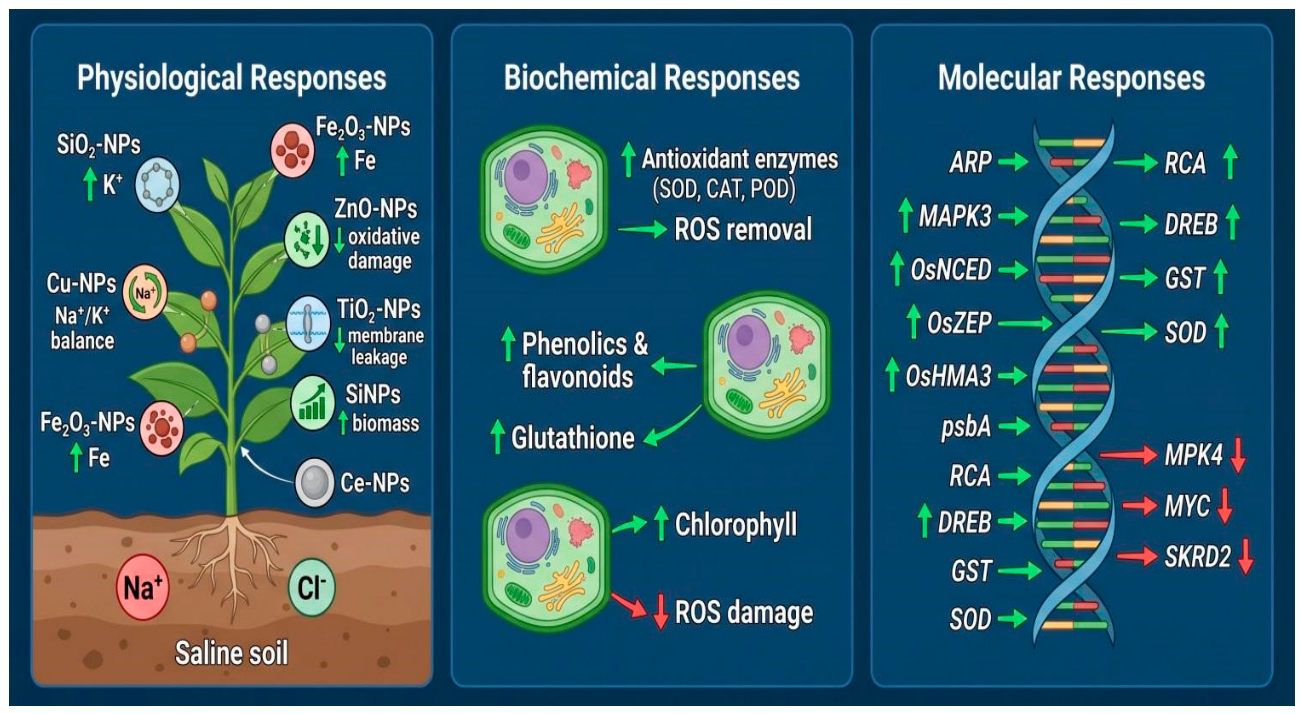
Figure 3.
This schematic diagram illustrates salinity stress induced by toxic Na⁺, Cl⁻ ions, and ROS damages plant membranes, proteins, and DNA, resulting in decreased growth and productivity. In contrast, nanoparticles are absorbed through roots and improve biomass, restore Na⁺/K⁺ balance, and lessen oxidative stress. By boosting phenolics, flavonoids, and glutathione for better ROS detoxification and cellular protection, as well as by activating SOD, CAT, and POD, they enhance antioxidant defence. They also restore chlorophyll content and photosynthetic efficiency. Nanoparticles are excellent regulators of physiological, biochemical, and genetic stress responses under salinity stress, as evidenced by the molecular upregulation of stress-responsive genes (DREB, GST, SOD, MAPK3) and downregulation of stress-related genes (MPK4, MYC).
Figure 3.
This schematic diagram illustrates salinity stress induced by toxic Na⁺, Cl⁻ ions, and ROS damages plant membranes, proteins, and DNA, resulting in decreased growth and productivity. In contrast, nanoparticles are absorbed through roots and improve biomass, restore Na⁺/K⁺ balance, and lessen oxidative stress. By boosting phenolics, flavonoids, and glutathione for better ROS detoxification and cellular protection, as well as by activating SOD, CAT, and POD, they enhance antioxidant defence. They also restore chlorophyll content and photosynthetic efficiency. Nanoparticles are excellent regulators of physiological, biochemical, and genetic stress responses under salinity stress, as evidenced by the molecular upregulation of stress-responsive genes (DREB, GST, SOD, MAPK3) and downregulation of stress-related genes (MPK4, MYC).
Conclusion
A major issue for worldwide agriculture is salinity stress, which affects a lot of arable land and lowers crop output. Due to their labor-intensive and time-consuming nature, traditional methods like cultivating salt-tolerant crops and applying agronomic techniques have had little effectiveness. With its special qualities and wide range of uses, nanotechnology shows potential as a way to increase plant resistance to salinity stress. Nanoparticles such as ZnO-NPs, TiO2-NPs, and Fe-NPs have the ability to enhance photosynthetic efficiency, protect photosynthetic apparatus, and initiate antioxidant activities to prevent damage from reactive oxygen species. Additionally, they promote production and development in saline environments, enhance nutrient uptake, and control genes associated with stress. Also, they improve nutrient absorption, regulate stress-related genes, and stimulate growth and yield in saline conditions. Moreover, nanotechnology in agriculture provides a sustainable and affordable solution to salinity stress Additionally, it indicates potential for broader use in enhancing crop productivity and ensuring food security. Future study should concentrate on enhancing nanoparticle compositions, examining their long-term environmental effects, and diversifying their application in order to maximise the benefits for global agriculture.
References
- Aazami, M.A.; Rasouli, F.; Panahi, T.R. Influence of salinity stress on morphological, nutritional and physiological attributes in different cultivars of Prunus amygdalus L. J. Plant Nutr. 2021, 1–15. [Google Scholar] [CrossRef]
- Abdoli, S.; Ghassemi-Golezani, K.; Alizadeh-Salteh, S. Responses of ajowan (Trachyspermum ammi L.) to exogenous salicylic acid and iron oxide nanoparticles under salt stress. Environ. Sci. Pollut. Res. 2020, 27, 36939–36953. [Google Scholar] [CrossRef] [PubMed]
- Abideen, Z.; Hanif, M.; Munir, N.; Nielsen, B. L. Impact of nanomaterials on the regulation of gene expression and metabolomics of plants under salt stress. Plants 2022, 11(5), 691. [Google Scholar] [CrossRef] [PubMed]
- Ahmad, P.; Ahanger, M.A.; Alam, P.; Alyemeni, M.N.; Wijaya, L.; Ali, S.; Ashraf, M. Silicon (Si) supplementation alleviates NaCl toxicity in mung bean (Vigna radiata L. Wilczek) through the modifications of physio-biochemical attributes and key antioxidant enzymes. J. Plant. Growth. Regu. 2019, 38, 70–82. [Google Scholar] [CrossRef]
- Ahmed, N.; Khalid, S.; Grewal, A.G.; Ali, M.A.; Anjum, M.A.; Rahi, A.A. Performance of mango scion cultivars under various levels of artificially induced salinity stress. Pak. J. Bot. 2020, 52, 1143–58. [Google Scholar] [CrossRef] [PubMed]
- Ahmed, M.; Tóth, Z.; Rizk, R.; Abdul-Hamid, D.; Decsi, K. Investigation of antioxidative enzymes and transcriptomic analysis in response to foliar application of zinc oxide nanoparticles and salinity stress in Solanum lycopersicum. Agronomy 2025, 15(7), 1715. [Google Scholar] [CrossRef]
- Ait-El-Mokhtar, M.; Baslam, M.; Ben-Laouane, R.; Anli, M.; Boutasknit, A.; Mitsui, T. Alleviation of detrimental effects of salt stress on date palm (Phoenix dactylifera L.) by the application of arbuscular mycorrhizal fungi and/or compost. Front Sustain Food Syst. 2020, 4, 131. [Google Scholar] [CrossRef]
- Alabdallah, N. M.; Alzahrani, H. S. The potential mitigation effect of ZnO nanoparticles on Abelmoschus esculentus L. Moench metabolism under salt stress conditions. Saudi J. Biol. Sci. 2020, 27, 3132–31. [Google Scholar] [CrossRef] [PubMed]
- Alabdallah, N. M.; Alzahrani, H. S. The potential mitigation effect of ZnO nanoparticles on Abelmoschus esculentus L. Moench metabolism under salt stress conditions. Saudi J. Biol. Sci. 2020, 27(11), 3132–3137. [Google Scholar] [CrossRef] [PubMed]
- Alabdallah, N.M.; Alzahrani, H.S. The potential mitigation effect of ZnO nanoparticles on Abelmoschus esculentus L. Moench metabolism under salt stress conditions. Saudi J. Biol. Sci. 2020, 27, 3132–3137. [Google Scholar] [CrossRef] [PubMed]
- Alabdallah, N.M.; Hasan, M.M. Plant-based green synthesis of silver nanoparticles and its effective role in abiotic stress tolerance in crop plants. Saudi J. Biol. Sci. 2021, 28, 5631–5639. [Google Scholar] [CrossRef] [PubMed]
- Ali, B.; Saleem, M.H.; Ali, S.; Shahid, M.; Sagir, M.; Tahir, M.B.; Qureshi, K.A.; Jaremko, M.; Selim, S.; Hussain, A.; Rizwan, M.; Ishaq, W.; Rehman, M.Z. Mitigation of salinity stress in barley genotypes with variable salt tolerance by application of zinc oxide nanoparticles. Front. Plant Sci. 2022, 13, 2850. [Google Scholar] [CrossRef] [PubMed]
- Ali, F.; Bano, A.; Hassan, T.U.; Nazir, M.; Khan, R.T. Plant growth promoting rhizobacteria induced modulation of physiological responses in rice under salt and drought stresses. Pak. J. Bot. 2023, 55, 447–52. [Google Scholar] [CrossRef] [PubMed]
- Ali, Y.; Aslam, Z.; Ashraf, M. Y.; Tahir, G. R. Effect of salinity on chlorophyll concentration, leaf area, yield and yield components of rice genotypes grown under saline environment. Int. J. Environ. Sci. Technol. 2013, 13(1), 221–225. [Google Scholar]
- Almutairi, Z.M. Influence of silver nanoparticles on the salt resistance of tomato (Solanum lycopersicum L.) during germination. Int. J. Agric. Biol. 2016, 18(2), 449–457. [Google Scholar] [CrossRef]
- Alrabie, H.; Alsamadany, H.; Almoshadak, A.S.; Alshamrani, R.; El-Zohri, M. Green biogenic sulfur nanoparticles enhance Capsicum annuum (L.) resilience to salt stress by triggering physio-biochemical and genetic repair mechanisms. Front. Plant Sci. 2025, 16, 1564621. [Google Scholar] [CrossRef] [PubMed]
- Altammar, K. A. A review on nanoparticles: Characteristics, synthesis, applications, and challenges. Front. Microbiol. 2023, 14, 1155622. [Google Scholar] [CrossRef] [PubMed]
- Anonymous. Nanoparticles alleviate salinity stress and promote the growth of an agroforestry tree Eucalyptus tereticornis Sm. Environ. Sci. Nano 2021, 8, 1308–1325. [Google Scholar] [CrossRef]
- Arif, Y.; Singh, P.; Siddiqui, H.; Bajguz, A.; Hayat, S. Salinity induced physiological and biochemical changes in plants: an omic approach towards salt stress tolerance. Plant. Physiol. Biochem. 2020, 156, 64–77. [Google Scholar] [CrossRef] [PubMed]
- Ateeq, M.; Ashraf, M.A.; Dong, Q.; Hu, Y.-G. Zinc oxide nano-priming fortifies Triticum aestivum L. against salt stress through physio-morphological, biochemical and transcriptomic responses. Plant Soil 2026, 521, 1–28. [Google Scholar] [CrossRef]
- Balusamy, S.R.; Rahimi, S.; Sukweenadhi, J.; Sunderraj, S.; Shanmugam, R.; Thangavelu, L.; et al. Chitosan, chitosan nanoparticles and modified chitosan biomaterials, a potential tool to combat salinity stress in plants. Carbohydr. Polym. 2022, 284, 119189. [Google Scholar] [CrossRef] [PubMed]
- Baz, H.; Creech, M.; Chen, J.; Gong, H.; Bradford, K.; Huo, H. Water-soluble carbon nanoparticles improve seed germination and post-germination growth of lettuce under salinity stress. Agronomy 2020, 10, 1192. [Google Scholar] [CrossRef]
- Bekele, E.T.; Gonfa, B.A.; Sabir, F.K. Use of different natural products to control growth of titanium oxide nanoparticles in green solvent emulsion, characterization, and their photocatalytic application. Bioinorg. Chem. Appl. 2021, 2021, 6626313. [Google Scholar] [CrossRef] [PubMed]
- Bulychev, N. Synthesis of gaseous hydrogen and nanoparticles of silicon and silicon oxide by pyrolysis of tetraethoxysilane in an electric discharge under the action of ultrasound. Int. J. Hydrogen Energy 2022, 47, 35581–35587. [Google Scholar] [CrossRef]
- Burklew, C. E.; Ashlock, J.; Winfrey, W. B.; Zhang, B. Effects of aluminum oxide nanoparticles on the growth, development, and microRNA expression of tobacco (Nicotiana tabacum). PLoS ONE 2012, 7(5), e34783. [Google Scholar] [CrossRef] [PubMed]
- Chen, C.; Haifang, W. Biomedical applications and toxicology of carbon nanomaterials; Wiley: Hoboken, NJ, USA, 2016. [Google Scholar]
- Chen, J.; Guo, Y.; Zhang, X.; Liu, J.; Gong, P.; Su, Z.; et al. Emerging nanoparticles in food: sources, application, and safety. J. Agric. Food Chem. 2023, 71, 3564–3582. [Google Scholar] [CrossRef] [PubMed]
- Cheung, H.-Y.; Yip, S.; Han, N.; Dong, G.; Fang, M.; Yang, Z.-X.; Wang, F.; Lin, H.; Wong, C.-Y.; Ho, J.C. Modulating electrical properties of InAs nanowires via molecular monolayers. ACS Nano 2015, 9, 7545–7552. [Google Scholar] [CrossRef] [PubMed]
- Choudhary, N.; Hwang, S.; Choi, W. Carbon nanomaterials: A review. In Handbook of Nanomaterials Properties; Springer: Berlin/Heidelberg, Germany, 2014; pp. 709–769. [Google Scholar]
- Chung, S.-H.; Kim, H.; Jeong, S.W. Carbon nanomaterials. Carbon 2018, 140, 24–29. [Google Scholar] [CrossRef]
- Devan, R.S.; Patil, R.A.; Lin, J.H.; Ma, Y.R. One-dimensional metal-oxide nanostructures: Recent developments in synthesis, characterization, and applications. Adv. Funct. Mater. 2012, 22, 3326–3370. [Google Scholar] [CrossRef]
- Díaz-Parra, D. G.; García-Casillas, L. A.; Velasco-Ramírez, S. F.; Guevara-Martínez, S. J.; Zamudio-Ojeda, A.; Zuñiga-Mayo, V. M.; Rodríguez-Guzmán, E.; Melchor-González, A.; Lomelí-Rosales, D. A.; Velázquez-Juárez, G. Role of metal-based nanoparticles in Capsicum spp. plants. ACS Omega 2025, 10(11), 12456–12472. [Google Scholar] [CrossRef] [PubMed]
- Dimkpa, C.; Mclean, J. E.; Martineu, N.; Anderson, A.; et al. Silver nanoparticles disrupt wheat (Triticum aestivum L.) growth in a sand matrix. Environ. Sci. Technol. 2012, 47(2), 1082–1090. [Google Scholar] [CrossRef] [PubMed]
- Dimkpa, C.; Mclean, J. E.; Martineu, N.; Britt, D. W.; Haverkamp, R.; Anderson, A. Silver nanoparticles disrupt wheat (Triticum aestivum L.) growth in a sand matrix. Environ. Sci. Technol. 2012, 47(2). [Google Scholar] [CrossRef] [PubMed]
- El-Araby, H. G.; El-Hefnawy, S. F. M.; Nassar, M. A.; Elsheery, N. I. Comparative studies between growth regulators and nanoparticles on growth and mitotic index of pea plants under salinity. Afr. J. Biotechnol. 2020, 19(8), 564–575. [Google Scholar] [CrossRef]
- El-Gazzar, N.; Almaary, K.; Ismail, A.; Polizzi, G. Influence of Funneliformis mosseae enhanced with titanium dioxide nanoparticles (TiO₂NPs) on Phaseolus vulgaris L. under salinity stress. PLoS ONE 2020, 15, e0235355. [Google Scholar] [CrossRef] [PubMed]
- Elsheery, N. I.; Helaly, M. N.; El-Hoseiny, H. M.; Alam-Eldein, S. M. Zinc oxide and silicone nanoparticles to improve the resistance mechanism and annual productivity of salt-stressed mango trees. Agronomy 2020, 10, 558. [Google Scholar] [CrossRef]
- El-Temsahy, S.A.; Almaghrabi, O.A.; Elsayed, H.E. Zinc oxide nanoparticles enhance the growth and the uptake of potassium and calcium in salt-stressed wheat (Triticum aestivum L.) seedlings. J. Plant Interact. 2019, 14(1), 442–452. [Google Scholar]
- Etesami, H.; Maheshwari, D.K. Use of plant growth promoting rhizobacteria (PGPRs) with multiple plant growth promoting traits in stress agriculture: Action mechanisms and future prospects. Ecotoxicol. Environ. Saf. 2018, 156, 225–246. [Google Scholar] [CrossRef] [PubMed]
- Faizan, M.; Bhat, J.A.; Chen, C.; Alyemeni, M.N.; Wijaya, L.; Ahmad, P.; Yu, F. Zinc oxide nanoparticles (ZnO-NPs) induce salt tolerance by improving the antioxidant system and photosynthetic machinery in tomato. Plant Physiol. Biochem. 2021, 161, 122–130. [Google Scholar] [CrossRef] [PubMed]
- Farhangi-Abriz, S.; Torabian, S. Nano-silicon alters antioxidant activities of soybean seedlings under salt toxicity. Protoplasma 2018, 255(3), 953–962. [Google Scholar] [CrossRef] [PubMed]
- Farooq, F.; Rashid, N.; Ibrar, D.; Hasnain, Z.; Ullah, R.; Nawaz, M. Impact of varying levels of soil salinity on emergence, growth and biochemical attributes of four Moringa oleifera landraces. PLoS ONE 2022, 17, e0263978. [Google Scholar] [CrossRef] [PubMed]
- Fathi, A.; Zahedi, M.; Torabian, S.; Khoshgoftar, A. Response of wheat genotypes to foliar spray of ZnO and Fe2O3 nanoparticles under salt stress. J. Plant Nutr. 2017, 40, 1376–1385. [Google Scholar] [CrossRef]
- Fayad, M.A.; Dhahad, H.A. Effects of adding aluminum oxide nanoparticles to butanol-diesel blends on performance, particulate matter, and emission characteristics of diesel engine. Fuel 2021, 286, 119363. [Google Scholar] [CrossRef]
- Filiz, E.; Kurt, F. Expression and co-expression analyses of WRKY, MYB, bHLH and bZIP transcription factor genes in potato (Solanum tuberosum) under abiotic stress conditions: RNA-seq data analysis. Potato Res. 2021, 64, 721–741. [Google Scholar] [CrossRef]
- Forni, C.; Duca, D.; Glick, B.R. Mechanisms of plant response to salt and drought stress and their alteration by rhizobacteria. Plant Soil 2017, 410, 335–356. [Google Scholar] [CrossRef]
- Frazier, T. P.; Burklew, C. E.; Zhang, B. Titanium dioxide nanoparticles affect the growth and microRNA expression of tobacco (Nicotiana tabacum). Funct. Integr. Genom. 2014, 14(1), 75–83. [Google Scholar] [CrossRef] [PubMed]
- Ghasemian, S.; Masoudian, N.; Nematpour, F. Saeid; et al. Selenium NPs stimulate growth, physiology, and gene expression to alleviate salt stress in Melissa officinalis. Biologia 2021, 76, 2879–2888. [Google Scholar] [CrossRef]
- Gill, S.S.; Tuteja, N. Reactive oxygen species and antioxidant machinery in abiotic stress tolerance in crop plants. Plant Physiol. Biochem. 2010, 48, 909–930. [Google Scholar] [CrossRef] [PubMed]
- Gohari, G.; Mohammadi, A.; Akbari, A.; Panahirad, S.; Dadpour, M. R.; Fotopoulos, V.; et al. Titanium dioxide nanoparticles (TiO2 NPs) promote growth and ameliorate salinity stress effects on essential oil profile and biochemical attributes of Dracocephalum moldavica. Sci. Rep. 2020, 10, 912. [Google Scholar] [CrossRef] [PubMed]
- Guidi, L.; Piccolo, E.L.; Landi, M. Chlorophyll fluorescence, photoinhibition and abiotic stress: Does it make any difference the fact to be a C3 or C4 species? Front. Plant Sci. 2019, 10, 174. [Google Scholar] [CrossRef] [PubMed]
- Guo, P.-R.; Wu, L.-L.; Wang, Y.; Liu, D.; Li, J.-A. Effects of drought stress on the morphological structure and flower organ physiological characteristics of Camellia oleifera flower buds. Plants 2023, 12, 2585. [Google Scholar] [CrossRef] [PubMed]
- Gupta, A.; Rayeen, F.; Mishra, R.; Tripathi, M.; Pathak, N. Nanotechnology applications in sustainable agriculture: An emerging eco-friendly approach. Plant Nano Biol. 2023, 4, 100033. [Google Scholar]
- Hafez, Y.; Attia, K.; Alamery, S.; Ghazy, A.; Al-Doss, A.; Ibrahim, E.; et al. Beneficial effects of biochar and chitosan on antioxidative capacity, osmolytes accumulation, and anatomical characters of water-stressed barley plants. Agronomy 2020, 10, 630. [Google Scholar] [CrossRef]
- Hammad, M.; Riaz, A.; Chouhdary, L.; Kabir, M.; De los Rios-Escalante, P.R. Genotypic modulation of nanoparticles-induced tolerance in heavy metals-stressed crops; a literature review. Front. Plant Sci. 2026, 16, 1687399. [Google Scholar] [CrossRef] [PubMed]
- Hasanuzzaman, M.; Parvin, K.; Bardhan, K.; Nahar, K.; Anee, T.I.; Masud, A.A.C. Biostimulants for the regulation of reactive oxygen species metabolism in plants under abiotic stress. Cells 2021, 10, 2537. [Google Scholar] [CrossRef] [PubMed]
- Hasanuzzaman, M.; Bhuyan, M. B.; Anee, T. I.; Parvin, K.; Nahar, K.; Mahmud, J. A.; Fujita, M. Regulation of ascorbate–glutathione pathway in mitigating oxidative damage in plants under abiotic stress. Antioxidants 2019, 8(9), 384. [Google Scholar] [CrossRef] [PubMed]
- Hashem, A.H.; Abdelaziz, A.M.; Askar, A.A.; Fouda, H.M.; Khalil, A.M.; Abd-Elsalam, K.A. Bacillus megaterium-mediated synthesis of selenium nanoparticles and their antifungal activity against Rhizoctonia solani in faba bean plants. J. Fungi 2021, 7, 195. [Google Scholar] [CrossRef] [PubMed]
- Hassan, F. A. S.; Ali, E.; Gaber, A.; Fetouh, M. I.; Mazrou, R. Chitosan nanoparticles effectively combat salinity stress by enhancing antioxidant activity and alkaloid biosynthesis in Catharanthus roseus (L.) G. Don. Plant Physiol. Biochem. 2021, 162, 291–300. [Google Scholar] [CrossRef] [PubMed]
- Heidari, A.; Toorchi, M.; Bandehagh, A.; Shakiba, M. Effect of NaCl stress on growth, water relations, organic and inorganic osmolytes accumulation in sunflower (Helianthus annuus L.) lines. Univ. J. Environ. Res. Technol. 2011, 1, 351–362. [Google Scholar]
- Hezaveh, T. A.; Pourakbar, L.; Rahmani, F.; Alipour, H. Interactive effects of salinity and ZnO nanoparticles on physiological and molecular parameters of rapeseed (Brassica napus L.). Commun. Soil Sci. Plant Anal. 2019, 50, 698–715. [Google Scholar] [CrossRef]
- Hnilickova, H.; Kraus, K.; Vachova, P.; Hnilicka, F. Salinity stress affects photosynthesis, malondialdehyde formation, and proline content in Portulaca oleracea L. Plants 2021, 10, 845. [Google Scholar] [CrossRef] [PubMed]
- Hosseinpour, A.; Haliloglu, K.; Cinisli, T.; Ozkan, G.; Ozturk, H.I.; Pour-Aboughadareh, A.; Poczai, P. Application of zinc oxide nanoparticles and plant growth promoting bacteria reduces genetic impairment under salt stress in tomato (Solanum lycopersicum L. ‘Linda’). Agriculture 2020, 10, 521. [Google Scholar] [CrossRef]
- Hossen, M.S.; Karim, M.F.; Fujita, M.; Bhuyan, M.H.M.B.; Nahar, K.; Masud, A.A.C. Comparative physiology of Indica and Japonica rice under salinity and drought stress: an intrinsic study on osmotic adjustment, oxidative stress, antioxidant defense and methylglyoxal detoxification. Stresses 2022, 2, 156–78. [Google Scholar] [CrossRef]
- Hu, J.; Hu, X.; Duan, H.; Zhang, H.; Yu, Q. Na+ and K+ homeostasis is important for salinity and drought tolerance of Calligonum mongolicum. Pak. J. Bot. 2021, 53, 1927–34. [Google Scholar] [CrossRef] [PubMed]
- Huang, S.; Gill, S.; Ramzan, M.; Ahmad, M.Z.; Danish, S.; Huang, P. Uncovering the impact of AM fungi on wheat nutrient uptake, ion homeostasis, oxidative stress, and antioxidant defense under salinity stress. Sci. Rep. 2023, 13, 8249. [Google Scholar] [CrossRef] [PubMed]
- Hussain, A.; Ali, S.; Rizwan, M.; Zia-ur-Rehman, M.; Javed, M.R.; Imran, M.; et al. Zinc oxide nanoparticles alter the wheat physiological response and reduce the cadmium uptake by plants. Environ. Pollut. 2018, 242, 1518–1526. [Google Scholar] [CrossRef] [PubMed]
- Hussein, M.; Abou-Baker, N. The contribution of nano-zinc to alleviate salinity stress on cotton plants. R. Soc. Open Sci. 2018, 5, 171809. [Google Scholar] [CrossRef] [PubMed]
- Imran, I.; Ortas, I. Nano biotechnology: Exploring the potential of nano materials in enhancing crop health and combating abiotic stress. Commun. Soil Sci. Plant Anal. 2024, 55(16), 1–20. [Google Scholar] [CrossRef]
- Iqbal, M. N.; Rasheed, R.; Ashraf, M. Y.; Ashraf, M. A.; Hussain, I. Exogenously applied zinc and copper mitigate salinity effect in maize (Zea mays L.) by improving key physiological and biochemical attributes. Environ. Sci. Pollut. Res. 2018, 25, 23883–23896. [Google Scholar] [CrossRef] [PubMed]
- Islam, F.; Shohag, S.; Uddin, M. J.; Islam, M. R.; Nafady, M. H.; Akter, A.; et al. Exploring the journey of zinc oxide nanoparticles (ZnO-NPs) toward biomedical applications. Materials 2022, 15, 2160. [Google Scholar] [CrossRef] [PubMed]
- Ismail, L.M.; Soliman, M.I.; Abd El-Aziz, M.H.; Abdel-Aziz, H.M.M. Impact of silica ions and nano silica on growth and productivity of pea plants under salinity stress. Plants 2022, 11, 494. [Google Scholar] [CrossRef] [PubMed]
- Jaleh, B.; Nasrollahzadeh, M.; Eslamipanah, M.; Nasri, A.; Shabanlou, E.; Manwar, N.R.; Zboril, R.; Fornasiero, P.; Gawande, M.B. Recent advances in carbon nanomaterials. Carbon 2022, 198, 301–352. [Google Scholar]
- Jamei, R.; Onsori, O.; Jamei, M. Nanoparticles and salinity stress: Emerging insights into plant responses and stress mitigation. Plant Stress 2026, 20, 101265. [Google Scholar] [CrossRef]
- Johnson, R.; Puthur, J. T. Seed priming as a cost-effective technique for developing plants with cross tolerance to salinity stress. Plant Physiol. Biochem. 2021, 162, 247–257. [Google Scholar] [CrossRef] [PubMed]
- Joudeh, N.; Linke, D. Nanoparticle classification, physicochemical properties, characterization, and applications: A comprehensive review for biologists. J. Nanobiotechnol. 2022, 20, 262. [Google Scholar] [CrossRef] [PubMed]
- Kaleem, M.; Shah, A.A.; Usman, S.; Xu, W.; Alfarhan, A.H. Foliar application of calcium phosphate nanoparticles improves photosynthetic efficiency, nutrient uptake, and antioxidant capacity in Coriandrum sativum L. under salinity stress. ACS Omega 2025, 10(40), 46393–46409. [Google Scholar] [CrossRef] [PubMed]
- Karimi, S.; Tavallali, V.; Ferguson, L.; Mirzaei, S. Developing a nano-Fe complex to supply iron and improve salinity tolerance of pistachio under calcium bicarbonate stress. Commun. Soil Sci. Plant Anal. 2020, 51(2), 1–17. [Google Scholar] [CrossRef]
- Kaya, C.; Akram, N.A.; Ashraf, M.; Sonmez, O. Exogenous application of humic acid mitigates salinity stress in maize (Zea mays L.) plants by improving some key physico-biochemical attributes. Cereal Res. Commun. 2018, 46, 67–78. [Google Scholar] [CrossRef]
- Khalid, M. F.; Khan, R. Iqbal; Jawaid, M. Z.; Shafqat, W.; Hussain, S.; Ahmed, T.; et al. Nanoparticles: the plant saviour under abiotic stresses. Nanomaterials 2022, 12, 3915. [Google Scholar] [CrossRef] [PubMed]
- Khan, A.; Shafi, M.; Bakht, J.; Anwar, S.; Khan, M.O. Effect of salinity (NaCl) and seed priming (CaCl2) on biochemical parameters and biological yield of wheat. Pak. J. Bot. 2021, 53, 779–89. [Google Scholar] [CrossRef] [PubMed]
- Khan, I.; Saeed, K.; Khan, I. Nanoparticles: properties, applications and toxicities. Arab. J. Chem. 2019, 12, 908–931. [Google Scholar] [CrossRef]
- Khan, I.; Raza, M. A.; Awan, S. A.; Shah, G. A.; Rizwan, M.; Ali, B.; et al. Amelioration of salt induced toxicity in pearl millet by seed priming with silver nanoparticles (AgNPs): The oxidative damage, antioxidant enzymes and ions uptake are major determinants of salt tolerant capacity. Plant Physiol. Biochem. 2020, 156, 221–232. [Google Scholar] [CrossRef] [PubMed]
- Khan, M.N.; Li, Y.; Fu, C.; Hu, J.; Chen, L.; Yan, J.; Khan, Z.; Wu, H.; Li, Z. CeO2 nanoparticles seed priming increases salicylic acid level and ROS scavenging ability to improve rapeseed salt tolerance. Glob. Chall. 2022, 6, 2270071. [Google Scholar] [CrossRef] [PubMed]
- Khan, S.; Hossain, M. K. Classification and properties of nanoparticles. In Nanoparticle-Based Polymer Composites; Elsevier: Amsterdam, The Netherlands, 2022; pp. 15–54. [Google Scholar]
- Kibria, M.G.; Hoque, M.A. A Review on plant responses to soil salinity and amelioration strategies. Open J. Soil Sci. 2019, 9, 219. [Google Scholar]
- Kibria, M.G.; Hossain, M.; Murata, Y.; Hoque, M.A. Antioxidant defense mechanisms of salinity tolerance in rice genotypes. Rice Sci. 2017, 24, 155–162. [Google Scholar] [CrossRef]
- Kolahalam, L.A.; Kasi Viswanath, I.V.; Diwakar, B.S.; Govindh, B.; Reddy, V.; Murthy, Y.L.N. Review on nanomaterials: Synthesis and applications. Mater. Today Proc. 2019, 18, 2182–2190. [Google Scholar] [CrossRef]
- Kopecká, R.; Kameniarová, M.; Černý, M.; Brzobohatý, B.; Novák, J. Abiotic stress in crop production. Int. J. Mol. Sci. 2023, 24(7), 6603. [Google Scholar] [CrossRef] [PubMed]
- Kora, D.; Bhattacharjee, S. The interaction of reactive oxygen species and antioxidants at the metabolic interface in salicylic acid-induced adventitious root formation in mung bean [Vigna radiata (L.) R. Wilczek]. J. Plant Physiol. 2020, 248, 153152. [Google Scholar] [CrossRef] [PubMed]
- Kravchik, M.; Bernstein, N. Effects of salinity on the transcriptome of growing maize leaf cells point at cell-age specificity in the involvement of the antioxidative response in cell growth restriction. BMC Genom. 2013, 14, 24. [Google Scholar] [CrossRef] [PubMed]
- Król, A.; Amarowicz, R.; Weidner, S. Changes in the composition of phenolic compounds and antioxidant properties of grapevine roots and leaves (Vitis vinifera L.) under continuous long-term drought stress. Acta Physiol. Plant. 2014, 36, 1491–1499. [Google Scholar] [CrossRef]
- Kumar, R.; Chaurasiya, D. K.; Singh, S. Advanced technological innovations for mitigating biotic stresses in horticulture: from remote sensing to AI-driven solutions. In Biotic Stress Tolerance in Horticultural Crops; Chandra Rai, A., Rai, V. P., Kumar, A., Santoyo, G., Azevedo, L. C. B., Eds.; Woodhead Publishing, 2025; pp. 231–242. [Google Scholar]
- Kumari, A.; Singh, J.; Yadav, S.K. Harnessing nanobiotechnology for sustainable agriculture: From plant nanobionics to AI-driven precision farming. Biosci. Nanotechnol. 2026, 2, 3. [Google Scholar] [CrossRef]
- Kumari, A.; Rana, V.; Yadav, S.K.; Kumar, V. Nanotechnology as a powerful tool in plant sciences: Recent developments, challenges and perspectives. Plant Nano Biol. 2023, 5, 100046. [Google Scholar] [CrossRef]
- Landa, P.; Vankova, R.; Andrlova, J.; Hodek, J.; Marsik, P.; Storchova, H.; White, J. C.; Vanek, T. Nanoparticle-specific changes in Arabidopsis thaliana gene expression after exposure to ZnO, TiO2, and fullerene soot. J. Hazard. Mater. 2012, 241–242, 55–62. [Google Scholar] [CrossRef] [PubMed]
- Li, Y.; Zhang, X.; Wang, Y.; Chen, J.; Wu, H.; Li, Z. Plants primed with CeO2 nanoparticles increased DNA methylation level to convey transgenerational salinity tolerance. Plant Nano Biol. 2025, 14, 100214. [Google Scholar] [CrossRef]
- Liang, W.; Ma, X.; Wan, P.; Liu, L. Plant salt-tolerance mechanism: a review. Biochem. Biophys. Res. Commun. Biochem. Biophys. Res. Commun. 2018, 495, 286–291. [Google Scholar] [CrossRef] [PubMed]
- Liu, J.; Li, G.; Chen, L.; Gu, J.; Li, Z. Cerium oxide nanoparticles improve cotton salt tolerance by enabling better ability to maintain cytosolic K+/Na+ ratio. J. Nanobiotechnol. 2021, 19, 153. [Google Scholar] [CrossRef] [PubMed]
- Liu, Y.; Cao, X.; Yue, L.; Wang, C.; Tao, M.; Wang, Z.; Xing, B. Foliar-applied cerium oxide nanomaterials improve maize yield under salinity stress: reactive oxygen species homeostasis and rhizobacteria regulation. Environ. Pollut. 2022, 299, 118900. [Google Scholar] [CrossRef] [PubMed]
- Ludwiczak, A.; Osiak, M.; Cárdenas-Pérez, S.; Lubińska-Mielińska, S.; Piernik, A. Osmotic stress or ionic composition: which affects the early growth of crop species more? Agronomy 2021, 11, 435. [Google Scholar] [CrossRef]
- Ma, C.; Chhikara, S.; Xing, B.; Musante, C.; White, J. C.; Dhankher, O. P. Physiological and molecular response of Arabidopsis thaliana (L.) to nanoparticle cerium and indium oxide exposure. Green Sustain. Chem. 2013, 1(1), 768–778. [Google Scholar] [CrossRef]
- Mahmoud, A. W. M.; Abdeldaym, E. A.; Abdelaziz, S. M.; El-Sawy, M. B.; Mottaleb, S. A. Synergetic effects of zinc, boron, silicon, and zeolite nanoparticles on confer tolerance in potato plants subjected to salinity. Agronomy 2020, 10, 19. [Google Scholar] [CrossRef]
- Mahmoud, L. M.; Shalan, A. M.; El-Boray, M. S.; Vincent, C. I.; El-Kady, M. E.; Grosser, J. W.; Dutt, M. Application of silicon nanoparticles enhances oxidative stress tolerance in salt stressed ‘Valencia’ sweet orange plants. Sci. Hortic. 2022, 295, 110856. [Google Scholar] [CrossRef]
- Manzoor, N.; Ali, L.; Ahmed, T.; Noman, M.; Adrees, M.; Shahid, M.S.; et al. Recent advancements and development in nano-enabled agriculture for improving abiotic stress tolerance in plants. Front. Plant Sci. 2022, 13, 951752. [Google Scholar] [CrossRef] [PubMed]
- Mariyam, S.; et al. Review on nitric oxide at the forefront of rapid systemic signaling in mitigation of salinity stress in plants: Crosstalk with calcium and hydrogen peroxide. Plant Sci. 2023, 336, 111835. [Google Scholar] [CrossRef] [PubMed]
- Martínez, F.G.; Paterlini, P.; Rasuk, M.C.; Prado, C.; Viruel, E.; Romero, C.M.; Álvarez, A. Microbial silver nanoparticles enhance the performance of maize plants cultivated in naturally occurring saline soil. Plants 2026, 15(4), 524. [Google Scholar] [CrossRef] [PubMed]
- Maswada, H. F.; Maduraimuthu, D.; Prasad, P. V. Vara. Seed treatment with nano-iron (III) oxide enhances germination, seedling growth and salinity tolerance of sorghum. J. Agron. Crop Sci. 2018, 204(1). [Google Scholar] [CrossRef]
- Mohamed, A.K.S.H.; Qayyum, M.F.; Abdel-Hadi, A.M.; Rehman, R.A.; Ali, S.; Rizwan, M. Interactive effect of salinity and silver nanoparticles on photosynthetic and biochemical parameters of wheat. Arch. Agron. Soil Sci. 2017, 63, 1736–1747. [Google Scholar] [CrossRef]
- Mohammadi, M.H.Z.; Panahirad, S.; Navai, A.; Bahrami, M.K.; Kulak, M.; Gohari, G. Cerium oxide nanoparticles (CeO₂-NPs) improve growth parameters and antioxidant defense system in Moldavian Balm (Dracocephalum moldavica L.) under salinity stress. Plant Stress 2021, 1, 100006. [Google Scholar] [CrossRef]
- Moradbeygi, H.; Jamei, R.; Heidari, R.; Darvishzadeh, R. Investigating the enzymatic and non-enzymatic antioxidant defense by applying iron oxide nanoparticles in Dracocephalum moldavica L. plant under salinity stress. Sci. Hortic. 2020, 272, 109537. [Google Scholar] [CrossRef]
- Moradbeygi, H.; Jamei, R.; Heidari, R.; Darvishzadeh, R. Investigating the enzymatic and non-enzymatic antioxidant defense by applying iron oxide nanoparticles in Dracocephalum moldavica L. plant under salinity stress. Sci. Hortic. 2020, 272, 109537. [Google Scholar] [CrossRef]
- Moradi, P.; Vafaee, Y.; Mozafari, A. A.; Tahir, N. A. R. Silicon nanoparticles and methyl jasmonate improve physiological response and increase expression of stress-related genes in strawberry cv. Paros under salinity stress. Silicon 2022, 14, 10559–10569. [Google Scholar] [CrossRef]
- Nadimi, S.; Farida, S.H. Moazzami. Chitosan nanoparticles enhance salinity tolerance in Lallemantia iberica by modulating physiological and biochemical responses. Plant Nano Biol. 2026, 15, 100245. [Google Scholar] [CrossRef]
- Najafi, S.; Razavi, S. M.; Khoshkam, M.; Asadi, A. Effects of green synthesis of sulfur nanoparticles from Cinnamomum zeylanicum barks on physiological and biochemical factors of lettuce (Lactuca sativa). Physiol. Mol. Biol. Plants 2020, 26, 1055–1066. [Google Scholar] [CrossRef] [PubMed]
- Namakka, M.; Rahman, M. R.; Bin Said, K. A. M.; Mannan, M. Abdul; Patwary, A. M. A review of nanoparticle synthesis methods, classifications, applications, and characterization. Environ. Nanotechnol. Monit. Manag. 2023, 100900. [Google Scholar]
- Narsing Rao, M.P.; Dong, Z.Y.; Xiao, M.; Li, W.J. Effect of salt stress on plants and role of microbes in promoting plant growth under salt stress. Microorg. Saline Environ. Strateg. Funct. 2019, 423–435. [Google Scholar] [CrossRef]
- Nascimento, M.A.; et al. Synthesis of polymetallic nanoparticles from spent lithium-ion batteries and application in the removal of reactive blue 4 dye. J. Clean. Prod. 2018, 202, 264–272. [Google Scholar] [CrossRef]
- Nasrallah, A.K.; Kheder, A.A.; Kord, M.A.; Fouad, A.S.; El-Mogy, M.M.; Atia, M.A.M. Mitigation of salinity stress effects on broad bean productivity using calcium phosphate nanoparticles application. Horticulturae 2022, 8, 75. [Google Scholar] [CrossRef]
- Naz, T.; Akhtar, J.; Mazhar, M.I.; Anwar-Ul-Haq, M.; Murtaza, G.; Khan, N.K. Assessment of gas exchange attributes, chlorophyll contents, ionic composition and antioxidant enzymes of bread wheat genotypes in boron toxic, saline and boron. Res. Murdoch Edu Au 2019, 21, 1271–8. [Google Scholar]
- Naz, T.; Iqbal, M. Mazhar; Tahir, M.; Hassan, M.M.; Rehmani, M.I.A.; Zafar, M.I. Foliar application of potassium mitigates salinity stress conditions in spinach (Spinacia oleracea L.) through reducing NaCl toxicity and enhancing the activity of antioxidant enzymes. Hortic. 2021, 7, 566. [Google Scholar] [CrossRef]
- Noohpisheh, Z.; Amiri, H.; Mohammadi, A.; Farhadi, S. Effect of the foliar application of zinc oxide nanoparticles on some biochemical and physiological parameters of Trigonella foenum-graecum under salinity stress. Plant Biosyst. 2021, 155, 267–280. [Google Scholar] [CrossRef]
- Omara, A.E.-D.; Hafez, E.M.; Osman, H.S.; Rashwan, E.; El-Said, M.A.A.; Alharbi, K. 2022 Collaborative impact of Compost and beneficial rhizobacteria on soil properties, physiological attributes, and productivity of wheat subjected to deficit irrigation in salt affected soil. Plants 11, 877. [CrossRef] [PubMed]
- Paramo, L.A.; Feregrino-Pérez, A.A.; Guevara, R.; Mendoza, S.; Esquivel, K. Nanoparticles in agroindustry: applications, toxicity, challenges, and trends. Nanomaterials 2020, 10, 1654. [Google Scholar] [CrossRef] [PubMed]
- Paul, W.; Sharma, C.P. Inorganic nanoparticles for targeted drug delivery. In Biointegration of Medical Implant Materials; Woodhead Publishing: Cambridge, UK, 2020; pp. 333–373. [Google Scholar]
- Peng, H.; Zhang, J. Plant genomic DNA methylation in response to stresses: potential applications and challenges in plant breeding. Prog. Nat. Sci. 2009, 19, 1037–1045. [Google Scholar] [CrossRef]
- Peng, Y.; Chen, L.; Zhu, L.; Cui, L.; Yang, L.; Wu, H.; Bie, Z. CsAKT1 is a key gene for the CeO₂ nanoparticle’s improved cucumber salt tolerance: a validation from CRISPR-Cas9 lines. Environ. Sci. Nano 2022, 9, 4367–4381. [Google Scholar] [CrossRef]
- Pérez-de-Luque, A. Interaction of nanomaterials with plants: what do we need for real applications in agriculture? Front Environ. Sci. 2017, 5, 12. [Google Scholar] [CrossRef]
- Pérez-Labrada, F.; López-Vargas, E. R.; Ortega-Ortiz, H.; Cadenas-Pliego, G.; Benavides-Mendoza, A.; Juárez-Maldonado, A. Responses of tomato plants under saline stress to foliar application of copper nanoparticles. Plants 2019, 8, 151. [Google Scholar] [CrossRef] [PubMed]
- Periakaruppan, R.; Romanovski, V.; Kumar, S.; Selvaraj, V.; et al. Innovations in modern nanotechnology for the sustainable production of agriculture. ChemEngineering 2023, 7, 61. [Google Scholar] [CrossRef]
- Piacentini, D.; Corpas, F. J.; D’Angeli, S.; Altamura, M. M.; Falasca, G. Cadmium and arsenic-induced stress differentially modulates Arabidopsis root architecture, peroxisome distribution, enzymatic activities and their nitric oxide content. Plant Physiol. Biochem. 2020, 148, 312–323. [Google Scholar] [CrossRef] [PubMed]
- Pinedo-Guerrero, Z.H.; Cadenas-Pliego, G.; Ortega-Ortiz, H.; González-Morales, S.; Benavides-Mendoza, A.; Valdés-Reyna, J.; Juárez-Maldonado, A. Form of silica improves yield, fruit quality and antioxidant defense system of tomato plants under salt stress. Agriculture 2020, 10, 367. [Google Scholar] [CrossRef]
- Qi, H.; Zhang, C. Organic nanoparticles for electrogenerated chemiluminescence assay. Curr. Opin. Electrochem. 2022, 34, 101023. [Google Scholar] [CrossRef]
- Qi, M.; Liu, Y.; Li, T. Nano-TiO₂ improves the photosynthesis of tomato leaves under mild heat stress. Biol. Trace Elem. Res. 2013, 156, 323–328. [Google Scholar] [CrossRef] [PubMed]
- Qi, X.; Chen, M.; Liang, D.; Xu, Q.; Zhou, F.; Chen, X. Jasmonic acid, ethylene and ROS are involved in the response of cucumber (Cucumis sativus L.) to aphid infestation. Sci. Hortic. 2020, 269, 109421. [Google Scholar] [CrossRef]
- Qian, H.; Peng, X.; Han, X.; Ren, J.; Sun, L.; Fu, Z. Comparison of the toxicity of silver nanoparticles and silver ions on the growth of terrestrial plant model Arabidopsis thaliana. J. Environ. Sci. 2013, 25, 1947–1956. [Google Scholar] [CrossRef] [PubMed]
- Rady, M. M.; Desoky, E.-S. M.; Ahmed, S. M.; Majrashi, A.; Ali, E. F.; Arnaout, S. M. A. I.; Selem, E. Foliar nourishment with nano-selenium dioxide promotes physiology, biochemistry, antioxidant defenses, and salt tolerance in Phaseolus vulgaris. Plants 2021, 10(6), 1189. [Google Scholar] [CrossRef] [PubMed]
- Rahimi, H.; Kazemeini, S.A.; Alinia, M.; Hosseini, S.M.H.; Ahmadi, M.J. Silicon nanoparticles ameliorate salt stress in cluster bean by improving antioxidant defense and ion homeostasis. Sci. Rep. 2026, 16, 10057. [Google Scholar] [CrossRef] [PubMed]
- Rajabi Dehnavi, A.; Zahedi, M.; Piernik, A. Understanding salinity stress responses in sorghum: exploring genotype variability and salt tolerance mechanisms. Front. Plant Sci. 2023, 14, 1296286. [Google Scholar] [CrossRef] [PubMed]
- Rajput, V. D.; Harish; Singh, R. K.; Verma, K. K.; Sharma, L.; Quiroz-Figueroa, F. R.; et al. Recent developments in enzymatic antioxidant defence mechanism in plants with special reference to abiotic stress. Biology 2021, 10, 267. [Google Scholar] [CrossRef] [PubMed]
- Rajput, V. D.; Harish; Singh, R. K.; Verma, K. K.; Sharma, L.; Quiroz-Figueroa, F. R.; et al. Recent developments in enzymatic antioxidant defence mechanism in plants with special reference to abiotic stress. Biology 2021, 10, 267. [Google Scholar] [CrossRef] [PubMed]
- Rajput, V. D.; Minkina, T.; Kumari, A.; Harish; Singh, V. K.; Verma, K. K.; et al. Coping with the challenges of abiotic stress in plants: new dimensions in the field application of nanoparticles. Plants 2021, 10, 1221. [Google Scholar] [CrossRef] [PubMed]
- Rajput, V.; Minkina, T.; Mazarji, M.; Shende, S.; Sushkova, S.; Mandzhieva, S.; Burachevskaya, M.; Chaplygin, V.; Singh, A.; Jatav, H. Accumulation of nanoparticles in the soil–plant systems and their effects on human health. Ann. Agric. Sci. 2020, 65, 137–143. [Google Scholar] [CrossRef]
- Rasheed, A.; Li, H.; Tahir, M.M.; Mahmood, A.; Nawaz, M.; Shah, A.N.; et al. The role of nanoparticles in plant biochemical, physiological, and molecular responses under drought stress: A review. Front. Plant Sci. 2022, 13, 976179. [Google Scholar] [CrossRef] [PubMed]
- Rassaei, L.; Marken, F.; Sillanpää, M.; Amiri, M.; Cirtiu, C. M.; Sillanpää, M. Nanoparticles in electrochemical sensors for environmental monitoring. TrAC Trends Anal. Chem. 2011, 30, 1704–1715. [Google Scholar] [CrossRef]
- Rico, C. M.; Peralta-Videa, J.; Gardea-Torresdey, J. Chemistry, biochemistry of nanoparticles, and their role in antioxidant defense system in plants. In Nanotechnology and Plant Sciences: Nanoparticles and Their Impact on Plants; Springer: Switzerland, 2015; pp. 1–17. [Google Scholar]
- Rossi, L.; Zhang, W.; Lombardini, L.; Ma, X. The impact of cerium oxide nanoparticles on the salt stress responses of Brassica napus L. Environ. Pollut. 2016, 219, 28–36. [Google Scholar] [CrossRef] [PubMed]
- Rui, Z.; Huali, X.; Min, S.; Yang, B.; Mina, N.; Yuanyuan, Z.; Haitao, L.; Prusky, D.; Xiaoyan, C. Mechanism of Ca²⁺-mediated NOX modulated in ROS metabolism induced by T-2 toxin in potato tuber. Food Chem. 2020, 317, 126416. [Google Scholar] [CrossRef] [PubMed]
- Sabrekov, A. F.; Semenov, M. V.; Terent’eva, I. E.; Litti, Y. V.; Il’yasov, D. V.; Glagolev, M. V. The link between soil methane oxidation rate and abundance of methanotrophs estimated by quantitative PCR. Microbiology 2020, 89(2), 182–191. [Google Scholar] [CrossRef]
- Shafiq, F.; Iqbal, M.; Ali, M.; Ashraf, M.A. Seed pre-treatment with polyhydroxy fullerene nanoparticles confer salt tolerance in wheat through upregulation of H₂O₂ neutralizing enzymes and phosphorus uptake. J. Soil Sci. Plant Nutr. 2019, 19, 734–742. [Google Scholar] [CrossRef]
- Shah, A.N.; Tanveer, M.; Abbas, A.; Fahad, S.; Song, Y. Targeting salt stress coping mechanisms for stress tolerance in brassica: A research perspective. Plant Physiol. Biochem. 2021, 158, 53–64. [Google Scholar] [CrossRef] [PubMed]
- Shah, T.; Latif, S.; Saeed, F.; Ali, I.; Ullah, S.; Alsahli, A. A.; et al. Seed priming with titanium dioxide nanoparticles enhances seed vigor, leaf water status, and antioxidant enzyme activities in maize (Zea mays L.) under salinity stress. J. King Saud Univ. Sci. 2021, 33, 101207. [Google Scholar]
- Shahbaz, M.; Anwar, T.; Fatima, S.; Onursal, N. Mitigation of salinity stress in sunflower plants (Helianthus annuus L.) through topical application of salicylic acid and silver nanoparticles. Plant Physiol. Biochem. 2025, 31(1), 27–40. [Google Scholar] [CrossRef] [PubMed]
- Shahi, S.; Srivastava, M. Influence of foliar application of manganese on growth, pigment content, and nitrate reductase activity of Vigna radiata (L.) R. Wilczek under salinity. J. Plant Nutr. 2018, 41, 1397–1404. [Google Scholar] [CrossRef]
- Shareef, H.J.; Abdi, G.; Fahad, S. Change in photosynthetic pigments of date palm offshoots under abiotic stress factors. Folia Oecol. 2020, 47, 45–51. [Google Scholar] [CrossRef]
- Sheikhalipour, M.; Esmaielpour, B.; Behnamian, M.; Gohari, G.; Giglou, M.T.; Vachova, P.; Rastogi, A.; Brestic, M.; Skalicky, M. Chitosan-selenium nanoparticle (Cs-Se NP) foliar spray alleviates salt stress in bitter melon. Nanomaterials 2021, 11, 684. [Google Scholar] [CrossRef] [PubMed]
- Shrivastava, P.; Kumar, R. Soil salinity: A serious environmental issue and plant growth promoting bacteria as one of the tools for its alleviation. Saudi J. Biol. Sci. 2015, 22(2), 123–131. [Google Scholar] [CrossRef] [PubMed]
- Siddiqui, H.; Ahmed, K. B. M.; Sami, F.; Hayat, S. Silicon nanoparticles and plants: Current knowledge and future perspectives. In Sustainable Agriculture Reviews 41: Nanotechnology for Plant Growth and Development; Springer: Switzerland, 2020; pp. 129–142. [Google Scholar]
- Singh, A.; Rawat, S.; Rajput, V. D.; Ghazaryan, K.; Minkina, T.; Al Tawaha, A. R. M.; et al. Nanoparticle-Based Priming-Enhanced Agricultural Practices. Nanopriming Approach To Sustain. Agric. 2023, 142–157. [Google Scholar] [CrossRef]
- Singh, D.; Sillu, D.; Kumar, A.; Agnihotri, S. Dual nanozyme characteristics of iron oxide nanoparticles alleviate salinity stress and promote the growth of an agroforestry tree, Eucalyptus tereticornis Sm. Environ. Sci. Nano 2021, 8, 1308–1325. [Google Scholar] [CrossRef]
- Singh, K. M.; Jha, A. B.; Dubey, R. S.; Sharma, P. Nanoparticle-mediated mitigation of salt stress-induced oxidative damage in plants: insights into signaling, gene expression, and antioxidant mechanisms. Environ. Sci. Nano 2025, 12(6). [Google Scholar] [CrossRef]
- Soliman, M. H.; Alnusairi, G. S. H.; Khan, A. A.; Alnusaire, T. S.; Fakhr, M. A.; Abdulmajeed, A. M.; Aldesuquy, H. S.; Yahya, M.; Najeeb, U. Biochar and selenium nanoparticles induce water transporter genes for sustaining carbon assimilation and grain production in salt-stressed wheat. J. Plant Growth Regul. 2023, 42, 1522–1543. [Google Scholar] [CrossRef]
- Soliman, 163; M.H.; Alnusairi, G.S.H.; Khan, A.A.; Alnusaire, T.S.; Fakhr, M.A.; Abdulmajeed, A.M.; Aldesuquy, H.S.; Yahya, M.; Najeeb, U. Biochar and selenium nanoparticles induce water transporter genes for sustaining carbon assimilation and grain production in salt-stressed wheat. J. Plant Growth Regul. 2022. [Google Scholar] [CrossRef]
- Song, G.; Cheng, N.; Zhang, J.; Huang, H.; Yuan, Y.; He, X.; Luo, Y.; Huang, K. Nanoscale cerium oxide: Synthesis, biocatalytic mechanism, and applications. Catalysts 2021, 11, 1123. [Google Scholar] [CrossRef]
- Soni, S.; Jha, A.; Dubey, R. S.; Sharma, P. Nanowonders in agriculture: Unveiling the potential of nanoparticles to boost crop resilience to salinity stress. Sci. Total Environ. 2024, 925, 171433. [Google Scholar] [CrossRef] [PubMed]
- Soraki, R. K.; Gerami, M.; Ramezani, M. Effect of graphene/metal nanocomposites on the key genes involved in rosmarinic acid biosynthesis pathway and its accumulation in Melissa officinalis. BMC Plant Biol. 2021, 21, 260. [Google Scholar] [CrossRef] [PubMed]
- Steffens, B. The role of ethylene and ROS in salinity, heavy metal, and flooding responses in rice. Front. Plant Sci. 2014, 5, 685. [Google Scholar] [CrossRef] [PubMed]
- Suriyaprabha, R.; Karunakaran, G.; Yuvakkumar, R.; Rajendran, V.; Kannan, N.; Rajaram, R. Silicon nanoparticle as an effective growth promoter in rice. Proc. Natl. Acad. Sci. India Sect. B Biol. Sci. 2015, 85(4), 1059–1068. [Google Scholar]
- Syu, Y.; Hung, J.-H.; Chen, J.-C.; Chuang, H. Impacts of size and shape of silver nanoparticles on Arabidopsis plant growth and gene expression. Plant Physiol. Biochem. 2014, 83, 57–64. [Google Scholar] [CrossRef] [PubMed]
- Thabet, S. G.; Alomari, D. Z.; Alqudah, A. M. Exploring natural diversity reveals alleles to enhance antioxidant system in barley under salt stress. Plant Physiol. Biochem. 2021, 166, 789–798. [Google Scholar] [CrossRef] [PubMed]
- Torabian, S.; Farhangi-Abriz, S.; Zahedi, M. Efficacy of FeSO4 nano formulations on osmolytes and antioxidative enzymes of sunflower under salt stress. Indian J. Plant Physiol. 2018, 23, 305–315. [Google Scholar] [CrossRef]
- Torabian, S.; Farhangi-Abriz, S.; Zahedi, M. Efficacy of FeSO4 nano formulations on osmolytes and antioxidative enzymes of sunflower under salt stress. Indian J. Plant Physiol. 2018, 23, 305–315. [Google Scholar] [CrossRef]
- Tripathi, D.K.; Shweta; Singh, S.; Singh, S.; Pandey, R.; Singh, V.P.; Sharma, N.C.; Prasad, S.M.; Dubey, N.K.; Chauhan, D.K. An overview on manufactured nanoparticles in plants: uptake, translocation, accumulation and phytotoxicity. Plant Physiol. Biochem 2017, 110, 2–12. [Google Scholar] [CrossRef] [PubMed]
- Tripathi, D. K.; Vishwakarma, K.; Singh, V. P.; Prakash, V.; Sharma, S.; Muneer, S.; et al. Silicon crosstalk with reactive oxygen species, phytohormones and other signaling molecules. J. Hazard. Mater. 2021, 408, 124820. [Google Scholar] [CrossRef] [PubMed]
- Tripathi, D. K.; Rai, P.; Guerriero, G.; Sharma, S.; Corpas, F. J.; Singh, V. P. Silicon induces adventitious root formation in rice under arsenate stress with involvement of nitric oxide and indole-3-acetic acid. J. Exp. Bot. 2021, 72, 4457–4471. [Google Scholar] [CrossRef] [PubMed]
- Tripathi, D.K.; Singh, S.; Singh, S.; Pandey, R.; Singh, V.P.; Sharma, N.C.; Prasad, S.M.; Dubey, N.K.; Chauhan, D.K. An overview on manufactured nanoparticles in plants: uptake, translocation, accumulation and phytotoxicity. Plant Physiol. Biochem. 2017, 110, 2–12. [Google Scholar] [CrossRef] [PubMed]
- Ullah, R.; Sher, S.; Muhammad, Z.; Jan, S. Afriq; Nafees, M. Modulating response of sunflower (Helianthus annuus) to induced salinity stress through application of engineered urea functionalized hydroxyapatite nanoparticles. Microsc. Res. Tech. 2022, 85, 244–252. [Google Scholar] [CrossRef] [PubMed]
- Van Zelm, E.; Zhang, Y.; Testerink, C. Salt tolerance mechanisms of plants. Annu. Rev. Plant Biol. 2020, 71, 403–433. [Google Scholar] [CrossRef] [PubMed]
- Vardumyan, H.; Singh, A.; Rajput, V.; Minkina, T.; El-Ramady, H.; Ghazaryan, K. Additive-Mediated Phytoextraction of Copper-Contaminated Soils Using Medicago lupulina L. Egypt. J. Soil Sci. 2024, 64(2), 599–618. [Google Scholar] [CrossRef]
- Verma, S. K.; Das, A. K.; Gantait, S.; Kumar, V.; Gurel, E. Applications of carbon nanomaterials in the plant system: A perspective view on the pros and cons. Sci. Total Environ. 2019, 667, 485–499. [Google Scholar] [CrossRef] [PubMed]
- Vila-Traver, J.; Aguilera, E.; Infante-Amate, J.; de Molina, M.G. Climate change and industrialization as the main drivers of Spanish agriculture water stress. Sci. Total Environ. 2021, 760, 143399. [Google Scholar] [CrossRef] [PubMed]
- Wahid, I.; Rani, P.; Kumari, S.; Ahmad, R.; Hussain, S. J.; Alamri, S.; et al. Biosynthesized gold nanoparticles maintained nitrogen metabolism, nitric oxide synthesis, ions balance, and stabilizes the defense systems to improve salt stress tolerance in wheat. Chemosphere 2022, 287, 132142. [Google Scholar] [CrossRef] [PubMed]
- Wahid, I.; Rani, P.; Kumari, S.; Ahmad, R.; Hussain, S.J.; Alamri, S.; Tripathy, N.; Khan, M.I.R. Biosynthesized gold nanoparticles-maintained nitrogen metabolism, nitric oxide synthesis, ions balance, and stabilizes the defense systems to improve salt stress tolerance in wheat. Chemosphere 2022, 287, 132142. [Google Scholar] [CrossRef] [PubMed]
- Wang, J.; Huang, R. Modulation of ethylene and ascorbic acid on reactive oxygen species scavenging in plant salt response. Front. Plant Sci. 2019, 10, 319. [Google Scholar] [CrossRef] [PubMed]
- Wang, Y.; Shao, Y.; Zhang, S.; Zhang, C.; Yin, L.; Guan, R. The combined effects of copper oxide nanoparticles and salt stress on the growth and physiology of soybean. Chemosphere 2019, 237, 124362. [Google Scholar]
- Wang, Z.; Li, H.; Li, X.; Xin, C.; Si, J.; Li, S.; Li, Y.; Zheng, X.; Li, H.; Wei, X.; Zhang, Z.; Kong, L.; Wang, F. Nano-ZnO priming induces salt tolerance by promoting photosynthetic carbon assimilation in wheat. Arch. Agron. Soil Sci. 2020, 66, 1259–1273. [Google Scholar] [CrossRef]
- Yasmin, H.; Mazher, J.; Azmat, A.; Nosheen, A.; Naz, R.; Hassan, M. N.; Noureldeen, A.; Ahmad, P. Combined application of zinc oxide nanoparticles and biofertilizer to induce salt resistance in safflower by regulating ion homeostasis and antioxidant defence responses. Ecotoxicol. Environ. Saf. 2021, 218, 112262. [Google Scholar] [CrossRef] [PubMed]
- Ye, Y.; Cota-Ruiz, K.; Hernandez-Viezcas, J. A.; Valdes, C.; Medina-Velo, I. A.; Turley, R. S.; Peralta-Videa, J. R.; Gardea-Torresdey, J. L. Manganese nanoparticles control salinity-modulated molecular responses in Capsicum annuum L. through priming: a sustainable approach for agriculture. ACS Sustain. Chem. Eng. 2020, 8(3), 1427–1436. [Google Scholar] [CrossRef]
- Ye, Y.; Cota-Ruiz, K.; HernáNdez-Viezcas, J. A.; Valdes, C.; Medina-Velo, I. A.; Turley, R. S.; et al. Manganese nanoparticles control salinity-modulated molecular responses in Capsicum annuum L. through priming: A sustainable approach for agriculture. ACS Sustain. Chem. Eng. 2020, 8, 1427–1436. [Google Scholar] [CrossRef]
- Yue, L.; Ma, C.; Zhan, X.; White, J. C.; Xing, B. Molecular mechanisms of maize seedling response to La₂O₃ nanoparticle exposure: water uptake, aquaporin gene expression and signal transduction. Environ. Sci. Nano 2017, 4, 843–855. [Google Scholar] [CrossRef]
- Zafar-ul-Hye, M.; Yaseen, R.; Abid, M.; Abbas, M.; Ahmad, M.; Rahi, A.A. Rhizobacteria having ACC-deaminase and biogas slurry can mitigate salinity adverse effects in wheat. Pak. J. Bot. 2022, 54, 297–303. [Google Scholar] [CrossRef] [PubMed]
- Zahra, Z.; Habib, Z.; Chung, S.; Badshah, M. A. Exposure route of TiO₂ NPs from industrial applications to wastewater treatment and their impacts on the agro-environment. Nanomaterials 2020, 10, 1469. [Google Scholar] [CrossRef] [PubMed]
- Zain, M.; Mao, H.; Rahman, S.; Nuruzzaman, M.; Chaudhary, S.; Azeem, I.; Mehmood, F.; Duan, A.; Sun, C. Nanotechnology in precision agriculture: Advancing towards sustainable crop production. SSRN Electron. J. 2023, 11 pages. [Google Scholar] [CrossRef]
- Zhao, X.; Wang, Y.; Chen, Y.; Huang, J.; Li, X. Effects of silicon nanoparticles on plant growth and expression of molybdenum transport genes in rice. J. Nanosci. Nanotechnol. 2017, 17(4), 2649–2655. [Google Scholar]
- Zulfiqar, F.; Ashraf, M. Nanoparticles potentially mediate salt stress tolerance in plants. Plant Physiol. Biochem. 2021, 160, 257–268. [Google Scholar] [CrossRef] [PubMed]
Figure 1.
Nanotechnology-Mediated Salt Stress Alleviation in Plants.
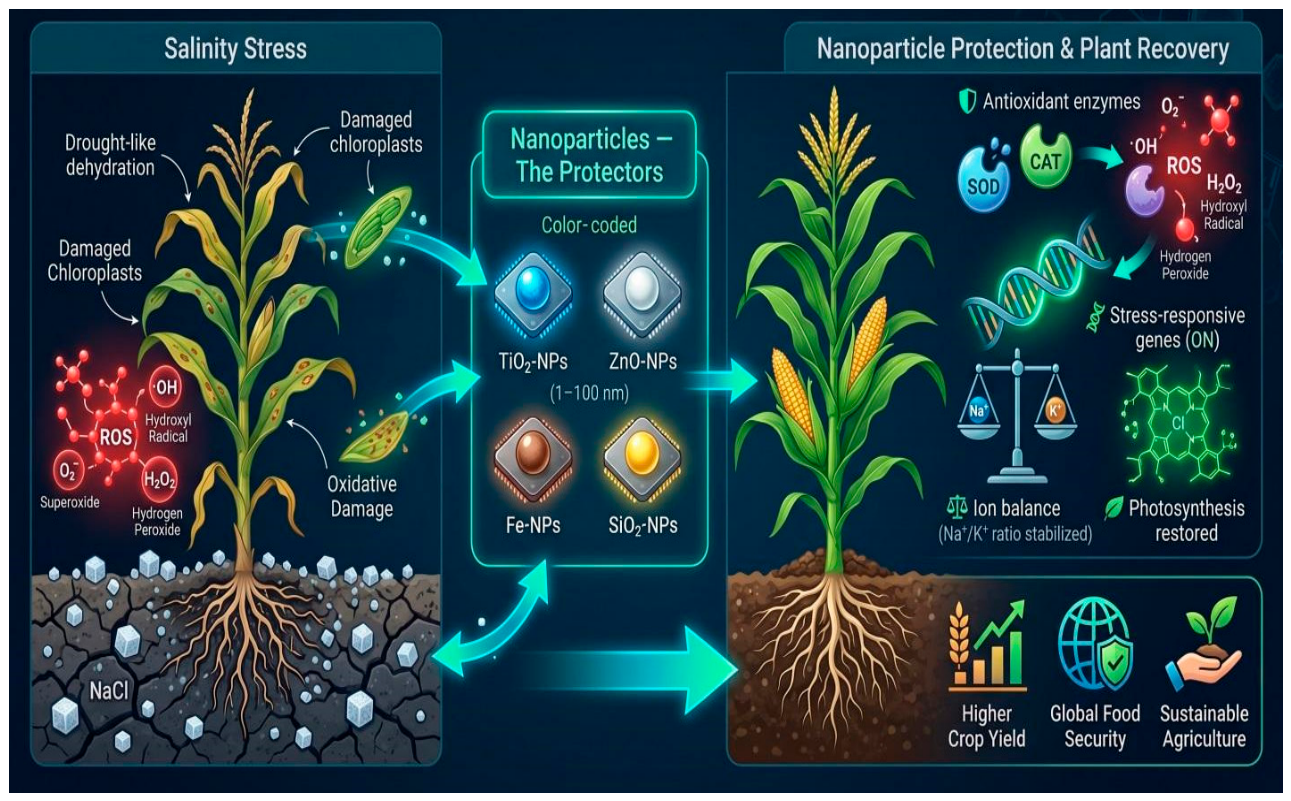
Figure 2.
Chemical classification of nanoparticles used in agriculture.
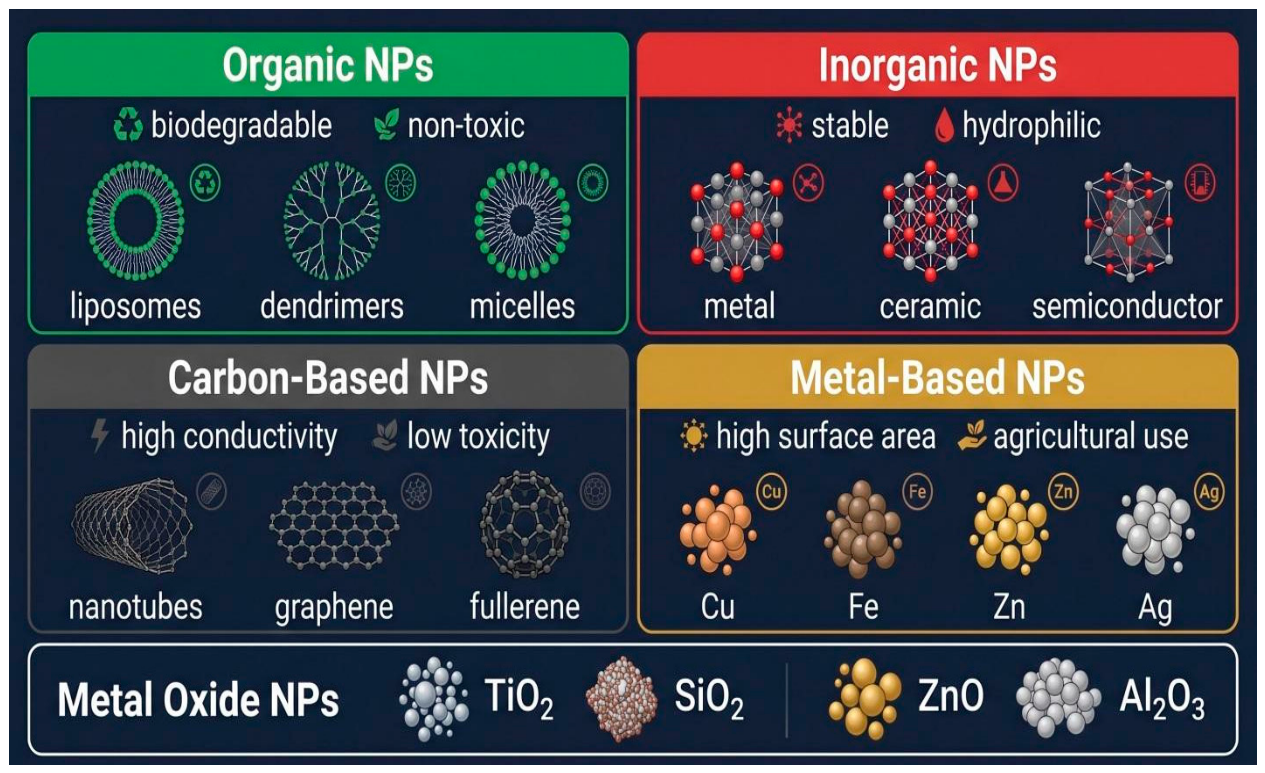

Table 1.
Physiological and biochemical response of NPs under salt stress.
| Nanomaterial (NMs) | Plant Species | Salt Stress (mM / dS m-1) | Mode of Treatment | Physiological & Biochemical Effects | Reference |
| TiO2 NPs | (Maize) Zea mays |
200 mM | Priming | ↑ FW, DW, RWC, antioxidants; ↓ MDA, proline, | Shah et al., 2021 |
|
(Dragonhead) Dracocephalum moldavica |
0–100 mM | Nutrient medium |
Na+ ↑ antioxidant enzymes, improved growth traits |
Gohari et al., 2020 | |
| Zn NPs | (Tomato) Solanum lycopersicum |
50–100 Mm |
Foliar Foliar |
↑ germination, SOD, CAT, chlorophyll; ↓ ROS ↑ | Ahmed et al., 2025 |
| (Fenugreek) Trigonella foenum-graecum |
0–150 mM |
Foliar |
proline, protein, antioxidants; ↓ H2O2, MDA ↑ |
Elsheery et al., 2020 |
|
| (Mango) Mangifera indica |
50–300 mg/L | Foliar | sugars, proline, antioxidant enzymes | Hassan et al., 2020 | |
| ZnO NPs | (Safflower) Carthamus tinctorius |
250 mM |
Foliar |
Improved germination, salt stress tolerance ↑ | Yasmin et al., 2021 Alabdallah & |
| (Okra) Abelmoschus esculentus |
0–100% SW |
Foliar |
SOD, CAT, chlorophyll; ↓ sugars, proline ↑ |
Alzahrani, 2020 |
|
| (Wheat) Triticum aestivum |
200 mM | Priming | electron transport, sucrose synthesis | Wang et al., 2020 | |
| Si NPs | (Orange) Citrus sinensis |
0–120 mM | Foliar | Improved oxidative stress tolerance | Mahmoud et al., 2022 |
| SiO2 NPs | (Banana) Musa acuminata |
200–600 mg/L | Foliar | ↑ K+/Na+ ratio, ↑ chlorophyll, growth | Mahmoud et al., 2020 |
| Se NPs | (Pea) Pisum sativum |
60–120 mM | Priming + foliar | Improved seedling performance | El-Araby et al., 2020 |
| SeO2 NPs | (Bean) Phaseolus vulgaris |
7.55–7.61 dS m-1 | Foliar | ↑ growth, yield improvement | Rady et al., 2021 |
| Fe2O3 NPs | (Cereal grain) Sorghum bicolor |
150 mM | Priming + soaking | ↑ PSII efficiency, photosynthesis ↓ | Maswada et al., 2018 |
|
(Pistachio) Pistacia vera |
0–200 mM |
Nutrient solution |
chlorophyll degradation, membrane damage |
Karimi et al., 2020 |
|
|
(Ajwain) Trachyspermum ammi |
4–12 dS m-1 |
Foliar | ↑K+/Na+ ratio, antioxidants |
Abdoli et al., 2020 |
|
| Ag NPs |
Helianthus annuus (Sunflower) |
100 mM | Foliar | ↓ ROS, ↑ chlorophyll, antioxidants | Shahbaz et al., 2025 |
| Chitosan | Lallemantia iberica | 30–60 mM | Foliar | ↑ PAL, TAL, phenolics; ↓ MDA, H2O2 | Nadimi and Farida, 2026 |
| CaP NPs |
Coriandrum sativum (Coriander) |
100–150 mM | Foliar | ↑ K+ uptake, ionic balance stability | Kaleem et al., 2025 |
Table 2.
Comparative Overview of Nanomaterials, Modes of Application, and Their Physiological and Molecular Effects in Plants under Salt Stress.
Table 2.
Comparative Overview of Nanomaterials, Modes of Application, and Their Physiological and Molecular Effects in Plants under Salt Stress.
| Nanomaterials (NMs) | Species / Group of Organisms | Mode of Treatment | Salt Stress Concentration | Physiological Effects | Gene Expression / Pathway Regulation [+/−] | References |
| Se NPs | Triticum aestivum (Wheat) | Foliar spray + soil amendment (SB) | 3000 ppm NaCl | ↑ Na⁺ stress tolerance, ↓ oxidative damage, ↓ photosynthesis, ↓ biomass and yield loss | Na⁺ transport [−], ionic homeostasis [+], carbon assimilation [+] | Soliman et al., 2023 |
|
Phaseolus vulgaris (Kidney bean) |
Foliar spray | ECe 7.55–7.61 dS m⁻¹ | Improved Na⁺ compartmentalization | ZmNHX1 [+] | Rady et al., 2021 | |
| ZnO NPs | Abelmoschus esculentus (Okra) | Foliar spray | 0, 10, 25, 50, 75, and 100% SW | ↑ antioxidant enzymes, improved salt tolerance | SOD [+], CAT [+] | Alabdallah and Alzahrani, 2020 |
| Solanum lycopersicum (Tomato) | Foliar application | 0.15 M | ↑ growth, ↑ ROS scavenging, improved stress tolerance | GR [+], POD [+], GST [+], SOD [+], CAT [+] | Ahmed et al., 2025 | |
| Brassica napus (Rapeseed) | Foliar spray | 0, 50, and 100 mM | ↓ ion leakage, ↑ photosynthesis | ARP [+], MPK [+]; SKRD2 [−], MYC [−], MPK4 [−] | Hezaveh et al., 2019 | |
| Triticum aestivum (Wheat) | Seed priming | 150 mM NaCl | ↓ Na+ uptake (shoot −24%, root −21%), ↑ K⁺ uptake, ↑ photosynthesis (Gs, Pn, Ci, Fv/Fm), ↓ ROS and electrolyte leakage, ↑ glutathione, improved growth and biomass | ZIP genes [+]; SOS, NHX, HKT, RN pathways [+]; AsA–GSH pathway [+]; photosynthesis genes (Psb27, Psb28, Lhca5, Lhca6) [+] | Ateeq et al., 2026 | |
| ZnO NPs + PGPR |
Solanum lycopersicum (Tomato) |
Soil application + microbial inoculation | 20–40 mg L-1 | Improved stress tolerance | ↓ DNA methylation, ↑ polymorphism | Hosseinpour et al., 2020 |
| CeO₂ NPs (PNC) |
Gossypium hirsutum (Cotton) |
Foliar spray | 200 mM NaCl | ↓ Na⁺ accumulation, improved ionic balance | HKT1 [+], KOR [−] | Liu et al., 2021 |
| Cs–Se NPs | Momordica charantia (Bitter melon) | Foliar spray | 0, 50, and 100 mM | ↑ K⁺, ↓ Na+ | Ionic homeostasis [+] | Sheikhalipour et al., 2021 |
| Ag NPs |
Solanum lycopersicum (Tomato) |
Seed priming | 150 and 100 mM | Improved Na⁺ exclusion | SOS2 [+] | Almutairi, 2016 |
| Nano-Si | Glycine max (Soybean) | Foliar spray | 0, 5, and 10 dS m⁻¹ NaCl | ↑ K⁺/Na⁺ ratio, improved stress tolerance | Ion transport regulation [+] | Farhangi-Abriz and Torabian, 2018 |
| PNC (nanoceria) | Arabidopsis thaliana | Priming (leaf infiltration of parental plants) + transgenerational exposure | 0.45 mM | ↑ growth, ↓ ROS, ↑ POD activity, improved salt tolerance | DNA methylation; RHD2 [+], PER64 [+], Prx37 [+], RHS19 [+], MAPKKK15 [+], NIG1 [−] | Li et al., 2025 |
| Cucumber (Cucumis sativus) | Foliar spray | 100 mM | ↑ K+ uptake, improved tolerance | CsAKT1 [+] | Peng et al., 2022 | |
| Rapeseed (Brassica napus) | Seed priming | 200 mM NaCl | ↑ stress tolerance | SA pathway [+] | Khan et al., 2022 | |
| SNPs | Sweet pepper (Capsicum annuum) | Nano-priming under NaCl stress | 50 and 100 mM | ↑ growth, ↓ ROS, improved membrane stability | CaHAK6 [+], CaHAK7 [+], CaDHN3 [+], CaCAT1 [+], CaPOD [+] | Alrabie et al., 2025 |
| Silicon nanoparticles (Si NPs / NSi) | Cluster bean (Cyamopsis tetragonoloba) | Foliar application | 0, 6, and 12 dS m-1 | 50–200 mg L-1(optimum: 50 mg L-1); ↑ antioxidant enzymes, ↓ MDA and H 2O2, ↓ Na⁺, ↑ K+ (ion homeostasis), ↑ seed weight (2.8×), ↑ unsaturated fatty acids (C18:1, C18:2), improved seed oil quality | Antioxidant defense pathways [+], ion homeostasis regulation [+], lipid metabolism pathways [+] | Rahimi et al., 2026 |
Disclaimer/Publisher’s Note: The statements, opinions and data contained in all publications are solely those of the individual author(s) and contributor(s) and not of MDPI and/or the editor(s). MDPI and/or the editor(s) disclaim responsibility for any injury to people or property resulting from any ideas, methods, instructions or products referred to in the content. |
© 2026 by the authors. Licensee MDPI, Basel, Switzerland. This article is an open access article distributed under the terms and conditions of the Creative Commons Attribution (CC BY) license.
Copyright: This open access article is published under a Creative Commons CC BY 4.0 license, which permit the free download, distribution, and reuse, provided that the author and preprint are cited in any reuse.