

Submitted:
28 August 2026
Posted:
31 August 2026
You are already at the latest version
Abstract
Neuroexposome research investigates associations between physical, chemical, biological, and psychosocial factors and neurological health. It offers great potential to be meaningfully translated into reductions in the incidence of neurodegenerative diseases such as Alzheimer’s Disease, Parkinson’s Disease, and Amyotrophic Lateral Sclerosis. Current translational efforts focus on reducing exposure to identified risk factors through policy or behavior change. Here, we offer a more comprehensive framework for environmental and brain health communities to translate neuroexposomics into public health improvements, based on two premises: 1) Exposome risks are linked to multiple neurodegenerative diseases, therefore prevention efforts arising from neuroexposome research should adopt a multi-disease approach with composite endpoints; and 2) Neuroexposome research translation should consider all possible interventions, not limiting itself to decreased exposure of the risk factors only. A strategy to develop interventions to reduce the incidence of multiple neurodegenerative diseases by blocking harms identified through neuroexposome research is feasible and needed. After describing key challenges hindering the translational pipeline for these mitigations, we advocate for increased research capacity and funding to support large-scale confirmatory studies.
Keywords:
neurodegeneration
; prevention
; neuroexposomics
; exposomics
; environment
; policy
; trial design
1. Introduction
The neuroexposome is sum of all physical, chemical, biological, and psychosocial influences that affect brain health throughout a person's life. Research into the neuroexposome has already identified many risk factors contributing to poor brain health, and many more are expected to be identified through future analyses of big data and artificial intelligence. But how do we turn this knowledge into meaningful health improvements for people?
A comprehensive translation pipeline for neuroexposome research should encompass all possible interventions arising from this science. The most common application for neuroexposome research is to reduce exposure to an identified risk factor, either through policy (e.g. banning leaded gasoline) or through behavioral strategies (e.g. government guidance to reduce consumption of high mercury seafood). Unfortunately, regulation is an imperfect health intervention; regulatory processes can take decades to ban production of a hazardous chemical, and some exposures, such as forest fires or certain metals, occur naturally. For example, even though lead has been highly regulated for decades, lead remains the eighth leading cause of global mortality and in 2023, was associated with 3.5 million excess deaths [1]. Approximately 7.3 billion people are exposed to unsafe levels of air pollution with fine particulate matter sized 2.5 μm or less (PM2.5) each year [2], and in 2023, PM2.5 exposure lead to 4.9 million excess deaths across a wide variety of organ systems, including 514,000 dementia deaths [3].
Medical mitigation strategies complement the limited effectiveness of policy and behavior change, offering underexplored potential. For instance, if an exposure cannot be eliminated, it is possible that a medication could simply block absorption, accelerate excretion or even interfere with the pathologic processes caused by that exposure. Further, whereas policy interventions usually affect an entire population independent of their health status, a medical intervention can be more easily targeted to people who are at risk of exposure and would benefit the most, for example, nutritional supplements to reduce lead absorbed through smoking [4].
This medical mitigation approach is currently underdeveloped, suggesting a limited focus by the scientific community on clinical application. For example, PubMed lists 445 papers published in 2025 with the MESH terms for Alzheimer’s Disease (AD), Amyotrophic Lateral Sclerosis (ALS) or Parkinson’s Disease (PD) that included the terms ‘exposome’ or ‘neuroexposome’ or the MESH term ‘Environment‘. Thirteen of those papers were assigned the publication type ‘randomized controlled trial’, and none of them mitigated environmental exposures (See the supplementary file for the list of papers). Hereafter, we discuss the next steps to proceed to confirmatory trials of medical interventions that improve brain health.
2. Multidisease Prevention
Many neurodegenerative diseases, such as AD, PD, ALS, and Frontal Temporal Dementia (FTD), offer an important opportunity for neuroexposomics translation, as these diseases share many of the same causal pathways even though the initial pathology affects different neuronal cell types. They also sometimes share overlapping exposome risks (e.g. neurotoxic pesticides in ALS and PD [5]) and even genetic factors (e.g. C9orf72 repeat expansion in ALS and FTD [6,7]). Moreover, at autopsy, pathology characteristics of different diseases are often identified in the same brain, for example in athletes with stage 4 Chronic Traumatic Encephalopathy arising from repeated head injury with pathology associated with AD (91% with amyloid-β), ALS (83% with TDP-43), and PD (40% with α-synuclein) [8]. Similar effects have been observed in centenarians [9]. The implication of shared pathways means a single intervention that mitigates the harms of an exposure could reduce risk of developing all the multiple neurodegenerative diseases associated with that exposure at the same time.
3. Approaches to Develop Medical Mitigation for Neuroexposome Risks
Neurodegenerative diseases may take decades to reach diagnostic thresholds, and prevention efforts often focus on early treatment for prodromal conditions (i.e., mild cognitive impairment, mild motor impairment). Neurodegeneration also has a silent phase prior to the emergence of prodromal conditions. For example, in AD, significant increases in beta-amyloid [10], tau protein level [11], and neurofilament light chain (NfL) [12] are detectable two decades before symptoms are apparent. By the time people who are eventually diagnosed with PD report motor symptoms, approximately 30% of substantia nigra neurons have been lost [13]. Neuroexposome research can identify the exposures and pathologic processes to target with medical interventions even before the clinically silent phase (Figure 1).
After the identification of a risk factor associated with neurodegeneration using neuroexposome research, the assessment of a medical intervention on that specific risk factor to prevent neurodegeneration can begin. Two illustrative examples of such medical exposure mitigation are clinical trials that demonstrated reductions in blood neurofilament chain light in contact sports athletes taking omega-3 supplements [14], and reductions in blood lead levels through supplements such as vitamin C [4,15,16]. These studies were too small to justify a clinical practice standard, yet suggested that these supplements could mitigate harms caused by subconcussive repeated head injury or lead exposure, respectively. Both examples demonstrate how our current research systems have been unable to conclusively study the role of supplements in mitigating immediate effects of neuorexposome risks, as well as the possibility that these risks can be studied and medically mitigated with the right resources.
The ‘exposure mitigation’ box presents the opportunity provided by neuroexposome research to medically intervene for people who are exposed to an environmental risk but are not diagnosed with a particular illness. In this case, the risks could be environmental exposures, and the interventions could be medications blocking absorption or aiding excretion of the exposure, or blocking the specific neurodegenerative processes triggered by that exposure. Exposure mitigation complements policy interventions to reduce exposure to an environmental risk, such as a ban on lead paint, that usually affect the entire population, from the healthy to those already suffering from illness associated with that exposure.
The next step, to determine if medically mitigating a risk to lower markers of injury (such as neurofilamement levels) or exposure (such as blood lead levels) results in reduced incidence of neurodegenerative disease, will either require long term cohort studies or the means to track diagnostic status of study participants through administrative health records.The assessment of a medical intervention to prevent that neurodegeneration with a specific risk factor will likely require two main stages of follow-up studies:
3.1. Stage 1: Measure the Effect of Medically Blocking Neuroexposome Risks on Biomarkers of Neurodegeneration
Determination of a causal relationship of the exposure on a disease-predicting biomarker is an important milestone in further clinical investigations and requires several specific steps. First, to support the causal relationship of the exposure with neurodegeneration, a dose-dependent effect of the exposure on both a biomarker (e.g. increase in plasma NfL) and actual neurodegeneration in preclinical studies should be identified. Second, interference with the exposure and biomarker (or actual neurodegeneration) through an intervention, such as a medication or supplement, should be demonstrated. Finally, that the intervention reduces biomarkers of neurodegeneration (such as omega-3 supplements reducing neurofilament levels in contact sports athletes [14]) should be investigated through randomized controlled clinical trials of humans with naturally high exposure to the exposome risk.
By focusing on biomarkers associated with neurodegeneration in clinical trials, and not on the later diagnosis per se, it is feasible to study the mitigation of an exposure that may occur years before one of several types of neurodegenerative disease could manifest. This could be a single biomarker measurement that predicts overall neurodegeneration, eg. NfL, and not a specific disease. Or, this could be a panel of biomarker measurements that together may predict future conversion (a composite biomarker). Biomarkers are in development for which a single marker may predict different neurological indications, such as ALS [17] and FTD [18] in the case of NfL. Composites of biomarkers are also in development such as marker panels identified by Chia et al. [18] and Xan et al. [19], which may predict ALS onset ~5 years prior from blood samples. These efforts are not limited to ALS, with recent similar reports in AD [20] and PD [21] also. Building on these foundations, the future development of a composite biomarker for overall neurodegeneration for future prevention trials may be well underway. Naturally, such a composite biomarker will ideally be validated and qualified for this context of use [22,23].
We recognize, however, that biomarkers alone are insufficient to definitively prove a reduction in incidence of neurodegenerative diseases, and the value of their use will depend on how reasonably likely they are to predict a future clinical benefit.
3.2. Stage 2: Measure the Effect of Medically Blocking Exposome Risks on Incidence of Multiple Forms of Neurodegenerative Disease Using a Composite Endpoint Approach
Often, it will be cost prohibitive to run a clinical trial long enough to track both environmental exposure and diagnosis of a neurodegenerative disease. The proposed prevention trials should capture a relationship between the medical intervention and change in a composite biomarker of neurodegeneration that is related to multiple neurodegenerative diseases with long clinically silent periods, such as PD, AD and ALS, among people actively exposed to a neuroexposome risk.
As described in Figure 2, to supplement the biomarker endpoints, the incidence of any of multiple neurodegenerative diseases could be studied as a long-term follow-up composite endpoint also [24] after the clinical trial ends. Here, we envision a measurement of incidence across multiple neurodegenerative diseases during a post trial surveillance phase. Eventual diagnosis of these diseases is a salient event and relatively easy to extract from centralized health records many years after the clinical trial has concluded. Such long-term tracking is supported by enriching trial participants to those enrolled in a long-term cohort study, or in a health system with lifetime enrollment and good administrative data such as the US Department of Veterans Affairs or some European countries.
4. Organizational Challenges and Recommendations
There are challenges in expanding the neuroexposome research pipeline to include medical interventions, and only some are technical. To improve the likelihood of actually preventing neurodegenerative diseases that arise in part through exposome risks exposures, we list several recommendations.
4.1. Expanding the Research Community
First, the neuroexposome research community often does not (yet) include many drug development experts and clinical trialists, who are invaluable in advancing risk mitigation through medical intervention. Additionally, when clinical studies show promise in mitigating environmental harms to the brain, this work is not often linked to the longer-term neurodegenerative disease prevention. For example, perhaps because of the long lag time between exposure and neurodegenerative disease onset, the promising work on mitigating repeated head injury (RHI) is confined to the sports medicine and nutrition literature [14]. The range of interventions translated from neuroexposome research needs to expand, and that will require including a broader group of scientists and the infrastructure to support them (e.g. preclinical research resources, clinical networks).
4.2. A Fragmented Neurology Infrastructure Makes Some Diseases Appear too Rare to Invest in Prevention
Each disease has its own organizations, funding, meetings, journals and prevention strategies, but when causative factors are shared across diseases and exposures occur before pathology begins, disease silos become impediments. Using neuroexposome research to intervene in a large population to prevent individual neurodegenerative diseases is difficult to justify due to the relatively low incidence of each rare neurodegenerative disease. However, a composite endpoint, measuring the incidence of multiple neurodegenerative diseases, will allow for broader studies and in a smaller population.
For example, RHI is associated with a 2.3 fold increase in PD among American football players [25]. The baseline incidence of PD is so low, that a medication that reduces the effects of RHI on PD by 50% would still require intervening with over 8,000 athletes to prevent one case of PD (Table 1). However, intervening on RHI means intervening prior to diagnosis (the Exposure Mitigation box of Figure 1), thereby potentially mitigating disease risk for multiple neurodegenerative diseases simultaneously. Combining prevention efforts across diseases is especially important opportunity for the rare disease community: for every case of ALS prevented among the 83,000 football players in the Table 1 example, 5 cases of Parkinson’s disease and 97 cases of Alzheimer’s disease would also be prevented. Exposure mitigation combined across PD, ALS, and AD, requires only intervening with 400 athletes to prevent one case of any of those three devastating diseases (Table 1), demonstrating how a multi-disease strategy makes neuroexposome research more impactful and cost effective as a prevention approach.
Interestingly, a composite endpoint approach becomes even more powerful when mitigating exposures that impact diseases across organ systems. For example, PM2.5 triggers systemic pathologies that attack multiple organ systems simultaneously. For every 10 μg/m3 of long term PM2.5 exposure, cardiovascular mortality increases by 1.1, respiratory disease mortality increases by 1.3[31] and incidence of Alzheimer’s disease increases by 1.5 [32] . (The United States currently sets PM2.5 standards at 9.0 μg/m3 [33].)
4.3. Individual Experience can Mask Population Benefits
Another implication of Figure 1 and Table 1 is that even if an intervention is effective for healthy research participants, it will be nearly impossible to identify which specific individuals avoided or delayed disease. Understanding individual experience is especially confusing when multiple exposures, behaviors and genes can contribute to the incidence of disease. This challenge is common to many prevention efforts, and cardiac science offers a strong precedent. Statins led to reductions in mortality and can be incredibly powerful on a population basis even if specific individuals who avoided a serious cardiac event cannot be identified with certainty. The cardiac community needed to develop a strong evidence base with large-scale trials to justify the broad adoption necessary to observe population-wide benefits, and offers an important lesson for the neurodegenerative disease community. Further, as the number needed to treat to prevent neurodegeneration will be relatively high, an intervention would need to be exceptionally safe and inexpensive to justify broad adoption.
Such considerations make the input of people with lived experience especially important when developing interventions and trials. Preventing multiple diseases at their earliest stages means listening to people with risky environmental exposures, in addition to people with known risks for neurodegenerative disease (e.g. people with genetic risk) or experience living with these conditions.
4.4. The Futility of Funding Asymptotic Studies
Inexpensive medical interventions on exposures may be possible, as several promising medical interventions are supplements (e.g. Omega-3 to address RHI [14], Vitamin C or Calcium to reduce lead absorption [34], or antioxidants like vitamin E to mitigate PM2.5 [35]). However, there are few private sector incentives to fund the large-scale trials of supplements that are required to demonstrate effects on neurodegeneration incidence. In addition, government organizations, such as the US National Institutes of Health, rarely fund Phase 3 trials. That puts this line of research into an asymptotic state, with small studies moving ever closer to an answer, but never scaled to meet the standard of evidence a regulatory or advisory body needs to issue a broad clinical recommendation.
5. Concluding Thoughts
These recommendations for environmental and brain health communities to lower the incidence of neurodegenerative disease will require an expansion of neuroexposome research in two ways: 1) reducing exposome risks not only through policy and behavior, but also through medical interventions to mitigate harms; and 2) reducing the harm of exposome risks to lower the incidence of multiple neurodegenerative diseases simultaneously. These efforts will require some capacity building, including funding to develop or attract clinical trial experts, and to develop trial capacity, preclinical labs, etc. necessary to identify medical intervention candidates and conduct large-scale clinical trials.
Most importantly, it falls to funders to ensure sufficient scale and research power to answer a question with public health impact. Whereas typical investigator-initiated grants are sufficient to answer a research question such as “Can Vitamin C reduce blood lead levels?” (for example, Dawson et al. [4] show it is possible), it takes a level of scale and intention beyond the means of a typical academic team to fund a confirmatory trial that will change the policies and practice standards, and answer questions such as: “Should people at risk for lead exposure take Vitamin C supplements?”. In other words, even if the initial evidence for mitigating effects of a supplement bears out, there are often no strong private sector incentives to support confirmatory clinical trials, leaving this line of research in an asymptotic state.
Neuroexposome research presents a funding opportunity that falls uniquely on governmental and philanthropic funders. It might be challenging under current budgets for them adopt an interventionist mindset and focus on public health impact. However, the strategy recommended here has two countervailing strengths: 1) that the ultimate application for neuroexposome research could be treatments that are inexpensive even for people in developing economies, leading to the potential for rapid and global impact, and 2) that with a composite endpoints approach, multiple environmental and neurodegenerative disease communities have strong reasons to combine their political and financial resources to support confirmatory trials.
A more recently popularized research field supporting broad prevention of multiple diseases, even across multiple organ systems, is the longevity space. Although there are many commercial applications and endeavors within 'longevity', the objective to increase and protect a healthy lifespan overlaps with the intentions to prevent neurodegenerative disease. This space may also be a scientific and financial partner in the pursuit of neuroexposome-informed disease prevention and public health in the future.
Supplementary Materials
The following supporting information can be downloaded at the website of this paper posted on Preprints.org: July 2026 lit search.xls
Author Contributions
Conceptualization, NMT. Writing – original draft, NMT and KAS; Writing – review & editing KAS and NMT.
Funding
This research received no external funding
Institutional Review Board Statement
Not applicable.
Informed Consent Statement
Not applicable.
Data Availability Statement
Not applicable.
Acknowledgments
None
Conflicts of Interest
Neil M. Thakur served as Chief Mission Officer for the ALS Association from 2020 to 2024, and is a consultant to BioJiva, LLC. Kim A. Staats works with multiple organizations in ALS and neurodegeneration as an independent consultant.
Abbreviations
The following abbreviations are used in this manuscript:
| AD | Alzheimer’s Disease |
| ALS | Amyotrophic Lateral Sclerosis |
| EHR | Electronic Health Record |
| FTD | Frontal Temporal Dementia |
| NfL | Neurofilament chain light |
| PD | Parkinson’s Disease |
| PM2.5 | Fine particulate matter sized 2.5 μm or less |
| RHI | Repeated Head Injury |
| TDP-43 | Transactive Response DNA Binding Protein, 43 kilodaltons |
References
- GBD 2023 Lead Collaborators. Lead-Attributable Cardiovascular Disease Burden: Global Burden of Disease Study 2023. JAMA 2026, 335(16), 1418–1427. [CrossRef]
- Rentschler, J.; Leonova, N. Global air pollution exposure and poverty. Nat. Commun. 2023, 14, 4432. [Google Scholar] [CrossRef]
- Health Effects Institute. State of Global Air 2025. Health Effects Institute. Available online: https://www.stateofglobalair.org/sites/default/files/documents/2025-10/soga-2025-report.pdf.
- Dawson, E.B.; Evans, D.R.; Harris, W.A.; Teter, M.C.; McGanity, W.J. The effect of ascorbic acid supplementation on the blood lead levels of smokers. J. Am. Coll. Nutr. 1999, 18(2), 166–170. [Google Scholar] [CrossRef]
- Sakowski, S.A.; Koubek, E.J.; Chen, K.S.; Goutman, S.A.; Feldman, E.L. Role of the Exposome in Neurodegenerative Disease: Recent Insights and Future Directions. Ann. Neurol. 2024, 95(4), 635–652. [Google Scholar] [CrossRef]
- DeJesus-Hernandez, M.; Mackenzie, I.R.; Boeve, B.F.; et al. Expanded GGGGCC hexanucleotide repeat in noncoding region of C9ORF72 causes chromosome 9p-linked FTD and ALS. Neuron 2011, 72(2), 245–256. [Google Scholar] [CrossRef]
- Renton, A.E.; Majounie, E.; Waite, A.; et al. A hexanucleotide repeat expansion in C9ORF72 is the cause of chromosome 9p21-linked ALS-FTD. Neuron 2011, 72(2), 257–268. [Google Scholar] [CrossRef]
- Mez, J.; Daneshvar, D.H.; Kiernan, P.T.; et al. Clinicopathological Evaluation of Chronic Traumatic Encephalopathy in Players of American Football. JAMA 2017, 318(4), 360. [Google Scholar] [CrossRef]
- Neuville, R.S.; Biswas, R.; Ho, C.C.; et al. Study of neuropathological changes and dementia in 100 centenarians in The 90+ Study. Alzheimers Dement. 2023, 19(8), 3417–3425. [Google Scholar] [CrossRef]
- Gordon, B.A.; Blazey, T.M.; Su, Y.; et al. Spatial patterns of neuroimaging biomarker change in individuals from families with autosomal dominant Alzheimer’s disease: a longitudinal study. Lancet Neurol. 2018, 17(3), 241–250. [Google Scholar] [CrossRef]
- Barthélemy, N.R.; Joseph-Mathurin, N.; Gordon, B.A.; et al. A soluble phosphorylated tau signature links tau, amyloid and the evolution of stages of dominantly inherited Alzheimer’s disease. Nat. Med. 2020, 26(3), 398–407. [Google Scholar] [CrossRef]
- Quiroz, Y.T.; Zetterberg, H.; Reiman, E.M.; et al. Plasma neurofilament light chain in the presenilin 1 E280A autosomal dominant Alzheimer’s disease kindred: a cross-sectional and longitudinal cohort study. Lancet Neurol. 2020, 19(6), 513–521. [Google Scholar] [CrossRef]
- Kouli, A.; Torsney, K.; Kuan, W.L. Parkinson’s Disease: Etiology, Neuropathology, and Pathogenesis. Ch. 1. In Parkinson’s Disease: Pathogenesis and Clinical Aspects; Codon Publications, 2018; Available online: https://www.ncbi.nlm.nih.gov/books/NBK536721/.
- Heileson, J.L.; Macartney, M.J.; Watson, N.L.; et al. Nutritional Optimization for Brain Health in Contact Sports: A Systematic Review and Meta-Analysis on Long-Chain ω-3 Fatty Acids and Neurofilament Light. Curr. Dev. Nutr. 2024, 8(10), 104454. [Google Scholar] [CrossRef]
- Onunkwor, B.; Dosumu, O.; Odukoya, O.O.; Arowolo, T.; Ademuyiwa, O. Biomarkers of lead exposure in petrol station attendants and auto-mechanics in Abeokuta, Nigeria: effect of 2-week ascorbic acid supplementation. Environ. Toxicol. Pharmacol. 2004, 17(3), 169–176. [Google Scholar] [CrossRef]
- Sundari, L.P.R.; Dinata, I.M.K.; Adiputra, L.M.I.S.H.; Tunas, I.K. Oral Administration of 250 Mg Vitamin C Reduces the Blood Level of Lead in Female Street Sweepers of Denpasar City. Biomed. Pharmacol. J. 2017, 10(2), 985–989. [Google Scholar] [CrossRef]
- Benatar, M.; Wuu, J.; Andersen, P.M.; Lombardi, V.; Malaspina, A. Neurofilament light: A candidate biomarker of presymptomatic amyotrophic lateral sclerosis and phenoconversion. Ann. Neurol. 2018, 84(1), 130–139. [Google Scholar] [CrossRef]
- Chia, R.; Moaddel, R.; Kwan, J.Y.; et al. A plasma proteomics-based candidate biomarker panel predictive of amyotrophic lateral sclerosis. Nat. Med. 2025, 31(10), 3440–3450. [Google Scholar] [CrossRef]
- Ran, X.; Wuu, J.; Qin, Z.S.; et al. Longitudinal plasma proteomics predict phenoconversion to clinically manifest ALS. Nat. Med. 2026. [Google Scholar] [CrossRef]
- Liu, M.; Gong, K.; Chen, Y.; et al. A plasma-based protein signature combining NPTXR, ACHE, and p-tau217 predicts progression to symptomatic Alzheimer’s disease. Alzheimers Dement. 2026, 22(8), e71748. [Google Scholar] [CrossRef]
- Hällqvist, J.; Bartl, M.; Dakna, M.; et al. Plasma proteomics identify biomarkers predicting Parkinson’s disease up to 7 years before symptom onset. Nat. Commun. 2024, 15(1), 4759. [Google Scholar] [CrossRef]
- Center for Drug Evaluation and Research. Context of Use. FDA. 21 January 2026. Available online: https://www.fda.gov/drugs/biomarker-qualification-program/context-use (accessed on 21 August 2026).
- Center for Drug Evaluation and Research. Biomarker Qualification Program. FDA. 17 June 2025. Available online: https://www.fda.gov/drugs/drug-development-tool-ddt-qualification-programs/biomarker-qualification-program (accessed on 21 August 2026).
- FDA. Multiple Endpoints in Clinical Trials Guidance for Industry. 2022. Available online: https://www.fda.gov/media/162416/download.
- Bruce, H.J.; Tripodis, Y.; McClean, M.; et al. American Football Play and Parkinson Disease Among Men. JAMA Netw. Open 2023, 6(8), e2328644. [Google Scholar] [CrossRef]
- National Football Foundation. Football by the numbers. 25 July 2023. Available online: https://footballfoundation.org/news/2023/7/25/football-by-the-numbers.aspx (accessed on 25 July 2025).
- Lehman, E.J.; Hein, M.J.; Baron, S.L.; Gersic, C.M. Neurodegenerative causes of death among retired National Football League players. Neurology 2012, 79(19), 1970–1974. [Google Scholar] [CrossRef]
- Xu, L.; Wang, Z.; Li, M.; Li, Q. Global incidence trends and projections of Alzheimer disease and other dementias: an age-period-cohort analysis 2021. J. Glob. Health 2025, 15, 04156. [Google Scholar] [CrossRef]
- Mehta, P.; Raymond, J.; Nair, T.; et al. Incidence of ALS in all 50 states in the United States, data from the National ALS Registry, 2012–2019. Amyotroph. Lateral Scler. Front. Degener. 2025, 26(7-8), 758–766. [Google Scholar] [CrossRef]
- Li, M.; Ye, X.; Huang, Z.; Ye, L.; Chen, C. Global burden of Parkinson’s disease from 1990 to 2021: a population-based study. 1 April 2025. [CrossRef]
- Guo, J.; Chai, G.; Song, X.; et al. Long-term exposure to particulate matter on cardiovascular and respiratory diseases in low- and middle-income countries: A systematic review and meta-analysis. Front Public Health 2023, 11, 1134341. [Google Scholar] [CrossRef]
- Cheng, S.; Jin, Y.; Dou, Y.; et al. Long-term particulate matter 2.5 exposure and dementia: a systematic review and meta-analysis. Public Health 2022, 212, 33–41. [Google Scholar] [CrossRef]
- US EPA O. National Ambient Air Quality Standards (NAAQS) for PM. 13 April 2020. Available online: https://www.epa.gov/pm-pollution/national-ambient-air-quality-standards-naaqs-pm (accessed on 29 July 2026).
- WHO Guideline for the Clinical Management of Exposure to Lead, 1st ed.; World Health Organization, 2021.
- Bo, L.; Jiang, S.; Xie, Y.; Kan, H.; Song, W.; Zhao, J. Effect of Vitamin E and Omega-3 Fatty Acids on Protecting Ambient PM2.5-Induced Inflammatory Response and Oxidative Stress in Vascular Endothelial Cells. PLoS ONE 2016, 11(3), e0152216. [Google Scholar] [CrossRef]
Figure 1.
Policy, behavioral and medical intervention strategies can complement each other when considering different stages of health.
Figure 1.
Policy, behavioral and medical intervention strategies can complement each other when considering different stages of health.
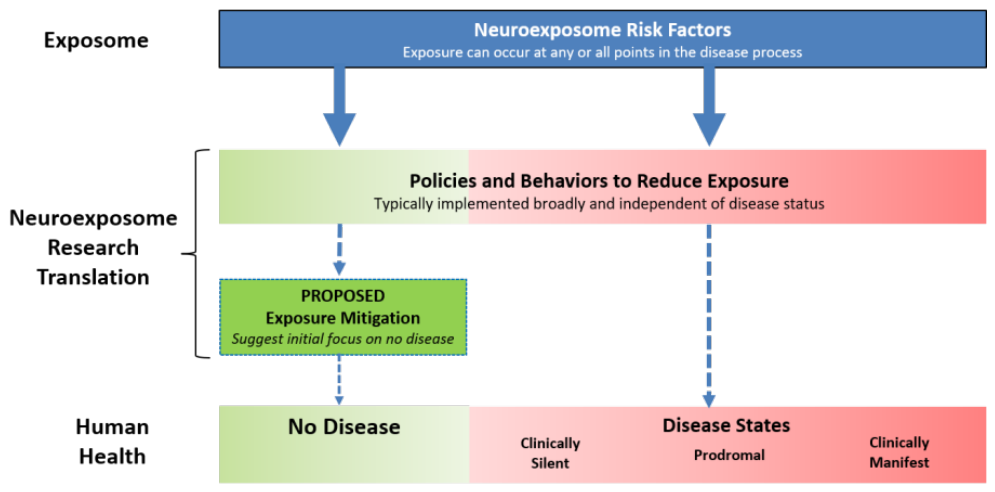
Figure 2.
Method to conduct interventional trials to mitigate exposures that impact disease onset years in the future. Since exposure to an environmental risk for neurodegenerative disease can occur years before that disease manifests, we propose conducting clinical trials where we only measure exposure and mitigation of that exposure through biomarkers of neurodegeneration. An eventual diagnosis of a neurodegenerative disease can be ascertained through surveillance of electronic health records years after the active phase of a clinical trial ends.
Figure 2.
Method to conduct interventional trials to mitigate exposures that impact disease onset years in the future. Since exposure to an environmental risk for neurodegenerative disease can occur years before that disease manifests, we propose conducting clinical trials where we only measure exposure and mitigation of that exposure through biomarkers of neurodegeneration. An eventual diagnosis of a neurodegenerative disease can be ascertained through surveillance of electronic health records years after the active phase of a clinical trial ends.
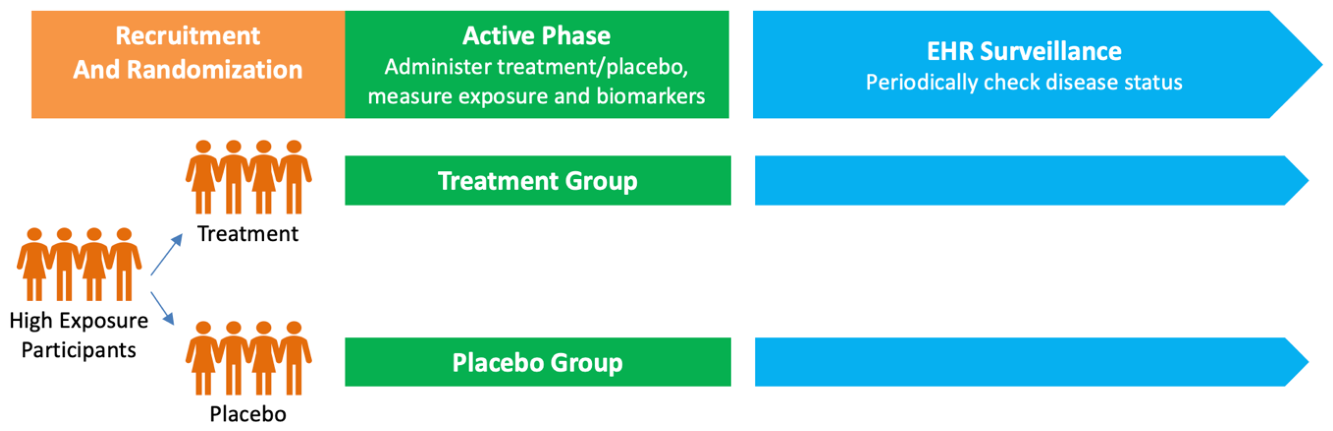

Table 1.
Hypothetical Number Needed to Treat [NNT] to prevent one case of neurodegenerative disease associated with repeated head injury for college and professional American football players [26], if risk could be mitigated by 50%. Occupational exposures associated with repeated head injury have long been associated with increased risk for multiple neurodegenerative diseases. This table illustrates that mitigating this risk for a rare disease like ALS even by 50% would require intervening with over 30,000 players to prevent a single case. Since the risk is linked to multiple neurodegenerative diseases at the same time, it is possible to sum the incidences and benefits for all impacted diseases into one NNT estimate.
Table 1.
Hypothetical Number Needed to Treat [NNT] to prevent one case of neurodegenerative disease associated with repeated head injury for college and professional American football players [26], if risk could be mitigated by 50%. Occupational exposures associated with repeated head injury have long been associated with increased risk for multiple neurodegenerative diseases. This table illustrates that mitigating this risk for a rare disease like ALS even by 50% would require intervening with over 30,000 players to prevent a single case. Since the risk is linked to multiple neurodegenerative diseases at the same time, it is possible to sum the incidences and benefits for all impacted diseases into one NNT estimate.
| Disease | Risk | Annual Incidence | NNT for a 50% Risk Reduction | Annual Cases Prevented |
|---|---|---|---|---|
| AD | 3.9[27] | 119.8[28] | 428 | 194 |
| ALS | 4.3[27] | 1.4[29] | 33,223 | 2 |
| PD | 2.3[25] | 15.6[30] | 8,013 | 10 |
| Composite Impact | 401 | 207 |
Disclaimer/Publisher’s Note: The statements, opinions and data contained in all publications are solely those of the individual author(s) and contributor(s) and not of MDPI and/or the editor(s). MDPI and/or the editor(s) disclaim responsibility for any injury to people or property resulting from any ideas, methods, instructions or products referred to in the content. |
© 2026 by the authors. Licensee MDPI, Basel, Switzerland. This article is an open access article distributed under the terms and conditions of the Creative Commons Attribution (CC BY) license (http://creativecommons.org/licenses/by/4.0/).
Copyright: This open access article is published under a Creative Commons CC BY 4.0 license, which permit the free download, distribution, and reuse, provided that the author and preprint are cited in any reuse.