

Submitted:
28 August 2026
Posted:
31 August 2026
You are already at the latest version
Abstract
3-Chlorophenoxypropionic acid (3-CPA; cloprop; CAS 101-10-0), formulated commercially as the propionamide-dominant preparation Fruitone CPA, is a synthetic auxin-class plant growth regulator with an experimental record across four horticultural crops spanning approximately six decades. This review synthesizes the available 3-CPA-specific literature on peach (Prunus persica), pineapple (Ananas comosus), grape (Vitis vinifera), and pecan (Carya illinoensis), keeping 3-CPA carefully distinguished from the structurally related chlorophenoxyacetic and pyridine compounds with which it is readily confused in the broader fruit-growth-regulation literature. The evidence is strongest in peach and pineapple. In peach, fruitlet thinning emerges as the product of four interacting conditions, developmental timing, cultivar identity, applied dose, and tree physiological status, with developmental timing the most consistently corroborated across independent research programs and no mechanism of action demonstrated. In pineapple, three biologically distinct responses are documented over four decades and multiple cultivars: inhibition of natural-differentiation flowering, delayed fruit maturation, and reduced crown size. Pineapple is also the only crop system in which 3-CPA-treated tissue was directly assayed for hormonal markers: ethylene-pathway indicators increased under 3-CPA treatment while flowering was simultaneously inhibited, the opposite of ethephon’s flowering-inducing effect, and the underlying mechanism remains, in the original investigator’s words, not known. Grape and pecan each contribute a single preliminary observation that extends the documented activity range without providing corroborative depth. Across all four systems, directional polar auxin transport flux has not been measured under 3-CPA treatment, so pool-level hormone data cannot resolve the mechanistic question that most interpretive frameworks require. This review covers the available 3-CPA-specific literature rather than a global systematic search; it makes no application or dosing recommendations, and modern validation under contemporary germplasm and applicable regulatory frameworks would be required before any historical finding could inform current practice. Our contribution is to organize a dispersed record, enforce compound-specific evidence boundaries, and define the questions that the six-decade literature leaves open.
Keywords:
chemical thinning
; cloprop
; fruit abscission
; pineapple flowering regulation
; plant hormones
; synthetic auxin
1. Introduction
3-Chlorophenoxypropionic acid (3-CPA; CAS 101-10-0) is a synthetic auxin-class plant growth regulator defined by a meta-chlorine substitution on the phenoxy ring and a propionic acid side chain. Introduced commercially as Fruitone CPA by Amchem Products, Inc., the formulation is propionamide-dominant, it contains approximately 7.9% of the amide form as active ingredient together with 0.4% of the free acid [1,2]. From its introduction into experimental horticulture, 3-CPA was evaluated for its use as a fruit-thinning agent in Prunus persica (peach), as an inhibitor of natural-differentiation flowering, a modifier of fruit maturation timing, and a crown-size regulator in Ananas comosus (pineapple); also, in preliminary trials in Vitis vinifera (grape) and Carya illinoensis (pecan). These are the four systems for which direct evidence of 3-CPA physiological effects exists [3]. The use of 3-CPA on these systems was studied independently across North America, South America, Europe, and South Asia over approximately six decades.
Interpreting this extended record is complicated by two main factors. First, 3-CPA belongs to a structural family, the chlorophenoxyalkylcarboxylic acids, within which closely related compounds share abbreviated nomenclature, partially overlapping biological activities, and interchangeable citation histories. 4-Chlorophenoxyacetic acid (4-CPAA), 2,4-dichlorophenoxyacetic acid (2,4-D), and related agents carry substantial literature references in fruit-growth regulation and abscission. The abbreviations CPA and pCPA appear different times in the literature for compounds at both meta and para positions and in both acetic and propionic acid forms. Where compound identity is not verified at the level of individual studies, synthesis can by accident combine evidence for structurally distinct molecules with different biological activities. Second, the published 3-CPA record has not previously been organized under a unified, compound specific outline that differentiates 3-CPA evidence from the chlorophenoxy and auxin literature. These facts have likely contributed to the absence of a comprehensive review on 3-CPA uses and mode of action.
However, there are several reasons that support a comprehensive review that may help new knowledge to be accrued. The original Prunus persica trials were performed in the pre-1980 period, pertaining to germplasm and production conditions that predate modern commercial orchards, and for this reason, no 3-CPA response data for modern peach cultivars appear in the available literature; establishing clearly what is known, and under what conditions, is a prerequisite for any assessment of what would require validation before historical findings could bear on current practice. In pineapple, the literature includes the only instance in which 3-CPA-treated plant tissue was directly assayed for hormonal pathway markers: Min [4] recognized elevated ethylene-pathway markers in Fruitone-treated Ananas comosus concurrent with inhibition of natural-differentiation flowering, a result paradoxical relative to ethephon’s flowering-inducing role, and explicitly characterized the underlying mechanism as not known. That conflict has not been solved in the literature pertaining to pineapple research and remains an open scientific question. Third, the four-crop 3-CPA record has not previously been summarized and reviewed under a consistent compound-identity standard applied across all four systems simultaneously; prior work has addressed individual crops without integrating the compound-level picture.
In this review we focus first on the compound characteristics, and then on the crop system. We focus on the available 3-CPA / Fruitone CPA literature about the compound’s biological activity across these four crops, and what remains unresolved. The chlorophenoxypropionic acid class has been applied in horticultural crop management since the mid-twentieth century [5]. Mechanistic interpretation of 3-CPA’s activity has historically been placed within the competitive polar auxin transport hypothesis elaborated by Bangerth [6] in a fruitlet-dominance framework. The molecular biology of the abscission zone has advanced substantially since the primary 3-CPA trial era; Tranbarger and Tadeo [7] provide a contemporary conceptual vocabulary for abscission events that did not exist when most of the primary literature was generated, but that review does not address 3-CPA-specific measurements and is used here only in the mechanistic-gaps discussion in Section 7.
This review is not intended to provide application recommendations, dosing prescriptions, or guidance for current use, as modern validation under contemporary germplasm, production conditions, and applicable regulatory frameworks will be needed before any historical finding could be considered relevant to today’s practice. The review is organized as follows: Section 2 defines compound identity, formulation character, and regulatory context; Section 3 and Section 4 present the primary evidence systems (Prunus persica and Ananas comosus); Section 5 covers the limited evidence from Vitis vinifera and Carya illinoensis; Section 6 situates the evidence within its interpretive context and introduces the theoretical framework; Section 7 evaluates physiological hypotheses and unresolved mechanisms; Section 8 addresses evidence limitations, modern relevance, and future research; and Section 9 presents the conclusion.
2. Compound Identity, Formulation Complexity, and Regulatory Context
2.1. Chemical Identity and Commercial Formulations
3-Chlorophenoxypropionic acid (3-CPA; CAS 101-10-0) [1] is a synthetic chlorophenoxy plant growth regulator defined by a chlorine substituent at the meta position of the phenyl ring and a propionic acid side chain. The compound exists in two related chemical forms: free acid (commonly abbreviated 3-CP in the older literature; 2-(3-chlorophenoxy)propionic acid) and propionamide (2-(3-chlorophenoxy)propionamide), which is the predominant active species in the most common commercial formulation. In regulatory contexts, the compound is identified by the common name cloprop, the designation used by the US Environmental Protection Agency [8] and retained in the Pesticide Properties DataBase [2]. The chemical names, trade names, abbreviations, and regulatory designations that appear across primary literature are compiled in Table 1.
The most used 3-CPA product on peach thinning and pineapple growth-regulation is Fruitone CPA, a commercial preparation developed by Amchem Products, Inc. Fruitone CPA is a propionamide-dominant formulation, containing approximately 7.9% of the amide form as active ingredient together with approximately 0.4% of the free acid [8]. A further historical trade name, Amchem 3-CP, designates a free-acid commercial product from the same manufacturer and appears in some older peach and plum reports. Bidisin Forte is a European market formulation name that appears in a smaller subset of sources.
2.2. Acid and Propionamide Forms
European and Brazilian studies from the same period more frequently employed the free acid directly. The practical equivalence of the acid and amide forms under field conditions was examined by Shaybany and colleagues [9], who applied both chemical forms to peach at the pit-hardening developmental stage and found no statistically significant difference in the response between the two treatments in that application context. While this result supports considering both chemical forms as functionally comparable under those conditions, the formulation character of individual sources, propionamide versus free acid, is noted in this review wherever it bears on the interpretation of specific results.
2.3. Regulatory History and Actual Status
Food-use tolerances for cloprop in the United States, covering both the acid and propionamide forms under a single tolerance entry, were revoked by the US Environmental Protection Agency in 2004, effective 2007. The stated basis was the absence of active registrations at the time, not a new toxicological finding [8]. The compound is currently listed as obsolete or non-approved in the PPDB [2]. The PPDB entry also reports an IARC Group 2B classification for the cloprop, indicating possible carcinogenicity to humans on the basis of limited evidence; this classification is cited here as reported in the PPDB and has not been independently verified against the primary IARC source in this review [2]. The EPA tolerance revocation and the IARC Group 2B classification are independent designations: the former is an administrative action occurring from registration status; the latter is a hazard characterization finding.
The US regulatory history described above does not represent global regulatory or commercial status. The literature reviewed in Section 4 documents continued experimental work in cloprop-based formulations for pineapple production across several countries, including Brazil, Mexico, India, and Australia, throughout the period covered by this review. Current registered commercial status of cloprop-based products in those or other jurisdictions requires jurisdiction-specific verification beyond the scope of this review.
2.4. Translocation Classification and the PGR Context
The PPDB classifies cloprop as not significantly translocated, a descriptor that reflects standard herbicide-registration classification; however, its applicability as a plant-growth-regulator (PGR) has been tested based on ¹⁴C-labeling work with the propionamide form in peach [10]. This study is cited here to illustrate the interpretative contrast between a herbicide-derived database classification and compound behavior under PGR application conditions. The implications of compound movement for the interpretation of peach developmental responses are addressed in Section 3.
2.5. Structurally Related Compounds
Studying the roles of several structurally related chlorophenoxy and auxinic compounds in the thinning, pineapple-flowering, and abscission literature may result in mistaken attribution if compound identity is not verified by considering studies individually. Throughout this review, only sources that tested 3-CPA in its acid form, propionamide form, or as Fruitone CPA are described as direct 3-CPA evidence. The principal compounds that require distinction are described below and summarized in Table 1. Structures of some of these compounds are shown in Figure 1.
4-Chlorophenoxyacetic acid (4-CPAA; CAS 122-88-3) carries the chlorine substituent at the para rather than meta position and has an acetic acid rather than propionic acid side chain. Einset and colleagues [11] characterized the effects of 4-CPAA on abscission, alongside picloram and 2,4-D, in excised Citrus pistil explants. The abbreviated forms 4-CPA and pCPA, as they appear in the tomato studies reviewed here [12,13], designate 4-chlorophenoxyacetic acid, not a propionic-acid positional analog. Both abbreviations are treated as referring to 4-chlorophenoxyacetic acid unless a primary source explicitly defines them otherwise. A propionic-acid positional analog does exist, 2-(4-chlorophenoxy)propionic acid (CAS 3307-39-9), but does not appear in the literature reviewed here. However, it is listed in Table 1 to prevent structural confusion. In all cases, para-position compounds differ from 3-CPA in substitution pattern and, depending on the side chain, in acid class; none is treated as direct 3-CPA evidence.
2,4-Dichlorophenoxyacetic acid (2,4-D) carries chlorine substituents at both the 2- and 4-positions of the phenyl ring and has an acetic rather than propionic acid side chain. Despite its extensive history in fruit-drop management and in the citrus auxin literature, 2,4-D is structurally and functionally distinct from 3-CPA and is not treated as equivalent to it in this review.
Picloram and triclopyr appear as comparator compounds in the Einset et al. [11] in vitro abscission study alongside 4-CPAA; neither is structurally related to 3-CPA, and neither contributes to the 3-CPA evidence base in this review. Naphthaleneacetic acid (NAA), ethephon, and forchlorfenuron (CPPU) appear in background or comparative roles in several of the reviewed sources and are not drawn on as direct 3-CPA evidence. Ethephon is the primary active compound used in the plum developmental study by Domoto and Hewitt [14], which is referenced in this review as a means of physiological background context rather than as 3-CPA evidence.
The abbreviation “CPA” appears in older literature without a numeric positional prefix. In two sources where the compound was initially described only as “CPA” or “Fruitone R,” verification against source-level descriptions confirmed the identity as Fruitone CPA in both cases [3,15]. No unresolved cases involving this abbreviation remain in the literature reviewed here.
3. Evidence on Prunus Persica Thinning with 3-CPA
3.1. Historical Evidence Base and Compound Identity
The Prunus persica literature provides the most documented record of 3-CPA / Fruitone CPA activity among crops reviewed here. It comprises eleven primary sources spanning multiple countries, multiple cultivars, and the period 1969–1979, peer-reviewed field trials from Italy, South Carolina, New Jersey, California, Texas, Florida, and Michigan (USA). These programs operated concurrently during the decade when Fruitone CPA entered commercial trial use for peach thinning.
All the trials reported in the literature and reviewed here were conducted under the orchard conditions, pest management regimes, and germplasm of that period, and the findings should be interpreted with caution when extrapolated to modern cultivars or contemporary production systems. Four analytical variables used to organize the peach evidence: developmental timing, tree physiological status, cultivar identity, and dose, emerged as recurring patterns across the primary sources and are used here as a peach-specific, inferential organizational framework. They are not a mechanism model, not a universal 3-CPA response framework, and are not carried over to the pineapple, grape, or pecan literature reviewed in Section 4 and Section 5.
Shaybany et al. [9] compared the 3-CP free acid and the 3-CPA propionamide form applied to peach at the pit-hardening developmental stage and found no statistically significant difference in fruit-size in response to the two chemical forms under those conditions. This comparison bears on formulation identity, confirming that the two chemical forms produced indistinguishable results in that context, but it is not a thinning-window efficacy observation: the application was made after the optimal thinning window, and fruit-size response at the pit-hardening stage does not establish fruitlet-abscission data.
3.2. Developmental Timing
Across the reviewed peach literature, 3-CPA applied when the ovule reached approximately 7–8 mm in length, a period corresponding to the onset of endosperm cytokinesis, consistently produced the most favorable fruitlet-abscission outcomes in responsive cultivars [16,17,18,19]. Three geographically separated programs converged on the same staging criterion: the South Carolina program [16], the California multi-variety screen [17], and the Italian multi-location trials [18,19]. Because these observations were obtained under different soils, climates, cultivars, and orchard management regimes, their agreement constitutes independent cross-program corroboration of the timing window and constitutes indication of a strong pattern of response in the historical peach record.
Applications made substantially earlier, at ovule lengths of approximately 4–5 mm, produced reduced or inconsistent thinning in most reported trials. Applications at later stages progressively lost efficacy, with one important cultivar exception: Redhaven required applications at 10 mm or larger ovule length for satisfactory thinning in the South Carolina trials [16], demonstrating that the effective timing window, not only the response magnitude, varies by cultivar. The post window border is also meaningful beyond declining efficacy: Inoue and Bukovac [20] documented that applications at fruit lengths substantially beyond the optimal window, specifically greater than 17 mm, induced fruit deformation characterized by mesocarp enlargement, premature coloration, and early softening along the ventral side, with severity greater in early maturing cultivars. This adverse effect at later stages establishes an upper limit to the effective timing window governed by phytotoxic risk rather than responsiveness alone.
Martin and Nelson [10] demonstrated, using ¹⁴C-labeled 3-CPA applied to peach leaves, that the compound was translocated from the treated leaf to the developing ovule under experimental conditions, with ovule accumulation quantifiable at the 7–8 mm developmental stage. This translocation finding is cited as biological context for the timing-sensitivity observations: the compound reaches the target organ at the developmental stage associated with effective response. It is not advanced as a demonstration of mechanism. The ¹⁴C study establishes compound distribution under experimental conditions; no causal inference is drawn from it.
3.3. Tree Physiological Status
Published field-trial evidence supports the interpretation that tree physiological status, encompassing crop load, vigor, and potentially associated reserve status, modulates 3-CPA thinning response at a constant applied dose.
The principal source for a crop-load × dose interaction in Prunus persica is Bowen and Powell [21], who documented that the same nominal 3-CPA concentration produced substantially different thinning outcomes on trees varying in crop load and physiological state under otherwise comparable protocol conditions; they specifically characterized variable physiological states of trees as the most serious source of tree-to-tree thinning variability in their trials. One independent observation from the broader peach record points in the same direction: Beutel et al. [17] noted, within a California multi-variety field trial, that “weak trees were thinned more than vigorous trees”. Costa and Vizzotto [22], in a secondary review of peach thinning literature, note the same general pattern of physiologically conditioned variability; this review-level citation supports the direction of the interpretation but does not add primary evidence and does not alter the weight assigned to the primary source.
The interpretation that tree physiological status may outweigh applied dose magnitude in determining the thinning outcome derives from Bowen and Powell’s bulletin [21]. The physiological-status evidence therefore rests on a single primary bulletin with one corroborating observation from a separate source; it has not been independently replicated by a second experimental program in the literature reviewed here.
3.4. Cultivar Identity
Cultivar identity was a consistent source of differential thinning response across the reviewed peach experiments. The observed range extended from cultivars that thinned readily at the optimal timing and dose to cultivars for which no satisfactory thinning was achieved at any tested combination [3,16,17,19]. ‘Cardinal’ peach was the most resistant cultivar in this record: no satisfactory thinning was achieved at any dose or timing in the South Carolina trials [16], and this resistance was confirmed independently in the Italian program using 3-CPA treatment [18]. The cross-program consistency of ‘Cardinal’ resistance is the strongest single cultivar-specific pattern in the peach literature reviewed here.
Among cultivars that showed response, ‘Ranger’ was among the most reliably thinned across programs: it thinned satisfactorily at 150 ppm in South Carolina [16] and at 100 ppm in Italian conditions [19], a difference in effective dose that illustrates the interaction between cultivar identity and the concentration required for a given response. ‘Redhaven’ responded in multiple programs but with a characteristically shifted timing window, requiring applications at 10 mm or larger rather than the canonical 7–8 mm [16]. This demonstrates that cultivar differences extend to the optimal developmental timing and not only to the response magnitude. The broadest single cultivar screen in this record was the Italian survey by Fideghelli and Monastra [19] across 11 cultivars at four locations, which identified ‘Ranger’, ‘Redhaven’, and ‘Vivian’ as responsive, and confirmed the approximately 8 mm length timing optimum across responsive cultivars, while other cultivars showed variable or absent response.
In New Jersey, Bausher et al. [3] evaluated four cultivars: ‘Jerseyqueen’ and ‘Redhaven’ were difficult to thin, while ‘Sunhigh’ and ‘Sunqueen’ thinned more readily. Bausher et al. also reported that shading increased thinning effectiveness across all four cultivars, a contextual observation consistent with differential compound penetration or delivery under shaded conditions, though no causal pathway was proposed. Collectively, cultivar identity is a well-documented determinant of 3-CPA thinning outcome within the historical Prunus persica germplasm; the mechanistic basis for differential response was not established in these trials.
3.5. Dose-Response Behavior
Dose-response in the reviewed peach trials was not consistent across experimental contexts, and no context-independent effective concentration can be specified from the available evidence. Stembridge and Gambrell [16] documented adequate thinning of responsive cultivars at 150 ppm in South Carolina; Fideghelli and Monastra [19] reported responses in responsive Italian cultivars at 100 ppm; and Beutel et al. [23] identified 300 ppm as the optimal single-spray concentration in California multi-variety conditions. The variation across programs reflects the conditioning of dose response by cultivar identity, developmental stage at application, and tree physiological state. Obviously, these variables differed among programs confirming that effective concentration cannot be evaluated independently of those contextual factors.
The upper boundary of the dose range is defined by phytotoxic effects: at 300 ppm applied at early developmental stages in South Carolina, overthinning and defoliation were documented, establishing that efficacy and crop safety converge at the high end of the tested range [16]. Buchanan et al. [24] measured ethylene evolution following 3-CPA application at the cytokinesis stage and documented a 48-hour lag in ethylene elevation; only the 3-CPA data from that study are drawn on here, as the study also included ethephon treatment, which involves a structurally distinct compound. The 48-hour ethylene lag provides a temporal parameter relevant to the dose-timing relationship and is reported here as a contextual observation; no mechanism was inferred from it. Stembridge and Gambrell [16] and Bausher et al. [3] both noted that spray additives increased thinning effectiveness at a given dose.
4. Ananas Comosus: 3-CPA Responses in Flowering Regulation, Maturation Delay, and Crown Development
Ananas comosus (pineapple) provides an important independent body of evidence for 3-CPA / Fruitone CPA / cloprop activity across three biologically distinct developmental aims: inhibition of natural-differentiation flowering, fruit maturation delay, and crown-size reduction. These three developmental processes are physiologically different from the stone fruit abscission process documented in Prunus persica. The pineapple evidence reviewed here spans four countries (Brazil, Mexico, Australia, and India), multiple cultivars, and the period 1981–2025. The most extensively documented cultivar is ‘Smooth Cayenne’ / ‘Cayena Lisa’; all dose-response observations are cultivar- and protocol-specific. This section is organized by biological target.
4.1. Inhibition of Natural-Differentiation Flowering
Natural-differentiation flowering (NDF) in pineapple refers to the spontaneous transition of the vegetative shoot apex to floral differentiation, triggered by low nocturnal temperatures or other environmental cues and agronomically undesirable when it occurs outside planned harvest windows. Multiple research programs in Mexico, Australia, and Brazil have documented that 3-CPA / Fruitone CPA inhibits this floral transition when applied during the vegetative phase [25,26,27,28,29]. These observations span more than three decades and at least four independent programs, establishing NDF inhibition as the most extensively documented 3-CPA response target in the reviewed pineapple literature.
Across the reviewed studies, effective NDF inhibition spans approximately 50–120 mg L⁻¹ active ingredient, with the most consistent inhibition at 90–100 mg L⁻¹ in multiple-application protocols. Phytotoxicity, expressed as plant mortality or growth abnormalities, has been reported above 100 mg L⁻¹ in some trials, establishing a practical ceiling under those protocols [26,28]. Units and application volumes differ across studies; dose data from NDF inhibition protocols must not be generalized to the maturation-delay or crown-reduction evidence discussed in Section 4.2 and Section 4.3. Rebolledo et al. [26] found no significant difference in NDF inhibition efficacy among applications made at 09:00, 14:00, and 04:00 h under the conditions of their trial.
Pérez-Romero et al. [29] reported 91–97% NDF inhibition across three cultivars, ‘Smooth Cayenne’, ‘MD2’, and ‘Cabezona’, at three planting dates and two planting densities in Tabasco, Mexico. This is the most multi-factorial NDF inhibition study in the reviewed literature and the only trial reporting MD2 response to 3-CPA for this target. The results must be interpreted within the specific humid-tropics environment of that trial. Scott [27], reporting a multi-year trial series in subtropical Australia (1988–1992) documented inhibition of precocious fruiting in sucker growth, a naturally triggered flowering form, with 50 ppm as the most effective single-treatment dose under Australian conditions; the inhibitory effect was limited in duration to approximately 10 months before a subsequent NDF wave occurred, a temporal limit that constrains interpretation of any single-protocol result as providing year-round flowering control. Cunha et al. [25] documented NDF inhibition in the cultivar ‘Pérola’, extending this evidence beyond ‘Smooth Cayenne’ and ‘Cayena Lisa’ to a second commercially important Brazilian cultivar.
Gowing and Leeper [30], in a systematic structure-activity screening study conducted in Hawaii, tested 3-CPA (identified in that paper as 3-chloro-α-phenoxypropionic acid) among a series of substituted phenoxyalkylcarboxylic acids and reported flowering-forcing activity, or induction of flowering, at the doses evaluated. This result is the opposite of NDF inhibition: Gowing and Leeper’s compound produced floral induction, not floral suppression. Their study is cited here as historical-technical context demonstrating that 3-CPA’s activity in pineapple inflorescence biology was documented at an early stage; it must not be read as evidence of NDF inhibition or treated as consistent with the NDF-suppression observations from subsequent decades at different doses and under different protocols.
4.2. Fruit Maturation Delay and Quality
Fruit maturation delay and associated modification of fruit quality parameters constitute a second biologically and agronomically distinct response target, documented in Brazil and Mexico across multiple cultivars. This target involves post-anthesis developmental modulation rather than prevention of the floral-initiation transition, and the dose protocols and experimental designs characteristic of the maturation-delay literature differ from those used in the NDF inhibition studies above.
Fahl and Franco [31] reported increases of 20–36% in fruit weight in ‘Smooth Cayenne’ pineapple treated with Fruitone CPA (sodium salt form) in a randomized complete block design in Brazil; crown weight was concurrently reduced and maturation parameters shifted. Rebolledo-Martínez et al. [32] documented that a single Fruitone CPA application at 900 mL ha⁻¹ delayed maturation in the cultivar ‘Cayena Lisa’ harvested in spring in Mexico, with associated fruit quality changes. The dose and protocol of that study apply specifically to the maturation-delay target under those conditions and are not transferable to NDF inhibition protocols or other production environments. Oliveira et al. [33], working with the cultivar ‘Pérola’ in Brazil over a 2022–2023 trial period, examined pre-harvest 3-CPA application and documented effects on fruit development, crown size, and post-harvest quality; this study extends the maturation-delay and crown-modification evidence to ‘Pérola’ under contemporary Brazilian conditions, a cultivar not represented in the earlier literature regarding maturation delay. Collectively, these papers document a maturation-modulating activity for 3-CPA in pineapple that is cultivar-specific, protocol-dependent, and biologically distinct from both NDF inhibition and crown reduction.
4.3. Crown-Size Reduction
Crown-size reduction is a third documented 3-CPA response in pineapple, with evidence across cultivars ‘Smooth Cayenne’, ‘Pérola’, and ‘Giant Kew’ in Brazil and India. Crown size affects post-harvest logistics and commercial handling costs in some pineapple production systems; this review documents the evidence for this response and does not evaluate its practical utility.
Fahl and Franco [31] observed concurrent crown-weight reduction alongside fruit-weight increases in their ‘Smooth Cayenne’ trial. Vieira et al. [34] applied Fruitone CPA (7.5% formulation) at 150–200 ppm to ‘Smooth Cayenne’ in Brazil and documented reductions in crown length and weight. Fruit weight was not significantly affected in that study, but the authors attributed the null result to drought conditions during the experiment. Imchen et al. [35] reported that 100 ppm cloprop (3-CPA) reduced crown size, improved several fruit quality parameters, and extended post-harvest shelf life in the cultivar ‘Giant Kew’ in Nagaland, India. That study used a methanol solvent carrier, a methodological detail relevant to cross-study protocol comparisons. Oliveira et al. [33] extend the crown-reduction evidence to the cultivar ‘Pérola’ under contemporary Brazilian conditions, as noted in Section 4.2. Across these studies, crown reduction was documented under geographically and cultivar-diverse conditions; the biological basis for this response was not characterized in the reviewed studies.
4.4. Physiological Interpretation and the Ethylene Dilemma
The literature regarding the use of 3-CPA contains a paradox that to date remains unresolved, and which this review preserves as an open scientific question. Min [4], in a doctoral dissertation at the University of Hawaii at Manoa, directly measured ethylene production, ACC oxidase (ACO) activity, and malonyl-ACC (MACC) content in Fruitone-treated Ananas comosus cv. Smooth Cayenne under greenhouse and growth-chamber conditions. Min documented that Fruitone treatment elevated these ethylene-pathway markers in stem tissue while concurrently inhibiting natural-differentiation flowering.
This co-occurrence constitutes a physiological paradox because ethephon, 2-chloroethylphosphonic acid, an ethylene-releasing compound structurally unrelated to 3-CPA, is used as a flowering inducer in pineapple production; both ethephon and Fruitone elevated ethylene-pathway markers, yet they produced opposite outcomes at the level of floral differentiation. The direction of the ethylene signal under 3-CPA treatment therefore cannot be read as predictive of a flowering outcome in the same way it is for ethephon. Min’s own conclusion on this point was explicit: “the mechanism by which it [Fruitone] delayed or inhibited flowering is not known”. This review does not extend beyond that conclusion. No other source in the reviewed pineapple literature provides data that resolves the directionality of the ethylene signal under Fruitone treatment in the flowering context, and the molecular pathway through which 3-CPA ultimately modulates the floral differentiation onset in pineapple remains uncharacterized.
The inhibitory effect of 3-CPA on flowering is independently documented across multiple programs over three decades; the unresolved aspect concerns the biological mechanism through which that effect is produced. Addressing this question will require experimental approaches that distinguish two separate effects: changes in tissue ethylene production, and changes in downstream pathway-specific signaling within the floral-induction cascade. Resolving this distinction represents a defined research priority for future investigation of 3-CPA activity in Ananas comosus.
5. Evidence from Vitis Vinifera and Carya Illinoensis
5.1. Vitis Vinifera
The only source documenting 3-CPA activity in grapes is a systematic chemical screening study by Weaver and Pool [36], conducted at the University of California, Davis, in two Vitis vinifera cultivars, ‘Carignane’, a compact-cluster wine grape, and ‘Thompson Seedless’, a seedless table grape. That study tested more than a dozen compounds at four phenological stages; the data drawn on in this review are restricted to the 3-CPA treatment rows.
At the bloom and fruit-set stages, 3-CPA produced dose-dependent reductions in berry number per cluster in both cultivars [36]. In ‘Carignane’, application of 100 ppm at bloom reduced cluster berry number from approximately 179 in untreated clusters to 88; application of 1,000 ppm reduced the number to approximately 7. ‘Thompson Seedless’ showed a similar pattern: 100 ppm at bloom reduced berry number from approximately 272 to 111, and 1,000 ppm reduced it to zero. Applications made after the fruit-set stage produced no significant reduction at any tested dose in either cultivar. These findings document that 3-CPA reduced berry set in Vitis vinifera under bloom- and fruit-set-stage treatment conditions, at doses in the range of 100–1,000 ppm, in a single-year screening trial at one California location.
The scope of these findings is constrained by both study design and biological distinctiveness. The trial covered a single year at one location, and the screening format was designed to rank compound activity rather than characterize dose-response relationships under production conditions. No mechanism was identified or proposed. Berry-set reduction in Vitis vinifera proceeds through developmental events, pollen-tube failure, early embryo arrest, or failure of cluster architecture; that are biologically distinct from the pedicel abscission process that defines fruitlet thinning in Prunus persica. Dose levels, phenological staging, and response variables are not directly comparable across these two systems. The Weaver and Pool [36] data determine that 3-CPA is active in grape under these specific conditions; they do not validate the peach evidence or extend the interpretive frameworks developed for Prunus persica to Vitis vinifera.
5.2. Carya Illinoensis
The only source documenting 3-CPA activity in pecan is a master’s thesis by Burke [15] at Oklahoma State University, reporting a field trial conducted in 1976 at the Oklahoma Pecan Research Station, Sparks, Oklahoma. The compound used was Fruitone CPA, identified in the thesis through a footnote as a product of Amchem Products, Inc. This constitutes the same commercial formulation confirmed throughout the peach and pineapple literature as 3-CPA propionamide-dominant. Two cultivars were evaluated: ‘Wichita’, using a completely randomized design with four replications, and ‘Western’, using a randomized complete block design with four replications. Three 3-CPA concentrations (75, 100, and 150 ppm) were applied in mid-June, at a nut developmental stage corresponding to approximately 4 mm diameter and 9–10 mm length, coinciding with the onset of rapid nut growth.
In the ‘Wichita’ cultivar, all three 3-CPA concentrations promoted nut abscission significantly as compared to the untreated control within two weeks of application [15]. At 150 ppm, cumulative nut drop over five weeks reached approximately 3.9 times the control level; at 100 ppm, approximately 3.5 times. The timing of the response, concentrated in the 14 to 21 days following application, is consistent with the post-application abscission curves documented in peach, though no mechanistic equivalence can be inferred from that temporal similarity. In the ‘Western’ cultivar, no 3-CPA treatment produced statistically significant nut thinning; a numeric trend was present but could not be separated from the effect of insect-pest pressure, which was substantial throughout the ‘Western’ trial. Hickory shuckworm and pecan nut casebearer infestations caused considerable background nut drop independent of treatment, rendering the ‘Western’ results uninformative for thinning-efficacy purposes.
5.3. Limits of Cross-Crop Transfer
The Vitis vinifera data of Weaver and Pool [36] and the Carya illinoensis data of Burke [15] together extend the documented crop range of 3-CPA activity to four systems: peach, pineapple, grape, and pecan. That breadth is scientifically relevant at the compound level, indicating that 3-CPA-induced responses are not restricted to the Rosaceae or Bromeliaceae, and that 3-CPA has produced measurable developmental responses across distinct horticultural crop systems. The contribution of these two sources to the review is, however, one of documented range rather than corroborative depth: each represents a single source, and neither, on its own or in combination, validates response patterns, dose-response parameters, or interpretive frameworks established for Prunus persica or Ananas comosus.
The response variables themselves make clear what the cross-crop record does and does not show. In grape, the response is berry-set reduction during a bloom-window application. In pecan, it is nut abscission during early nut development. In peach, fruitlet abscission within the ovule-length window. In pineapple, inhibition of natural-differentiation flowering, delay of maturation, or crown reduction depending on the target. These are distinct biological phenomena evaluated in different organs, at different developmental stages, and under different environmental regimes, and illustrate a wide variety of physiological effects of this compound.
6. Evidence Boundaries, Related Compounds, and Interpretive Context
Section 3, Section 4 and Section 5 focused exclusively on experiments using 3-CPA or its verified forms: however, thinning and abscission research is much broader, using similar plant systems and other plant growth regulators. This section establishes how these related studies complement the 3-CPA record and defines their boundaries.
6.1. Related Compounds and Their Interpretive Role
The literature regarding chlorophenoxy and phenoxycarboxylic acids contributes to this review in two limited ways. First, it defines compound-identity boundaries by showing that molecules structurally related to 3-CPA also produce similar biological responses. Second, it provides physiological context for the kinds of responses that auxinic compounds can provoke in abscission tissues. Other auxin-class and cytokinin-type compounds, including NAA and CPPU (forchlorfenuron), appear in background roles in several of the reviewed papers.
Einset and colleagues [11] examined the abscission-promoting activity of 4-CPAA (4-chlorophenoxyacetic acid), picloram, and 2,4-D in excised Citrus pistil explants in vitro and found that each compound produced distinct effects within that system. That finding reinforces a principle central to this review: compounds sharing a broad structural class are not interchangeable in their biological activity; positional isomers and structural analogs may operate differently within the same experimental system. The same principle applies to the 4-CPA and pCPA literature in tomato [12,13], where the para-isomer acetic-acid compound class characterized in those studies is a chemically distinct entity from 3-CPA; the compound-identity boundary established in Section 2 rules both bodies of work. Neither the Einset et al. [11] findings nor the tomato literature establish evidence for 3-CPA activity in any crop system.
Domoto and Hewitt [14] investigated the response of Prunus salicina (Japanese plum) to ethephon application and documented elevated auxin levels in the treated plum seeds, a result they discussed in the context of ethylene-auxin interactions in the abscission zone. Ethephon is an ethylene-releasing phosphonic acid compound structurally unrelated to 3-CPA and the Domoto and Hewitt study is used here as physiological background for ethylene-auxin dynamics relevant to stone fruit abscission, not as evidence for 3-CPA response in plum or any other species.
6.2. The Correlative Dominance Hypothesis
The theoretical framework most often invoked in the context of fruitlet abscission and 3-CPA response in peach is the correlative dominance amplification hypothesis, referred to here as CDA, as articulated by Bangerth [6] in a review of hormonal regulation and fruitlet abscission. The CDA hypothesis proposes that dominant fruitlets maintain their developmental position through superior capacity to attract polar auxin export from the seed, thereby suppressing polar auxin export from neighboring, weaker fruitlets and creating the auxin-depletion conditions at the abscission zone associated with separation. Bangerth’s primary empirical foundation was Malus domestica (apple); he explicitly noted that extension to other fruit species would require further experimentation; a species-scope caveat that applies directly to its use as an interpretive backdrop for any Prunus persica response.
The connection between CDA and 3-CPA in peach needs to be taken with caution. Bangerth [6] cited experimental work on 3-CPA-treated nectarine fruitlets. However, the original source was not available for direct inspection in the preparation of this review, and all characterizations of its findings derive from Bangerth’s own review on abscission. With respect to the extractable hormone pool measurements that formed part of that work, Bangerth [6] noted that “Retamales had been “unable to make reliable conclusions” from those data”. This qualification applies specifically to pool-concentration measurements in tissue extracts, not to the transport observation itself, which limits the interpretation of this study.
The distinction between pool measurements and transport flux is not incidental. Extractable pool measurements report the net concentration of a hormone in a tissue sample at a point in time; they do not establish the rate, direction, or cell-to-cell dynamics of auxin movement. Polar auxin transport flux, the directional, carrier-mediated movement of auxin between cells that CDA requires as its mechanistic substrate, is a distinct observation, assessed through approaches such as ¹⁴C-labeled auxin transport assays or inhibitor studies with NPA or TIBA. None of the sources in the reviewed literature applied any such approach to 3-CPA in any crop system. The pool-measurement limitation that Bangerth identified for the nectarine study therefore constrains what can be concluded from that work about transport flux; the broader gap, that transport flux has not been measured in 3-CPA-treated tissue across any crop, extends to the entire body of literature reviewed here.
Several features of the Prunus persica evidence in Section 3 are consistent with the interpretive context that CDA provides: developmental-stage dependence and the modulation of response by tree vigor and crop load are the kind of observations that a competition-based fruitlet-dominance framework would predict. That consistency, however, does not establish CDA as the mechanism of 3-CPA action. Demonstrating CDA for any applied compound would require direct measurement of polar auxin transport flux under treatment conditions, the central mechanistic step the hypothesis proposes, and that measurement is absent from the reviewed literature. Section 7 evaluates CDA and the remaining mechanistic questions in their full context.
6.3. Contemporary Abscission-Zone Biology as Interpretive Context
Modern plant biology characterizes fruit abscission at the molecular and cellular level as a precisely regulated sequence at the abscission zone, involving ethylene-dependent signaling, cell-wall loosening, programmed cell separation, and the activity of peptide-receptor systems including the IDA-HAE/HSL2 module [7]. This contemporary framework describes the molecular events that occur during competent abscission and set the basis to design experiments that could characterize how an applied compound might trigger those events. The framework does not address 3-CPA specifically: The article by Tranbarger and Tadeo [7] is a comprehensive review of abscission-zone biology in general, not a study of 3-CPA action.
What the contemporary framework does not provide, within the literature reviewed here, is direct evidence about how 3-CPA triggers or is involved in any of those molecular events. No reviewed study measured AZ gene expression under 3-CPA application, polar auxin transport flux in 3-CPA-treated tissue, TIR1/AFB receptor binding affinity for 3-CPA or its metabolites, or IDA-HAE pathway activation in any 3-CPA-treated system. The framework provides a map of the molecular landscape in which the 3-CPA mechanism question is situated, not a characterization of how 3-CPA could be involved. The research questions that would need to be addressed are identified in Section 8.
6.4. Limits of the Interpretive Context
The three bodies of literature reviewed in this section each contribute something specific to the synthesis that follows. Related-compound studies clarify the compound-identity specificity that justifies careful evidence attribution; they do not constitute 3-CPA evidence in any crop. The CDA hypothesis provides an inherited interpretive backdrop consistent with selected features of the Prunus persica response pattern, but consistency is not demonstration and the absence of any transport-flux measurement for 3-CPA across the reviewed literature prevents that consistency from being read as such. Contemporary abscission-zone biology supplies the molecular vocabulary needed to characterize 3-CPA’s mode of action, while making explicit that no reviewed study has conducted that characterization. All this information is summarized in Table 2 and Figure 2.
7. Physiological Hypotheses and Unresolved Mechanisms
No mechanism of 3-CPA action has been demonstrated for any of the crop systems reviewed here. In this section we reflect the full depth of what the available evidence can sustain. Section 7.1 evaluates the carbohydrate-directed auxin transport hypothesis, which constitutes, in our opinion, the most elaborated theoretical framework in the reviewed literature. Section 7.2 addresses the pineapple physiological paradox, the only case in which 3-CPA-treated tissue was directly assayed for hormonal pathway markers, which yields a paradox rather than a mechanism. Section 7.3 places these observations in the context of contemporary abscission-zone biology and synthetic-auxin signaling, used as a concept rather than as direct evidence.
7.1. Hypothesis: Carbohydrate-Directed Auxin Transport
The correlative dominance amplification hypothesis, CDA, attributed to Bangerth [6] and introduced in Section 6, proposes that the developmental fate of an individual fruitlet is determined by its capacity to compete for polar indoleacetic acid (IAA) export from the developing seed to the peduncle and pedicel. Fruitlets with superior IAA export capacity maintain their developmental trajectory; those with inferior export are directed toward abscission. The hypothesis further proposes that compounds capable of reducing net IAA export from individual fruitlets would initiate the abscission cascade. CDA provides a named theoretical backdrop for interpreting correlative patterns in the peach evidence, which is consistent with the CDA model, but does not demonstrate it.
Bangerth developed CDA primarily from Malus × domestica (apple) data and explicitly noted that extension to other fruit species would require further experimentation, a caveat that applies directly to its use for Prunus persica and to any non-Rosaceae.
The observation most directly relevant to CDA is an IAA export-reduction finding in 3-CPA-treated nectarine fruitlets: Bangerth [6], citing Retamales [37].
The distinction between pool measurements and transport flux is consequential here. Extractable hormone pool concentrations report the net balance of biosynthesis, conjugation, and degradation at the time of tissue harvest; they do not establish the rate or directionality of polar, carrier-mediated IAA movement between cells, which is the process that CDA requires. No study in the reviewed literature measured polar auxin transport flux under 3-CPA treatment in Prunus persica or any other crop system; the hypothesis remains neither supported nor disconfirmed by direct transport-flux measurement, as there is no experimentally grounded conclusion [6,37].
Two peach observations are most consistent with CDA’s interpretive context. The physiological-status modulation in Section 3.3, trees with higher crop load or lower vigor showing stronger thinning responses at constant dose [17,21], is consistent with a competitive-dominance framework in which a high fruitlet-to-carbohydrate-and-IAA-export ratio increases sensitivity to perturbation of fruitlet-level IAA export. The ¹⁴C translocation study of Martin and Nelson [10] established that labeled 3-CPA moved from treated leaf tissue to the developing peach ovule with peak accumulation at the 7–8 mm developmental stage, documenting compound delivery to the target organ, not inter-fruitlet polar IAA competition. Neither observation demonstrates CDA, but both are consistent with it. The compound-specificity argument from Einset et al. [11], that structurally related auxinic compounds (4-CPAA, picloram, 2,4-D) exhibit distinct abscission-zone transport and metabolism profiles in an in vitro Citrus system, underscores the methodological need for compound-specific transport-flux assays in 3-CPA systems; that study does not test 3-CPA and contributes no 3-CPA mechanism evidence.
7.2. The pineapple physiological dilemma: direct hormonal measurement and an unresolved paradox
The pineapple record occupies a distinct position in this mechanistic discussion. It is the only case in the reviewed literature where 3-CPA-treated plant tissue was directly assayed for hormonal pathway markers, and the result is a paradox rather than a mechanism. As previously discussed, Min [4] directly measured elevated ACO activity, MACC content, and ethylene production in Fruitone-treated Ananas comosus cultivar ‘Smooth Cayenne’ stem tissue, documenting these ethylene-pathway marker elevations concurrent with inhibition of natural-differentiation flowering.
The paradox arises from the comparison with ethephon. Ethephon is used as a flowering inducer in pineapple production and elevates the same ethylene-pathway markers that Fruitone elevated under Min’s conditions yet produces the opposite developmental outcome: floral induction rather than inhibition. Both compounds elevated ethylene-pathway markers; they produced opposite effects on meristematic floral differentiation. The directionality of the ethylene signal under Fruitone treatment therefore cannot be read as predictive of a developmental outcome in the way it is for ethephon. Min’s explicit conclusion was that the mechanism by which Fruitone delayed or inhibited flowering was not known.
7.3. Contemporary Molecular Context
The molecular biology of the abscission zone has advanced substantially since the primary 3-CPA field-trial era. Tranbarger and Tadeo [7] review in detail the molecular events at the abscission zone during fruit separation including transcription-factor networks, cell-wall remodeling cascades, and hormone-signaling interactions involved in AZ activation, thus providing a contemporary molecular vocabulary that did not exist when the primary 3-CPA literature was generated. This framework, however, does not address 3-CPA-specific measurements.
No reviewed study has characterized the effects of 3-CPA on abscission-zone transcript levels, cell-wall enzyme activities, or transcription-factor networks in any crop system; the contemporary AZ framework therefore provides a descriptive backdrop for future 3-CPA mechanistic work, not a characterization of current 3-CPA mechanism [7]. TIR1/AFB-mediated auxin receptor signaling, through which auxin perception triggers transcriptional changes relevant to AZ development, has not been tested for 3-CPA in any reviewed source; no binding-affinity, downstream-signaling, or genetic evidence linking 3-CPA to TIR1/AFB pathway components appears in the reviewed literature.
Ethylene-auxin crosstalk has been widely studied. For the purposes of this review, it is important to note the finding that ethephon application affected auxin levels in plum seed tissue [14], and Min’s [4] direct ethylene-pathway measurements in 3-CPA-treated pineapple. Both indicate that ethylene-auxin interactions are biologically relevant in the developmental contexts examined here. The Domoto and Hewitt [14] study examined ethephon in Prunus salicina, but not 3-CPA. Whether 3-CPA engages ethylene-auxin crosstalk as part of its mode of action remains unresolved for all four crop systems in the reviewed literature.
8. Evidence Limitations, Modern Relevance, and Future Research
8.1. Historical Evidence and Modern Validation
The Prunus persica evidence reviewed in Section 3 derives from a specific historical window, primarily the mid-1960s to mid-1970s, and all cultivar-specific data pertain to peach germplasm developed before 1980. The studies were conducted under the orchard conditions, pest management, and germplasm of their time; the findings are valid for those conditions but carry no implicit authority over the cultivar base or production systems that have since replaced them. The geographic footprint of the primary trials is also limited, covering several US regional programs and Italian field stations, a modest range relative to global peach production. No 3-CPA thinning response has been characterized in the commercially dominant post-1980 peach cultivars that now define most major production regions. The four response-conditioning variables documented in Section 3, developmental timing, cultivar identity, dose, and physiological status, were each assembled from separate experiments, and their interactions are inferential rather than directly quantified.
Extending the peach record to modern conditions would require, at minimum, controlled trials in commercially dominant post-1980 Prunus persica cultivars under contemporary orchard management, evaluating whether the developmental-staging and dose relationships in the historical record hold for modern germplasm. A factorial design that simultaneously varies developmental timing, cultivar identity, and dose within a single experiment would be the most direct way to estimate the interaction effects that cross-trial comparison can only suggest.
Within the peach record, the physiological status variable, the pattern by which tree vigor and crop load modulate thinning response to constant applied dose, carries a more limited foundation than the other three variables. The primary report is a single institutional bulletin [21], documenting Fruitone CPA responses on ‘Redskin’, ‘Ranger’, and ‘Redglobe’ at 0, 150, and 300 ppm across 1969–1970, with one supporting observation in a California extension publication [17]. Independent replication under a controlled experimental design would substantially strengthen their conclusions.
The other crop systems each carry a specific replication gap. The Vitis vinifera bloom-window berry-set reduction documented by Weaver and Pool [36] has not been confirmed or extended by any subsequent peer-reviewed study identified in the reviewed literature. The Carya illinoensis Wichita nut-abscission result reported by Burke [15] has likewise not been confirmed by subsequent peer-reviewed work, and no harvest-level data were obtained in that original trial. For Prunus salicina, no Fruitone CPA trial was identified; the plum data in Beutel et al. [23] used the 3-CP free acid, and a formulation-resolved evidence base for Japanese plum does not exist in the reviewed literature.
8.2. Mechanistic Gaps and Experimental Priorities
The mechanistic gaps in the reviewed literature are specific and experimentally tractable. Three direct-measurement absences can be stated together.
No study has directly measured polar auxin transport flux under 3-CPA treatment in any crop system. Extractable hormone pool concentrations, the type of data accessible from most of the available literature, report net tissue-level balances rather than directional cell-to-cell auxin movement [6,10]. Experimental designs capable of distinguishing pool concentrations from directional transport flux, directional auxin-transport assays or ¹⁴C-labeled IAA flux experiments in intact organ systems, would provide the data needed to evaluate the CDA hypothesis in a 3-CPA-specific context.
No molecular characterization of 3-CPA-treated abscission-zone tissue has been reported for any crop system. Transcriptomic or proteomic profiling of auxin-transporter and ethylene-signaling gene families in 3-CPA-treated Prunus persica abscission-zone tissue would connect the phenotypic observations to the molecular framework of contemporary abscission biology [7].
TIR1/AFB-mediated auxin receptor signaling has not been tested for 3-CPA in any reviewed source, and no binding-affinity, downstream-signaling, or genetic evidence linking 3-CPA to TIR1/AFB pathway components are available in the reviewed literature.
A fourth mechanistic gap is structural. The IAA export observation involved in the CDA hypothesis discussion in Section 6 is accessible only through the review of Bangerth [6], citing Retamales [37] and no experimental data is publicly available.
The pineapple ethylene paradox, elevated ethylene-pathway markers under Fruitone treatment with concurrent inhibition of NDF, with mechanism explicitly unresolved per Min [4], remains an open research question that future work should address directly. Approaches capable of distinguishing tissue ethylene-pool changes from downstream pathway-specific signaling within the floral induction cascade would be required to make progress on this question.
Each of the directions outlined above addresses a defined gap; none constitutes a recommendation for current use of 3-CPA in any crop system.
9. Conclusion
Six decades of field trials, applied research, and physiological investigations have produced a coherent account of 3-CPA / Fruitone activity across four horticultural systems, and have defined, by what was and was not measured, the boundaries within which that account can be read with confidence. The limitations documented in this article are structural features of the evidence assembled in this review, not assessments of the compound’s biological potential. Taken together, they organize a research agenda: the priorities that would most directly extend and test the historical record, paving the road for the evaluation of 3-CPA as a potential management tool for fruit crop production.
Through this review we have analyzed and provided a compound-specific, crop-resolved evidence base from which targeted future research can proceed. The research questions most consequential for advancing understanding of this compound are compound-specific: direct measurement of polar auxin transport flux under 3-CPA treatment in abscission-zone tissue; resolution of the ethylene-pathway paradox documented by Min [4] through approaches capable of distinguishing pool-concentration changes from directional signaling; and controlled trials in different crops to determine whether the developmental-timing and dose-contextuality patterns of the historical record extend to cultivars in current production. The historical evidence reviewed here, though era-bounded and germplasm-specific, provides a methodologically documented baseline for each of those questions. Whether 3-CPA / Fruitone CPA ultimately proves to have a role in contemporary horticultural practice will depend on the outcome of future research (conducted under formulation-specific, crop-specific, developmental-stage-aware, and mechanistically direct experimental designs).
References
- NIST. 2-(3-Chlorophenoxy)propionic Acid (CAS 101-10-0). NIST Chemistry WebBook, Standard Reference Database 69. National Institute of Standards and Technology: Gaithersburg, MD, USA. Available online: https://webbook.nist.gov/cgi/cbook.cgi?ID=C101-10-0&Mask=200 (accessed on 5 May 2026).
- PPDB. Cloprop. Pesticide Properties DataBase; University of Hertfordshire: Hatfield, UK; Available online: https://sitem.herts.ac.uk/aeru/ppdb/ (accessed on 2025).
- Bausher, M.G.; Christ, E.G.; Childers, N.F. Peach cultivar responses to fruit thinning with CPA. J. Am. Soc. Hortic. Sci. 1970, 95, 500–503. [Google Scholar] [CrossRef]
- Min, X.J. Physiological Effects of Environmental Factors and Growth Regulators on Floral Initiation and Development of Pineapple [Ananas comosus (L.) Merr.]. Ph.D. Thesis, University of Hawaii at Manoa, Honolulu, HI, USA, 1995. [Google Scholar]
- Martin, G.C. Peach fruit-set and abscission. Acta Hortic. 1973, 34, 345–352. [Google Scholar] [CrossRef]
- Bangerth, F. Abscission and thinning of young fruit and their regulation by plant hormones and bioregulators. Plant Growth Regul. 2000, 31, 43–59. [Google Scholar] [CrossRef]
- Tranbarger, T.J.; Tadeo, F.R. Abscission zone metabolism impacts pre- and post-harvest fruit quality: a very attaching story. Front. Plant Sci. 2025, 15, 1524893. [Google Scholar] [CrossRef] [PubMed]
- EPA. Bitertanol, Chlorpropham, Cloprop, Combustion Product Gas, Cyanazine, et al.; Tolerance Actions. Fed. Regist. 2004, 69, 43918–43926. [Google Scholar]
- Shaybany, B.; Costa, G.; Brown, S.S.; Obenauff, G.; Martin, G.C.; Gerdts, M. Effect of 2-(3-chlorophenoxy)propionic acid and 2-(3-chlorophenoxy)propionamide applications on fruit size and maturity of peach. J. Am. Soc. Hortic. Sci. 1979, 104, 34–36. [Google Scholar] [CrossRef]
- Martin, G.C.; Nelson, M. The thinning effect of 3-chlorophenoxy-α-propionamide (3-CPA) in Paloro peach. HortScience 1969, 4, 206–208. [Google Scholar] [CrossRef]
- Einset, J.W.; Lyon, J.L.; Sipes, D.L. Citrus tissue culture: auxins in relation to abscission in excised pistils. Plant Physiol. 1981, 67, 1109–1112. [Google Scholar] [PubMed]
- Özgüven, A.I.; Paksoy, M.; Abak, K. The effects of 4-CPA in tomato growing in greenhouse on the fruit set, quality and amount of 4-CPA residue in fruits. Acta Hortic. 1997, 463, 243–250. [Google Scholar] [CrossRef]
- Ahiakpa, J.K.; Munir, S.; Karikari, B.; Li, F.; Zhang, X.; Ge, P.; Tao, J.; Xu, H.; Ai, G.; Gai, W.; Zhang, Y. Alternative splicing occurs in auxin-mediated trade-off between fruit development and quality in tomato. BMC Plant Biol. 2025, 25, 1241. [Google Scholar] [CrossRef] [PubMed]
- Domoto, P.A.; Hewitt, A.A. Ethephon increases endogenous auxins in seeds of Prunus salicina L. HortScience 1973, 8, 503–504. [Google Scholar] [CrossRef]
- Burke, J.A. The Effect of CPA and Ethephon on Thinning of Nuts of the Wichita and Western Pecans. M.Sc. Thesis, Oklahoma State University, Stillwater, OK, USA, 1977. [Google Scholar]
- Stembridge, G.E.; Gambrell, C.E. Thinning peaches with α-chlorophenoxy-α-propion-amide. J. Am. Soc. Hortic. Sci. 1969, 94, 570–573. [Google Scholar] [CrossRef]
- Beutel, J.A.; Gerdts, M.H.; LaRue, J.H.; Carlson, C. Chemical thinning for shipping peaches, nectarines and plums. Calif. Agric. 1969, 23, 6–8. [Google Scholar]
- Morini, S.; Xiloyannis, C.; Fiorino, P. Il diradamento chimico del pesco: osservazioni sull’impiego del 3 CPA e dell’Ethrel. Riv. Ortoflorofruttic. Ital. 1971, 55, 470–483. [Google Scholar]
- Fideghelli, C.; Monastra, F. Diradamento chimico dei frutti di pesco. Riv. Ortoflorofruttic. Ital. 1972, 56, 643–656. [Google Scholar]
- Inoue, H.; Bukovac, M.J. Peach fruit deformation induced with 2-(m-chlorophenoxy)-propionamide. J. Am. Soc. Hortic. Sci. 1971, 96, 728–730. [Google Scholar] [CrossRef]
- Bowen, H.H.; Powell, A.A. Effects of Fruitone CPA on Thinning Peaches in Texas; Bulletin B-1168; Texas Agricultural Experiment Station, Texas A&M University System: College Station, TX, USA, 1976. [Google Scholar]
- Costa, G.; Vizzotto, G. Fruit thinning of peach trees. Plant Growth Regul. 2000, 31, 113–119. [Google Scholar] [CrossRef]
- Beutel, J.A.; Yeager, J.; Post, G.; Rough, D.; Anderson, W.; Ross, N.; Perry, F.; Gerdts, M.; LaRue, J.; Brown, L. Cling peaches effectively thinned with 3-CPA. Calif. Agric. 1969, 23, 10–11. [Google Scholar]
- Buchanan, D.W.; Biggs, R.H.; Blake, J.A.; Sherman, W.B. Peach thinning with 3CPA and Ethrel during cytokinesis. J. Am. Soc. Hortic. Sci. 1970, 95, 781–784. [Google Scholar] [CrossRef]
- Cunha, G.A.P.; Costa, J.T.A.; Reinhardt, D.H. Natural flowering on pineapple: inhibition by growth regulators. Fruits 2003, 58, 27–37. [Google Scholar] [CrossRef]
- Rebolledo, M.A.; Uriza, D.E.A.; Rebolledo, M.L. Rates of Fruitone CPA in different applications number during day versus night to flowering inhibition in pineapple. Acta Hortic. 2000, 529, 185–190. [Google Scholar] [CrossRef]
- Scott, C.H. The effect of two plant growth regulators on the inhibition of precocious fruiting in pineapple. Acta Hortic. 1993, 334, 77–84. [Google Scholar] [CrossRef]
- Rebolledo-Martínez, A.; Uriza-Ávila, D.; Aguirre-Gutiérrez, L. Inhibición de la floración de la piña con diferentes dosis de Fruitone CPA en dos densidades de siembra. Acta Hortic. 1997, 425, 347–356. [Google Scholar]
- Pérez-Romero, J.; Lagunes-Espinoza, L.C.; Córdova-Sánchez, S.; Mendoza-Hernández, J.H.R.; Rebolledo-Martínez, A.; Acosta-Pech, R.G. Yield and quality of fruits of pineapple cultivars treated with CPA regarding planting date and density. Int. J. Agron. 2025, 2025, 8250071. [Google Scholar] [CrossRef]
- Gowing, D.P.; Leeper, R.W. Studies on the relation of chemical structure to plant growth-regulator activity in the pineapple plant. I. Substituted phenyl and phenoxyalkylcarboxylic acids. Bot. Gaz. 1960, 121, 143–151. [Google Scholar] [CrossRef] [PubMed]
- Fahl, J.I.; Franco, J.F. Efeitos do ácido 2-(3-clorofenoxi) propiônico (3-CPA) sobre frutos de abacaxi ‘Cayenne’. Planta Daninha 1981, 4, 17–20. [Google Scholar] [CrossRef]
- Rebolledo-Martínez, A.; Uriza-Ávila, D.; Rebolledo-Martínez, L.; Becerril-Román, A.E.; Ruiz-Posadas, L.M. Fruitone CPA para retardar la maduración en piña Ananas comosus (L.) Merr., cv. Cayena Lisa, cosechada en primavera. Rev. Bras. Frutic. 2002, 24, 354–358. [Google Scholar] [CrossRef]
- Oliveira, F.S.; Maia, V.M.; Pegoraro, R.F.; Carvalho, D.M.; Souza, M.A.T.S.; Mota, M.F.C.M. Pre-harvest application of 2-(3-chlorophenoxy) propionic acid on pineapple plants. Comun. Sci. 2024, 16, e4222. [Google Scholar] [CrossRef]
- Vieira, A.; Gadêlha, R.S.S.; Santos, A.C. Aplicação de Fruitone C.P.A. em frutos de abacaxi. Pesqui. Agropecu. Bras. 1982, 17, 1599–1601. [Google Scholar]
- Imchen, A.; Sema, A.; Maiti, C.S.; Sarkar, A. A study on the effect of cloprop on crown size and quality of pineapple cv. Giant Kew. Int. J. Plant Soil Sci. 2022, 34, 112–119. [Google Scholar] [CrossRef]
- Weaver, R.J.; Pool, R.M. Chemical thinning of grape clusters (Vitis vinifera L.). Vitis 1971, 10, 201–209. [Google Scholar]
- Retamales, J.B.; Bangerth, F. Ph.D. Thesis;Plant Growth Regul., Cited in. Universität Hohenheim, Stuttgart, Germany, 2000; pp. 43–59.
Figure 1.
Chemical structures of 3-CPA / Fruitone CPA (panels A–B) and five structurally related compounds excluded from direct 3-CPA evidence in this review (panels C–F). A: 3-CPA free acid (3-CP; CAS 101-10-0). B: Fruitone CPA propionamide form (CAS 101-10-0), dominant active ingredient in the commercial formulation. C: 4-CPAA (CAS 122-88-3). D: 2,4-D (CAS 94-75-7). E: NAA (CAS 86-87-3). F: Ethephon (CAS 16672-87-0), used as a physiological contrast in Section 4.4 and Section 7.2 only; structurally unrelated to 3-CPA. Structures generated with RDKit 2026.03.3 from NIST-verified SMILES.
Figure 1.
Chemical structures of 3-CPA / Fruitone CPA (panels A–B) and five structurally related compounds excluded from direct 3-CPA evidence in this review (panels C–F). A: 3-CPA free acid (3-CP; CAS 101-10-0). B: Fruitone CPA propionamide form (CAS 101-10-0), dominant active ingredient in the commercial formulation. C: 4-CPAA (CAS 122-88-3). D: 2,4-D (CAS 94-75-7). E: NAA (CAS 86-87-3). F: Ethephon (CAS 16672-87-0), used as a physiological contrast in Section 4.4 and Section 7.2 only; structurally unrelated to 3-CPA. Structures generated with RDKit 2026.03.3 from NIST-verified SMILES.
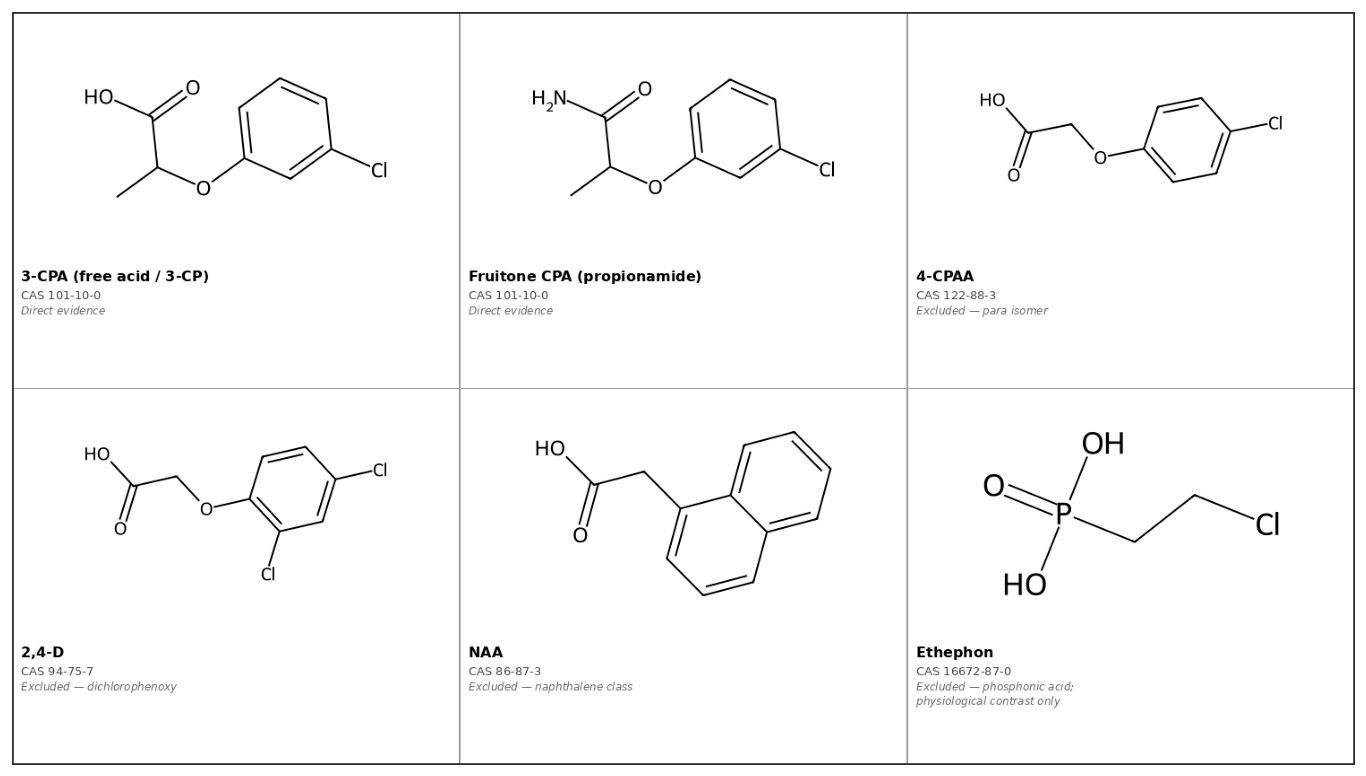
Figure 2.
Documented biological activity of 3-CPA / Fruitone CPA across four horticultural crop systems. Solid borders indicate multi-program evidence; dashed borders indicate single-source preliminary evidence. The mechanism of action remains unresolved in all four systems. NDF = natural-differentiation flowering; AZ = abscission zone.
Figure 2.
Documented biological activity of 3-CPA / Fruitone CPA across four horticultural crop systems. Solid borders indicate multi-program evidence; dashed borders indicate single-source preliminary evidence. The mechanism of action remains unresolved in all four systems. NDF = natural-differentiation flowering; AZ = abscission zone.
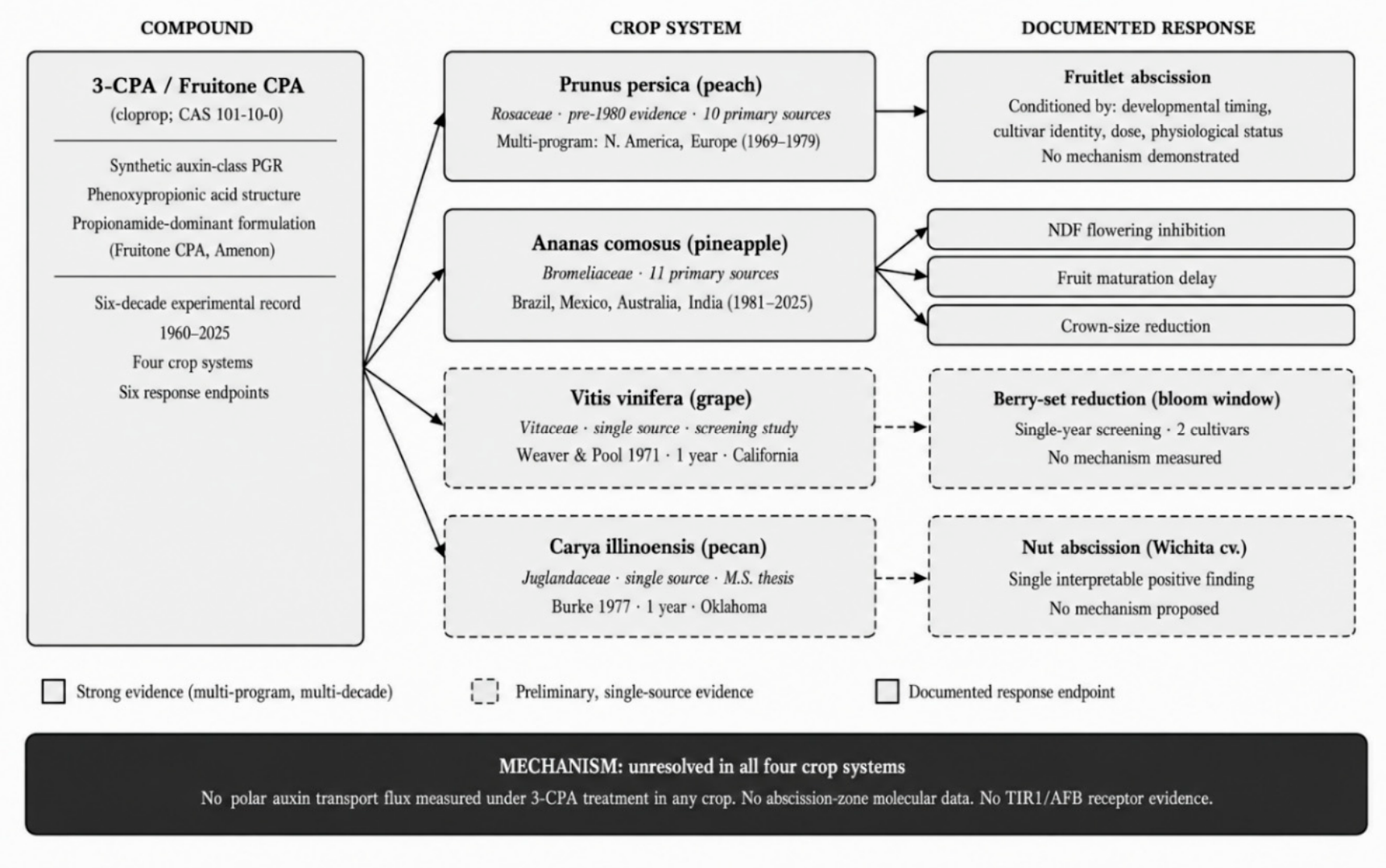

Table 1.
Chemical identity, nomenclature, and evidence-attribution status of 3-CPA and structurally related compounds. Compounds in the upper rows (CAS 101-10-0) contribute direct 3-CPA evidence; those below are excluded from the direct evidence base. CAS = Chemical Abstracts Service registry number.
Table 1.
Chemical identity, nomenclature, and evidence-attribution status of 3-CPA and structurally related compounds. Compounds in the upper rows (CAS 101-10-0) contribute direct 3-CPA evidence; those below are excluded from the direct evidence base. CAS = Chemical Abstracts Service registry number.
| Compound name and CAS number | Chemical form(s) | Role in this review | Basis for inclusion or exclusion |
|---|---|---|---|
| 3-CPA (3-chlorophenoxypropionic acid; 3-CP) CAS 101-10-0 | Free acid (3-CP); propionamide | Direct evidence; compound under review | - |
| Fruitone CPA (Amchem Products, Inc.) CAS 101-10-0 | Propionamide-dominant (~7.9% amide; ~0.4% free acid) | Direct evidence; principal commercial formulation | Trade/formulation name; not a chemical synonym for 3-CPA |
| Amchem 3-CP CAS 101-10-0 | Free acid | Direct evidence where compound identity confirmed | Historical free-acid trade name (same active ingredient) |
| Bidisin Forte CAS 101-10-0 | Propionamide / acid mix | Direct evidence in European sources where confirmed | European market name; less frequent in reviewed sources |
| 4-CPAA (4-chlorophenoxyacetic acid; 4-CPA; pCPA) CAS 122-88-3 | Free acid | Excluded;compound-identity context only | Para substitution (not meta); acetic acid side chain (not propionic). Appears in Einset et al. [11] and tomato literature [12,13] |
| 2,4-D (2,4-dichlorophenoxyacetic acid) CAS 94-75-7 | Free acid; salts | Excluded; contextual only | Dichlorophenoxy; acetic acid moiety; distinct compound class |
| NAA (1-naphthaleneacetic acid) CAS 86-87-3 | Free acid; salts | Excluded; background comparator only | Naphthalene ring system; entirely different structural class |
| Ethephon (2-chloroethylphosphonic acid) CAS 16672-87-0 | Phosphonic acid (ethylene-releasing) | Excluded as direct evidence; physiological contrast in 4.4 and 7.2 only | No structural relationship to 3-CPA; ethylene-releasing mechanism distinct |
| CPPU (forchlorfenuron) CAS 68157-60-8 | Phenylurea | Excluded; background comparator only | Cytokinin-type compound; different compound class |
| Picloram / Triclopyr | Pyridinecarboxylic / pyridyloxyacetic acids | Excluded; contextual only | Pyridine ring; distinct structural class. Appear in Einset et al. [11] |
| 2-(4-chlorophenoxy)propionic acid CAS 3307-39-9 | Free acid | Excluded; structural reference only (Table 1) | Para isomer of 3-CPA; not found in reviewed literature; listed to prevent structural confusion |
Table 2.
Evidence summary by crop system and biological response target. Evidence levels: Strong = multi-program, multi-decade; Moderate = multiple sources with context-specific limits; Preliminary = single source, single year. NDF = natural-differentiation flowering. Mechanism: not demonstrated in any crop system.
Table 2.
Evidence summary by crop system and biological response target. Evidence levels: Strong = multi-program, multi-decade; Moderate = multiple sources with context-specific limits; Preliminary = single source, single year. NDF = natural-differentiation flowering. Mechanism: not demonstrated in any crop system.
| Crop (family) | Biological target | Sources (n, period) | Evidence level | Key limitation |
|---|---|---|---|---|
| Prunus persica (Rosaceae) Peach | Fruitlet abscission / chemical thinning | 11 sources 1969–1979 | Strong for developmental timing (multi-program, multi-country). Moderate for cultivar identity and dose. Limited for physiological status. | All data pre-1980; no modern cultivar validation. Physiological-status axis anchored by a single institutional bulletin [21]. |
| Ananas comosus (Bromeliaceae) Pineapple | NDF flowering inhibition | 5 sources 1993–2025 | Strong: multi-program (Mexico, Australia, Brazil), >3 decades, multiple cultivars. | Dose protocols are target-specific; data not transferable to maturation-delay or crown-reduction protocols. Ethylene paradox unresolved [4]. |
| Ananas comosus (Bromeliaceae) Pineapple | Fruit maturation delay | 3 sources 1981–2024 | Moderate: multiple sources, two countries; cultivar- and protocol-specific. | Results not transferable across production environments or NDF inhibition protocols. |
| Ananas comosus (Bromeliaceae) Pineapple | Crown-size reduction | 4 sources 1981–2024 | Moderate: documented across three countries and three cultivars. | Vieira et al. [34] null fruit-weight result attributed to drought (not compound property). Imchen et al. [35] used methanol carrier. |
| Ananas comosus (Bromeliaceae) Pineapple | Hormonal markers (ethylene tension) | 1 source 1995 | Documented paradox: ethylene-pathway markers elevated under Fruitone treatment while flowering was inhibited. Mechanism explicitly unresolved. | Single source; mechanism unresolved. Min [4]: mechanism ‘not known’. |
| Vitis vinifera (Vitaceae) Grape | Berry-set reduction (bloom window) | 1 source 1971 | Preliminary: single-year, one-location, screening format; no replication. | Single source [36]. Post-fruit-set applications produced no effect. No mechanism measured or proposed. |
| Carya illinoensis (Juglandaceae) Pecan | Nut abscission | 1 source 1977 | Preliminary: M.S. thesis, single year, one location. Western cultivar confounded by insect pressure. | Burke [15] M.S. thesis. No yield-level data; final crop lost before harvest. No peer-reviewed replication. Mechanism not proposed. |
Disclaimer/Publisher’s Note: The statements, opinions and data contained in all publications are solely those of the individual author(s) and contributor(s) and not of MDPI and/or the editor(s). MDPI and/or the editor(s) disclaim responsibility for any injury to people or property resulting from any ideas, methods, instructions or products referred to in the content. |
© 2026 by the authors. Licensee MDPI, Basel, Switzerland. This article is an open access article distributed under the terms and conditions of the Creative Commons Attribution (CC BY) license (http://creativecommons.org/licenses/by/4.0/).
Copyright: This open access article is published under a Creative Commons CC BY 4.0 license, which permit the free download, distribution, and reuse, provided that the author and preprint are cited in any reuse.