
Submitted:
27 August 2026
Posted:
28 August 2026
You are already at the latest version
Abstract
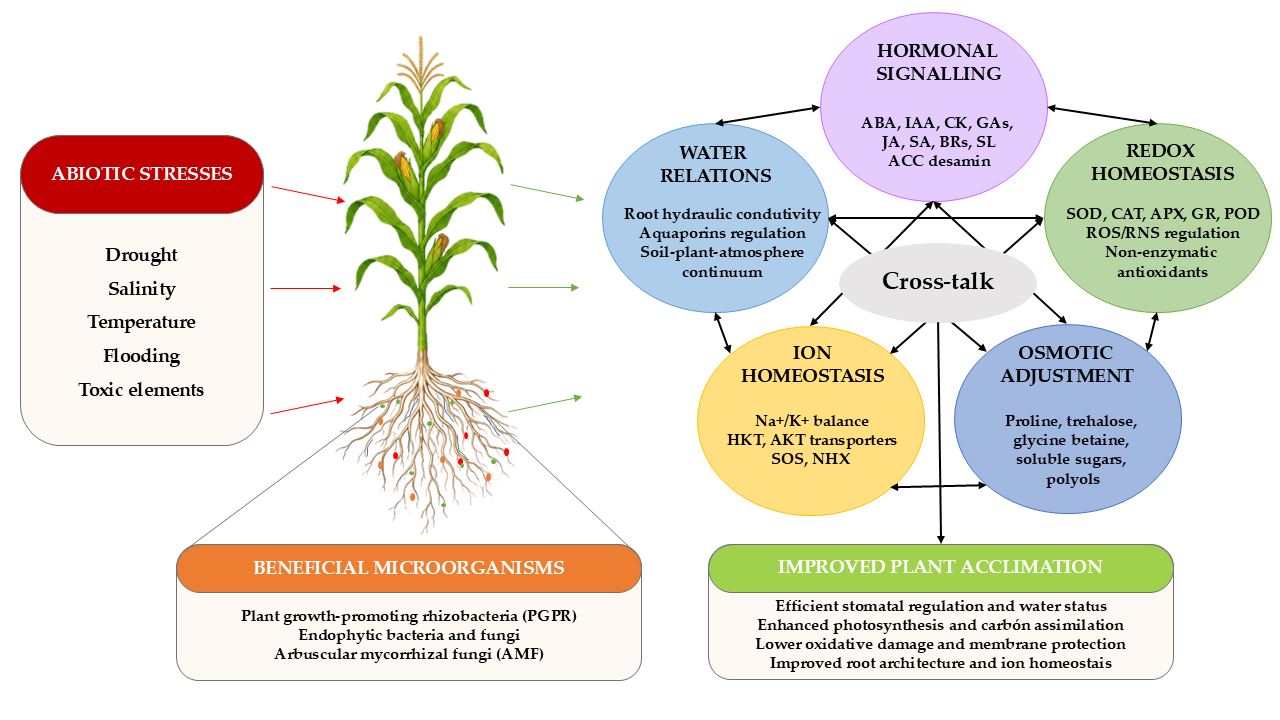
Abiotic stresses such as drought, salinity, temperature extremes, flooding, and exposure to toxic elements restrict crop productivity by disrupting plant water relations, hormonal regulation, redox homeostasis, osmotic balance, ion transport, photosynthesis, and reproductive development. Plant-associated microorganisms offer a biologically based means of supporting crop acclimation, although their effectiveness depends on the microbial strain, host genotype, environmental conditions, and capacity to colonise and persist in the target system. This review critically examines the physiological, biochemical, and molecular mechanisms through which beneficial bacteria and fungi influence plant responses to abiotic stress. Particular attention is given to microbial modulation of abscisic acid, auxins, cytokinins, ethylene and 1-aminocyclopropane-1-carboxylate metabolism, together with less extensively characterised interactions involving gibberellins, jasmonates, salicylic acid, brassinosteroids, and strigolactones. Microbial regulation of reactive oxygen and nitrogen species, enzymatic and non-enzymatic antioxidant systems, compatible-solute metabolism, Na⁺/K⁺ homeostasis, root hydraulic conductivity, aquaporins, and rhizosphere hydraulic properties is also evaluated. The evidence indicates that these mechanisms operate as interconnected regulatory networks rather than as independent protective processes. Particular caution is required when interpreting changes in stress markers, hormone concentrations, antioxidant activities, osmolytes, or transporter transcripts because these responses may indicate either enhanced acclimation or differences in stress severity. Stronger mechanistic evidence is provided by microbial biosynthetic mutants, complemented strains, hormone- or signalling-impaired plants, direct hydraulic measurements, protein localisation, ion-flux analysis, and isotopic tracing. Future progress will require time-resolved and tissue-specific studies that integrate microbial colonisation with functional plant measurements, followed by validation across representative soils, genotypes, climates, and management systems. Microbial inoculants should therefore be regarded as context-dependent components of integrated crop-management strategies rather than universal substitutes for good agronomic practices.
Keywords:
abiotic stress
; plant growth-promoting microorganisms
; microbial inoculants
; phytohormones
; redox homeostasis
; osmotic adjustment
; ion homeostasis
; aquaporins
; plant hydraulics
; rhizosphere hydraulic properties
Copyright: This open access article is published under a Creative Commons CC BY 4.0 license, which permit the free download, distribution, and reuse, provided that the author and preprint are cited in any reuse.