

Submitted:
26 August 2026
Posted:
28 August 2026
You are already at the latest version
Abstract
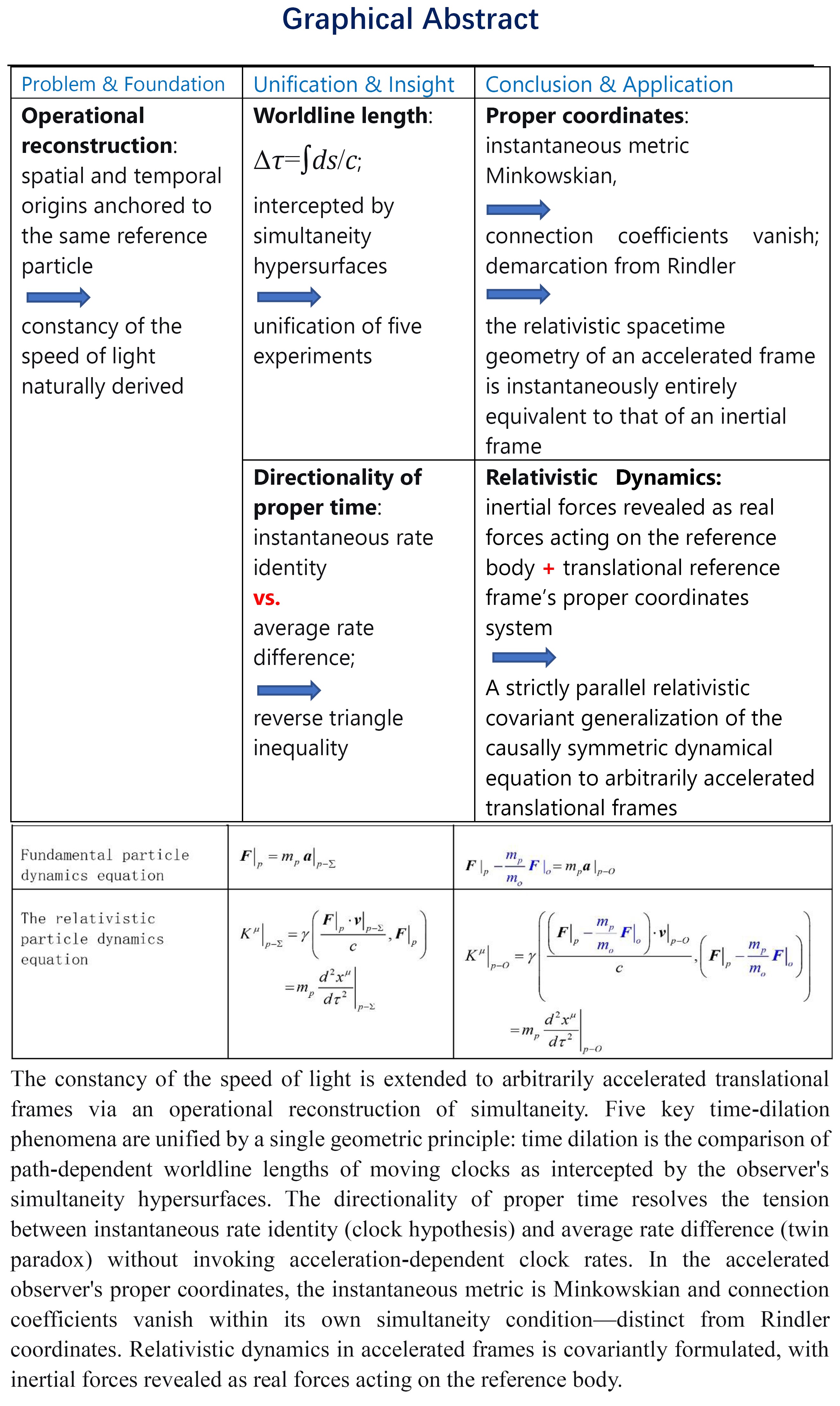
We extend the constancy of the speed of light from inertial to arbitrarily accelerated translational frames. The foundation is operational: the spatial and temporal reference origins of a frame are anchored to the same reference particle; their coordinated displacement under relative motion introduces a common calibration factor that cancels identically for light. Neither velocity nor acceleration alters the instantaneous proper rate of an ideal clock; the accelerated observer can therefore adopt proper coordinates, built from event-based simultaneity, in which the metric is instantaneously Minkowskian at every event and the connection coefficients vanish.Frame-to-frame relations are governed by the generalised transformation \(\Theta^{\mu}_{\nu}\): instantaneously it reduces to the Lorentz boost and preserves the Minkowski metric; over a finite interval its path-integrated form accumulates the proper time of the reference particle. The accumulated proper-time reading is the worldline length traversed by the reference particle---a worldline composed of a chain of proper-time basis vectors joined end to end; any worldline connecting the same two events necessarily contains the same total number of such basis vectors. Over a finite interval, the average scale of the clock carried by the reference particle is the average of the apparent proper-time scales corresponding to each proper-time basis vector, and it is not equal to the scale of the inertial clock whose worldline is the total four-displacement of that particle. The proper-time “reading” of the moving clock over that interval is the sum of the geometric projection coefficients obtained by projecting each proper-time basis vector of the accelerated clock onto the inertial frame corresponding to its total four-displacement (\(\Sigma_0\)). Owing to the properties of the Minkowski metric, whenever a proper-time basis vector deviates from the direction of the total four-displacement, it contains a spatial component that partially offsets the accumulated length of worldline, so that the geometric projection coefficient is always less than or equal to unity; when the worldline is curved, the average of these projection coefficients is necessarily smaller than unity---and this is identified as the geometric origin of the twin-paradox asymmetry. Five key phenomena—the twin paradox, rotating Mössbauer experiments, the symmetric rotor, Hafele–Keating, and muon storage-ring measurements—are unified by a single principle: the observed time dilation is the ratio of the lengths of the path-dependent worldlines of the clocks as intercepted by specific simultaneity hypersurfaces. Relativistic particle dynamics in any translational frame takes the covariant form, with forces entering as relative accounting between probe and reference particles, and inertial forces revealed as real forces acting on the reference body.
Keywords:
accelerated translational frames
; constancy of the speed of light
; proper coordinates
; worldline length
; relativistic dynamics
; equivalence principle
; moderate principle of relativity
1. Introduction
Special relativity constitutes a rigorous axiomatic system founded upon two postulates: the principle of special relativity and the principle of the constancy of the speed of light. The validity of both postulates rests upon a common conceptual foundation—the inertial frame [1,2]. In practice, however, no laboratory frame is strictly inertial [3]. Furthermore, the empirical support for the constancy of the speed of light originates from experiments conducted in non-ideal inertial frames. Consequently, experiments hint at the possibility that the principle of the constancy of the speed of light is not precluded from holding in arbitrary translational reference frames—a perspective that invites a re-examination of the foundational postulates of relativity as laid down by Einstein [4] and extensively developed in standard texts [5].
Extending the domain of the constancy of the speed of light from idealised inertial frames to practical translational frames O, thereby liberating physics from the constraint of inertial frames, has been a subject of significant theoretical exploration. Einstein’s 1915 general theory of relativity, based on the postulate of the strong equivalence principle, directly generalised the principle of relativity for general physical laws to arbitrarily moving (translational + rotational) reference frames [3,4,5]. Therefore, investigating the integration of the constancy of the speed of light with a moderate principle of relativity based on translational reference frames carries profound theoretical significance, grounded in both practical reality and the potential for fundamental advancements.
A concrete and compelling motivation stems from recent developments in classical mechanics. Through an analysis based on the principle of causal consistency, a moderate principle of relativity—defined as formal invariance under purely translational reference frame transformations—has been realised within the formalism of classical particle dynamics [6,7,8,9]. The logical core of this advancement can be re-articulated as follows.
1.1. Causal Symmetry and the Origin of Inertial Forces
First, most classical mechanical experiments are conducted not in inertial frames, but in laboratory frames. Second, the accounting evaluation of forces acting on a particle has never, in practice, accounted for the entirety of forces. The true empirical law directly summarised from mechanical experiments is therefore [7,8]:
where denotes the newly added force on the probe particle p relative to the previous mechanical equilibrium state, and denotes the resulting newly added acceleration. From a causal perspective, force is the cause, and acceleration is the effect. The theoretical calculation of common forces and the determination of inertial mass are fundamentally based on this relation. In contrast, Newton’s second law states:
which is strictly valid only in inertial frames . Newton’s second law can thus be interpreted as a theoretical formula obtained, on the basis of the empirical formula (1), by performing an “integral accounting” over all sources of forces acting on the body. Having clarified the causal relationship, we can analyse why Newton’s second law fails in practical reference frames O:
The left-hand side, , representing the total force exerted on p by the entire universe, depends solely on p. The right-hand side, , is the acceleration of p relative to O, which is physically equivalent to the acceleration relative to the reference body o defining the frame O. Formally, the left-hand side is a function of p only, whereas the right-hand side depends on both p and o. Since the choice of probe object p and reference object o is entirely arbitrary and independent, a formal causal asymmetry arises when applying Newton’s second law to non-inertial frames. This asymmetry is precisely why Newton’s second law is theoretically restricted to inertial frames, which are practically unattainable.
To satisfy the fundamental requirement of causal symmetry and consistency in dynamics, the effect corresponding to the total force exerted by the universe on a particle must be objective and independent of the choice of reference frame. Therefore, the acceleration of a particle independent of any reference frame can only be represented as its acceleration with respect to the background of cosmic space [10,11]:
Here, denotes the objective position of particle p within the background of cosmic space, and T denotes the objective temporal coordinate. The term “background” refers to the immutable void remaining after hypothetically removing all evolvable matter and energy from the universe—i.e., a three-dimensional vacuum devoid of any substance or quantum fields. This background is absolute, infinite, and devoid of kinematic attributes such as velocity or acceleration. Not only does mathematical logic require an invariant reference and background for the description of all changing observable quantities, but physical logic also dictates that, precisely because the background is an empty void free of any interactions, it can only be absolute. The concept of objective position does not contradict the empirical logic of special relativity; indeed, in special relativity, the objective position of an event in the spacetime background is implicit in the Lorentz transformation linking the coordinates of the same event across different inertial frames [1].
The logically necessary absolute nature of the spacetime background and the observationally encountered relativity of spacetime scales are dialectically unified. Spacetime concepts can be further refined into spacetime background and spacetime scale. The background is absolute, while the physical scale (), defined by intrinsic periodic physical phenomena within matter [12], is relative and subject to interactions. An important corollary follows: because the background is absolute and empty, the velocity and acceleration of any specific matter relative to this absolute background can never be absolutely determined through kinematic observations. Since the velocity relative to the absolute background is utterly unobservable at any level, velocity as a kinematic quantity can only be inherently relative—its value depends strictly on the choice of reference body. In contrast, acceleration relative to the absolute background of cosmic space, although it likewise cannot be determined by any kinematic measurement, can nevertheless be inferred through the forces acting on a body. In this sense, absolute acceleration is fundamentally a dynamical (force) concept, and not merely a kinematic one. Whether a reference frame accelerates relative to the absolute background cannot be determined by internal kinematic observations within that frame (since all observable kinematic quantities are inherently relative), but only by the real forces acting on its reference body o. This conceptual distinction between the absolute background and the relative scale in spacetime forms the essential natural-philosophical foundation for the moderate principle of relativity presented herein.
To make this abstract distinction more intuitive, consider the human experience of time. A person’s background age is the segment of the absolute background time intercepted between two events (such as birth and reunion), which is the same for all individuals regardless of their state of motion. A person’s biological age, in contrast, is the total number of intrinsic physical cycles—heartbeats, cellular divisions, metabolic oscillations—that their body has actually undergone. This biological age is precisely the Minkowski length of their worldline divided by c—that is, . It is directly measurable by comparing the local clock between the same two events. A person’s coordinate age is the coordinate time interval assigned by a particular reference frame—it is the biological age projected onto that frame’s time axis via the respective simultaneity hypersurfaces of the two events (i.e., the Lorentz transformation), and it varies from one observer to another. While two twins may share the same background age (having been born and reunited at the same two events in the absolute background), their cycle counts may differ if their worldlines have different lengths—a fact vividly illustrated by the twin paradox. The observed aging rates of the twins are symmetric during uniform motion, which is precisely the expected result when worldline lengths are computed as intercepted by the observer’s simultaneity hypersurfaces. Because two observers in uniform relative motion can never meet, the reciprocity of time dilation—each regards the other’s clock as running slow—is both natural and unproblematic. Upon reunion, however, the true difference in cycle counts is revealed; its physical rationale will be given a rigorous and natural explanation in the discussion that follows. The key insight lies in recognising that the differential of proper time of a moving clock is, up to a factor of the speed of light, the magnitude of the differential four-displacement vector of that clock. Therefore, the path-dependence of proper time inherently generalises this proper-time differential into a vector quantity, endowing it with the directionality of the worldline it traverses in four-dimensional spacetime. It is precisely the inequality between the sum of the magnitudes of these vectors and the magnitude of their vector sum that gives rise to the asymmetry and non-reciprocity of the worldline lengths of the twins. The human experience of time described above serves as a guiding metaphor for this more universal worldline-length formalism, which is employed throughout the paper to explain clock rates and comparisons.
While objective positions and in the background are conceptually real, we can only measure their differences. For any probe object p and reference object o:
Since all bodies are fundamentally equivalent under the laws of dynamics, the reference body o also satisfies:
Subtracting Equation ((6)) divided by from Equation ((4)) divided by yields a particle dynamics equation satisfying the moderate principle of relativity (where the left-hand side can be viewed as a relative statistical accounting of forces) [6,7,8,9]:
Equation ((7)) describes the dynamics of particle p in an arbitrary translational reference frame O defined by o. It places the probe and reference objects on an equal footing. This new formulation reveals that the so-called inertial forces are simply the real forces on the reference body, weighted by mass:
This demystifies inertial forces: they are not fictitious but reflect the true forces acting on the reference object that defines the frame. They are not necessarily gravitational, and—most importantly—they act on the reference body o, not on the probe particle p. This is a qualitative discovery with direct implications for the equivalence principle: if inertial forces are real forces on reference bodies, they belong to a fundamentally different ontological category from gravitational forces, removing the conceptual foundation for any equivalence between the two. The weak equivalence principle (equality of inertial and gravitational mass) remains an uncontested empirical fact, and it is sufficient to serve as the conceptual foundation for the geometrisation of gravity, in principle accommodating the success of the static Schwarzschild metric in solar system gravitational experiments.
This analysis departs from the empirical relation rather than the relativistic equation to preserve the objective equality between probe and reference particles before the definition of simultaneity via light. The symmetric new equation ((7)) demonstrates a novel form of relativity, termed moderate principle of relativity, intermediate between special and general relativity. A summary and comparison of the various relativity principles is provided in Table 1.
1.2. Why General Relativity’s Program Remains Incomplete
The causal logic of Equation ((7)) points to a natural hierarchy. An inertial frame requires no reference particle (idealisation). A translational frame requires one reference particle. An arbitrary (translational + rotational) frame requires at least four non-coplanar reference particles to fix its degrees of freedom. To write a dynamics equation in such a frame, one would need to incorporate the dynamics of at least four non-coplanar reference particles while maintaining formal symmetry. No existing mathematical framework achieves this. This suggests that the general principle of relativity, which posits the equivalence of arbitrary frames, may be mathematically unrealizable for particle dynamics beyond the translational case. Hence, the moderate principle of relativity proposed here—restricted to translational frames—is both physically well-motivated and mathematically tractable. The logical extension is summarised in Table 2.
The central aim of this paper is to extend special relativity to arbitrarily accelerated translational reference frames, thereby unifying the principle of the constancy of the speed of light with the moderate principle of relativity. A key geometric insight underlying this unification is that proper time, though a scalar at each instant, possesses directionality in its finite accumulation: the proper-time differential vector is, up to a factor of the speed of light, the clock’s differential four-displacement vector. Consequently, the sum of the magnitudes of these infinitesimal four-displacement vectors depends on their mutual alignment. This directionality—already implicit in the Minkowski reverse triangle inequality—will be developed in detail in the physical picture of Section 6, and provides the conceptual link between the instantaneous flatness of every translational frame and the asymmetric time dilation observed in accelerated systems.
The argument proceeds through six stages, each building on the preceding ones.
In Section 2, we analyse the physical constitution of a translational reference frame. The spatial and temporal reference origins are shown to play symmetric roles, both anchored to the same reference particle; their coordinated displacement under a change of frame is the operational basis of light-speed invariance. We establish that the physical time scale is invariant under velocity and acceleration, and that time dilation originates in the projection of the invariant proper-time interval onto the coordinate-time axis of a chosen frame.
In Section 3, we develop a constructive derivation of the constancy of the speed of light and the operational foundations of simultaneity, and introduce the second, event-based simultaneity calibration that is essential for non-inertial frames. Under this calibration the instantaneous metric in the proper coordinates of any translational frame is Minkowskian at every event.
In Section 4, we show that the twin paradox, rotating Mössbauer experiments, the symmetric rotor, Hafele–Keating, and muon storage-ring measurements are all governed by a single principle: the observed time dilation is the path-dependent worldline length of the clock. The generalised transformation is introduced to unify the instantaneous Lorentz boost with its finite path-integrated form; its explicit construction is given in full, and its application to the twin paradox is analysed.
In Section 5, we formulate relativistic particle dynamics in accelerated translational frames, with forces entering as relative force accounting between probe and reference particles. The dynamical connection between the transformation matrix and the real forces acting on reference bodies of two reference frames is established.
In Section 6, we assemble the complete physical picture: spacetime is endowed with a flat absolute background; every clock ticks at the universal instantaneous proper-time rate of unity; and the accumulated proper time between two events is the sum of the Minkowski magnitudes of the infinitesimal four-displacement vectors constituting its worldline. The Minkowski reverse triangle inequality—the magnitude of the sum is greater than the sum of the magnitudes when the summands are not collinear—is identified as the geometric origin of time-dilation asymmetries. We also clarify why the connection vanishes instantaneously while no globally flat coordinate chart covers a finite interval, and why this non-flatness is observationally induced rather than intrinsic to the background.
Section 7 summarises the principal results and their physical significance.
2. The Physics of Reference Frames: Symmetry Between the Spatial and Temporal Reference Origins, and the Invariance of the Physical Spacetime Scale
A physical (translational) reference frame is defined by two elements: (i) a reference body o that supplies the spatial coordinate origin and the zero-point event for the temporal origin, and (ii) the physical scales of space and time defined by the intrinsic periodic phenomena of that body. The absolute spacetime background provides the invariant stage upon which these relative measurements are performed.
2.1. Symmetric Role of the Spatial and Temporal Reference Origins
Measuring the spatial displacement of a probe particle requires identifying the same reference body o at two successive readings. Measuring a temporal displacement requires identifying the same clock zero-point at two successive readings—typically registered by local clocks at different spatial coordinate points—and this, in turn, demands that the zero-point event be propagated across distinct spatial positions via light signals to establish a convention of simultaneity. This reveals a deep symmetry:
- Spatial reference origin: defined by the reference body o.
- Temporal reference origin: defined by the simultaneity convention (via light signals).
The displacement of the reference body o relative to the absolute background alters both the spatial reference origin (directly) and the temporal reference origin (indirectly, i.e., the zero-point of the local clock at the coordinate point as recalibrated through simultaneity). For a light signal, these two adjustments cancel exactly, guaranteeing the invariance of the coordinate speed of light.
Consider a light pulse traveling along the x-axis in : . In a frame moving with velocity relative to , an observer fixed at the reference origin of the moving frame cannot perceive their own motion; from their perspective, no adjustment to simultaneity is needed. However, from the perspective of the stationary frame, the reference origin of the moving frame is observationally in motion, and its spatial position has manifestly changed. Therefore, when calibrating simultaneity, a “compensation for clock zero-point difference” must be applied. The subtlety involved can be made transparent through a simple example. Consider a moving train, with its locomotive serving as the spatial origin of the train’s reference frame. When a light signal is emitted from the locomotive towards the rear of the train for clock synchronisation, the observer on the train regards the locomotive as stationary; the coordinate distance travelled by the light is simply the train’s length. However, for an observer on the ground, during the propagation of the light signal, the locomotive is in motion; the physical distance the light actually travels through space is not equal to the train’s length. The observer on the train insists on treating the locomotive as stationary—and therefore, if a ground observer continues to rely on the clock-and-rod system fixed to the train’s reference frame to measure spacetime intervals, they are compelled to interpret this discrepancy as a recalibration of the zero-point of the coordinate clock at the rear of the train, rather than as a motion of the origin.
This recalibration is a direct manifestation of the dual nature of the reference origin: the same reference particle that defines the spatial origin is regarded as stationary by its comoving observer, yet undergoes genuine physical motion for an external observer. The spatial reference origin shifts by , and the temporal reference origin shifts accordingly through the recalibration of simultaneity: . Both origins are tied to the same reference particle, and their coordinated displacement introduces a common calibration factor that cancels identically for light, yielding c in every inertial frame. It is precisely this duality that forces the recalibration of clock zero-points, and—as we shall demonstrate in Section 3—this recalibration is the operational origin of the Lorentz transformation.
2.2. Velocity Does Not Alter Physical Time Scale: Time Dilation as a Projection Effect
A fundamental property of physical time scales follows from the operational definition of a reference frame. The intrinsic clock of the reference particle defines the unit of time for that particle’s frame. When the particle moves, its clock remains its own intrinsic standard. No physical mechanism alters the physical time scale , whose reciprocal is precisely the instantaneous intrinsic rate of the reference particle’s own clock, , a quantity that will be invoked repeatedly throughout this paper. It is therefore necessary to distinguish conceptually between:
- Physical time scale:, the temporal segment of the absolute background corresponding to one intrinsic cycle of a clock. By the relativity principle for inertial frames and the reciprocity of the time-dilation effect between them, the physical time scale remains invariant under changes of velocity.
- Coordinate time scale:, the ratio of the temporal segment of the absolute background to the coordinate time increment. In the time-dilation effect induced by relative motion, what actually changes is the coordinate time scale: it is frame-dependent, and it reflects the observer’s simultaneity convention.
In a proper coordinate system, the observer sets , so that the coordinate time scale coincides with the physical time scale at the origin. This is correct from the standpoint of each reference frame itself. However, when a stationary inertial frame examines the time scale in another moving inertial frame, the simultaneity convention requires that the relative motion of the reference particle necessitates a recalibration of clock zero-points to determine the simultaneity hypersurfaces; consequently, the coordinate time scale of the stationary frame is effectively altered relative to the proper time of the moving particle—yet this is merely an observational effect arising from relative motion.
In special relativity, the essence of time dilation is that the coordinate time interval is lengthened relative to the proper-time interval for a clock in relative motion: . This lengthening is not a physical alteration of the clock but a geometric consequence of the relativity of simultaneity. The coordinate time is the quantity calibrated by the simultaneity convention; its elongation relative to the invariant proper time is the geometric essence of time dilation. The invariance of the speed of light functions exclusively in this simultaneity calibration. Indeed, from the axiomatic structure of special relativity, all counterintuitive features—including time dilation—originate from the constancy of c; its role is solely to calibrate simultaneity, never to alter any clock’s intrinsic behaviour.
2.3. Time Dilation in Accelerated Frames: Experimental Evidence for the Clock Hypothesis
The extension from inertial to accelerated translational frames rests on the clock hypothesis [13]: the instantaneous proper-time rate is unity for every clock; what varies with velocity is not this intrinsic rate but the coordinate rate , which depends only on the clock’s instantaneous velocity, not on its acceleration. This hypothesis is not an independent assumption but a consequence of the invariance of the physical time scale. The proper-time interval read by a moving clock is determined by the length of the clock’s worldline in an inertial frame, and the worldline length itself is an invariant interval of four-dimensional spacetime. Velocity, being the first derivative of spatial interval with respect to time interval, can alter the coordinate rate , but it cannot alter the instantaneous proper-time rate , which remains identically unity. Acceleration, being the second derivative of spatial interval with respect to time interval, is even less capable of changing the clock’s instantaneous proper-time rate . Since neither velocity nor acceleration alters the physical time scale , the instantaneous proper-time rate of all arbitrary moving clocks is universally constant.
The experimental evidence strongly supports this conclusion. Muon storage ring experiments [14] demonstrate that the dilated lifetime of muons undergoing centripetal accelerations of order agrees precisely with the time-dilation formula using the instantaneous orbital speed alone, with no acceleration-dependent correction. The Hafele–Keating experiment [15] confirmed that the accumulated proper times of clocks flown around the Earth agree with the path integral of the instantaneous time-dilation factor evaluated in the Earth-centered inertial frame. The operational application of these relativistic corrections is fundamental to the Global Positioning System [16].
The rotating Mössbauer experiments provide strong and direct evidence. Hay et al. [17] and Kündig [18] measured the transverse Doppler shift for a source and absorber on a rotating disk, finding the coefficient for the frequency shift . Crucially, the shift depends only on ; no angular-acceleration () dependent term has ever been observed. If acceleration directly affected clock rates, the Euler force () would contribute, but it does not. A subsequent re-analysis of Kündig’s data by Kholmetskii et al. [19] reported a statistically significant deviation from , and a new Mössbauer rotor experiment by the same group [20] measured , close to . The interpretation of these measurements remains the subject of an ongoing debate. Corda [21,22] has argued that the standard relativistic prediction is consistent with Kündig’s original data once systematic errors are properly accounted for, and that the deviations reported by Kholmetskii et al. may reflect unaccounted systematic effects. The standard frequency shift factor originates from the perspective of the laboratory inertial frame, whereas the true observer is the absorber that undergoes resonant absorption; the additional contribution can therefore be explained precisely and self-consistently by the switch of simultaneity hypersurfaces. The kinematic explanation of the standard frequency shift, which has been regarded as important experimental evidence for the equivalence principle, will be addressed in Section 4 and Section 3.
These experiments collectively establish that: (i) the physical time scale is invariant under both velocity and acceleration; (ii) time dilation is an accumulated, path-dependent effect fully captured by the worldline-length formalism and the observer’s simultaneity hypersurfaces; (iii) the equivalence principle is neither required nor adequate to explain the observed phenomena; (iv) When the observer is at rest in a non-inertial frame rather than in an inertial one—as in the source–absorber co-rotating configuration of the Mössbauer experiment—a key element of the framework is the clear distinction between the light-signal-based simultaneity convention appropriate to inertial frames and the event-based simultaneity calibration required for non-inertial frames.
3. Operational Foundations of Light-Speed Invariance and Simultaneity
The preceding analysis of reference frames and time dilation rests on a deeper operational foundation that is developed in this section. The purpose is twofold: to provide the constructive derivation of light-speed invariance that motivates the extension to accelerated frames, and to clarify the conceptual distinction between light-signal-based and event-based simultaneity—a distinction that proves essential for understanding why the proper coordinate system of an accelerated translational frame, built from its own perspective, is always instantaneously flat, as developed in Section 4.
3.1. Reference-Origin Symmetry and the Five-Step Derivation of c-Invariance
The constancy of the speed of light is not an arbitrary postulate but a consequence of the operational manner in which reference frames are constructed. The Galilean transformation, , , correctly captures the shift of the spatial reference origin under relative motion but neglects a corresponding shift of the temporal reference origin. The operational construction of a reference frame (Section 2) reveals why: the same reference particle anchors both reference origins. When it moves, the spatial reference origin shifts by , and the calibration of simultaneity—which requires light signals to travel from the new origin position to clocks at other spatial points—introduces a shift of the temporal reference origin by . For terrestrial velocities, , making the temporal-origin shift imperceptible to pre-twentieth-century experiment. Galilean relativity is not false; it is an excellent approximation in the regime where the temporal-origin correction is negligible. Light-speed invariance emerges as the completion of Galilean intuition when both origin shifts are included.
A concise five-step derivation makes the logic transparent. We adopt three explicit assumptions: (i) in the source rest frame S, the speed of light is c; (ii) spatially separated clocks at mutual rest are synchronised by Einstein’s light-signal procedure [23]; (iii) spacetime homogeneity implies linearity, and spatial isotropy with velocity reciprocity implies a common scale factor [24,25].
- Step 1.
- Suppose a light signal, employed for cross-frame simultaneity calibration, propagates along the x-axis in a frame S that is already equipped with its own simultaneity calibration, and over a coordinate time interval it satisfies:
- Step 2.
- There exists a relatively moving inertial frame , already equipped with its own simultaneity calibration, and the spatial reference origin of moves relative to S as:
- Step 3.
-
Shift of the temporal reference origin. Because the spatial reference origin has moved, the light-travel time from the new origin to any fixed point changes. This is the most important step in the entire derivation, resting upon the spatial-origin displacement established in the previous step. The core subtlety lies in the dual nature of the reference origin: an observer comoving with the origin regards it as a fixed and static benchmark, maintaining rigid distances to all other points in the frame ; however, for an observer in S, this same origin of exhibits a different apparent behaviour, because it undergoes genuine physical motion of its own through the background of cosmic space. Consequently, the coordinate distance traversed by a light signal used for simultaneity calibration within (as determined by the comoving observer’s own coordinate system) does not coincide with the physical distance the signal actually travels through space (as identified by the coordinate system in S). For the observer in S, who insists on employing the physical scales and local coordinate system intrinsic to the moving frame to measure future spacetime intervals, this irreconcilable discrepancy manifests as a forced recalibration of the zero-points of all coordinate clocks distributed throughout —that is, a change of the simultaneity hypersurface. This recalibration is the direct operational origin of the Lorentz transformation. The magnitude of the temporal-origin recalibration, from the perspective of S, is given byThis is not a physical effect on the clock; it is the recalibration of the clock’s zero-point required by the operational definition of simultaneity. Both origins shift together because both are tied to the same reference particle. This is the pivotal step in all of special relativity.
- Step 4.
- Inertial frames themselves must enjoy a fully equal status in order for the principle of relativity to be satisfied. The fundamental spacetime architecture of an absolute background and relative scales confirms this: the background is absolute precisely because it is empty of all matter and devoid of any interaction; hence, the velocity of any reference frame, including any inertial frame, relative to it cannot be determined, and inertial frames are therefore naturally on an equal footing. More importantly, according to the principle of relativity, two inertial frames in uniform relative motion must each measure the other’s speed to have the same numerical value; otherwise, an absolute distinction between inertial frames would exist. Given the full equivalence of the relative speeds of reference particles, the time coordinate transformation and the space coordinate transformation between inertial frames ought to share a common scale factor:
- Step 5.
- For the propagation of the light signal used for simultaneity calibration, holds. Substituting:
The entire structure factor cancels completely. Its value—, determined by requiring the invariance of —is irrelevant for understanding whyc is invariant. The symmetry between the shifts of the spatial and temporal reference origins guarantees this cancellation. This derivation does not claim logical independence from the standard postulate of light-speed constancy. Rather, it reconciles and unifies the principle of light-speed invariance with the Galilean velocity addition principle—a cornerstone of macroscopic experience—from a perspective grounded in natural foundational logic and readily comprehensible. The factor encodes the same symmetries established by Berzi–Gorini [24] and Lévy-Leblond [25]. The operational contribution is to show why these mathematical symmetries produce the invariance of c under physical reference-frame transformations: the same reference particle anchors both reference origins, and their coordinated shifts enforce the cancellation.
Operationally, light is selected as the signal for defining simultaneity and faithfully conveying the recalibration of clock zero-points precisely because its physical properties are perfectly matched to this role: as a direct consequence of Maxwell’s equations, light propagates through vacuum without a material medium; more profoundly, its phase—the carrier of clock zero-point information—transforms covariantly under inertial frame changes through the purely spatiotemporal differential structure of the vacuum Maxwell equations, a structure that guarantees, at the level of physical mechanism, the invariance of the speed of light under frame transformations.
3.2. Coordinate-Time Elongation: The Essence of Time Dilation
The five-step derivation illuminates the nature of the principle of light-speed constancy with an analytical clarity that is precisely what the standard axiomatic formulation obscures or leaves unaddressed. Step 3 reveals that the temporal-origin shift is a recalibration of simultaneity: it adjusts the zero-points of clocks at different spatial positions so that the reference particle, while appearing stationary in its own frame, can, when viewed from another inertial frame that is taken to be at rest, consistently accommodate and account for its own physical motion. The coordinate time that emerges from this calibration is not an intrinsic property of any clock; it is a quantity that depends on the simultaneity convention. When the Lorentz transformation gives , this is not a statement about the clock “slowing down”—the clock’s intrinsic rate (the instantaneous proper-time rate) is invariant. It is a statement about the coordinate-time interval being elongated relative to the invariant proper-time interval . Time dilation is coordinate-time elongation.
This essential insight is fully consistent with the foundational role of the principle of light-speed constancy in the standard theory: in the axiomatic formalism, this principle is the source of time dilation and of all other counter-intuitive features, and it operates directly by altering time coordinates through simultaneity calibration.
This reframing has direct experimental consequences. In the rotating Mössbauer experiments, precisely because the coordinate-time elongation per unit proper interval differs for clocks at different radial positions, the additional contribution to the frequency shift (beyond the standard ) arises from the mismatch between the laboratory frame’s simultaneity convention and the rotating frame’s own intrinsic simultaneity—events that are simultaneous in the rotating frame are not simultaneous in the laboratory frame. When the proper simultaneity of the rotating frame is correctly accounted for—through event-based simultaneity calibration rather than light-signal-based Einstein synchronisation—the total frequency shift is obtained, consistent with the recent experimental determinations [19,20].
3.3. Event-Based Simultaneity and the Instantaneously Flat Proper Coordinates of an Accelerated Translational Observer
The distinction between light-signal-based and event-based simultaneity is essential for understanding why existing Rindler and Fermi coordinates do not constitute counterexamples to the framework developed in this paper.
Einstein synchronisation relies on light-signal exchange and assumes a constant coordinate speed of light. This works perfectly in inertial frames but fails in non-inertial frames for two reasons: the coordinate speed of light is not globally constant, and—more fundamentally—clock rates at different spatial points differ because the time-dilation factor varies from point to point. This necessitates a second simultaneity calibration, and the non-inertial frame must re-establish simultaneity from its own perspective.
When the speed of light is no longer constant, we should in principle perform this calibration using objective spacetime events. From the standpoint of an inertial frame, the second simultaneity calibration for a non-inertial frame can be accomplished via infinitesimal Lorentz transformations. The Lorentz transformation is fundamentally an event mapping: it relates the coordinates of the same event across different frames. It is crucial to recall, based on the earlier argument, that the essence of simultaneity recalibration is to account for the relative motion of the reference particle.
Take a uniformly rotating frame with a fixed axis as an example. When the reference particles of the laboratory inertial frame and the rotating frame coincide at a spatial point, and each pair of coordinate points to be calibrated differs only by an instantaneous relative velocity , the fact that the reference particles coincide and the coordinate points are instantaneously coincident means that the relative distances between the reference particles and the coordinate points are completely identical. Consequently, the simultaneity of the rotating frame needs only to be directly projected, in the neighbourhood of each pair of coordinate points to be calibrated, by an infinitesimal Lorentz boost . No light-signal calibration is required; this projection constitutes the second simultaneity calibration—the relationship is purely geometric. These boosts project the simultaneity calibrated by the laboratory frame onto the rotating frame, using events as the standard.
Historically, coordinate charts for accelerated observers—Rindler [26] and Fermi normal coordinates—do not perform this second calibration, nor are they built from the accelerated observer’s own perspective. The inherent subtleties in describing accelerated systems within the framework of special relativity have been emphasised by Bell [27] in his analysis of accelerated rigid motion. Rindler coordinates are defined by the transformation (here denotes the Rindler coordinate time, distinct from the proper time used elsewhere in this paper) , from an inertial frame . This construction inherits the inertial frame’s light-signal-based simultaneity convention and employs the velocity relative to that inertial frame—a quantity that a real accelerated observer cannot operationally determine from within his own frame, and which therefore cannot be grounded in the accelerated translational reference particle’s own perspective. Seen in this light, the Rindler metric and its non-zero connection coefficients are artifacts of the inherited, un-recalibrated simultaneity. Fermi normal coordinates share the same fundamental flaw: they reference the acceleration vector as measured in an external inertial frame. Neither construction yields the intrinsic geometry of the accelerated observer.
Under event-based simultaneity, the instantaneous metric in any translational frame’s proper coordinates () is Minkowskian,
This follows directly from the earlier demonstration that the instantaneous proper-time rate of a moving clock remains universally invariant; consequently, by the definition of the connection, and owing to the invariance of the metric values, all instantaneous connection coefficients vanish identically. Rindler and Fermi coordinates represent the “global perspective”—the external inertial observer’s mathematical re-labeling. By contrast, the proper coordinates proposed here are the “local operational perspective”—the accelerated observer’s own operational construction.
This instantaneous Minkowskian property is strictly local; as we shall see in Section 6.3, it does not imply the existence of a globally flat coordinate chart over finite intervals.
4. The Worldline-Length Paradigm: A Unified Interpretation of Time-Dilation Phenomena
Using the worldline length to calculate time-dilation effects offers distinct advantages. First, the worldline length is a Lorentz invariant, which can be naturally extended to an invariant under arbitrary physical reference frame transformations. Second, proper time, as a physical quantity, is also an invariant under mathematical coordinate transformations. This dual invariance allows us to compute the proper time of a clock in arbitrary motion by simply reparameterising the coordinates in an inertial frame with a known metric, and then compare it with the coordinate time to obtain the time-dilation effect.
4.1. Worldline Length as the Reference-Frame-Independent Invariant
Precisely, based on the instantaneously flat metric (15) in the proper coordinate system of an arbitrarily accelerated clock, the proper-time interval accumulated by a clock along its worldline is obtained by integrating the invariant Minkowski length at each instant:
This quantity is independent of the reference frame used to compute it, a fact guaranteed by the invariance of the line element . The coordinate time t and velocity appearing in the integrand are those of the particular inertial frame chosen for the calculation; the integral itself is invariant under Lorentz transformations. Furthermore, any experimental confirmation of the worldline-length interpretation of the proper time of an accelerated clock described by Equation (16) constitutes the strongest possible support for the instantaneous Minkowski flatness of accelerated translational reference frames.
4.2. Worldline Length as a Coordinate-Independent Invariant
Based on the mathematical coordinate-independence of the worldline-length calculation, we re-analyse the time-dilation effect between inertial frames in relative uniform motion using the worldline-length principle. Consider a purely mathematical reparametrisation of the laboratory coordinates: for a clock moving at speed u along , define the purely mathematical coordinate reparametrisation
Substituting into the metric of the laboratory inertial frame,
This yields the metric still expressed in the laboratory frame but in terms of new mathematical coordinates:
However, for a clock fixed in the moving frame, its reparametrised mathematical coordinates in the laboratory frame exactly satisfy
We thus obtain a result fully consistent with the time-dilation effect given by the standard Lorentz transformation:
This derivation uses no Lorentz transformation—only a pure coordinate reparametrisation—confirming that the physics underlying time dilation arising from relative motion is the comparison of worldline lengths evaluated in a given observer’s inertial coordinate system. This method generalises to accelerated and rotating frames, as demonstrated below.
For the Mössbauer rotor experiment, we work directly in the laboratory inertial reference frame—that is, we remain in that frame—and adopt a mathematical coordinate reparametrisation that keeps all spatial coordinates fixed for a point at rest in the rotating reference frame, defined by
Substituting the differential relation that follows from the fundamental definition of angular velocity, , into the laboratory Minkowski line element yields
For a point fixed in the rotating frame, its corresponding reparametrised coordinates satisfy
and substituting these into the reparametrised metric of the laboratory inertial frame we obtain
For a source (s) placed near the rotation axis and an absorber (a) fixed at the far end, the corresponding frequency shift is given by
In the limit , this immediately yields the standard frequency shift term that originates from the laboratory inertial frame’s simultaneity:
It must be pointed out that in actual experiments, the frequency comparison that produces the shift is carried out at the absorber located on the rotor rim; hence the above contribution constitutes only the dominant part of the overall frequency shift. Nevertheless, in the traditional approach, because the source and absorber are at rest relative to each other in the rotating frame, the standard relative-velocity formula of special relativity for computing time dilation is inapplicable, and the contribution is usually considered to be accounted for by invoking the equivalence between inertial forces and gravity within the rotating frame. Yet, the worldline-length principle differs: although the source and absorber are both at rest in the rotating frame, their worldline lengths relative to the laboratory inertial frame are invariant—worldline length must be referred to an inertial frame for a faithful computation of proper time intervals—so a frequency shift between them can still be perceived. As the above makes clear, the derivation of the standard term invokes neither the equivalence principle nor any intrinsic time-dilation effect of acceleration; it relies exclusively on the Minkowski metric of the laboratory inertial frame and the worldline length formula. The rotating coordinates are obtained by a pure spatial transformation from the laboratory frame, and the entire frequency shift is captured by evaluating the proper time along the respective worldlines—no Rindler metric [26], no gravitational analogy, and no curved spacetime are required. It is also worth mentioning that the lifetime dilation observed in high-energy muon storage-ring experiments [14], where the observer is in the laboratory inertial frame, can be directly accounted for by the frequency shift formula (27) given above.
Further confirmation of the worldline-length principle for time dilation is provided by the Champeney–Moon symmetric rotor experiment [28], in which the source and absorber rotate on the same circle in opposite directions. Since their speeds are equal, their worldline length increments are identical; moreover, because their positions are symmetric, their simultaneity hypersurfaces are tilted by the same angle relative to the laboratory inertial frame’s simultaneity hypersurface, so that the additional frequency shift also vanishes. Consequently, according to the principle of comparing worldline-length accumulation rates that is rooted in the observer’s simultaneity hypersurface, a null net frequency shift results. By contrast, the conventional formula based on relative velocity would predict a non-zero shift, because the source and absorber possess a doubled tangential relative velocity, which is not observed. Thus, the rotating Mössbauer experiments, correctly interpreted, demonstrate that the equivalence principle is not required to account for time-dilation phenomena in rotating systems and, together with the Champeney–Moon null result, strongly favour the worldline-length paradigm over interpretations that appeal to pseudo-gravitational potentials.
4.3. The Logical Structure of Unification
The preceding experimental analysis and the worldline length paradigm together reveal a unified geometric portrait of time dilation across all translational frames. The Mössbauer frequency shift is precisely the difference in the proper time between the absorber and the source within the same coordinate time interval : . The Hafele–Keating clock discrepancies are exactly the accumulated proper time differences along the eastward and westward trajectories. The extended muon lifetime in the storage ring is exactly the proper time for constant-speed circular motion. In every case, the observed time dilation is fully accounted for by the worldline length formula (16):, without invoking any “acceleration-induced time dilation” or gravitational equivalence. However, it must be emphasised that the core subtlety of special relativity lies precisely in the fact that relative motion often inverts physical essence and observational appearance: the motion that rightfully belongs to the reference particle is inverted into that reference particle being at rest, while other particles under examination are deemed to be in motion. This is equally true for time dilation. In fact, the instantaneous proper-time rates of all moving clocks in question are identically equivalent; what genuinely varies is that the coordinate time intervals, through which the proper intervals of moving clocks are observed via simultaneity hypersurfaces, are lengthened to different extents depending on their relative velocities.
These five phenomena—the twin paradox, the rotating Mössbauer measurements, the Champeney–Moon symmetric rotor, the Hafele–Keating around-the-world clock flights, and the muon storage ring lifetime dilation—span the full spectrum from conceptual gedankenexperiment to precision laboratory measurement. Three structural features are common to all: (i) the coordinate time axis of the chosen inertial frame provides the computational basis; (ii) the worldline length formula (16) provides the invariant proper time; (iii) acceleration enters only indirectly, by shaping the velocity history along the clock’s worldline, without contributing any independent term to . The unification achieved here demonstrates that the phenomenology of time dilation is governed by a simpler and deeper principle than previously recognised.
4.4. Three Temporal Quantities: Background Age, Biological Age, and Coordinate Age
To fix the conceptual structure precisely, we distinguish three temporal quantities, each with a definite operational meaning:
- Temporal background segment: the temporal segment of the absolute background intercepted between two fixed events. It is absolute—frame-independent and identical for every worldline sharing those endpoints—but not directly observable; it serves as the invariant benchmark against which all scale changes are compared. For an intuitive grasp, the temporal background segment may be likened to the background age.
- Proper-time reading interval: the proper time accumulated along a particular worldline—the invariant Minkowski length of that worldline segment. It is a Lorentz scalar, path-dependent, and equals what the clock physically registers. For an intuitive grasp, the proper-time reading interval may be likened to the biological age.
- Coordinate-time reading interval: the interval assigned by a chosen frame’s simultaneity convention. It is frame-dependent; holds only in the clock’s own rest frame. For an intuitive grasp, the coordinate-time reading interval may be likened to the coordinate age.
This threefold distinction serves as a precise characterisation of the subtle physical picture of time developed in this paper. The age terminology is retained purely as an intuitive gloss, not as a definition. The physical time scale is , and the coordinate time scale is . The clock hypothesis is acknowledged, and the physical picture proposed in this work—in which the absolute background and the relative scale are two aspects of a single entity—blends with it in a natural manner. The threefold age metaphor introduced above can further be translated into the three precise rates defined in Sec. Section 6.1 (the instantaneous proper-time rate, the average proper-time rate, and the coordinate-time rate).
4.5. Instantaneous Proper-Time Rate Invariance Versus Average Proper-Time Rate Difference: The Role of Directionality
We adopt the following notation, used throughout the remainder of this paper. For any clock and any pair of events on its worldline, let denote the inertial frame aligned with the clock’s total four-displacement between those events—equivalently, the inertial frame whose worldline is that total four-displacement, i.e., the unique inertial worldline sharing the clock’s two endpoints. It is in alone that the accumulated proper time of an arbitrarily moving clock is faithfully computed as the simple integral ; the directionality argument developed below shows why no other frame admits this exact computation.
The twin paradox presents the following tension: at every instant, the traveller’s clock and the Earth-bound clock share the same instantaneous proper-time rate (meaning the same physical time scale in their respective reference frames). Yet upon reunion, the traveller has aged less. The resolution is geometric. In Euclidean space, over the same duration, a person walking a straight road covers a longer distance than someone walking a winding path, even though both walk at identical instantaneous speeds. The disparity arises from the direction of the velocity in three-dimensional space. In Minkowski spacetime, the analogous structure is the reverse triangle inequality: over the same temporal background interval determined by the two events, the geodesic (inertial) path has the largest proper-time interval. The instantaneous rates are identical— in both cases. However, the worldline between two events is path-dependent—the accumulation of worldline length possesses directionality in four-dimensional spacetime. It is the directionality of each twin’s four-displacement that determines the accumulated interval: a non-geodesic worldline contains segments whose four-displacement is tilted away from the geodesic direction, reducing the proper-time contribution of each segment. This once again demonstrates that acceleration bends the worldline, but it never alters the clock’s intrinsic rate.
The analogy with Euclidean geometry is illuminating but structurally inexact, because the mediating mechanism differs. In Euclidean space the norm is indiscriminately additive: parallel and perpendicular components both contribute positively, so the deficit arises from the cancellation of perpendicular components in the vector sum, not from any reductive role of the norm. In Minkowski spacetime the norm is subtractive: the spatial deviation reduces the result of evaluating the norm. The two geometries therefore share the causal chain “directional change ⇒ perpendicular components ⇒ path-dependent average < instantaneous rate,” but its second link is realised oppositely: the Euclidean norm adds indiscriminately, so the deficit comes from cancellation in the sum; the Minkowski norm subtracts the spatial contribution, so the deficit is already extracted at each segment, and the cancellation in the sum only spares the total.
The physical role of the turnaround follows directly from this picture. Acceleration does not alter the clock’s instantaneous rate; it changes the direction of the four-velocity, so that each proper-time basis vector acquires, relative to the total four-displacement direction, a non-zero spatial deviation. The entire accelerated portion of the worldline—not merely the turnaround instant—contributes to the cumulative deficit. Without reunion a direct comparison of accumulated proper times is of course impossible; nevertheless, even without reunion, the deficit is already present and the resulting reduction in the proper-time reading interval is already a non-reciprocal effect. The role of the turnaround is therefore solely geometric closure: it is neither dynamical clock slowing nor a necessary condition for the shortening of the total worldline.
4.6. The Generalised Transformation : Definition and Properties
Neither velocity nor acceleration alters the instantaneous physical scale. An accelerated translational observer can therefore construct proper coordinates in which the time coordinate is their own proper time and the spatial coordinates are those of the instantaneous comoving inertial frame. At each instant, the metric in these coordinates is Minkowskian. This is because the intrinsic physical mechanism of the accelerated translational reference particle is independent of its relative velocity and acceleration with respect to external reference frames (gravity excepted). The local physical scales are identical to those of an inertial frame. Moreover, in a purely translational frame every spatial point shares the same acceleration—and therefore the same instantaneous velocity—so the average physical scales evolve synchronously throughout the frame at each instant. Therefore, the instantaneous metric of an accelerated translational frame is given by (15).
The instantaneous metric in an accelerated translational frame is therefore Minkowskian at every event. Moreover, in a non-inertial frame, simultaneity should be guided by events; hence, by the definition of the connection, all instantaneous connection coefficients vanish identically at each instant. It is important to clarify a potential source of confusion: this is a statement about the instantaneous intrinsic geometry in the proper coordinates of the translational frame, not a claim that Rindler or Fermi coordinates—which inherit the inertial frame’s light-signal-based simultaneity without performing the second, event-based calibration discussed in Section 3—should have a Minkowski metric. The Rindler metric and its non-zero connection coefficients are artefacts of the inherited simultaneity of the laboratory inertial frame, not properties of the accelerated observer’s intrinsic geometry.
The asymmetric aging in the twin paradox arises not from the metric, but from the comparative difference between the worldline lengths traversed by the two biological clocks. In special relativity, the transformation between inertial frames is the Lorentz matrix , which is symmetric under the exchange of observer roles: . For accelerated frames, the transformation is no longer symmetric, because the reference particles possess different worldline lengths; moreover, the calculation of worldline length must be performed in an inertial frame in order to faithfully represent proper time, since the average time scale of a non-inertial frame itself varies.
We now introduce the generalised transformation between the proper coordinates of two translational frames: an inertial frame O and a translational frame (which may be accelerated). Let be the instantaneous relative velocity of with respect to the inertial frame O. The coordinate differentials are related by
where is the Lorentz transformation matrix. In the instantaneous limit, therefore, is precisely the Lorentz boost: a matrix that preserves the Minkowski metric,
and local physics is governed by special relativity at each instant.
The reason for introducing rather than simply writing is that the parameter domain must be enlarged. The Lorentz matrix takes as its argument an instantaneous velocity (a three-vector ). For the accelerated frame , however, the finite coordinate relation between O and depends on the entire velocity history , not merely on its instantaneous value. We therefore define the finite transformation by the path integral of the instantaneous boosts:
where is the total four-displacement of the reference particle in the inertial frame, and is the worldline-averaged effective velocity parameter. The matrix thus defined is the equivalent Lorentz boost that, when applied once to the total four-displacement , reproduces the accumulated effect of the time-dependent instantaneous boosts integrated along the worldline. Its defining properties are:
- 1.
- Instantaneous limit. As , the velocity history collapses to a single value, , andrecovering the standard Lorentz boost.
- 2.
- Worldline-length encoding. For the reference particle at rest in its own proper frame (), the time component of ((30)) yields directlywhich is precisely c times the proper time—the Minkowski worldline length—of the arbitrary moving reference particle. The finite matrix therefore encodes the worldline-length principle: its action on the total four-displacement reproduces the accumulated proper time.
- 3.
- Metric preservation at all scales. The instantaneous belong to . The Minkowski metric is preserved everywhere and for every instant:
The twin-paradox asymmetry now follows in one step. The Earth-bound twin experiences at all times, so and
The travelling twin experiences a time-dependent , so and
The difference arises because the two worldlines produce different effective parameters , and hence different matrices . At no instant does depart from being a Lorentz boost or from preserving the metric; the asymmetry is a consequence of the path-dependence of the defining integral ((30)), which maps distinct velocity histories to distinct effective boost parameters.
This completes the conceptual generalisation from an inertial frame to an accelerated translational frame via a generalised coordinate transformation. The symbol unifies the instantaneous and the finite regimes: when its argument is the instantaneous velocity , it reduces to , recovering special relativity; when its argument is the worldline-averaged effective parameter , it encodes the finite accumulated transformation through the path integral (30).
4.7. The Generalised Transformation : The Generalised Directionality of the Proper-Time Differential and the Complete Resolution of the Twin Paradox
Yet beneath this mathematical structure lies a deeper geometric root. The instantaneous proper-time rate of any ideal clock, , is identically equal to unity, independent of both velocity and acceleration. What distinguishes one clock from another is not the magnitude of its instantaneous proper-time rate—which is universally unity for all clocks—but the direction in four-dimensional spacetime along which its proper time accumulates. According to the basic kinematic description of an arbitrarily moving clock, given both in an inertial frame and in the accelerated translational proper frame that it carries with it, the line element satisfies
where denotes the Minkowski norm. This implies that, when viewed from a laboratory inertial frame, the clock as a moving particle has a worldline that exhibits directionality in four-dimensional spacetime, and consequently proper time itself also possesses directionality. Up to a factor of the speed of light, the reading of proper time in a given coordinate system is precisely the magnitude of the differential four-displacement vector of the moving clock (taking the norm effectively reduces the vector to a scalar).
We therefore introduce the proper-time differential vector—a four-dimensional directed quantity whose magnitude is each infinitesimal proper-time interval of the moving clock and whose direction is the clock’s instantaneous four-velocity along its actual motion through spacetime. It is this intrinsic four-dimensional directionality—the fact that successive proper-time differential vectors along a worldline are not, in general, collinear—that lies at the geometric root of the path-dependence exhibited by finite proper-time intervals. Accordingly, the proper-time differential vector is defined as
In four-dimensional Minkowski spacetime, the Minkowski reverse triangle inequality for timelike curves asserts that, for any worldline connecting two timelike-separated events, let be a geodesic and an arbitrary worldline sharing the same endpoints. Because the total four-displacement along equals that along , the line-lengths, read in the same reference coordinate system, satisfy1
The left-hand side is the sum of the magnitudes of the infinitesimal segments—the sum of the line-element lengths, i.e., the proper-time integral accumulated along that worldline—while the right-hand side is the magnitude of the total four-displacement between the two events, an invariant independent of the path. Equality holds if and only if all infinitesimal displacement vectors are collinear, which is the defining property of a geodesic (inertial) worldline.
Along a geodesic, the four-displacement maintains a constant direction; the proper-time differential vectors are collinear, and the accumulated proper-time reading attains its maximum possible value. By contrast, along a non-geodesic (accelerated) worldline, the four-displacement continually changes direction; the proper-time differential vectors are non-collinear. In the process of taking the Minkowski norm of each proper-time differential vector with respect to the laboratory inertial frame, there is indeed no loss through the change of reference frame, because the norm is invariant under reference-frame transformations. However, the very operation of taking the norm already entails the spatial components of the proper-time differential vector making a negative contribution to the worldline length. Purely mathematically, in taking the norm of a timelike vector according to the Minkowski metric, the contribution of the spatial interval is always negative—it subtracts from the dominant contribution of the temporal interval. Hence, the more the worldline bends in three-dimensional space, the larger the accumulated spatial interval becomes, and the more negative its contribution to the norm, i.e., to the line length. In other words, the more spatially curved the worldline, the shorter its line length— and the smaller the corresponding proper-time reading. The Minkowski reverse triangle inequality itself reflects precisely this: between two spatial points, two vectors joined at an angle traverse a longer spatial path than a single straight vector, so their total four-dimensional norm is smaller.
Physically, the picture is as follows. When the proper-time differential vectors are expanded in the inertial frame whose worldline is the clock’s total four-displacement—here, the laboratory inertial frame—the Minkowski norm of each proper-time differential vector remains unchanged; that is, the proper-time interval reading corresponding to that vector suffers no loss merely because the reference frame has been switched to the inertial frame of the total four-displacement (), and the reading remains equal to its norm in the clock’s own proper coordinate system. The purpose of expanding in the inertial frame of the total four-displacement () is to provide a common reference benchmark for all the proper-time differential vectors, so that they may be summed. Whenever a proper-time differential vector deviates from the direction of the total four-displacement—that is, whenever the two clocks are in relative motion—the physical mechanism of Lorentz time dilation discussed in Section 2 and 3 dictates that, under the simultaneity convention of , the moving clock appears to run slow. In other words, the accelerated clock, as seen from , runs slow; its apparent time scale is larger, so that the apparent time scale of all proper-time differential vectors, averaged over the finite interval, is necessarily larger than the intrinsic time scale of the inertial frame of the total four-displacement (). Given that the absolute background interval between the two events is the same, the proper-time reading of the accelerated clock must be smaller—its worldline length must be shorter.
Thus, the time dilation of the accelerated clock ultimately reduces to the recalibration of coordinate-clock zero-points induced by the relative motion of clocks. The asymmetry arises because the computation of worldline length must be performed in an inertial frame in order to faithfully yield the proper time. That is, the difference in worldline lengths reduces to the speed of the accelerated clock relative to its total four-displacement (the inertial clock), while the asymmetry of the worldlines reduces to the asymmetry between an inertial frame (inertial motion) and a non-inertial frame (non-inertial motion).2
4.8. A More Intuitive Geometric Picture for Time Dilation
In this section, we develop a geometrically transparent interpretation of time dilation phenomena, with particular emphasis on the resolution of the twin paradox. It must be stated at the outset that the geometric picture presented below cannot independently provide a proof; it serves only to afford an intuitive understanding. The reason is that the proper-time vector is not a three-dimensional Euclidean vector but a four-dimensional Minkowski vector, and its projection coefficient can only be derived from the abstract Minkowski metric or from the operational mechanism of Lorentz time dilation provided in Section 2 and Section 3.
Before turning to the geometric picture, it is necessary to clarify and distinguish several fundamental concepts, in order to avoid confusion.
- 1.
- The line length of a timelike worldline is the reading of the proper-time interval of a clock moving along that worldline. This rests on the definition of line length as the Minkowski norm of the worldline, not its spatial geometric length. Both the line length and the proper-time interval reading are Lorentz invariants.
- 2.
- The worldline of a moving clock is itself a proper-time vector whose direction changes continuously; when the reading is finally taken, the direction of the total four-displacement of the worldline serves as the direction of the new average proper-time interval vector. That the proper-time vectors of two clocks point in different directions means that the two clocks are in relative motion. According to the physical mechanism of Lorentz time dilation exhibited in Section 2 and 3, relative motion induces a recalibration of coordinate-clock zero-points, so that under the observer’s simultaneity condition the apparent time scales of the clocks differ—one clock appears to run fast and the other slow.
- 3.
- The proper-time interval reading, multiplied by a scale, corresponds to a one-dimensional Euclidean geometric quantity—the interval in the absolute background of time. At the same time, the line length is a path-dependent scalar in four-dimensional spacetime. Because it satisfies the Minkowski metric, the line length of a timelike worldline, multiplied by the corresponding proper-time basis vector (which acts as a scale vector), constitutes a counter-intuitive Minkowski geometric quantity, namely the proper-time vector. As a geometric quantity, if the geometric shape is the same in the absolute background of spacetime, this quantity is the same; it is therefore simultaneously invariant under a change of reference frame, under a mathematical coordinate transformation, and under a scale transformation. It must be borne in mind that Minkowski geometric quantities are counter-intuitive and must be analysed strictly from the Minkowski metric, whereas Euclidean geometric quantities can be understood intuitively.
The absolute background and the universally constant instantaneous proper-time rate together yield a microscopically self-consistent physical picture that underpins the reverse triangle inequality. The absolute background interval between the two events is uniformly divided into N (with N very large) equal segments (). Each segment corresponds to one standard tick of any arbitrarily moving clock, and the associated proper-time basis vector of that worldline over that is . For any worldline connecting the same two events, the temporal segment of absolute background intercepted is the same, and by the clock hypothesis the instantaneous proper rate of every moving clock is identical [13]; hence the number N of standard ticks between the two events—the number of basis vectors—is the same for all such worldlines. Within each , both the accelerated frame and the laboratory inertial frame register one standard tick, and each yields one proper-time basis vector. The basis vectors of the laboratory inertial frame are geodesic vectors that remain collinear with one another throughout; the basis vectors of the accelerated frame, however, are in general misaligned with one another when referred to the laboratory inertial frame. The worldline of each clock is then constructed by concatenating its N basis vectors end to end, with each pair of i-th basis vectors confined to the same segment of absolute background of time , so that the two worldlines intersect at the same final spacetime point.
It must be stressed that the choice of reference frame is not itself the physical cause of any clock slowing down; it is merely a mathematical procedure by which the Minkowski norm of each proper-time basis vector is expanded on a common reference basis, so that the norms may be summed. The true physical cause of the clock slowing down is that the spatial distance traversed by the clock in deviating from geodesic motion reduces the clock’s proper-time reading through the properties of the Minkowski metric. The cause thus resides in the geometry of the worldline itself: the accelerated clock traverses a worldline composed of proper-time basis vectors whose directions deviate from the geodesic direction. When the Minkowski norms of these misaligned vectors are expanded with respect to the coordinates of a chosen inertial frame, their average expansion coefficient is necessarily smaller than unity; the expansion operation serves only to reveal this purely geometric fact.
The comparison of ages is not merely a comparison of worldline lengths and norms; more precisely, it is a comparison of projection coefficients under the same scale. The worldline represents proper time, its direction represents the direction of the proper-time vector, and its length represents the reading of the proper-time interval; but to actually read off a proper-time value on a worldline, one requires a scale. Only the coefficients expanded on the same scale provide the directly comparable ratio of proper-time readings. For the accelerated observer, one cannot simply take the Minkowski norm of each basis vector in his own proper coordinate system (where it is always unity) and then sum these norms to obtain N, as if the result were identical to that for the inertial observer—the key point is that each proper-time basis vector of the accelerated clock has its norm read relative to its own scale. When this basis vector deviates from the direction of the total-displacement inertial frame (), relative motion exists, and its apparent scale is therefore larger; since the absolute background time interval between the events is fixed, the proper-time reading must be correspondingly smaller. Even from the perspective of the inertial frame aligned with the accelerated clock’s total four-displacement, the norm of each individual proper-time basis vector is still read as unity—this is correct—but the reading obtained from the N proper-time basis vectors is emphatically not N; they cannot simply be added, because the underlying scale changes from one to the next.3
We now develop the geometric interpretation in detail. Within the same unit background interval , comparing the accelerated worldline with the worldline of its total four-displacement (the direction of the latter being the former straightened out) amounts to comparing a pair of proper-time basis vectors pointing in different directions. According to the underlying logic of Lorentz time dilation analysed in Section 2 and 3, from the perspective of the inertial observer whose worldline is the total four-displacement, the accelerated clock possesses a relative velocity ; consequently, a recalibration of coordinate-clock zero-points must occur. This means that one proper-time basis vector of the accelerated clock, when read according to the simultaneity condition of the inertial observer, corresponds to scale units of the inertial observer—that is, to proper-time basis vectors of the total-displacement worldline. Slicing according to the same background simultaneity hypersurfaces, the accelerated clock’s own reading is 1, whereas the coordinate reading of the inertial observer is ; equivalently, the former’s reading is times the latter’s. Moreover, within each , the greater the misalignment between the two proper-time basis vectors, the smaller the factor becomes. This is the geometric origin of the projection of proper-time basis vectors: one may picture it, by analogy, as the projection relation of the temporal component of a proper-time basis vector in a two-dimensional spacetime diagram. The projection is taken along the simultaneity hypersurfaces of the inertial observer associated with the total four-displacement. Note that the projection coefficient required here is no longer a ratio of three-dimensional Euclidean line lengths, but a ratio of four-dimensional Minkowski line lengths—to be carefully distinguished from the coordinate-axis expansion of a four-vector in a reference frame. Evaluating the invariant norm in an inertial frame merely reveals this purely geometric fact; it does not produce it. The projection coefficient is the ratio of the reading of the accelerated clock’s proper-time basis vector in its own proper coordinate system (which is 1) to its coordinate reading in the inertial frame corresponding to the total four-displacement (which is —note the distinction from the norm reading mentioned in the preceding paragraph). In observational effect, each proper-time basis vector of the accelerated clock, projected onto the time axis of the inertial clock, appears shorter compared with the latter’s basis vector—analogous to how, in three-dimensional Euclidean space, the orthogonal projection of a tilted ruler is shorter than the ruler laid flat, but with the Minkowski metric yielding an even smaller projection ratio. The projection coefficient of each pair satisfies less than or equal to unity. Summing over all N pairs, the reading of the accelerated clock’s worldline in its own proper coordinate system—its total proper-time interval—is N, whereas its coordinate reading in the inertial frame corresponding to its total four-displacement—which equals the proper-time reading of the inertial clock of the total four-displacement—is necessarily greater than N. That is, the proper-time reading of the accelerated clock is smaller than that of the inertial clock of the total four-displacement, and the worldline length of the accelerated clock is shorter than that of the inertial clock.
For non-reciprocal time dilation, exemplified by the twin paradox, the asymmetry hinges on the physical fact that proper time possesses directionality—and this directionality is objective in the absolute background of spacetime. A moving clock whose worldline changes direction in the absolute background of cosmic space, and hence changes direction in one inertial frame, cannot have that change of direction erased merely by transforming to another inertial frame. The preceding microscopic physical picture reveals that it is precisely the direction of the proper-time basis vectors—the direction of the worldline—that brings about the change in worldline length. Because the objective direction of the worldline in the absolute background of spacetime changes continuously, the average proper-time rate is dragged below the instantaneous proper-time rate. From an instantaneous perspective, a standard clock never runs slow regardless of its state of motion; what runs slow is its average reading over a finite interval—the average proper-time rate. The reduction of the average proper-time rate is not a reduction of the clock’s intrinsic rate, but the result of averaging after the direction of the instantaneous proper-time velocity changes— just as a car travelling at a constant speed of one metre per second along any curved path ends up with an average speed less than one. This is the microscopic physical essence of the biological clock slowing down in the twin paradox.
The same geometric image can also be understood from the one-dimensional Euclidean geometry of the absolute background of time. The worldline length is a geometric quantity, while the proper-time interval reading is a coordinate quantity requiring a scale—namely, the average of the time scales corresponding to each proper-time basis vector (note carefully that this average time scale is not the time scale of the direction of the clock’s total four-displacement). The direction of a proper-time basis vector represents the magnitude of the clock’s instantaneous speed. According to Lorentz time dilation, from the perspective of the inertial observer aligned with the total four-displacement direction, the more a proper-time basis vector deviates from that direction, the larger the relative speed, and observationally the larger the apparent scale of the accelerated clock. Since all worldlines share the same absolute background time interval , a larger scale yields a smaller proper-time reading—a shorter line length.
The twin paradox and Lorentz time dilation can be subsumed under this unified geometric projection framework: all time dilation is relative dilation—that is, it is geometric projection in essence. According to the invariant line element, , the norm is an invariant, but its decomposition in a specific reference frame is precisely the process of geometric projection onto the coordinate axes. In Lorentz time dilation, the factor in the formula is exactly the coefficient obtained by projecting the proper-time vector of a uniformly moving clock onto the time axis of the laboratory inertial frame. In the twin paradox, each worldline is composed of the same number of proper-time basis vectors but with different directions. Within each unit background interval , the proper-time basis vector is projected onto the total four-displacement direction, with projection factor . The more curved the worldline, the smaller the projection coefficient of each basis vector, and hence the shorter the total worldline length. Therefore, the time dilation factor is essentially a projection factor. The worldline length formula provides a unified description of the accumulated projection of the proper-time differential vector of an arbitrary clock onto the time axis of the observer’s reference frame:
where is the projection factor of the proper-time vector.
Furthermore, if the total four-displacement of a moving clock does not point along the geodesic direction of the laboratory inertial frame, and we require the norm of the proper-time basis vectors to be decomposed in that frame, this is equivalent to a two-step geometric projection: first, the N basis vectors are each projected onto the total four-displacement direction along the simultaneity hypersurface, yielding the total proper-time interval reading—this first projection embodies the fact that, in the twin paradox, the accelerated biological clock runs slower than the uniformly moving biological clock; second, a further projection is made along the coordinate simultaneity hypersurface of the laboratory inertial frame onto its time axis—this second projection embodies the fact that, in the Lorentz time dilation effect, the uniformly moving biological clock runs slower than the stationary biological clock.
Thus the generalised coordinate transformation has already unified, at the level of mathematical formalism, the time dilation effect of the Lorentz coordinate transformation with the proper-time asymmetry of the twin paradox. And now this geometric projection, at the underlying logic of the physical picture, seamlessly and completely unifies them into one coherent whole.
5. Relativistic Particle Dynamics and Transformation Laws
With the metric instantaneously Minkowskian and the connection vanishing in the proper coordinates of any translational frame, we now formulate the relativistic dynamics of a probe particle. The guiding principle remains the causal symmetry that underpins the classical theory (Sec. Section 1): the dynamical equation must treat the probe particle and the reference particle on an identical footing.
5.1. Covariant Equation with Relative Force Accounting
According to the preceding discussion, the relativistic modification from the Galilean velocity addition principle to the principle of light-speed constancy essentially consists in incorporating the temporal reference origin, so that it, together with the spatial reference origin, depends symmetrically on the motion of the reference particle. Given that in standard special relativity, the relativistic reformulation of particle dynamics in an inertial frame is
where is the Minkowski four-force, and is the proper time of the probe particle. The force extension satisfies
where and is the coordinate velocity of p in .
In an accelerated translational frame defined by the reference particle , causal symmetry demands that the total force on p be replaced by the relative force accounting that subtracts the force per unit mass on . Therefore, the non-relativistic but causally symmetric equation of particle dynamics is given by
where is the three-dimensional relative force accounting. As an analogue of (41), we thus define the four-dimensional relative force per unit mass in as
where is the coordinate velocity of p in , and . Thus, by analogy with the relativistic reformulation (40), the transition from the non-relativistic causally symmetric form (42) to the relativistically covariant form yields the covariant equation of motion in :
Here is likewise the proper time of the probe particle p, not that of the reference particle ; in fact, the proper time of is, by convention, relegated to the role of defining the coordinate time of the translational frame and serving as the source for simultaneity calibration.
According to the operational analysis of special relativity presented earlier in this paper, the relativistic modification essentially amounts to accounting for the influence of the reference particle’s motion on the temporal reference origin. Hence, the causally symmetric reformulation of particle dynamics—applied symmetrically to both the probe and the reference particle—is the logically prior step, followed only then by the relativistic reformulation.
5.2. Coordinate Form of the Dynamics
Because the metric in the proper coordinates of is instantaneously Minkowskian with vanishing connection, the relation between the coordinate time of the reference particle and the proper time of the probe particle is the standard one: , where . Substituting this into Equation ((44)) and separating the spatial and temporal components yields the coordinate form of the dynamics in :
where and . Equations ((45)) and (()) are formally identical to the relativistic dynamics equations in an inertial frame, with the sole modification that the total force is replaced by the relative force accounting. This embodies the moderate principle of relativity: the laws of particle dynamics take the same differential form in all translational frames, provided forces are consistently treated as relative accounting between the probe and reference particles.
5.3. Status and Implications
The dynamical equations are instantaneous relations, valid at each moment in the accelerated frame . No additional geometric terms (such as fictitious forces) appear, because the four-dimensionally covariant formulation of the relative force has absorbed the acceleration of the frame into the relative force accounting . The subtraction is a direct consequence of causal symmetry: the reference particle obeys the same dynamics as the probe p, and its own acceleration in an inertial frame is due to real forces acting on it. The local physics in any translational frame is indistinguishable from that in an inertial frame; finite interval comparisons reveal the path-dependent nature of time dilation encoded in the transformation.
All instantaneous four-vectors transform under the same rule:
including instantaneous kinematic and instantaneous mechanical quantities. The relative acceleration between reference particles is linked to through the forces acting on those particles:
an expression that provides the dynamical connection between the generalised coordinate transformation matrix and the real forces experienced by the reference bodies.
The preceding sections have established that every translational frame can adopt proper coordinates in which the metric is instantaneously Minkowskian at every event with vanishing connection. The distinction between accelerated translational frames lies in their generalised coordinate transformations relative to an inertial frame. The generalised transformation matrix is the mathematical realisation of the worldline length principle: the transformation between an accelerated translational frame in proper coordinates and an inertial translational frame is the change of coordinates that maps the line element of one to that of the other while preserving the Minkowski form.
6. Physical Picture: Coordinate Transformations Between Relatively Moving Frames Are Fundamentally Projection Effects
The mathematical framework developed in the preceding sections can be distilled into a unified physical picture. This picture resolves the long-standing tension between two seemingly contradictory aspects of relativistic time dilation: (i) every reference frame, whether inertial or accelerated, is locally equivalent to an inertial frame at each instant, and (ii) accelerated reference frames exhibit asymmetric time dilation that appears to require a departure from this local equivalence. The resolution hinges on recognising a distinction absent from conventional formulations: time dilation in special relativity is neither a deformation of spacetime geometry—as in general relativity—nor a genuine alteration of the intrinsic rate of any clock. Rather, it is a projection effect at the observational–logical level: when the proper time of a moving clock is projected along different simultaneity hypersurfaces onto the four-displacement directions of different observers, an apparent difference in worldline length emerges.
6.1. The Absolute Background, Intrinsic Scales, and the Three Time Rates
The entire framework rests on an absolute, immutable spacetime background—the invariant stage upon which all physical processes unfold. Its absoluteness is a logical necessity: the description of changing, observable quantities requires an invariant reference, and precisely because the background is devoid of interactions, it can only be absolute. This does not conflict with special relativity; rather, it is consistent with the underlying logic of coordinate transformations of events between different reference frames: the Lorentz transformation itself relates the objective position of the same event in this background to its coordinates in different inertial frames [1], and it even provides a natural justification for the principle of special relativity: precisely because the absolute background is empty and contains no anchoring markers, the velocity of any inertial frame relative to the absolute background cannot be distinguished, and therefore all inertial frames are equivalent. Within this background, matter defines its own intrinsic physical scales through periodic phenomena, and the physical time scale is a universal constant independent of both velocity and acceleration, as confirmed by the full body of experimental evidence discussed in Section 2.
The absolute background and the relative physical scales together form a dialectical structure that is indispensable for understanding the geometric projection picture of proper-time directionality developed in this work. The absolute background of time supplies the invariant projection baseline against which all scale changes are measured. Changes in relative physical scale, however, fall into two fundamentally distinct categories. A gravitational field—through spacetime curvature—alters the genuine intrinsic physical scale (or equivalently, the intrinsic proper-time rate itself), independently of any observer’s state of motion. Kinematic relative motion, by contrast, operates solely at the observational–logical level: it can produce only an apparent dilation of the physical scale, or a directional average over varying scale orientations, but it never alters the instantaneous intrinsic scale. This kinematic scale change manifests itself exclusively through the different tilting of simultaneity hypersurfaces—whether those of the stationary observer (passive recalibration) or those of the accelerated clock itself (active recalibration)—and it is precisely this mechanism that underlies all time-dilation effects within special relativity. The geometric projection of proper-time basis vectors developed below is the mathematical embodiment of this operational distinction.
It is essential to distinguish three rates that govern time-dilation phenomena:
- Instantaneous proper-time rate, identically unity for every clock. It guarantees that each clock, at each instant, intercepts the same temporal segment of the absolute background per unit proper time; hence the proper coordinates of any translational frame are instantaneously Minkowskian.
- Average proper-time rate, the ratio accumulated over a finite interval. Because proper time is the worldline length computed from the Minkowski metric of an inertial frame, and because the magnitude of a vector sum of non-collinear timelike vectors is strictly larger than the sum of their individual magnitudes (the Minkowski reverse inequality, equation (38)), the average proper-time rate can also be described by the finite transformation —equation (30)—, which is path-dependent: it is maximal for an inertial worldline and smaller for any accelerated one. An accelerated translational frame is therefore instantaneously Minkowskian at every event, but does not admit a globally flat coordinate chart over finite intervals.
- Coordinate-time rate: the familiar time-dilation factor, now recognised as a frame-dependent apparent rate.
What dilates in time dilation is therefore the coordinate-time reading interval , not the proper time , and not the clock’s intrinsic rate: the relation states that the coordinate time is lengthened to accommodate the smaller proper time accumulated along a moving worldline, while the clock itself ticks normally throughout.
6.2. Simultaneity Hypersurfaces and the Operational Logic of Time Dilation
Although every observer’s instantaneous local chart is Minkowskian, different observers define different simultaneity hypersurfaces. The essence of any simultaneity calibration is to convert the relative motion of the reference particle into a recalibration of clock zero-points at every spatial coordinate. An inertial observer achieves this through Einstein’s light-signal procedure; an accelerated observer in proper coordinates defines simultaneity through events themselves—the second calibration of Section 3—using infinitesimal Lorentz boosts from the instantaneous comoving inertial frame; general coordinate transformations (30), meanwhile, already furnish mathematically an event-guided simultaneity convention, namely the relation between the time intervals that the same two events register on different reference particles. The distinct simultaneity hypersurfaces of different observers, though locally intersecting, are generally non-parallel globally—they are mutually tilted foliations of the same absolute background manifold of spacetime. Their accumulated difference along the common time axis over a finite interval generates the apparent time dilation. The projection metaphor acquires its full operational content when we trace why the projection differs between observers, through four interconnected steps.
6.2.1. Step 1: Universality and Directionality of the Instantaneous Proper-Time Rate
As established in Section 2, is a universal constant, hence for every clock. What distinguishes one clock from another is the direction of its worldline in four-dimensional spacetime. As shown in Section 4.8, each standard tick of any moving clock is represented by the proper-time basis vector , whose norm is identically unity in the proper coordinate system comoving with the accelerated clock. The directionality of the four-displacement is thereby translated into the path-dependence of the Minkowski norm of successive basis vectors. An inertial clock maintains a fixed direction; an accelerated clock changes direction continuously. Because holds universally, the same temporal segment of the absolute background registers the same total number of intrinsic ticks on any clock traversing it. However, the direction of each proper-time basis vector must be geometrically projected onto the clock’s own total four-dimensional displacement direction, and the sum of the coefficients so obtained is precisely the proper time interval of the clock. Therefore, the alignment of these basis vectors—collinear for an inertial worldline, non-collinear for an accelerated one—differs, ultimately giving rise to a substantial difference in proper age along the two worldlines.
6.2.2. Step 2: The Worldline-Length Principle
All time-dilation phenomena are governed by a single principle: the accumulated proper-time reading of a moving reference particle is the Minkowski length of its worldline, given by the time component of the path integral (32), . All time-dilation factors admit the same geometric picture: between two events, the worldline of every clock can be decomposed into a head-to-tail concatenation of N proper-time basis vectors. For any clock, the sum of the Minkowski norms of these N basis vectors is mathematically governed by the reverse triangle inequality: ; that is, the sum of the norms of non-collinear timelike vectors is strictly smaller than the norm of their vector sum—this is the mathematical key to the twin paradox. Geometrically, this can be interpreted as projecting each proper-time basis vector onto the clock’s total four-dimensional displacement direction, which is equivalent to projecting onto the time axis of the inertial frame corresponding to that total four-displacement. Within the same absolute background interval , corresponding to one standard tick of the clock, this is a projection of one proper-time basis vector onto another, and the ratio of their respective proper-time readings is precisely the projection coefficient, which is always less than or equal to unity. Consequently, the accumulated proper-time interval of the accelerated clock can only be smaller than N. This provides an intuitive understanding of the twin paradox.
Physically, the time dilation of a moving clock—the apparent magnification of its temporal scale—stems operationally from the recalibration of coordinate zero-points induced by the clock’s motion, which leads to the following two scenarios.
For a uniformly moving clock, the simultaneity hypersurfaces of the stationary observer are tilted uniformly (since uniform motion is indistinguishable, this is a passive recalibration). This is analogous to a straight line that originally cuts a family of parallel lines perpendicularly now cutting them obliquely; as a result, the coordinate time intervals in the moving reference frame are uniformly elongated. It is just like two cars that only recognize the direction of their own forward motion and travel at the same speed along different straight lines: each car observes that the other car’s speed along its own forward direction is reduced.
For an accelerated clock, the simultaneity hypersurfaces of the accelerated clock itself are tilted back and forth repeatedly (since acceleration can be identified, this is an active recalibration). This is analogous to a straight line that swings back and forth while obliquely cutting a family of parallel lines; consequently, the coordinate time scale of the accelerated comoving frame is—on average—dilated. It is just like two cars that only recognize the direction of their own final displacement and travel at the same speed along different paths: the car moving along a curved path observes that its own average speed is reduced.
6.2.3. Step 3: Inertial-to-Inertial—Reciprocity without a Second Calibration
For two uniformly moving inertial frames, the Lorentz transformation transfers the established simultaneity convention from one frame to the other in a single step. The essence of a simultaneity calibration is to convert the relative motion of the reference particle into a recalibration of clock zero-points at every coordinate location; between uniformly moving inertial frames, a single Lorentz boost performs this conversion completely. No second calibration is required.
Time dilation between inertial frames is reciprocal for the following reason. Observer A, regarding herself as stationary, considers two events a and b on B’s worldline. The proper time elapsed for B between these events is the invariant Minkowski length of the worldline segment , intercepted directly by the two events themselves. However, A records the difference between the readings of the two coordinate clocks in A’s frame at the spatial locations of a and b respectively. This coordinate-time difference corresponds to the worldline length of A’s own reference particle as intercepted by A’s simultaneity hypersurfaces passing through a and b—a length that has been lengthened geometrically, relative to the worldline segment recorded by B, by the simultaneity calibration that A has applied. The lengthening factor is precisely . When the roles are exchanged, the lengthening factor is the same. Hence each observer regards the other’s clock as running slow: the reciprocity of time dilation is a direct consequence of the constancy of the instantaneous proper-time rate and the reciprocity of the observers’ simultaneity hypersurfaces.
6.2.4. Step 4: Inertial-to-Accelerated—Why the Second Calibration Is Necessary
The situation changes qualitatively when one frame is accelerated. The Lorentz transformation transfers only the simultaneity of the inertial frame. In the inertial frame, the accumulated worldline length correctly captures the magnitude of the vector sum of basis vectors, because the inertial frame provides a fixed coordinate basis against which all directions are consistently measured.
In an accelerated translational frame, by contrast, the four-displacement direction varies continuously. Although the instantaneous proper-time rate is unchanged at every instant, the directions of successive basis vectors are not collinear. The sum of the projections of these misaligned basis vectors onto the clock’s total four-dimensional displacement direction over a finite interval yields a shorter total proper time than would be obtained if the vectors were collinear. This is why the accelerated frame’s own proper coordinates do not provide a consistent reference for evaluating the worldline length: the basis vectors in the accelerated frame lack a common alignment direction.
The accelerated observer must therefore perform a second, event-guided calibration of simultaneity (Section 3), adjusting the clock zero-points continuously along the trajectory. The mathematical expression of this continuous adjustment is the time-dependent integrand in the path integral (30). The inertial frame is the necessary stage for the faithful geometric computation of proper time, precisely because it is the unique frame in which the coordinate basis vectors maintain a fixed orientation.
Finally, a point of central importance should be emphasised: the path-dependent generalised coordinate transformation (30) precisely furnishes the event-guided simultaneity condition between relatively accelerated translational reference frames. From the moment two frames, each with its own initial simultaneity calibration, are brought into relation, the simultaneity hypersurface for any given event thereafter depends on the history of the relative motion between the two frames. The second simultaneity calibration in rotating reference frames is likewise event-guided and is essentially equivalent to a generalised coordinate transformation (see Equation (30)), which connects the coordinates of the same event in different frames through the composition of a sequence of infinitesimal Lorentz transformations; and mathematically it takes exactly the form of an integral of the dilation factor along the history of relative motion, starting from an initial state of alignment.
6.3. The Twin Paradox: Vector Directionality and the Asymmetry of Worldlines
The apparent paradox of the twin experiment lies in the fact that, according to the clock hypothesis [13], twins with entirely different histories of velocity and acceleration nevertheless always share the same instantaneous proper-time rate, yet accumulate different proper times. It is resolved by recognising the directionality of the proper-time element in four-dimensional spacetime. Over a finite interval, each twin’s worldline is composed of a vast number of proper-time basis vectors joined end-to-end. For two clocks sharing the same initial and final events in the absolute background, the number of standard intrinsic ticks—the number of basis vectors—can be identical, yet the accumulated proper time—the sum of their Minkowski magnitudes as evaluated in the laboratory inertial frame—differs. Along a geodesic (inertial) worldline, the four-displacement maintains a constant direction; the basis vectors are collinear, and the accumulated proper time between the two events equals the sum of the magnitudes of the basis vectors along the geodesic, which also equals the magnitude of their vector sum. Along a non-geodesic (accelerated) worldline, the direction of the four-displacement changes continuously; the basis vectors are not collinear, and the sum of their magnitudes is strictly smaller than the magnitude of the vector sum between the two events (see (38)). We thus confirm, with a clear and self-consistent microscopic physical picture, that the travelling twin’s clock does not tick at a reduced rate—because the interval intercepted in the absolute background of time between the separation and reunion events is the same, and the instantaneous proper-time rate is identically unity, i.e., the Minkowski norm of each proper-time basis vector is identically unity in the proper coordinate system comoving with the accelerated clock (the physical time scale is unchanged); the (background) total number of ticks of any clock connecting these events is exactly the same.
However, this (background) total number of ticks does not equal the number of ticks actually registered by the clock, because each tick corresponds in fact to one proper-time basis vector, and the directions of these basis vectors can differ from one another and can also differ from the clock’s total four-displacement direction over the finite interval. Since the directions of proper time are different, it is entirely natural that the actually registered number of ticks, as a projected value, is smaller than the (background) total number of ticks. To argue this mathematically: when the clock’s worldline deviates from the clock’s total four-displacement direction, the proper-time basis vectors on it are misaligned and generally deviate from that total four-displacement direction. The process of taking the norm of a proper-time basis vector in the inertial frame corresponding to the total four-displacement () is in fact the process of projecting it onto the geodesic direction. In a two-dimensional spacetime diagram, according to the properties of the Minkowski metric, the projection factor—when compared within the same unit background interval , i.e., projected along the simultaneity hypersurfaces of the absolute background of time, it is the ratio of the proper-time reading of the accelerated clock’s proper-time basis vector (whose norm is unity based on its own scale) to that of the inertial clock’s proper-time basis vector (whose norm is unity based on its own scale), evaluated on the common scale of the inertial clock—is always less than or equal to unity. Therefore, it is precisely the misalignment of the proper-time basis vectors (once their four-dimensional directions differ, if the motion itself cannot be identified, this can only be attributed to a change of its apparent scale; if the motion can be identified, it can be attributed to a change of its actual scale) that reduces the sum of the norms of all proper-time basis vectors taken uniformly in the laboratory inertial frame (each proper-time basis vector, when its norm is taken in the laboratory inertial frame based on a common coordinate scale, has a coefficient less than or equal to unity, because the norm as an invariant does not itself incorporate the scale, yet the two must coordinate to guarantee the absoluteness of the spacetime background, and now the scale has changed)—the latter being the physical essence of the worldline length.
Finally, the underlying logic of the entire physical picture concerning clocks can be summarized as follows. Proper time is a vector; time possesses directionality! Between two events, the worldlines of arbitrarily moving standard clocks contain the same number of proper-time basis vectors, satisfying the absoluteness of the temporal background and the clock hypothesis that the instantaneous proper-time rate is constant. This, however, does not imply that the lengths of the worldlines are identical. The norm of a proper-time basis vector is invariant in itself, and its reading in its own proper coordinate system is unity (referenced to its own proper scale); the entire worldline’s length in its own terms is N. But during the clock’s motion, because the directions of the basis vectors vary, the proper scales of time differ accordingly, and the norm, which is invariant under reference-frame transformations, actually contains the scale. Therefore, when the norms of proper-time basis vectors with different directions are all expressed with respect to the scale of a single inertial reference frame, the coefficient appearing before the sum is no longer N—this is precisely the origin of the line-length formula. Hence, for the worldlines of moving clocks between two events, if the scale of one and the same inertial reference frame is used as the benchmark, the lengths are unequal, reflected by a coefficient , with equality holding when the worldline is a geodesic. If each worldline is computed with respect to its own comoving proper scale, the coefficients for different worldlines are numerically equal and always N.
Comparing this with the time dilation effect in the Lorentz transformation: the time dilation formula (21) takes the observer’s coordinate time as the reference, so from the observational appearance, one thinks that proper clocks run at different rates according to their velocities. But physically, the rate at which the proper time of any moving clock advances remains the same; what differs is the coordinate time interval. Because the velocities of the clocks are different, the calibration values for the clock zero-points required by simultaneity calibration are also different, and therefore the degree to which the coordinate time interval is prolonged is not the same. Thus, Lorentz time dilation is entirely an observational appearance, though it can be explained as a geometric projection through the principle of worldline length.
Contrast this with the asymmetry of biological age in the twin paradox. In reality, the intrinsic proper-time rate of the clock remains unchanged; yet for a third-party observer, in the twin paradox the worldline lengths—i.e., the proper-time readings—between the two events are indeed different: there is a genuine difference in the rate at which the proper time of the accelerated clock and that of the inertial clock elapses. At root, the average proper-time rate is reduced because the direction intrinsic to the instantaneous proper-time rate changes, leading to a smaller accumulated proper interval. Therefore, this is not merely an observational effect, since it does not depend on the observer’s reference frame; rather, it is physically real. Physically, it should be attributed to a geometric projection effect. For a given curved worldline, when projected onto the straight geodesic connecting its endpoints, the projected value of its length is smaller, but the projected average proper scale (note: not the proper scale of the inertial clock moving along that geodesic) becomes larger, so that the length as a norm remains invariant throughout the projection process. When worldlines of different paths are all projected onto the same observer’s reference frame, the post-projection scale is the same, and the differing projection coefficients can only be attributed to the fact that the norms of the different worldlines, i.e., their lengths, are different. (Note: the projection of the line length must take the time axis of the geodesic as the abscissa, so as to facilitate an intuitive analogy with a projection in three-dimensional space; in which specific inertial coordinate system the line length is expanded does not actually change the line length, but merely represents it using a different scale as the basis.) This is in fact very natural, because each worldline has the same number of proper-time basis vectors, but the directions of these vectors can be completely different. If accumulated using their respective comoving proper scales, the coefficients of the lengths are all N; however, the proper-time vector is a four-dimensional Minkowskian geometric quantity that carries a scale, so the line length itself, as the coefficient of the proper-time vector, after accounting for the difference in scale vectors, and based on the average scale vector, is smaller than N. And for different worldlines, the orientations of their series of proper-time basis vectors vary according to the actual shape of the worldline, and the average scale vector differs; therefore the line lengths are different and unequal.
To summarize the time-dilation effect arising from relative motion: The reciprocity of the time-dilation effect between uniformly moving inertial frames originates from the fact that every reference particle’s worldline is a geodesic with collinear basis vectors; therefore, the rate at which the worldline length accumulates is identical for every inertial reference particle. However, from the perspective of the observer who is regarded as stationary, the worldline of a moving reference particle is tilted. When this stationary observer uses her own simultaneity hypersurfaces to intercept the worldline lengths of the two particles, the intercepted lengths differ, giving rise to time dilation—this is the active viewpoint. The passive viewpoint is that a uniformly moving reference frame cannot, by itself, perceive its own velocity; hence, from the perspective of that uniformly moving frame, it can only be the simultaneity hypersurfaces of the stationary observer that appear tilted. Regardless of whether the active or the passive viewpoint is adopted, the angle between the worldline of the uniformly moving clock and the simultaneity hypersurface of the stationary observer is the same. Consequently, from the stationary observer’s perspective, the intercepted length is always shorter for the moving clock; that is, the uniformly moving biological clock runs slow compared with the coordinate clock. The advantage of usually adopting the passive viewpoint is that it is consistent with the operational logic of simultaneity calibration presented in Section 2 and 3, which is fully compatible with the clock hypothesis. When the roles of the stationary observer and the uniformly moving reference particle are exchanged, it is evident from the spacetime diagram that the relative orientation between the worldline and the simultaneity hypersurface is exactly the same, merely viewed from a different perspective. Therefore, the Lorentz time-dilation effect is reciprocal.
In the twin paradox, by contrast, the time-dilation effect is non-reciprocal, and its origin lies in the fact that the accelerated clock’s worldline is no longer a geodesic: the worldline of the accelerated clock is composed of a succession of proper-time basis vectors with varying directions, whereas the worldline of the uniformly moving clock is composed of a succession of such vectors all sharing the same direction. Consequently, between the events of separation and reunion, the geometric projection of each proper-time basis vector onto the clock’s total four-displacement direction yields a projection factor that is strictly less than unity whenever the direction deviates. Hence, the difference in the worldlines traversed by the twins is directly reflected in their biological ages: the accelerated biological clock runs slower than the uniformly moving one.
6.4. Why the Connection Vanishes Instantaneously, and Why Finite Intervals Are Not Globally Flat
The preceding geometric picture clarifies the mathematical statement that the connection coefficients vanish at each instant in the proper coordinates of an accelerated translational frame, yet no single globally flat coordinate chart covers a finite interval.
The instantaneous vanishing of the connection follows directly from the definition of the connection as the derivative of the metric. In the proper coordinates, the metric at every event is the constant matrix (equation (15)). Since the metric components have no coordinate dependence, their derivatives vanish identically, and the connection must be zero at each instant. A non-zero connection would require the metric to vary from point to point, which it does not in the instantaneous proper chart. This is a mathematical necessity.
A globally flat coordinate system covering a finite interval, however, does not exist for an accelerated translational frame. The reason is geometric: equal intervals of proper time correspond, through the directional change of the moving clock’s four-displacement, to unequal temporal segments of the absolute background . That is, the average proper-time rate no longer equals the constant instantaneous proper-time rate. The mapping between proper time and the temporal background is non-linear because the direction of the proper-time (differential or basis) vector in four-dimensional spacetime changes continuously, precluding a single coordinate chart in which the metric remains over a finite domain.
It is essential to recognise that this non-flatness over a finite interval is observationally induced physics, not intrinsic to the spacetime background. The direct cause is that the average proper-time rate is reduced—drawn below the instantaneous proper-time rate—by the directional change of the proper-time (differential or basis) vector. Fundamentally, proper time—the worldline length—derives from the invariant spacetime interval, which rests on the constancy of the speed of light. Therefore, the directionality of the proper-time (differential or basis) vector and the consequent departure from global flatness are physical in nature, but unrelated to the absolute background of spacetime: they arise from the way an accelerated observer parametrises the absolute background. The background itself remains strictly flat; what is non-uniform is the observer’s reparametrisation of the average according to the directionality of the proper-time (differential or basis) vector. This parametrisation dependence is precisely the difference in average proper time observed in experiments.
The instantaneous flatness of an accelerated translational frame in its proper coordinates is, therefore, a strictly local property; it is precisely this strict locality that necessitates the transformation: encodes the accumulated directional changes over finite intervals.
6.5. The Transformation as a Projector for Comparing Worldline Lengths
The transformation between translational reference frames in arbitrary relative motion is determined by the projection of the worldline of one reference particle onto that of another. The generalised transformation is the mathematical object that encodes this projection. At each instant, is the Lorentz boost that maps the inertial frame’s simultaneity hypersurface to the accelerated observer’s intrinsic simultaneity. Over a finite interval, the path integral (30) accumulates the net projection effect. For accelerated translational frames, it yields exactly the proper-time difference between two events that constitutes the asymmetry of the twin paradox; for uniformly moving inertial frames, it likewise yields exactly the proper-time difference for any observer between two simultaneity hypersurfaces that constitutes the standard Lorentz time-dilation effect.
The mathematical structure of reflects the geometric fact that proper time possesses directionality. belongs to at each instant and unconditionally preserves . Its instantaneous value is the Lorentz boost that geometrically projects each worldline segment onto the temporal longitudinal axis of the inertial frame, with the simultaneity hypersurface of that inertial frame—determined by the direction of the clock’s four-displacement—serving as the projecting slice; the path integral accumulates the net effect of these geometric projections. Different worldlines involve different sequences of geometric projections, and therefore yield different finite matrices ; the asymmetry of the twin paradox is the direct geometric consequence of this accumulation of projections of the proper-time vector.
6.6. The Essential Physical Logic: A Unified Summary
A final clarifying remark is in order. The projection operation is nothing other than the process of taking the Minkowski norm of each proper-time basis vector with respect to a chosen inertial frame. This operation itself is not the physical cause of any proper-time shortening; it is merely the mathematical procedure by which the geometric length of a worldline is expressed on the scale of the inertial clock whose worldline runs along the direction of the accelerated clock’s total four-displacement. The true physical cause resides in the geometry of the worldline itself: the accelerated clock traverses a worldline composed of a succession of proper-time basis vectors whose directions deviate from the direction of the total four-displacement. When the norms of these misaligned proper-time basis vectors are expanded on the scale of the chosen inertial clock, this is equivalent to performing a geometric projection onto the standard background intervals . By the properties of the Minkowski metric, the average projection coefficient is necessarily smaller than unity. Consequently, the accumulated proper time of the accelerated worldline is intrinsically shorter than that of the inertial worldline connecting the same two events. The projection operation serves only to reveal this purely geometric fact on a common basis for comparison. Within the physical framework of an absolute background and a strictly constant instantaneous proper-time rate, the direct reason why an accelerated worldline is shorter is that acceleration shapes the worldline, causing the proper-time basis vectors—which are everywhere tangent to the worldline—to deviate increasingly from the direction of the total four-displacement. Such a deviation implies that, at that instant, the speed of the accelerated clock relative to the inertial clock along the total four-displacement direction is larger. By the Lorentz time-dilation effect, this manifests observationally as the instantaneous proper-time scale of the accelerated clock, , being larger than the coordinate scale of the inertial clock along the total four-displacement direction. Since all worldlines being compared are pinned to the same two spacetime events—and therefore intercept identical intervals in the absolute background of time—a larger proper-time scale means a smaller proper-time reading . At the most fundamental level, therefore, the origin of this shortening ultimately reduces to the recalibration of the coordinate clock zero-point arising from the relative motion between the accelerated clock and the inertial clock. In this sense, the time-dilation effect for an accelerated clock and the standard Lorentz time-dilation effect are unified at the deepest logical level: both originate from the simultaneity recalibration necessitated by relative motion.
7. Conclusions
We have extended the principle of relativity to arbitrarily accelerated translational reference frames. The resulting framework, moderate relativity, upholds the relativity of spacetime scales and the absoluteness of the background, while recognising that time-dilation phenomena are geometric consequences of the projected worldline lengths of different clocks.
Throughout, the framework is grounded in a causally symmetric formulation of dynamics that places the probe particle and the reference particle on an equal footing, revealing inertial forces as real forces acting on the reference body. The absolute-background/relative-scale distinction that emerges is neither Newtonian dogma nor unnecessary metaphysics, but a logical necessity of comparative measurement.
Operational foundations. The constancy of the speed of light follows from the coordinated displacement of spatial and temporal reference origins, both anchored to the same reference particle (Section 2 and Section 3). The framework thereby demystifies the invariance of c and anchors time dilation in worldline geometry, in a manner that extends, rather than replaces, the standard axiomatic treatment. A second, event-based simultaneity calibration is identified for non-inertial frames; under this simultaneity condition derived entirely from the observer’s own perspective and guided by events, the instantaneous metric in any translational frame’s proper coordinates is Minkowskian at every event, and the instantaneous connection coefficients vanish—a mathematical necessity, since the metric is the constant matrix .
Unification by worldline length and the Θ transformation. Five key phenomena—the twin paradox, rotating Mössbauer experiments, the symmetric rotor, Hafele–Keating, and muon storage-ring measurements—are unified by a single principle: the observed time dilation is the path-dependent worldline length of the clock (Section 4). Neither spacetime curvature, acceleration-dependent clock rates, nor the equivalence principle are required.
The transformation between a translational frame and an inertial frame is governed by the generalised matrix (Section 4.6 and Section 5). In the instantaneous limit, reduces to the Lorentz boost and preserves the Minkowski metric; holds at every instant. Over a finite interval, the accumulated coordinate transformation is the path integral , whose time component directly yields , the accumulated proper time. Each worldline of a moving clock involves a sequence of geometric projections of its four-displacement directions at different time segments onto the observer’s geodesic; consequently, different worldlines yield different effective boost parameters . This path-dependence, together with the fact that the geometric projection coefficient dictated by the properties of the Minkowski metric is always less than or equal to unity, is the complete geometric origin of the twin-paradox asymmetry.
Physical picture: proper time as a directed quantity. This framework provides a unified geometric understanding of the time-dilation effect across all reference frames (Section 6). Spacetime possesses an absolute, unchanging background. Any reference frame in arbitrary motion, when gravity is neglected and proper-time coordinates are adopted, acquires an instantaneously Minkowski-flat metric (Equation (15)). The framework thereby isolates, with operational precision, the purely kinematic origin of time dilation in special relativity: it is the apparent change—or the directional averaging—of the physical scale, operating through kinematic geometry alone and manifested ultimately through the tilting of simultaneity hypersurfaces, and as such it is fundamentally distinct from the genuine alteration of intrinsic scale—or at least the equivalent thereof—produced by gravitational fields. The instantaneous proper rate of the clock carried by each moving reference particle satisfies ; in other words, every standard intrinsic tick of any clock corresponds to the same interval in the absolute background of time, and each such tick corresponds to a proper-time basis vector. The Minkowski norm of this vector, read in the proper coordinate system comoving with the accelerated clock, is invariably 1 (the norm is unity, but the scale employed is the comoving proper-time scale), whereas its direction is given by the direction of the clock’s four-displacement during that standard tick and therefore varies from tick to tick. Over a finite interval, the accumulated proper-time reading of the accelerated clock is obtained by geometrically projecting these proper-time basis vectors onto the temporal axis of the inertial frame defined by the direction of the clock’s total four-displacement. The projection is performed by slicing the absolute background of time with two simultaneity hypersurfaces separated by . The projection coefficient for each basis vector is the ratio of the length that the accelerated clock’s proper-time basis vector acquires on the scale of that inertial frame to the length of the inertial clock’s own proper-time basis vector (which is unity). The sum of these projection coefficients yields the proper-time reading of the accelerated clock. Its scale, however, is not the scale of the inertial clock corresponding to the total four-displacement (), but the average of the proper-time scales of all the individual proper-time basis vectors. Because whenever the direction of the clock’s four-displacement changes—as it must along any accelerated worldline—the basis vectors become non-collinear, whereas for the inertial clock whose worldline is simply the total four-displacement, the direction of the total four-displacement is exactly the geodesic direction. Consequently, by the properties of the Minkowski metric, the geometric projection coefficient of each proper-time basis vector is necessarily less than or equal to unity. From this elegant geometric picture, the average proper-time rate emerges as a natural consequence. Hence, the proper-time asymmetry between accelerated frames is neither a modification of the intrinsic rate of the clocks nor a deformation of the absolute spacetime background; it is a geometric consequence of the directional variability of proper time, arising from the projection of the same absolute background through simultaneity hypersurfaces of different inclinations by the worldline of the accelerated reference particle. The transformation encodes precisely this projection: on infinitesimal intervals it performs a geometric projection satisfying a Lorentz boost according to the instantaneous direction of the frame’s four-displacement, and over a finite interval it accumulates the net directional effect along the worldline. The age difference between the twins is the integral of the cumulative spatial subtraction exerted by the Minkowski norm at each segment of the accelerated worldline—not the integral of any dynamical slowing of the clock mechanism.
Particle dynamics. Relativistic particle dynamics in any translational frame takes the covariant form, with forces entering as relative force accounting between the probe and reference particles. Inertial forces are revealed as real forces that act on the reference body in an accelerated frame—not fictitious, not gravitational, and acting on the reference body rather than on the probe particle.Finally, from the low-velocity classical regime to the high-velocity relativistic regime, the systematic generalization of particle dynamics to translational reference frames [7,9] can now be fully summarized in Table 3.
Supplementary Materials
The following supporting information can be downloaded at the website of this paper posted on Preprints.org.
Acknowledgments
I am deeply grateful to Dr. Tianzhi Chen for his unwavering support and invaluable suggestion. This work was supported by the Natural Science Foundation of Zhejiang Province (Grant No. Y6110778) and the Knowledge Innovation Program of the Chinese Academy of Sciences (Grant No. KJCX2.YW.W10). I thank my beloved family for the spiritual motivation that has driven me to pursue eternal truth. It is my heartfelt pleasure to dedicate this series of works to my most beloved grandfather, Mr. Chen Chengdong, and to my grandmothers, Ms. Zhou Yuefeng and Ms. Zhuo, whose sacrifices have been the greatest of all.
References
- Zhang, S. H. University Physics, 3rd edn; Tsinghua University Press: Beijing, 2009. (In Chinese) [Google Scholar]
- Zhou, Y. B. A Course in Theoretical Mechanics, 3rd edn; Higher Education Press: Beijing, 2009. (In Chinese) [Google Scholar]
- Liu, L. General Relativity; Higher Education Press: Beijing, 1987. (In Chinese) [Google Scholar]
- Einstein, A. Relativity: The Special and the General Theory; Crown, New York, 1961. [Google Scholar]
- Weinberg, S. Gravitation and Cosmology; Wiley: New York, 1972. [Google Scholar]
- Chen, C. Y. Investigation of the formalism of particle dynamics under the framework of classical mechanics. J. Zhejiang Univ. (Sci. Ed.) 2014, 41(5), 531–536. (In Chinese) [Google Scholar]
- Chen, C. Y. Generalized dynamics equation with causal symmetry. J. Mech. 2024, 40, 149–154. [Google Scholar] [CrossRef]
- Chen, C. Y. Theoretical teaching of the work done by inertia forces and its practical applications. Coll. Phys. 2024, 43(11), 26–31. (In Chinese) [Google Scholar]
- Chen, C. Y. Theoretical framework for particle dynamics in translational reference frames and application to multi-body dynamics. AIP Adv. 2025, 15(5), 055210. [Google Scholar] [CrossRef]
- Chen, C. Y. Relativistic spacetime based on absolute background. Phys. Essays 2015, 28, 244–253. [Google Scholar] [CrossRef]
- Chen, C. Y. From the revelation of the nature of inertial forces to questioning the proposition of dark energy. arXiv 2004, arXiv:hep. [Google Scholar]
- BIPM, The International System of Units (SI). In BIPM, Sèvres, 9th edn; 2019.
- Misner, C. W.; Thorne, K. S.; Wheeler, J. A. Gravitation; W. H. Freeman, New York, 1973; Volume Ch. 6. [Google Scholar]
- Bailey, J.; et al. Measurements of relativistic time dilation for positive and negative muons in a circular orbit. Nature 1977, 268(5618), 301–305. [Google Scholar] [CrossRef]
- Hafele, J. C.; Keating, R. E. Around-the-world atomic clocks: Predicted relativistic time gains. Science 1972, 177(4044), 168–170. [Google Scholar] [CrossRef] [PubMed]
- Ashby, N. Relativity and the Global Positioning System. Phys. Today 2002, 55(5), 41–47. [Google Scholar] [CrossRef]
- Hay, H. J.; Schiffer, J. P.; Cranshaw, T. E.; Egelstaff, P. A. Measurement of the red shift in an accelerated system using the Mössbauer effect in 57Fe. Phys. Rev. Lett. 1960, 4, 165–166. [Google Scholar] [CrossRef]
- Kündig, W. Measurement of the transverse Doppler effect in an accelerated system. Phys. Rev. 1963, 129, 2371–2375. [Google Scholar] [CrossRef]
- Kholmetskii, A. L.; Yarman, T.; Missevitch, O. V. Kündig’s experiment on the transverse Doppler shift re-analyzed. Phys. Scr. 2008, 77, 035302. [Google Scholar] [CrossRef]
- Kholmetskii, A. L.; Yarman, T.; Missevitch, O. V.; Rogozev, B. I. A Mössbauer experiment in a rotating system on the second-order Doppler shift: Confirmation of the corrected result by Kündig. Phys. Scr. 2009, 79, 065007. [Google Scholar] [CrossRef]
- Corda, C. Interpretation of Mössbauer rotor experiments: The Kerr and the pseudo-gravitational effects. Int. J. Mod. Phys. D. 2018, 27, 1847016. [Google Scholar]
- Corda, C. New proof of general relativity through Mössbauer rotor experiments. Int. J. Mod. Phys. D. 2019, 28, 1950131. [Google Scholar] [CrossRef]
- Jammer, M. Concepts of Space, 3rd edn; Dover, New York, 2006. [Google Scholar]
- Berzi, V.; Gorini, V. Reciprocity principle and the Lorentz transformations. J. Math. Phys. 1969, 10(8), 1518–1524. [Google Scholar] [CrossRef]
- Lévy-Leblond, J.-M. One more derivation of the Lorentz transformation. Am. J. Phys. 1976, 44(3), 271–277. [Google Scholar] [CrossRef]
- Rindler, W. Kruskal space and the uniformly accelerated frame. Am. J. Phys. 1966, 34(12), 1174–1178. [Google Scholar] [CrossRef]
- Bell, J. S. Speakable and Unspeakable in Quantum Mechanics; Cambridge University Press: Cambridge, 1987; pp. 67–68. [Google Scholar]
- Champeney, D. C.; Moon, P. B. Absence of Doppler shift for gamma ray source and detector on same circular orbit. Proc. Phys. Soc. 1961, 77, 350–352. [Google Scholar] [CrossRef]
| 1 | Proper time is fundamentally identified with the worldline and should therefore be regarded as a vector. The proper-time reading is the Minkowski norm of the worldline—the line length—and the worldline as a four-dimensional geometric object differs from its line length by a scale vector; that is, the proper-time vector and the proper-time reading differ by a scale vector. Consequently, the line length and the proper-time reading are not invariant under an active scale transformation (the reading transforms actively, while the scale transforms passively; the two are covariant, which preserves the absoluteness of the spacetime background), but they are invariant under a change of physical reference frame. Hence, regardless of the reference frame, the proper-time readings of directed worldline segments satisfy the Minkowski reverse triangle inequality. Conversely, expanding each proper-time differential vector in the same reference coordinate system amounts to projecting it onto each coordinate axis; when geometrically projected onto the time axis of the inertial frame whose worldline is the total four-displacement (), the simultaneity hypersurface of that inertial frame serves as the projection line. The projection coefficient gives the ratio of the two readings. Owing to the counter-intuitive property of the Minkowski metric—that a spatial expansion reduces the norm—this geometric projection coefficient is necessarily less than or equal to unity; that is, within the same coordinate time interval of the inertial frame corresponding to the total four-displacement (), the reading of the moving clock is smaller than that of the inertial clock corresponding to the total four-displacement. This affords an intuitive understanding of the Minkowski reverse triangle inequality. |
| 2 | From a deeper perspective, the direction of the proper-time differential vector is absolute; that is, a body can possess an objective position and an objective direction in the absolute background of spacetime. |
| 3 | The norm is invariant under a change of reference frame; however, within a single reference frame, of two vectors connecting the same pair of fixed coordinate-time points, the one whose spatial extension is larger possesses a smaller Minkowski norm. Only when the same vector is duplicated within the same reference frame does the norm increase by a factor of two. Proper-time basis vectors with different spatial orientations do not behave in this way; moreover, by the Minkowski reverse triangle inequality, the sum of the norms of two differently oriented proper-time basis vectors is necessarily less than two—in agreement with the conclusion reached above. |

Table 1.
Summary and comparison of relativity principles.
| Principle | Meaning | Physical Basis |
|---|---|---|
| Galilean Principle of Relativity | Laws of mechanics invariant in inertial frames | Absolute space and time (Galilean acceleration transformation) |
| Special Principle of Relativity | Physical laws invariant in inertial frames | Relativistic spacetime (constancy of c) |
| General Principle of Relativity | Physical laws invariant in arbitrary frames | Strong equivalence principle (inertial and gravitational equivalence) |
| Moderate Principle of Relativity | Particle dynamics invariant in translational frames | Fundamental requirement of causal symmetry and consistency |
Table 2.
Causal logic for generalising the principle of relativity.
| Reference Frame | Physical Realisation | Equation |
|---|---|---|
| Inertial() | 0 reference particles (ideal) | |
| Translational(O) | 1 reference particle | |
| Translational+Rotational | 4 non-coplanar reference particles | ? (Mathematically unrealised) |
Table 3.
Systematic generalization of the particle dynamics to the translational reference frame.
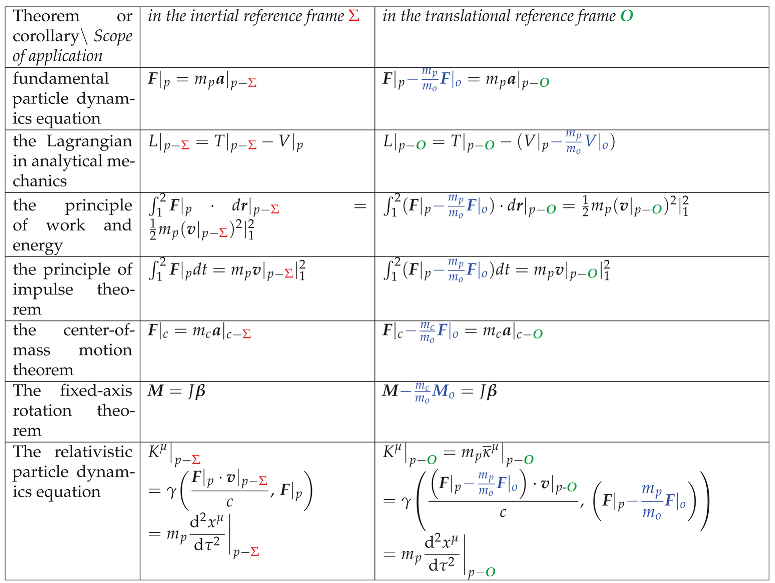 |
Disclaimer/Publisher’s Note: The statements, opinions and data contained in all publications are solely those of the individual author(s) and contributor(s) and not of MDPI and/or the editor(s). MDPI and/or the editor(s) disclaim responsibility for any injury to people or property resulting from any ideas, methods, instructions or products referred to in the content. |
© 2026 by the authors. Licensee MDPI, Basel, Switzerland. This article is an open access article distributed under the terms and conditions of the Creative Commons Attribution (CC BY) license (http://creativecommons.org/licenses/by/4.0/).
Copyright: This open access article is published under a Creative Commons CC BY 4.0 license, which permit the free download, distribution, and reuse, provided that the author and preprint are cited in any reuse.