
Submitted:
26 August 2026
Posted:
27 August 2026
You are already at the latest version
Abstract
This paper presents a facile fabrication method for C60 fullerene nanowhisker (C60FNW) gas sensors, investigating the influence of ultraviolet (UV) irradiation on their sensing behavior. Polar gases such as methanol produced distinct sensor currents, whereas non‑polar gases such as CCl₄ exhibited no measurable response. UV irradiation led to a decrease in sensor current, indicating a photo‑induced modulation of charge transport in C60FNWs. The pronounced response to polar gases is assumed to arise from two factors: (i) an increase in electrical conductivity owing to the reduction of the HOMO–LUMO gap of C60 molecules upon adsorption of polar species, and (ii) an enhanced adsorption probability driven by dipole-induced dipole interactions between the polar molecules and C60.
Keywords:
fullerene nanowhisker
; C60
; electric dipole moment
; polar gases
; photopolymer
1. Introduction
Among the different types of gas sensors, such as resistive, optical, electrochemical, and field-effect transistor (FET) sensors, chemiresistive gas sensors have been comprehensively explored owing to their low cost and ease of fabrication [1]. Different semiconducting metal oxides, carbon-based materials, and transition-metal dichalcogenides have been used as the sensing materials in chemiresistive gas sensors. A wide range of carbon-based materials, such as graphene, graphene oxide (GO), reduced GO (rGO), and carbon nanotubes (CNTs), have been comprehensively investigated for the fabrication of high-performance chemiresistive gas sensors [2].
Chemiresistive CNT-based sensors have been investigated for the detection of different gases, such as methane, ethanol, NO2, H2S, H2, Cl2, SO2, NH3, H2, CO2, isopropanol, CO, ethylene, benzene, water, acetone, chloroform, and isoprene. CNT composites with different metals and oxides such as Pd, Au, Rh, Co, Pt, ZnO, SnO2, TiO2, In2O3, Cr2O3, WO3, Cu2O, and NiO have been tested as sensing materials. Composites of graphene, rGO, and GO with different metal oxides such as TiO2, Co3O4, Fe2O3, SnO2, ZnO, WO3, In2O3, and NiO have also been investigated for chemiresistive sensing applications [2]. The carbon-based sensors typically work at room temperature, whereas the sensors based on metal oxides usually operate at high temperatures of 200–300 °C [3]. Operating under ambient conditions enables gas sensors to achieve significantly lower power usage, superior safety, and compact integration without the need for heating elements.
In addition to carbon-based chemiresistive sensors, quartz crystal microbalance (QCM) sensors have also been developed using carbon-based materials. Ethanol, butanol, isopropanol (IPA), and acetone were detected using QCM sensors coated with graphene flakes, whereas trimethylamine, ethanol, CO2 and NO2 were detected using QCM sensors based on GO or rGO [2].
Although fullerenes are completely composed of carbon atoms, their sensor applications are limited compared with those of CNT, graphene, GO, and rGO. C60 molecules have been tested as chemiresistive gas sensing materials by modifying the surface of C60 nanoparticles with metal oxides such as SnO2 for the detection of H2S gas [4]. QCM sensors using C60 and C60-aluminum composite films have been tested for water and ethanol gas sensing applications [5]. Bairi et al. synthesized hierarchically structured fullerene C70 cubes to detect volatile aromatic solvent vapors using a QCM sensor [6]. Wei et al. synthesized cornhusk-shaped C60 fullerene crystals and fabricated a QCM sensor for the detection of acetic acid vapors [7].
On the other hand, fullerene nanowhiskers (FNWs) are thin needle-like crystals of fullerene molecules that have diameters less than 1000 nm. Among various FNWs, C60 fullerene nanowhiskers (C60FNWs) have been comprehensively studied for applications in catalysis, electronics, energy, environmental, and biomedical fields [8,9]. C60 fullerene nanotubes (i.e., tubular C60FNWs) have been investigated for application in chemical sensors by forming complexes with DNA on the surface of a glassy carbon electrode for dopamine detection in highly concentrated ascorbic acid in a neutral buffer solution [10].
Although the electrical resistivity of C60FNWs decreases with the diameter [14,15], they exhibit a high electrical resistivity in air owing to the formation of a surface oxidation layer [16], which hinders their application as chemiresistive gas sensors in the ambient atmosphere. However, in this study, we demonstrated that the C60FNWs sensor current can be monitored through a high-resistance load resistor connected in series with the sensing part of the C60FNWs at room temperature.
We fabricated a slit-gap-type C60FNW gas sensor with a narrow linear gap filled with C60FNWs between the two electrodes. The sensors studied herein can be easily fabricated using graphite foil, double-sided adhesive tape, polyimide tape, or a glass substrate.
This study focuses on the electric current changes observed in C60FNW sensors exposed to various organic gases with different electric dipole moments. The C60FNW sensor is a carbon-based, and environmentally friendly device. The C60FNW sensor reported in this study is an experimental device fabricated for exploratory evaluation. A comprehensive characterization of the parameters governing the sensing performance—such as stability, sensitivity, response dynamics, and environmental dependence, will be addressed in future publications.
2. Experimental Section
2.1. Synthesis of C60FNWs and the Chemicals Used in Sensor Experiments
C60FNWs were synthesized using the LLIP method combined with manual mixing, as described previously, using a toluene solution saturated with C60 and isopropanol [17]. C60 powder (99.5% purity; BBS Chemicals) was purchased from ATR Company (Japan). Toluene (≥99.0% pure) and isopropanol (IPA, ≥99.0% pure) were purchased from Nacalai Tesque, Inc. (Japan), and used without further purification in preparing C60FNWs. The synthesized C60FNWs were vacuum-dried at room temperature and used in the sensor experiments.
In addition to toluene and IPA, other chemicals were purchased from commercial sources and used without further purification for the sensor experiments: ethanol (99.5% purity), methanol (99.8% purity), benzene (99.5% purity), acetone (99.5% purity), diethyl ether (99.5% purity), m-xylene (99% purity) (Nacalai Tesque, Inc., Japan), carbon tetrachloride (99.5% purity, Kanto Chemical Co., Inc., Japan), and methyl ethyl ketone (≥ 99% purity, SK KAKEN Co., Ltd., Japan).
The crystal structure of the synthesized C60FNWs was characterized using X-ray diffraction analysis (XRD, Cu Kα, Rigaku RINT-2200 HF X-ray diffractometer, Japan). The morphology of the C60FNWs was observed using scanning electron microscopy (SEM, HITACHI TM4000PlusII, Japan).
2.4. Fabrication of C60FNW Gas Sensors
Figure 1 (a) and (b) schematically show a slit-gap-type two-electrode gas sensor consisting of a C60FNW-filled narrow gap (width: 55 μm; length: 3 mm) between graphite foil electrodes (thickness: 50 μm, PATIKIL) and a polyimide spacer. The electrodes were attached to a glass substrate of thickness 1.3 mm using double-sided adhesive tape with a thickness 240 μm. A 100 MΩ load resistor was connected in series to one of the sensor electrodes [3]; a voltage of 30 V was applied to the sensor through the load resistor. The sensor current was calculated from the potential difference across the 100 MΩ resistor. The organic solvent was poured into a cylindrical plastic container with an inner diameter of 27 mm and a depth of 12 mm. The complete setup was enclosed in a plastic box (85 mm ×120 mm ×35 mm) fitted with a vacuum pump, as shown in Figure 1 (a). A quartz glass window with a radius of 10 mm was prepared to introduce ultraviolet (UV) light, using a UV lamp with a peak wave length of 365 nm (KONTEC, UV-SVGNC365-01FCDC, 690 mW power).
3. Results and Discussion
3.1. Structural Characterization of the Synthesized C60FNWs
Figure 2 (a) shows the SEM image of the C60FNWs synthesized using the LLIP method. The particle size distribution was determined from the SEM images, as shown in Figure 2 (b), (c), and (d). The synthesized C60FNWs exhibit a mean length of 4.3 ± 2.2 μm, a mean diameter of 630 ± 180 nm, and a mean aspect ratio of 6.8 ± 2.7. Figure 2 (e) shows the XRD profile of the synthesized C60FNW, revealing an FCC crystal structure with a lattice constant of a=1.43 nm. This value is 0.9% greater than that of the pristine FCC C60 crystals (a = 1.4166 nm, JCPDS no. 44-558).
3.2. Results for the C60FNW Gas Sensor Exposed to Organic Gases
The responses of the C60FNW gas sensors to organic gases, such as ethanol, methanol, and CCl4 were investigated. New sensors were prepared for each experiment.
Figure 3 (a) shows the background current of approximately 10 pA from a control experiment conducted without adsorbate organic gas molecules. Figure 3 (b) shows the sensor current after exposure to ethanol, followed by CCl4 gas. Table 1 lists the electric dipole moments of the gases tested. Although an evident increase in the current from the background level was observed upon exposure to ethanol (1.69 D), no distinct peak was detected upon exposure to CCl4 (0 D). The sensor current decreased rapidly when the ethanol gas was evacuated.
As shown in Figure 4, the sensor current was measured repeatedly for different combinations such as methanol and ethanol [Figure 4 (a)], methyl ethyl ketone and methanol [Figure 4 (b)], methanol and diethyl ether [Figure 4 (c)] , methanol and benzene [Figure 4 (d)], methanol and m-xylene [Figure 4 (e)], toluene and methanol [Figure 4 (f)], and IPA and 1-propanol [Figure 4 (g)]. Distinct peaks are were observed for methanol (1.70 D), ethanol (1.69 D), methyl ethyl ketone (2.779 D), IPA (1.58 D), 1-propanol (1.55–1.58 D), and acetone [2.88 D, Figure 4 (h)]. In contrast, no evident peaks were observed for diethyl ether (1.098 D), benzene (0 D), m-xylene (0.33–0.37 D), or toluene (0.375 D).
As shown in Table 1, organic gases with dipole moments greater than 1.5 D exhibited a distinct response to the C60FNW sensors, whereas organic gases with smaller or no dipole moments exhibited ambiguous or no peaks. Notably CCl4 and benzene did not exhibit any peaks, although they had higher or similar vapor pressures to ethanol and methanol, which gave clear peaks.
The electrical conductivity (σ) of a C60 crystal can be calculated using the following equation,
σ= AT 3/2exp(-HLG/2KT) , (1)
with A representing the Richardson constant (6 × 10⁵ A m−2), K being the Boltzmann constant, and T being the absolute temperature; and HLG is the HOMO-LUMO gap of a C60 molecule [18].
Using density functional theory (DFT), Alamri et al. showed that the HLG of a C60 molecule decreased from 1.68 to 0.65 eV upon the adsorption of acetone molecules on the C60 surface, increasing its electrical conductivity [18]. Similarly, Morad et al. used DFT to show that the adsorption of 5,6-dihydroxyindole-2-carboxylic acid (DHICA) molecules decreases the HLG of C60, resulting in enhanced conductivity [19]. As acetone and DHICA molecules are polar [20], this observation strongly indicates that the electrical conductivity of the C60 crystals increased owing the reduction in HLG value upon the adsorption of polar molecules.
The intrinsic electric dipole moment of C60 molecules is zero [21]. However, as the C60 molecules are enveloped by the π electron cloud, they develop a nonzero electric dipole moment owing to dipole-induced dipole interactions with polar gas molecules [22,23,24]. This interaction generates attractive forces that increase the probability of adsorption of polar gas molecules on the C60 surface. Therefore, the peaks observed in Figure 4 are attributed to the combined effects of increased electrical conductivity arising from the reduction in HLG values of the C60 molecules and the increased adsorption probability of polar gas molecules onto the surface of the C60 molecules.
Figure 5 shows the response of the C60FNW sensor upon exposure to methanol vapor, followed by irradiation with UV light. The current increased from the start of methanol gas exposure, rapidly decreased from the time of UV irradiation, and approached a constant value until the evacuation of the methanol gas.
C60 molecules polymerize upon irradiation with UV light [30]. A C60 molecule is covered by 60 π electrons [31]. However, the number of π electrons in the C60 molecule decreases when it is polymerized via the formation of sp3 bonds. The decrease in sensor current upon UV irradiation is attributed to the polymerization of C60 molecules, which reduces the number of available π electrons and weakens the dipole–induced dipole interactions responsible for the sensor response. Hence, it is assumed that the increased sensor current upon exposure to polar organic vapors resulted from the enhanced conductivity of the C60FNWs, which was caused by the reduction of their HOMO–LUMO gaps through dipole–induced dipole interactions between the polar gas molecules and C60 molecules.
4. Conclusions
(1) The C60FNW sensors exhibited evident and distinct responses to polar gas molecules with dipole moments greater than 1.5 D. The increase in the sensor current is assumed to originate from two effects: (i) a conductivity enhancement caused by the reduction of the HOMO–LUMO gap upon adsorption of polar molecules and (ii) an increased adsorption probability driven by dipole–induced dipole interactions between the polar species and C60.
(2) When the sensor was exposed to methanol gas, the sensor current decreased rapidly upon exposure to UV light. This behavior is attributed to the polymerization of C60 molecules, reducing the number of available π electrons to weaken the dipole-induced dipole interactions responsible for the sensor response.
Author Contributions
XXX
Funding
Please add: This research received no external funding.
Data Availability Statement
All data generated or analyzed during this study are included in this published article.
Acknowledgments
The authors are grateful to Dr. Takatsugu Wakahara (NIMS, Japan) for the insightful discussions regarding our research.
Conflicts of Interest
The authors declare no conflicts of interest.
References
- Hong, S.; Wu, M.; Hong, Y.; Jeong, Y.; Jung, G.; Shin, W.; Park, J.; Kim, D.; Jang, D.; Lee, J.-H. “FET-Type Gas Sensors: A Review,”. Sens. Actuators B Chem. 2021, 330, 129240. [Google Scholar] [CrossRef]
- Hejazi, 2 M.-A.; Eksik, O.; Taşdelen-Yücedağ, Ç.; Ünlü5, C.; Trabzon, L. Carbon-Based Nanomaterials in Gas Sensing Applications. Emergent Mater. 2023, 6, 45–77. [Google Scholar] [CrossRef]
- Galvani, M.; Freddi, S.; Sangaletti, L. Disclosing Fast Detection Opportunities with Nanostructured Chemiresistor Gas Sensors Based on Metal Oxides, Carbon, and Transition Metal Dichalcogenides. Sensors 2024, 24, 584. [Google Scholar] [CrossRef] [PubMed]
- Keshtkar, S.; Rashidi, A.; Kooti, M.; Askarieh, M.; Pourhashem, S.; Ghasemy, E.; Izadi, N. A Novel Highly Sensitive and Selective H2S Gas Sensor at Low Temperatures Based on SnO2 Quantum Dots-C60 Nanohybrid: Experimental and Theory Study. Talanta 2018, 188, 531–539. [Google Scholar] [CrossRef] [PubMed]
- Grynko, D.; Burlachenko, J.; Kukla, O.; Kruglenko, I.; Belyaev, O. Fullerene and Fullerene-Aluminum Nanostructured Films as Sensitive Layers for Gas Sensors. Semicond. Phys. Quantum Electron. Optoelectron. 2009, 12, 287–289. Available online: https://nasplib.isofts.kiev.ua/handle/123456789/118877. [CrossRef]
- Bairi, P.; Minami, K.; Nakanishi, W.; Hill, J. P.; Ariga, K.; Shrestha, L. K. Hierarchically Structured Fullerene C70 Cube for Sensing Volatile Aromatic Solvent Vapors. ACS Nano 2016, 10, 6631−6637. [Google Scholar] [CrossRef] [PubMed]
- Wei, 7 Z.; Song, J.; Ma, R.; Ariga, K.; Shrestha, L. K. Self-Assembled Corn-Husk-Shaped Fullerene Crystals as Excellent Acid Vapor Sensors. Chemosensors 2022, 10, 16. [Google Scholar] [CrossRef]
- Miyazawa, K.; Kuwasaki, Y.; Obayashi, A.; Kuwabara, M. C60 Nanowhiskers Formed by the Liquid-Liquid Interfacial Precipitation Method. J. Mater. Res. 2002, 17, 83–88. [Google Scholar] [CrossRef]
- Ko, S. W.; Chung, H. “Synthesis of a Bimetallic Co/Zn Zeolitic Imidazolate Framework-C60 Fullerene Nanowhisker Composite and its Photocatalytic Degradation of Tetracycline Hydrochloride under LED Light Condition”. Eurasian Chem.-Technol. J. 2025, 27, 191─198. [Google Scholar] [CrossRef]
- Zhang, X.; Qu, Y.; Piao, G.; Zhao, J.; Jiao, K. Reduced Working Electrode Based on Fullerene C60 Nanotubes@DNA: Characterization and Application. Mater. Sci. Eng. B 2010, 175, 159. [Google Scholar] [CrossRef]
- Ogawa, K.; Kato, T.; Ikegami, A.; Tsuji, H.; Aoki, N.; Ochiai, Y. Electrical Properties of Field-Effect Transistors Based on C60 Nanowhiskers. Appl. Phys. Lett. 2006, 88, 112109. [Google Scholar] [CrossRef]
- Nobuoka, M.; Sakaguchi, S.; Kawata, M.; Taguchi, A.; Kishida, K.; Tsutsui, Y.; Suda, M.; Inoue, H.; Idesaki, A.; Yamaki, T.; Seki, S. High Electrical Conductivity in Directionally Polymerized C60 Nanowires by Grazing Incidence Single Particle. Nanoscale Horiz. 2025. [Google Scholar] [CrossRef] [PubMed]
- Miyazawa, K. “Synthesis and Properties of Fullerene Nanowhiskers and Fullerene Nanotubes”. J. Nanosci. Nanotechnol. 2009, 9, 41–50. [Google Scholar] [CrossRef] [PubMed]
- Miyazawa, K.; Kuwasaki, Y.; Hamamoto, K.; Nagata, S.; Obayashi, A.; Kuwabara, M. Structural Characterization of C60 Nanowhiskers Formed by the Liquid/liquid Interfacial Precipitation Method. Surf. Interface Anal. 2003, 35, 117–120. [Google Scholar] [CrossRef]
- Larsson, M. P.; Kjelstrup-Hansen, J.; Lucyszyn, S. DC Characterisation of C60 Whiskers and Nanowhiskers. ECS Trans. 2007, 2, 27–38. [Google Scholar] [CrossRef]
- Xu, M. S.; Pathak, Y.; Fujita, D.; Ringor, C.; Miyazawa, K. Covered Conduction of Individual C60 Nanowhiskers. Nanotechnology 2008, 19, 075712. [Google Scholar] [CrossRef] [PubMed]
- Miyazawa, K.; Hirata, C.; Wakahara, T. Influence of the Solution Volume on the Growth of C60 Nanowhiskers. J. Cryst. Growth. 2014, 405, 68. [Google Scholar] [CrossRef]
- Alamri; Alafnan, A. Computational study on B, N, and Si-Doped C60 Nanocages for Acetone Detection in Heart Failure Diagnosis and Environmental Remediation. Sci. Rep. 2025, 15, 44298. [Google Scholar] [CrossRef] [PubMed]
- Morad, R.; Maaza, M. First-Principles Study on the Electronic and Optical Properties of Melanin–Fullerene C60 Nanocomplexes for Light-Harvesting Applications. J. Mater. Res. 2026, 41, 259. [Google Scholar] [CrossRef]
- Matta, M.; Pezzella, A.; Troisi, A. Relation between Local Structure, Electric Dipole, and Charge Carrier Dynamics in DHICA Melanin: A Model for Biocompatible Semiconductors. J. Phys. Chem. Lett. 2020, 11, 1045−1051. [Google Scholar] [CrossRef] [PubMed]
- Calculated electric dipole moments for (Buckminsterfullerene). Available online: https://cccbdb.nist.gov/dipole2x.asp.
- Israelachvili, J. N. Intermolecular and Surface Forces, Third Edition; Elsevier, 2011. [Google Scholar]
- Mezour, M. A.; Voznyy, O.; Sargent, E. H.; Lennox, R. B.; Perepichka, D. F. Controlling C60 Organization through Dipole-Induced Band Alignment at Self-Assembled Monolayer Interfaces. Chem. Mater. 2016, 28, 8322−8329. [Google Scholar] [CrossRef]
- Solov’yov, A.; Geng, J.; Solov’yov, A. V.; Johnson, B.F.G. On the Possibility of the Electron Polarization to be the Driving force for the C60-TMB Nanowire Growth. Chem. Phys. Lett. 2009, 472, 166–170. [Google Scholar] [CrossRef]
- CRC Handbook of Chemistry and Physics, 97th Edition; CRC Press,Taylor & Francis Group, FL, USA, 2017.
- NIST Chemistry WebBook, SRD69. Available online: https://webbook.nist.gov.
- National Library of Medicine. Available online: https://pubchem.ncbi.nlm.nih.gov.
- Rai, B.; Ghimire, R. R.; Dhakal, C.; Pudasainee, K.; Siwakoti, B. Structural Equilibrium Configuration of Benzene and Aniline: A First-Principles Study. J. Nepal Chem. Soc. 2024, 44, 1−15. [Google Scholar] [CrossRef]
- Minkin, V.I.; Osipov, O.A.; Zhdanov, Y.A. Dipole Moments in Organic Chemistry; Plenum: New York, 1970. [Google Scholar]
- Dean, J.A. Lange’s Handbook of Chemistry, Fifteenth Edition; McGraw-Hill, Inc., 1999. [Google Scholar]
- Alvarez-Zauco, E.; Sobral, H.; Basiuk, E. V.; Saniger-Blesa, J. M.; Villagr’an-Muniz, M. Polymerization of C60 fullerene thin films by UV pulsed laser irradiation. Appl. Surf. Sci. 2005, 248, 243–247. [Google Scholar] [CrossRef]
- Chen, Z.; Wu, J. I.; Corminboeuf, C.; Bohmann, J.; Lu, X.; Hirsch, A.; Schleyer, P. von R. Is C60 buckminsterfullerene aromatic? Phys. Chem. Chem. Phys. 2012, 14, 14886–14891. [Google Scholar] [CrossRef] [PubMed]
Figure 1.
(a) Plan view of the slit gap-type C60FNW gas sensor with two electrodes prepared using pieces of graphite foil. The C60FNW powder was filled into the gap with a width of 55 μm and a length of 3 mm. A direct voltage of 30 V was applied. (b) Side view of the slit gap-type C60FNW sensor. A quar glass window with a radius of 10 mm was prepared to introduce UV light with a peak wavelength of 365 nm.
Figure 1.
(a) Plan view of the slit gap-type C60FNW gas sensor with two electrodes prepared using pieces of graphite foil. The C60FNW powder was filled into the gap with a width of 55 μm and a length of 3 mm. A direct voltage of 30 V was applied. (b) Side view of the slit gap-type C60FNW sensor. A quar glass window with a radius of 10 mm was prepared to introduce UV light with a peak wavelength of 365 nm.
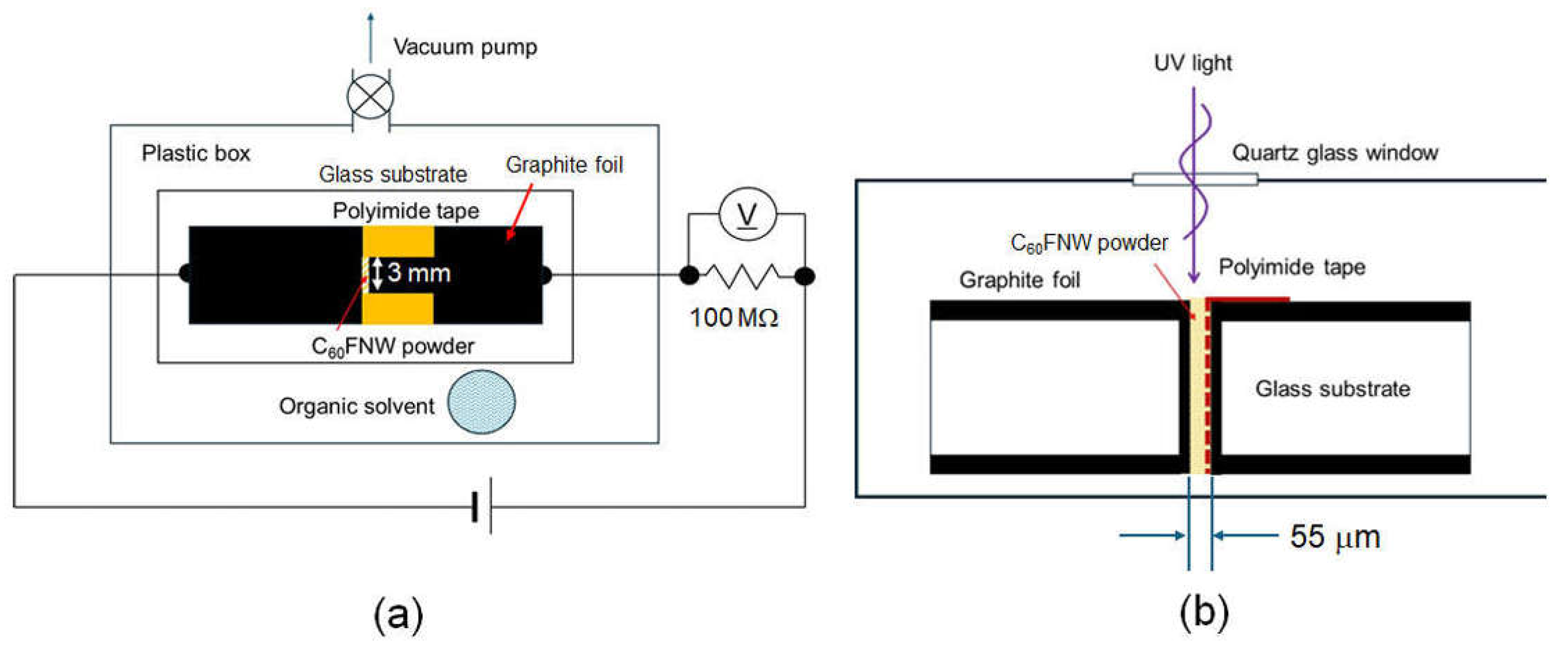
Figure 2.
(a) SEM image of the C60FNWs prepared using the LLIP method. Distributions of (b) length, (c) diameter, and (d) aspect ratio (b/a) for the synthesized C60FNWs. (e) XRD profile of the synthesized C60FNW powder.
Figure 2.
(a) SEM image of the C60FNWs prepared using the LLIP method. Distributions of (b) length, (c) diameter, and (d) aspect ratio (b/a) for the synthesized C60FNWs. (e) XRD profile of the synthesized C60FNW powder.
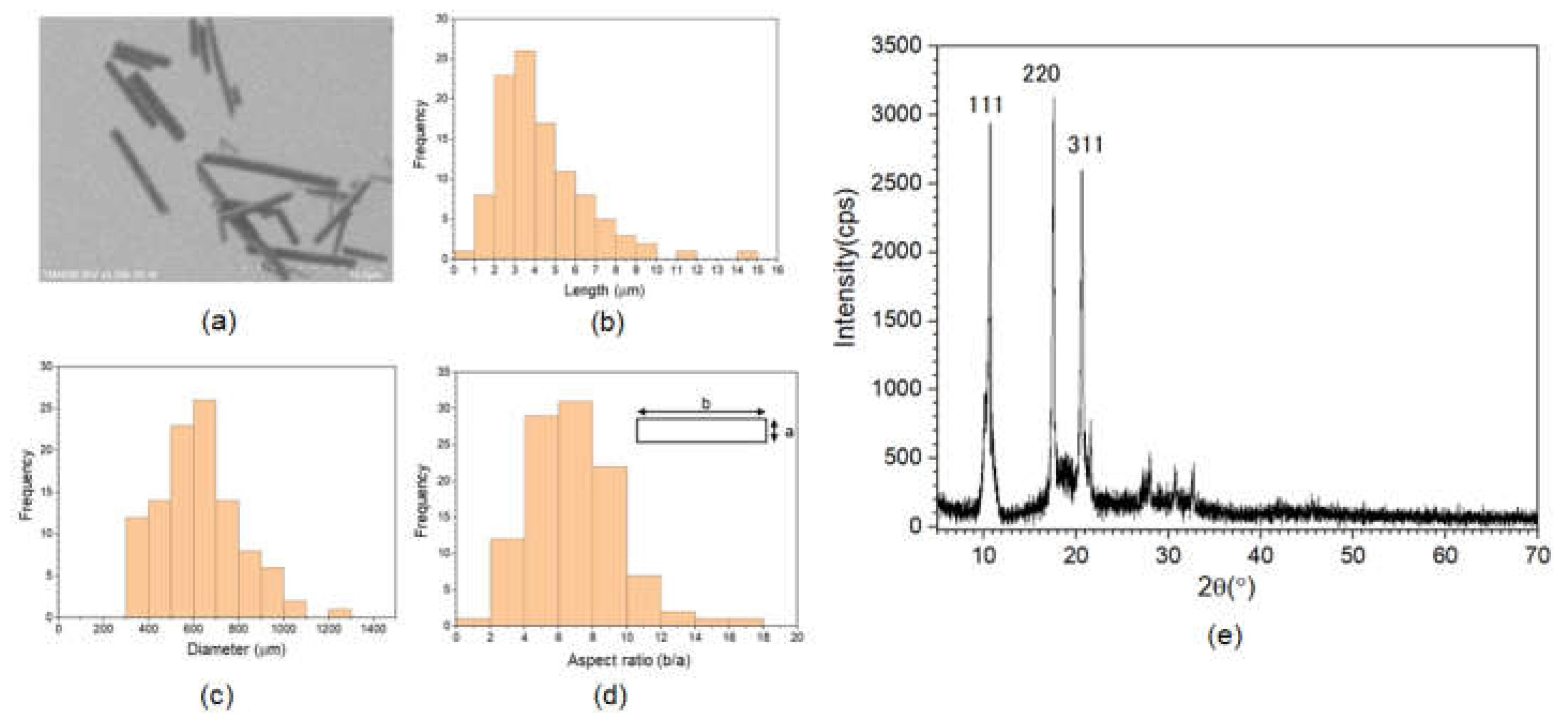
Figure 3.
Variation of sensor currents with respect to exposure time for (a) control experiment for the slit-type-gap C60FNW sensor in the ambient air without adsorbate organic gas molecules, and (b) exposure to an ethanol gas followed by a CCl4 gas.
Figure 3.
Variation of sensor currents with respect to exposure time for (a) control experiment for the slit-type-gap C60FNW sensor in the ambient air without adsorbate organic gas molecules, and (b) exposure to an ethanol gas followed by a CCl4 gas.
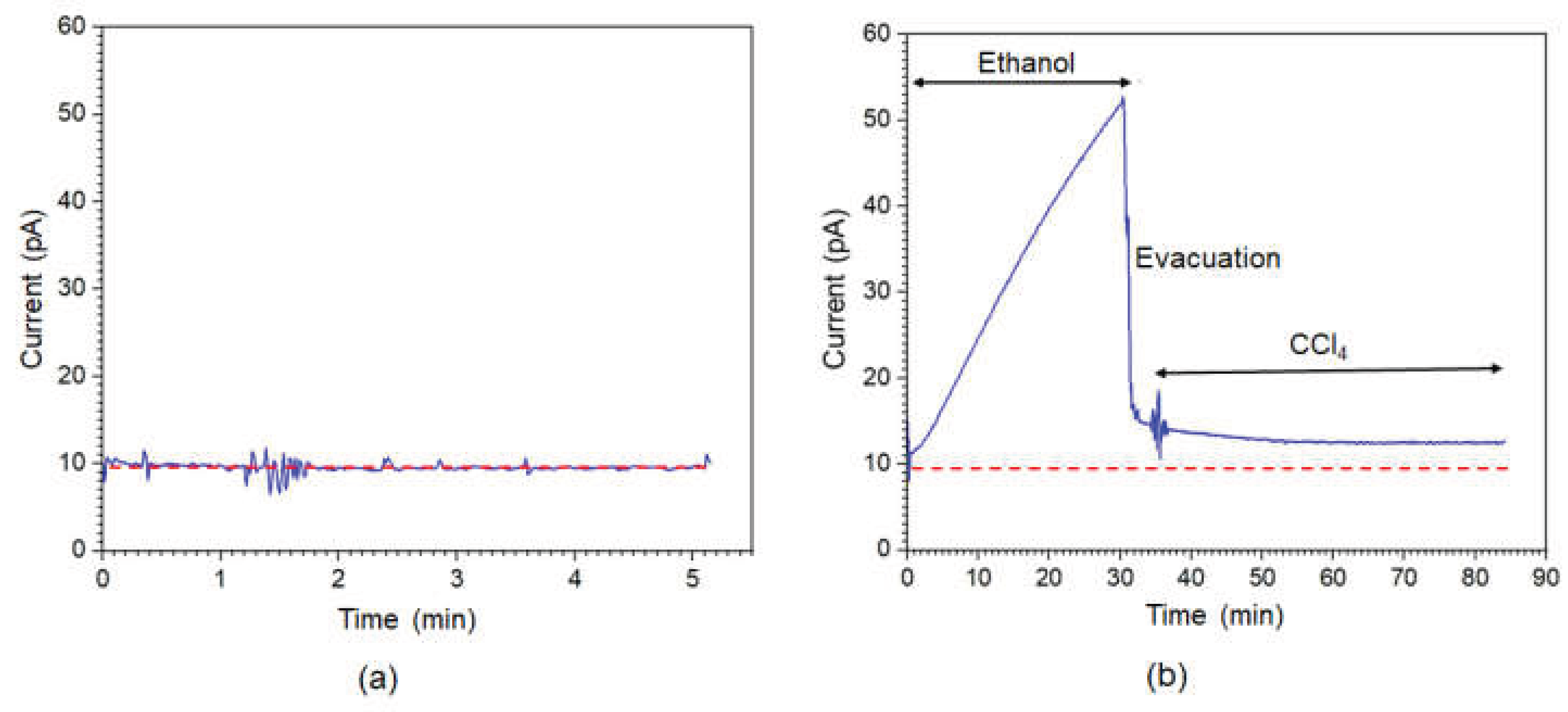
Figure 4.
Measured sensor currents with time for repeated exposure for (a) methanol and ethanol, (b) methyl ethyl ketone and methanol, (c) methanol and diethyl ether, (d) methanol and benzene, (e) methanol and m-xylene, (f) toluene and methanol, (g) IPA and 1-propanol, and (h) acetone.
Figure 4.
Measured sensor currents with time for repeated exposure for (a) methanol and ethanol, (b) methyl ethyl ketone and methanol, (c) methanol and diethyl ether, (d) methanol and benzene, (e) methanol and m-xylene, (f) toluene and methanol, (g) IPA and 1-propanol, and (h) acetone.
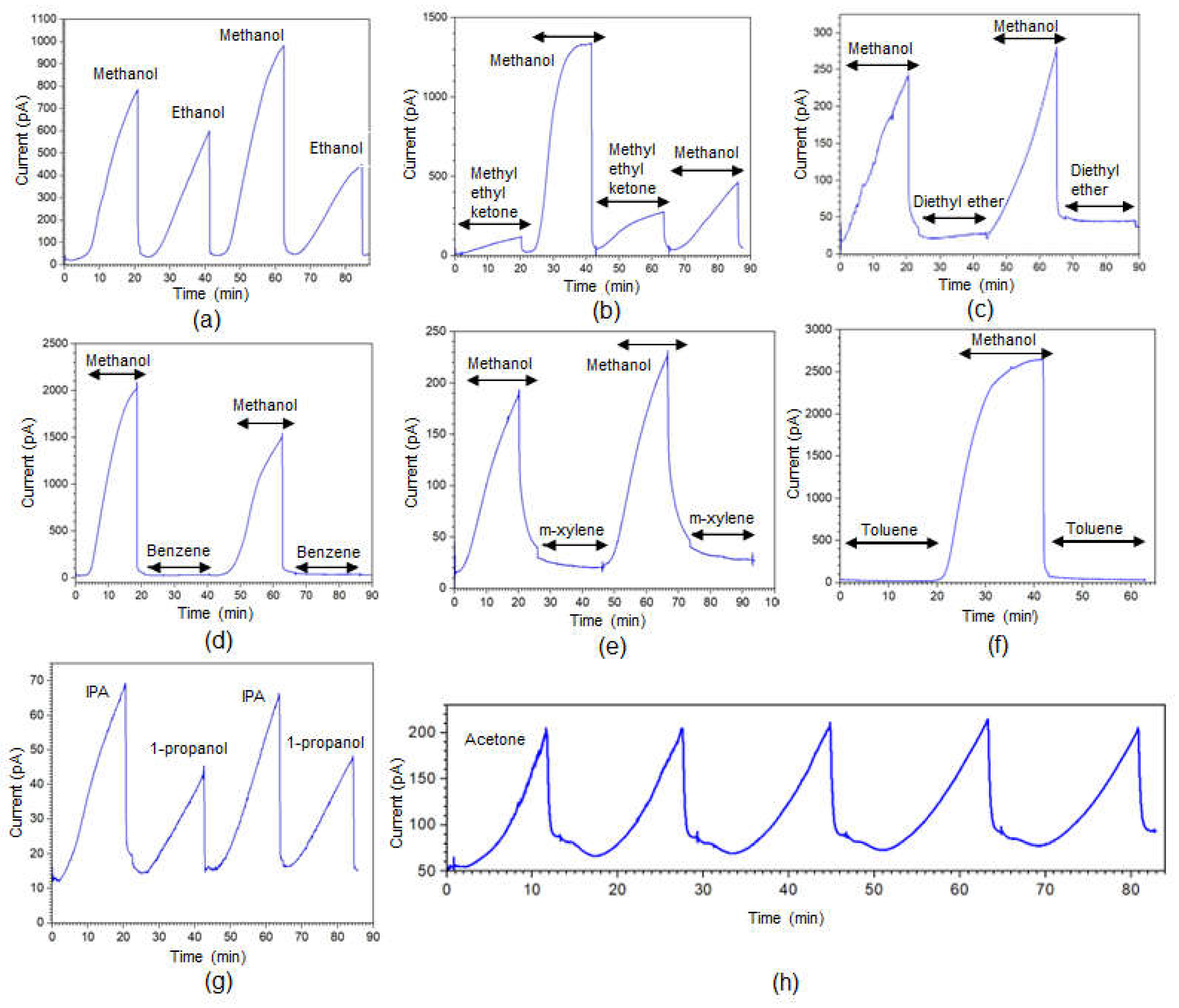
Figure 5.
The variation of sensor current with time upon the exposure to methanol gas.
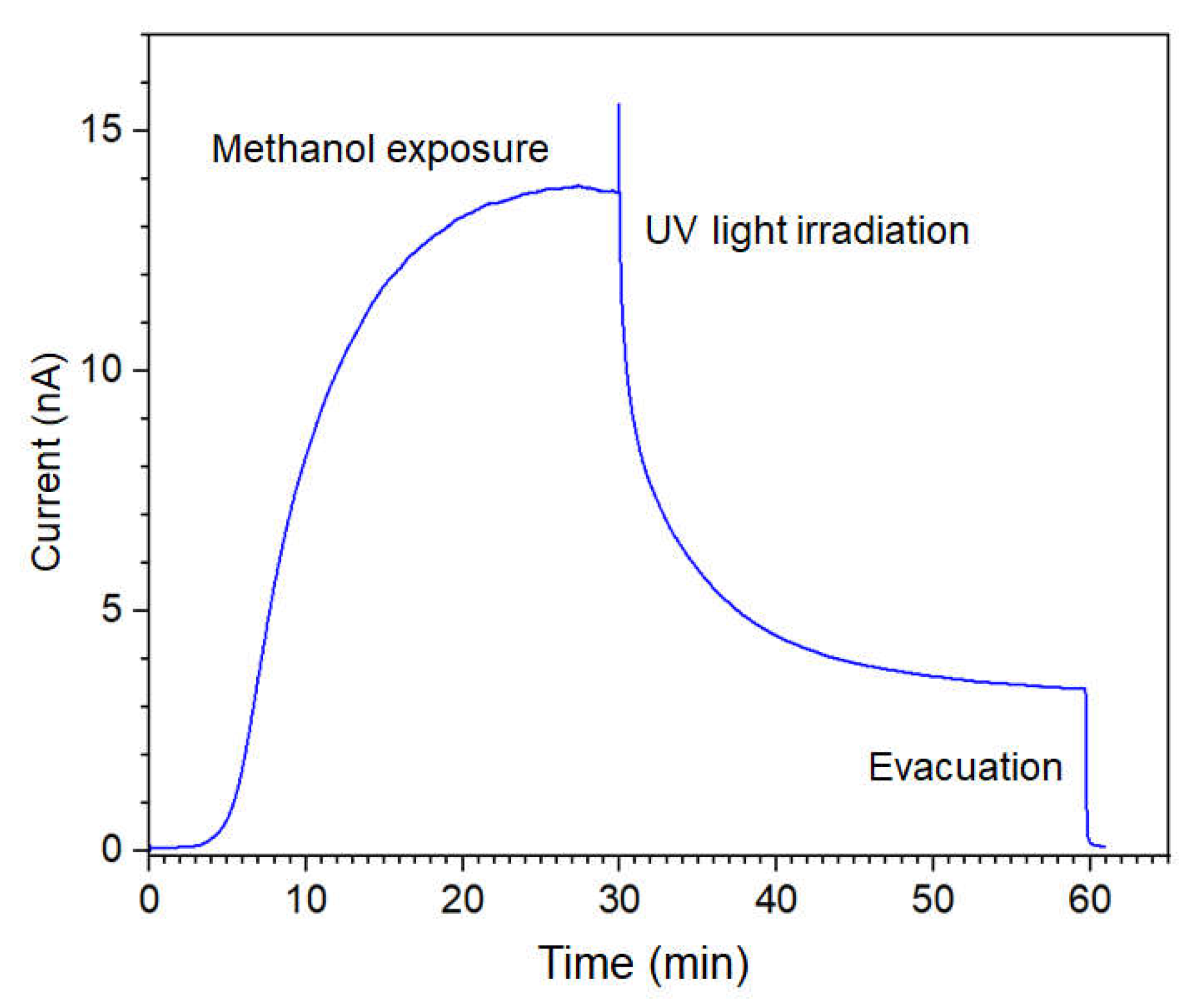

Table 1.
Electric dipole moment and vapor pressure for tested gasses.
| Chemical species | Chemical formula | Electric dipole moment (D, debye) | Vapor pressure (Pa) at 298 K |
| Methanol | CH3OH | 1.70 [25] | 1.68×10⁴ [26] |
| Ethanol | C2H5OH | 1.69 [25] | 7.80×10³ [26] |
| 1-propanol | CH3CH2CH2OH | 1.55–1.58 [25] | 2.79×10³ [26] |
| Isopropanol (IPA) | (CH3)2CHOH | 1.58 [25] | 6.05×10³ [27] |
| Methyl ethyl ketone | CH3COC2H5 | 2.779 [25] | 1.33×10⁴ [27] |
| Diethyl ether | (CH3CH2)2O | 1.098 [25] | 6.65×10⁴ [26] |
| Benzene | C6H6 | 0 [28] | 1.20×10⁴ [26] |
| Carbon tetrachloride | CCl4 | 0 [29] | 1.51×10⁴ [26] |
| Toluene | C6H5CH3 | 0.375 [25] | 3.78×10³ [26] |
| Acetone | (CH3)2CO | 2.88 [25] | 3.04×10⁴ [26] |
| Water | H2O | 1.8546 [25] | 3.14×10³ [26] |
| m-xylene | C6H4(CH3)2 | 0.33–0.37 [30] | 1.10×10³ [26] |
Disclaimer/Publisher’s Note: The statements, opinions and data contained in all publications are solely those of the individual author(s) and contributor(s) and not of MDPI and/or the editor(s). MDPI and/or the editor(s) disclaim responsibility for any injury to people or property resulting from any ideas, methods, instructions or products referred to in the content. |
© 2026 by the authors. Licensee MDPI, Basel, Switzerland. This article is an open access article distributed under the terms and conditions of the Creative Commons Attribution (CC BY) license (http://creativecommons.org/licenses/by/4.0/).
Copyright: This open access article is published under a Creative Commons CC BY 4.0 license, which permit the free download, distribution, and reuse, provided that the author and preprint are cited in any reuse.