
Submitted:
26 August 2026
Posted:
27 August 2026
You are already at the latest version
Abstract
Poland is the largest hard coal producer in the European Union. Economic decarbonization, undertaken to slow climate change, is reducing demand for fossil fuels. The restructuring of the hard coal mining industry in Poland is adapting the sector to new market, environmental, and social challenges. Currently, the Polish energy sector is not prepared to phase out the combustion of thermal coal. A transition period is necessary, during which the Polish hard coal mining industry must provide sufficient coal to stabilize the power grid through coal-fired power plants. Coal extraction occurs in extraction excavations, but to enable their operation, mining companies must conduct a certain amount of preparatory roadway excavations. The article analyzes the changes occurring in the basic technical parameters of excavated preparatory excavations and the difficulties affecting the length and number of excavated preparatory roadway excavations. Selected reasons for the temporary suspension of excavated preparatory roadway excavations are also analyzed. An attempt is made to identify the most important causes of these limitations and proposes recommendations. The obtained results of the statistical review of difficulties in preparatory exploitation will be used to present a picture of the current condition of the sector and to forecast possible directions of transformation of the hard coal mining sector in Poland and can potentially be used in other countries conducting similar decarbonization processes.
Keywords:
hard coal mining
; mining restructuring
; preparatory excavations
; decarbonization of the economy
; efficiency
1. Introduction
Central and Eastern Europe has large coal basins of similar nature, encompassing Poland, Germany, the Czech Republic, and Ukraine. In Germany and the Czech Republic decarbonization processes have already led to the cessation of mining. Germany ceased mining at the end of 2018, and the Czech Republic followed suit at the end of 2025. Currently, hard coal mining in this region is conducted in Poland and Ukraine.
The decarbonization transformation of economies counteracts the growing climate change. The green transformation of the economy and energy sector, including Poland, leads to a shift away from obtaining energy from fossil fuels [1]. To reduce the economy's carbon footprint, the hard coal mining industry in Poland is undergoing restructuring. The industry is gradually reducing production capacity, and the sector is adapting to new tasks and market conditions. In accordance with the decarbonization policy, industry and the energy sector are gradually moving away from traditional high-emission technologies. As Poland is the largest hard coal producer in the EU, traditional energy generation is based on the combustion of thermal coal [2]. Poland's energy generation and transmission infrastructure has been adapted to this method of energy generation and to traditional energy supply sources. The challenges of the energy transformation are compounded by social, economic, and political factors. According to the so-called social contract, the phase-out of thermal coal mines in Poland will continue until 2049. Until an alternative to coal-fired power generation becomes available to stabilize the grid, coal-fired power will continue to stabilize the Polish energy system [3,4]. Mining must be conducted efficiently and safely, supported by public funds. As demand for thermal coal decreases, the energy sector's mining capacity is being reduced, and the mining industry must adapt to the new situation [5,6]. The restructuring of the hard coal mining industry aims to improve the technical and economic efficiency of mining enterprises and optimally utilize their resources. Mining must continue efficiently and safely until the mining units reach the end of their operational life [7].
Technically, extracting minerals from a previously developed deposit requires the prior construction of preparatory roadway excavations, connecting the access roadway excavations with the extraction (exploitation) excavations. Preparatory roadway excavations are usually carried out within the deposit, so at least part of their cross-section is coal. Therefore, preparatory roadway excavations are also a small source of minerals useful for mines. Despite their short lifespan, preparatory roadway excavations enable proper, safe, and efficient mining in mining plants. By analyzing selected technical aspects of extracting raw materials through the development of preparatory roadway excavations, this study can help prepare effective adaptation measures for the hard coal mining sector in response to the changing situation on energy markets.
Another significant factor disturbing the proper functioning of economies, including the Polish one, was the global disruption of the fossil fuel supply structure caused by the Covid-19 pandemic (2020), the war in Ukraine (2022).
2. Methods
The presented analysis of technical indicators for the development of preparatory roadway excavations in the hard coal mining industry was based on information on hard coal mining processes in Poland from 2016 to 2025, periodically reported by mining companies [8]. As part of their statistical obligation, entrepreneurs engaged in hard coal mining in Poland report the parameters of their mining operations to the Katowice branch of the Industrial Development Agency (IDA) (Agencja Rozwoju Przemysłu S.A.). After collecting the data, the IDA provides central government units (including the Central Statistical Office) with aggregated statistical information on the mining activities of mining companies. Based on the data provided by the Industrial Development Agency, the Central Statistical Office presents only selected information on mining on its website. The data for the analysis was obtained from the website https://polskirynekwegla.pl/, maintained by the Katowice branch of the IDA. Data for analysis was obtained from the website https://polskirynekwegla.pl/, run by the Katowice branch of the Industrial Development Agency [8]. The presented data does not fully represent the entire sector. One small Polish mining company does not report its indicators. For this reason, the data presented in this article formally apply only to other domestic hard coal producers. However, it should be noted that this company's share in domestic production is marginal, not exceeding 0.15%, while the average impact on the coal market of other mining units during this period averages 3.39%. Therefore, the absence of this company's production results in the databases does not significantly impact the results of the entire sector. However, it should be noted that this company's share in production is marginal, and the absence of its results in the databases does not significantly affect the results of the entire sector. To protect the sensitive data of all mining companies, the presented analysis uses only aggregated data for the entire sector. However, this allows for drawing general conclusions, presenting recommendations, and comparing general results with those of specific producers.
The aim of this publication is to present the results of the author's statistical analysis of the effectiveness of development preparatory roadway excavations for the period from 2016 to 2025. The analysis identifies the most important factors hindering the development of preparatory roadway excavations. The authors' intention was to indicate only the general trend of change. For this scope of information presented, it was deemed sufficient to use simple linear regression and rely solely on visual analysis of trend lines. The dataset on the processes of conducting preparatory excavation and information on the correlation of the impact of various political, social and economic factors obtained during the research will enable the preparation of potential scenarios for possible directions of changes in the coal sector's adaptation to the dynamically changing situation on the fossil fuel market in the near and long term.
The present study analyzed only the group of preparatory roadway excavations. Due to the different driving methods, purpose, duration, and operational parameters, the group of access roadway excavations is not fully comparable to preparatory roadway excavations. The group of access roadway excavations with a long duration most often includes so-called stone roadway excavations. Stone roadway excavations are usually carried out in a rock massif and their entire cross-section contains waste rock (stone), hence their name. In stone roadway excavations, coal occurs only sporadically, if the excavation passes through the deposit. Coal, coal-stone, and stone-coal roadway excavations are usually assigned to preparatory roadway excavations. Preparatory roadway excavations, with a relatively short duration, are usually carried out in coal seams, therefore, coal is present in their cross-section, and the additional share of waste rock (stone) results from the dimensions of the excavation cross-section exceeding the thickness of the seams. To facilitate analysis and due to the significant similarities between the roadway excavations, in the presented analysis, the group of stone-coal roadway excavations includes two groups of roadway excavations, called stone-coal and coal-hard. In accordance with mining nomenclature, these roadway excavations differ only in the percentage of waste rock (stone) in the cross-section of the excavation [9].
The analysis is based on data directly reported by mining companies and on data calculated based on data reported by mining companies. Each indirectly obtained (calculated) value in the text includes information on how the calculations were made. The correlation between the individual analyzed aspects of mine excavations and the ongoing phenomena was established based on interviews with individuals currently managing hard coal mining operations in mines and with individuals who were formerly employed as managers of mines or coal companies. An additional source of information in this regard was conversations with selected employees of the crews performing preparatory mine excavations. Such conversations were conducted during routine mine visits. The authors' own experience in managing crews boring and closing preparatory mine excavations was also significant.
Underground hard coal mining technology requires the continuous development, maintenance, and subsequent liquidation of a certain number of preparatory roadway excavations. Underground hard coal mining begins with the creation of access roadway excavations, providing access to the selected part of the deposit. In the next stage preparatory roadway excavations are driven to enable the development of exploitation roadway excavations. Only then does the phase of mining the prepared part of the deposit begin. The technological cycle of deposit mining ends with the ongoing liquidation of redundant exploitation and preparatory roadway excavations.
The scope and length of preparatory roadway excavations required are directly related to the planned production volume and are adjusted by the mining and geological conditions of the field being mined [10]. In the context of declining production, fewer new preparatory roadway excavations are required, while descending to greater depths and extracting the deposit in increasingly complex mining and geological conditions leads to the opposite effect [11,12]. Particularly below a depth of approximately 700 to 800 meters, mining below this depth may prevent the reuse of previously excavated preparatory roadway excavations and necessitate the construction of new roadway excavations to functionally replace them [13].
In Poland, a typical preparatory excavation is excavated in the mined seam using a roadheader with point-cutting [14]. Continuous miners are not used in Polish mines, but sometimes, under specific conditions, the excavation can be excavated by drilling holes and mined with explosives. Preparatory excavations are typically constructed in an open-arch steel support (vaulted) with spacing no greater than 1 meter [15,16]. The shape of the support is adapted to the self-supporting rock vault. The most commonly used steel profile is a V-shaped (trough-shaped), which allows for slip-joining of elements and maintains the support's flexibility under pressure [17]. The most popular steel sections are V29 and V32 (less commonly V21, V25, V34, or V36), where the number indicates the approximate weight of 1 linear meter of the section in kilograms. The space between the support arches is secured with steel mesh or reinforced concrete elements. Due to ventilation requirements, excavations often have a cross-section of up to 18 m², with a bottom width of approximately 3.0 m to 5.0 m and a height of approximately 2.5 m to 3.5 m. The arch consists of three or four segments (a ceiling arch and side arches) connected by stirrups, usually without a segment securing the excavation floor. In specific cases, other types of support may also be used [9,18]. Most often, the workers are employees of the mine operator, but sometimes the construction of a specific excavation is outsourced to a subcontractor hired specifically for this work.
3. Restructuring of Hard Coal Mining in Poland
The ongoing restructuring of the hard coal mining sector in Poland is a result of the sector's adaptation to current market conditions. The most unprofitable mines, mines with depleted deposits, and mines particularly hazardous to personnel are being closed on an ongoing basis. These processes are compounded by the decarbonization of the economy and a shift away from fossil fuels [1,3]. The green transformation of the economy and the reduction of the energy sector's carbon footprint are intensifying restructuring processes. These processes are limiting mining capacity, which also impacts other aspects of mining companies' operations [19]. This decarbonization of the economy has resulted in a systematic decline in hard coal mining in Poland for many years (Figure 1 and Table A1) [5,6,8]. Historically, the highest hard coal mining production in Poland was recorded in 1977. According to official data, slightly over 200 million Mg (Mg = metric tonne) of coal was extracted in 1977. This level of extraction was mainly due to political and propaganda reasons and significantly exceeded the needs of the economy and the mining industry's production capacity.
Over the past ten years, the hard coal mining sector has been drastically reducing production by all domestic producers. In the analyzed period from 2016 to 2025, coal companies recorded the highest commercial coal production of 70.4 million Mg/year in 2016 (Figure 1 and Table A1). Since the initiation of the liquidation processes, a steady decline in production volume has been observed [8]. In 2025, compared to 2016, Polish hard coal mining production decreased by approximately 3.1 million Mg annually, corresponding to an annual decline of 4.4 percentage points.
At the end of 2025, mining companies achieved extraction of approximately 42.8 million Mg (slightly above 20% of the record extraction from 1977). In 2025, approximately 1.2 million Mg less was extracted than in the previous year (2.7% less year-on-year) (Figure 1 and Table A1). In 2025, domestic producers satisfied approximately 90% of the demand of Polish consumers burning hard coal, the rest being obtained from imports [8].
Decarbonization of economies reduces industrial and energy demand for fossil fuels but does not relieve mining companies of the obligation to operate efficiently. According to the principles of mining concentration, mining activities should be carried out in as few mining units as possible. This is achieved by closing mines that are permanently unprofitable. Over the past ten years, the number of mining units has decreased from 23 in 2016 to 18 in 2025. In 2025, hard coal mining was conducted by nine mining companies. Polska Grupa Górnicza SA operated seven mining units, Jastrzębska Spółka Węglowa SA operated four, and the remaining entities operated one mining unit each [8]. Before 2016, the decline in the number of mining units resulted both from the transfer of subsequent mines for actual liquidation and from the administrative processes of merging mines within mining companies into integrated mines. After 2016, the decline in the number of active mining units was caused by the liquidation of permanently inefficient plants [7]. Since 2016, 5 mining units have been liquidated, which corresponds to a decrease of approximately 22% (Figure 2 and Table A1). A unique phenomenon was the emergence of an additional unit conducting active mining in 2020. Mining was then temporarily restarted in a mine already placed under liquidation, where the liquidation process had already begun and continued until areas ready for exploitation were selected. Due to the occurrence of a shock in one of the mining units in 2024 and the excessive risk to the crew in this unit, the mining unit was put into liquidation from 01.01.2026 and one private mining company ceased mining in December 2025, so from 2026 the number of mining units will be reduced by 2.
The analysis of the number of mining units may give a false picture of the sector (Figure 2 and Table A1). Among mining units, there are structures that can be interpreted as single mines, but there are also units composed of two or more unit mines. To better present the specificity of the sector, in accordance with the data reported by the sector, the number of unit mines was determined. In accordance with the logic of reducing the sector's mining capacity, the number of active unit mines has been constantly decreasing. Since 2016, the number of active unit mines in the mining industry has decreased by 7 unit mines, from 33 in 2016 to 26 in 2025. The previously mentioned shock in one of the mines and the planned liquidation of two further unit mines will lead to a reduction in the number of unit mines to 23 by the end of 2026. The so-called "social contract" provides for further reduction of the sector's mining capacity and the resulting liquidation of subsequent mining units or individual mines (unit mines) [3,7].
The dominant mining system in hard coal mining in Poland is the longwall system, which involves caving the roof rock [20]. To simplify matters and in accordance with the requirements for mining units or individual mines (unit mine), extraction efficiency and the associated concentration of output suggest that the highest possible extraction should be achieved in the smallest possible number of mining faces. The only difference from mining units or unit mines is the relatively short operating time of the longwall and the relative ease of its liquidation.
In line with the principles of mining concentration and the requirements of proper sector restructuring, the number of mining faces (longwalls) in Poland is decreasing (Figure 3 and Table A1). Over the last 10 years, starting in 2016, the number of longwalls has decreased from 94.8 to 58.3 in 2025, a decrease of approximately 39%. The fraction used in the table to express the number of longwalls may be confusing at first glance. In the presented statistics, to include a value of 1 in the number of longwalls, a given longwall must be in operation for all days of the month. If it operates for a different number of days, a fraction based on the number of days worked is used. Analyzing only the number of longwalls against the background of the entire sector, one might get the impression that mining is conducted in accordance with the principles of mining concentration.
4. Results and Discussion
4.1. Analysis of the Length of the Developed Preparatory Roadway Excavations
The calculations of the length of developed preparatory roadway excavations were based on data reported by mining companies regarding the so-called hard coal and coal preparatory roadway excavations. In the assessed period of 2016 to 2025 in the Polish hard coal mining industry, the length of all new preparatory roadway excavations decreased by approximately 77 km, from approximately 254 km in 2016 to 177 km in 2025 (Figure 4 and Table A2) [8]. This corresponds to a decrease of approximately 30%. The years 2021 and 2022 were an exception, when coal companies reported an increase in the length of developed roadway excavations by 4 km and then by 2 km year-on-year, respectively. This increase in length resulted from the increased demand for hard coal by global economies. Additionally, in 2020, due to the so-called COVID restrictions, significantly fewer preparatory roadway excavations were excavated than in 2019 (37 km less and 15% less year-on-year). At that time, the mining industry also used up some of the previously prepared reserves of preparatory roadway excavations. To recreate the mining front, adapted to current market demand and to restore the sector's mining capacity, it was necessary to carry out an increased scope of preparatory roadway excavations. The length of excavated preparatory roadway excavations, as large as at the turn of 2019 and 2020, was not recorded subsequently. Since 2023, there has been a steady decline in the length of new preparatory roadway excavations [8].
The extent of preparatory mining is directly related to the mining activities of the coal sector as a whole. Comparing the approximately 39% decline in commercial coal production compared to 2016 and the approximately 30% decrease in the length of preparatory mining during the same period, the disproportionate nature of these declines becomes apparent [8]. This unevenness is due to the mining of deposits in residual areas, where a denser network of preparatory mining is necessary, but also to mines' difficulties in investing in opening new mining levels [21]. To maintain the target extraction level, new areas are explored, primarily those located at lower levels, known as sublevel mining. Very often, in these cases, access to deeper deposits is gained through preparatory mining, forgoing the need for typical access mining.
Another disturbing phenomenon is that, during the analyzed period, mines excavate more preparatory excavations than they close. According to data reported by the sector, there is an approximately 4% predominance of excavating new preparatory roadway excavations over the scope of their closure. Initially, hard coal mines in Poland were designed for production volumes significantly greater than currently assumed in their production plans. The current network of preparatory roadway excavations is somewhat oversized [22]. The preparatory roadway excavations network is based on the excavation of new preparatory roadway excavations and the ongoing closure of all unused roadway excavations. Given the current situation of reduced production, the length of the closed preparatory roadway excavations should be significantly greater than the length of the roadway excavations currently being closed. Unfortunately, some mines do not combine the ongoing closure of mining with the processes of adapting their ventilation networks to current needs. This would require increased expenditure, but would result in reduced costs of maintaining a smaller and safer ventilation network [20].
The described global length of preparatory roadway excavations performed annually does not fully reflect the efforts of mining crews in securing new mine fronts. The daily progress of new preparatory roadway excavations is striking (Figure 5 and Table A2). The reduced demand for preparatory roadway excavations is associated with a lower daily progress of the preparatory roadway excavations being driven. The parameter assessed was obtained by dividing the reported annual progress of hard coal and coal roadway excavations by the number of days allocated for their development as reported by mining companies. During the period under evaluation, 2016 to 2025, the daily length of new preparatory roadway excavations (coal and hard coal) decreased by approximately 290 m, from approximately 1 km in 2016 to approximately 0.71 km in 2025 (Figure 5 and Table A2) [8].
To illustrate the scale of preparatory excavations, Figure 6 presents the average length of preparatory excavations performed in a mining unit over the last ten years. As previously noted, direct comparisons of the number of mining units are not possible, as currently operating mining units include both single-unit mines (single-unit mines) and complex mines consisting of several single-unit mines (multi-unit mines). A different number of unit mine can distort comparisons within mining units, but the single mines themselves are also not uniform and typically differ in their production scale. With this limitation in mind, phenomena can be observed for average values and general conclusions can be drawn for the sector.
The pattern of the length of preparatory roadway excavations per number of mining units and individual mines in individual years is very similar, and similar phenomena are visible in both graphs (Figure 6 and Table A2). Over the last ten years, the average length of developed preparatory roadway excavations per mining unit has decreased by 11% and per individual mine by 12%. Most significant is the drastic reduction in the length of developed preparatory roadway excavations in 2020. This is primarily the result of economic lockdowns, preventative health measures during the pandemic, and limited available staff. The "Covid" reduction is visible in both tables.
Another factor limiting the development of new preparatory roadway excavations is the demand for commercial coal. Production volumes have been limited practically since the beginning of the restructuring of the hard coal mining industry. In 2020, the length of the roadway excavations would probably be shortened anyway, but without the so-called "Covid restrictions," this reduction would not have been as drastic.
The temporary increase in the length of preparatory roadway excavations drilled in 2023 appears to have been due to the recovery in the coal market to a very small extent. Mining units, and therefore individual mines, had their preparatory roadway excavations development plans adjusted to the sector's projected global production. The increase in the average length of preparatory roadway excavations drilled this year is attributable to the closure of two mining units, and thus two individual mines (unit mines).
In 2025, a decline in preparatory excavations per mining unit or individual mine is observed (Figure 6 and Table A2). This decline is partly due to the sector's reduction in production volume, but also to the preparation of some mines for closure in 2026. In the final year of mining, it is not necessary to prepare new areas for extraction, so preparatory excavation is abandoned or performed on a very limited scale. To compensate for the loss of production in the units being closed and ensure the target production across the sector, mining tasks are increased in the operating units, resulting in a temporarily increased demand for preparatory excavation.
4.2. Analysis of the Number of Preparatory Excavations Developed
New preparatory roadway excavations are being constructed in many places simultaneously. The front of a preparatory excavation is called a face. The number of currently developed preparatory roadway excavations (faces) is also used to assess the progress of preparatory roadway excavations (Figure 7 and Table A3) [8]. Mining companies provide the number of excavation faces in preparatory roadway excavations in their reports. To renew the scope of preparatory roadway excavations, mines launch new excavation faces. During mine operations, situations may arise when, for technological, safety, or other reasons, a specific excavation face is temporarily stopped. The total number of excavation faces includes all reported excavation faces of the preparatory roadway excavations, both those currently being excavated and those temporarily stopped due to mine operation issues. Statistical obligations require the reporting of both the number of all mine faces and the number of currently active excavation faces. In the statistics, the number of fronts is defined as 1 when the front was reported or was open for all business days in the month. If in a given month it was reported or was open for a number of days other than the full number of business days in the month, a fraction of 1 is provided. If the front was reported or was open for more than the full number of business days in the month, i.e., it was operated, for example, on non-excavation days, a number greater than 1 is provided.
In the analyzed period from 2016 to 2025, there has been a steady decline in the number of excavated mine faces, both in terms of their total number and the number of currently active roadway excavations (Figure 7 and Table A3). Compared to 2016, in 2025, a reduction in the total number of excavated preparatory roadway excavations was recorded by 38 faces and 21 percentage points, and in the case of currently active roadway excavations by 30 faces and 20 percentage points [8]. Given the constantly decreasing production volume, this phenomenon is worrying. The excavation of a larger number of preparatory roadway excavations may result not only from the increasing risk of mining hazards [9]. It should be assumed that during this period, some mining units exploited residual parts of the deposit using longwall systems with a smaller run.
Extracting raw materials from a deposit largely selected by the mine does not favor concentrated extraction. Such extraction usually requires a larger number of preparatory roadway excavations. To increase the efficiency of mining, it is necessary to optimize the number of preparatory excavations developed, which requires urgent attention from the management boards of mining companies.
Due to the previously discussed differences in the structure of mining units and individual mines, Figure 8 compares the average number of development faces excavated per mining unit and per individual mine. As with the analysis of the average length of development roadway excavations, the comparisons presenting the average number of developments completed per mining unit or individual mine are also very similar. This is due the fact that the current development work is hampered by mining in residual areas, which promote short roadway excavations [23,24]. The number of new faces most often results from deposit conditions and the assumed production level. Mining in residual areas does not allow for high concentration of extraction, which results in shorter lengths and runouts of longwalls, which again increases the need for new short roadways. In this situation, the excavated roadways are usually shorter and their number increases (Figure 8 and Table A3). A similar phenomenon may be encountered as early as 2026. In 2026, the closure of two mining units and two individual mines is scheduled to begin, totaling four individual mines. An analysis of the length and number of preparatory roadways in 2026 will temporarily increase these parameters [8].
4.3. Number of Excavated Preparatory Roadway Excavations
Slightly different conditions can be observed when analyzing the average length of excavated preparatory roadway excavations (Figure 9 and Table A4). Mining in residual parts of the deposit, where technical considerations allow mining only with longwall systems with a shorter run, translates into an increase in the number of short preparatory roadway excavations in some mining units. From 2016 to 2025, there has been a steady decline in the average length of excavated faces. To limit the decline in production given the limitations in the available number of personnel resulting from pandemic prevention, the management boards of mining companies decided to shorten the runs of operated longwall roadway excavations, and thus the scope of preparatory excavation. Mining company managements attribute the sharp decline in the length of preparatory roadway excavations in 2024 to the need to extract residual deposits in higher-lying seams to free up lower seams for mining. The increase in the average length of preparatory roadway excavations in 2021 and 2025 does not compensate for the previous declines. The situation could be changed by exploring new deposits, but coal companies lack sufficient funds to develop them.
The analysis of the average daily progress of the excavated preparatory roadway excavations (both hard coal and coal preparatory roadway excavations) is very unfavorable for the hard coal mining sector in Poland. This value is not directly reported by mining companies but is calculated indirectly based on other data reported by the companies. The average daily progress value was obtained by dividing the reported total annual progress of the faces by the reported number of excavation days in the year, which was then divided by the reported average number of faces in the year (Figure 10 and Table A4). In the case of excavated preparatory roadway excavations, a more or less constant, slight decline in the daily progress of the faces has been observed since 2016, at the level of 1 percentage point per year. In 2025, the average daily advance of preparatory roadway excavations was 5.8 m/day.
Compared to data from the late 20th century, the current average daily progress achieved at preparatory excavation faces is drastically low. At the end of the 20th century, the target for a typical hard coal face operating under typical mining and geological conditions was to achieve approximately 5 meters of shift progress. In a coal face, due to the easily workable rock, even greater shift progress was possible. Current average daily progress of the developed preparatory roadway excavations could theoretically be achieved in a single shift. The operation of preparatory roadway excavations in significantly depleted sections of the deposit explains these lower average daily progress values. The most common challenges in extracting residual sections of the deposit are increased levels of natural [25,26] or climatic hazards [16,20]. The increasing distance of mined areas from the shafts is also significant. The longer time required to transport crews to the worksite limits available work time at the face. Descent to greater depths in the areas being accessed increases the rock's original temperature. Climate threats and reduced effective excavation hours certainly reduce labor productivity, but these factors cannot explain such low labor productivity. In Polish hard coal mining, road faces are typically equipped with the best and most expensive mining equipment available. Coal company management should consider the reasons for such inefficient use of existing technical equipment.
4.4. Comparison of the Scope of Preparatory Excavation with the Volume of Commercial Coal Extraction
The most frequently assessed parameter for assessing the length of preparatory roadway excavations is the preparatory excavation intensity index. This index represents the length of the preparatory roadway excavations required to extract 1000 Mg of raw material. An increase in this index is perceived negatively. In more difficult deposit conditions, the value of this parameter increases, because extracting 1000 Mg of raw material requires a greater length of preparatory roadway excavations. Its value indirectly depends on the geometric parameters of the mined area, the thickness of the seams, the distance from access points, and the possibility of reusing the roadway excavations. The preparatory excavation intensity index is provided in mining company reports, and this is where the values were derived.
In the analyzed period of 2016 to 2025, the preparatory excavation intensity index is increasing, reaching its highest value in 2023, at 4.62 m/1000 Mg of commercial coal production (Figure 11 and Table A5) [8]. In 2025, the preparatory excavation intensity index drops to 4.43 m/1000 Mg of commercial coal production. While this is less than in 2024, it is still approximately 0.55 m more than in 2016 (an increase of 14%). A slight decrease in 2024 and a slightly larger one in 2025 do not change the overall unfavorable growth of this index (Figure 11 and Table A5).
For the purpose of describing the scope of preparatory excavations, Figure 12 shows the length of preparatory excavations converted into the number of exploitation excavations (longwall panels). This parameter was calculated by dividing the reported length of completed hard coal and coal excavations by the also reported number of exploitation excavations (longwall panels). Over the last 10 years, the length of preparatory excavations required to launch a longwall has been increasing. This parameter may be slightly overestimated because not all preparatory excavations are intended to directly launch longwalls, but as a parameter comparing the length of each longwall, it is sufficiently accurate to determine general trends and phenomena.
Recently, due to more challenging mining and geological conditions, shorter runs and longwall lengths, and difficulties in reusing prepared roadway excavations, approximately 370 meters more preparatory roadway excavations must be excavated to launch a new longwall than in 2016, an increase of approximately 13%. This trend is expected to continue in the near future (Figure 12 and Table A5).
4.5. Analysis of the Number of Temporarily Stopped Roadway Excavations
Relying solely on the residual portions of deposits already developed does not promote concentrated mining and increases the need for preparatory roadway excavations. In the absence of a developed deposit, mine management sometimes reverts to previously developed areas. These are most often seams that were abandoned for technical, economic, or occupational safety reasons. In these areas, exposure to increased mining hazards leads to more frequent shutdowns of the developed preparatory roadway excavations [27,28]. This stems from the need to carry out necessary work to prevent the effects of existing hazards. In mining practice, temporarily stopping some of the developed preparatory roadway excavations is naturally associated with the practical operation of mining in a mine where mining hazards are present. This phenomenon is, of course, undesirable and requires the greatest possible limitation. Stopping an already equipped preparatory excavation is always associated with high costs. Potentially, temporary shutdowns may result from situations beyond the control of the mining unit management. It's more difficult to explain, for example, poor deposit identification or changes in decision-making resulting solely from political motives. Coal companies do not directly report the number of halted mine faces. The number of temporarily halted mine faces was calculated by subtracting the reported number of all preparatory mines from the sector's reported number of active mine faces.
Over the last 10 years, the reduction in the number of faces temporarily suspended in hard coal mining has been mainly due to the need for preventive measures, but also to the decreasing demand for commercial coal and the resulting reduction in the need for new preparatory roadway excavations (Figure 13 and Table A6). Limiting the number of temporarily suspended but fully equipped preparatory excavations faces can increase the efficiency of mining operations by mining companies, therefore it is recommended to analyze the actual needs of the sector for the launch of new preparatory excavations.
The analysis of the number of temporarily stopped faces indicates a downward trend resulting from the reduction in annual production (Figure 13 and Table A6). Over the last 10 years, there has been a reduction of 6.8 roadway excavations and 24%. However, in 2024 and 2025, this indicator will increase by 4 temporarily stopped faces, which corresponds to a 23% increase compared to 2023 [8]. This may be due to the growing risk of mining hazards.
When analyzing the number of temporarily stopped preparatory roadway excavations, an additional positive phenomenon is the decreasing share of temporarily stopped roadway excavations in the total number of developed preparatory roadway excavations. The share of stopped preparatory excavation faces in the total number of developed roadway excavations has remained more or less constant at around 14% since 2016 (Figure 14 and Table A6), with a certain downward trend. The lowest percentage of temporarily stopped preparatory roadway excavations was recorded in 2023 [8]. At that time, 17.6 preparatory excavation faces were inactive, representing 11.4% of all developed preparatory roadway excavations. The highest percentage of stopped excavation faces was 15.6% in 2016.
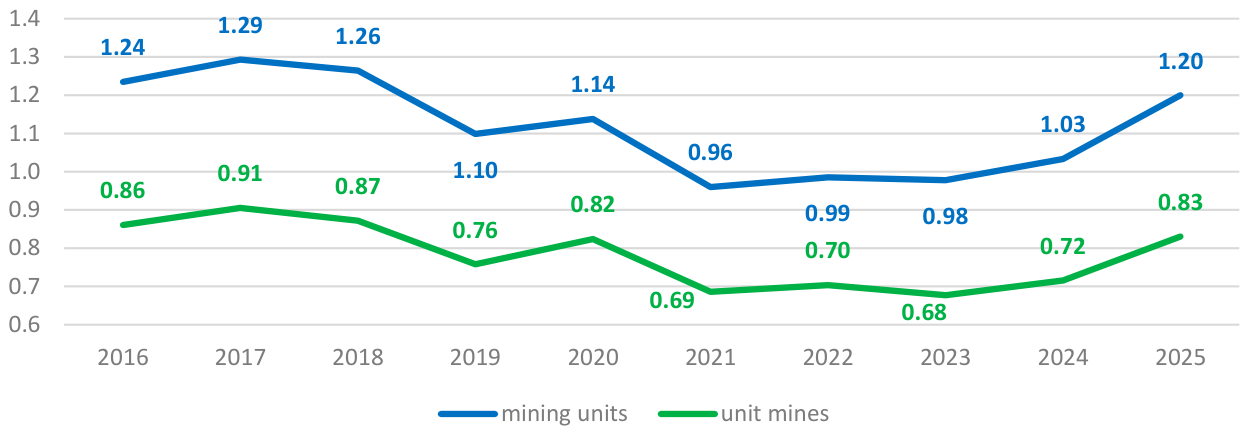
A valuable element of the hard coal mining picture is the comparison of the number of temporarily stopped excavated preparatory excavation faces per mining unit or individual mine (unit mine of the mining unit). In the analyzed period of 2016 to 2025, a more or less stable decline in temporarily stopped preparatory excavation faces can be observed annually (Figure 15 and Table A6). However, in 2024 and 2025, there is a rapid increase in the number of temporarily stopped roadway excavations in both statistics. Compared to 2016, the number of temporarily stopped roadway excavations in the mining unit and individual mine decreased by 3%. Unfortunately, the results from the last two years may change the current trend. It is estimated that this increase may result from difficulties caused by the descent of mining to greater depths.
5. Conclusions
Hard coal will be present in Polish industry and the energy sector until at least 2049, and extracting coal from deposits requires the construction of a sufficient number of preparatory roadways. The lack of investment in new deposits in mines and reliance solely on the remaining deposits that have been developed are not conducive to concentrated mining. The return to previously developed resources, abandoned for economic or safety reasons, increases the need for short preparatory roadways, which increases their number and the costs of excavation.
The Polish hard coal mining industry has seen a steady decline in the length and number of excavated preparatory roadway excavations over the last 10 years, by 30% and 21%, respectively. Among the decreasing indicators is the average length of excavated roadway, which has dropped by approximately 10%.
Unfavorable phenomenon there has been a noticeable increase in the intensity of preparatory excavation over the last 10 years. An unfavorable growth phenomenon is also shown by the average length of excavated roadway excavations per mining excavation (longwall).
The temporary suspension of some of the excavated preparatory roadway excavations in hard coal mines is a natural phenomenon resulting from mining conditions. Nevertheless, this phenomenon is clearly unfavorable. The number of temporarily suspended preparatory roadway excavations is decreasing, but this is not proportional to the reduction in production volume. Over the past two years, the number of suspended roadway excavations has been increasing as a proportion of all excavated roadway excavations.
According to data reported by the industry, there is an approximately 4% advantage to drilling new preparatory pits over closing them. This practice expands the network of pits in mines, which are theoretically intended to limit production.
Development excavation rates in Polish hard coal mines analyzed in this study are only partially due to mining and geological conditions and sector restructuring. Urgently addressing the escalation of the presented development excavation problems could improve the efficiency of hard coal mining processes.
Author Contributions
Conceptualization, A.C. and B.B.; methodology, O.T. and A.S.; software, B.B.; validation, O.T. and A.S.; formal analysis, O.T. and A.S.; investigation, A.C.; resources, A.C., B.B.; data curation, A.C., B.B.; writing—original draft preparation, A.C.; writing—review and editing, O.T.; visualization, B.B.; supervision, A.S.; project administration, A.S.; funding acquisition, A.C. All authors have read and agreed to the published version of the manuscript.
Funding
This research received no external funding.
Data Availability Statement
Research Data Policies at https://polskirynekwegla.pl/statystyka-publiczna.
Conflicts of Interest
Authors Andrzej Chmiela and Beata Barszczowska are employed by the Industrial Development Agency JSC. The remaining authors declare that the research was conducted in the absence of any commercial or financial relationships that could be construed as a potential conflict of interest.
Appendix A

Table A1.
Basic parameters of hard coal mining in Poland.
| 2016 | 2017 | 2018 | 2019 | 2020 | 2021 | 2022 | 2023 | 2024 | 2025 |
| Hard coal mining in Poland [million Mg] | |||||||||
| 70.4 | 65.5 | 63.4 | 61.6 | 54.4 | 55.0 | 52.8 | 48.4 | 44.0 | 42.8 |
| Number of active mining units in the hard coal mining industry in Poland [pieces] | |||||||||
| 23 | 21 | 20 | 20 | 21 | 20 | 20 | 18 | 18 | 18 |
| Number of active unit mines in the hard coal mining industry in Poland[pieces] | |||||||||
| 33 | 30 | 29 | 29 | 29 | 28 | 28 | 26 | 26 | 26 |
| Number of mining excavations (longwalls) in Polish hard coal mining [pieces] | |||||||||
| 94.8 | 85.2 | 82.9 | 78.9 | 77.2 | 71.1 | 68.8 | 67.9 | 64.3 | 58.3 |
Table A2.
Length of the developed preparatory roadway excavations.
| 2016 | 2017 | 2018 | 2019 | 2020 | 2021 | 2022 | 2023 | 2024 | 2025 |
| Length of excavated preparatory roadway excavations [km] | |||||||||
| 254 | 245 | 242 | 239 | 202 | 206 | 208 | 207 | 185 | 177 |
| Average daily length of excavated preparatory roadway excavations [km] | |||||||||
| 1.00 | 0.98 | 0.97 | 0.96 | 0.81 | 0.82 | 0.82 | 0.83 | 0.74 | 0.71 |
| Annual progress of preparatory excavation faces per mining unit [km] | |||||||||
| 11.04 | 11.65 | 12.11 | 11.93 | 9.60 | 10.30 | 10.38 | 11.52 | 10.29 | 9.85 |
| Annual progress of preparatory excavation faces per unit mine [km] | |||||||||
| 7.69 | 8.16 | 8.35 | 8.23 | 6.95 | 7.35 | 7.42 | 7.98 | 7.13 | 6.82 |
Table A3.
Number of preparatory excavations developed.
| 2016 | 2017 | 2018 | 2019 | 2020 | 2021 | 2022 | 2023 | 2024 | 2025 |
| Total number of all drilled preparatory roadway excavations [pieces] | |||||||||
| 181.8 | 178.7 | 186.3 | 176.3 | 163.8 | 156.8 | 154.5 | 154.0 | 147.5 | 144.2 |
| Total number of active developed preparatory roadway excavations [pieces] | |||||||||
| 153.4 | 151.6 | 161.0 | 154.3 | 139.9 | 137.6 | 134.8 | 136.4 | 128.9 | 122.6 |
| Number of excavated preparatory roadway excavations per mining unit [pieces] | |||||||||
| 7.9 | 8.5 | 9.3 | 8.8 | 7.8 | 7.8 | 7.7 | 8.6 | 8.2 | 8.0 |
| Number of excavated preparatory roadway excavations per unit mine [pieces] | |||||||||
| 5.5 | 6.0 | 6.4 | 6.1 | 5.6 | 5.6 | 5.5 | 5.9 | 5.7 | 5.5 |
Table A4.
Number of excavated preparatory roadway excavations.
| 2016 | 2017 | 2018 | 2019 | 2020 | 2021 | 2022 | 2023 | 2024 | 2025 |
| Average length of developed preparatory roadway excavations [m] | |||||||||
| 1131 | 1118 | 1074 | 1088 | 973 | 1051 | 1075 | 1060 | 968 | 1022 |
| Average daily advance length of the preparatory excavation [m] | |||||||||
| 6.5 | 6.5 | 6.0 | 6.2 | 5.8 | 6.0 | 6.1 | 6.1 | 5.7 | 5.8 |
Table A5.
Comparison of the scope of preparatory excavation with the volume of commercial coal extraction.
Table A5.
Comparison of the scope of preparatory excavation with the volume of commercial coal extraction.
| 2016 | 2017 | 2018 | 2019 | 2020 | 2021 | 2022 | 2023 | 2024 | 2025 |
| Preparatory excavation intensity indicator [m/1000 Mg] | |||||||||
| 3.88 | 3.99 | 4.06 | 4.12 | 4.02 | 4.06 | 4.21 | 4.62 | 4.61 | 4.43 |
| Length of developed preparatory roadway excavations per extraction excavation (longwall) [km] | |||||||||
| 2.88 | 3.07 | 3.11 | 3.22 | 2.83 | 3.14 | 3.23 | 3.29 | 3.16 | 3.25 |
Table A6.
Number of temporarily stopped preparatory roadway excavations.
| 2016 | 2017 | 2018 | 2019 | 2020 | 2021 | 2022 | 2023 | 2024 | 2025 |
| Number of stopped preparatory excavation faces [pieces] | |||||||||
| 28.4 | 27.2 | 25.3 | 22.0 | 23.9 | 19.2 | 19.7 | 17.6 | 18.6 | 21.6 |
| Share of stopped preparatory roadway excavations in the total number of faces [%] | |||||||||
| 15.6% | 15.2% | 13.6% | 12.5% | 14.6% | 12.2% | 12.8% | 11.4% | 12.6% | 15.0% |
| Number of temporarily stopped preparatory roadway excavations per mining unit [pieces] | |||||||||
| 1.24 | 1.29 | 1.26 | 1.10 | 1.14 | 0.96 | 0.99 | 0.98 | 1.03 | 1.20 |
| Number of temporarily stopped preparatory roadway excavations per individual mine [pieces] | |||||||||
| 0.86 | 0.91 | 0.87 | 0.76 | 0.82 | 0.69 | 0.70 | 0.68 | 0.72 | 0.83 |
References
- Ranosz, R.; Janicki, A.; Kowal, B. Costs of Transition Towards Renewable Energy in Poland. Energies 2026, 19, 1280. [CrossRef]
- Manowska A.; Bluszcz, A; Chomiak-Orsa I.; Wowra R. Towards Energy Transformation: A Case Study of EU Countries. Energies, 2024. 17, 1778. [CrossRef]
- Kielerz A.; Porzerzyńska-Antonik M. Wyzwania dla sektora górnictwa węgla kamiennego wynikające z transformacji energetycznej. Zeszyty Naukowe Instytutu Gospodarki Surowcami Mineralnymi i Energią Polskiej Akademii Nauk 1(113). 2025. 145–156. [CrossRef]
- Strzałkowski P.; Maruszczyk M. Hard Coal as a Necessary Energy Resource in Poland, Archives of Mining Sciences. 2024. 69. 1. 67-76. [CrossRef]
- Chmiela, A.; Barszczowska, B.; Czerwiński, S.; Smoliński, A. Rock Mass and Dust Emissions from Hard Coal Mining as a Sustainability Challenge During Energy Transition—The Case Study of Poland. Sustainability 2026, 18, 2145. [CrossRef]
- Chmiela, A.; Barszczowska, B.; Czerwiński, S.; Trokhymets, O.; Magdziarczyk, M.; Smoliński, A. Development of Potential Resources from Mine Waters from Hard Coal Mining as an Environmental Challenge for Sustainable Development—A Case Study of Poland. Resources 2026, 15, 55. [CrossRef]
- Barszczowska B., New support system for the hard coal mining sector – the essence and challenges related to the monitoring and control of the system of subsidies for production capacity reduction, Scientific Papers of the Mineral and Energy Economy Institute of the Polish Academy of Sciences 1(112). 93–100, 2024.
- IDA, 2025. www.polskirynekwegla.pl/statystyka-publiczna (acces 1.07.2026).
- Niedbalski, Z.; Majcherczyk, T. Indicative assessment of design efficiency of mining roadways, Journal of Sustainable Mining. 2018. Vol. 17: Iss. 3, Article 5. [CrossRef]
- Prostański D. Use of Air-and-Water Spraying Systems for Improving Dust Control in Mines, Journal of Sustainable Mining, 2013, Volume 12, Issue 2, Pages 29-34, ISSN 2300-3960, . [CrossRef]
- Małkowski, P.; Ostrowski, Ł.; Bednarek, Ł. The Effect of Selected Factors on Floor Upheaval in Roadways—In Situ Testing. Energies 2020, 13, 5686. [CrossRef]
- Małkowski, P.; Ostrowski, Ł.; Stasica, J. Modeling of Floor Heave in Underground Roadways in Dry and Waterlogged Conditions. Energies 2022, 15, 4340. [CrossRef]
- Małkowski, P.; Ostrowski, Ł.; Bednarek, Ł. The Effect of Selected Factors on Floor Upheaval in Roadways—In Situ Testing. Energies 2020, 13, 5686. [CrossRef]
- Cheluszka, P.; Remiorz, E.; Rostami, J. The Use of a Roadheader Simulator in Research of Dynamics and Energy-Consumption of Excavating Underground Roadways and Tunnels. Energies 2022, 15, 6673. [CrossRef]
- Kamiński, P.; Otto, A.; Dawidziuk, P.; Malinowski, L.; Stecuła, K.; Dyczko, A. Determination of the Ground Reaction Curve for an Elasto-Plasto-Fractured Rock Mass. Appl. Sci. 2024, 14, 5409. [CrossRef]
- Słota, K.; Słota, Z. Ventilation of tunnels during drilling using a forcing ventilation system – a case study, Journal of Sustainable Mining. 2023, Vol. 22, Iss. 4, Article 7. [CrossRef]
- Kotwica, K. Atypical and innovative tool, holder and mining head designed for roadheaders used to tunnel and gallery drilling in hard rock, Tunnelling and Underground Space Technology, 2018, Volume 82, Pages 493-503, ISSN 0886-7798, . [CrossRef]
- Krauze, K.; Bołoz, Ł.; Mucha, K.; Wydro, T. The mechanized supporting system in tunnelling operations, Tunnelling and Underground Space Technology, 2021, Volume 113, 103929, ISSN 0886-7798, . [CrossRef]
- Kozhubaev, Y.; Ershov, R.; Ali, A.; Yao, Y.; Yin, C. Control Systems for a Coal Mine Tunnelling Machine. Mining 2025, 5, 82. [CrossRef]
- Niewiadomski, A.P.; Musioł, D.; Pach, G.; Różański, Z.; Wrona, P.; Koch, N.; Šofranko, M. The Impact of Air Velocity on the Formation of Methane Concentration Fields in Excavated Workings. Appl. Sci. 2025, 15, 12352. [CrossRef]
- Czarny, R.; Malinowski, M.; Chamarczuk, M.; Ćwiękała, M.; Olechowski, S.; Isakow, Z.; Sierodzki, P. Dispersive seismic waves in a coal seam around the roadway in the presence of excavation damaged zone, International Journal of Rock Mechanics and Mining Sciences, 2021, Volume 148, 104937, ISSN 1365-1609, . [CrossRef]
- Ścigała, R.; Jendryś, M. A Hybrid Approach to Geomechanical Modeling of Mining Excavation Loads: Integration of Influence Function Model into FDM Simulations. Appl. Sci. 2025, 15, 11804. [CrossRef]
- Khalikova, E.R.; Diomin, V.F.; Mussin, R.A.; Krakovsky, A.P.; Khanafin, U.Z. Monitoring of the stress-strain state during preparatory workings. Complex Use of Mineral Resources, 2024. 328(1), 68-75. [CrossRef]
- Khalikova, E.; Zhumabekova, A.; Demina, T.; Syzdykbaeva, D.; Sattarova, G.; Karatayev, A., Stress-strain state of the near-contour rock mass around a gob-side development roadway in underground coal mining. Min. miner. depos. 2026, 20(2):111-121. [CrossRef]
- Sakhno, I.; Sakhno, S.; Isaienkov, O.; Petrenko, A. Research on influence of stress-strain evolution in immediate floor before and after excavation face on origin floor heave in coal mines roadways. IOP Conf. Ser.: Earth Environ. Sci. 2024, 1415, 012026 . [CrossRef]
- Sakhno, I.; Sakhno, S.; Skrzypkowski, K.; Isaienkov, O.; Zagórski, K.; Zagórska, A. Floor Heave Control in Gob-Side Entry Retaining by Pillarless Coal Mining with Anti-Shear Pile Technology. Appl. Sci. 2024, 14, 4992. [CrossRef]
- Mo, S.; Ramandi, H.L.; Oh, J.; Masoumi, H.; Canbulat, I.; Hebblewhite B.; Saydam, S. A new coal mine floor rating system and its application to assess the potential of floor heave, International Journal of Rock Mechanics and Mining Sciences, Volume 128, 2020, 104241, ISSN 1365-1609, . [CrossRef]
- Mo, S.; Sheffield, P.; Corbett, P.; Ramandi, H.L.; Oh, J.; Canbulat, I.; Saydam, S. A numerical investigation into floor buckling mechanisms in underground coal mine roadways. Tunn. Undergr. Space Technol. 2020, 103, 103497. [CrossRef]
Figure 1.
Hard coal mining in Poland [million Mg].
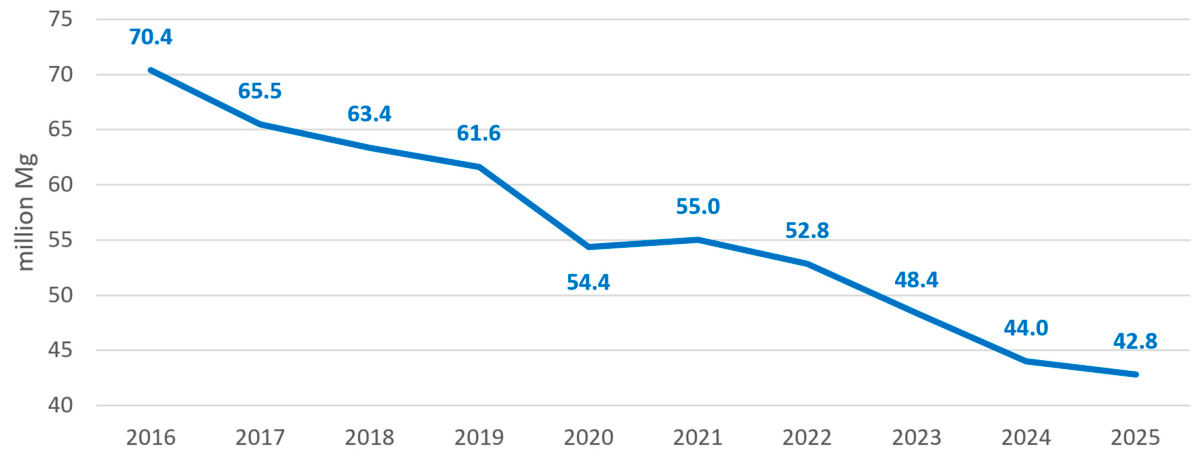
Figure 2.
Number of active mining units and unit mines in the hard coal mining industry in Poland.
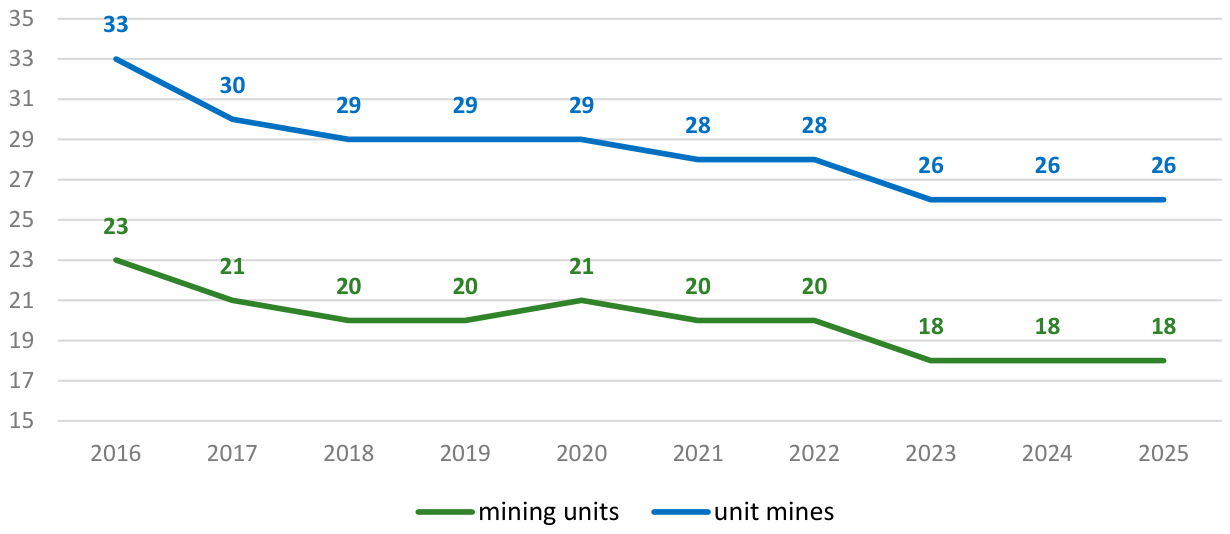
Figure 3.
Number of mining excavations (longwalls) in Polish hard coal mining.
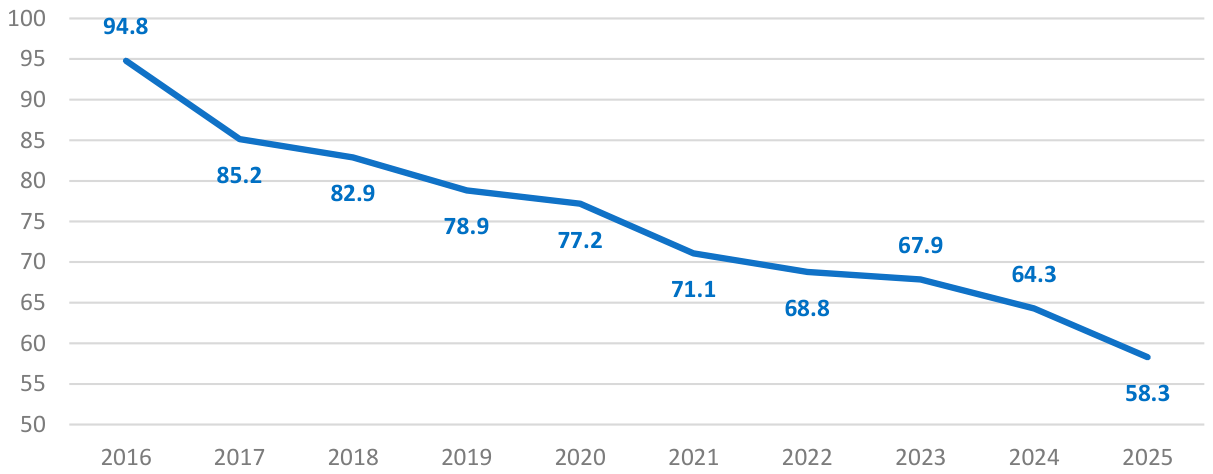
Figure 4.
Length of excavated preparatory roadway excavations [km].
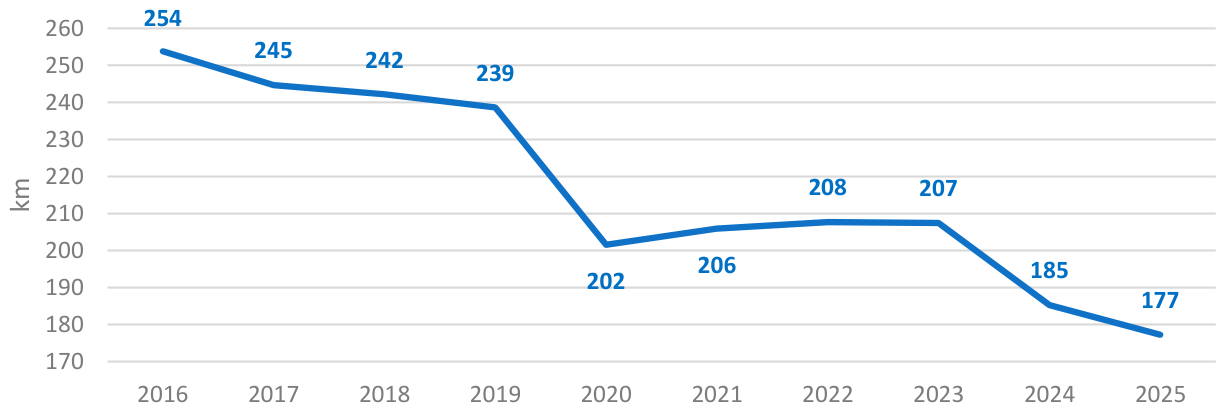
Figure 5.
Average daily length of excavated preparatory roadway excavations [km].
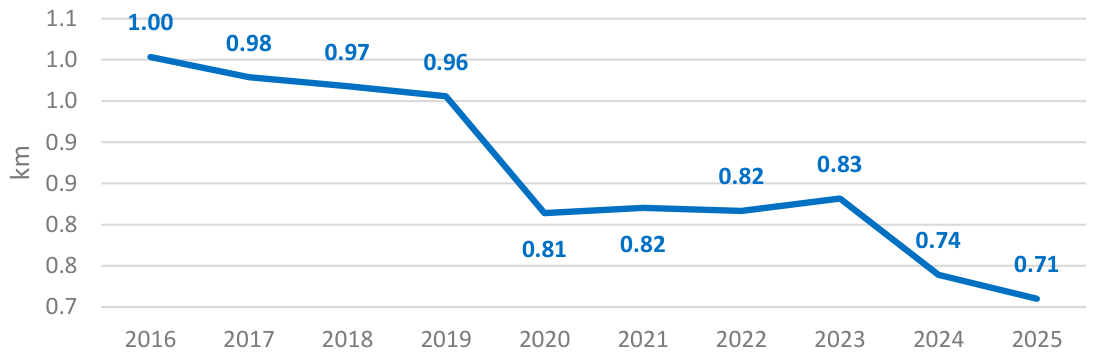
Figure 6.
Annual progress of preparatory excavation faces [km].
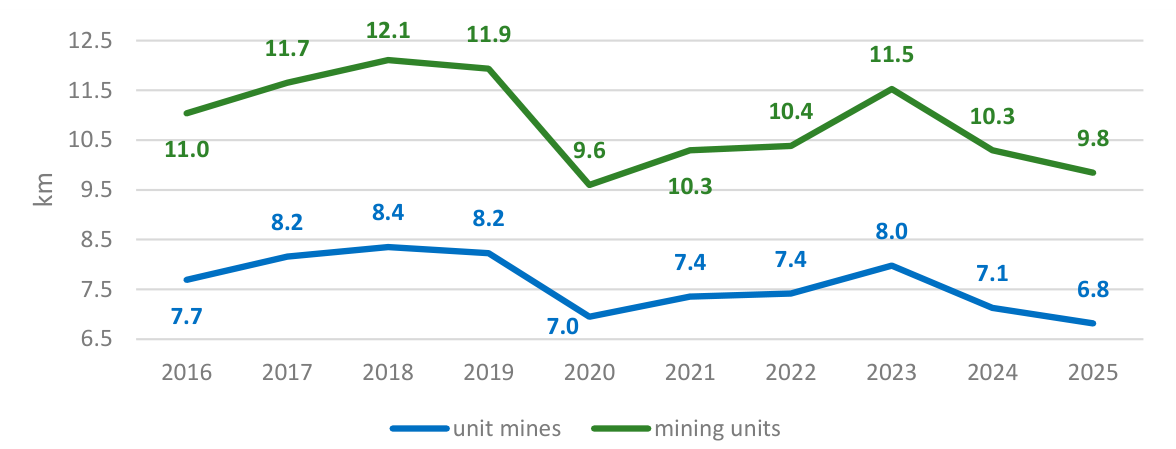
Figure 7.
Total number of developed preparatory roadway excavations.
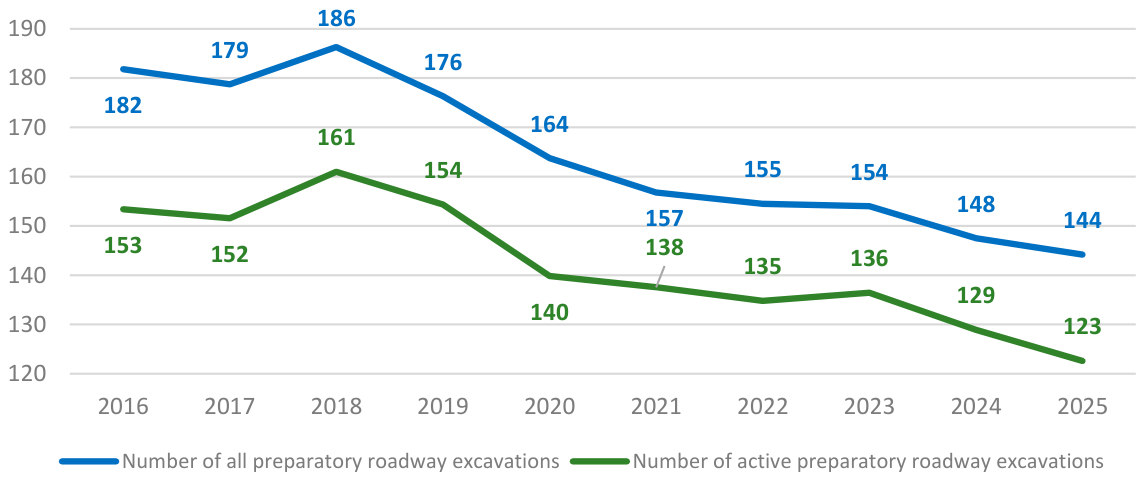
Figure 8.
Number of excavated preparatory roadway excavations per mining unit and per unit mine.
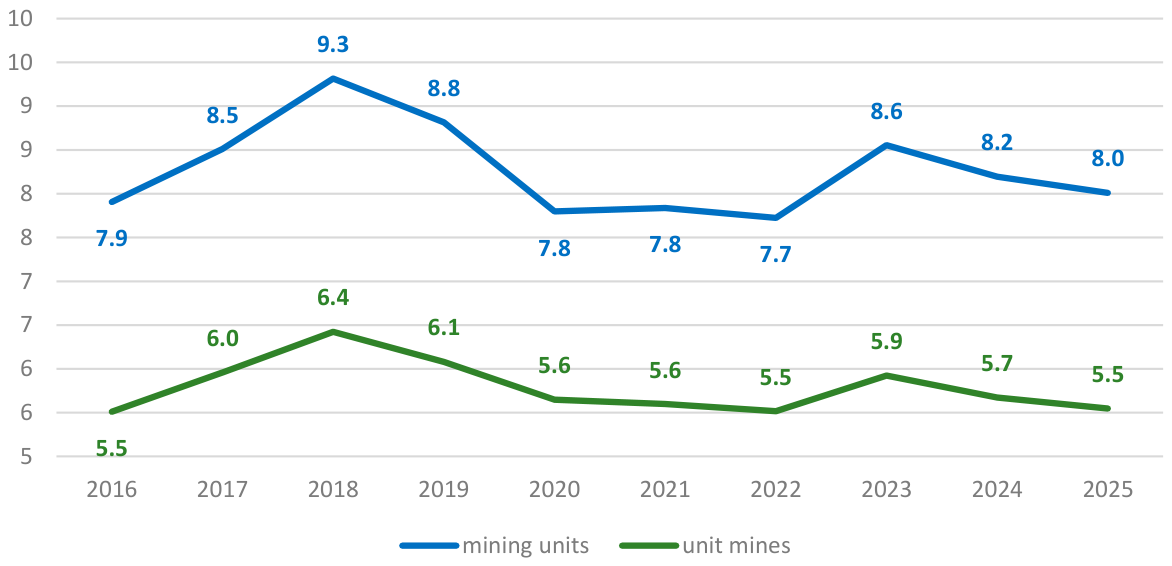
Figure 9.
Average length of developed preparatory roadway excavations [m].
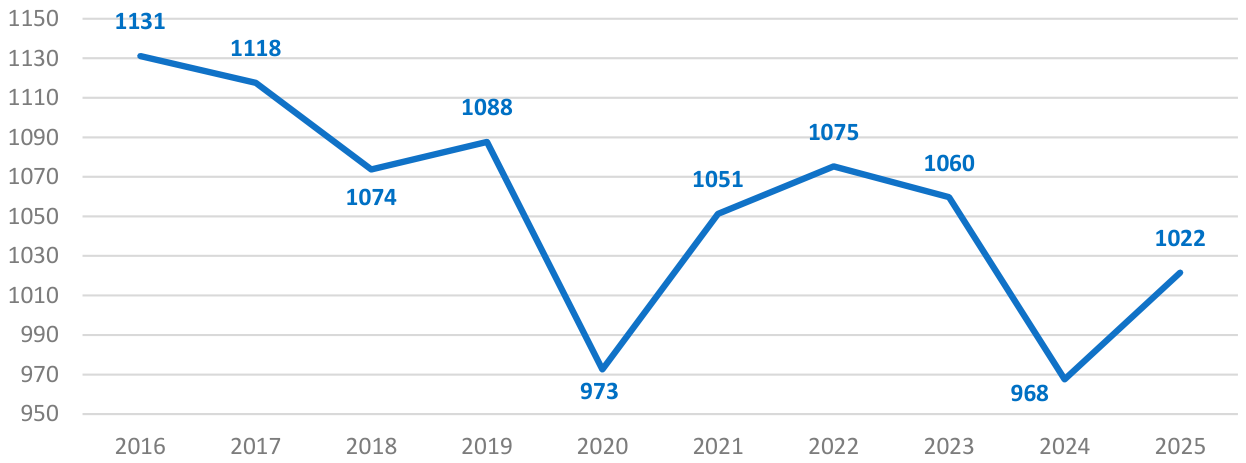
Figure 10.
Average daily advance length of the preparatory excavation [m].
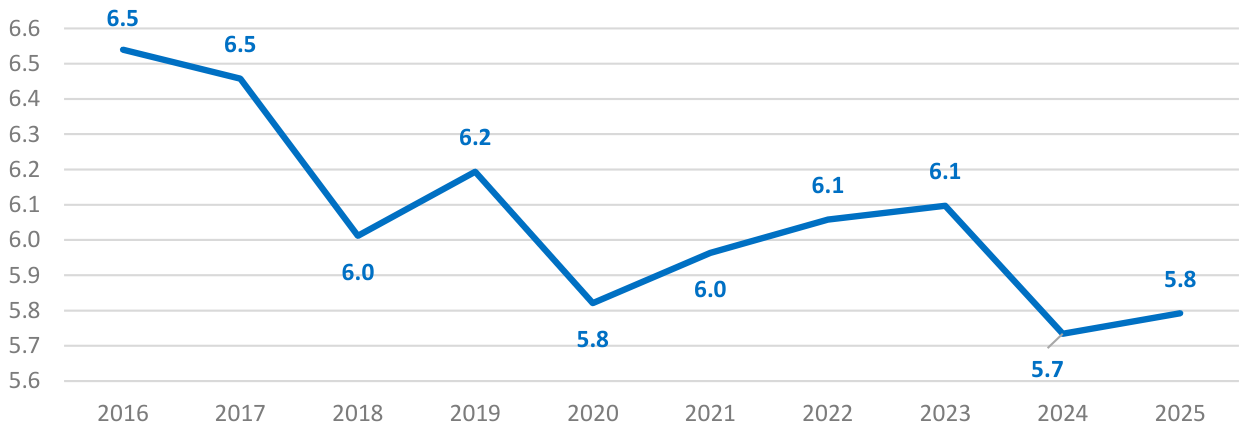
Figure 11.
Preparatory excavation intensity indicator.
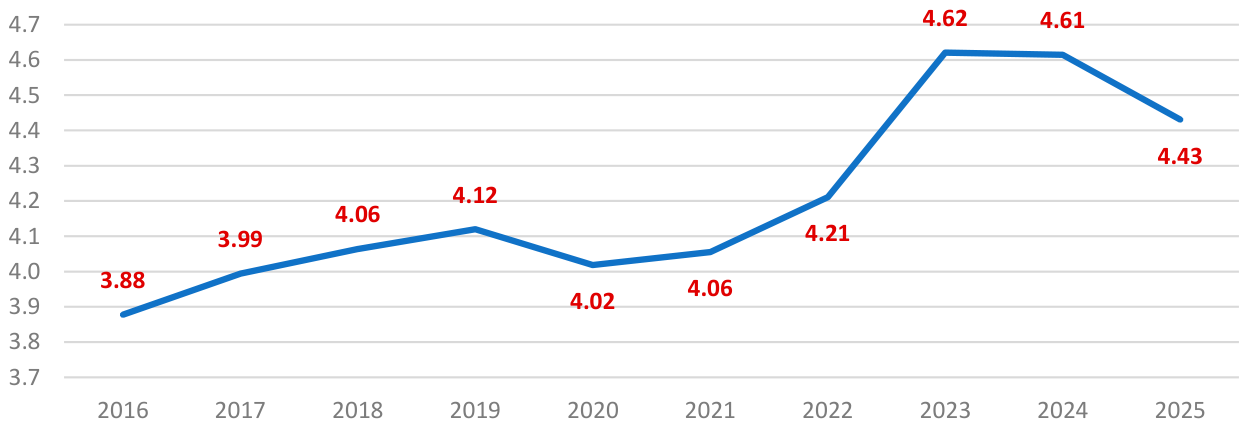
Figure 12.
Average length of developed preparatory roadway excavations per extraction excavation (longwall panel) [km].
Figure 12.
Average length of developed preparatory roadway excavations per extraction excavation (longwall panel) [km].
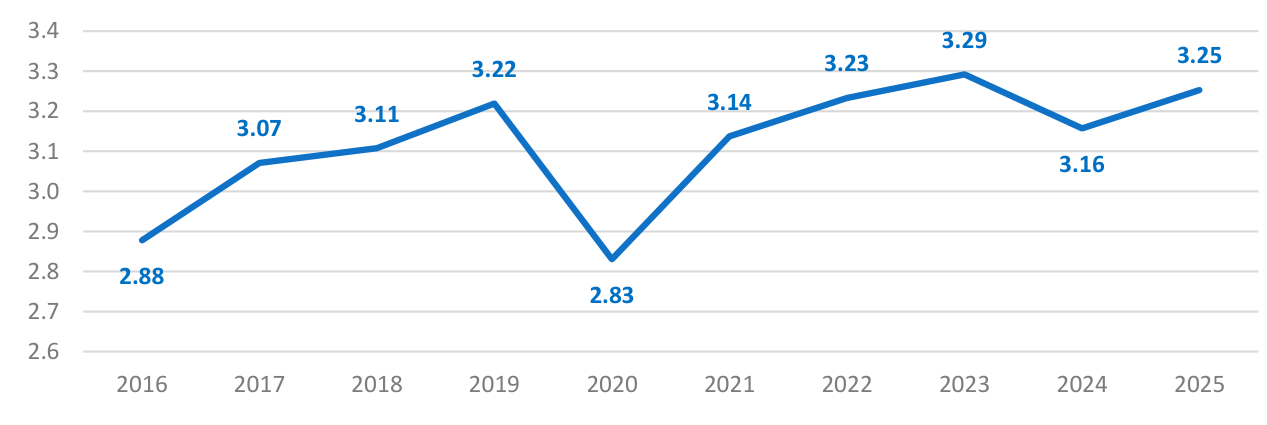
Figure 13.
Number of stopped preparatory excavation faces.
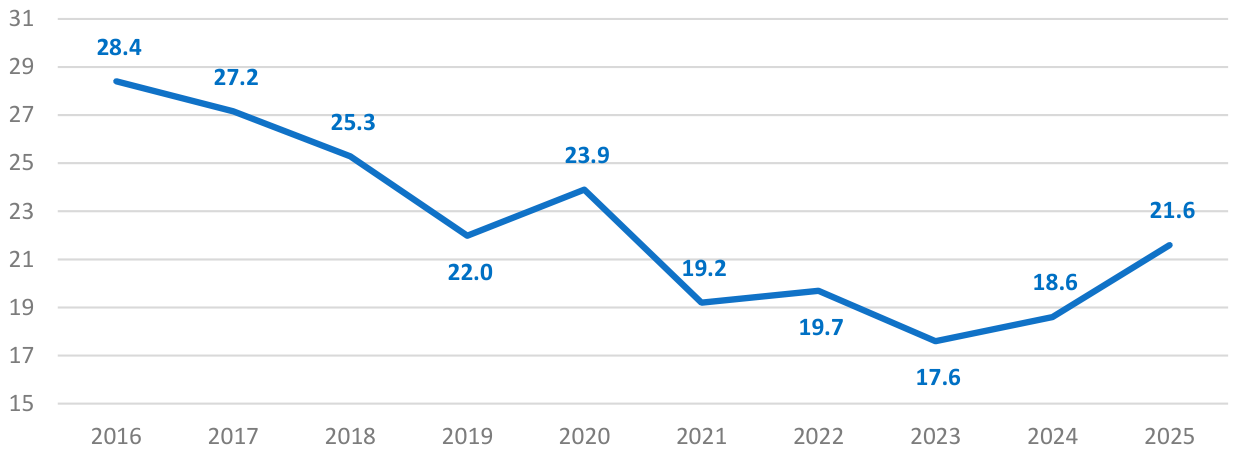
Figure 14.
Share of stopped preparatory roadway excavations in the total number of faces.
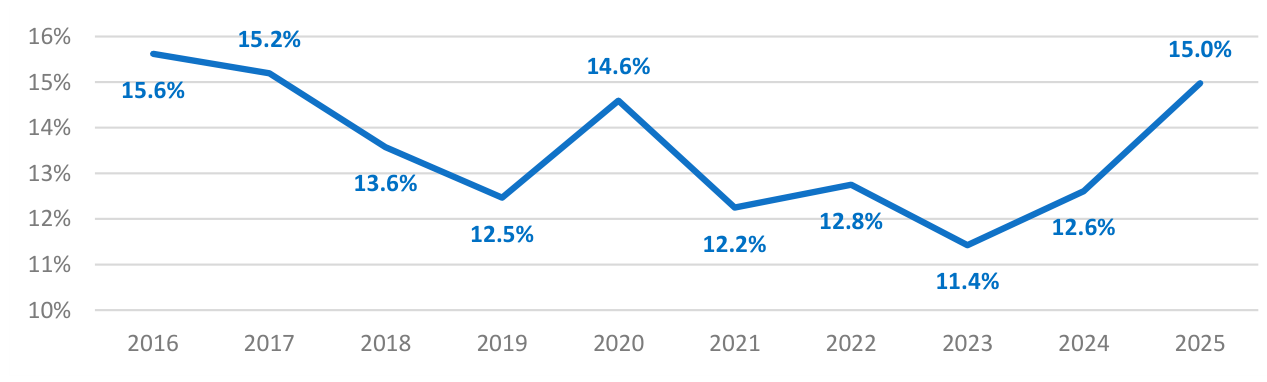
Figure 15.
Number of temporarily stopped preparatory roadway excavations per mining unit and per individual mine.
Figure 15.
Number of temporarily stopped preparatory roadway excavations per mining unit and per individual mine.
Disclaimer/Publisher’s Note: The statements, opinions and data contained in all publications are solely those of the individual author(s) and contributor(s) and not of MDPI and/or the editor(s). MDPI and/or the editor(s) disclaim responsibility for any injury to people or property resulting from any ideas, methods, instructions or products referred to in the content. |
© 2026 by the authors. Licensee MDPI, Basel, Switzerland. This article is an open access article distributed under the terms and conditions of the Creative Commons Attribution (CC BY) license.
Copyright: This open access article is published under a Creative Commons CC BY 4.0 license, which permit the free download, distribution, and reuse, provided that the author and preprint are cited in any reuse.