
Submitted:
26 August 2026
Posted:
26 August 2026
You are already at the latest version
Abstract
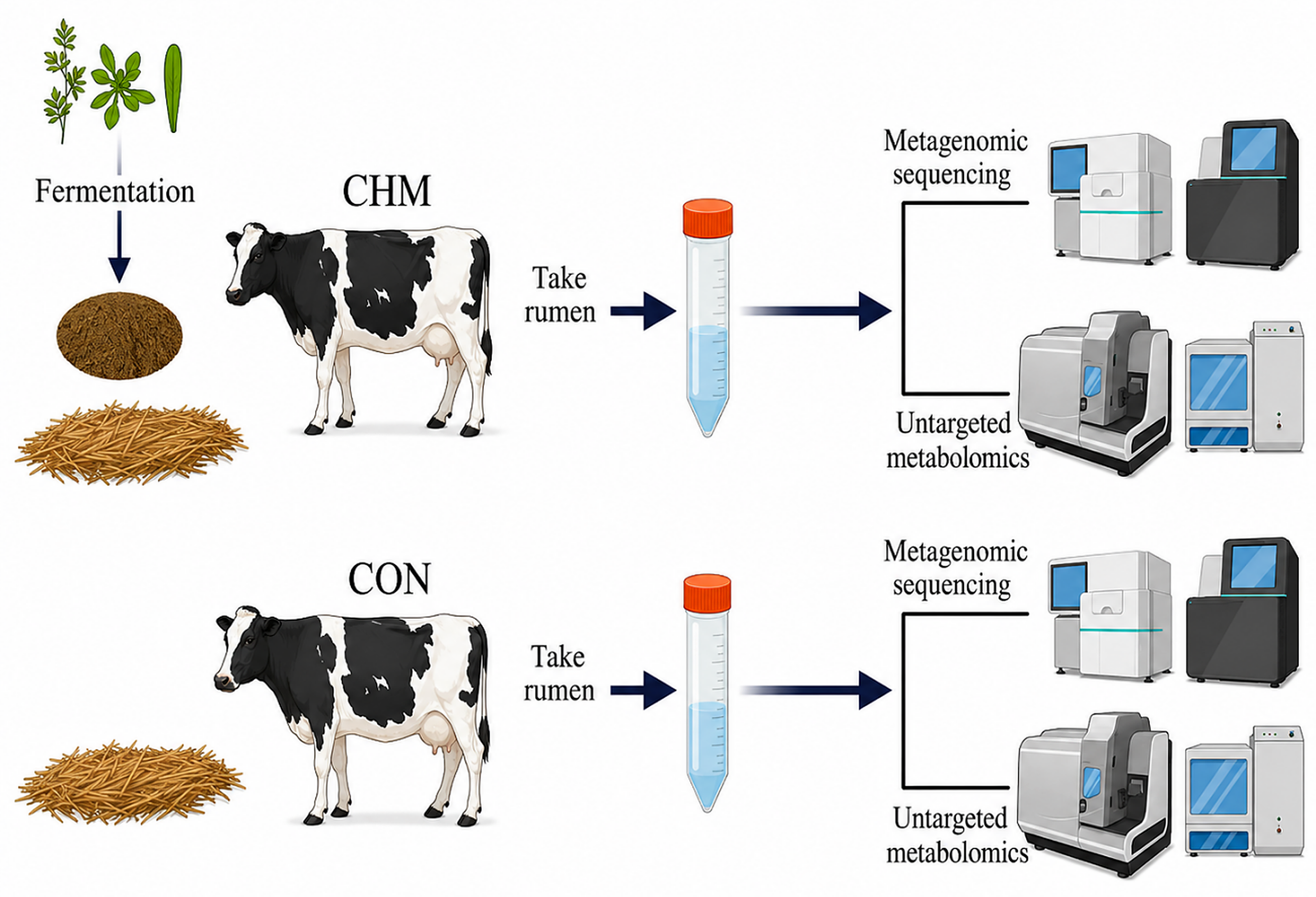
Fermented Chinese herbal medicine (CHM) may provide a plant-derived strategy for modulating rumen function. This study evaluated 360 mid-lactation Holstein cows assigned to a control diet (CON; n = 180) or the same total mixed ration supplemented with 30 g CHM/cow/day for 50 days. Rumen fluid from six cows per group was analyzed using shotgun metagenomics and untargeted liquid chromatography–mass spectrometry metabolomics. CHM did not alter alpha diversity or overall Bray–Curtis community structure, but selectively changed microbial taxa and functional profiles. CHM-enriched taxa included Nanobdellati and Candidatus Iainarchaeota lineages and Candidatus Saccharimonadota, accompanied by differences in Kyoto Encyclopedia of Genes and Genomes, evolutionary genealogy of genes: Non-supervised Orthologous Groups, and carbohydrate-active enzyme annotations. Metabolomics identified 29 differential features, with pathway signals involving butyrate, glycerolipid, energy, and plant-derived compound metabolism. Integrated Spearman and Mantel analyses linked Prevotella-related and other carbohydrate-associated taxa with differential metabolites and associated CHM supplementation with 10-gingerol, megastigmatriene, and a benzoxazinone-related feature. Overall, CHM selectively remodeled rumen microbial functions and metabolic output while preserving global community stability, supporting the potential of fermented herbal feed additives to modulate rumen microecology in mid-lactation dairy cows.
Keywords:
rumen microbiome
; Holstein cow
; fermented Chinese herbal medicine
; shotgun metagenomics
; untargeted metabolomics
Copyright: This open access article is published under a Creative Commons CC BY 4.0 license, which permit the free download, distribution, and reuse, provided that the author and preprint are cited in any reuse.