

Submitted:
26 August 2026
Posted:
26 August 2026
You are already at the latest version
Abstract
Fermented Chinese herbal medicine (CHM) may provide a plant-derived strategy for modulating rumen function. This study evaluated 360 mid-lactation Holstein cows assigned to a control diet (CON; n = 180) or the same total mixed ration supplemented with 30 g CHM/cow/day for 50 days. Rumen fluid from six cows per group was analyzed using shotgun metagenomics and untargeted liquid chromatography–mass spectrometry metabolomics. CHM did not alter alpha diversity or overall Bray–Curtis community structure, but selectively changed microbial taxa and functional profiles. CHM-enriched taxa included Nanobdellati and Candidatus Iainarchaeota lineages and Candidatus Saccharimonadota, accompanied by differences in Kyoto Encyclopedia of Genes and Genomes, evolutionary genealogy of genes: Non-supervised Orthologous Groups, and carbohydrate-active enzyme annotations. Metabolomics identified 29 differential features, with pathway signals involving butyrate, glycerolipid, energy, and plant-derived compound metabolism. Integrated Spearman and Mantel analyses linked Prevotella-related and other carbohydrate-associated taxa with differential metabolites and associated CHM supplementation with 10-gingerol, megastigmatriene, and a benzoxazinone-related feature. Overall, CHM selectively remodeled rumen microbial functions and metabolic output while preserving global community stability, supporting the potential of fermented herbal feed additives to modulate rumen microecology in mid-lactation dairy cows.
Keywords:
rumen microbiome
; Holstein cow
; fermented Chinese herbal medicine
; shotgun metagenomics
; untargeted metabolomics
1. Introduction
Mid-lactation dairy cows continue to partition substantial amounts of energy and metabolizable protein toward milk synthesis, and short periods of nutrient imbalance can alter endocrine status and nutrient use [1]. The rumen microbiota converts structural carbohydrates and other dietary substrates into volatile fatty acids and microbial protein, which provide a major part of the nutrients used for maintenance and lactation [2,3]. Diet, host physiology, and management all contribute to the composition of this microbial community [4,5].
Shotgun metagenomics extends taxonomic profiling by identifying the genes carried by the rumen community, including genes involved in carbohydrate degradation and the synthesis of milk precursors [6]. Community-level richness and evenness may remain stable even when selected microbial populations respond to a dietary treatment [7]. Meta-omics approaches are therefore useful when an intervention is expected to alter specific ecological functions rather than replace the dominant community [8].
Interest in non-antibiotic feed additives has increased because animal production systems require nutritional tools that support performance without routine antimicrobial exposure [9,10]. Phytogenic compounds can alter microbial growth and fermentation, but their effects depend on chemical composition, dose, basal diet, and animal population [11].
Fermentation modifies the plant matrix before an additive reaches the animal. Lactic-acid-bacterial fermentation can release low-molecular-weight constituents and generate microbial products that are absent or less abundant in the original material [12,13]. It can also transform phenolic compounds and change the measured bioactivity of plant extracts [14]. A fermented multi-herb product should therefore be considered a chemically complex preparation rather than a simple mixture of dried herbs.
Studies in dairy cattle have reported physiological, production, and rumen-microbial responses to Chinese herbal preparations [15,16]. Fermented multi-ingredient products add another layer of biological complexity because fermentation can modify plant-derived compounds before they enter the rumen. Integrating metagenomics with metabolomics provides a systems-level strategy for linking changes in microbial genes with changes in the rumen chemical environment [17,18].
The present study evaluated fermented Chinese herbal medicine (CHM) supplementation in mid-lactation Holstein cows. Metagenomic sequencing was used to characterize taxonomic assignments and predicted functional genes, whereas untargeted liquid chromatography–mass spectrometry (LC–MS) was used to identify group-associated rumen metabolite features. We hypothesized that cows sampled from the CHM feeding group would show coordinated differences in selected microbial taxa, functional annotations, and rumen metabolites compared with cows sampled from the control feeding group, thereby revealing the microbial and metabolic basis of the response to CHM supplementation.
2. Materials and Methods
2.1. Ethical Approval
All animal procedures were reviewed and approved by the Animal Welfare and Animal Experiment Ethics Committee of Shandong Agricultural University (approval no. SDAUA-2026-187). The experiment was conducted from March to May 2026 at a commercial dairy farm in Shandong Province, China.
2.2. Fermented Chinese Herbal Medicine
The fermented Chinese herbal medicine used in this study was produced by Jiaozuo Baiyian Bioengineering Co., Ltd. (Jiaozuo, China). The product consisted primarily of dandelion, citrus peel, motherwort, and Chinese yam and was manufactured by anaerobic fermentation followed by cold pelleting (product standard Q/HBYA 106-2025). The product specifications were moisture ≤ 40%, crude ash < 15%, crude fiber ≤ 11%, and total flavonoids ≥ 0.5%.
2.3. Animals and Experimental Design
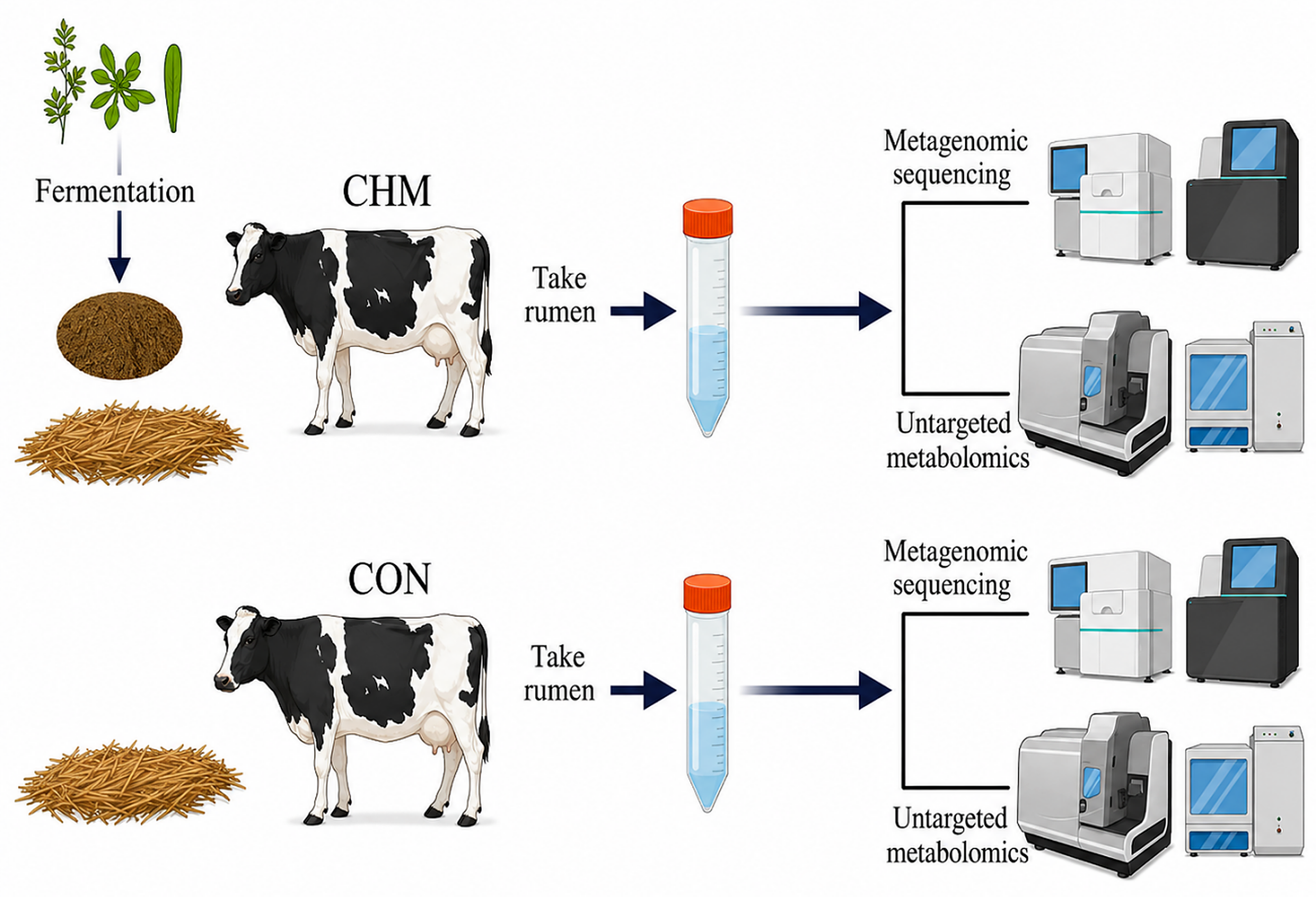
A controlled two-group feeding trial was conducted. Before group allocation, cows were screened according to parity, body condition score (BCS), health status, and production level. A total of 360 clinically healthy mid-lactation Holstein cows with 2–4 parities and similar BCS values (3.25–3.75) were enrolled and allocated to a control group (CON; n = 180) and a fermented Chinese herbal medicine group (CHM; n = 180). Cows in the CON group received the basal total mixed ration (TMR), whereas cows in the CHM group received the same basal TMR supplemented with 30 g CHM/cow/day for 50 days. The ingredient composition and nutrient levels of the basal TMR are provided in Supplementary Table S1. The basal diet was identical between groups; only CHM supplementation differed. The TMR was prepared and supplied collectively within each group rather than administered as an individual dose. Feeding management, milking procedures, access to water, and environmental management were kept consistent between groups.
For the CHM group, the daily supplement equivalent to 30 g CHM/cow/day was divided into two equal portions and thoroughly mixed into the group TMR at the 09:30 and 15:30 feedings. Feed disappearance was monitored after supplementation to confirm normal group-level intake. A schematic overview of the experimental design is shown in Figure 1. Water was available ad libitum throughout the study.
2.4. Sample Collection and Laboratory Analyses
2.4.1. Rumen Fluid Collection
At the end of the feeding period, six healthy cows were randomly selected from each group for rumen-fluid sampling. Samples were collected before the morning feeding using a portable oro-ruminal sampling device. The first 100 mL was discarded to reduce contamination from the sampling tube, and a second 100-mL aliquot was collected. Rumen fluid was filtered through four layers of sterile gauze, dispensed into 2-mL cryovials, snap-frozen in liquid nitrogen, and stored at −80 °C until analysis.
2.4.2. Statistical Analysis
The omics dataset included rumen-fluid samples from six randomly selected cows per group. Data distributions were evaluated using the Shapiro–Wilk test. Variables that were not normally distributed were logarithmically or square-root transformed when appropriate. Alpha-diversity indices, including the abundance-based coverage estimator (ACE), Chao1, Shannon, and Simpson indices, and differential taxa were compared using the Wilcoxon rank-sum test. Beta diversity was calculated from Bray–Curtis dissimilarities, and overall group separation was assessed by analysis of similarities (ANOSIM).
Differential functional features annotated against the Kyoto Encyclopedia of Genes and Genomes (KEGG), evolutionary genealogy of genes: Non-supervised Orthologous Groups (eggNOG), and the Carbohydrate-Active enZymes database (CAZy) were evaluated using the Wilcoxon rank-sum test. A p value < 0.05 was considered evidence of a between-group difference in these functional comparisons. Figures report group-level estimates, confidence intervals, and p values generated by the corresponding analysis workflow.
Metabolic profiles were visualized using principal component analysis (PCA) and partial least-squares discriminant analysis (PLS-DA), a commonly used multivariate approach for metabolomics data visualization [20]. Differential metabolites were defined by a variable-importance-in-projection (VIP) score > 1 and a false discovery rate (FDR)-adjusted p value < 0.05. Metabolite annotations were generated by spectral database matching and are reported as putative annotations.
Spearman rank correlations were used for the integrated analyses. Associations with |r| > 0.50 and p < 0.05 were retained for network visualization. Multi-omics networks were visualized using Gephi version 0.10.
2.4.3. Metagenomic Sequencing and Bioinformatic Analysis
Total genomic deoxyribonucleic acid (DNA) was extracted from rumen-fluid samples using a commercial DNA extraction kit. DNA concentration and purity were measured with a microvolume spectrophotometer, and DNA integrity was assessed by 1% agarose gel electrophoresis.
Qualified DNA was sheared to approximately 350 base pairs (bp), followed by end repair, A-tailing, adapter ligation, and polymerase chain reaction (PCR) enrichment to construct paired-end libraries. Library quality was assessed before sequencing on an Illumina NovaSeq 6000 platform using a paired-end 150-bp strategy.
Raw reads were processed with fastp to remove adapters, low-quality sequences, and reads containing excessive ambiguous bases, thereby generating high-quality clean reads [21]. Clean reads were assembled using MEGAHIT [22]. Open reading frames were predicted with Prodigal [23], and the predicted genes were clustered using CD-HIT to construct a non-redundant gene catalog [24].
Clean reads from each sample were mapped back to the non-redundant gene catalog using Bowtie 2 [25], and gene-abundance profiles were calculated. Amino-acid sequences in the catalog were aligned against the non-redundant protein database (NR), eggNOG, KEGG, CAZy, and Comprehensive Antibiotic Resistance Database (CARD) using DIAMOND [26]. KEGG annotations were used to characterize metabolic pathways and functional modules. eggNOG was used for Clusters of Orthologous Groups (COG) functional classification, CAZy [27,28] for carbohydrate-active enzyme (CAZyme) annotation, and CARD for antibiotic-resistance annotation.
2.4.4. Untargeted Rumen Metabolomics
Untargeted LC–MS metabolomics was performed on rumen fluid. Briefly, 100 μL of sample was mixed with 400 μL of extraction solvent (acetonitrile:methanol, 1:1, v/v) containing an internal-standard mixture. Samples were vortexed for 30 s, sonicated for 30 min at 5 °C and 40 kHz, and incubated at −20 °C for 30 min.
Samples were centrifuged at 13,000× g for 15 min at 4 °C. The supernatant was collected, dried under nitrogen, and reconstituted in 100 μL of acetonitrile:water (1:1, v/v). After low-temperature sonication for 5 min and a second centrifugation, the supernatant was transferred to autosampler vials for LC–MS analysis.
A pooled quality-control (QC) sample was prepared by mixing equal volumes of all sample extracts and was injected at regular intervals to monitor analytical stability and reproducibility.
LC–MS analysis was performed on an ultra-high-performance liquid chromatography (UHPLC)–Orbitrap Exploris 240 system equipped with an ACQUITY ultra-performance liquid chromatography (UPLC) HSS T3 column (100 mm × 2.1 mm, 1.8 μm). Mobile phase A consisted of water/acetonitrile containing 0.1% formic acid, and mobile phase B consisted of acetonitrile/isopropanol/water containing 0.1% formic acid. Data were acquired in positive- and negative-electrospray-ionization modes.
Raw data were processed with Progenesis QI for peak detection, integration, retention-time correction, and peak alignment. Metabolites were annotated by matching mass spectrometry (MS) and tandem mass spectrometry (MS/MS) spectra against the Human Metabolome Database (HMDB), METLIN, National Institute of Standards and Technology (NIST) library, MassBank, LipidBlast, and the Majorbio in-house database.
Features were filtered using the 80% rule, missing values were imputed, and the data were normalized and log10 transformed. PCA and PLS-DA were performed using the ropls package in R. Differential metabolites were identified using VIP > 1 and an FDR-adjusted p value < 0.05. KEGG annotation and pathway-enrichment analyses were conducted on the Majorbio Cloud platform [29,30].
2.4.5. Integrated Microbiome–Metabolome Analysis
Spearman correlations between differential taxa and differential metabolites were calculated using the psych and heatmap packages in R. Mantel tests were performed using vegan, dplyr, ggcor, and ggplot2 to evaluate associations among treatment, microbial variation, and metabolite profiles.
3. Results
3.1. Metagenomic Analysis
3.1.1. Sequencing Output
Quality filtering produced 888,001,038 clean reads. Assembly generated 6,456,996 contigs, and gene prediction followed by clustering yielded a non-redundant catalog of 3,100,497 genes.
3.1.2. Alpha Diversity
None of the four alpha-diversity indices differed between groups: Chao1 (p = 0.5752), ACE (p = 0.6889), Shannon (p = 0.9362), and Simpson (p = 0.9362; Figure 2A).
3.1.3. Beta Diversity
Principal coordinate analysis based on Bray–Curtis dissimilarities showed overlap between CON and CHM samples (Figure 2B). ANOSIM did not detect a significant difference in overall community structure (p > 0.05).
3.1.4. Microbial Composition and Differential Taxa
The annotation tables contained 245 phylum-level assignments and 5255 genus-level assignments shared by both groups. Two phylum-level and 71 genus-level assignments were detected only in CON, whereas three phylum-level and 262 genus-level assignments were detected only in CHM (Figure 2C).
Bacteroidota, Bacillota, Uroviricota, and Pseudomonadota were the most abundant phyla in both groups (Figure 3A,B), with Bacteroidota showing the highest relative abundance. Bacillota was numerically higher and Bacteroidota numerically lower in CHM than in CON. These composition plots are descriptive; statistical differences were assessed separately using linear discriminant analysis effect size (LEfSe).
At the genus level, dominant assignments included Prevotella, Xylanibacter, unclassified Caudoviricetes, Segatella, Bacteroides, Hallella, Succiniclasticum, Ruminococcus, Clostridium, and Candidatus Cryptobacteroides (Figure 3C,D). Hallella and Succiniclasticum were numerically higher in CHM, whereas Xylanibacter, Ruminococcus, and Clostridium were numerically higher in CON. These patterns were considered differential only when supported by the differential-abundance analysis.
LEfSe was used to identify group-associated taxa using p < 0.05 and a linear discriminant analysis (LDA) score > 2 (Figure 3E–H).
Among archaea, 11 taxa met the LEfSe criteria. Ten CHM-enriched assignments belonged mainly to unclassified Nanobdellati or Candidatus Iainarchaeota lineages, whereas Halosegnis was enriched in CON (Figure 3E,F). Among bacteria, Selenomonadales, Selenomonadaceae, and Selenomonas were enriched in CON, whereas Candidatus Saccharimonadota was enriched in CHM (Figure 3G,H). The complete differential taxonomic assignments are provided in Supplementary Table S2.
3.1.5. Microbial Functional Profiles
A total of 465 KEGG level-3 pathways were annotated. Three categories met the criterion for a between-group difference (Wilcoxon p < 0.05): antifolate resistance, other types of O-glycan biosynthesis, and the KEGG annotation category labelled ‘breast cancer’ (Figure 4A).
Ten KEGG Orthology (KO) features met the criterion for a between-group difference: K06400, K02529, K03308, K02876, K13292, K03733, K02520, K07027, K01840, and K01895 (Figure 4B). Their annotations included recombination, transcriptional regulation, translation, glycosyltransferase activity, phosphomannomutase activity, and acetyl-CoA synthesis.
eggNOG analysis identified ten orthologous groups that differed between groups (Figure 4C). Four were related to translation or ribosomal structure (COG0733, COG0200, COG0290, and COG1063), two to carbohydrate metabolism (COG1433 and COG1183), and one each to DNA repair (COG1640), protein chaperoning (COG0572), amino-acid transport (COG3378), and an uncharacterized function.
Among 543 annotated carbohydrate-active enzyme families, glycoside hydrolases (GH) accounted for 38.1% and glycosyltransferases (GT) for 28.3%. The family prefixes denote carbohydrate esterase (CE), GH, polysaccharide lyase (PL), and GT. Ten families differed between groups: CE7, GH143, GH43_18, GH136, GH16_21, GH64, GH49, GH153, PL41, and GT63 (Figure 4D). Exact p values and enrichment directions are provided in Supplementary Table S4.
CARD annotations were grouped into antibiotic target protection, antibiotic inactivation, antibiotic target alteration, and antibiotic target replacement. Target protection was the most abundant mechanism, and the four aggregated resistance mechanisms showed comparable profiles between groups (Figure 4E).
3.2. Untargeted Rumen Metabolomics
3.2.1. Multivariate Analysis
Partial least-squares discriminant analysis (PLS-DA) visually separated the sampled CON and CHM metabolomic profiles (Figure 5A), indicating distinct group-level organization of the rumen metabolic features.
Several features had variable-importance-in-projection (VIP) scores > 2 and showed opposite abundance patterns between groups (Figure 5B). Differential metabolites were defined using the prespecified combined criterion of VIP > 1 and false discovery rate (FDR)-adjusted p < 0.05.
3.2.2. Differential Metabolites
Positive-ion acquisition detected 11,315 molecular features, of which 1663 received database annotations. Negative-ion acquisition detected 14,763 features, of which 1761 were annotated.
In positive-ion mode, 27 putatively annotated metabolites met the differential criteria (Figure 5C). N-stearoyl proline was higher in CON, whereas 26 features were higher in CHM. Representative features included pilocarpine, diacylglycerol (DAG; O-17:0/24:6), butin, 10-gingerol, megastigmatriene, and proline–glutamine–histidine (Pro-Gln-His). The complete set is shown in Figure 5C.
In negative-ion mode, two putatively annotated metabolites—dodecadienoic acid and dimethylbenzenesulfonic acid—were higher in CHM (VIP > 1; FDR-adjusted p < 0.05; Figure 5C). Differential features and representative putative annotations are provided in Supplementary Table S3.
3.2.3. Metabolic Pathway Enrichment
Metabolite set enrichment analysis (MSEA) identified caffeine metabolism in positive-ion mode (p < 0.05). The urea cycle, lysine degradation, amino-sugar metabolism, aspartate metabolism, and arachidonic-acid metabolism had 0.05 < p < 0.10. In negative-ion mode, butyrate metabolism had p < 0.01. Vitamin K metabolism, the mitochondrial electron-transport chain, glycerolipid metabolism, plasmalogen synthesis, mitochondrial beta-oxidation of long-chain saturated fatty acids, and glutamate metabolism had p < 0.05 (Figure 5D).
KEGG pathway results are presented in Figure 6. Panels A and C show pathway enrichment for the positive- and negative-ion modes, respectively, whereas panels B and D show the corresponding differential-abundance scores.
In positive-ion mode, caffeine metabolism had the highest rich factor. Glycerophospholipid metabolism, choline metabolism in cancer, and glycosylphosphatidylinositol-anchor biosynthesis were also represented. Positive differential-abundance scores for caffeine metabolism, taurine and hypotaurine metabolism, and nitrogen metabolism denoted higher representation in CHM; negative scores denoted higher representation in CON (Figure 6A,B).
In negative-ion mode, the pentose-phosphate pathway had the highest enrichment. Nicotinate and nicotinamide metabolism, propanoate metabolism, and glycosaminoglycan degradation were also represented. Differential-abundance scores were positive for the pentose-phosphate pathway, lysine degradation, nicotinate and nicotinamide metabolism, and propanoate metabolism, and negative for oxidative phosphorylation, steroid biosynthesis, and glutathione metabolism (Figure 6C,D).
3.3. Microbiome–Metabolome Associations
Spearman analysis identified associations between differential taxa and differential metabolites at |r| > 0.50 and p < 0.05 (Figure 7A). Several Prevotella-related taxa were positively correlated with multiple metabolites, whereas Segatella bryantii, Hallella, and other Prevotella-related assignments were negatively correlated with selected metabolites. These coefficients describe co-variation and do not identify the organism responsible for metabolite production.
Mantel testing linked treatment-group variation with several differential metabolites (Figure 7B). Associations with p < 0.05 included 3-oxo-2,3-dihydro-4H-1,4-benzoxazin-4-ylacetic acid, 6(E,8E)-4,6,8-megastigmatriene, and 10-gingerol, highlighting a coordinated relationship between CHM supplementation and the rumen metabolite profile.
4. Discussion
The rumen is the central site at which structural carbohydrates, soluble dietary substrates, and nitrogenous compounds are converted by a dense microbial consortium into volatile fatty acids, microbial protein, vitamins, and other metabolites that support maintenance and lactation. Fermented phytogenic additives are therefore biologically distinctive interventions: they supply plant polysaccharides and secondary metabolites while fermentation can simultaneously release lower-molecular-weight compounds and generate new microbial products.[31,32] Rather than expecting such an intervention to replace the dominant rumen community, a more plausible ecological model is that it changes the substrates and chemical signals available to resident microorganisms and thereby redirects selected microbial populations and metabolic functions. This concept is consistent with the resilience and host specificity of the rumen microbiome, in which stable richness and evenness can coexist with substantial changes in functional gene abundance and metabolic output [33,34,35].
To resolve these responses across biological layers, the present study combined shotgun metagenomics with untargeted rumen metabolomics and integrated correlation analyses. Metagenomics characterized taxonomic composition and functional potential using Kyoto Encyclopedia of Genes and Genomes (KEGG) pathways, KEGG Orthology (KO), evolutionary genealogy of genes: Non-supervised Orthologous Groups (eggNOG), carbohydrate-active enzymes (CAZymes), and the resistome. Liquid chromatography–mass spectrometry (LC–MS) provided a complementary view of the rumen chemical environment. Spearman correlations and Mantel tests were then used to connect treatment-associated microorganisms with differential metabolites. This strategy follows the systems-level principle used in recent rumen multi-omics studies, in which community structure, microbial functional potential, and metabolite output are interpreted together rather than as isolated endpoints.
The principal finding was a selective remodeling of rumen function rather than a wholesale restructuring of the microbial community. CHM supplementation did not alter Chao1, ACE, Shannon, or Simpson indices and did not produce significant separation in Bray–Curtis community structure, yet specific archaeal and bacterial lineages, multiple predicted functional features, ten CAZyme families, and 29 putatively annotated metabolite features differed between feeding groups. This combination of global stability with local taxonomic and functional change defines the central biological theme of the study: the fermented herbal product appears to act by modifying microbial niche use and metabolic activity within an otherwise stable rumen ecosystem.
4.1. Taxonomic Responses and Ecological Implications
Bacteroidota and Bacillota remained the dominant phyla in both groups, in agreement with large-scale descriptions of the rumen ecosystem. Prevotella was also among the most abundant genera, but total Prevotella abundance was not significantly different between groups. This is biologically important because Prevotella is not a functionally uniform genus; individual species possess markedly different repertoires for degrading starch, hemicellulose, pectin, protein, and other plant-derived substrates [36,37]. Thus, the absence of a genus-level abundance shift does not preclude altered substrate use within Prevotella-associated guilds. The repeated appearance of Prevotella-related assignments in the microbiome–metabolome correlation matrix further supports the view that species- or strain-level functional responses may be more informative than total genus abundance.
Other numerical or differential patterns are also compatible with altered carbon flow. Succiniclasticum is specialized for conversion of succinate to propionate [38], whereas Ruminococcus contains major fibrolytic organisms that participate in the breakdown of plant cell walls [39]. In the context of a fermented multi-herb supplement, changes among these organisms can be interpreted as potential redistribution of fermentation substrates among primary polysaccharide degraders, succinate producers, and downstream succinate utilizers. Such redistribution could modify the balance of fermentation end products even when overall bacterial diversity remains unchanged.
A particularly notable result was the enrichment of ten archaeal assignments within unclassified Nanobdellati or Candidatus Iainarchaeota lineages in CHM, whereas Halosegnis was enriched in CON. Ruminant archaea are central to hydrogen disposal and methane formation, and recent genome-scale analysis has shown substantial taxonomic and functional diversity across the ruminant archaeome [40]. Nanobdellati and Iainarchaeota are associated with the broader DPANN archaeal radiation, many members of which have small genomes and host-associated lifestyles. Metagenomic studies outside the rumen indicate that DPANN archaea can participate in fermentation, organic-carbon scavenging, and hydrogen- and methane-linked biogeochemical processes, often through close metabolic dependence on bacterial or archaeal partners [41]. Their enrichment in CHM therefore suggests that the fermented herbal environment altered archaeal cross-feeding or host–symbiont interactions that influence the local flow of hydrogen, methyl compounds, or other small fermentation intermediates. This archaeal signal adds a cross-domain dimension to the CHM-associated remodeling of rumen fermentation ecology.
At the bacterial level, Selenomonadales, Selenomonadaceae, and Selenomonas were enriched in CON, whereas Candidatus Saccharimonadota was enriched in CHM. The bacterial and archaeal LEfSe results therefore indicate that CHM did not simply increase or decrease a single dominant taxon; instead, it shifted a set of low- to moderate-abundance ecological niches. Because related taxonomic ranks can describe the same underlying lineage [42], these assignments are best viewed as coordinated lineage-level responses. Their biological value lies in identifying responsive members of the microbial network associated with the polysaccharides, flavonoids, organic acids, and fermentation-derived compounds supplied by CHM.
4.2. Functional Remodeling of Carbohydrate Utilization and Microbial Adaptation
The functional data provide a clearer link between the taxonomic shifts and the chemical nature of the intervention. Ten KO features and ten eggNOG orthologous groups differed between groups, involving processes related to translation, DNA repair, carbohydrate metabolism, amino-acid transport, glycosyltransferase activity, phosphomannomutase activity, and acetyl-CoA synthesis. These categories collectively point to changes in microbial growth, macromolecular processing, and carbon allocation rather than to a single isolated pathway. Because the rumen microbiome contains extensive functional redundancy [43,44], a modest taxonomic response can still produce measurable changes in the distribution of genes responsible for substrate acquisition and metabolic conversion.
Among the KEGG level-3 features, antifolate resistance was higher in CHM, whereas other types of O-glycan biosynthesis and the database category labelled breast cancer were higher in CON[45,46]. In a complex metagenome, the antifolate-resistance pathway can reflect the relative abundance of microbial genes involved in folate-associated targets, bypass reactions, transport, or stress tolerance[47]. CHM contains plant secondary metabolites and fermentation products capable of imposing selective chemical pressure on rumen microorganisms[48,49,50]. The higher representation of this pathway in CHM is therefore consistent with ecological selection for microorganisms carrying a distinct set of folate-associated stress-response modules, illustrating how phytochemical exposure can reshape microbial functional potential .
The difference in other types of O-glycan biosynthesis may likewise reflect an ecologically meaningful change in microbial surface biology. Bacterial O-glycosylation can stabilize surface and secreted proteins and contribute to cell–cell interactions and competitive colonization; in Bacteroides, a general O-glycosylation system is important for normal physiology and intestinal competitiveness [51]. The higher representation of this category in CON may therefore indicate a different allocation of microbial resources to surface-glycan architecture, adhesion, or protein stabilization, whereas CHM shifted the community toward alternative substrate-processing strategies. The KEGG category labelled breast cancer captures shared molecular modules in the database and further indicates differences in the underlying ortholog composition of the microbial communities.
CAZyme profiling provides the most direct evidence for altered carbohydrate-processing potential. Glycoside hydrolases and glycosyltransferases accounted for 38.1% and 28.3% of all annotated CAZyme families, and the differential set included CE7, GH143, GH43_18, GH136, GH16_21, GH64, GH49, GH153, PL41, and GT63. These families span several distinct classes of plant and microbial carbohydrates. CE7 acetyl xylan esterases remove acetyl groups from xylan and can facilitate hemicellulose deconstruction [52]. GH43_18 contains experimentally characterized arabinofuranosidase activity relevant to removal of arabinose side chains from arabinoxylan [53], while a GH16_21 enzyme from the rumen cellulolytic bacterium Ruminococcus flavefaciens hydrolyzes mixed-linkage beta-glucans such as barley beta-glucan and lichenan [54]. Members of GH64 and GH49 are commonly associated with beta-1,3-glucan and alpha-1,6-glucan hydrolysis, respectively. The simultaneous appearance of enzyme families acting on xylan side chains, mixed-linkage glucans, and other complex glucans suggests that CHM affected substrate partitioning across several carbohydrate niches rather than a single generic 'fiber-degradation' function.
This pattern is particularly relevant to the composition of the supplement. Dandelion, citrus peel, motherwort, and Chinese yam provide a heterogeneous plant matrix containing structural polysaccharides and soluble carbohydrates, while anaerobic fermentation can partially disrupt plant tissues, release oligosaccharides, and modify phenolic compounds. These substrates can both feed carbohydrate-degrading organisms and alter competition among them. At the same time, flavonoids and other phytochemicals may selectively inhibit or favor particular microbial groups. The CAZyme shifts can therefore be viewed as the functional footprint of two simultaneous processes: increased access to a chemically diverse carbohydrate pool and selective pressure from plant secondary metabolites. This substrate–selection interaction offers a biologically coherent explanation for why functional differences were detectable despite stable community-wide diversity.
Changes in amino-acid transport, acetyl-CoA synthesis, and related functional categories may represent a second layer of metabolic adaptation. Microbial protein production requires coordinated supplies of fermentable carbon and nitrogen [55], while acetyl-CoA is a central node connecting carbohydrate fermentation, lipid metabolism, and biosynthetic reactions. The co-occurrence of carbohydrate-active and central-metabolic changes therefore suggests that CHM influenced not only extracellular substrate breakdown but also the intracellular routing of carbon and nitrogen after uptake. CARD analysis, in contrast, showed no difference among the four aggregated resistance mechanisms [56,57], indicating that the observed functional remodeling was concentrated in nutritional and metabolic functions rather than a broad shift in the resistome.
4.3. Rumen Metabolite Profiles and Metabolic Consequences
The metabolomic data provide a chemical readout of the functional remodeling observed in the metagenome. Untargeted LC–MS identified 27 differential putatively annotated features in positive-ion mode and two in negative-ion mode. Rumen metabolite profiles integrate dietary inputs, microbial transformations, and host exchange processes [58,59,60], and therefore offer a direct bridge between microbial functional potential and the biochemical environment in which fermentation occurs. In the present study, the metabolite differences were not restricted to one chemical class but extended across plant-associated compounds, amino-acid-related molecules, glycerolipids, and pathways linked with short-chain-fatty-acid and energy metabolism.
Butyrate metabolism was the most strongly enriched pathway in negative-ion mode. Butyrate is a major product of microbial carbohydrate fermentation and an important signaling and energy-related metabolite at the gastrointestinal epithelium [61]. This result is biologically consistent with the CAZyme evidence for altered carbohydrate processing. A change in the distribution of enzymes targeting hemicellulose, mixed-linkage glucans, and other polysaccharides would be expected to modify the supply of fermentable intermediates available to butyrate-producing and cross-feeding microorganisms. Thus, the CAZyme and metabolomic layers converge on a common theme of altered carbon routing through the rumen microbial network.
The negative-ion enrichment profile also included glycerolipid metabolism, plasmalogen synthesis, mitochondrial beta-oxidation of long-chain saturated fatty acids, the electron-transport chain, and glutamate metabolism, while KEGG analysis highlighted the pentose-phosphate, propanoate, nicotinate/nicotinamide, and lysine-degradation pathways. These annotations indicate that the response extended from fermentation end products to lipid, redox, and energy-related chemistry. The positive-ion data similarly contained a differential diacylglycerol feature and pathway signals involving glycerophospholipid, taurine/hypotaurine, and nitrogen metabolism. Taken together, these results suggest that CHM changed both carbon-fermentation chemistry and lipid/membrane-associated metabolic processes, a combination that is plausible when microbes are simultaneously exposed to new fermentable substrates and phytochemical compounds.
Several differential annotations, including 10-gingerol, pilocarpine, netivudine, alminoprofen, and other exogenous-sounding names, were generated through high-resolution untargeted mass-spectrometric database matching. Established metabolomics reporting and identification frameworks provide a systematic basis for interpreting such feature-level annotations [62,63]. The group-level patterns were biologically coherent at both the feature and pathway levels. In particular, the Mantel association between feeding group and 10-gingerol, megastigmatriene, and a benzoxazinone-related feature suggests that a portion of the metabolomic response represents plant-derived molecules, fermentation-transformed phytochemicals, or microbial co-metabolites generated after exposure to CHM. These compounds provide chemical markers of how the fermented product is transformed within the rumen ecosystem.
4.4. Integrated Microbiome–Metabolome Network and a Proposed Mechanistic Axis
The value of the multi-omics design becomes most apparent when the taxonomic, functional, and metabolite layers are considered together. Integrated analyses can identify coordinated biological variation that is not visible from either sequencing or metabolomics alone [64,65]. In the present dataset, Prevotella-related assignments formed one of the most recurrent groups in the Spearman correlation matrix, despite the lack of a significant change in total Prevotella abundance. This pattern is consistent with functional remodeling within a stable dominant genus: different Prevotella species or strains may alter their contribution to polysaccharide degradation and metabolite exchange without changing the genus-level proportion of the community. Prevotella-related lineages therefore emerge as potential metabolic hubs through which CHM could redirect the use of plant-derived carbohydrates.
The broader correlation structure supports a cross-feeding interpretation. Xylanibacter and other carbohydrate-associated taxa occurred in the network together with Prevotella-related assignments, while Succiniclasticum provides a known biochemical link from succinate to propionate. In contrast, Segatella bryantii and Hallella showed negative associations with selected differential metabolites. These opposing correlation patterns are compatible with niche partitioning in which primary degraders, intermediate producers, and downstream utilizers respond differently to the same fermented-herbal substrate pool. When considered alongside the differential CAZyme families, the data suggest a sequence in which CHM changes access to plant polysaccharides and oligosaccharides, reshapes competition among carbohydrate-degrading guilds, and consequently alters the small-molecule environment of the rumen.
The Mantel network extends this model by connecting treatment-group variation to a benzoxazinone-related feature, 6(E,8E)-4,6,8-megastigmatriene, and 10-gingerol. These molecules may represent compounds introduced by the plant matrix, products generated during fermentation, or metabolites formed by rumen microorganisms after exposure to CHM. Together with the taxon–metabolite correlations, these associations provide a plausible diet–microbiome–metabolome bridge. Fermented herbal constituents alter the rumen chemical environment; selected bacterial and archaeal niches respond; carbohydrate-processing and central-metabolic functions are redistributed; and the resulting fermentation and xenobiotic-processing reactions generate a distinct metabolite profile.
The archaeal findings add another layer to this proposed axis. DPANN-associated Nanobdellati/Iainarchaeota are strongly dependent on interactions with other microorganisms, and their enrichment is consistent with changes in the availability of hydrogen, methylated compounds, or other low-molecular-weight products released by bacterial fermentation. Their coordinated response to CHM therefore suggests that fermented phytogenic additives can influence not only bacterial substrate degradation but also cross-domain exchange between bacteria and archaea, extending the metabolic effects of the intervention across microbial domains.
On this basis, the results support a mechanistic model in which CHM acts primarily through selective ecological and metabolic remodeling rather than broad community replacement. Plant polysaccharides and fermentation-released oligosaccharides provide alternative substrates, flavonoids and other secondary metabolites impose selective pressure, carbohydrate-active guilds and associated archaeal partners reorganize their resource use, and these changes are expressed chemically through altered butyrate-, propanoate-, lipid-, amino-acid-, and plant-compound-related metabolite profiles. This integrated model connects the major taxonomic, functional, and metabolomic observations and highlights Prevotella-related lineages, carbohydrate-processing consortia, and DPANN-associated archaea as central components of the CHM response.
Recent studies provide complementary support for this ecological model. In dairy cattle, diet-influenced lignocellulolytic microbiomes have been shown to organize degradation cascades across key phases of ruminal biomass utilization [66]. Research using fermented palm kernel cake likewise linked fermented feed substrates with nutrient digestibility, digestive enzyme activity, short-chain fatty acids, and intestinal microbiota composition [67]. At the level of plant bioactives, ferulic acid was shown to alter gut redox conditions while modulating microbiota and metabolites [68]. Together, these recent findings place the CHM-associated CAZyme and metabolome remodeling observed here within a broader nutritional framework in which fermented or plant-derived feed additives coordinate substrate processing, microbial ecology, and metabolic output.
4.5. Limitations and Future Perspectives
The integrated metagenomic–metabolomic analyses identified coordinated associations among CHM supplementation, selected microbial taxa, functional profiles, and rumen metabolites. Because multi-omics correlation analyses do not by themselves establish the direction or causality of microorganism–metabolite relationships, targeted cultivation, isotope-tracing, and functional validation of key taxa and enzymes would help clarify the metabolic contributions of the identified microbial hubs. Future studies could extend these findings across production stages and herd conditions and connect the molecular responses with longitudinal production, health, and feed-efficiency outcomes. Under the conditions of this study, supplementation at 30 g/cow/day modulated selected rumen functional and metabolic features while preserving overall microbial diversity and community structure, indicating favorable microecological compatibility. This response provides a biological basis for developing CHM as a sustainable, plant-derived feed additive for mid-lactation dairy cows and supports further evaluation of its role in precision nutritional management.
5. Conclusions
Fifty days of CHM supplementation selectively remodeled the rumen ecosystem of mid-lactation Holstein cows without disrupting overall microbial richness, evenness, or Bray–Curtis community structure. Specific bacterial and archaeal lineages, including CHM-enriched Nanobdellati and Candidatus Iainarchaeota assignments and Candidatus Saccharimonadota, were accompanied by differences in KEGG, eggNOG, and CAZyme functions and by coordinated changes in 29 putatively annotated metabolite features. The convergence of carbohydrate-active enzyme shifts with butyrate-, propanoate-, glycerolipid-, energy-, and plant-compound-related metabolic signals indicates that CHM primarily affected substrate utilization and microbial metabolic output rather than causing broad community replacement.
Integrated microbiome–metabolome associations further identify Prevotella-related lineages and carbohydrate-processing consortia as key components of the CHM response and suggest a contribution of archaeal cross-feeding to the altered rumen chemical environment. These findings provide a mechanistic framework for understanding fermented Chinese herbal products as nutritional modulators of rumen microecology and demonstrate coordinated microbial, enzymatic, and metabolic remodeling under CHM supplementation.
Supplementary Materials
The following supporting information is provided in the accompanying supplementary file: Table S1: Ingredient composition and nutrient levels of the basal total mixed ration; Table S2: Differential rumen microbial taxonomic assignments identified by LEfSe; Table S3: Differential rumen metabolite features and representative putative annotations; Table S4: Differential rumen carbohydrate-active enzyme families.
Author Contributions
Conceptualization: Z.Y.H. and R.Z.; Methodology: Z.Y.H. and R.Z.; Software, validation, formal analysis, investigation, visualization: J.F.L. and Z.P.H.; Resources and data curation: J.F.L. and Z.P.H.; Guidance on the use of the fermented Chinese herbal medicine product: H.J.; Draft writing: J.F.L.; Review and editing: J.F.L., Z.Y.H. and R.Z.; Supervision and funding acquisition: Z.Y.H. and R.Z. All authors have read and agreed to the published version of the manuscript.
Funding
This research was funded by the National Natural Science Foundation of China, grant number 32402770, and the China Agriculture (Dairy) Research System, grant number CARS-35.
Institutional Review Board Statement
The animal care protocol passed the experimental animal welfare and animal experiment ethics review of Shandong Agricultural University (Shandong, China; approval number: SDAUA-2026-187), and every effort was made to minimize animal discomfort.
Informed Consent Statement
Informed consent was obtained from the animal owner.
Data Availability Statement
The original contributions presented in this study are included in the article. Further inquiries can be directed to the corresponding author.
Acknowledgments
The authors thank Shanghai Majorbio Bio-pharm Technology Co., Ltd. for technical assistance with metagenomic and metabolomic analyses. We also thank the employees of Shandong Jiabao Dairy Co., Ltd. for their assistance during the experiment.
Conflicts of Interest
The authors declare no conflicts of interest.
Abbreviations
The following abbreviations are used in this manuscript:
| ACE | abundance-based coverage estimator |
| ANOSIM | analysis of similarities |
| BCS | body condition score |
| bp | base pair |
| CARD | Comprehensive Antibiotic Resistance Database |
| CAZy | Carbohydrate-Active enZymes database |
| CAZyme | carbohydrate-active enzyme |
| CE | carbohydrate esterase |
| CHM | fermented Chinese herbal medicine |
| COG | Clusters of Orthologous Groups |
| CON | control group |
| DAG | diacylglycerol |
| DNA | deoxyribonucleic acid |
| eggNOG | evolutionary genealogy of genes: Non-supervised Orthologous Groups |
| FDR | false discovery rate |
| GH | glycoside hydrolase |
| GT | glycosyltransferase |
| HMDB | Human Metabolome Database |
| KEGG | Kyoto Encyclopedia of Genes and Genomes |
| KO | KEGG Orthology |
| LC–MS | liquid chromatography–mass spectrometry |
| LDA | linear discriminant analysis |
| LEfSe | linear discriminant analysis effect size |
| MS | mass spectrometry |
| MS/MS | tandem mass spectrometry |
| MSEA | metabolite set enrichment analysis |
| NIST | National Institute of Standards and Technology |
| NR | non-redundant protein database |
| PC1 | principal coordinate 1 |
| PC2 | principal coordinate 2 |
| PCA | principal component analysis |
| PCoA | principal coordinate analysis |
| PCR | polymerase chain reaction |
| PL | polysaccharide lyase |
| PLS-DA | partial least-squares discriminant analysis |
| Pro-Gln-His | proline–glutamine–histidine |
| QC | quality-control sample |
| TMR | total mixed ration |
| UHPLC | ultra-high-performance liquid chromatography |
| UPLC | ultra-performance liquid chromatography |
| VIP | variable importance in projection |
References
- Gross, J.; Stürmlin, R.; Bruckmaier, R. Metabolic and endocrine responses to short-term nutrient imbalances in the feed ration of mid-lactation dairy cows. Animal 2021, 15, 100306. [Google Scholar] [CrossRef] [PubMed]
- Pitta, D.W.; Indugu, N.; Baker, L.; Vecchiarelli, B.; Attwood, G. Symposium review: Understanding diet–microbe interactions to enhance productivity of dairy cows. J. Dairy Sci. 2018, 101, 7661–7679. [Google Scholar] [CrossRef] [PubMed]
- Mizrahi, I.; Wallace, R.J.; Moraïs, S. The rumen microbiome: balancing food security and environmental impacts. Nat. Rev. Microbiol. 2021, 19, 553–566. [Google Scholar] [CrossRef] [PubMed]
- Henderson, G.; Cox, F.; Ganesh, S.; Jonker, A.; Young, W.; Global Rumen Census Collaborators; Janssen, P.H. Rumen microbial community composition varies with diet and host, but a core microbiome is found across a wide geographical range. Sci. Rep. 2015, 5, 14567. [Google Scholar] [CrossRef] [PubMed]
- Stewart, R.D.; Auffret, M.D.; Warr, A.; Walker, A.W.; Roehe, R.; Watson, M. Compendium of 4,941 rumen metagenome-assembled genomes for rumen microbiome biology and enzyme discovery. Nat. Biotechnol. 2019, 37, 953–961. [Google Scholar] [CrossRef] [PubMed]
- Wu, X.; Huang, S.; Huang, J.; Peng, P.; Liu, Y.; Han, B.; Sun, D. Identification of the Potential Role of the Rumen Microbiome in Milk Protein and Fat Synthesis in Dairy Cows Using Metagenomic Sequencing. Animals 2021, 11, 1247. [Google Scholar] [CrossRef] [PubMed]
- Weimer, P.J. Redundancy, resilience, and host specificity of the ruminal microbiota: Implications for engineering improved ruminal fermentations. Front. Microbiol. 2015, 6, 296. [Google Scholar] [CrossRef] [PubMed]
- Gruninger, R.J.; Ribeiro, G.O.; Cameron, A.; McAllister, T.A. Invited review: Application of meta-omics to understand the dynamic nature of the rumen microbiome and how it responds to diet in ruminants. Animal 2019, 13, 1843–1854. [Google Scholar] [CrossRef] [PubMed]
- Hashemi, S.R.; Davoodi, H. Herbal plants and their derivatives as growth and health promoters in animal nutrition. Vet. Res. Commun. 2011, 35, 169–180. [Google Scholar] [CrossRef] [PubMed]
- Liu, H.-W.; Tong, J.-M.; Zhou, D.-W. Utilization of Chinese Herbal Feed Additives in Animal Production. Agric. Sci. China 2011, 10, 1262–1272. [Google Scholar] [CrossRef]
- Hassan, F.-U.; Arshad, M.A.; Ebeid, H.M.; Rehman, M.S.-U.; Khan, M.S.; Shahid, S.; Yang, C. Phytogenic Additives Can Modulate Rumen Microbiome to Mediate Fermentation Kinetics and Methanogenesis Through Exploiting Diet–Microbe Interaction. Front. Vet. Sci. 2020, 7. [Google Scholar] [CrossRef] [PubMed]
- Zhu, H.; Guo, L.; Yu, D.; Du, X. New insights into immunomodulatory properties of lactic acid bacteria fermented herbal medicines. Front. Microbiol. 2022, 13, 1073922. [Google Scholar] [CrossRef] [PubMed]
- Zhao, Y.-S.; Eweys, A.S.; Zhang, J.-Y.; Zhu, Y.; Bai, J.; Darwesh, O.M.; Zhang, H.-B.; Xiao, X. Fermentation Affects the Antioxidant Activity of Plant-Based Food Material through the Release and Production of Bioactive Components. Antioxidants 2021, 10, 2004. [Google Scholar] [CrossRef] [PubMed]
- Shakya, S.; Danshiitsoodol, N.; Noda, M.; Sugiyama, M. Role of Phenolic Acid Metabolism in Enhancing Bioactivity of Mentha Extract Fermented with Plant-Derived Lactobacillus plantarum SN13T. Probiotics Antimicrob. Proteins 2023, 16, 1052–1064. [Google Scholar] [CrossRef] [PubMed]
- Wang, X.; Wang, Y.; Feng, M.; Li, J.; Liu, Z.; Fu, L.; Zhang, N.; Zhang, H.; Qin, J. Herbal formula alleviates heat stress by improving physiological and biochemical attributes and modulating the rumen microbiome in dairy cows. Front. Vet. Sci. 2025, 12, 1558856. [Google Scholar] [CrossRef] [PubMed]
- Abulaiti, A.; Ahsan, U.; Naseer, Z.; Ahmed, Z.; Liu, W.; Ruan, C.; Pang, X.; Wang, S. Effect of dietary Chinese herbal preparation on dry matter intake, milk yield and milk composition, serum biochemistry, hematological profile, and reproductive efficiency of Holstein dairy cows in early postpartum period. Front. Vet. Sci. 2024, 11, 1434548. [Google Scholar] [CrossRef] [PubMed]
- Xue, M.-Y.; Sun, H.-Z.; Wu, X.-H.; Liu, J.-X.; Guan, L.L. Multi-omics reveals that the rumen microbiome and its metabolome together with the host metabolome contribute to individualized dairy cow performance. Microbiome 2020, 8, 1–19. [Google Scholar] [CrossRef] [PubMed]
- Newbold, C.J.; Ramos-Morales, E. Review: Ruminal microbiome and microbial metabolome: effects of diet and ruminant host. Animal 2020, 14, s78–s86. [Google Scholar] [CrossRef] [PubMed]
- Jiang, S.; Li, H.; Zhang, L.; Mu, W.; Zhang, Y.; Chen, T.; Wu, J.; Tang, H.; Zheng, S.; Liu, Y.; et al. Generic Diagramming Platform (GDP): a comprehensive database of high-quality biomedical graphics. Nucleic Acids Res. 2024, 53, D1670–D1676. [Google Scholar] [CrossRef] [PubMed]
- Szymańska, E.; Saccenti, E.; Smilde, A.K.; Westerhuis, J.A. Double-check: validation of diagnostic statistics for PLS-DA models in metabolomics studies. Metabolomics 2011, 8, 3–16. [Google Scholar] [CrossRef] [PubMed]
- Chen, S.; Zhou, Y.; Chen, Y.; Gu, J. fastp: an ultra-fast all-in-one FASTQ preprocessor. Bioinformatics 2018, 34, i884–i890. [Google Scholar] [CrossRef] [PubMed]
- Li, D.; Liu, C.-M.; Luo, R.; Sadakane, K.; Lam, T.-W. MEGAHIT: an ultra-fast single-node solution for large and complex metagenomics assembly via succinct de Bruijn graph. Bioinformatics 2015, 31, 1674–1676. [Google Scholar] [CrossRef] [PubMed]
- Hyatt, D.; Chen, G.-L.; Locascio, P.F.; Land, M.L.; Larimer, F.W.; Hauser, L.J. Prodigal: prokaryotic gene recognition and translation initiation site identification. BMC Bioinform. 2010, 11, 119. [Google Scholar] [CrossRef] [PubMed]
- Fu, L.; Niu, B.; Zhu, Z.; Wu, S.; Li, W. CD-HIT: Accelerated for clustering the next-generation sequencing data. Bioinformatics 2012, 28, 3150–3152. [Google Scholar] [CrossRef] [PubMed]
- Langmead, B.; Salzberg, S.L. Fast gapped-read alignment with Bowtie 2. Nat. Methods 2012, 9, 357–359. [Google Scholar] [CrossRef] [PubMed]
- Buchfink, B.; Xie, C.; Huson, D.H. Fast and sensitive protein alignment using DIAMOND. Nat. Methods 2015, 12, 59–60. [Google Scholar] [CrossRef] [PubMed]
- Cantarel, B.L.; Coutinho, P.M.; Rancurel, C.; Bernard, T.; Lombard, V.; Henrissat, B. The Carbohydrate-Active EnZymes database (CAZy): An expert resource for Glycogenomics. Nucleic Acids Res. 2009, 37, D233–D238. [Google Scholar] [CrossRef] [PubMed]
- Lombard, V.; Golaconda Ramulu, H.; Drula, E.; Coutinho, P.M.; Henrissat, B. The carbohydrate-active enzymes database (CAZy) in 2013. Nucleic Acids Res. 2014, 42, D490–D495. [Google Scholar] [CrossRef] [PubMed]
- Ren, Y.; Yu, G.; Shi, C.; Liu, L.; Guo, Q.; Han, C.; Zhang, D.; Zhang, L.; Liu, B.; Gao, H.; et al. Majorbio Cloud: A one-stop, comprehensive bioinformatic platform for multiomics analyses. iMeta 2022, 1. [Google Scholar] [CrossRef] [PubMed]
- Han, C.; Shi, C.; Liu, L.; Han, J.; Yang, Q.; Wang, Y.; Li, X.; Fu, W.; Gao, H.; Huang, H.; et al. Majorbio Cloud 2024: Update single-cell and multiomics workflows. iMeta 2024, 3, e217. [Google Scholar] [CrossRef] [PubMed]
- Weimer, P.; Stevenson, D.; Mantovani, H.; Man, S. Host specificity of the ruminal bacterial community in the dairy cow following near-total exchange of ruminal contents. J. Dairy Sci. 2010, 93, 5902–5912. [Google Scholar] [CrossRef] [PubMed]
- Wallace, R.J.; Sasson, G.; Garnsworthy, P.C.; Tapio, I.; Gregson, E.; Bani, P.; Huhtanen, P.; Bayat, A.R.; Strozzi, F.; Biscarini, F.; et al. A heritable subset of the core rumen microbiome dictates dairy cow productivity and emissions. Sci. Adv. 2019, 5, eaav8391. [Google Scholar] [CrossRef] [PubMed]
- Seshadri, R.; Leahy, S.C.; Attwood, G.T.; Teh, K.H.; Lambie, S.C.; Cookson, A.L.; A Eloe-Fadrosh, E.; A Pavlopoulos, G.; Hadjithomas, M.; Varghese, N.J.; et al. Cultivation and sequencing of rumen microbiome members from the Hungate1000 Collection. Nat. Biotechnol. 2018, 36, 359–367. [Google Scholar] [CrossRef] [PubMed]
- Huws, S.A.; Creevey, C.J.; Oyama, L.B.; Mizrahi, I.; Denman, S.E.; Popova, M.; Muñoz-Tamayo, R.; Forano, E.; Waters, S.M.; Hess, M.; et al. Addressing Global Ruminant Agricultural Challenges Through Understanding the Rumen Microbiome: Past, Present, and Future. Front. Microbiol. 2018, 9, 2161. [Google Scholar] [CrossRef] [PubMed]
- Creevey, C.J.; Kelly, W.J.; Henderson, G.; Leahy, S.C. Determining the culturability of the rumen bacterial microbiome. Microb. Biotechnol. 2014, 7, 467–479. [Google Scholar] [CrossRef] [PubMed]
- Jami, E.; White, B.A.; Mizrahi, I. Potential Role of the Bovine Rumen Microbiome in Modulating Milk Composition and Feed Efficiency. PLoS ONE 2014, 9, e85423. [Google Scholar] [CrossRef] [PubMed]
- Accetto, T.; Avguštin, G. The diverse and extensive plant polysaccharide degradative apparatuses of the rumen and hindgut Prevotella species: A factor in their ubiquity? Syst. Appl. Microbiol. 2019, 42, 107–116. [Google Scholar] [CrossRef] [PubMed]
- van Gylswyk, N.O. Succiniclasticum ruminis gen. nov., sp. nov., a Ruminal Bacterium Converting Succinate to Propionate as the Sole Energy-Yielding Mechanism. Int. J. Syst. Evol. Microbiol. 1995, 45, 297–300. [Google Scholar] [CrossRef] [PubMed]
- Koike, S.; Kobayashi, Y. Fibrolytic Rumen Bacteria: Their Ecology and Functions. Asian-Australas. J. Anim. Sci. 2009, 22, 131–138. [Google Scholar] [CrossRef]
- Mi, J.; Jing, X.; Ma, C.; Shi, F.; Cao, Z.; Yang, X.; Yang, Y.; Kakade, A.; Wang, W.; Long, R. A metagenomic catalogue of the ruminant gut archaeome. Nat. Commun. 2024, 15, 1–14. [Google Scholar] [CrossRef] [PubMed]
- Zhang, I.H.; Borer, B.; Zhao, R.; Wilbert, S.; Newman, D.K.; Babbin, A.R. Uncultivated DPANN archaea are ubiquitous inhabitants of global oxygen-deficient zones with diverse metabolic potential. mBio 2024, 15, e0291823. [Google Scholar] [CrossRef] [PubMed]
- Segata, N.; Izard, J.; Waldron, L.; Gevers, D.; Miropolsky, L.; Garrett, W.S.; Huttenhower, C. Metagenomic biomarker discovery and explanation. Genome Biol. 2011, 12, R60. [Google Scholar] [CrossRef] [PubMed]
- Li, F.; Guan, L.L. Metatranscriptomic Profiling Reveals Linkages between the Active Rumen Microbiome and Feed Efficiency in Beef Cattle. Appl. Environ. Microbiol. 2017, 83. [Google Scholar] [CrossRef] [PubMed]
- Hess, M.; Sczyrba, A.; Egan, R.; Kim, T.-W.; Chokhawala, H.; Schroth, G.; Luo, S.; Clark, D.S.; Chen, F.; Zhang, T.; et al. Metagenomic Discovery of Biomass-Degrading Genes and Genomes from Cow Rumen. Science 2011, 331, 463–467. [Google Scholar] [CrossRef] [PubMed]
- Benchaar, C.; Greathead, H. Essential oils and opportunities to mitigate enteric methane emissions from ruminants. Anim. Feed Sci. Technol. 2011, 166-167, 338–355. [Google Scholar] [CrossRef]
- Durmic, Z.; Blache, D. Bioactive plants and plant products: Effects on animal function, health and welfare. Anim. Feed. Sci. Technol. 2012, 176, 150–162. [Google Scholar] [CrossRef]
- Calsamiglia, S.; Busquet, M.; Cardozo, P.; Castillejos, L.; Ferret, A. Invited Review: Essential Oils as Modifiers of Rumen Microbial Fermentation. J. Dairy Sci. 2007, 90, 2580–2595. [Google Scholar] [CrossRef] [PubMed]
- Cobellis, G.; Trabalza-Marinucci, M.; Yu, Z. Critical evaluation of essential oils as rumen modifiers in ruminant nutrition: A review. Sci. Total Environ. 2016, 545–546, 556–568. [Google Scholar] [CrossRef] [PubMed]
- Patra, A.K.; Yu, Z. Effects of Essential Oils on Methane Production and Fermentation by, and Abundance and Diversity of, Rumen Microbial Populations. Appl. Environ. Microbiol. 2012, 78, 4271–4280. [Google Scholar] [CrossRef] [PubMed]
- Vasta, V.; Daghio, M.; Cappucci, A.; Buccioni, A.; Serra, A.; Viti, C.; Mele, M. Invited review: Plant polyphenols and rumen microbiota responsible for fatty acid biohydrogenation, fiber digestion, and methane emission: Experimental evidence and methodological approaches. J. Dairy Sci. 2019, 102, 3781–3804. [Google Scholar] [CrossRef] [PubMed]
- Fletcher, C.M.; Coyne, M.J.; Villa, O.F.; Chatzidaki-Livanis, M.; Comstock, L.E. A General O-Glycosylation System Important to the Physiology of a Major Human Intestinal Symbiont. Cell 2009, 137, 321–331. [Google Scholar] [CrossRef] [PubMed]
- Lv, A.; Ma, J.; Wang, L.; Wang, C.; Yan, Q.; Han, W.; Jiang, Z.; Yang, S. Elucidating the catalytic mechanism of a previously undescribed carbohydrate esterase family 7 acetyl xylan esterase ( LaCE7A ). FEBS J. 2026, 293, 4325–4341. [Google Scholar] [CrossRef] [PubMed]
- Helbert, W.; Poulet, L.; Drouillard, S.; Mathieu, S.; Loiodice, M.; Couturier, M.; Lombard, V.; Terrapon, N.; Turchetto, J.; Vincentelli, R.; et al. Discovery of novel carbohydrate-active enzymes through the rational exploration of the protein sequences space. Proc. Natl. Acad. Sci. 2019, 116, 6063–6068. [Google Scholar] [CrossRef] [PubMed]
- Mondal, S.; Thakur, A.; Fontes, C.M.G.A.; Goyal, A. A trimodular family 16 glycoside hydrolase from the cellulosome of Ruminococcus flavefaciens displays highly specific licheninase (EC 3.2.1.73) activity. Microbiology 2021, 167, 001055. [Google Scholar] [CrossRef] [PubMed]
- Hackmann, T.J.; Firkins, J.L. Maximizing efficiency of rumen microbial protein production. Front. Microbiol. 2015, 6, 465. [Google Scholar] [CrossRef] [PubMed]
- Jia, B.; Raphenya, A.R.; Alcock, B.; Waglechner, N.; Guo, P.; Tsang, K.K.; Lago, B.A.; Dave, B.M.; Pereira, S.; Sharma, A.N.; et al. CARD 2017: Expansion and model-centric curation of the comprehensive antibiotic resistance database. Nucleic Acids Res. 2017, 45, D566–D573. [Google Scholar] [CrossRef] [PubMed]
- Alcock, B.P.; Raphenya, A.R.; Lau, T.T.Y.; Tsang, K.K.; Bouchard, M.; Edalatmand, A.; Huynh, W.; Nguyen, A.-L.V.; Cheng, A.A.; Liu, S.; et al. CARD 2020: antibiotic resistome surveillance with the comprehensive antibiotic resistance database. Nucleic Acids Res. 2020, 48, D517–D525. [Google Scholar] [CrossRef] [PubMed]
- Morgavi, D.P.; Rathahao-Paris, E.; Popova, M.; Boccard, J.; Nielsen, K.F.; Boudra, H. Rumen microbial communities influence metabolic phenotypes in lambs. Front. Microbiol. 2015, 6, 1060. [Google Scholar] [CrossRef] [PubMed]
- Saleem, F.; Bouatra, S.; Guo, A.C.; Psychogios, N.; Mandal, R.; Dunn, S.M.; Ametaj, B.N.; Wishart, D.S. The Bovine Ruminal Fluid Metabolome. Metabolomics 2012, 9, 360–378. [Google Scholar] [CrossRef]
- Artegoitia, V.M.; Foote, A.P.; Lewis, R.M.; Freetly, H.C. Rumen Fluid Metabolomics Analysis Associated with Feed Efficiency on Crossbred Steers. Sci. Rep. 2017, 7, 14. [Google Scholar] [CrossRef] [PubMed]
- Koh, A.; De Vadder, F.; Kovatcheva-Datchary, P.; Bäckhed, F. From Dietary Fiber to Host Physiology: Short-Chain Fatty Acids as Key Bacterial Metabolites. Cell 2016, 165, 1332–1345. [Google Scholar] [CrossRef] [PubMed]
- Sumner, L.W.; Amberg, A.; Barrett, D.; Beale, M.H.; Beger, R.; Daykin, C.A.; Fan, T.W.-M.; Fiehn, O.; Goodacre, R.; Griffin, J.L.; et al. Proposed Minimum Reporting Standards for Chemical Analysis: Chemical Analysis Working Group (CAWG) Metabolomics Standards Initiative (MSI). Metabolomics 2007, 3, 211–221. [Google Scholar] [PubMed]
- Schymanski, E.L.; Jeon, J.; Gulde, R.; Fenner, K.; Ruff, M.; Singer, H.P.; Hollender, J. Identifying Small Molecules via High Resolution Mass Spectrometry: Communicating Confidence. Environ. Sci. Technol. 2014, 48, 2097–2098. [Google Scholar] [CrossRef] [PubMed]
- Franzosa, E.A.; Hsu, T.; Sirota-Madi, A.; Shafquat, A.; Abu-Ali, G.; Morgan, X.C.; Huttenhower, C. Sequencing and beyond: integrating molecular 'omics' for microbial community profiling. Nat. Rev. Microbiol. 2015, 13, 360–372. [Google Scholar] [CrossRef] [PubMed]
- Nicholson, J.K.; Holmes, E.; Kinross, J.; Burcelin, R.; Gibson, G.; Jia, W.; Pettersson, S. Host-Gut Microbiota Metabolic Interactions. Science 2012, 336, 1262–1267. [Google Scholar] [CrossRef] [PubMed]
- Lin, L.; Ma, H.; Zhang, J.; Yang, H.; Zhang, J.; Lai, Z.; Qi, W.; Xie, F.; Zhu, W.; Mao, S. Lignocellulolytic microbiomes orchestrating degradation cascades in the rumen of dairy cattle and their diet-influenced key degradation phases. Anim. Adv. 2024, 1. [Google Scholar] [CrossRef]
- Liao, J.; Daniel, S.; Miao, J.; Liu, Z.; Cao, X.; Ni, J.; Deng, W.; Sui, Z.; Hang, S. Finishing pig's responses to a diet incorporating unfermented or fermented palm kernel cake on growth performance, nutrient digestibility, digestive enzyme activity, short-chain fatty acid, and colonic microbiota composition. Anim. Adv. 2025, 2. [Google Scholar] [CrossRef]
- Feng, N.; You, J.; Xu, R.; Chen, L.; Wang, D.; Li, L.; Su, Y.; Feng, X. Ferulic acid reduces gut redox potential and alleviates chronic Mg-induced diarrhea by modulating gut microbiota and metabolites. Anim. Adv. 2024, 1. [Google Scholar] [CrossRef]
Figure 1.
Experimental design. Cows in the control group (CON) received the basal total mixed ration (TMR), whereas cows in the fermented Chinese herbal medicine group (CHM) received the same TMR plus 30 g CHM/cow/day for 50 days. Six cows per group were selected for metagenomic and metabolomic analyses. Created with BioGDP.com [19].

Figure 2.
Rumen microbial diversity and taxonomic distribution in CON and CHM cows (n = 6/group). (A) Alpha-diversity indices. (B) Principal coordinate analysis (PCoA) based on Bray–Curtis dissimilarities. PC1 and PC2 denote principal coordinates 1 and 2, respectively. (C) Shared and group-specific taxonomic assignments at the phylum and genus levels.

Figure 3.
Rumen microbial composition and differential taxa in CON and CHM cows (n = 6/group). (A) Phylum-level abundance heatmap. (B) Genus-level abundance heatmap. (C) Phylum-level community composition shown as stacked relative-abundance bars. (D) Genus-level community composition shown as stacked relative-abundance bars. (E) Linear discriminant analysis (LDA) scores of differential archaeal taxa. (F) LEfSe cladogram showing the taxonomic distribution of differential archaeal taxa. (G) LDA scores of differential bacterial taxa. (H) LEfSe cladogram showing the taxonomic distribution of differential bacterial taxa. Differential taxa were identified by linear discriminant analysis effect size (LEfSe) using p < 0.05 and an LDA score > 2.

Figure 4.
Functional profiles of the rumen microbiome in CON and CHM cows (n = 6/group). (A) Differential Kyoto Encyclopedia of Genes and Genomes (KEGG) level-3 pathways. (B) Differential KEGG Orthology (KO) features. (C) Differential evolutionary genealogy of genes: Non-supervised Orthologous Groups (eggNOG) annotations. (D) Differential carbohydrate-active enzyme (CAZyme) families. (E) Comprehensive Antibiotic Resistance Database (CARD) resistance-mechanism profiles.

Figure 5.
Rumen metabolomic profiles in CON and CHM cows (n = 6/group). (A) Partial least-squares discriminant analysis (PLS-DA). (B) Variable-importance-in-projection (VIP) ranking. (C) Heatmaps of differential metabolites in positive- and negative-ion modes. (D) Metabolite set enrichment analysis (MSEA).

Figure 6.
KEGG pathway analysis of differential rumen metabolites in CON and CHM cows. (A) Pathway-enrichment analysis in positive-ion mode. (B) Pathway-enrichment analysis in negative-ion mode. (C) Differential-abundance scores of enriched pathways in positive-ion mode. (D) Differential-abundance scores of enriched pathways in negative-ion mode. In the enrichment plots, bubble size represents the number of matched metabolites and color represents the pathway p value. Positive differential-abundance scores indicate higher representation in CHM, whereas negative scores indicate higher representation in CON.

Figure 7.
Integrated rumen microbiome–metabolome associations in CON and CHM cows (n = 6/group). (A) Spearman correlation heatmap between differential taxa and metabolites. (B) Mantel-test network linking treatment-group variation with selected metabolites.
Figure 7.
Integrated rumen microbiome–metabolome associations in CON and CHM cows (n = 6/group). (A) Spearman correlation heatmap between differential taxa and metabolites. (B) Mantel-test network linking treatment-group variation with selected metabolites.

Disclaimer/Publisher’s Note: The statements, opinions and data contained in all publications are solely those of the individual author(s) and contributor(s) and not of MDPI and/or the editor(s). MDPI and/or the editor(s) disclaim responsibility for any injury to people or property resulting from any ideas, methods, instructions or products referred to in the content. |
© 2026 by the authors. Licensee MDPI, Basel, Switzerland. This article is an open access article distributed under the terms and conditions of the Creative Commons Attribution (CC BY) license (http://creativecommons.org/licenses/by/4.0/).
Copyright: This open access article is published under a Creative Commons CC BY 4.0 license, which permit the free download, distribution, and reuse, provided that the author and preprint are cited in any reuse.