

Submitted:
25 August 2026
Posted:
26 August 2026
You are already at the latest version
Abstract
The role of insects in classical music was investigated using online sources. Over 1000 cases of insect works and pieces were discovered. Many composers repeatedly used insects in their works. The most common groups of arthropods represented were Lepidoptera, Hymenoptera, Diptera, Orthoptera and Aranea. The vast majority of cases were published recently, rather than during the traditional age of classical music from 1750 to 1830. The greatest number of composers came from the USA, followed by France, England, Austria and Germany. Only 9% of composers were female. A number of composers of insect pieces are ranked among the best known and most productive, though most insect compositions are poorly known. The music itself often evoked insects via buzzing, droning, and tremolo effects. Many pieces were inspired by literature featuring insects. Classical music is much like other genres of music, such as rock and folk, in that it uses the same groups of species for the same reasons–such as butterflies for beauty and flies for revulsion. However, the prevalence of insects in classical music is much greater than anticipated. The use of literary sources as inspiration is unique, as is the production of insect sounds using traditional instruments.
Keywords:
insect
; music
; classical
; piano
; symphony
; butterfly
; bee
; fly
Introduction
Many people would quickly recognize the melody of “Flight of the Bumblebee,” but beyond Nikolai Rimsky-Korsakov’s (1844-1908) well known piece, most would be hard-pressed to name another insect-themed bit of classical music. The influence of insects on popular culture has been examined in a variety of media ranging from literature to art, cinema and beyond (Hogue 1987). Recent studies on the prevalence of insect themes in music have covered rock music, folk music and music videos (Coelho 2000, Manard & Coelho 2019, Coelho 2021). These works, falling under the discipline of cultural entomology, inform us about human perceptions of insects. Some taxa, especially Lepidoptera, are very popular in music because they carry positive associations. Others, such as Diptera, are mentioned frequently, but for the opposite reason. Hymenoptera may dominate because they bear both sides of the coin, having positive associations, such honey, and negative ones, usually stinging (Schmidt 2020). The present study endeavors to examine the unexplored influences of insects in classical music.
Classical music is serious or conventional music following long-established principles rather than a folk, jazz, or popular tradition. Traditionally, classical music may be defined as music written in the European tradition characterized by particular notation, form, and expressive elements approximately from 1750 to 1830 (Gabler 2013, Cambridge Dictionary 2026, Wikipedia 2026). However, it has increased in complexity and expressive depth as it has evolved through various stylistic periods. Thus, the temporal limits of this study are not so strict. This genre is relatively refined, its exponents expected to be generally better educated than popular and folk music artists. Also, the serious approach to music should exclude the comedy and novelty songs so common in popular and folk music, as well as those designed to inspire repulsion. Hence, I I surmised that there would be less penetration of insects into classical. For example, popular treatments of the subject revealed only seven (Metcalf 2018), eight (Buja 2018), ten (Carlo 2024) and twelve (Martin and Hoffman 2018) pieces, and mostly the same ones.
The ways in which insects are represented in popular culture are likely to reflect how humans value them. Given the current insect apocalypse, it is critical to gain an understanding of trends in such attitudes. For example, music video, a relatively recent medium, seems to represent insects in a more positive light (Coelho 2021). Classical music, being a much older genre, might be expected to demonstrate more traditional negative views. The influence of insects in classical music will be examined through various lenses, such as the taxa represented, composer popularity, country of origin, and others.
Materials and Methods
Data Acquisition
A list of classical music databases was developed (Table 1). Some of these databases are no longer freely available (e.g., OpenOpus), since the time of data acquisition. A list of insect keywords (Table 2) used to query databases was used. Each word, originally in English, was translated into German, French and Italian (using Google Translate), so that the primary languages used in classical music could be used to query the databases. If the keyword appeared in the title of a piece, then the composer, title, year of publication, composer’s country of origin, birth and death year were recorded if available. These raw data were starting points; each was further investigated via internet searches to fill in gaps and to confirm that the piece was, in fact, classical in style and insect-related. If a piece was a movement in a larger work, then the title of that work was also recorded. When I encountered a list of a composer’s works, I examined it for additional insect content and recorded it as data. Duplicates were eliminated.
Caution was required in navigating multiple languages. Using Google Translate on Laus Deo in Latin to English results in “Praise God.” If German, it results in “louse deodorant.” Demoiselle in French translates both as damsel and damselfly. There were far more damsels than damselflies in the initial data set. A piece was included only if it was reasonably clear that an odonatan damselfly was intended.
All titles were translated into English, primarily using Google Translate. This method resulted in some awkward phrasing, which was corrected when possible. Still, ambiguities persist. The German Die Schwarze Spinne was probably intended to mean “black widow spider,” but there was no justification to make it anything other than “black spider.”
The Ant and the Grasshopper, the fable famously told by Aesop and repeated by La Fontaine (1886), was retold 22 times, primarily in French (La Cigale et la Fourmi), perhaps because La Fontaine was French, his book of fables was extremely popular, and this fable is first in his collection of 243. In this case, cigale clearly refers to a grasshopper. However, cigale can also be translated as cicada, making taxonomic classification of some of the pieces difficult.
In his famous Four Seasons, Antonio Vivaldi (1678-1741) represented buzzing gnats and flies, which do not appear in the titles, but the accompanying sonnets mention them in the Summer Adagio e piano—Presto e forte section. Hence, it was included. I also included some pieces that are known to have insects in the libretto but not the title. For example, George Handel’s (1685-1759) Israel in Egypt describes plagues of lice, flies and locusts. Similarly, Franz Schubert’s (1797-1828) “Der Einsame” (The Solitary), mentions crickets.
I accepted a variety of subgenres of classical music into the data, including those from the Renaissance, Baroque, Classical and Romantic periods. Instrumentation included orchestral music, choir, chamber music, ballet scores, operas, operettas and solo voice and instruments. Excluded were genres including children’s music, jazz, ragtime, and calypso.
I attempted to find a freely available recording of each piece, usually as a video on YouTube. The URL of each video was recorded in the data. These videos were collected into a playlist, accessible here: https://youtu.be/OGhV7fDlxxc?si=Ef3-QeOcUj7HoDcB. For each piece that was available, I listened and attempted to determine whether its musical characteristics reminded me in any way of the insect for which it was named. While this process was admittedly subjective, I believe it was still worth the attempt, as composers were likely to have intended such relationships. Program music is a type of instrumental music that attempts to musically render an extramusical narrative, such as the piece’s title. In contrast, absolute music has no narrative, i.e., it is not “about” anything (Scruton, 2001). The symphonic poem, music which illustrates a short story, was a popular form of program music during the classical period. Composers used different musical gestures to represent non-musical concepts such those from art, literature and nature (Alons 2020). I found many pieces that evoked, with reasonable clarity, images of the arthropods represented in the title.
Analysis
The title of each piece was examined for the types of insects mentioned. For each unique type, usually the insect order was recorded, except that I used the suborder Homoptera for its members, rather than Hemiptera. Some noninsect arthropods were also included. Spiders were assigned to Aranea, centipedes and millipedes to Myriapoda, and nonspecific terms such as “insect” were assigned to a “General” category.
I attempted to determine the year of publication for each piece. It was not always possible to obtain this information, which is not surprising considering the great age of some of the compositions. Nonetheless, I was able to assign dates to over 90% of the entries. Similarly, I attempted to determine the birth and death years (vital dates) of each composer, which are provided at first mention throughout this manuscript. Some composers were active long ago when record keeping was poor. Many living composers, perhaps out of privacy, have not made their birth years public.
I attempted to determine the country of origin of each composer. This effort was encumbered by the fact that countries’ names and boundaries have changed over the course of time, and many composers moved among different countries during their lives. I used the earliest country to which the composer could be assigned, unless they had moved during infancy. I used the individual countries that once composed the USSR, and separated Czechia and Slovakia from Czechoslovakia. Less than 2% of composers could not be assigned to a country. I also noted whether the composer was male or female.
Results
General
1018 pieces of insect music of the classical genre were discovered, and 649 unique composers. Half of the insect pieces were members of two or more from the same composer. While two per composer were by far the most common, up to as many as five was fairly common, with a maximum of 19 (Figure 1). Multiple insect pieces as part of the same work were also common, as 58 composers produced insect-themed works with multiple insect pieces, totalling 237.
Taxonomy
Among types of arthropods, Lepidoptera were by far the most common species discovered, comprising over 28% of mentions, followed by Hymenoptera. Diptera and Orthoptera tied for third most abundant, followed by Aranea (Figure 2). The general category was sixth most common, with Odonata, Coleoptera and Homoptera providing strong showings. The rest may be considered rare, comprising less than 3% each of the total.
Chronology
The earliest insect piece published was “Fleas,” by the poet Joseph ibn Sahl (c. 1003-1123) in 1124 (Cole 2007). Next is “El Grillo” by Josquin Des Prez (1450/1455-1521) from the 1490s. Only 22 pieces, or 1.6% of the total, were issued during the age of classical music, from 1750 to 1830. The majority of insect-related classical music was recent, over 50% being issued between the year 1950 and the present (Figure 3). There was a distinct trend of increasing frequency of insect pieces, especially during the 20th century. These patterns are essentially the same for birth years of the composers, which are, therefore, are not shown.
Country
Of 649 individual composers, the greatest number came from the USA (Figure 4). The European countries France, England, Austria and Germany followed, with Russia taking sixth place. Four more European countries were next: Italy, Denmark, Hungary and the Netherlands. Only 58 (9%) of the composers were female.
Music-Insect Resemblance
Forty-one pieces seemed to represent the insect(s) in the title via the sounds within (Table 3). Most common among these was an erratically rising and falling melody that evokes the irregular flight of insects such as bees and butterflies. Best known among these would be Rimsky-Korsakov’s “Flight of the Bumblebee,” which features a rapid, continuous melody built on a relentless stream of fast sixteenth notes that musically mimic the darting, erratic flight of a bee, and that makes it very difficult to play. Equally common among these were buzzing sounds, often generated with violin. Similarly, high pitched instruments including piccolo and flute and those represented flies or mosquitoes. Some pieces mimicked walking, jumping or running feet, or fluttering butterflies, while others resembled actual insect calls, such as crickets stridulating or cicadas trilling. Finally, three pieces simply sounded creepy or menacing, corresponding to their spider subjects.
Discussion
Insect representation in classical music far exceeded expectation, as two to three orders of magnitude more pieces were discovered here than had previously been listed in popular sources (Buja 2018, Carlo 2024, Martin and Hoffman 2018, Metcalf 2018). Many composers seemed to have such a fascination with insects that they wrote multiple pieces about them. Neither were these obscure composers. ClassicFM (2024) lists 30 greatest classical composers. Though such a list is necessarily subjective, it is interesting that 12 of these 30 wrote insect music (Table 4a). I list several more that are notable, and should be familiar to fans of classical music (Table 4b). A similar trend was found in rock music, with the Beatles, Rolling Stones, The Who and other big names using insects in their works (Coelho, 2000). Insects are so ubiquitous that artists are likely to incorporate them into their music.
Some lesser known composers made interesting contributions as well. Blind French organist Louis Vierne (1870-1937) wrote “Beautiful white butterflies,” but is better known for dying at the console of the great organ of Notre-Dame on 2 June 1937, ending an otherwise powerful performance (Foerch 2012). Alban Berg (1885-1935) published about 13 works, none of them insect related, but he died from sepsis following an insect bite (Steinberg 1998). The list also includes some well known modern composers, such as Henry Mancini (1924-1994), known for motion picture and television soundtracks, and Peter Schickele (also known as P.D.Q. Bach, 1935-2024), a composer of comedic classical music.
The greatest producers of insect classical music were not necessarily the most famous, but simply the most prolific. A list of 30 composers from the traditional classical period and the hours of music they created (Bat 2026) includes 14 (47%) that made insect music (Table 5). With such an output, the range of subjects may be so great that insects were likely to be included. Unfortunately, Georg Philipp Telemann (1681-1767) does not appear on this list of 30, though he is often cited as the most productive composer in history. Beginning composing at a young age and living to 86 (Baroquemusic, N.D.), he wrote approximately 3000 compositions (De Sapio 2025). Considering that half of his works were lost, his productivity in terms of hours cannot be known with certainty. But if Telemann and Johann Sebastian Bach (1685-1750), his contemporary, had the same average duration per composition (0.156 h), then Telemann’s oeuvre would comprise roughly 469 hours. With such a breadth of works, it is perhaps inevitable that some of his subjects were insects, including ants, crickets, fleas and spiders.
Women were notably underrepresented among composers. As in many professions, participation by women in composing was discouraged (Reich 2001, Sharratt 2026). Most female composers among the data are of recent vintage, as societal restrictions have relaxed. Some resorted to publishing under the name of a man, such as a brother or husband. Jane Vieu (1871-1955) was a French composer who also published works under the pseudonym Pierre Valette (Sadie and Samuel 1995). The women who did compose insect songs mostly wrote pieces about butterflies, but some created memorable ones. For example, Florence Price (1887-1953) wrote “The goblin and the mosquito,” Deon Nielsen Price (1934- ) wrote “Cockroaches,” Amy Riebs Mills (1955-) penned “Red dragonfly,” and Christina Viola Oorebeek (1944-) “A cicada in love.”
Famous Pieces
Only a few of the works and individual pieces are well known though. Vivaldi’s The Four Seasons is cited among one of the top 15 most famous works (ClassicFM 2022). Certainly, Rimsky-Korsakov’s “Flight of the Bumblebee” is widely recognized. Giacomo Puccini’s (1858-1924) Opera Madama Butterfly deserves mention, and perhaps Hector Berlioz’s (1803–1869) “Song of the Flea.” The lack of well known pieces may be the cause of the small sample sizes in popular treatments of this topic, and the misperception that insects are rarely referenced in classical music.
Several composers were apparently so moved by insects that they composed insect-themed works containing multiple insect pieces. Those with five or more insect pieces included Isabelle Aboulker’s (1938-) Petites Histoires Naturelles, Kalevi Aho’s (1949-) Hyönteissinfonia (Insect Symphony), Leonid Bashmakov’s (1927-2016) La Parade des Insectes, Seymour Bernstein’s (1927-2026) Insects Parts 1 & 2, Roger Cichy’s (1956-) Bugs, Carl Davis’s (1936-2023) A Creepy, Crawly Songbook, Jack Curtis Dubowsky’s (1965-) Spiders, Insects, and Bugs: Twelve Miniatures for Piano, Jean Francaix’s (1912-1997) L’Insectarium, Bruce Fraser’s (1947-2017) Carnival of the Insects, Rued Immanuel Langgaard’s (1893-1952) Insektarium, Leon Louder’s (1983-) Entomophonie, David Rothenberg’s (1962-) Bug Music and We Emerge, Albert Roussel’s (1869-1937) Le Festin de l’araignée, and Franz Zebinger’s (1946-) Schmetterlingsstücke.
Taxonomy
The taxa cited by classical music (Lepidoptera, Hymenoptera and Diptera) are generally the same as those in other musical genres examined, although the order differs slightly. In rock music, Hymenoptera are most common, followed by Lepidoptera and Diptera (Coelho 2000). In folk music, the order is Hymenoptera, Diptera and Lepidoptera (Manard and Coelho 2019). In more visual media, such as rock videos and cover art, the order is Lepidoptera, Hymenoptera and Coleoptera (Coelho 2004, 2021).
Lepidoptera
Butterflies, moths and caterpillars seem to be the most loved among insects, as they rank high not only in insect-themed classical music, but also in rock music, folk, and music videos. Seventy-one classical pieces were named or translated as “Butterfly” or “The butterfly” or their plurals. The widespread appeal of Lepidoptera is attributed to their beauty and probably their inability to sting or bite. Hence, they almost always inspire happy and pleasant thoughts. An exception is Lori Laitman’s (1955-) “I never saw another butterfly,” which was written from the perspective of a prisoner in a concentration camp. In this case, the absence of butterflies is part of the sorrow and horror.
Hymenoptera
Hymenoptera are also frequently encountered in popular culture, and the second most common insects in classical music. The most commonly mentioned among these were bees and ants, with just a few wasps. Many of these are attributable to the twenty-three interpretations of “The ant and the grasshopper”. Hymenoptera are unique among insects in their ability to conjure positive associations, such as the sweet honey of the bee or the strong work ethic of the ant, as well as negative associations, such as the stinging and potential aggression of wasps. These stereotypical roles make them common in rock and folk music as well.
Diptera
Diptera were mostly represented by flies and mosquitoes. Generally, these species conjure negative images, such as Chiel Meijering’s (1954-) “The fly who bugged me” (a wordplay on The Spy Who Loved Me). However, many of the titles are ambiguous at best (e.g., simply “The fly”), and several have more positive titles, such as “Dance of the mosquitoes.”
Orthoptera
Grasshoppers and crickets cannot sting, and only some of the largest can bite. They are well known to lay people and are generally well regarded. Their alleged laziness (described in “The ant and the grasshopper” accounts for a significant contribution to the data. Curiously, a genuinely negative characteristic, swarming migratory locusts, appears only twice, in Rued Immanuel Langgaard’s “Acridium migratorium (Migratory Locust)” and Handel’s Israel in Egypt as one of the Biblical plagues. Alexander Campbell Mackenzie’s (1847-1935) “The cricket on the hearth” is a nod to the classic novella by Charles Dickens (1845), as are Karl Goldmark’s (1830-1915) Das Heimchem am Herd 1896 and Riccardo Zandonai’s (1883-1944) Il grillo del focolare 1908. Most orthopterans, at least the males, are able to make calls via stridulation. This characteristic is represented in several pieces, such as Gordon Getty’s (1933-) “The cricket sang.”
Aranea
Fifty-seven pieces had “spider” or “spiders” in the title. Fourteen pieces had “tarantula” in the title, suggesting the outsized impact of large mygalomorph spiders on the public. Ten spider-themed pieces were named tarantella, an Italian dance which was thought to result from the bite of a tarantula spider or to serve as its cure. Nine pieces mentioned “black widow,” “black spider” or “red-backed spider,” referencing the well known, widespread, venomous genus Latrodectus. The negative characteristics of spiders seem to be getting most of the attention here, with a few exceptions, such as the tarantella cure.
Chronology & Country
Very little insect music was produced during the golden age of classical music, from 1750 to 1830, and almost none before that. The old masters focused on topics primarily related to religion and, secondarily, romance. It must be concluded that the inclusion of insects in the classical genre is primarily a recent phenomenon. It may be related to the fact that most of the composers are from the USA. The average year of publication for an insect piece from a composer in the USA is 1974, while for France it is 1879, England 1907 and Austria 1920. The country of origin and the timing of composition are related.
Insect/Music Resemblances
A modest number of pieces invoked the sound of real insects in various ways. Rimsky-Korsakov’s “Flight of the bumblebee,” published in 1900, is the best known among these. Written in a blistering fast tempo (often around 144 to 167 beats per minute), it requires extreme technical agility from the performer. The melody relies heavily on chromatic scales—moving by half-steps—which creates a buzzing sonic texture, rather than a traditional lyrical tune. Set in the key of A minor, the piece has a tense, urgent, and restless atmosphere. The notes dart rapidly up and down in pitch, capturing sudden shifts in direction similar to a bee in flight. Curiously, it is predated by Antonio Pasculli’s (1842-1924) 1874 “Le api (The Bees),” which uses a similar pattern of notes darting rapidly up and down in pitch. This pattern is relatively common, and a simple way of mimicking insects with music.
Ralph Vaughan Williams’s (1872-1958) “The Wasps (Overture),” features a loud, raspy, and energetic musical imitation of swarming wasps. It opens the piece with a sudden, aggressive sequence of buzzes that lasts for about two minutes before transitioning into traditional English folk-style melodies. The buzzing effect is created by specific orchestral techniques that mimic the rapid fluttering of wings, such as trills in the upper strings and woodwinds, fast, darting scale passages running up and down, sudden loud accents that mimic stinging or jabbing movements, and dynamic swells and orchestral stabs. The frantic buzzing serves as a theatrical curtain-raiser for Aristophanes’s classical Greek comedy, representing the chorus of old jurymen in the play who are dressed as wasps.
One musical method inspired by buzzing insects is a drone—a harmonic effect in which a single note or a chord is sounded continuously throughout a piece (Childed 2020). One common instrument used to emulate insects via a drone is the violin, which can produce a buzz by tremolo, or the rapid repetition of the same note.Overall, however, the instruments used were more diverse, including piano, saxophone, trumpet and accordion. In some cases, different instruments were used to represent the same insect. In Josquin Des Prez’s (1450–1455) “El grillo (The Cricket),” chattering vocal runs mimic crickets. Ferde Grofé (1892-1972), however, used trumpets to sound like crickets (Schiavone 2000). George Enescu’s (1881–1955) Grillon (Cricket) has squeaky cricket noises at the beginning made by violin and piano. Franz Schubert’s Der Einsame (The Solitary) features a piano baseline that resembles crickets chirping, while crickets are also mentioned in the lyrics (DuBose 2004). David Diamond’s (1915-2005) “Scherzo: Insects around the flame” is an instrumental work written for flute and piano, representing an insect’s frantic death-dance, flitting around a candle flame.
Joseph-Bodin de Boismortier’s (1689-1755) “La puce (The flea)” is played on the harpsichord, which mimics the jumping of fleas in part by using a similar mechanism of action. In a flea’s legs, slow muscle contraction stores elastic energy in the elastomeric protein resilin. The stored energy is suddenly released to launch the flea in a jump (Sutton and Burrows 2011). A harpsichord creates sound by plucking strings with small, plectrum-tipped levers called jacks, rather than striking strings with hammers as in the piano. When a key is pressed, its jack rises, the plectrum stretches the string, storing elastic energy until the string slips past the end of the plectrum, allowing the string to recoil and vibrate, making a note (Hubbard 1965). The ukulele was named by the Hawaiians, translating as “jumping flea,” perhaps for similar reasons, though other etymological explanations dominate (Aleksic 2023).
Program Music
Composers of classical music rarely write their own lyrics. They either borrow from existing works or enlist another person to be the lyricist. Program music was common, as many pieces were based on poems or literature. As mentioned, the frequency of “The ant and the grasshopper” is a result of La Fontaine’s fable, generating 22 interpretations. Similarly, “Where the bee sucks” from Shakespeare’s (1923) The Tempest is represented by seven cases. “The spider and the fly” entitles five pieces, a tribute to the famous cautionary poem from Mary Howitt (1829). The Cricket on the Hearth: A Fairy Tale of Home is a novella by Dickens (1885), and is represented by three examples. “The butterfly that stamped” is from Just So Stories by Kipling (1902), and two pieces were written to represent it. Arthur Farwell’s (1872-1952) “The level bee,” one of 12 Emily Dickinson Songs, Op. 105, is based on The Bee (Dickinson 1896), the second line of which is “I hear the level bee.” Hence, it appears that many insect musical pieces were inspired by popular literature referencing insects.
The sensational themes that appear frequently in rock music, such as giant insects, chimeric human-insects and large swarms (Coelho 2000, 2004, 2011, 2021), are absent from classical. However, classical music is not as serious and staid as most believe. Bawdy songs are well known, especially from the earliest pieces, a collection of 33 are even available as a CD (Aldrich et al. 1993).
Conclusions
In summary, insects were included in classical music much more often than anticipated, and were invoked by even some of the most revered composers. Some composers used them repeatedly in their works. However, only a few of these pieces remain popular today. The kinds of arthropods most often mentioned, such as butterflies, bees and ants, are the same as those frequently used in other media and genres of music. Most insect music was produced relatively recently, and by composers in the USA and western Europe. Insects are often characters in stories that are put to music. While it may not be possible to assess whether insects are regarded in a negative or positive way, there seems to be not much difference from other genres of music in this regard. Though classical may be more sophisticated, and the composers better educated, they use the same taxa, and explore similar themes.
Supplementary Materials
The following supporting information can be downloaded at the website of this paper posted on Preprints.org, A spreadsheet containing all of the data used in the study accompanies the manuscript: Table S1: Insect-related classical music and its composers.
Funding
No outside funding was obtained for this study.
Data Availability Statement
All data used in this study are available in the Supplementary material or readily found on the internet.
Acknowledgments
I thank the 2022 Quincy University entomology class for some of the early database searches, and Ann Behrens for comments on the manuscript.
Conflicts of Interest
The author declares no conflicts of interest in this study.
References
- Aldrich; H.; Anonymous; Straloch Lute Book Anonymous; John Blow; John Church; Vladimir Cosma; The Baltimore Consort; Merry Companions; Weaver, James F.; Becker, Peter; Shipper, Paul. The art of the bawdy song; Sono Luminus, 1993. [Google Scholar]
- Aleksic, A. Jumping flea. In The Etymology Nerd; 2023; Available online: https://www.etymologynerd.com/blog/jumping-flea.
- Alons, M. C. Hamlet as music: A study in the semantics of symphonic poetry. Selected Honors Theses (133)—via FireScholars. 2020. Available online: https://firescholars.seu.edu/cgi/viewcontent.cgi?article=1132&context=honors.
- Baroquemusic. N.D. Baroque composers and musicians: Georg Philipp Telemann. Available online: https://www.baroquemusic.org/biotelemann.html.
- Bat, I. Musical Marathons: Composers and Their Hours of Melodies. Voronoi by Visual Capitalist. 2026. Available online: https://www.voronoiapp.com/diagram/Musical-Marathons-Composers-and-Their-Hours-of-Melodies-7636.
- Buja, M. Music and Nature: Bugs. Interlude. 2018. Available online: https://interlude.hk/music-nature-bugs/.
- Cambridge Dictionary. Classical music. 2026. Available online: https://dictionary.cambridge.org/us/dictionary/english/classical-music.
- Carlo, L. Classical Bzzzz-ness; WCRB, 2024. [Google Scholar]
- Childed, S. Classical music examples imitating bees and buzzing insects. MusicTales. 2020. Available online: https://musictales.club/article/classical-music-examples-imitating-bees-and-buzzing-insects.
- ClassicFM. The 15 most famous tunes in classical music. 2022. Available online: https://www.classicfm.com/discover-music/famous-classical-music-tunes/.
- ClassicFM. The 30 greatest classical music composers of all time. 2024. Available online: https://www.classicfm.com/composers/greatest-classical-music-history/.
- Coelho, J.R. Insects in rock and roll music. Am. Entomol. 2000, 46(3), 186–200. [Google Scholar] [CrossRef]
- Coelho, J.R. Insects in rock and roll cover art. Am. Entomol. 2004, 50(3), 142–151. [Google Scholar] [CrossRef]
- Coelho, J.R. Noninsect arthropods in popular music. Insects 2011, 2(2), 253–263. [Google Scholar] [CrossRef] [PubMed]
- Coelho, J.R. Sex, bugs and rock ‘n’ roll: Insects in music videos. Insects 2021, 12, 616. [Google Scholar] [CrossRef] [PubMed]
- Cole, P. The Dream of the Poem: Hebrew Poetry from Muslim and Christian Spain 950–1492; Princeton University Press, Princeton and Oxford, 2007; p. 548 pp. Available online: https://dokumen.pub/the-dream-of-the-poem-hebrew-poetry-from-muslim-and-christian-spain-950-1492-9780691121949-069112194x-9780691121956-0691121958-f-1481995.html.
- De Sapio, M. Georg Philipp Telemann: Good Taste in Music. The Imaginative Conservative. 2025. Available online: https://theimaginativeconservative.org/2025/11/georg-philipp-telemann-good-taste-music-michael-de-sapio.html.
- Dickens, C. The cricket on the hearth: A fairy tale of home; Bradbury and Evans, 1845; p. 198 pp. Available online: https://gutenberg.org/cache/epub/678/pg678-images.html.
- Dickinson, E. Nature, Poem 15: The Bee. The Poems of Emily Dickinson: Series One; Roberts Brothers: Boston, MA, 1896; Available online: https://www.scottishpoetrylibrary.org.uk/poem/bee/.
- DuBose, J. Franz Schubert: Der Einsame. Musicians or Publishers Notes. 2004. Available online: https://www.classicalconnect.com/Baritone/Schubert/Der_Einsame/1526.
- Foerch, C. A beautiful stroke? A side note on the 75th anniversary of the spectacular death of the french organist and composer Louis Vierne (1870–1937). In Cerebrovascular Diseases (Basel, Switzerland); (in German). Department of Neurology, Goethe University: Frankfurt am Main, 2012; Volume 34, 4, pp. 322–5. [Google Scholar] [CrossRef] [PubMed]
- Gabler, J. What is classical music? Your classical. 2013. Available online: https://www.yourclassical.org/story/2013/10/15/what-is-classical-music.
- Hogue, C. Cultural entomology. Annu. Rev. Entomol. 1987, 32, 181–199. [Google Scholar] [CrossRef]
- Howitt, M. The spider and the fly: A new version of an old story. The New Year’s Gift; and Juvenile Souvenir; Watts, P.M., Ed.; Longman, Rees, Orme, Brown, and Green, London, 1829; pp. 49–53. [Google Scholar]
- https://doi.org/10.3390/insects12070616
- Available online: https:////www.classicalwcrb.org/blog/2024-03-18/classical-bzzzz-ness.
- Hubbard, F. Three centuries of harpsichord making; Harvard University Press, 1965; p. 472 pp. [Google Scholar]
- Kipling, R. Just so stories; Konecky and Konecky, Connecticut., 1902; Available online: https://gutenberg.org/cache/epub/2781/pg2781-images.html.
- de La Fontaine, J. The fables of La Fontaine. translated into English verse by Walter Thornbury, with illustrations by Gustave Doré. Cassell, Petter, and Galpin. London and New York. 833 pp; 1886; Available online: https://www.gutenberg.org/files/50316/50316-h/50316-h.htm.
- Manard, K.D.; Coelho, J.R. Insects in folk music. Am. Entomol. 2019, 65(1), 61–65. [Google Scholar] [CrossRef]
- Martin, R.; Hoffmann, M. Classical composers have been inspired for centuries by insects. NPR. 2018. Available online: https://www.npr.org/2018/07/09/627190250/classical-composers-have-been-inspired-for-centuries-by-insects.
- Metcalfe, F. 7 pieces of classical music inspired by insects. Spinditty. 2018. Available online: https://spinditty.com/playlists/8-Pieces-of-Classical-Music-Inspired-By-Insects.
- Reich, N.B. Clara Schumann: The artist and the woman; Cornell University Press: Ithaca, New York, 2001; p. 416 pp. [Google Scholar]
- Sadie, J. A.; Samuel, R. Norton Grove Dictionary of Women Composers; W.W. Norton & Co, 1995; p. 608 pp. [Google Scholar]
- Schiavone, T. Grand Canyon Suite. 2000. Available online: https://www.npr.org/2000/10/29/1113160/grand-canyon-suite.
- Schmidt, J.O. Everybody loves stinging insects! Am. Entomol. 2020, 66, 28–29. [Google Scholar] [CrossRef]
- Scruton, R. Programme music; Grove Music Online, 2001. [Google Scholar] [CrossRef]
- Shakespeare, W. “Where the bee sucks, there suck I” from The Tempest. Mr. William Shakespeare’s Comedies, Histories, & Tragedies; Published according to the True and Original Copies. 1623. Available online: https://gutenberg.org/cache/epub/1540/pg1540-images.html.
- Sharratt, M. Missing from history: Women composers. In Historical Novel Society; 2026; Available online: https://historicalnovelsociety.org/missing-from-history-women-composers/.
- Steinberg, M. The concerto: A listener’s guide; Oxford University Press: Oxford, 1998; p. 528 pp. [Google Scholar]
- Sutton, G.P.; Burrows, M. Biomechanics of jumping in the flea. J. Exp. Biol. 2011, 214 Pt 5, 836–47. [Google Scholar] [CrossRef] [PubMed]
- Wikipedia. Classical music. 2026. Available online: https://en.wikipedia.org/wiki/Classical_music.
Figure 1.
The number of composers producing two or more insect pieces.
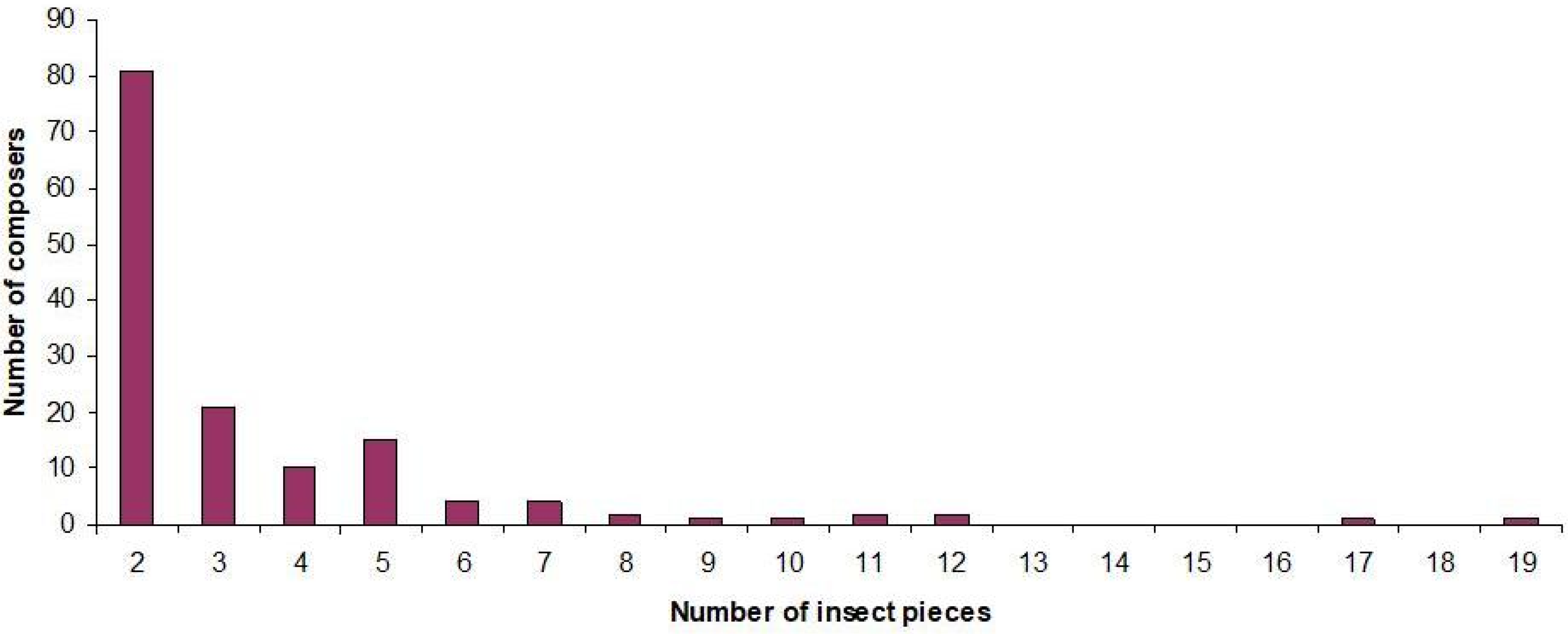
Figure 2.
The distribution of insect music among arthropods. Only the top 15 most common groups are shown.
Figure 2.
The distribution of insect music among arthropods. Only the top 15 most common groups are shown.
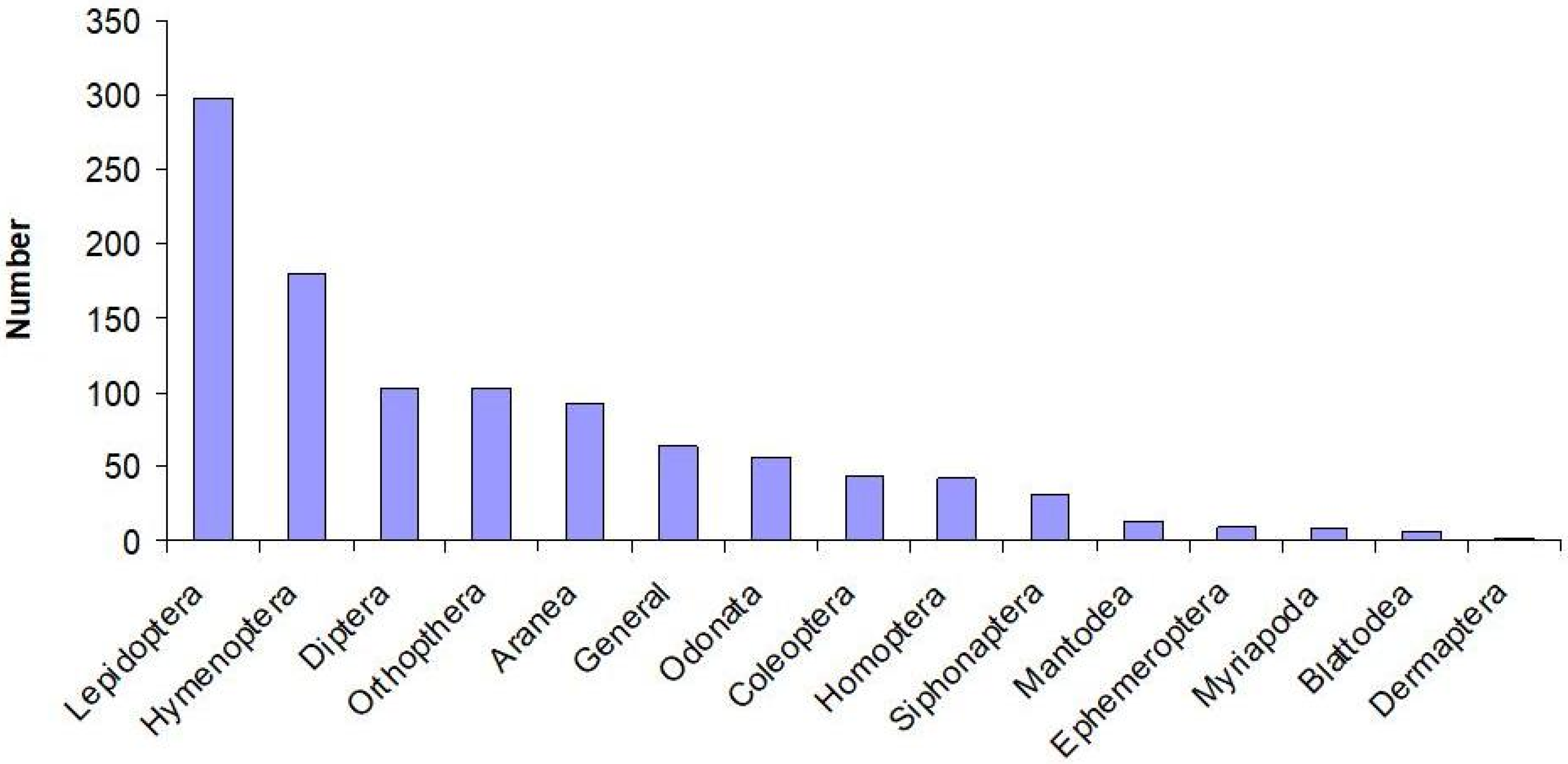
Figure 3.
The frequency of insect music production over time. Only two pieces were written before 1500.
Figure 3.
The frequency of insect music production over time. Only two pieces were written before 1500.
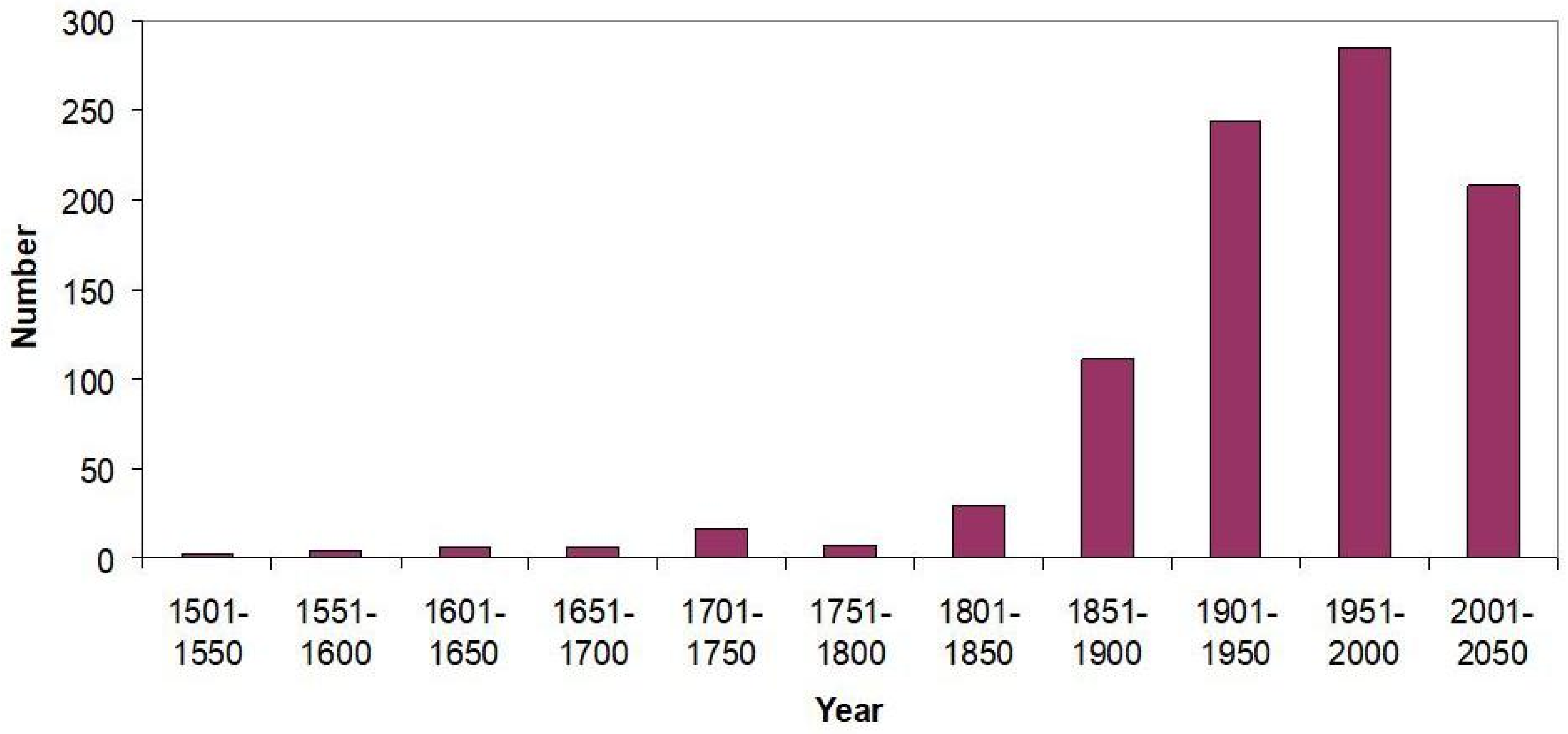
Figure 4.
The countries of origin of insect music-producing composers. Those countries with fewer than 3 are not included.
Figure 4.
The countries of origin of insect music-producing composers. Those countries with fewer than 3 are not included.
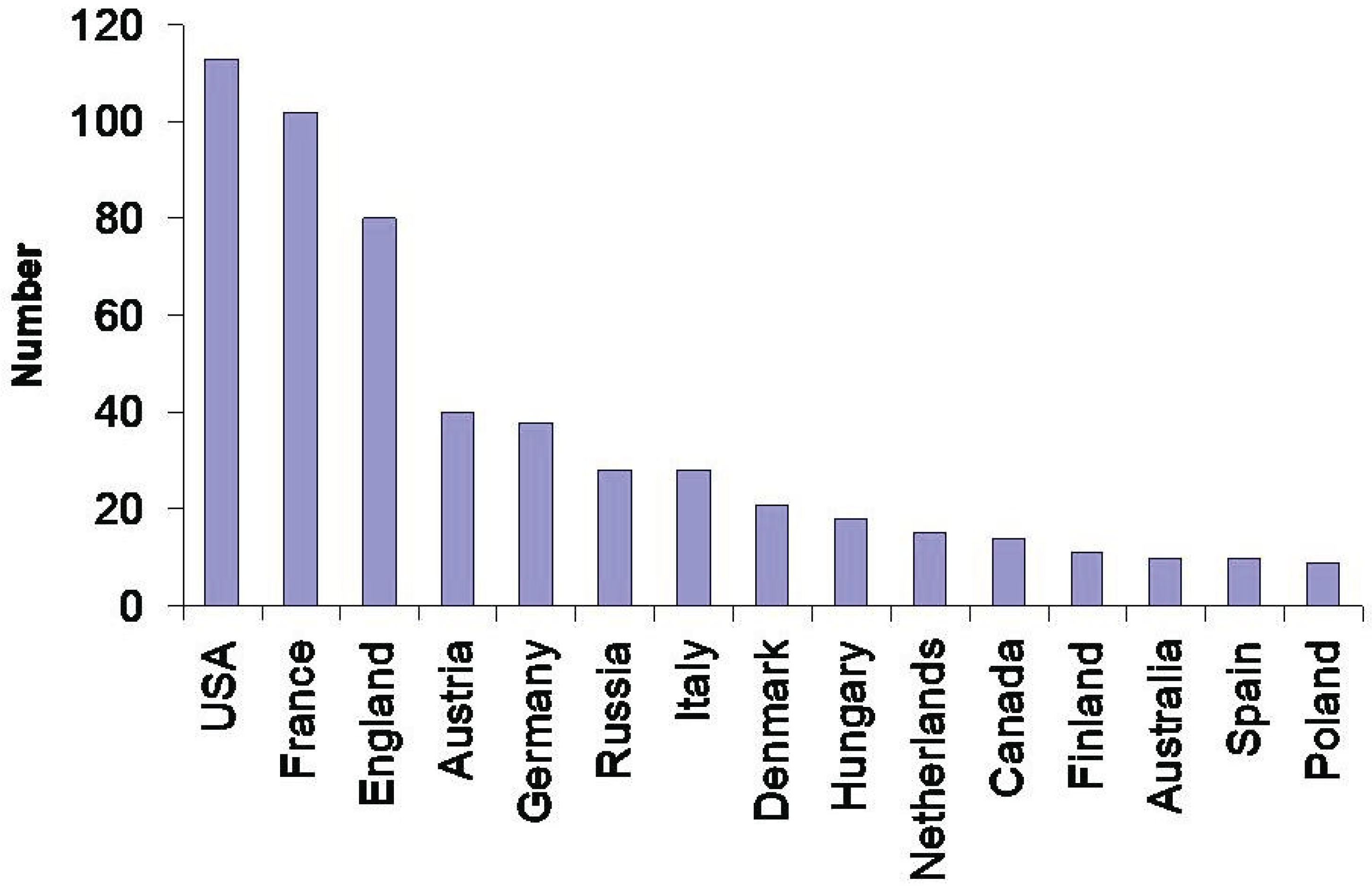

Table 1.
Online databases queried for insect terms.
| Name | URL |
|---|---|
| All Music | allmusic.com |
| Arkiv Music | arkivmusic.com/classical/main.jsp |
| Classical Net | http://www.classical.net/music/links/database.php |
| Classical Archives | https://www.classicalarchives.com/newca/#!/ |
| Dictionary of American | |
| Classical Composers | https://www.google.com/books/edition/Dictionary_of_American_Classical_Compose/WR8jAQAAQBAJ |
| Henry’s records | https://www.henrysrecords.org/ |
| Music and Musicians | https://www.musiqueorguequebec.ca/ |
| Music Brainz | musicbrainz.org |
| Music Web International | musicweb-international.com |
| Musicalics | https://musicalics.com/en |
| Naxos Works Database | https://www.naxos.com/feature/Naxos-Works-Database.asp |
| Online Archive of California | https://oac.cdlib.org/ |
| Open Opus | https://openopus.org/ |
| Sheet Music Plus | sheetmusicplus.com |
| Song of America | https://songofamerica.net/ |
| Subito Music Corporation | https://www.subitomusic.com/ |
| Vassar | https://library.vassar.edu/az.php?s=48527 |
Table 2.
List of search terms used to find insect-themed music.
| English | German | Italian | French |
|---|---|---|---|
| tarantula | tarentule | tarantola | tarentule |
| spider | Spinne | ragno | araignée |
| cockroach | Kakerlake | scarafaggio | cafard |
| fly | Fliege | mosca | mouche |
| maggot | Made | verme | asticot |
| mosquito | Moskito | zanzara | moustique |
| mayfly | Eintagsfliege | effimera | éphémère |
| cicada | Zikade | cicala | cigale |
| ant | Ameise | formica | fourmi |
| bee | Biene | Ape | abeille |
| wasp | Wespe | vespa | guêpe |
| caterpillar | Raupe | bruco | chenille |
| moth | Motte | falena | papillon |
| butterfly | Schmetterling | farfalla | papillon |
| mantis | Gottesanbeterin | mantide | mante |
| millipede | Tausendfüßler | millepiedi | mille-pattes |
| centipede | Tausendfüßler | centopiedi | scolopendre |
| dragonfly | Libelle | libellula | libellule |
| damselfly | Jungfer | damigella | demoiselle |
| grasshopper | Heuschrecke | cavalletto | sauterelle |
| cricket | Kricket | cricket | criquet |
| katydid | katydid | catadide | katydide |
| walkingstick | Stabheuschrecke | insetto stecco | phasme |
| louse | Laus | pidocchio | pou |
| flea | Floh | pulce | puce |
| caddisfly | Köcherfliege | caddisfly | phrygane |
| beetle | Käfer | scarafaggio | scarabée |
| weevil | Rüsselkäfer | tonchio | charançon |
| ladybug/ladybird | Marienkäfer | coccinella | coccinelle |
| dung beetle | Mistkäfer | Scarabeo stercorario | bousier |
| insect | insecte | insetto | insekt |
| bug | bogue | insetto | insekt |
| pupa | Puppe | pupa | pupe |
| earwig | Ohrwurm | forbicina | perce-oreille |
Table 3.
Resemblance of music to insect characteristics.
| Insect trait | Number |
|---|---|
| Erratic flight | 11 |
| Buzzing | 11 |
| High pitched fly | 7 |
| Footfalls | 7 |
| Fluttering | 4 |
| Suspense, horror | 3 |
| Insect calls | 3 |
Table 4.
a. Greatest classical composers, ranked according to ClassicFM (2024). Those who published insect-themed music are shown in red. b. Famous classical composers who published insect music, unranked.
Table 4.
a. Greatest classical composers, ranked according to ClassicFM (2024). Those who published insect-themed music are shown in red. b. Famous classical composers who published insect music, unranked.
| a | ||
| Rank | Name | Vital dates |
| 1 | Mozart, Wolfgang Amadeus | 1756-1791 |
| 2 | Bach, Johann Sebastian | 1685-1750 |
| 3 | Beethoven, Ludwig van | 1770-1827 |
| 4 | von Bingen, Hildegard | 1098-1179 |
| 5 | Monteverdi, Claudio | 1567-1643 |
| 6 | Handel, George Frideric | 1685-1759 |
| 7 | Vivaldi, Antonio | 1678-1741 |
| 8 | Debussy, Claude | 1862-1918 |
| 9 | Tchaikovsky, Pyotr Ilyich | 1840-1893 |
| 10 | Haydn, Joseph | 1732-1809 |
| 11 | Schumann, Robert | 1810-1856 |
| 12 | Elgar, Edward | 1857-1934 |
| 13 | Verdi, Giuseppe | 1813–1901 |
| 14 | Wagner, Richard | 1813–1883 |
| 15 | Strauss, Richard | 1864–1949 |
| 16 | Mahler, Gustav | 1860-1911 |
| 17 | Schubert, Franz | 1797-1828 |
| 18 | Saint-Saens, Camille | 1835-1921 |
| 19 | Stravinsky, Igor | 1882-1971 |
| 20 | Chopin, Frédéric | 1810-1849 |
| 21 | Williams, Ralph Vaughan | 1872-1958 |
| 22 | Beach, Amy Marcy | 1867-1944 |
| 23 | Mendelssohn, Felix | 1809-1847 |
| 24 | Shostakovich, Dmitri Dmitrievich | 1906-1975 |
| 25 | Brahms, Johannes | 1833-1897 |
| 26 | Dvořák, Antonin | 1841-1904 |
| 27 | Rachmaninov, Sergei | 1873–1943 |
| 28 | Glass, Philip | 1937- |
| 29 | Bernstein, Leonard | 1918-1990 |
| 30 | Williams, John | 1932- |
| b | ||
| Name | Vital dates | |
| Bartok, Bela | 1881-1945 | |
| Bizet, Georges | 1838-1875 | |
| Couperin, François | 1668-1733 | |
| Debussy, Claude | 1862-1918 | |
| Mancini, Henry | 1924-1994 | |
| Mozart, Franz Xavier (Wolfgang Amadeus, Jr.) | 1791-1844 | |
| Mussorgsky, Modest Petrovich | 1839-1881 | |
| Prokofiev, Sergei | 1891-1953 | |
| Puccini, Giacomo | 1858-1924 | |
| Purcell, Henry | 1659-1695 | |
| Schickele, Peter (P.D.Q. Bach) | 1935-2024 | |
| Telemann, Georg Philipp | 1681-1767 | |
Table 5.
The rank of composers from the traditional era in terms of their musical output (from Bat 2026). Names of composers of insect-themed music are shown in red.
Table 5.
The rank of composers from the traditional era in terms of their musical output (from Bat 2026). Names of composers of insect-themed music are shown in red.
| Rank | Composer | Hours |
|---|---|---|
| 1 | Mozart | 240 |
| 2 | Vivaldi | 235 |
| 3 | Haydn | 180 |
| 4 | Bach | 175 |
| 5 | Liszt (Piano) | 121 |
| 6 | Beethoven | 96 |
| 7 | Schubert | 82.8 |
| 8 | Britten | 78 |
| 9 | Richard Strauss | 76.8 |
| 10 | Tchaikovsky | 66 |
| 11 | Wagner | 62.4 |
| 12 | Shostakovich | 58.8 |
| 13 | Brahms | 55.2 |
| 14 | Dvorak | 54 |
| 15 | Schumann | 54 |
| 16 | Sullivan | 45 |
| 17 | Bartok | 38.4 |
| 18 | Rachmaninoff | 38.4 |
| 19 | Stravinsky | 36 |
| 20 | Walton | 27.6 |
| 21 | Poulenc | 24 |
| 22 | Debussy | 21.6 |
| 23 | Scriabin | 21.6 |
| 24 | Crumb | 20.4 |
| 25 | Mahler | 19 |
| 26 | Chopin | 18 |
| 27 | Ravel | 16 |
| 28 | Boulez | 14 |
| 29 | Ligeti | 12 |
| 30 | Satie | 12 |
Disclaimer/Publisher’s Note: The statements, opinions and data contained in all publications are solely those of the individual author(s) and contributor(s) and not of MDPI and/or the editor(s). MDPI and/or the editor(s) disclaim responsibility for any injury to people or property resulting from any ideas, methods, instructions or products referred to in the content. |
© 2026 by the authors. Licensee MDPI, Basel, Switzerland. This article is an open access article distributed under the terms and conditions of the Creative Commons Attribution (CC BY) license (http://creativecommons.org/licenses/by/4.0/).
Copyright: This open access article is published under a Creative Commons CC BY 4.0 license, which permit the free download, distribution, and reuse, provided that the author and preprint are cited in any reuse.