

Submitted:
24 August 2026
Posted:
26 August 2026
You are already at the latest version
Abstract
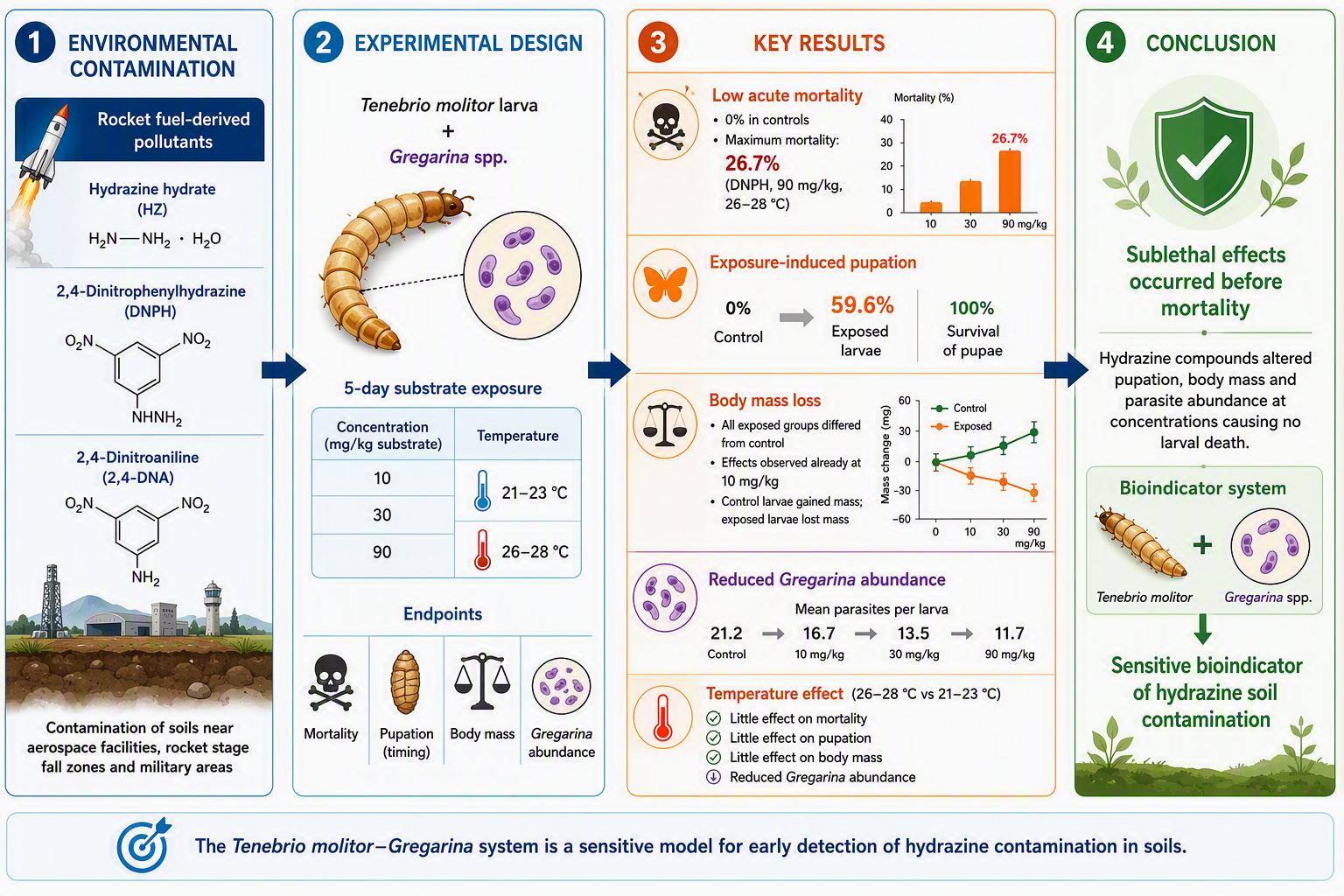
Hydrazine (N₂H₄) and its derivatives are components of rocket fuel that contaminate soils around aerospace facilities and military training grounds. The toxicity of hydrazine hydrate, 2,4-dinitrophenylhydrazine (DNPH) and 2,4-dinitroaniline to terrestrial invertebrates remains unexplored. This study examined the effects of these substances on the mortality, body mass, pupation, and intensity of Gregarina spp. infestation in larvae of Tenebrio molitor Linnaeus, 1758 (Coleoptera, Tenebrionidae) at temperatures of 21–23 and 26–28 °C. Six hundred larvae were distributed into 10 treatment groups at each of two temperatures, with three containers per group, over a 5-day exposure. A dose-dependent effect on the physiological parameters of T. molitor was recorded: mortality rose with dose for all three compounds and at 90 mg/kg reached 26.7% (DNPH, 26–28 °C). Pupation proved the earliest indicator of exposure: none was recorded in the control (0.0%), whereas 59.6% of the exposed larvae pupated, already at the lowest concentration of 10 mg/kg, where no deaths occurred. The proportion pupating was similar across the three compounds (55.0–62.2%) but declined with increasing concentration, from 67.2% at 10 mg/kg to 52.2% at 90 mg/kg. Temperature had no effect on it (57.8% at 21–23 °C versus 61.5% at 26–28 °C). All pupae survived (100.0%), compared with 85.3% of those that remained larvae. Initial body mass did not differ between these groups, so no size threshold for initiating metamorphosis was detected. Within the 21–28 °C range, no main effect of temperature on mortality, pupation, or body mass was found, although a statistically significant temperature × concentration interaction was recorded for the last of these. All three compounds reduced the intensity of Gregarina spp. infestation with increasing concentration, and raising the temperature to 26–28 °C lowered the mean parasite count from 18.0 to 13.0 specimens/larva. Under acute 5-day exposure, therefore, hydrazine compounds cause little larval mortality but alter pupation, body mass and the intensity of parasitic infestation at concentrations that kill no larvae. This makes the T. molitor–Gregarina spp. system suitable for the early detection of substrate contamination by hydrazine compounds.
Keywords:
hydrazine hydrate
; 2
; 4-dinitrophenylhydrazine
; 4-dinitroaniline
; pupation
; body mass
; Gregarina
; temperature
; ecotoxicology
; soil contamination
; Coleoptera
1. Introduction
Hydrazine (N₂H₄) and its derivatives, particularly unsymmetrical dimethylhydra zine (UDMH), are a high-energy liquid fuel widely used in the global aerospace industry, and their transformation products in soil include dimethylamine, N,N-dimethyl formamide and other harmful compounds (Du et al., 2026). This fuel is used in both military and civilian systems (Dallas et al., 2020). Launch vehicle accidents cause local soil contamination with hydrazine compounds, which decompose within a few weeks depending on the soil type (Du et al., 2026). In aquatic biocenoses, hydrazine is toxic to invertebrates and fish: the 48-hour EC₅₀ in Daphnia pulex Leydig, 1860 is 0.16–0.19 mg/L, and the 96-hour LC₅₀ in Pimephales promelas Rafinesque, 1820 is 5.98 mg/L (Velte, 1984). In soil nematodes, a 1% solution of hydrazine hydrate killed more than 80% of the larvae after 24 hours of exposure, and 2,4-dinitrophenylhydrazine also showed a nematocidal effect (Boyko & Brygadyrenko, 2026). According to Rybalka & Brygadyrenko (2026a), contact toxicity for terrestrial beetles is LC₅₀ = 0.015–0.035 g/m² in T. molitor and 0.085 g/m² in Opatrum sabulosum (Linnaeus, 1761).
Military activity and conflicts contaminate soils with munition and explosive residues, which accumulate in the environment and resist natural degradation (Broomandi et al., 2020). Concentrations of energetic compounds measured in soils at military ranges span from trace levels to tens of grams per kilogram: near a bomb crater, trinitrotoluene (TNT) ranged from 0.12 to 778 mg/kg with a mean of 31.8 mg/kg, at ammunition burn pads 2,4-dinitrotoluene reached 491 mg/kg, 2 m behind a firing line nitroglycerin reached 6560 mg/kg, and in soil inside a crater from a 500 lb bomb TNT was 42,200 mg/kg (Pichtel, 2012). The distribution and persistence of explosives and propellants in soils are determined by the physicochemical properties of the compounds and the characteristics of the soil environment (Pichtel, 2012). Organic pollutants of military origin affect soil microbial communities, nutrient cycling and plant physiology through oxidative stress, bioaccumulation and growth inhibition (Palchykov et al., 2025). Explosions of strike unmanned aerial vehicles also alter soil acidity: at the explosion sites active acidity was 6.62–7.41 with a mean of 7.14, which the authors attribute to carbonate parent rock released from the blast crater (Khomiak et al., 2025). Accidents involving Proton-M launch vehicles in Kazakhstan between 1999 and 2018 caused soil contamination with UDMH at concentrations exceeding regulatory limits (Radelyuk et al., 2025). The armed conflict in Ukraine (since 2014) is creating a new scale of soil contamination with rocket fuel components due to the intensive use of missile systems (Biyashev et al., 2024; Leal Filho et al., 2024; Solokha et al., 2024).
Hydrazine toxicity arises from oxidative stress with the production of reactive oxygen species, the formation of DNA adducts (N⁷-methylguanine and O⁶-methylgua nine), and depletion of pyridoxine (vitamin B₆), which inhibits the synthesis of gamma-aminobutyric acid (GABA) and causes neurotoxic effects (Kisby & Spencer, 2021; Crosby et al., 2022). Hydrazine causes mitochondrial dysfunction and oxidative damage that leads to hepatotoxicity (LeFort et al., 2024). This compound is a carcinogen in mammals (Matsumoto et al., 2016) and is classified by the International Agency for Research on Cancer as probably carcinogenic to humans, Group 2A (Crosby et al., 2022).
The compounds under investigation (hydrazine hydrate (N₂H₄•H₂O), 2,4-dinitro phenylhydrazine (DNPH), and 2,4-dinitroaniline) form a structural series (Figure 1) ranging from the parent hydrazine through its aromatic derivative to a related aromatic amine. Hydrazine hydrate is used as rocket fuel. DNPH combines a hydrazine functional group with a dinitrophenyl moiety, and 2,4-dinitroaniline is a component of dinitroaniline herbicides that are toxic to soil and aquatic invertebrates (Giglio & Vommaro, 2022). The contact toxicity of these compounds for T. molitor increases in the same order (Rybalka & Brygadyrenko, 2026a).
Temperature influences the toxicity of pollutants by accelerating metabolic processes through increased rates of enzymatic reactions, enhancing the permeability of cell membranes, and intensifying oxidative stress (Sokolova & Lannig, 2008). In inver tebrates, as poikilothermic organisms, temperature changes determine the dynamics of metabolism and detoxification. The interpretation of toxicity under different temperature regimes is therefore important for predicting ecological risks. The temperature dependence of the toxicity of hydrazine compounds requires experimental verification, as the available data are limited to aquatic organisms and mammals.
Tenebrio molitor, the mealworm beetle (Coleoptera, Tenebrionidae), is used in toxicological studies as a simplified model animal organism, in accordance with the 3R principles (Replacement, Reduction, Refinement) of the ethical use of animals, which ensures cost-effectiveness and rapid testing (Brai et al., 2023). It is the most common insect species for rearing in Europe, and the number of scientific publications on it has grown intensively following the adoption of EU Regulations 2283/2015 and 2017/893 (Bordiean et al., 2020). Previous studies have confirmed the sensitivity of T. molitor to organic xenobiotics of various classes (Lazurska & Brygadyrenko, 2024; Rybalka & Brygadyrenko, 2025); however, the effect of hydrazine derivatives on this model organism remains unexplored.
The intensity of parasitic infestation is a sensitive indicator of ecosystem status. Gregarines are the most common parasites of T. molitor, and the prevalence of parasites in cultivated edible insects gives the study of this system applied significance for food safety (Gałęcki & Sokół, 2019). The literature describes T. molitor larvae as hosts to three species of gregarines: Gregarina cuneata Stein, 1848, G. polymorpha (Hammerschmidt, 1838), and G. steini Berndt, 1902. A molecular check of this list recovered mainly G. polymorpha, and no trophozoites with the features of G. steini were found (Nocciolini et al., 2018). The intensity of gregarine infestation is related to the size and growth rate of the host larvae: smaller larvae carried fewer gregarines, and a positive relationship was found between mass gain and infestation intensity (Lazurska & Brygadyrenko, 2024). Chemical stress affects host-parasite relationships: sublethal concentrations of insectici des increase the abundance of gregarines by suppressing the host’s defensive responses (Wolz et al., 2022). The physiological state of the host also influences gregarine infestation, particularly under starvation (Schawang & Janovy, 2001).
The available data on the toxicity of hydrazine compounds concern mainly aquatic organisms and mammals, and for terrestrial invertebrates they are limited to contact exposure (Rybalka & Brygadyrenko, 2026a). Substrate exposure, in which the compo unds enter the organism with food, and the temperature dependence of this toxicity in a host-parasite context remain unexplored. Given the scale of soil contamination around aerospace facilities and military conflict zones (Radelyuk et al., 2025; Solokha et al., 2024), this problem requires more detailed analysis.
This study aims to determine the effect of three hydrazine compounds (hydrazine hydrate, DNPH, 2,4-dinitroaniline) on the mortality, body mass, pupation, and intensity of Gregarina spp. infestation in T. molitor larvae at two temperatures (21–23 and 26–28 °C). The hypotheses were that (1) a temperature of 26–28 °C, compared with 21–23 °C, would enhance the toxic effects of hydrazine compounds through accelerated metabolic processes; (2) sublethal endpoints—pupation, body mass, and intensity of parasitic infestation—would respond at concentrations causing no mortality; and (3) toxicity would increase according to the position of the compound in the structural series (hydrazine hydrate < DNPH < 2,4-dinitroaniline), as established for contact toxicity.
2. Materials and Methods
2.1. Experimental Design
Tenebrio molitor larvae were kept in transparent plastic containers (40 × 30 × 20 cm) at a temperature of 21–23 or 26–28 °C (depending on the experimental temperature regime), a relative humidity of 40–50%, and indirect sunlight. The feeding substrate consisted of organically produced pressed oat grains (2025 harvest). The water source for T. molitor was cabbage leaves, which were placed on the surface of the feeding substrate after being cut into 1 × 1 cm pieces. Each larva in the container was provided with 0.30 ± 0.03 g of cabbage leaves. The leaves were replaced every 2 days to prevent mold growth. Humidity, temperature, and lighting were maintained equally for all groups. All larvae had equal access to food and the same likelihood of parasitic infestation.
For the experiment, 600 T. molitor larvae of both sexes and 18–22 mm in length were selected from a laboratory colony whose size exceeded the requirements of the study, to standardize body size across groups. This corresponds to the lower part of the range described for this species, whose larvae usually reach 20–35 mm (Hong et al., 2020), meaning that the selected individuals were at a late stage of larval development. Inclusion criteria were defined a priori in accordance with the Animal Research: Reporting of In Vivo Experiments (ARRIVE) 2.0 guidelines (Percie du Sert et al., 2020): larvae 18–22 mm in length with no visible signs of disease or damage. The mean initial body mass was 144.4 ± 22.5 mg/individual.
Three hundred larvae were randomly assigned to each of the two temperature regimes (21–23 and 26–28 °C) to assess their effect on toxicity. At each temperature, the larvae were divided into ten treatment groups: a control group (without the addition of compounds) and nine groups exposed to three concentrations (10, 30, 90 mg/kg of substrate) of three compounds (hydrazine hydrate, DNPH, 2,4-dinitroaniline). The larvae were housed in groups of 10 individuals in separate transparent plastic containers with a volume of 500 mL, each containing 50 ± 1 g of pressed oat grains. Each treatment group consisted of three such containers (30 larvae per group at each temperature), 60 in total. They were arranged in a randomized complete block design with three blocks, each holding one container of every treatment group. Positions within a block were determined using a random number generator in accordance with the ARRIVE 2.0 guidelines (Percie du Sert et al., 2020). Because the compounds were added to the substrate of the container rather than to individual larvae, the container served as the experimental unit.
All chemicals were purchased from Sigma-Aldrich Chemie GmbH (Taufkirchen, Germany). The compounds were dissolved in dimethyl sulfoxide (DMSO) to ensure homogeneous distribution in the substrate. The DMSO concentration was selected on the basis of preliminary testing in which the LC₅₀ of the solvent was 0.964 ± 0.196 g/m² (Rybalka & Brygadyrenko, 2026a), so as to avoid background effects on the larvae. Control groups received an equivalent amount of DMSO without the tested compounds. The solutions were evenly applied to the feed substrate using a pipette to a depth of 20 mm from the surface. The substrate was thoroughly mixed, after which the larvae were placed in it. Each larva was marked with an individual number for tracking.
Concentrations (10, 30, 90 mg/kg of substrate) and sample size were determined based on a pilot experiment, statistical power analysis, and literature data on the toxicity of hydrazine compounds. A preliminary study of the acute contact toxicity of these compounds to T. molitor larvae (Rybalka & Brygadyrenko, 2026a) confirmed the species’ sensitivity to hydrazine hydrate, DNPH, and 2,4-dinitroaniline (LC₅₀: 0.035 ± 0.006, 0.026 ± 0.004, and 0.015 ± 0.001 g/m², respectively). A pilot experiment with n = 50 larvae (5 per compound-concentration combination, 5 in the control, temperature 21–23 °C) showed body mass loss under substrate exposure in every treatment group, whereas control larvae gained mass (Supplementary Table S1). Effect sizes (Cohen’s d) for body mass changes ranged from 2.07 to 3.32 depending on the compound and concentration, with a median value of d = 2.78, which corresponds to a large effect by the criteria of Cohen (1992). At that effect size, n = 4 larvae per group provides a statistical power of 0.80 at p = 0.050. The sample size was increased to n = 30 larvae per treatment group to absorb mortality and the exclusion of individuals that pupated from the analyses of body mass and intensity of parasitic infestation. The selected concentrations correspond to ecologically relevant soil contamination around aerospace facilities and military training grounds, where UDMH content exceeds regulatory limits (Radelyuk et al., 2025).
The experiment lasted 5 days, during which the larvae were exposed to the chemicals. Control groups were kept under the same conditions but without the addition of toxicants. A cotton disc was placed at the bottom of each plastic container to absorb excess moisture. After the 5-day exposure, mortality was recorded, and each T. molitor larva was weighed individually to assess changes in body mass. Exclusion criteria were defined a priori. Dead larvae were left out of the analysis of body mass and intensity of parasitic infestation. Individuals that pupated were also excluded from these analyses, as metamorphosis causes mass loss independent of toxic effects and distorts the assessment of the dose-dependent response (Percie du Sert et al., 2020). Comparisons of body mass changes between individuals that pupated and those that remained as larvae were performed separately.
Immediately after the end of the 5-day exposure, on the same day as weighing, the surviving T. molitor larvae were dissected for parasitological examination. The midgut (from the stomach to the Malpighian tubules) was placed on a microscope slide in a drop of physiological saline (0.9% NaCl) to prevent drying. The intestine was opened with a scalpel, making 12 transverse incisions with particular attention to the posterior part of the midgut, where Gregarina spp. trophozoites are localized (Harry, 1967). Immature gregarines still attached to the intestinal wall by an epimerite were not counted: such stages are embedded in the epithelium and their epimerites are ruptured during squash preparation (Valigurová, 2012). Only trophozoites released from the midgut during standardized compression with a cover slip were counted. Parasite counts were performed using a blind method: samples were coded with random numbers before dissection, which together with the microscopic counting was carried out by two trained researchers who had no access to the group membership of the sample, and the code was broken only after all the work was completed (Percie du Sert et al., 2020). Gregarina cuneata, G. polymorpha, and G. steini were identified from morphological characteristics following Valigurová (2012), Nocciolini et al. (2018), and Desportes & Schrével (2013).
2.2. Statistical Analysis
Statistical power analysis was performed using the pwr package (version 1.3-0) based on the effect size obtained in the pilot experiment to determine the minimum sample that ensures a power of >0.80 at p = 0.050. Because the compounds were added to the container substrate rather than to individual larvae, each model included its identifier as a random effect, so replication was carried at that level. This identifier combined the container number and the temperature cohort, as numbering restarted within each of them. Body mass changes were analyzed using a linear mixed model (LMM) with temperature, treatment group, and their interaction as fixed effects, initial body mass as a covariate, and container as a random effect, with degrees of freedom estimated by the Satterthwaite method. Homogeneity of variances was checked with Levene’s test, and the residuals of the fitted model were examined as well. Differences between each treatment group and the control were estimated as Dunnett contrasts with 95% confidence intervals and standardized as Cohen’s d relative to the residual standard deviation. The letters above the boxplots were obtained from pairwise contrasts of the same model with Tukey adjustment (Piepho, 2004).
For the analysis of binary outcomes (mortality, pupation), binomial generalized linear mixed models (GLMM) with a logit link function and container as a random effect were used. For each compound a separate concentration slope was fitted, but without a main effect of the substance, so that at 0 mg/kg all three dose series rely on a single control group. The statistical significance of the main effects was determined using likelihood ratio tests comparing the full model with the model lacking the corresponding predictor. Fisher’s exact test was used when a group contained no events. The threshold nature of the pupation response was examined separately: the concentration effect among the exposed larvae was assessed with a mixed model, and the difference between the control and treatment groups with Fisher’s exact test.
Analysis of individual Gregarina species did not reveal consistent concentration effects (Figure S1–S3), so the total number of parasites (the sum of G. cuneata, G. polymorpha, and G. steini) was analyzed using a zero-inflated negative binomial mixed model (ZINB) with container as a random effect. Four types of distributions were compared: Poisson, negative binomial (NB), zero-inflated Poisson (ZIP), and ZINB. The optimal specification was chosen by the Akaike Information Criterion (AIC), where lower values indicate a better fit to the data. The ZINB model showed the lowest AIC values, consistent with typical characteristics of parasitological data: overdispersion and structural zeros.
Statistical analysis was performed in R version 4.5.1 (R Core Team, 2024) using the following packages (versions in parentheses): dplyr (1.1.4) for data processing, ggplot2 (4.0.1) and patchwork (1.3.2) for visualization, tidyr (1.3.1) for data reshaping, lme4 (1.1.37) and lmerTest (3.2.1) for linear and generalized mixed models, glmmTMB (1.1.14) for zero-inflated models, emmeans (1.11.2.8) and multcomp (1.4-28) for contrasts and compact letter display, MASS (7.3-65) and pscl (1.5.9), described by Zeileis et al. (2008), for distribution comparison, car (3.1-3) for Levene’s test, and pwr (1.3-0) for power analysis.
3. Results
3.1. Mortality of T. molitor Larvae Under Xenobiotic Exposure
Larval mortality increased with increasing concentrations of the tested compounds (Figure 2). No mortality was recorded in the control groups (0 mg/kg substrate) at either temperature (21–23 and 26–28 °C). At the maximum concentration of 90 mg/kg, mortality was 13.3% and 26.7% for DNPH at 21–23 and 26–28 °C respectively, 10.0% for 2,4-dinitroaniline and 6.7% for hydrazine hydrate at both temperatures. In the treatment groups, mortality was 7.4% at 26–28 °C and 4.4% at 21–23 °C (n = 270 per temperature group, excluding controls).
A binomial GLMM revealed an effect of concentration and compound on mortality (χ² = 28.29, df = 3, p = 3.15 × 10⁻⁶), whereas the effect of temperature was not significant (χ² = 2.31, df = 1, p = 0.129). The odds of death increased with concentration for all three compounds: DNPH (z = 5.46, p < 0.001), 2,4-dinitroaniline (z = 3.79, p < 0.001), and hydrazine hydrate (z = 2.16, p = 0.031), with each additional 100 mg/kg multiplying them 30.6-, 13.6-, and 5.8-fold, respectively. Variability among containers was virtually zero, indicating an absence of clustering of mortality within them.
3.2. Effect of Xenobiotics on the Number of T. molitor Larvae That Proceeded to Pupation
Exposure to hydrazine compounds induced pupation of T. molitor larvae (Figure 3). No pupation was recorded in the control groups, whereas 59.6% of the exposed larvae pupated. Fisher’s exact test confirmed the statistical significance of pupation induction compared with the control (p = 1.53 × 10⁻²⁴). Proportions for the individual compounds are given in Table 1.
Among the exposed larvae, the proportion that pupated declined with increasing concentration (67.2% at 10 mg/kg, 59.4% at 30 mg/kg, and 52.2% at 90 mg/kg; n = 180 per concentration). A binomial GLMM confirmed this concentration effect (χ² = 6.62, df = 1, p = 0.010). The pupation frequency was 57.8% at 21–23 °C and 61.5% at 26–28 °C (n = 270 per temperature group). No effect of temperature was detected (χ² = 0.71, df = 1, p = 0.398).
All individuals that pupated survived (100.0%, n = 322), whereas among those that remained as larvae the figure was 85.3% (186/218 exposed larvae), a statistically sig nificant difference (Fisher’s exact test, p = 5.77 × 10⁻¹⁴). Initial body mass and its daily changes did not differ between these two groups (mass: 147.8 ± 20.7 vs. 147.3 ± 21.5 mg/larva, t = 0.295, df = 373.5, p = 0.768; change: −3.15 ± 1.82 vs. −3.10 ± 1.75 mg/larva per day, t = −0.326, df = 400, p = 0.745).
3.3. Changes in Body Mass of T. molitor Larvae Under Xenobiotic Exposure
The linear mixed model (larvae that did not pupate, n = 246) revealed an effect of treatment group on daily body mass changes (F = 40.57, df = 9, 40.02, p < 2.2 × 10⁻¹⁶). No main effect of temperature was recorded (F = 0.13, df = 1, 42.52, p = 0.716), but its interaction with treatment group was statistically significant (F = 2.32, df = 9, 37.52, p = 0.034). Initial body mass contributed to the model (F = 10.73, df = 1, 224.22, p = 0.001): lighter larvae gained mass more rapidly over the exposure period. The standard deviation of the container random effect was 0.562 against a residual of 1.431 mg/larva per day.
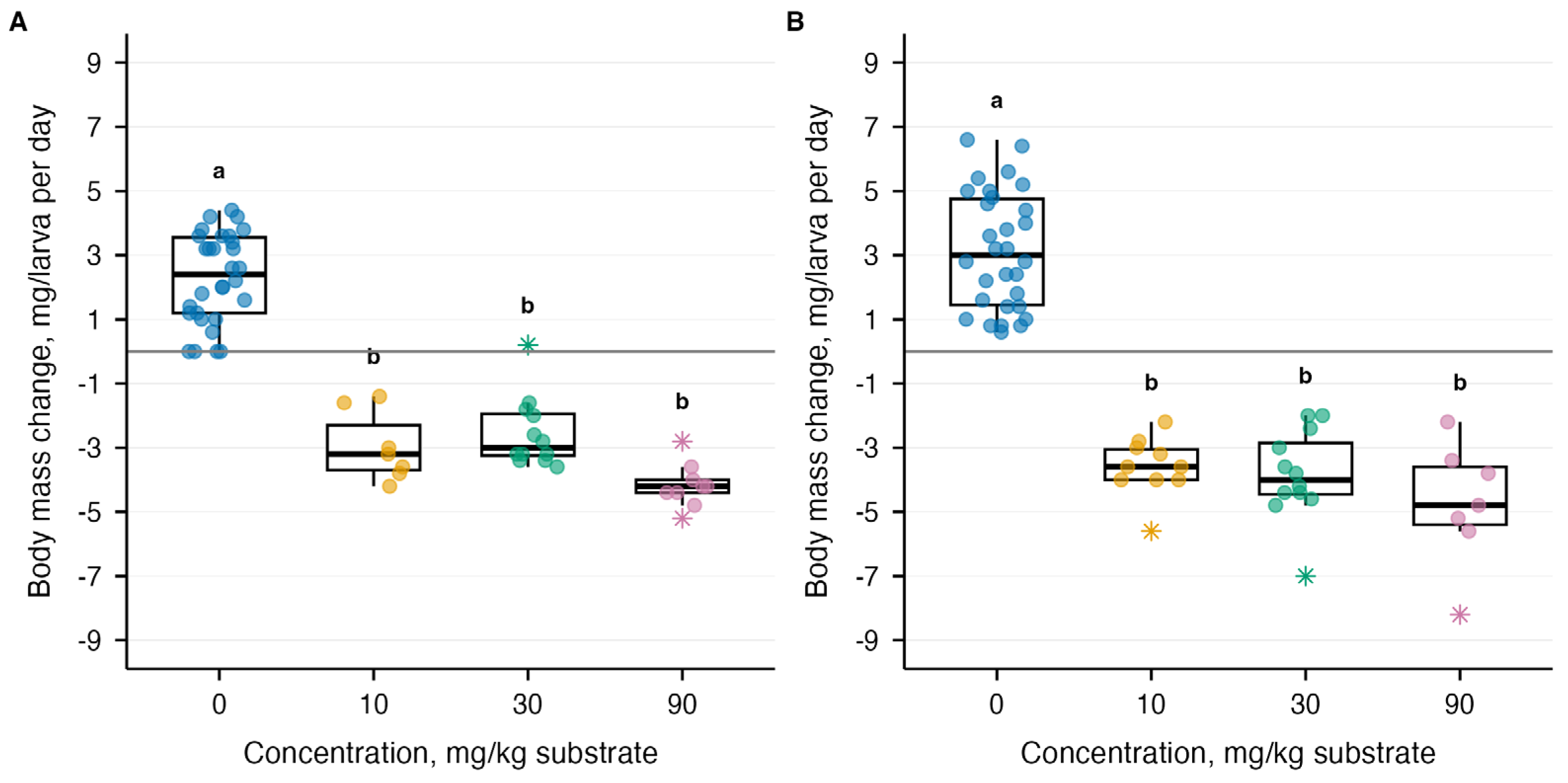
Compared with the control, all nine treatment groups reduced daily body mass changes (all p < 0.001). The reduction ranged from −3.86 to −7.53 mg/larva per day and corresponded to large effect sizes (d from −2.69 to −5.26). The extremes of that range belong to the groups at 90 mg/kg: −7.53 mg/larva per day for 2,4-dinitroaniline and −3.86 mg/larva per day for DNPH. Full estimates with 95% confidence intervals are given in Table 2.
Pairwise comparisons within the same model (with Tukey adjustment) separated the groups similarly for most compounds (Figure 3, Figure 4 and Figure 5). For hydrazine hydrate and 2,4-dinitroaniline, at both temperatures the control separated from all three concentrations, which did not differ from one another. For DNPH at 21–23 °C the pattern was the same, whereas at 26–28 °C the maximum concentration (90 mg/kg) additionally separated from the lower ones. In this group no mass loss was recorded: the mean was +0.48 mg/larva per day, which produced the statistically significant interaction of concentration with temperature.
Figure 6.
Effect of 2,4-dinitroaniline on daily body mass changes in Tenebrio molitor larvae during a 5-day experiment: A – temperature 21–23 °C, B – temperature 26–28 °C (n = 117 larvae that did not pupate); see Figure 4 for explanation.
Figure 6.
Effect of 2,4-dinitroaniline on daily body mass changes in Tenebrio molitor larvae during a 5-day experiment: A – temperature 21–23 °C, B – temperature 26–28 °C (n = 117 larvae that did not pupate); see Figure 4 for explanation.
3.4. Intensity of Gregarina spp. Infestation in T. molitor Larvae Under Xenobiotic Exposure
The zero-inflated negative binomial mixed model revealed a decrease in the total number of parasites (the sum of G. cuneata, G. polymorpha, and G. steini) with increasing concentration for all three compounds: hydrazine hydrate (z = −3.17, p = 0.002), DNPH (z = −2.34, p = 0.019), and 2,4-dinitroaniline (z = −2.26, p = 0.024), as shown in Figure 7. The concentration slopes did not differ between compounds (χ² = 0.10, df = 2, p = 0.949). The mean number of parasites decreased from 21.2 in the control to 16.7, 13.5, and 11.7 specimens/larva at concentrations of 10, 30, and 90 mg/kg, respectively. Temperature also affected the intensity of parasitic infestation (z = −2.25, p = 0.024): at 26–28 °C the mean number of parasites was 13.0 versus 18.0 specimens/larva at 21–23 °C.
4. Discussion
4.1. Toxicity of Hydrazine Compounds to T. molitor
Hydrazine compounds caused low mortality of T. molitor larvae during a 5-day exposure. At the maximum concentration of 90 mg/kg substrate, mortality was 13.3% and 26.7% for DNPH at 21–23 and 26–28 °C respectively, 10.0% for 2,4-dinitroaniline and 6.7% for hydrazine hydrate at both temperatures. This order does not coincide with the order of contact toxicity for T. molitor, where the LC₅₀ increases from 2,4-dinitroaniline through DNPH to hydrazine hydrate. The discrepancy between contact and substrate toxicity may be explained by a difference in bioavailability. DNPH, which combines a hydrazine group with a dinitrophenyl moiety, is more lipophilic than 2,4-dinitroaniline: XLogP is 1.5 vs. 1.0 according to the PubChem database (Kim et al., 2023), which may ease its penetration through the intestinal epithelium.
The toxicity of hydrazine compounds to soil invertebrates remains poorly studied, and the available toxicological data concern mainly aquatic organisms: the 96-hour LC₅₀ of hydrazine hydrate for P. promelas is 5.98 mg/L, and the 48-hour EC₅₀ for D. pulex is 0.16–0.19 mg/L (Velte, 1984). QSAR modeling indicates high acute toxicity of certain UDMH transformation products (Du et al., 2026). This study provides the first data on the substrate toxicity of hydrazine hydrate, DNPH, and 2,4-dinitroaniline to T. molitor larvae, demonstrating that changes in physiological parameters (pupation, body mass, and intensity of parasitic infestation) appear without larval death as low as 10 mg/kg of substrate.
4.2. Effect of Hydrazine Compounds on the Pupation Process of T. molitor
Exposure to hydrazine compounds induced pupation in 59.6% of T. molitor larvae, whereas under similar conditions this figure was 10.7% for nitroaromatic compounds (Rybalka & Brygadyrenko, 2026c). Pupation was induced by the very fact of exposure: it was absent in the control groups and reached 52–67% among the exposed larvae. However, among the exposed larvae, the pupation frequency declined with increasing concentration (p = 0.010), indicating suppression of metamorphosis at higher doses. All larvae that pupated survived (100.0%, n = 322), whereas among those that remained as larvae, survival was 85.3% (p = 5.77 × 10⁻¹⁴). This higher survival is consistent with the hypothesis of metamorphosis as a means of escaping an unfavorable environment, but does not prove it. Pupation ceases feeding, so the reduced contact with the toxic substrate is a mechanical consequence of the transition itself rather than evidence of an adaptive function. Within a 5-day observation period, a genuine survival advantage cannot be separated from the shorter time that the pupae spent on the substrate, and the pupae were not tracked to adult emergence. An alternative explanation cannot be excluded: the larvae that pupated under stress may have been primarily those already closest to metamorphosis, meaning this reflects selection rather than induction.
Accelerated metamorphosis under chemical stress has been described in other Coleoptera species. Li et al. (2026) suggested that oxidative stress in Tribolium castaneum (Herbst, 1797) may accelerate metamorphosis through an increase in the level of 20-hydroxyecdysone. Kodrík et al. (2015) showed that adipokinetic hormone (AKH) is the principal insect stress-response hormone, whose level rises under oxidative stress. The concept of “adaptive bailout” (Sharma et al., 2020) posits that larvae that have reached a critical mass initiate premature metamorphosis under adverse conditions as a survival strategy. In this study, initial body mass and daily mass changes did not differ between individuals that pupated and those that remained as larvae (p = 0.768 and p = 0.745, respectively), which does not support the existence of a size threshold for initiating metamorphosis under the “adaptive bailout” concept.
4.3. Effect of Hydrazine Compounds on Body Mass Changes in T. molitor
Control larvae gained mass (+2.7 mg/larva per day), whereas all treatment groups lost mass. The loss already reached large effect sizes at 10 mg/kg (all d from −2.7 to −5.3) and changed little with further increases in concentration: at both temperatures the control separated from all exposed groups, which for the most part did not differ from one another. Mass reduction under the influence of toxic compounds is a typical response of invertebrates (Brai et al., 2023). Hydrazine compounds may cause avoidance of the contaminated substrate through stimulation of deterrent receptors (Koul, 2008; Shields, 2023). However, we did not measure food consumption, so we cannot separate reduced feeding from a direct toxic effect on metabolism. The mass loss is equally consistent with both mechanisms, as well as with their combination.
4.4. Effect of Hydrazine Compounds on the Intensity of Gregarina spp. Infestation
The ZINB mixed model revealed a reduction in the intensity of parasitic infestation with increasing concentration for all three hydrazine compounds (all p < 0.025), and the concentration slopes did not differ between compounds (χ² = 0.10, df = 2, p = 0.949). This distinguishes hydrazine compounds from nitroaromatic ones, for which no effect on parasite number was found (Rybalka & Brygadyrenko, 2026c), and aligns them with ammonia, which also caused a dose-dependent reduction in the intensity of parasitic infestation (Rybalka & Brygadyrenko, 2026b). Lazurska & Brygadyrenko (2024) showed that only 4 of the 24 organic xenobiotics studied reduced the abundance of G. polymorpha in T. molitor, indicating the dependence of the parasitic response on the chemical structure of the compound. Thus, the ability to reduce gregarine infestation is charac teristic of hydrazine compounds and ammonia, but not of nitroaromatic contaminants.
The mechanism of the reduction in the intensity of parasitic infestation may be associated with the direct toxicity of hydrazine compounds to Gregarina trophozoites in the host’s intestine or with indirect changes in the intestinal environment under exposure to the toxicant. Because the effect was similar for volatile (hydrazine hydrate) and non-volatile (DNPH, 2,4-dinitroaniline) derivatives, volatility is unlikely to be the determining factor. Temperature also affected the intensity of parasitic infestation: at 26–28 °C the number of gregarines was lower than at 21–23 °C (p = 0.024). A moderate increase in temperature probably accelerates the metabolism of the parasites and shortens their residence time in the intestine.
4.5. Effect of Temperature on the Toxicity of Hydrazine Compounds
No main effect of temperature on mortality or pupation was found, whereas the intensity of parasitic infestation at 26–28 °C was lower than at 21–23 °C (p = 0.024). For body mass changes, no main effect was recorded either, but the interaction of temperature with treatment group was statistically significant (F = 2.32, df = 9, 37.52, p = 0.034): it did not shift mass loss uniformly but changed the shape of the dose-dependent response. This interaction was driven mainly by DNPH, for which mass loss at 90 mg/kg and 26–28 °C vanished, with the mean approaching zero, whereas for hydrazine hydrate and 2,4-dinitroaniline the group pattern was the same at both temperatures. Such temperature modulation may be associated with the acceleration of metabolic processes at elevated temperature (Sokolova & Lannig, 2008).
Both temperature regimes lie within the optimum of T. molitor: according to Podlesnik (2025), a temperature of 25–30 °C is considered optimal for development, so 26–28 °C lies within this range. In heat-stress experiments on this species, 28 °C is used as the non-stress control and stress is induced at 38 °C (Herren et al., 2024), so the upper regime of this study corresponds to the control temperature of such work. The absence of a main temperature effect on mortality, body mass, and pupation is consistent with both regimes lying within the physiological norm and with the data for ammonia, where no temperature modulation of toxicity was recorded in this range either (Rybalka & Brygadyrenko, 2026b). The reduction in the intensity of parasitic infestation at the higher temperature probably reflects the accelerated metabolism of the parasites themselves rather than heat stress in the host, since both regimes lie within limits that this species tolerates without signs of stress.
4.6. Implications for Biomonitoring and Insect Rearing
Pupation is a sensitive indicator of exposure to hydrazine compounds: it was induced as low as 10 mg/kg, where no mortality was recorded (0.0%). Tenebrio molitor is mass-reared as a sustainable source of protein for feed and human nutrition and is also used as a model organism in toxicological studies in accordance with the 3R principles (Brai et al., 2023). The species is approved in the EU as a novel food (Bordiean et al., 2020). The induction of premature pupation may serve as an early indicator of substrate contamination in production. At the same time, these considerations apply only to acute 5-day exposure. We did not measure reproduction, developmental duration, adult emergence, or other chronic parameters, so the implications for industrial rearing require verification in experiments covering the full life cycle.
The study’s findings are also relevant in the context of soil contamination with hydrazine compounds resulting from military operations in Ukraine (Hryhorczuk et al., 2024; Solokha et al., 2024; Grygorieva et al., 2025) and the activities of aerospace facilities, where UDMH concentrations in soils exceed regulatory limits (Radelyuk et al., 2025). Tenebrio molitor larvae can be used as bioindicators of substrate contamination with hydrazine compounds, where pupation serves as an early signal of exposure, and changes in body mass and intensity of parasitic infestation provide a quantitative assessment of the degree of impact.
4.7. Limitations of the Study
This study has several limitations. The 5-day exposure reflects only acute toxicity and does not allow the assessment of chronic effects of longer exposure. Both tempe rature regimes (21–23 and 26–28 °C) lie within the thermal optimum of T. molitor, which limits the extrapolation of the results to extreme temperatures. A single substrate type (pressed oat grain) was used, although the bioavailability of the compounds may differ in other substrates or soils. Individual compounds were studied, whereas under field conditions organisms are exposed to mixtures of UDMH transformation products (Du et al., 2026). Excluding larvae that pupated from the analysis of body mass and intensity of parasitic infestation reduced the sample size. Only Gregarina trophozoites were counted, and other stages of parasite development (cysts and gamonts) were not assessed. Dead larvae were not dissected, so at the highest concentrations, where mortality was greatest, the sample for parasitological analysis may have been biased toward the individuals that survived. The estimate for 2,4-dinitroaniline depended on the specification of the statistical model: under a negative binomial model without the container random effect or zero inflation, the reduction in parasite numbers did not reach significance (p = 0.088). Under the AIC-selected ZINB mixed model this reduction was statistically significant (p = 0.024). For hydrazine hydrate and DNPH the conclusion did not depend on the choice of distribution. We did not measure food consumption, oxidative stress, detoxification enzyme activity, or immune markers, so the proposed mechanisms remain hypotheses that require separate experimental verification.
5. Conclusions
The study revealed low acute toxicity of hydrazine compounds (hydrazine hydrate, DNPH, 2,4-dinitroaniline) to T. molitor larvae under substrate exposure: at the maximum concentration of 90 mg/kg, mortality was 13.3% and 26.7% for DNPH at 21–23 and 26–28 °C respectively, 10.0% for 2,4-dinitroaniline and 6.7% for hydrazine hydrate at both temperatures. The predicted increase in toxicity according to the position of the compound in the structural series was not observed.
The predicted enhancement of toxicity at the higher temperature was likewise not observed: no main effect of temperature on mortality or pupation was found within the 21–28 °C range. A statistically significant temperature × concentration interaction was recorded for body mass changes, and the intensity of parasitic infestation at 26–28 °C was lower than at 21–23 °C (p = 0.024).
Sublethal endpoints, by contrast, responded at concentrations causing no mortality. Pupation and body mass loss were recorded as low as 10 mg/kg, where mortality was 0.0%.
All three hydrazine compounds reduced the intensity of Gregarina spp. infestation with increasing concentration (all p < 0.025), and their concentration slopes did not differ from one another. Exposure induced pupation in 59.6% of the larvae (versus 0.0% in the control), yet among the exposed individuals its frequency declined with increasing concentration (p = 0.010). All individuals that pupated survived (100.0%), compared with 85.3% of those that remained as larvae. Accelerated metamorphosis may be a stress-associated response that reduces contact with the contaminated substrate, although the 5-day observation period does not allow this to be separated from the shorter time that the pupae spent on the substrate.
The results are consistent with the suitability of T. molitor and its associated Gregarina spp. as a model system for assessing the toxicity of hydrazine compounds under acute exposure. Further studies should include chronic exposures, an expanded temperature range, and the analysis of mixtures of UDMH transformation products.
Supplementary Materials
The following supporting information can be downloaded at the website of this paper posted on Preprints.org and https://github.com/RybalkaDenis/hydrazine_on_host_parasite_system.
Author Contributions
Conceptualization, D.R. and V.B.; methodology, V.B.; software, D.R.; validation, D.R. and V.B.; formal analysis, D.R.; investigation, D.R.; resources, V.B.; data curation, D.R.; writing—preparation of the original draft, D.R.; writing—reviewing and editing, V.B.; visualization, D.R.; supervision, V.B.; project administration, V.B.; securing funding, V.B. All authors have read and approved the published version of the manuscript.
Funding
This study was funded by the Ministry of Education and Science of Ukraine, “Agrobiotechnological Approaches to Restoring Soil Fertility on Agricultural Lands Affected by Hostilities” (2025–2027), grant number 0125U001860.
Institutional Review Board Statement
The animal research protocol was approved by the Ethics Committee of the Faculty of Biology and Ecology at Oles Honchar Dnipro National University (protocol code 16, September 12, 2025).
Informed Consent Statement
Not applicable.
Data Availability Statement
The data supporting this study are publicly available at https://github.com/RybalkaDenis/hydrazine_on_host_parasite_system (accessed August 20, 2026).
Acknowledgments
We are grateful to the Research Department of Oles Honchar Dnipro National University for administrative and technical support.
Conflicts of Interest
The authors declare no conflicts of interest.
References
- Biyashev, B.; Drobitko, A.; Markova, N.; Bondar, A.; Pismenniy, O. Chemical analysis of the state of Ukrainian soils in the combat zone. Int. J. Environ. Stud. 2024, 81(1), 199–207. [Google Scholar] [CrossRef]
- Boyko, O. O.; Brygadyrenko, V. V. Survival of nematode larvae under exposure to explosion-derived contaminants in war-affected environments. Biosyst. Divers. 2026, 34(3), e2612. [Google Scholar] [CrossRef]
- Bordiean, A.; Krzyżaniak, M.; Stolarski, M. J.; Czachorowski, S.; Peni, D. Will yellow mealworm become a source of safe proteins for Europe? Agriculture 2020, 10(6), 233. [Google Scholar] [CrossRef]
- Brai, A.; Poggialini, F.; Vagaggini, C.; Pasqualini, C.; Simoni, S.; Francardi, V.; Dreassi, E. Tenebrio molitor as a simple and cheap preclinical pharmacokinetic and toxicity model. Int. J. Mol. Sci. 2023, 24(3), 2296. [Google Scholar] [CrossRef]
- Broomandi, P.; Guney, M.; Kim, J. R.; Karaca, F. Soil contamination in areas impacted by military activities: A critical review. Sustainability 2020, 12(21), 9002. [Google Scholar] [CrossRef]
- Cohen, J. A power primer. Psychol. Bull. 1992, 112(1), 155–159. [Google Scholar] [CrossRef]
- Crosby, M. E.; Ciurlionis, R.; Brayman, T. G.; Kondratiuk, A.; Nicolette, J. J. Exploring the molecular and functional cellular response to hydrazine via transcriptomics and DNA repair mutant cell lines. Environ. Mol. Mutagen. 2022, 63(7), 336–350. [Google Scholar] [CrossRef]
- Dallas, J. A.; Raval, S.; Alvarez Gaitan, J. P.; Saydam, S.; Dempster, A. G. The environmental impact of emissions from space launches: A comprehensive review. J. Clean. Prod. 2020, 255, 120209. [Google Scholar] [CrossRef]
- Desportes, I.; Schrével, J. (Eds.) Treatise on Zoology - Anatomy, Taxonomy, Biology. The Gregarines (2 vols); Brill: Leiden, The Netherlands, 2013. [Google Scholar] [CrossRef]
- Du, J.; Ren, X.; Zeng, Y.; Liu, Y.; Dong, J.; Yang, S.; Shi, J.; Liu, B.; Chen, Y. Degradation dynamics and pathways of unsymmetrical dimethylhydrazine (UDMH) across contrasting soil matrices. Toxics 2026, 14(2), 169. [Google Scholar] [CrossRef]
- Gałęcki, R.; Sokół, R. A parasitological evaluation of edible insects and their role in the transmission of parasitic diseases to humans and animals. PLoS ONE 2019, 14(7), e0219303. [Google Scholar] [CrossRef]
- Giglio, A.; Vommaro, M. L. Dinitroaniline herbicides: a comprehensive review of toxicity and side effects on animal non-target organisms. Environ. Sci. Pollut. Res. 2022, 29(51), 76687–76711. [Google Scholar] [CrossRef]
- Grygorieva, O.; Zaimenko, N.; Vergun, O.; Zhurba, M.; Goncharovska, I.; Golubkova, I. Soil degradation caused by military activities in Ukraine: Challenges and prospects for ecological rehabilitation. Agrobiodiversity Improv. Nutr. Health Life Qual. 2025, 9(2), 310–329. [Google Scholar] [CrossRef]
- Harry, O. G. The effect of a eugregarine Gregarina polymorpha (Hammerschmidt) on the mealworm larva of Tenebrio molitor (L.). J. Protozool. 1967, 14(4), 539–547. [Google Scholar] [CrossRef]
- Herren, P.; Hesketh, H.; Dunn, A. M.; Meyling, N. V. Heat stress has immediate and persistent effects on immunity and development of Tenebrio molitor. J. Insects As Food Feed 2024, 10(5), 835–853. [Google Scholar] [CrossRef]
- Hong, J.; Han, T.; Kim, Y. Y. Mealworm (Tenebrio molitor larvae) as an alternative protein source for monogastric animal: A review. Animals 2020, 10(11), 2068. [Google Scholar] [CrossRef]
- Hryhorczuk, D.; Levy, B. S.; Prodanchuk, M.; Kolodiy, S. The environmental health impacts of Russia’s war on Ukraine. J. Occup. Med. Toxicol. 2024, 19, 4. [Google Scholar] [CrossRef]
- Kim, S.; Chen, J.; Cheng, T.; Gindulyte, A.; He, J.; He, S.; Li, Q.; Shoemaker, B. A.; Thiessen, P. A.; Yu, B.; Zaslavsky, L.; Zhang, J.; Bolton, E. E. PubChem 2023 update. Nucleic Acids Res. 2023, 51(D1), D1373–D1380. [Google Scholar] [CrossRef] [PubMed]
- Kisby, G. E.; Spencer, P. S. Role of hydrazine-related chemicals in cancer and neurodegenerative disease. Chem. Res. Toxicol. 2021, 34(9), 1953–1969. [Google Scholar] [CrossRef]
- Kodrík, D.; Bednářová, A.; Zemanová, M.; Krishnan, N. Hormonal regulation of response to oxidative stress in insects—an update. Int. J. Mol. Sci. 2015, 16(10), 25788–25816. [Google Scholar] [CrossRef]
- Khomiak, I. V.; Onyshchuk, I. P.; Kychkyruk, O. Y.; Vakerych, M. M.; Hasynets, Y. S.; Schwartau, V. V. The impact of strike UAV explosions on soil acidity and vegetation dynamics. Biosyst. Divers. 2025, 33(2), e2530. [Google Scholar] [CrossRef]
- Koul, O. Phytochemicals and insect control: An antifeedant approach. Crit. Rev. Plant Sci. 2008, 27(1), 1–24. [Google Scholar] [CrossRef]
- Lazurska, V.; Brygadyrenko, V. Effects of organic xenobiotics on Tenebrio molitor larvae and their parasite Gregarina polymorpha. Biology 2024, 13(7), 513. [Google Scholar] [CrossRef]
- Leal Filho, W.; Eustachio, J. H. P. P.; Fedoruk, M.; Lisovska, T. War in Ukraine: an overview of environmental impacts and consequences for human health. Front. Sustain. Resour. Manag. 2024, 3, 1423444. [Google Scholar] [CrossRef]
- LeFort, K. R.; Rungratanawanich, W.; Song, B. J. Contributing roles of mitochondrial dysfunction and hepatocyte apoptosis in liver diseases through oxidative stress, post-translational modifications, inflammation, and intestinal barrier dysfunction. Cell. Mol. Life Sci. 2024, 81, 34. [Google Scholar] [CrossRef]
- Li, M.; Chen, J.; Wang, Z.-Y.; Wang, F.-F.; Dong, L.-L.; Pan, J.; Li, M.-E.; Yu, L.; Sang, W. TcALS knockdown accelerates metamorphosis via insulin signaling in Tribolium castaneum. Insect Sci. 2026. [Google Scholar] [CrossRef]
- Matsumoto, M.; Kano, H.; Suzuki, M.; Katagiri, T.; Umeda, Y.; Fukushima, S. Carcinogenicity and chronic toxicity of hydrazine monohydrate in rats and mice by two-year drinking water treatment. Regul. Toxicol. Pharmacol. 2016, 76, 63–73. [Google Scholar] [CrossRef]
- Nocciolini, C.; Cucini, C.; Leo, C.; Francardi, V.; Dreassi, E.; Carapelli, A. Assessing the efficiency of molecular markers for the species identification of gregarines isolated from the mealworm and super worm midgut. Microorganisms 2018, 6(4), 119. [Google Scholar] [CrossRef]
- Palchykov, V. A.; Malaniia, M. M.; Tymoshenko, K. I.; Brygadyrenko, V. V. Organic soil pollutants resulting from military activities. Biosyst. Divers. 2025, 33(4), e2561. [Google Scholar] [CrossRef]
- Percie du Sert, N.; Hurst, V.; Ahluwalia, A.; Alam, S.; Avey, M. T.; Baker, M.; Browne, W. J.; Clark, A.; Cuthill, I. C.; Dirnagl, U.; Emerson, M.; Garner, P.; Holgate, S. T.; Howells, D. W.; Karp, N. A.; Lazic, S. E.; Lidster, K.; MacCallum, C. J.; Macleod, M.; …; Würbel, H. The ARRIVE guidelines 2.0: Updated guidelines for reporting animal research. PLoS Biol. 2020, 18(7), e3000410. [Google Scholar] [CrossRef]
- Pichtel, J. Distribution and fate of military explosives and propellants in soil: A review. Appl. Environ. Soil Sci. 2012, 617236. [Google Scholar] [CrossRef]
- Piepho, H. P. An algorithm for a letter-based representation of all-pairwise comparisons. J. Comput. Graph. Stat. 2004, 13(2), 456–466. [Google Scholar] [CrossRef]
- Podlesnik, J. Pupal development and adult acclimation temperatures influence the cold and heat tolerance in Tenebrio molitor (Coleoptera: Tenebrionidae). Insects 2025, 16(4), 402. [Google Scholar] [CrossRef]
- R Core Team. R: A language and environment for statistical computing; R Foundation for Statistical Computing: Vienna, Austria, 2024; Available online: https://www.R-project.org.
- Radelyuk, I.; Zhakupbekova, A.; Zhumadildinova, A.; Kashtanov, A.; Baimatova, N. Hidden contamination patterns: A stochastic approach to assessing unsymmetrical dimethylhydrazine transformation products in Kazakhstan’s rocket stage fall areas. Toxics 2025, 13(11), 963. [Google Scholar] [CrossRef]
- Rybalka, D.; Brygadyrenko, V. Effects of toxic organic compounds on Tenebrio molitor and its parasite Gregarina steini. Biology 2025, 14(5), 453. [Google Scholar] [CrossRef]
- Rybalka, D.; Brygadyrenko, V. Acute toxicity of TNT derivatives and hydrazine-based compounds from explosive and rocket fuel contamination to darkling beetles (Tenebrio molitor and Opatrum sabulosum). PeerJ 2026a, 14, e20427. [Google Scholar] [CrossRef]
- Rybalka, D.; Brygadyrenko, V. The effect of ammonia on the host–parasite system Tenebrio molitor at different temperatures. Biology 2026b, 15(3), 271. [Google Scholar] [CrossRef]
- Rybalka, D.; Brygadyrenko, V. Toxicity of nitroaromatic explosives for the host–parasite system Tenebrio molitor–Gregarina spp. at different temperatures. PeerJ 2026c. [Google Scholar] [CrossRef]
- Schawang, J. E.; Janovy, J., Jr. The response of Gregarina niphandrodes (Apicomplexa: Eugregarinida: Septatina) to host starvation in Tenebrio molitor (Coleoptera: Tenebrionidae) adults. J. Parasitol. 2001, 87(3), 600–605. [Google Scholar] [CrossRef]
- Sharma, K.; Mishra, N.; Shakarad, M. N. Evolution of reduced minimum critical size as a response to selection for rapid pre-adult development in Drosophila melanogaster. R. Soc. Open Sci. 2020, 7(6), 191910. [Google Scholar] [CrossRef]
- Shields, V. D. C. Deterrents and their effects on the feeding behavior and sensory physiology of insects. In Arthropods - new advances and perspectives; IntechOpen: London, 2023. [Google Scholar] [CrossRef]
- Sokolova, I. M.; Lannig, G. Interactive effects of metal pollution and temperature on metabolism in aquatic ectotherms: implications of global climate change. Clim. Res. 2008, 37(2–3), 181–201. [Google Scholar] [CrossRef]
- Solokha, M.; Demyanyuk, O.; Symochko, L.; Mazur, S.; Vynokurova, N.; Sementsova, K.; Mariychuk, R. Soil degradation and contamination due to armed conflict in Ukraine. Land 2024, 13(10), 1614. [Google Scholar] [CrossRef]
- Valigurová, A. Sophisticated adaptations of Gregarina cuneata (Apicomplexa) feeding stages for epicellular parasitism. PLoS ONE 2012, 7(8), e42606. [Google Scholar] [CrossRef]
- Velte, J. S. Acute toxicity of hydrazine hydrate to the fathead minnow (Pimephales promelas) and daphnid (Daphnia pulex). Bull. Environ. Contam. Toxicol. 1984, 33(1), 598–604. [Google Scholar] [CrossRef]
- Wolz, M.; Schrader, A.; Whitelaw, E.; Müller, C. Gregarines modulate insect responses to sublethal insecticide residues. Oecologia 2022, 198(1), 255–265. [Google Scholar] [CrossRef]
- Zeileis, A.; Kleiber, C.; Jackman, S. Regression models for count data in R. J. Stat. Softw. 2008, 27(8), 1–25. [Google Scholar] [CrossRef]
Figure 1.
Structural formulae of the three compounds studied here, which form a structural series: A – hydrazine (N₂H₄), the parent compound of the series, applied in the experiment as hydrazine hydrate (N₂H₄•H₂O); B – 2,4-dinitrophenylhydrazine (DNPH, C₆H₆N₄O₄), an aromatic derivative of hydrazine in which the hydrazine group is joined to a dinitrophenyl moiety; C – 2,4-dinitroaniline (C₆H₅N₃O₄), a related aromatic amine in which the hydrazine group is absent; atom colours follow the PubChem convention: nitrogen blue, oxygen red, carbon skeleton black; two-dimensional depictions were retrieved from the PubChem database (Kim et al., 2023).
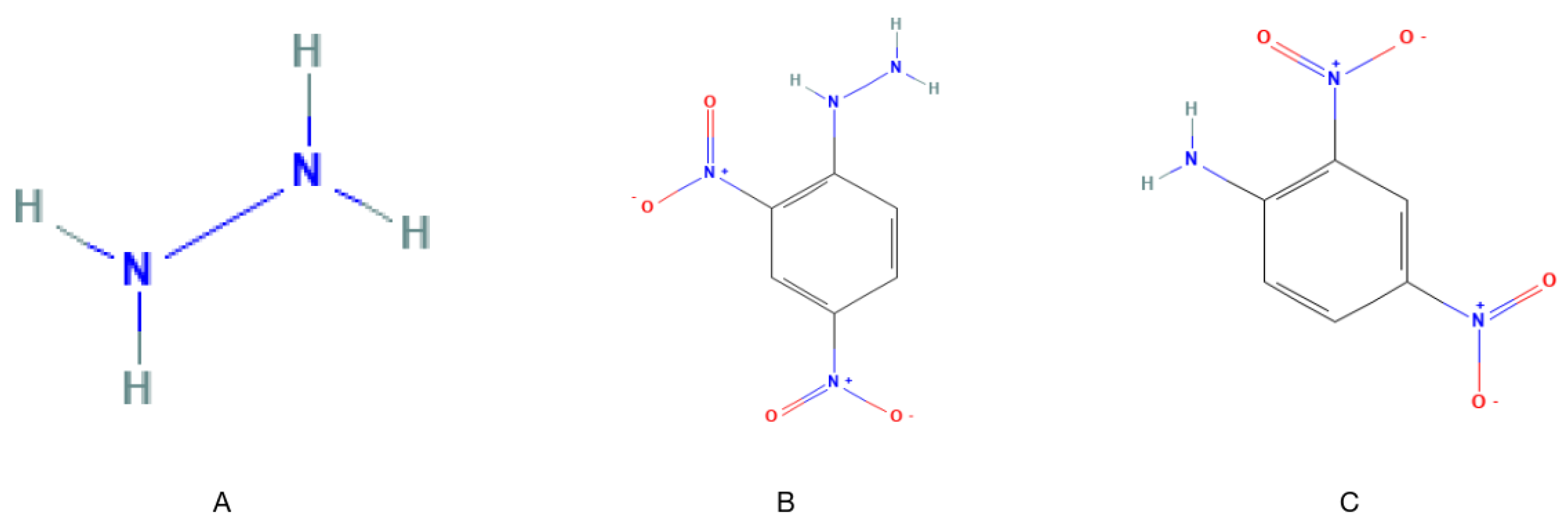
Figure 2.
Mortality of Tenebrio molitor larvae after 5 days of exposure to three hydrazine compounds (hydrazine hydrate, 2,4-dinitrophenylhydrazine, 2,4-dinitroaniline) in the feed substrate at two temperatures: the heat map shows the percentage of mortality (numerical values in cells) with a colour gradient from green (0.0% mortality) to red (26.7% mortality); n = 30 larvae per combination of compound, concentration and temperature.
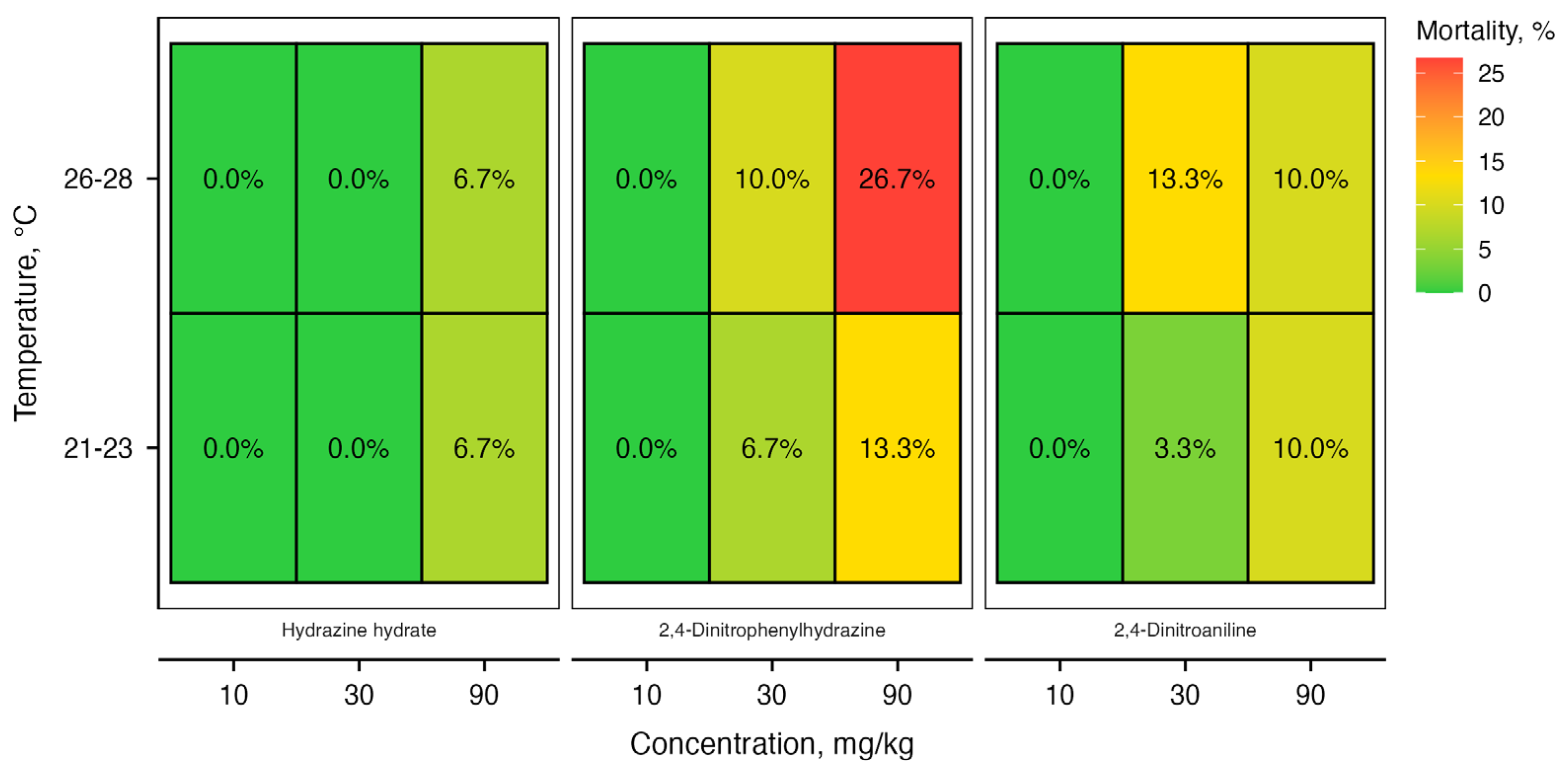
Figure 3.
Frequency of Tenebrio molitor larvae pupation during 5-day exposure to hydrazine compounds (hydrazine hydrate, 2,4-dinitrophenylhydrazine, 2,4-dinitroaniline) in the feed substrate depending on concentration (data pooled across the two temperature regimes, 21–23 and 26–28 °C); the bar chart shows the percentage of larvae that underwent metamorphosis during the experiment, out of the larvae exposed; bars are grouped by compound along the x-axis: control, hydrazine hydrate, 2,4-dinitrophenylhydrazine and 2,4-dinitroaniline, with the three concentrations within each group; grey bar – control group (0 mg/kg), green bars – 10 mg/kg, blue bars – 30 mg/kg, orange bars – 90 mg/kg; the numerical values above the bars show the frequency of pupation in percent; letters above the bars – results of pairwise comparisons by Fisher’s exact test (groups sharing a letter do not differ statistically at α = 0.050); the control group showed 0.0% pupation; n = 60 larvae per bar.
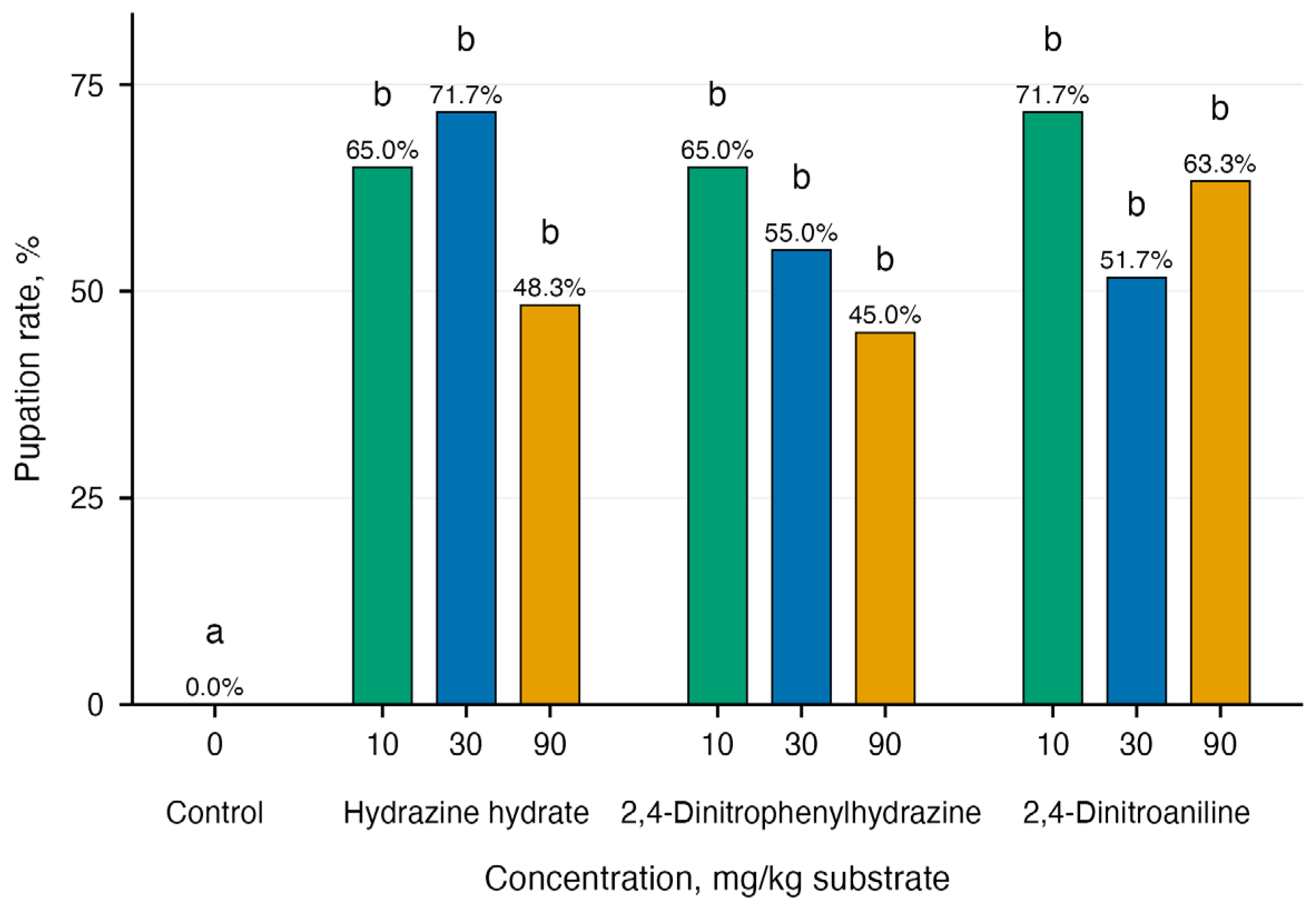
Figure 4.
Effect of hydrazine hydrate on daily body mass changes in Tenebrio molitor larvae during a 5-day experiment: A – temperature 21–23 °C, B – temperature 26–28 °C (n = 125 larvae that did not pupate); the boxplots show the distribution of daily body mass changes (mg/larva per day) for each concentration; the thick black line inside the box – median, the box boundaries – first and third quartiles (Q1, Q3); the boxplot whiskers – range of typical values within 1.5× the interquartile range (IQR) from the box limits; colored circles – individual measurements for each larva; asterisks (*) in the group color – statistical outliers beyond that range; the horizontal gray line marks zero mass change; the letters above the boxplots – pairwise contrasts of the linear mixed model with Tukey adjustment, in which the container served as the unit of replication (groups sharing a letter do not differ statistically at α = 0.050).
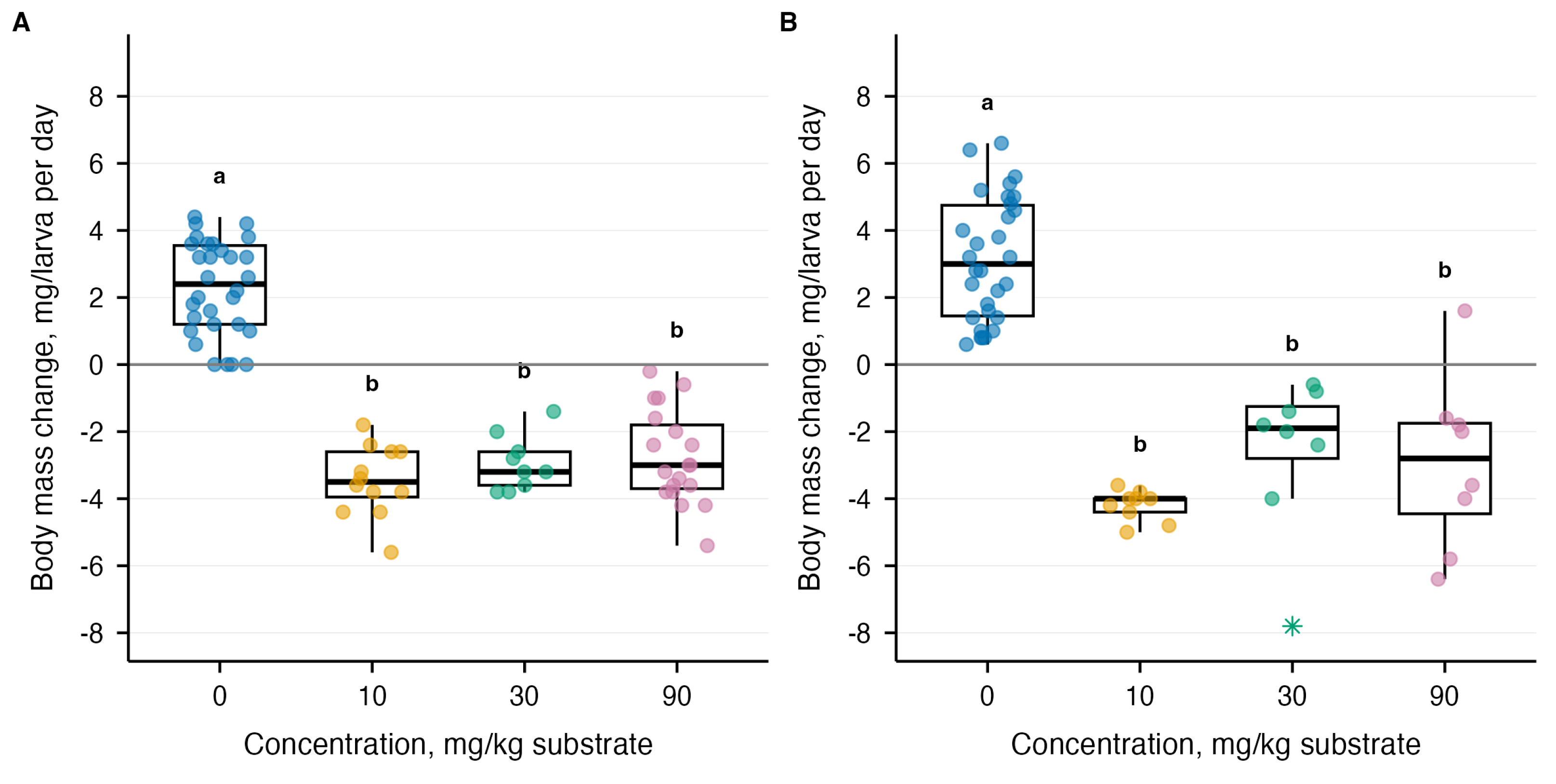
Figure 5.
Effect of 2,4-dinitrophenylhydrazine (DNPH) on daily body mass changes in Tenebrio molitor larvae during a 5-day experiment: A – temperature 21–23 °C, B – temperature 26–28 °C (n = 124 larvae that did not pupate); see Figure 4 for explanation.
Figure 5.
Effect of 2,4-dinitrophenylhydrazine (DNPH) on daily body mass changes in Tenebrio molitor larvae during a 5-day experiment: A – temperature 21–23 °C, B – temperature 26–28 °C (n = 124 larvae that did not pupate); see Figure 4 for explanation.
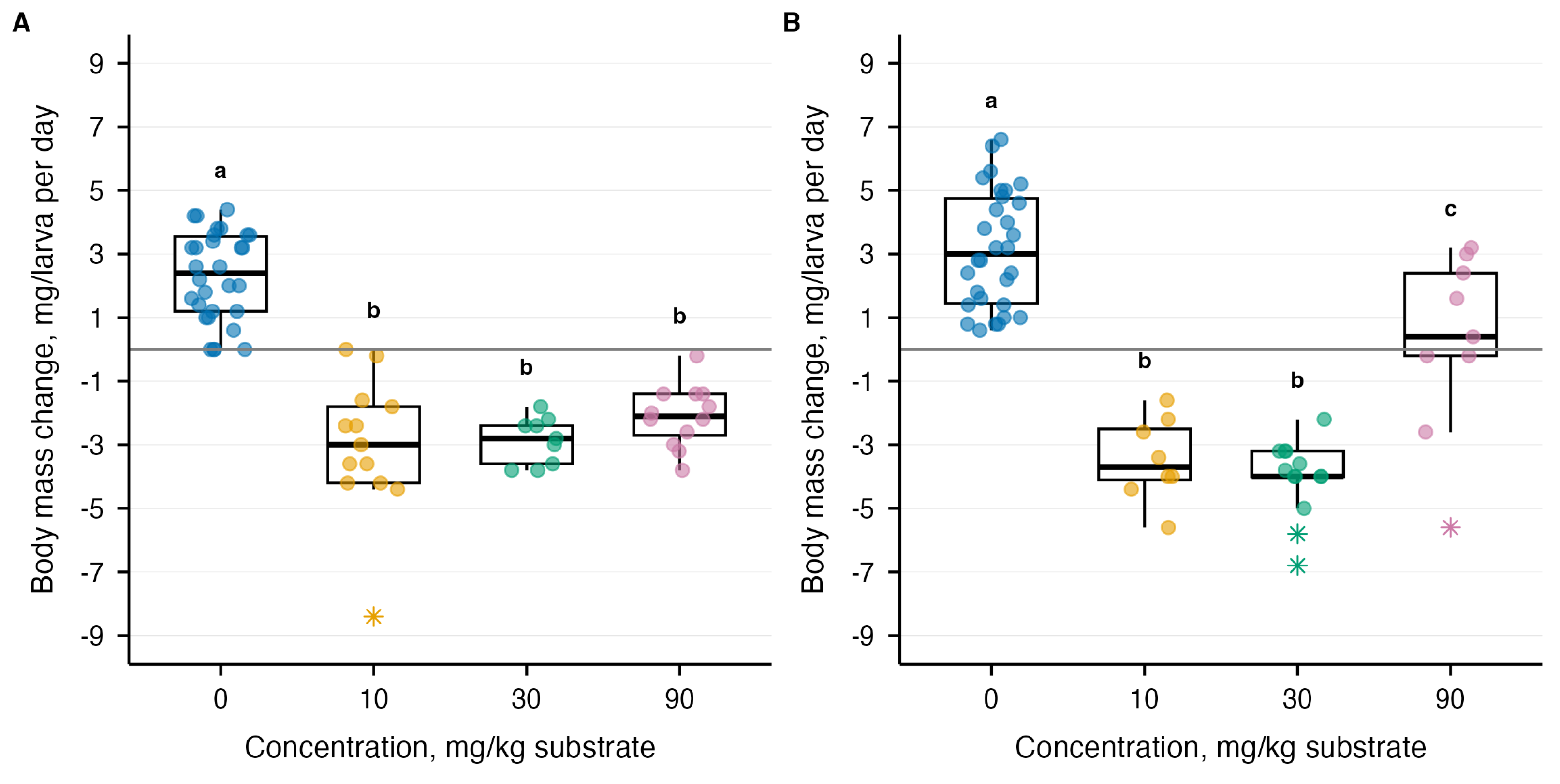
Figure 7.
Effect of hydrazine compounds on the total parasite load (sum of all three Gregarina species) in Tenebrio molitor larvae during a 5-day experiment: A, B – hydrazine hydrate (n = 125); C, D – 2,4-dinitrophenylhydrazine (n = 124); E, F – 2,4-dinitroaniline (n = 117); left panels – temperature 21–23 °C, right panels – temperature 26–28 °C; see Figure 4 for explanation.
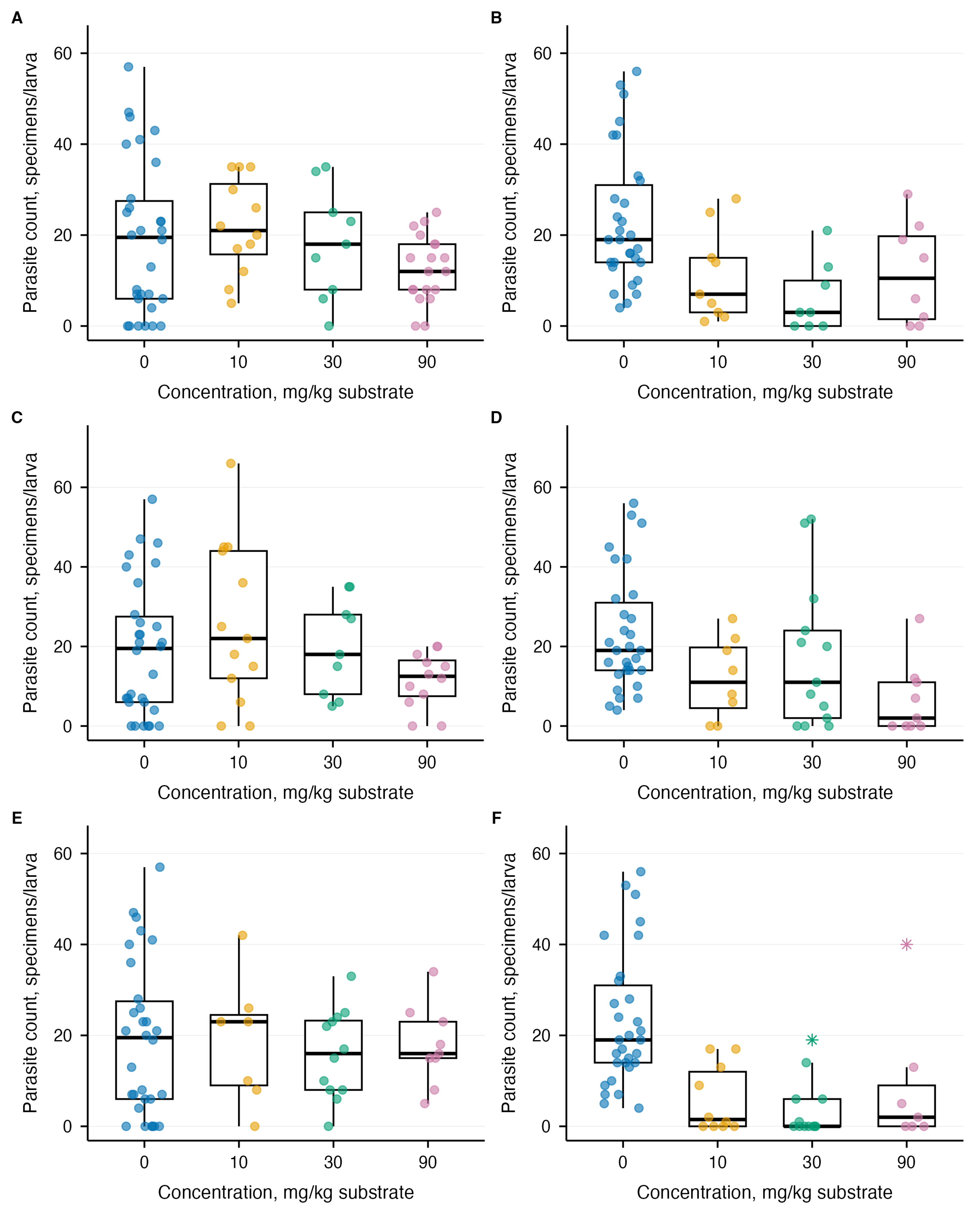

Table 1.
Proportion of Tenebrio molitor larvae that pupated during a 5-day substrate exposure to three hydrazine compounds; data are pooled across the two temperature regimes (21–23 and 26–28 °C) and the three concentrations (10, 30 and 90 mg/kg substrate); the denominator is the number of larvae exposed rather than the number that survived, because survival itself depends on the exposure; the proportion therefore expresses the probability of reaching pupation and incorporates larval mortality.
| Group | n | Pupated | Proportion, % |
| Control | 60 | 0 | 0.0 |
| Hydrazine hydrate | 180 | 111 | 61.7 |
| 2,4-dinitrophenylhydrazine (DNPH) | 180 | 99 | 55.0 |
| 2,4-dinitroaniline | 180 | 112 | 62.2 |
| All treatment groups | 540 | 322 | 59.6 |
Table 2.
Differences in daily body mass changes of Tenebrio molitor larvae between the nine treatment groups and the control group during a 5-day substrate exposure to three hydrazine compounds; estimates were obtained as Dunnett contrasts from a linear mixed model with temperature, treatment group and their interaction as fixed effects, initial body mass as a covariate and container as a random effect; values are averaged over the two temperature regimes (21–23 and 26–28 °C); negative values denote mass loss relative to the control; 95% CI – 95% confidence interval with Dunnett adjustment; d – Cohen’s d effect size, calculated as the ratio of the difference to the residual standard deviation of the model (1.431 mg/larva per day); n = 246 surviving larvae that did not pupate.
| Compound | Concentration, mg/kg |
Difference, mg/larva per day |
95% CI | d |
| Hydrazine hydrate | 10 | −7.13 | −8.66 to −5.61 | −4.98 |
| Hydrazine hydrate | 30 | −5.77 | −7.26 to −4.28 | −4.03 |
| Hydrazine hydrate | 90 | −5.96 | −7.39 to −4.53 | −4.17 |
| 2,4-dinitrophenylhydrazine (DNPH) | 10 | −6.45 | −7.93 to −4.97 | −4.51 |
| 2,4-dinitrophenylhydrazine (DNPH) | 30 | −6.52 | −7.96 to −5.08 | −4.55 |
| 2,4-dinitrophenylhydrazine (DNPH) | 90 | −3.86 | −5.30 to −2.41 | −2.69 |
| 2,4-dinitroaniline | 10 | −6.50 | −8.04 to −4.95 | −4.54 |
| 2,4-dinitroaniline | 30 | −6.46 | −7.92 to −5.01 | −4.52 |
| 2,4-dinitroaniline | 90 | −7.53 | −9.06 to −6.01 | −5.26 |
Disclaimer/Publisher’s Note: The statements, opinions and data contained in all publications are solely those of the individual author(s) and contributor(s) and not of MDPI and/or the editor(s). MDPI and/or the editor(s) disclaim responsibility for any injury to people or property resulting from any ideas, methods, instructions or products referred to in the content. |
© 2026 by the authors. Licensee MDPI, Basel, Switzerland. This article is an open access article distributed under the terms and conditions of the Creative Commons Attribution (CC BY) license (http://creativecommons.org/licenses/by/4.0/).
Copyright: This open access article is published under a Creative Commons CC BY 4.0 license, which permit the free download, distribution, and reuse, provided that the author and preprint are cited in any reuse.