
Submitted:
24 August 2026
Posted:
26 August 2026
You are already at the latest version
Abstract
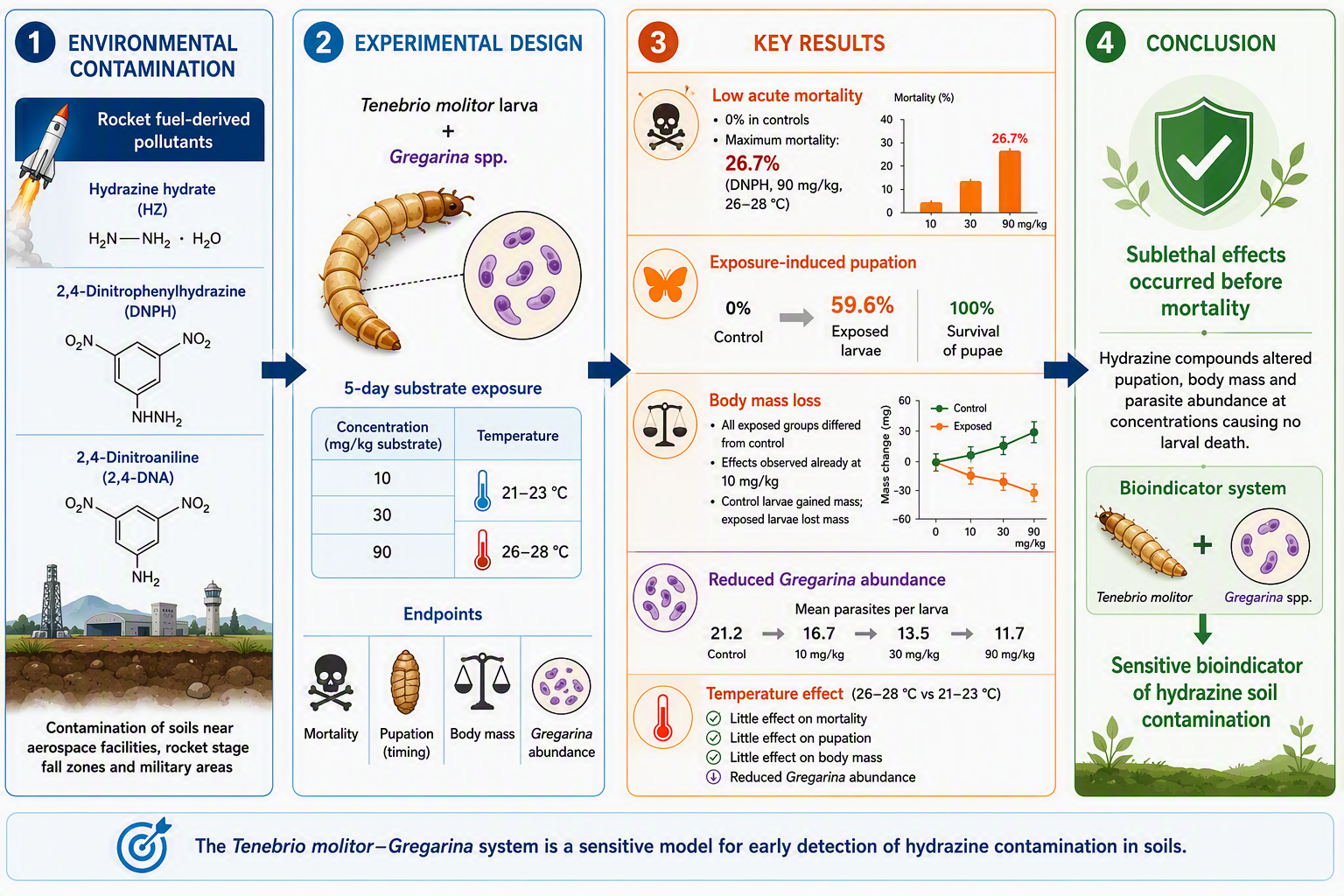
Hydrazine (N₂H₄) and its derivatives are components of rocket fuel that contaminate soils around aerospace facilities and military training grounds. The toxicity of hydrazine hydrate, 2,4-dinitrophenylhydrazine (DNPH) and 2,4-dinitroaniline to terrestrial invertebrates remains unexplored. This study examined the effects of these substances on the mortality, body mass, pupation, and intensity of Gregarina spp. infestation in larvae of Tenebrio molitor Linnaeus, 1758 (Coleoptera, Tenebrionidae) at temperatures of 21–23 and 26–28 °C. Six hundred larvae were distributed into 10 treatment groups at each of two temperatures, with three containers per group, over a 5-day exposure. A dose-dependent effect on the physiological parameters of T. molitor was recorded: mortality rose with dose for all three compounds and at 90 mg/kg reached 26.7% (DNPH, 26–28 °C). Pupation proved the earliest indicator of exposure: none was recorded in the control (0.0%), whereas 59.6% of the exposed larvae pupated, already at the lowest concentration of 10 mg/kg, where no deaths occurred. The proportion pupating was similar across the three compounds (55.0–62.2%) but declined with increasing concentration, from 67.2% at 10 mg/kg to 52.2% at 90 mg/kg. Temperature had no effect on it (57.8% at 21–23 °C versus 61.5% at 26–28 °C). All pupae survived (100.0%), compared with 85.3% of those that remained larvae. Initial body mass did not differ between these groups, so no size threshold for initiating metamorphosis was detected. Within the 21–28 °C range, no main effect of temperature on mortality, pupation, or body mass was found, although a statistically significant temperature × concentration interaction was recorded for the last of these. All three compounds reduced the intensity of Gregarina spp. infestation with increasing concentration, and raising the temperature to 26–28 °C lowered the mean parasite count from 18.0 to 13.0 specimens/larva. Under acute 5-day exposure, therefore, hydrazine compounds cause little larval mortality but alter pupation, body mass and the intensity of parasitic infestation at concentrations that kill no larvae. This makes the T. molitor–Gregarina spp. system suitable for the early detection of substrate contamination by hydrazine compounds.
Keywords:
hydrazine hydrate
; 2
; 4-dinitrophenylhydrazine
; 4-dinitroaniline
; pupation
; body mass
; Gregarina
; temperature
; ecotoxicology
; soil contamination
; Coleoptera
Copyright: This open access article is published under a Creative Commons CC BY 4.0 license, which permit the free download, distribution, and reuse, provided that the author and preprint are cited in any reuse.