

Submitted:
25 August 2026
Posted:
25 August 2026
You are already at the latest version
Abstract
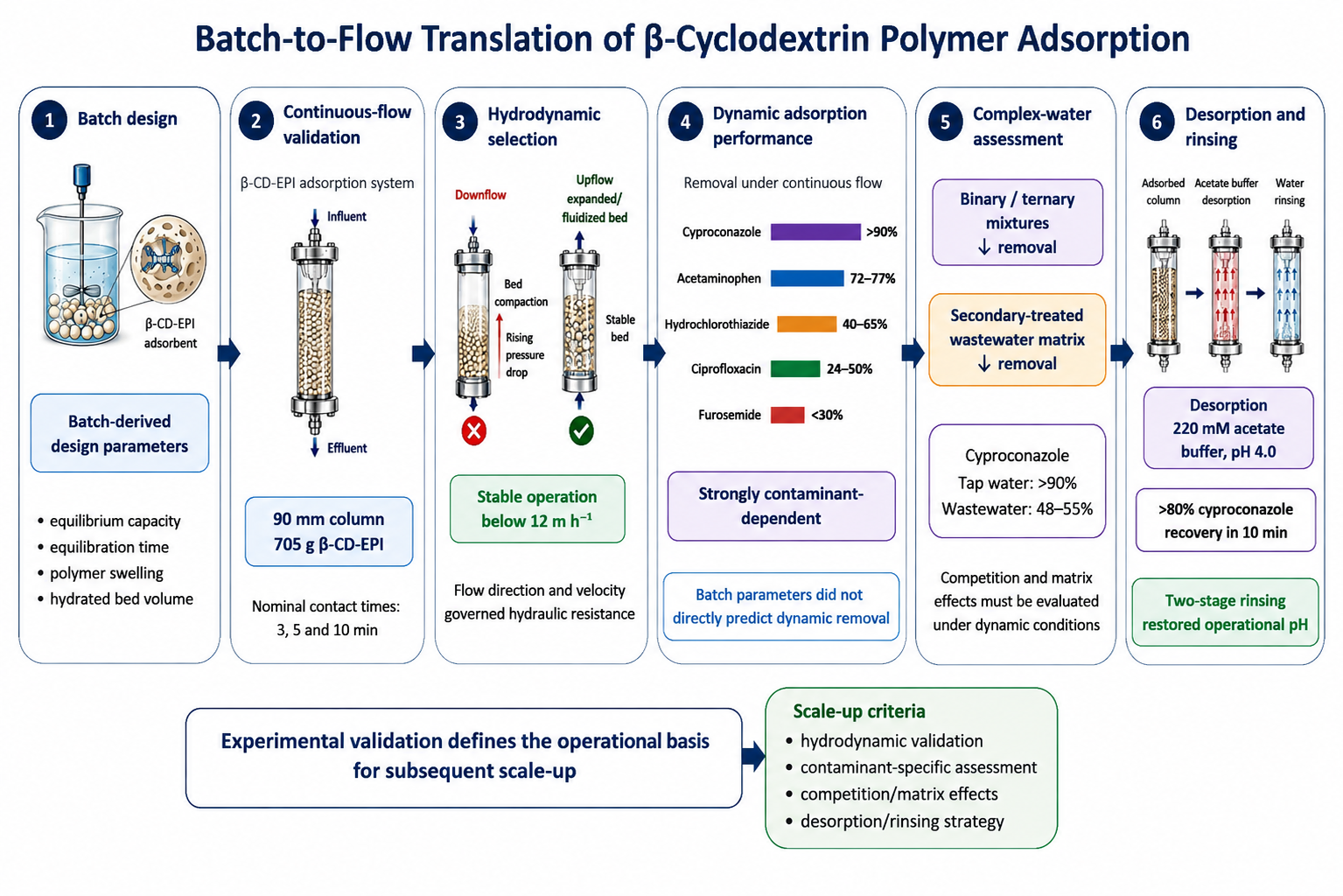
Translating adsorption performance from batch experiments to continuous-flow operation is a key step toward practical water-treatment applications. In this study, a laboratory-scale continuous adsorption system based on a water-insoluble β-cyclodextrin-epichlorohydrin (β-CD-EPI) polymer was validated from hydrodynamic, adsorptive, and operational perspectives. Downflow operation caused progressive bed compaction and excessive pressure development, whereas a 90 mm column operated in upflow expanded/fluidized-bed mode remained stable at superficial linear velocities below approximately 12 m h⁻¹. Under these conditions, removal was strongly contaminant-dependent: cyproconazole exceeded 90%, acetaminophen reached 72–77%, hydrochlorothiazide 40–65%, ciprofloxacin 24–50%, and furosemide remained below 30%. The relative performance of furosemide and hydrochlorothiazide differed from that predicted by previous batch-derived adsorption parameters, demonstrating that batch results cannot be directly extrapolated to dynamic operation. Competitive adsorption in binary and ternary mixtures reduced removal, while cyproconazole removal decreased from >90% in tap water to 48–55% in secondary-treated wastewater. Desorption with 220 mM acetate buffer at pH 4.0 recovered >80% of retained cyproconazole within 10 min, followed by a two-stage rinse restoring operational pH. These results define hydrodynamic, adsorption, matrix, and regeneration criteria for subsequent scale-up of β-CD-EPI adsorption processes.
Keywords:
β-cyclodextrin-epichlorohydrin polymer
; continuous-flow adsorption
; expanded/fluidized bed
; emerging contaminants
; competitive adsorption
; wastewater matrix
; regeneration
; scale-up
1. Introduction
Contaminants of emerging concern (CECs), including pharmaceuticals, personal care products, pesticides, endocrine-disrupting compounds, biocides, and a wide range of industrial chemicals, are widely detected in aquatic environments and wastewater streams worldwide, typically at trace concentrations ranging from the ng/L to the µg/L level [1]. Their continuous release into the aquatic environment is of concern because many CECs are biologically active, persistent, or incompletely removed during wastewater treatment, and some may exert adverse effects on aquatic organisms even at low concentrations [2]. Municipal wastewater treatment plants (WWTPs) therefore represent an important pathway for the discharge of CECs into receiving waters, since conventional treatment processes were primarily designed to remove suspended solids, biodegradable organic matter, and nutrients rather than structurally diverse organic micropollutants [3]. Consequently, removal efficiencies vary widely among compounds according to their physicochemical properties and the treatment processes applied, and measurable concentrations may remain in treated effluents [4]. This issue has acquired additional regulatory relevance in Europe following the adoption of Directive (EU) 2024/3019 on urban wastewater treatment, which explicitly incorporates quaternary treatment to reduce a broad spectrum of micropollutants in urban wastewater [5]. These developments reinforce the need for advanced treatment technologies combining high contaminant removal with operational robustness, scalability, and compatibility with continuous wastewater-treatment processes [6].
Among the technologies available for CEC removal, adsorption is particularly attractive as a polishing treatment because of its operational simplicity, high removal potential, modularity, and adaptability to existing treatment trains. Within this context, cyclodextrin (CD)-based polymers have emerged as a versatile class of adsorbent materials for the removal of organic contaminants from water and wastewater [7]. Cyclodextrins are cyclic oligosaccharides characterized by a hydrophilic external surface and a relatively hydrophobic internal cavity capable of accommodating organic guest molecules through host–guest inclusion when molecular size, geometry, and chemical affinity are favorable. Cross-linking cyclodextrins into water-insoluble polymeric networks overcomes their intrinsic water solubility while retaining accessible inclusion cavities and generating a three-dimensional polymer matrix that provides additional interaction domains for pollutant retention [8]. These networks can therefore combine host–guest complexation with interactions involving the polymer framework, including hydrophobic interactions, hydrogen bonding, and, depending on polymer composition and solution chemistry, electrostatic interactions [8]. Their insolubility also facilitates physical retention within treatment systems and enables their potential regeneration and reuse over successive adsorption–desorption cycles [9].
Among these materials, β-cyclodextrin-epichlorohydrin (β-CD-EPI) polymers represent a particularly attractive class of cross-linked CD adsorbents because epichlorohydrin produces a hydrated, three-dimensional network containing accessible β-CD cavities together with hydroxyl-rich polymer domains capable of interacting with chemically diverse solutes. β-CD-EPI polymers have previously demonstrated the ability to remove a broad range of pharmaceutical and other organic contaminants under batch conditions, although adsorption efficiency is strongly compound-dependent [10]. More broadly, recent research has substantially expanded the structural diversity, porosity, functionalization, and adsorption performance of CD-based polymers [11]. Nevertheless, the development of these materials for water treatment remains dominated by synthesis, structural characterization, and batch-scale adsorption studies, whereas their translation into stable continuous treatment systems is still comparatively underexplored. This represents an important step because the properties governing adsorption under equilibrium batch conditions do not necessarily determine performance once the polymer is incorporated into a continuously operated adsorbent bed.
The versatility of EPI-cross-linked cyclodextrin networks has also been demonstrated in previous studies from our group using different CD architectures for aqueous contaminant removal. A water-insoluble β-CD-EPI polymer was successfully applied to the adsorption of Direct Blue 78 from an aqueous model system, with its adsorption behavior characterized through kinetic, equilibrium, and thermodynamic analyses [12]. Subsequently, γ-CD-EPI and hydroxypropyl-γ-CD-EPI polymers were developed as adsorbents for Direct Red 83:1, demonstrating that EPI cross-linking can generate functional water-insoluble adsorbents from different CD derivatives and that their adsorption behavior depends on the resulting polymer architecture [13]. Together, these studies established the versatility of CD-EPI networks as functional materials for aqueous pollutant removal and provided a material-level basis for progressing from batch-scale adsorption characterization toward operational validation under continuous-flow conditions.
Batch experiments remain essential for determining adsorption equilibrium, kinetics, selectivity, and the influence of solution chemistry, and the resulting parameters provide a valuable basis for adsorbent evaluation and preliminary process design [14]. Under continuous-flow conditions, however, adsorption performance is additionally influenced by contact time, flow velocity, bed geometry, external and intraparticle mass transfer, and progressive adsorbent loading, meaning that equilibrium capacity alone cannot reliably predict reactor performance [14]. This limitation has recently been demonstrated for β-CD-based adsorbents, for which batch sorption kinetics did not fully reproduce column behavior under flow-through conditions [15]. For hydrated polymeric adsorbents, an additional consideration is the physical response of the polymer bed to liquid flow. Swelling, deformation, compression or expansion, particle entrainment, channeling, and pressure development may ultimately determine whether continuous operation is feasible. Reactor configuration is therefore particularly important for cross-linked polymers that undergo substantial hydration, because fixed- and fluidized-bed operation impose markedly different hydrodynamic conditions and can strongly affect bed porosity, hydraulic resistance, solid–liquid contact, and mass-transfer behavior [16]. Although continuous treatment using CD-based adsorbents has been demonstrated at pilot scale, including the removal of micropollutants from treated municipal wastewater using a β-CD bead polymer under fluidized conditions [17], systematic studies integrating polymer-bed hydrodynamics with adsorption performance remain limited.
A further challenge arises when CD-based adsorbents are transferred from simplified single-solute systems to complex aqueous matrices. Real wastewater contains numerous micropollutants that may interact simultaneously with a finite number of accessible cyclodextrin cavities and polymer-network domains, thereby modifying apparent affinity and selectivity through competitive adsorption [15]. Dissolved organic matter, inorganic ions, and other wastewater constituents may also interfere with adsorption by competing for interaction sites, modifying electrostatic interactions, or hindering solute transport within the polymer network [18]. The magnitude of these effects depends on both adsorbent chemistry and the physicochemical characteristics of the target contaminant. Recent studies using full- and pilot-scale adsorption systems similarly indicate that competitive adsorption and wastewater-matrix effects can substantially reduce the direct transferability of parameters obtained from simplified laboratory experiments to realistic treatment conditions [19]. Consequently, meaningful validation of CD-based polymer adsorbents should progressively move from single-contaminant model solutions toward multicomponent systems and real wastewater matrices while maintaining controlled hydrodynamic conditions.
In our previous work, a stepwise strategy was developed to translate β-CD polymer adsorption data from batch experiments into the engineering design of a laboratory-scale continuous-flow prototype [20]. Using an insoluble β-CD-EPI polymer, furosemide and hydrochlorothiazide were employed as model pharmaceuticals to determine adsorption kinetics, equilibrium behavior, and physicochemical parameters relevant to reactor design. These adsorption parameters, together with polymer properties including swelling, density, and particle size, were integrated with engineering criteria such as adsorbent volume, bed depth, contact time, flow rate, regeneration, and rinsing requirements to dimension the prototype [20]. The resulting system incorporated a 90 mm diameter adsorption column as the main configuration and an additional 63 mm diameter column for comparative evaluation. However, that work established the batch-derived design and construction of the prototype without experimentally validating either its polymer-bed hydrodynamics or its adsorption performance under continuous-flow conditions. Continuous-flow experiments with contaminated water and wastewater were therefore identified as the necessary next stage in evaluating whether the design parameters derived from batch adsorption could be successfully transferred to dynamic operation [20].
The present study addresses this unresolved step by experimentally validating the β-CD-EPI polymer adsorption system under continuous-flow conditions. First, the effects of column diameter, polymer loading, superficial linear velocity, and flow direction were evaluated to establish hydrodynamically stable operating conditions. The adsorption behavior of the system was then assessed using five CECs with contrasting physicochemical characteristics -furosemide, hydrochlorothiazide, acetaminophen, ciprofloxacin, and cyproconazole- to determine compound-specific performance and examine the transferability of previously obtained batch parameters. System complexity was subsequently increased through binary and ternary contaminant mixtures and the use of secondary-treated WWTP effluent as the aqueous matrix, allowing competitive adsorption and wastewater-matrix effects to be evaluated under the same continuous-flow framework. Finally, continuous-flow desorption and post-desorption rinsing were investigated as prerequisite operational steps for polymer regeneration and reuse. To the best of our knowledge, no previous study has systematically integrated batch-derived process design, hydrated polymer-bed hydrodynamics, compound-specific dynamic adsorption, multicomponent competition, wastewater-matrix effects, and regeneration within a single experimental framework for a β-CD-EPI polymer adsorption system. The results provide an experimental basis for defining the operational conditions required for subsequent scale-up of this class of cyclodextrin polymer adsorbents.
2. Materials and Methods
2.1. Chemicals, Contaminants, and Aqueous Matrices
β-Cyclodextrin (β-CD; CID 444041) was supplied by AraChem (Tilburg, The Netherlands). Epichlorohydrin (EPI), sodium borohydride, sodium hydroxide, acetone, and acetate buffer were obtained from Sigma-Aldrich (Barcelona, Spain). Standards of furosemide (CAS No. 54-31-9, ≥98% purity), hydrochlorothiazide (CAS No. 58-93-5, ≥98% purity), acetaminophen (CAS No. 103-90-2, ≥99.0% purity), ciprofloxacin (CAS No. 85721-33-1, ≥98% purity), and cyproconazole (CAS No. 94361-06-5, ≥98% purity; PESTANAL® analytical standard) were supplied by Sigma-Aldrich (Barcelona, Spain). All other reagents were of analytical grade.
The five target contaminants were selected to encompass compounds with distinct physicochemical properties and previously observed adsorption responses. Aqueous solutions for the controlled continuous-flow experiments were prepared using tap water at the concentrations specified for each assay. To evaluate the influence of the wastewater matrix, secondary-treated effluent collected from the Cabezo Beaza municipal wastewater treatment plant (Cartagena, southeastern Spain) was used as the aqueous matrix and spiked with cyproconazole prior to continuous-flow treatment.
2.2. β-CD-EPI Polymer
A water-insoluble β-CD network cross-linked with epichlorohydrin (β-CD–EPI) was used as the adsorbent throughout this study. The polymer was synthesized in the UCAM laboratory following the EPI cross-linking procedure described by Pellicer et al. [21]. The resulting β-CD-EPI material was subsequently used in the batch experiments that provided the design basis for the laboratory-scale prototype [20]. Briefly, β-CD (24 g) and sodium borohydride (60 mg) were dispersed in distilled water (24 mL) and maintained under stirring at 50 °C for 10 min. Subsequently, 26 mL of a 40% sodium hydroxide solution was added, and the mixture was stirred for a further 5 min. EPI (264 g) was then added dropwise, and the reaction was maintained under continuous stirring for 6 h. The resulting polymer was washed with 100 mL of acetone for 10 min and subsequently dried at 50 °C for 12 h. The dried material was ground and homogenized prior to use in the continuous-flow experiments.
Previously determined physicochemical properties relevant to reactor operation, including swelling behavior, density, and particle characteristics, were used as engineering inputs for the design and dimensioning of the laboratory-scale prototype [20]. Thus, the present study focused on the hydrodynamic and adsorption behavior of the previously developed β-CD-EPI polymer under continuous-flow conditions rather than on its structural characterization.
2.3. Laboratory-Scale Continuous-Flow Prototype
Continuous-flow experiments were performed using the laboratory-scale adsorption prototype previously designed and constructed on the basis of batch-derived adsorption parameters and the physicochemical characteristics of the β-CD-EPI polymer [20]. The system consisted of an adsorption-column circuit connected to 50 L feed and collection vessels. Liquid circulation was provided by a self-priming diaphragm pump, while the operating flow rate was regulated by a needle valve and continuously monitored using an in-line flow meter. Pressure was measured immediately upstream and downstream of the adsorption column, enabling the pressure drop across the polymer bed to be monitored during operation. The system also incorporated pH monitoring and sampling points at both the column inlet and outlet.
The prototype accommodated two transparent PVC adsorption columns with nominal diameters of 90 and 63 mm. The 90 mm column was used as the main configuration for the continuous-flow adsorption experiments, whereas the 63 mm column provided an additional configuration for comparative hydraulic and regeneration experiments. Both columns were equipped with polypropylene retaining elements with a nominal opening of 100 µm to prevent loss of adsorbent while allowing passage of the liquid phase. The transparent column walls enabled direct observation of polymer-bed compaction, expansion, and particle movement during operation. The hydraulic circuit allowed the direction of liquid flow to be switched between downflow and upflow operation, permitting comparison between a conventional downward-flow configuration and an upward-flow expanded/fluidized-bed configuration. Adsorbent loadings, superficial linear velocities, and nominal contact times used in the hydrodynamic and adsorption experiments are specified in the following sections.
2.4. Hydrodynamic Characterization of the Prototype
Prior to the adsorption experiments, the hydrodynamic behavior of the β-CD-EPI polymer bed was evaluated to identify operating conditions compatible with stable continuous-flow operation. Four variables were examined: column configuration, adsorbent loading, superficial linear velocity, and flow direction. Initial experiments were performed in downflow mode using columns with nominal diameters of 63 and 90 mm. The effective internal cross-sectional areas used for the hydraulic calculations were 0.0026 and 0.0056 m² for the nominal 63 and 90 mm columns, respectively. Three β-CD-EPI loadings (235, 470, and 705 g) were evaluated over a superficial linear-velocity range of 4–20 m h⁻¹.
The hydraulic response of the adsorbent bed was assessed by continuously monitoring the pressure difference (Δp) between the column inlet and outlet as a function of operating time. Bed compaction, expansion, and particle movement were simultaneously monitored by visual inspection through the transparent column wall. A pressure drop approaching 1 bar was considered the practical operating limit, while the system overpressure protection was activated at approximately 1.5 bar.
Following evaluation of the downflow configuration, upflow operation was investigated using the 90 mm column containing 470 or 705 g of β-CD-EPI. In this configuration, liquid was introduced through the bottom of the column, allowing the hydrated polymer bed to expand and remain mobile during operation. Downflow and upflow configurations were subsequently compared at equivalent adsorbent loadings and superficial linear velocities to determine the operating mode providing the greatest hydraulic stability and the lowest tendency toward bed compaction. The hydrodynamic conditions identified from these experiments were then used to define the operating configuration for the subsequent continuous-flow adsorption assays. All hydrodynamic experiments, including the downflow screening and the direct downflow–upflow comparison at a superficial linear velocity of 12 m h⁻¹, were performed in triplicate (n = 3), and pressure-drop data are expressed as mean ± standard deviation (SD).
2.5. Continuous-Flow Adsorption Experiments
Following hydrodynamic characterization, continuous-flow adsorption experiments were performed using the 90 mm nominal-diameter column operated in upflow expanded/fluidized-bed mode. The column was loaded with 705 g of β-CD-EPI polymer, corresponding to an approximate hydrated adsorbent-bed volume (Vads) of 3 L and a bed depth of approximately 0.54 m. The polymer was supported on a layer of activated silica glass covering the lower retaining element of the column. Feed solutions were introduced through the bottom of the column and passed upward through the hydrated adsorbent bed before being collected in the outlet vessel.
Three nominal contact times (tc) of 3, 5, and 10 min were evaluated. The corresponding volumetric flow rate was calculated from the hydrated adsorbent-bed volume according to Equation (1):
where tc is the nominal contact time, Vads is the hydrated adsorbent bed volume and Q is the volumetric flow rate. The resulting flow rates, superficial linear velocities and hydraulic loadings corresponding to each nominal contact time are summarized in Table 1.
2.5.1. Single-Contaminant Experiments
Single-solute continuous-flow experiments were performed independently for the five target contaminants: furosemide, hydrochlorothiazide, acetaminophen, ciprofloxacin, and cyproconazole. Separate feed solutions were prepared in tap water at initial concentrations (C₀) of 5 mg L⁻¹ for furosemide, 5 mg L⁻¹ for hydrochlorothiazide, 10 mg L⁻¹ for acetaminophen, 9.6 mg L⁻¹ for ciprofloxacin, and 7 mg L⁻¹ for cyproconazole. Each contaminant was evaluated at nominal contact times of 3, 5, and 10 min under the continuous-flow conditions described in Section 2.5. Samples were collected from the influent and column effluent for each operating condition and analyzed as described in Section 2.7. The resulting inlet and outlet concentrations were used to determine the normalized effluent concentration (C/C₀) and removal efficiency for each compound.
2.5.2. Multicomponent Adsorption Experiments
Competitive adsorption under continuous-flow conditions was evaluated using binary and ternary contaminant mixtures. For the ternary experiment, the feed solution contained cyproconazole (7 mg L⁻¹), acetaminophen (10 mg L⁻¹), and ciprofloxacin (9.6 mg L⁻¹). The mixture was processed through the β-CD-EPI polymer bed at nominal contact times of 3, 5, and 10 min using the operating conditions described in Section 2.5. Influent and effluent samples were collected for each condition, and the concentration of each contaminant was determined independently as described in Section 2.7. Compound-specific C/C₀ values and removal efficiencies were then calculated to assess the influence of simultaneous exposure on contaminant retention.
A second multicomponent experiment was subsequently performed using a binary mixture containing cyproconazole (7 mg L⁻¹) and acetaminophen (10 mg L⁻¹). The binary system was evaluated at nominal contact times of 3 and 5 min under the same continuous-flow configuration. Influent and effluent concentrations were determined separately for both compounds and compared with those obtained in the corresponding single-solute experiments.
2.5.3. Wastewater-Matrix Experiments
The influence of the wastewater matrix on contaminant removal was evaluated using secondary-treated effluent collected from the Cabezo Beaza municipal wastewater treatment plant (Cartagena, southeastern Spain). Matrix characterization was carried out in accordance with Royal Decree 1085/2024 [22]. The main physicochemical characteristics of the secondary-treated effluent used in the matrix experiment are summarized in Table 2.
For the continuous-flow matrix experiment, 50 L of this secondary-treated effluent was spiked with cyproconazole to obtain an initial concentration (C₀) of 7 mg L⁻¹. The fortified wastewater was processed through the β-CD-EPI polymer bed at nominal contact times of 3, 5, and 10 min using the same column configuration and hydraulic conditions applied in the corresponding single-solute experiment in tap water. Influent and effluent samples were collected at each operating condition and analyzed as described in Section 2.7. Compound-specific C/C₀ values and removal efficiencies were subsequently compared with those obtained in tap water (pH 8.3, electrical conductivity 1200 µS cm⁻¹, total hardness 280 mg L⁻¹ CaCO₃, free chlorine 0.8 mg L⁻¹, Ca²⁺ 50 mg L⁻¹, NO₃⁻ 6 mg L⁻¹) at the same cyproconazole concentration to assess the effect of wastewater constituents on adsorption performance.
2.6. Desorption and Post-Desorption Rinsing
2.6.1. Continuous-Flow Desorption Experiments
The desorption step required for regeneration of the β-CD-EPI polymer was evaluated in a separate set of continuous-flow experiments using the 63 mm nominal-diameter column. The column was loaded with 100 g of β-CD-EPI polymer supported on a layer of activated silica glass covering the lower retaining element. Cyproconazole was selected as the model contaminant. Prior to desorption, the adsorbent was loaded by passing a 10 mg L⁻¹ cyproconazole solution through the column at a flow rate of 4.8 L h⁻¹, corresponding to a nominal contact time of 5 min. The cyproconazole concentration in the column effluent was determined to estimate the amount retained by the polymer before desorption.
Desorption was subsequently performed using 220 mM acetate buffer adjusted to pH 4.0 at a desorbent-to-adsorbent ratio of 10 mL g⁻¹. The regenerating solution was introduced through the desorption line and passed through the polymer bed in downflow mode. Independent desorption experiments were initially conducted at nominal contact times of 5 and 10 min. An additional experiment at 15 min was subsequently included to determine whether extending the contact time further increased cyproconazole recovery. The 5, 10, and 15 min desorption conditions were operated at flow rates of 4.8, 2.4, and 1.6 L h⁻¹, corresponding to superficial linear velocities of 1.88, 0.94, and 0.63 m h⁻¹, respectively. The desorption eluate was collected downstream of the column and analyzed for recovered cyproconazole as described in Section 2.7.
2.6.2. Post-Desorption Rinsing
Following each desorption experiment, the polymer bed was rinsed with demineralized water to remove residual acetate buffer before subsequent adsorption use. The slow-rinsing stage was initially evaluated at flow rates of 2, 3, 4, and 5 BV h⁻¹ for up to 30 min. The pH of the column effluent was monitored throughout the procedure, and the rinsing endpoint was defined as the point at which the outlet pH approached that of the incoming rinse water. This criterion was used as an operational indicator of the removal of residual pH 4.0 acetate buffer from the polymer bed.
After the slow-rinsing stage, an additional high-flow rinse was applied to complete buffer displacement. Based on these preliminary rinsing tests, a final combined operating sequence was established, consisting of a 30 min low-flow rinse at 6 L h⁻¹ followed by a 10 min high-flow rinse at 30 L h⁻¹. Outlet pH was monitored throughout both stages, and the rinsing procedure was considered complete when the effluent pH recovered values comparable to those of the rinse water.
Because these rinsing experiments were intended to establish operational flow-rate and time requirements for restoring the column effluent to the target pH, the recorded pH profiles were treated as process-control data rather than as datasets for statistical comparison.
2.7. Analytical Determination and Data Treatment
All influent and effluent samples generated during the continuous-flow adsorption, multicomponent, wastewater-matrix, and desorption experiments were analyzed by ultra-high-performance liquid chromatography coupled to high-resolution tandem mass spectrometry (UHPLC-HRMS/MS). The analytical procedure was adapted from chromatographic and high-resolution mass-spectrometric conditions previously applied by our group for the determination of pharmaceutical contaminants in water [10], with compound-specific conditions selected for the five target analytes considered in the present study.
Analyses were performed using an X500R quadrupole time-of-flight (QTOF) high-resolution mass spectrometer (SCIEX, Redwood City, CA, USA) equipped with a Turbo V™ ion source and coupled to a UHPLC system controlled by SCIEX OS software. Chromatographic separation was achieved using an end-capped Purospher STAR RP-18 column (100 × 2 mm, 2 µm particle size; Merck, Darmstadt, Germany) maintained at 40 °C. The injection volume was 10 µL, and the mobile-phase flow rate was 0.4 mL min⁻¹.
Separate acquisitions were performed under positive and negative electrospray ionization conditions. In positive-ion mode, the aqueous mobile phase consisted of water containing 0.1% (v/v) formic acid and 5 mM ammonium acetate, while acetonitrile was used as the organic phase. The initial acetonitrile content (5%) was maintained for 0.5 min and then increased to 98% over 15.5 min. The 98% organic composition was maintained for 3 min before returning to the initial conditions, followed by a 5 min column re-equilibration period. The total chromatographic analysis time was approximately 24 min.
For negative-ion acquisition, the mobile phases consisted of water containing 5 mM ammonium acetate and acetonitrile. The initial acetonitrile content (5%) was maintained for 0.5 min, increased to 73% over 11.5 min, and subsequently increased to 100% over 0.5 min. The 100% organic condition was maintained for 40 s before returning to the initial composition, followed by a 1.8 min column re-equilibration period. The total chromatographic analysis time was 15 min.
Acetaminophen, ciprofloxacin, and cyproconazole were monitored under positive-ion conditions, whereas furosemide and hydrochlorothiazide were determined under negative-ion conditions. High-resolution MS/MS data were acquired in multiple-reaction-monitoring high-resolution (MRMHR) mode. The MS acquisition range was m/z 100–800, and MS/MS spectra were recorded over m/z 50–700 using an accumulation time of 25 ms. For each target analyte, the precursor ion and two characteristic product ions were monitored, with one product-ion transition used for quantitative determination and the second for confirmatory identification. The compound-specific precursor ions and corresponding quantifier and qualifier product ions used for MRMHR acquisition are summarized in Table S1 (Supplementary Materials).
Quantification was performed using analyte-specific external calibration curves obtained from mixed standard solutions. Experimental samples were diluted when necessary to ensure that analyte responses remained within the corresponding calibration range. In multicomponent samples, chromatographic separation combined with accurate-mass precursor- and product-ion monitoring allowed each target compound to be selectively identified and quantified independently.
For the wastewater-matrix experiments, cyproconazole was intentionally added to the secondary-treated effluent at 7 mg L⁻¹ to evaluate adsorption performance in a real wastewater matrix rather than to determine environmentally occurring trace concentrations; therefore, no analyte preconcentration step was required. Prior to UHPLC-HRMS/MS analysis, influent and effluent samples were filtered through disposable 0.45 µm hydrophilic polyethersulfone (PES) syringe filters to remove suspended particulate matter. Cyproconazole was subsequently quantified using the same chromatographic and high-resolution mass-spectrometric criteria described above.
Continuous-flow adsorption performance was expressed as the normalized effluent concentration (C/C₀), where C₀ and C represent the experimentally measured influent and corresponding effluent concentrations, respectively. Removal efficiency was calculated according to Equation (2):
Both C/C₀ and removal efficiency were calculated independently for each target contaminant and used to compare adsorption performance as a function of contaminant identity, nominal contact time, mixture composition, and aqueous matrix. For the wastewater-matrix experiment, the use of experimentally measured influent and effluent concentrations under each operating condition allowed adsorption performance to be assessed relative to the corresponding influent concentration in the same wastewater matrix.
For the desorption experiments, cyproconazole concentrations in the loading and desorption fractions were determined using the same UHPLC-HRMS/MS procedure. Desorption efficiency was calculated as the fraction of the contaminant mass previously retained by the polymer that was subsequently recovered in the acetate-buffer eluate according to Equation (3):
where mdes is the mass of cyproconazole recovered during desorption and mads is the mass retained by the β-CD-EPI polymer bed during the preceding adsorption step. Both masses were calculated from the measured cyproconazole concentrations and the corresponding solution volumes. Post-desorption rinsing was monitored by measuring the pH of the column effluent, and the rinsing sequence was considered complete when the outlet pH approached that of the incoming rinse water.
Unless otherwise stated, adsorption experiments used for quantitative removal comparisons were performed in triplicate (n = 3), and results are expressed as mean ± SD. Desorption and post-desorption rinsing tests were conducted as operational optimization assays to define process set points and endpoint conditions; therefore, the corresponding recovery efficiencies and effluent-pH profiles are reported as operational values without dispersion statistics.
3. Results and Discussion
3.1. Hydrodynamic Behavior and Selection of the Operating Mode
Hydrodynamic characterization showed that the operating configuration was a critical determinant of the feasibility of continuous treatment with the β-CD-EPI polymer. Under downflow conditions, the hydrated polymer bed exhibited a pronounced tendency toward compaction, and the resulting pressure drop increased with both superficial linear velocity and polymer loading. In the 63 mm column containing 235 g of polymer, the pressure drop remained moderate at superficial velocities below 12 m h⁻¹, whereas operation at 20 m h⁻¹ resulted in rapid pressure development and marked bed compaction within approximately 5 min. Increasing the polymer loading further intensified this behavior. With 705 g of β-CD–EPI, a pressure drop close to 1 bar was reached after approximately 10 min even at 4 m h⁻¹, while at 12 m h⁻¹ rapid pressure development resulted in termination of stable operation after approximately 5 min.
Increasing the nominal column diameter to 90 mm partially improved the hydraulic behavior but did not eliminate the tendency of the hydrated β-CD-EPI bed to compact under downflow operation. At the lowest polymer loading (235 g), the larger effective cross-sectional area allowed comparatively stable short-term operation, with the pressure drop remaining below approximately 0.3 bar at superficial velocities up to 16 m h⁻¹ and below 0.5 bar at 20 m h⁻¹ during the initial operating period. However, when operation at the highest velocity was extended to 20 min, the pressure drop increased to approximately 1.5 bar, demonstrating that the larger column delayed rather than prevented bed compaction. This limitation became more pronounced as polymer loading increased: with 470 and 705 g of β-CD–EPI, rapid pressure development and bed compaction were again observed within the 8–12 m h⁻¹ range, resulting in operating periods of only a few minutes before excessive hydraulic resistance developed. Thus, increasing column diameter reduced the initial resistance to liquid flow but was insufficient, by itself, to provide stable continuous operation in the downflow configuration. The complete hydrodynamic screening under downflow operation, including the effects of column diameter, polymer loading, and superficial linear velocity, is presented in Figure S1.
A markedly different hydraulic response was observed when the 90 mm column was operated in upflow expanded/fluidized-bed mode. With both 470 and 705 g of β-CD-EPI polymer, superficial linear velocities below approximately 12 m h⁻¹ produced low and comparatively stable pressure drops, while the hydrated polymer particles remained mobile within the central region of the column. Stable operation could also be maintained at velocities up to 16 m h⁻¹ for short operating periods. At 20 m h⁻¹, however, the pressure drop progressively increased, mainly in association with polymer-particle entrainment toward the upper retaining element during prolonged operation. The complete pressure-drop profiles obtained under upflow expanded/fluidized-bed conditions are shown in Figure S2. Direct comparison of downflow and upflow configurations at equivalent polymer loadings and a superficial linear velocity of 12 m h⁻¹ confirmed that upflow operation substantially reduced pressure development and the tendency of the hydrated bed to compact (Figure 1).
The contrasting behavior observed between downflow and upflow operation can be related to the swelling and deformability of the hydrated β-CD-EPI polymer network. Under downflow conditions, the hydraulic force acts in the same direction as gravitational settling, progressively compressing the polymer bed, reducing interparticle void space, and increasing resistance to liquid passage. Once compacted, the hydrated polymer formed cohesive regions that were difficult to redisperse, even after water backwashing, which explains the rapid recovery of high pressure drop when downflow operation was resumed. In contrast, upward flow counteracted gravitational settling and maintained the polymer particles in a dynamically expanded state, thereby preserving interparticle void space and limiting the progressive increase in hydraulic resistance. This interpretation is consistent with the general behavior of fluidized-bed adsorption systems, in which particle mobilization can alleviate limitations associated with fixed-bed operation, particularly excessive pressure drop and channeling [16]. Moreover, the feasibility of operating CD-based polymer adsorbents under fluidized conditions has previously been demonstrated at pilot scale for the removal of micropollutants from treated municipal wastewater [17].
Based on this hydrodynamic characterization, the 90 mm column operated in upflow expanded/fluidized-bed mode was selected for the subsequent adsorption experiments. A polymer loading of 705 g, corresponding to an approximately 3 L hydrated bed and a bed depth of about 0.54 m, was retained as the working configuration because it provided sufficient adsorbent volume while remaining hydraulically stable under the selected operating conditions. A superficial linear velocity of approximately 12 m h⁻¹ was therefore established as the practical upper operating limit. Accordingly, the nominal contact times of 3, 5, and 10 min used in the adsorption experiments corresponded to superficial linear velocities of 10.7, 6.4, and 3.2 m h⁻¹, respectively, all below the hydrodynamic instability threshold identified during prototype characterization. Establishing this operating window was essential to ensure that the differences subsequently observed among contaminants could be interpreted primarily in terms of adsorption behavior rather than as consequences of polymer-bed compaction or excessive pressure development.
3.2. Contaminant-Specific Adsorption under Continuous-Flow Conditions
Once a hydraulically stable operating configuration had been established, the adsorption performance of the β-CD-EPI polymer was evaluated individually for the five target contaminants. A pronounced compound-dependent response was observed under continuous-flow conditions. Cyproconazole showed the highest retention, with removal efficiencies above 90% at all three nominal contact times, whereas acetaminophen also exhibited consistently high removal, reaching 77.3% at 3 min and remaining at approximately 72% at 5 and 10 min. Hydrochlorothiazide displayed an intermediate response, with removal decreasing from more than 65% at 3 min to approximately 48% and 40% at 5 and 10 min, respectively. Ciprofloxacin showed lower retention, decreasing from approximately 50% at 3 min to 36% at 5 min and 24% at 10 min, while furosemide was the least effectively retained compound, with removal remaining below 30% throughout the investigated operating range. Thus, under the same reactor configuration, although at compound-specific influent concentrations, the β-CD-EPI polymer exhibited markedly different adsorption responses depending on contaminant identity. The corresponding removal efficiencies are compared in Figure 2.
Notably, increasing the nominal contact time from 3 to 5 or 10 min did not improve contaminant removal and, for most compounds, was accompanied by a moderate or marked decrease in adsorption efficiency. This trend should not be interpreted as a conventional time-dependent loss of adsorption capacity, because the three nominal contact-time conditions were generated by changing the volumetric flow rate and therefore represented distinct hydrodynamic conditions rather than successive sampling times within a single fixed-condition adsorption run. In the present configuration, nominal contact times of 3, 5, and 10 min corresponded to superficial linear velocities of 10.7, 6.4, and 3.2 m h⁻¹, respectively. Consequently, the observed response reflects the combined effects of residence time and expanded/fluidized-bed hydrodynamics. The comparatively higher removal obtained at the shortest nominal contact time for furosemide, hydrochlorothiazide, acetaminophen, and ciprofloxacin suggests that the higher upward velocity may have promoted a more favorable degree of bed expansion and particle mobility, whereas reducing the flow rate may have modified solid–liquid contacting despite increasing nominal residence time. Cyproconazole was comparatively insensitive to these changes, maintaining removal above 90% throughout the investigated range, consistent with its markedly stronger retention by the β-CD-EPI polymer.
A similarly non-uniform influence of contact time has recently been reported for a chemically distinct β-CD adsorbent under flow-through conditions, where increasing contact time improved removal only for selected high-affinity contaminants and batch-derived kinetic parameters did not directly reproduce dynamic column behavior [15]. These observations further emphasize that nominal residence time should not be considered independently from the hydrodynamic state of the polymer bed when interpreting adsorption performance under continuous-flow conditions.
The comparison between furosemide and hydrochlorothiazide was particularly informative because these two compounds had been used in the preceding batch study to derive the adsorption parameters employed in prototype design [20]. Under batch conditions, furosemide showed a higher Langmuir-derived maximum adsorption capacity than hydrochlorothiazide (1.282 versus 0.844 mg g⁻¹) and reached apparent equilibrium considerably faster, within approximately 10–20 min compared with 40–60 min for hydrochlorothiazide. Nevertheless, their relative behavior was reversed under continuous-flow operation. At the same influent concentration of 5 mg L⁻¹, furosemide removal remained below 30% under all tested conditions, whereas hydrochlorothiazide removal exceeded 65% at the 3 min nominal contact time and remained approximately 48% and 40% at 5 and 10 min, respectively. Thus, neither the higher batch-derived adsorption capacity nor the shorter batch equilibration time of furosemide translated into superior removal under dynamic operation. This divergence provides direct experimental evidence that batch-derived equilibrium and kinetic parameters are valuable inputs for preliminary process design but cannot, by themselves, predict compound-specific removal in a continuously operated β-CD-EPI polymer bed.
Acetaminophen and ciprofloxacin further illustrated the strong dependence of continuous-flow adsorption on contaminant identity. At comparable influent concentrations of 10 and 9.6 mg L⁻¹, respectively, acetaminophen was consistently well retained, with removal efficiencies of 77.3% at 3 min and approximately 72% at both 5 and 10 min, corresponding to C/C₀ values of approximately 0.23–0.28. In contrast, ciprofloxacin removal was approximately 50% at 3 min and decreased to 36% and 24% at 5 and 10 min, respectively, with corresponding C/C₀ values increasing from approximately 0.51 to 0.76. These markedly different responses under the same reactor configuration indicate that hydraulic residence time alone cannot account for adsorption performance and instead point to contaminant-specific interactions with the β-CD-EPI network.
Previous studies with EPI-cross-linked cyclodextrin polymers have likewise shown that pollutant retention cannot generally be explained by a single physicochemical descriptor, but results from the combined influence of host–guest inclusion, hydrophobic and hydrophilic interactions, hydrogen bonding, molecular size, stereochemistry, and the structural characteristics of the cross-linked polymer network [8,10,12,13]. The different adsorption behavior observed here is therefore consistent with the multifunctional nature of β-CD-EPI materials, in which both the cyclodextrin cavities and the surrounding polymer matrix may contribute to solute retention. However, because the individual contribution of these interactions was not experimentally resolved in the present study, the results should be interpreted as evidence of contaminant-specific apparent affinity under dynamic conditions rather than as proof of a particular molecular adsorption mechanism.
Cyproconazole exhibited the most favorable continuous-flow response among the five contaminants evaluated. At an influent concentration of 7 mg L⁻¹, removal remained above 90% at nominal contact times of 3, 5, and 10 min, corresponding to C/C₀ values below approximately 0.1. Unlike the other compounds, its retention was therefore comparatively insensitive to the changes in superficial linear velocity associated with the three operating conditions. Such behavior is consistent with a strong apparent interaction with the β-CD-EPI adsorbent and with the ability of CD-based polymeric networks to retain organic compounds through the combined contribution of host–guest inclusion and interactions with the cross-linked polymer matrix [8,10]. Although the relative contribution of these mechanisms was not directly determined, the consistently high removal of cyproconazole across the investigated hydrodynamic range indicates that its affinity for the adsorbent was sufficient to minimize the influence of the operating changes that affected the other contaminants. This behavior also supported its selection as the model compound for the subsequent evaluation of competitive adsorption, wastewater-matrix effects, and desorption.
Taken together, the single-contaminant experiments demonstrate that the transfer of batch-derived design parameters to continuous-flow adsorption is inherently compound-dependent. The β-CD-EPI polymer provided high removal for cyproconazole and acetaminophen, intermediate performance for hydrochlorothiazide, and substantially lower retention of ciprofloxacin and furosemide. Importantly, this ranking could not be predicted solely from the batch-derived adsorption capacities or equilibration times obtained during prototype design, as illustrated most clearly by the contrasting behavior of furosemide and hydrochlorothiazide. Batch studies therefore remain essential for initial characterization of polymer–solute interactions and for preliminary process design, but dynamic validation is required to account for the additional influence of hydrodynamics, mass-transfer conditions, and contaminant-specific affinity under continuous operation. The present results thus support the feasibility of continuous β-CD-EPI adsorption while defining an important limitation of direct batch-to-flow extrapolation: adsorption parameters obtained under equilibrium conditions should be regarded as design inputs rather than direct predictors of continuous-flow removal efficiency.
3.3. Competitive Adsorption in Multicomponent Systems
The presence of multiple contaminants markedly altered the adsorption response of the β-CD-EPI polymer. In the ternary system containing cyproconazole, acetaminophen, and ciprofloxacin, removal efficiencies were lower than those obtained in the corresponding single-contaminant experiments, although the magnitude of the decrease was strongly compound-dependent. Cyproconazole remained the most effectively retained compound, with removal efficiencies ranging from approximately 48% to 74% across the three operating conditions, compared with >90% when evaluated individually. The effect of the mixture was more pronounced for acetaminophen, whose removal decreased from approximately 72–77% in single-solute experiments to approximately 33–35% in the ternary system. Ciprofloxacin was also strongly affected, with removal efficiencies of approximately 18–20%, compared with approximately 24–50% when evaluated individually. Thus, although the relative retention order cyproconazole > acetaminophen > ciprofloxacin was preserved, simultaneous exposure substantially reduced the removal efficiency of all three contaminants.
The reduction in removal observed in the ternary system is consistent with competitive interactions within the heterogeneous β-CD-EPI network. Because the polymer provides both cyclodextrin cavities and interaction domains within the EPI-cross-linked matrix, simultaneously present solutes may compete for partially overlapping adsorption environments rather than for a single uniform class of sites. Previous studies with cyclodextrin–EPI polymers have shown that contaminant retention can involve the combined contribution of host–guest inclusion, hydrophobic and hydrophilic interactions, hydrogen bonding, molecular dimensions, stereochemistry, and the structural characteristics of the polymer network [8,10,12,13]. Competition within such a multifunctional material is therefore expected to be contaminant-specific.
The different sensitivity of the three contaminants to multicomponent adsorption is also consistent with their contrasting molecular structures and ionization behavior under the experimental conditions. At the tap-water pH used in these experiments (pH 8.3), cyproconazole is expected to occur predominantly in its neutral form because of the weak basic character of its triazole functionality [23]. Its comparatively hydrophobic character, together with aromatic and chlorinated structural domains, may favor association with the hydrophobic β-CD cavities and less polar regions of the cross-linked network, while its hydroxyl and triazole groups provide additional potential interaction sites. Acetaminophen is also expected to remain predominantly neutral at this pH but is considerably more hydrophilic; its phenolic hydroxyl and amide functionalities may participate in hydrogen-bonding interactions with the hydroxyl- and ether-rich β-CD-EPI network, whereas its lower hydrophobicity may provide a weaker driving force for cavity-associated interactions. In contrast, ciprofloxacin, with reported pKa values of approximately 6.18 and 8.76, is predominantly zwitterionic at pH 8.3, with an appreciable contribution from the anionic form [24]. Its ionized character, strong hydration, and greater structural complexity may reduce favorable association with hydrophobic β-CD domains and make its retention more sensitive to the presence of competing solutes. These structural and speciation differences are consistent with the experimentally preserved affinity order cyproconazole > acetaminophen > ciprofloxacin, although the individual contribution of each interaction mechanism cannot be resolved from the present experiments alone.
The ability of cyproconazole to maintain the highest removal efficiency in the presence of two competing pharmaceuticals therefore indicates a stronger apparent affinity for the β-CD-EPI polymer under dynamic multicomponent conditions. Conversely, the larger relative losses observed for acetaminophen and particularly ciprofloxacin suggest that their retention was more sensitive to the simultaneous presence of other solutes. Importantly, these results demonstrate that adsorption performance derived from single-contaminant experiments may substantially overestimate removal when several organic contaminants coexist. Multicomponent effects under flow-through conditions have also been reported for a chemically distinct β-CD adsorbent, in which the presence and accumulation of higher-affinity contaminants altered the retention of more weakly interacting species [15].
Reducing the mixture from three contaminants to the binary combination of cyproconazole and acetaminophen resulted in substantially higher removal efficiencies. Both compounds were removed at efficiencies above 50% at nominal contact times of 3 and 5 min. Cyproconazole maintained a removal efficiency of approximately 75%, corresponding to a C/C₀ value of about 0.25, whereas acetaminophen removal ranged from approximately 62% to 65%, with C/C₀ values of approximately 0.35–0.38. These values remained below those obtained in the corresponding single-contaminant experiments but were clearly higher than those measured in the ternary mixture. This partial recovery of adsorption performance when ciprofloxacin was absent from the feed is consistent with competitive effects among coexisting solutes and indicates that both mixture composition and combined solute loading can influence dynamic adsorption performance. Cyproconazole again showed the greatest resistance to multicomponent effects, whereas acetaminophen exhibited an intermediate response between its single-solute and ternary-mixture behavior. A direct comparison of the experimentally evaluated single-solute, binary, and ternary conditions is presented in Figure 3.
Taken together, the multicomponent experiments demonstrate that competitive adsorption is an important factor when translating β-CD-EPI performance from simplified single-solute systems toward more complex aqueous conditions. Although the polymer retained a clear preference for cyproconazole, the progressive decrease in removal from single-solute to multicomponent systems shows that continuous-flow adsorption depends not only on the apparent affinity of each contaminant but also on influent composition and the simultaneous presence of other solutes. This effect was particularly evident for acetaminophen and ciprofloxacin, whose removal efficiencies were substantially reduced in the ternary mixture. Consequently, performance estimates based exclusively on isolated contaminants may overpredict treatment efficiency in complex waters. Recent pilot- and full-scale adsorption studies using other adsorbent materials similarly demonstrate that competitive adsorption can limit the transferability of parameters derived from simplified experiments to realistic wastewater-treatment conditions [19]. From a process-design perspective, multicomponent effects should therefore be considered when defining polymer loading, operating conditions, and regeneration requirements for subsequent scale-up. These findings also provide the rationale for evaluating the β-CD-EPI system in an actual wastewater matrix, where dissolved organic matter, inorganic ions, and other constituents introduce an additional level of complexity.
3.4. Effect of the Wastewater Matrix on Adsorption Performance
The transition from tap water to secondary-treated wastewater produced a pronounced decrease in cyproconazole removal under continuous-flow conditions. When cyproconazole was evaluated individually in tap water at an influent concentration of 7 mg L⁻¹, the β-CD-EPI polymer removed more than 90% of the contaminant across the three operating conditions. In contrast, when the same cyproconazole concentration was introduced into secondary-treated effluent from the Cabezo Beaza WWTP, removal efficiencies decreased to approximately 48–55%, corresponding to C/C₀ values of approximately 0.52–0.45 at nominal contact times of 3–10 min. Thus, even though cyproconazole was the most strongly retained compound under controlled single-solute conditions, approximately half of the influent contaminant remained in the treated stream when the aqueous matrix was changed to secondary-treated wastewater. This marked reduction demonstrates a substantial matrix-related effect on the apparent adsorption performance of the β-CD-EPI polymer. The comparison between tap water and secondary-treated wastewater is shown in Figure 4.
The lower cyproconazole removal observed in secondary-treated wastewater is consistent with the combined influence of organic and inorganic constituents present in the effluent. These matrix components may affect adsorption through several non-mutually exclusive processes, including competition for accessible interaction domains within the polymer, partial occupation of cyclodextrin cavities by dissolved organic molecules, and modification of solute–adsorbent interactions by the ionic composition of the aqueous phase. Previous studies have shown that water-matrix composition can influence micropollutant adsorption by β-CD polymers, with dissolved organic matter and inorganic ions contributing to adsorption inhibition to different extents depending on the properties of both the adsorbent and the target compound [18]. Relatively small dissolved organic molecules may compete for access to CD cavities, while changes in ionic strength can modify electrostatic and other intermolecular interactions involved in contaminant retention [8,18]. However, because the individual contribution of these matrix constituents was not isolated experimentally in the present study, the observed decrease in cyproconazole removal cannot be attributed to any single mechanism. Rather, the results demonstrate that the apparent affinity measured in a simplified aqueous system is substantially modulated when the β-CD-EPI polymer is exposed to a chemically more complex wastewater matrix.
Comparable matrix-related limitations have been reported for other adsorption systems. In activated-carbon adsorption, dissolved organic matter can reduce micropollutant uptake through a combination of pore blocking and competitive interactions, while the magnitude of this effect depends on the adsorbability of both the dissolved-organic-matter fractions and the target micropollutant [25,26]. Although these mechanisms cannot be directly transferred to the β-CD-EPI network, they support the broader conclusion that matrix effects are both adsorbent- and contaminant-dependent.
Importantly, sensitivity to the aqueous matrix is not uniform across β-CD-based adsorbents. In flow-through experiments performed with porous β-CD polymers and broad mixtures of micropollutants at environmentally relevant concentrations, adsorption was rapid but strongly compound-selective, while the influence of natural organic matter differed markedly from that observed for activated carbon [27]. These findings reinforce the need to establish matrix effects for each specific polymer–contaminant system rather than extrapolating behavior from the cyclodextrin scaffold alone. More recently, styrenic β-CD polymers evaluated directly in municipal wastewater showed compound-dependent removal and measurable dynamic adsorption behavior under rapid small-scale column operation [28], further demonstrating that the performance of cyclodextrin-based adsorbents in complex wastewater must be established experimentally under flow conditions.
From an operational perspective, the wastewater-matrix experiment defines an important boundary for extrapolating performance from controlled water to more realistic treatment conditions. Although the β-CD-EPI polymer retained a substantial fraction of cyproconazole in secondary-treated effluent, the decrease from >90% removal in tap water to approximately 48–55% in wastewater demonstrates that performance obtained in simplified matrices cannot be transferred directly to municipal effluents. Wastewater composition should therefore be incorporated explicitly into subsequent reactor design and scale-up, particularly when defining polymer loading, hydraulic operating conditions, and regeneration requirements.
In this context, upstream physical pretreatment may represent a useful strategy for reducing the non-target load reaching the adsorption bed. Microfiltration followed by ultrafiltration could remove suspended and colloidal material and part of the higher-molecular-weight organic fraction before adsorption, thereby potentially reducing fouling and competition for accessible interaction domains. The importance of controlling wastewater composition prior to adsorption is supported by studies showing that dissolved organic matter can inhibit micropollutant uptake by β-CD-based adsorbents and that adsorption in other sorbent systems is strongly influenced by the concentration and adsorbability of background dissolved organic carbon [18,29]. Such pretreatment could therefore help preserve adsorption performance and potentially delay adsorbent exhaustion during prolonged operation. However, this benefit was not directly evaluated in the present laboratory-scale study and should be assessed experimentally during subsequent pilot-scale validation.
The relatively high cyproconazole concentration used in the wastewater-matrix experiment was deliberately selected as a controlled high-loading challenge condition rather than to reproduce environmentally occurring concentrations. This approach imposed a substantially greater contaminant mass load on the adsorbent during the short-duration prototype experiments and allowed matrix interference to be evaluated under a demanding continuous-flow condition. Individual CEC concentrations in treated municipal wastewater typically occur at much lower levels; however, real continuous treatment involves prolonged exposure of the adsorbent to chemically diverse micropollutants together with background organic and inorganic matrix constituents. Consequently, the present results should not be extrapolated quantitatively to environmentally relevant concentration levels. Instead, they should be interpreted as a high-loading operational stress test demonstrating that contaminant loading and wastewater-matrix complexity are distinct variables that must both be addressed during subsequent long-term scale-up.
3.5. Desorption and Post-Desorption Rinsing
The feasibility of recovering the adsorbed contaminant from the β-CD-EPI polymer under continuous-flow conditions was subsequently evaluated using cyproconazole as the model compound. Prior to desorption, the polymer was loaded with a 10 mg L⁻¹ cyproconazole solution under continuous-flow conditions, resulting in approximately 92% removal. Desorption with 220 mM acetate buffer at pH 4.0, applied at a desorbent-to-adsorbent ratio of 10 mL g⁻¹, recovered approximately 76% of the retained cyproconazole at a nominal contact time of 5 min. Increasing the desorption contact time to 10 min increased recovery to approximately 81%, whereas a further increase to 15 min produced only a marginal improvement, reaching approximately 82%. Thus, most of the recoverable cyproconazole was released within the first 10 min, after which the desorption response approached a plateau. Under the conditions investigated, a 10 min desorption period therefore represented a practical compromise between contaminant recovery and process duration.
The continuous-flow desorption results provide an experimental link with the regeneration strategy previously established during batch-scale prototype development. In the preceding batch study, desorption of the β-CD-EPI polymer was performed using the same 220 mM acetate buffer at pH 4.0, but with a 30 min contact period and a buffer-to-polymer ratio of 50 mL g⁻¹ [20]. Importantly, the reusability of the β-CD-EPI polymer was also demonstrated under batch conditions for at least 10 consecutive adsorption–desorption cycles, maintaining more than 90% of its adsorption capability [20]. Under the present continuous-flow conditions, approximately 81% of the retained cyproconazole was recovered after only 10 min using a desorbent-to-adsorbent ratio of 10 mL g⁻¹. Although the target contaminant and operating configuration differed between the batch and continuous-flow experiments, the present results demonstrate that the desorption component of the previously validated batch regeneration strategy can be transferred to continuous-flow operation while substantially reducing both contact time and desorbent volume under the conditions tested. This reduction is particularly relevant for subsequent scale-up because desorption duration and regenerant consumption directly influence cycle time, secondary liquid-stream generation, and overall operating requirements.
The previous demonstration of polymer reusability under batch conditions is important when interpreting the present experiments. The remaining question is therefore not whether the β-CD-EPI polymer can be regenerated, but whether its adsorption capacity, desorption efficiency, physical integrity, and hydraulic stability can be maintained during repeated adsorption–desorption cycles under continuous-flow operation. The present study addresses the preceding operational step by establishing continuous-flow conditions for contaminant desorption and subsequent bed rinsing. Validation of cyclic stability under prolonged flow conditions represents the next stage required before and during transfer of the process toward semi-industrial operation.
Regenerability has also been demonstrated for other CD-based adsorption systems using different desorption strategies. Romita et al. showed that a water-insoluble β-CD-EPI polymer used for sulfamethoxazole adsorption could be regenerated with 0.5 M sodium bromide without loss of adsorption performance [30]. Chemically distinct styrenic β-CD polymers have also been subjected to solvent-based regeneration during laboratory-scale wastewater experiments [28]. More recently, long-term pilot operation of StyDex columns treating municipal wastewater demonstrated effective regeneration following bed exhaustion, with a substantial fraction of retained contaminants recovered during the initial desorption stage [31]. Although the adsorbates, polymer chemistries, regenerants, and operating configurations differ among these studies, collectively they demonstrate the technical relevance of incorporating regeneration into the development of cyclodextrin-based wastewater-treatment processes. The reported regeneration of β-CD-EPI with 0.5 M sodium bromide without loss of adsorption performance further supports the intrinsic reusability of this class of polymeric adsorbents [30].
Following desorption, an effective rinsing step was required to remove residual acetate buffer and restore the aqueous conditions of the polymer bed before subsequent adsorption use. During the initial low-flow rinsing tests, the effluent pH progressively increased from values close to those of the pH 4.0 desorbing solution toward neutrality, with approximately 30 min required to approach the pH of the incoming demineralized water. Based on these observations, the final rinsing procedure consisted of a 30 min low-flow stage at 6 L h⁻¹ followed by a 10 min high-flow rinse at 30 L h⁻¹. This two-stage sequence restored the column effluent to the operational pH range while combining prolonged buffer displacement with a final higher-flow wash.
Maintaining the hydrated state of the β-CD-EPI bed during the transition from desorption to rinsing was also operationally important. Prolonged drainage of the column could promote compaction of the hydrated polymer and thereby compromise subsequent hydraulic behavior. Post-desorption rinsing should therefore be considered an integral component of the operating sequence rather than a secondary washing step. The desorption response and the evolution of effluent pH during the subsequent slow- and fast-rinsing stages are shown in Figure 5.
Overall, the present experiments extend the previously demonstrated batch-scale reusability of the β-CD-EPI polymer to the operational definition of a continuous-flow desorption and rinsing sequence. Acetate-buffer treatment enabled recovery of more than 80% of the retained cyproconazole within 10 min, while the subsequent two-stage water rinse restored the effluent pH to the operating range. The experiments also highlighted the need to preserve the hydrated state of the polymer bed throughout the desorption–rinsing transition in order to minimize compaction and preserve hydraulic performance. Together with the previously demonstrated repeated batch reusability of the polymer [20,30], these results establish the regeneration basis required for subsequent cyclic continuous-flow validation and transfer toward semi-industrial scale. Long-term operation will nevertheless need to confirm that adsorption capacity, desorption efficiency, polymer integrity, and hydraulic stability remain reproducible over repeated cycles under continuous-flow conditions.
3.6. Operational Implications for Batch-to-Flow Translation and Subsequent Scale-Up
The present continuous-flow validation demonstrates that batch-derived adsorption and material parameters provide a necessary starting point for process development but are not sufficient, by themselves, to define the final operating conditions of a dynamic β-CD-EPI adsorption system. The previous batch-based study established the prototype architecture, adsorbent-volume range, column dimensions, preliminary operating conditions, and polymer regeneration strategy required for construction of the laboratory-scale unit [20]. However, experimental operation of the hydrated β-CD-EPI bed revealed additional constraints that could not be identified from batch experiments alone, particularly the strong coupling between polymer swelling, bed compression, flow direction, and hydraulic resistance. Stable operation could not be achieved simply by increasing column diameter or modifying polymer loading under downflow conditions. Instead, the hydrodynamic regime had to be adapted to the physical behavior of the hydrated polymer by operating the 90 mm column in upflow expanded/fluidized-bed mode and maintaining the superficial linear velocity below an approximate upper operating limit of 12 m h⁻¹. Thus, the first requirement for translating the batch-derived design into a functional continuous process was the experimental definition of a hydrodynamic operating window compatible with the swelling and compressibility of the β-CD-EPI bed.
Once hydraulic stability had been established, the adsorption experiments revealed a second limitation of direct batch-to-flow extrapolation: equilibrium adsorption capacity and batch equilibration time did not translate proportionally into dynamic removal efficiency. This was particularly evident for furosemide and hydrochlorothiazide, which had provided the original batch-design basis for the prototype. Under batch conditions, furosemide exhibited a higher Langmuir-derived maximum adsorption capacity than hydrochlorothiazide (1.282 versus 0.844 mg g⁻¹) and reached apparent equilibrium more rapidly; nevertheless, under continuous-flow conditions its removal remained below 30%, whereas hydrochlorothiazide exceeded 65% removal under the 3 min nominal contact-time condition. More broadly, the five-contaminant evaluation showed that dynamic removal varied markedly among compounds, ranging from consistently >90% for cyproconazole to substantially lower values for furosemide and ciprofloxacin. These findings demonstrate that batch-derived parameters are useful for establishing material feasibility and preliminary process sizing, but contaminant-specific dynamic performance must be validated experimentally because the effective removal achieved under flow reflects the combined influence of apparent affinity, mass-transfer conditions, and reactor hydrodynamics. This staged interpretation is consistent with adsorption-process frameworks in which batch equilibrium and kinetic characterization and continuous-flow behavior represent complementary rather than interchangeable levels of process assessment [14].
A third requirement for reliable scale-up is the incorporation of multicomponent competition and wastewater-matrix effects into performance assessment. High removal in single-solute experiments did not guarantee equivalent behavior as aqueous-system complexity increased. Cyproconazole, for example, was removed by more than 90% when evaluated individually in tap water, but its removal decreased to approximately 48–74% in the ternary contaminant mixture and to approximately 48–55% when the same influent concentration was evaluated in secondary-treated wastewater. Multicomponent exposure produced even larger relative effects for acetaminophen and ciprofloxacin. These observations demonstrate that apparent adsorption performance depends not only on contaminant identity and reactor hydrodynamics but also on the composition and combined solute burden of the influent and on the chemical characteristics of the aqueous matrix. Consequently, scale-up criteria derived from simplified single-solute systems should be complemented by multicomponent and wastewater-matrix validation, and polymer loading and operating conditions should ultimately be established using representative treatment matrices rather than clean-water performance alone.
A fourth operational requirement concerns regeneration, which should be incorporated into process development together with adsorption rather than considered as an independent downstream operation. Reusability of the β-CD-EPI polymer had already been demonstrated under repeated batch adsorption–desorption cycles [20], whereas the present experiments established the operational transfer of the desorption and rinsing stages to continuous-flow conditions. More than 80% of the retained cyproconazole was recovered using 220 mM acetate buffer at pH 4.0 within a 10 min desorption period, after which a two-stage water rinse restored the column effluent to the operating pH range. The continuous-flow experiments also identified an additional hydrodynamic requirement: the β-CD-EPI bed should remain hydrated throughout the transition between adsorption, desorption, and rinsing to minimize compaction and preserve subsequent flow behavior. Scale-up should therefore account not only for adsorption capacity and treatment flow rate but also for regenerant consumption, desorption time, rinsing-water demand, and maintenance of bed hydration. Accordingly, the practical productivity of a continuous β-CD-EPI process will depend on the performance of the complete adsorption–desorption–rinsing sequence rather than on adsorption efficiency alone.
The experimentally derived operating criteria emerging from the present laboratory-scale continuous-flow validation are summarized in Table 3.
Taken together, the results support a staged development framework in which batch-derived equilibrium, kinetic, physicochemical, and reusability data are first used to establish an engineering design, which is then refined by experimental validation under continuous-flow conditions. For the β-CD-EPI system, this second stage required selection of an upflow expanded/fluidized-bed configuration to control hydraulic resistance, contaminant-specific assessment of dynamic adsorption, evaluation of multicomponent competition and wastewater-matrix effects, and operational integration of desorption and rinsing. Continuous-flow validation therefore does not replace the preceding batch studies but complements them by identifying process constraints that cannot be resolved under equilibrium conditions. Batch-derived parameters should consequently be considered design inputs rather than direct predictors of dynamic treatment performance. The operating criteria established here provide the experimental basis for the subsequent transition from the laboratory prototype toward semi-industrial validation under more representative wastewater-treatment conditions.
The present study was deliberately designed to establish the hydrodynamic operating window and short-term dynamic adsorption behavior of the β-CD-EPI system before undertaking long-term fixed-condition operation. The reported C/C₀ values therefore represent normalized outlet concentrations obtained under distinct nominal contact-time and hydrodynamic conditions and should not be interpreted as time-on-stream breakthrough curves obtained at constant operating conditions. Once a hydraulically stable expanded/fluidized-bed configuration had been established, extended bed-exhaustion experiments could be meaningfully addressed as a subsequent stage of process development. Long-term operation at fixed hydraulic conditions will be required to determine conventional breakthrough profiles, dynamic adsorption capacity, mass-transfer behavior, and bed service life [32].
Recent pilot-scale work with a chemically distinct styrene-functionalized β-CD bead adsorbent has similarly demonstrated that optimal operating conditions can be contaminant-dependent and that long-term assessment requires integrated evaluation of breakthrough behavior, competitive sorption, wastewater-matrix effects, and adsorbent regeneration [31]. These findings reinforce the relevance of the cyclic, fixed-condition, and scale-up validation stages identified here as the next steps toward implementation of the β-CD-EPI process.
4. Conclusions
This study experimentally validated the transition of a batch-derived β-CD-EPI adsorption process to laboratory-scale continuous-flow operation and demonstrated that successful translation requires consideration of the hydrodynamic behavior of the hydrated polymer bed in addition to its adsorption properties. The batch-derived parameters provided a suitable basis for prototype design, whereas continuous operation revealed additional constraints associated with polymer swelling, bed compressibility, flow direction, and hydraulic resistance. Upflow expanded/fluidized-bed operation in the 90 mm column provided the most stable configuration, with superficial linear velocities below approximately 12 m h⁻¹ defining a practical operating window for subsequent adsorption experiments.
Continuous-flow removal was strongly contaminant-dependent and could not be predicted directly from batch-derived equilibrium capacities or equilibration times. This was particularly evident for furosemide and hydrochlorothiazide, whose relative performance under dynamic conditions differed from that anticipated from the preceding batch experiments. Increasing system complexity further reduced adsorption performance: multicomponent exposure decreased the removal of cyproconazole, acetaminophen, and ciprofloxacin, while cyproconazole removal decreased from >90% in tap water to approximately 48–55% in secondary-treated wastewater. These results demonstrate that batch-derived parameters should be regarded as design inputs rather than direct predictors of continuous-flow performance and that contaminant competition and wastewater-matrix effects must be incorporated into subsequent process development.
The study also established the operational transfer of the desorption and rinsing stages to continuous-flow conditions. More than 80% of the retained cyproconazole was recovered using 220 mM acetate buffer at pH 4.0 within 10 min, followed by a two-stage water rinse that restored the effluent pH while maintaining the polymer bed in its hydrated state. Together with the previously demonstrated batch-scale reusability of the β-CD–EPI polymer, these findings establish the operational basis required for subsequent cyclic continuous-flow validation and transfer toward semi-industrial scale. Extended operation under fixed hydraulic conditions, repeated adsorption–desorption cycles, and prolonged multicomponent exposure at environmentally relevant contaminant concentrations will be required to determine breakthrough behavior, dynamic adsorption capacity, bed service life, and long-term process stability before full process-scale implementation.
Supplementary Materials
The following supporting information can be downloaded at the website of this paper posted on Preprints.org, Figure S1: Hydrodynamic screening of the β-CD-EPI polymer bed under downflow continuous-flow operation. Pressure-drop evolution as a function of superficial linear velocity in the 63 mm column containing (A) 235 g, (B) 470 g and (C) 705 g of β-CD-EPI polymer, and in the 90 mm column containing (D) 235 g, (E) 470 g and (F) 705 g of β-CD-EPI polymer. Data are presented as mean ± SD (n=3); Figure S2: Hydrodynamic behavior of the β-CD-EPI polymer bed under upflow expanded/fluidized-bed operation. Pressure-drop evolution as a function of superficial linear velocity in the 90 mm column containing (A) 470 g and (B) 705 g of β-CD-EPI polymer. Superficial linear velocities of 4, 8, 12, 16 and 20 m h⁻¹ were evaluated. The pressure-drop profiles were used as operational hydrodynamic measurements to define the stable operating window of the polymer bed; Table S1: MRMHR acquisition parameters used for the determination of the five target contaminants by UHPLC-HRMS/MS.
Author Contributions
Conceptualization, E.N.-D. and J.A.-G.; methodology, A.T.H.C., J.A.P. and A.G.; validation, A.T.H.C., J.A.P. and J.A.-G.; formal analysis, A.T.H.C., T.G.-M., N.V. and A.G.; investigation, T.G.-M. and M.I.R.-L.; resources, M.I.R.-L.; data curation, J.A.P. and A.G.; writing—original draft preparation, A.T.H.C.; writing—review and editing, N.V., E.N.-D. and J.A.-G.; visualization, T.G.-M.; supervision, M.I.R.-L., N.V., E.N.-D. and J.A.-G.; project administration, J.A.-G. All authors have read and agreed to the published version of the manuscript.
Funding
This work was supported by the European Union through the LIFE Programme 2014–2020 under the LIFE CLEAN UP project, “Validation of adsorbent materials and advanced oxidation techniques to remove emerging pollutants in treated wastewater” [LIFE16 ENV/ES/000169]. The funding body had no role in the study design; collection, analysis or interpretation of data; preparation of the manuscript; or decision to submit the article for publication.
Institutional Review Board Statement
Not applicable.
Informed Consent Statement
Not applicable.
Data Availability Statement
Data are contained within the article and Supplementary Materials.
Acknowledgments
During manuscript preparation, the authors used ChatGPT (OpenAI) to assist with language editing, rephrasing, and organization of the manuscript text. All scientific content, experimental data, interpretations, references, and conclusions were independently reviewed and verified by the authors, who take full responsibility for the final content.
Conflicts of Interest
The authors declare no conflicts of interest.
Abbreviations
The following abbreviations are used in this manuscript:
| Abbreviation | Definition |
| BOD₅ | Five-day biochemical oxygen demand |
| BV | Bed volume |
| CD | Cyclodextrin |
| CEC | Contaminant of emerging concern |
| COD | Chemical oxygen demand |
| EPI | Epichlorohydrin |
| MRMHR | Multiple-reaction-monitoring high-resolution acquisition mode |
| NH₄-N | Ammonium nitrogen |
| NO₃-N | Nitrate nitrogen |
| PES | Polyethersulfone |
| PVC | Polyvinyl chloride |
| QTOF | Quadrupole time-of-flight mass spectrometry |
| SD | Standard deviation |
| UHPLC-HRMS/MS | Ultra-high-performance liquid chromatography coupled to high-resolution tandem mass spectrometry |
| WWTP | Wastewater treatment plant |
| β-CD | β-Cyclodextrin |
| β-CD–EPI | Water-insoluble β-cyclodextrin-epichlorohydrin polymer |
The following symbols are used in this manuscript:
| Symbol | Definition |
| C0 | Influent contaminant concentration |
| C | Effluent contaminant concentration |
| C/C0 | Normalized effluent concentration |
| Q | Volumetric flow rate |
| tc | Nominal contact time |
| Vads | Hydrated adsorbent-bed volume |
| Δp | Pressure drop across the adsorbent bed |
References
- Jiang, T.; Wu, W.; Ma, M.; Hu, Y.; Li, R. Occurrence and distribution of emerging contaminants in wastewater treatment plants: A globally review over the past two decades. Sci. Total Environ. 2024, 951, 175664. [Google Scholar] [CrossRef]
- Li, X.; Shen, X.; Jiang, W.; Xi, Y.; Li, S. Comprehensive review of emerging contaminants: Detection technologies, environmental impact, and management strategies. Ecotoxicol. Environ. Saf. 2024, 278, 116420. [Google Scholar] [CrossRef]
- Matesun, J.; Petrik, L.; Musvoto, E.; Ayinde, W.; Ikumi, D. Limitations of wastewater treatment plants in removing trace anthropogenic biomarkers and future directions: A review. Ecotoxicol. Environ. Saf. 2024, 281, 116610. [Google Scholar] [CrossRef] [PubMed]
- Zhang, H.; Mu, Y.; Li, S.; Wang, Y.; Ya, T.; Chen, C.; Duan, L. Challenges and future directions of neglected emerging contaminants in wastewater treatment plants. ACS ES&T Water 2025, 5, 2005–2008. [Google Scholar] [CrossRef]
- European Parliament; Council of the European Union. Directive (EU) 2024/3019 of the European Parliament and of the Council of 27 November 2024 concerning urban wastewater treatment (recast). Off. J. Eur. Union . 2024, L 2024/3019. Available online: http://data.europa.eu/eli/dir/2024/3019/oj (accessed on 21 August 2026).
- Ianes, J.; Piraldi, S.; Cantoni, B.; Antonelli, M. Micropollutants removal, residual risk, and costs for quaternary treatments in the framework of the Urban Wastewater Treatment Directive. Water Res. X 2025, 29, 100334. [Google Scholar] [CrossRef]
- Liu, C.; Crini, G.; Wilson, L.D.; Balasubramanian, P.; Li, F. Removal of contaminants present in water and wastewater by cyclodextrin-based adsorbents: A bibliometric review from 1993 to 2022. Environ. Pollut. 2024, 348, 123815. [Google Scholar] [CrossRef]
- Morin-Crini, N.; Winterton, P.; Fourmentin, S.; Wilson, L.D.; Fenyvesi, É.; Crini, G. Water-insoluble β-cyclodextrin–epichlorohydrin polymers for removal of pollutants from aqueous solutions by sorption processes using batch studies: A review of inclusion mechanisms. Prog. Polym. Sci. 2018, 78, 1–23. [Google Scholar] [CrossRef]
- Kamaraj, M.; Babu, P.S.; Shyamalagowri, S.; Pavithra, M.K.S.; Aravind, J.; Kim, W.; Govarthanan, M. β-Cyclodextrin polymer composites for the removal of pharmaceutical substances, endocrine disruptor chemicals, and dyes from aqueous solution—a review of recent trends. J. Environ. Manag. 2024, 351, 119830. [Google Scholar] [CrossRef]
- Gómez-Morte, T.; Gómez-López, V.M.; Lucas-Abellán, C.; Martínez-Alcalá, I.; Ayuso, M.; Martínez-López, S.; Montemurro, N.; Pérez, S.; Barceló, D.; Fini, P.; Cosma, P.; Cerón-Carrasco, J.P.; Fortea, M.I.; Núñez-Delicado, E.; Gabaldón, J.A. Removal and toxicity evaluation of a diverse group of drugs from water by a cyclodextrin polymer/pulsed light system. J. Hazard. Mater. 2021, 402, 123504. [Google Scholar] [CrossRef]
- He, Y.; Shi, Y.; Li, L.; Zhang, Z.; Cao, N.; Zhang, L.; Zhang, Y.; Zhang, K. Recent progress on the porous cyclodextrin polymers in water treatment. Coord. Chem. Rev. 2025, 541, 216826. [Google Scholar] [CrossRef]
- Murcia-Salvador, A.; Pellicer, J.A.; Fortea, M.I.; Gómez-López, V.M.; Rodríguez-López, M.I.; Núñez-Delicado, E.; Gabaldón, J.A. Adsorption of Direct Blue 78 using chitosan and cyclodextrins as adsorbents. Polymers 2019, 11, 1003. [Google Scholar] [CrossRef]
- Pellicer, J.A.; Rodríguez-López, M.I.; Fortea, M.I.; Gómez-López, V.M.; Auñón, D.; Núñez-Delicado, E.; Gabaldón, J.A. Synthesis of new cyclodextrin-based adsorbents to remove Direct Red 83:1. Polymers 2020, 12, 1880. [Google Scholar] [CrossRef]
- Wang, Y.; Wang, C.; Huang, X.; Zhang, Q.; Wang, T.; Guo, X. Guideline for modeling solid-liquid adsorption: Kinetics, isotherm, fixed bed, and thermodynamics. Chemosphere 2024, 349, 140736. [Google Scholar] [CrossRef]
- Shapiro, E.F.; Lin, Z.-W.; Saavedra Cifuentes, E.; Barajas-Rodriguez, F.J.; Gwinn, R.; Dichtel, W.R.; Packman, A.I. Removal of PFAS and pharmaceuticals from municipal wastewater using a novel β-cyclodextrin adsorbent over distinct contact times. Water Res. 2025, 282, 123631. [Google Scholar] [CrossRef]
- Brandão, R.J.; Gomes, T.L.C.; Sivaraman, S.; de Sousa, R.C.; Selvasembian, R.; Meili, L. Fluidized bed adsorption: A comprehensive review of fundamentals, modeling, and technological innovations. Sep. Purif. Technol. 2026, 402, 138475. [Google Scholar] [CrossRef]
- Fenyvesi, É.; Barkács, K.; Gruiz, K.; Varga, E.; Kenyeres, I.; Záray, G.; Szente, L. Removal of hazardous micropollutants from treated wastewater using cyclodextrin bead polymer—a pilot demonstration case. J. Hazard. Mater. 2020, 383, 121181. [Google Scholar] [CrossRef]
- Ling, Y.; Alzate-Sánchez, D.M.; Klemes, M.J.; Dichtel, W.R.; Helbling, D.E. Evaluating the effects of water matrix constituents on micropollutant removal by activated carbon and β-cyclodextrin polymer adsorbents. Water Res. 2020, 173, 115551. [Google Scholar] [CrossRef]
- Parniske, J.; Froemelt, A.; Morck, T. Modelling competitive adsorption of organic micropollutants onto granular activated carbon in fixed-bed adsorbers for advanced wastewater treatment. Water Res. 2026, 288, 124631. [Google Scholar] [CrossRef]
- Hernández Cegarra, A.T.; Gómez-Morte, T.; Pellicer, J.A.; Vela, N.; Rodríguez-López, M.I.; Núñez-Delicado, E.; Gabaldón, J.A. A comprehensive strategy for stepwise design of a lab prototype for the removal of emerging contaminants in water using cyclodextrin polymers as adsorbent material. Int. J. Mol. Sci. 2024, 25, 2829. [Google Scholar] [CrossRef]
- Pellicer, J.A.; Rodríguez-López, M.I.; Fortea, M.I.; Gabaldón-Hernández, J.A.; Lucas-Abellán, C.; Mercader-Ros, M.T.; Serrano-Martínez, A.; Núñez-Delicado, E.; Cosma, P.; Fini, P.; Franco, E.; García, R.; Ferrándiz, M.; Pérez, E.; Ferrándiz, M. Removing of Direct Red 83:1 using α- and HP-α-CDs polymerized with epichlorohydrin: Kinetic and equilibrium studies. Dye. Pigm 2018, 149, 736–746. [Google Scholar] [CrossRef]
- España. Real Decreto 1085/2024, de 22 de octubre, por el que se aprueba el Reglamento de reutilización del agua y se modifican diversos reales decretos que regulan la gestión del agua. BOE 2024, 256. Available online: https://www.boe.es/eli/es/rd/2024/10/22/1085 (accessed on 21 August 2026).
- Konášová, R.; Jaklová Dytrtová, J.; Kašička, V. Determination of acid dissociation constants of triazole fungicides by pressure assisted capillary electrophoresis. J. Chromatogr. A 2015, 1408, 243–249. [Google Scholar] [CrossRef]
- Vázquez, J.L.; Berlanga, M.; Merino, S.; Domènech, O.; Viñas, M.; Montero, M.T.; Hernández-Borrell, J. Determination by fluorimetric titration of the ionization constants of ciprofloxacin in solution and in the presence of liposomes. Photochem. Photobiol. 2001, 73, 14–19. [Google Scholar]
- Guillossou, R.; Le Roux, J.; Mailler, R.; Pereira-Derome, C.S.; Varrault, G.; Bressy, A.; Vulliet, E.; Morlay, C.; Nauleau, F.; Rocher, V.; Gasperi, J. Influence of dissolved organic matter on the removal of 12 organic micropollutants from wastewater effluent by powdered activated carbon adsorption. Water Res. 2020, 172, 115487. [Google Scholar] [CrossRef]
- Wang, Q.; Zietzschmann, F.; Hofman-Caris, R.; Jiang, N.; Schuster, J.; Wang, Z.; Yu, J.; Yang, M.; Rietveld, L.C. Unraveling competition versus adsorbability of dissolved organic matter against organic micropollutants onto activated carbon. Sep. Purif. Technol. 2022, 292, 120942. [Google Scholar] [CrossRef]
- Ling, Y.; Klemes, M.J.; Xiao, L.; Alsbaiee, A.; Dichtel, W.R.; Helbling, D.E. Benchmarking micropollutant removal by activated carbon and porous β-cyclodextrin polymers under environmentally relevant scenarios. Environ. Sci. Technol. 2017, 51, 7590–7598. [Google Scholar] [CrossRef]
- Lin, Z.-W.; Shapiro, E.F.; Barajas-Rodriguez, F.J.; Gaisin, A.; Ateia, M.; Currie, J.; Helbling, D.E.; Gwinn, R.; Packman, A.I.; Dichtel, W.R. Trace organic contaminant removal from municipal wastewater by styrenic β-cyclodextrin polymers. Environ. Sci. Technol. 2023, 57, 19624–19636. [Google Scholar] [CrossRef]
- Gidstedt, S.; Betsholtz, A.; Falås, P.; Cimbritz, M.; Davidsson, Å.; Micolucci, F.; Svahn, O. A comparison of adsorption of organic micropollutants onto activated carbon following chemically enhanced primary treatment with microsieving, direct membrane filtration and tertiary treatment of municipal wastewater. Sci. Total Environ. 2022, 811, 152225. [Google Scholar] [CrossRef]
- Romita, R.; Rizzi, V.; Gubitosa, J.; Gabaldón, J.A.; Fortea, M.I.; Gómez-Morte, T.; Gómez-López, V.M.; Fini, P.; Cosma, P. Cyclodextrin polymers and salts: An eco-friendly combination to modulate the removal of sulfamethoxazole from water and its release. Chemosphere 2021, 283, 131238. [Google Scholar] [CrossRef]
- Shapiro, E.F.; McGillis, C.L.; Harlan, G.H.; Lin, Z.-W.; Barajas-Rodriguez, F.; Saavedra Cifuentes, E.; Hunter, A.; Gwinn, R.; Dichtel, W.R.; Packman, A.I. Performance of StyDex beads for removal of PFAS and pharmaceuticals at a municipal wastewater treatment plant. ACS ES&T Water 2026. [Google Scholar] [CrossRef]
- Hu, Q.; Yang, X.; Huang, L.; Li, Y.; Hao, L.; Pei, Q.; Pei, X. A critical review of breakthrough models with analytical solutions in a fixed-bed column. J. Water Process Eng. 2024, 59, 105065. [Google Scholar] [CrossRef]
Figure 1.
Effect of flow direction on the hydrodynamic behavior of the β-CD-EPI polymer bed in the 90 mm column at a superficial linear velocity of 12 m h⁻¹. Pressure-drop evolution under downflow and upflow expanded/fluidized-bed operation with (A) 470 g and (B) 705 g of β-CD-EPI polymer. Data are presented as mean ± SD (n = 3).
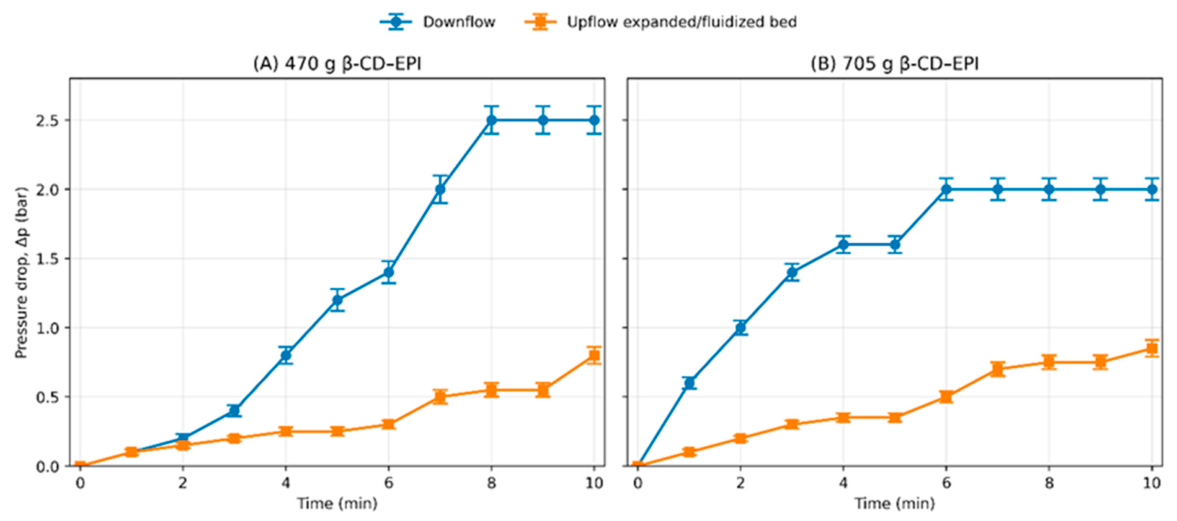
Figure 2.
Continuous-flow removal efficiencies of furosemide, hydrochlorothiazide, acetaminophen, ciprofloxacin, and cyproconazole by the β-CD-EPI polymer at nominal contact times of 3, 5, and 10 min. Initial contaminant concentrations were 5 mg L⁻¹ for furosemide and hydrochlorothiazide, 10 mg L⁻¹ for acetaminophen, 9.6 mg L⁻¹ for ciprofloxacin, and 7 mg L⁻¹ for cyproconazole. Data are presented as mean ± SD (n = 3).
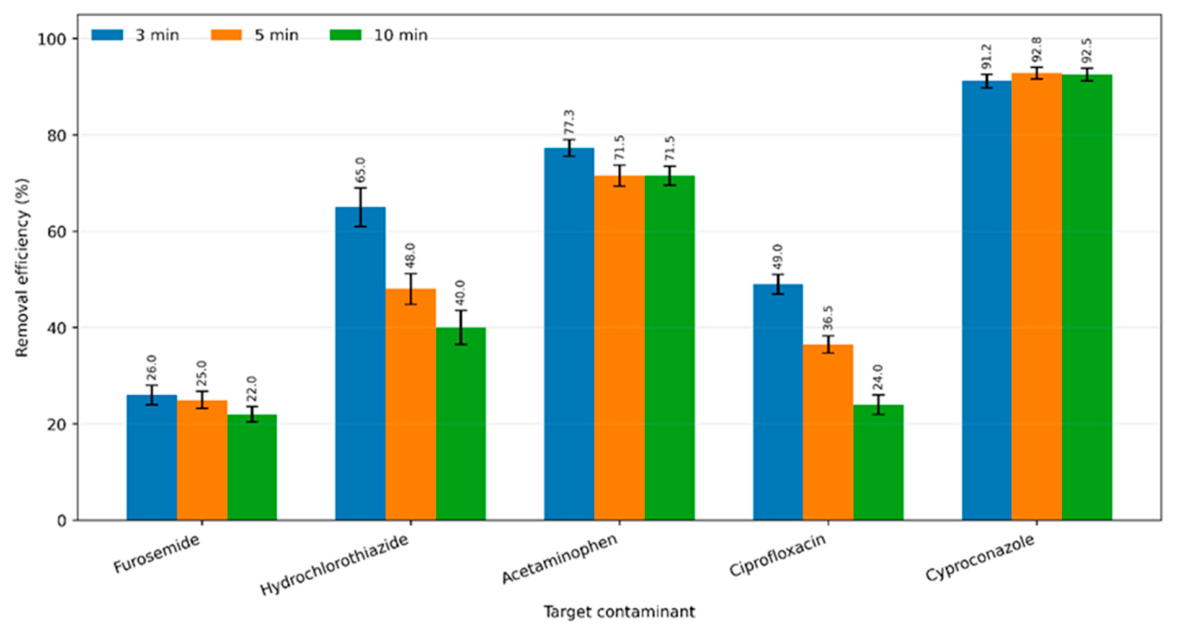
Figure 3.
Effect of mixture composition on continuous-flow contaminant removal by the β-CD-EPI polymer. Removal efficiencies obtained under single-solute and ternary conditions at nominal contact times of 3, 5, and 10 min are compared for (A) cyproconazole, (B) acetaminophen, and (C) ciprofloxacin. Binary experiments containing cyproconazole and acetaminophen were performed only at nominal contact times of 3 and 5 min; no binary experiment containing ciprofloxacin was conducted. Data are presented as mean ± SD (n = 3).
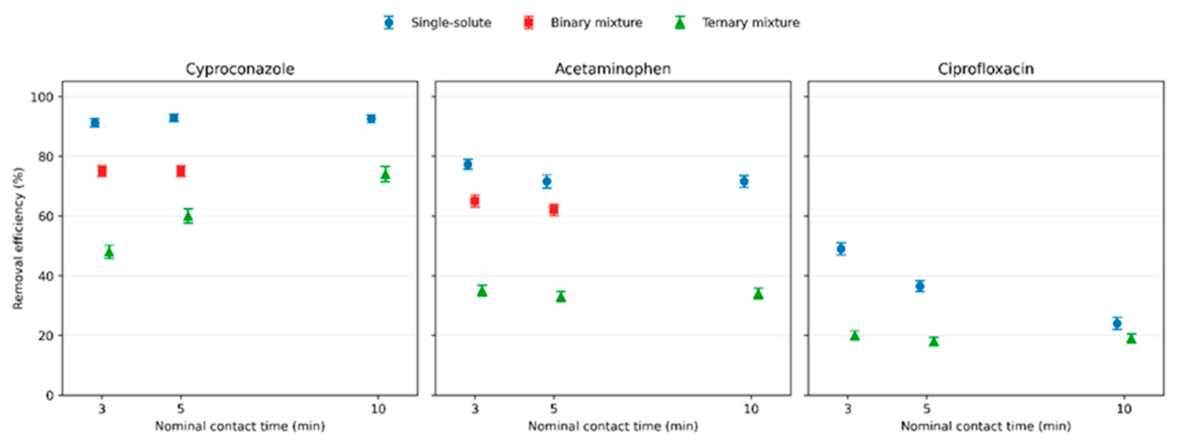
Figure 4.
Effect of the aqueous matrix on cyproconazole removal by the β-CD-EPI polymer under continuous-flow conditions. Cyproconazole (C₀ = 7 mg L⁻¹) was evaluated in tap water and secondary-treated wastewater at nominal contact times of 3, 5, and 10 min. Data are presented as mean ± SD (n = 3).
Figure 4.
Effect of the aqueous matrix on cyproconazole removal by the β-CD-EPI polymer under continuous-flow conditions. Cyproconazole (C₀ = 7 mg L⁻¹) was evaluated in tap water and secondary-treated wastewater at nominal contact times of 3, 5, and 10 min. Data are presented as mean ± SD (n = 3).
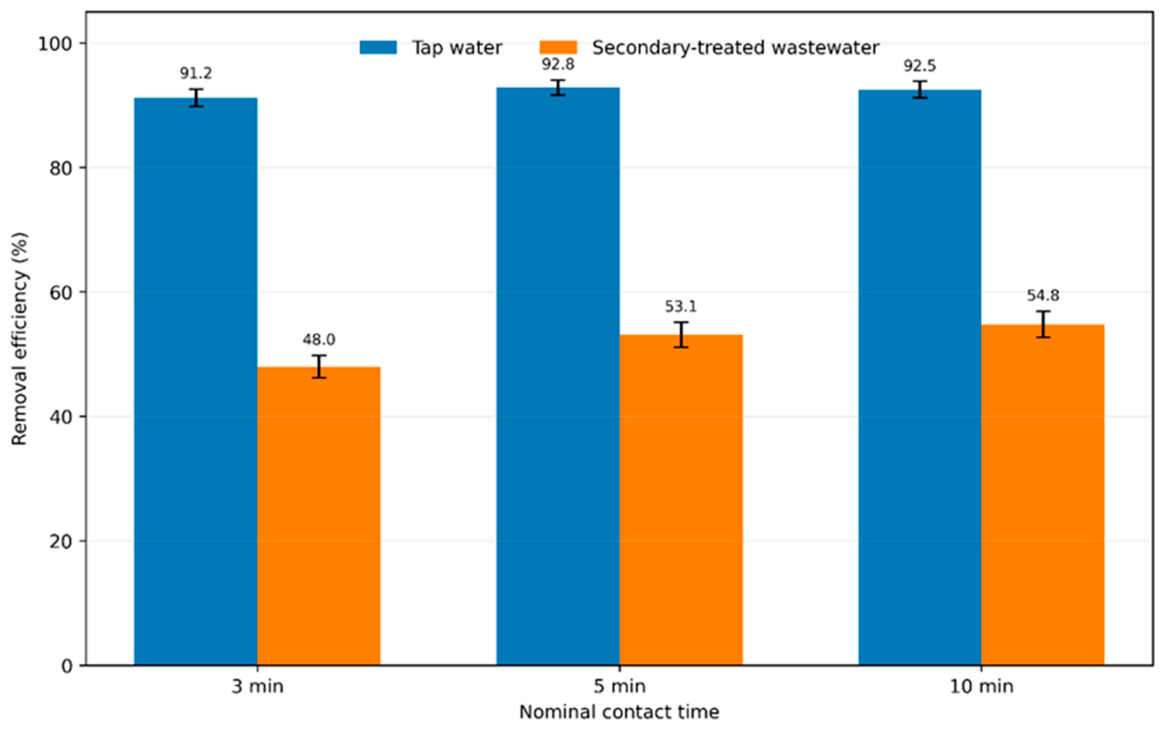
Figure 5.
Desorption and post-desorption rinsing behavior of the β-CD-EPI polymer under continuous-flow conditions. (A) Summary of cyproconazole adsorption and desorption efficiencies, showing the reference adsorption-loading step and desorption efficiencies obtained with 220 mM acetate buffer at pH 4.0 at nominal contact times of 5, 10, and 15 min. (B) Evolution of effluent pH during slow post-desorption rinsing with demineralized water at 2, 3, 4, and 5 BV h⁻¹. (C) Evolution of effluent pH during fast post-desorption rinsing with demineralized water at 10, 20, 30, and 40 BV h⁻¹.
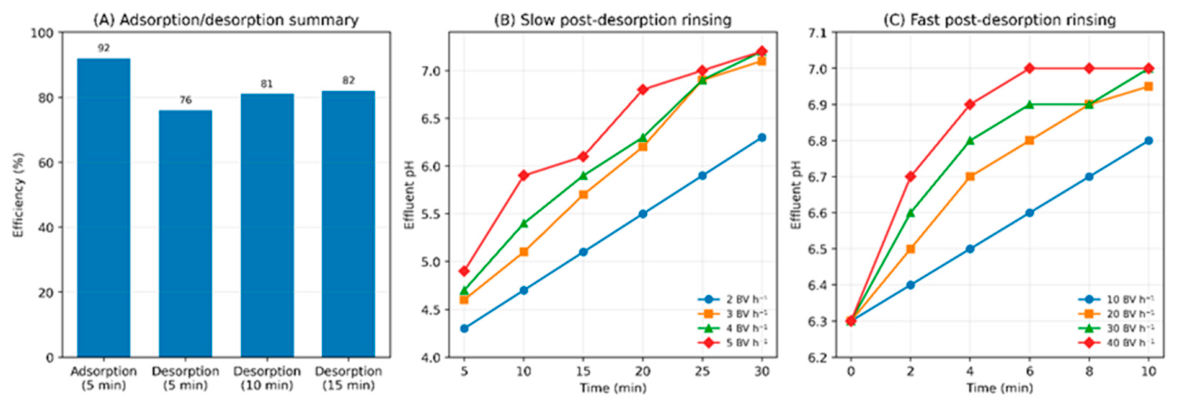

Table 1.
Operating conditions used for the continuous-flow adsorption experiments with the β-CD-EPI polymer.
Table 1.
Operating conditions used for the continuous-flow adsorption experiments with the β-CD-EPI polymer.
| Nominal contact time tc (min) | Flow rate Q (L h⁻¹) |
Superficial linear velocity (m h⁻¹) | Hydraulic loading (BV h⁻¹) |
|---|---|---|---|
| 3 | 60 | 10.7 | 20 |
| 5 | 36 | 6.4 | 12 |
| 10 | 18 | 3.2 | 6 |
Experimental configuration: 90 mm diameter column; β-CD-EPI loading, 705 g; approximate hydrated adsorbent-bed volume, 3 L; bed depth, approximately 0.54 m; upflow expanded/fluidized-bed operation.
Table 2.
Physicochemical characteristics of the secondary-treated effluent used in the wastewater-matrix experiment.
Table 2.
Physicochemical characteristics of the secondary-treated effluent used in the wastewater-matrix experiment.
| Parameter | Value |
|---|---|
| BOD₅ | 9.36 ± 1.50 mg L⁻¹ |
| COD | 46.43 ± 4.22 mg L⁻¹ |
| Suspended solids | 7.37 ± 1.17 mg L⁻¹ |
| pH | 7.38 ± 0.09 |
| Electrical conductivity | 2,093 ± 37.64 µS cm⁻¹ |
| NH₄-N | 14.35 ± 2.31 mg L⁻¹ |
| NO₃-N | 8.79 ± 1.84 mg L⁻¹ |
| Total nitrogen | 26.5 ± 3.16 mg L⁻¹ |
| Total phosphorus | 1.56 ± 0.41 mg L⁻¹ |
Values are expressed as mean ± SD. BOD₅, five-day biochemical oxygen demand; COD, chemical oxygen demand; NH₄-N, ammonium nitrogen; NO₃-N, nitrate nitrogen.
Table 3.
Experimentally derived operating criteria for subsequent scale-up of the β-CD-EPI polymer adsorption process.
Table 3.
Experimentally derived operating criteria for subsequent scale-up of the β-CD-EPI polymer adsorption process.
| Process parameter / requirement | Experimentally derived criterion | Implication for subsequent scale-up |
|---|---|---|
| Adsorption column configuration | 90 mm nominal-diameter column | Provides the laboratory geometry validated under continuous-flow operation |
| Polymer loading | 705 g β-CD-EPI, corresponding to approximately 3 L hydrated bed and 0.54 m bed depth | Defines the experimentally validated laboratory-scale polymer inventory |
| Flow direction | Upflow expanded/fluidized-bed operation | Minimizes bed compaction and excessive pressure development |
| Superficial linear velocity | Practical upper operating limit of approximately 12 m h⁻¹ | Subsequent scale-up should maintain hydrodynamic conditions below the instability region identified for the hydrated polymer |
| Nominal adsorption contact times | 3, 5 and 10 min, corresponding to 10.7, 6.4 and 3.2 m h⁻¹, respectively | Nominal contact time must be interpreted together with the associated hydrodynamic regime |
| Dynamic adsorption performance | Strongly contaminant dependent | Batch-derived equilibrium and kinetic parameters should be treated as design inputs rather than direct predictors of continuous-flow removal |
| Multicomponent operation | Removal decreased relative to single-solute conditions | Polymer requirements should be established using representative contaminant mixtures |
| Wastewater matrix | Secondary-treated wastewater substantially reduced cyproconazole removal relative to tap water | Subsequent scale-up should be validated using representative wastewater matrices rather than clean water alone |
| Desorption | 220 mM acetate buffer, pH 4.0; 10 mL g⁻¹; 10 min; >80% cyproconazole recovery | Regenerant consumption and desorption duration should be incorporated into process sizing |
| Post-desorption rinsing | 30 min at 6 L h⁻¹ followed by 10 min at 30 L h⁻¹ | Rinsing-water demand and cycle time must be included in overall process design |
| Bed management | Maintain the β-CD-EPI polymer in the hydrated state during adsorption–desorption–rinsing transitions | Minimizes compaction and helps preserve hydraulic performance |
| Polymer reusability | Repeated adsorption-desorption reusability previously demonstrated under batch conditions [20] | Provides the material basis for cyclic operation; stability must now be confirmed under repeated continuous-flow cycles |
| Continuous cyclic validation | Repeated continuous adsorption–desorption cycles not evaluated in the present study | Adsorption capacity, desorption efficiency, polymer integrity, and hydraulic stability require validation under prolonged continuous cyclic operation |
| Influent loading regime | Present laboratory experiments performed at mg L⁻¹ concentrations as controlled high-loading challenge conditions | Performance at environmentally relevant concentrations must subsequently be established under prolonged multicomponent exposure |
| Breakthrough characterization | Conventional time-on-stream breakthrough under fixed hydraulic conditions was not determined | Extended fixed-condition operation is required to determine breakthrough profiles, dynamic adsorption capacity and bed service life |
| Subsequent process stage | Laboratory continuous-flow operating window experimentally established | Provides the operational basis for transfer toward semi-industrial validation under representative treatment conditions |
Note: Desorption and post-desorption rinsing criteria were established using the dedicated 63 mm regeneration configuration containing 100 g of β-CD-EPI polymer and should therefore be revalidated during subsequent process scale-up.
Disclaimer/Publisher’s Note: The statements, opinions and data contained in all publications are solely those of the individual author(s) and contributor(s) and not of MDPI and/or the editor(s). MDPI and/or the editor(s) disclaim responsibility for any injury to people or property resulting from any ideas, methods, instructions or products referred to in the content. |
© 2026 by the authors. Licensee MDPI, Basel, Switzerland. This article is an open access article distributed under the terms and conditions of the Creative Commons Attribution (CC BY) license (http://creativecommons.org/licenses/by/4.0/).
Copyright: This open access article is published under a Creative Commons CC BY 4.0 license, which permit the free download, distribution, and reuse, provided that the author and preprint are cited in any reuse.