
Submitted:
25 August 2026
Posted:
25 August 2026
You are already at the latest version
Abstract
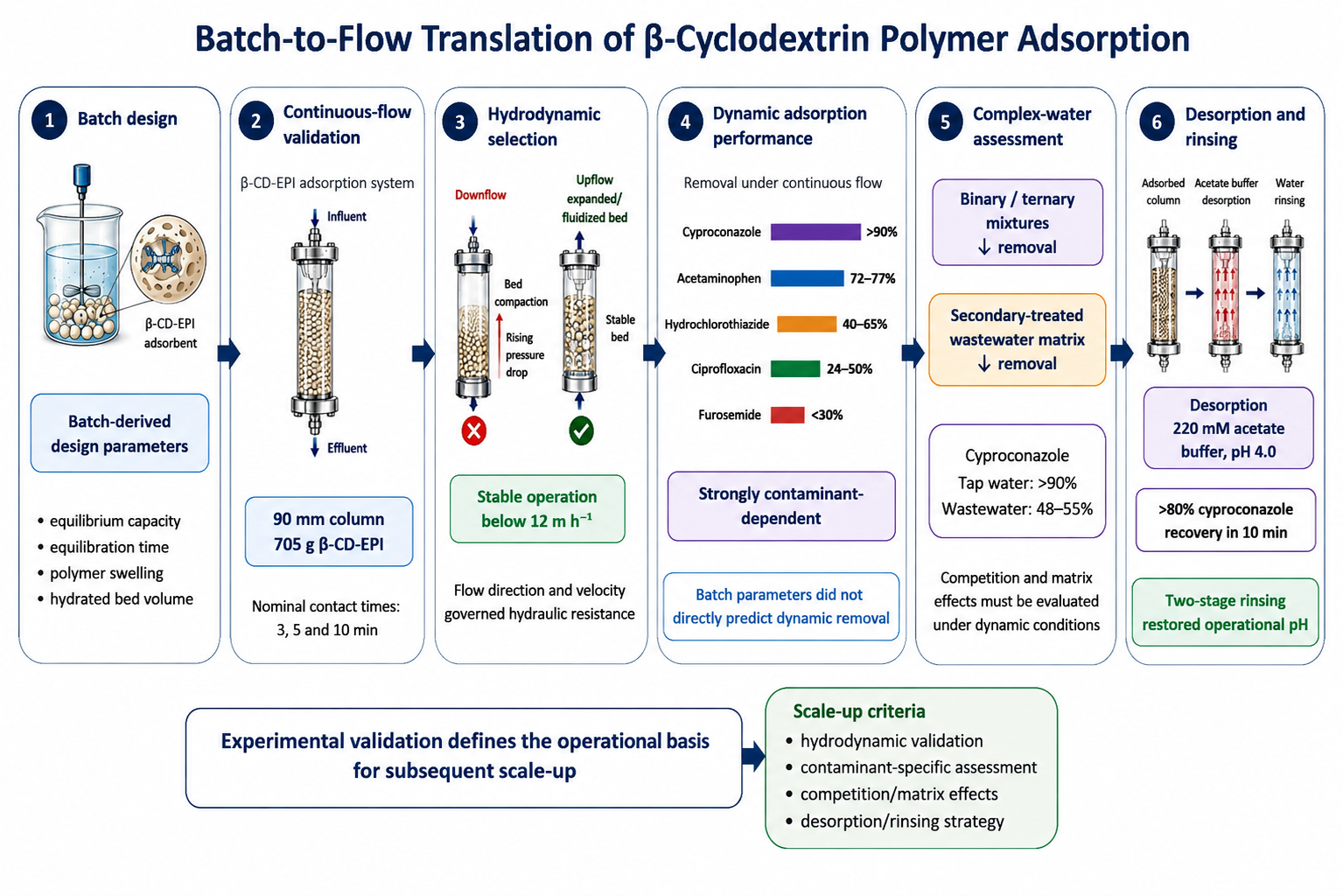
Translating adsorption performance from batch experiments to continuous-flow operation is a key step toward practical water-treatment applications. In this study, a laboratory-scale continuous adsorption system based on a water-insoluble β-cyclodextrin-epichlorohydrin (β-CD-EPI) polymer was validated from hydrodynamic, adsorptive, and operational perspectives. Downflow operation caused progressive bed compaction and excessive pressure development, whereas a 90 mm column operated in upflow expanded/fluidized-bed mode remained stable at superficial linear velocities below approximately 12 m h⁻¹. Under these conditions, removal was strongly contaminant-dependent: cyproconazole exceeded 90%, acetaminophen reached 72–77%, hydrochlorothiazide 40–65%, ciprofloxacin 24–50%, and furosemide remained below 30%. The relative performance of furosemide and hydrochlorothiazide differed from that predicted by previous batch-derived adsorption parameters, demonstrating that batch results cannot be directly extrapolated to dynamic operation. Competitive adsorption in binary and ternary mixtures reduced removal, while cyproconazole removal decreased from >90% in tap water to 48–55% in secondary-treated wastewater. Desorption with 220 mM acetate buffer at pH 4.0 recovered >80% of retained cyproconazole within 10 min, followed by a two-stage rinse restoring operational pH. These results define hydrodynamic, adsorption, matrix, and regeneration criteria for subsequent scale-up of β-CD-EPI adsorption processes.
Keywords:
β-cyclodextrin-epichlorohydrin polymer
; continuous-flow adsorption
; expanded/fluidized bed
; emerging contaminants
; competitive adsorption
; wastewater matrix
; regeneration
; scale-up
Copyright: This open access article is published under a Creative Commons CC BY 4.0 license, which permit the free download, distribution, and reuse, provided that the author and preprint are cited in any reuse.