

Submitted:
23 August 2026
Posted:
25 August 2026
You are already at the latest version
Abstract
Digital twins promise to turn continuous poultry observations into biologically informed decisions about welfare, physiology, behavior, production and product quality. Yet the concept outruns its evidence. This critical narrative review asks when measurements become a credible representation of an embryo, bird, flock or egg, and when that representation improves husbandry. We examine recent studies, welfare assessments and industry evidence through physiological, ethological, welfare and production lenses. Seven programs organize the synthesis: HatchTwin for embryonic development; HenTwin for longitudinal change in laying hens; CluckTwin for contextual acoustic evidence; EggTwin for identity, quality, handling and traceability; FlockTwin Population for collective movement and resource use; BroilerTwin for the distinctive biology of meat chickens; and ChickenTwin for comparison without biological homogenization. Across these programs, observations remain inherently ambiguous. Reduced movement may indicate rest, growth, pain, heat load, fear or restricted opportunity; sound, surface temperature, clustering and production shifts are context dependent. Detection is therefore an entry point, not validation. A decision-worthy twin must establish independent biological credibility, operate prospectively, arrive within an actionable window, fit farm practice and demonstrate benefit against current practice. Welfare cannot be inferred from productivity or activity alone, flock averages may conceal vulnerable birds, and egg identity does not establish hen-level provenance. We propose silent-mode evaluation followed by cluster-randomized or justified stepped implementation, measuring welfare, production, labor, economics, governance and unintended harm. The opportunity is considerable, but integrated commercial evidence remains absent. Poultry digital twins will earn authority only by enabling earlier care, fewer preventable harms and more resilient farms.
Keywords:
digital twin
; poultry welfare
; broiler
; laying hen
; precision livestock farming
1. A Twin Earns Relevance Only When It Changes a Worthwhile Decision
Poultry production is often described through endpoints. A chick hatches, a broiler reaches processing weight, a hen enters lay, and an egg is graded. Biology is less conveniently divided. Conditions during incubation influence the quality and physiological capacity of the chick. Growth, skeletal development, thermoregulation, behavior, and social experience unfold together after placement. In laying hens, reproductive output is sustained through changing mineral demands, age-related physiology, and continuing exposure to the housing environment. An egg leaving the house retains features of its formation, handling, and storage, but only part of the biological history from which it arose.
The attraction of a digital twin is therefore understandable. It promises continuity across observations separated by time, sensor, production stage, and professional responsibility. Poultry houses can now be observed through cameras, microphones, thermal imagers, environmental probes, feed and water records, egg counters, grading data, and processing outcomes. Together these streams create a record more continuous than periodic human observation alone can provide.
That promise requires unusual scientific restraint. A camera records visible displacement, not the motivation for movement. A microphone records pressure waves, not an animal’s emotional state. Surface temperature reflects heat exchange among skin, plumage, air, and surrounding surfaces; it is not identical to core temperature or thermal discomfort. Egg production is an important flock outcome, but continued production does not demonstrate freedom from pain. Each signal is an incomplete and context-sensitive expression of a process that remains partly hidden.
The central scientific question is consequently not whether poultry can be measured continuously. It is whether a measured change can be interpreted as a biologically defensible condition, distinguished from credible alternatives, and used to support a proportionate husbandry decision. A poultry twin should not be judged by the density of its data, but by the discipline of its inferences.
This review uses seven named research programs to examine that discipline. HatchTwin concerns the developing embryo and its incubation history. HenTwin concerns the changing state of laying hens. CluckTwin concerns acoustic evidence and the limits of assigning meaning to vocal patterns. EggTwin concerns identity, quality, handling, and post-lay history. FlockTwin Population concerns collective behavior, distribution, and resource use. BroilerTwin concerns meat chickens, whose rapid growth and compressed life create physiological and welfare questions distinct from those of laying hens. ChickenTwin is treated as a bounded umbrella for comparison and translation among these programs, not as a universal model of “the chicken.”
These distinctions matter because the commercial unit and the biological unit do not always coincide. A producer manages a flock, but welfare is experienced by individual birds. A hatchery controls an incubator, while embryos within it differ in size, heat production, and developmental trajectory. A grading station handles eggs by lot, although physical defects and deterioration occur in individual eggs. A flock may display apparently orderly movement while a vulnerable minority is lame, excluded from resources, or unable to follow the group. Averaging is a practical necessity in poultry production and an ethical risk.
The recurring test in this review is decision additionality: does the digital evidence enable a better decision than current practice, at a time when a feasible action remains, and does that action improve an independently measured outcome? Five elements must align: the animal, flock, egg, embryo, or process being represented; measurements whose limitations are known; an interpretation supported by independent biology; a decision that can still be taken; and an outcome evaluated in the animal or production system. A detector may work without identifying cause. A prediction may be accurate but too late. An alert may change management without improving welfare or production. The purpose of the seven programs is not to conceal these gaps beneath a technological label. It is to make them visible and experimentally tractable.
2. Scope and Approach of This Critical Review
This article is a critical narrative synthesis, not a systematic review or meta-analysis. It does not claim exhaustive retrieval, PRISMA compliance, or quantitative pooling. Sources were selected to test the biological credibility, husbandry relevance, and evidentiary limits of poultry digital-twin claims. Priority was given to peer-reviewed primary studies published from 2020 onward, supplemented by older incubation and welfare studies where they remain foundational to embryo physiology or interpretation. Authoritative welfare assessments and Canadian industry or regulatory sources were used to define outcomes, operational constraints, and the decisions that matter in practice.
Evidence was interpreted according to the claim it can support. A sensing study may demonstrate that a variable can be measured under specified conditions. It does not, by itself, demonstrate that the variable represents welfare, identifies a causal mechanism, or improves a farm decision. An association between a signal and a later outcome can support risk stratification but not an intervention claim. A longitudinal study can reveal change within a bird or flock only when identity, missing observations, equipment changes, and age-related baselines are handled credibly. Commercial relevance requires further evidence about timeliness, false alerts, workflow, maintenance, full ownership cost, and animal or production outcomes.
Each program is considered through four lenses. The physiological lens asks which internal processes could generate the observation and how they change with age, strain, nutrition, and environment. The ethological lens asks what a behavior or vocalization means in its social and motivational setting. The welfare lens asks whether monitoring addresses health, behavioral opportunity, and likely experience rather than productivity alone. The industrial lens asks which decision would change, who would act, within what time, and how benefit or harm would be measured. Across all four lenses, emphasis is placed on competing explanations and conditions under which an inference should be withheld.
The HenTwin preprint is included because it directly defines one of the named programs (Dhaliwal et al., 2026). Its non-peer-reviewed status, controlled-room setting, flock-level resolution, and limited biological dimensions are stated explicitly. An earlier FlockTwin review examined how separately bounded poultry twins could be connected computationally (Neethirajan, 2026). The present article asks a different question: what biological meaning, farm decision, and animal or production consequence would make any such program worth using? The wider argument is carried by independent work in poultry physiology, behavior, welfare, production, food quality, adoption, and farm management. This boundary is intentional. The review evaluates whether the named concepts can become useful animal-science programs; it does not treat their names as evidence of maturity.
3. Biological Credibility Before Digital Ambition
A poultry twin first needs an honest statement of what it represents. “The bird” is insufficient when observations come from a room-level microphone or a flock-level movement field. An individual-hen history requires defensible continuity of individual identity. A flock twin may legitimately represent distributions and collective behavior, but it should not attribute the group pattern to every member. EggTwin may represent a physical egg after lay, yet cannot claim to represent the hen’s current physiology without a verified hen-to-egg link. Ambiguity at this level determines which mechanisms, outcomes, and welfare claims are valid.
The next requirement is a biologically specified target. Welfare, stress, health, affect, and behavior are not interchangeable labels. The Five Domains framework considers nutrition, physical environment, health, behavioral interactions, and likely mental experience (Mellor et al., 2020). Digital monitoring can enlarge the evidence available to welfare assessment, yet the historical concentration of precision systems on health and productivity must not redefine welfare around what is easiest to measure (Buller et al., 2020). Reduced activity can reflect normal rest, heat avoidance, lameness, fear, high body mass, crowding, or loss of opportunity. Increased vocal output can reflect social separation, feeding anticipation, disturbance, heat, respiratory change, or development. Similar outward patterns can arise from different internal conditions, and the same welfare problem may appear through different patterns.
Validation must therefore draw on independent evidence. If a camera-derived activity score is used both to define and confirm a welfare state, the reasoning is circular. Stronger studies compare remote observations with clinical examination, gait assessment, radiography, experimentally controlled exposure, or validated behavioral tests. Repeated radiography has shown that keel damage develops dynamically through the laying cycle (Baur et al., 2020). Severe fractures have been associated with a depressive-like judgment bias, linking physical injury to affective consequence (Armstrong et al., 2020). These findings show why unchanged production or gross movement cannot demonstrate the absence of serious welfare impairment. Important biological conditions may remain poorly visible to routine sensors.
Time changes meaning. A chick’s vocal repertoire, a broiler’s activity, and a hen’s thermoregulatory response are not stationary. Age, body mass, reproductive development, learning, social experience, and repeated exposure shift the expected baseline. A credible longitudinal representation must recognize development rather than flagging every maturation-related change as abnormal. It must also avoid normalizing slow deterioration merely because the baseline is continually updated.
Continuity of identity is equally consequential. Doornweerd et al. (2024) found that strong frame-level broiler detection could coexist with repeated identity switches and short tracklets. Occlusion, proximity, and pen structures fragmented trajectories. If segments from several birds are inadvertently joined, the resulting “individual history” is partly synthetic. In dense flocks, individual claims should therefore depend on demonstrated identity continuity, not detection accuracy alone. When continuity fails, the scientific claim should move to a defensible subgroup, zone, or population level.
Finally, credibility is tested at the decision boundary. Prediction creates value only when it arrives early enough, directs a feasible response, and produces a better outcome than current practice. A thermal alert may prompt checks of ventilation, water, panting, and distribution. An acoustic change may prioritize a house for stockperson assessment. A shift in flock movement may trigger gait sampling or litter inspection. These uses guide attention while preserving alternative explanations and human judgment. Automatic changes to ventilation, lighting, feeding, or other consequential controls demand prospective evidence that the action is safe, beneficial, and robust under ordinary farm variation.
4. Seven Programs as Seven Biological Hypotheses
4.1. HatchTwin: Development Before Visibility
HatchTwin should represent the developing embryo rather than only the incubator. This distinction is physiologically fundamental. During early incubation, evaporative cooling can keep embryo temperature below incubator air temperature. Later, increasing metabolic heat production can raise it above the surrounding air (French, 1997). Egg size, shell conductance, breeder age, storage, airflow, machine position, oxygen availability, and developmental rate modify that relation. A machine setting is an environmental input, not a direct description of the embryo.
Experimental work supports eggshell temperature as a closer approximation of thermal exposure. Lourens et al. (2005) showed that imposed eggshell-temperature profiles affected development, hatchability, and post-hatch thermoregulation, with the strongest outcomes under a constant 37.8°C treatment in the studied batches. That value should not become a universal constant. Genotype, breeder age, egg size, ventilation, humidity, and machine design alter heat exchange. Molenaar et al. (2011) further showed that eggshell temperature and oxygen concentration affected yolk-free body mass, organ development, nutrient availability, and late embryo mortality. HatchTwin should preserve exposure history and developmental stage rather than reduce incubation to a single threshold.
Non-invasive physiology offers a more direct view. Youssef et al. (2020) demonstrated continuous photoplethysmography-based monitoring of embryo heart rate with high estimation performance under experimental conditions. Cardiac activity is biologically closer to the embryo than incubator settings, but it remains one dimension. Heart rate changes with stage, oxygen, temperature, and autonomic development. It does not alone establish normal development, future chick robustness, or welfare.
Spectral imaging illustrates both opportunity and boundary. Ghaderi et al. (2024) used 227 clean white-shell eggs to classify fertility before incubation, reporting 93.33% accuracy with selected spectral regions. Removing infertile eggs could reduce wasted incubator space, energy, and contamination risk. Fertility classification is not equivalent to developmental monitoring, however, and transfer across shell color, breeder age, strain, equipment, and commercial acquisition conditions remains to be shown.
The most defensible near-term decisions are circumscribed: identify eggs unlikely to be fertile, recognize deviations in thermal or cardiac trajectory, investigate tray-level heterogeneity, and refine transfer or hatch-window management. Claims about later welfare and performance require prospective linkage to chick condition, hydration, early mortality, thermoregulation, behavior, and growth. HatchTwin becomes biologically meaningful when it follows development and its consequences, not when it simply reproduces incubator telemetry.
4.2. HenTwin: A Changing Animal, Not a Fixed Baseline
HenTwin concerns the longitudinal condition of laying hens. The key word is longitudinal. A pullet, a hen at sexual maturity, a bird at peak lay, and an older hen in extended production are not the same physiological system observed repeatedly. Skeletal mineral balance, ovarian activity, body composition, thermoregulation, behavior, and social experience change together. A fixed threshold can misclassify development, whereas a continuously adjusted threshold can conceal slow deterioration.
The HenTwin preprint follows 150 Lohmann LSL-Lite hens in five controlled rooms for 25 weeks and combines surface temperature, acoustic characteristics, optical-flow movement, and an environmental index (Dhaliwal et al., 2026). It shows that several modalities can be followed over developmental time and that coordinated changes may identify transitions. Its evidentiary scope is narrower than the name may imply. The representation is flock-level, contains four derived measurements, involves one strain under controlled conditions, and has not undergone peer review. It does not directly measure skeletal pathology, pain, reproductive physiology, health, social position, or affective experience.
Heat exposure shows why several forms of evidence are needed. In a 42-day experiment with 120 ISA Brown hens, high temperature altered rectal and surface temperatures, heart rate, panting, and wing elevation consistently, whereas corticosterone and heterophil-to-lymphocyte responses were more dependent on timing (Kim et al., 2021b). No marker was an unqualified reading of stress. A surface-temperature rise should be interpreted with ambient conditions, respiration, posture, drinking, and production history. Similar changes may arise from handling, disease, local inflammation, or circadian variation.
Ethology adds another layer. Sibanda et al. (2020) monitored 3,125 radio-frequency identification (RFID)-tagged hens in three commercial free-range flocks and found substantial individual variation and resource-use subpopulations. Gómez et al. (2022) found that temporal movement similarity was associated with social relationships and strengthened among socially associated hens. Movement is partly social and cannot be treated as an isolated individual trait.
A welfare-oriented HenTwin should preserve such individuality without pretending that every hen can always be identified. It should reveal widening distributions, persistent loss of access to a resource, or departure from a reliable individual trajectory. It must also recognize latent pathology. Longitudinal radiography exposed keel damage that visual activity monitoring could not directly confirm, and severe fractures have affective consequences (Armstrong et al., 2020; Baur et al., 2020).
Decision relevance lies in targeted attention: identify rooms needing thermal inspection, zones needing resource assessment, or reliably identified hens whose changed behavior warrants examination. The proper output is a biologically reasoned concern with alternatives. Reduced upper-tier use could reflect pain, lighting, social exclusion, equipment failure, or age. HenTwin earns trust by narrowing these possibilities and directing care rather than concealing ambiguity within a welfare score.
4.3. CluckTwin: Listening Without Inventing Meaning
Poultry vocalizations are biologically rich because they are produced rapidly, non-invasively, and in social context. They are also difficult to interpret. A commercial microphone records overlapping callers, ventilation, feeders, people, equipment, and reverberation. Even a correctly detected call class does not necessarily reveal why it occurred, which bird produced it, or how seriously the animal was affected.
Mao et al. (2022) trained a system on 3,363 annotated distress calls and 1,973 barn-sound samples and reported a combined precision-recall score of 94.73%. This shows that a defined call category can be distinguished from selected background sounds under the studied conditions. It does not establish a universal distress diagnosis. Breeds, housing, microphone placement, work sounds, and low-amplitude calls shape performance, and the identity and causal condition of callers were not established.
Many clips do not equal many independent animals. Soster et al. (2025) assembled more than 2,000 labelled samples from continuous recordings of 10 male Ross 308 broilers and achieved balanced accuracy of 91.1% across four vocal categories. The acoustic library was substantial; the biological sample was 10 birds. Generalization across sex, strain, density, disease status, age, and commercial soundscapes remains empirical. A separate study of 1,680 broilers showed that vocal patterns varied strongly with age and time of day, and monitored call categories did not show clear changes under the tested heat and platform conditions (Soster de Carvalho et al., 2025). Context can dominate the signal, and no detected change does not demonstrate absence of discomfort.
Controlled elicitation can build stronger ground truth. Golfidis et al. (2024) used an interactive feeder to expose hens voluntarily to stimuli intended to differ in valence and arousal. Preliminary results distinguished arousal more clearly than valence. The asymmetry is instructive: sound can show that something changed without uniquely identifying whether the experience was positive or negative.
CluckTwin should therefore be described as contextual listening. Its near-term role is to identify a changed soundscape and prompt inspection. A rise in distress-associated calls might trigger checks of temperature, ventilation, water, social disturbance, equipment, and respiratory health. The absence of an acoustic alert should not reassure automatically. Claims that a system “understands chicken language,” detects emotion directly, or diagnoses disease exceed current evidence.
4.4. EggTwin: From Biological Product to Accountable Food
EggTwin begins where the egg becomes an independently handled product. Its appropriate questions concern physical identity, shell integrity, internal quality, collection, storage exposure, grading, and traceability. These are commercially important and scientifically tractable. They should not be confused with a complete history of the hen.
Chen et al. (2023) used shell images from 770 eggs to develop individual identification. On 1,540 test images, the reported correct-recognition rate was 99.96%. Shell patterning may function as a naturally occurring identity feature under controlled acquisition. Recognition must remain reliable after washing, abrasion, condensation, rotation, illumination changes, and commercial handling before it can maintain chain of custody. Identifying an egg still does not identify the hen that laid it.
Quality monitoring has a different evidentiary basis. Botta et al. (2022) reported 95.38% egg-level accuracy for shell-crack detection. Quan et al. (2021) found that egg weight, albumen height, and Haugh unit declined during storage, with faster deterioration at higher temperatures, and developed shelf-life models for the tested conditions. These studies support EggTwin functions such as crack screening, storage-risk estimation, and stock rotation. They do not demonstrate universal validity across shell colors, initial quality, washing practices, conveyor motion, or fluctuating temperatures.
The strongest decisions are operational: divert cracked eggs, identify lots exposed to unfavorable storage, adjust collection or handling, improve grading consistency, conduct a narrower recall, and reduce waste. Welfare claims require caution. Shell defects, egg weight, or internal quality may reflect hen age, nutrition, or physiology, yet the mapping is many-to-one. Without verified identity and independent animal evidence, EggTwin should not reconstruct the welfare of the laying hen from the product.
4.5. FlockTwin Population: Collective Order and Individual Vulnerability
Collective behavior is a legitimate level of poultry biology. Chickens coordinate movement, respond to disturbance, form social associations, compete for resources, and create local density patterns that cannot be understood by studying an isolated bird alone. FlockTwin Population should represent these properties while preserving the difference between a group pattern and individual experience.
Dawkins et al. (2021) followed 74 commercial broiler flocks in the United Kingdom and Switzerland and showed that optical-flow descriptors were associated with later mortality and hock burn. Differences appeared early and accumulated. This supports flock movement as a risk signal and suggests a decision use: prioritize houses for inspection before adverse outcomes become obvious. It does not identify which birds are compromised or show that movement itself is causal. Similar patterns can arise from body mass, lighting, disturbance, heat, litter, health, or routine.
Collective analysis must also respect measurement error. Doornweerd et al. (2024) obtained excellent frame-level detection, yet evaluated trajectories contained repeated identity switches and mean tracklets of only 12.36 min. A movement field can remain useful after individual identity fails, but the claim must move to the group. Population evidence should not be narrated as thousands of continuous individual histories.
Ethological interpretation requires distributions and social context. Gómez et al. (2022) showed that movement similarity among hens related to social association. Synchrony may reflect affiliation or a shared response to resources, but can also arise from alarm, restriction, or imposed routine. High synchrony is not intrinsically positive. A stable mean can likewise conceal a minority that is inactive, injured, or excluded.
Defensible outputs include occupancy, movement distributions, clustering, synchrony, and change in the fraction of birds within concerning tails. Decisions can include relocating resources, examining a crowding zone, sampling gait, correcting lighting, or checking litter and ventilation. Population monitoring should make vulnerable subgroups more visible, not average them away.
4.6. BroilerTwin: Growth, Locomotion, and the Compressed Production Life
BroilerTwin must be specific to chickens raised for meat. It should not contain EggTwin logic or borrow normal trajectories from laying hens. Broilers undergo rapid changes in body mass, muscle deposition, skeletal load, cardiovascular demand, appetite, and thermoregulation over a short cycle. Age and body weight are closely related but biologically distinct. A bird can be young in days and already carry a substantial locomotor burden.
Variation among strains is large. Torrey et al. (2021) studied 7,528 birds from 16 strains and demonstrated marked differences in growth and feed efficiency. Dawson et al. (2021), comparing 2 conventional and 12 slower-growing strains, found that faster-growing birds became inactive earlier and used enrichments less. The category “slower-growing” was itself heterogeneous. A universal BroilerTwin baseline would obscure genetic and developmental variation.
Welfare interpretation must extend beyond survival and feed conversion. Rayner et al. (2020) found that slower-growing commercial conditions were associated with better walking ability, lower contact dermatitis and mortality, and more behavioral indicators of positive welfare than the fastest-growing condition. Exploration, play, and enrichment use provide information absent from production records. Growth rate, stocking density, litter, and farm management interact, however. Reduced activity should not be interpreted as lameness without considering body mass, resting, thermal conditions, and opportunity to move.
BroilerTwin can create value by recognizing departures from strain- and age-appropriate growth, identifying worsening mobility distributions, locating persistent inactivity or crowding, and combining litter, climate, and behavioral evidence before processing losses occur. It should distinguish screening from diagnosis. A movement change can prompt gait assessment; it cannot replace it. A growth forecast can inform feeding and harvest planning; it should not be labelled a welfare benefit unless animal-based outcomes improve. External evaluation must span strains, farms, seasons, stocking conditions, and camera systems because these are the variables that shape commercial behavior.
4.7. ChickenTwin: Translation Without Biological Erasure
ChickenTwin is best treated as an umbrella for disciplined comparison among the 6 programs. It should not become an all-purpose model whose represented entity changes opportunistically among embryo, laying hen, broiler flock, and egg. Biological continuities are real, as are discontinuities. Incubation affects the chick, yet measurements appropriate to an embryo are not those appropriate to a laying flock. Layers and broilers both thermoregulate, but their ages, body composition, housing, production goals, and welfare hazards differ. An egg carries information about formation and handling; it is not a current physiological copy of the hen.
The umbrella should specify what can travel. General principles such as age-aware baselines, independent welfare evidence, honest resolution, prospective evaluation, and decision relevance apply across programs. Particular thresholds and meanings often do not. Authoritative welfare assessments prioritize different consequences for broilers and laying hens (EFSA AHAW Panel, 2023a,b). A common name must not flatten those differences.
ChickenTwin should also preserve stockmanship. Farmers using precision systems have described both useful new forms of observation and concern about dependence on devices or loss of direct animal-observation skills (Kling-Eveillard et al., 2020). Digital evidence should guide attention and improve the timing of care, not make the animal present only as a stream of numbers.
The test is not whether 7 programs can be displayed together. It is whether each makes a biological claim proportionate to evidence and whether comparison improves decisions. HatchTwin should lead to better incubation and chick outcomes. HenTwin should reveal meaningful change without mistaking maturation for disease. CluckTwin should prompt contextual inspection without inventing semantic certainty. EggTwin should strengthen quality and accountability without fabricating hen-level provenance. FlockTwin Population should reveal collective risk without erasing vulnerable birds. BroilerTwin should respect the physiology and welfare of meat chickens. ChickenTwin should keep these boundaries visible.
5. The Same Observation Can Tell Different Biological Stories
A sensor records a change in the world available to it. It does not, by itself, reveal the cause of that change or its meaning for the animal. This distinction is easy to acknowledge and easy to violate. A decline in movement, a rise in surface temperature, a different soundscape, a shift in spatial occupancy, or a fall in egg output may each be informative. None has a unique biological interpretation. The practical intelligence of a poultry twin therefore lies less in detecting change than in conducting a disciplined differential interpretation of change.
Reduced activity offers the clearest example (Figure 1). In a broiler flock, activity normally declines as birds age and body mass increases. Fast-growing strains can become inactive earlier than slower-growing strains, and age and body mass do not exert interchangeable effects on gait, resting, feeder use, and behavioral opportunity (Dawson et al., 2021; Torrey et al., 2021). A further decline may reflect heat avoidance, impaired walking ability, painful contact dermatitis, poor litter, restricted access to resources, disease, or a normal period of rest. In laying hens, reduced movement may be associated with keel injury or fear, but it may also occur during nesting, night-time rest, or adaptation to a new housing system (Armstrong et al., 2020; Edgar et al., 2023). A model that learns a single threshold for “low activity” can be technically consistent and biologically wrong.
The required response differs with the explanation. Suspected heat load directs attention to air temperature, humidity, air speed, bird distribution, panting, wing elevation, drinking, and ventilation performance. Suspected locomotor pain directs attention to gait, posture, footpads, hocks, keel condition, litter, and clinical examination. Suspected disturbance requires inspection of equipment cycles, sudden sounds, personnel movement, predators, lighting changes, or social disruption. Normal rest requires no corrective action. The value of the signal therefore depends on contextual evidence that separates these possibilities while an effective response remains possible. An alert that simply reports inactivity transfers the unresolved inferential burden to the producer.
Surface temperature is similarly attractive and ambiguous. Thermal imaging can reveal spatial and temporal patterns without handling every bird, yet the surface is an interface between the animal and its environment rather than a direct reading of core temperature. Feather coverage, body region, posture, blood flow, air movement, humidity, camera angle, distance, emissivity assumptions, and the thermal history of the house all influence the recorded value. Sustained heat exposure can alter surface and rectal temperature, heart rate, panting, and wing elevation, although physiological markers differ in their responsiveness and timing (Kim et al., 2021a,b). The same high surface temperature can accompany increased peripheral heat dissipation, local inflammation, recent activity, or a warmer microclimate. Conversely, a bird under severe heat load may not be the warmest object in a frame if feathers, occlusion, or camera geometry distort the measurement.
A biologically credible interpretation should therefore combine exposure and response. Environmental measurements describe a hazard or opportunity. Bird-based measures describe how animals are responding. Neither alone constitutes welfare. House temperature may exceed an operational threshold without demonstrating the intensity or duration of thermal discomfort in every bird. Panting and wing elevation are closer to the response of the animal but remain affected by age, strain, activity, and health. A useful system links both forms of evidence, preserves disagreement between them, and prompts inspection when the pattern does not fit what was expected.
Vocal change poses an even sharper temptation to overinterpret. A poultry house contains calls, mechanical noise, ventilation, feed delivery, water flow, reverberation, human speech, and sometimes signals from outside the building. Age and time of day alter the acoustic repertoire, and call structure can change with body size, social context, arousal, respiratory condition, and temperature. Soster et al. (2025) showed that selected call types could be classified with high balanced accuracy in a controlled sample of 10 male broilers. A larger broiler study found pronounced effects of age and time of day, yet the monitored vocal categories did not change clearly under the heat and platform conditions tested (Soster de Carvalho et al., 2025). These findings are not contradictory. They show that acoustic sensitivity depends on what is recorded, how calls are defined, and which biological context is present.
CluckTwin should consequently avoid the language of translation. A change in sound may justify a targeted walkthrough, a check of climate or equipment, or closer respiratory observation. It does not establish that the system has inferred an emotion, diagnosed disease, or discovered the semantic content of a call. Unsupervised clusters are especially vulnerable to narrative inflation. A statistically distinct cluster can be a promising subject for elicitation studies, but it becomes a biological category only when its production, context, repeatability, and consequence have been independently examined. Silence also needs interpretation. The failure to detect an acoustic change is not evidence that birds are comfortable.
Spatial clustering is often presented as intuitive because its visual form is compelling. Birds gather near heat, shade, feed, water, shelter, conspecifics, walls, light gradients, or disturbances. They may avoid drafts, wet litter, unfamiliar objects, dominant birds, or areas disturbed by people. A dense cluster can signal thermal discomfort or a piling hazard, but it can also arise during coordinated rest or resource use. An empty zone can indicate poor microclimate, a blocked path, a lighting gradient, unavailable resources, or an artifact produced by incomplete camera coverage. The geometry of a barn helps create the pattern. It cannot be treated as a neutral stage.
Collective measures are valuable precisely because commercial flocks cannot always be observed as named individuals. Optical flow and occupancy distributions can reveal changes that a periodic walkthrough may miss and can relate to later welfare outcomes at flock level (Dawkins et al., 2021). The ethical risk appears when the flock average becomes the whole animal story. A stable mean can coexist with a small, persistently compromised group. The birds that walk least, lose access to resources, sustain injury, or remain at the edge of a cluster may matter more than the center of the distribution. FlockTwin should therefore report heterogeneity, tails, and persistent zones of concern whenever the measurement system supports those claims. The flock is a meaningful unit of management; welfare is still experienced by animals.
Production changes also resist single-cause explanation. Egg output and egg quality reflect reproductive stage, lighting, nutrition, health, social conditions, environment, age, strain, skeletal mineral demands, and handling after oviposition. Keel fracture can affect behavior, affective state, production, or egg quality, yet production may continue despite injury and therefore cannot certify the absence of suffering (Armstrong et al., 2020; Edgar et al., 2023). Shell cracks can originate during formation, collection, transport, or grading. Albumen quality changes with storage time and temperature. An EggTwin that detects a defect is valuable at the point where diversion, grading, handling, or storage can be changed. It should not assign the defect to hen physiology unless verified timing and identity make that inference possible.
The same discipline applies before hatch. Incubator air temperature is not embryo temperature. Metabolic heat production rises as development proceeds, and eggs within the same machine experience differences related to tray position, airflow, shell conductance, breeder age, egg size, storage history, and oxygen availability (French, 1997; Lourens et al., 2005; Molenaar et al., 2011). Heart rate, fertility classification, embryo movement, or shell temperature can each contribute evidence, but none alone represents development. A HatchTwin must distinguish an observation about the incubator, an observation about the egg, and an interpretation of embryonic state. Correctly identifying a fertile egg is not equivalent to predicting a robust chick.
Several streams that agree are not automatically independent confirmation. Heat can simultaneously alter distribution, movement, sound, surface temperature, water use, and feed intake. Combining these measurements may strengthen recognition of a heat-associated pattern, but the signals are correlated consequences of one exposure. If all are biased by the same timing, housing, or sampling condition, multimodal fusion can give false confidence. Independent anchors remain necessary: direct animal assessment, physiological measures chosen for the timescale of interest, verified equipment status, flock records, and the observed outcome of an intervention.
Figure 1 formalizes this principle as differential interpretation. The purpose is not to demand an exhaustive diagnosis from a digital system. In many settings, the proper output is narrower: “this flock differs from its age- and context-specific pattern; inspect these birds or this zone now.” Such restraint is scientifically stronger than an elaborate but unverified label. A poultry twin should become more specific only as evidence permits. The sensor may open the question. Biology must decide how far the answer can travel.
6. When Digital Evidence Becomes a Farm Decision
The necessary sequence is observation, interpretation, decision, intervention, and outcome. A break at any link converts apparent precision into false reassurance. An observation may be repeatable but biologically nonspecific. An interpretation may be plausible but arrive after the response window has closed. A warning may arrive early yet identify no feasible action. An action may be feasible but no better than what an experienced stockperson would already have done. A producer may act, but the response may fail to improve the birds. The full chain, rather than detection performance alone, is the appropriate unit of evaluation.
Commercial evidence illustrates both promise and distance from consequence. Optical-flow measurements from 74 broiler flocks in the United Kingdom and Switzerland were associated with subsequent mortality and hock burn, with between-flock differences evident early in life (Dawkins et al., 2021). This is useful prognostic evidence. It does not establish why a flock differs, which intervention should follow, or whether acting on the signal improves welfare. Automated observation of broiler resource zones also performed well for feeders, bales, and perches in one commercial study, whereas the estimate of drinker use performed poorly because a bird located near a drinker was not necessarily drinking (van der Eijk et al., 2022). The system could locate an animal and still misunderstand its behavior. A 2025 survey found only 20 qualifying open poultry image or video datasets, with inconsistent baselines and evaluation methods, underlining how narrow the evidence available for robust transfer remains (Li, 2025).
Decision episodes differ across production settings. HatchTwin should not merely display incubator conditions. It should identify a departure associated with embryo development, hatch-window spread, chick quality, or downstream performance, then indicate whether the appropriate response concerns airflow, humidity, turning, transfer, pull time, or breeder-flock investigation. Alternative hatching and early-life systems have produced mixed effects on mortality, physiology, feed efficiency, and behavior, showing why downstream consequences must be followed rather than presumed (Hanna et al., 2024).
HenTwin should relate longitudinal change in an individual hen, a subgroup, or a flock to decisions that can still be made: inspect body and keel condition, examine plumage and wounds, evaluate nest or litter access, check feed and water, assess heat load, or seek veterinary advice. The resolution must be honest. If individual identity is lost under occlusion, the output becomes a group or zone-level observation, not an individual history by assertion.
CluckTwin is most credible when it directs listening into action. A departure in the soundscape might prompt a check of barn temperature, ventilation, drinkers, equipment cycles, unexpected disturbance, or respiratory signs. It should report the context that shaped the alert, including flock age, time of day, microphone position, and competing mechanical noise. It should not claim to diagnose disease or translate calls without independent evidence.
FlockTwin and BroilerTwin can support decisions about microclimate, litter, lighting, enrichment, resource placement, stocking pressure, and the order of inspection. Their value often lies in revealing variation that house averages conceal: a persistently empty zone, a crowded drinker line, a subgroup with low movement, or an area where litter and bird distribution deteriorate together. EggTwin should serve the egg actually handled by the business, commonly a belt interval, tray, lot, or carton rather than a presumed one-to-one link between hen and egg. It can change decisions about collection frequency, belt damage, grading, storage, diversion, and recall.
Decision time matters as much as biological accuracy (Figure 2). A ventilation failure may demand action within minutes. A widening hatch window develops over hours. Injurious pecking may require attention before a behavioral pattern becomes established. Changes in laying persistence or shell quality may be managed over days or weeks. Evidence for investment return may take multiple flock cycles. These clocks must align. A prediction delivered after the biological condition has become irreversible is a description of the past, even when computed in real time.
The appropriate output is not always a recommendation. For ambiguous, high-consequence conditions, a prioritized request for human inspection may be the safest and most useful form of support. Advice becomes more specific only when the system has reliable evidence about cause, response, and operational limits. This preserves the judgment of farmers, veterinarians, hatchery personnel, graders, and welfare assessors while extending their field of view.
7. Welfare, Physiology, and Production: Alignment and Conflict
Many useful decisions can improve welfare and production together. Rapid correction of water failure protects birds from thirst and prevents growth or laying losses. Maintaining dry litter reduces contact dermatitis while supporting mobility and air quality. Earlier recognition of heat load may reduce distress, mortality, and production variability. Detecting uneven distribution may reveal drafts, local crowding, resource competition, or inaccessible space before a whole-house average changes. These are strong value pathways because a biological mechanism, a husbandry response, and an economically relevant outcome can be examined together.
Alignment must nonetheless be demonstrated rather than assumed. High egg output can coexist with keel injury, feather damage, pain, or restricted behavioral opportunity. Efficient broiler growth can coexist with walking impairment and prolonged inactivity. A quiet flock can appear operationally calm while some birds struggle to reach resources. Greater movement is not necessarily positive when it arises from panic, unwanted disturbance, or failed resting. The recent European Food Safety Authority (EFSA) assessments identify multiple welfare consequences in broilers and laying hens that cannot be represented by mortality or production alone, including locomotor disorders, bone lesions, thermal stress, resting problems, restriction of movement, and inability to perform comfort, exploratory, or foraging behavior (EFSA AHAW Panel, 2023a,b).
This is why welfare should not be calculated as production plus activity. The Five Domains model makes explicit that nutrition, physical environment, health, behavioral interactions, and likely mental experience contribute different kinds of evidence (Mellor et al., 2020). A poultry twin may measure indicators within several domains, but it does not observe affect directly. It should retain the distinction between hazard, bodily response, behavior, pathology, and inferred experience.
Positive welfare expands the scientific task beyond alerting to harm. Foraging, dustbathing, perching, comfort behavior, exploration, social interaction, play, and choice can provide evidence about opportunity and engagement. Their absence is difficult to interpret without knowing whether the environment permitted the behavior, whether the observation system could see it, and whether competing motivations were present. Their occurrence is not proof that all behavioral needs are met. The aim is not a universal happiness score. It is a richer account of what birds can do, what they attempt to do, and how management changes those opportunities (Lawrence et al., 2019; Mellor et al., 2020).
BroilerTwin must use age-, genotype-, and management-specific baselines. A meat chicken changes rapidly across a short production cycle, and the relation among muscle growth, skeletal support, cardiovascular capacity, thermoregulation, appetite, and motivated behavior does not remain constant. Signals normal during the first week may be concerning near processing weight. Relevant outcomes include gait, panting, litter condition, footpad dermatitis, hock burn, access to feed and water, growth uniformity, mortality, and processing findings. Torrey et al. (2021) documented substantial strain differences in growth and feed-efficiency trajectories, and Dawson et al. (2021) found that conventional and slower-growing strains differed in inactivity and enrichment use. “The broiler” is not one stationary biological baseline.
HenTwin spans a longer and equally dynamic life. Its interpretation must accommodate sexual maturation, onset and persistence of lay, skeletal mineral demands, molt, social experience, housing level, nest use, accumulated injury, and age-related egg-quality change. Repeated radiography has shown that keel damage develops through time, and physiological work shows that mineral regulation changes as hens age (Baur et al., 2020; Gloux et al., 2020). A stable digital threshold across the laying cycle would treat biology as measurement drift. Transferring a broiler activity rule to layers, or a layer rule to broilers, would be indefensible.
Group measures create an ethical asymmetry. They describe the center of a distribution more readily than its vulnerable margin. A flock can appear uniform while a small number of lame, injured, subordinate, or resource-deprived birds remain hidden. Continuous observation is valuable not because it produces a smoother mean, but because it can reveal persistent outliers, spatial pockets, and the welfare tail. Whenever individual recognition is unreliable, the system should state its true resolution and support focused inspection rather than implying that every bird has been assessed.
Environmental and welfare objectives can also conflict. Reducing fan or heating use may save energy while worsening humidity, ammonia, or thermal comfort. Increasing ventilation can protect birds but raise fuel use during a Canadian winter. A Canadian life-cycle comparison found that the environmental performance of alternative poultry-house heating, ventilation, and air-conditioning systems depended on provincial climate and electricity mix, with benefits in some settings and burdens in others (Vanbaelinghem et al., 2025). Environmental claims require metered energy, weather adjustment, and a declared life-cycle boundary. Air quality, thermal comfort, and animal-based responses remain constraints, not variables to be traded away invisibly.
8. Farmer Adoption Is Part of Scientific Validity
The potential scale of benefit is substantial. Canada produced approximately 1.4 billion kg of chicken, including stewing hens, with sales of CA$4.1 billion in 2025. Egg production reached 997.2 million dozen, total egg sales reached CA$2.5 billion, and hatchery egg production reached 82.9 million dozen (Statistics Canada, 2026). National scale makes small changes potentially consequential. It does not guarantee a return to the farm that buys, maintains, and acts on the system.
The strongest value pathways are avoided loss, reduced variability, better-timed husbandry, redeployed labor, energy management, traceability, and lower exposure to rare but severe events. Generic claims that monitoring “increases profit” are not credible without naming the decision and the counterfactual. In broilers, value may arise from avoiding water-line failure, reducing late discovery of wet litter, improving uniformity, or identifying high-risk houses early enough to intervene. In layers, it may arise from fewer cracked or dirty eggs, more stable laying persistence, earlier recognition of resource problems, or better management of extended cycles. In hatcheries, a narrower hatch window and more consistent chick condition may matter, but value should be traced through placement and later flock performance.
Supply management changes the calculation. Additional output is not automatically additional revenue when production is allocated. A Canadian analysis of extended laying cycles estimated approximately 6% greater annual profit in its studied aviary scenario, while showing that cost-of-production pricing and coordination with hatcheries and graders can alter apparently simple incentives (Traore and Doyon, 2023). A poultry twin should therefore be evaluated through a farm-specific partial budget that includes purchase, installation, networking, subscription, storage, calibration, cleaning, replacement, staff training, alert response, cybersecurity, and eventual vendor exit. Benefits should be measured over representative complete flocks or laying cycles rather than inferred from a short demonstration.
Labor value should be described as redistribution rather than elimination. Cameras, microphones, and other sensors can extend observation into hours and locations that people cannot continuously cover. They can help staff decide where to look first. They also create work through cleaning, checking failures, reviewing alerts, annotating uncertain events, and recording actions. A defensible labor study measures total time before and after adoption, including maintenance and false-alert burden. It also asks whether workers retain direct animal-observation skills. Livestock farmers interviewed by Kling-Eveillard et al. (2020) described potential benefits from precision monitoring but also concerns about equipment dependence and erosion of direct observation. Remote monitoring should not justify fewer required walkthroughs.
Practicability is an empirical outcome. Michaelis et al. (2024) found that trained broiler and turkey farmers could score animal-based measures with high agreement during a year-long welfare-assessment study, yet acceptance was only moderate. Documentation, processing of results, labor, and cost constrained continued use. A digital tool can therefore be biologically credible and reliably applied yet still fail in routine practice. Research reports should state whether the output was understood, whether it altered work, how often it was ignored, and what burden it created.
Canadian egg research offers a constructive model for co-design. The NESTT sustainability platform was developed with farmer participation and connects farm inputs to environmental assessment, benchmarking, and technology scenarios (Arulnathan et al., 2025). Its broader lesson is to begin with decisions producers recognize. Industry-reported life-cycle results indicate that the carbon footprint of Canadian chicken declined from 2.3 to 2.2 kg carbon dioxide equivalent per kg between 2016 and 2023, alongside a 6% improvement in feed conversion (Chicken Farmers of Canada, 2025). Digital twins may support better accounting and decision testing, but cannot claim these improvements without intervention-specific evidence.
Biosecurity creates another value pathway and another boundary. More than 17 million Canadian domestic poultry birds have been affected by highly pathogenic avian influenza since December 2021 (Canadian Food Inspection Agency, 2026a). Remote observation may reduce unnecessary entry and help detect unusual mortality, water use, distribution, or sound. Such anomalies are not diagnostic. They cannot clear a flock, replace sampling, alter mandatory reporting, or supersede veterinary and regulatory action. The proper role is to prompt earlier inspection and escalation through established procedures. False reassurance should be treated as seriously as excessive alarm.
Trust begins with governance. In a conjoint study of 367 European pig and dairy farmers, governance of farm data was the most influential system attribute, followed by on-farm early warning; governance through farmer organizations was preferred (Krampe et al., 2024). These results do not represent Canadian poultry directly, but they identify questions that Canadian research should ask. Who can access raw and derived data? May farm records be used to train commercial models? Which secondary uses require permission? Can the farmer export records in a common format? What happens when a subscription ends, a supplier is sold, or a model is changed? Who is responsible for a missed alert, a false alert, or an outage?
Cameras and microphones may capture identifiable workers. Animal and equipment data can be commercially sensitive even when they are not personal information, whereas images, voices, device identifiers, and activity records may engage privacy obligations. Data minimization, restricted fields of view, limited audio retention, role-based access, transparent worker policies, and auditable secondary use should be specified before deployment rather than added after conflict occurs.
Interoperability should be described operationally. Can the farmer retrieve records, move them to another supplier, and share the necessary portion with a veterinarian, grader, auditor, or regulator? Canadian food traceability rules generally require one-step-back and one-step-forward records and applicable electronic records that can be produced within 24 hours in a usable form (Canadian Food Inspection Agency, 2026b). GS1 Electronic Product Code Information Services (EPCIS) offers an established event-based language for what occurred, when, where, why, and under which measured conditions (GS1, 2025). EggTwin should build on such usable conventions instead of enclosing traceability within a proprietary display.
Cybersecurity is an animal-welfare concern when connected systems influence ventilation, lighting, water, feed, or alarms. Ransomware remains a leading threat to Canadian critical infrastructure (Canadian Centre for Cyber Security, 2026). Essential barn functions should retain safe local control during loss of internet or remote service. Networks for barn control should be separated from ordinary office or guest systems. Unique accounts, multifactor authentication, logs, tested offline backups, patch schedules, and end-of-life support should be routine. Automatic control should follow an alert-only period and preserve manual override. A system that makes water or ventilation less resilient has failed its primary biological duty.
Adoption should consequently begin with one consequential decision selected with producers, stockpeople, veterinarians, and animal scientists. The signal is then tested under ordinary dust, darkness, equipment noise, cleaning, seasons, ages, and genetic strains. It is compared with independent animal-based and physiological evidence. It next runs silently while staff record what they would have done. Only then should a prospective intervention test whether acting on the warning improves welfare or production compared with current good practice. Full ownership cost, labor, environmental effects, and producer experience are outcomes, not afterthoughts.
9. What Claims Can the Evidence Support?
Validation should follow the consequence of the claim. A detector is tested against an agreed observation. A biological interpretation is tested against independent animal-based, clinical, behavioral, or physiological evidence. A warning is tested prospectively for novelty, lead time, workload, and missed events. An intervention is tested against current good practice. A welfare, production, environmental, or economic claim is tested using that outcome. Movement accuracy cannot validate pain. Correlation with temperature cannot validate thermal comfort. A successful forecast cannot validate the benefit of acting on it.
9.1. Establish the Biological Construct
The first question is what the tool claims to infer. Movement, surface temperature, clustering, and acoustic activity are observations. Pain, fear, heat discomfort, respiratory disease, positive experience, and social exclusion are biological interpretations. Construct validity requires those interpretations to be compared with independent evidence collected at a biologically appropriate interval. For broilers, useful anchors include gait, footpad dermatitis, hock burn, panting, lethargy, mortality, and opportunities for resting, exploration, and foraging. For laying hens, they include plumage damage, wounds, keel fractures, fear responses, injurious pecking, resource access, and comfort behavior (EFSA AHAW Panel, 2023a,b).
Evidence should converge where common biological processes are expected and separate where plausible alternatives differ. A gait-related output should remain related to independently scored locomotor impairment after age and body mass are considered. An acoustic warning should remain informative after ventilation noise, time of day, flock age, and microphone position are considered. Average performance is insufficient when errors concentrate among heavier broilers, older hens, birds using upper aviary tiers, or barns with uncommon equipment. The claim should contract when evidence cannot support a wider interpretation.
9.2. Operate Silently Before Influencing Care
A promising association should next run prospectively in commercial barns while recommendations remain hidden from routine decisions. Outputs are time-stamped before outcomes, and staff continue normal observation and care. Their findings, decisions, and actions are recorded independently. This is not a license to withhold necessary care. Predefined rescue procedures must allow immediate disclosure or intervention when welfare could be compromised.
Silent operation reveals weaknesses that retrospective data conceal. It shows how often warnings occur, whether they precede action by a useful interval, how often staff have already recognized the condition, and how much work repetitive or false alerts would create. It tests dust, darkness, partial views, equipment cycles, cleaning, seasonal variation, staff movement, and network interruption. The meaningful denominator is not only the number of images or sound clips. It includes independent flocks, farms, days, and decision opportunities.
Each silent alert should be classified as biologically credible or unsupported, novel or redundant, actionable or unactionable, and timely or late. Producers and staff should record whether they understood it, would have acted, and what prevented a response. A system that finds a real condition after the stockperson has corrected it may be accurate but adds no decision value. A system that identifies a condition for which no response is possible has scientific interest but limited husbandry value.
9.3. Test the Complete Decision Process
Only after silent-mode evidence is satisfactory should a tool influence management in a prospective trial. The intended user, decision, response window, permitted actions, and comparison with current practice should be specified before enrollment. Primary outcomes and stopping rules should be fixed. The intervention is the complete decision process, not the prediction alone. Investigators should record whether the alert was received, understood, believed, and used; whether an action was feasible and taken; and whether the expected consequence followed.
These links reveal distinct failure modes. A warning may be correct but redundant, novel but unactionable, actionable but ignored, or followed without improving birds. Human judgment is part of the intervention. Workload, interpretation, trust, disagreement, and unintended behavior are therefore study outcomes. Early live evaluation should treat the system and its users as one intervention, with safety and practical use examined together rather than appended to technical performance.
The allocation unit should match the level at which management acts. Randomizing individual birds is rarely appropriate when ventilation, lighting, litter, feed delivery, and flock inspection are shared. Rooms, barns, flocks, or farms are more appropriate clusters, and analyses must recognize them. Treating thousands of images or birds within a few barns as independent creates an illusion of precision. The number of independent production units matters.
A parallel cluster-randomized trial provides a clear comparison when enough barns or farms are available. A stepped-wedge design may suit sequential implementation, especially when all farms are expected eventually to receive the system. Its practical appeal does not remove confounding by calendar time, season, staff learning, or carryover. Transitions between flock cycles can provide cleaner steps than switching within one flock. Controlled before-and-after comparisons may establish feasibility but are vulnerable to simultaneous changes in genetics, feed, disease pressure, weather, and management.
9.4. Measure Outcomes, Harms, and Withdrawal Conditions
Outcomes should follow the biological problem and available action. A heat warning is evaluated against panting, wing elevation, lethargy, environmental correction, recovery, mortality, and energy use, not merely correspondence with temperature. A locomotion intervention examines gait, access to feed and water, contact dermatitis, culling, and activity distribution. A layer-flock warning may require injurious pecking, plumage, wounds, keel condition, resource use, and behavioral opportunity.
Production measures such as mortality, growth, feed use, egg loss, downgrading, and condemnations remain essential. They cannot substitute for welfare evidence. Labor, additional barn entry, maintenance, veterinary use, direct costs, and false reassurance should also be recorded. Results should show distributions and subgroup outcomes because a stable average can coexist with serious harm in a minority.
Stopping and withdrawal conditions should be declared before intervention. Reasons include excess mortality or injury, delayed response to urgent events, unacceptable alert burden, systematic failure in a subgroup, or evidence that supported decisions worsen an animal-based outcome. After deployment, performance should be re-examined when genetics, housing, equipment, management, or disease patterns change. Past success does not grant permanent authority.
9.5. Publish Enough to Permit a Skeptical Judgment
Reports should identify the production purpose, strain, age, housing, flock size, stocking conditions, season, farm recruitment, and staff roles. They should describe the claimed biological construct, independent reference measures, timing, intended decision, action window, and comparator. Missing periods, exclusions, alert frequency, lead time, false alerts, missed events, staff uptake, actions, protocol deviations, adverse outcomes, and uncertainty should be reported.
Protocols and analysis plans should be registered before decision-supported management begins. Null findings, failures, and abandoned uses are scientifically valuable. Transparent reporting must connect intended use, development data, external evaluation, husbandry decisions, and animal outcomes. Practicability deserves the same attention as statistical performance: Michaelis et al. (2024) showed that a welfare protocol could be scored reliably by trained farmers yet still face only moderate acceptance because documentation, labor, cost, and processing of results constrained use.
Table 1 summarizes the claim levels that should be kept separate. No level is inherited automatically from the one before it.
10. Priority Field Trials for Decision-Worthy Poultry Twins
The field needs fewer demonstrations of isolated sensing and more trials of decisions. Four trial families would materially advance the evidence.
First, a multicenter HatchTwin trial should evaluate whether prospective developmental or thermal warnings change incubation, tray inspection, transfer, or hatch-pull decisions and improve chick condition. Breeder age, storage, shell phenotype, incubator position, and machine design should be represented. Outcomes should extend beyond fertility or hatchability to dehydration, navel condition, residual yolk, early mortality, post-placement thermoregulation, behavior, and later flock performance. Tray-level observations must not be presented as individual embryo histories unless individual continuity is demonstrated.
Second, a cluster-randomized BroilerTwin and FlockTwin Population trial should test whether warnings about thermal load, uneven occupancy, locomotion, litter risk, or resource access prompt earlier inspection and effective correction. It should span several strains, seasons, barn designs, and production cycles. Primary welfare measures should include gait, footpad dermatitis, hock burn, resting disruption, panting, and mortality, alongside growth, uniformity, feed and water use, labor, energy, and processing outcomes. The comparator should be current good commercial practice.
Third, a stepped implementation across commercial layer farms should test HenTwin and CluckTwin as aids to targeted inspection. The decision pathway could focus on injurious pecking, declining plumage, thermal load, abnormal resource use, or a persistent acoustic departure. Independent outcomes should include wounds, feather condition, keel status, fear, social and resource context, and behavioral opportunity. Alarm burden and loss of individual identity should be reported. Acoustic change should remain a prompt for investigation rather than a diagnosis.
Fourth, EggTwin should be tested at collection, grading, storage, and recall. Trials should compare current practice with decision support for crack detection, collection timing, belt damage, temperature exposure, lot diversion, and mock recall. Outcomes include cracked or downgraded eggs, waste, shelf-life loss, time to identify affected lots, traceability completeness, labor, and cost. Provenance must be claimed at the finest level actually preserved through the chain, which may be a flock, collection interval, tray, or lot rather than an individual hen.
ChickenTwin can serve as the comparative research program that joins lessons from these trials. Its value would lie in identifying which principles transfer, which thresholds remain production-specific, and why. It should not pool incompatible bird categories to create a larger but less meaningful dataset. The decisive deliverable is not one integrated screen. It is a set of biologically grounded decisions that remain valid at their own scale and can be compared without erasing difference.
Table 2 provides a decision-value map for the seven programs. It is intentionally centered on the decision and the outcome rather than the technology used to produce the observation.
11. Conclusions
The decisive transition is not from analog barns to digital barns. It is from measurements that describe poultry to evidence that improves the lives of birds and the decisions of those responsible for them. This transition is demanding because the same signal can carry several biological stories, the relevant decision windows differ, and commercial value is realized only through changed action.
The 7 programs described here provide a productive research vocabulary when their boundaries remain visible. HatchTwin follows development rather than machinery alone. HenTwin treats the laying hen as a changing animal. CluckTwin listens without pretending to translate. EggTwin follows quality and accountability without fabricating a hen history. FlockTwin Population examines collective pattern while preserving individual vulnerability. BroilerTwin respects the distinctive biology of meat production. ChickenTwin compares these programs without homogenizing them.
None is entitled to practical authority by name. Each must earn it through independent biological evidence, prospective decision trials, producer fit, welfare safeguards, and measured consequences. The strongest poultry twin will be modest in claim, early enough to matter, and rigorous enough to show when it should remain silent. Its success will be seen in better husbandry, fewer preventable harms, more resilient farms, and records that people can trust and use.
Funding
This research did not receive any specific grant from funding agencies in the public, commercial, or not-for-profit sectors.
Data Availability
No new data were created or analyzed in this critical review.
Acknowledgments
The author thanks poultry producers, animal-care professionals, and research collaborators whose practical questions continue to sharpen this research program.
Conflicts of Interest
The author declares no conflict of interest.
References
- Armstrong, E. A.; Rufener, C.; Toscano, M. J.; Eastham, J. E.; Guy, J. H.; Sandilands, V.; Boswell, T.; Smulders, T. V. Keel bone fractures induce a depressive-like state in laying hens. Sci. Rep. 2020, 10, 3007. [Google Scholar] [CrossRef]
- Arulnathan, V.; Turner, I.; Doyon, M.; Li, E.; Pelletier, N. NESTT: Development of an online, life cycle-based sustainability assessment and management platform for Canadian egg farmers. J. Clean. Prod. 2025, 493, 144954. [Google Scholar] [CrossRef]
- Baur, S.; Rufener, C.; Toscano, M. J.; Geissbühler, U. Radiographic evaluation of keel bone damage in laying hens: Morphologic and temporal observations in a longitudinal study. Front. Vet. Sci. 2020, 7, 129. [Google Scholar] [CrossRef]
- Botta, B.; Gattam, S. S. R.; Datta, A. K. Eggshell crack detection using deep convolutional neural networks. J. Food Eng. 2022, 315, 110798. [Google Scholar] [CrossRef]
- Buller, H.; Blokhuis, H.; Lokhorst, K.; Silberberg, M.; Veissier, I. Animal welfare management in a digital world. Animals 2020, 10, 1779. [Google Scholar] [CrossRef] [PubMed]
- Canadian Centre for Cyber Security. Ransomware playbook (ITSM.00.099). Government of Canada: Ottawa, Canada, 2026. Available online: https://www.cyber.gc.ca/en/guidance/ransomware-playbook-itsm00099 (accessed on 23 August 2026).
- Canadian Food Inspection Agency. The Canadian Food Inspection Agency launches confined field trial to explore poultry vaccination against highly pathogenic avian influenza; Government of Canada: Ottawa, Canada, 2026a; Available online: https://inspection.canada.ca/en/animal-health/terrestrial-animals/diseases/reportable/avian-influenza/vaccination/field-trial-statement (accessed on 23 August 2026).
- Canadian Food Inspection Agency. Regulatory requirements: Traceability for food; Government of Canada: Ottawa, Canada, 2026b; Available online: https://inspection.canada.ca/en/food-safety-industry/traceability/traceability (accessed on 23 August 2026).
- Chen, Z.; He, P.; He, Y.; Wu, F.; Rao, X.; Pan, J.; Lin, H. Eggshell biometrics for individual egg identification based on convolutional neural networks. Poult. Sci. 2023, 102, 102540. [Google Scholar] [CrossRef]
- Chicken Farmers of Canada. Sustainability in action: How Canadian chicken farmers are reducing their environmental footprint. 2025. Available online: https://www.chickenfarmers.ca/media-room/lifecycle-assessment-2025/ (accessed on 23 August 2026).
- Dawkins, M. S.; Wang, L.; Ellwood, S. A.; Roberts, S. J.; Gebhardt-Henrich, S. G. Optical flow, behaviour and broiler chicken welfare in the UK and Switzerland. Appl. Anim. Behav. Sci. 2021, 234, 105180. [Google Scholar] [CrossRef]
- Dawson, L. C.; Widowski, T. M.; Liu, Z.; Edwards, A. M.; Torrey, S. In pursuit of a better broiler: A comparison of the inactivity, behavior, and enrichment use of fast- and slower-growing broiler chickens. Poult. Sci. 2021, 100, 101451. [Google Scholar] [CrossRef]
- Dhaliwal, Y.; Rao, S.; Neethirajan, S. HenTwin: A multimodal digital twin framework for longitudinal biological state monitoring in laying hens. arXiv 2607.28652. 2026. [Google Scholar] [CrossRef]
- Doornweerd, J. E.; Veerkamp, R. F.; de Klerk, B.; van der Sluis, M.; Bouwman, A. C.; Ellen, E. D.; Kootstra, G. Tracking individual broilers on video in terms of time and distance. Poult. Sci. 2024, 103, 103185. [Google Scholar] [CrossRef]
- Edgar, J. L.; Omi, Y.; Booth, F.; Mackie, N.; Richards, G.; Tarlton, J. Fear, anxiety, and production in laying hens with healed keel bone fractures. Poult. Sci. 2023, 102, 102514. [Google Scholar] [CrossRef]
- EFSA Panel on Animal Health and Welfare. Welfare of broilers on farm. EFSA J. 2023a, 21, 7788. [Google Scholar] [CrossRef]
- EFSA Panel on Animal Health and Welfare. Welfare of laying hens on farm. EFSA J. 2023b, 21, 7789. [Google Scholar] [CrossRef]
- French, N. A. Modeling incubation temperature: The effects of incubator design, embryonic development, and egg size. Poult. Sci. 1997, 76, 124–133. [Google Scholar] [CrossRef]
- Ghaderi, M.; Mireei, S. A.; Masoumi, A.; Sedghi, M.; Nazeri, M. Fertility detection of unincubated chicken eggs by hyperspectral transmission imaging in the Vis-SWNIR region. Sci. Rep. 2024, 14, 1289. [Google Scholar] [CrossRef]
- Gloux, A.; Le Roy, N.; Même, N.; Piketty, M. L.; Prié, D.; Benzoni, G.; Gautron, J.; Nys, Y.; Narcy, A.; Duclos, M. J. Increased expression of fibroblast growth factor 23 is the signature of a deteriorated calcium-phosphorus balance in ageing laying hens. Sci. Rep. 2020, 10, 21124. [Google Scholar] [CrossRef]
- Golfidis, A.; Kriengwatana, B. P.; Mounir, M.; Norton, T. An interactive feeder to induce and assess emotions from vocalisations of chickens. Animals 2024, 14, 1386. [Google Scholar] [CrossRef]
- Gómez, Y.; Berezowski, J.; Jorge, Y. Abreu; Gebhardt-Henrich, S. G.; Vögeli, S.; Stratmann, A.; Toscano, M. J.; Voelkl, B. Similarity in temporal movement patterns in laying hens increases with time and social association. Animals 2022, 12, 555. [Google Scholar] [CrossRef]
- GS1. EPCIS and Core Business Vocabulary, version 2.0.1. GS1 AISBL: Brussels, Belgium, 2025. Available online: https://ref.gs1.org/standards/epcis/2.0.1/ (accessed on 23 August 2026).
- Hanna, H.; Richmond, A.; Lavery, U.; O’Connell, N. E. Health, welfare and lifetime performance implications of alternative hatching and early life management systems for broiler chickens. PLOS ONE 2024, 19, e0303351. [Google Scholar] [CrossRef]
- Kim, D.-H.; Lee, Y.-K.; Kim, S.-H.; Lee, K.-W. The impact of temperature and humidity on the performance and physiology of laying hens. Animals 2021a, 11, 56. [Google Scholar] [CrossRef]
- Kim, D.-H.; Lee, Y.-K.; Lee, S.-D.; Kim, S.-H.; Lee, K.-W. Physiological and behavioral responses of laying hens exposed to long-term high temperature. J. Therm. Biol. 2021b, 99, 103017. [Google Scholar] [CrossRef]
- Kling-Eveillard, F.; Allain, C.; Boivin, X.; Courboulay, V.; Créach, P.; Philibert, A.; Ramonet, Y.; Hostiou, N. Farmers’ representations of the effects of precision livestock farming on human-animal relationships. Livest. Sci. 2020, 238, 104057. [Google Scholar] [CrossRef]
- Krampe, C.; Ingenbleek, P. T. M.; Niemi, J. K.; Serratosa, J. Designing precision livestock farming system innovations: A farmer perspective. J. Rural Stud. 2024, 111, 103397. [Google Scholar] [CrossRef]
- Lawrence, A. B.; Vigors, B.; Sandøe, P. What is so positive about positive animal welfare? A critical review of the literature. Animals 2019, 9, 783. [Google Scholar] [CrossRef]
- Li, G. A survey of open-access datasets for computer vision in precision poultry farming. Poult. Sci. 2025, 104, 104784. [Google Scholar] [CrossRef]
- Lourens, A.; van den Brand, H.; Meijerhof, R.; Kemp, B. Effect of eggshell temperature during incubation on embryo development, hatchability, and posthatch development. Poult. Sci. 2005, 84, 914–920. [Google Scholar] [CrossRef]
- Mao, A.; Giraudet, C. S. E.; Liu, K.; De Almeida Nolasco, I.; Xie, Z.; Xie, Z.; Gao, Y.; Theobald, J.; Bhatta, D.; Stewart, R.; McElligott, A. G. Automated identification of chicken distress vocalizations using deep learning models. J. R. Soc. Interface 2022, 19, 20210921. [Google Scholar] [CrossRef]
- Mellor, D. J.; Beausoleil, N. J.; Littlewood, K. E.; McLean, A. N.; McGreevy, P. D.; Jones, B.; Wilkins, C. The 2020 Five Domains Model: Including human-animal interactions in assessments of animal welfare. Animals 2020, 10, 1870. [Google Scholar] [CrossRef] [PubMed]
- Michaelis, S.; Gieseke, D.; Knierim, U. Reliability, practicability and farmers’ acceptance of an animal welfare assessment protocol for broiler chickens and turkeys. Poult. Sci. 2024, 103, 103900. [Google Scholar] [CrossRef]
- Molenaar, R.; van den Anker, I.; Meijerhof, R.; Kemp, B.; van den Brand, H. Effect of eggshell temperature and oxygen concentration during incubation on the developmental and physiological status of broiler hatchlings in the perinatal period. Poult. Sci. 2011, 90, 1257–1266. [Google Scholar] [CrossRef]
- Neethirajan, S. R. FlockTwin: A federated architecture of scoped digital twins from embryo to egg in precision poultry farming. SSRN 2026. [Google Scholar] [CrossRef]
- Quan, C.; Xi, Q.; Shi, X.; Han, R.; Du, Q.; Forghani, F.; Xue, C.; Zhang, J.; Wang, J. Development of predictive models for egg freshness and shelf-life under different storage temperatures. Food Qual. Saf. 2021, 5, fyab021. [Google Scholar] [CrossRef]
- Rayner, A. C.; Newberry, R. C.; Vas, J.; Mullan, S. Slow-growing broilers are healthier and express more behavioural indicators of positive welfare. Sci. Rep. 2020, 10, 15151. [Google Scholar] [CrossRef]
- Sibanda, T. Z.; Welch, M.; Schneider, D.; Kolakshyapati, M.; Ruhnke, I. Characterising free-range layer flocks using unsupervised cluster analysis. Animals 2020, 10, 855. [Google Scholar] [CrossRef]
- Soster, P. de Carvalho; Grzywalski, T.; Hou, Y.; Thomas, P.; Dedeurwaerder, A.; De Gussem, M.; Tuyttens, F.; Devos, P.; Botteldooren, D.; Antonissen, G. Automated detection of broiler vocalizations: A machine learning approach for broiler chicken vocalization monitoring. Poult. Sci. 2025, 104, 104962. [Google Scholar] [CrossRef]
- Soster de Carvalho, P.; Grzywalski, T.; Buyse, K.; Thomas, P.; Lopes Carvalho, C.; Khan, I.; Khalfi, B.; Tuyttens, F.; De Gussem, M.; Devos, P.; Botteldooren, D.; Antonissen, G. Influence of age, time of day, and environmental changes on vocalization patterns in broiler chickens. Poult. Sci. 2025, 104, 105298. [Google Scholar] [CrossRef]
- Statistics Canada. Poultry and egg statistics, 2025. The Daily, May 27, 2026; Statistics Canada: Ottawa, Canada, 2026; Available online: https://www150.statcan.gc.ca/n1/daily-quotidien/260527/dq260527e-eng.htm (accessed on 23 August 2026).
- Torrey, S.; Mohammadigheisar, M.; Dos Santos, M. N.; Rothschild, D.; Dawson, L. C.; Liu, Z.; Kiarie, E. G.; Edwards, A. M.; Mandell, I.; Karrow, N.; Tulpan, D.; Widowski, T. M. In pursuit of a better broiler: Growth, efficiency, and mortality of 16 strains of broiler chickens. Poult. Sci. 2021, 100, 100955. [Google Scholar] [CrossRef]
- Traore, O. Z.; Doyon, M. Economic sustainability of extending lay cycle in the supply-managed Canadian egg industry. Front. Anim. Sci. 2023, 4, 1201771. [Google Scholar] [CrossRef]
- van der Eijk, J. A. J.; Guzhva, O.; Voss, A.; Möller, M.; Giersberg, M. F.; Jacobs, L.; de Jong, I. C. Seeing is caring: Automated assessment of resource use of broilers with computer vision techniques. Front. Anim. Sci. 2022, 3, 945534. [Google Scholar] [CrossRef]
- Vanbaelinghem, L.; Arulnathan, V.; Costantino, A.; Pelletier, N. Comparative life cycle assessment of alternative heating, ventilation and air-conditioning systems for poultry houses. J. Environ. Manage. 2025, 383, 125541. [Google Scholar] [CrossRef]
- Youssef, A.; Berckmans, D.; Norton, T. Non-invasive PPG-based system for continuous heart rate monitoring of incubated avian embryo. Sensors 2020, 20, 4560. [Google Scholar] [CrossRef]
Figure 1.
One observation, several biological stories. Reduced activity can reflect normal rest, developmental change, thermal load, pain or disease, fear or disturbance, or restricted opportunity. Each explanation requires different corroborating evidence and a different husbandry response. When the cause remains uncertain, the appropriate output is prioritized inspection rather than an unverified causal label.
Figure 1.
One observation, several biological stories. Reduced activity can reflect normal rest, developmental change, thermal load, pain or disease, fear or disturbance, or restricted opportunity. Each explanation requires different corroborating evidence and a different husbandry response. When the cause remains uncertain, the appropriate output is prioritized inspection rather than an unverified causal label.

Figure 2.
The four clocks of a decision-worthy poultry twin. Biological change, the remaining decision window, the time required to establish credible evidence, and the period over which animal and operational value becomes visible operate on different timescales. A useful twin aligns these clocks around a feasible, biologically defensible action whose consequences are compared with current practice and verified through outcomes.
Figure 2.
The four clocks of a decision-worthy poultry twin. Biological change, the remaining decision window, the time required to establish credible evidence, and the period over which animal and operational value becomes visible operate on different timescales. A useful twin aligns these clocks around a feasible, biologically defensible action whose consequences are compared with current practice and verified through outcomes.
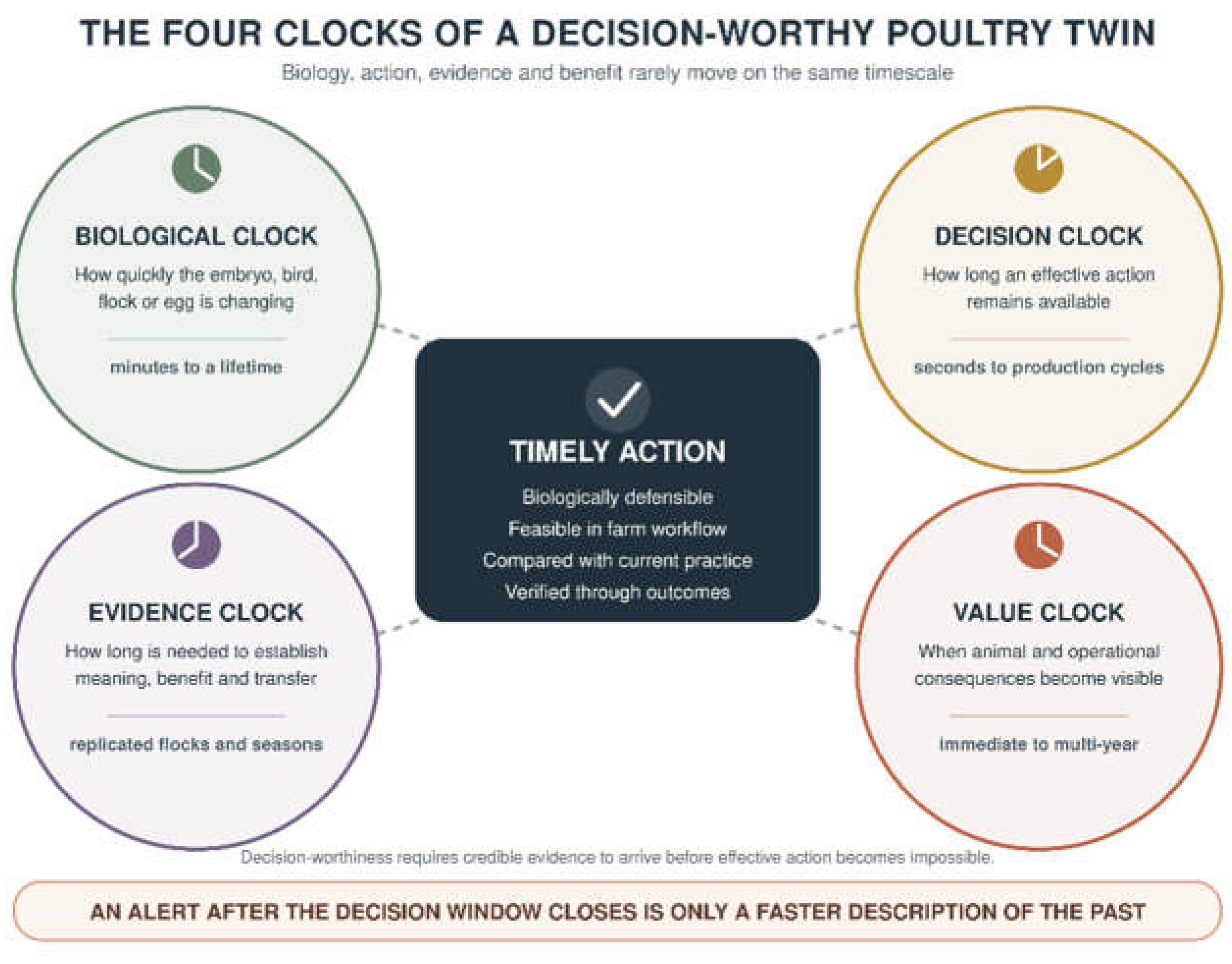

Table 1.
Evidence required for increasingly consequential poultry digital-twin claims.
| Claim | Minimum supporting study | Necessary endpoint | Typical overclaim to avoid |
|---|---|---|---|
| Observation | Repeatability and agreement under stated conditions | Measurement error, missingness, drift, observer agreement | Calling detection a biological state |
| Interpretation | Independent animal-based, clinical, behavioral, or physiological comparison | Construct validity and competing explanations | Naming pain, stress, affect, or disease from one proxy |
| Forecast | Prospective, time-ordered evaluation in independent flocks | Calibration, useful lead time, false and missed alerts | Treating retrospective separation as early warning |
| Decision support | Silent-mode and live workflow study against current practice | Novelty, actionability, uptake, workload, safety | Assuming an accurate alert changes care |
| Intervention | Cluster-randomized, crossover, or justified stepped implementation | Animal, production, and unintended outcomes | Treating association as evidence that action works |
| Transfer | External evaluation across farms, seasons, strains, housing, and devices | Subgroup performance and failure conditions | Claiming commercial generality from one site |
| Value | Full cost and consequence evaluation over representative cycles | Welfare, labor, production, environment, risk, and return | Inferring profit or sustainability from technical accuracy |
Table 2.
Biological question, farm decision, expected value, and primary inferential risk for seven poultry twin programs.
Table 2.
Biological question, farm decision, expected value, and primary inferential risk for seven poultry twin programs.
| Program | Biological or product question | Decision that could change | Outcome that would establish value | Principal inferential risk |
|---|---|---|---|---|
| HatchTwin | Is embryo development departing from an expected trajectory? | Inspect a tray or machine; adjust permitted incubation or hatch-pull management | Chick condition, hatch-window consistency, early welfare and performance | Mistaking incubator conditions or fertility for embryo state |
| HenTwin | Is a laying hen, subgroup, or flock changing in a biologically important way? | Inspect birds or zones; examine keel, plumage, resources, health, or climate | Earlier care, improved animal-based welfare, persistent production without hidden harm | Calling a flock signal an individual history or a proxy a welfare state |
| CluckTwin | Has the flock soundscape changed beyond age- and context-specific expectation? | Check climate, equipment, disturbance, water, and respiratory signs | Useful lead time and verified resolution with acceptable alarm burden | Claiming semantic translation, affect, or disease diagnosis |
| EggTwin | Has egg identity, quality, or handling history changed? | Divert, grade, investigate handling, adjust storage, or narrow a recall | Less breakage and waste, preserved quality, faster traceability | Inferring hen identity or welfare without verified linkage |
| FlockTwin Population | Is collective distribution, movement, or resource use changing? | Inspect a zone, correct a resource or microclimate problem, sample vulnerable birds | Earlier recognition of spatial risk and improved welfare distribution | Allowing a mean to conceal compromised individuals |
| BroilerTwin | Is growth, mobility, thermal response, or resource access departing from a strain- and age-specific pattern? | Check gait, litter, climate, feed, water, or stocking conditions | Better welfare, uniformity, survival, and processing outcomes | Importing layer baselines or treating inactivity as a unique diagnosis |
| ChickenTwin | Which findings can be compared across stages without losing biological specificity? | Coordinate research, define evidence, and trace justified upstream-downstream questions | Transferable principles with explicit production-specific limits | Becoming a universal model with no stable biological meaning |
Disclaimer/Publisher’s Note: The statements, opinions and data contained in all publications are solely those of the individual author(s) and contributor(s) and not of MDPI and/or the editor(s). MDPI and/or the editor(s) disclaim responsibility for any injury to people or property resulting from any ideas, methods, instructions or products referred to in the content. |
© 2026 by the author. Licensee MDPI, Basel, Switzerland. This article is an open access article distributed under the terms and conditions of the Creative Commons Attribution (CC BY) license.
Copyright: This open access article is published under a Creative Commons CC BY 4.0 license, which permit the free download, distribution, and reuse, provided that the author and preprint are cited in any reuse.