
Submitted:
23 August 2026
Posted:
25 August 2026
You are already at the latest version
Abstract
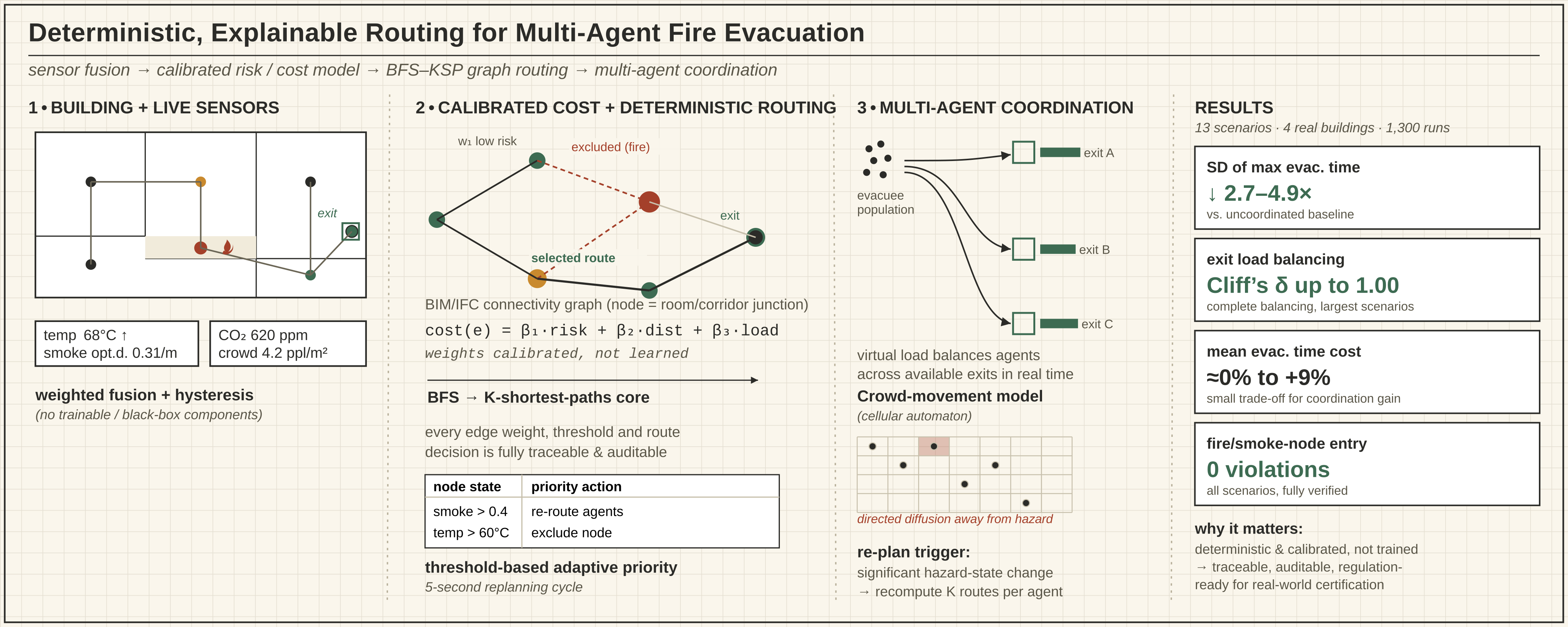
Fire evacuation in complex multi-storey buildings is a dynamic task in which route safety changes depending on fire development, smoke propagation, and the spatial distribution of evacuees. Contemporary research increasingly applies artificial-intelligence methods for adaptive evacuation planning, but most of these approaches achieve adaptivity at the expense of interpretability and traceability. This is a limitation that is especially critical for systems with direct relevance to human safety. The present paper introduces a fully deterministic approach to intelligent fire evacuation that extends the hierarchical building graph model proposed by Ivanov [1] with continuous sensor-based risk assessment (temperature, smoke, CO₂, crowd density), unified through weighted fusion with hysteresis. Route evaluation uses a calibrated composite edge-cost model, complemented by a threshold-based table for adaptive node priority and multi-agent coordination through virtual load, while evacuee movement is modeled by a cellular automaton. All components of the proposed system are configurable and calibrated rather than trainable, which ensures full traceability, auditability, and compliance with fire-safety regulatory requirements. Evaluation across thirteen scenarios in four real buildings shows that the system's adaptivity stems mainly from multi-agent coordination and dynamic route recomputation, rather than from offline calibration of the graph weights. Coordination reduces the standard deviation of the maximum evacuation time by a factor of 2.7 to 4.9 relative to an uncoordinated baseline algorithm, at a mean evacuation time that is practically equivalent (within 1%) or, in the worst case, about 9% higher. The system achieves complete load balancing across exits (Cliff's delta up to 1.00) and guaranteed avoidance of fire and smoke nodes in all test scenarios, with the only exception involving boundary cases in which fire spreads faster than the sensor-classification interval, a physical detection-latency limit rather than a routing failure. These results indicate that deterministic, calibrated coordination can achieve adaptivity comparable to learning-based methods while preserving the traceability and auditability required for regulatory-compliant fire-safety deployment.
Keywords:
fire evacuation
; deterministic routing
; sensor fusion
; risk assessment
; regulatory compliance
; multi-agent systems
; dynamic route planning
Copyright: This open access article is published under a Creative Commons CC BY 4.0 license, which permit the free download, distribution, and reuse, provided that the author and preprint are cited in any reuse.