

Submitted:
21 August 2026
Posted:
25 August 2026
You are already at the latest version
Abstract
Shift work among nurses is a known contributor to circadian rhythm disruptions and related health risks. However, empirical evidence on the circadian phase in this population remains limited. In Japan, the adoption of two-shift systems with 16 h night shifts has reduced the frequency of night work compared to that with traditional rotating schedules. The aim of this study was to quantitatively assess the circadian phases in nurses working on such schedules using the dim light melatonin onset (DLMO). Questionnaires were administered to 31 day-shift nurses and 27 two-shift nurses, of whom 24 and 19, respectively, underwent DLMO assessments. Saliva samples were collected hourly between 20:00 and 24:00 after a day shift in the non-shift work group and before and after a night shift in the shift work group. The baseline DLMO did not differ significantly between groups (21:26 vs. 21:34). Although it was significantly delayed by approximately 30 min following a single night shift (p < 0.01), the magnitude of the phase delay was relatively small. Among shift workers, a later DLMO was associated with greater social jet lag and a shorter phase angle, indicating greater circadian misalignment. These findings suggest that the Japanese two-shift schedule induces only mild and transient circadian disruptions at the group level. However, nurses with a delayed circadian phase may be more vulnerable to circadian misalignment, highlighting the importance of considering individual circadian phases when evaluating adaptations to shift work.
Keywords:
shift work
; nurses
; circadian rhythm
; dim light melatonin onset (DLMO)
1. Introduction
Shift work is essential in healthcare and many other industries that require continuous operation. However, work schedules that require activity during biological nights disrupt the circadian timing system and are associated with a wide range of adverse health outcomes. Epidemiological studies have shown that shift workers have an increased risk of cardiovascular disease, metabolic syndrome, gastrointestinal disorders, and several types of cancer compared to day workers [1,2,3]. Reflecting this growing body of evidence, the International Agency for Research on Cancer classified night shift work involving circadian disruption as “probably carcinogenic to humans” (Group 2A) [4]. Circadian misalignment, defined as a mismatch between endogenous circadian rhythms and behavioral cycles such as sleep, wakefulness, and meals, is considered one of the principal mechanisms underlying these health consequences [5,6,7].
Among the shift-working population, nurses comprise one of the largest occupational groups exposed to circadian disruptions. Work schedules vary considerably across countries. In Europe and North America, many hospitals employ 12 h shift systems or schedules involving several consecutive night shifts, whereas nurses in Japan typically work under either a traditional three-shift system or two-shift system consisting of 8 h day shifts and 16 h night shifts. Over the past two decades, the two-shift system has rapidly become the predominant work schedule in Japanese hospitals because it simplifies staffing and shift handovers while providing longer recovery periods between night duties[8,9]. Under this schedule, nurses generally work only four to five non-consecutive night shifts per month, returning to daytime work between night duties. This intermittent pattern differs substantially from the consecutive night-shift schedules commonly studied internationally [10].
Previous laboratory and field studies have consistently demonstrated that repeated or consecutive night shifts induce substantial circadian disruption, including delayed melatonin rhythms, altered peripheral clock gene expression, and internal circadian desynchronization [11,12,13,14]. However, it remains uncertain whether these findings can be generalized to the Japanese two-shift system. Because Japanese nurses usually perform isolated night shifts separated by several recovery days, the circadian phase shifts induced by each night shift may not accumulate to produce persistent circadian misalignment. Although several studies have investigated fatigue, sleep, and physiological responses in Japanese nurses working two-shift schedules [15,16,17], few have directly evaluated the timing of the central circadian clock using validated physiological markers. Consequently, the extent of circadian misalignment associated with single, non-consecutive 16 h night shifts remains largely unknown.
The dim light melatonin onset (DLMO) is widely regarded as the gold standard marker of the central circadian phase because it provides a reliable estimate of the timing of the endogenous circadian pacemaker [18,19,20]. Salivary melatonin sampling allows for noninvasive measurements of the DLMO under field conditions while maintaining high temporal accuracy [21]. Previous studies measuring the DLMO in shift workers have primarily focused on schedules involving consecutive night shifts, in which pronounced circadian phase delays have been demonstrated [11,22]. In contrast, the DLMO has not been used to characterize the circadian phase in Japanese nurses working in a rapidly alternating two-shift schedule with isolated night duties. This assessment is essential for determining whether this increasingly common work schedule produces persistent circadian misalignment or only transient phase changes following individual night shifts.
Because the Japanese two-shift system combines long individual night shifts with relatively infrequent and non-consecutive night work, it remains unclear whether this schedule induces persistent circadian misalignment or only transient phase shifts during each night shift. Clarifying this issue is important because the degree of circadian disruption may depend not only on the duration of an individual night shift but also on the overall organization of the work schedule. Therefore, we hypothesized that the intermittent nature of the Japanese two-shift schedule would limit cumulative circadian phase shifts despite the long duration of individual night shifts. Therefore, the aims of the present study were to (1) compare the baseline circadian phase, as assessed based on the DLMO, between Japanese nurses working a two-shift schedule and non-shift workers; (2) quantify the magnitude of acute circadian phase changes induced by a single 16 h night shift under real-world working conditions; and (3) examine the relationship between the DLMO and sleep timing to evaluate individual differences in circadian misalignment.
2. Results
2.1. Measurements of Sleep Habits
Based on the survey questionnaire, the shift work and non-shift work groups showed no statistical differences in the Morningness–Eveningness Questionnaire (MEQ), Japanese version of the Pittsburgh Sleep Quality Index (PSQI), Japanese version of the Epworth Sleepiness Scale (ESS), or sleep habits on workdays and free days assessed using the Munich Chronotype Questionnaire (MCTQ) (Table 1). For participants in the shift work group, the MCTQ responses regarding workday and free-day sleep habits were based on their usual sleep patterns during periods of day-shift work, excluding night shifts. These findings remained consistent after adjusting for age.
2.2. Circadian Phase and DLMO in Shift and Non-Shift Workers
At baseline, the DLMO was detected within the scheduled sampling window (20:00–24:00) in 13 of 19 participants (68.4%) in the shift work group and 16 of 24 participants (66.7%) in the non-shift work group (Figure 1). Non-detectable cases included participants whose melatonin levels were already above the threshold (3 pg/mL) at the start of sampling (shift work group: 2 of 19 [10.5%]; non-shift work group: 4 of 24 [16.6%]), those who did not reach the threshold by the end of the sampling period (shift work group: 2 of 19 [10.5%]; non-shift work group: 2 of 24 [8.3%]), and those with missing data (shift work group: 2 of 19 [10.5%]; non-shift work group: 2 of 24 [8.3%]). None of these categories differed significantly between the two groups (Fisher’s exact tests, p > 0.05). The baseline demographic and sleep characteristics of the participants included in the DLMO analyses are summarized in Supplementary Table S1. No significant inter-group differences were observed.
At baseline, before the scheduled night shift, the mean DLMO occurred at 21:34 ± 1:03 in the shift work group and at 21:26 ± 0:51 in the non-shift work group, with no statistically significant difference between the groups (t(27) = −0.40, p = 0.69, d = −0.15) (Figure 2 and Table 2). Similarly, the interval between the DLMO and habitual bedtime (phase angle) did not differ between the groups on workdays (t(27) = 0.17, p = 0.87, d = 0.06) or free days (t(27) = 0.48, p = 0.63, d = 0.18) (Table 2). Figure 3 shows the changes in the DLMO before and after a single night shift among the 10 participants for whom the DLMO could be determined at both time points. The mean DLMO occurred at 21:35 ± 1:07 before the night shift and at 22:09 ± 1:07 after the night shift. Consequently, the DLMO was significantly delayed by 34 ± 18 min following the night shift (t(9) = −5.9, p < 0.01, d = −1.88).
2.3. Inter-Individual Variability in Circadian Phases Among Shift Workers
As an exploratory analysis, correlations between the pre-night-shift DLMO and sleep-related variables were examined within the shift work group (n = 13). A later DLMO was associated with a greater social jet lag (r = 0.636, p = 0.02) (Figure 4) and a shorter phase angle between the DLMO and bedtime on work days (r = –0.733, p = 0.004) and free days (r= -0.627, p= 0.02). In the non-shift work group (n = 16), the DLMO was not significantly correlated with social jet lag (r = −0.140, p = 0.60). In contrast, the DLMO showed significant negative correlations with the phase angle on both work days (r = −0.630, p = 0.009) and free days (r = −0.565, p = 0.023).
3. Discussion
3.1. Circadian Phase in Shift Workers
In the present study, no significant difference in the DLMO was observed between nurses working a Japanese two-shift schedule and non-shift workers. Furthermore, although the DLMO was significantly delayed following a single 16 h night shift, the magnitude of the phase delay was relatively small (approximately 30 min). These findings suggest that the Japanese two-shift schedule induces only a mild and transient circadian disruption without causing a persistent delay in the central circadian clock.
One possible explanation for the relatively small phase delay following a single night shift is that the phase-delaying effect of nocturnal light exposure was partially counteracted by morning light exposure after the night shift. According to the human phase response curve (PRC), light exposure during the early biological night delays the circadian phase, whereas light exposure during the biological morning advances it [23]. During the present study, the nurses worked under conditions of fluorescent ward lighting of approximately 300–600 lx. Although this illuminance was considerably lower than that of the bright-light stimuli commonly used in laboratory phase-shifting experiments, previous studies have demonstrated that light of a similar intensity can still induce substantial melatonin phase delays when administered during the delay portion of the PRC [24]. However, these laboratory protocols typically concentrate light exposure within the phase-delay region, while minimizing subsequent exposure to phase-advancing morning light. In contrast, participants in the present field study were not instructed to avoid natural morning light or wear dark goggles after completing their night shifts. Experimental studies have consistently shown that blocking morning light with dark goggles facilitates circadian adaptation to night work, indicating that morning light counteracts the delaying effects of nocturnal light exposure [25,26,27]. Therefore, exposure to natural morning light while commuting home likely attenuated the phase delay induced by nighttime light exposure, resulting in the relatively modest average delay of approximately 30 min observed in the present study.
The absence of a significant difference in the DLMO between shift and non-shift workers is likely explained by the fact that these relatively small phase delays did not accumulate across successive night shifts. The night shifts in the present two-shift schedule in Japan are generally non-consecutive, and nurses typically work only four to five night shifts per month, providing several recovery days between night duties. Previous studies have suggested that the extent of circadian disruption depends not only on exposure to night work itself, but also on the temporal organization of work schedules. Hattammaru et al. (2019) reported that peripheral clock-gene rhythms remain largely aligned with a day-oriented schedule after a single night shift, whereas rhythmic patterns become more dispersed after three or more consecutive night shifts [9].Similarly, Resuehr et al. (2019) [22] and Yang et al. (2024) [28] demonstrated a marked disruption of peripheral and central circadian rhythms under sustained or more frequent night-work exposure. Furthermore, Razavi et al. (2019) [29] reported delayed urinary melatonin timing and reduced nocturnal melatonin secretion in rotating-shift nurses during periods of active night work. Taken together, these studies suggest that cumulative or repeated night-work exposure is required to produce substantial circadian disruptions.
Importantly, the sleep timing on both day-shift workdays and free days without night work did not differ significantly between the shift and non-shift work groups in the present study. This finding indicates that, outside night-shift periods, nurses generally return to a daytime-oriented sleep–wake schedule rather than maintaining a chronically delayed lifestyle. Exposure to the natural light–dark cycle during the day, together with habitual nighttime sleep, may therefore have facilitated recovery from the modest phase delay induced by each individual night shift before the subsequent night duty. This interpretation is broadly consistent with that of Bracci et al. (2016) [30], who found that although shift-working nurses exhibit alterations in the amplitudes of several circadian markers, assessments performed after 1 day off did not indicate the uniform displacement of circadian timing.
Taken together, the relatively small phase delay induced by each night shift, probably due in part to the counteracting effects of morning light exposure, together with the non-consecutive nature and relatively low frequency of night shifts, and the maintenance of daytime-oriented sleep schedules between night duties may explain why no significant difference in the DLMO was observed between the shift work and non-shift work groups. These findings suggest that the Japanese two-shift schedule examined in the present study results in repeated but largely transient circadian phase delays rather than the cumulative circadian misalignment reported under schedules involving consecutive or more frequent night shifts.
3.2. Inter-Individual Differences in the Circadian Phase
In an exploratory analysis, we found a significant positive correlation between the DLMO and social jet lag among shift workers. Social jet lag has been proposed as a behavioral marker of circadian misalignment, reflecting the discrepancy between biological and social time [31]. In their seminal study, Wittmann et al. demonstrated that individuals with a later chronotype exhibit greater social jet lag. The present findings extend this observation by showing that a later physiologically assessed circadian phase, as determined based on the DLMO, is likewise associated with greater social jet lag. This suggests that shift workers with delayed circadian phases experience greater misalignment between their endogenous circadian timing and socially constrained sleep schedules.
This interpretation is further supported by the finding that participants with a later DLMO exhibited a shorter phase angle between the DLMO and their bedtime. In other words, shift workers with a delayed circadian phase tended to initiate sleep at an earlier biological time relative to their endogenous melatonin rhythms, particularly on workdays. Such a shortened phase angle may reflect the circadian misalignment caused by the need to conform to socially imposed work schedules despite a delayed biological night.
Interestingly, although an association between the DLMO and phase angle was also observed in non-shift workers, no significant association was found between the DLMO and social jet lag. The reason for this difference remains unclear. However, given the relatively small sample size in the present study, further investigations with larger cohorts are warranted.
3.3. Clinical and Occupational Implications
In addition to the present findings, the relatively preserved circadian phase observed in the Japanese two-shift schedule may have implications for occupational health. Previous studies have reported that nurses working in Japanese two-shift schedules exhibit better intershift recovery than those working three-shift rotations despite the longer duration of individual night shifts [15]. The mechanisms underlying this favorable recovery profile remain largely speculative and have been primarily attributed to longer recovery intervals between shifts. The present findings suggest an additional physiological explanation; specifically, the relatively small and transient circadian phase delays induced by this work schedule may facilitate recovery by limiting persistent circadian misalignment. Although fatigue and recovery were not assessed in this study, these findings provide a chronobiological perspective that complements previous studies of shift schedules. Future studies that simultaneously evaluate the circadian phase, sleep, and fatigue are needed to determine whether the preservation of circadian timing contributes to better intershift recovery in Japanese two-shift nurses.
3.4. Limitations
This study has several limitations. First, the relatively small sample size may have limited the statistical power to detect subtle differences in the circadian phase between the shift work and non-shift work groups. Second, the melatonin sampling window was restricted to a relatively narrow period. This protocol was chosen to minimize the participant burden and avoid disrupting the participants’ usual sleep schedules or work responsibilities, which are an important considerations in field studies involving hospital nurses. Consequently, the DLMO could not be determined in some participants whose melatonin levels had already exceeded the threshold at the beginning of the sampling or had not yet reached the threshold by the end of the sampling period. Future studies employing a wider sampling window or more frequent sampling, where feasible, would provide a more comprehensive assessment of circadian phases.
Third, the absence of a significant difference in the DLMO should not be interpreted as evidence that the circadian system is entirely unaffected by shift work. Previous field and laboratory studies have demonstrated that shift work can alter multiple characteristics of the circadian system, including reductions in the amplitude and distortions of melatonin and cortisol rhythms, dampened or desynchronized peripheral clock gene expression, and internal desynchronization between the central and peripheral circadian oscillators, even when phase shifts are relatively modest [5,22]. As the present study was designed specifically to estimate the DLMO, it did not include assessments of the melatonin rhythm amplitude, 24 h hormonal profiles, or peripheral clock gene expression. Consequently, the present findings indicate that the timing of the melatonin onset was relatively preserved under the present two-shift schedule; however, they do not exclude the possibility that other aspects of circadian rhythmicity were altered.
Despite these limitations, our findings provide a basis for future research. Adaptation to shift work is increasingly recognized as a multifactorial phenomenon rather than being determined solely by circadian characteristics. Previous systematic reviews and expert consensus statements have shown that demographic, psychological, behavioral, and circadian factors contribute to individual differences in shift work tolerance, although the relative importance of these factors remains incompletely understood [32,33]. Recent large-scale epidemiological evidence has further supported the involvement of multiple demographic and psychological characteristics in the susceptibility to shift work-associated sleep disorders [34]. Therefore, future studies with larger sample sizes are warranted to investigate how the objective circadian phase, assessed based on the DLMO, interacts with these individual characteristics to determine resilience or vulnerability to shift work.
4. Materials and Methods
4.1. Participants
Twenty-seven clinical nurses (mean age 44.4 ± 10.1 years, including two men) working a two-shift schedule at a 199-bed research hospital in Japan voluntarily participated in the questionnaire survey as the shift work group. In addition, 31 clinical nurses (mean age 50.5 ± 8.8 years, all women) who did not engage in shift work were recruited as a control group (non-shift work group). A subset of these participants (19 shift workers and 24 non-shift workers) also participated in the DLMO assessment (Figure 1).
Nurses in the shift work group worked on a Japanese two-shift schedule consisting of an 8 h day shift (08:00–17:00) and a 16 h night shift (17:00–09:00). The night shifts were non-consecutive, with participants typically working four to five night shifts per month. Work schedules were individually arranged by nurse managers without a fixed rotation pattern. During the 10-day study period, the participants completed one or two night shifts.
The study was approved by Kyushu University, Reiwa Health Sciences University, and the Japan Community Healthcare Organization, and written informed consent was obtained from all participants.
4.2. Experimental Process and Items for Measurement
This study was conducted between November 2023 and January 2024. All participants completed the Japanese versions of the MEQ [35], MCTQ [36], PSQI [37], and ESS [38]. They maintained daily sleep diaries throughout the experimental period. In this study, sleep habits were assessed using the MCTQ, and this included their bedtime, wake time, sleep duration, and sleep latency on both workdays and free days. The responses to the MCTQ were also used to calculate social jet lag, which was defined as the difference between mid-sleep on free days (MSF) and mid-sleep on workdays (MSW); that is, social jet lag = MSF − MSW.
The participants subjected to a DLMO assessment (19 shift workers and 24 non-shift workers) subsequently completed the 10-day protocol. During this period, the participants were instructed to maintain their habitual sleep–wake schedules and usual daily routines while completing their daily sleep diaries. For the shift work group, the study schedule was arranged such that a night shift occurred on day 9 of the protocol. Saliva sampling for the DLMO assessment was performed in the evening before the night shift (day 8) and again in the evening after the night shift (day 10). Participants in the non-shift work group underwent a DLMO assessment once in the evening of day 10.
Participants collected their own saliva samples at home following the methods of previous studies using home-collected saliva to determine the DLMO[39,40]. The sampling protocol was based on previous home-based DLMO protocols but was modified for this field study involving working nurses. To minimize disruptions to the participants’ work schedules and daily lives, all saliva sampling sessions were conducted according to a fixed schedule between 20:00 and 24:00, regardless of individual habitual bedtimes. Saliva samples were collected every hour between 20:00 and 24:00, yielding five samples according to the standard protocol. For the participants with later habitual bedtimes, the sampling period was extended to 01:00. Because saliva collection had to begin immediately after work for some participants, the sampling schedule could not be advanced for those with earlier habitual bedtimes. Saliva was collected in tubes equipped with cotton swabs (Salivette, Sarstedt, Germany). After collection, samples were stored with refrigeration and transported to the hospital within 8–36 h, where they were centrifuged and stored at −30°C.
To ensure dim-light conditions, participants were instructed to maintain a dim-light environment (≤15 lx at eye level) from 1 h before the first saliva sample (19:00) until completion of the final saliva collection. Clip-light devices (2800 K) were used to maintain a dim-light environment. The participants were instructed to place the clip lights in an elevated position and direct the light toward the ceiling to provide indirect illumination while preventing direct viewing of the light source. Based on the spectral characteristics of the light source, this criterion was considered sufficient to satisfy the recommended threshold of ≤10 melanopic equivalent daylight illuminance (mEDI) [37]. Compliance with the dim-light conditions was verified using a wearable illuminance logger (MotionWatch 8 [CamNtech Ltd., Cambridge, UK] or a HOBO Pendant [UA-002-64, Onset Computer Corporation, Bourne, MA, USA]) worn on the front of the chest throughout the sampling period. Light-exposure records were reviewed to confirm that illuminance remained at ≤15 lx.
From 1 h before the first saliva sample until the completion of the final saliva collection, participants were instructed to remain in a dim-light environment while otherwise continuing their usual activities at home. They were instructed to keep the brightness of their smartphone and other electronic device screens at a minimum setting, avoid vigorous physical activity, abstain from tooth brushing throughout the sampling period, avoid caffeinated foods and beverages from the afternoon of the sampling day until completion of the final saliva collection, and remain seated as much as possible throughout the sampling period. Before each saliva collection, the participants were instructed to refrain from eating within 30 min and drinking within 15 min of sampling. Deviations from the instructions were recorded.
The salivary melatonin concentrations were quantified using a radioimmunoassay (RIA) kit (RK-DSM2, NovoLytiX, Witterswil, Switzerland). The DLMO was estimated via linear interpolation as the clock time at which the salivary melatonin concentration exceeded the commonly recommended threshold of 3 pg/mL for the salivary DLMO determination [41]. Participants for whom the DLMO could not be determined because melatonin concentrations were already above 3.0 pg/mL at the start of sampling or did not reach 3.0 pg/mL by the end of sampling, as well as participants with an insufficient saliva volume, were excluded from the analysis.
The phase angle, an indicator of circadian misalignment, was calculated as the interval between the DLMO and habitual bedtime reported in the MCTQ. The phase angles were calculated separately for the workdays and free days. For the shift work group, the workday bedtime was defined as habitual bedtime on day shift days, and the free-day bedtime was defined as habitual bedtime on regular days off, excluding days off following a night shift. The habitual bedtimes reported in the MCTQ were used because the 10-day sleep diaries did not provide sufficient data to reliably estimate habitual bedtimes.
The vertical illuminance and relative color temperature at eye level during night shifts at the nursing station were measured in a seated position at multiple locations using a portable illuminance meter (CL-200, KONICA MINOLTA HOLDINGS, Inc., Tokyo, Japan). The illuminance levels ranged from 314 to 660 lx and the correlated color temperature ranged from 4079 to 4589 K.
4.3. Statistical Analysis
Comparisons between the shift work and non-shift work groups were performed using independent-samples t-tests after confirming the homogeneity of variance using Levene’s test. As the groups differed significantly in age, analyses of questionnaire-derived sleep variables were additionally performed using an analysis of covariance (ANCOVA) with age as a covariate. For analyses involving the DLMO, the baseline values measured on the day before the night shift were used for the shift work group. Changes in the DLMO before and after the night shift were evaluated using paired t-tests. Pearson's correlation coefficients were calculated separately for the shift and non-shift work groups to examine the associations among the DLMO, social jet lag, and phase angle. Statistical significance was set at p < 0.05.
5. Conclusions
The present study found no major differences in sleep habits or circadian phases between nurses working a Japanese two-shift schedule (8 h day shifts and 16 h night shifts) and those working day shifts only. Although the DLMO was significantly delayed following a single night shift, the magnitude of the phase delay was relatively small, suggesting that the Japanese two-shift schedule induces only mild and transient circadian misalignment. Nevertheless, among shift workers, nurses with a delayed circadian phase exhibited greater circadian misalignment, as reflected by the greater social jet lag and shorter phase angle.
Supplementary Materials
The following supporting information can be downloaded at: https://www.mdpi.com/article/doi/s1, Table S1: Sleep habits and dim light melatonin onset (DLMO) in early and late chronotype shift work groups.
Author Contributions
Conceptualization, F.M., K.K., Y.O. and S.H.; methodology, Y.A., F.M. and S.H.; validation, S.H.; formal analysis, Y.A. and K.T. ; investigation, K.S. and F.M., ; resources, F.M., S.W. and K.M.; data curation, Y.A., K.T. and S.H.; writing-original draft preparation, Y.A.; writing-review and editing, F.M., K.O. and S.H.; visualization, Y.A. and K.T.,; supervision, S.H.; project administration, F.M. and S.H.; funding acquisition, Y.A. and F.M., All authors have read and agreed to the published version of the manuscript.
Funding
This study was supported by the Research Support Program of the Japan Community Healthcare Organization (JCHO) and JSPS KAKENHI (grant number 23K19819). Additional funding was provided through a collaborative research agreement with IWASAKI ELECTRIC Co., Ltd.
Institutional Review Board Statement
The study was conducted in accordance with the Declaration of Helsinki, and approved by the Institutional Review Board of Uwajima Hospital, Japan Community Healthcare Organization (protocol code R5-02-005), Kyushu University Graduate School of Arts and Design (protocol code 562, date: 2023.08.31), and Reiwa Health Sciences University (protocol code 23-028).
Informed Consent Statement
Informed consent was obtained from all participants involved in the study.
Data Availability Statement
The datasets generated and analyzed during the current study are not publicly available due to privacy and ethical restrictions but are available from the corresponding author upon reasonable request.
Acknowledgments
We sincerely thank the nurses who assisted in collecting the data on site.
Conflicts of Interest
This study was supported in part by a collaborative research agreement with IWASAKI ELECTRIC Co., Ltd. Employees of IWASAKI ELECTRIC Co., Ltd. are included among the authors and contributed to the study as described in the Author Contributions section. Apart from these author contributions, the sponsor had no role in the study design, data collection, data analysis, interpretation of the data, decision to publish, or preparation of the manuscript.
Abbreviations
The following abbreviations are used in this manuscript:
| DLMO | Dim light melatonin onset |
| MEQ | Morningness–Eveningness Questionnaire |
| MCTQ | Munich Chronotype Questionnaire |
| PSQI | Pittsburgh Sleep Quality Index |
| ESS | Epworth Sleepiness Scale |
References
- Sigurdardottir, L.G.; Valdimarsdottir, U.A.; Fall, K.; Rider, J.R.; Lockley, S.W.; Schernhammer, E.; Mucci, L.A. Circadian disruption, sleep loss, and prostate cancer risk: a systematic review of epidemiologic studies. Cancer Epidemiol Biomarkers Prev 2012, 21, 1002-1011. [CrossRef]
- Sooriyaarachchi, P.; Jayawardena, R.; Pavey, T.; King, N.A. Shift work and the risk for metabolic syndrome among healthcare workers: A systematic review and meta-analysis. Obes Rev 2022, 23, e13489. [CrossRef]
- Torquati, L.; Mielke, G.I.; Brown, W.J.; Kolbe-Alexander, T. Shift work and the risk of cardiovascular disease. A systematic review and meta-analysis including dose-response relationship. Scand J Work Environ Health 2018, 44, 229-238. [CrossRef]
- Ward, E.M.; Germolec, D.; Kogevinas, M.; McCormick, D.; Vermeulen, R.; Anisimov, V.N.; Aronson, K.J.; Bhatti, P.; Cocco, P.; Costa, G. Carcinogenicity of night shift work. The Lancet Oncology 2019, 20, 1058-1059.
- Boivin, D.B.; Boudreau, P.; Kosmadopoulos, A. Disturbance of the Circadian System in Shift Work and Its Health Impact. J Biol Rhythms 2022, 37, 3-28. [CrossRef]
- Baron, K.G.; Reid, K.J. Circadian misalignment and health. International Review of Psychiatry 2014, 26, 139-154. [CrossRef]
- Fishbein, A.B.; Knutson, K.L.; Zee, P.C. Circadian disruption and human health. The Journal of clinical investigation 2021, 131. [CrossRef]
- Japanese Nursing, A. 2023 Hospital Nursing Survey Report by the Japanese Nursing Association; 2024.
- Hattammaru, M.; Tahara, Y.; Kikuchi, T.; Okajima, K.; Konishi, K.; Nakajima, S.; Sato, K.; Otsuka, K.; Sakura, H.; Shibata, S.; et al. The effect of night shift work on the expression of clock genes in beard hair follicle cells. Sleep medicine 2019, 56, 164-170. [CrossRef]
- Griffiths, P.; Dall'Ora, C.; Simon, M.; Ball, J.; Lindqvist, R.; Rafferty, A.M.; Schoonhoven, L.; Tishelman, C.; Aiken, L.H. Nurses' shift length and overtime working in 12 European countries: the association with perceived quality of care and patient safety. Med Care 2014, 52, 975-981. [CrossRef]
- Stone, J.E.; Sletten, T.L.; Magee, M.; Ganesan, S.; Mulhall, M.D.; Collins, A.; Howard, M.; Lockley, S.W.; Rajaratnam, S.M.W. Temporal dynamics of circadian phase shifting response to consecutive night shifts in healthcare workers: role of light-dark exposure. J Physiol 2018, 596, 2381-2395. [CrossRef]
- Chellappa, S.L.; Morris, C.J.; Scheer, F. Circadian misalignment increases mood vulnerability in simulated shift work. Scientific reports 2020, 10, 18614. [CrossRef]
- Cuesta, M.; Boudreau, P.; Cermakian, N.; Boivin, D.B. Rapid resetting of human peripheral clocks by phototherapy during simulated night shift work. Scientific reports 2017, 7, 16310. [CrossRef]
- Kosmadopoulos, A.; Boudreau, P.; Kervezee, L.; Boivin, D.B. Circadian Adaptation of Melatonin and Cortisol in Police Officers Working Rotating Shifts. J Biol Rhythms 2024, 39, 49-67. [CrossRef]
- Yamaguchi, S.; Winwood, P.C.; Yano, R. Chronic fatigue and recovery among nurses working two-shift and three-shift rotations. Collegian 2023, 30, 786-794. [CrossRef]
- Kida, R.; Takemura, Y. Working Conditions and Fatigue in Japanese Shift Work Nurses: A Cross-sectional Survey. Asian Nursing Research 2022, 16, 80-86. [CrossRef]
- Terauchi, M.; Ideno, Y.; Hayashi, K. Effect of shift work on excessive daytime sleepiness in female nurses: results from the Japan Nurses’ Health Study. Industrial Health 2024, 62, 252-258. [CrossRef]
- Benloucif, S.; Guico, M.J.; Reid, K.J.; Wolfe, L.F.; L'Hermite-Baleriaux, M.; Zee, P.C. Stability of melatonin and temperature as circadian phase markers and their relation to sleep times in humans. J Biol Rhythms 2005, 20, 178-188.
- Arendt, J. Melatonin and human rhythms. Chronobiol Int 2006, 23, 21-37.
- Arendt, J.; Skene, D.J. Melatonin as a chronobiotic. Sleep Med Rev 2005, 9, 25-39.
- Voultsios, A.; Kennaway, D.J.; Dawson, D. Salivary melatonin as a circadian phase marker: validation and comparison to plasma melatonin. J Biol Rhythms 1997, 12, 457-466.
- Resuehr, D.; Wu, G.; Johnson, R.L., Jr.; Young, M.E.; Hogenesch, J.B.; Gamble, K.L. Shift Work Disrupts Circadian Regulation of the Transcriptome in Hospital Nurses. J Biol Rhythms 2019, 34, 167-177. [CrossRef]
- Khalsa, S.B.; Jewett, M.E.; Cajochen, C.; Czeisler, C.A. A phase response curve to single bright light pulses in human subjects. J Physiol 2003, 549, 945-952.
- Zeitzer, J.M.; Dijk, D.J.; Kronauer, R.; Brown, E.; Czeisler, C. Sensitivity of the human circadian pacemaker to nocturnal light: melatonin phase resetting and suppression. J Physiol 2000, 526 Pt 3, 695-702.
- Eastman, C.I.; Stewart, K.T.; Mahoney, M.P.; Liu, L.; Fogg, L.F. Dark goggles and bright light improve circadian rhythm adaptation to night-shift work. Sleep 1994, 17, 535-543.
- Boivin, D.B.; James, F.O. Circadian adaptation to night-shift work by judicious light and darkness exposure. J Biol Rhythms 2002, 17, 556-567. [CrossRef]
- Crowley, S.J.; Lee, C.; Tseng, C.Y.; Fogg, L.F.; Eastman, C.I. Combinations of bright light, scheduled dark, sunglasses, and melatonin to facilitate circadian entrainment to night shift work. J Biol Rhythms 2003, 18, 513-523. [CrossRef]
- Yang, Z.; Black, K.; Ohman-Strickland, P.; Graber, J.M.; Kipen, H.M.; Fang, M.; Zarbl, H. Disruption of central and peripheral circadian clocks and circadian controlled estrogen receptor rhythms in night shift nurses in working environments. Faseb j 2024, 38, e23719. [CrossRef]
- Razavi, P.; Devore, E.E.; Bajaj, A.; Lockley, S.W.; Figueiro, M.G.; Ricchiuti, V.; Gauderman, W.J.; Hankinson, S.E.; Willett, W.C.; Schernhammer, E.S. Shift Work, Chronotype, and Melatonin Rhythm in Nurses. Cancer Epidemiol Biomarkers Prev 2019, 28, 1177-1186. [CrossRef]
- Bracci, M.; Ciarapica, V.; Copertaro, A.; Barbaresi, M.; Manzella, N.; Tomasetti, M.; Gaetani, S.; Monaco, F.; Amati, M.; Valentino, M.; et al. Peripheral Skin Temperature and Circadian Biological Clock in Shift Nurses after a Day off. Int J Mol Sci 2016, 17. [CrossRef]
- Wittmann, M.; Dinich, J.; Merrow, M.; Roenneberg, T. Social jetlag: misalignment of biological and social time. Chronobiol Int 2006, 23, 497-509. [CrossRef]
- Booker, L.A.; Magee, M.; Rajaratnam, S.M.W.; Sletten, T.L.; Howard, M.E. Individual vulnerability to insomnia, excessive sleepiness and shift work disorder amongst healthcare shift workers. A systematic review. Sleep Med Rev 2018, 41, 220-233. [CrossRef]
- Ritonja, J.; Aronson, K.J.; Matthews, R.W.; Boivin, D.B.; Kantermann, T. Working Time Society consensus statements: Individual differences in shift work tolerance and recommendations for research and practice. Ind Health 2019, 57, 201-212. [CrossRef]
- Degenfellner, J.; Strohmaier, S.; Zebrowska, M.; Saksvik-Lehouillier, I.; Schernhammer, E. Identifying Risk and Protective Factors for Shift Work Sleep Disorder: Insights from UK Biobank Night Shift Workers. Clocks & sleep 2025, 7. [CrossRef]
- Ishihara, K.; Saitoh, T.; Inoue, Y.; Miyata, Y. Validity of the Japanese version of the Morningness-Eveningness Questionnaire. Percept Mot Skills 1984, 59, 863-866.
- Kitamura, S.; Hida, A.; Aritake, S.; Higuchi, S.; Enomoto, M.; Kato, M.; Vetter, C.; Roenneberg, T.; Mishima, K. Validity of the Japanese version of the Munich ChronoType Questionnaire. Chronobiol Int 2014, 31, 845-850. [CrossRef]
- Doi, Y.; Minowa, M.; Uchiyama, M.; Okawa, M.; Kim, K.; Shibui, K.; Kamei, Y. Psychometric assessment of subjective sleep quality using the Japanese version of the Pittsburgh Sleep Quality Index (PSQI-J) in psychiatric disordered and control subjects. Psychiatry Res 2000, 97, 165-172. doi:S0165178100002328 [pii].
- Takegami, M.; Suzukamo, Y.; Wakita, T.; Noguchi, H.; Chin, K.; Kadotani, H.; Inoue, Y.; Oka, Y.; Nakamura, T.; Green, J.; et al. Development of a Japanese version of the Epworth Sleepiness Scale (JESS) based on item response theory. Sleep medicine 2009, 10, 556-565. [CrossRef]
- Pullman, R.E.; Roepke, S.E.; Duffy, J.F. Laboratory validation of an in-home method for assessing circadian phase using dim light melatonin onset (DLMO). Sleep medicine 2012, 13, 703-706. [CrossRef]
- Murray, J.M.; Stone, J.E.; Abbott, S.M.; Bjorvatn, B.; Burgess, H.J.; Cajochen, C.; Dekker, J.J.; Duffy, J.F.; Epstein, L.J.; Garbazza, C.; et al. A Protocol to Determine Circadian Phase by At-Home Salivary Dim Light Melatonin Onset Assessment. J Pineal Res 2024, 76, e12994. [CrossRef]
- Benloucif, S.; Burgess, H.J.; Klerman, E.B.; Lewy, A.J.; Middleton, B.; Murphy, P.J.; Parry, B.L.; Revell, V.L. Measuring melatonin in humans. J Clin Sleep Med 2008, 4, 66-69.
Figure 1.
Flowchart of participant recruitment and classification into non-shift and shift work groups.
Figure 1.
Flowchart of participant recruitment and classification into non-shift and shift work groups.
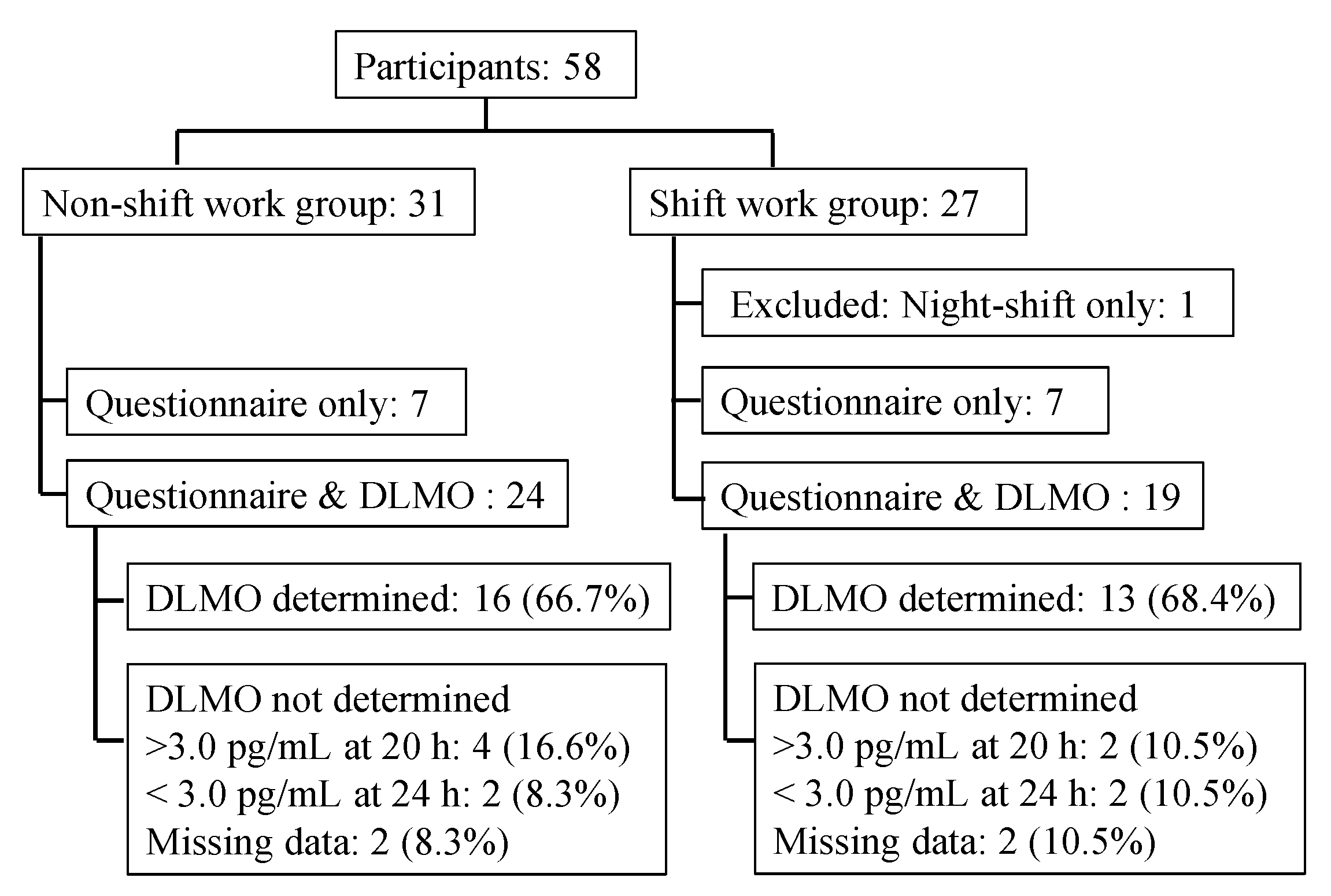
Figure 2.
Dim light melatonin onset (DLMO) in the non-shift work and shift work groups. Individual data are shown as circles. Squares and error bars represent the mean and SD, respectively.
Figure 2.
Dim light melatonin onset (DLMO) in the non-shift work and shift work groups. Individual data are shown as circles. Squares and error bars represent the mean and SD, respectively.
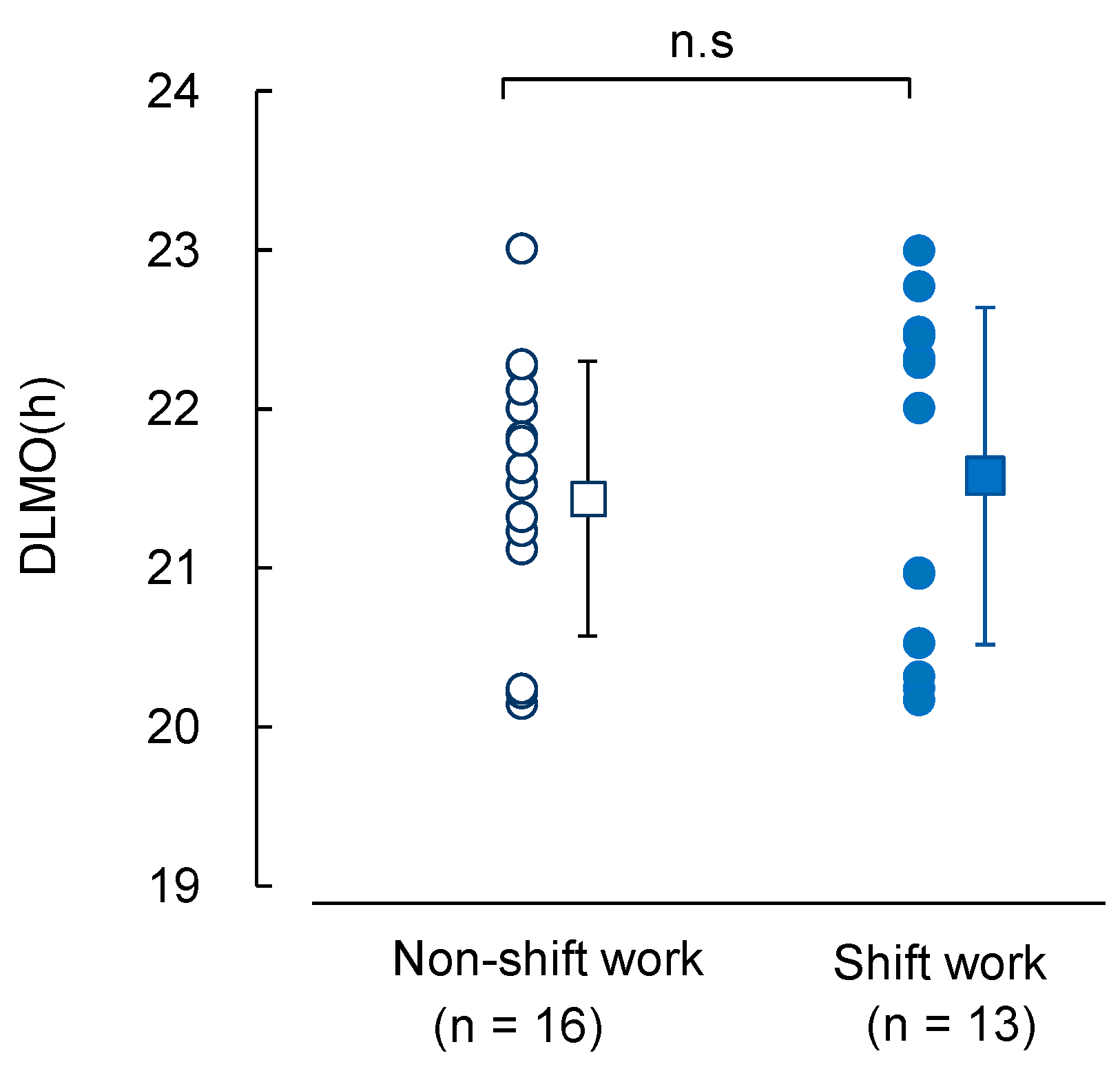
Figure 3.
Dim light melatonin onset (DLMO) before and after a single night shift in the shift work group. Each circle represents an individual participant, with lines connecting paired measurements. Squares and error bars represent the mean and SD, respectively.
Figure 3.
Dim light melatonin onset (DLMO) before and after a single night shift in the shift work group. Each circle represents an individual participant, with lines connecting paired measurements. Squares and error bars represent the mean and SD, respectively.
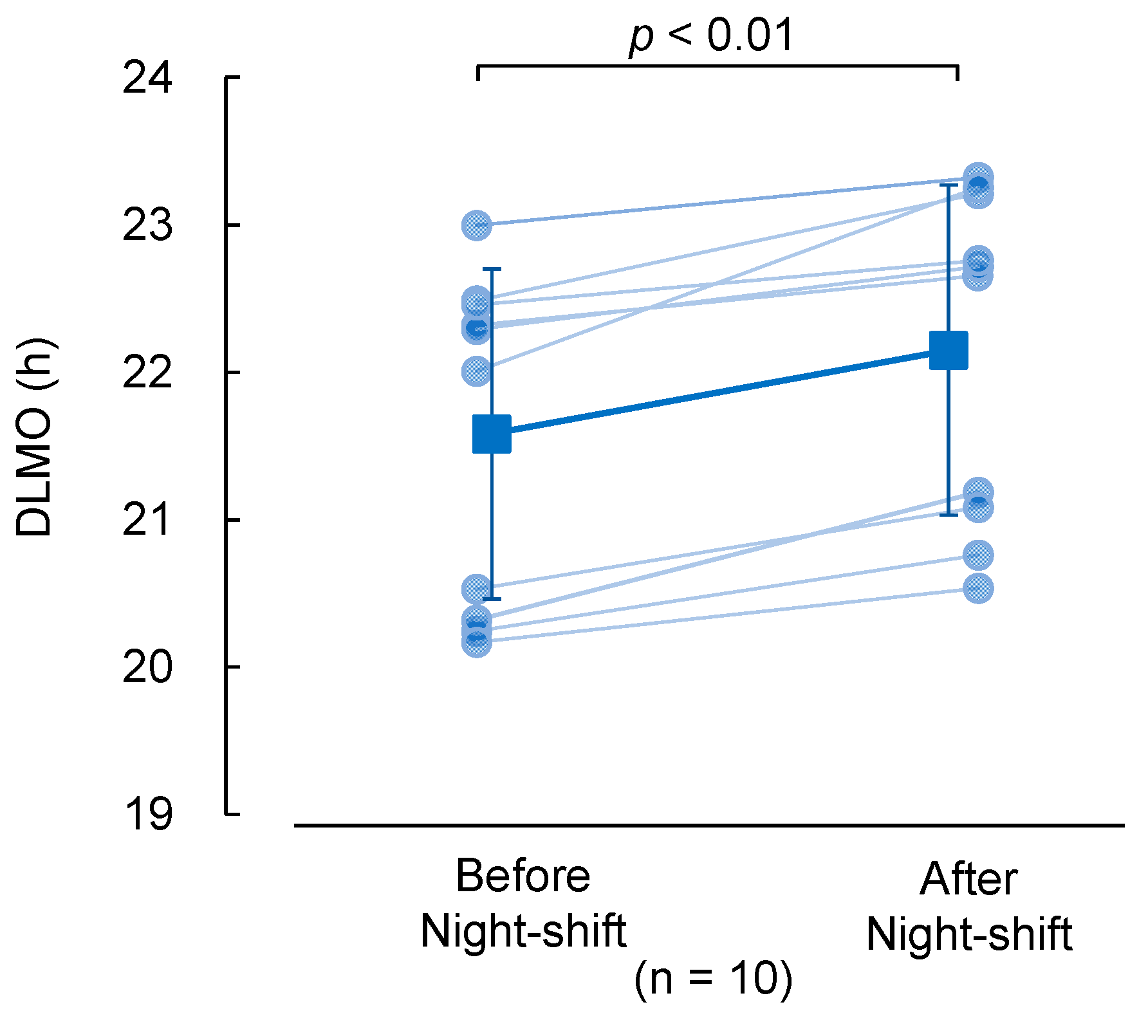
Figure 4.
Inter-individual associations between pre-night-shift dim light melatonin onset (DLMO) and sleep-related variables in the shift work group. (A) Social jet lag. (B) Phase angle between DLMO and bedtime on work days. Each point represents one participant (n = 13). Dotted lines indicate linear regression lines.
Figure 4.
Inter-individual associations between pre-night-shift dim light melatonin onset (DLMO) and sleep-related variables in the shift work group. (A) Social jet lag. (B) Phase angle between DLMO and bedtime on work days. Each point represents one participant (n = 13). Dotted lines indicate linear regression lines.
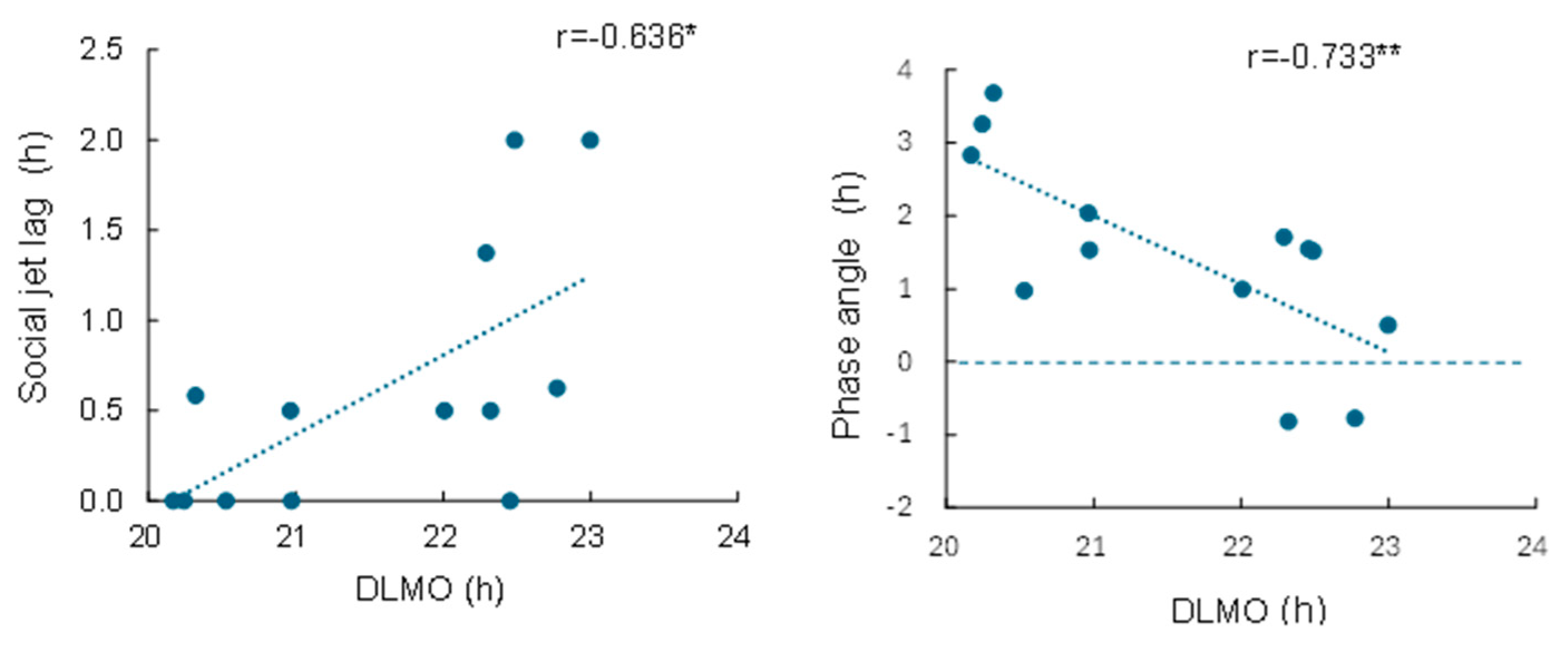

Table 1.
Baseline characteristics of the non-shift work and shift work groups.
|
Non-shift work (n =31) |
Shift work (n =26) |
p | |
| Age PSQI Score MEQ Score ESS Score |
50.48 (8.82) 5.74 (2.53) 55.32 (8.37) 10.10 (4.81) |
45.15 (9.56) 5.58 (3.07) 51.80 (8.57) 9.77 (4.72) |
0.03 0.97 0.17 0.47 |
| Bedtime on Workday Sleep Latency on Workday (min) Sleep-Onset on Workday Awake Time on Workday Midpoint of Sleep on Workday Sleep Duration on Workday (h) |
23:02 (1:02) 24.95 (25.15) 23:40 (0:59) 5:56 (0:40) 2:48 (0:37) 6.26 (1.14) |
23:03 (0:59) 22.65 (18.43) 23:40 (0:52) 5:51 (0:58) 2:46 (0:40) 6.18 (1.27) |
0.50 0.74 0.49 0.37 0.93 0.22 |
| Bedtime on Free Day Sleep Latency on Free Day (min) Sleep-Onset on Free Day Awake Time on Free day Midpoint of Sleep on Free Day Sleep Duration on Free Day (h) Social Jet Lag (h) |
23:30 (1:17) 22.69 (24.47) 24:10 (1:07) 6:58 (1:14) 3:34 (0:59) 6.80 (1.32) 0.77 (0.61) |
23:28 (1:04) 23.16 (18.29) 24:12 (0:57) 6:37 (1:35) 3:25 (1:06) 6.44 (1.51) 0:65 (0.67) |
0.81 1.00 0.60 0.21 0.59 0.10 0.38 |
Values are presented as the mean ± SD. P values for all variables except age were obtained by performing an ANCOVA with age as a covariate. PSQI, Pittsburgh Sleep Quality Index; MEQ, Morningness–Eveningness Questionnaire; ESS, Epworth Sleepiness Scale.
Table 2.
Dim light melatonin onset (DLMO) and phase angle in the non-shift work and shift work groups.
Table 2.
Dim light melatonin onset (DLMO) and phase angle in the non-shift work and shift work groups.
|
Non-shift work (n = 16) |
Shift work (n = 13) |
p |
|
| Dim light melatonin onset (DLMO) | 21:26 ± 0:51 | 21:34 ±1:03 | 0.69 |
| Phase Angle on Workday (h) | 1.55 ± 1.46 | 1.46 ±1.35 | 0.87 |
| Phase Angle on Free day (h) | 2.06 ± 1.81 | 1.77 ±1.40 | 0.63 |
Values are presented as the mean ± SD.
Disclaimer/Publisher’s Note: The statements, opinions and data contained in all publications are solely those of the individual author(s) and contributor(s) and not of MDPI and/or the editor(s). MDPI and/or the editor(s) disclaim responsibility for any injury to people or property resulting from any ideas, methods, instructions or products referred to in the content. |
© 2026 by the authors. Licensee MDPI, Basel, Switzerland. This article is an open access article distributed under the terms and conditions of the Creative Commons Attribution (CC BY) license (http://creativecommons.org/licenses/by/4.0/).
Copyright: This open access article is published under a Creative Commons CC BY 4.0 license, which permit the free download, distribution, and reuse, provided that the author and preprint are cited in any reuse.