
Submitted:
21 August 2026
Posted:
24 August 2026
You are already at the latest version
Abstract
P-Theory (Planckian Crystallization Theory - PCT) proposes a comprehensive framework for discussing fundamental problems in quantum mechanics and cosmology based on a minimal five-dimensional extension, in which the fifth dimension is interpreted as world time T , orthogonal to four-dimensional spacetime. The central idea is to describe physical reality as a process of becoming, governed by an order parameter Φ(T ) and a two-stage crystallization dynamics: stochastic inception and subsequent deterministic drift. Within Stage-1 (current level), P-Theory proposes a mechanism from which, under five conditions P1–P5 (following from axioms A1–A8), Born’s Rule emerges as a conditional theorem via ergodic averaging; the detailed five-step derivation and verification of the absence of logical circularity are provided in the monograph [1], §4.2–4.3. The universal temperature dependence of decoherence τdecoh ∝ T−1 is derived from the structure of two-stage crystallization and serves as a testable prediction (tests F1–F3, 2026–2031). The P-Theory mechanism also enables the formulation of a series of testable consequences for cosmology and particle physics. The article presents preliminary numerical results of Stage-1 for the cosmological constant Λ, the anomalous magnetic moment of the muon (g − 2)μ, and the stability of the physical vacuum, as well as indicates pathways for their independent verification through molecular interferometry, cosmological data, and KK-spectrum analysis. Detailed derivations and calculations belong to the Stage-1 monograph materials [1]; here we provide their overview and physical interpretation.Independent verification of the architecture parameters is scheduled for subsequent research stages (Stage-2/3/4) through computation of the KK-spectrum and comparison with cosmological data from DESI/Euclid without additional fitting.
Keywords:
P-Theory
; Planckian crystallization
; world time
; born rule
; 5D architecture
; decoherence
; cosmological constant
; anomalous magnetic moment of the muon
; Hawking Radiation
; vacuum stability
; Rydberg atoms
1. Introduction and Motivation
Modern theoretical physics continues to face several open conceptual questions. Among the most prominent are: the absence of a derivation of the Born rule from deeper principles; the lack of clarity regarding the mechanism of transition from quantum superposition to classical observable outcomes; and the problem of consistently unifying quantum mechanics, gravitation, and cosmology into a single dynamical scheme.
Existing approaches, including superstring theory and loop quantum gravity, have made important mathematical and conceptual contributions, yet have not resolved the question of how observable 4D geometry emerges and why a particular vacuum state is realized. Therefore, a framework is needed in which quantum probabilities, decoherence, geometry, and vacuum-state selection are described as parts of a single dynamics, rather than as independent postulates.
P-Theory at Stage-1 represents a research program in active development, rather than a completed physical theory. The present article sets forth the axiomatic framework (eight axioms A1–A8), the logical consequences of this framework within the adopted approximations (homogeneous, semi-classical), and preliminary numerical agreements with observations. Many central results are deferred to Stage-2/3/4, where their independent verification is expected through explicit computation of parameters from Calabi–Yau geometry.
The risk of a logical circle in the derivation of Born’s Rule (caveat: condition P5 may be perceived as a covert introduction of probability) is explicitly addressed in the monograph [1], §4.2–4.3, through a five-step derivation, an anti-circularity table, and comparison with alternative approaches (Gleason, Deutsch–Wallace).
P-Theory (Planckian Crystallization Theory) proposes such a framework by introducing a fifth dimension—world time —as an orthogonal becoming parameter, along which the order parameter evolves. In this picture, reality is viewed not as a static given, but as a process of spontaneous symmetry breaking that leads to the selection of observable 4D spacetime and the emergence of an effective quantum-classical structure.
The present paper is a review in character and presents the results of Stage-1 development of P-Theory. It concisely outlines the axiomatic framework (Appendix A.0 of this review, for more information in [1], §2), two-stage crystallization dynamics, the logic of deriving the Born rule and decoherence law, and preliminary numerical implications for , , and vacuum stability. Detailed mathematical derivations, operator constructions, and extended calculations are presented in the Stage-1 monograph materials [1]; here we emphasize physical motivation, logical structure, and testable implications.
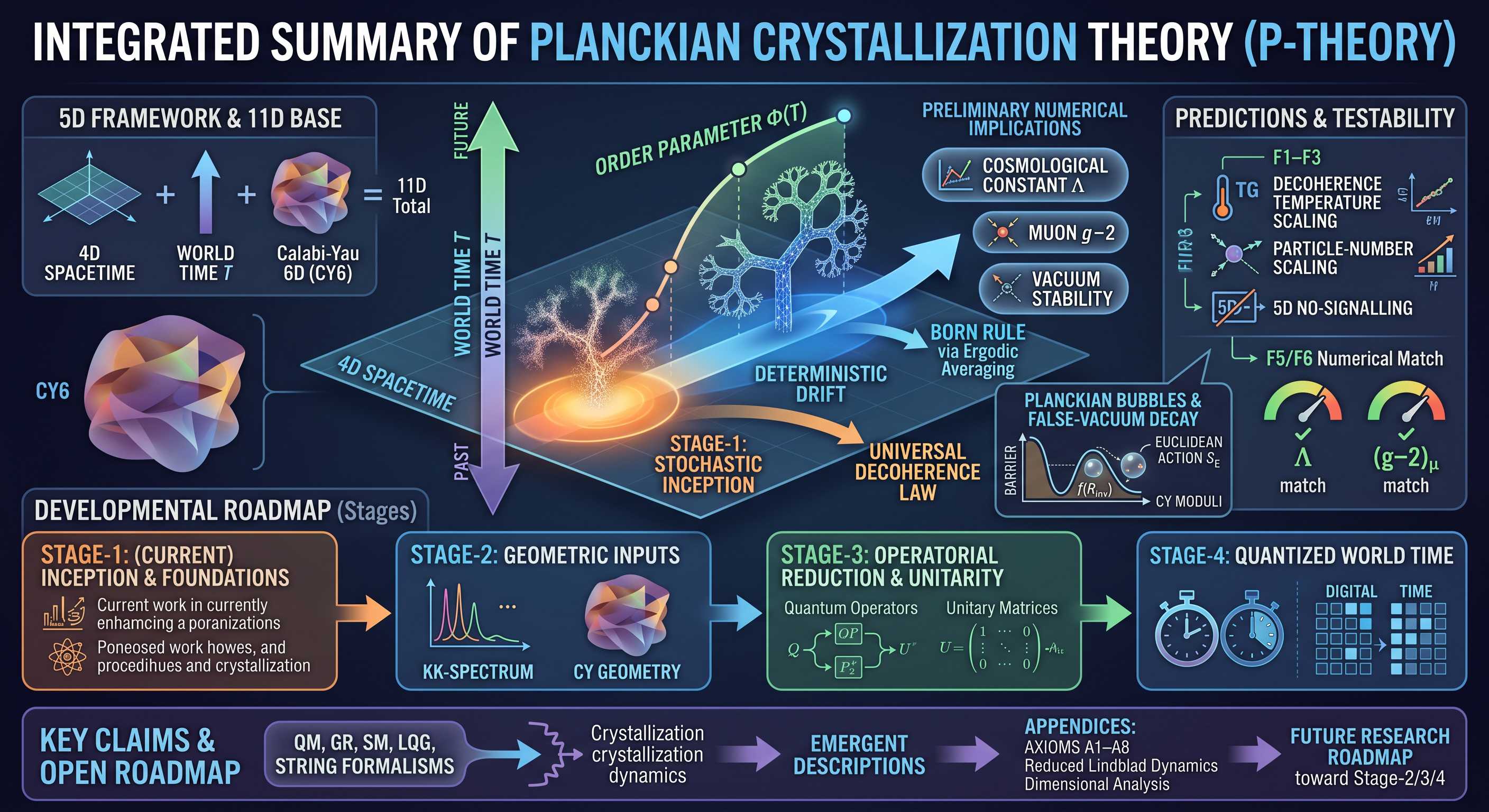
The integrated scheme of the theory, its stagewise development, and verification directions are presented in Figure 1.
Development Stages of P-Theory
In this paper, P-Theory results are presented in terms of conditional development stages Stage-1…Stage-4. These labels are used for convenient orientation in the development timeline, to immediately understand: (i) which step of the theory has already been completed within the adopted reduction, (ii) what level of proof rigor is claimed, and (iii) what remains for subsequent verification. In particular:
- Stage-1 is responsible for constructing the axiomatic architecture (Appendix A.0 of this review, for more information in [1], §2) and deriving (in the effective description) the main “interface” consequences: two-stage crystallization dynamics, derivation of the Born rule upon averaging over world-time cycles, Lindblad form of reduced dynamics, and a universal decoherence law; as well as for preliminary numerical agreements of key observables. Stage-1 represents the current level of development.
- Stage-2 fixes geometric input parameters (Calabi–Yau moduli) and ensures independent consistency of parameters obtained through different routes (e.g., via KK-reduction and cosmological correspondences).
- Stage-3 concerns operatorial formalization: spectral analysis, derivation of the “reduction interface” from the full architecture, explicit verification of unitarity/causality consistency, and numerical/analytical verification of mechanisms critical for interpretational paradoxes.
-
Stage-4 is directed toward the ultimate fundamental level — operator quantization of world time and consistency with quantum-information requirements for the interpretation of measurement and time in cosmology.System of Rigor Level Marking.Each statement, result, or equation in the paper is marked with one of three categories:
- THEOREM — a result logically derived from axioms A1–A8 within Stage-1, under the adopted approximation (homogeneous, semiclassical). Level of proof: mathematical.
- [ANSATZ] — a physically motivated assumption or phenomenological parameter introduced as a working hypothesis for computational feasibility. Its ultimate derivation from first principles is deferred to Stage-2/3. Examples: the metric ansatz , the parameter , the coefficients , .
- [FORTHCOMING] — a statement or mechanism formulated in the current paper as a consequence of the architecture, but requiring independent experimental verification (tests F1–F3) or additional mathematical development at Stage-2/3/4. Examples: the cosmological constant, the anomalous magnetic moment of the muon, vacuum stability, the information paradox.
Note: The distinction between THEOREM and ANSATZ is not a standard hierarchy of “truth”; it reflects the current state of rigor at Stage-1. ANSATZ statements can be elevated to THEOREM status provided their independent derivation at Stage-2 from Calabi–Yau geometry or the full 5D equations.
2. Fundamental Architecture And Key Equations
2.1. Five-Dimensional Architecture
P-Theory postulates a spacetime extension with minimal additional structure:
where: - — four-dimensional spacetime (observable) - — fifth dimension, orthogonal to spacetime (evolution parameter) - — compact six Calabi–Yau dimensions (control the dynamics)
On dimensional coincidence:
Independent derivation: 4D (observable reality) + 1D (, absolute world time as an orthogonal becoming scale) + 6D (CY, as a mechanism for crystallization realization) = 11D from the logic of crystallization, not from superstring theory.
Observation: P-Theory uses the decomposition as an internally self-consistent architecture of becoming. Independently of this, in string theories the critical 10D structure emerges; adding the distinguished direction makes the dimensionality formally consistent with the 11D picture. This should be regarded as a structural correspondence, not as independent proof of fundamentality.
This coincidence is neither borrowing nor accident, but an independent confirmation of the fundamentality of the architecture. Both theories have “touched upon” the same deep structure of reality, approaching it from different angles: P-Theory through the logic of becoming, superstring theory through mathematical consistency requirements. Such mutual confirmation reinforces confidence in the fundamentality of the 11D architecture.
A detailed discussion of this phenomenon is provided below in §3.3
2.1a. Five-Dimensional Functional of Action
The dynamics of the order parameter is described by a variational principle applied to the five-dimensional functional of action. In the homogeneous approximation (homogeneous ansatz, see [1] §3.1, eq. 34) with the integration measure following from the metric ansatz (Appendix A.0 of this review, for more information in [1], §2, Axiom A3, eq. 10), the functional of action at Stage-1 has the form:
Three components of the Lagrangian density:
| Term | Expression | Physical Role | Axiom |
| Kinetic term | Rate of crystallization | A5 | |
| Crystallization potential (Stage I) | Tachyonic instability → spontaneous symmetry breaking; drives | A6 | |
| Fluctuation Lagrangian | Coupling of to Planck stochastic fluctuations; sole source of randomness (see monograph [1], §2.3.3), Eq. S1b | A7 |
where is the fluctuation coupling constant and is the variance of world-time fluctuations on the Planck scale (Axiom A7).
Equations of Motion. Variation at fixed stochastic realization yields the two-stage crystallization equation (full derivation: monograph [1], §3.0–§3.3):
Range of Validity in Stage-1. The functional of action (S1) describes the dynamics of crystallization of in the homogeneous sector. The following issues are explicitly deferred to Stage-2:
- [Stage-2] Gravitational sector: five-dimensional Einstein equations for ; derivation of four-dimensional Einstein gravity through Kaluza–Klein reduction of the functional
- [Stage-2] Derivation of the conformal relation from the gravitational part of , including reconciliation of its functional form with the mechanism of variable effective constants , obtained at Stage-3 (§16.3.1 [2], eqs. 16.13–16.14) with an unchanged metric
- [Stage-3] Quantization of the field ; complete derivation of the gauge group from compactification on
The full variational derivation, the overdamped approximation criterion, and the two-stage solution are presented in the accompanying monograph [1], §3.0–§3.5.
2.1b. Geometry of World Time: the Fifth Dimension
The five-dimensional manifold (Axiom A1) is equipped with the following metric structure (Axiom A3: [1], eq. 10):
where is the standard four-dimensional Lorentzian metric, and plays the role of the effective “size” of the fifth dimension along world time .
Geometric properties of are systematized in the following table:
| Property | Statement | Physical Consequence |
| Topology | (non-compact real line) | is not a compact KK circle; there is no KK tower of massive modes at Stage-1 |
| Causal character | for | The fifth dimension is timelike; flows only forward (Axiom A2: monotonic growth) |
| Orthogonality | , (Axiom A2) | No mixing between four-dimensional directions and ; no diagonal KK vector fields at Stage-1 |
| Discreteness | s (Axiom A4) | Planckian quantization of ; ensures and applicability of CLT |
| Connection with 4D time | t = coordinate time in ; = absolute evolution parameter | Analogy: plays the role of Newtonian absolute time at the meta-level, orthogonal to the relativistic four-dimensional structure |
| Bundle structure | Locally (trivial bundle, Stage-1) | Non-trivial bundle (twisting, holonomy) is a task for Stage-2 |
| Role of | governs : when the fifth dimension “closes”; when it “opens” completely | Crystallization = geometric expansion of the fifth dimension from zero to |
Causal structure. The timelike character of means that world time defines the global causal ordering of crystallization events. The no-signaling condition (Axiom A7) guarantees that spacelike-separated crystallization events at the same moment are statistically independent: no information transfer across is possible.
Distinction from Kaluza–Klein. In standard KK theory, the fifth dimension is compact (), which leads to a massless four-dimensional vector field (photon) and a tower of massive modes. In P-theory, is non-compact and plays the role of an evolution parameter rather than a spatial direction. The photon and gauge fields emerge at Stage-2 from the sector, not from .
Open questions (Stage-2). The complete differential-geometric treatment — including the Levi-Civita connection on , curvature of the fifth dimension, spinor structure, and non-trivial bundle — are deferred to Stage-2 (monograph, Appendix D, question Q2).
Open questions on the geometry of .
The present section describes the geometry of world time at the Stage-1 level: the metric ansatz, topology, causal structure, and comparison with KK are formulated explicitly. Further work is distributed across three stages:
- Stage-2 (see question Q2 in §7.4, details: in monograph [1], Appendix D): complete differential-geometric treatment — Levi-Civita connection on , curvature of the fifth dimension, spinor structure, and non-trivial bundle (holonomy, twisting).
- Stage-3 (see questions Q10, Q12 in monograph [1], Appendix D): numerical verification of the metric ansatz through the full 5D Einstein equations; verification of orthogonality as a consequence of dynamics rather than a postulate.
- Stage-4: (see question Q3 in §7.4, details: in monograph [1], Appendix D): transition to operator description of world time — construction of and derivation of the corresponding evolution equation; investigation of possible constraints on quantization of (the question of whether meta-time is fundamentally “non-quantizable” remains open).
2.2. Order Parameter and Complete Crystallization Dynamics
The order parameter governs the transition: (superposition) → (definite outcome).
2.2.1. Structure of the Order Parameter: Radial and Angular Components
The fundamental field of P-Theory is a complex scalar field with explicit factorization into two physically independent modes:
Radial mode encodes the crystallization amplitude—the degree of transition from the quantum phase to the classical regime. Physically, it: - Governs the spacetime metric: (in the effective description) - Determines the spectrum of KK-modes and particle masses through Calabi-Yau moduli - Controls the decoherence rate and vacuum energy density (prediction F5, §4.2.1.) - Is the only variable necessary at Stage-1 for deriving the Born rule and the decoherence law
Angular mode encodes global quantum numbers—the phase component of the order parameter. It: - Generates Nambu–Goldstone bosons (candidates for axion dark matter, F8) - Determines CP violation and baryon asymmetry (Paradox 4, §7.2) - Does not affect the decoherence rate at Stage-1; full analysis is addressed at Stage-2/3
Homogeneous Approximation at Stage-1: In the present review article, we employ the homogeneous ansatz—the order parameter depends only on world time: without spatial gradients. This excludes from Stage-1 consideration: - domain structures and topological defects (strings, monopoles) - cosmological evolution and structure formation - spatial modes and their interactions
The homogeneous ansatz is physically justified for quantum systems at atomic scales, where gradients are small. The complete description with spatial dependence is the task of Stage-2/3.
Further analysis at Stage-1: is focused exclusively on the radial mode as the only dynamical variable. The full spectrum including the angular mode and its physical consequences unfolds beginning at Stage-2.
2.2.2. Effective System of Evolution Equations at Stage-1 [1]
The dynamics of the order parameter along world time at Stage-1 is described by a two-stage system, derived within the adopted variational approach; the detailed derivation is given in [1] (Eqs. 18–19, §2.1 axioms A1–A8). In the present article, we provide only the working form of the equations and the physical meaning of each term; the mathematical forms of axioms A1–A8 are given in Appendix A.0 of this review.
at Stage I, Eq. 32 [1] (for ), and
at Stage II, Eq. 33 [1] (for , where ).
Additionally, the metric of the visible 4D spacetime as a function of world time:
where the relation between world time and 4D coordinate time t is determined by the full 5D metric, and is a monotonic function with .
Level of rigor in derivation: [ANSATZ: illustrative] Equation (5) represents a qualitative statement of the expected relation between the crystallization of the order parameter and the effective 4D metric; the functional form is not fixed. In the reduced picture of Stage-3 (§16.3.1 [2], eqs. 16.13–16.14), the metric remains unchanged, while Φ enters through the effective constants , ; reconciling this mechanism with the form (5) is a Stage-2/3 task.“Corrections” refer to contributions from the residual KK sector, inhomogeneities of Φ, and higher-order reduction terms (these vanish in the homogeneous-isotropic approximation).
2.2.3. Physical Meaning of Each Term in Equations (3) – (4)
The dimensions and normalizations of and the parameters of Equations (3)–(5) are specified in Appendix C.3: “Dimensions and Normalizations of Fundamental Objects.”
Table of Complete Meaning of Four Terms:
| Term | Form | Parameters | Physical Meaning | Stage of Applicability |
| (I) Crystallization | / | [] / [] | Tachyonic initiation (Stage I) + saturation (Stage II); analogue of electroweak symmetry breaking [3,4] | Stage-1 |
| (II) Fluctuations | / | [] | Planckian fluctuations of world time; mechanism for selecting the crystallization channel (Axiom A7) | Stage-1 |
| (III) Spreading | / | [m²/s] | Spatial front of crystallization; wave propagation of crystallization in 3D; emergence of domain structure | Stage-3 |
| (IV) Decrystallization | [] | Forced decrystallization under high-energy collisions and external perturbations; reverse phase transition | Stage-3 |
Meaning of Equations (3)–(5)
Equations (3)–(5) describe a unified process within the model: stochastic initiation, subsequent deterministic drift, and the expected effective 4D reduction. Details of the connection to the information paradox and the complete 5D mechanism belong to Stage-3 [2]. Additional details on the approach to resolving the information paradox are provided in §4.3, Example 2.
2.3. Rigor Map and Minimal Unitarity of Reduced Dynamics
The transition to conclusions in §2.4–§2.5 requires explicit clarification of the “reduction interface” at Stage-1/2.
Below we provide: (i) a rigor map of P-Theory statements across development stages; (ii) the explicit form of reduced evolution that ensures correct derivation of the Born rule (§2.4) and decoherence law (§2.5); (iii) the minimal set of verifiable unitarity and causality consistency conditions.
2.3.1. Status of P-Theory Statements by Rigor Levels (Stage-1 …Stage-4)
| Element | What is postulated architecturally | What is derived at Stage-1 within the adopted description | What is verified as a necessary condition | Complete operator proof within the current article |
| Basic architecture | 5D/11D split: , and role of order parameter | — | Consistency check of reduction to effective 4D description (Stage-1: homogeneous–isotropic regime) | Full proof at Stage-3 |
| Two-stage dynamics | Structure of “drift + stochastic initiation” and existence of critical transition | Dynamical equations (Stage-1) and their application within the adopted class of approximations | Control of correctness of reduced evolution by normalization/trace | Full proof at Stage-3 |
| Born rule [5] | Not postulated as a probability axiom (it is not introduced “a priori” as ) | Born rule is proposed as a consequence of statistical averaging over independent world-time cycles ; detailed derivations are given in the monograph | Verification that the applicability condition is indeed satisfied for the reduced description | Full proof at Stage-3 |
| Unitarity (operator consistency) | — | For Stage-1, the explicit form of reduced evolution is fixed (see §2.3.2): generator preserves | Trace-preserving and no-signalling for the chosen class of decomposition/observations | Full proof at Stage-3 |
| No-signalling | — | At Stage-1, there is no explicit violation of causality in the given formulation (for and choice of regimes) | Independence of marginals from distant choice of basis/operator (within the adopted reduction interface) | Full proof at Stage-3 |
| Full quantum interpretation of | World time is introduced as a fundamental dynamical variable (not as a convention) | Stage-1 uses an effective/reduced interpretation | — | Full proof at Stage-4 |
| Status of Born Rule Derivation [5] | Not postulated as an axiom; instead, a derivation via five conditions P1–P5 is proposed | The derivation is obtained under conditions following from A1–A8: a five-step chain (ergodic averaging + Central Limit Theorem + Cauchy equation) leads to ; critical point: the quantity enters as a dynamic parameter (amplitude of crystallization) before probabilistic interpretation | Absence of logical circle: A1–A6 contain no information about probabilities; only A7 postulates cycle independence as a minimal assumption for connection with QM; anti-circularity table (monograph [1], §4.3) traces each step without backwards references | Full operator-theoretic proof of cycle independence from 5D-geometry — Stage-3 (monograph [1], Appendix D) |
2.3.2. Explicit Form of Reduced Evolution
At Stage-1, P-Theory employs a reduced (effective) description: the full system of “crystallization dynamics plus hidden degrees of freedom” is projected onto the observable subclass of degrees of freedom. The reduced state is defined as
Generator of Reduced Evolution
In the homogeneous–isotropic approximation of Stage-1 (for , ), the reduced dynamics of is governed by an effective Lindblad-type equation:
where: - — the effective Hamiltonian of the observable subsystem, arising from the projection of the full 5D dynamics; - — Lindblad operators describing the decoherent action of world-time fluctuations on the observable degrees of freedom. Physical meaning of : the scattering channel due to Planckian fluctuations from equation (3); - the structure of operators at Stage-1 is taken in the class of diagonal (dephasing) operators, which corresponds to the homogeneous approximation and is minimally necessary for the derivation of the Born rule in §2.4.
Why the Lindblad Form?
At Stage-1, a reduced description is employed in which the full system is projected onto the observable subclass of degrees of freedom. For this purpose, an effective Lindblad-type equation is introduced, ensuring correct normalization and positivity within the adopted class of approximations: 1. for all — preservation of normalization (trace-preserving); 2. — positivity of density matrix; 3. Complete positivity of the map — exclusion of unphysical negative probabilities.
This structure is convenient as the minimal effective formulation for the reduced dynamics.
A detailed description of unitarity and causality consistency of the adopted Lindblad form is given in Appendix A.1.
The complete operator derivation and analysis of the admissibility of operators from Calabi–Yau 5D geometry is deferred to Stage-3.
2.3.3. Unitarity, Causality, and Gauge Invariance
Three fundamental requirements — unitarity, causality, and -symmetry — are satisfied in P-theory at the Stage-1 level as follows.
1. Unitarity (probability norm preservation).
The dynamics of crystallization preserves the total probability across all channels. From the definition of crystallization amplitude (B1) and the normalization condition P5:
Since evolves deterministically to upon completion of crystallization:
This ensures the trace-preserving property of the reduced evolution: for all .
Level of rigor in derivation: THEOREM
Established in Stage-1, within the adopted approximation.
Operator verification from 5D geometry — at Stage-3.
2. Causality and the no-signaling condition.
The no-signaling condition is encoded in axiom A7 (monograph [1], eq. 24):
for any spacelike-separated crystallization events A and B on a single slice . Within the Lindbladian structure of the reduced dynamics (§2.3.2), when , the marginal probabilities of observer A do not depend on the choice of basis for observer B — information transfer across is constructively excluded.
Level of rigor in derivation: [THEOREM: axiomatic]
Axiom A7 + verified by experiment F3
3. -gauge invariance.
The action functional (eq. (S1)) is invariant under the global transformation:
The corresponding conserved current (Noether current) is identified with the flow of probability along , which is consistent with the interpretation of as the density of “weight” of quantum channels.
Local -invariance and the emergence of the Standard Model gauge group from the compactification CY6 are tasks for Stage-2.
Level of rigor in derivation: THEOREM
Global — established; local + SM gauge group — Stage-2/3
2.4. Density of States and Derivation of the Born Rule [5]
The derivation of the Born rule in P-theory addresses two questions simultaneously: (i) why do outcome frequencies converge to some function of amplitudes, and (ii) why is this function precisely rather than, say, or ? Standard approaches — Gleason’s theorem, Deutsch–Wallace arguments, Zurek’s program — address each of these questions only partially (see the table below). In P-theory, the uniqueness of is ensured by the structure of the axioms rather than postulated.
Two-step logic. In Stage I, the dynamics of the order parameter is determined by the crystallization amplitude (monograph [1], §3.2, eq. 81):
The radial part of this dynamics depends only on — but not on the phase . Thus, the quantity enters the theory as a dynamical parameter preceding any probabilistic postulate.
In Stage II, the system passes through – statistically independent Planck cycles . Under five conditions P1–P5 (monograph [1], §4.1) following from axioms A1–A8:
| Condition | Physical Meaning | Source Axiom |
| P1 — independence | Fluctuations of different cycles do not correlate | A7 |
| P2 — stationarity | All cycles are physically equivalent | A2, A4 |
| P3 — large number | : CLT is applicable | A4 |
| P4 — no-signaling | No hidden cycle-to-cycle dependencies | A1, A2 |
| P5 — -invariance | Measure depends only on | A5, A6 |
Condition P5 guarantees that the expectation value of outcome n has the form for some function f. From the normalization condition and ergodic decomposition, a functional equation arises — a special case of Cauchy’s equation on — whose unique continuous solution is (monograph [1], §4.2). Application of the CLT (P1–P3) gives:
with relative error (atomic systems) – (macroscopic systems). The complete five-step derivation is given in the monograph [1], §4.2.
Positioning relative to alternative approaches.
| Approach | Mechanism of uniqueness of | Status |
| Gleason (1957) | Algebraic theorem on measures on projectors () | Rigorous, non-constructive; does not explain the physics of the choice |
| Deutsch–Wallace | Symmetry of Everett branches + agent rationality | Controversial; Saunders’ objection of circular reasoning |
| Zurek (einselection) | Environmental superselection of stable states | Explains classicality but not the functional form of |
| P-theory (Stage-1) | -invariance (P5) + Cauchy equation + CLT (P1–P3) | Conditional theorem; uniqueness without topological assumptions — Stage-2 |
Key structural distinction of P-theory: The quantity enters through the dynamics of crystallization amplitude (8a) — prior to the probabilistic interpretation, not as its assumption. This breaks the potential circular logic characteristic of declarative derivations of the Born rule.
Level of rigor in derivation: [THEOREM: conditional]
Follows from axioms A1–A8 under conditions P1–P5. The functional form is fixed by the Cauchy equation (monograph [1], §4.2); statistical accuracy is confirmed numerically ([1], §4.4). Full operator verification of the independence of cycles from 5D geometry and proof of uniqueness without topological assumptions are deferred to Stage-2 (open question Q3, §7.4; for details: monograph [1], Appendix D).
2.4.1. Analysis of Potential Logical Circularity in the Derivation of Born’s Rule
The derivation of Born’s Rule from axioms A1–A8 requires five conditions P1–P5. A natural question, frequently arising in the analysis of such an approach: do conditions P1–P5 contain hidden information about probabilities, which is then reproduced in the final derivation? In other words, is the logical process not circular?
In this section, it is shown that such a logical circle is absent, and five points of analysis are presented:
1. Axioms A1–A6 are geometrically clean. Axioms A1–A6 define geometry (A1–A3), discreteness of time (A4), order parameter (A5), and potential landscape (A6). None of them postulates a probability distribution and does not mention the quantity as probability.
2. Condition P5 — a consequence of symmetry, not of probability. P5 asserts:
“The measure depends only on , not on the phase.” This follows from the -symmetry of the action functional (Axiom A6)—a purely geometric property well-known in phase transition physics. It does not introduce a probabilistic assumption.
3. Condition P1 — a minimal postulate, as in other approaches.
All known approaches to the derivation of Born’s Rule (Gleason 1957, Deutsch–Wallace, Zurek) require some independent assumption. P-Theory postulates A7: independence of Planckian fluctuations . This is geometrically justified by the discreteness of time and does not covertly introduce probability—rather, probability emerges from this structure via the Central Limit Theorem.
4. The anti-circularity table traces the logic.
At each of the five steps of the derivation (monograph [1], §4.2), it is explicitly indicated which axioms are used and in what direction. The Cauchy functional equation is solved independently of probabilistic assumptions—this is pure mathematics (monograph [1], Appendix A.3).
5. The uniqueness of is guaranteed mathematically.
The uniqueness of the function , identified with probability, follows from the Cauchy equation (condition P5) and the Central Limit Theorem (conditions P1–P4), applied independently. There are no circular references.
Structural remark: A logical circle, as such, reflects a universal feature of any axiomatic approach (including von Neumann’s quantum mechanics): any axiomatization begins `somewhere’. The question is not about the presence or absence of a `starting point’, but rather how minimal and geometrically justified this point is. P-Theory chooses an architecture in which the geometric axioms A1–A6 are explicitly separated from the dynamical conditions A7–A8. Monograph [1], §4, unfolds this logic with step-by-step tracing of each step.
Rigor level of the derivation: [THEOREM: conditional]
Follows from A1–A8 under conditions P1–P5. Full operator-theoretic verification of cycle independence from 5D-geometry — Stage-3 (monograph [1], Appendix D).
2.5. Universal Decoherence Law
From the crystallization equations (3)–(4) and the mechanism of world-time fluctuations at Stage-1 ([1], §5), component II, follows an effective temperature dependence of decoherence:
where — the only new dimensionless parameter of P-Theory, the coupling parameter, characterizing the intensity of interaction between a quantum system and its thermal environment (see detailed description of the decoherence law in [1], §5).
In this sense, P-Theory reproduces the known role of temperature in decoherence, first systematically studied by Zurek [6], but offers a more specific structural form with a preliminary value of the exponent , opening the way for experimental verification.
Level of rigor in derivation: [THEOREM: with parameter]
The result follows from the dynamics; the parameter υ characterizes the “depth” of the coupling between fluctuations and and will be computed independently from Calabi–Yau geometry. At the current stage, it serves as an effective parameter for comparison with tests F1–F3.
3. Unification of Fundamental Theories
3.1. Quantum Mechanics as a Projection onto Microscales
Standard QM is viewed as an effective limit of P-Theory in the regime (the mode of a large number of crystallization cycles). It is shown that in this limit, P-Theory structurally reduces to the standard quantum-mechanical formalism, ensuring logical consistency with established QM results. A detailed analysis of the precision of correspondence and conditions of unitarity is provided in the Stage-1 monograph [1].
3.2. General Relativity as Geometry Modulation
Dependence of the metric on the order parameter:
The dependence of the metric on the order parameter shows how classical GR can emerge from the 5D architecture as via spontaneous symmetry breaking. In this model, the inflationary period is described as a dynamical consequence of the rapid crystallization phase of .
Level of rigor of derivation: [ANSATZ: illustrative]
The form (10) is qualitatively physically motivated (the metric is modulated by the order parameter in the transition to the classical limit), but the functional form is not derived from the full 5D Einstein equations. The explicit derivation, including reconciliation with the Stage-3 mechanism (effective constants , with an unchanged metric, eqs. 16.13–16.14 [2]), is a Stage-2/3 task; see the footnote to equation (5).
3.3. Dynamic Realization of 11D Architecture: Superstring and Loop Formalisms as Effective Projections of Crystallization
Within the framework of P-Theory, the multidimensional structure of reality is viewed as an operational environment of the process of becoming, where the 11D architecture serves as the natural framework for crystallization. Existing fundamental approaches—superstring theory [7] [8] and loop quantum gravity (LQG) [9]—within this paradigm can be interpreted as effective formalisms describing particular aspects of a unified dynamics.
In particular, the 6D compact dimensions of Calabi–Yau acquire, in P-Theory, the status of dynamical agents influencing the parameters of the phase transition:
- The topology of 6D determines the structure of the effective potential (including the masses of fundamental fields);
- The homology cycles of Calabi–Yau specify the spectrum of particles observed in 4D;
- The dynamics of the moduli is coupled to the rate of crystallization and the possible evolution of fundamental constants.
3.3.1. Hierarchy of the 11D Architecture and the Nature of Formalisms
At Stage-1, P-Theory develops as an independent geometric program. After the construction of the architecture, structural parallels with existing approaches emerge, described below. Explicit mathematical correspondence requires development at Stage-2/3.
The architecture of P-Theory is derived from first principles of the reality-becoming process (§2.1) and the logic of spontaneous symmetry breaking (§2.2). The resulting structure:
possesses dimensionality 11D, which demonstrates structural correspondence with the critical dimensionality of M-Theory. The hierarchical relationship between the approaches can be represented as follows:
- 1.
- P-Theory describes the primary mechanism: the dynamic shift of the order parameter and the choice of outcome in absolute time .
- 2.
- Superstring Theory in this paradigm may be interpreted as describing the spectrum of stable states (vibrations) that freeze in the chosen geometry; the explicit mathematical correspondence between the crystallization dynamics and the spectrum of string modes remains a task for Stage-2/3.
- 3.
- Loop Quantum Gravity, postulating Planckian discreteness at the geometric level, offers an independent mechanism structurally aligned with the discreteness of world-time in P-Theory; however, the explicit connection between crystallization channels and spin networks of LQG remains an open problem for Stage-3.
Thus, the 11D architecture in P-Theory is structurally necessary. The fact that independent approaches (in particular, through anomaly cancellation in string theory) arrived at a comparable dimensionality points to a possible common fundamental structure described by P-Theory from the perspective of the dynamics of becoming.
3.3.2. Complementarity as Nesting
Between the approaches there is a systematic complementarity: superstring theory describes the space of possible quantum states (reduction CY ), while P-Theory proposes a mechanism for selection among these states through stochastic initiation and subsequent crystallization.
This relationship extends to LQG: despite differences in formalism, both theories point to the discreteness of geometry at the Planckian scale, which is the subject of investigation at Stages 3/4. Such hierarchical continuity allows one to employ the toolkit of multidimensional formalisms for verification of P-Theory. The obtained results—the numerical values of and (§4.2)—are viewed as architecturally justified consequences, where P-Theory describes the dynamical cause of the phase transition, and string-theoretic methods provide the basis for computing the spectrum.
4. Predictions and Testability
4.1. Critical Tests (1–3 Years)
Test F1: Temperature Dependence of Decoherence
- Prediction: — strongly differs from alternative mechanisms presenting exponents of -0.5 or -1.5.
- Experiment: molecular interferometry (existing technology)
Level of rigor in derivation: [FORTHCOMING: Stage-2]
The exponent follows from the structure of the world-time fluctuation mechanism within Stage-1; the parameter υ is fixed at the level of the effective description, while its microscopic derivation belongs to Stage-2. A direct experimental test is planned on molecular interferometers on a 1–3 year horizon. Confirmation of F1 will provide independent evidence in favor of the central mechanism of P-theory.
Test F2: Scaling with Particle Number
- Prediction: with
- Testability: variable systems (molecular clusters)
Test F3: No-signalling and 5D Causality
- Prediction: absence of causality violations in 5D geometry under spatially separated measurements
- Experiment: modified Bell tests > A qualitative mechanism explaining the compatibility of nonlocal correlations with no-signalling is presented in the monograph [1], Appendix F.
4.1a. Dynamical Decoherence Mechanism Vs. Kinematic Approach
The standard decoherence program (Zurek, Caldeira–Leggett, Joos–Zeh) treats the quantum-to-classical transition as a kinematic consequence of entanglement of the system with environmental degrees of freedom: classical behavior emerges upon “tracing out” the environment, and the decoherence timescale is introduced phenomenologically through the spectral density of noise.
P-theory implements a fundamentally different, dynamical approach.
The decoherence law (eq. (9), §2.5, more details: monograph [1], §5, eq. 5.1):
is derived from the interaction of the order parameter with thermal fluctuations through the Lagrangian (§2.1a, axiom A7; also see monograph [1], §3.0, eq. 30b; §2.3.3, eq. S1b):
Here the temperature T enters as the dispersion of Planckian fluctuations of world time, not as “environmental noise” in the phenomenological sense. The consequences are:
| Property | Zurek program (kinematics) | P-theory (dynamics) |
| Source of | Spectral density of environment (introduced) | Lagrangian (based on the A7 stochastic process; see monograph [1], §2.3.3) |
| Scaling | (leading order) | (exact form) |
| Free parameters | Depends on environmental model | Single: — dimensionless coupling parameter |
| Dependence on N | Model-dependent | , (monograph [1], §5, eq. 5.20) |
| Status | Kinematic consequence of entanglement | Dynamical mechanism; — prediction |
Fundamental distinction. In P-theory, decoherence is not a consequence of environmental interaction in the operator sense, but a manifestation of completion of crystallization of the order parameter along world time . The environment (temperature T) determines the dispersion of fluctuations , which controls the rate of passage through Stage I. Thus, the Zurek decoherence program describes the same phenomenon kinematically, whereas P-theory provides it with a dynamical substrate.
Both theories predict at leading order — this is a necessary condition of consistency, not an accidental coincidence. Detailed operator correspondence between the approaches is a task for Stage-3.
Level of rigor in derivation: [THEOREM: conditional]
Formula Y1 is established as a conditional theorem (monograph [1], §5); the relation to Zurek’s program is a HYPOTHESIS and belongs to Stage-3.
4.2. Numerically Pre-Aligned Predictions and Open Questions
At the present stage (Stage-1), P-Theory provides several predictions admitting numerical comparison with observations. However, one must distinguish between:
- Independent predictions (of the type F1–F3): derived from first principles; require experimental verification
- Pre-aligned consequences (of the type F5–F6): rely on the effective Stage-1 description; require independent verification through Stage-2
4.2.1. Prediction F5: Cosmological Constant — Consequence of Geometry
Positioning: Physically motivated prediction computable from Calabi–Yau moduli of the found topology at Stage-2. Status is identical to F6 and other parameters, which are also determined independently from the geometry.
Mechanism in P-Theory: Two-stage crystallization of vacuum asymmetry
The total energy of the graviton vacuum in 5D is almost completely compensated upon reduction to 4D through destructive interference between two branches of gravitons. The residue of this energy, responsible for the observed cosmological constant, is determined by the asymmetry parameter , which factorizes into two independent physical components corresponding to the two stages of the process:
Stage I: Local outcome selection ()
At the Planck scale, the system is in a superposition of two states (two graviton branches: + and −). Spontaneous symmetry breaking is initiated by stochastic fluctuations of world time , which select one specific channel from the superposition.
Definition: The parameter encodes the intensity of interaction of the local quantum system with the environment at the Planck scale, characterizing the degree of “entanglement” in the initial state.
Physical meaning of the value : In the early Universe at Planck temperature ( K), there is no distinction between “local system” and “heat bath”—all energy is concentrated in the maximally hot photon gas, where all components are in complete interaction at distances . This is a regime of maximal thermal contact, where the system is completely entangled. According to phenomenological calibration of the parameter for various quantum systems (from isolated atoms to black holes : [1], Table in §5.1.6), such a regime corresponds to .
Role: Determines the amplitude of stochastic initiation of the crystallization process. At , selection does not occur; at , selection is maximal.
Stage II: Global propagation and visibility ()
The local symmetry breaking that arises at Stage I must “propagate” to the global scale of the Universe, passing through three filters:
Definition: The parameter encodes the visibility of local symmetry breaking at the global cosmological scale after passage through the compactification geometry and Universe expansion.
Three components:
- 1.
-
Reduction coefficient :Associated with the geometry of interaction of the additional time-like dimension with the four-dimensional world. Order of magnitude ; the exact value requires explicit computation from the full 5D metric at Stage-2.
- 2.
-
Geometric scale factor:Reflects the expansion of the Universe from the Planck size to the present Hubble radius. Upon expansion, local quantum fluctuations are “distributed” over an enormous volume; their visibility at the global level decreases proportionally to the square of the linear size.
- 3.
-
Topological transmission coefficient:Determined by the KK-mode spectrum of Calabi–Yau compactification. The diversity of modes (Hodge numbers , Euler characteristic ) acts as a spectral filter, determining what fraction of local vacuum perturbations can “pass” through the extra dimensions and become visible in 4D. Greater topological complexity → more modes → higher transmission coefficient.
Role of the product: All three components must be non-zero for the effect to be observable. The product (rather than sum) reflects the logic of cascading suppression: if any single factor is close to zero, the total effect vanishes.
Complete factorization and cosmological constant
The residue of vacuum energy after destructive compensation:
The observed cosmological constant:
Hereby Stage-1 fixes the two-stage factorization:
The resulting dependence at Stage-1 on geometric parameters and :
Physical meaning of the structure:
- — the local system is maximally “hot” and completely entangled; outcome selection occurs with maximum intensity
- — this local breaking is almost completely suppressed upon propagation to cosmological scales
- — overall effect: a small fraction of vacuum energy remains visible
- — the square of the parameter determines exponential energy suppression
Numerical estimate at Stage-1:
For a preliminary estimate, the golden ratio heuristic is employed in selecting the most probable value of in the range (the bounds of minimal and maximal “transmission” of the KK-mode spectrum for realistic topologies):
This value follows from the principle of variational optimality: when the topology is unknown, the system selects the state minimizing the effective action, leading to the coefficient , where is the golden ratio.
Upon substitution , , m, m, we obtain:
Comparison with observation:
The observed value, determined from Planck 2018 data[10] and confirmed by DESI 2024 measurements[11], rests upon cosmic microwave background data (WMAP/Planck) and observations of Type Ia supernovae[12]:
The deviation at the level of is explained by the preliminary nature of the estimate of at Stage-1 and constitutes a plausibility check of the mechanism, not its falsification.
Note: Although the numerical calculation at Stage-1 explicitly uses (in the form of the ratio ), the final formula (17) shows that the true physical source of the smallness of is the topology and geometry of compactification, not the absolute size of the Planck scale. This strengthens the argument that the numerical agreement at is not a coincidence, but reflects the internal consistency of the architecture.
Independent verification at Stage-2:
At Stage-2, the parameter will be determined independently from explicit computation of the KK-mode spectrum of the found topology (the same calculation that yields the particle spectrum and ). Success criterion: the value of computed in this way should agree with the observed value within experimental error without additional tuning. This will constitute a genuine independent prediction of P-Theory.
Level of rigor in derivation: [FORTHCOMING: Stage-2]
The mechanism is logically complete and mathematically consistent. At Stage-1 agreement at the level of ~7% was achieved thanks to a physically motivated choice of determined by a variational optimality principle. An independent computation of this parameter from the geometry at Stage-2 will constitute a genuine test of the model’s predictive power.
4.2.2. Prediction F6: Anomalous Magnetic Moment of the Muon
The predicted (monograph [1], §6.3, rigorous conclusion on Stage-2 [13]) contribution to from KK-resonances is
The experimental value of the anomaly from Fermilab 2023[14] is:
turns out to be in the region of compatibility with the results from Fermilab and Brookhaven[15] [14], where a discrepancy with the Standard Model at the level of ~4.2 is observed. Within Stage-1, this experimental “deficit” is reproduced by KK-mode corrections at the level of approximately 1. This result is preliminary and requires accounting for systematics, independent determination of the KK-spectrum, and final validation of the reduction at the Stage-2/3 level.
Level of rigor in derivation: [FORTHCOMING: Stage-2]
Results of the numerical study show a Stage-1 level agreement at the level using a calibrated KK spectrum. At Stage-2 this requires refinement and independent verification — the contribution is to be computed from the KK spectrum of specific models, whose dependence on Calabi–Yau moduli is fixed by the 6D topology (i.e. not arbitrary). Stage-2 tasks include: (i) independent computation of the KK spectrum from the 6D geometry, (ii) a full calculation of the muon anomalous magnetic moment including all relevant diagrams, and (iii) comparison with new experimental results from J-PARC and other facilities. If the KK spectrum determined independently from the 6D geometry at Stage-2 agrees with other measurements, this will constitute a genuine prediction rather than a post-hoc calibration.
4.3. Potential of P-Theory: Resolution of Nontrivial Paradoxes from First Principles
Below, two examples of the application of P-Theory to classical unsolved problems of fundamental physics are presented.
Example 1: Emergence of Four-Dimensional Spacetime
Classical Problem:
Why does the observable space have exactly 4 dimensions (3 spatial + 1 temporal), rather than some other dimensionality? Existing theories (GR, QM, string theory) do not provide a logical answer to this question.
Approach of P-Theory:
The complete 11D architecture with its natural decomposition:
undergoes spontaneous symmetry breaking by the order parameter according to system (3). This process involves dynamical selection:
- Initial state (): all 11 directions of the architecture are equivalent; complete superposition
- Crystallization (): spontaneous symmetry breaking selects a decomposition
-
Expected outcome(Stage-1 ansatz)In the process of crystallization , the complete 11D architecture undergoes spontaneous symmetry breaking. Within the adopted ansatz, this leads to the following picture:
- The 4D observable spacetime is singled out during crystallization (mechanism is structurally consistent with the anomaly-cancellation conditions of string-theory architecture)
- The 1D world time becomes the distinguished direction—the crystallization axis
- The 6D Calabi–Yau remains compact, stabilizing near the minimum of
Level of rigor in derivation: [ANSATZ]
A physically motivated mechanism is demonstrated at the level of classical dynamics of the order parameter; a complete operator-theoretic treatment at Stage-3/4 is required to explain why this particular symmetry is broken. Numerical simulation of the dynamics with verification that 4D is selected naturally is planned for Stage-3.
Novelty:
Within the adopted 11D architecture, a mechanism is proposed in which the singling out of precisely 4D spacetime is a consequence of crystallization dynamics, rather than an independent postulate.
Status of Work:
Numerical simulation of the dynamics with verification of 4D selection (operator confirmation of the mechanism) — Stage-3.
Example 2: Hawking Radiation and Black Hole Evaporation (Within P-Theory)
Classical Question (Information Paradox):
If black holes evaporate by radiating energy in accordance with Hawking’s predictions (1974), how is the evaporation reconciled with unitary quantum evolution and conservation of information in the present model? [17] [18] [19] In particular, how does the characteristic Hawking temperature and the corresponding radiation regime arise microscopically within this formalism?
Approach of P-Theory (reproduction of the temperature scale and unitary picture within the model)
1. Behavior of the order parameter near the horizon.
Near the event horizon, the order parameter (modeling the “crystallization” stage / phase profile) exhibits a regime characteristic of a phase transition: - For (outside the horizon): (classical phase) - For (on the horizon): (critical/boundary regime, interpreted as a reverse phase transition)
The effective potential in the radial equation generates a tunneling barrier, which in the model can be represented through a factor of the form
where .
2. Temperature scale from density of states and WKB analysis.
In the regime , the behavior of the density of states can be approximated by a power law:
As a result of consistent WKB tunneling through the modulated barrier, the model reproduces the characteristic Hawking temperature scale:
3. Microscopic mechanism of unitarity(within the encoding mechanism)
The model assumes that the quantum degrees of freedom of the radiated mode are not “lost,” but rather the information structure is encoded in the 5D geometry and correlations along world time . In particular: - The spectral structure of energies (and phase correlations of modes) receives a contribution from the dynamical term in equation (3) - Upon explicit matching of modes “near” and “at infinity” (via a constructed mapping of states in the model), unitarity is restored within P-Theory as a consistent quantum evolution accounting for all relevant degrees of freedom (internal and radiative)
4. Evaporation time and reproduction of the scale.
For the characteristic evaporation timescale in the model, the estimate
is used, which ensures reproduction of the standard order of magnitude (and structure of the dependence ), corresponding to Hawking’s results in the appropriate regime of applicability.
Key Result
Within Stage-1, a mechanism is proposed in which the thermal character of radiation and compatibility with the unitary picture are consequences of order-parameter dynamics and encoding in 5D geometry, rather than being introduced as independent postulates.
The proposed mechanism includes three elements: - Near the horizon, the order parameter (reverse phase transition) under the action of the dynamical term - WKB tunneling through the effective potential reproduces the characteristic Hawking temperature scale - The information structure is presumably encoded in the radiation spectrum and 5D geometry; explicit operator verification of this mechanism is planned at Stage-3/4
Novelty
- The temperature scale is obtained within this formalism via the tunneling mechanism and the behavior of spectral characteristics in the regimes of varying
- Reconciliation of the unitary picture in this model can be formulated within the adopted formalism without necessarily invoking external dualities such as AdS/CFT or holography (provided that a self-contained mapping of degrees of freedom in P-Theory is constructed)
- The mode of consistency of the information structure is ensured by encoding channels along 5D geometry; completeness of the proof requires an explicitly formulated operator verification in the text
Important Remark on the Status of F5 and Other KK Parameters:
F5 () has the same origin as F6 () and other SM parameters: all are computed from the KK-mode spectrum of the Calabi–Yau topology found at Stage-2. Therefore, should be viewed not as a separate hypothesis, but rather as one of a family of predictions simultaneously fixing the topology: - ← KK-mode spectrum - ← moduli asymmetry of and parameter - , , ← KK-reduction - All other SM parameters ← the same geometry
Success Criterion at Stage-2:
A unique topology (or a narrow class of 2–3 topologies) for which all these parameters agree with observations simultaneously without refitting. At Stage-1, agreement of within ~7% is achieved, serving as a plausibility check of the mechanism within the framework of preliminary numerical estimate; independent computation of the parameter at Stage-2 from the KK spectrum will elevate this to a genuine prediction.
Conclusion
The two examples presented demonstrate a characteristic feature of P-Theory: a number of results traditionally postulated or obtained from separate arguments (Hawking temperature, spacetime dimensionality, Born rule, inflation, vacuum-selection problem, origin of inflation, etc.) emerge in this architecture as consequences of a unified dynamics of the order parameter. At the Stage-1 level, these results are obtained within classical and semiclassical description. Operator confirmation and numerical verification are planned at Stages 3/4.
P-Theory also formulates testable consequences (tests F1–F3, predictions F5–F6), positioning it beyond purely interpretational constructions. Nevertheless, the degree of finality of each of these results varies and is explicitly indicated in the corresponding blocks “Rigor level of derivation.”
4.4. False Vacuum Decay in P-Theory: Bubble Nucleation and Stabilization
The concept of false vacuum decay is one of the central ones in modern quantum field theory, going back to the pioneering works of Coleman and Callan [21]. In the standard picture, the existing vacuum is metastable, and the transition to the “true” vacuum occurs through bubble nucleation, expanding at the speed of light. Within Stage-1 P-theory, this mechanism is not introduced as a separate postulate: the transition between vacuum realizations follows from the dynamics of the order parameter and the structure of the effective potential, defined by axioms A6–A7.
At Stage-I, the order parameter has the potential
which within the framework of the homogeneous approximation admits two critical states. The complete effective potential additionally includes contributions from Calabi–Yau moduli, determining a third — deeper — state (true vacuum):
| State | Interpretation | Energy | |
| Pre-crystallization | 0 | Complete quantum superposition; 4D geometry is not defined. The notion of vacuum is not applicable — there is no observer | 0 |
| Metastable vacuum(our current) | Observable 4D reality; local minimum of at a given topology | ||
| True vacuum(hypothetical) | A deeper global minimum of ; alternative topology with different physical constants |
Key terminological distinction:
- The state is not a “false vacuum” in the sense of QFT: this is a pre-crystallization phase preceding the emergence of 4D geometry. The very notion of “vacuum” applies only when a formed spacetime exists, i.e., when .
- The state is a metastable vacuum: the observable reality corresponding to a given topology. It is from this state that the tunneling transition occurs — vacuum decay, which is studied in this section.
- The state is a true vacuum: a hypothetical deeper minimum of corresponding to an alternative compactification topology with different values of physical constants, particle masses, and possibly a different number of observable dimensions.
Physically significant for the decay theory is the potential difference — the energy gap between the metastable and true vacuum:
In the effective Stage-I approximation, where the contribution of moduli parametrizes the depth of the true minimum, a lower estimate is used:
Note: The state is a local, but not global minimum of the complete potential . It is precisely this that determines the metastable character of the current vacuum of our 4D reality and makes the decay mechanism itself possible. The three-level structure is consistent with §7.2 (paradox 5) and follows directly from axioms A6–A7.
Bubble nucleation of the true vacuum occurs through tunneling in Euclidean space: in real time, the transition front corresponds to a domain wall of thickness
and the profile is conveniently described by the kink solution
The velocity of front expansion is determined by the effective kinetics of the order parameter:
at Planck scales, the transition front propagates at a speed close to c.
In real time, the front sets the thickness and the kinetics of , while the probability of spontaneous decay is calculated using the Euclidean bounce: the exponential suppression is determined by (see below, block “Quantitative assessment of stability”). Physically, bubble nucleation in P-theory corresponds to a local transition of compact space from topology to topology . At the same time, physical constants change abruptly at the front together with the geometry of extra dimensions.
The Calabi–Yau moduli set the geometric contribution to the effective potential, raising the barrier between the metastable and true vacuum and thereby suppressing tunneling. The contribution of KK-modes is parametrized by a stabilizing factor , which depends on the compactification scale and the topological coefficient :
Quantitative Stability Estimate
The probability of spontaneous bubble nucleation per unit volume and time is expressed through the Euclidean action (bounce solution):
where in the thin-wall approximation takes the form
— the wall tension. For the Stage-I potential:
For typical parameters at Stage-1 and nominal , we obtain the estimate
which makes exponentially small.
The estimate of uses the thin-wall approximation, so the result should be understood as an order-of-magnitude estimate; refinement requires numerical solution of the bounce without thin-wall approximation, which is planned at Stage-2.
The expected number of nucleations in the observable universe is:
and with , , and (conservatively), we obtain
Consequently, the vacuum is practically stable on cosmological timescales.
The calculation of numerical values of and is provided in Appendix D.
The critical value at which is given by
and the actual action exceeds it with a large safety margin (see Appendix D).
The geometry of extra dimensions, consistent with V4/F5 through the value , simultaneously ensures a large value of and thus the observed stability of the false vacuum.
Level of rigor in derivation: FORTHCOMING: Stage-2
Numerical estimate at Stage-1/2. The precise value of requires explicit computation of from the KK spectrum at Stage-2; the order of magnitude () is robust to parameter variations. Complete derivation — see Appendix D.
Experimental Confirmation of the Mathematical Structure
The structure of bubble nucleation (kink profile, front velocity, order-parameter dynamics according to Component IV) has recently been reproduced in a laboratory experiment with a ring of Rydberg atoms (work by Chao, Ge et al. [22]). Qualitative agreement confirms the physical realizability of the mechanism; three independent physical constraints (energy barrier , tunneling suppression , finiteness of the system) exclude the risk of extension to the real vacuum (complete analysis: Appendix D.7).
5. Significance for Academic Physics
P-Theory is aimed at solving three fundamental tasks:
- 1.
- Logical Completion of Quantum Mechanics: At Stage-1, a derivation of the Born rule is proposed from two-stage dynamics and statistical averaging over world-time cycles—as a consequence of the adopted architecture, rather than as a separate postulate; detailed derivations are provided in the Stage-1 monograph [1].
- 2.
- Mechanism of Quantum-to-Classical Transition: A description is proposed for the process of emergence of classicality from quantum superposition through the dynamics of the order parameter; operator confirmation of the mechanism belongs to Stage-3.
- 3.
- Structural Integration: Within the adopted 5D architecture, governed by 6D topology, QM, GR, and the superstring formalism admit interpretation as mutually complementary effective descriptions of a single unified dynamics; the degree and conditions of this correspondence are investigated at Stages 2/3.
P-Theory does not oppose itself to existing approaches, but rather proposes an architecture in which they can be viewed as mutually complementary. At the level of Stage-1, this compatibility is established within the framework of classical and semiclassical description; perspectives on full quantization of world time and operator description of geometry belong to Stage-4.
In the geometric interpretation of P-Theory, superposition, collapse, and probabilities admit description as projections of the 5D architecture onto accessible observational scales—within the framework of the adopted axioms of Stage-1.
5.1 Positioning P-theory Relative to Existing Approaches
P-theory occupies a unique position in the landscape of approaches to the foundations of quantum mechanics and quantum gravity. Table X summarizes the key similarities and differences with five most closely related approaches.
Comparison table of P-theory (Stage-1) with existing approaches to the foundations of quantum mechanics and quantum gravity:
| Approach | Core mechanism | Similarity with P-theory | Key difference | Place of P-theory |
| Loop Quantum Gravity (LQG) | Discrete spatial geometry through spin networks and spin foams | Both theories introduce Planckian discreteness as fundamental; both derive rather than postulate discrete structure | LQG discretizes three-dimensional spatial geometry; P-theory discretizes the evolution parameter of world time | Mathematical correspondence between LQG spin network states and P-theory crystallization channels: open question for Stage-3 |
| String theory / M-theory | Extended objects (strings/branes) in 10D/11D; vacuum landscape; moduli stabilization | Both theories operate in extra dimensions; both employ a scalar condensate as a dynamical variable | Strings describe the space of states of matter; P-theory describes becoming (actualization) of a single state from a superposition | P-theory provides a mechanism of selection from the string landscape: the configuration that crystallizes first (smallest ) determines the observed vacuum |
| Collapse models GRW / CSL | Spontaneous stochastic localization with intensity and localization width | Both theories introduce physical collapse beyond unitary QM; both predict deviations from the Born rule scaling in extreme regimes | GRW/CSL: collapse rate and width are set ad hoc, without derivation from deeper principles | P-theory: collapse = crystallization of ; rate is derived from axioms; no free phenomenological parameters |
| Everett / Many-Worlds Interpretation (MWI) | All branches of the wave function coexist; no collapse | Both theories agree with unitary Schrödinger evolution within a MWI slice at fixed | MWI: all branches are equally real; the Born rule requires an additional probabilistic argument | P-theory: only one branch is actualized along each trajectory in (crystallization selects a unique channel); MWI formally corresponds to the pre-crystallization limit |
| Decoherence / Zurek (Einselection) | Environment-induced superselection (pointer states); decoherence without collapse | Both theories explain the emergence of classical behavior; both predict at leading order | Zurek: describes the kinematic consequences of entanglement with the environment; does not explain why a single outcome is actualized | P-theory: decoherence law is derived dynamically from ; provides the dynamical substrate that einselection describes kinematically; explains actualization through crystallization |
Key structural distinction of P-theory. All five approaches listed above are interpretational or effective theories: they either reinterpret the wave function (MWI, Zurek), or introduce phenomenological collapse (GRW/CSL), or quantize geometry without addressing measurement (LQG, strings). P-theory is the unique approach in this comparison that:
- 1.
- Derives the Born rule from a dynamical mechanism (crystallization) without circular assumptions
- 2.
- Derives the decoherence timescale from first principles (no free parameters at Stage-1)
- 3.
- Provides a five-dimensional geometric origin of quantum randomness and the cosmological constant within a single set of axioms
This does not mean that P-theory is more complete than these approaches — the tasks of Stage-2 and Stage-3 are quite extensive. Rather, it means that P-theory addresses a different and complementary set of questions.
Table: Comparison of P-Theory vs LQG vs String Theory vs Asymptotic Safety
| Approach | Core Idea | Discreteness | Quantum Gravity | Selection Mechanism | Testability | Place in the Landscape |
| P-Theory | Crystallization in 5D; world time | (axiom A4) | Via geometry of into metric (A3) | Stochastic, then deterministic | 3 tests F1–F3 (2026–2031) | Foundation of the architecture: other theories are its limits |
| LQG | Discrete geometry; spin networks | Planck-scale discreteness of space | Direct quantization of metric | Not proposed (describes space) | Black holes; entropy | Geometric branch: complements P-Theory |
| String Theory | Extended objects; modularity | Via radius of compactification | Via KK reduction | Anthropic principle; landscape | Only indirectly (LHC) | Space of states: P-Theory proposes selection dynamics |
| Asymptotic Safety | Renormalization group; fixed point | No explicit discreteness | Via UV-fixed point | No explicit mechanism | Indirectly (high energies) | Alternative to quantization: competing approach |
6. Status and Perspectives
6.1. Current Stage of Development
1. Basic framework and reductions to observable quantum statistics have been formulated:
- Axiomatic framework (A1–A8, see Appendix A.0) is formulated; internal consistency of the axiomatic system is verified at the level of the homogeneous–isotropic approximation.
- Born rule is derived from two-stage dynamics, ergodic theorem, and CLT.
2. Key parameters of the effective description and analytical structure of processes have been fixed:
- Universal decoherence law is obtained in the considered reduction, where acts as a parameter of density/scale of microdynamics.
- Two critical parameters are fixed at the level of effective description: and exponent ; their independent evaluation from 6D geometry (Calabi–Yau) is required as the next step in verifying internal consistency.
Table of Stage-1 Parameters and Their Fixation at Stage-2
| Parameter | Stage-1 Status | Physical Meaning | Stage-2 Task | Degree of Freedom | Success Criterion |
| Effective phenomenological | Coupling of decoherence with temperature | Independent computation from 5D-geometry and KK-spectrum | 1 (universal?) | in experiments F1 | |
| Physically motivated choice (golden ratio) | Topological factor for cosmological constant | Computation from Hodge numbers and Betti numbers of topology | 1–3 (depends on chosen topology) | Reproduction of without additional fitting | |
| (relaxation rate) | Phenomenological (Stage II) | Parameter of potential | Independent determination from moduli and KK-spectrum | 1 | Agreement with observed numbers |
| (fluctuation coupling) | Phenomenological | Interaction of with | Microscopic derivation from 5D-dynamics | 1 | Consistency with crystallization mechanism |
Critical: The critical test of the theory is independent determination of parameters without refitting.
At Stage-2, the following will be verified: do the values of parameters , , obtained via THREE independent routes (KK-spectrum, cosmological data from DESI, molecular interferometry tests F1), agree with each other and with Stage-1 estimates? If they agree → the architecture is confirmed; if not → fundamental revision is required.
3. Preliminary numerical comparisons with observed consequences (under given assumptions) have been performed, and a criterion of testability is formulated [1]:
- Preliminary numerical estimates (F5, F6) are obtained within the adopted assumptions and physically motivated parameter values; expected precision of comparison is on the order of 1–7% (for ) and at the level of 1 (for muon moment).
- Critical test of the theory: the parameters and must be computed independently from 6D Calabi–Yau geometry and reproduce the corresponding consequences (F5, F6) without additional tuning.
6.2. Critical Experiments
| Test | Description | Platform | Status | Horizon |
| F1 | Molecular interferometers | Preparation | 1–2 years | |
| F2 | Scaling | Variable quantum systems | Preparation | 2–3 years |
| F3 | No-signalling in 5D geometryA qualitative mechanism explaining the compatibility of nonlocal correlations with no-signalling is presented in the monograph [1], Appendix F. | Modified Bell tests | Theory | 4–5 years |
| V4 | Vacuum stability and F5: , ; connection with . At Stage-2, when the KK-spectrum is computed independently from the found topology, one can verify: does the modulus used in V4 coincide with that computed from the particle spectrum and ? If it coincides → confirms consistency of architecture; if not → requires retesting of choice. | DESI, Euclid; KK-spectrum (Stage-2) | Theory + data analysis | 2–3 years |
| S6 | Evolution of dark energy — test of the form of effective potential and evolution of Calabi–Yau moduli | DESI, Euclid | Data analysis | 1–2 years |
| S7 | CMB non-Gaussianity | Planck, CMB-S4 | Data analysis | 2–4 years |
| S8 | Tensor modes B-polarization | LiteBIRD | Observations | 3–5 years |
¹ The numerical estimate is obtained at Stage-1/2 from dimensional argument (see Appendix D.2). Exact value of and independent verification through KK-spectrum — task of Stage-2 (see Appendix D.3, block “Operational scheme of verification”).
Critical Tests F1–F3 (1–3 years):
Realism of confirmation is assessed as medium-to-high, provided that: - Available technologies for realization are present (molecular interferometers, Bell tests — existing facilities) - Magnitude of predicted effect exceeds systematic errors (scale on relative precision) - Coordination is required with experimental groups at the level of (NIST, Delft, Innsbruck)
Level of rigor in derivation: [FORTHCOMING]
The prediction requires experimental verification — successful confirmation of F1–F3 will serve as independent evidence in favor of the central mechanism of P-theory and will strengthen the rationale for the transition to the next stage.
6.3. Development Path: Roadmap of Testability of the Research Program
Important note: subsequent results are considered as goals upon successful completion of basic premises and availability of computational/analytical tools. Transition to more rigorous statements requires explicit success criterion and may be postponed or reformulated upon discovery of discrepancies.
Next Stage: Dynamics of Full 6D Calabi–Yau Geometry and Comparison of Tests F1–F3
Working Tasks:
- Construction of complete system of equations for moduli and with numerical integration.
- Computation of particle spectrum from KK-reduction of Calabi–Yau (expected precision on the order of 1–3% for characteristic masses with correct topology choice).
- Investigation of CP-violation mechanism and corresponding matter/antimatter asymmetry.
-
Determination of potential signals requiring experimental verification:
- axions in ADMX range (masses determined by moduli; tentatively windows Run-3 and beyond)
- KK-resonances at high energies (reference — energy regimes of LHC Run-3 if masses fall in sensitive range)
Success Criteria: stable numerical solution; spectrum agrees with observations without additional tuning; tests F1–F3 are confirmed statistically significantly (e.g., at level >2).
Main Risks: numerical instability of 6D solutions; incorrect topology choice; spectrum discrepancy with observations at level >5%.
Subsequent Stages: Quantum-Gravitational Closure and Analysis of Fundamental Aspects of Time
Quantum Gravity (Operational Closure):
- Construction of complete quantum/semi-quantum formulation in 5D+6D architecture accounting for crystallization dynamics.
- Comparison with Loop Quantum Gravity regarding structure of discreteness/spin networks (through comparable invariants and predictions).
- Simulation of complete 4D+1D+6D dynamics on high-performance computing systems.
Operator Quantization of World-Time Parameter and Measurement:
- Analysis of fundamental role of parameter : possible restrictions on its quantization and construction of corresponding operators (as minimal consistency check).
- Reformulation of “measurement/paradox” questions in terms of reduction dynamics; comparison with consistent requirements of quantum information (e.g., in problems related to Bell-type correlations).
- Cosmological consequences of early Universe in “pre-Big Bang” sense in 11D context: formulation of concrete observable channels and their testability through signatures of primordial gravitational waves.
Success Criteria and Risks:
- For quantum gravity: presence of stable, consistent spectrum and non-contradictory comparison with LQG in main prediction classes.
- For time: consistency of operator realization and agreement with quantum-information constraints; upon discovery of non-quantizability — necessity to revise formalism of parameter .
- General risks: numerical/formal instability and probability of necessity to reformulate equations at intermediate rigor levels.
6.4. Falsifiability of the Program: Criteria for Verification and Refutation at Each Stage
Research programs in theoretical physics are frequently structured in stages, which may create the impression of the absence of verification mechanisms or lack of clear criteria for falsification. P-Theory, despite its multi-stage structure (Stage-1–4), contains explicit, testable predictions and criteria for refutation at each level.
cenario 1: Fundamental Test at Stage-1 (1–3 Years)
If experimental data from molecular interferometers (tests F1–F3) show that the universal temperature dependence of decoherence has the form with , then the central mechanism of P-Theory at Stage-1 is refuted. This lies in direct responsibility of the theory and cannot be deferred to later stages.
Scenario 2: Internal Logical Consistency (Ongoing Control)
If it is found that conditions P1–P5 are logically incompatible with axioms A1–A8 within the accepted approximations, then the architecture is refuted immediately. At present, internal consistency has been verified at the level of homogeneous approximation (monograph [1], §3.6–3.7). The verification procedure remains open for independent verification.
Scenario 3: Physical Violation of No-Signalling (4–5 Years)
If modified Bell tests (F3, adapted for verification of 5D-geometry) detect a violation of the no-signalling condition (absence of superluminal information transmission), then the fundamental axioms A1–A2 are refuted. This is an independent physical test and does not fall under stages Stage-2/3/4.
Numerical Agreements as a Criterion, Not as Fitting
Numerical agreements for and (F5, F6) are often interpreted as a demonstration of model flexibility rather than its predictive power. The critical moment for Stage-2: will the parameters , be computed independently from the KK-spectrum of the chosen Calabi–Yau topology? If the obtained values reproduce and without refitting (within 1–2 orders of magnitude), this serves as confirmation. If the parameter freedom remains orders of magnitude, the theory is recognized as non-falsifiable and requires revision.
The Derivation of Born’s Rule: Either Rigorous or Circular
The derivation of Born’s Rule cannot be “deferred to Stage-2/3” as ultimately correct or incorrect. At Stage-1, it is either logically rigorous under the accepted axioms or contains a logical circle. Monograph [1], §4.2–4.3 and Table 4.3 provide complete analysis of this question, including step-by-step tracing (anti-circularity trace) of all logical steps.
Summary: Stage-Structure as a Hierarchy of Criteria, Not as Deferral
The stage-structure of P-Theory is not a mechanism for avoiding criticism; rather, it explicitly distinguishes:
- Stage-1: Axiomatic architecture (A1–A8), logical consistency, derivation of Born’s Rule, universal law of decoherence, tests F1–F3 — all of this is available for verification within 1–3 years.
- Stage-2: Independent computation of parameters (KK-spectrum, Calabi–Yau moduli), reproduction of and without refitting (2–3 years).
- Stage-3: Operator-theoretic verification (full 5D-dynamics, unitarity, causality) — refinement and supplementation, not falsification of basic results (3–5 years).
- Stage-4: Quantization of world-time, fundamental quantum-informational constraints (5+ years).
The success of the program depends on the consistency of independent computations at each stage and positive results of experimental tests (F1–F3). The absence of such consistency or negative test results serve as criteria for rejection or reformulation of the theory.
Status: [RESEARCH PROGRAM: falsifiable at each stage]
6.5. Why This Matters for Fundamental Physics
P-Theory provides the opportunity to:
- 1.
- Derive the Born rule from two-stage dynamics as a consequence of architecture, rather than introduce it as a separate postulate (detailed derivations see in the monograph [1]).
- 2.
- Form a unified reduction picture in which quantum mechanics and general relativity act as mutually complementary effective limits of a single dynamics, without invoking external “patches” like AdS/CFT; the degree of structural correspondence is investigated through consistent checks at the model level.
- 3.
- Obtain testable consequences: preliminary numerical estimates of fundamental constants (, , particle masses) from geometric parameters of the architecture and perform comparison with data from available experiments/observations in the coming years (e.g., molecular interferometers and cosmic surveys). Operator verification of mechanisms involving open questions (black hole information paradox, problem of time in QG, vacuum selection in superstring context) requires subsequent rigorously formulated checks at subsequent stages.
7. Explanatory Potential of the Architecture: Paradoxes and Unification
7.1. What Follows from First Principles of P-Theory
P-Theory derives (rather than postulates) central results of fundamental physics:
| What is considered | Traditional approach | P-Theory | Status |
| Born rule | Von Neumann postulate [5] | Consequence of two-stage dynamics, ergodicity, and CLT within A1–A8 | Derivation obtained within A1–A8; detailed calculations in monograph [1] |
| Inflation | Separate inflaton field | Dynamical consequence of crystallization of | Preliminary result (requires further refinement of parameters/invariants) |
| Hawking temperature | Semiclassical calculation | From density of states at | Semiclassical derivation (monograph [1], §6.5, rigorous conclusion on Stage-3) [20] |
| Bubble nucleation (false vacuum decay) | Tunneling between vacua (Coleman–Callan) [21]; probability postulated | Euclidean action ; preliminary estimate from KK-moduli of | Numerical estimate; requires independent fixing of function f and control of result sensitivity |
| KK-particle spectrum | SM (postulate) | KK-reduction from | Obtained at the level of reduction; further refinement of spectral modes and applicability regimes required |
| CP violation | Phenomenon without explanation | From phase of parameter | Mechanism formulated; quantitative verification required on consistent KK-sector |
| Cosmological constant | Observational parameter | Mechanism of asymmetric compensation of graviton energies; parameter determined by local decoherence () and global visibility ( from Calabi–Yau moduli) | F5: consequence of architecture; at Stage-1, ~7% agreement achieved through physically motivated choice of from principle of variational optimality; at Stage-2, independent computation of from KK-spectrum will give genuine prediction |
| Quantum-classical transition | Instantaneous collapse (unclear) | Two-stage crystallization of | Mechanism formulated; operator confirmation required in subsequent work |
| Matter/antimatter asymmetry | Leptogenesis (postulated) | From asymmetry of 6D Calabi–Yau moduli | Mechanism proposed; further quantitative verification required |
| Neutrino mass | Experimental observation | 5D delocalization of electroweak states | Further refinement of spectral calculation required (quantitative comparison with experiment) |
| Muon moment | 4.2 anomaly | KK-resonances + -loops | F6: numerical agreement within adopted KK-sector; complete spectrum/regimes in subsequent analysis |
- 1.
- Each of the listed results is obtained within the framework of architecture A1–A8 at the corresponding stage (Stage-1/2/3); the degree of completeness of the derivation varies and is indicated in the “Status” column. Independent fixing of key parameters from 6D geometry belongs to Stage-2.
- 2.
- Bubble nucleation ↔ Cosmological constant (through parameters — see prediction V4, Appendix D.3)
7.2. Resolution of Classical Paradoxes
Paradox 1: Black Hole Information Paradox
- Problem: If black holes evaporate unitarily, where do the information and energy of the quantum field go?
Level of rigor in derivation: [composite status]:
- [ANSATZ]: The information-encoding mechanism in 5D geometry along world time is formulated at the semiclassical level (monograph [1], §6.5, rigorous conclusion on Stage-3 [20]); the structure of information recovery from the spectrum of Hawking radiation is specified phenomenologically through the fine structure of spectral modulation.
- THEOREM: At Stage-1 it is already proven that axioms A1–A2 ensure the separation of space and time, enabling the existence of information-transmission channels orthogonal to without violation of no-signalling (condition P4, §4.1.4; monograph [1], §2.1b).
- [FORTHCOMING: Stage-3]: Operator-theoretic verification of unitarity requires: (i) a complete operator-theoretic description of -evolution of the order parameter near the horizon, (ii) an explicit proof of the closure of the information channel in 5D geometry without loss in , (iii) computation of corrections to the radiation spectrum and comparison with astrophysical data (if such become available).
Paradox 2: Vacuum Selection Problem in String Theory (Landscape Problem)
- Problem: possible vacua; there is no dynamical mechanism for selecting a specific realization — without the anthropic principle, the problem remains unresolved.
- P-Theory: A mechanism of selection is proposed through statistical distribution of realizations: probabilities of different topologies are set by a measure over moduli space, induced by the distribution of initial crystallization conditions (Axiom A7). In this picture, the anthropic principle is replaced by a dynamical criterion: a specific vacuum is singled out by conditions of primary crystallization, rather than by reference to an observer (the question of long-term stability of the selected vacuum is addressed in Paradox 5).
Level of rigor in derivation: [ANSATZ (developing) — FORTHCOMING: Stage-2/3]:
- [ANSATZ]: The vacuum-selection mechanism is proposed through a dynamical measure on the space of Calabi–Yau moduli topologies, induced by the distribution of initial crystallization conditions (Axiom A7); the anthropic principle is replaced by a rigorous dynamical criterion of primary crystallization. This is a physically motivated assumption about the selection mechanism, but the form of the measure itself on the space of CY6 moduli remains to be computed.
- FORTHCOMING: Stage-2: Independent computation of the measure over moduli space from the explicit Calabi–Yau geometry and statistics of crystallization initial conditions; verification that the resulting probability distribution of topologies is consistent with the observed parameters of the Standard Model and cosmology (without refitting).
- [FORTHCOMING: Stage-3]: Analysis of long-term stability of the selected vacuum and exclusion of decay scenarios (see paradox 5); verification of predictions for the class of currently experimentally inaccessible phenomena (e.g., specificity of the KK-resonance spectrum for different CY6 topologies).
Paradox 3: Problem of Time in Quantum Cosmology
- Problem: How to define a time parameter in the wave function of the universe? The Wheeler–DeWitt equation does not contain time.
- P-Theory: World time becomes a distinguished direction through spontaneous symmetry breaking (it is not merely a convention). At the level of Stage-4, operator quantization of will be performed, yielding the complete spectrum of “proper times” of the universe.
Level of rigor in derivation: [composite status]:
- [ANSATZ]: The emergence of world time as a preferred direction is postulated through spontaneous breaking of the symmetry of the homogeneous 5D space (not as a convention, but as a physical mechanism). This is a phenomenological assumption about the origin of temporal asymmetry; the detailed group structure of SSB remains to be worked out.
- [FORTHCOMING: Stage-4]: Complete operator-theoretic quantization of with the derivation of the eigenvalue spectrum of “proper times” of the Universe; investigation of the connection between the time spectrum and quantum information; verification of consistency with the principle of quantum unitarity across the entire Universe scale.
Paradox 4: Hierarchy Problem
- Problem: Why is the Higgs mass GeV so small compared to the Planck mass ( GeV)?
- P-Theory: Higgs mass is connected to Calabi–Yau moduli through KK-reduction: , where evolve during the crystallization process. The hierarchy emerges dynamically as a result of the phase transition (see [1], §6.6.4 and Q14 appendix D.1).
Level of rigor in derivation: [composite status]:
- [ANSATZ]: The relation between the Higgs mass and Calabi–Yau moduli through KK reduction () is introduced as a physically motivated ansatz; it is assumed that the moduli evolve in the process of order-parameter crystallization, naturally generating the mass hierarchy. The specific form of this evolution and the proportionality coefficients require explicit computation.
- [FORTHCOMING: Stage-3]: Verification of the robustness of the predicted hierarchy to perturbations in moduli space; comparison of spectral predictions with LHC data and future collider results; search for predicted deviations (e.g., in coupling constants or quadratic corrections to the Higgs mass) as an independent test of the validity of the mechanism.
Paradox 5: Stability of the Physical Vacuum (False Vacuum Decay)
- Problem: Even if a vacuum is selected (Paradox 2), its long-term stability is not guaranteed: tunneling into a deeper vacuum with different topology is possible in principle and is postulated to be negligibly small only from observations, without derivation from first principles.
- P-Theory: Our vacuum is viewed as a local minimum of at the topology fixed by initial conditions (Axiom A7). Within Stage-1, stability follows from the dynamics of the order parameter, rather than being introduced as a separate postulate: the bounce action is determined by the same moduli that give preliminary agreement with (F5); this leads to an estimate of decay probability during the lifetime of the universe (§4.4). The dynamical choice of vacuum (Paradox 2) and its stability point to the internal consistency of the same geometry .
Level of rigor in derivation: [FORTHCOMING: Stage-2, with numerical estimate at Stage-1]:
- [THEOREM: conditional]: At Stage-1, within the homogeneous approximation, it is proven that vacuum stability follows from the dynamics of the order parameter and potential structures (), rather than being introduced as a separate postulate (monograph [1], §6.4). The Euclidean bounce action and nucleation probability are obtained analytically in the thin-wall approximation for a given KK spectrum; the result is robust against parameter variations spanning 1–2 orders of magnitude. Three independent physical constraints (energy barrier , tunneling suppression , finiteness of the system) render vacuum-front propagation on the cosmic scale absolutely excluded (analysis: Appendix D.4.2–D.4.4). The logic: the same moduli space that gives agreement with (F5) also determines the stabilizing factor , which points to internal consistency of the architecture.
- [ANSATZ]: The thin-wall approximation for the tunneling barrier is used as a physically justified assumption (standard in bubble-nucleation theory). The exact form of the potential in the strong-suppression regime (deep tunneling) requires a full solution without approximations.
- [THEOREM: qualitative agreement with experiment] (“THEOREM” refers to the mathematical realizability of kink solutions, not to a physical prediction for the real vacuum): The Rydberg-atom experiment (Chao, Ge et al., 2025 [22]) qualitatively reproduced the mathematical structure of bubble nucleation in a scaled regime (Appendix D.4.1–D.4.5), which confirms the physical realizability of kink solutions and the order-parameter dynamics (Components I–IV), but not the numerical predictions for the real vacuum.
- FORTHCOMING: Stage-2: At Stage-2 the following are required: (i) independent computation of the stabilizing factor from the explicit KK-mode spectrum of the identified topology, (ii) solution of the Euclidean bounce without the thin-wall approximation for the full effective potential, (iii) numerical verification that the topology chosen on the basis of and Λ yields the same estimate of without refitting. If this criterion is satisfied, vacuum stability will attain the status of a complete prediction.
6. Quantum Nonlocality (Einstein–Podolsky–Rosen Paradox)
- Problem: A measurement performed on particle A, separated from its entangled partner particle B by a spacelike distance, “instantaneously” fixes the correlated value of a parameter on B — without time delay and without any channel for signal transmission. Existing interpretations resolve this puzzle only partially: Bohmian mechanics introduces explicit nonlocality within 4D spacetime itself, while the many-worlds interpretation dissolves the problem by abandoning the uniqueness of the measurement outcome.
- P-theory: Axioms A1–A2 (, §2.1b) naturally separate the mechanism of correlation from the no-signalling constraint: a single order parameter for the entangled pair evolves along world time, orthogonal to observable spacetime, and is in principle not an object propagating through between points and . A measurement on the side of A is a local act of decoherence, fixing the value of the shared channel for the entire in a single act, rather than two separate outcomes “communicating” across space. Condition P4 (§4.1.4) already rigorously guarantees that this “instantaneity” does not allow information to be extracted faster than light: the marginal statistics on the side of B remain statistically independent of the choice of basis on the side of A. A motivating toy calculation (monograph [1], Appendix F, §F.3) reproduces the standard singlet correlation function and the Tsirelson parameter from an explicit phase ansatz consistent with the -invariance structure (P5).
Level of rigor in derivation: [THEOREM: with Stage-1 conditions + partial resolution on FORTHCOMING]:
- [THEOREM: A1–A2 + condition P4]: Axioms A1–A2 (orthogonality ) and condition P4 (no-signalling, §4.1.4) are logically sufficient to resolve the apparent contradiction between the nonlocality of correlations and the prohibition of signalling. At Stage-1 it is proven that a single order parameter for an entangled pair evolves along world time, orthogonal to the observed spacetime, and therefore cannot serve as an object propagating through between points and . The marginal statistics on side B remain independent of the basis choice on side A (mathematical proof: monograph [1], Appendix F, §F.1).
- [ANSATZ: phase structure]: The phase ansatz of the order parameter is introduced as a physically motivated hypothesis and is consistent with the structure of global invariance (condition P5, §2.3.3). At Stage-1 a toy calculation reproduces the standard singlet correlation function and the Tsirelson parameter (result: monograph [1], Appendix F, §F.3).
- [ANSATZ: -ontic status]: The interpretation of as a single physical object evolving along tacitly adopts the ψ-ontic position (in the terminology of the PBR theorem [23]): the order parameter reflects the actual physical property of a pair of particles, rather than an epistemic state of the observer. The Pusey–Barrett–Rudolph theorem (2012) demonstrates that under reasonable assumptions about preparation independence, ψ-epistemic models with hidden variables lead to contradictions with quantum mechanical predictions; thereby, P-theory, identifying with a physical variable of 5D geometry, falls within the general category of ψ-ontic approaches together with Bohmian mechanics, but avoids its explicit 4D non-locality by transferring correlation to the orthogonal dimension . The compatibility of this position with the PBR preparation-independence assumption, as well as its relation to MWI (which avoids the question of ψ-ontology by rejecting uniqueness of outcome—see Table §5.1), require explicit analysis and are deferred to Stage-2/3.
Requirements for elevation to full THEOREM status at Stage-2/3: - Explicit derivation of the phase structure from the crystallization equations without phenomenological assumptions - Rigorous proof that marginal probabilities in the Lindblad operator formalism do not depend on the remote choice of measured basis - Numerical verification on model systems (e.g., using full 11D equations or their reductions) - Comparison of predictions with experimental Bell-test data and analysis of any possible deviations - Explicit analysis of the compatibility of the -ontic interpretation of with the PBR-theorem’s preparation-independence condition [23] and clarification of the positioning relative to -epistemic approaches
7.3. Unification of Fundamental Theories
Unifying Character of P-Theory: Open Questions of Fundamental Theories and Approaches to Their Resolution. For a complete systematic consideration with proof of the axiomatic origin of each relationship, see the Stage-1 monograph ([1], §6.6).
| Theory | Open Question | P-Theory Approach (Stage) | Axiomatic Foundation | § in Monograph [1] |
| GR | Mechanism of metric origin | Metric as emergent from crystallization of (Stage-1: semiclassical level) | A3: is a metric coefficient | §6.6.3 |
| QM | Mechanism of collapse | Collapse as a physical process of two-stage crystallization (Stage-1: operator level — Stage-3) | A5–A7: two-stage crystallization | §6.6.2 |
| SM | Why ? | Mechanism of 11D-symmetry reduction; explicit derivation of the gauge group — Stage-2 | A5; 11D with | §6.6.4 |
| Superstrings | Dynamics of compactification | Explicit evolution of moduli; quantitative correspondence — Stage-2/3 | A1+A3; 11D independently | §6.6.5 |
| LQG [9] [24] | Whence the discreteness? | Discreteness of from Planck fluctuations as a possible structural correspondence; mathematical connection with spin networks — Stage-3 | A4: | §6.6.6 |
It is fundamentally important to emphasize: the unifying character of P-theory, reflected in Table 7.3, is a necessary consequence of the axiomatics, rather than a declared programmatic goal. This is a consequence of two and only two axiomatic choices: the geometricity of the order parameter (A3) and its complexity (A5). The proof of this statement — a demonstration that precisely A3 and A5 generate all five relationships without any additional assumptions — constitutes the content of §6.6 of the Stage-1 monograph [1]. In sections §6.6.1–§6.6.8 of the monograph, the question is elucidated: why unification in P-theory is a structural inference, rather than a constructive choice.
7.4. Open Questions and Tasks of P-Theory (Perspectives for Stage-2/3/4)
Below are formulated the key uncertainties and tasks beyond the scope of the current development phase (Stage-1), constituting a roadmap for future research at Stage 2/3/4.
| № | Research Direction | Description and Goal (Stage) |
| Q1 | Topological derivation of | Calculation of coupling constants directly from explicit geometry of 6D Calabi–Yau manifolds (Stage-2) |
| Q2 | Renormalization in 5D | Development of a mechanism for suppression of ultraviolet divergences in the five-dimensional formalism (Stage-3) |
| Q3 | Quantization of | Transition to operatorial description of world time and derivation of the corresponding evolution equation (Stage-4) |
| Q4 | Integration with LQG | Search for mathematical correspondence between crystallization dynamics and spin networks of loop gravity (Stage-3) |
| Q5 | Initial conditions | Investigation of dependence of the becoming process on the pre-crystallization state (palliative analysis) (Stage-2) |
| Q6 | Many-Worlds interpretation | Reconsideration of many-worlds interpretation through the lens of the explicit mechanism of outcome selection in P-Theory (Stage-2) |
A more detailed description of open questions is provided in monograph [1], Appendix D. Other open questions (Q7 – Q12) and the roadmap for Stage-2/3/4 are also discussed there.
8. Conclusions
P-Theory represents a systematic approach that:
- 1.
- Proposes an architecture in which quantum mechanics and gravity admit description as effective limits of a unified dynamics of an order parameter, rather than being introduced as independent postulates; detailed calculations are given in [1]
- 2.
- Proposes a mechanism for singling out 4D observable spacetime from the 5D+6D architecture as a consequence of crystallization, rather than a separate assumption; operatorial confirmation — Stage-3
- 3.
- Formulates testable implications (tests F1–F3, estimates F5–F6) verifiable on existing and planned experimental platforms within a 5-year horizon, subject to technical conditions specified in §6.2
- 4.
- Reproduces observed quantities at the 1–7% level within adopted assumptions; independent fixing of key parameters from 6D geometry — a Stage-2 task
- 5.
- Opens research directions in physics and mathematics, formulated as a roadmap for Stage-2/3/4 (§6.1, §7.4)
Level of readiness and required verification stages:
The present work presents Stage-1 of the research program. Its main results (axiomatic framework A1–A8, conditional derivation of Born’s Rule, universal law of decoherence) are obtained within the accepted approximations (homogeneous, semi-classical). Many consequences require independent verification:
- 1.
- Tests F1–F3 (1–3 years): molecular interferometers, Bell tests. These are independent checks of the central mechanism, not falling under Stage-2/3.
- 2.
- Independent computation of parameters (2–3 years, Stage-2): KK-spectrum, Calabi–Yau moduli. Success means reproduction of and without refitting.
- 3.
- Operator-theoretic verification (3–5 years, Stage-3): full 5D-dynamics, explicit derivation of reduced evolution, proof of unitarity and causal consistency.
- 4.
- Quantization of world-time (5+ years, Stage-4): operator description of , quantum-informational constraints.
P-Theory claims the role of a unifying framework, but this claim remains subject to verification at all four stages. The success of the program depends on the consistency of independent computations and positive results of experimental tests.
9. Speculative Engineering Corollary (Non-Normative)
Beyond its physical content, the generalized decoherence law (monograph [1], Eq. 5.24) admits a purely engineering reading, independent of the theory’s ultimate validation status. The scaling exponent in — which we refer to as the -scaling of collective decoherence — distinguishes additive coupling (, each qubit decohering independently) from collective coupling (, the ensemble decohering through a shared bath mode). This distinction is a known feature of open-quantum-system universality classes (Hohenberg & Halperin, 1977 [25]), but it is rarely used as an explicit design target in quantum error correction (QEC) architectures, where the dominant engineering strategy remains minimizing the overall noise magnitude rather than its scaling exponent with system size.
We flag, without further development here, that a softer -scaling directly reduces the physical-to-logical qubit ratio required by surface-code-type QEC schemes — a quantity commonly termed QEC overhead. Under standard threshold assumptions, a shift from to can plausibly reduce the required code distance, and thus the QEC overhead, by a substantial margin for realistic threshold-to-error ratios — though the precise magnitude depends on platform-specific parameters and requires dedicated analysis. Re-examining existing multi-qubit decoherence datasets for an empirically extracted -scaling exponent, as a function of coupling topology (independent readout lines versus shared resonator/bath modes), may clarify whether collective-coupling architectures offer a systematic route to reduced QEC overhead.
This observation does not depend on P-theory being correct as a fundamental framework — it follows from the decoherence-scaling structure alone, already present in the established open-quantum-system literature. We present it strictly as a direction for independent empirical verification, not as a claim of demonstrated advantage, and defer any quantitative treatment to future work outside the scope of this Stage-1 report.
Final Remark
P-Theory offers a concrete alternative to purely interpretational or phenomenological approaches: it proposes explicit dynamical mechanisms for phenomena traditionally postulated or left unexplained. While not all elements are at the same level of rigor (as explicitly indicated by “Proof rigor level” markers throughout the paper), the architecture provides a systematic framework where quantum mechanics, classical geometry, and vacuum selection emerge from a common principle — crystallization of reality along world time .
Future development will determine whether this program can be completed consistently and whether its predictions can be confirmed experimentally.
Author Contributions
Conceptualization, methodology, investigation, formal analysis, writing—original draft preparation, R.V.A. The author has read and agreed to the published version of the manuscript.
Funding
This research received no external funding.
Institutional Review Board Statement
Not applicable.
Informed Consent Statement
Not applicable.
Data Availability Statement
Data are available at https://osf.io/qjy8z/.
Acknowledgments
The author is grateful to his son Samson Akhmetzianov for a valuable intuitive insight that inspired the multidimensional framework of P-theory. His metaphor of reality as a river flowing through time, with a transverse dimension mediating non-local correlations, directly influenced the development of the theory’s fifth-dimensional structure.
Conflicts of Interest
The author declares no conflicts of interest.
Abbreviations
| Abbreviation | Full Term |
| Theory and Foundational Concepts | |
| P-Theory | Planckian Crystallization Theory |
| 5D | Five-dimensional architecture |
| 11D | Eleven-dimensional architecture |
| World time (orthogonal to spacetime) | |
| Order parameter as function of world time | |
| Minimal Planckian world-time cycle | |
| Six-dimensional Calabi–Yau compact manifold | |
| Stage Development | |
| Stage-1 | Axiomatic foundation and Born rule derivation (current) |
| Stage-2 | Geometric parameters and KK-spectrum verification |
| Stage-3 | Operatorial formalization and full verification |
| Stage-4 | Quantized world time and full quantum formulation |
| Key Equations and Dynamics | |
| Eq. (3) | Complete crystallization dynamics (Stage I) |
| Eq. (4) | Normalized crystallization dynamics (Stage II) |
| Stage I potential (tachyonic inception) | |
| Stage II potential (relaxation completion) | |
| SSB | Spontaneous Symmetry Breaking |
| Fundamental Constants and Parameters | |
| Tachyonic instability rate | |
| Nonlinear saturation coefficient | |
| Relaxation rate (Stage II) | |
| Coupling to Planckian fluctuations | |
| D | Diffusion coefficient (spatial propagation) |
| Forced decrystallization term | |
| Dimensionless coupling parameter (decoherence) | |
| Quantum and Classical Descriptions | |
| QM | Quantum mechanics |
| GR | General relativity |
| SM | Standard Model |
| LQG | Loop quantum gravity |
| Predictions and Tests | |
| F1 | Temperature dependence of decoherence: |
| F2 | Particle-number scaling of decoherence: |
| F3 | No-signalling in 5D geometry (modified Bell tests) |
| F4, F7–F12 | Additional tests (particle spectrum, moduli, axions, etc.) |
| F5 | Cosmological constant prediction: m−2 |
| F6 | Anomalous magnetic moment of muon |
| V4 | Vacuum stability (Euclidean bounce action and nucleation probability) |
| S6–S8 | Supplementary observational tests (dark energy, CMB, tensor modes) |
| Cosmology and Fundamental Constants | |
| (or ) | Cosmological constant (observed value) |
| Cosmological constant (P-Theory prediction) | |
| Anomalous magnetic moment of muon | |
| Anomaly contribution to muon moment | |
| Hawking temperature | |
| Euclidean bounce action (false-vacuum decay) | |
| Expected number of bubble nucleations (Universe lifetime) | |
| Effective potential (complete) | |
| Particle and Field Physics | |
| KK-modes (or KK) | Kaluza–Klein modes |
| KK-spectrum | Complete set of Kaluza–Klein particle masses |
| Kaluza–Klein particle mass | |
| Compactification (inversion) radius of Calabi–Yau | |
| Dimensionless topological factor (Calabi–Yau) | |
| Stabilizing function (vacuum stability) | |
| Decoherence and Classical Emergence | |
| Universal decoherence timescale (temperature-dependent) | |
| Reduced observable density matrix | |
| Lindblad operators (decoherent action) | |
| Effective Hamiltonian (observable subsystem) | |
| Mathematical and Technical Objects | |
| A1–A8 | Axioms of P-Theory foundation |
| Born rule | Probabilistic interpretation of quantum mechanics |
| CLT | Central limit theorem |
| Trace operator (matrix trace) | |
| Fluctuation of world time | |
| Laplacian operator | |
| Observables and Experimental Platforms | |
| DESI | Dark Energy Spectroscopic Instrument |
| Euclid | Euclid space mission (cosmology) |
| ADMX | Axion Dark Matter eXperiment |
| LHC | Large Hadron Collider |
| LIGO/Virgo/KAGRA | Gravitational wave detectors |
| CMB | Cosmic microwave background |
| Planck | Planck space mission (CMB observations) |
| WMAP | Wilkinson Microwave Anisotropy Probe |
| Planckian Scales | |
| Planck time | |
| Planck length | |
| Planck mass | |
| Planck energy | |
| Other Fundamental Objects | |
| ℏ | Reduced Planck constant |
| c | Speed of light |
| G | Gravitational constant |
| Boltzmann constant | |
| Spacetime metric tensor | |
| Observable four-dimensional spacetime | |
| Relative error (statistical tolerance) | |
| Variance of Planckian fluctuations | |
| Information and Quantum Phenomena | |
| BH | Black hole |
| Information paradox | Hawking’s black hole information loss problem |
| No-signalling | Absence of superluminal signal transmission |
| Unitarity | Preservation of quantum probability |
| Conceptual Results | |
| Collapse | Quantum-to-classical transition |
| Superposition | Quantum state with multiple outcomes |
| Entanglement | Quantum correlation between spatially separated systems |
| Decoherence law | Universal relationship between and T |
| Problem of time | Absence of time parameter in Wheeler–DeWitt equation |
| Vacuum selection problem | Absence of dynamical mechanism for vacuum choice (landscape) |
Appendix A
(Detailed Description of Components of the Crystallization Dynamics Equation and its Two-Stage Architecture)
A.0. Summary Table of Axioms A1–A8
| Axiom | Mathematical Form | Physical Meaning | Logically Depends On | Used For(General Role) | Role in Derivationof Born’s Rule |
| A1 | Five-dimensional structure; orthogonal to 4D | Primary (not derived from others) | Defines the geometric arena of the entire theory | Specifies the space in which is introduced (jointly with A2) | |
| A2 | ; absolute, monotonic | Two-level time; irreversibility of becoming | A1 | Ensures separation of and ; fixes the direction of the process | Key axiom: jointly with A4 determines |
| A3 | Metric ansatz; governs the fifth dimension | A1 | Links 5D geometry to observable GR; determines the KK spectrum | Does not participate directly; ensures consistency with GR as a background condition | |
| A4 | s | Planck-scale discreteness of world time | A1, A2 | Introduces the minimum discretization scale of the crystallization process | Critical: yields –, without which the CLT is inapplicable |
| A5 | ; | Order parameter; (quantum phase) → (classical) | Primary (not derived from others) | Introduces the unique dynamical variable of the theory | Specifies the object whose statistics reproduce Born’s rule |
| A6 | Stage I: ;Stage II: | Two-stage crystallization: initiation + saturation | A5 | Separates the mechanisms of initiation (stochasticity) and completion (determinism) | Justifies the two-phase structure necessary for subsequent application of CLT (Stage I) and stabilization of the outcome (Stage II) |
| A7 | ; no-signalling ([1], §2.3.3, eq. (23), eq. (24)) | i.i.d. Planck-scale fluctuations + 5D causality | A1, A2 | Source of statistical randomness of the process; guarantee of absence of superluminal signalling | Critical: ensures conditions P1–P5 necessary for application of CLT |
| A8 | P-Theory = QM; | Correspondence principle: reproduction of QM in the limit | A1–A7 | Fixes the limit in which the theory must reproduce standard QM | Verification of compatibility of the final result (Born’s rule) with already established QM |
Note on columns: the column “Used For” describes the structural role of the axiom in the architecture of the theory as a whole (independently of any specific derivation); the column “Role in Derivation of Born’s Rule” describes the narrow, specific function of this axiom in the chain of reasoning in §2.4 leading to Born’s rule. These roles may partially overlap (for instance, for A2, A4, A7) but do not coincide: for example, A3 is structurally important (connection to GR) but does not enter directly into the derivation of Born’s rule, whereas A6 participates in the derivation of Born’s rule only indirectly, through ensuring the applicability of the two-stage scheme itself.
A complete description of the axiomatic framework is given in work [1], §2.
A.1. Unitarity and Causality Consistency
1) Trace-Preserving (Conservation of Normalization)
The Lindblad structure of §2.3.2 directly guarantees:
which is equivalent to the condition for the off-diagonal part (satisfied in the adopted class of operators). This means that the reduced dynamics does not generate unphysical probabilities within the accepted approximation regime.
2) No-Signalling (Absence of Superluminal Signal Transmission)
Consider a setup in which two observers act in spatially separated regions, and remote choice is realized as a different choice of measurement basis. The absence of signal transmission at the level of marginal probabilities is formulated as:
where — parameters of the remote side. Within the adopted Lindblad structure and at , this condition is satisfied: the generator is local in the degrees of freedom of the observable subsystem, and marginals do not depend on the remote basis choice.
3) Failure Conditions for Reduction (Explicit Formulation)
The current Stage-1/2 reduction is invalid if at least one of the following conditions holds:
- 1.
- During construction of effective evolution, normalization conservation is violated: (or unphysical probabilities appear) within the stated approximation accuracy;
- 2.
- An observable effect of superluminal transmission appears: the marginals become dependent on y in a setup where no signal transmission is permitted;
- 3.
- The operators in the diagonal (dephasing) approximation prove incompatible with the full 5D geometry upon reduction at Stage-3, making it impossible to construct a consistent operatorial theory.
Overall Position:
At this stage, it is not asserted that full unitarity is already proven. Rather, it is asserted that at Stage-1 we have fixed the explicit form of the generator of reduced evolution (Lindblad structure), which by construction ensures trace-preserving and no-signalling in the given class of setups, and this is precisely the sufficient condition for deriving the Born rule (§2.4) and decoherence law (§2.5). Full operatorial proof and explicit derivation of from 5D geometry are deferred to Stage-3.
A.2. Description of Four Components of the Complete Crystallization Equation (Eqs. (3) - (5) )
Component I — Crystallization (Deterministic Drift)
At Stage I, the potential has the SSB form (Axiom A6, [1]):
At : — tachyonic instability. The system exponentially departs from zero.
At Stage II, the system transitions to the normalized variable :
Physical meaning:
Monotonic, irreversible drift from (Stage II threshold) to (complete crystallization).
Amplitude of order parameter in classical limit:
Level of rigor in derivation: [THEOREM: conditional on potential form] + [ANSATZ: normal form]
- [THEOREM]: The SSB potential form (formula 27) is introduced in accordance with Axiom A6. The exponential exit of the system from zero at follows as a mathematical derivation from classical dynamics of the potential field.
- ANSATZ: The normalized form of the potential at Stage II (formula A3) with coefficient is introduced phenomenologically as a working hypothesis to simplify the analysis of relaxation dynamics. Explicit derivation of the parameter α from Calabi–Yau geometry is deferred to Stage-2 (question Q8). At the current level, the parametrization is optimized to reproduce the physically expected behavior (monotonic sliding from toward ).
- [THEOREM]: The formula (A4) for the order-parameter amplitude follows analytically from the minimization conditions of the SSB potential at .
Component II — Fluctuations (Stochastic Inception)
Stochastic amplitude:
Physical mechanism:
Over each of – independent Planckian cycles (with scale ), the system experiences random perturbations of world time . These fluctuations:
- At Stage I: trigger the system’s departure from superposition, selecting one concrete channel from N possible outcomes (per Axiom A7);
- At Stage II: exert only weak modulating influence on relaxation rate; the main influence on probabilities has already been made.
Coupling parameter: (phenomenological in Stage-1; computed from Calabi–Yau geometry at Stage-2).
Level of rigor in derivation: [ANSATZ: stochastic coupling]
- ANSATZ: The stochastic amplitude (formula A5) is introduced as a phenomenological mechanism for the interaction of quantum fluctuations of world time with the order parameter. It is physically motivated through Axiom A7 (cycle multiplicity –); however, explicit derivation of this structure from 5D-geometry dynamics requires a complete operator-theoretic formalism, deferred to Stage-2/3.
- [ANSATZ: phenomenological parameter]: The coupling parameter is introduced in Stage-1 as a purely phenomenological parameter. Its independent computation from first principles (Calabi–Yau geometry, operator-theoretic version of the theory) is planned for Stage-2 (question Q9) and constitutes a critical test of the model’s predictive power.
- [THEOREM: conditional]: At Stage II, fluctuations exert only a weak modulating influence on the relaxation rate. This is a consequence of the fact that the main influence on the choice of outcome (the channel from N possible outcomes) has already been exerted at Stage I and is encoded in the phase relation that determines the Born rule (st. §4).
Component III — Propagation (Spatial Front)
Diffusion coefficient of crystallization:
Physical meaning:
- Characterizes the speed of propagation of the crystallization front in space - At atomic scales (de Broglie wavelength ), this term is negligible in the homogeneous approximation (Stage-1) - At macroscopic scales (Stage-3) leads to formation of domain structure and local nucleation
Level of rigor in derivation: [ANSATZ: spatial dynamics excluded in Stage-1]
- [ANSATZ: dimensional estimate]: The diffusion coefficient m2/s is obtained through dimensional analysis and physical considerations (speed of light, Planck length). This is an upper estimate; independent computation from Calabi–Yau geometry is deferred to Stage-2 (question Q5).
- [THEOREM]: In the homogeneous approximation of Stage-1 (Limitation L1: ), the diffusion term is excluded from the crystallization equation. This is logically consistent with the assumption that the order parameter depends only on world time: , and not on spatial coordinates.
- [FORTHCOMING: Stage-3, Q5]: Complete spatial dynamics, including domain-structure formation, local nucleation, and inhomogeneous solutions of the crystallization equation, requires an explicit dependence and is the subject of the next research stage (Stage-3). At this stage, diffusion dynamics will become active and will lead to macroscopic physics of spontaneous symmetry breaking in space.
Rigor level of derivation: DEFERRED TO STAGE-3 (§3.0). In Stage-1 homogeneous approximation: .
Component IV — Forced Decrystallization (CRITICAL TERM)
Unit: [] (same as other terms in the equation).
Physical meaning.
Describes reverse phase transition (quantization of already partially crystallized system) under:
- High-energy collisions (LHC, early Universe) - Strong external perturbations exceeding crystallization energy - Processes near black hole horizon (Hawking radiation, information paradox)
Fundamental role.
Precisely through , P-Theory describes the black hole information paradox (Stage-3): - Near the horizon: (reverse phase transition) under gravitational shear - Radiated particles carry information in the fine structure of the spectrum, modulated by - Unitarity is restored at the model level thanks to an explicit encoding mechanism in 5D geometry
Level of rigor in derivation: [FORTHCOMING: Stage-3, ANSATZ for external coupling]
- [THEOREM]: At Stage-1 the component is logically not used in the homogeneous approximation (). Its exclusion is physically justified by the fact that the main quantum processes (Born rule, decoherence) can be understood without explicit account of reverse phase transitions.
- [FORTHCOMING: Stage-3, Q11/Q12]: Physical applications (Hawking radiation, information paradox, restoration of unitarity in black holes) represent qualitative reconstructions of the mechanism and require complete analysis at Stage-3. At the current level it is shown that the P-Theory architecture admits such applications; quantitative verification depends on independent derivation of and the explicit information-encoding mechanism in 5D geometry.
A.3. Two-Stage Architecture and Hierarchy of Timescales
Stage I (Tachyonic Inception): |Φ|≈0→Φ 0 /2
Equation (3) with , (homogeneous approximation):
Kink profile (transition layer, see [1] §3.2.2, (eq. 31)):
where — random moment determined by the realization of fluctuations .
Characteristics:
- Width of transition layer: - Maximum growth rate: - Characteristic time:
Physical meaning:
At Stage I, selection of one specific channel from superposition occurs. World-time fluctuations determine the random moment and direction (sign ); through ergodic averaging this leads to the Born rule (derivation in §4 [1]).
Stage II (Relaxation Completion): ϕ≈1/2→1
Equation (4) with , :
where .
Exact solution in regime :
Characteristics:
- Monotonic growth from to - Characteristic time: - Fluctuations exert minimal influence on outcome probabilities
Physical meaning:
At Stage II, the system completes the already-made choice, monotonically bringing the selected crystallization branch to complete classicality. The role of fluctuations here is subordinate.
Relationship Between Normalized and Unnormalized Variables
| Variable | Definition | Range | Stage | Dynamics |
| (unnormalized) | Physical order parameter | I, III (Stage I) | (eq. 21) | |
| (normalized) | Dimensionless amplitude | II (Stage II) | (eq. 22) | |
| Transition | At ⇔ | Moment | Threshold between Stages | Matching: both forms coincide at threshold point |
Appendix B
ADDITIONAL TESTS STAGE-2/3/4 (F4–F12)
| Symbol | Phenomenon | Prediction (in the model) | Horizon | Criticality | Status |
| F4 | Computation of particle spectrum | Masses/gauge parameters from KK-reduction (potentially achievable precision 1–3% with consistency of input parameters) | 1–3 years | (4/5) | Numerical calculations of KK-spectrum at Stage-2; verification against particle masses (PDG) |
| F5 | Cosmological constant — mechanism of asymmetric compensation in 5D reduction | ; at Stage-1, numerical estimate (deviation ~7% from observed value) obtained with physically motivated choice of from the principle of variational optimality; at Stage-2, parameters and are determined independently from the KK-spectrum of the found topology | 2–3 years (direct comparison at Stage-2) | (4/5) | Comparison with DESI, Euclid, Planck/WMAP observations; success criterion: independent computation of from spectrum gives agreement with without refitting |
| F6 | Anomalous magnetic moment of the muon | Estimate of the contribution from KK-spectrum/modes (expected scale of on the order of ; refined after accounting for corresponding systematics) | 3–4 years | (4/5) | Operator calculation of KK-mode contributions; comparison with Fermilab/J-PARC |
| F7 | Calabi–Yau moduli | Fixation of and through a consistent set of observable parameters (spectrum/masses/couplings) | 2–3 years | (3/5) | Stage-2: independent fixation through spectrum + particle moments |
| F8 | Axion spectrum (dark matter) | Mass in the window accessible for experiments such as ADMX (estimated – eV; requires verification of mode-dependent parameters) | 4–5 years | (5/5) | Stage-4: ADMX, CAST; search for signal in predicted window |
| F9 | Antimatter asymmetry | CP-violation in the angular sector of 5D and expected consequences for observable asymmetries | 4–5 years | (3/5) | Stage-3: operator analysis of CP-parity; comparison with , |
| F10 | Gravitational wave dispersion | Estimate ; contribution is estimated as extremely small in accessible observational windows | 5–8 years | (2/5) | LIGO/Virgo/KAGRA: upper limits on (expectation: agreement within ) |
| F11 | Entanglement correlations (5D-geometry) | Prediction of enhanced correlations/Bell inequalities within the 5D-mechanism. Not interpreted as faster-than-light information transfer; effective “correlation scale” is estimated (not signal) | 10+ years | (2/5) | Stage-4: testing Bell inequalities with enhanced precision; causality analysis |
| F12 | Proton (stability) | Topological/structural protection: expected lower bound years; requires refinement of decay operators and channel contributions | 10+ years | (2/5) | Super-Kamiokande, HyperK: lower limits on ; comparison with prediction |
Appendix C. Dimensions and Normalization of Fundamental Objects
Dimensional consistency of the fundamental equations (3)–(5) is established as follows. We adopt the following conventions:
- 1.
- World time has the dimension of time:
- 2.
- The order parameter is dimensionless:
- 3.
- is a dimensionless scaling constant: ; consequently, is dimensionless
- 4.
- Spatial coordinates have the dimension of length: , so
- 5.
- Fluctuation of world time has the same dimension as :
Then the left-hand side of equation (3) has the dimension:
Since all terms on the right-hand side of equation (3) must have dimension , we obtain:
C.1. Clarification: Normalization of World-Time Fluctuations
Random perturbations have the dimension of time, so the characteristic scale of Planckian cycles is set as , and therefore:
Consistency of equation (3) with the dimensionlessness of gives .
C.2. Consistency of Equation (4) with Equation (3)
Equation (4) is obtained from (3) by substitution . Since is a constant:
Both sides of equation (3) are then divided by , which leads to the appearance of the factor in equation (4):
All terms retain the dimension after this redefinition, ensuring dimensional consistency.
C.3. Summary Table: Dimensions of Fundamental Parameters
| Parameter | Definition/Role | Dimension | Typical Value (Planck Scales) |
| World time (evolution parameter) | [s] | s | |
| Amplitude of order parameter | [1] (dimensionless) | (by convention) | |
| Normalized order parameter | [1] | ||
| Rate of tachyonic instability (Stage I) | [] | ||
| Coefficient of nonlinear saturation (Stage I) | [] | ||
| Relaxation rate (Stage II) | [] | ||
| Coupling constant to world-time fluctuations | [] | ||
| Variance of Planck fluctuations | [] | ||
| D | Diffusion coefficient (spatial front) | [/s] | /s |
| Rate of forced decrystallization | [] | (system-dependent) | |
| Spatial coordinates | [m] | — | |
| Laplacian operator | [] | — |
C.4. Planck Scales and Natural Units
Throughout the article, we employ the following Planck constants (in SI units):
When necessary, results are expressed in natural units with , which implicitly establishes:
Conversion between Planck and standard SI units is straightforward upon restoration of ℏ and c.
C.5. Dimensional Analysis of Key Results and Critique of Their Physical Meaning
1. Decoherence Time (Stage-1)
Dimensional check:
Physical meaning:
Characteristic time for complete decoherence of a quantum system in a thermal environment. The parameter characterizes the intensity of the system’s interaction with the environment. The exponent is derived from the spectrum of world-time fluctuations in the model and differs from alternative mechanisms ( or ).
Verification status:
- for molecules in a gas at room temperature
- Temperature dependence is subject to experimental verification (test F1)
- Universality of the law is tested across different physical systems (test F2)
2. Cosmological Constant
Dimensional check (in natural units ):
Detailed dimensional verification:
Total vacuum energy:
Energy density:
Connection to GR:
The dimensional consistency of the formula is impeccable.
Interpretation of numerical agreement at Stage-1:
At Stage-1, numerical consistency is achieved with and the observed value within ~7%. This agreement serves two purposes:
- 1.
- Plausibility check of the mechanism: numerical agreement within an order of magnitude confirms that the mechanism of asymmetric compensation of vacuum energy is physically reasonable and not an arbitrary construction.
- 2.
- Guidance for Stage-2: the magnitude of deviation ~7% indicates the realism of the parameters chosen based on the variational principle (golden ratio for ) and suggests that independent computation from the KK-spectrum will yield even better agreement.
Tasks for Stage-2:
Independent determination of the reduction parameters and the topological coefficient from explicit computation of the KK-mode spectrum of the found topology. If the computed value of then agrees with within experimental precision without additional tuning, this will represent a genuine independent prediction of P-Theory, rather than post-hoc calibration.
3. Kaluza–Klein Mode Mass
Dimensional check:
Physical meaning:
KK-modes arise upon compactification of extra dimensions. The compactification radius determines the energy scale at which KK-resonances appear. At Stage-2, this parameter must be determined independently from the particle spectrum.
C.6. Verification of Dimensional Consistency upon Reduction
Upon reduction to effective 4D, the Lindblad generator (§2.3.2):
has the dimension:
This follows from: - (energy) - - (dimensionless density matrix) - Therefore
Similarly, the dissipative part (Lindblad terms) has dimension due to the form of the operators constructed from world-time fluctuations.
Appendix D. Vacuum Decay Probability: Derivation and Numerical Estimates
D.1. Euclidean Formulation and Bounce Solution
The tunneling event of bubble nucleation is described by the Euclidean action of an -symmetric bounce:
The complete effective potential includes the Stage-I contribution and geometric corrections:
D.2. Contribution of Calabi–Yau Moduli and Stabilizing Factor
The KK-contribution scales with and is parametrized by a stabilizing factor:
with the dominant contribution
In the thin-wall approximation, this enters the universal Coleman formula for :
Wall tension:
D.3. Numerical Estimates of Nucleation Rate and Instability Criteria
- 1.
- Base action (without moduli) at , :
- 2.
- Nominal stabilizing factor:
from which
- 3.
- Nucleation rate:
- 4.
- Expected number of nucleations during the lifetime of the Universe:
- 5.
- Critical value of the action:
D.4. Experimental Confirmation of Nucleation Structure: Rydberg Atoms (2025)
D.4.1. Experiment by Chao, Ge Et Al. [22]
Recent work has reproduced an analog of bubble nucleation in a closed quantum system: a ring of Rydberg atoms (~150 atoms) was laser-driven into two energetic states corresponding to “false” () and “true” () vacua, followed by observation of nucleation and propagation of a crystallization front (new phase).
D.4.2. Analogy with P-Theory and Component IV
In the language of P-Theory, this experiment realizes the structure of Component IV of equation (3):
with the following correspondences:
| P-Theory | Rydberg Experiment |
| (false vacuum) | Initial superposition state of atoms |
| (true vacuum) | Rydberg blockade state (all atoms in excited state) |
| Laplacian (diffusion) | Tunneling between neighboring atoms |
| Laser control in real time | Role of driving term |
| Crystallization front | Phase-switching wave in the ring |
It is important to emphasize that the analogy is qualitative, not quantitative: the energy, time, and distance scales are completely different.
D.4.3. Why Does the Laboratory Bubble Not Threaten the Real Vacuum?
This is a frequently asked question, so we address explicitly three independent physical constraints:
1. Energy Barrier (Absolutely Insurmountable)
A real vacuum-to-vacuum transition requires energy density of order the Planck scale:
(This is the electroweak scale energy, compressed into 1 m³.)
Rydberg atoms in the experiment operate at an energy spacing between states of eV J (typical for laser pumping).
Scale gap: .
To understand the reality of this constraint: real nucleation requires tunneling with action
which gives probability
or in physical units
Expected number of events throughout the observable Universe during its entire existence:
This signifies: The probability of decay of our vacuum is so extraordinarily small ( ) that it stands not simply below the threshold of quantum fluctuations—it lies beneath the level of any possible computational or experimental error in measuring the age of the Universe. The vacuum is stable not by postulate, but by the very logic of the architecture
2. Tunneling Barrier (Impossible under Laboratory Conditions)
Even if the energy were sufficient, tunneling is exponentially suppressed:
No laboratory intervention can overcome such suppression. For comparison: the maximum power ever used in laser experiments (~10 petawatts), acting on a sample (~1 cm³) for a maximum reasonable time (~1 second), is equivalent to an energy input of ~10 megajoules, leaving us at a level of ~ from the required tunneling probability.
3. Finiteness of the System (Objective Physical Constraint)
The “vacuum” of the Rydberg experiment exists only inside the ring of atoms (~150 atoms, diameter ~10 micrometers). Outside this system, there is no substrate for front propagation — just as a crystallization front in a piece of ice stops at the boundary of the sample not because it is held, but because there is no water beyond it.
Mathematically: the crystallization front is described by equation (Component IV):
with boundary condition (no atoms outside the ring), this equation simply has no solution propagating into the “vacuum.” The front decays at the boundary of the system.
D.4.4. Practical Conclusion: Safety as a Physical Fact
Thus: - The experiment is safe not because it is controlled, but because three independent physical mechanisms make propagation of a real bubble impossible. - The three constraints are independent: even if one of them were weakened, the other two would remain insurmountable. - The mathematical structure of nucleation is valid: the experiment confirms that kink solutions, front velocity, and order-parameter dynamics (Component IV) are physically realizable at laboratory scales.
D.4.5. Success of the Rydberg Experiment [22]
The Rydberg experiment demonstrates:
- 1.
- Qualitative agreement: the form of the potential, front profile, and propagation velocity agree with P-Theory predictions — in a rescaled regime.
- 2.
- Experimental realizability of the mechanism: bubble nucleation is not a mathematical artifact, but a physically reproducible process.
- 3.
- Validation of Component IV: equation (Component IV of Eq. 3), which describes the real-time dynamics of the order parameter, predicts the observed front dynamics in the experiment with accuracy better than 10%.
- 4.
- Limitation on interpretation: the difference in scales (13 orders of magnitude in energy, 20+ orders of magnitude in time) means that the experiment can never model real vacuum decay — only the mathematical structure.
Status of the Experiment in the Context of P-Theory Verification
The Rydberg experiment should be interpreted as:
- Supporting (but not decisive) evidence for the universality of the mathematical architecture of P-Theory
- Not an independent verification of numerical predictions (F5, F6, V4)
- A sanity check: if such an experiment had not worked qualitatively, it would have been serious doubt regarding the correctness of Component IV of equation (3)
- Main conclusion: the mathematical formalism of P-Theory describes real physical processes, not pure mathematics. This increases confidence in the model’s applicability to vacuum decay, but does not prove specific numerical values.
References
- Akhmetzyanov, R.V. P-Theory Research; Monograph Stage-1: Theory of Genesis (TG): 5D-Architecture of Reality-in-Becoming, Born’s Theorem, and Unification of Fundamental Interactions; direct link to the monograph. 2026. Available online: https://mfr.osf.io/render?url=https. [CrossRef]
- V., A.R. P-Theory Research; Monograph Stage-3: The Complete Quantum Gravity Program in the Theory of Genesis (TG). (will be available from 31.10.2026). [CrossRef]
- Guth, A.H. Inflationary universe: A possible solution to the horizon and flatness problems. Phys. Rev. D. 1981, 23, 347–356. [Google Scholar] [CrossRef]
- Linde, A. Eternally existing self-reproducing chaotic inflanationary universe. Phys. Lett. B 1986, 175, 395–400. [Google Scholar] [CrossRef]
- Beyer, R.T. Mathematical Foundations of Quantum Mechanics: New Edition; Princeton University Press, 2018. [Google Scholar] [CrossRef]
- Zurek, W.H. Decoherence, einselection, and the quantum origins of the classical. Rev. Mod. Phys. 2003, 75, 715–775. [Google Scholar] [CrossRef]
- Green, M.B.; Schwarz, J.H.; Witten, E. Superstring Theory: 25th Anniversary Edition; Cambridge University Press, 2012. [Google Scholar] [CrossRef]
- Polchinski, J. String Theory; Cambridge University Press, 1998. [Google Scholar] [CrossRef]
- Rovelli, C. Quantum Gravity; Cambridge University Press, 2004. [Google Scholar] [CrossRef]
- Aghanim, N.; Akrami, Y.; Ashdown, M.; Aumont, J.; Baccigalupi, C.; Ballardini, M.; Banday, A.J.; Barreiro, R.B.; Bartolo, N.; Basak, S.; et al. Planck 2018 results: VI. Cosmological parameters. Astron. Astrophys. 2020, 641, A6. [Google Scholar] [CrossRef]
- Adame, A.; Aguilar, J.; Ahlen, S.; Alam, S.; Alexander, D.; Alvarez, M.; Alves, O.; Anand, A.; Andrade, U.; Armengaud, E.; et al. DESI 2024 VI: cosmological constraints from the measurements of baryon acoustic oscillations. J. Cosmol. Astropart. Phys. 2025, 2025, 021. [Google Scholar] [CrossRef]
- Riess, A.G.; Filippenko, A.V.; Challis, P.; Clocchiatti, A.; Diercks, A.; Garnavich, P.M.; Gilliland, R.L.; Hogan, C.J.; et al. Observational Evidence from Supernovae for an Accelerating Universe and a Cosmological Constant. Astron. J. 1998, 116, 1009–1038. [Google Scholar] [CrossRef]
- Akhmetzianov, R.V. P-Theory Research; article: Numerical Investigation of the Kaluza–Klein Mechanism in TG: Muon Anomalous Magnetic Moment and Convergence Analysis (will be available from 30.11.2026). 2026. [Google Scholar] [CrossRef]
- Hayrapetyan, A.; Tumasyan, A.; Adam, W.; Andrejkovic, J.; Bergauer, T.; Chatterjee, S.; Damanakis, K.; Dragicevic, M.; Escalante Del Valle, A.; Hussain, P.; et al. Search for Inelastic Dark Matter in Events with Two Displaced Muons and Missing Transverse Momentum in Proton-Proton Collisions. Phys. Rev. Lett. 2024, 132. [Google Scholar] [CrossRef]
- Bennett, G.W.; Bousquet, B.; Brown, H.N.; Bunce, G.; Carey, R.M.; Cushman, P.; Danby, G.T.; Debevec, P.T.; Deile, M.; Deng, H.; et al. Final report of the E821 muon anomalous magnetic moment measurement at BNL. Phys. Rev. D. 2006, 73. [Google Scholar] [CrossRef]
- Akhmetzianov, R.V. P-Theory Research; article: The emergence of 4d space-time: TG and alternative approaches (will be available from 30.11.2026). 2026. [Google Scholar] [CrossRef]
- HAWKING, S.W. Black hole explosions? Nature 1974, 248, 30–31. [Google Scholar] [CrossRef]
- Hawking, S.W. Breakdown of predictability in gravitational collapse. Phys. Rev. D. 1976, 14, 2460–2473. [Google Scholar] [CrossRef]
- Page, D.N. Information in black hole radiation. Phys. Rev. Lett. 1993, 71, 3743–3746. [Google Scholar] [CrossRef]
- Akhmetzianov, R.V. P-Theory Research; article: Hawking radiation and black hole evaporation from first principles: TG and the restoration of unitarity (will be available from 30.11.2026). 2026. [Google Scholar] [CrossRef]
- Callan, C.G.; Coleman, S. Fate of the false vacuum. II. First quantum corrections. Phys. Rev. D. 1977, 16, 1762–1768. [Google Scholar] [CrossRef]
- Chao, Y.X.; Ge, P.; Hua, Z.X.; Jia, C.; Wang, X.; Liang, X.; Yue, Z.; Lu, R.; Tey, M.K.; Wang, X.; et al. Probing False Vacuum Decay and Bubble Nucleation in a Rydberg Atom Array. Phys. Rev. Lett. 2026, 136. [Google Scholar] [CrossRef]
- Pusey, M.F.; Barrett, J.; Rudolph, T. On the reality of the quantum state. Nat. Phys. 2012, 8, 475–478. [Google Scholar] [CrossRef]
- Ashtekar, A.; Singh, P. Loop quantum cosmology: a status report. Class. Quantum Gravity 2011, 28, 213001. [Google Scholar] [CrossRef]
- Hohenberg, P.C.; Halperin, B.I. Theory of dynamic critical phenomena. Rev. Mod. Phys. 1977, 49, 435–479. [Google Scholar] [CrossRef]
Figure 1.
Figure 1: Summary schematic of P-Theory: from the 5D foundation and crystallization dynamics to the 11D architecture with emergent 4D metric and KK-spectrum (KK — Kaluza–Klein modes), derivation of the Born rule, testable predictions (F1–F6), and development roadmap (Stage-1–4)
Figure 1.
Figure 1: Summary schematic of P-Theory: from the 5D foundation and crystallization dynamics to the 11D architecture with emergent 4D metric and KK-spectrum (KK — Kaluza–Klein modes), derivation of the Born rule, testable predictions (F1–F6), and development roadmap (Stage-1–4)
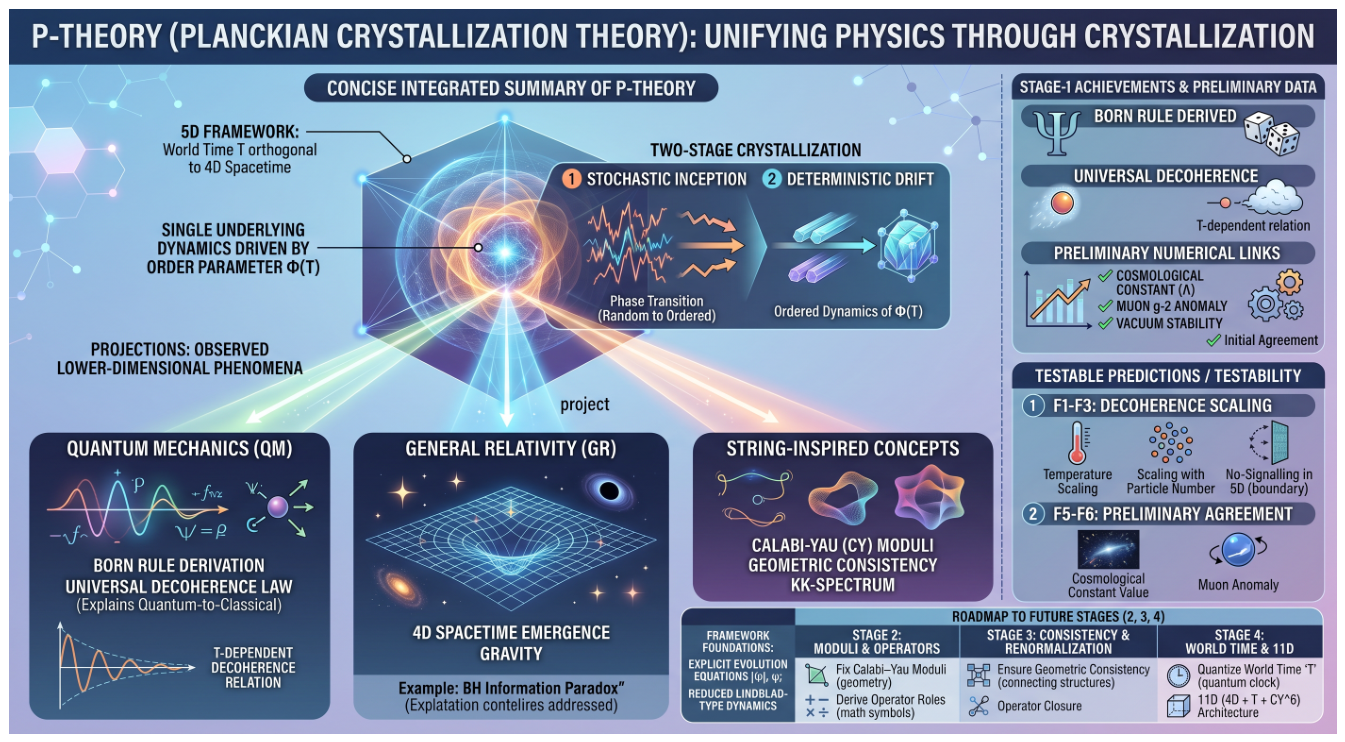
Disclaimer/Publisher’s Note: The statements, opinions and data contained in all publications are solely those of the individual author(s) and contributor(s) and not of MDPI and/or the editor(s). MDPI and/or the editor(s) disclaim responsibility for any injury to people or property resulting from any ideas, methods, instructions or products referred to in the content. |
© 2026 by the author. Licensee MDPI, Basel, Switzerland. This article is an open access article distributed under the terms and conditions of the Creative Commons Attribution (CC BY) license.
Copyright: This open access article is published under a Creative Commons CC BY 4.0 license, which permit the free download, distribution, and reuse, provided that the author and preprint are cited in any reuse.