

Submitted:
22 August 2026
Posted:
24 August 2026
You are already at the latest version
Abstract
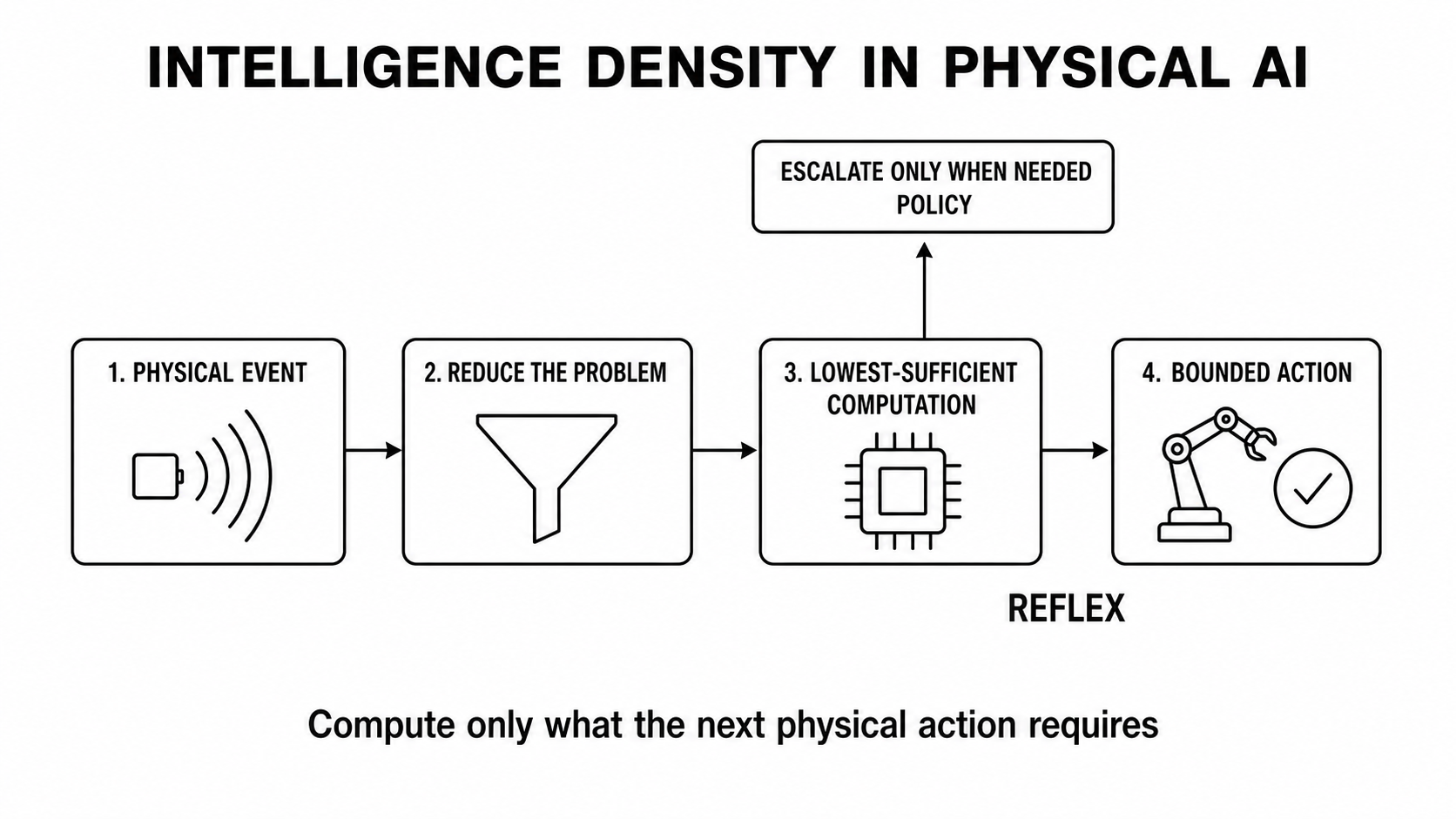
Artificial intelligence is becoming denser: equivalent capability can increasingly be achieved with fewer parameters, less memory and lower computational cost. For Physical AI, however, this is only the first of three efficiencies. A system may possess very large computational capacity, extract only a fraction of its possible useful intelligence from that capacity, and still devote more computation than the physical action actually requires. This Perspective argues that the first optimization should therefore occur before processor or model selection: reformulate the task so that only the information required for the next useful physical action must be computed. Nature repeatedly follows this strategy, from optic-flow control in insect flight to the vestibulo-ocular reflex and retinal preprocessing. Recent honeybee-inspired robot navigation provides an engineering example in which changing the representation of the navigation problem enables extremely compact computation. We propose embodied intelligence density as a family of system-level measures and position Reflex-Policy as one architecture for problem reduction, lowest-sufficient computation and selective escalation.
Keywords:
physical AI
; intelligence density
; problem formulation
; Reflex-Policy
; embodied intelligence
; energy proportionality
; neuromorphic computing
1. From Scaling Laws to Intelligence Density
Artificial intelligence has advanced through scale. Larger training sets, larger models and larger compute budgets have produced striking gains in language, vision and multimodal reasoning. Yet scale also creates an architectural temptation: when abundant computation is available, it becomes natural to formulate a rich problem first and then rely on the hardware to solve it. In Physical AI this can be wasteful even when the processor itself is highly energy efficient. The relevant question is not only how much computational power is installed, or how fully it is utilized, but how much of that power is converted into useful intelligence for the task and how much intelligence the physical action actually needs.
Physical AI couples sensing, computation and actuation to a body and environment. The relevant constraints are therefore not only model accuracy and inference throughput, but also the characteristic time of the physical event, the energy required to acquire and move information, the spatial distance between sensing and actuation, and the cost of acting too late. Recent discussion in Nature Machine Intelligence has emphasized that the move from embodied intelligence to Physical AI changes the scientific problem from describing the world to acting robustly within it [1]. A roadmap for AI in robotics similarly stresses that physical interaction imposes challenges that differ from those encountered in data analysis alone [2].
At the same time, AI research is moving from parameter count toward capability density. Xiao and colleagues formalized a relative capability-density measure for large language models and reported a 'densing law': over time, comparable capability has been achieved with progressively fewer parameters [3]. Compression, quantization, knowledge distillation and TinyML pursue related objectives by reducing the resource cost of a chosen model [4,5,6,7]. These developments show that a fixed amount of hardware or memory can support substantially more useful capability as algorithms and representations improve. For Physical AI, however, there is an additional step: even an excellent dense model can remain excessive if the immediate physical problem has been formulated more richly than necessary.
A useful public illustration of the possible gap was offered by Elon Musk in a January 2026 discussion on AI, when he argued that the potential intelligence density of current systems could be much greater per gigabyte without changing the underlying computer [28]. The statement should not be read as a measured CPU or GPU utilization result. It is better understood as a representative observation that present systems may convert only a small fraction of the computational potential available in their hardware and memory into useful intelligence. In practice, conventional processor utilization and intelligence density are different quantities, but they point toward the same architectural issue: available compute is not the same as useful intelligence. Physical AI adds a further question. Even if the hardware were used perfectly and the algorithm extracted its full potential, would the physical action actually require all of that intelligence?
The core proposition of this Perspective is therefore stronger than low-power AI. A highly efficient and highly utilized computer can still be the wrong first architectural choice if it is solving an unnecessarily rich problem. A physical system may need a small, timely and bounded action long before it needs a complete explanation of the world. If the physical variable that determines that action can be isolated, the required sensing, representation, communication and computation can fall dramatically. The design objective should therefore not only be to exploit the available computer more completely, but to determine how little of that computational potential needs to be activated in the first place.
2. Problem-Formulation Efficiency Precedes Compute Efficiency
Four levels should be distinguished. Computational capacity is the raw capability made available by processors, memory and communication. Utilization describes how much of that capacity is active. Intelligence extraction describes how much useful capability an algorithm and representation obtain from the available resources. Problem-formulation efficiency asks how much of that useful capability is actually required for the physical action. Hardware efficiency improves the cost of executing operations; model efficiency improves capability per parameter, byte or operation; problem-formulation efficiency changes the number and type of operations that need to exist at all. For embodied systems, this last level can dominate the previous two.
This distinction matters because data movement and state construction can be more expensive than the arithmetic that follows them [8,9]. A rich perception pipeline may require high-resolution sensing, analog-to-digital conversion, buffering, feature extraction, memory traffic, synchronization and communication before a control decision is reached. A processor can therefore be both energy efficient and highly utilized while the overall system remains inefficient. It may be efficiently reconstructing variables that the actuator does not need. In contrast, a directly actionable physical observable can bypass parts of that chain and reduce the computational demand before efficiency is even considered.
Problem reduction should not be confused with crude simplification. The objective is not to make the world appear simpler than it is, nor to force every decision into a binary rule. The objective is to identify the lowest-dimensional state that preserves the action-relevant information for a defined time horizon. When the reduced representation ceases to be sufficient—because context is ambiguous, risk is high or long-horizon consequences matter—the system must escalate to richer inference. The relevant architecture is therefore adaptive and conditional, not anti-computation.
This idea has antecedents in active perception, ecological approaches to perception and reactive robotics. Active perception treats sensing as an action-dependent process rather than passive data acquisition [10]. Brooks argued that some robotic competence can emerge without building a complete central representation [11]. Physical intelligence research likewise emphasizes that morphology, materials and local dynamics can perform part of the control problem [12,13]. The contribution proposed here is to connect these ideas to the contemporary discussion of intelligence density through a three-stage view: first increase the intelligence extracted from a given computational substrate; then identify the smallest action-relevant representation; finally activate only the computational layer required by the event.
3. Nature Often Solves a Different Problem
Natural nervous systems provide compelling examples because they possess substantial central computational capacity yet do not route every physical event through that capacity. Instead, evolution has selected sensor variables, local circuits and short pathways that are matched to recurrent physical tasks. These pathways do not imply that the animal lacks richer representations; they demonstrate that richer representation is not always the first requirement for useful action.
Honeybee Landing: Regulate an Optical Variable Rather than Reconstruct Distance
Landing appears to demand continuous estimates of distance to the surface, approach velocity, orientation and time to contact. Honeybees can instead regulate visual motion. Baird and colleagues showed that bees use image expansion during landing in a manner that allows speed to fall as the surface is approached [14]. The controller need not separately recover metric distance and velocity and then solve a trajectory optimization problem. A directly observable optical relation contains enough information for the immediate action. The physical problem has been reformulated from metric state reconstruction to regulation of an action-relevant invariant.
Corridor Flight: Relational Sensing Replaces Geometric Reconstruction
Related experiments on insect flight show how optic flow can regulate position and speed. A bee moving through a corridor can respond to relative image motion on the two sides instead of building a metric reconstruction of the corridor and explicitly estimating the distance to both walls [15,16]. The key variable is relational: imbalance in optic flow. This is computationally attractive because the comparison can be made close to the sensory stream and can drive control without constructing a global map.
Vestibulo-Ocular Reflex: Use the Short Pathway even when the Cortex is Available
The vestibulo-ocular reflex provides an even clearer demonstration of architectural choice. Humans possess a powerful visual cortex, yet rapid gaze stabilization during head movement is not delayed until cortical visual reconstruction is complete. A short vestibular pathway produces compensatory eye movement with only a few milliseconds of latency [17]. The lesson is not that the cortex is unimportant; it is that the most capable processor is not necessarily the correct processor for a physical deadline. A specialised low-latency pathway acts first, while richer processing remains available for interpretation, adaptation and learning.
Retina: Transform Before Transmitting
The retina similarly undermines the idea that sensing should produce a neutral raw stream for later central analysis. Retinal circuits perform spatial and temporal transformations, adaptation and feature-selective processing before information reaches the brain [18,19]. Recent work also shows that efficient biological coding is not equivalent to simply removing all redundancy; under natural gaze dynamics, retinal populations can preserve context-dependent redundancy that may support robust downstream inference [20]. The broader point is architectural: the sensory periphery decides what representation is useful to transmit. Local transformation can be part of intelligence.
Bee-Nav: An Engineered Example of Problem Reformulation
An especially relevant engineering result appeared in Nature in 2026. Ou and colleagues introduced Bee-Nav, a navigation method inspired by honeybee learning flights [21]. Rather than treating long-range homing as a requirement to build and maintain a detailed metric map of the environment, Bee-Nav combines path integration with a small learned mapping from omnidirectional visual input to a home vector. In real-world experiments, small neural networks of 3.4 kB and 42 kB supported successful return flights over tens to hundreds of metres. The design is not a universal replacement for SLAM; it deliberately solves a narrower task. That is precisely why it is important for the present argument.
Bee-Nav illustrates the difference between optimizing a general algorithm and reformulating the task. If the mission requires arbitrary localization, loop closure, map sharing and semantic querying, a richer representation is justified. If the mission is primarily to leave a known location and return, a home-vector representation can be sufficient. The computational advantage comes not only from better hardware or a smaller network but from refusing to solve the more general mapping problem when the physical objective does not require it.

Table 1.
Nature-inspired examples of problem reformulation. The examples illustrate task-specific reductions, not universal replacements for richer models.
Table 1.
Nature-inspired examples of problem reformulation. The examples illustrate task-specific reductions, not universal replacements for richer models.
| Physical task | Richer formulation | Reduced action-relevant representation | Architectural lesson |
|---|---|---|---|
| Landing | Estimate distance, speed and trajectory | Optical expansion / image motion | Control the variable that directly predicts safe approach. |
| Corridor centering | Reconstruct walls and corridor geometry | Left-right optic-flow balance | Relational sensing can replace metric reconstruction. |
| Gaze stabilization | Wait for rich visual interpretation | Fast vestibular-to-ocular pathway | Use the pathway matched to the physical deadline. |
| Early vision | Transmit a raw visual stream centrally | Retinal spatial-temporal transformation | Preprocess where information is generated. |
| Homing | Build a general metric map | Path integration + compact visual home vector | Match representation to the actual mission. |
4. From Model Density to Embodied Intelligence Density
The term intelligence density should therefore be used as an umbrella concept rather than a single scalar with mixed physical units. The capability-density framework for language models is well defined within its domain because model capability is compared with parameter count [3]. For Physical AI, the concept should be expanded carefully. A system can have high installed computational capacity but low useful intelligence density; it can also have a dense model but low embodied efficiency because the model is invoked for events that require only a simple local action. Embodied intelligence density therefore concerns the concentration of useful, timely and physically relevant decision capability, not merely the concentration of operations or parameters.
This suggests a useful hierarchy. The first ratio concerns useful intelligence extracted from available computational capacity. The second concerns useful intelligence actually required by the physical event. A large gap can exist at either stage. Better algorithms may extract more intelligence from the same gigabyte of memory or the same processor. Better problem formulation may then show that only a small part of that richer intelligence must be activated for the immediate action. The strongest system combines both: dense general intelligence when needed, and sparse local intelligence when sufficient.
This view also separates intelligence density from low-power electronics. A very efficient NPU may still be invoked too frequently. A processor may operate at high utilization while processing unnecessary state. A highly compressed model may still reconstruct variables that the actuator does not need. Conversely, a local comparator, state machine, event-based sensor or tiny neural network can have high embodied intelligence density when it provides exactly the information needed for a valuable physical response. The relevant benchmark is therefore not processor activity alone, but useful action per unit of total system resource.
Neuromorphic computing is relevant because event-driven sensing and processing naturally align computation with changes in the physical world [22,23]. In-memory and non-volatile computing are relevant because they can reduce data movement and retain local state [24]. But no hardware substrate guarantees high intelligence density. The architecture must first decide which problem belongs locally and which problem requires richer policy-level computation.
5. Reflex-Policy as a Consequence of Problem Reduction
The Reflex-Policy architecture provides one way to operationalize this principle [25,26]. Its purpose is not to place all intelligence at the edge or to replace learned models with fixed rules. It separates bounded, time-critical and locally observable events from decisions that require broader context, prediction, semantic interpretation or long-horizon optimization. In this sense, Reflex-Policy is not mainly an argument for smaller computers. It is an argument for activating only the fraction of the system's intelligence that the current physical event justifies.
A reflex path has a defined event contract: the evidence that can trigger it, the action it is permitted to take, its validity range, its maximum duration, its exit condition and the conditions that force escalation. A policy path has a different contract: integrate uncertain evidence, compare alternatives, learn from history, update parameters and decide when the local representation is no longer sufficient. The two paths are mutually dependent. Policy constrains reflexes; reflexes protect policy from unnecessary high-frequency workload.
The design sequence is therefore inverted relative to an AI-first approach. First, identify the physical action and its deadline. Second, determine the minimum observable state that can justify that action. Third, select the lowest-sufficient computational mechanism. Fourth, specify the uncertainty that must be escalated. Only then should the designer ask whether the policy layer requires a microcontroller, FPGA, NPU, GPU, cloud model or world model. This approach preserves the value of powerful computers while avoiding the assumption that their full representational capability should be exercised for every event.
The Abacus Paradox captures an extreme case of this principle [27]. A very small rule can outperform a vastly more capable accelerator on the narrow metric of first safe action when the immediate physical decision is low-dimensional. The paradox disappears once the objective is stated correctly: the small mechanism is not more intelligent in general; it has been assigned a smaller problem whose solution is more urgent.
6. Energy Proportionality: Do not Spend More Intelligence than the Action is Worth
Problem reduction has an energy consequence because the cost of intelligence includes more than arithmetic. Sensing, signal conditioning, analog-to-digital conversion, memory access, communication, processor wake-up and switching can all contribute to the total control cost. Energy proportionality therefore asks whether the sophistication and activation frequency of the computational path are commensurate with the physical value of the event.
In earlier Reflex-Policy work, Energy Returned on Invested Energy for Embodied Intelligence (EROIE) was introduced as a system-level accounting concept for cases in which the useful physical outcome can be expressed as energy returned, recovered or protected [25]. It can be written conceptually as:
where invested control energy includes the relevant sensing-to-action boundary. EROIE is not the same as decisions per joule. 'Safe actions per joule' or 'validated decisions per joule' are useful decision-efficiency metrics, whereas EROIE applies when physical energy benefit can be meaningfully quantified—for example, energy harvesting, battery protection or loss avoidance.
EROIE = Euseful returned or protected / Einvested control
The distinction prevents a common mistake: celebrating the efficiency or utilization of a processor while ignoring whether the processor needed to wake, reconstruct or communicate that information at all. A system can contain an excellent low-power computer, run it close to full utilization and still be inefficient if it repeatedly reasons about events that could have been resolved by a simpler local observable. Problem-formulation efficiency therefore sets a more fundamental bound: the best operation is not always the cheapest operation, but sometimes the operation that was removed from the problem altogether.
7. A Falsifiable Research Programme
The argument should be tested at the system level rather than accepted as a metaphor. For the same physical task, three implementations should be compared: a rich inference-first pipeline; a lower-power or compressed version of the same pipeline; and a problem-reduced architecture in which a local pathway handles defined events and escalates the remainder. The comparison should include the complete sensor-to-action chain, not only accelerator benchmarks.
At least six quantities are important. First, end-to-end latency distributions, including tail latency, determine whether deadlines are met. Second, total energy per event should include sensing, conversion, memory and communication. Third, information traffic should quantify how many bytes or events must cross architectural boundaries. Fourth, false and missed interventions measure the cost of reduction. Fifth, escalation rate measures how often the local representation proves insufficient. Sixth, physical outcome quality determines whether a fast local response actually preserves safety or value.
Table 2.
Suggested system-level measurements for comparing inference-first, compressed and problem-reduced Physical AI architectures.
Table 2.
Suggested system-level measurements for comparing inference-first, compressed and problem-reduced Physical AI architectures.
| Metric | What it tests | Why it matters |
|---|---|---|
| Sensor-to-action latency | Whether the reduced path meets physical deadlines | Average inference latency can hide queueing and communication delays. |
| Total event energy | Complete sensing-to-action cost | Prevents processor-only efficiency claims. |
| Information traffic | Degree of event compression and locality | Measures how much representation is moved rather than acted on locally. |
| False / missed intervention | Safety cost of problem reduction | A smaller representation is useful only if it remains reliable. |
| Escalation rate | How often richer context is genuinely required | Defines the boundary between reflex and policy. |
| Outcome value / EROIE | Physical benefit of acting | Links intelligence expenditure to the value returned or protected. |
The central prediction is conditional. When routine events are low-dimensional, physically local and frequent, while only a minority of events require rich context, a problem-reduced architecture should activate only a small fraction of the available computational hierarchy for most events and should show lower end-to-end energy and latency than either an unoptimized or optimized monolithic pipeline. The phrase 'small fraction' is intentionally qualitative here: it is a design hypothesis to be measured application by application, not a universal utilization percentage. The advantage should increase as the ratio of routine events to ambiguous exceptional events increases. In contrast, if almost every event requires escalation, the local layer will add overhead without providing much value.
This prediction makes intelligence density experimentally tractable. The question is not whether one hardware technology is intrinsically superior. It is whether the overall architecture concentrates useful computation where it produces physical value. Negative results are important: applications in which local reduction causes excessive false actions, loses essential context or fails under distribution shift should be reported as clearly as successful cases.
8. Where Problem Reduction Fails
Problem reduction has hard limits. Some actions depend on hidden variables that cannot be inferred locally. Others involve conflicting objectives, social context, long-horizon consequences or rare events whose safe response changes with the broader scene. An obstacle may justify immediate deceleration from local optical evidence, but a full evasive manoeuvre may depend on adjacent traffic, road geometry and human intent. A battery anomaly may justify current limiting, but a reconfiguration strategy can depend on thermal state, aging and mission requirements.
Reduced variables can also become brittle under sensor failure or environmental change. An optic-flow strategy that works in textured environments may fail when visual structure disappears. A threshold chosen from historical data can become unsafe when component aging changes the plant. For this reason, local pathways require validity domains, confidence or consistency checks, safe defaults and explicit escalation. The architecture should treat uncertainty as a reason to recruit more representation, not as a reason to force a simple rule.
There is also a governance problem. If policy layers can update local rules, those updates must be constrained, versioned and auditable. The benefit of a deterministic low-level path is lost if its permissible action can drift without verification. Thus intelligence density should not be optimized independently of assurance. A slightly more expensive local pathway may be preferable if it provides stronger fault detection, traceability or certification evidence.
9. Research Directions
A useful research agenda follows from the distinction among computational capacity, intelligence extraction and problem-formulation efficiency. First, Physical AI benchmarks should report actionable-state dimensionality: how many variables are required to justify the first physical response, and which additional variables are needed only for later interpretation. Second, benchmarks should report what fraction of events can be resolved at each computational layer, rather than only peak inference throughput. Third, datasets and simulators should label decision urgency and the cost of delay. Fourth, hardware evaluations should include complete sensor-to-action energy rather than processor energy alone.
Fifth, learning systems should investigate how higher-level models can discover and validate lower-dimensional control variables. Nature provides many such variables through evolution; engineered systems may be able to learn them from experience. A world model could therefore serve not only as an online controller but as a teacher that identifies recurrent situations, proposes compact event contracts and transfers verified low-dimensional rules downward. This would combine the flexibility of large models with the efficiency of local execution.
Sixth, research should explore when representation can be delegated to morphology, materials or analog dynamics. Embodied intelligence can reside partly in compliant bodies, sensor geometry and physical coupling rather than only in digital computation [12,13]. Finally, common reporting standards are needed for escalation rate, tail latency, useful action energy and failure under distribution shift. Without such system-level measures, intelligence-density claims risk becoming another isolated hardware metric.
10. Conclusions
The transition from scaling laws to densing laws is a valuable shift in AI: it asks how much capability can be obtained from a smaller computational footprint. Physical AI requires two further questions. How much of the available computational potential is converted into useful intelligence? And, of that useful intelligence, how much does the physical action actually require? The first question motivates denser algorithms and representations. The second motivates problem reduction, locality and selective activation.
Nature repeatedly answers physical challenges by choosing action-relevant variables, local transformations and pathways matched to the timescale of the event. Honeybees need not reconstruct metric distance to land; optic flow can be enough. The vestibulo-ocular reflex does not wait for the cortex. The retina transforms information before transmission. Bee-Nav shows that an engineered navigation task can also be reformulated around a compact home-vector representation rather than a general map.
These examples suggest a broader interpretation of intelligence density. Intelligence is dense when a small amount of sensing, representation and computation produces a large amount of timely physical value. A system should therefore be judged not only by the intelligence it can potentially deliver, but by how selectively it deploys that intelligence. Reflex-Policy is one possible architecture for realizing this principle: reduce the problem first, allocate it to the lowest-sufficient computational layer, and escalate only when the physical situation genuinely demands richer intelligence. The most energy-efficient powerful computer is therefore not always the best first answer. Sometimes the larger gain comes from discovering that most of its potential capability did not need to be activated for that event.
Scope and Status of this Perspective
This is a non-primary Perspective. It does not report new experimental results, introduce a new dataset or claim an empirically demonstrated performance advantage for Reflex-Policy. The article synthesizes published evidence from AI efficiency, biological sensorimotor control, neuromorphic computing and robotics to formulate a forward-looking systems hypothesis and a set of measurements by which that hypothesis can be tested.
Author Contributions
P.P.: conceptualization, methodology, analysis, writing - original draft, and writing - review and editing.
Funding and Acknowledgements
This work was supported by the European Commission through URBANE (grant agreement 101069782) and STEEL ALIVE (grant agreement 101216680).
Data Availability Statement
No new datasets were generated or analysed for this Perspective.
AI-Assisted Language and Document Preparation
Generative AI tools were used to assist with language editing and document formatting. The author reviewed and approved the entire manuscript and takes full responsibility for its content.
Conflicts of Interest
The author is employed by IFEVS and has contributed to patent applications related to Reflex-Policy concepts and low-bit physical control architectures. The author declares no other conflicts of interest.
References
- From embodied intelligence to physical AI. Nat. Mach. Intell. 2026, 8, 491–492. [CrossRef]
- Billard, A.; et al. A roadmap for AI in robotics. Nat. Mach. Intell. 2025, 7, 818–824. [Google Scholar] [CrossRef]
- Xiao, C.; et al. Densing law of LLMs. Nat. Mach. Intell. 2025, 7, 1823–1833. [Google Scholar] [CrossRef]
- Han, S.; Mao, H.; Dally, W. J. Deep Compression: compressing deep neural networks with pruning, trained quantization and Huffman coding. ICLR 2016. [Google Scholar] [CrossRef]
- Hinton, G.; Vinyals, O.; Dean, J. Distilling the knowledge in a neural network. arXiv 2015, arXiv:1503.02531. [Google Scholar]
- Lai, L.; et al. MCUNetV2: memory-efficient patch-based inference for tiny deep learning. Adv. Neural Inf. Process. Syst. 2021, 34. [Google Scholar]
- Sze, V.; Chen, Y.-H.; Yang, T.-J.; Emer, J. S. Efficient processing of deep neural networks: a tutorial and survey. Proc. IEEE 2017, 105, 2295–2329. [Google Scholar] [CrossRef]
- Horowitz, M. Computing's energy problem (and what we can do about it). IEEE International Solid-State Circuits Conference, 2014; pp. 10–14. [Google Scholar] [CrossRef]
- Sebastian, A.; Le Gallo, M.; Khaddam-Aljameh, R.; Eleftheriou, E. Memory devices and applications for in-memory computing. Nat. Nanotechnol. 2020, 15, 529–544. [Google Scholar] [CrossRef] [PubMed]
- Bajcsy, R. Active perception. Proc. IEEE 1988, 76, 996–1005. [Google Scholar] [CrossRef]
- Brooks, R. A. Intelligence without representation. Artif. Intell. 1991, 47, 139–159. [Google Scholar] [CrossRef]
- Howard, D.; et al. Evolving embodied intelligence from materials to machines. Nat. Mach. Intell. 2019, 1, 12–19. [Google Scholar] [CrossRef]
- Sitti, M. Physical intelligence as a new paradigm. Extrem. Mech. Lett. 2021, 46, 101340. [Google Scholar] [CrossRef]
- Baird, E.; Boeddeker, N.; Ibbotson, M. R.; Srinivasan, M. V. A universal strategy for visually guided landing. Proc. Natl. Acad. Sci. USA 2013, 110, 18686–18691. [Google Scholar] [CrossRef]
- Srinivasan, M. V. Honeybees as a model for the study of visually guided flight, navigation, and biologically inspired robotics. Physiol. Rev. 2011, 91, 413–460. [Google Scholar] [CrossRef]
- Cope, A. J.; et al. A model for an angular velocity-tuned motion detector accounting for deviations in the corridor-centering response of the bee. PLoS Comput. Biol. 2016, 12, e1004887. [Google Scholar] [CrossRef]
- Huterer, M.; Cullen, K. E. Vestibuloocular reflex dynamics during high-frequency and high-acceleration rotations of the head on body in rhesus monkey. J. Neurophysiol. 2002, 88, 13–28. [Google Scholar] [CrossRef]
- Doi, E.; et al. Efficient coding of spatial information in the primate retina. J. Neurosci. 2012, 32, 16256–16264. [Google Scholar] [CrossRef]
- Baden, T.; Euler, T.; Berens, P. Understanding the retinal basis of vision across species. Nat. Rev. Neurosci. 2020, 21, 5–20. [Google Scholar] [CrossRef] [PubMed]
- Karamanlis, D.; et al. Nonlinear receptive fields evoke redundant retinal coding of natural scenes. Nature 2025, 637, 394–401. [Google Scholar] [CrossRef]
- Ou, D.; et al. Efficient robot navigation inspired by honeybee learning flights. Nature 2026, 653, 1039–1046. [Google Scholar] [CrossRef]
- Roy, K.; Jaiswal, A.; Panda, P. Towards spike-based machine intelligence with neuromorphic computing. Nature 2019, 575, 607–617. [Google Scholar] [CrossRef] [PubMed]
- Gallego, G.; et al. Event-based vision: a survey. IEEE Trans. Pattern Anal. Mach. Intell. 2022, 44, 154–180. [Google Scholar] [CrossRef]
- Grollier, J.; et al. Neuromorphic spintronics. Nat. Electron. 2020, 3, 360–370. [Google Scholar] [CrossRef]
- Perlo, P.; Dalmasso, M.; Penserini, D.; Pozzato, S. Physical AI as Seen from Nature: A Reflex-Policy Layered Architecture for Energy-Proportional Embodied Intelligence; Preprints.org, 2026. [Google Scholar] [CrossRef]
- Perlo, P. Reflex-Policy Architecture in Physical AI: Latency, Throughput, Bandwidth and the Role of Spintronic Devices; Preprints.org, 2026. [Google Scholar] [CrossRef]
- Perlo, P. The Pallottoliere/Abacus Paradox: Why a Low-Bit Local Rule Can Outperform Advanced AI for the First Safe Action in Physical Spatial AI; Preprints.org, 2026. [Google Scholar] [CrossRef]
- Musk, E. Moonshots with Peter Diamandis, episode 220 discussion at approximately 1:17 h. 2026. [Google Scholar]
Disclaimer/Publisher’s Note: The statements, opinions and data contained in all publications are solely those of the individual author(s) and contributor(s) and not of MDPI and/or the editor(s). MDPI and/or the editor(s) disclaim responsibility for any injury to people or property resulting from any ideas, methods, instructions or products referred to in the content. |
© 2026 by the authors. Licensee MDPI, Basel, Switzerland. This article is an open access article distributed under the terms and conditions of the Creative Commons Attribution (CC BY) license (http://creativecommons.org/licenses/by/4.0/).
Copyright: This open access article is published under a Creative Commons CC BY 4.0 license, which permit the free download, distribution, and reuse, provided that the author and preprint are cited in any reuse.