

Submitted:
20 August 2026
Posted:
21 August 2026
You are already at the latest version
Abstract
The desire to employ wearable electronics and smart textiles has been excitingly driving researchers to design flexible devices for energy conversion and storage. Carbon cloth has been recommended as an electrode skeleton because of its flexibility, chemical stability, safety, environmental friendliness, affordability, excellent electrical conductivity, and high mechanical strength. This review sheds light on recent advances and challenges in CC-based hybrid electrodes for supercapacitors. Four general strategies have proven efficacious in augmenting the electrochemical performance. Firstly, treatment of the CC surface via chemical, thermal, or electrochemical activation processes aims to introduce pores and oxygen functional groups that increase specific surface area and wettability. Secondly, the combination of transition metal compounds, conductive polymers, and carbon forms on hybrid electrodes utilizes both charge storage mechanisms of EDLC and pseudocapacitors. Thirdly, optimization of synthesis parameters is a prime practice to obtain favorable morphology and crystallinity. Fourthly, the integration of current collectors, electrodes, and electrolytes by conformal coating of active materials on carbon microfibers preserves the 3D nature of the cloth. Last but not least, analysis of cycling stability receives a great deal of attention for practical considerations. By following these strategies, CC-based hybrid supercapacitors hit the apex of their performance, scoring colossal specific capacitances, energy and power densities, and stability.
Keywords:
carbon
; cloth
; supercapacitor
; flexible
; energy
; storage
; nanomaterial
; polymer
; metal
; wearable
1. Introduction
Interest in developing efficient, safe, and
ecologically sustainable electrochemical energy storage systems has become
unprecedentedly high, as it has been driven by the surge in the use of
electronic devices and renewable energy technologies, such as solar, wind, and
geothermal energy. Supercapacitors (SCs), or electrochemical capacitors, as
high-power energy storage devices, have been extensively utilized in hybrid
automobiles, energy recovery systems, and emergency power supplies, among other
applications. However, low energy density, rigidity, and the bulky nature of
current SCs have restricted their design and utilization in flexible, portable,
and wearable electronics. The ability to bend, twist, and fold has been desired
in smart textiles, bendable phones, curved screens, electronic skin, and health
monitoring bracelets [1].
Supercapacitors are basically classified depending
on their charge storage mechanisms into three classes: electric double-layer
capacitors (EDLCs), pseudocapacitors or Faradic capacitors, and hybrid
supercapacitors (HSCs) or asymmetric supercapacitors (ASCs). In EDLCs, charges
are electrostatically accumulated in the interface between porous electrodes
and appropriately sized electrolyte ions. Fast charging and discharging
processes occur in the electric double layer that is called the Helmholtz
layer. Differently, charges in pseudocapacitors are chemically bonded by
Faradic redox reactions between reduced/oxidized electrodes and compatible
electrolytes. This mechanism resembles batteries more than capacitors. Such
repeated reactions during charging-discharging processes result in a degradation
of electrode materials and an increase in the internal resistance.
Consequently, pseudocapacitors in most cases exhibit lower cyclic stability
compared to EDCLs, but higher energy density. The features of both mechanisms
are combined in HSCs or ASCs. The operating voltage of ASCs is generally wider
than that of symmetric SCs, which leads to an increase in energy density. As a
rule, the electrochemical performance of supercapacitors is basically evaluated
through three main experiments, which are cyclic voltammetry (CV),
galvanostatic charge–discharge (GCD), and electrochemical impedance spectroscopy
(EIS).
A variety of nanomaterials have been hybridized in
one or both electrodes of HSCs, utilizing their superior specific surface area
compared to bulk materials. Metal-organic frameworks (MOFs) [2], layered double hydroxides (LDHs) [3], multivalent metal elements [4], and bimetallic oxide-conducting polymer
composites [5] have been widely reported as promising
electrodes of HSCs. Various nanomaterials have been simply and cost-effectively
prepared via chemical solution–based deposition techniques on different
substrates, achieving results for HSCs on par with complex and costly
techniques like atomic layer deposition (ALD) [6].
Unlike flat substrates, carbon cloth (CC) is an affordable commercial textile
of a three-dimensional (3D) network of carbon microfibers (5-10 μm). In
addition, CC is lightweight, safe, breathable, moisture-permeable, and woven,
making it suitable for wearable SCs. It has excellent electrical conductivity,
mechanical strength, flexibility, chemical stability, and environmental
friendliness. Because of these outstanding properties, CC-based hybrid
electrodes [7] and treated CC self-standing electrodes [8] for supercapacitors have been of prime
interest. Carbon cloth has been employed not only in supercapacitors, but also
in other energy storage and conversion devices, including lithium-ion batteries
and solar cells [9,10]. Recently, an asymmetric
photo-assisted supercapacitor was built based on CeO2-MnO2/CC
at one end and photosensitive CeO2-MnO2/FTO at the other
end [11]. In light, the areal capacitance was 4.8
mF/cm2, higher than in the dark (2.8 mF/cm2).
On the carbon cloth substrate, the hydrothermal
synthesis and HCS performance of conductive polymers, carbon materials, metal
compounds, and composite materials were reviewed by Wang and co-authors in 2021
[12]. Interestingly, researchers have still
been reporting innovative synthesis techniques, advanced materials, and
improved performance of CC-based supercapacitors. In the following content,
such recent advances are thoroughly summarized and critically compared, giving
comprehensive coverage of challenges and opportunities. Most of the selected
original articles herein were published between 2021 and 2026 and indexed in
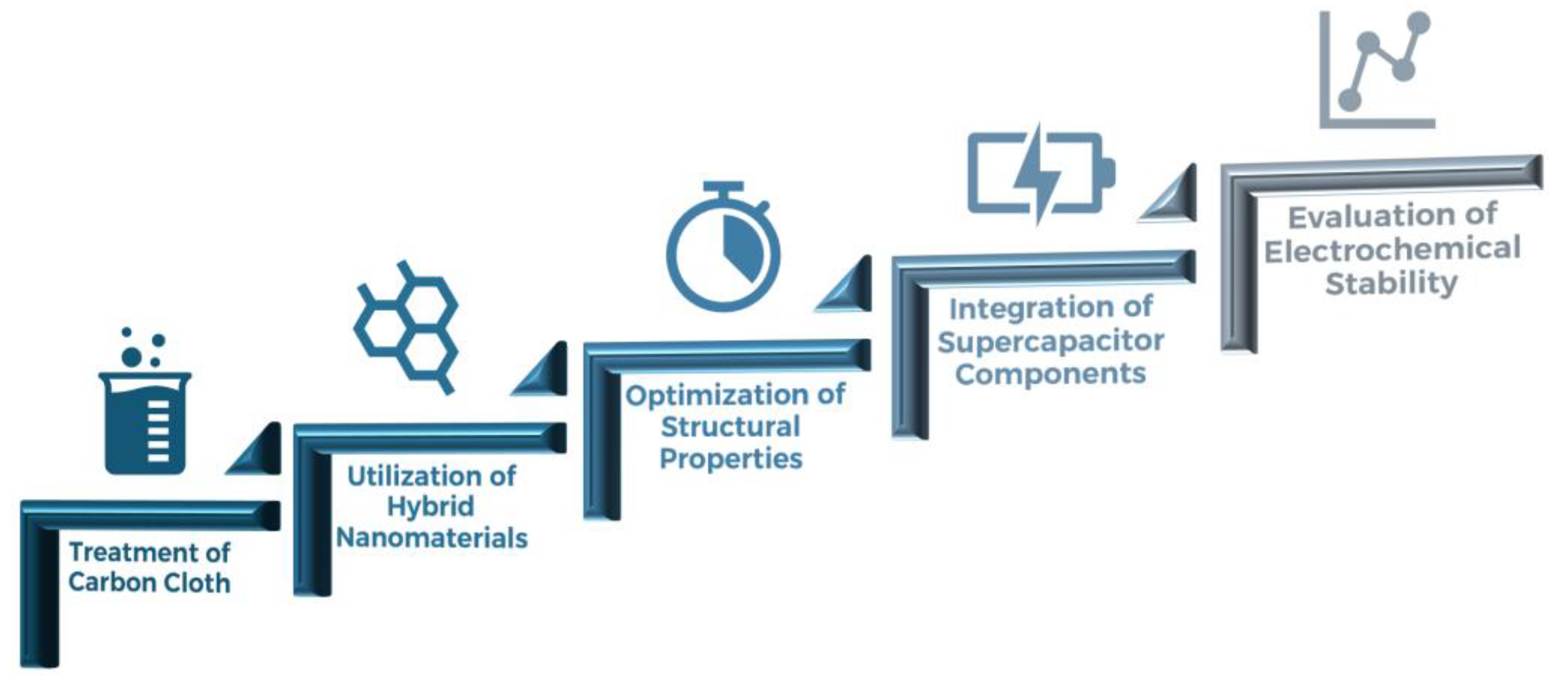
Web of Science. Each section of this review sheds light on effective strategies
that are categorized in a roadmap, pointing toward improving carbon cloth-based
supercapacitors, as outlined in Figure 1.
Figure 1.
A staircase roadmap of effective strategies for improving carbon cloth-based hybrid supercapacitors.
Figure 1.
A staircase roadmap of effective strategies for improving carbon cloth-based hybrid supercapacitors.
2. Treatment of Carbon Cloth
Whether used as a self-standing electrode or a
current collector substrate in supercapacitors, the surface of carbon cloth
requires pre-processing. Chemical and physical treatments are applied to enhance
the surface properties as well as supercapacitor performance. At the
electrode-electrolyte interface, increasing the overpotentials of the oxygen
evolution reaction (OER) or hydrogen evolution reaction (HER) is one strategy
to broaden the operating voltage window of supercapacitors, hence elevating the
energy. In one study by Xu and others [13],
CC was activated in Li2SO4 solution, then modified using
the amino acid of L-Lysine. In an aqueous electrolyte of Na2SO4,
the modified CC showcased a potential window versus Ag/AgCl from −0.8 to 0.7 V,
wider than that of the unmodified CC from −0.8 to 0.4 V. The OER was impeded by
the amphoteric dissociation of L-Lysine, which regulated the pH of the
microenvironment between the electrode and the electrolyte. Based on that, a
symmetric SC of L-Lysine-modified CC operated in 1.5 V range, which is wider
than 1.2 V of the unmodified SC. The increase in voltage yielded a 59.42%
increase in energy density of the CC-L-Lysine SC.
There is a proportional relationship between
electrode capacitance and surface area that is accessible by electrolyte ions.
Based on that, creating pores on CC is an effective strategy especially for
self-standing CC electrodes. As proof of this, the CC surface was etched by
immersing CC in a mixture of acetic acid and potassium chlorate at 180 ◦C for
12 h, creating nanopores and oxygen-containing functional groups [14]. Therefore, Brunauer–Emmett–Teller (BET)
specific surface area of 1.5 m2/g for the untreated CC was increased
by two orders of magnitude to 137.9 m2/g for the treated CC. The
amount of oxygen attached to the CC was also elevated from 4.6 at. % to 11.8
at. %. The large surface area and the oxygen content improved the areal
capacitance from 68 mF/cm2 to 7758 mF/cm2 at 0.5 mA/cm2.
Furthermore, Su et al. activated carbon cloth, called ACC, using a solution of
MoCl5, ethylene diamine tetraacetic acid, and ammonium acetate in
the electrodeposition process at −1.0 V for 5 min, followed by drying at 60 °C
for 12 h, and annealing at 400 °C for 6 h [15].
The resultant mesoporous ACC displayed a surface area of 185.7 m2/g
and a pore volume of 0.118 cm3/g, compared to 46.6 m2/g
and 0.059 cm3/g of untreated CC. In addition, an increase in oxygen
content occurred from 4.9 at. % on CC to 11.7 at. % on ACC. An areal
capacitance of 1000 mF/cm2 at 2 mA/cm2 resulted due to
the large surface area and functional groups. Moreover, a perfect cycling
stability of 100% capacitance retention during 10000 cycles at 16 mA/cm2
was achieved. When the electrodepositing time was prolonged to 10 min, the
areal capacitance dropped to 677 mF/cm2. This was because of the
decrease in the shell layer thickness as measured by TEM images, caused by the
rougher edge structure and denser carbon exfoliation. A similar electrochemical
activation process of CC in HNO3 and H2SO4 at
3 V for 12 min was reported [16]. Then, the ACC
was coated with a biomass-derived carbon (BMC). As expected, the BMC/ACC
electrode showed higher areal capacitance (1157 mF/cm2 at 4 mA/cm2)
than the BMC/CC electrode and ACC electrode.
Coating carbon cloth microfibers with metals is a
successful approach to augment the conductivity of CC-based electrodes. For
example, CC was coated with dense Ni grains using an electroplating bath
containing NiSO4⋅6H2O,
Na3C6H5O7, NH4Cl, NaOH,
and NaH2PO2 in DI water at 45 °C for 20 min [17]. The Ni-CC prepared by Sudhakaran and
co-authors was used as a substrate for a directly electrodeposited β-Co(OH)2@CoNi2S4
core-shell heterostructure. As a result of that, it successfully showed low
solution resistance (Rs) of 1.1 ohm and charge transfer resistance
(Rct) of 1.8 ohm. Similar results were obtained but using another
way by our group for porous carbon nanostructure derived from date palm fronds.
This carbon powder was activated either chemically in NaOH or physically in CO2,
then drop-casted on carbon cloth [18].
An excellent specific surface area of 1011 m2/g, specific
capacitance of 126 F/g, and Rct of 1.8 ohm were obtained for
NaOH-activated carbon, superior to 603.5 m2/g, 57 F/g, and 1.5 ohm
for the CO2-activated carbon.
Compared with the abovementioned CC activated by
hydrothermal and electrodeposition, a higher BET specific surface area of
329.8699 m2/g was recorded by Akhbar and others using a simple heat
treatment at 400 °C for 6 h in the air [19].
The values of pore volume and pore size were 0.183707 cm3/g and
2.2276 nm. On top of ACC, NiCo nanoneedles were coated with NiOOH nanoflakes
and CoMoO4 nanosheets using hydrothermal and dip-dry coating
methods. The core-shell heterostructure of the hybrid electrode of
ACC@NiCo@NiOOH@CoMoO4 provided an extraordinary areal capacitance of
2920 mF/cm2 at 1 mA/cm2 and 2541 mF/cm2 at 10
mA/cm2. A fabricated ASC of ACC@NiCo@NiOOH@CoMoO4//ACC
offered an excellent areal energy density of 101 mWh /cm2 coupled
with a remarkable areal power density of 125 mW /cm2. It is worth
noting that this low-cost supercapacitor was stable by 92% after 10000 cycles
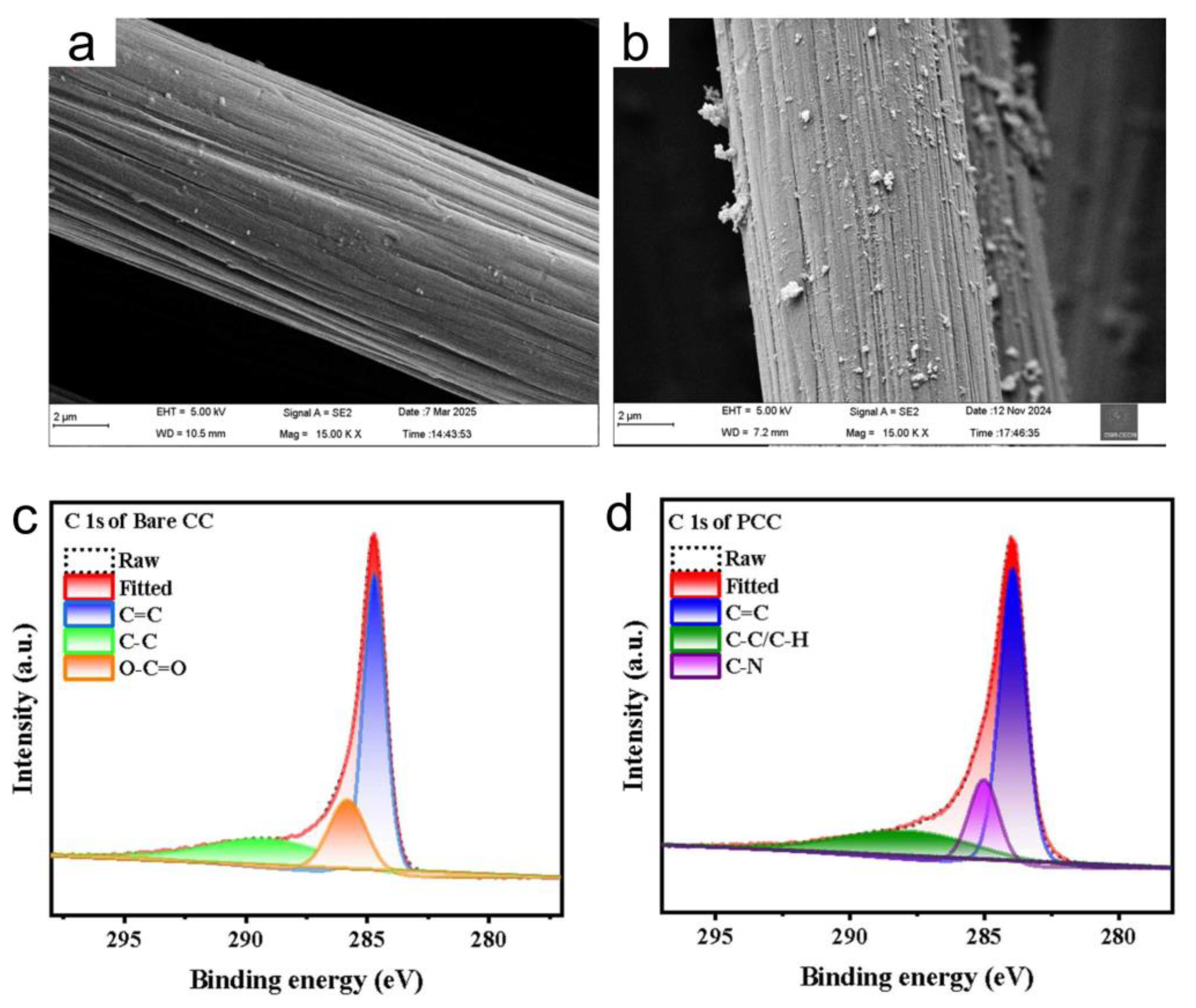
of charging and discharging at 8 mA/cm2 in the range of 0-1.7 V. Figure 2 shows SEM images and XPS spectra of
bare CC and pretreated carbon cloth (PCC) [20].
The pretreatment involved heating at 600 °C in argon then dipping in 60% nitric
acid for 6 h. The cracks and structural defects in PCC were ascribed to
chemical oxidation, thereby improving the surface wettability. The XPS
confirmed that the treatment of CC produced hydroxyl ( ̶ OH), carbonyl (C––O),
and carboxylic acid ( ̶ COOH) groups. Likewise, an outstanding specific surface
area of 1031.5 m2/g was reached through activating CC in aqueous 5 M
KOH at 100 °C for 1 h by Xu et al. [21].
Comparing this result with the untreated CC in the same study, the treated CC
had a 33 times higher specific surface area. A rough and porous structure was
displayed on the CC surface after the treatment with bases. Besides, this ACC
electrode showed better capacitance than ACC treated in mixed acids, where both
samples were tested electrochemically in KOH electrolyte. A partial dissolution
of CC in H2SO4 and HNO3 was noted, affecting
the mechanical strength. Furthermore, they found that the activation in KOH for
30 min or longer led to more stable capacitance than that of the activated
electrodes in 0, 10, and 20 min. Such wet chemical methods of activation are simple
and widely applied to introduce pores and oxygen groups on the CC surface,
leading to improved surface area, wettability, and capacitance of CC-based
electrodes.
Figure 2.
SEM images of a) Bare CC; and b) pretreated CC. XPS analysis of (c) bare CC; and (b) pretreated CC [20].
Figure 2.
SEM images of a) Bare CC; and b) pretreated CC. XPS analysis of (c) bare CC; and (b) pretreated CC [20].
3. Utilization of Hybrid Nanomaterials
Incorporating nanostructured materials on the same
current collector substrate as a hybrid electrode has been extensively
recognized as a powerful strategy for betterment in the electrochemical
performance of SCs. Nanomaterials of transition metal compounds, conductive
polymers, and carbon forms have been the core active materials of SCs
electrodes. The areal capacitances of various CC-based electrodes have been
compared at a common areal current. For instance, the areal capacitances in
mF/cm2 at 1 mA/cm2 were 4008 for Ni-Mn metal-organic
framework [22], 3834 for MoS2 [23], 2312 for polyaniline [24], 2120 for tetraaniline [25], 1018 for boron and nitrogen-doped
carbon [26], and 494 for SnO2@PPy [27], all on CC. At 2 mA/cm2 in
other reports, the areal capacitances in mF/cm2 were 4303 for
nitrogen, boron, and fluorine co-doped carbon nanotubes (NBF-CNT) [28], 4082 for nitrogen-doped carbon
nanotubes (N-CNT) [29], and 1796 for polypyrrole on wolfram
carbide [30], all on CC. In the following
subsections, detailed cases are reviewed under each class of electrode
materials.
3.1. Transition Metal Compounds
Transition metal chalcogenides, hydroxides,
nitrides, phosphides, and related compounds have been categorized as
pseudocapacitive materials mainly due to their redox activity. As SC
electrodes, examples of transition metal compounds on carbon cloth include, but
are not limited to, NiS2, NiO, Ni(OH)2, Ni2P [31], Ni2P/Ni(OH)2 [32], MnO2/TiN, Fe2O3/TiN
[33], WS2, Ni-WS2 [34], WS2/graphene [35], FeNb2O6 [36], CuO [37],
Ni(OH)2/CuO [38], gallium oxynitride [39], Co3O4/Ni-based
MOFs [40], and CoxMn3-x(PO4)2/MXene
[41]. Hybrid CC-based electrodes have been
carefully designed and fabricated in complex hierarchical architectures such as
hollow spheres of a carbon layer between α-Fe2O3 outer
and inner shells [42], a core-shell framework of Mn(OH)2
and CuO on Cu-coated carbon cloth [43],
and NixCo2x(OH)6x nanoflake layer on MoO3
arrays on CC [44]. In particular, MnCo2O4
hollow nanospheres with multi-hierarchical pores were grown on activated carbon
cloth by Zhu and his colleagues, resulting in a specific surface area up to
110.2 m2/g. Their ASC of MnCo2O4/ACC//ACC
delivered 0.8 mWh/cm3 of energy density at 9.8 mW/cm3 of
power density with 87% capacitance retention after 5000 GCD cycles at 45 ° of
bending [45]. Another core-shell hierarchical
nanostructure was designed by Li and co-authors [46].
Initially, carbon cloth were hydrothermally coated with nickel-doped Ga2O4
nanowalls, then with MnO2 nanoflakes on NiGa2O4
nanowalls. The large specific surface area of the 3D core-shell hierarchical
nanostructures in the hybrid electrode of NiGa2O4@MnO2/CC
offered additional pseudocapacitive sites, hence contributing to improving the
CV, GCD, and EIS performance compared to the NiGa2O4/CC
electrode. Based on that, an ASC of NiGa2O4@MnO2/CC//N-CMK-3/CC
was built, showing an energy density of 0.6 Wh/cm3 at a power
density of 48 W/cm3. After 5000 cycles at 6 mA/cm2, 80%
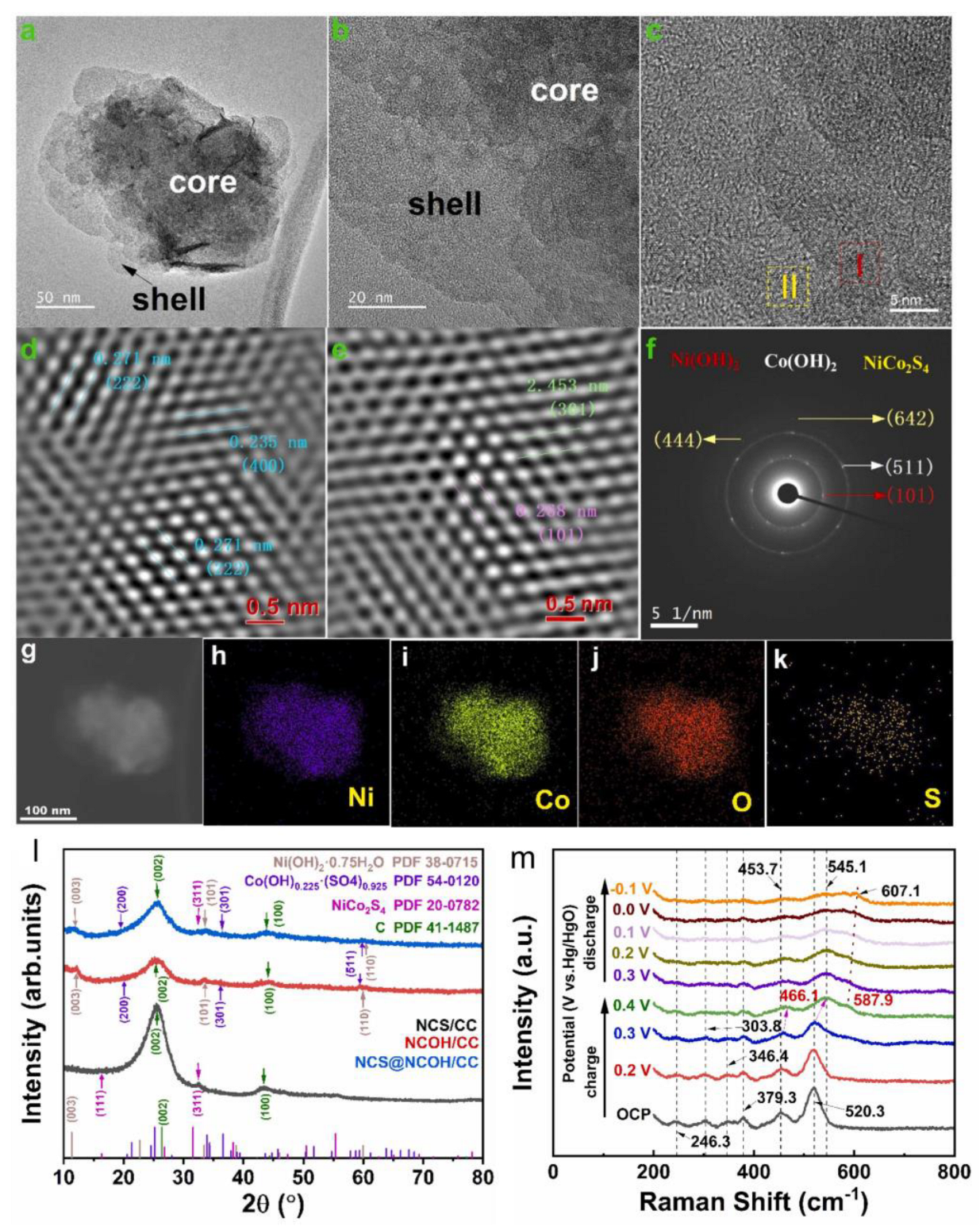
of the initial capacitance was retained. Furthermore, a hybrid electrode of
nickel cobalt sulfide/double hydroxide on carbon cloth (abbreviated as
NCS@NCOH/CC) was investigated using microscopy and spectroscopy techniques as
supplied in Figure 3 [47].
The findings clarified the formation of a core-shell heterostructure and the
corresponding interplanar atomic planes. Analyzing in-situ Raman spectra during
charging-discharging between −0.1 and 0.4 V revealed that material structure
transformations were partially irreversible, leading to a 78% capacitance
retention after 7000 cycles.
Metal-organic frameworks (MOFs) with multivalent
organic ligands and metal centers tolerate functionalization and possess design
changeability along with large surface-to-volume ratios. The groundbreaking
work in the design and synthesis of MOFs by Richard Robson, Susumu Kitagawa,
and Omar M. Yaghi has been recognized with the Nobel Prize in Chemistry 2025 [48]. Recently, there have been review
articles on applying MOFs in supercapacitors highlighting their potential [49,50]. For instance, a hybrid electrode of
Co3O4@Ni-MOF on carbon cloth exhibited a specific
capacitance of 1416 F/g at the current density of 1 A/g, outstanding compared
to 410 F/g of Co3O4 and 690 F/g of Ni-MOF non-hybrid
electrodes [51]. A full cell of Co3O4@Ni-MOF/CC
electrode and AC electrode delivered an energy density of 69 Wh/kg at the power
density of 510 W/kg, and 88% capacitance retention after 5000 cycles.
Similarly, a stability of 88% even after 10000 cycles, accompanied by 2.5
mWh/cm3 at 22.8 mW/cm3, was achieved by Song and his team
using NiCo2O4/Co2P/Ni2P/CC as a
positive electrode and AC/CC as a negative electrode in polyvinyl alcohol (PVA)
with KOH gel electrolyte [52]. These porous
hierarchical nanosheets of transition metal oxides and phosphides were derived
from MOF of zeolite-imidazolate framework-67 (ZIF-67) as a model during
the process of in-situ growth-etching, in addition to the method of ion
exchange-carbonization-phosphorization. In a similar approach, Chen and others
synthesized NiCo-LDH@CC based on a ZIF-67 crystal, then phosphorated it into
NiCoP@CC nanosheets [53]. Outstanding 99.7% of initial
capacitance is maintained using NiCoP@CC electrode over 10000 cycles at 6 A/g,
which outperforms 93% using NiCo-LDH@CC electrode. A constructed ASC of
NiCoP@CC//AC stored a high energy density of 79 Wh/kg at a specific power of
800 W/kg, and kept 90.3% of capacitance after 10000 cycles at 8 A/g.
Figure 3.
(a-b) TEM; (c) HRTEM; and (f) SAED images of NCS@NCOH nanoflake. (d-e) Inverse FFT images of area I and II in Figure 3c labelled by the red and yellow dashed rectangular frames. (g-k) EDS mapping of NCS@NCOH heterostructure. (l) XRD patterns of the NCS/CC, NCOH/CC, and NCS@NCOH/CC electrodes, respectively. (m) In-situ Raman spectra of the NCS@NCOH/CC electrode during charging-discharging at 20 A /g [47].
Figure 3.
(a-b) TEM; (c) HRTEM; and (f) SAED images of NCS@NCOH nanoflake. (d-e) Inverse FFT images of area I and II in Figure 3c labelled by the red and yellow dashed rectangular frames. (g-k) EDS mapping of NCS@NCOH heterostructure. (l) XRD patterns of the NCS/CC, NCOH/CC, and NCS@NCOH/CC electrodes, respectively. (m) In-situ Raman spectra of the NCS@NCOH/CC electrode during charging-discharging at 20 A /g [47].
Two-dimensional (2D) materials of transition metal
carbides recognized as MXenes have recently been employed in SCs. For instance,
a flexible MXene (Ti3C2Tx) lamellar structure
was prepared by vacuum filtration on cellulose nanofibers and considered a
negative electrode [54]. As a positive electrode, polyaniline
(PANI) was polymerized on CC. This ASC demonstrated an energy density of 31 Wh/kg
at 1211 W/kg, with a capacitance stability of 86% during 5000 cycles.
Additionally, hybridizing MXene with metal oxide nanoparticles is a promising
strategy to improve electrode performance. For example, Ti3C2Tx
MXene was derived from multilayer Ti3C2Tx
powder, and Co3O4 nanoparticles were prepared using a
microplasma discharge reactor, which is a cost-effective, unique synthesis
method [55]. This Ti3C2Tx/Co3O4/CC
hybrid electrode possessed a maximum specific capacitance of 577 F/g at 1 A/g,
higher by 95% than the Ti3C2Tx/CC electrode. A
better performance was achieved by Lin et al., who prepared MXene nanosheets
from Ti3AlC2, then placed MXene onto a CC substrate
drop-by-drop to maintain a good quality of the atomic layers. After that, the
MXene/CC was coated with PANI and CoNi-LDH by electrodeposition [56]. The incorporation of the MXene
decreased the internal resistance of the electrode. Consequently, the hybrid
electrode of MXene/PANI/CC presented a specific capacitance of 362 F/g, higher
than 210 F/g of non-hybrid electrodes of PANI/CC and 279 F/g of MXene/CC. Among
them, another hybrid electrode of MXene/PANI/CoNi-LDH/CC reached the greatest
value of 1200 F/g. Its internal resistance was low due to the incorporation of
MXene, as calculated from the EIS fitting curve. Combining this positive
electrode with negative electrode of an activated carbon powder, called AC, on
carbon cloth in a PVA-KOH gel electrolyte, an energy density of 39 Wh/kg was
stored at a power density of 400 W/kg. Up to 91% of capacitance was held after
10000 cycles at 5 A/g. As another example of MXene, Fei and co-authors prepared
V2CTx MXene-coated CC with Ni3S2
nanoblock arrays [57]. The hybrid electrode of Ni3S2/V2CTx/CC
had a higher specific capacitance than the individual components. An energy
density of 56 Wh/kg at 414 W/kg was delivered by an ASC of Ni3S2/V2CTx/CC//AC/CC,
with 91% cycling stability after 10000 cycles. Such a binder-free 2D layered
MXene facilitated ion transport, while the Ni3S2
nanoarrays hindered the dilapidation of the V2CTx
interlayers.
For iron-related compunds, Bi and co-researchers
prepared a heterogeneous composite structure of CoS nanosheets and FeOOH
nanorods using one-step electrodeposition on carbon cloth [58]. The hybrid FeOOH/CoS/CC electrode
exhibited a lower charge transfer resistance (0.68 ohm), thus higher specific
capacitance (419 F/g), than that of the pure FeOOH/CC electrode (0.90 ohm and
277 F/g). In a similar example, the crystal structure and conductivity of iron
oxide (Fe2O3) nanospheres were altered by doping with
cobalt using a hydrothermal method, resulting in a 137% enhancement of the
areal capacitance of the hybrid Co-Fe2O3@CC electrode
(316 mF/cm2 versus 133 mF/cm2 of pure Fe2O3@CC
electrode) [59]. Furthermore, the maximum volumetric
energy density of the ASC of Co-Fe2O3@CC//Ni-MnO2@CC
within 2 V (0.96 mWh/cm3) can be almost doubled (2.03 mWh/cm3)
in another ASC of MoS2/Fe2O3@CC//Ni-MnO2@CC
[60]. This occurs only by utilizing
molybdenum disulfide nanosheets loaded with iron oxide instead of cobalt
doping. The MoS2 in 1 T and 2 H crystal structures had reinforced
conductivity, and the long interplanar distance between the two-dimensional
nanosheets facilitates the accommodation of electrolyte ions. However, the
maximum volumetric power density dropped by nearly half from 29 mW/cm3
of the Co-doped supercapacitor to 16 mW/cm3 of the MoS2-combined
supercapacitor. Although iron oxide used in negative electrodes has
considerable theoretical capacitance and environmental friendliness, its energy
and power merits are still in a trade-off.
3.2. Conductive Polymers
Conductive polymers, including polypyrrole (PPy),
polythiophene (Pth), polyaniline (PANI), and poly(5-nitroindole), have been
utilized in CC-based electrodes. A moderate performance of 1.4 mWh/cm3
at 54 mW/cm3 was reached by Li et al., adding a PPy nano-crosslinked
network to Co-Fe2O3 in an ASC of PPy/Co-Fe2O3@CC//Ni-MnO2@CC
[61]. This three-dimensional nanostructured
network of PPy/Co-Fe2O3 on carbon cloth provided a large
specific surface area of 45.229 m2/g, hence an areal capacitance of
704 mF/cm2 at 2 mA/cm2, which was higher than that of
Co-Fe2O3 nanospheres on carbon cloth. Regarding PANI,
eigenstate polyaniline (EB) on carbon cloth was doped with Mn2+ and
used as a positive electrode [62]. Higher than the
last example, the EB/CC//AC stored 2.6 mWh/cm3 at 18.3 mW/cm3
in PVA-H2SO4 (0.3 M Mn2+) gel electrolyte. The
loose structure of the EB irregular granular particle suffered from weak
capacitance stability during charge-discharge cycles of 79% after only 2000
cycles.
In one study, polypyrrole was electrodeposited in
SrFeO3−δ perovskite on carbon cloth (PPy@SFO@CC) by Qiao and others [63]. The external PPy layer greatly improves
the charge storage performance by increasing the number of oxygen vacancies in
the perovskite, in addition to speeding up electron transport and ion
diffusion. Moreover, an energy density of 17 Wh/kg at a power density of 984
W/kg was exhibited by an ASC of NiCo2O4@CC//PPy700@SFO@CC,
where PPy700@SFO@CC was the negative electrode. The mechanical flexibility of
this device was tested at 0, 45, 90, 135, and 180 ° folds, maintaining specific
capacitances of 62, 48, 39, 39, and 39 F/g, respectively. After 1000 folds, a
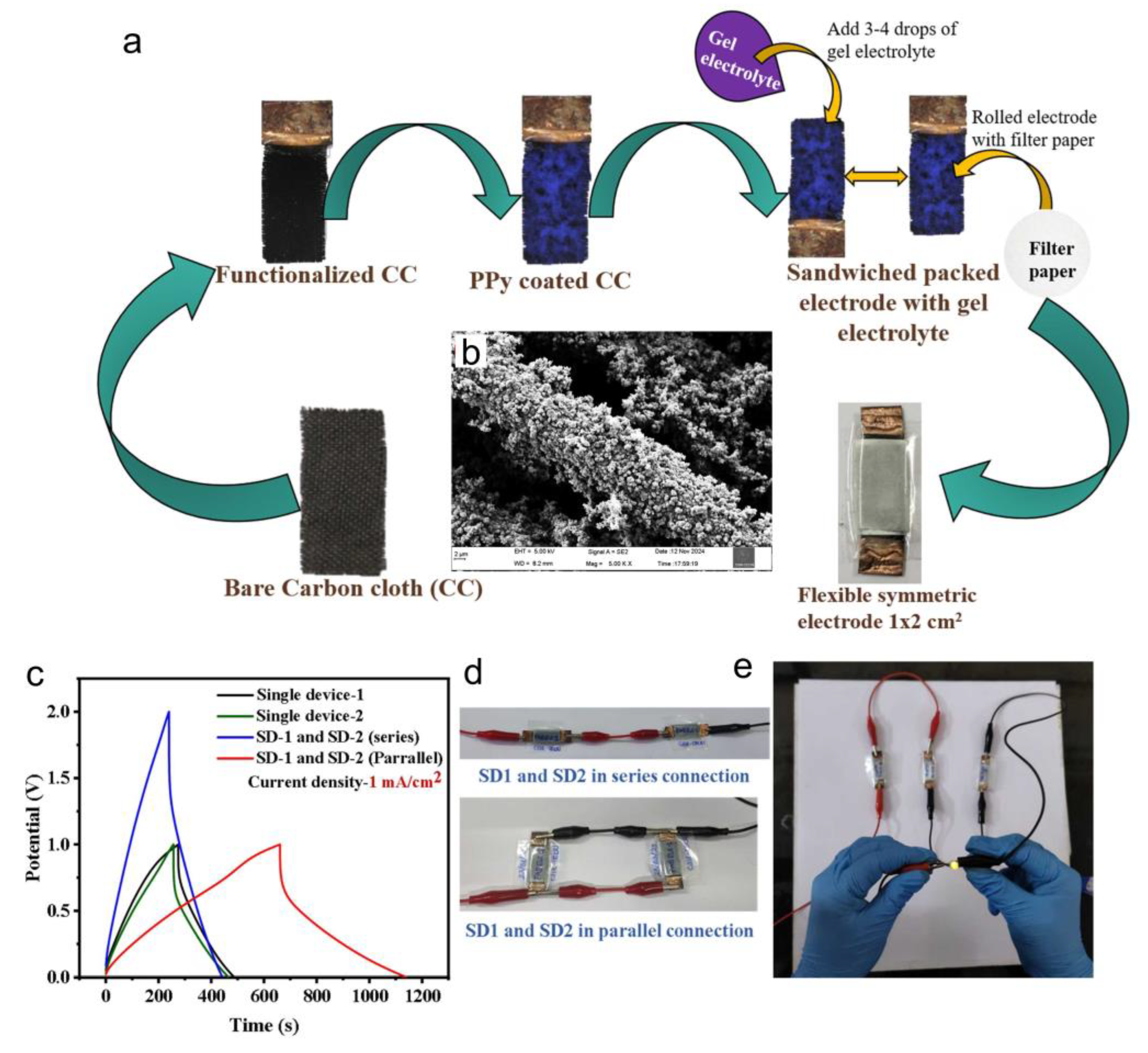
retention of 69% of the initial capacitance was measured. In another study, PPy
can be used as positive and negative electrodes in symmetric SC. As illustrated
in Figure 4, PPy-coated CC electrodes were
separated by PVA/H3PO4 gel electrolyte and a filter
paper, then three SCs connected in series successfully powered an LED [20]. Furthermore, an ASC of SnO2@PPy/CC//SnO2@PPy/CC
was fabricated by solvothermal and chemical oxidative polymerization [27]. The synergistic benefit of coupling SnO2
nanosheets with a PPy layer led to higher areal capacitance than
single-material electrodes. As well as that, the SnO2@PPy/CC
electrode was mechanically strong, where a 956 g stainless steel autoclave was
lifted by this CC-based electrode. At different angles of bending and twisting,
the CV curves were still similar even after 200 bending cycles.
Figure 4.
(a) Scheme for the preparation of flexible PPy@PCC and fabrication of symmetric device. (b) SEM images of PPy–coated PCC. (c) GCD of single device (SD)-1 and SD-2 in series and parallel connections; (d) LED light-emitting photographic images [20].
Figure 4.
(a) Scheme for the preparation of flexible PPy@PCC and fabrication of symmetric device. (b) SEM images of PPy–coated PCC. (c) GCD of single device (SD)-1 and SD-2 in series and parallel connections; (d) LED light-emitting photographic images [20].
In other examples of utilizing conductive polymers
in supercapacitors, polyaniline (PANI) was deposited by polymerization of
aniline on CC that was doubly activated by the Hummers method and
electrochemical treatment [64]. Then, reduced
graphene oxide (rGO) was adsorbed on the CC. Such an ACC-PANI@rGO electrode
achieved 670 F/g at 0.5 A/g, surpassing 485 for PPy [65],
and 309 F/g for oxygen vacancy-Fe2O3@PANI [66] at the same current density. A symmetric
SC of ACC-PANI@rGO electrodes delivered 112 µWh/cm2 at a power
density of 0.5 mW/cm2 [64].
Additionally, after 500 repetitions of bending at 180 °, 91% of capacitance was
retained. Poly(5-nitroindole) is hydrophilic and redox-rich due to the
electron-withdrawing nitro ( ̶ NO2) group. Poly(5-nitroindole)
loaded on LaNiO3/CC prepared by electrodeposition showcased 594
mF/cm2 and 808 F/g at 0.5 mA/cm2 and 76% retention of
after 10000 cycles [67]. Polythiophene (Pth) had high
conductivity around 6.21 S/cm; thus, it was utilized to increase the
conductivity of NiCo2S4 (NCS) coated CC [68]. Moreover, the dip-coating process of
the Pth protection layer on NCS nanoneedles lessened agglomeration during
charge-discharge cycling, achieving 90% capacitance retention after 5000
cycles. The specific capacitance of the NCS@Pth@CC electrode (1633 F/g at 1
A/g) exceeded both NCS@CC and Pth@CC individual electrodes.
As seen, conductive polymers have been combined
with metal compounds or graphene, reinforcing pseudocapacitance, energy,
mechanical strength due to flexibility, hydrophilicity, and conductivity of
electrodes. However, capacitance stability is still weak because of the
pseudocapacitive storage mechanism. As a design strategy, loading metal
compounds of graphene in nano-crosslinked network of polymers expands the
active surface area. There has been a recent review article on binder-free
electrodes for supercapacitors based on conducting polymers on various
substrates, not only carbon cloth [69].
3.3. Carbon Nanomaterials
On the whole, hybridizing carbon nanomaterials with
pseudocapacitive materials has stabilized the electrode charge-discharge
cycles, as no phase change occurs in the EDLC mechanism of carbon-based
electrodes. In one approach, carbon nanotubes (CNTs) were attached via the
chemical vapor deposition (CVD) technique on carbon cloth, followed by the
hydrothermal in situ growth of CuS nanosheets [70].
On top, FeOOH was electrodeposited. As expected, Li and others confirmed that
the cycling stability of their cost-effective CC/CNT/CuS electrode was much
better than that of the CC/CuS electrode. The electrochemical deposition was
also applied to prepare nickel cobalt layered double hydroxide NiCo-LDH on CNTs
on CC to act as a positive electrode. Impressively, the fabricated ASC of
CC/CNT/NiCo-LDH//CC/CNT/CuS/FeOOH recorded an outstanding volumetric energy
density of 3.3 Wh/cm3 at 12.2 W/cm3 and maintained 97.6%
of its initial capacitance after 2000 cycles at 20 mA/cm2. Along
with this, there was excellent electrochemical performance at different scan
rates and current densities, in addition to the minor charge transfer
resistance of 2.1 ohm. In another approach, CNTs were inserted into the MnO2/ACC
surface via a facile impregnation method [71].
This incorporation of CNTs minimizes volume changes in the MnO2
structure during charging-discharging cycling, thereby improving capacitance
retention.
In another example of carbon nanomaterials, reduced
graphene oxide (rGO) was integrated into NiCoFe2O4 and
PPy on carbon cloth during a scalable sol-gel auto-combustion method by Nabeel
and co-authors [72]. The ternary electrode of PPy/rGO/NiCoFe2O4/CC
demonstrated 223 F/g at 1 A/g, which was higher than 157 F/g of the binary
electrode of rGO/NiCoFe2O4/CC. In a brief comparison, the
gravimetric capacitances in F/g at 0.5 A/g were 670 for PANI@rGO/CC electrode [64], and 170 for rGO/CC electrode [73]. Interestingly, the same rGO from the
last report was also deposited on a nickel strip substrate, exhibiting 143 F/g,
which is lower than that on carbon cloth. This indeed points out one of the
potential advantages of selecting CC as an electrode substrate, as CC contains
abundant of woven microfibers.
New graphitic crystallite nanosheets, called GCNs,
were coated on NiCo2S4 nanorod arrays hydrothermally
grown on carbon cloth by Liu et al. [74].
Assisted with polyethyleneimine solution that contains amine groups, the NiCo2S4
nanorods became positively charged; hence, GCNs with negative hydroxyls and
carboxyls were electrostatically interacted. Such a simple coating process was
repeated 3 times, resulting in improved capacitance, rate capability, and
cyclic stability of electrodes compared to that repeated for 1, 2, 4, and 5
times, and better than on NiCo2S4 with either carbon
quantum dots CQDs@NiCo2S4/CC or graphene oxide coated by
the same method. A value of 51 Wh/kg energy density was obtained at 808 W/kg
power density using an ASC of GCNs@NiCo2S4/CC//AC/CC. In
a different study, graphene nanowalls were vertically aligned on CC, doped with
nitrogen and functionalized by oxygen [75].
This hierarchical porous and redox-rich interface had an improved defect
density (ID/IG=1.70) by Raman spectroscopy, enhancing the
wettability and pseudocapacitance of 13 F/cm2 at 2 mA/cm2.
Based on this electrode, the symmetric SC exhibited 1.03 mWh/cm2 at
1.34 mW/cm2 and 102% capacitance retention after 10000 cycles.
Altogether, the integration of carbon
nanomaterials, such as CNTs and graphene, into conductive polymers, MOFs,
MXenes, metal oxides, hydroxides, sulfides, nitrides, or phosphides has been
clearly proven as a powerful strategy for enhancing SC electrodes. Due to the
synergistic effects of each component, the previously discussed cases confirm
that the electrochemical performance of hybrid electrodes mostly exceeds that
of single-material electrodes. Tables 1–4
compare areal, volumetric, and gravimetric electrochemical performance of
recent CC-based symmetric and asymmetric supercapacitors, including their
energy and power densities and capacitance retention. It is clearly seen that
the energy densities of asymmetric SCs surpass those of symmetric SCs, mainly
due to the broadened cell voltage window of the different materials in positive
and negative electrodes. Notably, it has been recommended to normalize
capacitance, current, energy, and power to the geometric electrode area in cm2
and volume in cm3. The gravimetric values may imply overestimated
calculations when the mass loading is less than 1 mg/cm2.

Table 1.
Specific performance of recent carbon cloth-based symmetric supercapacitors.
| Electrode on Carbon Cloth | Energy Density at Power Density |
Longevity (Cycles) |
Ref. |
| B and N-doped C | 1.6 mWh/cm3 @ 12.5 mW/cm3 | 90% (10000) | [26] |
| SnO2@PPy | 0.7 mWh/cm3 @ 4.7 mW/cm3 | 91% (10000) | [27] |
| Tetraaniline (TA) | 74.2 mWh/cm2 @ 405.3 mW/cm2 | 94% (10000) | [76] |
| Mg-Zn codoped MnO2 | 0.2 mWh/cm2 @ 2.4 mW/cm2 | 83% (4000) | [77] |
| TA | 21.1 μWh/cm2 @ 0.5 mW/cm2 | 100% (20000) | [25] |
| GaN | 27.5 μWh/cm2 @ 0.1 mW/cm2 | 77% (20000) | [78] |
| Cd-doped MnO2 | 7.7 μWh/cm2 @ 1133 μW/cm2 | 94% (5000) | [79] |
| MoS2 | 70.8 Wh/kg @ 1000 W/kg | 75% (8000) | [80] |
| Ni3S2/V2CTx | 55.7 Wh/kg @ 413.8 W/kg | 91% (10000) | [57] |
| MXene@CoMnPO4 | 48 Wh/kg @ 1500 W/kg | 93% (5000) | [41] |
| Oxygen Vacancy-Fe2O3@PANI | 12.1 Wh/kg @ 250 W/kg | 100% (10000) | [66] |
| rGO | 5.5 Wh/kg @ 1000 W/kg | 88% (5000) | [73] |
| Commercial carbon fiber (T300) | 4.6 Wh/kg @ 10 W/kg | 92% (1000) | [81] |
| UIO66 * | 0.04 Wh/kg @ 89.9 W/kg | 130% (10000) | [82] |
* UIO66: Zirconium-based metal-organic framework, comprising 12-connected [Zr6(μ3-O)4(μ3-OH)4(O2C)12] cluster, terephthalic acid and isoreticular series.
Table 2.
Areal performance of recent carbon cloth-based asymmetric supercapacitors.
|
Positive Electrode on Carbon Cloth |
Negative Electrode on Carbon Cloth |
Energy Density (mWh/cm2) at Power Density (mW/cm2) |
Longevity (Cycles) at Current Density (mA/cm2) |
Ref. |
| MnO2 | ACC | 140 @ 1 | 100% (10000) @ 16 | [15] |
| PPy | AC | 15 @ 80 | 105% (1000) @ 2.5 | [83] |
| PPy | PPy | 4.1 @ 80 | 130% (1000) @ 2.5 | [83] |
| ACC | NiVO3@CoNi-MOF/AC | 1.27 @ 4 | 96% (10000) @ 50 | [84] |
| CoNi-MOF | N-doped CC | 1.25 @ 4 | 99% (10000) @ 110 | [85] |
| Ni-Mn-S | AC | 0.79 @ 0.85 | 83% (18,000) @ 25 | [86] |
| CoNiOOH | N-doped CC | 0.73 @ 1.60 | 97% (1000) @ 10 | [87] |
| NiCoMoS | AC | 0.60 @ 0.80 | 83% (15,000) @ 30 | [88] |
| (NiO)0.75(MnO)0.25 | AC | 0.49 @ 0.80 | 82% (15000) @ 20 | [89] |
| Ni1.5Co1.5S4 | ACC | 0.49 @ 4.50 | 90% (10000) @ 40 | [90] |
| NiCo2O4@NiCoMnS4 | AC | 0.40 @ 0.85 | 81% (20000) @ 20 | [91] |
| NiCo2O4/NiFeMn-LDH | ZnMn2O4 | 0.29 @ 4.38 | 92% (20000) @10 | [92] |
| MnO2 | AC | 0.27 @ 1.02 | 92% (4500) @ 1 | [93] |
| VS2 | AC | 0.22 @ 4.24 | 81% (5000) @ 5 | [94] |
| Co(OH)2@CoNi2S4/Ni | AC/Ni | 0.21 @ 1.5 | 96% (5000) @ 20 | [17] |
| Co3O4 | CeO2 | 0.11 @ 3.25 | 74% (5000) @ 5 | [95] |
| Co3O4-P | Fe2O3-P | 0.07 @ 0.38 | 100% (5000) @ 20 | [96] |
Table 3.
Volumetric performance of recent carbon cloth-based asymmetric supercapacitors.
|
Positive Electrode on Carbon Cloth |
Negative Electrode on Carbon Cloth |
Energy Density (mWh/cm3) at Power Density (mW/cm3) |
Longevity (Cycles) at Current Density (mA/cm2) |
Ref. |
| CNT/NiCo-LDH | CNT/CuS/FeOOH | 3300 @ 12200 | 98% (2000) @ 20 | [70] |
| NiGa2O4/MnO2 | N-CMK-3 * | 590 @ 48000 | 80% (5000) @ 6 | [46] |
| AC | CuO/Mn(OH)2Cu | 6.29 @ 34.31 | 89% (10000) @ 20 | [43] |
| PPy | AC | 5.00 @ 26.70 | 105% (1000) @ 2.5 | [83] |
| Ni-MnO2 | Co-Fe2O3 | 0.96 @ 28.60 | 85% (4000) @ 10 | [59] |
| Ni-MnO2 | MoS2/Fe2O3 | 2.03 @ 15.60 | 78% (3000) @ 10 | [60] |
| NiO | Fe2O3/C | 2.87 @ 40.20 | 82% (10000) @ 20 | [42] |
| Eigenstate polyaniline | AC | 2.57 @ 18.30 | 79% (2000) @ 1 | [62] |
| NiCo2O4/Co2P/Ni2P | AC | 2.53 @ 22.77 | 88% (10000) @ 2 | [52] |
| PPy | PPy | 1.00 @ 20.00 | 130% (1000) @ 2.5 | [83] |
| MnCo2O4 | ACC | 0.78 @ 9.780 | 87% (5000) @ 5 | [45] |
* N-CMK-3: nitrogen-doped ordered mesoporous carbon.
Table 4.
Gravimetric performance of recent carbon cloth-based asymmetric supercapacitors.
|
Positive Electrode on Carbon Cloth |
Negative Electrode on Carbon Cloth |
Energy Density (Wh/kg) at Power Density (W/kg) |
Longevity (Cycles) at Curren Density (A/g) |
Ref. |
| NiCoS | ACC | 107.7 @ 1000 | 89% (2000) @ 20 | [97] |
| NiS/MnS | AC | 111.2 @ 800.0 | 93% (10000) @ 5 | [98] |
| AC | NiCo2S4/LaNiO3 | 86.6 @ 400.0 | 85% (10000) @ 4 | [99] |
| Ni3Se2/NiSe2 | CuxFe3-xSe4 | 84.8 @ 664.0 | 86% (10000) @ 5 | [100] |
| NiCoP | AC | 78.5 @ 799.5 | 90% (10000) @ 8 | [53] |
| Na+-doped NH4V4O10 | Ti3C2Tx MXene | 77.7 @ 424.3 | 106% (8000) @ 6 | [101] |
| CuS/VAGN * | VAGN * | 76.7 @ 800.2 | 84% (10000) @ 8 | [102] |
| Ni0.85Se@ZnSe | AC | 74.7 @ 800.0 | 91% (5000) @ 5 | [103] |
| NiCoMnS4 | AC | 68.2 @ 850.1 | 93% (10000) @ 4 | [104] |
| NH4+-intercalated MnO2 | AC | 63.5 @ 949.8 | 81% (10000) @ 10 | [105] |
| MnCo2O4@CuCo2O4 | AC | 62.0 @747.2 | 91% (10000) @ 8 | [106] |
| MnO2@NiCo2O4@Ti3SiC2 | AC | 58.0 @ 800.0 | 62% (5000) @ 10 | [107] |
| NiCo2Mn-LDH@Fe2O3 | Fe2O3 | 53.7 @ 800.0 | 80% (10000) @ 10 | [108] |
| GCNs@NiCo2S/AC | AC | 50.5 @ 807.7 | 90% (20000) @ 5 | [74] |
| SiC@NiCo2O4 | SiC@C | 49.9 @ 800.0 | 89% (10000) @ 10 | [109] |
| MXene/PANI/CoNi-LDH | AC | 39.3 @ 400.0 | 91% (10000) @ 5 | [56] |
| NiCoLDH | NiCoLDH | 38.3 @ 1957 | 90% (10000) @ 5 | [110] |
| NiS2 | AC | 34.1 @ 561.3 | 96% (8000) @ 10 | [31] |
| NiCo2Se4 | AC | 30.7 @ 800.0 | 70% (2000) @ 5 | [111] |
* VAGN: vertically aligned graphene nanosheets, ** GCN: graphitic crystallite nanomaterials.
4. Optimization of Structural Properties
It is imperative to tune the structural properties of electrode materials to improve the performance of supercapacitors. The crystallinity, morphology, and conductivity of nanomaterials can be tuned by optimizing the synthesis conditions, such as chemical reaction time, solvent, temperature, and precursors. As an example, our group synthesized Co3O4 nanoflakes hydrothermally and Co3O4 octahedra solvothermally, both on carbon cloth [112]. Then, both samples were converted to Co9S8 by another hydrothermal reaction at 160 °C for 20 h. Although the two products possessed the same crystal phase and chemical composition, their morphologies were still distinct. The specific capacitance of CC/Co9S8 nanoflake electrodes was 12 times higher than that of CC/Co9S8 octahedra. As another example, the electrode properties were affected by the number of electrodeposition cycles. Core−shell nanoarrays of NiCoP@NiCoS on carbon cloth were electrodeposited with 10 cycles on CC, and produced the best morphology and performance compared to the same composite deposited in 5 and 15 cycles [113]. During a few cycles, a thin NiCoS layer was deposited on the NiCoP nanowires, while the nanomaterial’s structure was dilapidated after extended deposition cycles, weakening electrolyte ions transport and capacitance. More examples are systematically discussed in the following subsections.
4.1. Effects of Synthesis Time and Temperature
To clarify the effect of reaction time, Zou and coworkers developed four samples of nanoflakes on MnO2 nanothorns on porous carbon cloth in 1, 2, 3, and 6 h of hydrothermal reaction [114]. The growth of nanoflakes increased over time. In the 3 hour-reaction, the (Ni)MOF nanoflakes uniformly coated the MnO2 nanothorns, resulting in the highest areal specific capacitance of 1780 mF/cm2 at 4 mA/cm2 among the other coated samples. In the 6-hour reaction, closely packed (Ni)MOF nanoflakes hindered the rate of electron transport to the underlying MnO2 nanothorns. Similarly, the reaction time affected the morphology and aggregation of ZnMn2O4 nanoparticles on CC [115]. As shown in Figure 5a–h, the results of the samples that were hydrothermally deposited for 7, 9, and 12 h, respectively, called ZMO-7, ZMO-9, and ZMO-12, demonstrated that the reaction time of 9 h led to the optimum morphological and electrochemical properties. The specific capacitance of ZMO-9 was 499 F/g, corresponding to a specific capacity of 300 C/g at 1 A/g. The deposition time also affects the conductive polymer doping in electrodes. To elaborate on this, thermally activated CC was coated with PPy using oxidative chemical vapor deposition (oCVD) at 30, 60, and 90 min [83]. The longest time produced the highest doping degree as indicated by Raman spectroscopy, yielding the best electrode performance of 300 mF/cm2 (1498 mF/cm3) in that article. Regarding the effect of heating time, our team prepared the alpha phase of nickel hydroxide at 150 °C in just 10 minutes by microwave-assisted synthesis using nickel acetate as a precursor [116]. Besides, mixed alpha and beta phases at 150 °C in 30 min and the beta phase at 220 °C in 30 min were also prepared and identified according to XRD spectra in Figure 5i. Although all samples on CC exhibited similar nanoflake morphology, the alpha-phase-based electrode showcased a higher capacity as compared in Figure 5j,k. Such an increase in charge storage was explained by comparing the nickel oxidation states; the difference between +2 and +3.6 in α-Ni(OH)2 and γ-NiOOH, respectively, was wider than the difference between +2 and +3 in β-Ni(OH)2 and β-NiOOH, respectively [117].
In demonstrating the temperature effects, Ni microparticles were initially electrodeposited on CC to enhance the conductivity, then four samples of MoO3 thin films were electrodeposited at 25, 50, 70, and 90 °C [118]. The MoO3/Ni/CC synthesized at 90 °C displayed optimum electrochemical properties in both K2SO4 and KOH electrolytes. Increasing the deposition temperature increased MoO3 thin film loading mass on Ni-enhanced CC, structural integrity, and active material-flexible substrate adhesion. In the hydrothermal method, Co(OH)2 nanoneedles were vertically grown on CC at an optimum reaction temperature of 120 °C [119]. This condition produced the best morphological and electrochemical performance (591 F/g at 0.5 A/g) compared to Co(OH)2 prepared at 80, 100, 140, and 160 °C. By a selenization method, NiSe2/CoSe2/CC electrodes were prepared from Ni-Co precursors at different temperatures of 300, 350, 400, and 450 °C [120]. The temperature of 400 °C was found to be the optimal condition for a perfect transformation to NiSe2/CoSe2/CC via an Ostwald ripening mechanism. This electrode exhibited 1558 F/g at 1 A/g, higher than the electrodes prepared at the other temperatures.
Recently, a facile, safe, and environmentally friendly method was innovated for fast preliminary activation of CC and for nanoparticle synthesis. Three pulses of high-temperature thermal shock (HTS) at ~800 °C for 100 ms were applied to CC pretreated by mixed acids [121]. After dropping a precursor of transition metal oxides on the activated CC, another three pulses at ~1000 °C were applied to obtain Co3O4 nanoparticles. The ultrafast-prepared Co3O4/ACC electrode showed 408 mF/cm2 at 0.2 mA/cm2, and a capacity retention of 97% following 20000 cycles at 2 mA/cm2. Using the same HTS, MnOx nanoparticles were prepared on ACC, which achieved 456 mF/cm2 at 0.2 mA/cm2. It is worth noting that the mass loading of each oxide was 3.5 mg/cm2, and the total time of the HTS was 20 s. As presented in the previous examples, the temperature and time of heating, chemical reaction, electrodeposition, and other methods affect one or more material properties, such as morphology, crystal phase, and doping, which in turn affect electrode surface area, redox activity, and conductivity.
4.2. Effects of Synthesis at Room Temperature
For nanomaterials of metal compounds, the chemical co-precipitation technique can be cost-effectively used at room temperature. Using this simple method, Samyn and others synthesized copper(II) hexacyanoferrate(II) (CuHCF) nanoparticle powder at room temperature, which was mixed with activated carbon and polyvinylidene difluoride (PVDF) binder, then plated on fibers of carbon cloth [122]. This CuHCF@CC positive electrode exhibited a specific capacity of 43 C/g in K2SO4 electrolyte and 24 C/g in Na2SO4 electrolyte, at 0.2 A/g. Using the same method, potassium nickel(II) hexacyanoferrate(III) nanoparticles were prepared at room temperature and adhered to carbon cloth by PVA binder. At 0.4 A/g, 199 F/g in Na2SO4 and 169 F/g in K2SO4 were reported by the last-mentioned authors [123]. Without a binder, Alhebshi successfully deposited a conformal coating of cobalt hydroxide chloride, Co2(OH)3Cl, nanoflakes on carbon cloth at room temperature in 1 h [124]. The nanoflakes evolved from nanoparticles that appeared during the first 10 min of chemical bath deposition, as confirmed in Figure 6a–h. The specific capacitance of the nanoflakes was 313 F/g at 1 A/g, while it was 293 F/g for the nanoparticles due to morphological features, crystallinity, and conductivity. A higher specific capacitance of 521 F/g at 0.5 A/g was reached by Ag-doped MnO2 nanowires directly grown on CC by a chemical reaction at 25 °C for 24 h [125]. Silver doping concentrations of 1, 3, and 5% affect the MnO2 growth, as captured in Figure 6i–n. Besides, the growth of Ag-doped MnO2 nanowires on CC produced a larger BET specific area and a higher specific capacitance compared to the doped compound prepared via the same experiment but without CC. In addition, the capacitance retention of 91% during 2000 cycles at 1 A/g confirmed that MnO2 had firm bonds with the CC surface, minimizing exfoliation during charge-discharge cycles. Carbon nanomaterials can also be fabricated under ambient conditions. In a sustainable approach, porous graphene was derived from lignin on carbon cloth through direct laser writing (DLW) [[126]. The used lignin is commercially available at a low cost, and the DLW method is safer and faster than other methods to prepare graphene with toxic chemicals. Excellent flexibility and 157 mF/cm2 at 0.1 mA/cm2 were achieved by this green-fabricated electrode. Notably, synthesis at room temperature is safe, low-cost, and facile. However, it may yield lower-quality materials in terms of purity and crystallinity compared to energy-consuming synthesis methods that require high temperatures.
4.3. Effects of Precursor Compounds and Ratios
One of our studies focused on the effect of nickel precursors used in the electrospinning technique on the nanostructure of nickel oxide on carbon cloth [127]. It was found that the NiO electrode derived from nickel acetate, abbreviated NiO-A, had a well-crystalline phase and a robust nanofiber structure. Consequently, it possessed superior electrochemical performance over the other NiO electrode derived from nickel nitrite, abbreviated NiO-N, as compared in Figure 7a–h. Using 0.1 mol/L of nickel nitrite resulted initially in nanofibers but turned to NiO nanoparticles after calcination. When the concentration increased to 0.2 mol/L, the electrospinning was not stable due to the high ionic conductivity of nitrate. As the ionic conductivity of the acetate is lower, NiO nanofibers were stably electrospun using 0.2 mol/L of nickel acetate and maintained their morphology after calcination. Figure 7i,j shows that hybridizing with CNTs on both positive and negative electrodes as an ASC of NiO/CNT/CC//CNT/CC significantly improved the CV and GCD curves over another ASC of NiO/CC//CNT/CC.
Deeply, tuning the molar ratios of precursors alters structural properties and hence the electrochemical performance. In one study, Liang and co-researchers discovered a creative way to grow metal-organic frameworks on carbon cloth, then converted them into porous hollow CoNiOOH nanorods [87]. A hydrothermally grown Ni(OH)2 nanosheet on carbon cloth was used as a precursor in a solvothermal reaction at 120 °C for 12 h. Then, the resultant solid nanorods of CoNi-MOF were electrochemically induced to hollow nanorods of CoNiOOH. The molar ratios of Co(NO3)2⋅6H2O and 2,5-dihydroxyterephthalic acid (H4DOBDC) were tuned as 1:1, 2:1, and 3:1, and symbolized as CoNi-MOF-1, CoNi-MOF-2 and CoNi-MOF-3 electrodes, respectively. By comparing the electrochemical performance, the most favorable amount of organic ligand was found in CoNi-MOF-2 using a 2:1 ratio. Furthermore, combining this positive electrode with a nitrogen-doped activated carbon cloth (NAC) electrode produced an areal energy of 0.7 mWh/cm2 at 1.6 mW/cm2 and displayed 99% capacitance retention after 10000 cycles. In another study, Das and others optimized a heterostructure of copper iron selenide (CuxFe3-xSe) by changing the molar ratio of Cu/Fe in the precursor solution of an electrodeposition process [100]. The results revealed that the stoichiometric ratio of x = 1.5, denoted as CFS-1.5/CC, yields the optimal electrode compared to other ratios of x = 0, 1, 2, and 3. The obtained sample has nanoneedles of iron selenide and flower-like clusters of copper selenide, which were dense flake-like clusters in the CFS-1/CC. By increasing the Cu/Fe ratio to 2:1, the nanoneedles in the CFS-2/CC became mainly covered by extra clusters. Based on that, a selenide-based supercapacitor of CFS-1.5/CC negative electrode and Ni3Se2/NiSe2/CC positive electrode operated at 1.6 V showed an excellent energy density of 85 Wh/kg at 664 W/kg. Another bimetallic chalcogenide was prepared by Jin et al. by optimizing the feeding ratio in a hydrothermal reaction [128]. Nanopetal (Ni,Co)Se2@CC and nanoagaric (Ni,Co)Se2@CC were produced when the molar ratio of Ni/Co was 2:1 and 1:2, respectively. The nanopetal-structured electrode showed better capacitance, internal resistance, and stability than the nanoagaric one. The DFT calculations revealed that the nanopetal (Ni,Co)Se2 had an adsorption energy of OH− of −2.6386 eV, greatly higher than −1.8820 eV of nanoagaric (Ni,Co)Se2. As a result, an ASC of nanopetal (Ni,Co)Se2@CC//AC@CC stored a maximum energy density of 75 Wh/kg at a power density of 250 W/kg.
In a balanced comparison of different methods, two samples of iron oxide/hydrophilic carbon cloth (Fe2O3@hCC) were synthesized, one by hydrothermal (HT) and the second by electrodeposition (E), then converted to iron nitride [129]. Figure 8 compares their morphology, crystallinity, specific capacity, and EIS. The electrodeposition produced amorphous Fe2N but with a higher specific capacity by 66%. All the above-mentioned cases obviously emphasize the synergetic effects of synthesis conditions on the tunable properties of materials, and consequently on the electrochemical performance of electrodes. Table 5 and Table 6 present lists of the areal and gravimetric capacitances, respectively, of recent carbon cloth-based electrodes, along with their morphologies and synthesis methods. It can be concluded from the tables that the capacitances of Ni-based electrodes of nanosheets and 3D nanostructures are at the top. They have been considered favorable morphologies for supercapacitor electrodes due to their large specific surface area and redox-active sites. Although graphene has a nanosheet morphology as well, its capacitance is lower than metal compound nanosheets, based on their different charge storage mechanisms, as explained earlier.
5. Integration of Supercapacitor Components
Enhancement of supercapacitor performance requires careful integration of electrodes and electrolytes on current collector substrates. The nature of electrolytes used in supercapacitors affects the charge storage performance and electrode lifetime. To elaborate on such effects, six aqueous electrolytes of Na2SO4, Li2SO4, K2SO4, H2SO4, LiCl, and KCl were tested with MoS2@CC binder-free electrodes [139]. Among them, using LiCl and H2SO4 electrolytes activated the highest capacitances but lowest cycling stability, ascribed to corrosion as indicated by the morphological and elemental imaging after cycling. On the other hand, better stability (94% after 5000 cycles) but lower specific capacitance (223 F/g) were obtained in Na2SO4 electrolyte with the same electrode. Such a compromise between capacitance and stability is still a challenge. Nevertheless, in the same Na2SO4 electrolyte, MnO2@CC cathode induced by cetyltrimethylammonium bromide (CTAB) nanomicellar and AC anode provided 1011 mF/cm2 at 1 mA/cm2 and maintained an extraordinary 127% capacitance after 20000 long cycles at 30 mV/s [93]. Such increase in capacitance during cycling is discussed in detail in section 6 of this review. In an additional case for Na2SO4 electrolyte, an Aquivion membrane was used as a polymer electrolyte when dipped in 1 M Na2SO4 solution for 3 h [140]. This electrolyte membrane was then inserted between a carbon xerogel (CX) electrode and MnO2 electrode, both screen-printed on CC (Figure 9). The GCD curves specify the positive potential of the MnO2/CC electrode (0.95 V) and the negative potential of the CX/CC electrode (− 0.85 V) versus the reversible hydrogen electrode (RHE), in addition to the cell voltage of 1.8 V of the asymmetric supercapacitor. Using this prototype, an LED module consisting of 30 LEDs in a ring was powered for 50 s in normal and bent conditions.
5.1. Conformal Coating on Carbon Cloth
The direct deposition of nanomaterials on current collector substrates, instead of a physical pasting of nanomaterial powder on substrates using insulating binders, plays a substantial role in augmenting the electrochemical performance of electrodes. As a typical demonstration, two electrodes of Ni(OH)2 were simply prepared at room temperature using chemical bath deposition by Alhebshi et al. (Figure 10) [141]. The first one was directly deposited on carbon cloth, while the second was drop-cast on carbon cloth. Both resultant Ni(OH)2 samples consisted of multi-phase crystalline nanoflakes. The conformal coating of nanoflake-based film around each carbon microfiber provided greater contact with electrolyte ions than nanoflakes aggregated in a flower-like morphology that filled gaps in CC. Therefore, the conformal Ni(OH)2/CC resulted in not only five times higher specific capacitance, but also better cyclic stability than the drop-cast electrode. Interestingly, Kordek-Khalil and co-researchers [129] found that an amorphous Fe2N film electrodeposited on hydrophilic carbon cloth showed a 66% higher specific capacity than a crystalline Fe2N prepared by the hydrothermal method, first as a powder, then drop-cast onto the hydrophilic carbon cloth. Similarly, they prepared Fe2O3 by the two methods and confirmed the advantage of the electrodeposition technique over the hydrothermal method with drop-casting. In a more accurate comparison, two electrodes of tungsten trioxide (WO3) nanotube bundles were made by Li et al. via a safe hydrothermal method, replacing strong corrosive acids with NaHSO3. The first electrode was in-situ anchored on carbon cloth, while the second electrode was loaded with the prepared WO3 powder with a binder [137]. Both had similar XRD, Raman, SEM, and TEM results, but the binder-free electrode had better CV, GCD, EIS, and capacitance results than the pasted WO3 electrode and the bare CC electrode. Inserting substrates inside the hydrothermal autoclaves is a simple yet powerful strategy to produce direct nucleation and growth of nanostructured thin films for binder-free electrodes.
In novel approaches, electrodeposition and cyclic voltammetry passivation (CVP) and oxidation were applied to coat CC with Ni, then oxidized to a porous nickel oxide layer, resulting in strong interfacial adhesion to the substrate [142]. The electrode showcased 1736 mF/cm2 at 1 mA/cm2, and 99% mass retention after high-power ultrasonication. Moreover, the supercapacitor maintained nearly its initial capacitance under 180 ° bending. A molten salt method is a one-step reaction that was used for direct deposition of ZnMn2O4 nanoparticles on CC [92]. Within a potential window from −1.2 to 0 V, this electrode exhibited an excellent areal specific capacitance of 2863 mF/cm2 at 5 mA/cm2. Additionally, the capacitance retention was 93% after 12000 cycles at 20 mA/cm2. Printing on CC is a promising technique for large-scale supercapacitor fabrication. In specific, carbon xerogel (CX) and manganese dioxide (MnO2) were prepared as electrically conductive inks, then screen-printed on CC [143]. An ASC based on printed CX and MnO2 on CC achieved a low self-discharge rate with a voltage retention of 72% after 22 hours, a high specific capacitance of 213 F/g, and an energy density of 24 Wh/kg at 180 W/kg.
In another creative way, conductive porous carbon nanoflakes (CPCN) were derived from a Co-based MOF on carbon cloth, then hybridized with MnO2 and Au nanoparticles [144]. The CPCN as a skeleton offered abundant mass loading of 2.86 mg/cm2, while the presence of gold increased the charge transfer between electrode and electrolyte, leading to a higher specific capacitance. In three-electrode measurements, an aqueous electrolyte of Na2SO4 was used. The Au-MnO2/CPCN electrode displayed a leakage current of 0.048 mA at 1 V. As a consequence, an output voltage of 1 V dropped to 0.743 V after 24 h in self-discharge conditions. A sodium ion adsorption energy of 3.744 eV was calculated by Density-functional theory (DFT) of the electrode, and a large density of states (DOS) was found near the Fermi level. In two-electrode measurements, an organic electrolyte of sodium hexafluorophosphate (NaPF6) with ethylene carbonate (EC), propylene carbonate (PC), and fluoroethylene carbonate (FEC) was used. An ASC of Au-MnO2/CPCN/CC//AC/CC exhibited 72 Wh/kg at 80 W/kg. A higher performance was reached in a similar example. CPCN was derived from ZnCo-MOFs conformally on carbon cloth by annealing and etching, then hydrothermally decorated with CdSe nanoparticles [136]. The CdSe/CPCN on CC was used as a positive electrode and activated carbon on nickel foam as a negative electrode. Regarding the electrolyte, they used NaPF6 dissolved in EC, PC, and FEC as an additive. The fabricated an ASC of CdSe/CPCN/CC//AC/CC stored 139 Wh/kg at 590 W/kg, and retained up to 89% of its capacitance following 10000 cycles. The 3D CPCN structure promoted electron transport and Na+ diffusion while inhibiting nanoparticle disintegration and aggregation. Furthermore, DFT simulations indicated that the CdSe/CPCN hybrid material improved the sodium ion adsorption energy to −1.0692 eV and promoted electrode conductivity. Besides, when the nickel foam was replaced by carbon cloth, the authors noticed better mechanical flexibility. In bending states at angles of 100, 60, and 0 °, two supercapacitors connected in parallel powered an LED array. Clearly, this is an evidence of the powerful flexibility of CC-based supercapacitors.
Hydrothermally, NiCo2O4 nanoarrays were directly grown on CC under conditions of 120 °C for 4 h, followed by calcination at 300 °C for 2 h [145]. Interestingly, oxygen vacancies were introduced in NiCo2O4 by a solvothermal treatment in a glycol with 1.2 g NaOH at 120 °C for 16 h, avoiding high temperature and strong reducing agents. The calculated specific surface area was 124 m2/g. An ASC of NiCo2O4/CC//AC/CC offered 44 Wh/kg at 281 W/kg. Such defect engineering of oxygen vacancies is considered an effective strategy for increasing the electrocatalytic active sites. Hierarchical porous triangle-like NiCo2O4 nanosheets were derived from MOF nanoarrays, grown on SiC nanowires on CC, and used as a negative electrode [109]. On positive other electrode, carbon nanosheet arrays were derived from MOF on the SiC nanowires on CC. This ASC exhibited 50 Wh/kg at 800 W/kg, which is higher than the previous example. Furthermore, 89% capacitance was maintained over 10000 cycles at 10 A/g, and excellent flexibility at bending angles of 0, 90, and 180 °. As concluded in the study, there were four possible factors for the enhanced supercapacitor performance. First, the absence of insulating binders prevented the formation of inactive spots on the electrode. Second, the porous nanosheet array morphology provided a larger active area accessible to the electrolyte. Third, the interwoven conductive nanowires facilitated electron transfer. Fourth, the core-shell nanosheets maintained structural stability.
5.2. Adjusting Electrode Mass Loading
In large-scale production of electrodes, the mass loading of active materials on the substrate may vary from the reported laboratory-scale fabrication. Accordingly, the mass loading should be adjusted to meet practical considerations. It has still been challenging to control mass loading, especially in conformal coating synthesis methods. Nevertheless, a high mass loading of 12 mg/cm2 of zeolite imidazole framework (ZIF-67) microrods on CC was achieved by Bai and others, considered a commercial-level amount [146]. The preparation process of ZIF included crystallization, electrodeposition, and seed-oriented growth. It was found that a better mass was loaded in a longer dipping time of 72 h than 24 h. The heterostructure of vertically aligned microrods on CC offered approachable pathways and electroactive locations, thus demonstrating an excellent areal energy density of 380 mWh/cm2 at 1600 mW/cm2 using ASC of ZIF-67/CC//AC/CC in PVA/ LiOH gel electrolyte. The same mass loading, 12 mg/cm2, was measured for another electrode of MnO2 on CC, which is higher than the commonly reported cases (< 1 mg/cm2) [147]. A hydrothermal reaction at 160 °C for 12 h followed by annealing at 400 °C for 2 h and treatment in N2-plasma created oxygen vacancies on MnO2. The ASC of MnO2/CC//ACC delivered 46 Wh/kg at 420 W/kg, equivalent to 0.56 mWh/cm2 at 5.14 mW/cm2. Similar results of 0.49 mWh/cm2 at 4.5 mW/cm2 were measured for Ni1.5Co1.5S4/CC//ACC by Chen and co-researchers [90]. Produced by hydrothermal reactions, the mass loading of vertical Ni1.5Co1.5S4 nanorods on CC was 5.54 mg/cm2, which is relatively high. Similarly, 5 mg/cm2 of was directly loaded on CC by Javed et al. using the hydrothermal conditions of 135 °C for 16 h, then sintering at 350 °C for 2 h [135]. Interestingly, ZnCo2O4 nanowires were formed in a nanonest-like structure. The electrode exhibited 467 F/g, which was equivalent to 1320 C/g, at 1.2 A/g. At 15 mV/s, the charge storage kinetics were a combination of surface capacitive charge storage of 42% and diffusion-controlled charge storage of 62%. The contribution of the surface capacitive process increased when the scan rate increased.
Much higher mass loading of 20.4 mg/cm2 of Mn3O4/NiMoO4@NiCo-LDH was reported by Liang et al. The CC was ultrasonically cleaned with deionized water and absolute ethyl alcohol for 30 min, followed by drying at 60 °C for 12 h [148]. Then, Mn3O4 was electrochemically deposited on CC, resulting in a mass loading of 7.4 mg/cm2. Above them, NiMoO4 was grown by a hydrothermal method; the mass loading of NiMoO4 was 7.6 mg/cm2. Finally, NiCo-LDH with a mass of 5.4 mg/cm2 was also hydrothermally synthesized on Mn3O4/NiMoO4. The fabricated ASC of Mn3O4/NiMoO4@NiCo-LDH//AC/CC delivered a maximum energy density of 23 Wh/kg.
Wu and co-authors investigated the interesting relationship between the mass loading of vanadium nitride (VN) on CC and the areal and gravimetric capacitances [149]. The areal capacitance of VN/CC with 28.3 mg/cm2 of 3.3 F/cm2 was higher than the electrodes with 6.5, 14.0, and 21.2 mg/cm2. On the other hand, the gravimetric capacitance decreased by nearly 21% with increasing mass loading from 6.5 to 28.3 mg/cm2. The charge transfer resistance slightly increased from 0.162 to 0.447 ohm with increasing mass loading. The mass loading was controlled by optimizing the number of dip-dry repetitions during the coating of CC with VOx. All electrodes were nitridated in ammonia at 550 °C for 2 h. In the two aforementioned examples, the porous structure of the electrodes played a crucial role in enhancing the contact between electrode charges and electrolyte ions. Overall, seed-oriented growth of microrods on CC, subsequent hydrothermal routes of two or more materials on CC, or dip-dry repetitions of one material on CC, all have been suggested as promising future directions to overcome the limited mass loading challenge.
5.3. Testing Electrolytes at Low and High Temperatures
Most supercapacitor performance reported in the literature has been tested at room temperature. For some commercial applications, energy storage devices require working properly under cold or hot conditions. Although the common usage of aqueous electrolyte solutions in supercapacitors is safer than organic electrolytes, the presence of water limits their durability at freezing or evaporating temperatures. In a recent research by Zhang and others [150], a supercapacitor with a CC@Co(OH)2:Mn2+@T3 positive electrode and a CC@T3 negative electrode was assembled in polyvinyl alcohol/sodium alginate hydrogel electrolyte. This anti-freezing hydrogel was abbreviated as PSET30, as it includes polyvinyl alcohol (P), sodium alginate (S), ethylene glycol (E), and 30 mg of Ti3C2Tx (T). At 0 °C, areal capacitance of 52 mF/cm2 and Rct of 33.4 ohm were calculated, greatly better than 2.4 mF/cm2 and 223.1 ohm at 25 °C. This phenomenon was ascribed to the availability of rich hydrogen bonds in the PSET30 hydrogel, which was stronger at 0 °C, leading to strengthening of the porous network of PSET30 with Ti3C2Tx, thus enhancing the electron conductivity. At room temperature, the electron movement was further impeded because some pores were blocked by free ethylene glycol molecules.
At 35, 0, −10, −20, and −30 °C, the areal capacitances of an ASC of NiCo2O4@NiMn-LDH/CC//AC/CC were measured as 1608, 1532, 1517, 878, and 253 mF/cm2, respectively [151]. PVA/KOH was prepared by adding 1.2 mL glutaraldehyde (1 vol%) as a crosslinking agent and 30 μL H2SO4 (1 M) as an initiating agent. This gel film has the ability of withstand temperature changes without losing its elasticity, and it freezes at around −20 °C. From 0 to 60 °C, a CC/PPy symmetric SC with a PVA-H3PO4 gel electrolyte was tested by Liu et al. [152]. With increasing temperature, they found that the areal specific capacitance increased, and the internal resistance decreased, attributed to increasing ionic conductivity of the electrolyte. However, the cycling stability decreased, and the self-discharge became worse at high temperatures, where the long chain in PPy became more breakable. To quantify the self-discharge effect of a supercapacitor, its voltage was recorded under open-circuit conditions after being charged. As a result, an ASC of MnCo2O4@CuCo2O4/CC//AC was charged at 1.6 V, then self-discharged until 0.88 V after 70 h [106]. As summarized, gel electrolytes such as PSET30, PVA-H3PO4, and PVA/KOH with glutaraldehyde have been alternatively proposed to withstand a range of temperatures. Despite that, self-discharge and weak cycling stability remain current issues.
6. Evaluation of Electrochemical Stability
For practical applications, testing the cycling stability of supercapacitors in a full-cell configuration is a key requirement. It is worth noting that excellent stability of electrodes tested in a half-cell configuration does not necessarily lead to similar performance in full cells. For example, a nearly perfect cyclic stability of 99.7% over 30000 cycles at 3 mA/cm2 was achieved using an electrode of oxygen vacancy-containing cobalt-based metal-organic framework (O-v-CoFe-MOF) nanoparticles on CC [153]. A maximum areal capacitance of 57 mF/cm2 was calculated at 0.5 mA/cm2. However, when used as a negative electrode with an ACC positive electrode in PVA/ H2SO4 gel electrolyte, the supercapacitor preserved 77% of its capacitance after 15000 cycles at 5 mA/cm2. Analyzing factors affecting supercapacitor stability and tracking recent strategies for stability improvement are reviewed in this section.
Although extraordinary capacitances and energy have been recorded using the NiCo-LDHs-based asymmetric supercapacitors, as presented in the previous sections, some challenges have impeded cycling stability, hence delaying their utilization in practical applications. The hydroxides have inherently low conductivity, and their volume changes during the charge-discharge cycles. One of the innovative solutions was validated by in-situ implanting carbon quantum dots (CQDs) on NiCo-LDHs [130]. After 5000 cycles, a 54% capacitance retention of the NiCo-LDHs@CC electrode was improved to 83% of the CQDs/NiCo-LDHs@CC electrode, both at 30 mA/cm2. Luo and co-authors investigated the primary factors using SEM and TEM before and after cycling. During 5000 cycles, cracks and deformation occurred in the NiCo-LDHs that were easily exfoliated from the carbon fibers, while the CQDs/NiCo-LDHs remained conformally and firmly attached to the carbon fibers. The robust cactus-like nanopillars evolved by an electrostatic interaction between NiCo-LDH positive ions and carboxyl and hydroxyl groups on CQDs. Such a strong attachment by the in-situ implantation of CQDs decreased internal resistance and charge transfer resistance. The CQDs were also coupled with P-Fe2O3 on CC through a one-pot hydrothermal process by Wang and others [154]. The hybrid electrode exhibited a specific capacitance of 1787 F/g, which was the highest among Fe2O3, P-Fe2O3, and CQDs/Fe2O3 electrodes, all on CC. Employing CQDs/P-Fe2O3 as a negative electrode and MnO2 as a positive electrode, both on CC substrates in KOH, this ASC kept 91.31% capacitance after 1000 cycles. In addition, at 640 W/kg, an excellent 103 Wh/kg was recorded at an operating voltage of 1.6 V.
One of the highest energy densities of carbon cloth-based ASC was reached by Zhang et al. using NiCoS/ACC//ACC in PVA/KOH [97]. The CC was activated at 500 °C for 2 h, then hydrothermally coated with NiCoAl, which in turn converted to porous NiCoS nanosheets by a second hydrothermal reaction. The flexible device operated at 2 V and offered 108 Wh/kg with a power density of 1000 Wk/g. However, after 2000 cycles at 20 A/g, it holed 89% of its capacitance. In a recent article, NiCo2S4 was combined with a perovskite structure of lanthanum nickel oxide (LaNiO3) on CC by Noormohammadi [99]. After 10000 cycles at 4 A/g, 85% capacitance retention was observed using an ASC of LaNiO3/NiCo2S4/CC//AC/CC. Besides, an energy density of 87 Wh/kg was evaluated at a power density of 400 W/kg. It was found that the layers in this perovskite promoted cyclic stability. Moreover, the device was tested at different bending angles with almost no change in its CV and GCD curves, confirming its mechanical flexibility.
As reviewed, nickel-based sulfides, selenides, and oxides have been considered as promising electrodes. Adil et al. electrodeposited mixed NiS/MnS on ACC, then combined the NiS/MnS/ACC positive electrode with the ACC negative electrode in a KOH aqueous solution [98]. This ASC operated at 1.6 V and exhibited 111 Wh/kg at 800 Wh/kg in addition to maintaining 93% of initial capacitance over 10000 cycles at 5 A/g. These electrochemical merits were superior to ASCs of the last-mentioned NiCoS/ACC//ACC and LaNiO3/NiCo2S4/CC//AC/CC. Nevertheless, cyclic stability needs further improvements to meet commercial preferences. Wan and others combined NiCoS with Ni-Mn-S on CC by electrodeposition [155]. An ASC of Ni-Mn-S@NiCo2S4/CC//porous carbon/CC promoted a stability of 96% after 10000 cycles at 8 A/g, which is better than the previous examples in this section. Such improvement was caused by the core-shell heterostructure of nanosheets. On the other hand, its energy and power densities of 59 Wh/kg at 345 W/kg are lower than theirs. At 5 A/g, the capacitance retention of an ASC of NiCo2Se4/CC//AC/CC supercapacitor was 88% after 20000 cycles [156], while it was 95% after 10000 cycles for an ASC of NiCo2O4/CC//rGO/CC [157], as shown in Figure 11.
Such a stability issue can be overcome using electrodes whose capacitance undergoes a continuous increment during charge-discharge cycles. In an interesting case, 107% of the initial capacitance was increased over 20000 cycles using a Co(OH)F/CoS2//AC supercapacitor in aqueous KOH by Liu et al. [158]. The transfer of ions and electrons during long cycles was facilitated by a hollow structure, CoS2 derived from ZIF-67, conjugated with nanowires of Co(OH)F. Therefore, the following redox reactions are possibly accelerated:
CoS2 + OH− ↔ CoS2OH + H2O + e−
CoS2OH + OH− ↔ CoS2O + H2O + e−
Co(OH)F + OH− ↔ CoOF + H2O + e−
CoOF + OH− ↔ Co(OH)OF + e−
In addition, a high energy density of 64 Wh/kg occurred at a power density of 800 W/kg. Besides, a mass of 1.0 mg/cm2 of Co(OH)F/CoS2 was loaded on CC, far from commercial scales of electrode materials. A similar increase of the initial capacitance by 106% after 8000 cycles at 6 A/g was recently reported by Zhou and co-researchers using Na+-doped NH4V4O10 nano-array on CC, symbolized as NaNVO@CC [101]. It was set as a positive electrode, and Ti3C2Tx MXene as a negative electrode with a mass ratio of 0.40 mg: 1.90 mg to balance the asymmetric supercapacitor. An energy density of 78 Wh/kg at 424 W/kg was reached. The cyclic stability was improved due to the gradual activation of the layered crystal structures, in addition to the strong ionic bonds affected by the doped sodium ions.
Zhao et al. found that the addition of iron in the NiCoFe-LDH/CC electrode increases the capacitance by 142% of the initial capacitance following 4000 CV cycles at 100 mV/s [159]. This rare result was better than the retention of 99% using a NiCo-LDH/CC electrode under the same CV cycling conditions. By comparing SEM images before and after cycling, it was found that the thickness of the NiCoFe-LDH nanosheet obviously increased with no structural collapse. Therefore, the doped Fe created additional electroactive sites during the CV test. Even in the full-cell testing, 127% of the capacitance and of an ASC of doped NiCoFe-LDH/CC//AC/CC increased after 5000 CV cycles at 200 mV/s, compared to 99% by another ASC of undoped NiCo-LDH/CC//AC/CC reported in the same study. Moreover, 65 Wh/kg at 83 W/kg was produced by the Fe-doped ASC, much higher than 25 Wh/kg at 94 W/kg produced by the undoped ASC.
Nanoporous aniline and 1,5-diaminoanthraquinone (DAA) were electrochemically copolymerized on carbon cloth after functionalization [132]. The value of Rct decreased from 1.064 to 0.229 ohm with increasing aniline concentration. Surprisingly, the capacitance maintained 127% after 10000 cycles, as the authors attributed this behavior to the availability of nanopores. The same group conducted more investigation on what is called the “improving with using” phenomenon for poly(1,5-diaminoanthraquinone) (PDAA) electrodeposited CC electrodes [160]. After 50000 charge-discharge cycles, an unusual cyclic stability of 194.8% was recorded. Using XPS, SEM, and additional experiments before and after 50000 cycles, they concluded that the encapsulated 1,5-diaminoanthraquinone (DAA) doped with H2SO4 and electropolymerized in the immobilized PDAA nanoparticles during these long cycles, enhancing the capacitance. Regarding the charge transfer resistance, the FCC@PDAA electrode deposited in 3 h had a much smaller value of 0.391 ohm than 345.5 ohm of the CC@PDAA electrode with the same deposition time. It was an increase by three orders of magnitude gained by attaching carboxyl groups to the commercial CC via an oxidizing process. This functional group enhanced the interfacial interaction of the polymers with carbon. The “improving with using” effect has been further reported for other conductive polymers, such as aniline with diphenylamine on functionalized carbon cloth (FCC@PANI-DPA) nanoparticles, and aniline with triphenylamine (FCC@PANI-TPA) nanowire network, showing capacitance retentions of 102% and 106%, respectively, after 10000 CV cycles at 100 mV/s [133]. Based on the presented studies herein, improving with using” phenomenon, that can occur by doping or electropolymerization during cycling, is a promising solution for the cycling stability issue. Future research direction should include in-situ experiments to analyze this phenomenon in the promising hybrid nanomaterial-based electrodes. There is a recent review article that focuses on improving the cycling stability of layered double hydroxides for supercapacitors [161].
7. Current Challenges and Future Directions
In this review, recent articles on carbon cloth-based supercapacitors have been critically compared and categorized according to four main strategies for improving their performance. They are presented as promising future directions as well: (1) applying surface treatment and activation; (2) utilizing hybrid nanomaterials-based electrodes; (3) optimizing the synthesis-structure-property relationship; and (4) integrating supercapacitor components. Extensively reported experiments using carbon cloth with hybrid nanomaterials have achieved advanced supercapacitor performance. It is noteworthy that some high-capacitance supercapacitors still require enhanced energy density, while others with high energy density need stable charge and discharge cycles over extended periods. Still others require improved mechanical flexibility of the nanomaterials deposited on the carbon cloth. Furthermore, increasing the loading of active materials onto the carbon cloth without impeding ion diffusion and charge transport must be balanced. Additionally, while exploiting redox reactions in hybrid materials on carbon cloth increases capacitance, it often leads to slower charge and discharge rates and material degradation after numerous cycles.
Therefore, future approaches include fabricating shell-core nanostructures, MOFs, MXenes, and CQDs to prevent the electrochemical degradation of active materials. To translate such research into commercial manufacturing, methods for depositing materials onto carbon cloth must be scalable to produce a uniform, homogeneous coating around each microfiber of the cloth, at a cost-effective price. For example, coating carbon fabric with nanomaterials using dip-coating, spray-coating, or roll-to-roll techniques continues to garner scientific and practical attention. Given the importance of sustainability, supercapacitors should ideally be manufactured at standard temperatures by green methods, without hazardous solvents, and from recyclable or biodegradable components such as biochar, lignin-derived carbon, and organic redox molecules. This aligns with the global trend toward environmentally friendly energy storage technologies. Ultimately, future directions for supercapacitor applications have been suggested as follows:
- Integration of energy conversion, harvesting, and storage technologies into a carbon cloth-based system such as supercapacitors with solar cells, piezoelectric, thermoelectric energy harvesters, or batteries.
- Combination of different functions in a single hybrid carbon cloth such as energy storage with sensing, catalysis, or heat management.
- Artificial intelligence-assisted material simulation for the prediction of optimal hybrid structures and compatible electrolyte compositions.
- Woven carbon cloth with microelectronics in smart textiles, flexible robots, medical devices, the Internet of Things, and the aerospace industry.
8. Conclusion
Supercapacitors among electrochemical energy storage systems demonstrate higher energy density than conventional capacitors but lower than batteries. Although supercapacitors have been found in multiple current applications such as transportation, renewable energy systems, and electronics, the low energy density and rigidity of supercapacitors have still limited their use. For wearable electronics, smart textiles, bendable devices, and flexible robots, the supercapacitor electrodes need to be flexible enough. Carbon cloth that consists of woven microfibers is a perfect candidate for next-generation supercapacitors. It is flexible, lightweight, conductive, mechanically strong, chemically stable, breathable, and affordable. To unlock the capabilities of CC, its surface requires activation and treatment. As reviewed, chemical activation, electrochemical activation, acid/base treatment, heat treatment, amino-acid modification, and metal coating have proven efficacious in enhancing capacitance, voltage range, conductivity, stability, and electrolyte accessibility in CC-based electrodes.
On activated CC, utilization of hybrid nanomaterials couples both charge storage mechanisms of EDLC and pseudocapacitors. Hierarchical architectures such as core-shell structures, hollow nanospheres, nanosheets, nanowalls, and nanoflakes increase active sites and improve ion-electron transport. On one hand, conductive polymers and transition metal compounds, including oxides, hydroxides, sulfides, phosphides, nitrides, chalcogenides, MOF-derived structures, and MXene-based composites, offer high energy density due to their redox reactions with compatible electrolytes. Unfortunately, they usually suffer swelling and structural degradation over extended charging-discharging cycles. On the other hand, carbon nanomaterials such as CNTs and rGO possess almost perfect stability but low energy density. Hybridizing two or more of those materials as hybrid CC-based electrodes achieves high energy density and excellent cycling stability. To succeed in such hybridization, synthesis-structure-property relationships should be investigated. Optimization of synthesis parameters such as reaction time, temperature, precursor type, precursor ratio, solvent, and deposition method is a prime practice to obtain favorable morphology, crystallinity, and conductivity of CC-based hybrid electrodes.
The integration of supercapacitor components implies that there is a strong attachment of electrode materials to the current collector in addition to full electrolyte accessibility. Such integration affects device performance on the whole. Some acidic electrolytes can cause high capacitance but weak electrode stability due to corrosion, in contrast to natural electrolytes. It has been clearly seen that the direct deposition of active materials conformally on carbon microfibers preserves the 3D nature of the cloth, lower resistance, better adhesion, and mechanical flexibility. This strategy is more effective than drop-casting powders with binders on CC as a 2D flat bulky electrode. One of the remaining challenges has been the balance of increasing electrode mass loading to meet manufacturing requirements without blocking ion diffusion and charge transfer. Other challenges have been the stability of electrolytes at high and low operating temperatures, electrode cycling stability, self-discharge, and large-scale fabrication techniques. Future directions have been suggested as deep understanding of tunable properties of nanomaterials, integrating supercapacitors with other devices into a carbon cloth-based system, and artificial intelligence-assisted material designs.
Funding
This research received no external funding.
Acknowledgments
The author thanks Taibah University in Saudi Arabia and King Abdullah University of Science and Technology (KAUST) in Saudi Arabia for library services.
Conflicts of Interest
The author declares no conflicts of interest.
Biography: Nuha Alawi Alhebshi is an associate professor of Physics at Taibah University, Yanbu, Saudi Arabia. She has Ph.D. and M.S. degrees in Materials Science and Engineering from King Abdullah University of Science and Technology (KAUST), Thuwal, Saudi Arabia. She is interested in developing energy devices and water treatment by optimizing nanomaterials. She has publications in many high-impact journals, such as Advanced Energy Materials, Small Methods, Nano Energy, and Journal of Materials Chemistry A. In 2023, she received gold medals for her US patent. In addition, she won the ALECSO award in nanotechnology in 2015 and the IEEE-KAUST award for scientific photos in 2014.
Abbreviations
The following abbreviations are used in this manuscript:
| 2D | Two-dimensional |
| 3D | Three-dimensional |
| AC | Activated carbon |
| ACC | Activated carbon cloth |
| ALD | Atomic layer deposition |
| ASC | Asymmetric supercapacitor |
| BMC | Biomass-derived carbon |
| BET | Brunauer–Emmett–Teller |
| CC | Carbon cloth |
| CNT | Carbon nanotube |
| CPCN | Conductive porous carbon nanoflakes |
| CQD | Carbon quantum dot |
| CTAB | Cetyltrimethylammonium bromide |
| CV | Cyclic voltammetry |
| CVD | Chemical vapor deposition |
| CVP | Cyclic voltammetry passivation |
| CX | Carbon xerogel |
| DAA | 1,5-diaminoanthraquinone |
| DFT | Density-functional theory |
| DI | Deionized |
| DLW | Direct laser writing |
| DOS | Density of states |
| EB | Eigenstate polyaniline |
| EC | Ethylene carbonate |
| EDLC | Electric double-layer capacitor |
| EDS | Energy-dispersive X-ray spectroscopy |
| EIS | Electrochemical impedance spectroscopy |
| FCC | Functionalized carbon cloth |
| FEC | Fluoroethylene carbonate |
| FFT | Fast Fourier transform |
| FTO | Fluorine-doped tin oxide |
| GCD | Galvanostatic charge–discharge |
| GCN | Graphitic crystallite nanosheet |
| HER | Hydrogen evolution reaction |
| HRTEM | High-resolution transmission electron microscopy |
| HSC | Hybrid supercapacitor |
| HTS | High-temperature thermal shock |
| LDH | Layered double hydroxide |
| LED | Light-emitting diode |
| MOF | Metal-organic framework |
| NAC | Nitrogen-doped activated carbon cloth |
| NBF-CNT | Nitrogen, boron, and fluorine co-doped carbon nanotube |
| N-CMK-3 | nitrogen-doped ordered mesoporous carbon |
| N-CNT | Nitrogen-doped carbon nanotube |
| NCS | Nickel cobalt sulfide |
| NCOH | Nickel cobalt double hydroxide |
| OER | Oxygen evolution reaction |
| PANI | Polyaniline |
| PC | Propylene carbonate |
| PCC | Pretreated carbon cloth |
| PDAA | Poly(1,5-diaminoanthraquinone) |
| PPy | Polypyrrole |
| PSET30 | Hydrogel of Polyvinyl alcohol/sodium alginate/ethylene glycol/30 mg Ti3C2Tx |
| Pth | Polythiophene |
| PVA | Polyvinyl alcohol |
| PVDF | Polyvinylidene difluoride |
| rGO | Reduced graphene oxide |
| RHE | Reversible hydrogen electrode |
| SAED | Selected-area electron diffraction |
| SC | Supercapacitor |
| SCE | Saturated calomel electrode |
| SEM | Scanning electron microscopy |
| TA | Tetraaniline |
| TEM | Transmission electron microscopy |
| VAGN | Vertically aligned graphene nanosheets |
| XPS | X-ray photoelectron spectroscopy |
| XRD | X-ray diffraction |
| ZIF | Zeolitic imidazolate framework |
References
- Liu, D.; Xue, Y.; Yang, X.; Shen, Y.; Zhang, P.; Zheng, H.; Wang, C.; Chen, H.; Zheng, X.; Zhang, T. Flexible Fiber-Shaped Supercapacitors: Structures, Materials, Fabrication Methods, and Applications. Interdiscip. Mater. 2025, 4, 377–411. [Google Scholar] [CrossRef]
- Zhan, F.; Wang, H.; He, Q.; Xu, W.; Chen, J.; Ren, X.; Wang, H.; Liu, S.; Han, M.; Yamauchi, Y.; et al. Metal–organic frameworks and their derivatives for metal-ion (Li, Na, K and Zn) hybrid capacitors. Chem. Sci. 2022, 13, 11981–12015. [Google Scholar] [CrossRef]
- Karwasra, R.; Siwatch, P.; Gupta, Y.; Sharma, K.; Tripathi, S.K. Recent advancements in layered double hydroxides as an electrode material for high-performance asymmetric supercapacitors. J. Solid State Electrochem. 2026, 30, 57–87. [Google Scholar] [CrossRef]
- Huang, Y.; Yu, G.; Cheng, Y.; Wang, N.; Hu, W. Alternative Multivalent Metal Elements for Aqueous Hybrid Supercapacitors. Batter. Supercaps 2025, 8, e202400680. [Google Scholar] [CrossRef]
- Myrthong, B.; Ansari, S.; Choudhary, R.B. Bimetallic oxide-conducting polymer composites for robust supercapacitor performance and applications: A review. J. Energy Storage 2025, 117, 116182. [Google Scholar] [CrossRef]
- Ojodun, O.E.; Imoisili, P.E.; Jen, T.-C. Chemical Solution–Based Deposition Techniques for Asymmetric Supercapacitors: Progress in Electrode Materials for High-Efficiency Energy Storage. J. Nanotechnol. 2025, 2025, 5551493. [Google Scholar] [CrossRef]
- Mishra, A.; Shetti, N.P.; Basu, S.; Raghava Reddy, K.; Aminabhavi, T.M. Carbon Cloth-based Hybrid Materials as Flexible Electrochemical Supercapacitors. ChemElectroChem 2019, 6, 5771–5786. [Google Scholar] [CrossRef]
- Liu, X.; Xu, W.; Zheng, D.; Li, Z.; Zeng, Y.; Lu, X. Carbon cloth as an advanced electrode material for supercapacitors: progress and challenges. J. Mater. Chem. A 2020, 8, 17938–17950. [Google Scholar] [CrossRef]
- Yan, S.; Yuan, L.; Guo, J.; Xu, K.; Zhang, Z. Full carbon cloth distribution lithium-ion batteries: A natural outcome of lithium-ion batteries development. J. Mater. Res. 2025, 40, 2056–2070. [Google Scholar] [CrossRef]
- Shi, H.; Wen, G.; Nie, Y.; Zhang, G.; Duan, H. Flexible 3D carbon cloth as a high-performing electrode for energy storage and conversion. Nanoscale 2020, 12, 5261–5285. [Google Scholar] [CrossRef]
- Momeni, M.M.; Mohammadinejad, F.; Ghasemipur, F.; Lee, B.K. Asymmetric photo-assisted supercapacitor and symmetric flexible supercapacitors based on CeO2-MnO2 supported on carbon cloth. J. Alloy. Compd. 2025, 1029, 180761. [Google Scholar] [CrossRef]
- Wang, X.N.; Xu, P.Q.; Zhang, P.Y.; Ma, S.Y. Preparation of Electrode Materials Based on Carbon Cloth via Hydrothermal Method and Their Application in Supercapacitors. Materials 2021, 14, 18. [Google Scholar] [CrossRef]
- Xu, A.; Gao, J.; Li, H.; Song, X.Y.; Xu, B.; Liu, Y.; Yu, Y.Y.; Wang, P.; Wang, Q.; Zhou, M. High-Voltage aqueous supercapacitors based on l-lysine pH Self-Buffering Coating-modified carbon cloth electrode. Chem. Eng. J. 2025, 509, 8. [Google Scholar] [CrossRef]
- Xiang, M.L.; He, L.X.; Wang, N.; Chen, J.J.; Hu, W.C. Hydrothermally etching commercial carbon cloth to form a porous structure for flexible zinc-ion hybrid supercapacitors. Appl. Surf. Sci. 2023, 613, 8. [Google Scholar] [CrossRef]
- Su, X.H.; Liang, Z.C.; Chen, J.Y.; Guo, Y.X.; Dang, D.; Cheng, G.; Yu, L. Advanced asymmetric supercapacitors based on two-step activated carbon cloth with long cycle life. Diam. Relat. Mat. 2024, 142, 9. [Google Scholar] [CrossRef]
- Arinzechi, C.; Huang, P.; Kumankuma-Sarpong, J.; Wang, F.; Naushad, M.; Ouyang, T.; Balogun, M.S. Biomass-Derived Carbon Integrated With Activated Carbon Cloth as a Binder-Free Carbon Architecture for Tunable Charge Storage in Asymmetric Supercapacitors. Chem.-A Eur. J. 2026, e71461. [Google Scholar] [CrossRef]
- Sudhakaran, M.S.P.; Devi, V.S.; Youk, J.H. (3-Co(OH)2@CoNi2S4 core-shell heterostructures supported on carbon cloth for high-performance flexible asymmetric supercapacitors. J. Alloy. Compd. 2025, 1022, 10. [Google Scholar] [CrossRef]
- Alhebshi, N.A.; Salah, N.; Hussain, H.; Salah, Y.N.; Yin, J. Structural and Electrochemical Properties of Physically and Chemically Activated Carbon Nanoparticles for Supercapacitors. Nanomaterials 2022, 12, 122. [Google Scholar] [CrossRef]
- Akbar, A.R.; Peng, G.Q.; Li, Y.Y.; Iqbal, R.; Saleem, A.; Wang, G.H.; Khan, A.S.; Ali, M.; Tahir, M.; Assiri, M.A.; et al. Hierarchical NiCo@NiOOH@CoMoO4 Core-Shell Heterostructure on Carbon Cloth for High-Performance Asymmetric Supercapacitors. Small 2023, 19, 14. [Google Scholar] [CrossRef]
- Nithishkumar, S.; Kumar, V.L.; Santhosh, V.; Sanjay, R.; Giribabu, K.; Sivakumar, C. Electro-grafting of polypyrrole onto functionalized carbon cloth for tuning high areal capacitance of flexible supercapacitors. Mater. Today Commun. 2026, 50, 114632. [Google Scholar] [CrossRef]
- Xu, J.; Li, C.L.; Yu, S.Y.; Wang, Z.L.; Pritzel, C.; Jiang, X.; Yang, N.J. Flexible Carbon Cloth Supercapacitors with High Power and Energy Densities. Energy Technol. 2023, 11, 8. [Google Scholar] [CrossRef]
- Chen, Y.; Tian, X.Y.; Chen, N.N.; Liu, R.Q.; Lin, X.J.; Feng, X.M. Two-dimensional Ni-Mn MOF grown on carbon cloth for flexible supercapacitors. Chin. J. Inorg. Chem. 2023, 39, 2317–2327. [Google Scholar] [CrossRef]
- Pi, X.H.; Sun, X.X.; Wang, R.Q.; Chen, C.L.; Wu, S.B.; Zhan, F.R.; Zhong, J.B.; Wang, Q.; Ostrikov, K.K. MoS2 nanosheets on plasma-nitrogen-doped carbon cloth for high-performance flexible supercapacitors. J. Colloid Interface Sci. 2023, 629, 227–237. [Google Scholar] [CrossRef]
- Li, J.M.; Zhao, L.N.; Liu, P. One-Step Electrodeposition of Polyaniline Nanorods on Carbon Cloth for High-Performance Flexible Supercapacitors. Langmuir 2023, 39, 14297–14307. [Google Scholar] [CrossRef]
- Wang, D.S.; Li, J.M.; Li, X.; Liu, P. High-crystalline tetraaniline nanofibers deposited carbon cloth as flexible electrode for high-performance solid-state supercapacitors. Surf. Coat. Technol. 2021, 424, 9. [Google Scholar] [CrossRef]
- Shi, L.; Ye, J.W.; Lu, H.; Wang, G.Y.; Lv, J.L.; Ning, G.L. Flexible all-solid-state supercapacitors based on boron and nitrogen-doped carbon network anchored on carbon fiber cloth. Chem. Eng. J. 2021, 410, 9. [Google Scholar] [CrossRef]
- Zhuang, Q.R.; Li, W.Z.; Zhu, Z.T.; Yu, H.; Chen, W.; Yang, J.; Fu, M. Facile growth of hierarchical SnO2@PPy composites on carbon cloth as all-solid-state flexible supercapacitors. J. Alloy. Compd. 2022, 906, 9. [Google Scholar] [CrossRef]
- Xu, Y.S.; Xiao, M.J.; Liu, T.T.; Lin, R.P.; Meng, Y.S.; Zhang, Y.; Zhu, F.L. Nitrogen, boron and fluorine tri-doped carbon nanotubes on carbon cloth as the electrode materials for supercapacitors. J. Electroanal. Chem. 2023, 948, 13. [Google Scholar] [CrossRef]
- Xu, Y.S.; Zhang, Y.; Meng, Y.S.; Xiao, M.J.; Cheng, Y.L.; Lu, X.; Zhu, F.L. In situ preparation of nitrogen-doped carbon nanotubes on carbon cloth surface as binder-free flexible electrode materials for supercapacitors. J. Mater. Sci.-Mater. Electron. 2023, 34, 12. [Google Scholar] [CrossRef]
- Liu, H.; Liu, Q.F.; You, H.; Zang, L.M.; Chen, M.Z.; Yang, C. In-situ growth of sub-micron tentacle-like polypyrrole on wolfram carbide coated fiberglass cloth for flexible quasi-solid-state supercapacitors. J. Electroanal. Chem. 2021, 893, 9. [Google Scholar] [CrossRef]
- Fu, M.; Zhu, Z.T.; Chen, W.; Yu, H.; Lv, R.T. Carbon cloth supported flower-like porous nickel-based electrodes boosting ion/charge transfer characteristics of flexible supercapacitors. Carbon 2022, 199, 520–528. [Google Scholar] [CrossRef]
- Lan, Y.Y.; Xing, H.N.; Zong, Y.; Sun, Y.; Zhang, L.X.; Wang, Y.J.; Li, X.H.; Zheng, X.L. Hierarchical Ni2P@Ni(OH)2 architectures supported on carbon cloth as battery-type electrodes for hybrid supercapacitors with boosting specific capacitance and cycle stability. J. Mater. Sci.-Mater. Electron. 2021, 32, 7973–7986. [Google Scholar] [CrossRef]
- Li, M.; Zhu, K.L.; Meng, Z.Y.; Hu, R.H.; Wang, J.L.; Wang, C.R.; Chu, P.K. Efficient coupling of MnO2/TiN on carbon cloth positive electrode and Fe2O3/TiN on carbon cloth negative electrode for flexible ultra-fast hybrid supercapacitors. RSC Adv. 2021, 11, 35726–35736. [Google Scholar] [CrossRef]
- Pandey, K.; Jeong, H.K. Nickel doped tungsten disulfide grown on carbon cloth for flexible supercapacitors. J. Alloy. Compd. 2024, 1008, 11. [Google Scholar] [CrossRef]
- Moradpur-Tari, E.; Sarraf-Mamoory, R.; Yourdkhani, A. 1T-WS2/Graphene on activated carbon cloth as a flexible electrode for wearable supercapacitors. Ceram. Int. 2022, 48, 8563–8571. [Google Scholar] [CrossRef]
- Liang, J.J.; Guan, S.D.; Xing, J.J.; Peng, Z.J.; Fu, X.L. Network-like FeNb2O6 nanostructures on flexible carbon cloth as a binder-free electrode for aqueous supercapacitors. J. Alloy. Compd. 2022, 896, 7. [Google Scholar] [CrossRef]
- Nanda, P.S.; Singh, A.K.; Gautam, A.; Patidar, R.D.; Singh, R.S.; Singh, A. A simple method of fabricating binderless nanostructured CuO on carbon cloth for high energy and power density wearable supercapacitors. J. Mater. Sci.-Mater. Electron. 2025, 36, 2237. [Google Scholar] [CrossRef]
- Wu, T.; Xu, L.N.; Sun, H.B.; Bao, Y.Q.; Yu, H.Y.; Guo, X.; Hu, Q.Q.; Li, J. Hierarchical shell/core electrodes with CuO nanowires based on carbon cloths for high performance asymmetric supercapacitors. Ceram. Int. 2021, 47, 33758–33765. [Google Scholar] [CrossRef]
- Wang, J.Y.; Zhang, F.X.; Xu, Z.; Hu, W.; Jiang, H.H.; Liu, L.B.; Gai, L.G. Gallium oxynitride@carbon cloth with impressive electrochemical performance for supercapacitors. Chem. Eng. J. 2021, 411, 10. [Google Scholar] [CrossRef]
- Zhang, L.; Zhang, Y.; Huang, S.; Yuan, Y.; Li, H.; Jin, Z.; Wu, J.; Liao, Q.; Hu, L.; Lu, J.; et al. Co3O4/Ni-based MOFs on carbon cloth for flexible alkaline battery-supercapacitor hybrid devices and near-infrared photocatalytic hydrogen evolution. Electrochim. Acta 2018, 281, 189–197. [Google Scholar] [CrossRef]
- Hussain, S.; Katkar, P.K.; Vikraman, D.; Sheikh, Z.A.; Nazir, G.; Batoo, K.M.; Kim, D.K.; Kim, H.S.; Jung, J.W. Direct and Binder-Free MXene-Assisted Cobalt Manganese Phosphate Electrode Fabrication on Carbon Cloth by Electrosynthesis for Efficient Supercapacitors. Int. J. Energy Res. 2023, 17. [Google Scholar] [CrossRef]
- Wei, Y.; Zhou, C.M.; Cao, X.M.; Sun, Z.J.; Wu, Q.; Liu, D.L.; Xing, Z.; Zhang, Q.G. Hierarchically structured Fe2O3@C hollow acanthospheres on carbon cloth as anodes for high-performance asymmetric supercapacitors. J. Alloy. Compd. 2022, 929, 11. [Google Scholar] [CrossRef]
- Gong, S.G.; Shi, Y.H.; Su, Y.; Li, Y.F.; Ding, L.; Lin, J.; Yang, G.D.; Li, B.; Wu, X.L.; Zhang, J.P.; et al. In Situ Growth of 3D Lamellar Mn(OH)2 on CuO-Coated Carbon Cloth for Flexible Asymmetric Supercapacitors with a High Working Voltage of 2.4 V. ACS Sustain Chem. Eng. 2021, 9, 13385–13394. [Google Scholar] [CrossRef]
- Qi, F.Y.; Lu, X.Y.; Wang, Y.Q.; Zhang, H.B.; Trukhanov, A.; Sun, Z.P. Fabrication of hierarchical MoO3@NixCo2x(OH)6x core-shell arrays on carbon cloth as enhanced-performance electrodes for asymmetric supercapacitors. J. Colloid Interface Sci. 2022, 607, 1253–1261. [Google Scholar] [CrossRef]
- Zhu, Z.T.; Zhang, Z.H.; Zhuang, Q.R.; Gao, F.; Liu, Q.Y.; Zhu, X.X.; Fu, M. Growth of MnCo2O4 hollow nano-spheres on activated carbon cloth for flexible asymmetric supercapacitors. J. Power Sources 2021, 492, 8. [Google Scholar] [CrossRef]
- Li, H.; Qi, F.Y.; Yang, F.; Sun, Z.P. Novel synthesis of hierarchical NiGa2O4@MnO2 core-shell hetero-nanostructured nanowall arrays on carbon cloth for high-performance all-solid-state asymmetrical supercapacitors. J. Colloid Interface Sci. 2021, 587, 302–310. [Google Scholar] [CrossRef]
- Wang, Y.; Su, G.Y.; Lin, S.Y.; Xie, Q.W.; Chen, Z.; Liao, L.Z. In situ electrodeposition of nickel cobalt sulfide/double hydroxide heterostructure on carbon cloth as a binder-free electrode for supercapacitors. Mater. Today Commun. 2026, 53, 115305. [Google Scholar] [CrossRef]
- The Nobel Prize. Available online: https://www.nobelprize.org/the-2025-chemistry-prize-mofs-molecular-structures/ (accessed on 29 Jul 2026).
- Argirusis, C.; Katsanou, M.E.; Alizadeh, N.; Argirusis, N.; Sourkouni, G. Recent Advances in the Application of MOFs in Supercapacitors. Batteries-Basel 2025, 11, 181. [Google Scholar] [CrossRef]
- Zhang, L.L.; Luo, F.J.; Yang, C.; Yu, H.B.; Tao, K. Binder-free metal-organic framework-based core-shell arrays for supercapacitors. Dalton Trans. 2025, 54, 17400–17413. [Google Scholar] [CrossRef]
- Zhang, F.; Zhang, J.; Song, J.; You, Y.; Jin, X.; Ma, J. Anchoring Ni-MOF nanosheet on carbon cloth by zeolite imidazole framework derived ribbonlike Co3O4 as integrated composite cathodes for advanced hybrid supercapacitors. Ceram. Int. 2021, 47, 14001–14008. [Google Scholar] [CrossRef]
- Song, W.W.; Wang, B.; Cao, X.M.; Chen, Q.; Han, Z.B. ZIF-67-derived NiCo2O4@Co2P/Ni2P honeycomb nanosheets on carbon cloth for high-performance asymmetric supercapacitors. Inorg. Chem. Front. 2021, 8, 5100–5112. [Google Scholar] [CrossRef]
- Chen, X.B.; Zhu, J.Y. ZIF-67 derived NiCoP nanosheets on carbon cloth as a flexible cathode for high-performance solid-state asymmetric supercapacitors. J. Energy Storage 2022, 55, 8. [Google Scholar] [CrossRef]
- Bi, X.Y.; Li, M.C.; Zhou, G.Q.; Liu, C.Z.; Huang, R.Z.; Shi, Y.; Bin Xu, B.; Guo, Z.H.; Fan, W.; Algadi, H.; et al. High-performance flexible all -solid-state asymmetric supercapacitors based on binder -free MXene/cellulose nanofiber anode and carbon cloth/polyaniline cathode. Nano Res. 2023, 16, 7696–7709. [Google Scholar] [CrossRef]
- Nguyen, L.; Ali, A.; Aissa, B.; Teke, S.; Bhattarai, R.M.; Denra, A.; Vu, O.Q.; Mok, Y.S. Electrochemical investigation of Ti3C2Tx (MXene), N-Ti3C2Tx, and the Ti3C2Tx/Co3O4 hybrid composite deposited on carbon cloth for use as anode materials in flexible supercapacitors. Nanoscale Adv. 2025, 7, 5313–5322. [Google Scholar] [CrossRef]
- Lin, Z.T.; Li, X.; Li, S.N.; Li, B.; Ding, J.X.; Han, Y.Q.; Li, T.X.; Hou, C.P.; Ma, Y. Highly flexible, foldable carbon cloth/MXene/polyaniline/CoNi layered double hydroxide electrode for high-performance all solid-state supercapacitors. J. Energy Storage 2023, 64, 10. [Google Scholar] [CrossRef]
- Hu, F.; Wei, J.H.; Lv, C.L.; Bian, L.M.; Quan, X.Y.; Ouyang, Q.Y. High-performance flexible solid-state supercapacitors based on binder-free V2CTx/Ni3S2 nanocomposites on carbon cloth. Appl. Surf. Sci. 2025, 686, 10. [Google Scholar] [CrossRef]
- Bi, L.G.; Yin, X.Y.; Zhang, Y.; Li, H.; Li, X.Y.; Qi, M.L.; Tang, B.; Liu, S.B. FeOOH@CoS heterojunction nanoarrays on carbon cloth as potent catalysts for efficient oxygen evolution reaction and supercapacitors. J. Appl. Electrochem. 2025, 13. [Google Scholar] [CrossRef]
- Shao, W.; Li, M.L.; Wang, X.D.; Fu, N.; Yang, Z.L. High-performance cobalt-doped carbon cloth supported porous Fe2O3 flexible electrode material in quasi-solid asymmetric supercapacitors. J. Alloy. Compd. 2022, 929, 9. [Google Scholar] [CrossRef]
- Li, M.L.; Li, Z.W.; Wang, X.D.; Fu, N.; Yang, Z.L. MoS2 nanosheet loaded Fe2O3 @ carbon cloth flexible composite electrode material for quasi-solid asymmetric supercapacitors. J. Electroanal. Chem. 2022, 919, 10. [Google Scholar] [CrossRef]
- Li, Z.W.; Li, M.L.; Wang, X.D.; Fu, N.; Yang, Z.L. A crosslinked network polypyrrole coated cobalt doped Fe2O3@carbon cloth flexible anode material for quasi-solid asymmetric supercapacitors. Dalton Trans. 2023, 52, 13169–13180. [Google Scholar] [CrossRef]
- Xu, H.; Ma, J.; Zhu, Y.Q.; Jiang, X.D.; Chen, Y. Eigenstate polyaniline deposited on carbon cloth with optimized electrochemical performance for supercapacitors. Ionics 2024, 30, 1007–1022. [Google Scholar] [CrossRef]
- Qiao, Y.; He, J.H.; Zhou, Y.; Wu, S.B.; Li, X.Y.; Jiang, G.M.; Jiang, G.H.; Demir, M.; Ma, P.P. Flexible All-Solid-State Asymmetric Supercapacitors Based on PPy-Decorated SrFeO3-δ Perovskites on Carbon Cloth. ACS Appl. Mater. Interfaces 2023, 15, 52381–52391. [Google Scholar] [CrossRef]
- Chen, M.; Jia, S.Y.; Wang, J.J.; Yang, J.; Zheng, C.P.; Zeng, S.Z.; Yu, X.H.; Huang, H.B.; Ji, J.Y.; Li, L. Polyaniline@reduced graphene oxide modified carbon cloths for the construction of high-performance flexible solid-state supercapacitors. J. Mater. Sci. 2025, 60, 5399–5414. [Google Scholar] [CrossRef]
- Chen, M.; Thou, F.; Wan, B.; Tu, L.; Rang, Y.; Mao, B.L.; Chen, P.; Yan, J.; Ji, J.Y.; Li, L. Polypyrrole-assisted surface-oxidized carbon cloth for high-performance flexible solid-state supercapacitors. J. Energy Storage 2024, 99, 11. [Google Scholar] [CrossRef]
- Dong, K.J.; Yang, Z.K.; Chen, J.W.; Shi, D.J.; Chen, M.Q. Oxygen Vacancy-Fe2O3@polyaniline Composites Directly Grown on Carbon Cloth as a High Stable Electrode for Symmetric Supercapacitors. J. Inorg. Organomet. Polym. Mater. 2021, 31, 3894–3903. [Google Scholar] [CrossRef]
- Hu, Y.; Song, H.C.; Qu, Z.H.; Dong, J.; Jiang, F.X.; Liu, C.C.; Liu, X.F.; Jiang, Q.L.; Liu, C.; Xu, J.K.; et al. Effective electrodeposition of poly(5-nitroindole) loaded on LaNiO3/carbon cloth as high-performance electrode for supercapacitors. J. Alloy. Compd. 2025, 1044, 184306. [Google Scholar] [CrossRef]
- Dogramaci, O.B.; Zenkin, K.; Durmus, S.; Bilici, A.; Koca, A. Construction of core@shell NiCo2S4@conductive polythiophene nanocone arrays on carbon cloth for high-performance supercapacitors. J. Energy Storage 2025, 129, 117344. [Google Scholar] [CrossRef]
- Kamal, N.; Choudhury, A.; Mahapatra, S.S. Advances in conducting polymer-based electrodes for supercapacitors: a focus on binder-free integration. J. Macromol. Sci. Part A-Pure Appl. Chem. 2025, 62, 451–468. [Google Scholar] [CrossRef]
- Zhang, Y.N.; Wang, D.X.; Niu, H.; Chen, H.; Yang, L.X.; Bai, L.J.; Liang, Y.; Wei, D.L.; Yang, H.W. Construction of CNT/CuS/FeOOH hierarchical composites on carbon cloth for high-performance solid-state flexible supercapacitors. Electrochim. Acta 2023, 469, 12. [Google Scholar] [CrossRef]
- Dai, S.C.; Wang, Y.X.; Li, Y.F.; Guo, J.H.; Ding, B.H.; Yuan, Y.R.; Liu, D.M.; Zhang, D.; Sun, Y.; Feng, Y.Q.; et al. High-performance flexible CNT/MnO2/activated carbon cloth composite electrode for supercapacitors fabricated via a three-step method. Mater. Chem. Phys. 2026, 356, 132016. [Google Scholar] [CrossRef]
- Nabeel, A.N.; Jain, A.; Alharbi, T.; Ahmad, A.; Husain, D.; Naeem, S. Synthesis of PPy/rGO/NiCoFe2O4 Ternary Composite and rGO/NiCoFe2O4 Binary Composite Hybrid Materials for the Fabrication of Flexible Carbon Cloth Electrodes for Supercapacitors. Energy Storage 2025, 7, 9. [Google Scholar] [CrossRef]
- Rajaputra, S.S.; Nagalakshmi, P.; Yerramilli, A.; Mahesh, K.N. Hydrothermally Reduced Graphene Oxide-Coated Carbon Cloth for Flexible Supercapacitors. J. Electrochem. Energy Convers. Storage 2021, 18, 9. [Google Scholar] [CrossRef]
- Liu, L.; Zuo, S.L.; Wang, S.S. Engineering a highly conductive honeycomb network on carbon cloth-supported bimetallic sulfide nanorod arrays for flexible solid-state asymmetric supercapacitors with superior performance. Chem. Eng. J. 2024, 502, 13. [Google Scholar] [CrossRef]
- Han, X.Y.; Wang, Q.; Yin, P.F.; Sui, B.B.; Li, X.Y.; Li, J.; Hu, C.G. Vertically aligned graphene nanowalls on carbon cloth as high-performance anodes for supercapacitors: Synergistic nitrogen doping and oxygen functionalization. J. Alloy. Compd. 2025, 1044, 184625. [Google Scholar] [CrossRef]
- Wang, D.S.; Li, J.M.; Li, X.; Wang, Q.; Liu, P. High performance flexible carbon cloth-based solid-state supercapacitors with redox-mediated gel electrolytes. Appl. Surf. Sci. 2022, 583, 8. [Google Scholar] [CrossRef]
- Momeni, M.M.; Moosavi, N. Light-weight flexible symmetric supercapacitors based on magnesium-zinc codoped MnO2 nanostructures on carbon cloth as enhanced-performance binder-free electrodes. J. Alloy. Compd. 2024, 1006, 11. [Google Scholar] [CrossRef]
- Hu, Y.L.; Wang, Z.H.; Yuan, R.H.; Xu, Z.H.; Dai, Y.; Wang, B.; Fu, Y.; Ye, M.D.; Yang, Y.; Zou, Z.M.; et al. A hybrid GaN/Ga2O3 structure anchored on carbon cloth as a high-performance electrode of supercapacitors. Dalton Trans. 2022, 51, 16945–16956. [Google Scholar] [CrossRef]
- Momeni, M.M.; Nezhad, S.S.; Aydisheh, H.M.; Lee, B.K. Boosting Electrochemical Properties of Carbon Cloth with Hydrothermal Deposition of Cadmium-Doped MnO2 Nanostructures: Binder-Free Electrodes for High-Performance Flexible Symmetric Supercapacitors. J. Electron. Mater. 2025, 13. [Google Scholar] [CrossRef]
- Yan, Z.S.; Zhao, J.X.; Gao, Q.S.; Lei, H. A 2H-MoS2/carbon cloth composite for high-performance all-solid-state supercapacitors derived from a molybdenum dithiocarbamate complex. Dalton Trans. 2021, 50, 11954–11964. [Google Scholar] [CrossRef]
- Pang, S.Y.; Lin, L.Y.; Shen, Y.Q.; Chen, S.S.; Chen, W.; Tan, N.; Ahmad, A.; Al-Kahtani, A.A.; Tighezza, A.M. Surface activated commercial carbon cloth as superior electrodes for symmetric supercapacitors. Mater. Lett. 2022, 315, 4. [Google Scholar] [CrossRef]
- Hung, Y.H.; Lin, L.Y.; Lin, H.Y.; Sung, Y.S.; Hsiao, Y.J.; Li, Y.C. Enhanced energy storage ability of UIO66 active material on acid-treated carbon cloth for flexible supercapacitors. Electrochim. Acta 2021, 380, 7. [Google Scholar] [CrossRef]
- Von Tumacder, D.; Fauzi, F.; Dianatdar, A.; Mukherjee, A.; Morávková, Z.; Bose, R.K.; Bober, P. Polypyrrole-Coated Thermally Activated Carbon Cloth for High-Performing Solid-State Supercapacitors. Acs Appl. Electron. Mater. 2025, 7, 7811–7826. [Google Scholar] [CrossRef]
- Qin, S.M.; Liang, J.Y.; Luo, S.; Feng, J.; Xu, P.F.; Liu, K.; Li, J. Rational designing NiVO3@CoNi-MOF heterostructures on activated carbon cloth for high-performance asymmetric supercapacitors and oxygen evolution reaction. J. Colloid Interface Sci. 2024, 673, 321–332. [Google Scholar] [CrossRef]
- Liang, J.Y.; Qin, S.M.; Luo, S.; Wang, Y.R.; Feng, J.; Liu, K.; Liao, S.N.; Xu, Z.L.; Li, J. Epitaxially growing multilayer CoNi-MOFs nanosheets on activated carbon cloth for high-performance asymmetric supercapacitors. J. Power Sources 2024, 618, 11. [Google Scholar] [CrossRef]
- Emin, A.; Li, J.S.; Song, X.Q.; Fu, Y.J.; He, D.Y.; Li, Y.L. A flexible cathode of nickel-manganese sulfide microparticles on carbon cloth for aqueous asymmetric supercapacitors with high comprehensive performance. J. Power Sources 2022, 551, 8. [Google Scholar] [CrossRef]
- Liang, J.Y.; Luo, S.; Pan, D.; Xu, P.F.; Zhan, F.; Li, J. Metal organic framework derived CoNiOOH nanorods anchored on carbon cloth as electrodes for asymmetric supercapacitors. Chem. Eng. J. 2023, 464, 12. [Google Scholar] [CrossRef]
- Li, D.H.; Li, Y.L.; Chen, Y.C.; Dong, Y.X.; Hu, J.D.; Zhao, J.W.; Zhao, S.K.; Fu, Y.J.; He, D.Y.; Li, J.S. One-step electrodeposited cracked-bark-shaped NiCoMoS on carbon cloth for high-performing aqueous asymmetric supercapacitors. J. Energy Storage 2024, 102, 7. [Google Scholar] [CrossRef]
- Emin, A.; Li, J.S.; Dong, Y.X.; Shen, S.J.; Li, D.H.; Chen, Y.C.; Hu, J.D.; Fu, Y.J.; He, D.Y.; Li, Y.L. Flexible Free-Standing Electrode of Nickel-Manganese Oxide with a Cracked-Bark Shape Composited with Aggregated Nanoparticles on Carbon Cloth for High-Performance Aqueous Asymmetric Supercapacitors. ACS Appl. Energ. Mater. 2023, 6, 9637–9645. [Google Scholar] [CrossRef]
- Chen, L.; Chen, S.H.; Chen, G.; Deng, J.H.; Xu, X.T.; Wang, F. Enhanced synergistic effect of NiCo sulfide nanorod arrays with high mass loading on carbon cloth for hybrid supercapacitors: The role of compositional regulation. J. Alloy. Compd. 2024, 997, 14. [Google Scholar] [CrossRef]
- Yang, M.Z.; Wang, X.; Chen, Y.; Du, Y.H.; Zou, S.T.; Emin, A.; Song, X.Q.; Fu, Y.J.; Li, Y.L.; Li, J.S.; et al. NiCo2O4 nanowire-supported NiCoMnS4 nanosheets on carbon cloth as a flexible cathode for high-performance aqueous supercapacitors. Electrochim. Acta 2021, 398, 8. [Google Scholar] [CrossRef]
- Wu, T.; Zhang, J.H.; Gu, Y.J.; Wen, W.; Ye, Z.Z.; Wu, J.M. Molten salt synthesis of ZnMn2O4 anchored on carbon cloth for high-performance supercapacitors with excellent cycling stability. J. Energy Storage 2025, 127, 117189. [Google Scholar] [CrossRef]
- Wen, T.; Zheng, W.J.; Cheng, H.H.; Zhao, T.T.; Hao, J.N.; Meng, T.; Shu, D. Induced nanostructured MnO2 on carbon cloth with optimized sodium-ion storage capability for self-supporting supercapacitors. Chem. Commun. 2025, 61, 15207–15210. [Google Scholar] [CrossRef]
- Zhang, M.Y.; Miao, J.Y.; Yan, X.H.; Zhu, Y.H.; Li, Y.L.; Zhang, W.J.; Zhu, W.; Pan, J.M.; Javed, M.S.; Hussain, S. Vanadium disulfide nanosheets loaded on carbon cloth as electrode for flexible quasi-solid-state asymmetric supercapacitors: energy storage mechanism and electrochemical performance. J. Mater. Chem. C 2022, 10, 640–648. [Google Scholar] [CrossRef]
- Jiang, J.Z.; Gu, Y.J.; Wen, W.; Ye, Z.Z.; Wu, J.M. A molten salt route to binder-free CeO2 on carbon cloth for high performance supercapacitors. J. Energy Storage 2022, 55, 10. [Google Scholar] [CrossRef]
- Tang, J.L.; Yuan, H.; Duan, Q.; Liu, Y.N.; Wang, Y.; Yuan, S.J. Phosphorus-functionalized low-crystallinity transition-metal oxide nanorod arrays grown on carbon cloth for high-performance asymmetric supercapacitors. Colloid Surf. A-Physicochem. Eng. Asp. 2022, 654, 10. [Google Scholar] [CrossRef]
- Zhang, S.F.; Ren, J.; Gu, T.; Guo, H.; Wang, H.Q.; Imran, M.; Ren, R.P.; Lv, Y.K. Porous NiCoS nanosheets decorated activated carbon cloth for flexible asymmetric supercapacitors. Diam. Relat. Mat. 2022, 127, 7. [Google Scholar] [CrossRef]
- Adil, E.; Xie, W.L.; Long, X.; Wang, X.; Song, X.Q.; Chen, Y.; Fu, Y.J.; Li, J.S.; Li, Y.L.; He, D.Y. High-performance aqueous asymmetric supercapacitors based on the cathode of one-step electrodeposited cracked bark-shaped nickel manganese sulfides on activated carbon cloth. Sci. China-Technol. Sci. 2022, 65, 293–301. [Google Scholar] [CrossRef]
- Noormohammadi, E.; Naji, L.; Najafloo, M.; Jouybar, S.; Aminian, P. Investigating the influences of lanthanum-based perovskite oxides on NiCo2S4 as electrode material in activated carbon cloth-based flexible supercapacitors. Sustain. Mater. Technol. 2025, 44, 17. [Google Scholar] [CrossRef]
- Das, A.K.; Shankar, E.G.; Ramulu, B.; Yu, J.S. Electrodeposited CuxFe3-xSe4 nanoheterostructure arrays on carbon cloth as a binder-free faradaic negative electrode for asymmetric supercapacitors. Compos. Pt. B-Eng. 2023, 258, 11. [Google Scholar] [CrossRef]
- Zhou, Y.W.; Hou, Y.X.; Lin, X.Y.; Sun, L.; Mo, S.Y.; Long, F.; Gao, Y.H. In situ grown Na+-doped NH4V4O10 nano-arrays on carbon cloth with ultra-high specific capacity for high-performance aqueous ammonium ion hybrid supercapacitors. J. Mater. Chem. A 2025, 13, 1023–1033. [Google Scholar] [CrossRef]
- Zhang, Y.; Cao, X.Y.; Zhuang, G.C.; Chen, X.B. In situ anchoring CuS nanoparticles on vertical aligned graphene nanosheets supported on carbon cloth for high-performance supercapacitors. J. Electroanal. Chem. 2023, 928, 8. [Google Scholar] [CrossRef]
- Liu, S.L.; Wang, R.; Wang, Q.T.; Cui, X.; Liu, Z.Y. Three-dimensional Ni0.85Se@ZnSe nanostructures on carbon cloth for flexible asymmetric battery-type supercapacitors. Sustain. Energ. Fuels 2022, 6, 3169–3178. [Google Scholar] [CrossRef]
- Wang, X.; Tian, L.; Long, X.; Yang, M.Z.; Song, X.Q.; Xie, W.L.; Liu, D.Q.; Fu, Y.J.; Li, J.S.; Li, Y.L.; et al. Cracked bark-inspired ternary metallic sulfide (NiCoMnS4) nanostructure on carbon cloth for high-performance aqueous asymmetric supercapacitors. Sci. China-Mater. 2021, 64, 1632–1641. [Google Scholar] [CrossRef]
- Zheng, C.Y.; Sun, X.H.; Zhao, X.Q.; Zhang, X.; Wang, J.W.; Yuan, Z.; Gong, Z.Y. Ammonium Ion-Pre-Intercalated MnO2 on Carbon Cloth for High-Energy Density Asymmetric Supercapacitors. Materials 2024, 17, 15. [Google Scholar] [CrossRef]
- Chen, X.B.; Wang, W.; Pan, X.; Qiu, C.Q. Hierarchical MnCo2O4@CuCo2O4 core-shell nanoarrays on carbon cloth as binder-free electrode for flexible all-solid-state asymmetry supercapacitors. J. Energy Storage 2021, 43, 9. [Google Scholar] [CrossRef]
- Yan, W.K.; Bi, J.Q.; Wang, W.L.; Xing, Z.; Liu, R.; Hao, X.X.; Gao, X.C.; Leng, M.Z. Hierarchical MnO2@NiCo2O4@Ti3SiC2/carbon cloth core-shell structure with superior electrochemical performance for all solid-state supercapacitors. Ceram. Int. 2021, 47, 292–300. [Google Scholar] [CrossRef]
- Lu, Z.Q.; Wang, X.; Zong, H.W.; Lan, D.; Sun, Y.S.; Zhao, K.; Wang, B.B.; Liu, J.Q. Construction of flexible and self-supported NiCo2Mn-LDH@Fe2O3 electrode materials with hierarchical core/shell heterostructures on carbon cloths for high-performance asymmetrical supercapacitors. Chem. Eng. J. 2024, 500, 13. [Google Scholar] [CrossRef]
- Yin, X.M.; Li, H.J.; Yuan, R.M.; Lu, J.H. Metal-organic framework derived hierarchical NiCo2O4 triangle nanosheet arrays@SiC nanowires network/carbon cloth for flexible hybrid supercapacitors. J. Mater. Sci. Technol. 2021, 81, 162–174. [Google Scholar] [CrossRef]
- Guo, Y.M.; Du, X.D.; Hu, L.Q.; Lu, Y.P.; Yao, S.P.; Zhao, M.H.; Zhou, W.C.; Wei, T.; Zhang, H.X.; Chang, J.; et al. Hydrothermal synthesis of Ni, Co hydroxide nanosheet array on vertically suspended carbon cloth for flexible high-performance supercapacitors. Ceram. Int. 2024, 50, 39167–39174. [Google Scholar] [CrossRef]
- Liu, L.; Li, Z.J.; Peng, W.C.; Chang, J.Z.; Wang, H.Y. Morphological modulation of NiCo2Se4 nanostructured arrays on carbon cloth and application to asymmetric supercapacitors. Solid State Ion. 2022, 386, 8. [Google Scholar] [CrossRef]
- Rakhi, R.B.; Alhebshi, N.A.; Anjum, D.H.; Alshareef, H.N. Nanostructured cobalt sulfide-on-fiber with tunable morphology as electrodes for asymmetric hybrid supercapacitors. J. Mater. Chem. A 2014, 2, 16190–16198. [Google Scholar] [CrossRef]
- Wu, H.; Xie, X.Y.; Sun, Z.J.; Song, L.X.; Du, P.F. Construction of NiCoP@NiCoS Core-Shell Nanoarrays on Carbon Cloth for High-Performance Supercapacitors. Langmuir 2025, 41, 30633–30643. [Google Scholar] [CrossRef]
- Zou, J.A.; Wang, Y.Y.; Wang, Z.Y.; Fu, A.P.; Guo, Y.G.; Li, H.L. (Ni)MOF interpenetrated with MnO2 nanothorns anchored on porous carbon cloth as self-standing cathode for high-performance supercapacitors. Int. J. Electrochem. Sci. 2022, 17, 16. [Google Scholar] [CrossRef]
- Li, C.X.; Feng, X.S.; Zhou, J.X.; Zhao, G.C.; Cheng, K.M.; Yu, H.; Li, H.; Yang, H.B.; Zhao, D.Q.; Wang, X.T. Morphology Modulation of ZnMn2O4 Nanoparticles Deposited In Situ on Carbon Cloth for Supercapacitors. Metals 2024, 14, 16. [Google Scholar] [CrossRef]
- Alshareef, S.F.; Alhebshi, N.A.; Almashhori, K.; Alshaikheid, H.S.; Al-hazmi, F. A Ten-Minute Synthesis of α-Ni(OH)2 Nanoflakes Assisted by Microwave on Flexible Stainless-Steel for Energy Storage Devices. Nanomaterials 2022, 12, 1911. [Google Scholar] [CrossRef]
- Corrigan, D.A.; Knight, S.L. Electrochemical and Spectroscopic Evidence on the Participation of Quadrivalent Nickel in the Nickel Hydroxide Redox Reaction. J. Electrochem. Soc. 1989, 136, 613. [Google Scholar] [CrossRef]
- Fu, P.Z.; Zhao, N.; Deng, L.; Luo, M.X.; Huang, J. High-performance pseudocapacitive anodes: Precision engineering of MoO3 thin films on nickel microparticles-enhanced carbon cloth for advanced supercapacitors. Chem. Eng. J. 2025, 519, 165216. [Google Scholar] [CrossRef]
- Wang, J.J.; Zhang, K.; Tang, F.Y.; Guo, H.B.; Xiao, G.Y. Hydrothermally engineered cobalt hydroxide nanoneedle heterostructures on carbon cloth enabling high-performance asymmetric supercapacitors. J. Energy Storage 2025, 134, 118215. [Google Scholar] [CrossRef]
- Hao, Y.D.; Bi, L.S.; Zhang, Z.Y.; Zheng, B.Y.; Xu, Z.B.; Liu, C.Y.; Gao, J.S.; He, Y. Temperature-governed Ostwald ripening engineering: Constructing wheat-like NiSe2/CoSe2 on carbon cloth for high-performance supercapacitors. Colloid Surf. A-Physicochem. Eng. Asp. 2026, 734, 139403. [Google Scholar] [CrossRef]
- Chen, G.; Wang, M.T.; Jiao, M.Z.; Kong, X.L.; Zhao, L. Rapid Joule-heating synthesis of oxide nanoparticles on carbon cloth as electrodes for supercapacitors. J. Power Sources 2025, 629, 7. [Google Scholar] [CrossRef]
- Samyn, L.M.; Babu, R.S.; Vinodh, R.; Vivekananth, R.; Haddad, D.B.; de Barros, A.L.F. Flexible supercapacitors based on carbon fiber cloth coated copper hexacyanoferrate nanoparticles as positive electrode material. Diam. Relat. Mat. 2024, 144, 8. [Google Scholar] [CrossRef]
- Samyn, L.M.; Lessa, T.S.; Babu, R.S.; Kalaivani, A.; Barbosa, T.M.; de Barros, A.L.F. High-performance flexible supercapacitors based on potassium nickel(ii) hexacyanoferrates(iii) nanoparticles on carbon cloth as an electrode material. Mater. Adv. 2023, 4, 3654–3661. [Google Scholar] [CrossRef]
- Alhebshi, N.A. A Cobalt-based Nanostructured Electrode Prepared by a Fast Chemical Method. J. Eng. Technol. Sci. 2025, 57, 187–195. [Google Scholar] [CrossRef]
- Feng, Y.Q.; Qu, H.H.; Wang, Y.X.; Wang, L.Z.; Wang, Y.B.; Yang, D.L.; Ding, B.H.; Sun, Y.; Guo, J.H.; Dai, S.C. Facile Synthesis of Ag-Doped Urchin-like MnO2 on Carbon Cloth for Supercapacitors. Materials 2024, 17, 14. [Google Scholar] [CrossRef]
- Sun, X.Z.; Jin, H.; Qu, W.D. Lignin-derived 3D porous graphene on carbon cloth for flexible supercapacitors. RSC Adv. 2021, 11, 19695–19704. [Google Scholar] [CrossRef]
- Aihemaitituoheti, R.; Alhebshi, N.A.; Abudula, T. Effects of Precursors and Carbon Nanotubes on Electrochemical Properties of Electrospun Nickel Oxide Nanofibers-Based Supercapacitors. Molecules 2021, 26, 5656. [Google Scholar] [CrossRef]
- Jin, D.L.; Yang, W.T.; Zhou, J.M.; Jiao, Y.F.; Ren, L.L.; Feng, Q.Q.; Peng, W.J.; Min, Z.J. Controlled Synthesis of (Ni, Co) Bimetallic Selenide Composites Supported on Carbon Cloth and Their Application in Supercapacitors. ACS Appl. Nano Mater. 2025, 8, 7540–7551. [Google Scholar] [CrossRef]
- Kordek-Khalil, K.; Moyseowicz, A.; Moyseowicz, A.K. Synthesis strategies of iron nitrides at carbon cloth as battery-like electrode for hybrid supercapacitors. Front. Mater. 2023, 10, 10. [Google Scholar] [CrossRef]
- Luo, W.S.; Chen, W.C.; Quan, H.Y.; Zhang, Z.X.; Zeng, Y.; Wang, Y.Y.; Chen, D.Z. Strongly coupled carbon quantum dots/NiCo-LDHs nanosheets on carbon cloth as electrode for high performance flexible supercapacitors. Appl. Surf. Sci. 2022, 591, 12. [Google Scholar] [CrossRef]
- Li, J.M.; Zhao, L.N.; Liu, P. Facile electrodepositing coral-/urchin-like polyaniline on carbon cloth in salty media as electrode for high-performance flexible supercapacitors. Prog. Nat. Sci. 2023, 33, 668–673. [Google Scholar] [CrossRef]
- Li, J.M.; Zhao, L.N.; Liu, P. Electrodeposition of nanoporous conjugated copolymer on functionalized carbon cloth with extraordinary cycling stability for high-performance flexible supercapacitors. Surf. Interfaces 2023, 40, 6. [Google Scholar] [CrossRef]
- Li, J.M.; Zhao, L.N.; Liu, P. Boosting electrochemical property of carbon cloth for supercapacitors with electrodeposited aniline-based copolymers. Electrochim. Acta 2023, 462, 8. [Google Scholar] [CrossRef]
- Zhang, Y.M.; Gao, Y.; Jiao, Y.F.; Xing, D.F.; Feng, Q.Q.; Chen, K.; Min, Z.J.; Jin, D.L. Controlled synthesis of 3D Sm-doped amorphous nickel hydroxide supported on carbon cloth and their application in supercapacitors. Solid State Sci. 2026, 179, 108356. [Google Scholar] [CrossRef]
- Javed, M.S.; Khan, A.J.; Ahmad, A.; Siyal, S.H.; Akram, S.; Zhao, G.W.; Bahajjaj, A.A.A.; Ouladsmane, M.; Alfakeer, M. Design and fabrication of bimetallic oxide nanonest-like structure/carbon cloth composite electrode for supercapacitors. Ceram. Int. 2021, 47, 30747–30755. [Google Scholar] [CrossRef]
- Zhao, H.X.; Li, M.; Du, J.T.; Lei, Y.H.; Irfan, A.; Imran, M.; Wang, C.R.; He, J.; Sun, Z.Y.; Chu, P.K. CdSe-nanoparticles-regulated synthesis of ZnCo-MOFs derived conductive porous carbon nanoflakes on carbon cloth for flexible sodium-ion supercapacitors. Electrochim. Acta 2023, 471, 11. [Google Scholar] [CrossRef]
- Li, J.; Luo, J.; Yan, S. Fabrication of three-dimensional WO3 nanotube bundles on carbon cloth as a binder-free electrode for high-performance supercapacitors. New J. Chem. 2022, 46, 13861–13865. [Google Scholar] [CrossRef]
- Ahmad, S.; Tariq, M.; Rehman, Z.U.; Yao, S.S.; Zhu, B.; Ni, H.M.; Samiuddin, M.; Khan, K.A.; Zaki, M.E.A. A tremella-like in situ synthesis of ZIF-67Co(OH)F@Co3O4 on carbon cloth as an electrode material for supercapacitors. RSC Adv. 2024, 14, 27831–27842. [Google Scholar] [CrossRef]
- Faisal, M.M.; Rigby, O.M.; Campbell, S.; Hunt, M.R.C. Optimised electrochemical energy storage performance of MoS2 anchored to carbon cloth for advanced asymmetric aqueous supercapacitors. Electrochim. Acta 2025, 532, 146294. [Google Scholar] [CrossRef]
- Chebil, A.; Cannilla, C.; Lufrano, E.; Brigandì, A.; Squadrito, G.; Emanuele, U.; Arenillas, A.; Lufrano, F. Toward the development of flexible printed electrodes on carbon cloth for solid-state supercapacitors☆. J. Energy Storage 2026, 171, 122869. [Google Scholar] [CrossRef]
- Alhebshi, N.A.; Rakhi, R.B.; Alshareef, H.N. Conformal coating of Ni(OH)2 nanoflakes on carbon fibers by chemical bath deposition for efficient supercapacitor electrodes. J. Mater. Chem. A 2013, 1, 14897–14903. [Google Scholar] [CrossRef]
- Liu, S.B.; Yin, B.L.; Jia, R.F.; Cheng, S.J.; Shang, W.P. Carbon cloth/molybdenum disulfide@CoNi layered double hydroxides electrodes for high-performance all-solid-state supercapacitors. Electrochim. Acta 2025, 538, 146980. [Google Scholar] [CrossRef]
- Lufrano, F.; Chebil, A.; Brigandì, A.; Rey-Raap, N.; Sinopoli, S.; Arenillas, A.; Emanuele, U. Proof of concept of flexible supercapacitors fabricated with carbon gels and MnO2 printed on carbon cloth. J. Power Sources 2025, 656, 238059. [Google Scholar] [CrossRef]
- Zhao, H.X.; Yang, K.S.; Zhu, K.L.; Li, M.; Xu, W.D.; ul Hasan, W.; Wang, J.L.; Deng, Q.L.; Yu, J.; Sun, Z.Y.; et al. α-MnO2 composite with gold nanoparticles on carbon cloth modified with MOFs-derived porous carbon for flexible and activity-enhanced sodium-ion supercapacitors. J. Alloy. Compd. 2023, 969, 11. [Google Scholar] [CrossRef]
- Cai, D.M.; Cao, Q.H.; Du, J.J.; Liu, Y.; Bu, F.; Yan, Y.H.; Lu, X.H.; Xia, Q.H.; Zhou, D.; Xia, Y.D. Oxygen Vacancies Enhanced NiCo2O4 Nanoarrays on Carbon Cloth as Cathode for Flexible Supercapacitors with Excellent Cycling Stability. Batter. Supercaps 2022, 5, 10. [Google Scholar] [CrossRef]
- Bai, C.C.; Li, B.J.; Li, D.J.; Han, Y.; Wang, C.Y. Constructing vertically aligned ZIF-67 microrod arrays on carbon cloth with commercial-level mass-loading for high-performance supercapacitors. Mat. Chem. Front. 2025, 9, 436–444. [Google Scholar] [CrossRef]
- Zeng, W.L.; Quan, H.Y.; Meng, J.Y.; Wei, W.; Liu, M.; Chen, D.Z. Nitrogen plasma activation of cactus-like MnO2 grown on carbon cloth for high-mass loading asymmetric supercapacitors. Appl. Surf. Sci. 2022, 572, 8. [Google Scholar] [CrossRef]
- Liang, R.B.; Liu, S.; Lin, J.R.; Dai, J.F.; Peng, J.Y.; Huang, P.Y.; Chen, J.W.; Xiao, P. A high mass loading flexible electrode with a sheet-like Mn3O4/NiMoO4@NiCo LDH on a carbon cloth for supercapacitors. RSC Adv. 2023, 13, 33463–33470. [Google Scholar] [CrossRef]
- Wu, Z.Q.; Li, H.; Li, H.; Yang, B.B.; Wei, R.H.; Zhu, X.G.; Zhu, X.B.; Sun, Y.P. Direct growth of porous vanadium nitride on carbon cloth with commercial-level mass loading for solid-state supercapacitors. Chem. Eng. J. 2022, 444, 9. [Google Scholar] [CrossRef]
- Zhang, W.F.; Shan, Y.; Yu, X.G.; Chen, K.Z. A Ti3C2Tx-encapsulated Mn2+-doped Co(OH)2 nanosheets electrode grown on carbon cloth for low-temperature flexible supercapacitors. Electrochim. Acta 2025, 513, 8. [Google Scholar] [CrossRef]
- Xiao, H.H.; Ma, Y.; Xu, M.; Liu, R.; Li, X.L.; Wang, X.; Wang, Y.M.; Liu, Y.; Yuan, G.H. Constructing nickel cobaltate @nickel-manganese layered double hydroxide hybrid composite on carbon cloth for high-performance flexible supercapacitors. J. Colloid Interface Sci. 2022, 611, 149–160. [Google Scholar] [CrossRef]
- Liu, J.H.; Xu, X.Y.; Liu, C.; Chen, D.Z. Thermal effect on the pseudocapacitive behavior of high-performance flexible supercapacitors based on polypyrrole-decorated carbon cloth electrodes. New J. Chem. 2021, 45, 12435–12447. [Google Scholar] [CrossRef]
- Xu, J.; Chen, S.H.; Han, N.N.; Chen, Z.L.; Jing, Y.Z.; Zhang, Y.H.; Bing, P.B. In situ design of bimetallic CoFe-MOF on carbon cloth with abundant oxygen vacancies for advanced flexible asymmetric supercapacitors with high energy density. Electrochim. Acta 2024, 507, 8. [Google Scholar] [CrossRef]
- Wang, Y.; Liu, C.H.; Yoon-Yul, P.; Hiroshi, A.; Hiroshi, T.; Wang, W.C.; Chen, Z.D. Electrodeposition of CQDs/P-Fe2O3 on carbon cloth for flexible asymmetric supercapacitors. Inorg. Chem. Commun. 2022, 138, 7. [Google Scholar] [CrossRef]
- Wan, L.; Yuan, Y.L.; Liu, J.X.; Chen, J.; Zhang, Y.; Du, C.; Xie, M.J. A free-standing Ni-Mn-S@NiCo2S4 core-shell heterostructure on carbon cloth for high-energy flexible supercapacitors. Electrochim. Acta 2021, 368, 11. [Google Scholar] [CrossRef]
- Guo, J.Y.; Hu, Y.W.; Li, J.S.; Peng, X.Z.; Tong, J.B. Balancing high performance with synthesis complexity: one-step hydrothermal growth of self-supported NiCo2/Se4/ nanoflowers on carbon cloth for advanced asymmetric supercapacitors. RSC Adv. 2026, 16, 12215–12225. [Google Scholar] [CrossRef]
- Zhang, X. Facile Synthesis of Mesoporous NiCo2O4 Nanosheets on Carbon Fibers Cloth as Advanced Electrodes for Asymmetric Supercapacitors. Nanomaterials 2025, 15, 11. [Google Scholar] [CrossRef]
- Liu, X.Y.; Sun, L.; Liu, Y.; Yang, Q.J.; Yan, F.R.; Shi, W.D. Synthesis of multi-dimensional nanostructured Co(OH)F/CoS2 grown on carbon fiber cloth for hybrid-supercapacitors with outstanding cyclic stability. J. Colloid Interface Sci. 2023, 631, 143–154. [Google Scholar] [CrossRef]
- Zhao, N.; Feng, Y.; Zhao, H.J.; Fan, H.Q.; Tian, S.; Hu, B.B. Simple electrodeposition of 3D NiCoFe-layered double hydroxide nanosheet assembled nanospheres/nanoflowers on carbon cloth for high performance hybrid supercapacitors. J. Alloy. Compd. 2022, 901, 10. [Google Scholar] [CrossRef]
- Li, J.M.; Liu, P. “Improving with using” effect and mechanism analysis of electrodeposited poly(1,5-diaminoanthraquinone)/carbon cloth electrode for high-performance flexible supercapacitors. J. Colloid Interface Sci. 2023, 651, 346–355. [Google Scholar] [CrossRef]
- Hu, W.X.; Hu, B.; Zheng, Q.; Shan, G.R.; Du, M. A critical review on boosting cycling stability of layered double hydroxides for supercapacitors: Degradation mechanism and rational design. J. Energy Storage 2025, 134, 118278. [Google Scholar] [CrossRef]
Figure 5.
SEM images of ZnMn2O4 hydrothermally deposited in 7 h (a,b), 9 h (c,d), and 12 h (e,f). (g) Graph of the electrode-electrolyte interface. (h) Long-cycle performance of the ZMO-7, ZMO-9, and ZMO-12 electrodes at 1 A/g [115]. (i) XRD patterns of Ni(OH)2 powder synthesized with changing microwave-assisted heating times and temperatures. (j) GCD curves at a current density of 1 m A/cm2; and (k) areal capacity functions of current densities of Ni(OH)2/CC electrodes [116].
Figure 5.
SEM images of ZnMn2O4 hydrothermally deposited in 7 h (a,b), 9 h (c,d), and 12 h (e,f). (g) Graph of the electrode-electrolyte interface. (h) Long-cycle performance of the ZMO-7, ZMO-9, and ZMO-12 electrodes at 1 A/g [115]. (i) XRD patterns of Ni(OH)2 powder synthesized with changing microwave-assisted heating times and temperatures. (j) GCD curves at a current density of 1 m A/cm2; and (k) areal capacity functions of current densities of Ni(OH)2/CC electrodes [116].
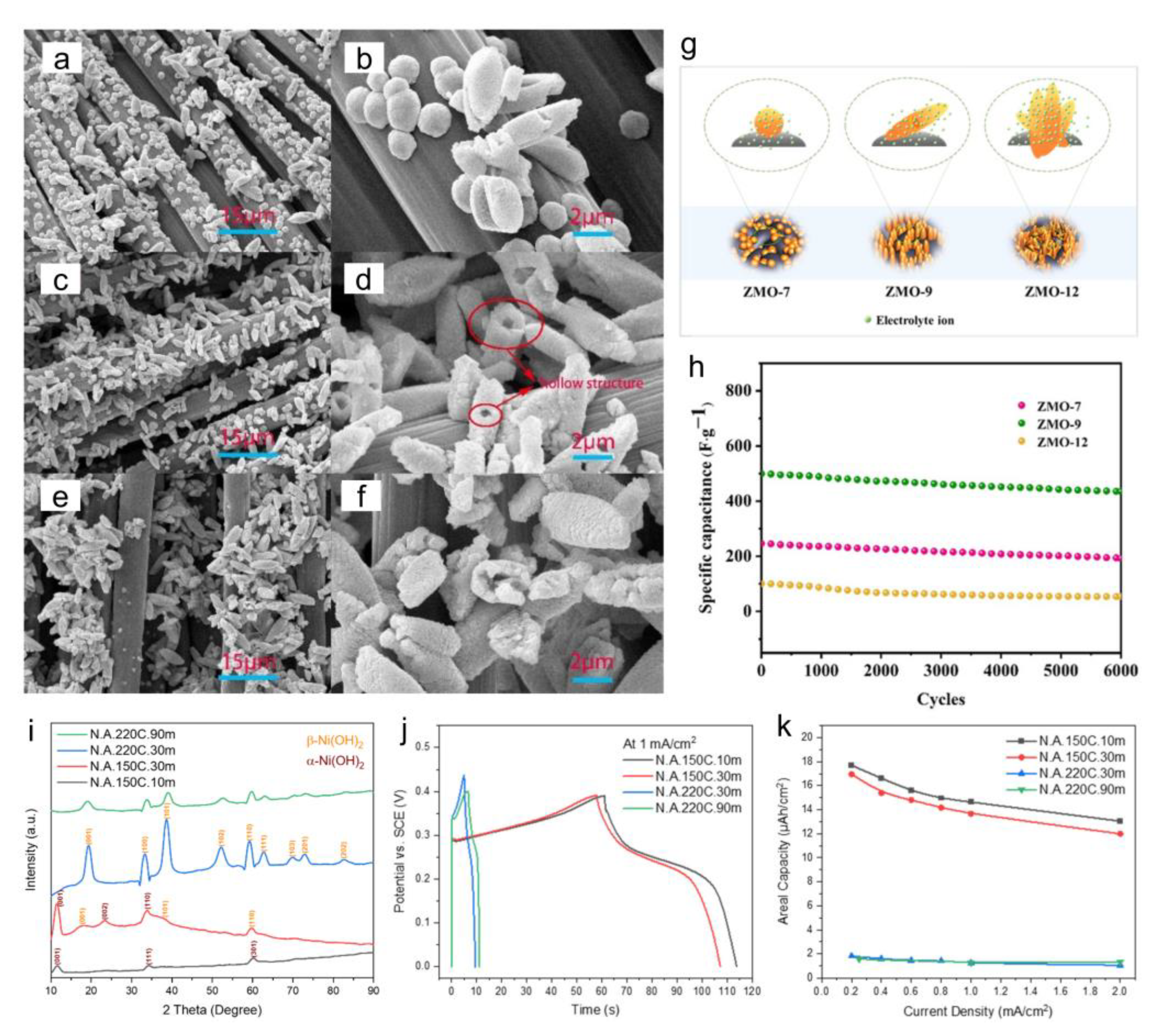
Figure 6.
SEM images of Co2(OH)3Cl in (a-c) the sample prepared in 10 min; and (d-f) the sample prepared in 60 min, both directly deposited on CC at room temperature. (g) XRD spectra of both samples powder. (h) EDS spectrum of the sample prepared in 60 min on CC with its element weight and atomic weight percentages [124]. SEM images of Ag@MnO2 with Ag+ concentration of (i,l) 1%; (j,m) 3%; and (k,n) 5% [125].
Figure 6.
SEM images of Co2(OH)3Cl in (a-c) the sample prepared in 10 min; and (d-f) the sample prepared in 60 min, both directly deposited on CC at room temperature. (g) XRD spectra of both samples powder. (h) EDS spectrum of the sample prepared in 60 min on CC with its element weight and atomic weight percentages [124]. SEM images of Ag@MnO2 with Ag+ concentration of (i,l) 1%; (j,m) 3%; and (k,n) 5% [125].
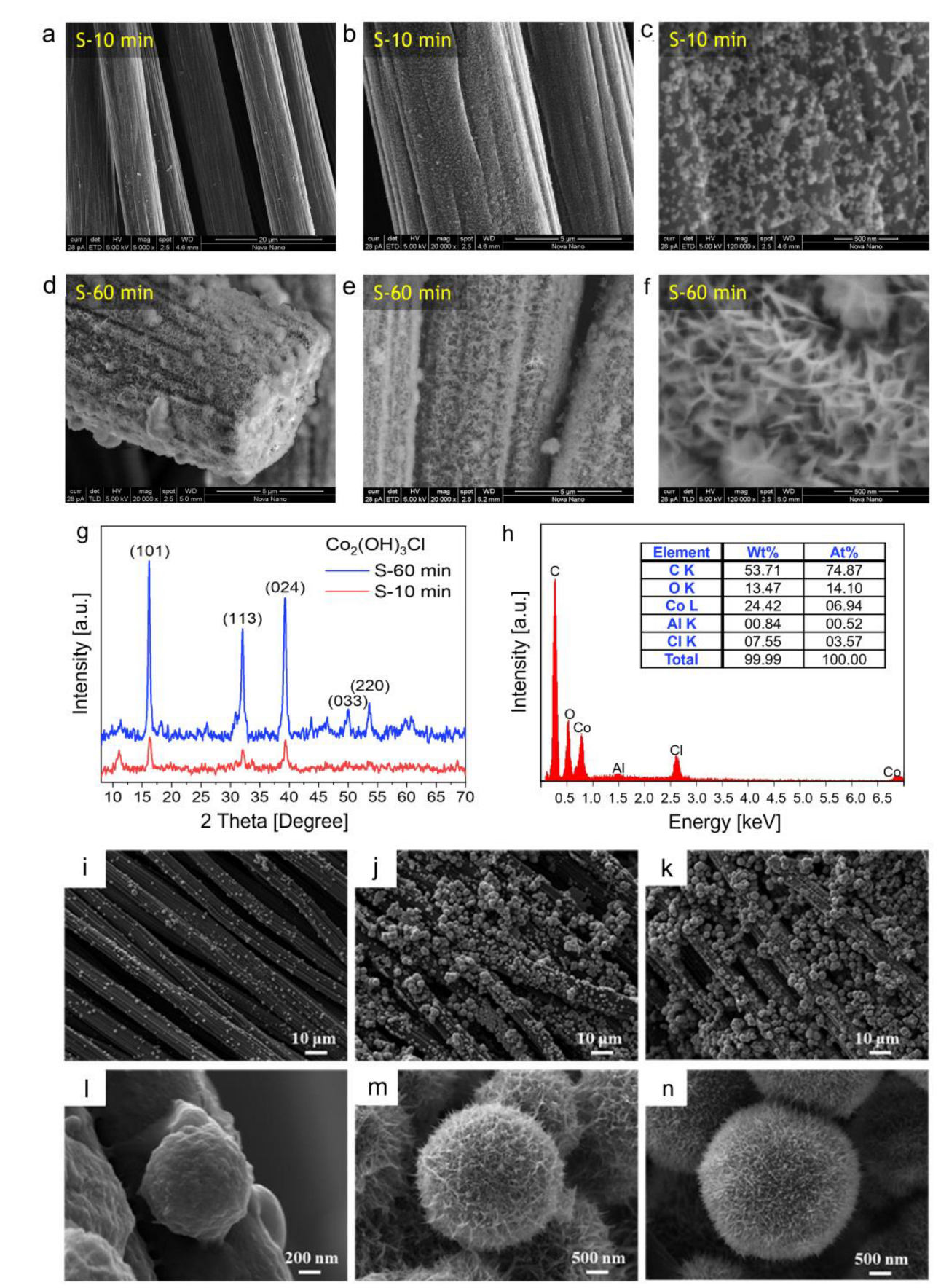
Figure 7.
SEM images of (a,b) nitrate-derived sample (NiO-N) before and after calcination, respectively; and (c,d) acetate-derived sample (NiO-A) before and after calcination, respectively. (e,f) Size distribution of NiO-A nanofibers before and after calcination. (g) CV curves; and (h) GCD curves of NiO-N and NiO-A half-cells vs SCE. (i) CV curves; and (j) CD curves of NiO-A//CNT and NiO-A/CNT//CNT full cells [127].
Figure 7.
SEM images of (a,b) nitrate-derived sample (NiO-N) before and after calcination, respectively; and (c,d) acetate-derived sample (NiO-A) before and after calcination, respectively. (e,f) Size distribution of NiO-A nanofibers before and after calcination. (g) CV curves; and (h) GCD curves of NiO-N and NiO-A half-cells vs SCE. (i) CV curves; and (j) CD curves of NiO-A//CNT and NiO-A/CNT//CNT full cells [127].
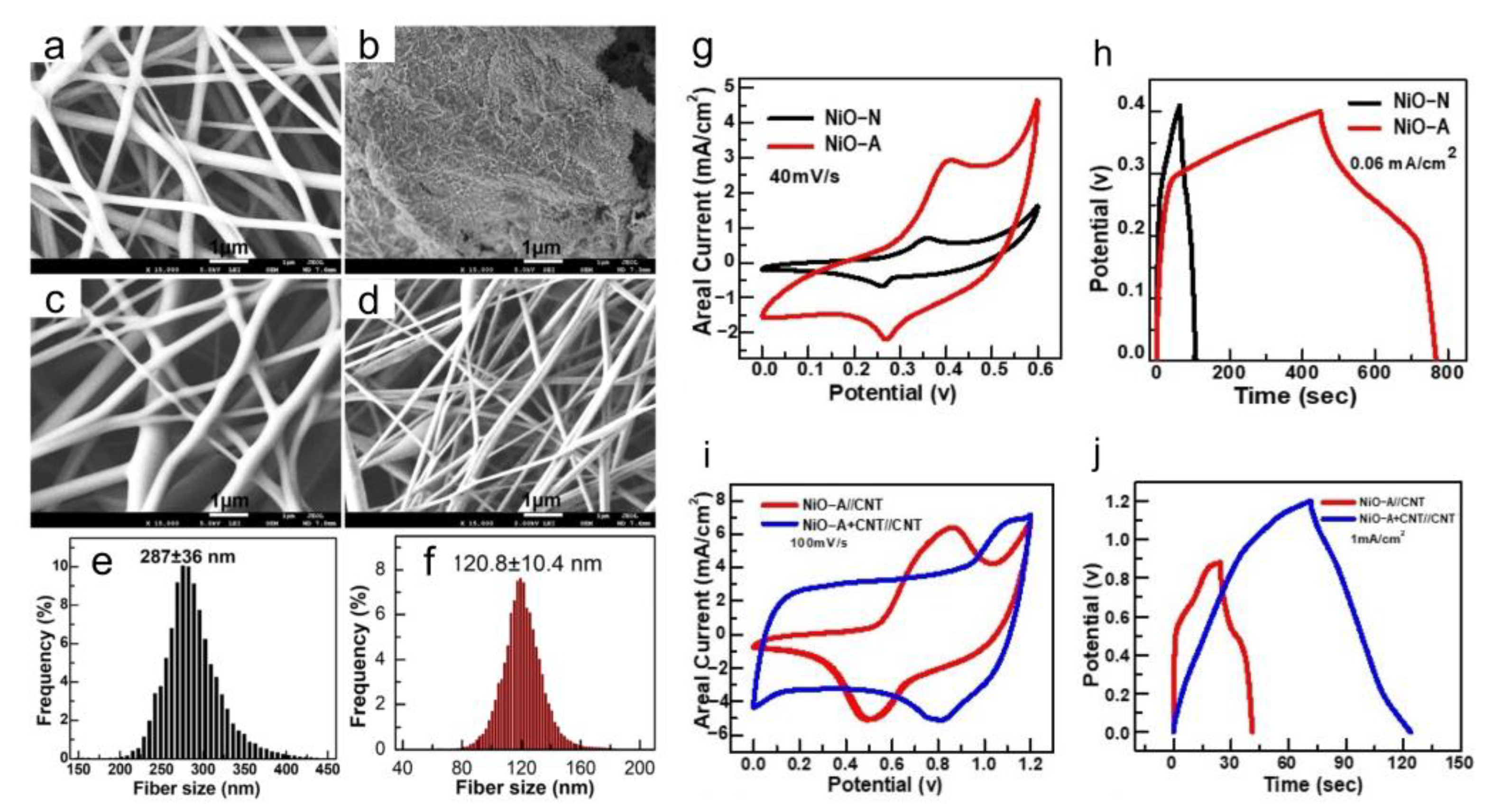
Figure 8.
Comparison between iron oxides and iron nitrides on hydrophilic CC prepared by hydrothermal (HT) and electrodeposition (E) techniques: (a-d) SEM images; (e) specific capacity functions of scan rate; (f) Nyquist plots with an inset of the high-frequency region; and (g) XRD patterns [129].
Figure 8.
Comparison between iron oxides and iron nitrides on hydrophilic CC prepared by hydrothermal (HT) and electrodeposition (E) techniques: (a-d) SEM images; (e) specific capacity functions of scan rate; (f) Nyquist plots with an inset of the high-frequency region; and (g) XRD patterns [129].
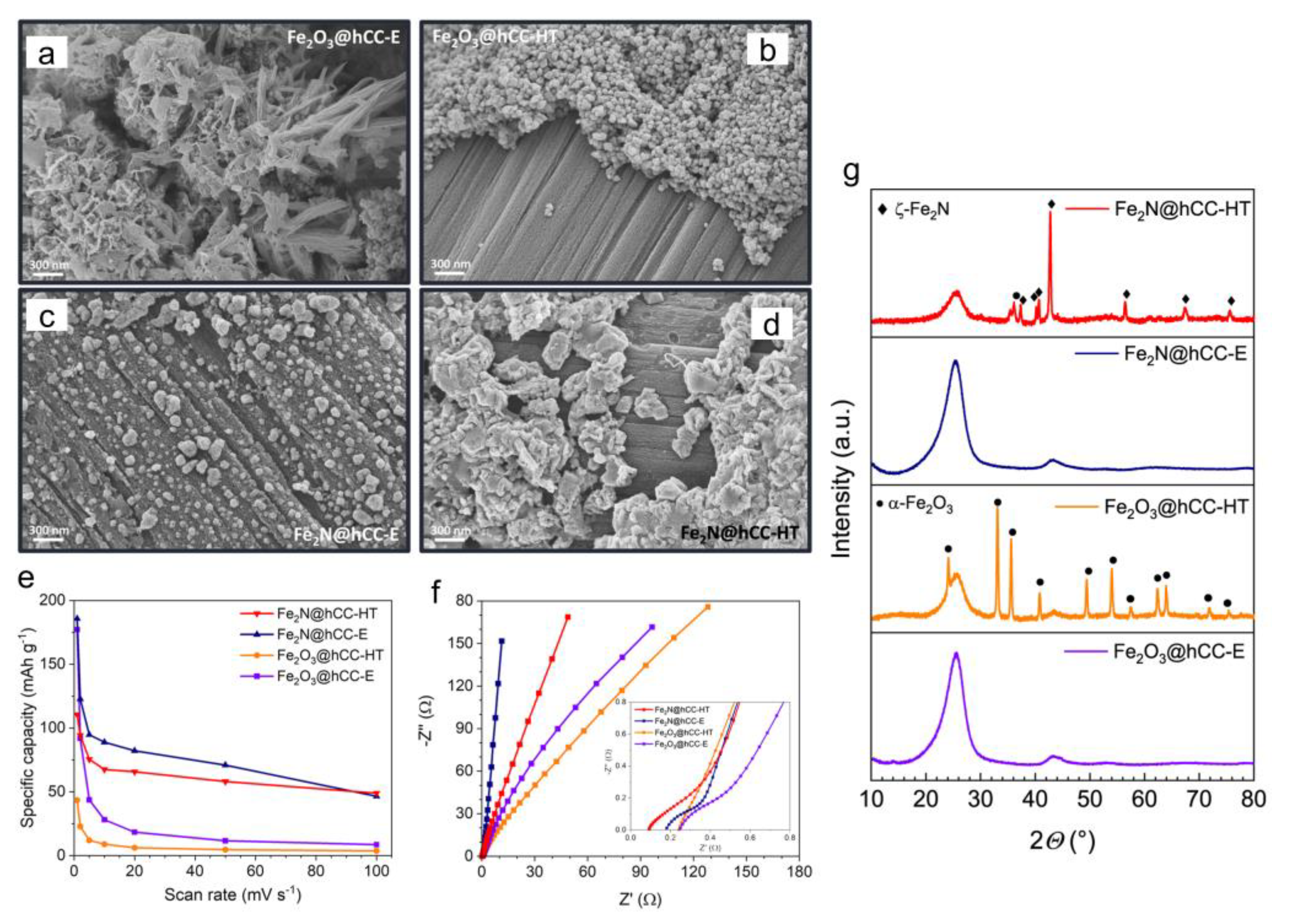
Figure 9.
(a) Schematic representation of carbon xerogel (CX) and MnO2-printed supercapacitor on CC. (b) GCD performed at ±0.2 A/g of MnO2 and CX half-cells versus RHE, and MnO2//CX full-cell. (c,d) a module consisting of 30 LEDs powered for 50 s by two flexible supercapacitors (16 cm2) in normal and bent conditions. (e) CV curves at 100 mV/s at different bending angles [140].
Figure 9.
(a) Schematic representation of carbon xerogel (CX) and MnO2-printed supercapacitor on CC. (b) GCD performed at ±0.2 A/g of MnO2 and CX half-cells versus RHE, and MnO2//CX full-cell. (c,d) a module consisting of 30 LEDs powered for 50 s by two flexible supercapacitors (16 cm2) in normal and bent conditions. (e) CV curves at 100 mV/s at different bending angles [140].
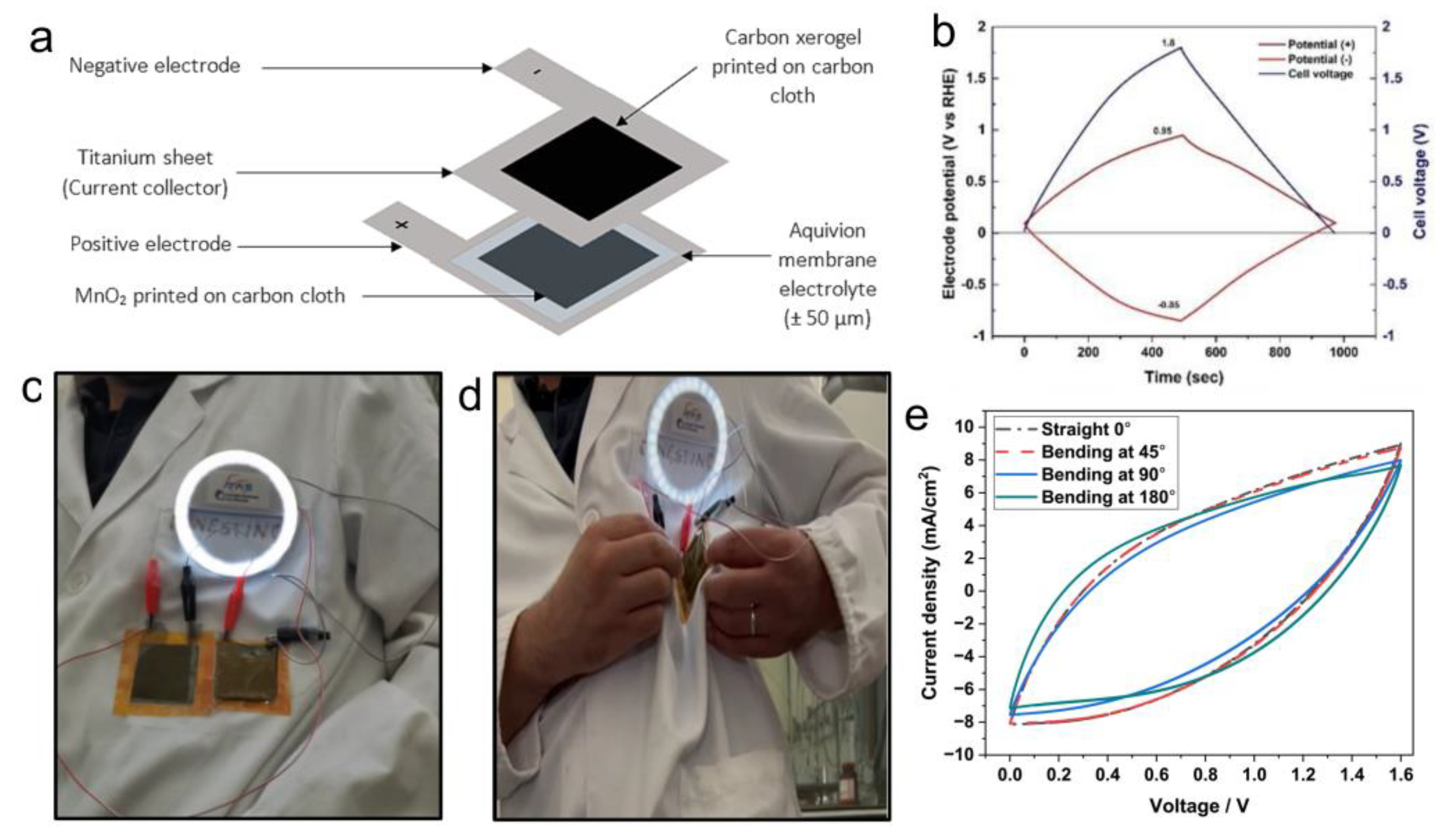
Figure 10.
Schematic of fabrication of (a) chemical bath deposition of Ni(OH)2 on CC; and (b) chemical precipitation of Ni(OH)2 and drop-cast on CC. (c) Specific capacitance functions of current densities for both electrodes. SEM images of (d) bare carbon cloth; (e-g) conformal coating of Ni(OH)2 nanoflakes on CC; and (h,i) planar coating of Ni(OH)2 nanoflakes on CC. [141].
Figure 10.
Schematic of fabrication of (a) chemical bath deposition of Ni(OH)2 on CC; and (b) chemical precipitation of Ni(OH)2 and drop-cast on CC. (c) Specific capacitance functions of current densities for both electrodes. SEM images of (d) bare carbon cloth; (e-g) conformal coating of Ni(OH)2 nanoflakes on CC; and (h,i) planar coating of Ni(OH)2 nanoflakes on CC. [141].
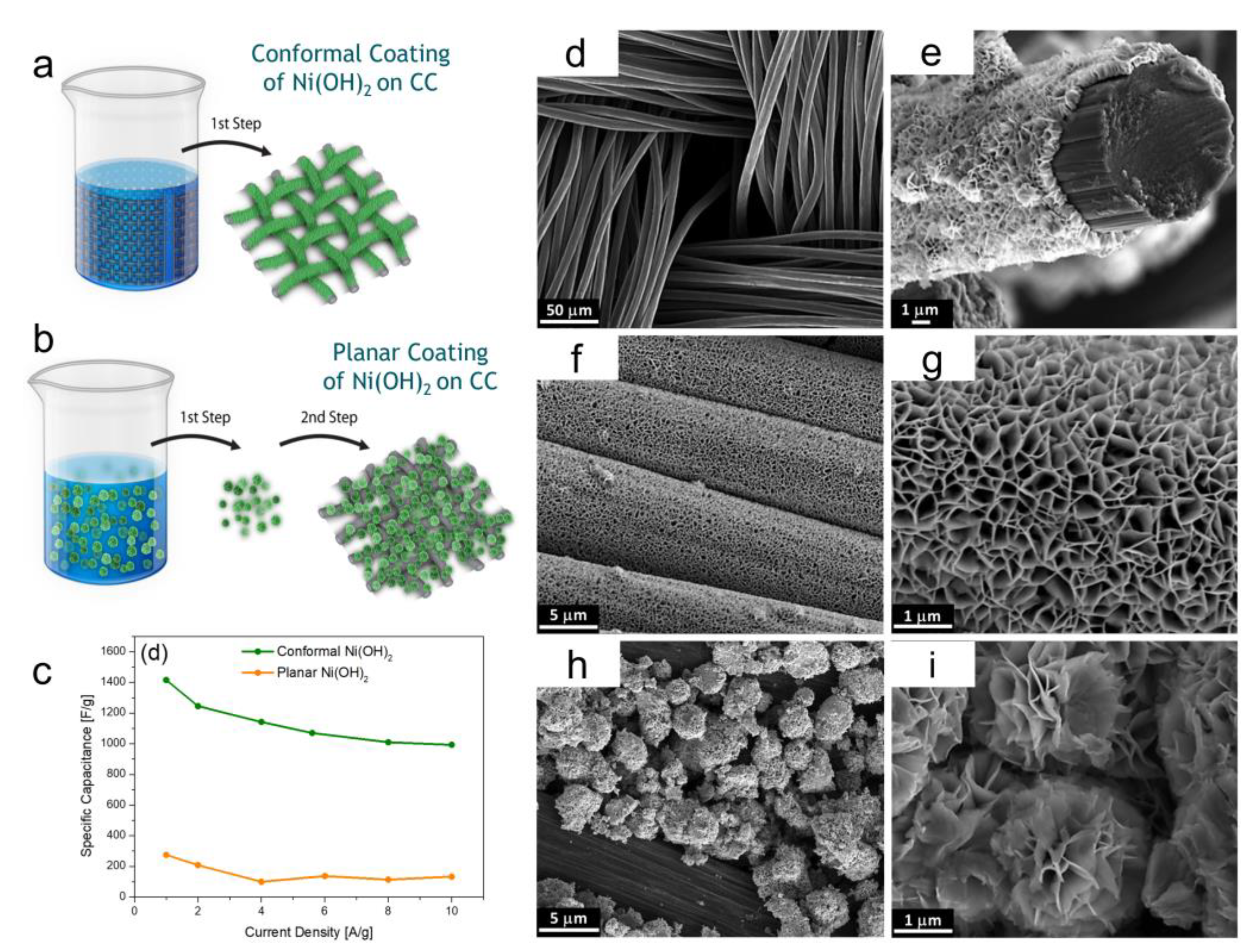
Figure 11.
(a,b) TEM image; and (c) HRTEM image of NiCo2Se4/CC. (d) XRD pattern of CC, NiCo2Se4 and NiCo2Se4/CC composites. (e) CV curves at 10 mV/s for NiSe2/CC, CoSe2/CC, and NiCo2Se4/CC electrodes. (f) Cycling performance of NiCo2Se4/CC//AC/CC asymmetric supercapacitor at 5 A/g for 20000 cycles [156]. For NiCo2O4/CC//rGO/CC asymmetric supercapacitor: (g) CV curves at 0-120 ° bent angles; (h) GCD curves at 1st and 5000th cycles; and (i) Cycling performance for 10000 cycles at 5 A/g [157].
Figure 11.
(a,b) TEM image; and (c) HRTEM image of NiCo2Se4/CC. (d) XRD pattern of CC, NiCo2Se4 and NiCo2Se4/CC composites. (e) CV curves at 10 mV/s for NiSe2/CC, CoSe2/CC, and NiCo2Se4/CC electrodes. (f) Cycling performance of NiCo2Se4/CC//AC/CC asymmetric supercapacitor at 5 A/g for 20000 cycles [156]. For NiCo2O4/CC//rGO/CC asymmetric supercapacitor: (g) CV curves at 0-120 ° bent angles; (h) GCD curves at 1st and 5000th cycles; and (i) Cycling performance for 10000 cycles at 5 A/g [157].
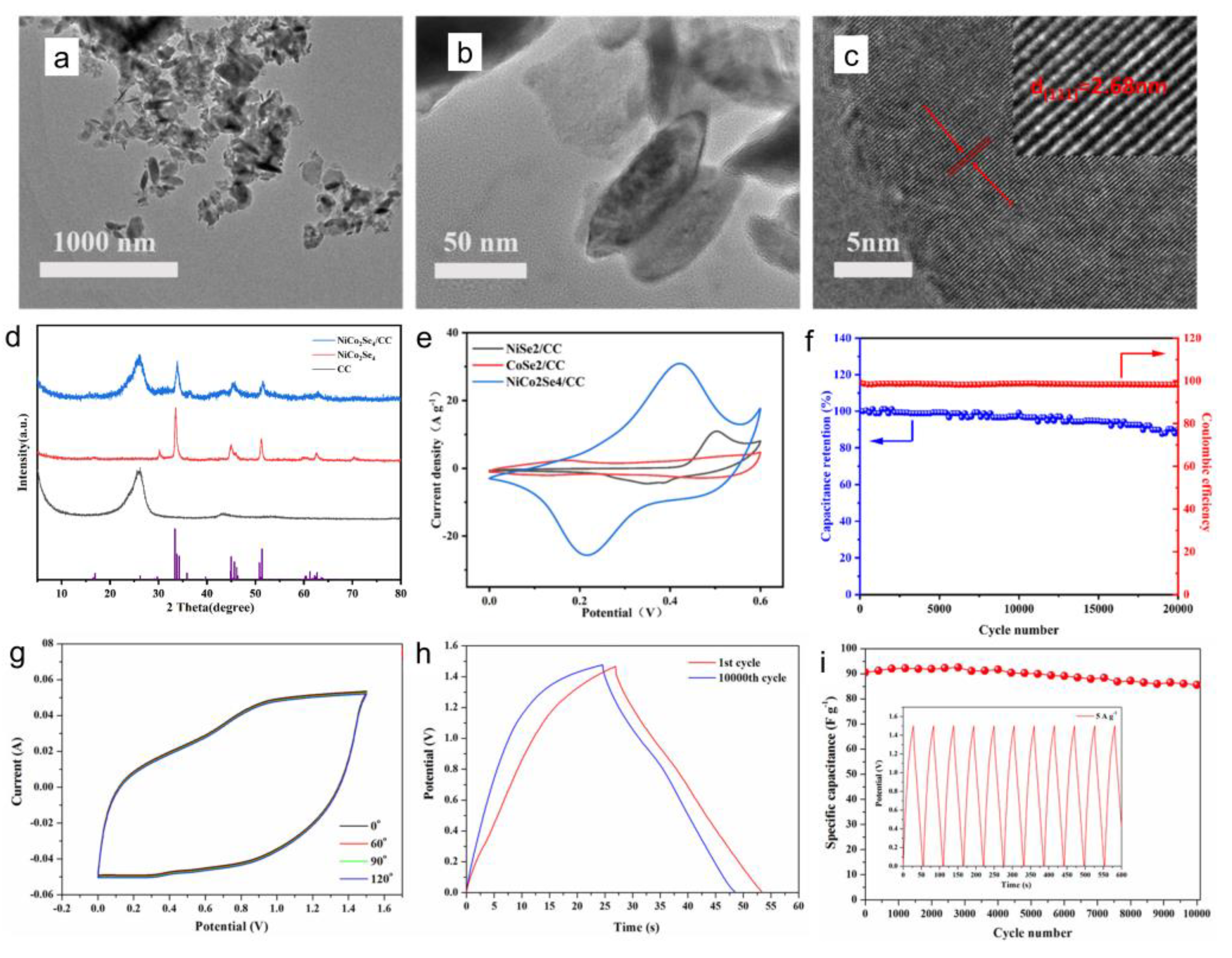
Table 5.
Carbon cloth-based electrodes and their morphology, synthesis, and areal capacitance.
| Electrode @CC | Morphology | Synthesis |
Areal Capacitance (mF/cm2 @ mA/cm2) |
Ref. |
| NiCo-LDHs/CQDs * | Nanosheets | Solvothermal | 5220 @ 5 | [130] |
| PANI | Coral-like and Nanowire Arrays |
Electrochemical Polymerization |
3376 @ 1 | [131] |
| WS2/Graphene | Nano-flower | Solvothermal | 2964 @ 4 | [35] |
| DAA@PDA-AN ** | Nanoporous | Electrodeposition | 2847 @ 1 | [132] |
| PANI-triphenylamine | Network of Nanowires | Electrochemical Copolymerization |
2489 @ 1 | [133] |
| PANI | Nanorods | Electrochemical Copolymerization |
2125 @ 1 | [133] |
| (Ni)MOF/MnO2 | Nanothorns | Hydrothermal | 1780 @ 4 | [114] |
| PANI-diphenylamine | Nanoparticles | Electrochemical Copolymerization |
1693 @ 1 | [133] |
| Co3O4 | Nanoparticles | Ultrafast High-Temperature Thermal Shock (HTS) | 408 @ 0.2 | [121] |
| Graphene | 3D Porous Nanosheets | Direct Laser Writing | 157 @ 0.1 | [126] |
* LDHs: layered double hydroxide; CQDs: carbon quantum dots. ** DAA@PDA-AN-4: aniline and 1,5-diaminoanthraquinone nanoporous conjugated copolymer.
Table 6.
Carbon cloth-based electrodes and their morphologies, synthesis and specific capacitances.
| Electrode @CC | Morphology | Synthesis |
Gravimetric Capacitance (F/g @ A/g) |
Ref. |
| Sm-doped Ni(OH)2 | 3D Nanostructure | Hydrothermal | 3777 @ 1 | [134] |
| NiSe2/CoSe2 | 3D Wheat-like Nanostructure |
Hydrothermal Then Temperature-Dependent Selenization |
1558 @ 1 | [120] |
| ZnCo2O4 | Nanonest-like Structure Composed of Nanowires | Hydrothermal | 1467 @ 1.2 | [135] |
| CdSe/CPCN * | CdSe Nanoparticles, and CPCN Nanoflakes |
Annealing, Etching, and Hydrothermal |
894 @ 0.125 | [136] |
| WO3 | 3D Nanotube Bundles | Hydrothermal | 743 @ 1 | [137] |
| Ag-doped MnO2 | Nanowire, Urchin-like Structure | Chemical Reaction | 521 @ 0.5 | [125] |
| ZIF-67Co(OH)F@Co3O4 | Tremella-like Structure | In Situ Technique Then Hydrothermal |
442 @ 1 | [138] |
| FeOOH@CoS | CoS Nanosheets and FeOOH Nanorods Core-shells |
One-step Process Electrodeposition |
419 @ 0.5 | [58] |
| Potassium nickel(ii) hexacyanoferrate(iii) | Nanoparticles | Co-precipitation | 199 @ 0.4 | [123] |
* CPCN: conductive porous carbon nanoflakes.
Disclaimer/Publisher’s Note: The statements, opinions and data contained in all publications are solely those of the individual author(s) and contributor(s) and not of MDPI and/or the editor(s). MDPI and/or the editor(s) disclaim responsibility for any injury to people or property resulting from any ideas, methods, instructions or products referred to in the content. |
© 2026 by the author. Licensee MDPI, Basel, Switzerland. This article is an open access article distributed under the terms and conditions of the Creative Commons Attribution (CC BY) license.
Copyright: This open access article is published under a Creative Commons CC BY 4.0 license, which permit the free download, distribution, and reuse, provided that the author and preprint are cited in any reuse.