

Submitted:
20 August 2026
Posted:
21 August 2026
You are already at the latest version
Abstract
We show that Bažant’s Type-2 size effect law follows exactly from a single premise---that the cross-scale energy flux is constant within a bounded range of scales---once the fracture process zone is allowed to saturate at a material length rather than remaining geometrically similar. The resulting effective energy scaling exponent is \(\alpha_{\mathrm{eff}}(l)=2+\left(1+l/\ell_p\right)^{-1}\), decreasing from 3 to 2 with increasing size, and the transitional size is not a fitting parameter: it is Irwin's characteristic length \(\ell_p=E'G_c/f_t^{2}\), fixed by independently measurable properties. We note that the alternative assumption of a geometrically similar process zone, which appears in parts of the multiscale-damage literature, yields an exponent that increases with size and a size effect law inverted relative to observation. The same constant-flux premise is then used to organise two extensions. For fractal crack surfaces we prove that the energy scaling exponent equals the surface fractal dimension, \(\alpha=D_f\), within the surface-controlled regime only; we set out explicitly why this weaker statement escapes Bažant’s critique of the fractal size-effect hypothesis, which we accept in its original target. For anisotropic media we develop a structural-tensor perturbation of the exponent and organise it by an angular decomposition on the orientation sphere, which yields a sharp prediction: the \(\ell=2\) component must vanish identically for cubic symmetry, so that a cubic polycrystal must show a four-lobed rather than a two-lobed angular pattern. We also show that the universal anisotropy of fracture surfaces reported by Ponson and co-workers implies a direction-dependent excess-area exponent even in nominally isotropic materials, which bounds the accuracy of any single-\(D_f\) description. Throughout, the constant-flux premise is treated as a hypothesis rather than a result. Section~7 states four falsifiable predictions and a validation protocol using existing published size-effect data. The connection to Kolmogorov's inertial-range argument is used as a method of organisation, not as a physical claim about any equivalence between fluids and solids.
Keywords:
size effect
; quasibrittle fracture
; fracture process zone
; energy flux
; scaling law
; fractal fracture
; anisotropy
; self-similarity
; representation theory
1. Introduction
1.1. The Result
Consider a quasibrittle solid in which dissipation occurs in a process zone of material width , at a rate per unit volume. We show (Section 3.2) that if the cross-scale energy flux is constant over a bounded range of scales, then the energy exchanged in a damage event of size l is
whence the effective scaling exponent and nominal strength are
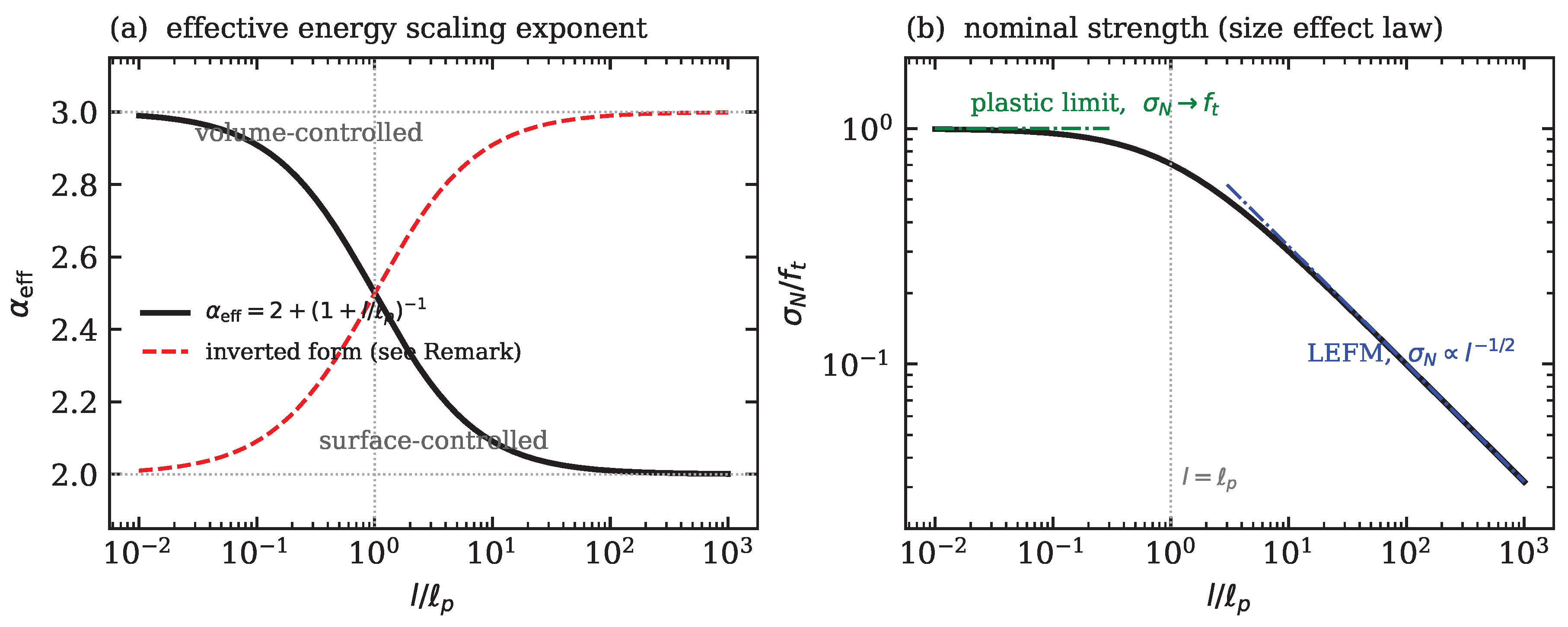
The second of these is Bažant’s Type-2 size effect law [5,8,12] with transitional size . What is worth noting is not the law—which is well established—but that it emerges here with no adjustable constant, from a premise about energy transport rather than from asymptotic matching, and that is delivered already identified with Irwin’s characteristic length. The exponent decreases from 3 (volume-controlled dissipation, small structures) to 2 (surface-controlled, large structures), so that brittleness increases with size. Figure 1 shows both curves.
Remark 1
(An error worth naming). If the process zone is instead taken to scale with the structure, , one obtains the additive form and , whichincreasesfrom 2 to 3 with size, and a nominal strength that saturates at for large structures and diverges as for small ones. This is the size effect law with its asymptotes exchanged. The assumption appears in parts of the multiscale-damage and energy-cascade literature, where the versus competition is often quoted without noting that the crossover direction is fixed by whether is a material constant. It is not a small matter: the incorrect form predicts that large concrete structures are more ductile than laboratory specimens.
1.2. Method, and What Is Borrowed
The premise behind (1) is the fracture analogue of Kolmogorov’s inertial-range argument [22,23]: in a range of scales bounded away from both the loading geometry and the microstructural cutoff, a statistically stationary cascade can neither accumulate nor deplete energy, so the cross-scale flux is constant and dimensional analysis fixes the form of the scaling. We borrow this and nothing else. No claim is made that solids and fluids share dynamics; the analogy is used to identify which quantity must be held constant and over what range, and is then discharged.
This places the present work within the tradition of incomplete similarity and intermediate asymptotics [3,4], to which Bažant’s own asymptotic theory of quasibrittle scaling [6] also belongs. The distinctive step here is to make the conserved flux, rather than the asymptotic expansion, the primitive object, which is what allows the fractal and anisotropic extensions of Section 4Section 5 to be developed within the same framework.
1.3. Relation to the Fractal Size-Effect Debate
Section 5 proves that the energy scaling exponent equals the fractal dimension of the fracture surface, . Claims of this general shape have a contested history. Following the observation of fractal fracture surfaces [15,27,28] and their use to explain strength scaling [14,16,17], Bažant [7] argued that the fractal hypothesis rests on geometric reasoning divorced from the mechanics of crack propagation, and that it implies unreasonable behaviour for large structures and for failure at crack initiation.
We accept that critique against its original target and do not attempt to revive the hypothesis it rejects. Our theorem is deliberately weaker in three respects, set out in detail in Section 5.2: it applies only in the surface-controlled regime ; it does not explain the size effect, which in this framework comes from and is derived independently in Section 3.2; and it is bounded above and below by the inertial range (10), so the fractal correction saturates and correct large-size asymptotics are recovered. Separating the two mechanisms—rather than offering fractality as an alternative account of the size effect—is what makes the weaker statement defensible.
1.4. Contributions and Organisation
- 1.
- A flux-based, parameter-free derivation of the Type-2 size effect law via process-zone saturation, and identification of the inverted form that follows from the geometric-similarity assumption (Section 3.2).
- 2.
- A structural-tensor perturbation model for the direction-dependent exponent in anisotropic media, its systematic angular decomposition, and the resulting prediction that the component must vanish for cubic symmetry (Section 4).
- 3.
- 4.
- A validation protocol and four falsifiable predictions (Section 7).
Notation
| Symbol | Meaning |
| continuum damage variable, | |
| , | fractal dimension of fracture surface / of a profile line |
| scale separation ratio | |
| G, | generalised and critical energy release rate () |
| effective generalised energy release rate () | |
| damage energy release rate () | |
| l, , L | running scale, microscopic cutoff, macroscopic size |
| process-zone width, Irwin characteristic length | |
| dissipation per unit volume in the process zone () | |
| , | energy scaling exponent; effective (local) exponent |
| H, , | Hurst exponent; roughness and growth exponents |
| dimensionless traceless structural (anisotropy) tensor |
2. Energy Balance and the Damage Inertial Range
2.1. Total Energy Balance
Let a solid occupy reference configuration with boundary , under tractions and body force . The mechanical power input is
and, under isothermal or adiabatic conditions,
with the elastic strain energy, the surface energy of discrete cracks and the irreversible dissipation.
In continuum damage mechanics [21,25] the damage variable measures stiffness degradation, with , and
The Clausius–Duhem inequality requires
both terms being separately non-negative since decreases with D and . With a dissipation potential and normality,
Separation of a discrete crack contributes .
Remark 2
(Avoiding double counting). and describe the same physics at different resolutions and must not be added indiscriminately. We take to account for diffuse damage and plasticity in unseparated material and for material that has fully separated. The two are bridged in the localisation limit [20,29] by
n being the coordinate normal to the crack plane. Note the dimensions: , integration over D is dimensionless, and integration over n supplies the missing length, giving . A volume integral of Y would give and cannot represent an energy release rate.
2.2. The Flux and the Inertial Range
Definition 1
(Generalised energy release rate). In the damage inertial range, G is the elastic strain energy released per unit projected area of crack advance, coinciding with the Griffith rate for ideal brittle behaviour and related to the volumetric damage dissipation by (8).
For rough surfaces the true area exceeds the projected area; with cutoff and surface dimension we define
Hypothesis 1
(Constant flux). In a statistically stationary damage inertial range, G (equivalently Π) is independent of scale.
This is a hypothesis, not a theorem, and everything below is conditional on it. Its justification is that within the inertial range neither the loading geometry nor the microscopic cutoff supplies a length, so a stationary cascade cannot accumulate or deplete energy at any intermediate scale. Section 7 states how it can be falsified.
Scale separation is required. With and boundary layer thickness , the inertial range satisfies
A sharper statement follows from renormalisation-group reasoning. Let be a dimensionless effective coupling obeying . At a fixed point ; linearising,
Power-law behaviour is thus controlled by the linearised flow, the exponent being the RG eigenvalue; at the fixed point itself F is constant. In this language is relevant and conserved, while parameters describing microstructural heterogeneity are irrelevant and decay—which is why the inertial range is insensitive to microscopic detail.
Proposition 1
(Restricted equivalence). Suppose that in the energy depends only on l and on a single flux-like parameter of fixed dimension, and that no other length enters. Then is a power law in l if and only if that parameter is scale-independent.
Proof
(Sketch). Sufficiency is dimensional analysis. For necessity, if then , constant only if is a power of l; requiring the dimensional identification of as a flux to hold uniformly forces . □
Remark 3.
The proposition holds within a restricted hypothesis class and does not establish that real materials satisfy its hypotheses. Section 3.2 shows what happens when a second length is present: scaling becomes local rather than global, and Proposition 1 correctly predicts that no single global exponent exists.
3. Isotropic Media: From Ideal Brittleness to the Size Effect
Let l be the characteristic scale of a damage event. Under Hypothesis 1,
Remark 4
(What denotes). is the energyexchangedat scale l: released by, and—at the propagation threshold—dissipated in, a damage event of size l. Identifying released with dissipated energy is legitimate only at criticality, which is where all scaling statements below are made.
3.1. Ideal Brittle Limit
For a planar crack, with , hence
dimensionally . An ideal brittle solid has no internal length, so the energy of advance is proportional to created area and the exponent is purely geometric [19].
Remark 5
(A caveat on the J-integral argument). It is sometimes argued that path-independence of J [33] makes G scale-independent. It does not: J is independent of thecontour, not of the crack size, and for one has , which grows with l. Scale-independence of G is Hypothesis 1, physically realised because a crack in the inertial range propagates at with σ adjusting as l grows.
3.2. Quasibrittle Media: Process-Zone Saturation
Let be the dissipation per unit volume in the process zone and its width. The decisive point is that is a material constant [10,20]: the process zone cannot grow indefinitely with structure size. An effective thickness interpolating between the two limits is
so that the dissipated energy of an event of size l is
interpolating between volume-controlled dissipation for and surface-controlled dissipation for . Hence
which decreases from 3 to 2: increasing size increases brittleness.
Remark 6
(The inverted form). Assuming instead gives and , increasing from 2 to 3 (dashed curve, Figure 1a). The error is in treating as geometrically similar rather than as a material length; see Remark 1.
3.2.0.1. The size effect law.
The work available from nominal stress is . Equating it to (15) at criticality,
which is the Type-2 size effect law [5,12] with , having asymptotes for and for (Figure 1b). Consistently is Irwin’s characteristic length, so the transitional size is fixed by independently measurable , , and is not adjustable. This is the sense in which the derivation is parameter-free.
Remark 7
(The size effect is a crossover, not a power law). Equation (16) is arunningexponent: is not a power law, and the scale invariance of Section 2 holds only asymptotically at each end. In Barenblatt’s terminology [3,4] the similarity is incomplete in , and is the parameter whose presence forbids a global exponent. This is the same structure that Bažant obtains by asymptotic matching of the large-size and small-size expansions [6]; the difference here is that the interpolation follows from an assumption about the process zone (14) rather than being introduced as a matching device. Reporting a single fitted exponent for a quasibrittle material is therefore meaningful only alongside the size range over which it was measured.
Remark 8.
Exponents are occasionally reported. Within this framework they cannot arise from plasticity, and indicate either microcrack shielding or a change of failure mode across scales. They mark the breakdown, not an extension, of (16).
3.3. Dissipation Rate and Dynamic Loading
Differentiating (12),
with reducing to and to at . At fixed propagation speed the volumetric dissipation rate falls as : large structures dissipate less per unit volume, an energetic restatement of the size effect.
Remark 9
(Dynamic loading). We restrict the quantitative claims of this paper to quasi-static loading. For completeness: the driving force is reduced by the universal function of crack speed [18], with , so as and the Rayleigh speed is unattainable; in practice branching intervenes well below it [32,34]. If Hypothesis 1 survives dynamically, one expects with —that is, speed modulates the prefactor but not the exponent. We record this as a prediction (Section 7) rather than a result: establishing it would require resolving the flux at fixed crack speed, which we have not done.
3.4. Critical Scale
At criticality , and with ,
Since this is dimensionally exact, and appears because carries it; no dimensional patch is required. For the released energy grows faster than the resistance, so propagation is unstable beyond ; for growth is stable and marks arrest. At the criterion degenerates to the scale-independent Griffith condition and no characteristic scale is selected.
3.4.0.2. Statistical correction.
Under weakest-link statistics with Weibull modulus m and n dimensions of similitude, , so with ,
4. Anisotropic Media
4.1. Direction-Dependent Scaling
With a unit direction, dimensional consistency requires a direction-dependent cutoff:
Writing this without the cutoff factor is dimensionally inconsistent whenever .
The origin of the directional dependence is competition between microscopic mechanisms, not merely geometric resistance contrast. In a unidirectional composite, a crack running along the fibres proceeds by matrix cracking and interfacial debonding with bridging and pull-out, giving a long process zone ( large, small) and hence, by (16), toward 3; a crack running across the fibres must sever them, giving a short process zone and . Note that within this framework the angular variation of is, to leading order, the angular variation of —the anisotropy of the exponent is inherited from the anisotropy of the process zone, which is directly measurable [9].
4.2. Structural Tensor Representation
Let be a dimensionless symmetric second-order structural tensor with , extracted from by contraction and normalisation. By the representation theorem for scalar functions of a tensor and a direction [36],
with dimensionless couplings .
Remark 10.
Since but , the quadratic term contains an isotropic part, so second-order anisotropy renormalises the baseline, , before producing any directional variation. This is absent at first order and is easily mistaken for a shifted baseline when fitting.
For an orthotropic material with axes , writing with eigenvalues , , and ,
Remark 11
(Correction). The quadratic invariant is : the eigenvalues are squared, the direction cosines are not. The form , which appears in some treatments, is not an invariant of the expansion.
4.3. Angular Decomposition and a Prediction for Cubic Symmetry
Equation (23) is one term of a systematic expansion. Since is a scalar field on the orientation sphere , it admits the decomposition
in which is the isotropic baseline and the five independent components of the traceless tensor supply the multiplet. Successive orders correspond to structural tensors of increasing rank, in the standard hierarchy of anisotropic representation theory [35,36].
Two constraints follow, both of which are testable.
First, only even ℓ can appear. Crack advance along and along encounters the same microstructure, so and all odd multipoles vanish. Any measured odd component would indicate a genuinely polar microstructure (for example a processing-induced gradient) rather than the orientation distribution assumed here.
Remark 12
(Cubic symmetry). Second, and more sharply: for cubic material symmetry every traceless symmetric second-order structural tensor vanishes identically, so and the leading anisotropy is . Equation (22) is then inadequate at leading order and must be replaced by an expansion in a fourth-order structural tensor. A cubic polycrystal must therefore exhibitno angular component in : measuring the exponent on geometrically similar specimens cut at a sequence of orientations should yield a four-lobed rather than a two-lobed pattern. Detecting a significant component in a nominally cubic material would falsify either the symmetry assignment or the representation (22).
4.4. Anisotropic Roughness and the Cascade Network
With a direction-dependent surface dimension ,
the volume expression reducing to when all . The local flux density is then strongly non-uniform, forming preferred paths along weak directions and barriers along strong ones, with percolation of such a path marking the onset of macroscopic instability.
Remark 13
(Intrinsic surface anisotropy). A caution that bears on the whole of Section 5. Ponson and co-workers [30,31] showed that fracture surfaces are anisotropically self-affine even innominally isotropicmaterials: the 2D height–height correlation function requires exponents along the crack front, along the propagation direction, and , reported as material-independent and velocity-independent across silica glass, aluminium alloy, mortar and wood.
Since a self-affine profile of Hurst exponent H has profile dimension , the excess-area exponent differs between the two in-plane directions by . Two consequences follow. First, the anisotropy treated by (22)—which originates in material structure—isdistinctfrom this kinematic anisotropy of the crack front, and the two must not be conflated when fitting. Second, a single scalar in Theorem 1 is an approximation whose error is bounded below by in the exponent unless the direction over which is measured is specified. Which of the two exponents controls the energy budget is, to our knowledge, open, and we flag it as such rather than assume it.
5. Fractal Surfaces and the Isomorphism Theorem
5.1. The Theorem
For an isotropic self-similar surface, with , so , and the area observed at scale l is
whence with ,
Theorem 1
(Energy–fractal isomorphism). Assume (i) the inertial range (10) is non-empty; (ii) the fracture surface is statistically self-similar with constant over that range; (iii) dissipation is surface-controlled, i.e., , so that the energy of an event of size l is proportional at criticality to the true created area with a scale-independent constant G. Then
5.2. Reconciliation with the Critique of the Fractal Size Effect
Theorem 1 must be positioned against Bažant’s critique [7] of the hypothesis that crack fractality explains the size effect. That critique makes three charges: that the fractal explanation rests on geometric analogy rather than the mechanics of crack propagation; that unbounded fractality implies unreasonable scaling at large sizes; and that it fails for failures at crack initiation, where no large crack exists. We accept all three against their original target. Theorem 1 is not that hypothesis, and differs from it in exactly the three respects at issue.
- 1.
- It does not explain the size effect. In this framework the size effect is produced by and derived independently in Section 3.2, where it reproduces (17) without reference to . Fractality modifies only the surface-controlled asymptote. The two mechanisms are separated, not offered as alternatives—which is the substantive difference from the hypothesis criticised in [7].
- 2.
- It is bounded. Hypothesis (i) confines fractality to . Outside that window the correction saturates: for the exponent returns to 2 and LEFM asymptotics are recovered, so the unreasonable large-size behaviour does not arise. Unbounded fractality is precisely what the inertial range excludes.
- 3.
Remark 14
(What survives, and how large it is). What remains is a modest and testable claim: in the surface-controlled regime, the slope of measured fracture energy against size equals . With – typical of measured surfaces [15,31], this is a slope of –—a real but secondary correction, not a competitor to the size effect itself. Two diagnostic errors should be avoided. First, exponents appreciably above this rangecannotbe explained by roughness alone and require a volumetric contribution; attributing a large α to fractality is a misdiagnosis. Second, fracture surfaces are generally self-affinerather than self-similar, so their box dimension is scale-dependent across a crossover length; must be measured over the same range of scales as the energy, and in a stated direction (Remark 13).
5.3. Multiscale Fractality
If mechanisms differ across scales, becomes scale-dependent. For a self-affine profile of Hurst exponent H, and ; with , (27) generalises to
reducing to for constant . The isomorphism thus survives in local form even when global scaling invariance is lost. Multiscale fractality produces curvature, and sometimes log-periodic modulation, in versus , expected to be prominent in hierarchically structured materials [1].
6. Comparison with the Turbulent Cascade
| Turbulence (K41) | Fracture (this work) | |
| Conserved flux | dissipation rate | G, or for rough cracks |
| Inertial range | Equation (10) | |
| Carrier | continuous velocity field | discrete topological change |
| Reversibility | statistically quasi-reversible | strictly irreversible |
| Threshold | none | required |
| Anomaly source | intermittency of | anisotropy; threshold intermittency |
| Closure | exact law from Navier–Stokes | none available |
The shared structure is a forward cascade through an inertial range controlled by internal nonlinearity, with a constant flux underwriting scaling invariance. Two differences are decisive, and both bound the applicability of Hypothesis 1.
6.0.0.3. Threshold conditionality.
In turbulence, energy transfer between neighbouring scales is unconditional: every eddy interacts, and intermittency arises from fluctuations in the transfer rate. In fracture the transfer is conditional. Only regions where the local intensity satisfies participate in the cascade at all; sub-threshold regions store elastic energy without transmitting it, and release it only when a neighbouring region crosses the threshold and redistributes the field [2,26]. The flux is therefore intermittent by construction rather than by fluctuation, and its statistics are governed by threshold crossing rather than by smooth nonlinear interaction. This has a concrete consequence for Hypothesis 1: constancy of G can hold only in the mean over an ensemble of threshold events, never instantaneously, and the ensemble must be large enough that the crossing statistics are stationary. Where the number of participating sites is small—near failure, or in a specimen only a few characteristic lengths across—the hypothesis should not be expected to hold, and the scaling predictions of Section 3, Section 4 and Section 5 correspondingly weaken.
6.0.0.4. Irreversibility and topological change.
Turbulent structures are statistically quasi-reversible; damage is not. Entropy production is strictly positive, and each transfer event changes the topology of the configuration space in which subsequent events occur, since a crack that has formed cannot un-form and permanently alters the elastic field. The cascade therefore runs on a substrate that the cascade itself modifies—a feature with no counterpart in the K41 picture, and the reason we treat the analogy as a device for identifying the conserved quantity rather than as a physical correspondence.
Remark 15
(Limits of the analogy). The analogy is structural, not dynamical, and we do not rely on it beyond Section 2. There is no fracture counterpart of the Navier–Stokes equations from which the cascade could be derived, no counterpart of the exact law, and no direct measurement of a fracture energy flux comparable to the measurement of ε. Hypothesis 1 must therefore be tested through its consequences, which is the purpose of Section 7.
7. Predictions, Validation Protocol and Limitations
7.1. Falsifiable Predictions
- 1.
- 2.
- Isomorphism. In the surface-controlled regime , the slope of measured fracture energy versus size must equal , with measured by fractography over the same range of scales and in a stated direction.
- 3.
- Angular structure. must contain only even spherical harmonics, with for cubic symmetry (Remark 12).
- 4.
- Dynamic separability. Crack speed should modulate the prefactor but not the exponent (Remark 9); a measured speed-dependent exponent would falsify Hypothesis 1 under dynamic loading.
7.2. Validation Protocol
Prediction 1 can be tested against existing data without new experiments. The procedure is:
- 1.
- 2.
- Obtain , and for the same material from independent tests, and form . Do not fit .
- 3.
- Plot against l. Equation (17) predicts a straight line through the origin of slope .
- 4.
- Compare the fitted slope with from step 2. Agreement within the experimental scatter of and supports Hypothesis 1; systematic discrepancy falsifies the parameter-free claim while leaving the functional form intact.
7.3. Limitations
- 1.
- Hypothesis 1 is postulated, supported by dimensional and RG arguments, not derived from micromechanics; there is no fracture analogue of Kolmogorov’s exact relations.
- 2.
- is an input, not a prediction. Deriving it from the statistics of microstructural obstacles and the crack-tip field is the natural next step and is not attempted here.
- 3.
- The interpolation (14) is the simplest function with the correct limits, not a derived crossover; a different interpolation would change the shape of between the asymptotes without changing them.
- 4.
- The couplings in (22) are phenomenological and must be fitted.
- 5.
- No new experimental or numerical data are reported. All quantitative statements are either derived or drawn from cited literature.
8. Conclusions
Taking constancy of the cross-scale energy flux as the primitive assumption, and allowing the fracture process zone to saturate at a material length rather than remaining geometrically similar, we obtain the effective energy scaling exponent and, from it, Bažant’s Type-2 size effect law with no adjustable constant and with the transitional size identified as Irwin’s characteristic length. The opposite assumption, which appears in parts of the energy-cascade literature on damage, yields the size effect law with its asymptotes exchanged.
Within the same framework, the energy scaling exponent equals the fracture surface fractal dimension in the surface-controlled regime, a claim we have been careful to keep weaker than the fractal size-effect hypothesis criticised by Bažant: it neither explains nor competes with the size effect, is bounded by the inertial range, and applies only after substantial crack growth. For anisotropic media, a structural-tensor perturbation organised by an angular decomposition yields a definite prediction for cubic symmetry, and the universal surface anisotropy reported by Ponson and co-workers sets a floor on the accuracy of any single- description.
Data Availability Statement
The data supporting the findings of this study are available from the corresponding author upon reasonable request
Conflicts of Interest
The author declare that there are no competing financial interests
References
- Alava, M. J.; Nukala, P. K. V. V.; Zapperi, S. Statistical models of fracture. Adv. Phys. 2006, 55(3–4), 349–476. [Google Scholar] [CrossRef]
- Bai, Y. L.; Xia, M. F.; Ke, F. J. Cascade and catastrophe of solid damage evolution. Adv. Mech. (in Chinese). 1996, 26(2), 145–162. [Google Scholar]
- Barenblatt, G. I. Scaling, Self-Similarity, and Intermediate Asymptotics; Cambridge University Press: Cambridge, 1996. [Google Scholar]
- Barenblatt, G. I. Scaling; Cambridge University Press: Cambridge, 2003. [Google Scholar]
- Bažant, Z. P. Size effect in blunt fracture: concrete, rock, metal. J. Eng. Mech. ASCE 1984, 110(4), 518–535. [Google Scholar] [CrossRef]
- Bažant, Z. P. Scaling of quasibrittle fracture: asymptotic analysis. Int. J. Fract. 1997, 83(1), 19–40. [Google Scholar] [CrossRef]
- Bažant, Z. P. Scaling of quasibrittle fracture: hypotheses of invasive and lacunar fractality, their critique and Weibull connection. Int. J. Fract. 1997, 83(1), 41–65. [Google Scholar] [CrossRef]
- Bažant, Z. P. Scaling theory for quasibrittle structural failure. Proc. Natl. Acad. Sci. 2004, 101(37), 13400–13407. [Google Scholar] [CrossRef]
- Bažant, Z. P.; Daniel, I. M.; Li, Z. Size effect and fracture characteristics of composite laminates. J. Eng. Mater. Technol. ASME 1996, 118(3), 317–324. [Google Scholar] [CrossRef]
- Bažant, Z. P.; Kazemi, M. T. Determination of fracture energy, process zone length and brittleness number from size effect, with application to rock and concrete. Int. J. Fract. 1990, 44(2), 111–131. [Google Scholar] [CrossRef]
- Bažant, Z. P.; Pfeiffer, P. A. Determination of fracture energy from size effect and brittleness number. ACI Mater. J. 1987, 84(6), 463–480. [Google Scholar] [CrossRef]
- Bažant, Z. P.; Planas, J. Fracture and Size Effect in Concrete and Other Quasibrittle Materials; CRC Press: Boca Raton, 1998. [Google Scholar]
- He, S.; Plesha, M. E.; Rowlands, R. E.; Bažant, Z. P. Fracture energy tests of dam concrete with rate and size effects. Dam Eng. 1992, 3, 139–159. [Google Scholar]
- Borodich, F. M. Some fractal models of fracture. J. Mech. Phys. Solids 1997, 45(2), 239–259. [Google Scholar] [CrossRef]
- Bouchaud, E. Scaling properties of cracks. J. Phys. Condens. Matter 1997, 9(21), 4319–4344. [Google Scholar] [CrossRef]
- Carpinteri, A. Fractal nature of material microstructure and size effects on apparent mechanical properties. Mech. Mater. 1994, 18(2), 89–101. [Google Scholar] [CrossRef]
- Carpinteri, A.; Chiaia, B. Multifractal nature of concrete fracture surfaces and size effects on nominal fracture energy. Mater. Struct. 1995, 28(8), 435–443. [Google Scholar] [CrossRef]
- Freund, L. B. Dynamic Fracture Mechanics; Cambridge University Press: Cambridge, 1990. [Google Scholar]
- Griffith, A. A. The phenomena of rupture and flow in solids. Philos. Trans. R. Soc. A 1921, 221, 163–198. [Google Scholar] [CrossRef]
- Hillerborg, A.; Modéer, M.; Petersson, P. E. Analysis of crack formation and crack growth in concrete by means of fracture mechanics and finite elements. Cem. Concr. Res. 1976, 6(6), 773–781. [Google Scholar] [CrossRef]
- Kachanov, L. M. Introduction to Continuum Damage Mechanics; Martinus Nijhoff, Dordrecht, 1986. [Google Scholar]
- Kolmogorov, A. N. The local structure of turbulence in incompressible viscous fluid for very large Reynolds numbers. Dokl. Akad. Nauk SSSR 1941, 30, 301–305. [Google Scholar]
- Kolmogorov, A. N. Dissipation of energy in locally isotropic turbulence. Dokl. Akad. Nauk SSSR 1941, 32, 16–18. [Google Scholar]
- Le, J.-L.; Bažant, Z. P.; Bazant, M. Z. Unified nano-mechanics based probabilistic theory of quasibrittle and brittle structures. J. Mech. Phys. Solids 2011, 59(7), 1291–1321. [Google Scholar] [CrossRef]
- Lemaitre, J.; Chaboche, J.-L. Mechanics of Solid Materials; Cambridge University Press: Cambridge, 1990. [Google Scholar]
- Lu, C. S.; Bai, Y. L. Cascade connection of microcracks and critical failure of materials. Acta Mech. Sin. (in Chinese). 1994, 30(6), 683–689. [Google Scholar]
- Måløy, K. J.; Hansen, A.; Hinrichsen, E. L.; Roux, S. Experimental measurements of the roughness of brittle cracks. Phys. Rev. Lett. 1992, 68(2), 213–215. [Google Scholar] [CrossRef]
- Mandelbrot, B. B.; Passoja, D. E.; Paullay, A. J. Fractal character of fracture surfaces of metals. Nature 1984, 308(5961), 721–722. [Google Scholar] [CrossRef]
- Pijaudier-Cabot, G.; Bažant, Z. P. Nonlocal damage theory. J. Eng. Mech. ASCE 1987, 113(10), 1512–1533. [Google Scholar] [CrossRef]
- Ponson, L.; Bonamy, D.; Bouchaud, E. Two-dimensional scaling properties of experimental fracture surfaces. Phys. Rev. Lett. 2006, 96, 035506. [Google Scholar] [CrossRef]
- Ponson, L.; Bonamy, D.; Auradou, H.; Mourot, G.; Morel, S.; Bouchaud, E.; Guillot, C.; Hulin, J. P. Anisotropic self-affine properties of experimental fracture surfaces. Int. J. Fract. 2006, 140, 27–37. [Google Scholar] [CrossRef]
- Ravi-Chandar, K.; Knauss, W. G. An experimental investigation into dynamic fracture: III. On steady-state crack propagation and crack branching. Int. J. Fract. 1984, 26(2), 141–154. [Google Scholar] [CrossRef]
- Rice, J. R. A path independent integral and the approximate analysis of strain concentration by notches and cracks. J. Appl. Mech. 1968, 35(2), 379–386. [Google Scholar] [CrossRef]
- Sharon, E.; Fineberg, J. Confirming the continuum theory of dynamic brittle fracture for fast cracks. Nature 1999, 397, 333–335. [Google Scholar] [CrossRef]
- Spencer, A. J. M. Theory of invariants. In Continuum Physics; Eringen, A. C., Ed.; Academic Press: New York, 1971; vol I, pp. 239–353. [Google Scholar]
- Zheng, Q.-S. Theory of representations for tensor functions: A unified invariant approach to constitutive equations. Appl. Mech. Rev. 1994, 47(11), 545–587. [Google Scholar] [CrossRef]
Figure 1.
Consequences of process-zone saturation. (a) The effective energy scaling exponent (2), decreasing from the volume-controlled value 3 to the surface-controlled value 2 as grows. The dashed curve is the exponent obtained if the process zone is instead assumed geometrically similar (); it runs the wrong way (Remark 6). (b) The corresponding nominal strength, which is Bažant’s Type-2 size effect law, with its plastic and LEFM asymptotes. Both panels are theory; no data are plotted.
Figure 1.
Consequences of process-zone saturation. (a) The effective energy scaling exponent (2), decreasing from the volume-controlled value 3 to the surface-controlled value 2 as grows. The dashed curve is the exponent obtained if the process zone is instead assumed geometrically similar (); it runs the wrong way (Remark 6). (b) The corresponding nominal strength, which is Bažant’s Type-2 size effect law, with its plastic and LEFM asymptotes. Both panels are theory; no data are plotted.
Disclaimer/Publisher’s Note: The statements, opinions and data contained in all publications are solely those of the individual author(s) and contributor(s) and not of MDPI and/or the editor(s). MDPI and/or the editor(s) disclaim responsibility for any injury to people or property resulting from any ideas, methods, instructions or products referred to in the content. |
© 2025 by the author. Licensee MDPI, Basel, Switzerland. This article is an open access article distributed under the terms and conditions of the Creative Commons Attribution (CC BY) license.
Copyright: This open access article is published under a Creative Commons CC BY 4.0 license, which permit the free download, distribution, and reuse, provided that the author and preprint are cited in any reuse.