
Submitted:
19 August 2026
Posted:
21 August 2026
You are already at the latest version
Abstract
Rootstocks that reduce the tree vigor in demand for all fruit species, including peach. The study evaluated the suitability of four rootstocks (Prunus besseyi, Hui-Hun-Tao, Rakonievicka, and Minnesota) and two peach cultivars (‘RedHaven’ and ‘Harnaś’) for the production of maiden peach trees in a nursery. The percentage of successful budding, tree height, stem diameter, branching characteristic, and root system development were evaluated according to rootstock and cultivar. In addition, the accumulation of macronutrients in the leaves were determined., The highest percentage of successful maiden trees was obtained on the Hui-Hun-Tao rootstock (89.7%), whereas the lowest percentages were recorded for the Rakonievicka (81.1%) and Minnesota seedling (80.4%). The cultivar ‘Harnaś’ showed significantly higher budding success (86.0%) than ‘Red Haven’ (82.7%). The Minnesota seedling and Prunus besseyi rootstocks significantly reduced tree height and stem diameter compared with the Hui-Hun-Tao and Rakonievicka rootstocks. The two cultivars did not differ significantly in tree growth. Better-branched maiden trees were produced on the Rakonievicka and Hui-Hun-Tao rootstocks. Trees budded onto the Rakonievicka rootstock had the greatest fresh weight. The highest number of roots was recorded for young trees on the Prunus besseyi rootstock (13.4), whereas the Minnesota seedling produced the fewest roots (8.7). Leaves of trees budded onto the Rakonievicka and Prunus besseyi rootstocks contained higher accumulation of phosphorus and magnesium. Potassium level was highest in leaves from trees produced onto the Rakonievicka rootstock. Leaves of trees on the Minnesota seedling contained significantly lower calcium content than those on the other rootstocks, which was associated with its lower vigor and less-developed root system. Compared with the Rakonievicka rootstock, the Minnesota seedling reduced maiden tree height by 18%, while Prunus besseyi reduced it by 17%. In addition, the Minnesota seedling reduced the number of lateral shoots by 29%, and their total length by 32%, whereas the corresponding reductions for Prunus besseyi were 41% and 35%, respectively. Despite its dwarfing effect, Prunus besseyi produced a root system comparable in size to that of the well-rooted Hui-Hun-Tao rootstock. The Minnesota seedling and Prunus besseyi rootstocks appear to be suitable for the production of maiden peach trees with reduced growth in the nursery.
Keywords:
production of maidens
; nursery
; efficiency
; growth parameter
; root system
; macronutrients content in leaves
1. Introduction
Peach (Prunus persica (L.) Batsch.) belongs to the Rosaceae family and is believed to have originated in China, where it was cultivated as early as 2000 BC. It was subsequently introduced westward to Persia and, around 350 BC. to Greece [1]. Peach rootstock breeding programs are currently conducted in North and South America, Europe, Africa, Australia, and Asia. Rootstocks play a crucial role in improving the adaptation of fruit trees to diverse growing environments by reducing tree vigor, and enabling the adaptation of modern orchard management system that enhance yield and fruit quality [2]. Rootstock influence tree productivity by modifying canopy architecture, nutrient uptake and availability, and consequently flowering and fruiting performance [3]. The contrasting growth vigor of rootstocks is determined by differences in their hormonal regulation. In addition, rootstocks genetic properties can improve adaptation to stress conditions, particularly soil-borne diseases, temperature extremes, soil salinity, and nutrient deficiencies [4]. Previous studies on various fruit species have demonstrated that improvements in orchard profitability have resulted primarily from innovations in rootstock breeding and cultivation systems rather than from the development of new cultivars alone [5]. The introduction of dwarf rootstocks, which promote earlier bearing has revolutionized the cultivation of apple and sweet cherry. These rootstocks have significantly improved orchard productivity by increasing yield efficiency while enhancing fruit uniformity, ripening, and quality [6,7,8].
The main challenges faced by peach growers worldwide are associated with adverse soil conditions, including poor soil structure, high soil pH, drought, waterlogging, and the presence of plant-parasitic nematodes [9], as well as bacterial and fungal pathogens involved in peach replant disease [2]. These constraints have shaped the objectives of peach rootstock breeding programs. To address these limitations, breeders have focused on developing new rootstocks derived primarily from peach seedlings and interspecific peach hybrids [2]. One of the primary breeding objectives has been resistance to root-knot nematodes, resulting in the development of widely used rootstocks such as ‘Nemaguard’ and ‘Guardian’. In Mediterranean regions, peach × almond hybrids, such as GF677, are extensively used because of their high tolerance to calcareous soils and reduced susceptibility to iron chlorosis induced by high lime content. These rootstocks are also highly compatible with commercial peach cultivars and can be propagated relatively easily in the nursery [10]. Furthermore, they are characterized by a long productive lifespan and excellent adaptation to infertile soils and drought-prone environments [10,11]. Another peach × almond hybrid, ‘Garnem’, which exhibits characteristics similar to those of GF677, was developed in Spain for its resistance to root-knot nematodes [12,13].
According to several authors [14,15,16], the selection of an appropriate rootstock–cultivar combination is one of the most important factors determining the success of peach production [14,15,16]. Rootstocks used for the production of maiden peach trees differ in their ability to control tree vigor and influence the uptake and accumulation of mineral nutrients [11,17,18,19,20]. These characteristics are particularly important in modern high-density orchards, where reduced tree vigor and balanced nutrient status contribute to improved orchard productivity and fruit quality. Currently, the rootstocks most commonly used for the production of maiden peach trees in Polish nurseries are seed-propagated rootstocks, including ‘Manżurska’, ‘Rakonievicka’, and ‘Siberian C’ [21]. However, these rootstocks induced excessive vegetative growth of peach trees in the orchard conditions. As with other fruit tree species, modern peach production requires rootstocks that reduce tree vigor in order to facilitate high-density planting systems. Properly selected rootstocks reduce tree size, improving access to the canopy during harvesting while also facilitating pruning and plant protection practices [22]. Among vegetatively propagated rootstocks Prunus besseyi and ‘Pumiselect’ have attracted considerable attention because they reduce tree vigor and exhibit high tolerance to drought and plant-parasitic nematodes [22,23]. These characteristics are largely attributed to their well-developed root systems, consisting of numerous fine roots and producing relatively few suckers [24]. According to Okie [25], another important advantage of these rootstocks is their ease of vegetative propagation by stem cuttings, layering, or in vitro culture. Rootstocks may also enhance tree tolerance to low temperatures, an important trait for peach cultivation in regions prone to winter frost. During cold acclimation, fruit trees gradually acquire freezing tolerance through physiological and biochemical changes, including a decline in cytokinin levels and a marked increase in abscisic acid concentrations [26,27]. Consequently, the use of an appropriately selected rootstock may improve winter survival and overall adaptation of peach trees to adverse climatic conditions [28].
From the perspective of nursery production, some authors [29] have shown that the type of rootstock significantly affects the efficiency of the budding process. The success of budding is also strongly influenced by the climatic and environmental conditions of a given region [30]. In addition, budding success largely depends on the quality of the rootstocks used [30,31]. The most important factor for the growth and development of maiden trees in the nursery is the availability and uptake of nutrients from the soil, which depends on the appropriate combination of rootstock and cultivar [11,14,16,32,33]. The role of rootstocks in water and nutrient uptake has been studied for decades [34] as the rootstock is the plant component responsible for the absorption and transport of water and mineral nutrients. Therefore, any rootstock traits affecting these functions, such as root structure, may significantly influence nutrient uptake and their concentration in leaves [11,32,35]. The influence of Prunus rootstocks on the variability of leaf nutrient content has been well documented [11,36,37]. Nutrient absorption and translocation are also affected by the grafted cultivar and environmental conditions, which interact with the specific root architecture of the rootstock [38]. In some cases, rootstocks may absorb mineral nutrients less efficiently than the scion cultivar y. According to some studies [39], in the case of semi-dwarf rootstocks, the calcium content in the leaves is much lower than in the rootstock itself, which results from the lower demand of the rootstock for this element. Proper selection of rootstocks can optimize nutrient utilization under conditions of both deficiency and excess in the soil, thereby improving tree growth and yield performance [40]. The aim of this experiment was to evaluate the suitability of four rootstocks for the production of peach maiden trees of two cultivars. A rootstock commonly used for nursery production in Poland (Rakonievicka) was compared with three less widely known rootstocks (Prunus besseyi, Hui-Hun-Tao, and Minnesota). This study represents the first direct comparison of these four specific rootstocks in western Poland and provides an integrated analysis of root morphology and leaf macronutrient status during the growth phase of budded plants in the nursery. Particular attention was paid to determining whether any of the tested rootstocks could limit the growth of the budded peach cultivars during the nursery production stage.
2. Material and Methods
The field experiment was conducted in a nursery located at the Experimental Station of the Faculty of Agriculture, Horticulture and Biotechnology, Poznań University of Life Sciences in 2022-2023. Peach rootstocks: Minnesota, Rakowniewicka and Hui-Hun-Tao (Prunus kansuensis Rehd.) were obtained from seeds sown in a nursery, whereas Prunus besseyi Bailey (Sand cherry) was propagated vegetatively by vertical layering. Seed propagated rootstocks with a diameter of 4-5 mm and vegetative propagated rootstocks with a thickness of 7-8 mm were planted in the nursery in the spring of 2021 and 2022 at a spacing of 30 × 90 cm, in a randomized complete block design with four replication of twenty rootstocks each. The experiment consisted of eight combinations, including two peach cultivars ‘RedHaven’ and ‘Harnas’ budded by letter T method onto four above-mentioned rootstocks. Total rainfall in 2022-2023 amounted to 430 mm and 595 mm, respectively. The mean air temperature for the April-October period over two years was as follows for individual months: 8.2; 13.6; 18.9; 20.0; 19.2; 18.3 and 10.9 °C. The prevailing climatic conditions were generally favorable for the growth of peach maiden trees in nursery. The nursery site was located on podzolic soil of class IVb. The content of soluble macronutrients in the soil was as follows: (P-106, K-179, Mg-246, Ca-614 mg ∙ dm-³).
Cultural practices for peach maiden trees included nitrogen fertilization at 120 kg N·ha⁻¹ applied in three split doses, no phosphorus fertilization, and potassium fertilization at 90 kg K·ha⁻¹ applied once before planting the rootstocks in the nursery. Weeds were removed manually, and plant protection treatments were applied against Taphrina deformans and aphids. A preventative spray against Taphrina deformans was carried out before the start of the growing season in mid-February. The first dose of nitrogen was applied after the start of the growing season in mid-March, with two further doses applied at one-month intervals. Spraying against aphids was carried out twice during the growing season as soon as the first signs of feeding by this pest were observed. Preventative treatments against diseases were carried out every 14 days from April to August, particularly during periods of rainfall.
Translated with DeepL.com (free version).
At the beginning of August 2023, 20 fully expanded leaves (collected from five maiden trees per plot) were randomly sampled from the middle portion of current-season shoots to determine leaf macronutrient content (% dry weight). Soil samples were chemically analysed using the universal extraction method. Macronutrients (P, K, Ca, and Mg) were extracted with 0.03 M CH₃COOH at a sub-strate-to-extractant ratio of 1:10 (w/v). Phosphorus (P) was determined colorimetrically using the ammonium vanadomolybdate method, potassium (K) and calcium (Ca) were determined photometrically, and magnesium (Mg) was determined by atomic absorption spectrometry (AAS). The analytical procedures for macronutrient determination were described in a previous publication [41].
After the completion of maiden tree growth in 2022-2023 growing season, the percentage of maiden trees obtained relative to the number of budded rootstocks was calculated. At the end of October (14 months after grafting), measurements were taken from 15 randomly selected maiden trees per plot for each cultivar-rootstock combination, with four replication. Tree height (cm) and stem diameter (mm) were measured with stem diameter determined at 10 cm above the budding union. The number of side shoots was counted and their length (cm) was measured. The number of primary (first-order) roots was also counted. Subsequently, the fresh weight (kg) of the maiden trees was determined. Statistical analyses were performed using Statistica 13.1 software (StatSoft, Poland). The data were subjected to a two-way analysis of variance (ANOVA), with cultivar and rootstock as the experimental factors.). Mean values were separated using Duncan’s multiple range test at a significance level of P ≤ 0.01 and P ≤ 0.05. Percentage data were transformed to Bliss angular values before statistical analysis [41]. The results presented in the tables are the means of the two experimental years
3. Results
The highest percentage of maiden peach trees was obtained on the Hui-Hun-Tao rootstock for both cultivars and on Prunus besseyi rootstock for the ‘Harnaś’ cultivar. The lowest percentage of maiden trees was recorder for the ‘RedHaven’ cultivar budded onto Minnesota and Rakonievicka rootstocks. Overall, the ‘Harnaś’ cultivar produced a higher percentage of maiden trees than ‘RedHaven’. The percentage of young trees did not differ significantly between cultivars only when produced onto the Hui-Hun-Tao rootstock. Averaged across both cultivars, the Hui-Hun-Tao rootstock showed the highest efficiency of maiden tree production, whereas the Minnesota and Rakoniewicka rootstocks exhibited the lowest efficiency (Table 1).
The tallest maiden trees were obtained for the ‘RedHaven’ cultivar onto the Rakonievicka rootstock and from the ‘Harnaś’ cultivar budded onto the Hui-Hun-Tao rootstock. The shortest young trees were produced on the Minnesota and Prunus besseyi rootstocks as well as on the ‘RedHaven’ variety. For three of the four rootstocks evaluated, the ‘Harnaś’ cultivar produced taller maiden trees than ‘Red Haven’ whereas the opposite relationship was observed only on the Rakoniewicka rootstock. Overall, the Hui-Hun-Tao and Rakoniewicka rootstocks produced significantly taller one year old trees of both peach cultivars than the Minnesota and Prunus besseyi rootstocks (Table 2, Figure 1).
The stem diameters of maiden trees differed depending on cultivar and rootstock. The largest diameters for both cultivars were recorded on the Hui-Hun-Tao rootstock, as well as for the ‘RedHaven’ cultivar grafted onto the Rakoniewicka and Prunus besseyi rootstocks. In contrast, the smallest stem diameters were observed on the Minnesota rootstock. The ‘Harnaś’ cultivar generally produced smaller-diameter maiden trees on the Rakoniewicka and Prunus besseyi rootstocks compared with ‘RedHaven’. However, no differences between cultivars were found for the remaining rootstocks. On average, the Minnesota rootstock and the ‘Harnaś’ cultivar were associated with the lowest stem diameters (Table 3, Figure 1).
The highest number of axially shoots was recorder for both cultivars budded onto the Rakonievicka rootstock. For the remaining rootstocks, no clear differences were observed, except for maiden trees of the ‘Harnaś’ cultivar on the Prunus besseyi rootstock, which produced the lowest number of lateral shoots. Overall, cultivar had no significant effect on the number of lateral axially shoots. Among the rootstocks tested, Rakoniewicka stimulated the greatest number of lateral shoots in both cultivars, whereas Minnesota and Prunus besseyi resulted in the lowest values (Table 4, Figure 1).
The greatest total length of axially shoots in maiden trees was recorded for the Rakonievicka rootstock. The Hui-Hun-Tao rootstock ranked second, followed by P. besseyi. In contrast, both cultivars grafted onto the Minnesota rootstock produced the shortest lateral shoots.. Overall, the mean axially lateral shoot length of both cultivars was greatest on the Rakoniewicka rootstock, followed by Hui-Hun-Tao and P. besseyi, whereas the shortest shoots were recorded on the Minnesota rootstock (Table 5, Figure 1).
On average, the highest numbers of roots in both peach cultivars was recorded for the Hui-Hun-Tao and P. besseyi rootstocks whereas the Minnesota rootstock produced by far the fewest roots. For the Rakoniewicka and Hui-Hun-Tao rootstocks, the number of roots varied between cultivars, while similar values were observed for the remaining two rootstocks (Table 6, Figure 2).
The greatest fresh mass of maiden trees in both examined cultivars was recorded on the Rakoniewicka rootstock. In contrast, the lowest fresh mass was observed in young trees grafted onto P. besseyi, irrespective of the cultivar. No differences in fresh mass between the two cultivars were observed within individual rootstocks. Overall, maiden trees grafted onto the Rakoniewicka rootstock had the greatest fresh mass, whereas those on P. besseyi had the lowest (Table 7).
The highest phosphorus content in the leaves was recorded for the ‘Redhaven’ cultivar grafted onto P. besseyi. This was followed by ‘Harnaś’ on P. besseyi and both cultivars budded onto the Rakoniewicka rootstock. In contrast, the lowest leaf phosphorus level were observed in trees produced onto the Minnesota and Hui-Hun-Tao rootstocks, irrespective of the cultivar. A significant difference between cultivars was found only for the P. besseyi rootstock, where ‘Redhaven’ exhibited a higher phosphorus content than ‘Harnaś’. On average, the highest leaf phosphorus level concentration was recorded for P. besseyi, whereas the lowest values were observed for the Minnesota and Hui-Hun-Tao rootstocks (Table 8).
The highest potassium content in the leaves was recorded in maiden trees grafted onto the Rakoniewicka rootstock. No differences in leaf potassium level were observed among the remaining rootstocks or between cultivars (Table 9).
The highest magnesium accumulation was recorded in leaves of the ‘Harnaś’ cultivar budded onto the Rakoniewicka rootstock. The remaining rootstock–cultivar combinations showed lower leaf magnesium accumulation. Differences between cultivars were observed only on the Rakoniewicka rootstock. On average, leaves of maiden trees grafted onto the Rakoniewicka and P. besseyi rootstocks contained higher magnesium content than those budded onto the Hui-Hun-Tao and Minnesota rootstocks (Table 10).
The highest calcium accumulation in the leaves was recorded in the ‘Harnaś’ cultivar produced onto the Rakoniewicka rootstock, followed by both cultivars on the Hui-Hun-Tao and P. besseyi rootstocks. The lowest calcium was observed in both cultivars grafted onto the Minnesota rootstock. No consistent effect of cultivar on leaf calcium level was detected. However, among the tested rootstocks, Hui-Hun-Tao promoted higher calcium accumulation, whereas the Minnesota rootstock resulted in the lowest calcium content (Table 11).
4. Discussion
In the present study, the production efficiency of maiden peach trees was high. Depending on the rootstock, the yield of young maiden trees ranged from 78.3% to 89.5% for the ‘Redhaven’ cultivar and from 82.5% to 89.9% for ‘Harnaś’. Similar results were reported by Shah et al. [43], who found that the percentage of successful bud take in a peach cultivar ranged from 72.5% to 82.5%, depending on the rootstock, budding method, and timing of the operation. Likewise, Ahmad et al. [44] reported bud take ranging from 64.0% to 86.5%, with success strongly influenced by the budding date. The highest bud survival was obtained when budding was performed in June, whereas the lowest values were recorded for budding carried out in July. In contrast, other authors [45] reported a lower bud survival rate (65.0%) for peach trees budded onto local rootstocks. Similarly, Sumrah et al. [46] observed even lower bud take, not exceeding 60.0%, when budding was performed at the end of July. The success of budding is strongly influenced by environmental conditions, particularly air temperature and relative humidity. Favorable temperature and humidity promote the formation of a successful graft union between the bud and the rootstock, as reported by Ahmad et al. [44] and Raziq et al. [47]. These conditions enhance sap flow in both the rootstock and the scion, thereby stimulating cambial activity and facilitating the formation of a functional graft union [44,48]. Environmental factors may modify local hormonal gradients, which subsequently regulate plant adaptation to low-temperature stress. Consequently, favorable climatic conditions improve bud survival and increase the production efficiency of maiden trees, as reported by Singh and Singh [49]. Both the rootstock and the scion cultivar significantly affected the height and trunk diameter of maiden peach trees grown in the nursery. The tree heights obtained in the present study were greater than those reported by Ahmad et al. [44], who recorded an average height of 120 cm. However, the two studies are not directly comparable because Ahmad et al. [44] performed budding earlier in the season and measured tree height in the same year as budding. In the present experiment, budding was carried out in early August, the buds remained dormant over winter, and the maiden trees developed throughout the following growing season, which likely contributed to their greater vegetative growth. The height and stem diameter of ‘Redhaven’ maiden trees were also greater than those reported by Gudarowska and Szewczuk [50], who recorded an average height of 104.2 cm and a trunk diameter of 15.4 mm. In their study, the authors evaluated the semi-dwarf Pumiselect rootstock (Prunus pumila), which has growth characteristics similar to those of P. besseyi. Despite this similarity, the present study produced more vigorous maiden trees on P. besseyi. Likewise, the height and stem diameter recorded in the present experiment exceeded those reported by Gudarowska et al. [51] for the ‘Saturn’ cultivar, for which the untreated control trees reached a height of 110 cm and a trunk diameter of 17.4 mm. It should be noted, however, that these authors used a different nursery production system, in which budded rootstocks were planted on raised beds in spring. Consequently, direct comparisons between the studies should be interpreted with caution. Nevertheless, the above-mentioned authors reported a similar number of lateral shoots and total axially lateral shoot length, reaching 21.5 shoots per tree and 662 cm, respectively [51]. Compared with the present study, the number of lateral shoots was comparable to that observed for the most vigorous Rakoniewicka rootstock, whereas the total lateral shoot length was intermediate between the moderately vigorous Hui-Hun-Tao rootstock and the less vigorous P. besseyi and Minnesota rootstocks. In the present experiment, both the number and total length of lateral shoots were significantly affected by the rootstock and cultivar. Young peach trees of the ‘Harnaś’ cultivar grafted onto the Rakoniewicka rootstock produced the greatest number of lateral shoots and the highest total shoot length, whereas both cultivars grafted onto the Minnesota rootstock exhibited the lowest values. The cultivar effect was also evident, as trees of ‘Harnaś’ produced more and longer axially shoots than those of ‘Redhaven’. The number of lateral shoots obtained in the present study was considerably higher than that reported by Ahmad et al. [44], who recorded an average of 14.8 shoots per tree. However, direct comparison of these results is difficult because of differences in climatic and soil conditions between the experiments. Gudarowska and Szewczuk [50] also reported lower values for the number of lateral shoots and their total length in trees grafted onto the ‘Pumiselect’ rootstock (12.6 shoots and 332.1 cm, respectively), which has growth characteristics similar to P. besseyi evaluated in the present study. The greater branching intensity observed in the present experiment may have been associated with favorable environmental conditions, particularly sufficient rainfall and high temperatures during the period of intensive vegetative growth (June–August), which promoted the development of maiden peach trees. Fresh mass of one year old trees also varied significantly depending on the rootstock used. Similar results were obtained by Amaliotis et al. [52], who reported significant differences in the fresh mass of peach maiden trees grown on three tested rootstocks. In the present study, both the rootstock and the scion cultivar significantly affected the accumulation of macronutrients in peach leaves, which is consistent with previous reports [10,11,35,53]. According to several authors [16,54], Prunus rootstocks differ genetically in their nutrient requirements and in their capacity to accumulate mineral elements in various plant organs. Differences in nutrient accumulation among peach rootstocks have been reported in trees of different ages [16,35,55] and are considered to be genetically determined, reflecting the growth characteristics and physiological interactions between the rootstock and the scion [56,57]. Similarly to the findings of Yahmed et al. [58], maiden trees grafted onto the most vigorous rootstock, Rakoniewicka, exhibited the highest content of some macronutrients, particularly potassium and magnesium. However, nutrient accumulation was not uniform across all macronutrients. The two cultivars also differed in vigor and nutrient accumulation efficiency. In contrast, Menegatti et al. [19] reported significant differences in nutrient content among cultivars but found no effect of rootstock on nutrient uptake efficiency. These findings differ from those of the present study, in which the rootstock exerted a stronger influence than the cultivar on the accumulation of individual macronutrients. All analyzed macronutrients varied significantly among the tested rootstocks, which contrasts with the results of Galarça et al. [59], who reported significant variation only in magnesium and calcium accumulation. Likewise, other studies have demonstrated that different rootstocks, particularly under varying irrigation regimes, can significantly influence leaf potassium [60] and magnesium level [61]. In the present study, leaf phosphorus content was significantly affected by the rootstock, whereas Sobierajski et al. [20] did not observe such an effect among ten peach rootstocks. Their results suggest that phosphorus uptake may depend primarily on the scion cultivar, whereas in the present study a cultivar effect was detected only for one of the four tested rootstocks. Shahkoomahally et al. [16] and other authors [61] reported phosphorus content of only 0.29–0.31% of dry matter in the leaves of three- and four-year-old orchard-grown peach trees, approximately half the values recorded in the present study. The same authors [62] also reported lower potassium content (2.40–2.44% of dry matter) than those observed here. Sobierajski et al. [20] likewise found no effect of rootstock on phosphorus uptake and transport, in agreement with the findings of Menegatti et al. [19]. In contrast, Shahkoomahally et al. [16] reported leaf potassium level content (3.35–3.54% of dry matter) in four-year-old peach trees that were comparable to those observed in maiden trees grafted onto the Rakoniewicka rootstock. Similar potassium content were also reported by Alshammari [63], who found mean values ranging from 2.70% to 3.45% of dry matter, depending on the year of the study. The magnesium and calcium accumulation recorded in the present study were substantially higher than those reported by Alshammari [63], whose mean values were 0.40% and 0.70% of dry matter, respectively, compared with 1.45% and 2.21% in the present experiment. Likewise, Shahkoomahally et al. [16] reported approximately twofold lower magnesium (0.40–0.43% of dry matter) and calcium (1.80–1.93% of dry matter) level in the leaves of four-year-old peach trees. In contrast, Sobierajski et al. [20] observed significant differences in leaf calcium content among rootstocks, supporting the results of the present study. Mestre et al. [15] also reported a considerably lower magnesium content (0.47% of dry matter) in the leaves of twelve-year-old peach trees grafted onto different rootstocks. The mechanisms governing nutrient transport from the rootstock to the scion are complex and have not yet been fully elucidated. Their efficiency depends largely on the rootstock genotype, which may enhance nutrient uptake even when nutrients are present at relatively low content in the soil, as demonstrated for Prunus rootstocks [64]. Consequently, rootstock selection should consider not only its effect on tree vigor and productivity but also its capacity to absorb and transport water and mineral nutrients [55]. However, increased nutrient accumulation in leaves does not necessarily translate into higher productivity of the scion cultivar [65]. Some rootstocks have been shown to restrict the transport of specific nutrients through the xylem [66], whereas differences in root architecture and physiology may substantially influence nutrient uptake efficiency [67]. Therefore, the final level of mineral nutrients in scion tissues reflects the combined effects of nutrient uptake, transport, and redistribution within the plant [55]. This variation enables the selection of rootstocks with lower nutrient uptake efficiency, such as the ‘Ishtara’ rootstock described by previous authors [68]. Despite its reduced nutrient uptake, this rootstock maintained relatively high content of certain nutrients in the leaves while reducing tree vigor. Such characteristics make low-vigor rootstocks particularly suitable for high-density orchard systems, where reduced vegetative growth may improve overall orchard productivity. A similar response was observed for the Minnesota rootstock in the present study. Trees grafted onto this rootstock exhibited lower leaf mineral content together with markedly reduced vegetative vigor. It is generally accepted that dwarfing rootstocks absorb fewer mineral nutrients because of their smaller root systems and reduced root volume [11,16,32,55]. These differences may also be attributed to the variable root uptake kinetics of individual macronutrients, differences in their xylem transport efficiency, and hormone-mediated regulation of ion acquisition and distribution [69,70,71,72]. Minnesota was also identified as a valuable rootstock because of its pronounced dwarfing effect on maiden trees in the nursery. However, trees grafted onto this rootstock produced fewer lateral shoots and roots and exhibited lower leaf macronutrient level, particularly calcium. In addition, trees grafted onto P. besseyi developed numerous lateral shoots and a well-developed root system. This may reflect changes in the balance between nutrient acquisition by the rootstock and their transport to the scion [73,74] as well as altered patterns of carbohydrate allocation between the rootstock and scion components [75,76]. P besseyi rootstock also provided one of the highest nursery tree yields for both tested peach cultivars, while maintaining leaf macronutrient content comparable to those observed in the more vigorous rootstocks.
5. Conclusions
The results of the present study improve our understanding of nutrient uptake and translocation in different scion–rootstock combinations. They provide valuable information for selecting combinations that use soil nutrient resources more efficiently. Furthermore, the findings contribute to predicting the effects of specific scion–rootstock combinations on tree vigor and subsequent productivity, even though the present evaluation was conducted at the nursery stage. Nursery studies provide essential information for selecting appropriate rootstocks and cultivars for commercial orchard production. Producing maiden peach trees with an optimal nutritional status and a well-matched scion–rootstock combination may promote earlier bearing, improve fruit quality, and enhance long-term orchard productivity, thereby contributing to a faster return on investment for fruit growers. Among the tested rootstocks, Minnesota and Prunus besseyi were the most effective in reducing the vegetative growth of maiden peach trees. Further studies should evaluate a broader range of peach cultivars and include detailed measurements of physiological processes, such as photosynthetic performance, water relations, and nutrient uptake efficiency, to improve our understanding of rootstock–scion interactions during nursery production and their subsequent effects on orchard performance.
Author Contributions
Conceptualization, S.Ś. methodology, S.Ś.; software, S.Ś.; validation, S.Ś., formal analysis, S.Ś.; investigation, S.Ś.; resources, S.Ś.; data curation, S.Ś.; writing—original draft preparation, S.Ś.; writing—review and editing, S.Ś; visualization, S.Ś.; supervision, S.Ś.; project administration, S.Ś.; funding acquisition, S.Ś. All authors have read and agreed to the published version of the manuscript.
Data Availability Statement
The original contributions presented in this study are included in the article. Further inquiries can be directed to the corresponding author.
Conflicts of Interest
The authors declare no conflicts of interest.
References
- Hartman, H.T.; Kofranek, A.M.; Rubartzky, V.E.; Flacker, W.J. Temperate zone fruit and nut crops. In Plant Science; Practice Hall, 1976. [Google Scholar]
- Anthony, B.M.; Minas, I. S. Optimizing peach tree canopy architecture for efficient light use, increased productivity and improved fruit quality. Agronomy 2021, 11(10), 1961. [Google Scholar] [CrossRef]
- Rom, R. C.; Carlson, R. F. Rootstocks for Fruit Crops; A Wiley-Interscience Publication, 1987. [Google Scholar]
- Reddy, Y.T.N.; Kurian, R.M.; Ramachander, P.R.; Singh, G.; Kohli, R.R. Long-term effects of rootstocks on growth and fruit yielding patterns of ‘Alphonso’mango (Mangifera indica L.). Sci. Hortic. 2003, 97(2), 95–108. [Google Scholar] [CrossRef]
- Manganaris, G.A.; Minas, I.; Cirilli, M.; Torres, R.; Bassi, D.; Costa, G. Peach for the future: A specialty crop revisited. Sci. Hortic. 2022, 305, 111390. [Google Scholar] [CrossRef]
- Musacchi, S.; Gagliardi, F.; Serra, S. New training systems for high-density planting of sweet cherry. HortScience 2015, 50(1), 59–67. [Google Scholar] [CrossRef]
- Autio, W.; Robinson, T.; Black, B.; Crassweller, R.; Fallahi, E.; Hoying, S.; Wolfe, D. Budagovsky, Geneva, Pilnitz, and Malling apple rootstocks affect ‘Fuji’ performance over eight years in the 2010 NC-140 ‘Fuji’ apple rootstock trial. J. Amer. Pomol. Soc. 2020, 74(4), 196. [Google Scholar] [CrossRef]
- Lang, G.A.; Shane, W.W. Canopy training affects peach/nectarine vigor and advances planar training system development as well as evaluation of vigor-limiting rootstocks. Acta Hortic. 2022, 1346, 253–262. [Google Scholar] [CrossRef]
- Pinochet, J.; Calvet, C.; Hernández-Dorrego, A.; Bonet, A.; Felipe, A.; Moreno, M. Resistance of peach and plum rootstocks from Spain, France, and Italy to root-knot nematode Meloidogyne javanica. HortScience 1999, 34(7), 1259–1262. [Google Scholar] [CrossRef]
- Font, I.; Forcada, C.; Reig, G.; Mestre, L.; Mignard, P.; Betrán, J. Á.; Moreno, M. Á. Scion× rootstock response on production, mineral composition and fruit quality under heavy-calcareous soil and hot climate. Agronomy 2020, 10(8), 1159. [Google Scholar] [CrossRef]
- Mestre, L.; Reig, G.; Betran, J.A.; Pinochet, J.; Moreno, M.A. Influence of peach almond hybrids and plum-based rootstocks on mineral nutrition and yield characteristics of “Big Top” nectarine in replant and heavy-calcareous soil conditions. Sci. Hortic. 2015, 192, 475–481. [Google Scholar] [CrossRef]
- Felipe, A.J. ‘Felinem’, ‘Garnem’, and ‘Monegro’ Almond × Peach Hybrid Rootstocks. HortScience Horts 2009, 44(1), 196–197. [Google Scholar] [CrossRef]
- Reig, G.; Garanto, X.; Mas, N.; Iglesias, I. Long-term agronomical performance and iron chlorosis susceptibility of several Prunus rootstocks grown under loamy and calcareous soil conditions. Sci. Hortic. 2020, 262, 109035. [Google Scholar] [CrossRef]
- Reig, G.; Mestre, L.; Betrán, J.A.; Pinochet, J.; Moreno, M.Á. Agronomic and physicochemical fruit properties of “big top” nectarine budded on peach and plum based rootstocks in Mediterranean conditions. Sci. Hortic. 2016, 210, 85–92. [Google Scholar] [CrossRef]
- Santana, A.S.; Uberti, A.; Lovatto, M.; do Prado, J.; do Santos, M.V.; Rocha, J.R.; Mayer, N.A.; Giacobbo, C.L. Adaptability and stability of peach yield of cultivar BRS Libra grafted on different rootstocks in the subtropics. Crop Breed. Appl. Biotechnol. 2020, 20, 34. [Google Scholar] [CrossRef]
- Shahkoomahally, S.; Chaparro, J.X.; Beckman, T.G.; Sarkhosh, A. Influence of rootstocks on leaf mineral content in the subtropical peach cv. UF Sun. HortScience 2020, 55(4), 496–502. [Google Scholar] [CrossRef]
- Chatzissavvidis, C.; Therios, I.; Antonopoulou, C.; Dimassi, K. Effects of high boron concentration and scion rootstock combination on growth and nutritional status of olive plants. J. Plant Nutr. 2008, v.31, 638–658. [Google Scholar] [CrossRef]
- Jimenes, I.M.; Mayer, N.A.; Santos Dias, C.T.; Scarpare Filho, J.A.; da Silva, S.R. Influence of clonal rootstocks on leaf nutrient content, vigor and productivity of young ‘Sunraycer’ nectarine trees. Sci. Hortic. 2018, 235, 279–285. [Google Scholar] [CrossRef]
- Menegatti, R. D.; das Graças Souza, A.; Bianchi, V. J. Nutritional efficiency for nitrogen, phosphorus and potassium in peach rootstocks. J. Plant Nutr. 2021, 44:2, 228–237. [Google Scholar] [CrossRef]
- Sobierajski, G.; Blain, R.; Teixeira, G.C.; Mayer, N.A. Vegetative growth and foliar nutrient contents of peach on different clonal rootstocks. Pesqui. Agropecuária Bras. 2021, 56. [Google Scholar] [CrossRef]
- Świerczyński, S.; Stachowiak, A. The usefulness of two rootstocks for some plum cultivars. J. Fruit. Ornam. Plant Res. 2009, 17(2), 63–71. [Google Scholar]
- Szewczuk, A.; Gudarowska, E.; Dereń, D. Effect of the method of planting and rootstock on growth and yielding of selected apple cultivars. Acta Sci. Pol. Hortorum Cultus 2011, 10(4), 15–26. [Google Scholar]
- Reighard, G. L.; Loreti, F. Rootstock development. In the peach: botany, production and uses; CABI: Wallingford UK, 2008; pp. 193–220. [Google Scholar]
- Danilovich, M.; Shane, W. Plum research trials. Fruit. ICM News 2004, 1(6). [Google Scholar]
- Okie, W.R. Register of new fruit and nut varieties. List 41. Hort. Scence 2002, 37(2), 251–271. [Google Scholar] [CrossRef]
- Wisniewski, M.; Arora, R. Adaptations and Responses of Woody Plants to Environmental Stresses. J. Crop. Improv. 2004, 10(1/2), 19–20. [Google Scholar]
- Melke, A. The Physiology of Chilling Temperature Requirements for Dormancy Release and Bud-break in Temperate Fruit Trees Grown at Mild Winter Tropical Climate. J. Plant Stud. 2015, 4(2), 110–156. [Google Scholar] [CrossRef]
- Layne, D. R.; Bassi, D. The peach: botany, production and uses; CABI: Cambrige, 2008; p. 615. [Google Scholar]
- Gunes, M.; Cekiç, C. Effects of Various Rootstocks, Budding Times and Techniques on Budding Success of Black Mulberry. Propag. Ornam. Plants 2011, 11(1), 44–46. Available online: http://www.journal-pop.org/2011_11_1_44-46.html.
- Baryła, P.; Kapłan, M. The effect of the time of budding of mahaleb cherry (Prunus mahaleb L.) seedlings on the quality of maiden trees of sour cherry (Prunus cerasus L.) ‘Łutówka’. Acta Agrobot. 2012, 65, 163–168. [Google Scholar] [CrossRef]
- Baryła, P.; Kapłan, M.; Krawiec, M.; Kiczorowski, P. The effect of rootstock on the efficiency of a nursery of sweet cherry (Prunus avium L.) trees cv. ‘Regina’. ActaAgrobotanica 2013, 66(4), 121–128. [Google Scholar] [CrossRef]
- Ben Yahmed, J.; Ghrab, M.; Mimoun, M.B. Eco-physiological evaluation of different scion-rootstock combinations of almond grown in Mediterranean conditions. Fruits 2016, 71, 185–193. [Google Scholar] [CrossRef]
- Efstathios, N.; Annie, A.; Petros, R.A. Cultivar-Rootstock Interactions on Growth, Yield and Mineral Nutrition of Newly Planted Peach Trees in a Pot Experiment. Emir. J. Food Agric. 2021. [Google Scholar] [CrossRef]
- Casamali, B.; van Iersel, M.W.; Chavez, D.J. Nitrogen Partitioning in Young ‘Julyprince’ Peach Trees Grown with Different Irrigation and Fertilization Practices in the Southeastern United States. Agronomy 2021, 11((2)), 350. [Google Scholar] [CrossRef] [PubMed]
- Mestre, L.; Reig, G.; Betrán, J. A.; Moreno, M.Á. Influence of plum rootstocks on agronomic performance, leaf mineral nutrition and fruit quality of ‘Catherina’ peach cultivar in heavy-calcareous soil conditions. Span. J. Agric. Res. 2017, 15(1), e0901. [Google Scholar] [CrossRef]
- Reighard, G.L.; Bridges, W.; Rauh, B.; Mayer, N.A. Prunus rootstocks influence peach leaf and fruit nutrient content. Acta Hortic. 2013, 117–124. [Google Scholar] [CrossRef]
- Mayer, N.A.; Ueno, B.; Silva, V.A.L. Leaf nutrient content of peach on five rootstocks. Rev. Bras. Frutic. 2015, 37, 1045–1052. [Google Scholar] [CrossRef]
- Martínez-Ballesta, M.C.; Alcaraz-López, C.; Muries, B.; Mota-Cadenas, C.; Carvajal, M. Physiological aspects of rootstock–scion interactions. Sci. Hortic. 2010, 127, 112–118. [Google Scholar] [CrossRef]
- Almaliotis, D.; Therios, I.; Karatassiou, M. Effects of nitrogen fertilization on growth, leaf nutrient concentration and photosynthesis in the peach cv. Redhaven grafted on three rootstocks. Acta Hortic. 1997, 449, 169–174. [Google Scholar] [CrossRef]
- Zhang, Z.K.; Li, H.; Zhag, Y.; Huang, Z.J.; Chen, K.; Liu, S.Q. Grafting enhances copper tolerance of cucumber through regulating nutrient uptake and antioxidative system. Agric. Sci. China 2010, 9, 1758–1770. [Google Scholar] [CrossRef]
- Świerczyński, S.; Antonowicz, A. The Effects of Reduced Mineral Fertilization Combined with the Foliar Application of Biostimulants and Fertilisers on the Nutrition of Maiden Apple Trees and the Contents of Soil Nutrients. Agronomy 2021, 11(12), 2438. [Google Scholar] [CrossRef]
- Bliss, C. I. The Calculation of the Dosage-Mortality Curve. Ann. Appl. Biol. 1935, 22(1), 134–167. [Google Scholar] [CrossRef]
- Shah, A. R.; Sharma, A.; Wali, V.; Bakshi, P.; Kumar, R.; Gupta, R. Response of budding methods and time on bud success and budding growth of peach (Prunus persica) on different rootstocks. Indian J. Agric. Sci. 2017, 87(5), 669–676. [Google Scholar] [CrossRef]
- Ahmad, I.; Cheng, Z.; Liu, T.; Nan, W.; Ejaz, M.; Khan, M.A.; Wasila, H. Effect of different time of budding on the bud take success of peach on peach rootstock. Adv. Environ. Biol. 2012, 6(5), 1848–1852. Available online: https://www.researchgate.net/publication/291091700.
- Gautam, S.R.; Khatiwada, P.P.; Thapa, M.P.; Neupane, G.; Shrestha, C.P. Preliminary observation on plant propagation of fruit and nuts at Pakhribas Agriculture Centre. PAC Work. Pap. Park. Agric. Cent. 1991, 24, 19. [Google Scholar]
- Sumrah, M. S.; Akhtar, A.; Bakhsh, A.; Abbas, M.M. Standardization of Optimum Budding Time for Peach Nursery in Soan Valley. Proceedings of Pakistan Society for Horticultural Science, 2nd International Conference on Horticultural Sciences, February 18-20; 2016. [Google Scholar]
- Rudikova, N.D. Effect of seedling planting on the production of one-year old peach transplants. Hort. Absts. 1987, 3, 65–69. [Google Scholar]
- Hartmann, H.T.; Kester, D.E.; Davies, F.T.J. R.; Geneve, L.R. Plant Propagation: Principles and Practices, 7th edn; Regents Prentice Hall International Editions: Englewood Cliffs, New Jersey, 2002; p. 880. [Google Scholar]
- Singh, J.; Singh, H. Effect of budding and plant growth regulation on the bud-take in plums (Prunus salicina Lindl.). Res. Dev. Report. 1986, 3, 60–7. [Google Scholar]
- Gudarowska, E.; Szewczuk, A. The inflence of drip irrigation and agrogel on quality of rootstock Pumiselect® and one -year—old trees of two peach cultivars. Infrastruct. Ecol. Rural Areas 2009, 3, 119–128. [Google Scholar]
- Gudarowska, E.; Szewczuk, A.; Czplicka-Pędzich, M. The influence of geo-composite, drip-irrigation and methods of planting on the quality of peach trees obtained in short cycle of nursery material production. Infrastruct. Ecol. Rural Areas 2015, 2(1), 233–244. [Google Scholar] [CrossRef]
- Almaliotis, D.; Therios, I.; Karatassiou, M. Effect of nitrogen fertilization on growth, leaf nutrient concetration and photosynthesis in the peach cv. ‘Redhaven’ grafted on three rootstocks. Acta Hort. 1997, 449, 169–174. [Google Scholar] [CrossRef]
- Zarrouk, O.; Gogorcena, Y.; Gómez-Aparisi, J.; Betrán, J.A.; Moreno, M.A. Influence of almond × peach hybrids rootstocks on flower and leaf mineral concentration, yield and vigour of two peach cultivars. Sci. Hortic. 2005, 106, 502–514. [Google Scholar] [CrossRef]
- Menegatti, R. D.; Souza, A. G.; Bianchi, V. J. Growth and nutrient accumulation in three peach rootstocks until the grafting stage. Comun. Sci. 2019, 10(4), 467–476. [Google Scholar] [CrossRef]
- Nawaz, M.A.; Imtiaz, M.; Kong, Q.S.; Cheng, F.; Ahmed, W.; Huang, Y.; Bie, Z.L. Grafting: a technique to modify ion accumulation in horticultural crops. Front. Plant Sci. 2016, 7, 1–15. [Google Scholar] [CrossRef] [PubMed]
- Paula, B. V.; Marques, A. C. R.; Rodrigues, L. A. T.; Souza, R. O. S.; Kulmann, M. S. S.; Kaminski, J.; Brunetto, G. Morphological and kinetic parameters of the uptake of nitrogen forms in clonal peach rootstocks. Sci. Hortic. 2018, 239, 205–209. [Google Scholar] [CrossRef]
- Raddatz, N.; Ríos, L. M.; Lindahl, M.; Quintero, F. J.; Pardo, J. M. Coordinated transport of nitrate, potassium, and sodium. Front. Plant Sci. 2020, 11, 247. [Google Scholar] [CrossRef] [PubMed]
- Yahmed, J. B.; Ghrab, M.; Moreno, M. A.; Pinochet, J.; Mimoun, M.B. Leaf mineral nutrition and tree vigor of ‘Subirana’ flat peach cultivar grafted on different Prunus rootstocks in a warm Mediterranean area. J. Plant Nutr. 2020, 43:6, 811–822. [Google Scholar] [CrossRef]
- Galarça, S.P.; Lima, C.S.M.; Fachinello, J.C.; Pretto, A.; Vahl, L.C.; Betemps, D.L. Influence of several rootstocks on foliar nutrition in peach. Acta Hortic. 2015, 75–84. [Google Scholar] [CrossRef]
- Thapa Magar, S.; Vellidis, G.; Porter, W.; Liakos, V.; Andreis, J.H.; Chavez, D.J. Nutritional Status of Young Peach Plants on Guardian and MP-29 Rootstocks Under Different Irrigation Scheduling Practices. The Southern Region—American Society for Horticultural Science Annual Conference, New Orleans, LA, Feb. 11-13, 2022; 2022. [Google Scholar]
- Clavijo-Herrera, J.; Shahid, M. A.; Rossi, L.; Sarkhosh, A. Exogenous Silicon Applications Enhance Peach Seedling Response to Flooding-Induced Hypoxia Stress. 2022. [Google Scholar] [CrossRef] [PubMed]
- Mayer, N.A.; Ueno, B.; Silva, V.A.L. Teores de nutrients foliares de pessegueiro em cinco porta-enxertos. Rev. Bras. De Frutic. 2015, 37, 1045–1052. [Google Scholar] [CrossRef]
- Alshammari, N. The Influence of Water Stress and Rootstocks on Nutrient Uptake and Gas Exchange of Young Peach Trees, All Theses. 3835. 2022. Available online: https://tigerprints.clemson.edu/all_theses/3835.
- Gonzalo, M.J.; Moreno, M.A.; Gogorcena, Y. Physiological responses and differential gene expression in Prunus rootstocks under iron deficiency conditions. J. Plant Physiol. 2011, 168, 887–893. [Google Scholar] [CrossRef] [PubMed]
- Pérez-Alfocea, F. Why should we investigate vegetable grafting? Acta Hortic. 2015, 21–29. [Google Scholar] [CrossRef]
- Tombesi, S.; Almehdi, A.; DeJong, T.M. Phenotyping vigour control capacity of new peach rootstocks by xylem vessel analysis. Sci. Hortic. 2011, 127, 353–357. [Google Scholar] [CrossRef]
- Hell, R.; Stephan, U.W. Iron uptake, trafficking and homeostasis in plants. Planta 2003, 216, 541–551. [Google Scholar] [CrossRef] [PubMed]
- Savvas, D.; Papastavrou, D.; Ntatsi, G.; Ropokis, A.; Olympios, C.; Hartmann, H.; Schwarz, D. Interactive effects of grafting and manganese supply on growth, yield, and nutrient uptake by tomato. HortScience 2009, 44, 1978–1982. [Google Scholar] [CrossRef]
- Gojon, A.; Nacry, P.; Davidian, J.C. Root uptake regulation: a central process for NPS homeostasis in plants. Curr. Opin. Plant Biol. 2009, 12(3), 328–338. [Google Scholar] [CrossRef] [PubMed]
- Kviklys, D.; Lanauskas, J.; Uselis, N.; Viskelis, J.; Viskeliene, A.; Buskiene, L.; Staugaitisa, G.; Mazeika, R.; Samuoliene, G. Rootstock vigour and leaf colour affect apple tree nutrition. Zemdirbyste-Agriculture 2017, 104(2), 185–190. [Google Scholar] [CrossRef]
- Griffiths, M.; York, L.M. Targeting Root Ion Uptake Kinetics to Increase Plant Productivity and Nutrient Use Efficiency. Plant Physiol. 2020, 182(4), 1854–1868. [Google Scholar] [CrossRef]
- Marschner, P. Ion-uptake mechanisms of individual cells and roots: short-distance transport. In Marschner’s Mineral Nutrition of Plants; Academic Press, 2023. [Google Scholar]
- Amiri, M.E.; Fallahi, E.; Safi-Songhorabad, M. Influence of rootstock on mineral uptake and scion growth of ‘Golden Delicious’ and ‘Royal Gala’ apples. J. Plant Nutr. 2014, 37(1), 16–29. [Google Scholar] [CrossRef]
- Valverdi, N.A.; Cheng, L.; Kalcsits, L. Apple scion and rootstock contribute to nutrient uptake and partitioning under different belowground environments. Agronomy 2019, 9(8), 415. [Google Scholar] [CrossRef]
- Salvatierra, M.A.G.; Gemma, H.; Iwahori, S. Partitioning of carbohydrates and development of tissues in the graft union of peaches grafted on Prunus tomentosa Thunb. rootstock. J. Jpn. Soc. Hortic. Sci. 1998, 67(4), 475–482. [Google Scholar] [CrossRef]
- Foster, T.M.; McAtee, P.A.; Waite, C.N.; Boldingh, H.L.; McGhie, T.K. Apple dwarfing rootstocks exhibit an imbalance in carbohydrate allocation and reduced cell growth and metabolism. Hortic. Res. 2017, 4, 17009. [Google Scholar] [CrossRef] [PubMed]
Figure 1.
Appearance of the maiden peach trees ‘Redhaven’ cultivar budded onto the following rootstocks (from left to right): Minnesota, Hui-Hun-Tao, Prunus besseyi, and Rakonievicka.
Figure 1.
Appearance of the maiden peach trees ‘Redhaven’ cultivar budded onto the following rootstocks (from left to right): Minnesota, Hui-Hun-Tao, Prunus besseyi, and Rakonievicka.
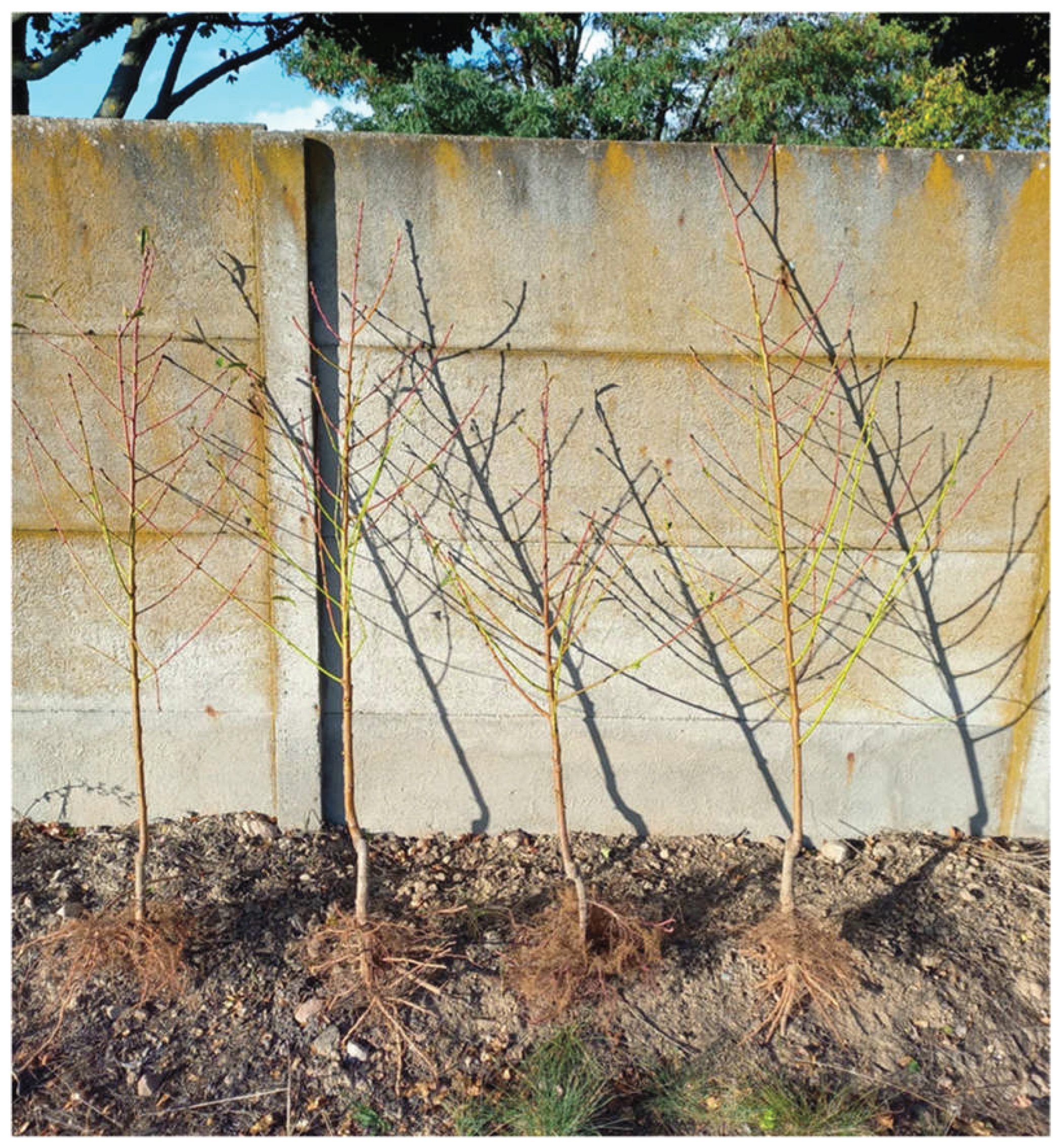
Figure 2.
Appearance of the root system of maiden peach trees ‘RedHaven’ cultivar budded onto the following rootstocks (from left to right): Minnesota, Hui-Hun-Tao, Prunus besseyi, Rakoniewicka.
Figure 2.
Appearance of the root system of maiden peach trees ‘RedHaven’ cultivar budded onto the following rootstocks (from left to right): Minnesota, Hui-Hun-Tao, Prunus besseyi, Rakoniewicka.
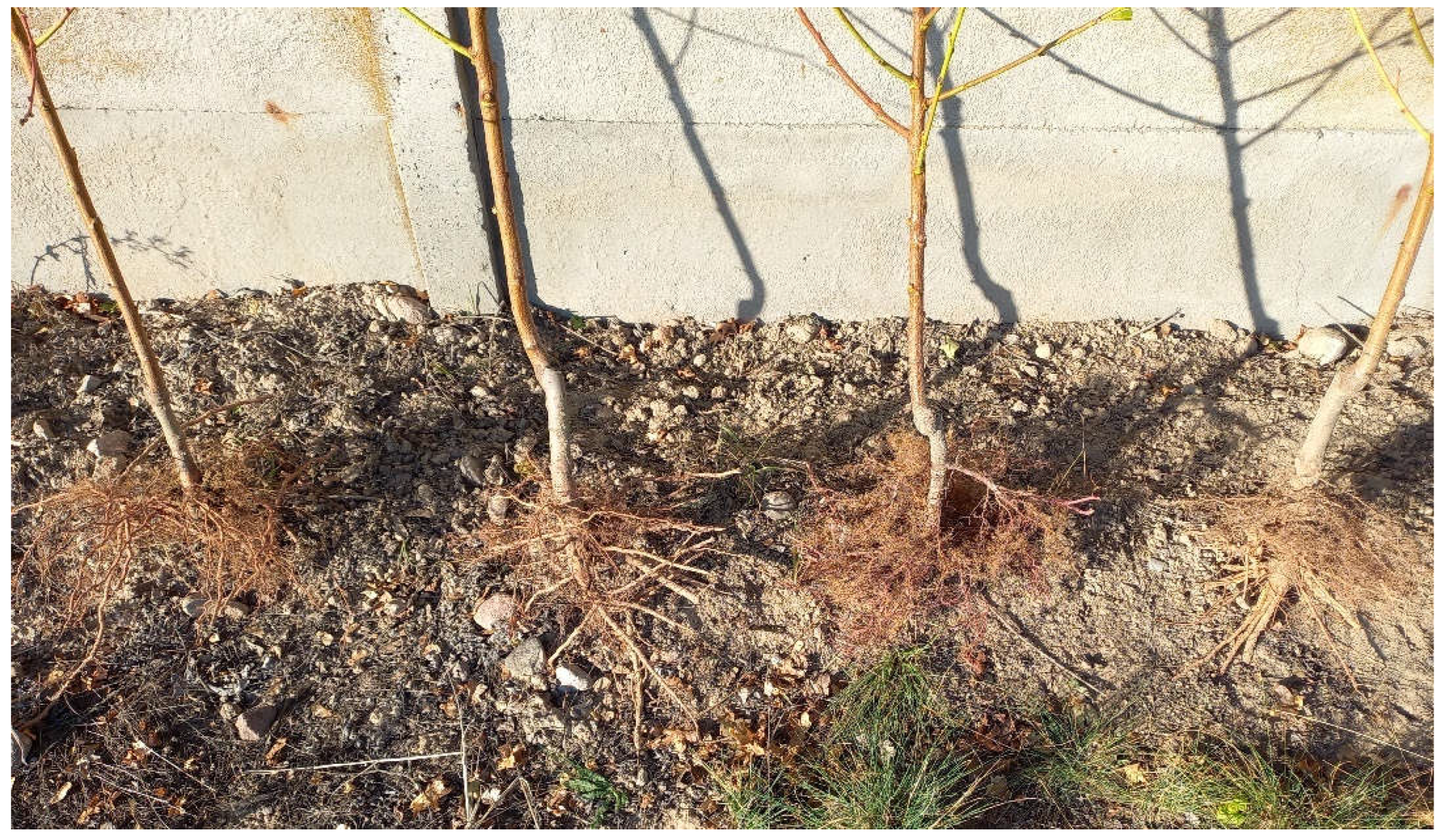

Table 1.
The percentage of successful peach budding depending on the rootstock and cultivar.
| Rootstocks | Harnas | RedHaven | Mean value for rootstock F empirical 43.68 ** |
|---|---|---|---|
| HHT | 89.94 c | 89.46 c | 89.70 c |
| Rakoniewicka | 82. 72 b | 79.39 a | 81.08 a |
| Minnesota | 82.47 b | 78.28 a | 80.42 a |
| P. besseyi | 88.02 c | 82.68 b | 85.45 b |
| Mean value for cultivar F empirical 23.44 ** |
85.95 b | 82.70 a | Interaction A x B F empirical 2.33 |
Means followed by the same letter do not differ significantly according to Duncan’s multiple range test. Means marked with one asterisk (*) differ significantly at the α = 0.05 level, whereas those marked with two asterisks (**) differ significantly at the α = 0.01 level.
Table 2.
The height of maiden peach trees depended on the rootstock and cultivar (cm).
| Rootstocks | Harnas | RedHaven | Mean value for rootstock F empirical 64.11 ** |
|---|---|---|---|
| HHT | 175.5 cd | 168.4 c | 171.9 b |
| Rakoniewicka | 167.5 c | 181.0 d | 174.2 b |
| Minnesota | 150.4 b | 139.5 a | 144.9 a |
| P. besseyi | 150.4 b | 135.4 a | 142.9 a |
| Mean value for cultivar F empirical 5.28 * |
160.9 b | 156.1 a | Interaction A x B F empirical 9.06 ** |
Means followed by the same letter do not differ significantly according to Duncan’s multiple range test. Means marked with one asterisk (*) differ significantly at the α = 0.05 level, whereas those marked with two asterisks (**) differ significantly at the α = 0.01 level.
Table 3.
The stem diameter of maiden peach trees depended on the rootstock and cultivar (mm).
| Rootstocks | Harnas | RedHaven | Mean value for rootstock F empirical 27.28 ** |
|---|---|---|---|
| HHT | 17.7 b-d | 18.8 d | 18.2 b |
| Rakoniewicka | 16.5 b | 18.7 d | 17.6 b |
| Minnesota | 14.6 a | 14.3 a | 14.5 a |
| P. besseyi | 17.0 bc | 18.0 cd | 17.5 b |
| Mean value for cultivar F empirical 9.88 ** |
16.4 a | 17.5 b | Interaction A x B F empirical 2.47 |
Means followed by the same letter do not differ significantly according to Duncan’s multiple range test. Means marked with one asterisk (*) differ significantly at the α = 0.05 level, whereas those marked with two asterisks (**) differ significantly at the α = 0.01 level.
Table 4.
The number of axially shoots of maiden peach trees depended on the rootstock and cultivar.
| Rootstocks | Harnas | RedHaven | Mean value for rootstock F empirical 57.71 ** |
|---|---|---|---|
| HHT | 17.7 c | 17.2 bc | 17.4 b |
| Rakoniewicka | 22.7 d | 22.3 d | 22.5 c |
| Minnesota | 16.7 bc | 15.4 ab | 16.0 a |
| P. besseyi | 14.7 a | 15.9 a-c | 15.3 a |
| Mean value for cultivar F empirical 0.34 |
17.9 a | 17.7 a | Interaction A x B F empirical 1.45 |
Means followed by the same letter do not differ significantly according to Duncan’s multiple range test. Means marked with one asterisk (*) differ significantly at the α = 0.05 level, whereas those marked with two asterisks (**) differ significantly at the α = 0.01 level.
Table 5.
The sum of axially shoots of maiden peach trees depended on the rootstock and cultivar (mm).
Table 5.
The sum of axially shoots of maiden peach trees depended on the rootstock and cultivar (mm).
| Rootstocks | Harnas | RedHaven | Mean value for rootstock F empirical 105.46 ** |
|---|---|---|---|
| HHT | 744.3 cd | 734.2 c | 739.2 c |
| Rakoniewicka | 803.3 de | 843.3 e | 823.3 d |
| Minnesota | 533.3 ab | 490.0 a | 511.7 a |
| P. besseyi | 585.9 b | 557.3 b | 571.6 b |
| Mean value for variety F empirical 0.56 |
666.7 a | 656.2 a | Interaction A x B F empirical 1.66 |
Means followed by the same letter do not differ significantly according to Duncan’s multiple range test. Means marked with one asterisk (*) differ significantly at the α = 0.05 level, whereas those marked with two asterisks (**) differ significantly at the α = 0.01 level.
Table 6.
The number of roots of maiden peach trees depended on the rootstock and cultivar.
| Rootstocks | Harnas | RedHaven | Mean value for rootstocks F empirical 19.94 ** |
|---|---|---|---|
| HHT | 15.3 d | 11.4 bc | 13.4 c |
| Rakoniewicka | 9.2 ab | 13.5 cd | 11.4 b |
| Minnesota | 8.6 a | 8.8 a | 8.7 a |
| P. besseyi | 15.4 d | 14.2 d | 14.8 c |
| Mean value for cultivar F empirical 0.06 |
12.1 a | 11.9 a | Interaction A x B F empirical 8.34 ** |
Means followed by the same letter do not differ significantly according to Duncan’s multiple range test. Means marked with one asterisk (*) differ significantly at the α = 0.05 level, whereas those marked with two asterisks (**) differ significantly at the α = 0.01 level.
Table 7.
The fresh mass of maiden peach trees depended on the rootstock and cultivar (kg).
| Rootstocks | Harnas | RedHaven | Mean value for rootstock F empirical 35.72 ** |
|---|---|---|---|
| HHT | 0.88 ab | 0.95 b | 0.91 b |
| Rackoniewicka | 1.17 c | 1.09 c | 1.13 c |
| Minnesota | 0.87 ab | 0.86 ab | 0.86 ab |
| P. besseyi | 0.83 a | 0.78 a | 0.80 a |
| Mean value for cultivar F empirical 0.51 |
0.94 a | 0.92 a | Interaction A x B F empirical 1.77 |
Means followed by the same letter do not differ significantly according to Duncan’s multiple range test. Means marked with one asterisk (*) differ significantly at the α = 0.05 level, whereas those marked with two asterisks (**) differ significantly at the α = 0.01 level.
Table 8.
The phosphorus (P) content in the leaves of maiden peach trees depended on the rootstock and cultivar (mg·kg-1dry mass).
Table 8.
The phosphorus (P) content in the leaves of maiden peach trees depended on the rootstock and cultivar (mg·kg-1dry mass).
| Rootstocks | Harnas | RedHaven | Average for rootstock F empirical 34.70 ** |
|---|---|---|---|
| HHT | 0.55 a | 0.57 a | 0.56 a |
| Rackoniewicka | 0.62 b | 0.62 b | 0.62 b |
| Minnesota | 0.53 a | 0.54 a | 0.54 a |
| P. besseyi | 0.64 b | 0.69 c | 0.67 c |
| Average for cultivar F empirical 3.95 |
0.59 a | 0.61 a | Interaction A x B F empirical 1.06 |
Means followed by the same letter do not differ significantly according to Duncan’s multiple range test. Means marked with one asterisk (*) differ significantly at the α = 0.05 level, whereas those marked with two asterisks (**) differ significantly at the α = 0.01 level.
Table 9.
The potassium (K) content in the leaves of maiden peach trees depended on the rootstock and cultivar (mg·kg-1dry mass).
Table 9.
The potassium (K) content in the leaves of maiden peach trees depended on the rootstock and cultivar (mg·kg-1dry mass).
| Rootstocks | Harnas | RedHaven | Average for rootstock F empirical 25.00 ** |
|---|---|---|---|
| HHT | 2.94 a | 2.99 a | 2.97 a |
| Rackoniewicka | 3. 33 b | 3.53 b | 3.43 b |
| Minnesota | 2.90 a | 2.94 a | 2.92 a |
| P. besseyi | 2.92 a | 2.91 a | 2.91 a |
| Average for cultivar F empirical 1.98 |
3.02 a | 3.09 a | Interaction A x B F empirical 16.64 ** |
Means followed by the same letter do not differ significantly according to Duncan’s multiple range test. Means marked with one asterisk (*) differ significantly at the α = 0.05 level, whereas those marked with two asterisks (**) differ significantly at the α = 0.01 level.
Table 10.
The magnesium (Mg) content in the leaves of maiden peach trees depended on the rootstock and cultivar (mg·kg-1dry mass).
Table 10.
The magnesium (Mg) content in the leaves of maiden peach trees depended on the rootstock and cultivar (mg·kg-1dry mass).
| Rootstocks | Harnas | RedHaven | Average for rootstock F empirical 16.64 ** |
|---|---|---|---|
| HHT | 0.83 ab | 0.82 ab | 0.83 a |
| Rackoniewicka | 1.00 d | 0.88 bc | 0.94 b |
| Minnesota | 0.83 ab | 0.80 a | 0.81 a |
| P. besseyi | 0.91 c | 0.94 cd | 0.92 b |
| Average for cultivar F empirical 3.69 |
0.89 a | 0.86 a | Interaction A x B F empirical 0.82 |
Means followed by the same letter do not differ significantly according to Duncan’s multiple range test. Means marked with one asterisk (*) differ significantly at the α = 0.05 level, whereas those marked with two asterisks (**) differ significantly at the α = 0.01 level.
Table 11.
The calcium (Ca) content in the leaves of maiden peach trees depended on the rootstock and cultivar (mg·kg-1dry mass).
Table 11.
The calcium (Ca) content in the leaves of maiden peach trees depended on the rootstock and cultivar (mg·kg-1dry mass).
| Rootstocks | Harnas | RedHaven | Average for rootstock F empirical 421.20 ** |
|---|---|---|---|
| HHT | 2.95 de | 3.00 e | 2.97 c |
| Rackoniewicka | 3.01 e | 2.76 c | 2.88 b |
| Minnesota | 2.26 b | 1.95 a | 2.11 a |
| P. besseyi | 2.92 de | 2.90 d | 2.91 b |
| Average for variety F empirical 42.94 ** |
2.78 b | 2.65 a | Interaction A x B Femp. 19.80 ** |
Means followed by the same letter do not differ significantly according to Duncan’s multiple range test. Means marked with one asterisk (*) differ significantly at the α = 0.05 level, whereas those marked with two asterisks (**) differ significantly at the α = 0.01 level.
Disclaimer/Publisher’s Note: The statements, opinions and data contained in all publications are solely those of the individual author(s) and contributor(s) and not of MDPI and/or the editor(s). MDPI and/or the editor(s) disclaim responsibility for any injury to people or property resulting from any ideas, methods, instructions or products referred to in the content. |
© 2026 by the authors. Licensee MDPI, Basel, Switzerland. This article is an open access article distributed under the terms and conditions of the Creative Commons Attribution (CC BY) license (http://creativecommons.org/licenses/by/4.0/).
Copyright: This open access article is published under a Creative Commons CC BY 4.0 license, which permit the free download, distribution, and reuse, provided that the author and preprint are cited in any reuse.