
Submitted:
19 August 2026
Posted:
21 August 2026
You are already at the latest version
Abstract
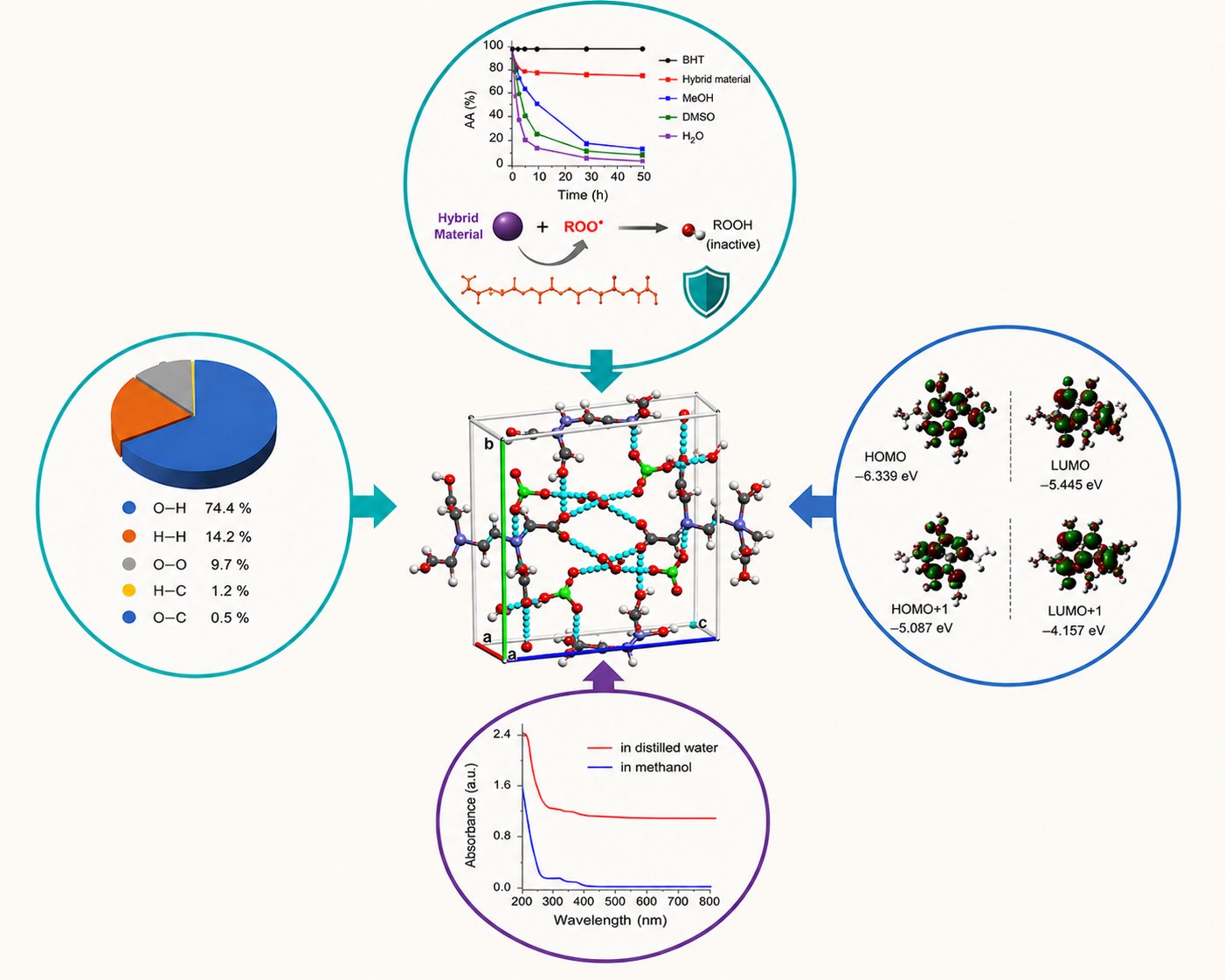
New single crystal hybrid ionic material, ethylenediammonium tetraacetate diperchlorate tetrahydrate (EDTAH₂²⁺.2ClO₄⁻.4H₂O), was synthesized. Its structure was affined by XRD, illustrating P2/n monoclinic system with cell parameters a=11.705(2), b=5.592(11), c=14.250(3)Å, β=101.747(7)° and filling rate Z=2. The 3D-supramolecular network is maintained by weak interactions as confirmed by Hirshfeld surfaces analysis, showing a supramolecular layered-like structure. UV-Vis spectrum reveals that the material is transparent in the visible domain; FT-IR spectroscopy investigates the vibration modes that were correlated to the functional groups of the material. In addition, the hybrid material exhibits significant in vitro antioxidant activity, as demonstrated by the β-carotene bleaching assay, showing effective inhibition of lipid peroxidation compared to BHT. In addition, density functional theory (DFT) calculations provided insight into the electronic structure and showed good agreement with the experimental results, supporting the observed antioxidant behavior.
Keywords:
hybrid ionic material
; EDTA
; X-ray crystallography
; Hirshfeld surface analysis
; DFT
; β-carotene bleaching assay
; in vitro antioxidant activity
1. Introduction
Inorganic-organic hybrids materials can be applied in many branches of materials chemistry because they are simple to process and are amenable to design on the molecular scale. The main idea in development of the hybrid materials was to take advantage of the best properties of each component that forms a hybrid, trying to decrease or eliminate their drawbacks getting in an ideal way a synergic effect; that results in the development of new materials with new properties. Hybrid materials do not represent only a creative alternative to design new materials and compounds for academic research, but their improved or unusual features allow the development of innovative industrial applications. In last few decades, these materials provide a large range of enhanced and various physico-chemical properties can lead to technological innovations and making them ideal for applications in various fields, such as energy storage, electronics, optical, thermal stability, environmental remediation, and biomedical engineering [1,2,3,4,5,6,7,8,9,10,11,12,13,14,15,16,17,18,19,20,21,22,23,24].
A fascinating class of materials known as supramolecular hybrid materials combines the functionality of inorganic or organic components with the principles of supramolecular chemistry [25,26,27]. The supramolecular hybrid materials are held together only by non-covalent interactions such as van der Waals forces, hydrogen bonding, short contacts and π-π stacking, enabling the development of new structures with improved properties[28,29] . The combination of supramolecular chemistry’s molecular recognition and hybrid materials’ adaptability creates new opportunities for a variety of applications, from energy storage and drug delivery to catalysis and sensing [30,31], as well as, their outstanding potential for sustainability and environmental remediation has attracted increasing interest, these materials can be modified for effective recycling and pollution removal. [32,33,34]. Furthermore, recent researches in the design of novel supramolecular systems have generated prospects for intelligent, adaptive materials in nano-technological and biomedical applications [35,36,37]. This paper aims to provide the synthesis of a new supramolecular hybrid crystal, based on Ethylenediaminetetraacetic acid (EDTA) as organic part.
EDTA is a chemical used for both industrial and medical purposes. It has worked as a powerful chelate that used in analytic chemistry and industrial processes, it is a molecule that is known as a chelating agent, used something that has a claw-like structure that is use to stick and grab other molecules while, it is used to sequester and decrease the reactivity of metal ions that may be present in a product. Moreover, doctors prescribe them to clear toxins from the body. Also, it is one of the key ingredients in cancer-fighting medicines. Moreover, this material is being investigated for use in biomedical applications, specifically in drug delivery systems, where the chelation capabilities of EDTA can improve the medicines’ controlled release. EDTA-functionalized hybrid materials are useful for environmentally friendly and sustainable applications because they have shown great promise for environmental remediation, including the removal of heavy metal ions from contaminated water. With respect to its adaptability, EDTA is a promising component for creating multifunctional supramolecular hybrid materials with a wide range of other applications [38,39,40,41,42,43,44,45,46,47,48,49,50].
The new hybrid material crystal EDTAH22+.2ClO4-.4H2O, the characterization of this material was carried out exploring single crystal X-ray diffraction, infrared and UV-visible spectroscopies. Through X-ray diffraction data, the 3D-supramolecular network was discussed, the Hirshfeld surface analysis provide supplementary discussion of the short-contacts and weak interactions within the supramolecular structure. In addition, the infrared spectroscopy divulges the vibrational frequencies, in which they were all attributed to the various functional group of the material. The electronic transitions were studied using UV-visible spectroscopy. Finally, the antioxidant activity of the synthesized hybrid material was evaluated in vitro using the β-carotene bleaching assay, with BHT used as a standard reference compound. In addition, Density Functional Theory (DFT) calculations were carried out to gain insight into its electronic properties and to rationalize its antioxidant behavior.
2. Experimental
2.1. Synthesis and Crystal Growth
EDTAH22+.2ClO4-.4H2O synthesized by the chemical reaction of a commercially with EDTA (Aldrich, 99%) and perchloric acid (Aldrich, 65%). The acid was added to the hot aqueous solution of EDTA with the help of a dropper, in the 1:2 molar ratio. Then the reaction mixture was brought to reflux under magnetic stirring. After 6 h of refluxing, the solution was cooled to room temperature, it remained clear, without any precipitants. The solution slowly evaporated during a few days till the white and single crystals appeared, collected by filtration, then dried in air. The chemical structure of the hybrid ionic material obtained (Scheme 1) was identified by single-crystal X-ray diffraction analysis.
2.2. Single Crystal X-Ray Diffraction (SXRD)
The single-crystal X-ray diffraction (SXRD) was performed at 150 K, using Bruker D8 Venture photon diffractometer, equipped with a Mo(Kα) anticathode and a graphite filter monochromator giving λ= 0.71073Å. The refinement was performed by the full-matrix least square method using SHELXL-2017 (Sheldrick, 2017) programs [51].
All observed reflections and data reduction were used for the unit cell refinement, by the mean of the CrysAlisRed program [52]. At the end, the structures were plotted by using Mercury software [53]. The X-ray crystallographic data for the structure reported in this paper have been deposited at “Cambridge Crystallographic Data Centre” (CCDC) with the reference number 2412884.
2.3. Hirschfield Surface Analysis
The 3-Dimensional Hirshfeld surfaces are mapped for the affined molecule with dnorm, shape-index, curvedness and 2-Dimensional fingerprint plots were generated using CrystalExplorer-17.5 [54].
2.4. UV-Vis. and FT-IR Spectroscopies
The UV-Visible spectra were performed in two different solvents: distilled water and methanol in the range 200-800 nm at room temperature, using JASCO V680 Spectrophotometer. The FT-IR spectrum was recorded in the range 4000-600 cm-1 by SHIMADZU IRSpirit equipped with the diffuse reflectance attachment (Miracle Attenuated Total Reflectance Attachment) at a 4 cm-1 resolution in the wave number’s region of 4000-400 cm-1
2.5. Antioxidant Activity Test in Vitro
2.5.1. β-Carotene Bleaching
The β-carotene bleaching assay is a widely used method in food chemistry for estimating the antioxidant activity of compound [55]. This assay relies on the discoloration of the yellowish β-carotene solution, which occurs due to the disruption of its π-conjugation system. This disruption results from the addition of lipid or lipid peroxyl radicals to the C=C double bonds of β-carotene, leading to its degradation. In this method [56], a β-carotene/linoleic acid emulsion in water serves as the reaction medium, where peroxyl radicals are generated. The reduction in β-carotene concentration is monitored in both a control sample and a sample containing the tested antioxidant. The antioxidant activity of the examined substance is then determined by spectrophotometric measurement at 490 nm, following a slightly modified version of a previously established protocol.
2.5.2. Antioxidant Activity Test in Vitro
The stock solution of the β-carotene/linoleic acid emulsion was prepared by dissolving 0.5 mg of β-carotene in 1 ml of chloroform. Next, 25 μl of linoleic acid and 200 mg of Tween 40 were added to the mixture. The chloroform was evaporated at 40 °C using a rotary evaporator, and 100 ml of oxygen-saturated distilled water was added to complete the emulsion preparation. Afterward, 350 μl of test material (2 mg/ml) dissolved in DMSO, along with the BHT standard (soluble in methanol), were mixed with 2.5 ml of the emulsion. A negative control was prepared using only the emulsion (containing methanol, H₂O, and DMSO) without test samples, while the blank contained only the test samples without the emulsion. The emulsion system was incubated in the dark at room temperature, and absorbance was measured at 490 nm at specific time intervals (t = 0, 1, 2, 4, 6, 24 and 48 hours). The β-carotene bleaching rate, indicating the antioxidant activity (AA), was calculated using the equation:
Where: Ae is the absorbance of β-carotene in the presence of the test samples, and Ac is the absorbance of the control (BHT).
2.6. Quantum Calculations Details
3. Results and Discussion
3.1. XRD Study
The asymmetric unit of the synthetized hybrid material crystal is shown in the Figure 2(a), it is formed by one water molecule, one perchloric acid anion and one half EDTA cation. In addition, the related detailed crystal data and data collection parameters are collected in the Table 1. Furthermore, any abnormal measurement of bond length or angle was noted on the studied crystal, all are in general order [61,62,63,64,65].
The Table 2 reports some characteristic bond lengths, angle and torsion measurements of the title material. Another common point that, the protonated EDTA molecules in the crystal possess a cis-conformation (Figure 1 (a)), maintained by two intramolecular hydrogen bonds of the type O-H∙∙∙O, also it is centroid and characterized by a punctual symmetry group C2, noting that all carboxylic acid groups have a similar steric environment of slightly deformed sp2-hybridization (Table 1).
In addition, the synthetized ionic material crystalizes in monoclinic system with P2/n space group, with the unit cell filling (Z=2), that having the parameters a=5.5183(2), b=13.9178(5), c=14.3894(5)Å and β=99.458(2)°. In addition, the unit cell is characterized by identity symmetry, an inversion center at the origin (0, 0, 0), 2-fold rotation axis along b-direction at (0, y, ¼) with a screw component [0, ½, 0], and a glide plane perpendicular to b-direction with glide component [0, 0, ½].
Furthermore, the junction between the different components is ensured by weak interactions, forming consequently a hybrid type-I material. These weak interactions are mainly hydrogen bonds type, and counted to be twelve inter and intra-hydrogen bonds for one formal unit cell, and all are of the types O-H∙∙∙O and N-H∙∙∙O, this richness of hydrogen bonds can find interest in supramolecular chemistry field[18,19,20].

Table 3.
Hydrogen bond length and angles obtained from SXRD considering 3Å as maximum donor acceptor distance.
Table 3.
Hydrogen bond length and angles obtained from SXRD considering 3Å as maximum donor acceptor distance.
| D-H∙∙∙A | D-H (Å) | H∙∙∙A (Å) | D-A (Å) | D-H∙∙∙A (°) |
| O2-H∙∙∙O10 | 0.840 | 2.820 | 2.983 | 92.91 |
| N5-H∙∙∙O13 | 0.864 | 2.171 | 2.815 | 131.14 |
| O2-H∙∙∙OW1 | 0.840 | 1.724 | 2.553 | 168.88 |
| OW1-H∙∙∙O3 | 0.843 | 2.010 | 2.829 | 163.83 |
| O10-H∙∙∙OW2 | 0.854 | 2.251 | 2.617 | 135.22 |
| O14-H∙∙∙OW1 | 0.845 | 2.015 | 2.858 | 174.92 |
| O12-H∙∙∙OW2 | 0.851 | 2.175 | 2.668 | 116.69 |
| O11-H∙∙∙OW2 | 0.854 | 2.251 | 2.919 | 135.22 |
Moreover, the 3D-network of title material is constituted by an alternation of organic and inorganic supramolecular chains can be seen in the direction (Oc), Alternated supramolecular chains of protonated EDTA and water molecules disposed along the (Oc) direction (Figure 2 (a)), two water molecules join two protonated EDTA molecules via hydrogen bonds of the type O-H∙∙∙O, in which, each oxygen atom of the two water molecules acts as donor and acceptor. Along the same direction, a supramolecular inorganic chain constituted by an alternation of one perchlorate and one water molecules, interconnected by O-H∙∙∙O hydrogen bonds type. In addition, the organic and the inorganic chains are joined by hydrogen bonds of the type N-H∙∙∙O, while the organic chains are related between them by hydrogen bonds of the type O-H∙∙∙O (Figure 2 (a)). Along the perpendicular direction (Oa), an almost parallel supramolecular layers form the 3D network, that can be seen as a superposition of unit cell, which each unit cell contains one layer part.
3.2. Hirshfeld Surface Analysis (HS)
An important technique for gaining more definition in the intermolecular interaction of molecular crystals is the study of the Hirshfeld surface (HS). The size and shape of the HS allow the qualitative and quantitative investigations and visualization of near intermolecular contacts in molecular crystals [66]. Furthermore, a collection of 3D points in which the target molecule’s electron density contribution equals that of every other molecule determines the HS. The distance between any HS point and the inner (di) or externally surface (de) of the nearest nucleus is known as the conventional contact distance mapping (dnorm), and it is used to categorize molecular interactions (Formula 1) [67].
Where revdW and rivdW are the van der Waals radius of the appropriate atom internal and external respectively. Using a red-blue-white color scheme, the dnorm rates were mapped onto the HS as follows: the closer distance and negative dnorm values are represented by the red regions; the longer contacts and positive dnorm values are represented by the blue domains; and the contact lengths equal to the VdW separation and zero dnorm values are represented by the white regions. However, the two-dimensional fingerprints show the distance between molecules in the crystal, which improves the HS analysis [68]. When, the shape index (S), which is a dimensionless measurement of the local form of the surface that changes from red to blue throughout the interval [−0.99, + 0.99], can be written as follows using formula (2):
Where, the primary curvatures of the Hirshfeld surface at the site of study, denoted by k1 and k2. On the other hand, curvedness © expresses le the root of the average square of the surface curvature, it is defined by the formula (3):
The values of © are contain in the domain ([-4.0, +0.4]), which the domain’s extremities are commonly indicated by red and blue colors [69].
The molecular HS mapped with dnorm, shape index, and curvedness is shown in Figure 3. The form index is between -0.99 and 0.99Å in color, the curvedness is between -3.6 and +0.48Å, and the dnorm surfaces are mapped between -0.74 and 1.34Å. Furthermore, the dnorm surface exhibits extremely intimate intermolecular interactions, and the information from the shape index is compatible with 2D fingerprint plots and is especially sensitive to even little variations in the surface shape. The degree of curvature of the crystal depends on the quantity of its forms. Curved surface areas are associated with low curvedness values. Conversely, the sharp curvature zones tend to link with significant curvedness and divide the surface into patches, indicating interactions. The nearest neighbor coordination environment of a molecule is identified from the color patches on the Hirshfeld surface depending on their closeness to adjacent molecules (Figure 3 (d)).
Table 4. lists the results of the HS analysis, which also determines several quantitative measurements including asphericity, globularity, SH area, and SH-volume. The globularity, which is less than one [70], indicates that the HS is far from spherical, and the asphericity [71,72], indicates structural anisotropy.
Table 4.
Quantitative measures of Hirshfeld surfaces.
|
Molecular volume VH (Å3) |
Surface area SH (Å2) | Globularity (G) |
Asphericity (Ω) |
| 418.77 | 396.33 | 0.683 | 0.198 |
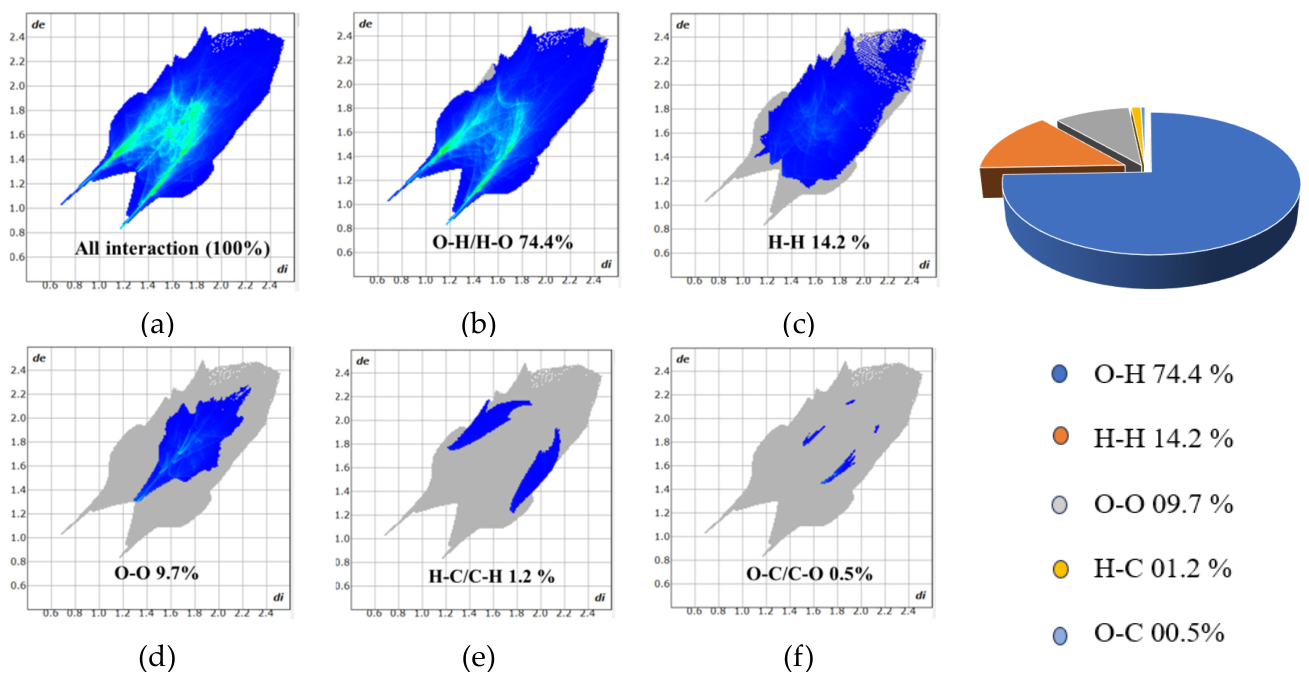
The 2D fingerprints allow for the discussion of weak contacts and the differentiation of contributions from different types of interactions that overlap throughout the fingerprint. O···H connections constitute the primary intermolecular contact within the investigated crystal. The primary contributions were determined to be H···O, H···H, O···O, H···C and O···C contacts of 74.4, 14.2, 9.7, 1.2, and 0.5% respectively. The azote atom exhibits no contact in the crystal packing, as is typical in pentahedral coordination. The H∙∙∙O and O∙∙∙H contacts predominate, followed by the H∙∙∙H and O∙∙∙O contacts.
Figure 4.
2D-fingerprint plots of EDTA²⁺·2ClO₄⁻·4H₂O: showing the percentages of contacts contributing to the total Hirshfeld surface area of the molecule.
Figure 4.
2D-fingerprint plots of EDTA²⁺·2ClO₄⁻·4H₂O: showing the percentages of contacts contributing to the total Hirshfeld surface area of the molecule.
3.3. FT-IR Analysis
The experimental and DFT-calculated FT-IR spectra of the hybrid crystal EDTAH2²⁺·2ClO₄⁻·4H2O are presented in Figure 5, while the corresponding vibrational assignments are summarized in Table 5. Overall, an excellent agreement is observed between the experimental spectrum and the scaled theoretical frequencies, confirming the reliability of the optimized molecular structure and the DFT model. The small deviations between calculated and experimental band positions originate from the harmonic approximation adopted in the calculations, together with the neglect of crystal packing effects and anharmonic vibrational contributions, which commonly affect condensed-phase spectra.
The high-wavenumber region is dominated by vibrations associated with the extensive hydrogen-bond network. The broad experimental band at 3524 cm⁻¹, reproduced theoretically at 3432 cm⁻¹, is assigned to the asymmetric O–H stretching vibration of lattice water molecules. The band at 2750 cm⁻¹ (calculated 2790 cm⁻¹) is attributed to N+–H stretching of the protonated amine groups overlapping with asymmetric C–H stretching, further confirming the protonation state of the EDTA molecule within the crystal lattice. The band observed at 3010 cm⁻¹ (calculated 2865 cm⁻¹) is assigned to the O–H stretching of the carboxylic group interacting with water oxygen atoms, reflecting the strong involvement of the carboxylic functions in the hydrogen-bonding network.
The intense absorption at 1733 cm⁻¹, well reproduced by the DFT calculation (1718 cm⁻¹), originates from the C=O stretching vibration of the carboxylic group. The band at 1629 cm⁻¹ (calculated 1591 cm⁻¹) is assigned to the bending vibration of water O–H together with the H2O in-plane bending mode, in line with the important role played by lattice water in the hydrogen-bond network. Intermediate-frequency bands located at 1457 and 1412 cm⁻¹ arise from coupled C–H, C–N, and C–C stretching modes together with O–H bending of the carboxylic group, and from C–N stretching coupled with N–H bending, respectively. A closely related band at 1452 cm⁻¹ is attributed to C–O and C–C stretching of the carboxylic group together with C–N and C–C bending, illustrating the strong vibrational coupling within this spectral region. The bands at 1339 and 1258 cm⁻¹ are assigned to C–N and C–H bending combined with O–C–O bending of the carboxylic group, and to the C–C asymmetric stretching vibration of the carboxylic acid function, respectively, while the band at 1195 cm⁻¹ corresponds to a strong O–C–O bending vibration of the carboxylic group [73,74]. The calculated spectrum reproduces these bands with very good accuracy, demonstrating that the optimized geometry correctly describes the local environment of the EDTA framework.
In the fingerprint region, the band at 1044 cm⁻¹ is assigned to the O–H vibration of water interacting with the O–H of the carboxylic group, coupled with the C–O symmetric stretching vibration, while the band at 949 cm⁻¹ corresponds to the asymmetric stretching vibration of the perchlorate anion. The absorptions at 888, 797, 679, and 544 cm⁻¹ are attributed, respectively, to vibrations of the hydrogen-bond network involving ClO₄⁻ and O–H groups together with the ClO₄⁻ symmetric stretching mode, to the ClO₄⁻ bending vibration, to the O–H vibration of water interacting with water O–H combined with an asymmetric bending-type vibration of ClO₄⁻, and to a C–N bending vibration. Most of these low-frequency vibrations are strongly coupled with hydrogen-bond network interactions, indicating that the lattice water molecules and perchlorate ions actively participate in the vibrational dynamics of the crystal, in particular through the characteristic ClO₄⁻ stretching and bending modes, which confirm the structural integrity of the perchlorate tetrahedra.
The FT-IR results are fully consistent with the single-crystal X-ray diffraction analysis, which revealed a three-dimensional supramolecular architecture stabilized by numerous O–H···O and N–H···O hydrogen bonds, as well as with the Hirshfeld surface analysis showing that H···O/O···H contacts account for 74.4% of the total intermolecular interactions. Such a dominant contribution explains both the broad O–H stretching region and the extensive vibrational coupling observed throughout the spectrum, particularly the strong involvement of the carboxylic and water O–H groups highlighted by the revised assignments.
From a functional viewpoint, the coexistence of protonated amine groups, carboxylic functionalities, lattice water molecules, and a dense hydrogen-bonding network provides numerous interaction sites capable of participating in proton transfer, molecular recognition, and hydrogen-bond-mediated stabilization. These structural characteristics are particularly relevant for biological systems, where hydrogen bonding governs biomolecular recognition and host-guest interactions. Furthermore, the presence of multiple oxygen- and nitrogen-containing functional groups may facilitate interactions with reactive oxygen species and biomolecules, which is consistent with the significant antioxidant activity observed for the material (82.6 ± 1.9% inhibition after 24 h). Although FT-IR spectroscopy alone cannot establish the antioxidant mechanism, the vibrational analysis confirms the preservation of the functional groups responsible for intermolecular interactions, supporting the potential of this supramolecular hybrid material for future biomedical and bioactive applications.
3.4. UV-Visible Spectra
The UV–Vis spectra of EDTAH₂²⁺.2ClO₄⁻.4H₂O (Figure 6) exhibit a pronounced solvent dependent behavior. In methanol, well resolved absorption bands at 207.51 and 225.33 nm are assigned to π→π* transitions, while those at 309.13 and 351.87 nm correspond to n→π* transitions, in agreement with previously reported data for polyaminocarboxylic systems [75]. In aqueous solution, the absorption bands appear at 199.93, 238.20, 301.75, and 343.07 nm, accompanied by significant band broadening. The overall spectral changes indicate a clear solvatochromic effect arising from differential stabilization of the ground and excited states by the solvent. The observed hypsochromic shifts are consistent with stronger hydrogen bonding interactions in water, leading to preferential stabilization of the ground state [76,77]. The pronounced band broadening suggests the presence of multiple solvation environments, as well as possible ion pairing with ClO₄⁻, contributing to spectral inhomogeneity and intermolecular interactions in solution [78].
3.5. Antioxidant Activity
To evaluate the antioxidant activity of the synthesized material, the β-carotene bleaching assay was performed in vitro. The assessment of its antioxidant capacity, based on absorbance measurements recorded over a 48-hour period, revealed a significant activity compared to the reference control. The experiment was conducted in triplicate to ensure the reliability and reproducibility of the results. This activity was reflected in better preservation of the β-carotene color, indicating effective protection against oxidation.
3.5.1. β-Carotene Bleaching Test
The inhibitory power of lipid peroxidation by the hybrid material was evaluated using the β-carotene/linoleic acid bleaching assay. During incubation, the β-carotene/linoleic acid emulsion generates hydroperoxide free radicals [79], which oxidize β-carotene, leading to its discoloration. Negative controls, such as DMSO, MeOH, and H₂O (without samples), unambiguously promote β-carotene oxidation. Among them, water exhibited the weakest inhibitory effect compared to the organic solvents MeOH and DMSO, which were used to dissolve the tested compound. In general, these solvents showed lower inhibition levels than BHT and the tested material. After 24 hours of storage in the dark, the inhibition results, represented in graphical curves and histograms (Figure 7), indicate that the antioxidant efficiency of the hybrid material is lower than that of BHT. However, the inhibition remains significant, suggesting that the hybrid material could be considered for applications requiring moderate to high antioxidant activity. The results, presented in Table 6, allow the antioxidant activity percentages to be ranked in ascending order as follows: H₂O < MeOH < DMSO < Hybrid material < BHT.
3.6. Frontier Molecular Orbital (FMO) Analysis and Global Reactivity Descriptors
To obtain further insight into the electronic structure and global reactivity of the synthesized hybrid compound, the frontier molecular orbitals were analyzed using the optimized geometry. The HOMO-2, HOMO-1, HOMO, LUMO, LUMO+1, and LUMO+2 orbitals are presented in Figure 8, while the corresponding frontier-orbital energies, conceptual-DFT descriptors, and thermodynamic parameters are summarized in Table 7. The FMO analysis identifies the spatial regions involved in electron donation and acceptance, whereas the global descriptors provide complementary quantitative information on electronic stability, polarizability, and the propensity for charge redistribution. The thermodynamic functions, in turn, describe the energetic and thermal characteristics of the optimized molecular model at 298 K. These three levels of analysis should therefore be considered complementary rather than interpreted independently.
The spatial distribution of the frontier orbitals highlights the electron-donor regions associated with the occupied orbitals and the electron-acceptor regions associated with the unoccupied orbitals, providing a qualitative representation of the sites potentially involved in intramolecular or intermolecular charge redistribution.
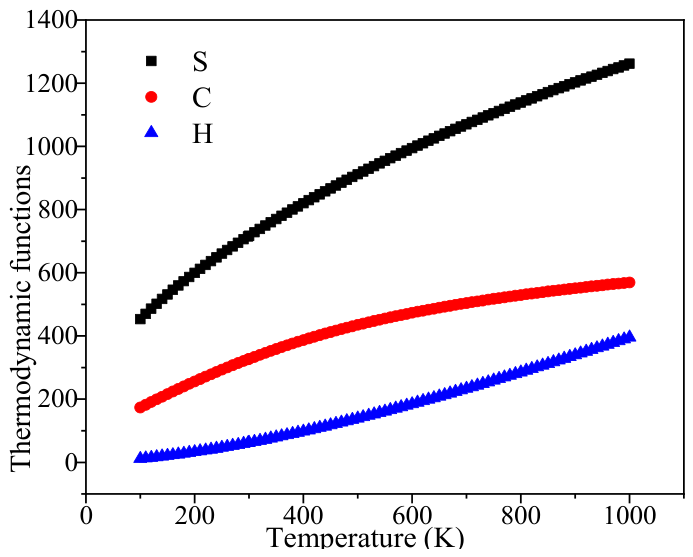
Figure 9.
Temperature dependence of the calculated thermal enthalpy, entropy, and constant-volume heat capacity of the optimized EDTAH₂²⁺·2ClO₄⁻·4H₂O molecular mode.
Figure 9.
Temperature dependence of the calculated thermal enthalpy, entropy, and constant-volume heat capacity of the optimized EDTAH₂²⁺·2ClO₄⁻·4H₂O molecular mode.
The calculated HOMO and LUMO energies are -6.339 and -5.445 eV, respectively, giving a HOMO-LUMO separation of 0.894 eV. Within the adopted molecular DFT model, this relatively small orbital-energy separation indicates that electronic redistribution between the occupied and unoccupied frontier levels may occur with a comparatively low excitation-energy requirement. It is therefore consistent with an electronically polarizable and potentially reactive system. However, the HOMO-LUMO gap should not be interpreted alone as direct proof of antioxidant activity, because radical scavenging also depends on the reaction mechanism, solvent environment, proton-transfer ability, bond-dissociation energies, and the stability of the generated radical species [80,81,82]. According to Koopmans-type approximations, the vertical ionization potential and electron affinity were estimated as IP = 6.339 eV and EA = 5.445 eV, respectively. The ionization potential reflects the energy required to remove an electron, whereas the relatively high electron affinity indicates a marked ability of the system to accept electron density. Taken together, these values suggest an amphielectronic response in which the hybrid molecular unit can participate in charge-transfer interactions, although the balance between electron donation and acceptance must be interpreted together with the global reactivity descriptors.
The calculated chemical hardness (η = 0.447 eV) and global softness (S = 1.119 eV⁻¹) further support the relatively reactive nature of the system. In general, soft molecular systems exhibit higher electronic flexibility, facilitating charge redistribution during interactions with free radicals or biological receptors [83,84,85,86,87]. This behavior is fully consistent with the experimentally observed antioxidant activity. The negative chemical potential (μ=−5.892 eV) indicates that electron loss from the optimized neutral system is energetically unfavorable within the adopted approximation; however, this quantity should not be interpreted by itself as a direct measure of thermodynamic stability. In parallel, the relatively high electrophilicity index (ω=38.85 eV) reflects a strong tendency to accept and stabilize additional electron density following charge transfer [88,89]. Such an electronic profile is often associated with molecular systems capable of interacting with biological macromolecules through charge-transfer processes [90,91,92,93,94,95,96]. Overall, the calculated descriptors consistently characterize the molecular model as electronically soft, strongly electrophilic, and capable of substantial charge redistribution. Inspection of the frontier molecular orbitals shows that the occupied orbitals are predominantly distributed over oxygen- and nitrogen-containing regions of the protonated EDTA unit, with contributions from the carboxylic groups, amine functions, perchlorate ions, and lattice-water environment depending on the orbital considered. These electron-rich regions represent the most plausible sites for electron donation and for the establishment of hydrogen-bonding interactions. The unoccupied orbitals exhibit a different and, for some levels, more extended distribution over the ionic supramolecular unit, identifying the regions that can accommodate additional electron density. The spatial complementarity between the occupied and unoccupied orbitals is therefore consistent with the low calculated hardness and high softness, since both indicate that the electron density can be redistributed across several chemically distinct sites [97]. The simultaneous presence of multiple hydrogen-bond donor and acceptor sites revealed by the crystal structure, Hirshfeld surface analysis and frontier orbital distribution demonstrates that the biological response of the material is not governed by a single functional group but rather by the entire supramolecular hydrogen-bond network. Therefore, the small HOMO–LUMO separation, low hardness, high softness, and spatial distribution of the frontier orbitals provide a coherent description of an electronically responsive molecular system. These properties may facilitate charge redistribution during interactions with radical species and are qualitatively compatible with the experimentally observed antioxidant response. Nevertheless, the present descriptors do not establish a unique radical-scavenging mechanism. Additional calculations, such as O–H or N–H bond-dissociation enthalpies, ionization energies in solution, proton affinities, and the stability of the corresponding radical species, would be required to discriminate among hydrogen-atom transfer, single-electron transfer, and sequential proton-loss electron-transfer pathways [98,99,100].
The electronic-structure results are consistent with the experimental structural characterization. Single-crystal X-ray diffraction revealed a three-dimensional network involving protonated amine groups, carboxylic functions, perchlorate ions, and lattice-water molecules, while the Hirshfeld-surface analysis showed that H···O/O···H contacts dominate the intermolecular-contact distribution. FT-IR spectroscopy independently confirmed the participation of O–H, N–H, C=O, and perchlorate groups in the hydrogen-bonded environment. The FMO maps indicate that these same oxygen- and nitrogen-containing regions contribute significantly to the frontier electronic density. This correspondence links the experimentally observed interaction sites to the calculated donor and acceptor regions. Furthermore, the delocalization of the frontier orbitals over several functional groups is consistent with the small energy gap, low hardness, and high softness, all of which indicate that electronic perturbation is not restricted to a single localized site but can be distributed over the ionic molecular assembly. The thermodynamic quantities calculated from the vibrational analysis provide a complementary description of the optimized molecular model. At 298 K, the total electronic energy is -39.865 keV, whereas the reported thermal energy, heat capacity, and entropy are 148.153 kcal mol⁻¹, 76.014 cal mol⁻¹. K⁻¹, and 170.949 cal mol⁻¹. K⁻¹, respectively. The total electronic energy defines the energetic reference of the optimized structure at the selected DFT level, while the thermal energy includes translational, rotational, and vibrational contributions at the specified temperature. The heat capacity reflects the amount of thermal energy required to increase the temperature of the molecular system, and the entropy describes the number of thermally accessible molecular states. These quantities should not be directly equated with the conceptual-DFT descriptors: the latter are derived from frontier-orbital energies and describe electronic response, whereas the thermodynamic functions are obtained from the molecular partition function and characterize thermal population and molecular motion [101,102,103].
Nevertheless, the two analyses provide complementary information. The low hardness and high softness indicate that the electron density can respond readily to an electronic perturbation, whereas the finite heat capacity and relatively high entropy reflect the contribution of numerous vibrational and conformational degrees of freedom associated with the EDTA framework, lattice-water molecules, and hydrogen-bonded ionic environment. As temperature increases, the calculated entropy, heat capacity, and thermal enthalpy are expected to increase because a larger number of translational, rotational, and vibrational states become populated. This thermal activation may enhance structural fluctuations and intermolecular reorganization, but it does not directly modify the zero-temperature HOMO–LUMO descriptors reported in Table 7. The FMO, global-reactivity, and thermodynamic results therefore describe distinct but complementary aspects of the material: spatial electron donation and acceptance, susceptibility to electronic redistribution, and thermal accessibility of molecular degrees of freedom, respectively.
4. Conclusions
In this work, a new single-crystal hybrid ionic material, EDTAH₂²⁺·2ClO₄⁻4H₂O, was successfully synthesized and fully characterized. Its molecular and crystal structures were determined by single-crystal X-ray diffraction, while Hirshfeld surface analysis revealed that the crystal packing is mainly governed by O···H/H···O interactions, highlighting the key role of hydrogen bonding in stabilizing the supramolecular architecture. The UV–visible spectrum indicates good transparency in the visible region, and the FTIR results are consistent with the crystallographic data, confirming the formation of the hybrid structure. The β-carotene bleaching assay revealed that the material exhibits notable antioxidant activity, demonstrating its ability to inhibit lipid peroxidation in comparison with BHT as a reference standard. DFT calculations not only showed good agreement with the experimental geometry but also provided insights into the electronic properties of the material, supporting its potential reactivity and contribution to the observed antioxidant behavior. Overall, these findings suggest that the synthesized hybrid material may be a promising candidate for antioxidant applications.
Author Contributions
Mounira Mesbah: investigation (synthesis, antioxidant activity, spectroscopic analysis), formal analysis, data curation, visualization and writing – original draft.; Samira Ghedjati: investigation (antioxidant activity) and Resources (provided materials for antioxidant activity assays); Lotfi Boudjema: investigation (DFT calculations) and writing – original draft; Louiza Ouksel: investigation (Hirshfeld surface analysis), writing – original draft; Hakima Ait Youcef: investigation (synthesis), formal analysis and writing – original draft; Amel Djedouani: investigation (synthesis); Abdeltif Amrane: Investigation (X-ray diffraction analysis); Riadh Bourzami: conceptualization, crystallographic analysis, DFT calculations, formal analysis, project administration, visualization, writing – original draft, writing – review & editing;
Funding
This research received no external funding.
Institutional Review Board Statement
Not applicable.
Informed Consent Statement
Not applicable.
Data Availability Statement
Data are contained within the article.
Acknowledgments
The authors acknowledge the Algerian Ministry of Higher Education and Scientific Research, the Algerian Directorate General for Scientific Research and Technological Development. The DFT calculations were carried out using Computational Chemistry HPC facility at University College London. .
Conflicts of Interest
The authors declare that they have no conflict of interest to report regarding the publication of this manuscript.
Abbreviations
The following abbreviations are used in this manuscript:
| SXRD | Single-crystal X-ray diffraction |
| UV-Vis | Ultraviolet–visible spectroscopy |
| FT-IR | Fourier Transform Infrared |
| TGA | Thermogravimetric Analysis |
| DTG | Derivative Thermogravimetry |
| CCDC | Cambridge Crystallographic Data Centre |
| 3D | 3 dimensional |
| 2D | 2 dimensional |
| XRD | X-ray diffraction |
| HS | Hirshfeld surface |
| dnorm | Normalized contact distance mapping is utilized to categorize areas of specific interest for intermolecular interactions |
| di | Distance of any HS point to the inner surface of the closest nucleus to the surface |
| de | Distance of any HS point to the outer surface of the closest nucleus to the surface |
| vdW | Van der Waals |
| Van der Waals radius of the appropriate atom internal | |
| Van der Waals radius of the appropriate atom external |
References
- C. Sanchez, F. Ribot, Design of hybrid organic-inorganic materials synthesized via sol-gel chemistry, New Journal of Chemistry 18 (1994) 1007–1047.
- D.A. Loy, K.J. Shea, Bridged polysilsesquioxanes. Highly porous hybrid organic-inorganic materials, Chemical Reviews 95 (1995) 1431–1442. [CrossRef]
- C. Morterra, G. Magnacca, A case study: surface chemistry and surface structure of catalytic aluminas, as studied by vibrational spectroscopy of adsorbed species, Catalysis Today 27 (1996) 497–532. [CrossRef]
- C. Sanchez, G.J.D.A.A. Soler-Illia, F. Ribot, T. Lalot, C.R. Mayer, V. Cabuil, Designed Hybrid Organic−Inorganic Nanocomposites from Functional Nanobuilding Blocks, Chem. Mater. 13 (2001) 3061–3083. [CrossRef]
- L. Nicole, C. Laberty-Robert, L. Rozes, C. Sanchez, Hybrid materials science: a promised land for the integrative design of multifunctional materials, Nanoscale 6 (2014) 6267–6292. [CrossRef]
- C.R. Kagan, D.B. Mitzi, C.D. Dimitrakopoulos, Organic-Inorganic Hybrid Materials as Semiconducting Channels in Thin-Film Field-Effect Transistors, Science 286 (1999) 945–947. [CrossRef]
- E. Cordoncillo, P. Escribano, F.J. Guaita, C. Philippe, B. Viana, C. Sanchez, Optical Properties of Lanthanide Doped Hybrid Organic-Inorganic Materials, Journal of Sol-Gel Science and Technology 24 (2002) 155–165. [CrossRef]
- M.A. Iramain, A.E. Ledesma, S.A. Brandán, Structural properties and vibrational analysis of Potassium 5-Br-2-isonicotinoyltrifluoroborate salt. Effect of Br on the isonicotinoyl ring, Journal of Molecular Structure 1184 (2019) 146–156. [CrossRef]
- C. Sanchez, B. Lebeau, F. Chaput, J. -P. Boilot, Optical Properties of Functional Hybrid Organic–Inorganic Nanocomposites, Advanced Materials 15 (2003) 1969–1994. [CrossRef]
- C. Sanchez, P. Belleville, M. Popall, L. Nicole, Applications of advanced hybrid organic–inorganic nanomaterials: from laboratory to market, Chem. Soc. Rev. 40 (2011) 696. [CrossRef]
- M. Sessolo, H.J. Bolink, Hybrid Organic-Inorganic Light-Emitting Diodes, Advanced Materials 23 (2011) 1829–1845. [CrossRef]
- X.-L. Wang, Y.-L. Wang, W.-K. Miao, M.-B. Hu, J. Tang, W. Yu, Z.-Y. Hou, P. Zheng, W. Wang, Langmuir and Langmuir–Blodgett Films of Hybrid Amphiphiles with a Polyoxometalate Headgroup, Langmuir 29 (2013) 6537–6545. [CrossRef]
- R. Bourzami, S. Eyele-Mezui, E. Delahaye, M. Drillon, P. Rabu, N. Parizel, S. Choua, P. Turek, G. Rogez, New Metal Phthalocyanines/Metal Simple Hydroxide Multilayers: Experimental Evidence of Dipolar Field-Driven Magnetic Behavior, Inorg. Chem. 53 (2014) 1184–1194. [CrossRef]
- S. Eyele-Mezui, P. Vialat, C. Higy, R. Bourzami, C. Leuvrey, N. Parizel, P. Turek, P. Rabu, G. Rogez, C. Mousty, Electrocatalytic properties of metal phthalocyanine tetrasulfonate intercalated in metal layered simple hydroxides (Metal: Co, Cu, and Zn), The Journal of Physical Chemistry C 119 (2015) 13335–13342. [CrossRef]
- H. Wang, H. Ohnuki, H. Endo, M. Izumi, Impedimetric and amperometric bifunctional glucose biosensor based on hybrid organic–inorganic thin films, Bioelectrochemistry 101 (2015) 1–7. [CrossRef]
- Kaushik, R. Kumar, S.K. Arya, M. Nair, B.D. Malhotra, S. Bhansali, Organic–Inorganic Hybrid Nanocomposite-Based Gas Sensors for Environmental Monitoring, Chem. Rev. 115 (2015) 4571–4606. [CrossRef]
- H.A. Youcef, S. Chafaa, R. Doufnoune, T. Douadi, Synthesis, characterization and thermal behavior of tetrakis(melamine2+) bis(melamine+) pentakis(monohydrogenphosphate) tetrahydrate, Journal of Molecular Structure 1123 (2016) 138–143. [CrossRef]
- R. Bourzami, H.C. AitYoucef, N. Hamdouni, M. Sebais, Synthesis, crystal structure, vibrational spectra and thermal properties of novel ionic organic-inorganic hybrid material, Chemical Physics Letters 711 (2018) 220–226. [CrossRef]
- H. Chenefa AitYoucef, R. Bourzami, Synthesis, single crystal X-ray structure and vibrational spectroscopic characterization study of a new hybrid material crystal: Bis(2,4,6-trihydroxy-1,3,5-triazin-1-ium) bischloride monohydrate, Journal of Molecular Structure 1191 (2019) 218–224. [CrossRef]
- Z. Fellahi, H. Chenaf-Ait youcef, D. Hannachi, A. Djedouani, L. Ouksel, M. François, S. Fleutot, R. Bourzami, Synthesis, X-ray crystallography, Hirshfeld surface analysis, thermal properties and DFT/TD-DFT calculations of a new material hybrid ionic (C10H18N2O82+.2ClO4−.4H2O), Journal of Molecular Structure 1244 (2021) 130955. [CrossRef]
- Md. Mohasin, Md.Z. Alam, S. Ahmad, U. Salma, Y. Kumar, R. Patel, Q. Ullah, S.A. Khan, Photophysical Investigation of One Pot Synthesized Novel Indenofluorene Derivative (BDP) as a Fluorescent Chemosensor for the Detection of Fe3+ Ion, J Fluoresc 35 (2024) 4569–4578. [CrossRef]
- Md. Mohasin, S.A. Khan, A Review on Pyrazolines as Colorimetric Fluorescent Chemosensors for Cu2+, J Fluoresc 35 (2024) 2553–2568. [CrossRef]
- M. Latoui, H.C. AitYoucef, F. Benghanem, V. Dorcet, R. Bourzami, New organic-inorganic hybrid ionic material Tris(melaminium) monodrogenphosphate dihydrogenphosphate tetrahydrate: Synthesis, single-crystal structure, Hirshfeld surface analysis, spectroscopic characterization, and thermal behavior, Journal of Molecular Structure 1300 (2024) 137312. [CrossRef]
- M. Latoui, H.C. AitYoucef, F. Benghanem, L. Boudjema, R. Bourzami, A comprehensive exploration of the structural, vibrational, optical, and thermal properties of 2, 4, 6-triamino-1, 3, 5-triazinium perchlorate monohydrate layered hybrid ionic material, Journal of Molecular Structure 1324 (2025) 140903. [CrossRef]
- A.B. Descalzo, R. Martínez-Máñez, F. Sancenón, K. Hoffmann, K. Rurack, The supramolecular chemistry of organic–inorganic hybrid materials, Angewandte Chemie International Edition 45 (2006) 5924–5948. [CrossRef]
- S.I. Stupp, L.C. Palmer, Supramolecular Chemistry and Self-Assembly in Organic Materials Design, Chem. Mater. 26 (2014) 507–518. [CrossRef]
- J.M. Cameron, G. Guillemot, T. Galambos, S.S. Amin, E. Hampson, K. Mall Haidaraly, G.N. Newton, G. Izzet, Supramolecular assemblies of organo-functionalised hybrid polyoxometalates: from functional building blocks to hierarchical nanomaterials, Chem. Soc. Rev. 51 (2022) 293–328. [CrossRef]
- X. Wei, D. Liu, J. Cai, J. Zhang, H. Yuan, Dynamic control and functionalization of supramolecular chirality, Chin. Sci. Bull. 61 (2016) 630–641. [CrossRef]
- J. Hu, S. Liu, Engineering Responsive Polymer Building Blocks with Host–Guest Molecular Recognition for Functional Applications, Acc. Chem. Res. 47 (2014) 2084–2095. [CrossRef]
- H.-Q. Peng, W. Zhu, W.-J. Guo, Q. Li, S. Ma, C. Bucher, B. Liu, X. Ji, F. Huang, J.L. Sessler, Supramolecular polymers: Recent advances based on the types of underlying interactions, Progress in Polymer Science 137 (2023) 101635. [CrossRef]
- J. Liu, Y. Lan, Z. Yu, C.S.Y. Tan, R.M. Parker, C. Abell, O.A. Scherman, Cucurbit[ n ]uril-Based Microcapsules Self-Assembled within Microfluidic Droplets: A Versatile Approach for Supramolecular Architectures and Materials, Acc. Chem. Res. 50 (2017) 208–217. [CrossRef]
- G. Murtaza, Z. Ahmed, M. Valipour, I. Ali, M. Usman, R. Iqbal, U. Zulfiqar, M. Rizwan, S. Mahmood, A. Ullah, M. Arslan, M.H.U. Rehman, A. Ditta, A. Tariq, Recent trends and economic significance of modified/functionalized biochars for remediation of environmental pollutants, Sci Rep 14 (2024) 217. [CrossRef]
- J. Javed, Y. Zhou, S. Ullah, T. Gao, C. Yang, Y. Han, H. Wu, Progress and Perspectives on Pyrite-Derived Materials Applied in Advanced Oxidation Processes for the Elimination of Emerging Contaminants from Wastewater, Molecules 30 (2025) 2194. [CrossRef]
- K. Aravinthkumar, S.G. Eswaran, S. Hsieh, S. Hsieh, A.S.K. Kumar, C.R. Mohan, Design and Engineering of Metal-Organic Frameworks for Energy Conversion and Environmental Remediation, Coordination Chemistry Reviews 555 (2026) 217582. [CrossRef]
- W. Liang, C. Zhou, J. Bai, H. Zhang, H. Long, B. Jiang, J. Wang, X. Huang, H. Zhang, J. Zhao, Prospective applications of bioactive materials in orthopedic therapies: A review, Heliyon 10 (2024) e36152. [CrossRef]
- G. Prakash, B. Parmar, D. Bhatia, Structurally programmable, functionally tuneable dendrimers in biomedical applications, Biomater. Sci. 13 (2025) 875–895. [CrossRef]
- S. Yadav, A.K. Sharma, P. Kumar, Nanoscale Self-Assembly for Therapeutic Delivery, Front. Bioeng. Biotechnol. 8 (2020) 127. [CrossRef]
- J. Schardein, R. Sakowski, J. Petrere, R. Humphrey, Teratogenesis Studies with EDTA and its Salts in Rats, Toxicology and Applied Pharmacology 61 (1981) 423–428. [CrossRef]
- Svenson, L. Kaj, H. Björndal, Aqueous photolysis of the iron (III) complexes of NTA, EDTA and DTPA, Chemosphere 18 (1989) 1805–1808. [CrossRef]
- Ali, M.-A. Sirard, Effect of the absence or presence of various protein supplements on further development of bovine oocytes during in vitro maturation, Biology of Reproduction 66 (2002) 901–905. [CrossRef]
- M. Menges, S. Rößner, C. Voigtländer, H. Schindler, N.A. Kukutsch, C. Bogdan, K. Erb, G. Schuler, M.B. Lutz, Repetitive injections of dendritic cells matured with tumor necrosis factor α induce antigen-specific protection of mice from autoimmunity, The Journal of Experimental Medicine 195 (2002) 15–22. [CrossRef]
- E. Schmelzer, E. Wauthier, L.M. Reid, The phenotypes of pluripotent human hepatic progenitors, Stem Cells 24 (2006) 1852–1858. [CrossRef]
- Y. Deng, Y. Song, Z. Huang, Y. Song, Q. Tian, X. Liu, Z. She, J. Jiao, E. Lu, The application of EDTA in drug delivery systems: doxorubicin liposomes loaded via NH4EDTA gradient, IJN (2014) 3611. [CrossRef]
- L. Wu, H. Wang, H. Lan, H. Liu, J. Qu, Adsorption of Cu(II)–EDTA chelates on tri-ammonium-functionalized mesoporous silica from aqueous solution, Separation and Purification Technology 117 (2013) 118–123. https://doi.org/10.1016/j.seppur.2013.06.016.
- X. Ye, J. Zhang, Y. Zhang, Y. Lv, R. Dou, S. Wen, L. Li, Y. Chen, Y. Hu, Treatment of Ni-EDTA containing wastewater by electrocoagulation using iron scraps packed-bed anode, Chemosphere 164 (2016) 304–313. [CrossRef]
- M. Paolieri, Ferdinand Münz: EDTA and 40 years of inventions, (2017).
- W. Guan, B. Zhang, S. Tian, X. Zhao, The synergism between electro-Fenton and electrocoagulation process to remove Cu-EDTA, Applied Catalysis B: Environmental 227 (2018) 252–257. [CrossRef]
- R. Cheng, M. Kang, S. Zhuang, L. Shi, X. Zheng, J. Wang, Adsorption of Sr(II) from water by mercerized bacterial cellulose membrane modified with EDTA, Journal of Hazardous Materials 364 (2019) 645–653. [CrossRef]
- M. Li, D. Wei, T. Liu, Y. Liu, L. Yan, Q. Wei, B. Du, W. Xu, EDTA functionalized magnetic biochar for Pb(II) removal: Adsorption performance, mechanism and SVM model prediction, Separation and Purification Technology 227 (2019) 115696. [CrossRef]
- Z. Zhao, W. Dong, H. Wang, G. Chen, J. Tang, Y. Wu, Simultaneous decomplexation in blended Cu (II)/Ni (II)-EDTA systems by electro-Fenton process using iron sacrificing electrodes, Journal of Hazardous Materials 350 (2018) 128–135. [CrossRef]
- Nemtarev, V. Mironov, R. Fayzullin, I. Litvinov, R. Musin, Reactions of Arylenedioxytrihalophosphoranes with Acetylenes: XV. 1 Reaction of 2, 2, 2-Tribromo-4, 6-di-tert-butylbenzo-1, 3, 2λ5-dioxaphospholedioxaphosphole with Pent-1-yne, Russian Journal of General Chemistry 88 (2018) 2290–2295. [CrossRef]
- Diffraction, CrysAlis CCD and CrysAlis RED. Versions 1.171, (2003).
- C.F. Macrae, I.J. Bruno, J.A. Chisholm, P.R. Edgington, P. McCabe, E. Pidcock, L. Rodriguez-Monge, R. Taylor, J. Streek, P.A. Wood, Mercury CSD 2.0–new features for the visualization and investigation of crystal structures, Applied Crystallography 41 (2008) 466–470. [CrossRef]
- E. Repo, J.K. Warchoł, A. Bhatnagar, A. Mudhoo, M. Sillanpää, Aminopolycarboxylic acid functionalized adsorbents for heavy metals removal from water, Water Research 47 (2013) 4812–4832. [CrossRef]
- M.S. Al-Saikhan, L.R. Howard, J.C. Miller, Antioxidant Activity and Total Phenolics in Different Genotypes of Potato ( Solanum tuberosum , L.), Journal of Food Science 60 (1995) 341–343. [CrossRef]
- M. Gulluce, F. Sahin, M. Sokmen, H. Ozer, D. Daferera, A. Sokmen, M. Polissiou, A. Adiguzel, H. Ozkan, Antimicrobial and antioxidant properties of the essential oils and methanol extract from Mentha longifolia L. ssp. longifolia, Food Chemistry 103 (2007) 1449–1456. [CrossRef]
- W. Kohn, L.J. Sham, Self-consistent equations including exchange and correlation effects, Physical Review 140 (1965) A1133. [CrossRef]
- A.D. Becke, Density-functional thermochemistry. III. The role of exact exchange, The Journal of Chemical Physics 98 (1993) 5648–5652. [CrossRef]
- Lee, W. Yang, R.G. Parr, Effective homogeneity of the exchange-correlation energy functional, Phys. Rev. B 37 (1998). 785. [CrossRef]
- Miehlich, A. Savin, H. Stoll, H. Preuss, Results obtained with the correlation energy density functionals of Becke and Lee, Yang and Parr, Chemical Physics Letters 157 (1989) 200–206. [CrossRef]
- L. Ouksel, R. Bourzami, N. Hamdouni, A. Boudjada, Synthesis, supramolecular structure, spectral properties and correlation between nonlinear optic, thermochemistry and thermal behavior of an α-Hydroxyphosphonate acid ester, dual experimental and DFT approaches, Journal of Molecular Structure 1229 (2021) 129792. [CrossRef]
- S. Bendia, R. Bourzami, J. Weiss, K. Ouari, Structural investigation of the catalytic activity of Fe (III) and Mn (III) Schiff base complexes, Polyhedron 202 (2021) 115206. [CrossRef]
- S. Bendia, W. Benabid, R. Bourzami, K. Ouari, Spectroscopic characterization of a mononuclear oxovanadium (IV) Schiff base complex. Oxidation catalysis applications and antibacterial activities, Journal of Molecular Structure 1281 (2023) 135131. [CrossRef]
- M. Belhocine, R. Bourzami, F. Dergal, L. Ouksel, A. Ammari, Z. Benladghem, A. Haouzi, F. Hoppenot, S. Bouktab, Physical, chemical and antibacterial properties of benzethonium chloride: Experimental and ab-initio analysis, Journal of Molecular Structure 1293 (2023) 136299. [CrossRef]
- M. Belhocine, R. Bourzami, F. Dergal, L. Ouksel, A. Ammari, Z. Benladghem, A. Haouzi, S. Bouktab, Physical, chemical and antibacterial properties of 1-methyl-3-(4-vinylbenzyl) imidazol-3-ium chloride ionic liquid: Experimental and ab-initio analysis, Journal of Molecular Structure 1271 (2023) 133955. [CrossRef]
- R.K. Roy, S. Krishnamurti, P. Geerlings, S. Pal, Local Softness and Hardness Based Reactivity Descriptors for Predicting Intra- and Intermolecular Reactivity Sequences: Carbonyl Compounds, J. Phys. Chem. A 102 (1998) 3746–3755. [CrossRef]
- W. Śmiszek-Lindert, A. Michta, A. Tyl, G. Małecki, E. Chełmecka, S. Maślanka, X-ray, Hirshfeld surface analysis, spectroscopic and DFT studies of polycyclic aromatic hydrocarbons: Fluoranthene and acenaphthene, J Serb Chem Soc 80 (2015) 1489–1504. [CrossRef]
- M.A. Spackman, J.J. McKinnon, Fingerprinting intermolecular interactions in molecular crystals, CrystEngComm 4 (2002) 378–392. [CrossRef]
- J.J. McKinnon, M.A. Spackman, A.S. Mitchell, Novel tools for visualizing and exploring intermolecular interactions in molecular crystals, Acta Crystallogr B Struct Sci 60 (2004) 627–668. [CrossRef]
- A.Y. Meyer, The size of molecules, Chem. Soc. Rev. 15 (1986) 449. [CrossRef]
- J. Rudnick, G. Gaspari, The aspherity of random walks, J. Phys. A: Math. Gen. 19 (1986) L191–L193. [CrossRef]
- Baumgärtner, Shapes of flexible vesicles at constant volume, The Journal of Chemical Physics 98 (1993) 7496–7501. [CrossRef]
- S. Aruna, A. Anuradha, P.C. Thomas, M.G. Mohamed, S. Rajasekar, M. Vimalan, G. Mani, P. Sagayaraj, Growth, optical and thermal studies of L-arginine perchlorate? A promising non-linear optical single crystal, Indian Journal of Pure and Applied Physics 45 (2007) 524.
- M. Marchewka, M. Drozd, A. Pietraszko, Structure, spectra and phase transition in p-nitroanilinium perchlorate crystal, Materials Science and Engineering: B 100 (2003) 225–233. [CrossRef]
- S. Bhattacharyya, Spectrophotometric determination of EDTA, Talanta 18 (1971) 446–449. [CrossRef]
- Reichardt, T. Welton, Solvents and solvent effects in organic chemistry, John Wiley & Sons, 2011 doi:10.1002/9783527632220.
- J. Catalán, Toward a generalized treatment of the solvent effect based on four empirical scales: dipolarity (SdP, a new scale), polarizability (SP), acidity (SA), and basicity (SB) of the medium, J. Phys. Chem. B 113 (2009) 5951–5960. [CrossRef]
- D.W. James, R.E. Mayes, Ion-ion-solvent interactions in solution. II. Solutions of LiClO4 in diethyl ether, Aust. J. Chem. 35 (1982) 1785–1792. [CrossRef]
- R.S. Parker, J.E. Swanson, C.-S. You, A.J. Edwards, T. Huang, Bioavailability of carotenoids in human subjects, Proceedings of the Nutrition Society 58 (1999) 155–162. [CrossRef]
- V.A. Adole, T.R. Rajput, B.S. Jagdale, Synthesis, Molecular Structure, HOMO-LUMO, Chemical, Spectroscopic (UV-Vis and IR), Thermochemical Study of Ethyl 6-amino-5-cyano-2-methyl-4-(4-nitrophenyl)-4H-pyran-3-carboxylate: A DFT Exploration, Mat. Sci. Res. India 18 (2021) 179–189. [CrossRef]
- J. Aires-de Sousa, D.A. Latino, Energies of the HOMO and LUMO Orbitals for 111725 Organic Molecules Calculated by DFT B3LYP/6-31G, (2016). [CrossRef]
- D.D.Y. Setsoafia, K.S. Ram, H.M. Rad, D. Ompong, V. Murthy, J. Singh, DFT and TD-DFT calculations of orbital energies and photovoltaic properties of small molecule donor and acceptor materials used in organic solar cells, Journal of Renewable Materials 10 (2022) 2553–2567. [CrossRef]
- M. Rani, N. Hadia, A.M. Shawky, R.F. Mehmood, S. Hameed, S. Zahid, J. Iqbal, N.S. Alatawi, A. Ahmed, R.A. Khera, Novel A-π-D-π-A type non-fullerene acceptors of dithienyl diketopyrropopyrrole derivatives to enhance organic photovoltaic applications: a DFT study, RSC Advances 13 (2023) 1640–1658. [CrossRef]
- E.U. Rashid, N. Hadia, A.M. Shawky, N. Ijaz, M. Essid, J. Iqbal, N.S. Alatawi, M. Ans, R.A. Khera, Quantum modeling of dimethoxyl-indaceno dithiophene based acceptors for the development of semiconducting acceptors with outstanding photovoltaic potential, RSC Advances 13 (2023) 4641–4655. [CrossRef]
- Irfan, A.G. Al-Sehemi, M.A. Assiri, M.W. Mumtaz, Exploring the electronic, optical and charge transfer properties of acene-based organic semiconductor materials, Bull Mater Sci 42 (2019) 145. [CrossRef]
- Roman-Maldonado, H. Reyes, M.A. Sanchez-Carmona, N. Gonzalez-Rivas, E. Cuevas-Yanez, 1-(2-Chlorobenzyloxy)-3-[1, 2, 3] triazol-1-yl-propan-2-ol Derivatives: Synthesis, Characterization, and DFT-Based Descriptors Analysis, Journal of Chemistry 2017 (2017) 4783608. [CrossRef]
- L. Tabrizi, T.L.A. Nguyen, D.Q. Dao, Experimental and theoretical investigation of cyclometalated phenylpyridine iridium (iii) complex based on flavonol and ibuprofen ligands as potent antioxidant, RSC Advances 9 (2019) 17220–17237. [CrossRef]
- P.K. Chattaraj, S. Giri, Electrophilicity index within a conceptual DFT framework, Annual Reports Section 105 (2009) 13–39. [CrossRef]
- D. Yildiz, U. Bozkaya, Assessment of the extended Koopmans’ theorem for the chemical reactivity: Accurate computations of chemical potentials, chemical hardnesses, and electrophilicity indices, Journal of Computational Chemistry 37 (2016) 345–353. [CrossRef]
- T. Förster, Mechanisms of energy transfer, in: Comprehensive Biochemistry, Elsevier, 1967: pp. 61–80. [CrossRef]
- V.C. Flores, H. Keyzer, C. Varkey-Johnson, K.L. Young, Related topics I: charge-transfer complexes in biological systems, in: Organic Conductors, CRC Press, 2022: pp. 691–734.
- P.R. Bergethon, Dynamic Bioelectrochemistry – Charge Transfer in Biological Systems, in: The Physical Basis of Biochemistry, Springer New York, New York, NY, 2010: pp. 713–737. [CrossRef]
- K.M. Honório, A.B.F. Da Silva, An AM1 study on the electron-donating and electron-accepting character of biomolecules, Int J of Quantum Chemistry 95 (2003) 126–132. [CrossRef]
- S. Dhonnar, V. Adole, N. Sadgir, B. Jagdale, Structural, Spectroscopic (UV-Vis and IR), Electronic and Chemical Reactivity Studies of (3,5-Diphenyl-4,5-dihydro-1H-pyrazol-1-yl)(phenyl)methanone, PCR 9 (2021). [CrossRef]
- T.M. Wu, Enhanced Excitation in Biosystem, in: R.K. Mishra (Ed.), Molecular and Biological Physics of Living Systems, Springer Netherlands, Dordrecht, 1990: pp. 19–30. [CrossRef]
- L.N. Christophorov, Intelligent molecules: examples from biological charge transport, in: P.F. Gobin, J. Tatibouet (Eds.), Lyon, France, 1996: p. 58. [CrossRef]
- S. Soudani, M. Hajji, J.X. Mi, C. Jelsch, F. Lefebvre, T. Guerfel, C. Ben Nasr, Synthesis, structure and theoretical simulation of a zinc(II) coordination complex with 2,3-pyridinedicarboxylate, Journal of Molecular Structure 1199 (2020) 127015. [CrossRef]
- C.E. Galvez, O.E. Piro, G.A. Echeverría, K. Vignesh, S. Thamotharan, M.D.H. Loandos, D.M. Gil, Supramolecular assembly mediated by hydrogen bonds and weak noncovalent interactions in two eucalyptol derivatives with potential antineoplastic activity: crystal structure, Hirshfeld surface analysis, DFT calculations and molecular docking analysis, CrystEngComm 27 (2025) 3806–3822. [CrossRef]
- Gannouni, W. Tahri, T. Roisnel, S.I. Al-Resayes, M. Azam, R. Kefi, Single Crystal Investigations, Hirshfeld Surface Analysis, DFT Studies, Molecular Docking, Physico-Chemical Characterization, and Biological Activity of a Novel Non-Centrosymmetric Compound with a Copper Transition Metal Precursor, ACS Omega 8 (2023) 7738–7748. [CrossRef]
- Mohanapriya, N. Kanagathara, M.K. Marchewka, J. Janczak, K. Senthilkumar, M. Azam, Exploring the structure–property relationship of ethylenediammonium hydrogen phosphite: Insights from XRD, vibrational, DFT, and biological evaluation, Journal of Molecular Structure 1300 (2024) 137226. [CrossRef]
- Yurtseven, H. Özdemi̇, Temperature Dependence of the Entropy and the Heat Capacity Calculated from the Raman Frequency Shifts for Solid Benzene, Naphthalene and Anthracene, International Journal of Thermodynamics 25 (2022) 55–62. [CrossRef]
- S. Varshney, D. Kumar, S. Sharma, A. Sharma, Thermodynamic functions of 1, 2, 3-tri-meth-oxy-benzene and m-methyl-meth-oxy benzene, international journal 8 (2020) 11–14. [CrossRef]
- Dr.S. Malik, D.P. Singh, S. Kumar, Thermodynamic Functions Molecular Polarizability of 2,6-dichloro-4-fluoro Phenol, JAP 7 (2015) 1448–1456. [CrossRef]
Scheme 1.
Developed empirical formula of the EDTAH22+.2ClO4-.4H2O.
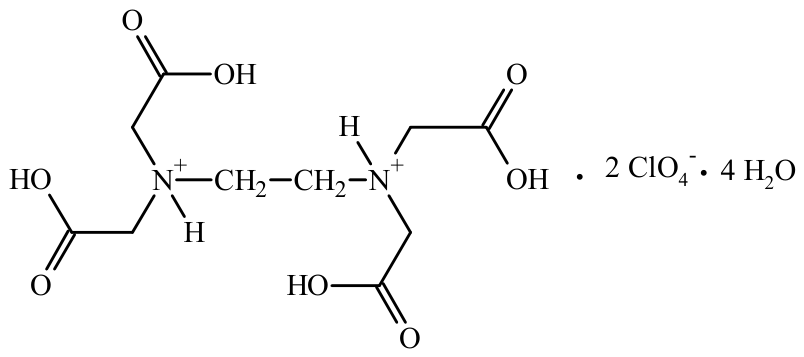
Figure 1.
(a) EDTA anion within the crystal (b) Asymmetric unit (c) unit cell of EDTAH22+∙2(ClO-4)∙4(H2O) provided by intra-hydrogen system.
Figure 1.
(a) EDTA anion within the crystal (b) Asymmetric unit (c) unit cell of EDTAH22+∙2(ClO-4)∙4(H2O) provided by intra-hydrogen system.
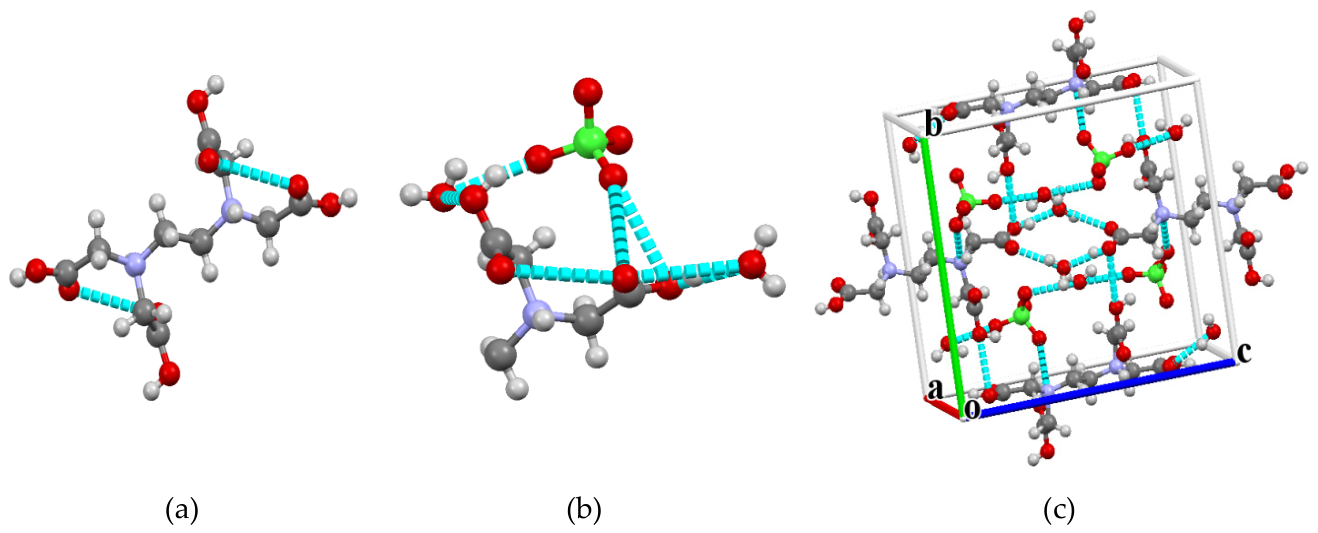
Figure 2.
Supramolecular 3D network of the EDTAH22+∙2(ClO-4)∙4(H2O), (a) view along (Oc) direction, (b) view along (Oa) direction.
Figure 2.
Supramolecular 3D network of the EDTAH22+∙2(ClO-4)∙4(H2O), (a) view along (Oc) direction, (b) view along (Oa) direction.
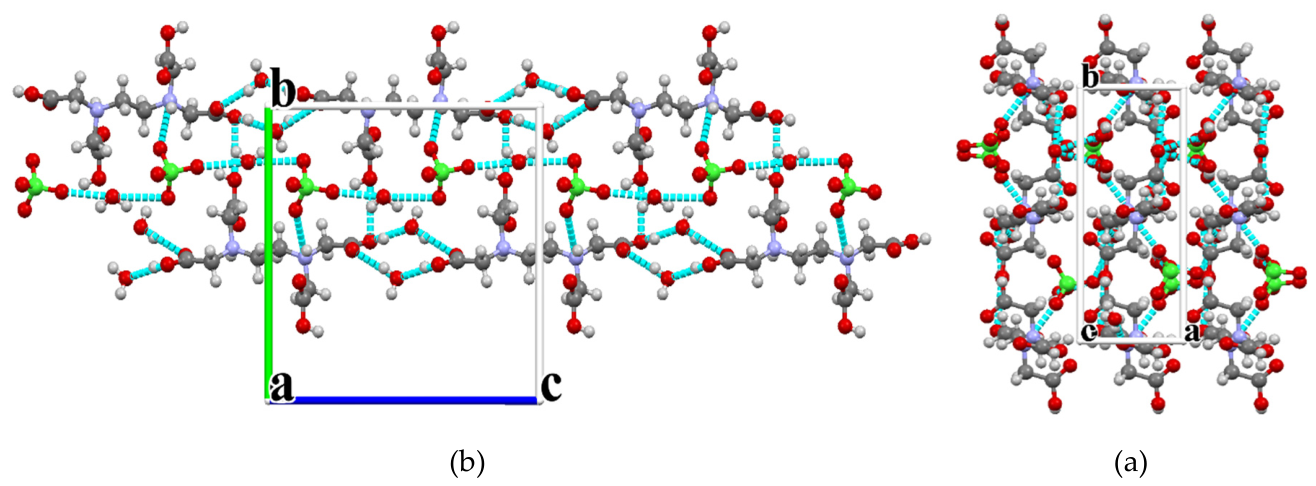
Figure 3.
Hirshfeld surfaces of EDTA²⁺·2ClO₄⁻·4H₂O (a) 3D dnorm surface showing the various intermolecular contacts in the crystal, (b) Surface index, (c) Curvedness and (d) fragment patch.
Figure 3.
Hirshfeld surfaces of EDTA²⁺·2ClO₄⁻·4H₂O (a) 3D dnorm surface showing the various intermolecular contacts in the crystal, (b) Surface index, (c) Curvedness and (d) fragment patch.
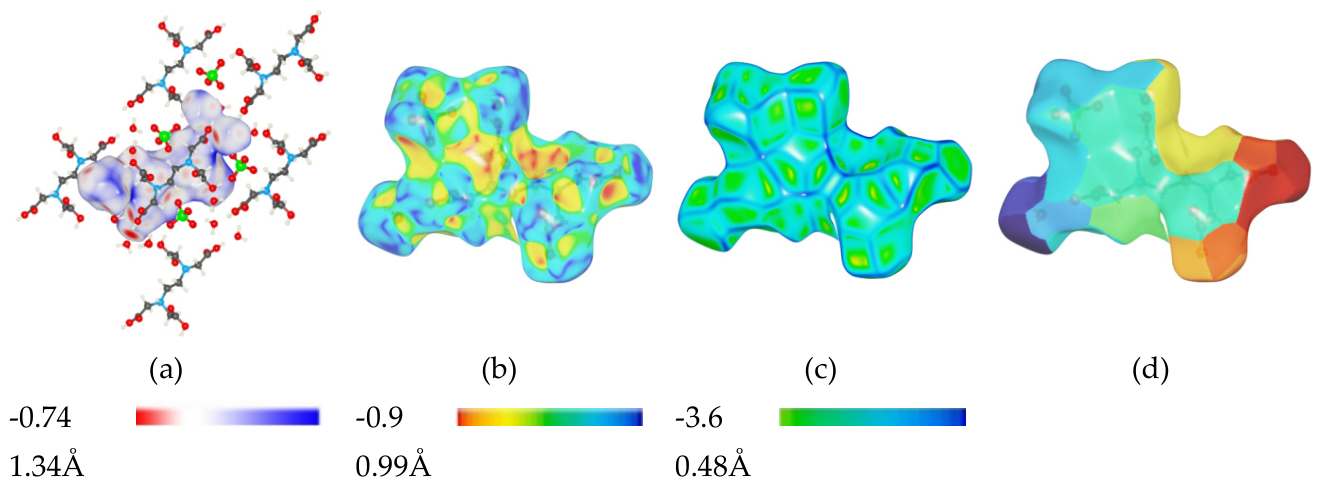
Figure 5.
Comparison of simulated and experimental FT-IR spectra of EDTAH₂²⁺·2ClO₄⁻·4H₂O.
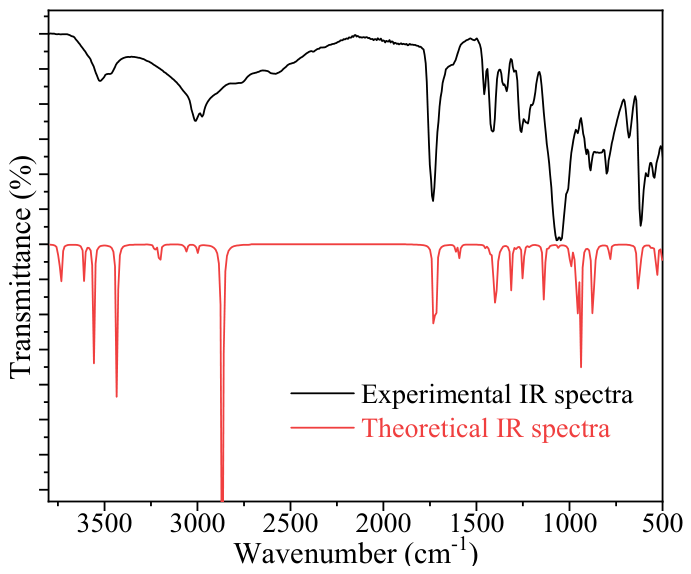
Figure 6.
UV-Vis. Spectra of EDTAH2²⁺·2ClO₄⁻·4H₂O (blue line) in methanol, (red line) in distilled water.
Figure 6.
UV-Vis. Spectra of EDTAH2²⁺·2ClO₄⁻·4H₂O (blue line) in methanol, (red line) in distilled water.
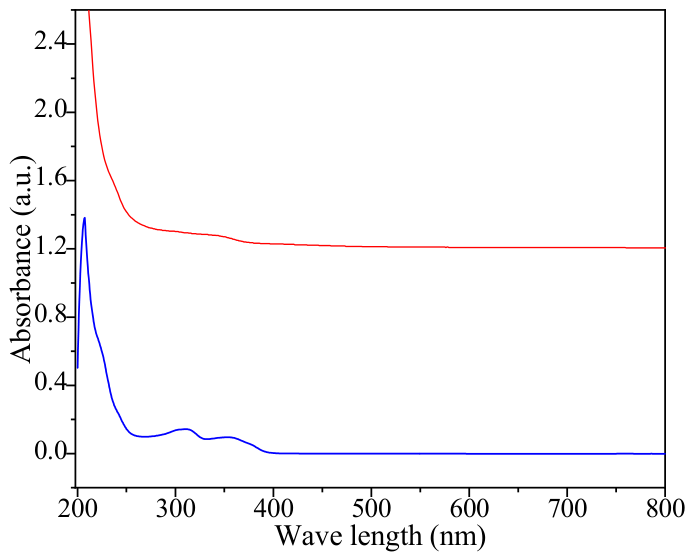
Figure 7.
(a) Antioxidant activity of hybrid material using β-carotene bleaching method, compared to BHT as positive control and to different solvents as negative controls, (b) Percent inhibition histogram of AA% after 24 h, compared to BHT as a positive control and to negative controls.
Figure 7.
(a) Antioxidant activity of hybrid material using β-carotene bleaching method, compared to BHT as positive control and to different solvents as negative controls, (b) Percent inhibition histogram of AA% after 24 h, compared to BHT as a positive control and to negative controls.
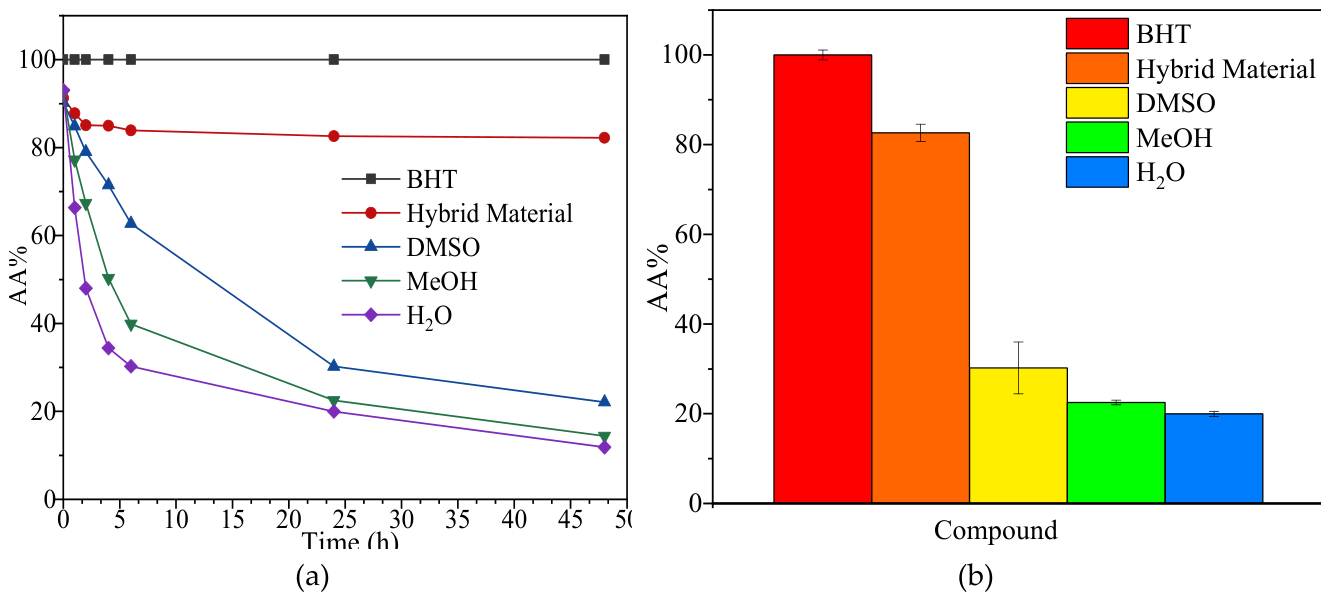
Figure 8.
Frontier molecular orbitals (HOMO-2 to LUMO+2) of the optimized EDTA–ClO₄ hybrid system.
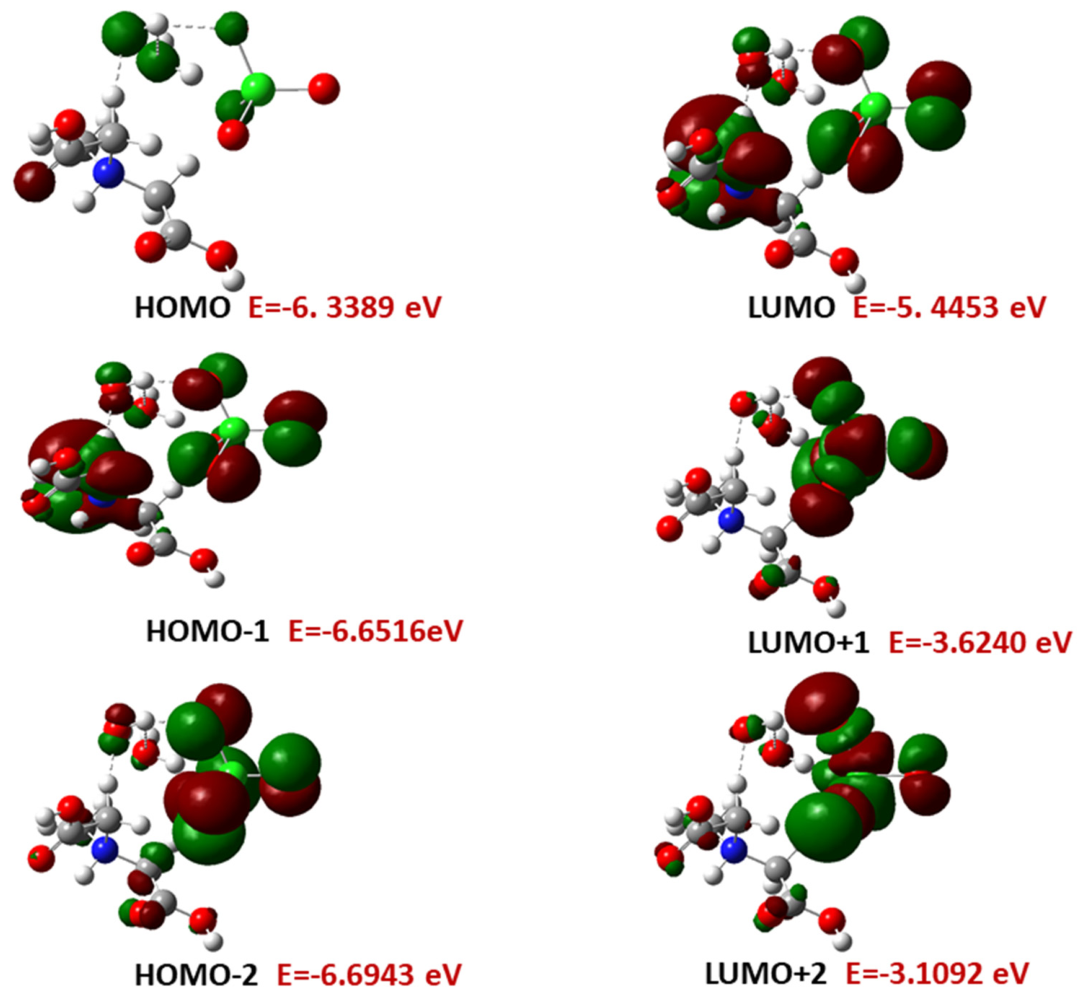
Table 1.
Selected bond lengths (Å) and angle measurements (°) for EDTAH22+∙2ClO4-∙4H2O.
| Atoms | Distances | Atoms | Distances | |
| C1—O3 | 1.217 (4) | C8—O9 | 1.213 (4) | |
| C1—O2 | 1.296 (4) | C8—O10 | 1.302 (4) | |
| C1—C4 | 1.510 (4) | Cl1—O13 | 1.411 (3) | |
| C4—N5 | 1.498 (3) | Cl1—O11 | 1.421 (3) | |
| N5—C7 | 0.9900 | Cl1—O12 | 1.440 (3) | |
| N5—C6 | 0.9900 | Cl1—O14 | 1.445 (3) | |
| C7—C8 | 1.506 (3) | |||
| Atoms | Angles | Atoms | Angles | |
| O3—C1—O2 | 127.1 (3) | N5—C7—C8 | 109.7 (2) | |
| O3—C1—C4 | 122.1 (3) | O9—C8—O10 | 126.0 (3) | |
| O2—C1—C4 | 110.8 (2) | O9—C8—C7 | 121.9 (3) | |
| N5—C4—C1 | 110.7 (2) | O10—C8—C7 | 112.1 (2) | |
| C4—N5—C7 | 111.6 (2) | O13—Cl1—O11 | 112.5 (2) | |
| C4—N5—C6 | 109.3 (2) | O13—Cl1—O12 | 108.7 (2) | |
| C7—N5—C6 | 113.5 (2) | O11—Cl1—O12 | 107.52 (18) | |
| O12—Cl1—O14 | 109.19 (19) | |||
| Atoms | Torsions | Atoms | Torsions | |
| O3—C1—C4—N5 | 18.3 (4) | N5—C7—C8—O10 | −174.2 (2) | |
| O2—C1—C4—N5 | −164.1 (2) | C4—N5—C7—C8 | −136.2 (2) | |
| C1—C4—N5—C7 | 70.0 (3) | C6—N5—C7—C8 | 99.8 (3) | |
| C1—C4—N5—C6 | −163.7 (2) | N5—C7—C8—O9 | 4.9 (4) | |
| Symmetry code: (i) −x+1, −y+1, −z+2. | ||||
Table 2.
Crystal data, data structure and refinement details of EDTA2+∙2ClO4-∙4H2O.
| Empirical formula | C10H18N2O8+2·2ClO4-·4H2O |
| Molecular weight g/mol | 565.23 |
| Crystal size (mm3) | 0.17×0.15×0.13 Mm |
| Color | colourless |
| Shape | Prism |
| Space group | P21/c |
| Crystal system | Monoclinic |
| F(000) | 440 |
| a (Å) | 5.5183 (2) |
| b (Å) | 13.9178 (5) |
| c (Å) | 14.3894 (5) |
| β (°) | 99.458 (2) |
| V(Å3) | 1090.12 (7) |
| Z | 2 |
| T (K) | 150 |
| µ (mm−1) | 0.40 |
| h | -6→6 |
| k | -15→17 |
| l | -17→17 |
| θ range for data collection (°) | 2.9 -27.5° |
| Radiation | CuKα1 (λ=1.54184) |
| Dcalc. (g/cm-3) | 1.722 |
| F(000) | 588 |
| Nmb. of reflections measured | 5438 |
| Independent reflections | 2197 |
| Reflections with I>2σ(I) | 2008 |
| Number of parameters | 171 |
| R[F2 > 2σ(F2)] | 0.058 |
| wR(F2) | 0.161 |
| Rint | 0.032 |
| δρMax/min (e/Å3) | 1.79→-0.95 |
Table 5.
Comparison of simulated and experimental IR spectra and vibrational assignments of EDTAH₂²⁺·2ClO₄⁻·4H₂O.
Table 5.
Comparison of simulated and experimental IR spectra and vibrational assignments of EDTAH₂²⁺·2ClO₄⁻·4H₂O.
|
Experimental frequencies (cm-1) |
Theoretical Frequencies (cm-1) |
Assignments |
|
| Unscaled | Scaled | ||
| 3524 | 3539 | 3432.24 | Asymmetric stretching of water OH |
| 3317 | 3302 | 3202.94 | O–H stretching of carboxylic acid |
| 3010 | 2954 | 2865.38 | OH stretching of carboxylic group interacting with water oxygen |
| 1733 | 1771 | 1717.87 | C=O stretching of carboxylic group |
| 1629 | 1640 | 1590.8 | Bending vibration of water OH, and H2O in plane bend |
| 1457 | 1447 | 1403.59 |
C–H, C–N C–C stretching OH bending of carboxylic group |
| 1412 | 1432 | 1389.04 | C–N stretching and N–H bending |
| 1452 | 1476 | 1431.72 |
C–O and C–C stretching of carboxylic group C–N and C–C bending |
| 1339 | 1353 | 1312.41 |
C–N bending C–H bending O–C–O bending of carboxylic group |
| 1258 | 1288 | 1249.36 | C−C asymmetric stretching vibration of carboxylic acid |
| 1195 | 1171 | 1135.87 | Strong O–C–O bending of carboxylic group |
| 1044 | 1022 | 991.34 | OH vibration of water interacting with OH of carboxylic group, and C−O symmetric stretching vibration |
| 949 | 988 | 958.36 | ClO₄⁻ asymmetric stretching vibration |
| 888 | 900 | 873 | Vibrations of hydrogen bond networks (ClO₄⁻ and O–H group), and ClO4̄ symmetric stretching vibration |
| 797 | 807 | 782.79 | ClO4- bending vibration |
| 679 | 652 | 632.44 | OH vibration of water interacting with water OH, and ClO4- asymmetric bending type of vibration |
| 544 | 545 | 528.65 | C-N bending vibration |
Table 6.
Percent inhibition AA% after 24h, estimated as means ± SD.
| BHT | Hybrid Ma2. | DMSO | MeOH | H2O | |
| AA% at 24h | 100±1.11 | 82.62±1.92 | 30.217±5.77 | 22.504±0.52 | 19.968±0.56 |
Table 7.
Some global quantum descriptors and thermodynamic parameters calculated at 298K of EDTAH2²⁺·2ClO₄⁻·4H₂O.
Table 7.
Some global quantum descriptors and thermodynamic parameters calculated at 298K of EDTAH2²⁺·2ClO₄⁻·4H₂O.
| EHOMO (eV) | -6.339 |
| ELUMO (eV) | -5.445 |
| Gap energy (ΔE, eV) | 0.894 |
| Ionization potential (I, eV) | 6.339 |
| Electron affinity (A, eV) | 5.445 |
| Global Hardness (η, eV) | 0.447 |
| Chemical potential (μ, eV) | 0.447 |
| Global electrophilicity (ω, eV) | 38.849 |
| Global softness (σ, eV-1) | 2.237 |
| Electronegativity (χ, eV) | 5.892 |
| Dipolar moment (Debye) | 17.510 |
| ETotal (keV) | -39.865 |
| EThermal (kcal/mol) | 148.153 |
| Heat Capacity (Cv, cal/mol.kelvin) | 76.014 |
| Entropy (S, cal/mol.kelvin) | 170.949 |
I=−EHOMO, A=−ELUMO, η=[(ELUMO−EHOMO)/2], σ=1/η, χ=−µ, µ=[(ELUMO+EHOMO)/2], ω=χ²/2η.
Disclaimer/Publisher’s Note: The statements, opinions and data contained in all publications are solely those of the individual author(s) and contributor(s) and not of MDPI and/or the editor(s). MDPI and/or the editor(s) disclaim responsibility for any injury to people or property resulting from any ideas, methods, instructions or products referred to in the content. |
© 2026 by the authors. Licensee MDPI, Basel, Switzerland. This article is an open access article distributed under the terms and conditions of the Creative Commons Attribution (CC BY) license (http://creativecommons.org/licenses/by/4.0/).
Copyright: This open access article is published under a Creative Commons CC BY 4.0 license, which permit the free download, distribution, and reuse, provided that the author and preprint are cited in any reuse.