
Submitted:
19 August 2026
Posted:
21 August 2026
You are already at the latest version
Abstract
The nearly neutral theory predicts that mildly deleterious mutations persist transiently within populations before being removed by purifying selection. During the past three decades, studies across diverse taxa, including humans, mammals, viruses, bacteria, and other vertebrates, have consistently reported a temporal pattern showing a higher proportion of deleterious variants at short timescales compared to that observed at long timescales. The elevated ratios of nonsynonymous-to-synonymous diversity (dN/dS), enrichment of deleterious variants among rare and young alleles, higher proportions of deleterious mutations in terminal branches of phylogenetic trees, and time-dependent variation in molecular evolutionary rates all support the progressive removal of harmful mutations by purifying selection. These observations have important implications for molecular evolution, phylogenetic inference, phylogeography and divergence-time estimation, particularly where recent evolutionary timescales are considered. This review synthesises evidence from population genetics, phylogenomics and molecular evolutionary studies to provide a unified perspective on the temporal dynamics of deleterious mutations. We discuss how these patterns arise from the interaction between genetic drift and purifying selection and their consistency with the predictions of the nearly neutral theory. Finally, we highlight recent advances in modeling purifying selection, particularly in viral evolutionary studies, identify outstanding questions, and propose future research directions for understanding the temporal behaviour of deleterious mutations across genomes and evolutionary timescales.
Keywords:
deleterious variants
; temporal patterns
; time dependency
; dN/dS ratio
; mitochondrial genome and purifying selection
Small Summary
generation, new genetic mutations are introduced into the populations of all living species. While many of these are harmless, some can affect an organism’s fitness to varying degrees. Fortunately, natural selection removes these bad mutations, but this process takes time. Therefore, recently arisen mutations contain a higher proportion of harmful ones than those introduced earlier. This review collected results from previous studies on humans, animals, bacteria and viruses that showed that the proportion of harmful mutations in populations declines over time. It also discusses how this temporal pattern influences the shape of phylogenetic trees, estimations of molecular evolutionary rates, and population/species divergence times. Overall, the review highlights the importance of the age of mutations or genetic variations for interpreting genomic data and evolutionary history.
1. Introduction
The neutral theory of molecular evolution proposed by Motoo Kimura predicts that the majority of molecular evolutionary change results from the fixation of selectively neutral mutations through genetic drift rather than adaptive evolution [1]. Apart from neutral mutations, this theory incorporated only strongly deleterious mutations, which were assumed to be quickly eliminated by purifying selection and hence do not significantly contribute to long-term evolutionary divergence [2]. Tomoko Ohta extended neutral theory by accommodating mildly deleterious mutations and proposed the Nearly Neutral Theory [3]. As the selective disadvantage is small for these mutations, they can segregate in a population for substantial periods before eventually being removed. These mutations are influenced by the effective population size. In small populations, genetic drift may weaken the efficiency of selection, which could lead to an appreciable increase in the frequency of mildly deleterious mutations. However, in larger populations, purifying selection becomes more efficient, reducing both their persistence time and probability of fixation. In agreement with this, later, Kimura proposed that deleterious mutations can contribute significantly to diversity but that at high frequencies they are selected against and prevented from becoming fixed [4].
Although Ohta did not explicitly discuss it, her theory helped to understand the temporal patterns of deleterious polymorphisms observed by a number of studies conducted later. The central prediction is that deleterious mutations are transient and segregate in populations for varying lengths of time before eventually being eliminated by purifying selection. This implies that newly arising mutations should contain a high proportion of harmful mutations, and this fraction is gradually reduced over time. This will produce a continuous temporal change in the composition of polymorphism within populations. This review focuses on studies that reported differences in the fraction of deleterious mutations observed over time in populations and closely related species. The potential reasons for those observed patterns and their implications for phylogeny, evolutionary rate, and divergence time estimations were discussed.
2. The Abundance of Deleterious Variants Within and Between Species
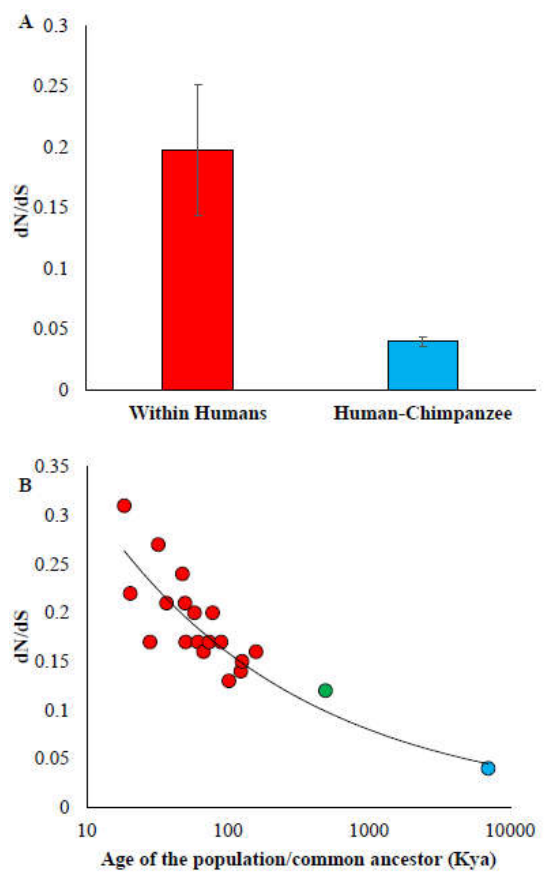
Based on the strict neutral theory, the amino acid replacement polymorphisms are neutral and largely governed by mutation and genetic drift [2]. This theory also predicts that the segregation of polymorphisms in a population and the long-term fixation of mutations between species are two different aspects of the same evolutionary process [4]. According to this, the rate of protein evolution and the extent of amino acid polymorphisms are largely determined by the rate of neutral amino acid mutations. Therefore, the ratio (dN/dS) of nonsynonymous divergence (dN) to synonymous divergence (dS) between species is expected to be equal to the ratio of nonsynonymous diversity (N) to synonymous diversity (πS) within the population of a species. The popular McDonald–Kreitman test was based on this prediction [5]. Contrary to this prediction, studies on fruit fly mitochondrial protein-coding genes showed that the dN/dS ratio observed within species was much higher than that estimated between species [6,7]. This pattern became universal across species, as similar elevated within-population dN/dS ratios were observed in mice, chimpanzee, and humans [8,9,10,11]. This suggests an excess of nonsynonymous polymorphisms in populations compared to fixed replacement mutations. The excess proportion of nonsynonymous polymorphisms could be due to the enrichment of deleterious variants. Since natural selection eliminates them over time, the dN/dS ratio observed for between-species comparison is reduced, as it only contains the neutral amino acid substitutions.
Interestingly, studies on human dengue virus noticed a marked elevation in the frequency of nonsynonymous variation of the viral genomes within a host (intrahost) in comparison to the frequency of nonsynonymous polymorphisms between hosts (interhost) [12]. To explain this, the authors suggested that purifying selection must have eliminated nonsynonymous variants shared between viral genomes belonging to different hosts due to the time elapsed since their separation. Another study compared the dN/dS ratio of various bacterial species and found that this ratio was much higher for the comparisons involving closely related strains than those involving distantly related strains [13]. This study also attributed purifying selection to be the potential cause to explain this pattern. These observations in viruses and prokaryotes further confirm that the drastic difference in the proportion of deleterious variants between short and long timescales is a universal pattern in biology, which was accurately predicted by the nearly neutral theory of molecular evolution.
3. Temporal Trails of Deleterious Polymorphisms
The above-mentioned studies showed a significant difference in the dN/dS ratio at short and long timescales (Figure 1A). However, this dichotomous information is insufficient to understand the gradual variation in the evolutionary process over time. To examine this, the complete mitochondrial genomes belonging to more than a dozen haplogroups were used by another study [14]. The age of mitochondrial haplogroups were first estimated, which revealed that some haplogroups were very old (e.g., L0 – 158,000 years) while others were too recent (e.g., X – 18,000 years). This study then went on to estimate the dN/dS ratio of each haplogroup, and those for human-Neanderthal and human-chimpanzee comparisons. These ratios were then correlated with the ages of haplogroups and the age of common ancestor of human-Neanderthal and human-Chimpanzee (Figure 1B). This revealed a highly significant negative relationship between the two variables. Importantly, there was a twofold difference in the dN/dS ratios among the haplogroups, and these differences perfectly correlated with their age. This result revealed that the differences in the dN/dS ratios observed by previous studies were not discreetly qualitative, but a continuous quantitative attribute modulated by time (Figure 1B). Since higher ratios suggest a high proportion of nonsynonymous variations, this reveals the gradual declining pattern of deleterious variations in human mitochondrial genomes. This in turn implies that purifying selection is removing deleterious nonsynonymous variants continuously over time.
The allele frequency of Single Nucleotide Variants (SNVs) also indirectly indicates their age. This is because when a mutation is created in a population, its frequency will be low initially and increase over time. Therefore, typically low-frequency alleles are younger than the high-frequency ones. Based on this prediction, another study estimated the proportion of deleterious nonsynonymous SNVs present in different allele frequency windows [15]. The results found that a high proportion of deleterious SNVs constitutes the low-frequency alleles, and this proportion declined with a gradual increase in the allele frequency. While 53% of the nonsynonymous SNVs with a MAF <0.002 were deleterious, this proportion was only 12% for the high frequency SNVs (MAF 0.4-0.5). This finding also indirectly supports the negative relationship between the age of the alleles and the fraction of deleterious SNVs.
A similar observation was reported by a study, which directly estimated the age of each mutation from 6500 exomes belonging to Africans and Europeans [16]. This study also revealed a highly significant negative correlation between mutation age and the proportion of deleterious nonsynonymous SNVs. The average age of deleterious nonsynonymous SNVs was 20 Kyr and 30 Kyr for European and African populations, respectively. However, the average age of neutral (synonymous or noncoding) SNVs was 45 Kyr and 60 Kyr for European and African populations, respectively. This suggests that the age of deleterious SNVs is around two times younger than that of the neutral SNVs.
4. Patterns of Harmful Mutations on Phylogenetic Trees and Phylogeography
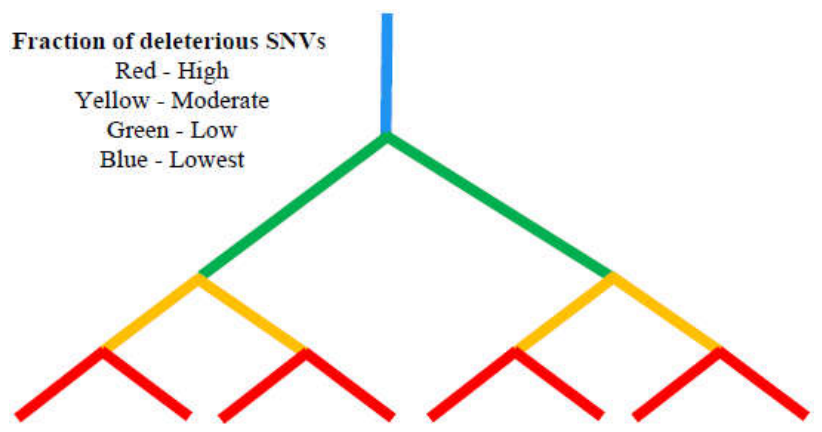
Using over 1000 human mitochondrial genomes, a previous study constructed a phylogenetic tree and estimated the ratio of nonsynonymous-to-synonymous mutations (N/S) for each branch of the tree [17]. This revealed that the terminal branches had a much higher N/S ratio compared to that observed for the internal branches. Since terminal branches are relatively younger than internal branches, they are enriched with rare or low-frequency deleterious nonsynonymous mutations. A similar study on human mitochondrial genomes further confirmed this finding by concluding that young branches have a high proportion of deleterious mutations [18]. Later, using complete nuclear genomes from Africans, Europeans, and Asians, a previous study constructed the population phylogeny and estimated the fraction of deleterious nonsynonymous SNVs in each branch [19]. This study then quantified the difference in the deleterious mutation load between the branches. The results of these investigations showed a gradual reduction in the fraction of deleterious nonsynonymous SNVs from tip to root of the phylogenetic tree. The conceptual pattern is shown in Figure 2. Typically, the proportion of deleterious SNVs is expected to be the highest at the terminal branches (red), and the first-level internal branches have a moderate proportion (orange). While the second-level internal branches (green) have low proportions of deleterious SNVs, the root of the tree has the lowest proportion (blue). This suggests that the deleterious SNPs are enriched in the terminal branches and that sufficient time is not elapsed for purifying selection to purge them. To further demonstrate the role of purifying selection another study separated the genes based on the level of selective constraints on them and performed the above analyses for each set of genes separately [20]. This study observed a drastic decline in the proportion of deleterious nonsynonymous SNVs from the tip to root of the tree for the highly constrained genes. The rate of decline was modest for moderately constrained genes, and in contrast, there was no significant difference in the proportion of nonsynonymous SNVs between the tip and root of the tree of the genes under relaxed selective constraints. This further confirms the role of purifying selection as the major factor for observing the temporal pattern, as they are absent in the variants segregating in neutrally evolving genes.
Population genetic theories predict that populations that are located closely are expected to be genetically more similar to each other compared to those that are located distantly. Therefore, the geographic distance and genetic distance correlate, which is known as phylogeography. This also implies that populations in proximity must have separated more recently than those that are geographically apart. The above studies showed that the fraction of deleterious mutations is higher among closely related populations, and therefore this should be true for closely located ones as well. This was examined using the complete mitochondrial genomes of the reptile tuatara from various regions of New Zealand [21]. This study found that diversity at evolutionarily constrained sites (nonsynonymous + RNA) was elevated in the case of comparisons involving closely located populations. Conversely, diversity was reduced in the case of comparisons between distantly located populations. Since a fraction of nonsynonymous and RNA polymorphisms could be deleterious, this suggests that natural selection must have removed those over time. The distantly located populations must have separated much earlier, and hence the fraction of deleterious nonsynonymous and RNA mutations observed by comparing these populations was much lower. This is because natural selection must have removed those over the long elapsed time. In contrast, a significant fraction of deleterious mutations must be segregating in populations located closely, as they must have separated only recently.
5. Purifying Selection and the Rate of Molecular Evolution
A series of other studies reported variation in the evolutionary rate estimated between recent and deep calibrations. By observing a number of studies using mitochondrial DNA to estimate divergence time between various avian taxa, Garcia-Moreno found that the evolutionary rate was much higher for those studies using recent calibrations (<1 Myr) compared to those using old calibrations (>1 Myr) [22]. Later, another study examined this issue using mitochondrial coding and non-coding genes of primates along with the avian data [23]. Later studies on freshwater fish and insects also reported a higher rate of evolution using a recent calibration point compared to the traditional rate estimated based on deep calibrations [24,25]. These studies attributed many potential factors to explain these patterns, including purifying selection, mutational hot spots, saturation of substitutions, rate variation between lineages, sequencing errors, ancestral polymorphisms, and calibration uncertainty. Although the role of purifying selection in explaining the rate variation has been recognised, the validity of other potential causes and the magnitude of their influence on rate variation has been debated [26,27,28,29,30]. As this review is focused only on the effect of purifying selection, we do not discuss these issues further.
The above-mentioned studies reported significant variation in molecular rates based on different calibration points used protein-coding genes and D-loop mitochondrial regions. Both these datasets are not suited to examine the effect of purifying selection due to confounding effects of neutral and nonneutral sites present in them. Therefore, a later study separated neutral synonymous sites, and various constrained sites, including nonsynonymous sites, RNA and D-loop regions in human mitochondrial genomes [31]. The rate was estimated using all these types of sites at short-timescale (18 Kyr) and long (6 Myr) timescales. For constrained sites (nonsynonymous, RNA and D-Loop), the rate estimated for the short timescale was 3-10 times higher than that estimated for the long timescale. However, there was no significant difference in the rate estimated using the neutral synonymous sites. This proved the major role of purifying selection in influencing the estimation of molecular evolutionary rate at different timescales or using different calibration points. A similar observation was also reported using the synonymous, RNA, and nonsynonymous sites of mitochondrial genomes of penguins [32]. Another important study that not only appreciated the influence of purifying selection on rate estimation but also corrected the rate of evolution at constrained sites of mitochondrial genomes using the rate at the neutral synonymous sites [33]. This corrected rate for the whole mitochondrial genome was then used for calibrating the time of divergence between human populations.
6. Recent Advances
Although the effect of purifying selection at short and long timescales was investigated by a series of studies during 2005 – 2012, there was not much progress in this area of research later. This is because these studies predominantly used mitochondrial genes that are densely packed with coding genes under purifying selection. Hence, phylogenetic, molecular rate, and divergence time estimates based on mitogenome data were seriously affected by purifying selection on short timescales and there was a scarcity of neutral sites to perform these estimations. Later, due to the advent of next-generation sequencing technology, the complete genomes of vertebrate populations became available. Therefore, phylogenetic and population genetic studies have shifted from using mitochondrial to nuclear genomes. Since >90% of vertebrate genomes are under neutral evolution, evolutionary rate and divergence time estimations were not largely influenced by purifying selection.
In contrast, the major fraction of viral genomes is under purifying selection (due to densely located coding genes) the rate and divergence time estimation for this group is still heavily affected by purifying selection. Therefore, during the past decade, the temporal pattern of deleterious variations was predominantly studied only for viral genomes. Particularly, these studies developed methods to accommodate the rate variation between the tip and root of the viral trees caused by purifying selection [34,35,36,37]. For instance, a robust Bayesian framework was developed to accommodate the rate acceleration at the tips of the Ebola virus tree [34]. Similarly, a predictive mechanistic model was developed to explain the rate decay across timescales, and this model was used to estimate the diversification times of hepatitis C virus and Sarbecovirus [35]. Furthermore, the influence of purifying selection was accommodated in the estimation of evolutionary rates in influenza and covid (SARS-CoV-2) viral genomes [36].
7. Future Directions
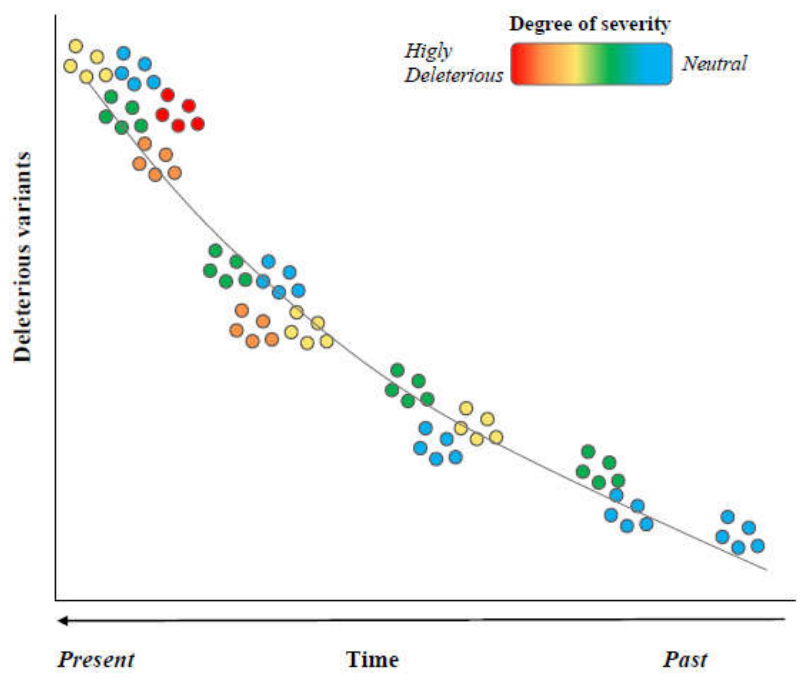
Penny [38] has elegantly demonstrated the declining pattern of deleterious mutations over time based on the predictions of neutral and nearly neutral theories. To explain the pattern, deleterious mutations were divided into different categories based on the severity of the deleterious effects and the fate of these mutations over time was discussed. Here we extended Penny’s work and grouped segregating mutations into five categories, namely, highly deleterious (but not lethal), moderately deleterious, mildly deleterious, very mildly deleterious and neutral (Figure 3). At very short timescales (e.g., within a few hundred years or so), all four types are expected to segregate in a population due to genetic drift. The highly deleterious mutations (red) are the first ones to be removed by purifying selection and followed by the moderately deleterious ones (orange). The mildly deleterious ones (yellow) are expected to be purged next, and the very mildly deleterious ones (green) persist a bit more time before being eliminated. Finally, the neutral variants (blue) stay for over a significant period of time. Although previous studies have shown the relative abundance of deleterious SNVs at different timescales, the magnitude of their severity was not documented. Therefore, this could be a potential area of research that could be worth pursuing in the future. Another important factor to consider is the population size. Because population size influences the allele frequency and duration of persistence of deleterious SNVs. It is well-known that the fraction of deleterious SNVs is expected to be high in small populations, as purifying selection is weak due to high genetic drift. Hence, future studies could study the influence of effective population size on the temporal dynamics of deleterious variations.
Author Contributions
SS - conceived and designed the study, wrote the final manuscript.
Funding
This research was supported by the funds from the University of the Sunshine Coast awarded to SS.
Institutional Review Board Statement
Not applicable.
Informed Consent Statement
Not applicable.
Data Availability Statement
Not Applicable.
Conflicts of Interest
The authors declare no competing interests.
References
- Kimura, M. Evolutionary rate at the molecular level. Nature 1968, 217, 624–626. [Google Scholar] [CrossRef]
- Kimura, M.; Ohta, T. Protein polymorphism as a phase of molecular evolution. Nature 1971, 229, 467–469. [Google Scholar] [CrossRef]
- Ohta, T. Slightly deleterious mutant substitutions in evolution. Nature 1973, 246, 96–98. [Google Scholar] [CrossRef] [PubMed]
- Kimura, M. The Neutral Theory of Molecular Evolution; Cambridge University Press: Cambridge, UK, 1983. [Google Scholar]
- McDonald, J.H.; Kreitman, M. Adaptive protein evolution at the Adh locus in Drosophila. Nature 1991, 351, 652–654. [Google Scholar] [CrossRef] [PubMed]
- Rand, D.M.; Dorfsman, M.; Kann, L.M. Neutral and non-neutral evolution of Drosophila mitochondrial DNA. Genetics 1994, 138, 741–756. [Google Scholar] [CrossRef] [PubMed]
- Ballard, J.W.; Kreitman, M. Unraveling selection in the mitochondrial genome of Drosophila. Genetics 1994, 138, 757–772. [Google Scholar] [CrossRef] [PubMed]
- Rand, D.M.; Kann, L.M. Excess amino acid polymorphism in mitochondrial DNA: contrasts among genes from Drosophila, mice, and humans. Mol. Biol. Evol. 1996, 13, 735–748. [Google Scholar] [CrossRef] [PubMed]
- Nachman, M.W.; Brown, W.M.; Stoneking, M.; Aquadro, C.F. Nonneutral mitochondrial DNA variation in humans and chimpanzees. Genetics 1996, 142, 953–963. [Google Scholar] [CrossRef] [PubMed]
- Nachman, M.W.; Boyer, S.N.; Aquadro, C.F. Nonneutral evolution at the mitochondrial NADH dehydrogenase subunit 3 gene in mice. Proc. Natl. Acad. Sci. U S A 1994, 91, 6364–6368. [Google Scholar] [CrossRef] [PubMed]
- Hasegawa, M.; Cao, Y.; Yang, Z. Preponderance of slightly deleterious polymorphism in mitochondrial DNA: nonsynonymous/synonymous rate ratio is much higher within species than between species. Mol. Biol. Evol. 1998, 15, 1499–1505. [Google Scholar] [CrossRef] [PubMed]
- Holmes, E.C. Patterns of intra- and interhost nonsynonymous variation reveal strong purifying selection in dengue virus. J. Virol. 2003, 77, 11296–11298. [Google Scholar] [CrossRef] [PubMed]
- Rocha, E.P.; Smith, J.M.; Hurst, L.D.; Holden, M.T.; Cooper, J.E.; Smith, N.H.; Feil, E.J. Comparisons of dN/dS are time dependent for closely related bacterial genomes. J. Theor. Biol. 2006, 239, 226–235. [Google Scholar] [CrossRef] [PubMed]
- Subramanian, S. Temporal trails of natural selection in human mitogenomes. Mol. Biol. Evol. 2009, 26, 715–717. [Google Scholar] [CrossRef] [PubMed]
- Subramanian, S. Quantifying harmful mutations in human populations. Eur. J. Hum. Genet 2012, 20, 1320–1322. [Google Scholar] [CrossRef] [PubMed]
- Fu, W.; O'Connor, T.D.; Jun, G.; Kang, H.M.; Abecasis, G.; Leal, S.M.; Gabriel, S.; Rieder, M.J.; Altshuler, D.; Shendure, J.; et al. Analysis of 6,515 exomes reveals the recent origin of most human protein-coding variants. Nature 2013, 493, 216–220. [Google Scholar] [CrossRef] [PubMed]
- Ruiz-Pesini, E.; Mishmar, D.; Brandon, M.; Procaccio, V.; Wallace, D.C. Effects of purifying and adaptive selection on regional variation in human mtDNA. Science 2004, 303, 223–226. [Google Scholar] [CrossRef] [PubMed]
- Kivisild, T.; Shen, P.; Wall, D.P.; Do, B.; Sung, R.; Davis, K.; Passarino, G.; Underhill, P.A.; Scharfe, C.; Torroni, A.; et al. The role of selection in the evolution of human mitochondrial genomes. Genetics 2006, 172, 373–387. [Google Scholar] [CrossRef] [PubMed]
- Subramanian, S. The abundance of deleterious polymorphisms in humans. Genetics 2012, 190, 1579–1583. [Google Scholar] [CrossRef] [PubMed]
- Subramanian, S.; Lambert, D.M. Selective constraints determine the time dependency of molecular rates for human nuclear genomes. Genome Biol. Evol. 2012, 4, 1127–1132. [Google Scholar] [CrossRef] [PubMed]
- Subramanian, S.; Mohandesan, E.; Millar, C.D.; Lambert, D.M. Distance-dependent patterns of molecular divergences in Tuatara mitogenomes. Sci. Rep. 2015, 5, 8703. [Google Scholar] [CrossRef] [PubMed]
- García-Moreno, J. Is There a Universal mtDNA Clock for Birds? J. Avian Biol. 2004, 35, 465–468. [Google Scholar] [CrossRef]
- Ho, S.Y.; Phillips, M.J.; Cooper, A.; Drummond, A.J. Time dependency of molecular rate estimates and systematic overestimation of recent divergence times. Mol. Biol. Evol. 2005, 22, 1561–1568. [Google Scholar] [CrossRef] [PubMed]
- Papadopoulou, A.; Anastasiou, I.; Vogler, A.P. Revisiting the insect mitochondrial molecular clock: the mid-Aegean trench calibration. Mol. Biol. Evol. 2010, 27, 1659–1672. [Google Scholar] [CrossRef] [PubMed]
- Burridge, C.P.; Craw, D.; Fletcher, D.; Waters, J.M. Geological dates and molecular rates: fish DNA sheds light on time dependency. Mol. Biol. Evol. 2008, 25, 624–633. [Google Scholar] [CrossRef] [PubMed]
- Peterson, G.I.; Masel, J. Quantitative prediction of molecular clock and ka/ks at short timescales. Mol. Biol. Evol. 2009, 26, 2595–2603. [Google Scholar] [CrossRef] [PubMed]
- Ho, S.Y.; Shapiro, B.; Phillips, M.J.; Cooper, A.; Drummond, A.J. Evidence for time dependency of molecular rate estimates. Syst. Biol. 2007, 56, 515–522. [Google Scholar] [CrossRef] [PubMed]
- Ho, S.Y.; Lanfear, R.; Bromham, L.; Phillips, M.J.; Soubrier, J.; Rodrigo, A.G.; Cooper, A. Time-dependent rates of molecular evolution. Mol. Ecol. 2011, 20, 3087–3101. [Google Scholar] [CrossRef] [PubMed]
- Emerson, B.C. Alarm bells for the molecular clock? No support for Ho et al.'s model of time-dependent molecular rate estimates. Syst. Biol. 2007, 56, 337–345. [Google Scholar] [CrossRef] [PubMed]
- Bandelt, H.J. Clock debate: when times are a-changin': time dependency of molecular rate estimates: tempest in a teacup. Heredity (Edinb) 2008, 100, 1–2. [Google Scholar] [CrossRef] [PubMed]
- Subramanian, S.; Lambert, D.M. Time dependency of molecular evolutionary rates? Yes and no. Genome Biol. Evol. 2011, 3, 1324–1328. [Google Scholar] [CrossRef] [PubMed]
- Subramanian, S.; Denver, D.R.; Millar, C.D.; Heupink, T.; Aschrafi, A.; Emslie, S.D.; Baroni, C.; Lambert, D.M. High mitogenomic evolutionary rates and time dependency. Trends Genet 2009, 25, 482–486. [Google Scholar] [CrossRef] [PubMed]
- Soares, P.; Ermini, L.; Thomson, N.; Mormina, M.; Rito, T.; Rohl, A.; Salas, A.; Oppenheimer, S.; Macaulay, V.; Richards, M.B. Correcting for purifying selection: an improved human mitochondrial molecular clock. Am. J. Hum. Genet 2009, 84, 740–759. [Google Scholar] [CrossRef] [PubMed]
- Membrebe, J.V.; Suchard, M.A.; Rambaut, A.; Baele, G.; Lemey, P. Bayesian Inference of Evolutionary Histories under Time-Dependent Substitution Rates. Mol. Biol. Evol. 2019, 36, 1793–1803. [Google Scholar] [CrossRef] [PubMed]
- Ghafari, M.; Simmonds, P.; Pybus, O.G.; Katzourakis, A. A mechanistic evolutionary model explains the time-dependent pattern of substitution rates in viruses. Curr. Biol. 2021, 31, 4689–4696 e4685. [Google Scholar] [CrossRef] [PubMed]
- Ghafari, M.; du Plessis, L.; Raghwani, J.; Bhatt, S.; Xu, B.; Pybus, O.G.; Katzourakis, A. Purifying Selection Determines the Short-Term Time Dependency of Evolutionary Rates in SARS-CoV-2 and pH1N1 Influenza. Mol. Biol. Evol. 2022, 39. [Google Scholar] [CrossRef] [PubMed]
- Ghafari, M.; Liu, Q.; Dhillon, A.; Katzourakis, A.; Weissman, D.B. Investigating the evolutionary origins of the first three SARS CoV-2 variants of concern. Front. Virol. 2022, 2, 942555. [Google Scholar] [CrossRef]
- Penny, D. Evolutionary biology: relativity for molecular clocks. Nature 2005, 436, 183–184. [Google Scholar] [CrossRef] [PubMed]
- Mishmar, D.; Ruiz-Pesini, E.; Golik, P.; Macaulay, V.; Clark, A.G.; Hosseini, S.; Brandon, M.; Easley, K.; Chen, E.; Brown, M.D.; et al. Natural selection shaped regional mtDNA variation in humans. Proc. Natl. Acad. Sci. U S A 2003, 100, 171–176. [Google Scholar] [CrossRef] [PubMed]
Disclaimer/Publisher’s Note: The statements, opinions and data contained in all publications are solely those of the individual author(s) and contributor(s) and not of MDPI and/or the editor(s). MDPI and/or the editor(s) disclaim responsibility for any injury to people or property resulting from any ideas, methods, instructions or products referred to in the content. |
© 2026 by the authors. Licensee MDPI, Basel, Switzerland. This article is an open access article distributed under the terms and conditions of the Creative Commons Attribution (CC BY) license (http://creativecommons.org/licenses/by/4.0/).
Copyright: This open access article is published under a Creative Commons CC BY 4.0 license, which permit the free download, distribution, and reuse, provided that the author and preprint are cited in any reuse.