
Submitted:
19 August 2026
Posted:
20 August 2026
You are already at the latest version
Abstract
In this work we propose Carrier-Embedded Non-Holonomy Matter (CENM) as a possible new phase of matter and test whether its effective galactic dynamics can account for observed rotation curves. In the motivating reconstruction framework, localized visible matter is associated with carrier-relative holonomy-bearing defects, whereas CENM is an extended gravitating phase without an ordinary gauge-readable defect core. The galactic model is deliberately more limited than this microscopic interpretation. It treats the CENM density as a conserved continuum field whose leading weak-field evolution is a gravitational drift–smoothing gradient flow. Zero-flux equilibrium gives the isothermal relation ρD∝exp(−Φ/σD2). In a dark-dominated spherical envelope, the regular isothermal equation approaches ρD∝r−2 and vc2→2σD2. For transparent rotation-curve fitting we use the familiar pseudo-isothermal interpolation, explicitly distinguishing this empirical profile from the new CENM interpretation. The proposed cross-galaxy restriction is a universal transition acceleration aCENM. Conditional on the transition and matching relations, it gives v∞4=GMbaCENM. We therefore test two nested models: an unconstrained CENM/pseudo-isothermal halo with (v∞,rc) fitted independently for each galaxy, and a constrained CENM model in which one aCENM is shared by the full sample and only rc remains galaxy specific. Applying a predeclared quality selection to the SPARC database leaves 113 galaxies and 2666 rotation-curve points. The shared-acceleration fit gives aCENM=1.825−0.007+0.007×10⁻¹⁰ms−2. The median reduced chi-squares of the unconstrained and constrained CENM models are 1.058 and 3.082, respectively, compared with 1.046 for Burkert and 1.893 for NFW. The unconstrained surrogate has the lowest information criteria among the four fitted profiles and a near-unity median galaxy-level reduced chi-square, although its global reduced chi-square of 4.71 shows that outliers or unmodeled systematics remain important. The one-acceleration closure is decisively rejected: relative to CENM-U it increases chi-square by Δχ2=15273.4 for 112 restrictions and gives ΔBICA−U=14389.9. Thus the familiar pseudo-isothermal effective profile is comparatively compatible with the data, but the distinctive shared-acceleration closure tested here is not. The analysis neither identifies the microscopic non-holonomy interpretation nor supplies a complete cosmology.
Keywords:
dark matter
; galaxy rotation curves
; SPARC
; pseudo-isothermal halo
; baryonic Tully–Fisher relation
; effective medium
; drift–diffusion
; Smoluchowski–Poisson system
; non-holonomy matter
1. Introduction
The evidence for a dominant non-luminous gravitating component spans galaxy rotation curves, gravitational lensing, clusters, large-scale structure, and the cosmic microwave background [1,2,3,4]. Cold collisionless dark matter remains the standard and highly successful cosmological description. Its microscopic identity, however, is unknown, and galactic observations continue to motivate close examination of inner halo structure, rotation-curve diversity, and the coupling between baryonic and total gravitational acceleration [5,6,7,8,9].
In this work we propose a complementary possibility: the dark component may be an extended phase of an underlying carrier rather than a population of localized particles. We call this possible new phase of matter Carrier-Embedded Non-Holonomy Matter (CENM). We then ask two empirical questions. First, can a coarse-grained CENM halo reproduce the observed diversity of galaxy rotation curves? Second, does it remain viable when its amplitude is restricted by one acceleration common to all galaxies?
The term “non-holonomy” is used structurally. In the motivating reconstruction picture, visible particle-like matter is associated with localized configurations having nontrivial carrier-relative return data, while CENM is an extended organized state of the carrier without an ordinary gauge-readable defect core [14,15]. This is a hypothesis about microscopic interpretation, not a conclusion extracted from rotation curves.
The astrophysical content of the paper is correspondingly conservative. At weak field and after coarse-graining, CENM is represented by a conserved density . Its leading dynamics are taken to be a gradient flow in which gravity produces drift and carrier response produces smoothing. The resulting equations belong to the well-studied Smoluchowski–Poisson family [25,26,27]. The new proposal is not the mathematical existence of drift–diffusion, an isothermal envelope, or a pseudo-isothermal fitting profile. It is their interpretation as the galactic limit of a carrier-embedded non-holonomy phase and the additional cross-galaxy restriction proposed below.
This distinction matters because the profile
is already the standard pseudo-isothermal halo [28,29]. A successful fit with this profile can show only that the proposed effective phase is compatible with galaxy kinematics; it cannot distinguish CENM from existing halo phenomenology. The stronger test is whether the same profile remains viable when its amplitude is tied to baryonic mass through a single acceleration shared across galaxies.
The paper therefore separates three levels of claim:
- Structural hypothesis. CENM is an extended carrier-embedded non-holonomy phase that gravitates without ordinary particle-like gauge signatures.
- Effective galactic dynamics. Its leading redistribution is described by drift–smoothing dynamics coupled to Newtonian gravity.
- Conditional empirical closure. A universal transition acceleration relates the asymptotic halo speed to baryonic mass, .
Only the last two levels are tested by the SPARC analysis. In particular, a good rotation-curve fit can establish compatibility of the effective profile with the data; it cannot establish that the carrier ontology is correct, or even favored over another ontology that yields the same profile.
Section 2 defines the structural hypothesis and its limits. Section 3 gives the gradient-flow formulation and discusses stability. Section 4 derives the isothermal asymptote and explains the pseudo-isothermal surrogate. Section 5 states the conditional transition law without treating all effective transport coefficients as universal. Section 6 and Section 7 define the reproducible numerical test. Section 8, Section 9 and Section 10 report and interpret the generated results.
2. Conceptual Entry Ramp: Carrier, Read-Out, Holonomy, and CENM
2.1. Carrier, the Physical Vacuum, and Spacetime
The word carrier denotes the proposed structured support from which local comparison, propagation, and geometric response become physically meaningful. It is not a material ether, fluid, or hidden mechanical substance moving inside an already existing spacetime. In the reconstruction framework, effective spacetime and its familiar fields are downstream descriptions of admissible carrier-relative structure [14,15].
This use of “carrier” should also be distinguished from the vacuum of ordinary quantum field theory. The QFT vacuum is the lowest-energy state of quantum fields already defined on spacetime. Although it is not a classical empty void—it has field correlations and may support vacuum polarization or condensates—it belongs to the post-read-out field description [16]. The carrier is instead proposed as the pregeometric structural support that makes such a spacetime field description possible. CENM is not identified with the featureless QFT vacuum: it is postulated to be a nontrivial, persistent, extended organization of the carrier with a positive coarse-grained gravitational density.
2.2. Read-Out and the Local Electromagnetic
Read-out means the map from admissible carrier structure to effective physical quantities—spacetime intervals, fields, charges, and sources—used by ordinary physics. It does not mean an observer’s measurement or a detector-induced collapse. Once read out, Standard Model fields and general-relativistic geometry retain their usual roles.
In particular, low-energy Standard Model spacetime is not merely a bare set of points. Over every spacetime event there is an internal electromagnetic phase fiber with group ; this internal circle is not an additional spatial dimension. The electromagnetic potential is the connection that compares phase at neighboring events, and its curvature is the field strength [17]. For a closed spacetime loop , the electromagnetic phase return is
This closed-loop quantity is the electromagnetic holonomy. A nontrivial value means that a charged phase transported around the loop returns with a measurable phase difference, as illustrated physically by the Aharonov–Bohm effect [18]. Thus the local comparison structure is what allows electromagnetic phase transport and its holonomy to be read in ordinary spacetime.
These bundle and holonomy facts are standard gauge theory. The new structural hypothesis is that they are the post-read-out detectors of a deeper distinction between localized carrier defects and an extended carrier phase.
2.3. Holonomy-Bearing Defects and Baryonic Matter
In geometry, holonomy records the failure of an object transported around a closed loop to return unchanged. The idea that particle-like excitations can be stabilized and classified by nontrivial topology is not introduced by the reconstruction framework. It belongs to a long-established program in mathematical and gauge-field physics: Skyrme modeled baryons as topological solitons; Nielsen and Olesen obtained vortex defects in a gauge–Higgs theory; ’t Hooft and Polyakov independently found monopoles as particle-like topological excitations; and Atiyah and Manton constructed Skyrmions from the holonomy of Yang–Mills instantons [19,20,21,22,23,24]. These theories establish topology and holonomy as standard mechanisms for persistent particle-like identity. They do not, however, imply that every Standard Model particle has already been experimentally established as a topological defect.
The reconstruction framework adopts this established mechanism at a more general structural level. Here a localized defect is a persistent carrier-relative obstruction enclosed by a comparison loop, and its nontrivial return data cannot be removed by a smooth carrier-compatible redefinition. The framework’s new claim is not that topological defects can behave as particles. It is that ordinary localized matter is read out from carrier-relative holonomy-bearing defects, while an extended non-holonomy phase can remain electromagnetically dark and gravitationally active.
Definition 1
(Localized holonomy-carrying matter). A localized configuration is holonomy carrying when a closed comparison loop enclosing its core has nontrivial return data that cannot be removed by a smooth carrier-compatible redefinition.
For the present galaxy calculation, this structural statement has a simple operational meaning. The stars and gas cataloged by SPARC are ordinary baryonic matter and are treated with their standard Newtonian mass models. Their proposed interpretation as read-outs of localized holonomy-bearing defects does not modify their measured luminosities, gas masses, electromagnetic interactions, or gravitational source . The Skyrme precedent is especially relevant because it treats baryon number as a topological charge [19,24]; nevertheless, the SPARC analysis does not replace standard baryonic mass modeling with a Skyrme-model calculation. Leptons and other visible particle states belong to the same proposed localized sector, but galaxy mass modeling is dominated by baryons.
2.4. CENM as a Possible New Phase of Matter
CENM is proposed as the complementary extended sector. “Non-holonomy” does not mean that all connections or curvatures vanish everywhere. It means that the phase does not decompose into the localized, loop-readable defect cores that the framework associates with ordinary gauge-coupled particles.
Definition 2
(Carrier-Embedded Non-Holonomy Matter). CENM is a persistent, extended carrier-embedded phase whose coarse-grained state has no ordinary localized, gauge-readable holonomy core, but which contributes to the gravitational source.
This definition is a model postulate. The absence of a localized readable core is not, by itself, a general mathematical theorem of gauge inactivity. The narrower proposal tested here is that CENM has no ordinary electromagnetic particle signature, remains gravitationally active, and admits a continuum density and transport law on galactic scales. The empirical task is to determine whether such a phase can account for the observed rotation curves.
Figure 1 summarizes the logical order. The carrier is not placed within spacetime; rather, spacetime and its local comparison structures appear at read-out. The two branches then differ in what is read: localized holonomy-bearing defects have ordinary gauge and gravitational signatures, whereas the proposed extended CENM phase has a gravitational read-out without an ordinary localized electromagnetic signature.
2.5. Why a Medium Description Is Appropriate
An extended phase is represented naturally by a density and flux rather than by a collisionless one-particle distribution. We therefore use
The description is explicitly coarse grained. It does not assert that the carrier is a thermal bath of microscopic Brownian particles. Instead, the Smoluchowski form is used as the leading local, mass-conserving gradient flow compatible with attraction by a potential and smoothing of sharp density gradients.
2.6. Division of Labor
Ordinary particle physics governs the post-read-out interactions of localized matter. Newtonian gravity is retained in the weak-field galactic regime. The CENM hypothesis concerns the organization and transport law of the dark source, not a modification of the Poisson equation. This division makes the present proposal falsifiable at its intended level: a carrier interpretation is viable only if the resulting dark density can satisfy rotation-curve, lensing, cluster, and cosmological constraints.
3. Drift–Smoothing Dynamics as a Gradient Flow
3.1. Free Energy and Flux
Let denote the Newtonian potential generated by baryons and CENM:
At fixed baryonic source, consider the coarse-grained free-energy functional
The first term represents leading local smoothing; it is an effective entropy-like contribution, not a claim that CENM is an ideal particle gas. With mobility , the mass-conserving gradient flow is
Using , this becomes
Equivalently,
Proposition 1
(Free-energy dissipation). For solutions with vanishing normal flux at the boundary and sufficient regularity, Equation (4) satisfies
This gives the dissipative equation a precise effective interpretation. It also makes clear that the model selects a coarse-grained carrier rest frame. A covariant completion and its energy exchange with the carrier remain outside the present weak-field treatment.
3.2. Zero-Flux Equilibrium
Where and ,
Thus measures the effective smoothing response of a particular halo. It is not assumed to be the same for every galaxy. This point is essential: if both and the asymptotic slope were universal, Equation (11) below would predict one common rotation speed rather than the observed mass-dependent sequence.
3.3. Regularization, Boundaries, and Stability
Linear diffusion does not by itself guarantee global regularity for arbitrary self-gravitating initial data. Smoluchowski–Poisson systems can collapse or evaporate depending on dimension, boundary conditions, and control parameters [26,27]. The present paper therefore makes a limited equilibrium claim: it studies quasi-static, finite galactic regions in which a regular core and outer truncation are supplied by the nonlinear carrier response and the galactic environment.
A microscopic completion may generate, for example, nonlinear pressure or capillarity terms,
which alter the core and high-gradient regimes while leaving the leading isothermal envelope available. Deriving these coefficients from the carrier theory is a future task. We do not claim a stability theorem that has not yet been established.
4. Equilibrium Halos and the Pseudo-Isothermal Surrogate
4.1. Regular Isothermal Equation
In a spherical dark-dominated region, introduce
The regular solution has a finite central density and approaches
over its isothermal envelope. Consequently,
The behavior is therefore an asymptotic property of the isothermal equilibrium, not a new density law unique to CENM.
4.2. Why an Outer Boundary Is Required
An untruncated envelope has linearly divergent mass. Any physical halo must leave the scale-free regime through a virial, environmental, or cosmological boundary. Rotation curves probe a finite radial interval, so the present test concerns the cored-to-isothermal region rather than an infinite equilibrium. Lensing and halo-abundance applications will require an explicit truncation prescription.
4.3. Analytic Fitting Surrogate
For an initial transparent comparison with SPARC we use
This is the standard pseudo-isothermal profile [28,29]; we call it the CENM/pISO surrogate when it is interpreted as an interpolation between a smoothed CENM core and its isothermal envelope. It is not an exact solution of Equation (9).
Its enclosed mass and circular speed are
The two parameters are convenient and weakly less degenerate than .
5. Conditional Transition Acceleration
5.1. What Is and Is Not Assumed Universal
We distinguish the galaxy-dependent effective smoothing scale from a proposed universal transition acceleration . The underlying carrier law may be universal while its coarse-grained coefficients depend on the reconstructed halo, its baryonic source, and its boundary conditions. Define an effective response length by
where is a dimensionless matching coefficient. The response length is galaxy dependent and is not asserted to be one fixed microscopic length for all galaxies.
5.2. Transition and Matching Conditions
Let denote the transition from a baryon-dominated region to a CENM-dominated envelope. The proposed closure condition is
Outside the main baryonic distribution,
Suppose also that the asymptotic halo speed matches the gravitational scale at this transition,
where records the finite contribution of the dark component and the precise transition convention.
For the empirical test we absorb into the operational definition of the fitted acceleration and write
Equation (20) is a conditional closure relation, not a microscopic derivation of the numerical value of . Its scientific content in this paper is parameter reduction: the same acceleration must describe every selected galaxy.
5.3. Core Quantity
For the CENM/pISO surrogate,
The theory presently does not fix . Its distribution is therefore reported as a diagnostic and is not converted into a new free normalization after inspecting the data. A future structural closure would have to predict it before fitting.
6. Nested Rotation-Curve Models
6.1. Baryonic Contribution
For each SPARC galaxy,
The signed-square convention preserves the occasional negative gas contribution supplied by SPARC. The primary comparison fixes and in solar units at . A declared sensitivity analysis instead fits them with truncated Gaussian stellar-population priors.
The baryonic mass used in Equation (20) is
6.2. CENM-U: Unconstrained Viability Model
The first model fits independently for every galaxy using Equation (). We denote it CENM-U. It is mathematically identical to an ordinary pseudo-isothermal halo fit. Accordingly, it tests only whether the equilibrium shape motivated by CENM is viable; it does not test the new cross-galaxy closure.
6.3. CENM-A: Shared-Acceleration Model
The principal CENM test imposes Equation (20) during the fit:
Only remains as a galaxy-specific halo parameter, while one is fitted jointly to the complete sample. We denote this model CENM-A. Relative to CENM-U, it removes one independent halo amplitude per galaxy and is therefore a substantially stronger test.
6.4. Comparison Halos
The Burkert profile is
[30]. The NFW profile is
7. SPARC Data and Predeclared Analysis
7.1. Data Provenance and Sample Selection
SPARC contains 175 late-type galaxies with photometry, resolved rotation curves, and Newtonian baryonic mass models [33]. The accompanying program downloads the official sample table, mass-model table, and bulge-luminosity table directly from the SPARC project site.
The primary selection is deterministic:
No galaxy is selected or removed using CENM fit quality. The program writes both the included sample and an exclusion log. Alternative cuts may be used only as labeled sensitivity tests.
7.2. Likelihood and Parameter Bounds
For measured velocities and reported random uncertainties ,
where the primary run sets the optional velocity floor . Physical parameters are fitted in logarithmic form with broad, predeclared bounds:
For NFW the conversion between and uses . The same stellar assumptions, parameter-search strategy, and observational cuts are applied to all halo models. Fits landing on a bound remain visible in the machine-readable catalog and must be examined as a robustness diagnostic.
The optional nuisance run allows distance and inclination to vary under their SPARC uncertainties. If , radii scale as , the baryonic velocity components as , luminosities and gas mass as , and deprojected observed velocities as . This approximation is used only for sensitivity testing because a complete re-reduction of the photometry and velocity fields is beyond the scope of the paper.
7.3. Global Acceleration Fit
The primary CENM-A calculation evaluates 61 uniformly spaced values over
At every grid value the local parameters of every selected galaxy are minimized. The galaxy profile likelihoods are summed, and a local quadratic interpolation gives the sub-grid minimum and the profile interval. A 1000-realization galaxy bootstrap, with seed 20260728 and performed on the already calculated profile curves, supplies a distribution that is robust to domination by a few systems. A boundary minimum requires rerunning with a wider acceleration interval.
7.4. Model Comparison and Diagnostics
The program reports total , AIC, corrected AIC when defined, BIC, the global reduced statistic , the median galaxy-level reduced chi-square, and the fraction of galaxies below predeclared reduced- thresholds. Because a galaxy-level reduced chi-square can be unstable for short rotation curves, no conclusion rests on its median alone. CENM-A is nested within CENM-U, so the direct likelihood-ratio statistic
is also reported for restrictions. This comparison does not depend on a choice among information-criterion penalties. BIC is retained as a descriptive comparison across all four profiles under the adopted independent-point Gaussian likelihood.
For CENM-U, the diagnostic acceleration
is reported in logarithmic units together with its robust sample scatter. The code also tests correlations of residuals and with baryonic mass, surface brightness, gas fraction, size, and inclination. Full machine-readable fits and the exact run configuration accompany the figures and tables.
8. Results
8.1. Selected Sample
The predeclared cuts in Equation (27) select 113 galaxies containing 2666 rotation-curve measurements. The full inclusion and exclusion lists are provided in the generated machine-readable tables.
8.2. Fit Quality and Parameter Economy
Table 1 summarizes the global fit statistics and the complete parameter penalty.
The median galaxy-level reduced chi-square is 1.058 for CENM-U and 3.082 for CENM-A, compared with 1.046 for Burkert and 1.893 for NFW. The corresponding global values are 4.71, 10.49, 6.18, and 6.77. Thus CENM-U performs best in the global comparative statistics, while none of the four fits is an adequate complete description under the quoted random errors alone. A minority of poorly fitted galaxies and unmodeled systematics dominate the global totals despite near-unity medians for CENM-U and Burkert.
For the direct nested comparison,
This deterioration is far too large to be offset by the parameter saving and decisively rejects the exact CENM-A closure under the analysis assumptions. Relative to the unconstrained CENM-U model, the BIC difference for CENM-A is . Relative to Burkert and NFW, the corresponding differences are and . These information criteria, rather than the ordering of median reduced chi-square alone, determine whether the shared-acceleration restriction is supported. In the reported run, CENM-U gives the lowest global BIC, while the large positive shows that the reduction from two halo parameters per galaxy to one shared acceleration plus one core radius per galaxy does not compensate for the loss of fit quality. Accordingly, the data establish comparative compatibility of the flexible pseudo-isothermal surrogate, but they do not provide positive evidence for the CENM ontology; they reject the proposed CENM-A universality closure in its present form.
Figure 2 displays the same conclusion in two complementary ways. Its left panel shows that no single median describes the full galaxy-to-galaxy spread, while the right panel makes the global BIC cost of the constrained closure explicit.
8.3. Shared Acceleration and Scatter
The CENM-A profile likelihood gives
The CENM-U galaxy-by-galaxy acceleration diagnostic has logarithmic robust scatter 0.377 dex. The galaxy bootstrap gives (16th, 50th, and 84th percentiles) for the best compromise acceleration. Its magnitude must be assessed against the observational and stellar-mass uncertainties; a median without a scatter estimate is not treated as evidence for universality. The much narrower profile interval in Equation (30) is therefore a formal point-likelihood interval conditional on the fixed stellar mass-to-light ratios, the adopted SPARC errors, and the CENM-A closure. It is not a complete physical uncertainty on a fundamental constant. Because CENM-A is rejected, its fitted value is best interpreted as the compromise normalization of a misspecified closure, not as a measurement of a universal constant.
As shown in Figure 3, the independently inferred values occupy a much broader distribution than the narrow formal CENM-A profile band. The extreme tail includes fits whose halo parameters reach predeclared bounds; it therefore must not be read as a physical acceleration distribution without the accompanying fit catalog. The broad central scatter and the direct nested likelihood ratio, rather than the tail alone, show that a universal transition acceleration is not supported by the present closure.
8.4. Core Diagnostic and Representative Rotation Curves
The median diagnostic coefficient in Equation (21) is 0.066. Because no microscopic value was specified before fitting, this is reported as a descriptive quantity rather than a confirmed prediction.
Figure 4 provides rotation-curve examples at four predeclared baryonic-mass quantiles. Because the examples were selected by mass before inspecting fit quality, they illustrate both the explanatory reach and the remaining tensions of CENM-A without choosing only visually favorable galaxies.
Figure 5 tests whether the mean normalized residuals have simple monotonic trends with four major galaxy properties. The reported Spearman coefficients do not reveal a statistically compelling one-variable trend. This absence of a simple trend does not rescue the global CENM-A fit; it indicates instead that the loss of fit quality is not summarized by any one of these four observables.
9. Comparison with Existing Halo Interpretations
9.1. Pseudo-Isothermal and Burkert Halos
CENM-U is not a newly discovered profile. It is the pseudo-isothermal model with a new proposed physical interpretation. Its value is to test the compatibility of the CENM equilibrium picture with galaxy data and to provide the parent model against which the parameter-reduced CENM-A closure is judged. Burkert supplies a standard cored benchmark with a steeper outer density falloff [28,30].
9.2. NFW and Collisionless Dark Matter
NFW is a cosmological halo profile rather than a complete galaxy formation prediction. Baryonic feedback, halo response, concentration priors, and selection effects can change its galaxy-level performance [6,32,35]. A two-parameter NFW fit is included to provide a transparent rotation-curve benchmark, not to claim that a poor individual fit excludes cold dark matter.
9.3. SIDM and MOND-like Phenomenology
Self-interacting dark matter produces cores through particle scattering and heat transfer [36]; CENM instead attributes smoothing to transport within an extended carrier-embedded phase. MOND-like phenomenology directly introduces a universal acceleration and naturally organizes the BTFR [37,38]. CENM-A retains a gravitating dark density while imposing an analogous empirical acceleration closure. Rotation curves alone may not cleanly distinguish these ontologies. Lensing, clusters, time-dependent halo response, and cosmological perturbations are required.
9.4. Relation to Universal-Acceleration Analyses
The status of a galaxy-independent acceleration scale in SPARC has been debated. Rodrigues et al. reported strong evidence against a common scale when individual-galaxy nuisance parameters were treated with their adopted priors, whereas Li et al. found no credible improvement from galaxy-to-galaxy variation after marginalizing over stellar mass-to-light ratio, distance, and inclination [10,11]. The methodological sensitivity of this question was emphasized in the subsequent exchange [12], and a later joint analysis showed explicitly that nuisance parameters act as correlated systematics in an underlying RAR fit [13].
The present test is related but not identical to those RAR analyses. CENM-A constrains the asymptotic amplitude of a pseudo-isothermal dark halo through ; it does not fit a MOND interpolation function at every measured radius. Under fixed primary stellar mass-to-light ratios, distances, and inclinations, the exact CENM-A restriction is decisively rejected. A joint nuisance-parameter analysis remains necessary to quantify the robustness of that rejection, but it cannot be replaced by comparing the fitted numerically with an RAR acceleration scale because the two parameters enter different models.
10. Discussion
10.1. Empirical Outcome and Its Interpretation
The analysis answers the two empirical questions posed in the Introduction differently. First, the unconstrained CENM-U model has the best global information criteria among the four profiles and a near-unity median galaxy-level reduced chi-square. Its global reduced chi-square nevertheless remains 4.71, so the result should not be described as an adequate absolute fit under the quoted random errors alone. Because CENM-U is exactly the known pseudo-isothermal profile, its comparative performance establishes compatibility of the effective profile, not evidence that the dark component has the proposed CENM microphysics.
Second, CENM-A is not competitive after the amplitude is tied to one sample-wide acceleration. Its parameter saving is outweighed by for 112 restrictions, as well as the large BIC difference reported in Table 1 and Figure 2. Consequently, the simple transition and matching assumptions leading to are too restrictive for the selected sample under the primary stellar assumptions. This is a useful falsification of the proposed closure, not a falsification of every possible carrier-embedded phase model.
Neither outcome proves that dark matter is non-holonomy matter. The same equilibrium profile can arise from other mechanisms, and the BTFR is an already established empirical relation. Distinctive support for the CENM ontology requires predictions beyond equilibrium rotation curves.
10.2. Observable Program
The next tests should address:
- whether the same inferred density produces the required weak and strong lensing;
- whether a covariant CENM stress-energy tensor reproduces cluster collisions and cosmological growth;
- whether drift–smoothing predicts relaxation times, substructure, or environmental trends different from collisionless dark matter;
- whether the core scale or outer truncation can be predicted before galaxy-by-galaxy fitting; and
- whether a microscopic carrier calculation fixes , rather than merely accommodating its empirical value.
10.3. Relation to the Reconstruction Program
The reconstruction framework supplies the distinction between localized holonomy-carrying read-out and an extended non-holonomy phase. The present paper does not use particle-mass or cosmic-capacity formulas to fit the galaxies. This separation is intentional. The astrophysical analysis can establish the empirical viability of the effective dark phase, while a later structural calculation may attempt to derive its acceleration, abundance, or cosmological capacity. The later derivation must not be counted as validated merely because the present pseudo-isothermal surrogate fits rotation curves.
11. Limitations
The principal limitations are:
- The theory is nonrelativistic and does not yet provide a covariant stress-energy tensor.
- The microscopic mapping from carrier variables to , and the nonlinear regularization is not derived.
- The universal acceleration is a conditional closure whose numerical value is fitted rather than predicted.
- The pseudo-isothermal profile is an analytic surrogate, not the exact regular isothermal solution and not a finite-mass cosmological halo.
- SPARC random errors do not encode every systematic uncertainty; distance, inclination, stellar populations, and non-circular motion remain important. The reported primary fit fixes these quantities; the optional nuisance and stellar-prior modes in the accompanying code are not reported here and should be run before interpreting the rejection as independent of those assumptions.
- Several fitted parameters reach their predeclared bounds, including three CENM-U asymptotic speeds and two CENM-U core radii. Bound-reaching fits are retained transparently in the machine-readable catalog but should not be assigned a direct physical interpretation.
- The pseudo-isothermal parameter is an asymptotic extrapolation, whereas many SPARC rotation curves do not reach a demonstrably flat outer regime. A future test should repeat the closure with an observed finite-radius velocity statistic.
- Rotation curves test the gravitational field over a restricted radial range. They cannot alone establish microscopic ontology or cosmological consistency.
12. Conclusions
We have proposed CENM as a possible new phase of matter and tested whether its effective-medium limit can account for galactic rotation curves. A mass-conserving drift–smoothing gradient flow gives the isothermal equilibrium relation , and its regular spherical solution approaches an envelope with a flat circular-speed scale. The pseudo-isothermal profile used for fitting is a known analytic surrogate; the proposed novelty lies in the CENM interpretation and in the shared-acceleration restriction.
The transport ratio is a galaxy-dependent effective response; it is not assumed to be universal. Only the transition acceleration is proposed as universal. Under the explicit transition and matching assumptions, it yields the conditional closure .
The full-sample SPARC analysis contains 113 galaxies. The constrained model’s best compromise acceleration is , but the constrained CENM-A median galaxy-level reduced chi-square is 3.082 and its global reduced chi-square is 10.49. Relative to CENM-U, CENM-A incurs for 112 restrictions and . The current shared-acceleration closure is therefore decisively rejected under the primary assumptions. Its fitted acceleration must not be reported as a measured fundamental constant.
The favorable comparative performance of CENM-U shows that the proposed effective phase can reproduce the same pseudo-isothermal phenomenology; it does not constitute evidence for CENM over other interpretations. The scientifically meaningful result of the present paper is therefore a clear empirical boundary: the effective profile remains compatible, while its simplest universal-amplitude closure fails. The decisive future tasks are a covariant stress-energy description, lensing and cluster tests, cosmological perturbations, and a structural derivation of the transition acceleration.
Author Contributions
Bin Li is the only author.
Funding
This research received no external funding.
Data Availability Statement
The analysis uses the publicly available SPARC tables cited in Reference [33]. The accompanying Supplementary Materials contain the program, exact run configuration, selection log, fitted parameters, profile likelihood, bootstrap realizations, tables, and figures needed to reproduce the reported results are deposited and publicly available at Zenodo [39].
Conflicts of Interest
The author is employed by Silicon Minds Inc. The company had no role in the design of the study; in the collection, analysis, or interpretation of data; in the writing of the manuscript; or in the decision to publish the results. The views expressed are those of the author.
References
- Rubin, V.C.; Ford, W.K., Jr.; Thonnard, N. Rotational properties of 21 SC galaxies with a large range of luminosities and radii, from NGC 4605 to UGC 2885. Astrophys. J. 1980, 238, 471–487. [Google Scholar] [CrossRef]
- Clowe, D.; Bradac, M.; Gonzalez, A.H.; Markevitch, M.; Randall, S.W.; Jones, C.; Zaritsky, D. A direct empirical proof of the existence of dark matter. Astrophys. J. Lett. 2006, 648, L109–L113. [Google Scholar] [CrossRef]
- Planck Collaboration. Planck 2018 results. VI. Cosmological parameters. Astron. Astrophys. 2020, 641, A6. [Google Scholar]
- Bertone, G.; Hooper, D. History of dark matter. Rev. Mod. Phys. 2018, 90, 045002. [Google Scholar] [CrossRef]
- de Blok, W.J.G. The core-cusp problem. Adv. Astron. 2010, 2010, 789293. [Google Scholar] [CrossRef]
- Bullock, J.S.; Boylan-Kolchin, M. Small-scale challenges to the ΛCDM paradigm. Annu. Rev. Astron. Astrophys. 2017, 55, 343–387. [Google Scholar] [CrossRef]
- Lelli, F.; McGaugh, S.S.; Schombert, J.M. The small scatter of the baryonic Tully–Fisher relation. Astrophys. J. Lett. 2016, 816, L14. [Google Scholar] [CrossRef]
- McGaugh, S.S.; Lelli, F.; Schombert, J.M. Radial acceleration relation in rotationally supported galaxies. Phys. Rev. Lett. 2016, 117, 201101. [Google Scholar] [CrossRef]
- Lelli, F.; McGaugh, S.S.; Schombert, J.M.; Pawlowski, M.S. One law to rule them all: The radial acceleration relation of galaxies. Astrophys. J. 2017, 836, 152. [Google Scholar] [CrossRef]
- Rodrigues, D.C.; Marra, V.; del Popolo, A.; Davari, Z. Absence of a fundamental acceleration scale in galaxies. Nat. Astron. 2018, 2, 668–672. [Google Scholar] [CrossRef]
- Li, P.; Lelli, F.; McGaugh, S.S.; Schombert, J.M. Fitting the radial acceleration relation to individual SPARC galaxies. Astron. Astrophys. 2018, 615, A3. [Google Scholar] [CrossRef]
- McGaugh, S.S.; Li, P.; Lelli, F.; Schombert, J.M. Presence of a fundamental acceleration scale in galaxies. Nat. Astron. 2018, 2, 924. [Google Scholar] [CrossRef]
- Desmond, H. The underlying radial acceleration relation. Mon. Not. R. Astron. Soc. 2023, 526, 3342–3351. [Google Scholar] [CrossRef]
- Li, B. Topological classification of admissible reconstruction operations in generative systems. Int. J. Topol. 2026, 3, 8. [Google Scholar] [CrossRef]
- Li, B. Particle structure from codimension-two carrier closure. Symmetry 2026, 18, 1154. [Google Scholar] [CrossRef]
- Weinberg, S. The Quantum Theory of Fields, Volume I: Foundations; Cambridge University Press: Cambridge, UK, 1995. [Google Scholar]
- Nakahara, M. Geometry, Topology and Physics, 2nd ed.; Institute of Physics Publishing: Bristol, UK, 2003. [Google Scholar]
- Aharonov, Y.; Bohm, D. Significance of electromagnetic potentials in the quantum theory. Phys. Rev. 1959, 115, 485–491. [Google Scholar] [CrossRef]
- Skyrme, T.H.R. A non-linear field theory. Proc. R. Soc. Lond. A 1961, 260, 127–138. [Google Scholar] [CrossRef]
- Nielsen, H.B.; Olesen, P. Vortex-line models for dual strings. Nucl. Phys. B 1973, 61, 45–61. [Google Scholar] [CrossRef]
- ’t Hooft, G. Magnetic monopoles in unified gauge theories. Nucl. Phys. B 1974, 79, 276–284. [Google Scholar] [CrossRef]
- Polyakov, A.M. Particle spectrum in quantum field theory. JETP Lett. 1974, 20, 194–195. [Google Scholar]
- Atiyah, M.F.; Manton, N.S. Skyrmions from instantons. Phys. Lett. B 1989, 222, 438–442. [Google Scholar] [CrossRef]
- Manton, N.; Sutcliffe, P. Topological Solitons; Cambridge University Press: Cambridge, UK, 2004. [Google Scholar]
- Keller, E.F.; Segel, L.A. Initiation of slime mold aggregation viewed as an instability. J. Theor. Biol. 1970, 26, 399–415. [Google Scholar] [CrossRef]
- Chavanis, P.-H.; Sire, C. Thermodynamics and collapse of self-gravitating Brownian particles in D dimensions. Phys. Rev. E 2002, 66, 046133. [Google Scholar] [CrossRef]
- Chavanis, P.-H. Virial theorem and dynamical evolution of self-gravitating Brownian particles in an unbounded domain. I. Overdamped models. Phys. Rev. E 2006, 73, 066103. [Google Scholar] [CrossRef]
- Jimenez, R.; Verde, L.; Oh, S.P. Dark halo properties from rotation curves. Mon. Not. R. Astron. Soc. 2003, 339, 243–259. [Google Scholar] [CrossRef]
- Barranco, J.; Bernal, A.; Nunez, D. Dark matter equation of state from rotational curves of galaxies. Mon. Not. R. Astron. Soc. 2015, 449, 403–413. [Google Scholar] [CrossRef]
- Burkert, A. The structure of dark matter halos in dwarf galaxies. Astrophys. J. Lett. 1995, 447, L25–L28. [Google Scholar] [CrossRef]
- Navarro, J.F.; Frenk, C.S.; White, S.D.M. The structure of cold dark matter halos. Astrophys. J. 1996, 462, 563–575. [Google Scholar] [CrossRef]
- Navarro, J.F.; Frenk, C.S.; White, S.D.M. A universal density profile from hierarchical clustering. Astrophys. J. 1997, 490, 493–508. [Google Scholar] [CrossRef]
- Lelli, F.; McGaugh, S.S.; Schombert, J.M. SPARC: Mass models for 175 disk galaxies with Spitzer photometry and accurate rotation curves. Astron. J. 2016, 152, 157. [Google Scholar] [CrossRef]
- Lelli, F.; McGaugh, S.S.; Schombert, J.M.; Desmond, H.; Katz, H. The baryonic Tully–Fisher relation for different velocity definitions and implications for galaxy angular momentum. Mon. Not. R. Astron. Soc. 2019, 484, 3267–3278. [Google Scholar] [CrossRef]
- Di Cintio, A.; Brook, C.B.; Dutton, A.A.; Maccio, A.V.; Stinson, G.S.; Knebe, A. The dependence of dark matter profiles on the stellar-to-halo mass ratio: A prediction for cusps versus cores. Mon. Not. R. Astron. Soc. 2014, 437, 415–423. [Google Scholar] [CrossRef]
- Tulin, S.; Yu, H.-B. Dark matter self-interactions and small scale structure. Phys. Rep. 2018, 730, 1–57. [Google Scholar] [CrossRef]
- Milgrom, M. A modification of the Newtonian dynamics as a possible alternative to the hidden mass hypothesis. Astrophys. J. 1983, 270, 365–370. [Google Scholar] [CrossRef] [PubMed]
- McGaugh, S.S.; Schombert, J.M.; Bothun, G.D.; de Blok, W.J.G. The baryonic Tully–Fisher relation. Astrophys. J. Lett. 2000, 533, L99–L102. [Google Scholar] [CrossRef]
- Supplementary Materials contain the program, exact run configuration, 564 selection log, fitted parameters, profile likelihood, bootstrap realizations, tables, and figures needed 565 to reproduce the reported results. [CrossRef]
Figure 1.
Relation among the proposed carrier, read-out, ordinary holonomy-bearing matter, and CENM. The local bundle and gravitational geometry belong to the effective spacetime description. Identifying localized defects with visible matter and the extended phase with CENM is the structural hypothesis, not an observational derivation.
Figure 1.
Relation among the proposed carrier, read-out, ordinary holonomy-bearing matter, and CENM. The local bundle and gravitational geometry belong to the effective spacetime description. Identifying localized defects with visible matter and the extended phase with CENM is the structural hypothesis, not an observational derivation.
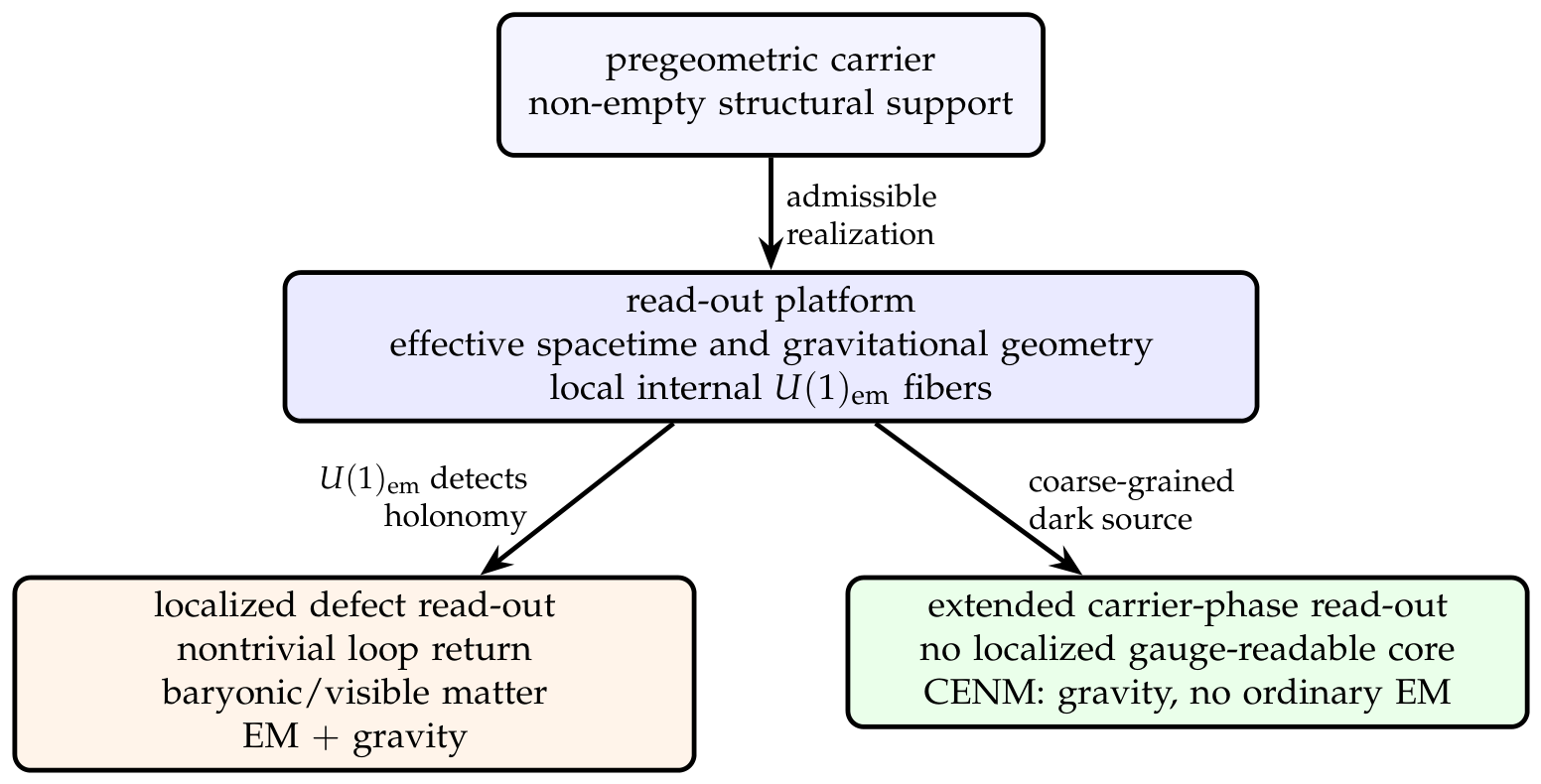
Figure 2.
Distribution of galaxy-level reduced chi-square values and global information-criterion comparison for the nested CENM and benchmark halo models.
Figure 2.
Distribution of galaxy-level reduced chi-square values and global information-criterion comparison for the nested CENM and benchmark halo models.
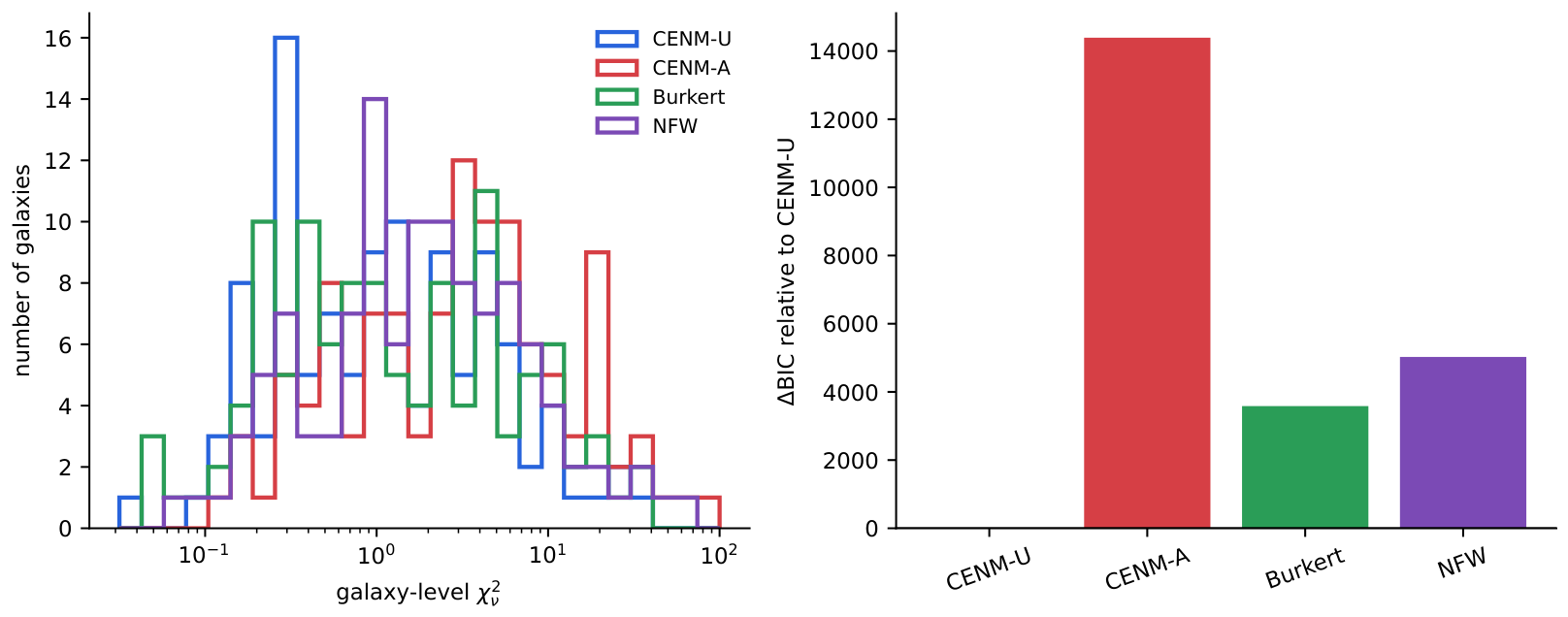
Figure 3.
Distribution of the galaxy-level CENM-U acceleration diagnostic. The vertical line and band show the shared acceleration and its profile interval from CENM-A.
Figure 3.
Distribution of the galaxy-level CENM-U acceleration diagnostic. The vertical line and band show the shared acceleration and its profile interval from CENM-A.
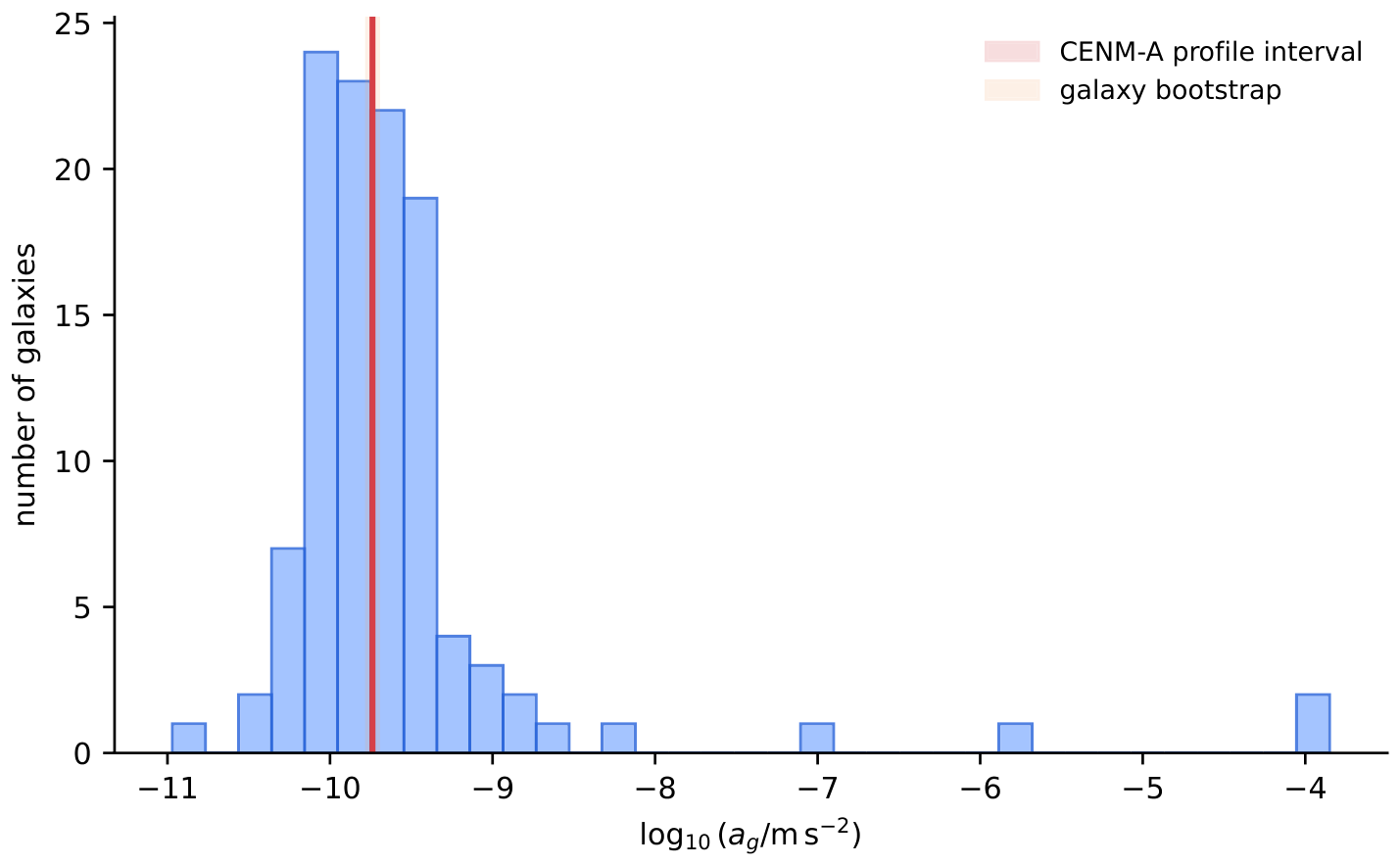
Figure 4.
CENM-A rotation curves for galaxies selected at fixed baryonic-mass quantiles before inspection of fit quality. The panels show the data, baryonic contribution, halo contribution, and total prediction.
Figure 4.
CENM-A rotation curves for galaxies selected at fixed baryonic-mass quantiles before inspection of fit quality. The panels show the data, baryonic contribution, halo contribution, and total prediction.
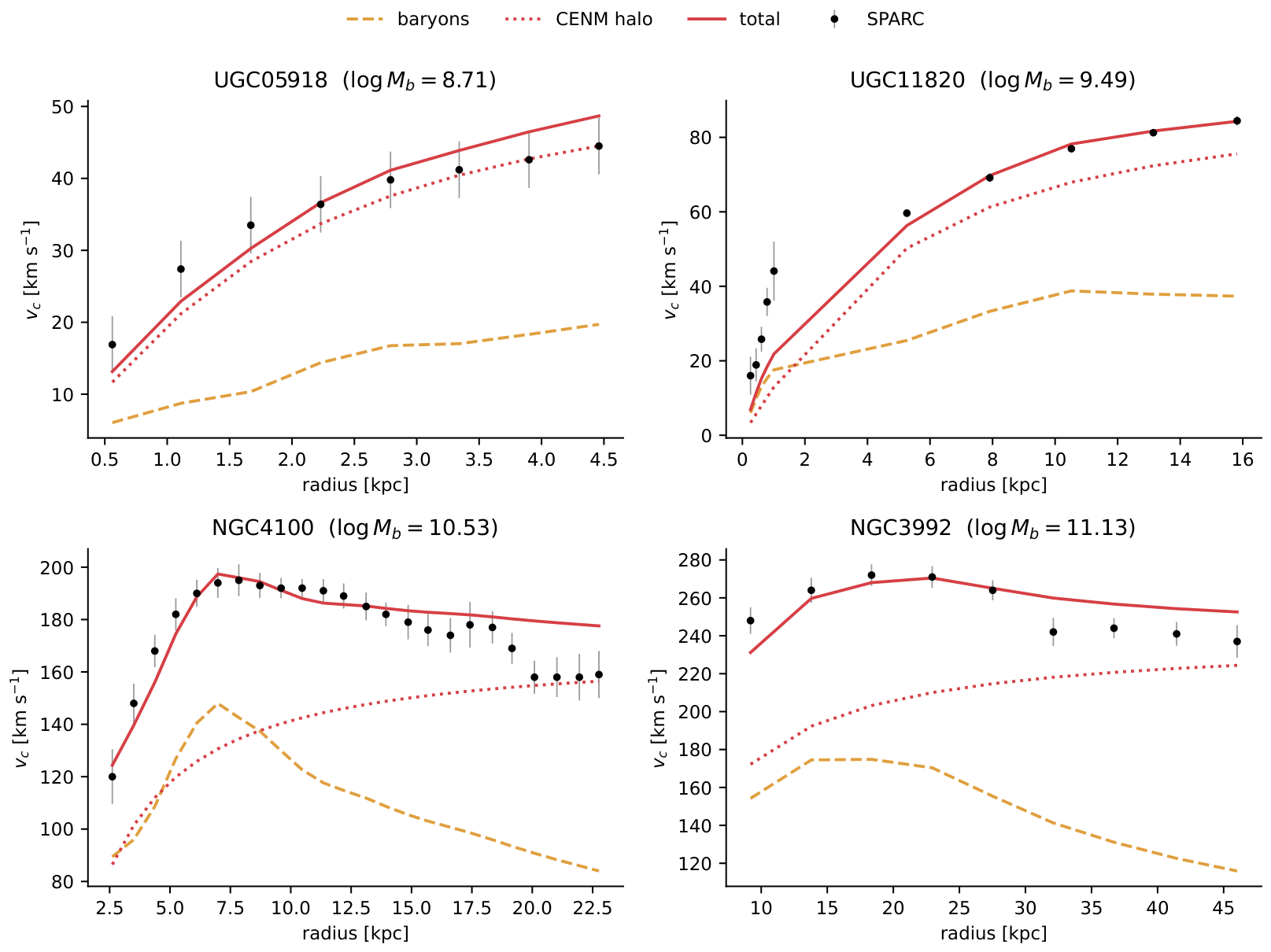
Figure 5.
Residual diagnostics for the constrained CENM-A model as functions of baryonic mass, effective surface brightness, gas fraction, and inclination.
Figure 5.
Residual diagnostics for the constrained CENM-A model as functions of baryonic mass, effective surface brightness, gas fraction, and inclination.
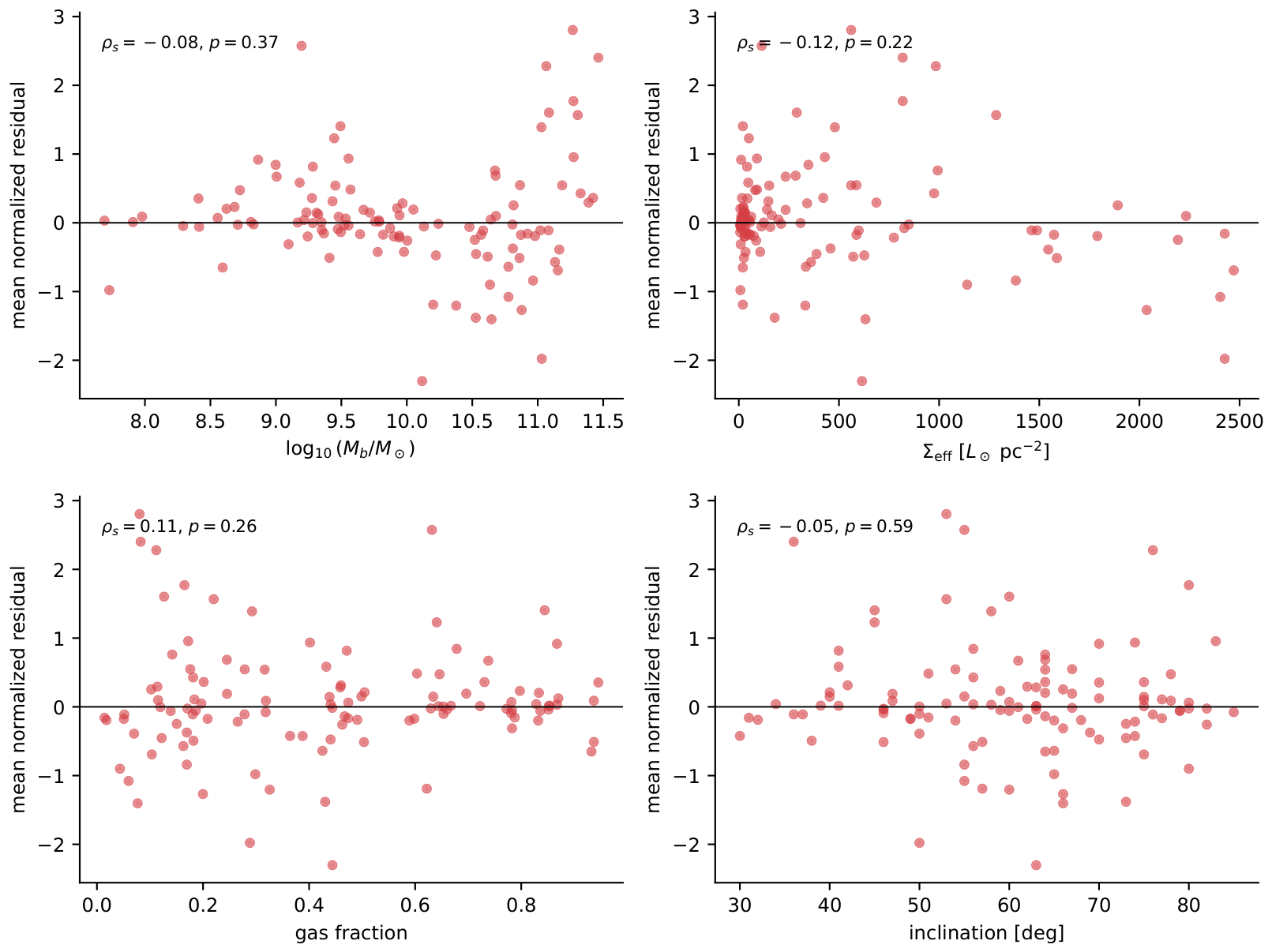

Table 1.
Global fit and information-criterion summary. The parameter count includes all galaxy-specific parameters and, for CENM-A, the one sample-wide acceleration.
Table 1.
Global fit and information-criterion summary. The parameter count includes all galaxy-specific parameters and, for CENM-A, the one sample-wide acceleration.
| Model | k | global | median | AICc | BIC | |
|---|---|---|---|---|---|---|
| CENM-U | 226 | 11485.5 | 4.71 | 1.058 | 11979.5 | 13268.2 |
| CENM-A | 114 | 26758.9 | 10.49 | 3.082 | 26997.2 | 27658.1 |
| Burkert | 226 | 15068.7 | 6.18 | 1.046 | 15562.8 | 16851.5 |
| NFW | 226 | 16511.9 | 6.77 | 1.893 | 17006.0 | 18294.7 |
Disclaimer/Publisher’s Note: The statements, opinions and data contained in all publications are solely those of the individual author(s) and contributor(s) and not of MDPI and/or the editor(s). MDPI and/or the editor(s) disclaim responsibility for any injury to people or property resulting from any ideas, methods, instructions or products referred to in the content. |
© 2026 by the authors. Licensee MDPI, Basel, Switzerland. This article is an open access article distributed under the terms and conditions of the Creative Commons Attribution (CC BY) license (http://creativecommons.org/licenses/by/4.0/).
Copyright: This open access article is published under a Creative Commons CC BY 4.0 license, which permit the free download, distribution, and reuse, provided that the author and preprint are cited in any reuse.