

Submitted:
19 August 2026
Posted:
20 August 2026
You are already at the latest version
Abstract
The fundamental laws of physics are generally time-reversible. In contrast, the second law of thermodynamics is time-irreversible with respect to macroscopic variables, establishing a link between the arrow of time, entropy growth, coarse-graining, and causality. These are all indispensable prerequisites for life, which is a macroscopic physical process that is necessarily time-irreversible, scale-irreducible, entropy-sensitive, and causally driven. We consider these questions within the axiomatic framework of causal set theory and formulate the law of conservation of causality in terms of fluid dynamics. Its corollary is the principle of causal equivalence, which states that there is no causally preferred scale of observation with respect to conservation laws. Nevertheless, scale still matters. A perfect observer like Laplace’s demon capable of tracking the behavior of matter with unlimited precision at the atomic scale might not detect any signs of life in the universe. Instead, we can agree that life, causality, and the second law of thermodynamics, with their time-irreversible processes, are manifested at macroscopic scales, but nothing of this sort, nor even the arrow of time, exists at the microscopic scales.
Keywords:
life
; matter
; scale transition
; causal chain
1. Introduction
Schrödinger (1944) is one of the most cited physicists in the biology literature, thanks to his book “What is Life?” In it, he defined life as a process that successfully resists the second law of thermodynamics. This law states that entropy, often viewed as a measure of disorder, increases with time, so that all physical systems, including the universe as a whole, inevitably move toward thermodynamic equilibrium or thermal death, where free energy is no longer available to do work. Indeed, although all living organisms strive to remain far from thermodynamic equilibrium due to homeostasis, they eventually die, while their bodies, which are nothing more than multiscale organization of matter, undergo complete disintegration into microscopic elements at the atomic level. Matter cannot be created or destroyed. Life can emerge from matter and then disintegrate, but it cannot violate conservation laws.
Schrödinger admitted that life could fight against entropy growth due to unknown laws of physics, the idea particularly maintained by another outstanding physicist Anderson (1972) who argued that the laws that drive the evolution of complex and, especially, biological systems in time and across spatial scales lie in broken symmetry. Broken symmetry refers here to the macroscopic dynamics of a system that has symmetries different from the symmetries of its underlying dynamics at a microscale. Symmetry is a key concept in physics. According to Noether’s theorem, symmetries can be related to the most fundamental laws of physics: conservation of energy as a result of symmetry with respect to translation in time, conservation of momentum, related to symmetry with respect to translation in space, angular momentum following from symmetry with respect to rotations, and so on.
The most famous manifestation of spatial broken symmetry in biology is chirality. Chirality of DNA, amino acids, and sugars does not follow from the known laws of physics. The DNA double helix in all living organisms on Earth is right-handed, whereas a left-handed form of DNA is rare and has very limited functionality, enabled by a structural difference between them (Stumpf, 2022). A more complicated example of temporal broken symmetry is presented by the central dogma of biology, which describes the flow of genetic information in living systems from DNA to RNA (transcription) and then to protein (translation) as an irreversible chain DNA → RNA → Protein. This states that once information (the precise sequence of amino acids) has passed into a protein, it cannot get out again in a way that dictates the sequence of a nucleic acid. Whatever ‘information’ means here, its flow in the chain must be causally carried out as a time-irreversible process. And this poses its own unsolved problem in molecular biology: Why cannot the information flow be transmitted in reverse, from protein to nucleic acid (Koonin, 2015).
The broken time-reversal symmetry means the emergence of the arrow of time, which is an indispensable condition for the evolution of life on Earth from simplest lifeforms to multicellularity on the phylogenetic tree. Causality is often said to play no role in physics (Rovelli, 2023). It is not surprising, given that the physical laws are mathematically formulated as time-reversible. Importantly, they are also formulated with no respect to a spatial scale. Conservation laws and laws of motion apply equally to atoms and planets. But in biology, both the arrow of time and large-scale complex organization of biological systems are intrinsically linked to the causal order in which they self-organize, interact with the environment, and affect each other in a way that is commonly referred to as ‘agency’.
My aim is to consider the relationship between causality, entropy gradient, and coarse-graining from the perspective of life. I outline the notion of “cause” and put it into the axiomatic framework of causal set theory (Sec. 2). After discussing the phenomenology of natural coarse-graining that is responsible for our observations of macroscopic physical systems and, eventually, their proper physical existence (Sec. 3), I consider scale separation within these physical systems and define the spatial span, encompassed by their dynamics (Sec. 4). Then I formulate the law of conservation of causality, which in fact follows trivially from the conservation of matter in fluid dynamics and is formally tantamount to the statement that the whole is quantitatively the sum of its parts regardless of how the whole is partitioned into parts. This law is then transformed into the principle of causal equivalence that states that there is no preferred scale of observation with respect to conservation laws (Sec. 5). Yet, we must discriminate between natural coarse-graining, which makes the universe observable, and its specific, more intricate forms of endogenous coarse-graining, which makes life possible in the universe (Sec. 6).
Finally, I discuss these issues from the perspective of atomistic reductionist in Sec. 7 and conclude that a perfect observer capable of tracking the behavior of matter at the atomic scale with unlimited precision would be unable to detect any signs of life in the universe. We humans do not share a single universe with atoms. Not only do physical phenomena of different length scales decouple, but the universe itself is partitioned into ‘parallel’ scale strata that exist simultaneously but causally independent of each other.
2. Causality
In the philosophical literature, it is sometimes suggested to differentiate between causation, defined as the production of one particular event by another, and causality, which is regarded as the law-like relation between causes and effects (Hulswit, 2002). This distinction is tied to Peirce’s view that cause and effect are facts within an epistemological context, while they are actual events within an ontological context. The word “causation” is widely accepted in biology, statistics, and philosophy, while “causality” is typically used in the realm of relativistic physics.
In this paper, I will use the word “causality” uniformly to mean the causal order of actual events as those unfold in spacetime from the dynamics of physical systems, governed by the laws of nature, regardless of our epistemic observations. In other words, I take the ontic view on physical events that occur on their own throughout the universe, the most part of which is beyond our observation and intervention. In this way, I follow the axioms of causal set theory in physics, based on the geometry of Lorentzian manifold or, more simply, on the light cone structure of Minkowski space (Bombelli et al., 1987).
First, we must be certain about what the cause and effect are. Until these concepts are precisely defined, any cause-like statements are possible, including those with zero scientific value, such as the claim that the Big Bang is the ultimate cause of our existence. Henceforth, the cause and effect are spatiotemporal events, associated with the instantaneous states of a dynamical system , composed of variables, at time and , for cause and effect, respectively. I denote their states as and . In practice, the lag depends on the temporal resolution, provided by observation. Clearly, the causal order would be undetectable and causality itself would evaporate for , i.e., in the absence of the arrow of time.
Definition 1.
An event is an instantaneous state of a dynamical system .
The “dynamical system” can be any physical body or system, such as an elementary particle, atom, molecule, living cell, organism, planet, galaxy, or the whole universe. Accordingly, an “event” corresponds to the states of each of them.
On the other hand, a cause cannot be someone’s action or behavior, a physical force or process, an environmental factor or an explanatory (epistemic) reason, unless those must be carefully reformulated in terms of the instantaneous states of physical systems. The approach to physical causality, accepted here, as opposed to Aristotelian explanatory causation and Pearlian predictive causality based on counterfactual reasoning, implies that causal analysis should not necessarily possess explanatory power for why something happened (e.g., in canonical examples of smoking ‘causing’ cancer, one’s belief ‘causing’ them to act, or monetary policy ‘causing’ inflation, all involving a semantic meaning of events). I also leave aside an interventionist account of causality (Woodward, 2003).
Instead, the ontic approach should provide a rigorous account of causality derived from physics, firstly from the principles of special relativity. The speed of light limits all causal relations as local. The direct corollaries of it are: (i) the cause must necessarily precede the effect, (ii) simultaneous events are mutually causally independent within a fixed (inertial) frame of reference, and (iii) linear causal chains of events must satisfy the Markov property. The linearity means preserving additivity and homogeneity as defined on a vector space via a linear map , where the link between two events is a vector symbolizing their immediate cause-effect relation.
A causal set is defined as a partially ordered set , where is an ordering relation that represents the local link between two points in spacetime and corresponds to a timelike or lightlike interval between two points in Minkowski space (Rideout and Sorkin, 1999):
Definition 2.
A causal set
is a discrete set of spacetime points that satisfies the following conditions:
Irreflexivity: For all points, ;
Transitivity: For all , ;
Connectedness: For all , there is
Here, irreflexivity forbids closed causal loops, meaning that no event can be a cause of itself; transitivity provides the consistent causal order; and connectedness means that any two events in can in principle be connected by a linear causal chain of finite length. While events represent the instantaneous states of a physical system , linear chains correspond to the time evolution of the system.
In this way, linear causal chains are responsible for transporting matter in spacetime and can be formally related to measurable quantities such as mass, energy, and momentum in physics. For example, a particular causal chain between two events and can be associated with the action functional, which is defined as the integral of the Lagrangian along the path of a system evolving from the initial state to the final state. Considering causality in Lagrangian formalism is beyond the scope of this paper, given also that this formalism is hardly applicable to living systems, with moderate success in population dynamics (Pham and Musielak, 2023; Paliathanasis and Duffy, 2025).
The ontic approach to causality encourages us to study the universe not as a world of things but as a spacetime full of lightlike points (events). What are the things around us, e.g., a stone on a hill, a teacup on our table, or ourselves? We know that they all consist of atoms. How do these things physically appear to us? Suppose a teacup falls off the table and breaks into pieces. The teacup no longer exists, as its causal history ends at that time, but its parts continue to exist with their own causal histories. In terms of the causal set , a linear chain of macroevents of a , associated with a teacup, splits into many linear chains of microevents, associated with its pieces, which, in principle, might themselves be decomposed into a set of linear causal chains at the atomic scale. The obvious conclusion here is that every macroevent consists of a set of simultaneous microevents at a smaller scale and is itself a part of a larger event, and so on across all the scales we can distinguish in theory. Henceforth, we must discriminate between macroevents and microevents, each woven into their own linear causal chains.
Causal chains come in two types: one-body and multi-body. The one-body chain corresponds to the trajectory of an object in ordinary (Euclidean) space, and is best described by its worldline in Minkowski space. The multi-body chain is less familiar, as it reflects the path of an impact transmitted through many neighboring objects. For example, the behavior of a classical pendulum is a one-body causal chain, while the behavior of Newton’s cradle represents a multi-body chain. A well-known example of a one-body causal chain is the Markov chain, which probabilistically describes the time evolution of a system where the system’s future state depends only on its present state. Consider a stone freely falling in empty space. Its trajectory can be an example of one-body linear causal chain. Now consider a stone rolling down a hill. The force, moving the stone is the same – gravity, but the Markov property cannot be preserved because of multiple collisions between the stone and the hill. The stone’s future state at time is determined by both the stone’s present state and the state of the hill’s landscape at time . This is an example of a multi-body chain. More generally, all physical interactions between different bodies generate multi-body chains.
Now suppose a system is more or less isolated from the environment, such as a gas in a container (Figure 1a).
The time evolution of this system is a one-body causal chain of macroevents , i.e., the system’s states properly (Figure 1b). What about the particles of a gas that are in the Brownian motion? Although their dynamics can be viewed similarly as one-body causal chains of microevents , associated with the corresponding states of particles , these chains are intertwined with each other as they converge and diverge after each collision. The macroevent observed at time is produced by the union of all simultaneous microevents of the particles at that time.
While a one-body chain represents the time evolution of a single macroevent, each multi-body chain connects many microevents, and they all collectively determine this one-body chain of the macroevents (Figure 1c).
3. Natural Coarse-Graining
We derive the notion of causality from observations of microevents and macroevents occurring in things around us. What guarantees that we are not ‘hallucinating’ their existence and that our observations are objective and physically valid? Nature itself organizes matter into physical bodies and systems of growing size whose instantaneous states we can observe as events across spatial scales. Accordingly, we do not think of these macroscopic bodies and systems as piles of atoms but consider them to exist in their own right.
In physics and biology, coarse-graining is associated with computational modeling of macroscopic systems by reducing the microscopic degrees of freedom to a few effective ones. Generally, coarse-graining is the way of obtaining macroscopic state variables that describe the behavior of such systems well enough, despite the loss of information about microscopic variables the dynamics of which, however, are often computationally prohibitive (Schilling, 2022; Moran and Tikhonov, 2022; Guenza, 2025). Obviously, we might not make sense of coarse-graining at all if the macroscopic systems themselves were phenomenologically unobservable. Thus, the existence of these macroscopic systems must precede any sort of modeling.
Let us call this phenomenon natural coarse-graining which is manifested in the formation of all physical bodies in the universe, from molecules to planets and galaxies which existence is evidently observer-independent. In other words, natural coarse-graining is a fundamental property of matter to generate macroscopic systems with aggregative physical quantities such as mass, energy, and momentum, or average thermodynamic measures like temperature, pressure, and entropy that we can measure and calculate. For instance, Newtonian laws of motion, discovered long before the creation of atomic theory, demonstrate that causal chains of macroevents are consistent and precise in describing the dynamics of massive systems at the planetary scale without knowing anything about causal chains of microevents at the atomic scale. Moreover, even atoms themselves can already be defined as naturally coarse-grained systems composed of elementary particles.
The quantum world is notoriously exotic for its wave-particle duality, superposition, entanglement, and the uncertainty principle. The Schrödinger equation describes the unitary time evolution of a quantum system in a perfectly deterministic way. A random collapse of the wave function is induced by a measurement allowing to observe a particular event as the state of the quantum system at time . This is known as the measurement problem, which puts a sharp boundary between the quantum world and the classical world. von Neuman speculated that the boundary is induced by a conscious observer whenever they will make a measurement at their will. This idea was later generalized by Wheeler (2018) as the participatory anthropic principle “Observers are necessary to bring the universe into existence”. But what would the universe be like before the first observers had biologically evolved there? And what would these observers themselves be physically?
This principle is especially implausible in the context of natural coarse-graining. Obviously, no observers might appear before molecules they consist of, and ecosystems they live in. The existence of these and other naturally coarse-grained systems in the universe is apparently independent of our observations. Instead, quantum Darwinism is based on the conjecture that spontaneous decoherence of a quantum system to a definite state (event) is produced by the macroscopic environment that plays the phenomenological role of an observer (Zeh, 1070; Zurek, 2018). The environment provides the lowest boundary between the quantum world and the appearance of classical objects, whose instantaneous states we can observe as micro- and macro-events across various scale strata. Among these classical objects, atoms represent the smallest naturally coarse-grained systems made of vibrant quantum fields.
Now suppose a macroscopic system occupies some region in Minkowski space and moves in it during an interval . We ‘compress’ the region by spacelike slices , yielding macroevents , where the states of variables are the simultaneous and mutually causally independent microevents at each slice (Figure 1c). When combined with the compression of by the timelike worldlines of the variables, these turn all one-body linear chains of the microevents into a pair of two macroevents and , associated with and , respectively. The ‘compression’ provides a natural coarse-graining in the sense that no microevent is missed or doubled. In other words, this coarse-graining is warranted against both under- and over-determination of the system. Here, a dynamical system is underdetermined if , and overdetermined if .
This raises an interesting question. How do two distant (spacelike separated) atoms within a macroscopic system simultaneously contribute to its collective quantities such as mass, energy, and momentum? Their collective contribution should be nonlocal despite the principle of locality that forbids any action at a distance exceeding the speed of light. The problem of nonlocality evaporates if we realize that the system and the atoms it is made of belong to different scales and cannot causally interact with each other. The contribution of the atoms to the system’s mass, energy, temperature, and so on (in fact, to its very existence) is phenomenologically nonlocal but physically not causal. We cannot deny the phenomenological aspect of nonlocal contributions unless we have to conclude that macroscopic systems themselves, at least, those large enough to make their distant parts spacelike separated, are hallucinations.
Nonetheless, two distant parts within such a macroscopic system can still be causally connected through a multi-body linear chain of finite length, unfolding in time. It is shown in (Yurchenko, 2026), that there can always be possible a minimal linear multi-body chain that causally connects any two variables and within , where all immediate links between connected variables are local. In principle, a local multi-body chain can be physically possible even between two distant atoms in the universe, which phenomenologically exists with all its parts simultaneously. In contrast, such a chain would theoretically be very long and take billions of years for its unfolding in space.
4. Separation of Scales
We believe that the universe exists as the largest naturally coarse-grained system, regardless of a reference frame and at all spatial scales simultaneously, where atoms, molecules, stones, organisms, planets, and galaxies coexist. In everyday life, we are surrounded by a variety of things of different sizes, from street buildings to a grain of sand. We can distinguish these things from the larger-scale environment, see their parts, and know that the invisible parts of these things also exist. How do these scales relate to one another? Reductionism is commonly accepted in physics and based on the belief that there is only one universe, and microscopic interactions determine everything (all events) that can occur there. But how does the universe exist exactly? Is it composed of galaxies, atoms, or something else? Contrary to our belief, these naturally coarse-grained systems cannot phenomenologically coexist simultaneously, as this would multiply the amount of matter, mass, and energy in the universe. So, the atomic world consists only of atoms, while in the galactic world there are no atoms.
Suppose someone, say Alice, wants to buy a home appliance. Alice heard that the appliance is good, but some of its parts often break, so she tells the seller that she wants “an appliance with all the parts working”. Alice is surprised to learn that the price has doubled. She is told that her order will include two appliances, one of which needs to be disassembled. The whole and its parts cost twice as much. Now, recall the story of the teacup that shattered when it fell off the table onto the floor. The teacup has definite measurable and calculable physical quantities. In particular, its mass is the ‘simultaneous sum’ of the masses of the atoms that make up the teacup. If we were to gather the pieces of the broken teacup and weigh them, their mass would remain roughly the same. We believe that having the whole means also having all its parts. However, at any time we can have either the teacup or its pieces, but never both simultaneously. Having both – the whole and its parts – would be a miracle, violating conservation laws.
Phenomenologically, the universe is like a multiscale graph. A multiscale graph is a hierarchical network, where nodes , , form its elementary basis at the zero level , . A cluster , , contain a number of nodes connected by edges , . Each upper level consists of nodes that are clusters of the previous level . Here, nodes are microevents, edges are causal links between them, clusters correspond to macroevents, and levels represent scales of their phenomenological existence. Theoretically, the lowest level of nodes can represent all elementary particles the universe consists of. In , the universe is divided into levels, and each level represents a scale stratum , consisting of the clusters of characteristic size , where means the cardinality of a cluster.
Another way to define the stratum is to compare it to the notion of a covering in set theory and topology. The covering of a set X is a collection of the subsets S∗that satisfies two conditions:
- (i)
- (ii)
-
In this representation, a particular stratum corresponds to a covering of subsets of an equal size . Now we can define the universe phenomenologically:
Definition 3.
The universe is a multitude of strata
indexed by a countable set
over the elementary basis
.
The strata correspond to various phenomenological worlds of atoms, molecules, viruses, cells, stones, animals, planets, galaxies, which existence depends on the average amount of matter (mass) in these entities as represented by the scale of their physical formation. These phenomenological worlds all emerge from the quantum world as the elementary basis of the universe. We must relax the condition (ii) to since some can be incomplete coverings of . On the other hand, for every physical system , there always exists a larger system , and the instantaneous states of both systems can be observed as events at their strata.
Importantly, the expansion of the universe into is nonadditive, since each stratum can either contain the full amount or some fraction of universe’s matter, which is also present in other strata. The strata are different in how matter is naturally coarse-grained into physical bodies and systems across scales. Conservation laws apply to them within each stratum independently but never across strata. Local interactions, as described by linear multi-body causal chains in the causal set , are only possible within each stratum, not between them.
Now we want to learn how multi-body linear chains unfold in spacetime within each stratum of . For a dynamical system , its spatial span is defined by the number of strata, causally encompassed by it, beginning with its zero stratum for its own elementary basis chosen by an observer (Yurchenko, 2026):
where is the average causal scope of variables .
The causal scope must be equal to or greater than , since will describe a multiscale system simply as a one-body causal chain. Accordingly, is meaningless for any . Now if we represent the dynamical system as a graph ), the is similar but not identical to the average degree of nodes in the graph. The degree of a node is defined as the total number of edges, directly connecting the node with other nodes that are possible in . Instead, the causal scope of a variable determines how much variables (nodes) the can affect simultaneously to form clusters of characteristic size. Hence, . The value of depends on the type of a system and can be obtained numerically or experimentally under perturbations of the system, e.g., for the human brain, which elementary basis is assigned to separate neurons, (Kwan and Dan, 2012), while for a starling flock, with consisting of individual birds, (Cavagna et al., 2010).
To make sense of it, consider a graph with six nodes connected specifically by edges as shown in Figure 2a. Assume all nodes are of equal scale. The edges between them represent immediate causal links that may or may not be active at a given time. We see that the average causal scope of a node in this network is . Its spatial span by Eq. (3) is . Here, the level 1 represents the zero stratum containing only separate nodes as its elementary basis at the highest level of resolution, provided by observation. Generally, this elementary basis is not fixed but can correspond to any scale, depending on a system of interest. In any case, their dynamics conventionally correspond to microevents under a given observation, while the level 3 corresponds to the stratum in which is coarse-grained as a single node for macroevents.
We want to find the level 2, dividing the graph into a full set of characteristic sums of events per stratum to learn the multiscale causal organization of the graph. Theoretically, the additive sum can be chosen differently in a space of possible decompositions (excluding one for separate nodes in the elementary basis for the sum of units). According to the scheme shown in Figure 2b, the ‘right’ sum is the only one, when the graph is coarse-grained as . All other combinations of coarse-graining are arbitrary, such as or .
The particular causal diagrams of multi-body linear chains of microevents at the stratum unfolds with time in through local links according to how the nodes are connected and can interact at a given time . Their dynamics are then coarse-grained by the diagrams of multi-body linear chains of mesoevents at the stratum . Ultimately, the time evolution of the graph as a whole is represented by a one-body linear chain of macroevents at the stratum in Figure 2c.
5. Conservation of Causality
As stated, conservation laws apply to physical, naturally coarse-grained systems only within each stratum. The conservation of causality follows immediately from the conservation of matter. Saying that matter cannot be created or destroyed implies that events, representing states of matter, cannot arise and vanish without trace. This can be considered in the context of the continuity equation for incompressible flow in fluid dynamics (Yurchenko, 2026):
Here, is a flux of a quantity , is the divergence operator, is the flow density, and is the flow velocity vector. Informally, Eq. (4) implies that the control volume of flow remains constant in time. Integrating the continuity equation over a control volume leads to the conservation of the quantity , . The incompressibility is necessary to warrant that when one partition the space occupying by the quantity into equal parts per unit volume , it provides a uniform partition of the quantity as well. However, there is no point in saying that the flow of causality is incompressible. Conceptually, natural coarse-graining can be viewed as a result of compressing all simultaneous microevents within a control volume into a macroevent occupying this volume (Yurchenko, 2023).
In causal analysis, natural coarse-graining takes on the phenomenological aspect of an integrating, which is concerned with the instantaneous states of matter (events) and not with the metric space occupied by it. Given the spatial span of a system , there can be found a full set of characteristic sums of simultaneous events per stratum by the causal scope to learn the multiscale causal organization of the system.
For simplicity, let us consider a dynamical system as a graph with two levels, the lower level for variables as representing its elementary basis, and the upper level for the system as a whole, ignoring all intermediate levels. The state at time is a macroevent at the stratum , which, by Eq. (1), is the union of all simultaneous (causally independent) microevents at the stratum , each associated with a corresponding state of the variable at that time. Here, all simultaneous microevents (a vertical column in Figure 1) represent the flow density, i.e., the number of causally independent microevents at the stratum , whereas each chain of causally connected microevents (a horizontal row) conforms to the flow velocity vector, i.e., the number of microevents per unit time in the one-body linear causal chains.
The simultaneous conservation of causality across scale strata is provided by the conservation of matter in its measurable values such as mass:
Now, suppose there is a linear causal chain of such microevents per unite time . The flow of causality in time is determined by the causal order which is preserved as a link between two macroevents at the stratum by reducing the temporal resolution of observation to the lag due to by the axiom of transitivity in the causal set . Therefore, the transitions across the spatial span of a system does not change the flow of causality in it.
It might be argued that a system should still be closed to preserve the same amount of matter (mass) over time. However, we most interested not in the conservation of causality over time but how its flow is simultaneously conserved across scale strata within its spatial span. Therefore, if the system as a whole loses some quantity of matter at time , the loss simultaneously occurs at the lower level, e.g., associated with some variable as if were transformed into a smaller system . It is the scale strata that are physically and causally closed within the system’s spatial span, but not necessarily the system itself, which should be closed from the environment for some time.
This may raise the question about the identity of a system over time, which is of interest for philosophical discussions rather than for causal analysis. For example, if a system loses a part, is it still the same system? Or, if a system is completely decomposed, can these parts still be regarded as its parts given that the system no longer exists? Such transformations are indeed abundant in chemical reactions, where substances separate or form entirely new compounds. In this case, the conservation of matter over time is implicit in the law of mass action in kinetic form, indicating that for macroscopic chemical reactions in equilibrium, the ratios between the concentrations of reactants and products remain constant over time. Such transformations are described by the differential equations of mass-action kinetics by representing a system as a graph :
where is stoichiometric coefficients, is a flux that depends on the species concentration and a reaction rate (Okada and Mochizuki, 2016).
In other words, it is possible to find a larger system , for which the total amount of matter – and, hence, causality – stays the same across its spatial span and over time. For causal analysis, as stated, the most important is that at any given time , the flow of causality within a system at the macroscale is equal to its flow at the microscale.
The law of conservation of causality. The flow of causality in a dynamical system in conserved across its spatial spanat any given time.
This law can be regarded as trivial. The conservation of causality amounts to the statement that a whole (presented by some physical quantity ) is quantitatively the sum of its parts regardless of how the whole is partitioned into parts. According to Definitions 1 and 2, causes are events, associated with instantaneous states of a physical system and its components, up and down across scale strata, whose dynamics go on their own by the laws of physics, regardless of whether or not these states can be observed. Here, causality is defined an intrinsic property of matter as if viewed from the perspective of a perfect observer which does not need the probabilistic account of causality. Its predictive and explanatory aspects are a matter of our imperfect observations and the tasks we want to decide.
The scale-invariance of the flow of causality allows us to formulate the principle of causal equivalence by analogy with the principle of relativity in SR, which states that all inertial frames of reference are equivalent with respect to the laws of motion and electrodynamics.
The principle of causal equivalence. All spatial scale strata are causally equivalent with respect to conservation laws.
The principle of causal equivalence aligns with scientific realism, namely, with the statement that the existence and behavior of physical systems from an atom to the entire universe is independent of observation. In effect, this principle asserts that the choice of a scale of observation at any time time does not affect the flow of causality in a system, which remains conserved simultaneously across all scale strata within its spatial span. All scale strata are causally closed, each providing a total amount of the flow of causality in physical systems. A new cause, without its own past, cannot appear out of nowhere to intervene in linear causal chains with their own past.
Now we can analyze the concept of top-down causality in the framework of the graph associated with a dynamical system in Figure 2a. Assuming top-down causality would mean that the whole and its parts can phenomenologically coexist, thereby doubling the amount of matter (its mass or other measurable quantity ) in the system as if all its variables (as a whole) could simultaneously affect any one of them (as a part), forming a clique of totally interconnected nodes. Their causal scope would be . According to Eq. (3), the spatial span of such a system would be , having variables at the zero stratum (level 1), and the system as a whole at the stratum (level 2).
In principle, could represent the entire universe as a clique of totally interconnected elementary particles, with . In this case, all particles could directly interact with each other through immediate superluminal causal links in . Physically, such a universe would be nonlocal and violating conservation laws. Accordingly, its causal span would comprise only two scale strata: the one for the quantum world , and the other for the universe as a whole, with no intermediate strata for existence of atoms, molecules, stones, organisms, planets, and galaxies. Such a universe would be phenomenologically empty, and no observers might exist there. Thus, our universe must necessarily be a nonadditive union of scale strata for the multitude of phenomenological worlds where macroscopic (naturally coarse-grained) systems are physically possible, while top-down causality is forbidden in .
6. Endogenous Coarse-Graining
Biological systems are complex multiscale systems. When analyzing and modeling them, we should distinguish between, at least, three forms of coarse-graining: (i) natural coarse-graining, (ii) arbitrary (artificial) coarse-graining, and (iii) endogenous coarse-graining, internally generated by the causal organization of complex systems across scales. The first form makes the parts a single whole and is manifested in the formation of all macroscopic physical systems, from atoms to galaxies to the entire universe. The second is imposed by the observer when modeling the system dynamics via a choice of variables. Finally, endogenous coarse-graining is a specific form of the natural coarse-graining that is inherent to all biological systems, conditioned on their hierarchical functional organization across scales.
Natural coarse-graining provides an approximation for homogenous physical systems but fails shortly in describing biological systems, which complexity grows exponentially with the scale: from chemical compounds to proteins and DNA, from nuclei and organelles to cells, from cells to tissues and organs, and so up to the whole organism (Figure 3).
Man-made machines can be viewed as another class of endogenously coarse-grained systems. This is not surprising, given that the machines are designed to implement more or less complex functions only due to their multiscale organization. To do it, they must consist of functional units, arranged consistently and transmitting matter and energy through causal multi-body chains by means of various mechanical links, pipes, and communication channels. For example, a clock, a car, or a computer consist of many specific parts, which themselves can be regarded as endogenous coarse-grained systems composed of their own parts at a smaller scale, and so on down to atoms. Overall, natural coarse-graining ensures that, for example, the mass of a clock is the total of the masses of its constituents at every spatial scale, whereas endogenous coarse-graining provides the functionality of the clock. There may also be arbitrary coarse-graining, imposed on a system by modular modeling or by dividing the system into spatially equal parts per unit volume. Metaphorically, shattering a clock into random pieces – akin to a broken teacup – serves as an example of arbitrary coarse-graining.
The main difficulty in studying biological systems is to select the right variables at a given scale of observation. However, even if such variables are identified, this may explain how they behave but not why they do it, as their behavior depends on their internal organization at a smaller scale. For example, if we associate a dynamical system with a graph , then we can learn how a variable is causally connected with its neighbors via edges. Still, its causal response every time is determined by its own internal causal organization at a smaller scale, that is, by the network of the hidden sub-variables of the variable .
The most important point here is that the endogenous coarse-graining of a system at each scale stratum determines its specific causal structure at that stratum, which enables the system’s functions across its spatial span . At each stratum, it is solely the causal structure that determines how a system will work and whether it will work at all. For example, it is not sufficient to know the molecular components of a cell to synthesize a living copy of it. If there is no unknown (non-physical) force in a cell that makes it alive, and living systems other than carbon-based are possible, then the “code of life” we need to learn is hidden in the multiscale causal organization of matter like that in a clock or computer (albeit much more intricate). This causal structure is unique at each scale stratum, and this uniqueness is irreducible to a smaller one.
It is generally accepted in statistical mechanics that the numerous degrees of freedom at a microscale of homogenous physical systems average out to several effective degrees of freedom at larger scales, which is the key idea of the renormalization group formalism. This property is also applicable to heterogenous biological systems. So, two particular multi-body chains in Figure 2c are indiscernible at a larger scale, where both are averaged by the same one-body chain of macroevents. In living systems, their dynamics at the organismal level become naturally coarse-grained and causally renormalized to a macroscopic one-body linear (Markov) chain. However, such a chain of macroevents contextually corresponds to what biologists refer to as ‘agency’ when describing a wide range of different dynamics from bacterial chemotaxis to human behavior. Although such a Markov chain can be used to describe the organism’s behavior (and even scaled up to a population level), this does not explain how its future state is processed from its previous state within the organism’s spatial span and in time. The most intriguing question here is how we humans can choose one action, i.e., our future state (macroevent), over another.
As stated, natural coarse-graining and separation of scales are necessary conditions for the universe to be observable as the multitude of phenomenological worlds (i.e., be more than the underlying quantum world ), whereas endogenous coarse-graining allows observers to exist in the universe. Without the former, living organisms might not learn and adapt by obtaining information about how causality works at relevant scales before discovering quantum physics; without the latter, they could not evolve from inanimate (homogenous) matter at all. The main conclusion here is that the endogenous coarse-graining of living systems cannot be obtained from its natural form to be reducible to a microscopic scale.
The gap between physics and biology, discussed by biologists (e.g., Mayr, 2009; Kauffman, 2019; Succi, 2022) stems eventually from this distinction between two forms of coarse-graining. Unlike an optimistic view that a unified theory is possible (Bialek, 2018), Anderson’s main message is that sciences would be divided into a hierarchy according to the scale of their validity, each existing in its own right and not reducible to a lower one.
The main fallacy in this kind of thinking is that the reductionist hypothesis does not by any means imply a “constructionist” one: The ability to reduce everything to simple fundamental laws does not imply the ability to start from those laws and reconstruct the universe. In fact, the more the elementary particle physicists tell us about the nature of the fundamental laws, the less relevance they seem to have to the very real problems of the rest of science, much less to those of society. The constructionist hypothesis breaks down when confronted with the twin difficulties of scale and complexity (Anderson, 1972).
Physical laws have historically been developed to study the quantitative aspects of matter’s behavior, and causality indeed cannot add anything to these fundamental laws (Rovelli, 2023). On the other hand, the locality principle, which is fundamental in physics, implies a causal ordering of events as is explicitly presented in the structure of the lightcone in Minkowski space. So, causality itself may be regarded as a fundamental notion that has been trivialized in physics (D’Ariano, 2018). More importantly, these quantitative physical laws do not reflect the qualitative distinctions in matter’s macroscopic organization. Meanwhile, if there is no vital or mental force hidden in the mystery of life, then it is precisely the multiscale causal organization that transforms inanimate matter into living organisms. This qualitative aspect creates a gap between time-reversible atomistic determinism and the time-directed behavior of organisms driven by agency.
Accordingly, reductionism can be viewed as the requirement that the flow of causality at one scale of description must be consistent with the flow of causality at any other scale of description with respect to the lowest scale of analysis. This lowest scale of analysis should be related to the Planck scale. From this perspective, chemical systems are simply time-dependent multiparticle quantum systems, completely described by the fundamental principles of quantum field theory, however, with little relevance to the questions of interest to a chemist (Andersen et al., 2017). As the scale and level of complexity increase, the quantum-mechanical descriptions are abandoned in biology, excepting their auxiliary role in physiological processes such as photosynthesis, olfaction, and magnetodetection (Brookes, 2017). Overall, it would be impossible to explain biological phenomena even as simple as bacterial chemotaxis from the perspective of quantum systems. This is more than a trade-off between reasonable simplicity and the scope of detail we are interested in.
Despite the variety of different measures and algorithms, proposed in network science, causal (predictive) modeling, and machine data mining to compute characteristic properties, hidden patterns, and correlations from the behavior of complex systems, it is often noted that the endogenous units of their dynamics may significantly differ from the exogenous units of analysis imposed by a model. In other words, there likely cannot be an algorithm that effectively uncovers the multiscale causal organization of complex systems from microscopic data, especially in biological systems, given their irreducible complexity.
7. Discussion
7.1. Life
I would like to begin with Conway’s Game of Life. The game is a two-dimensional cellular automaton that evolves according to a simple set of rules over the states of cells that can be either ‘dead’ or ‘alive’, depending on certain conditions. To biologize the game, I will use it as a metaphor for the Miller-Urey experiment in a closed, sterile glass system demonstrating the spontaneous synthesis of organic compounds from inorganic constituents in an origin of life scenario. Suppose there is a display with cells that can be either black or white. Let us associate the black cells with the atoms, known as building elements of life on Earth such as C, H, N, O, P, S, and the white cells with the space occupied by neutral medium such as water. Unlike the game of life, their states are unchangeable, so the numbers of black and white cells are constant as and , respectively. It is enough for them to swap places and stick together via molecular bonds due to the Brownian motion and chemical reactions.
We can think of the display as a closed container in which the amount of active matter and, hence, flow of causality are conserved across scales and over time. The game starts with a fine-grained grey display, where black cells are uniformly distributed in the medium. As time passes, the cells become more and more lumped into arbitrary black islands on the display, as if they were endogenously coarse-grained. These islands grow in size and take on various shapes until a black swan spontaneously emerges on the white background (Figure 4a). Note that we do not ask how and why this highly improbable event is physically possible. We accept the appearance of the black swan as a fact.
In statistical mechanics, Liouville’s theorem states that the volume of a conservative system in a phase space does not change with time, (Figure 4b). An immediate consequence of this is that the entropy of the system, defined as the logarithm of the volume , remains constant, . Information is conserver for a perfect observer capable of tracking the dynamics of a system at every point of phase space with infinite precision. Now let us associate the volume with the number of black cells on the display in Figure 4a. Since is unchangeable in both time directions, so entropy, if taken as an informational measure of ignorance, is (it would be more accurate to associate the black cells with their total mass in a closed container by writing ). On the other hand, as the system becomes apparently more ordered with time, entropy as a thermodynamic measure of disorder gradually decreases from left to right over these five phases of endogenous coarse-graining in Figure 4a. In the view of biology, they symbolize the origin and evolution of life from a prebiotic soup to first cells to large-scale multicellular organisms.
This metaphor is a prelude to my main question. We are born once, we live in pursuing our own goals, and inevitably die by disintegrating the whole (organism) into its parts. But none of these events occur at the atomic scale. Is life a subjective illusion, existing only from its own macroscopic perspective?
The difference between microscopic and macroscopic observations results in a reduction in the scope of details, so that coarse-graining is typically associated with information loss (Cerino et al., 2016; Shalizi and Moore, 2025). This relationship is intuitively derived from the distinction between a map and a territory. For example, if we look at a city from a bird’s-eye view, we see only the silhouettes of city blocks and the lines of roads between them. This is a map. As we decrease our viewing altitude, we begin to discern individual buildings and adjacent streets with moving people. Eventually, we can monitor every person in a crowd on the streets. Thus, we can gain more detailed information about the microscopic parts of the city when exploring its territory. On the other hand, by narrowing our field of view to microscopic details, we also lose all information about the macroscopic properties of the city as a whole. We can no longer know exactly what kind of city it is.
This is why the second law of thermodynamics is sometimes viewed not as a fundamental law, but as an “anthropomorphic” principle reflecting a purely subjective quantification of one’s lack of knowledge about a system’s state at the atomic scale (Jaynes, 1983; McGlynn, 2026). This ambiguity stems from the distinction between two concepts of entropy in science: the one as Boltzmann’s ontic measure of disorder in the macroscopic state of matter, and the other as Gibbs-Shannon’s epistemic measure of uncertainty in the state of one’s knowledge about the microscopic state of matter. So, in the context of Liouville’s theorem, there is no information loss or gain for a perfect observer capable of tracking the dynamics of a system at the microscopic scale (Figure 4a).
However, for an imperfect observer, endogenous coarse-graining can provide a gain in macroscopically encoded information albeit in the expense of information loss at the microscopic scale. Since all crucial features of life, such as self-organization, homeostasis, agency, goal-directedness, and free will, are macroscopic properties of living systems enabled by the multiscale causal organization of matter, we come to one striking conclusion.
If a hypothetical observer were able, like Laplace’s demon, to observe all microevents in the universe in the highest spatiotemporal resolution and with unlimited precision at the atomic scale, whose preferred perspective is thought to be the ultimate source of knowledge in physics, then this perfect observer might not detect any signs of life in the universe. Only imperfect observers like us, who are themselves endogenously coarse-grained systems, can ‘see’ life.
This paradox also suggests a new perspective on the anthropomorphic nature of entropy advocated by Jaynes (1983). His main argument is that the very concept of a ‘thermodynamic system’ is not physical. Many different thermodynamic systems can be defined for the same physical system. Jaynes argues that in the search for the ultimate ‘true’ entropy of such a physical system , completely determined by the microscopic degrees of freedom of the variables , an observer should have unlimited access to information at the atomic scale to reach the point where they might monitor the position and momentum of each atom independently. But just at that point the notion of entropy collapses for this perfect observer, and the second law of thermodynamics loses its validity in accordance with Liouville’s theorem.
Jaynes’ line of reasoning seems to completely ignore the macroscopic manifestations of the second law that occur abundantly around us from the melting of an ice cube in a glass of water to the organic decay of living systems. While his perfect observer would know everything about the physical (microscopic) properties of a system, they could no longer know anything about its thermodynamic (macroscopic) properties, as illustrated by the distinction between a map and a territory.
For example, Wolfram (2024) also delineates the objective and subjective sides of entropy but makes it more explicit. In his analysis, this distinction arises from the interplay between the computational irreducibility of macroscopic patterns of complexity in matter’s behavior to microscopic degrees of freedom, as simulated by a simple set of rules for the deterministic models of cellular automata, and the computational boundedness of us as observers. Wolfram concludes:
It is in the end some kind of tradeoff. Either we can have a coherent thread of experience, in which case we will conclude that the world produces apparent randomness, as the second law suggests. Or we can develop to the point where we have “spread our experience” and no longer have coherence as observers, but can recognize enough regularities that the second law potentially seems irrelevant.
We can place Jaynes and Wolfram’s treatments within an informational context as a distinction between syntactic and semantic information (Di Felice et al., 2025). Syntactic information is fine-grained information that can be computed, stored, and transmitted, as best captured by information theory. Notably, its founder, Claude Shannon also refers (albeit contextually) to the anthropomorphic or subjective nature of semantic information:
The fundamental problem of communication is that of reproducing at one point either exactly or approximately a message selected at another point. Frequently the messages have meaning; that is, they refer to or are correlated according to some system with certain physical or conceptual entities. These semantic aspects of communication are irrelevant to the engineering problem (Shannon, 1948).
A hypothetical perfect observer could have unlimited access to syntactic information, encoded completely in the dynamics of microevents in the universe, but be blind to the semantic meaning that this information acquires in coarse-grained macroevents. This observer might not discriminate between living and nonliving entities, as they were both only a particular configuration of atoms. For example, the two states of a cat that is alive at time but dead at time refer both to the same physical system at different thermodynamic states. There is no physical difference between them unless we assign semantic meaning to the information contained in our macroscopic observations.
In the biological context, semantic information is typically defined as the information that a physical system has about its environment which is causally necessary for the system to maintain its own existence over time (Kolchinsky and Wolpert, 2018). A proponent of Jaynes’ view might note that this definition is already somewhat anthropomorphic. First, it implies that such a system is not just a pile of atoms but it exists in its own right as an endogenously coarse-grained system. Second, an ordinary physical system does not need to maintain its own existence far from thermodynamic equilibrium, unless it has its own perspective on the information about its environment. In other words, semantic information requires subjectivity, which is not at all an inherent property of physical systems, but exclusively a property of living systems.
We can trace the origin of semantic information in living systems as far as it is presented in primitive chemotaxis, which helps bacteria find nutrients and avoid harmful substances in their surroundings. Obviously, which molecular compounds are nutrient and which are toxins for a bacterium depends on its ‘subjective view’ determined by its biochemical organization (one might speculate that the difference between them is dependent of their causal effect on the bacterium’s molecular machinery). Bacteria navigate towards nutrients or away from toxins due to chemical gradients, sensed through multiple transmembrane receptors, with the subsequent transduction of sensory signals that bind to the rotary flagellar motor (Wadhwa and Berg, 2022). This simple pathway of signal transduction provides the basis for the evolution of stimulus-response mechanisms, sensitivity, and learning in all species on the phylogenetic tree.
The brain had evolved as a system for better adaptation to the environment through extracting semantic information from received sensory signals (Thagard and Stewart, 2014). As a result, perceiving the universe as full of events imbued with meaning through the lens of semantic information has become so ingrained in human nature that we do not even understand what the universe would be like for Laplace’s demon – the paradigm of a perfect observer and an ideal physicist with unlimited access to syntactic fine-grained information about microevents at the atomic scale. In contrast, it is precisely the endogenous coarse-graining that transforms a pile of atoms into a living organism. However, this transformation would likely be inaccessible to Laplace’s demon. We are bounded observers, but only bounded observers can ‘see’ life.
Of course, this also implies that Laplace’s demon itself is biologically impossible. Since processing syntactic information at the atomic scale requires unlimited computational power, such a perfect observer could not, in principle, evolve as a conscious being that works primarily with semantic coarse-grained information. Wherever conscious life might arise in the universe, physical limitations would restrict its computational power. Perhaps we enjoy perceiving the properties of things around us – their color, smell, taste, shape, sound, softness, and warmth – thanks to a loophole life has found in these limitations. Philosophers call these subjective (anthropomorphic) properties ‘qualia’, while physicists define such aggregate characteristics as ‘macroscopic state variables’.
7.2. Free Will
The most intriguing property of life is agency, inherent in all lifeforms, from bacteria to complex animals. Its biological culmination is free will, encapsulated in the question of why and how we humans choose one action, i.e., our future state (macroevent), over another. There is a tendency in modern biology toward the idea that life is distinct from other kinds of physical systems in how it learns and adapts. The major evolutionary transitions should advance the multiscale organization of living organisms, allowing the information intrinsically processed in their endogenously coarse-grained architecture to gain causal power over the matter (Watson and Szathmáry, 2016; Walker and Davies, 2016; Ginsburg and Jablonka, 2021; Ellis, 2023).
On the other hand, as Feynman put it in one of his famous lectures:
[T]here is nothing that living things do that cannot be understood from the point of view that they are made of atoms acting according to the laws of physics … Is it possible that that “thing” walking back and forth in front of you, talking to you, is a great glob of these atoms in a very complex arrangement, such that the sheer complexity of it staggers the imagination as to what it can do? When we say we are a pile of atoms, we do not mean we are merely a pile of atoms, because a pile of atoms which is not repeated from one to the other might well have the possibilities which you see before you in the mirror (Feynman, 1961).
Even more can be said here. Since the flow of causality is conserved across scale strata within the spatial span of a system, organisms cannot quantitatively have more causal power than the atoms they are made of. Free will cannot appear from nothing as a new cause allowing organisms to make a choice independent from the past. As ‘t Hooft puts it in his superdeterministic interpretation of quantum mechanics in the context of Bell’s theorem:
Whenever observers seem to be using their “free will” to choose the settings of the detectors they use, they cannot ‘change their minds’ unless microscopic data at all times in the past are modified as well… In particular, if we assume that the universe started with a given, fixed state at (the Big Bang), then there is no option anymore for any observer to change his mind; his actions are fixed, even if he thought to have free will (‘t Hooft, 2018).
An argument against such reductionist verdicts is typically derived from a philosophical concept of emergence, encapsulated in the aphorism “The whole is greater than the sum of its parts”. In particular, it argues that organisms are capable of performing tasks that are enabled by atoms but transcend atomic interactions. Therefore, microscopic determinism and free will can be compatible. However, it is not enough to point out that the whole can do work inaccessible to its parts, since this assertion is true even for simple thermodynamic systems like a steam engine. This does not endow the engine with free will.
Nevertheless, a steam engine can still serve as an example of how separation of scales and causal reconfiguration occur in endogenously coarse-grained systems. The engine is typically conceptualized as a device that converts heat into mechanical work using pressurized steam. In causal analysis, this is the Brownian motion of water molecules that is converted into the rotation of a wheel through a set of intermediate mechanisms. Thus, the causal structure of a great number of chaotically moving water molecules (microevents) in a container is qualitatively reconfigured into a linear causal chain of the wheel’s states (macroevents), capable of putting machinery into motion.
Likewise, biological agency can be possible exclusively due to combining quantitative causal renormalization with qualitative causal reconfiguration of the flow of matter in endogenously coarse-grained systems (Figure 3). In this sense, there is nothing supernatural in free will. Instead, it is precisely scale separation, endogenous coarse-graining, and causal decoupling that transform the dynamics of a pile of atoms into a legitimate form of agency, avoiding the two extremes in the free will problem: any form of superdeterminism (‘t Hooft, 2018; Palmer, 2024), and its opposite that introduces quantum randomness into the macroscopic world (Hameroff and Penrose, 2014; Yurchenko, 2021). There is also no need to assume that syntactic information encoded in the structures of living systems, such as DNA, can somehow acquire causal power over the matter in which it is instantiated (Walker and Davies, 2016; Ellis, 2023). Nor is it necessary to believe that synergistic information, emerging as a nonadditive component of Shannon mutual information processed by the brain, can enable consciousness to have self-initiated (mental) power over the body due to top-down causality (Rosas et al., 2020; Luppi et al., 2021).
More specifically, the assumption that living (agential) systems do not adhere to deterministic Lagrangian mechanics by merely minimizing the action under Hamilton’s principle, but instead function as Bayesian systems under the free energy principle (FEP) utilizes a mathematical interplay between Boltzmann (ontic) and Shannon (epistemic) entropies, formalized as ‘a dual information geometry of states and beliefs’ (Ramstead et al. 2020; Radomski and Dołȩga, 2024). Living systems are said to maintain a steady-state far from thermodynamic equilibrium by minimizing the variational (Helmholtz) free energy or, equivalently, surprisal on expected semantic information about external events, i.e., particular states of their environment (Isomura, 2025; Kiefer, 2020). In FEP formalism, thus, Bayesian systems are open thermodynamic systems that have somehow turned into subjective observers for which reducing uncertainty in the prediction of future events and preserving a highly ordered state align. Learning and survival become the ‘two sides of the same coin’ for organisms. In doing so, they are said to implement active inference as a form of free will by exerting top-down causality on developmental and evolutionary timescales, thus claiming to bridge the gap between teleological features of living systems and determinism (Friston et al., 2023; Kim, 2024).
The law of conservation of causality states that the flow of causality in the universe is quantitatively consistent but qualitatively different across all scale strata. In the multitude of phenomenological worlds, atomistic determinism and quantum indeterminism are both irrelevant to the manifestation of free will as a macroscopic phenomenon. In addition, top-down causality, if not only viewed as an environmental constraint (e.g., a steam engine's container constraining the Brownian motion of water molecules within a confined space) or an explanatory mechanism (e.g., describing how information flows up and down in the functional hierarchical organization of the brain), but as a causal (nonlinear) link from macroevents to microevents (Figure 1c), would violate the locality principle and conservation laws. Instead, the phenomenology of wholeness, scale separation, and causal decoupling may be sufficient to make free will physically valid in its own right.
Because the whole and its parts never coexist phenomenologically, we humans do not inhabit the same phenomenological world as the atoms we consist of. Not only do physical phenomena of different length scales decouple, but the universe is decoupled by the scale stratainto the nonadditive multitudeof phenomenological worlds that exist simultaneously yet remain causally closed and independent of one another. Only some of these worlds are hospitable to life, namely, those where emergent phenomena of nonlinear dynamics, self-organization, subjectivity, and biological agency are physically possible.
Life is a macroscopic process that is necessary (i) time-irreversible, (ii) scale-irreducible, (iii) entropy-sensitive, and (iv) causally driven.
7.3. The Arrow of Time
Causality crucially depends on the arrow of time which is also indispensable in physiological and evolutionary processes of life. The so-called Loschmidt's paradox asks how the thermodynamic arrow of time occurs, despite the fact that the laws of motion, describing the behavior of particles, obey time-reversal symmetry. Scientifically, the time-irreversibility of thermodynamic (and living) processes follows immediately from the irreducibility of thermodynamics (and life) to microscopic descriptions in physics.
This conclusion is compatible with Rovelli’s argument that the second law of thermodynamics and the arrow of time are perspectival and can only be manifested in peculiar coarse-grained subsystems of the universe.
The universe is in a generic state, but is sufficiently rich to include subsystems whose coupling with the rest of the universe defines a coarse graining for which entropy increases monotonically. These subsystems are those where information can pile up and “information gathering creatures” such as those composing the biosphere can exist…Therefore the difference between past and future may follow from the peculiarities of our coupling to the rest of the universe, rather than from a peculiarity of the microstate of the universe (Rovelli, 2015).
Life utilizes the second law of thermodynamics (Schneider and Kay, 1994; Jeffery et al., 2019). Living organisms maintain their multiscale ordered structure in a state far from thermodynamic equilibrium (at least for some time) by maximizing entropy production in their environment through dissipating energy received from the outside. So, we must agree with Rovelli that the broken time-reversal symmetry may be induced by a peculiar coupling of our subsystem with the rest of the universe, which supplies life on Earth with a steady flow of electromagnetic energy from the Sun. But is that all there is to it?
If time, entropy, coarse-graining, and causality are perspectival phenomena, how is this related to the fact that we ourselves are nothing more than endogenously coarse-grained systems composed ultimately of inanimate atoms? According to the principle of causal equivalence, there is no preferred scale of observation with respect to conservation laws. Nevertheless, scale still matters. The question of principle here is not the scale of observation, but our own existence in the universe as observers.
Most likely, the origin and evolution of life on Earth does not require unknown laws of physics as Schrödinger (1944) suggested. Life simply is irreducible to physical microscopic variables. Here, one might agree with Jaynes (1983) that the second law of thermodynamics is ‘anthropomorphic’ – not in the sense that human observers are responsible for its experimental (time-irreversible) manifestations, but that this law allows living systems themselves to exist as observers. One might even agree with Wheeler (2018) that these observers are necessary to bring the universe into existence – not in the sense that they participate in the creation of phenomenological worlds as specific coverings of the quantum world, but that they endow the existence of naturally coarse-grained systems in these worlds with semantic meaning and causal relationships.
8. Concluding Remarks
Einstein famously wrote in a private letter: “People like us, who believe in physics, know that the distinction between past, present, and future is only a stubbornly persistent illusion.” Science can indeed become a matter of belief if it depends on what we consider to be truly existing – the whole or its parts, as viewed from the perspective of us humans (and other animals) or a perfect observer like Laplace’s demon. Which scale tells us the truth about what is occurring in the universe? Is our phenomenological world as a scale-specific covering of the quantum world only a semantic map of the universe’s genuine territory? Is life physically real, or is it perspectival and illusory?
Instead, we can agree that life, causality, and the second law of thermodynamics, with their time-irreversible processes, are manifested at macroscopic scales, but nothing of this sort, nor even the arrow of time, exists at the microscopic scales. In this sense, Anderson’s hierarchy of sciences, where biology is not reducible to chemistry, and chemistry is not just applied quantum physics, but each of them deals with broken symmetries at the different scales of interest, reflects the expansion of the universe into the multitude of phenomenological worlds.
References
- Andersen, J.L., Flamm, C., Merkle, D., Stadler, P.F. 2017. An intermediate level of abstraction for computational systems chemistry. Phil. Trans. R. Soc. A 375:20160354. [CrossRef]
- Anderson, P.W. 1972. More is different: broken symmetry and the nature of the hierarchical structure of science. Science 177, 393-396. [CrossRef]
- Bialek, W. 2018. Perspectives on theory at the interface of physics and biology. Rep. Prog. Phys. 81, 012601. [CrossRef]
- Bombelli, L., Lee, J., Meyer, D., Sorkin, R.D. 1987. Space-time as a causal set. Phys. Rev. Lett. 59(5), 521. [CrossRef]
- Brookes, J.C. 2017. Quantum effects in biology: golden rule in enzymes, olfaction, photosynthesis and magnetodetection. Proc. R. Soc. A 473:20160822. [CrossRef]
- Cavagna, A., Cimarelli, A., Giardina, I., et al. 2010. Scale-free correlations in starling flocks. Proc. Natl. Acad. Sci. USA 107(26), 11865–11870.
- Cerino, L., Cecconi, F., Cencini, M., Vulpiani, A. 2016. The role of the number of degrees of freedom and chaos in macroscopic irreversibility. Physica A: Statistical Mechanics and its Applications 442, 486-497. [CrossRef]
- D’Ariano, G.M. 2018. Causality re-established. Phil. Trans. R. Soc. A 376:20170313. [CrossRef]
- Di Felice, L.J., Diaconescu, A., Zahadat, P., Mellodge, P. 2025. The value of information in multi-scale feedback systems. Front. Complex Syst. 3:1612142. [CrossRef]
- Ellis, G.F.R. 2023. Efficient, Formal, Material, and Final Causes in Biology and Technology. Entropy 25, 1301. [CrossRef]
- Feynman, R. 1961. The Feynman Lectures on Physics, 1(1-2). https://www.feynmanlectures.caltech.edu.
- Friston, K., Friedman, D.A., Constant, A., et al. 2023. A Variational Synthesis of Evolutionary and Developmental Dynamics. Entropy 25, 964. [CrossRef]
- Ginsburg, S., Jablonka, E. 2021. Evolutionary transitions in learning and cognition. Philos. Trans. R. Soc. B 376, 20190766. [CrossRef]
- Guenza, M.G. 2025. Everything You Want to Know About Coarse-Graining and Never Dared to Ask: Macromolecules as a Key Example. WIREs Comput Mol Sci, 15: e70022. [CrossRef]
- Hameroff, S., Penrose, R. 2014. Consciousness in the universe: a review of the ‘Orch OR’ theory. Phys. Life Rev. 11, 39–7. [CrossRef]
- Hulswit, M. 2002. From Cause to Causation: A Peircean Perspective. Springer Dordrecht.
- Isomura, T. 2025. Triple equivalence for the emergence of biological intelligence. Communication Physics 8, 160. [CrossRef]
- Jaynes, E.T. 1983. Papers on Probability, Statistics, and Statistical Physics. London: Reidel.
- Jeffery, K., Pollack, R., Rovelli, C. 2019. On the Statistical Mechanics of Life: Schrödinger Revisited. Entropy 21(12), 1211. [CrossRef]
- Kauffman, S.A. 2019. World Beyond Physics. Oxford University Press.
- Kiefer, A.B. 2020. Psychophysical identity and free energy. J. R. Soc. Interface 17, 20200370. [CrossRef]
- Kim, C.S. 2024. Bayesian Mechanics of Synaptic Learning Under the Free-Energy Principle. Entropy 26, 984. [CrossRef]
- Kolchinsky, A., Wolpert, D.H. 2018. Semantic information, autonomous agency and non-equilibrium statistical physics. Interface Focus 8, 20180041. [CrossRef]
- Koonin, E.V. 2015. Why the Central Dogma: on the nature of the great biological exclusion principle. Biol. Direct 10, 52. [CrossRef]
- Kwan, A.C., Dan, Y. 2012. Dissection of cortical microcircuits by single-neuron stimulation in vivo. Curr. Biol. 22(16), 1459–1467. [CrossRef]
- Luppi, A.I., Mediano, P.A.M., Rosas, F.E., et al. (2021). What it is like to be a bit: an integrated information decomposition account of emergent mental phenomena. Neurosci. Conscious. 2021(2), niab027. [CrossRef]
- Mayr, E. 2009. What makes biology unique? Cambridge University Press. [CrossRef]
- McGlynn, E. 2026. Reminder of Jaynes’ views on two key issues of Gibbsian statistical mechanics. Eur. J. Phys. 47, 029601. [CrossRef]
- Moran, J., Tikhonov, M. 2022. Defining Coarse-Grainability in a Model of Structured Microbial Ecosystems. Phys. Rev. X 12, 021038. [CrossRef]
- Okada, T., Mochizuki, A. 2016. Law of Localization in Chemical Reaction Networks. Phys Rev Lett 117, 048101. [CrossRef]
- Paliathanasis, A., Duffy, K. 2025. Lagrangians and Newtonian analogs for biological systems. Eur. Phys. J. Plus 140, 191. [CrossRef]
- Palmer, T. 2024. Superdeterminism without Conspiracy. Universe 10, 47. [CrossRef]
- Pham, D.T., Musielak, Z.E. 2023. Novel Roles of Standard Lagrangians in Population Dynamics: Modeling and Their Ecological Implications. Mathematics 11, 365. [CrossRef]
- Radomski, B.M., Dołȩga, K. 2024. Forced Friends: Why the Free Energy Principle Is Not the New Hamilton’s Principle. Entropy 26, 797. [CrossRef]
- Ramstead, M.J.D., Friston, K.J., Hipolito, I. 2020. Is the Free-Energy Principle a Formal Theory of Semantics? From Variational Density Dynamics to Neural and Phenotypic Representations. Entropy 22(8), 889. [CrossRef]
- Ramstead, M.J.D., Sakthivadivel, D.A.R., Heins, C., et al. 2023. On Bayesian mechanics: a physics of and by beliefs. Interface Focus 13, 20220029. [CrossRef]
- Rideout, D.P., Sorkin, R.D. 1999. Classical sequential growth dynamics for causal sets. Phys. Rev. D 61(2), 024002. [CrossRef]
- Rosas, F.E., Mediano, P.A.M., Jensen, H.J., et al. 2020. Reconciling emergences: An information-theoretic approach to identify causal emergence in multivariate data. PLoS Comput. Biol. 16(12), e1008289. [CrossRef]
- Rovelli, C. 2023. How Oriented Causation Is Rooted into Thermodynamics. Phil. Phys. 1(1), 1–14. [CrossRef]
- Rovelli, C. 2016. Is Time's Arrow Perspectival? In: Chamcham, K., Silk, J., Barrow, J., Saunders, S. (eds) The Philosophy of Cosmology. Cambridge University Press: Cambridge, UK.
- Shalizi, C.R., Moore, C. 2025. What Is a Macrostate? Subjective Observations and Objective Dynamics. Found. Phys. 55, 2. [CrossRef]
- Schilling, T. 2022. Coarse-grained modelling out of equilibrium. Phys. Reports 972, 1-45. [CrossRef]
- Schneider, E.D., Kay, J.J. 1994. Life as a manifestation of the second law of thermodynamics. Math. Comput. Modelling 19(6–8), 25-48. [CrossRef]
- Schrödinger, E. 1944. What is Life? Cambridge University Press.
- Shannon, C. 1948. A Mathematical Theory of Communication. Bell Syst. Tech. J. 27, 379–423. [CrossRef]
- Stumpf, M.P.H. 2022. More is different with a vengeance. Cell. Syst. 13(8), 594-597. [CrossRef]
- Succi, S. 2022. The world beyond physics: How big is it? Europhys. Lett. 137, 1. [CrossRef]
- Thagard, P., Stewart, T.C. 2014. Two theories of consciousness: Semantic pointer competition vs. information integration. Cons. Cogn. 30, 73-90. [CrossRef]
- ’t Hooft, G. 2018. Time, the Arrow of Time, and Quantum Mechanics. Front. Phys. 6, 81. [CrossRef]
- Wadhwa, N., Berg, H.C. 2022. Bacterial motility: machinery and mechanisms. Nat. Rev. Microbiol. 20, 161–173. [CrossRef]
- Walker, S.I., Davies, P.C.W. 2016. The “Hard Problem” of Life. In: Walker, S.I., Davies, P.C.W., Ellis, G.F.R. (eds). From matter to life. Cambridge University Press, Cambridge, pp 19–37. https://arxiv.org/abs/1606.07184v1.
- Watson, R.A., Szathmáry, E. 2016. How Can Evolution Learn? Trends Ecol. Evol. 31(2), 147-157. [CrossRef]
- Wheeler, J.A. 2018. Information, Physics, Quantum: The Search for Links. In: Hey, A. (ed) Feynman and Computation. CRC Press, pp. 309–36. [CrossRef]
- Wolfram, S. 2024. Computational Foundations for the Second Law of Thermodynamics. Complex Systems, 33(2), 133–252. [CrossRef]
- Woodward, J. 2003. Making things happen. Oxford: Oxford University Press.
- Yurchenko, S.B. 2021. The Importance of Randomness in the Universe: Superdeterminism and Free Will. Axiomathes 31, 453–478. [CrossRef]
- Yurchenko, S.B. 2023. Is information the other face of causation in biological systems? Biosystems 229, 104925. [CrossRef]
- Yurchenko, S.B. 2026. On a Physical Theory of Causation in Multiscale Analysis of Biological Systems. Acta Biotheor. 74, 2. [CrossRef]
- Zeh, H.D. 1970. On the interpretation of measurement in quantum theory. Found. Phys. 1, 69–76. [CrossRef]
- Zurek, W.H. 2018. Quantum theory of the classical: quantum jumps, Born’s Rule and objective classical reality via quantum Darwinism. Philos. Trans. A Math. Phys. Eng. Sci. 376 (2123), 20180107. [CrossRef]
Figure 1.
Causal chains (a) The Brownian motion of the particles in a container. (b) The one-body causal chains (grey lines) reflect only the time evolution of the particles. The multi-body chains (red polygonal lines) depict the traces of their interactions (collisions) over time in 2D space. The state of a system at time is a simultaneous ‘union’ of the states of its particles. (c) The time evolution of the system can be observed as a one-body linear causal chain of macroevents , each associated with the microevents within the spatial 3D slices .
Figure 1.
Causal chains (a) The Brownian motion of the particles in a container. (b) The one-body causal chains (grey lines) reflect only the time evolution of the particles. The multi-body chains (red polygonal lines) depict the traces of their interactions (collisions) over time in 2D space. The state of a system at time is a simultaneous ‘union’ of the states of its particles. (c) The time evolution of the system can be observed as a one-body linear causal chain of macroevents , each associated with the microevents within the spatial 3D slices .
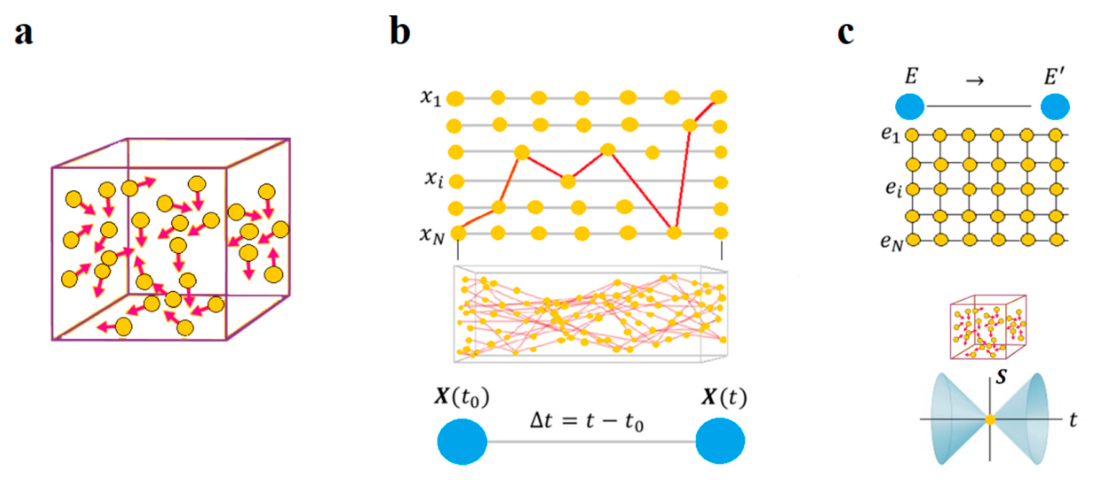
Figure 2.
Scale separation (a) Graph’s connectome. (b) Three levels of separation of the graph into micro-, meso-, and macro-events. (c) The multiscale causal organization of the graph for characteristic sums per stratum.
Figure 2.
Scale separation (a) Graph’s connectome. (b) Three levels of separation of the graph into micro-, meso-, and macro-events. (c) The multiscale causal organization of the graph for characteristic sums per stratum.
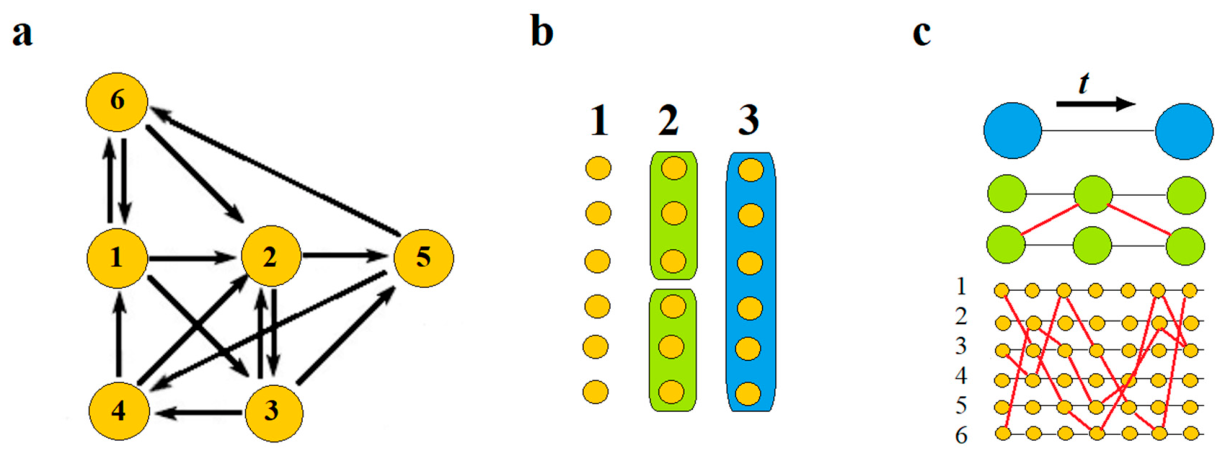
Figure 3.
Coarse-graining. Left: Natural coarse-graining of homogenous physical systems. Right: Endogenous coarse-graining of complex biological systems.
Figure 3.
Coarse-graining. Left: Natural coarse-graining of homogenous physical systems. Right: Endogenous coarse-graining of complex biological systems.
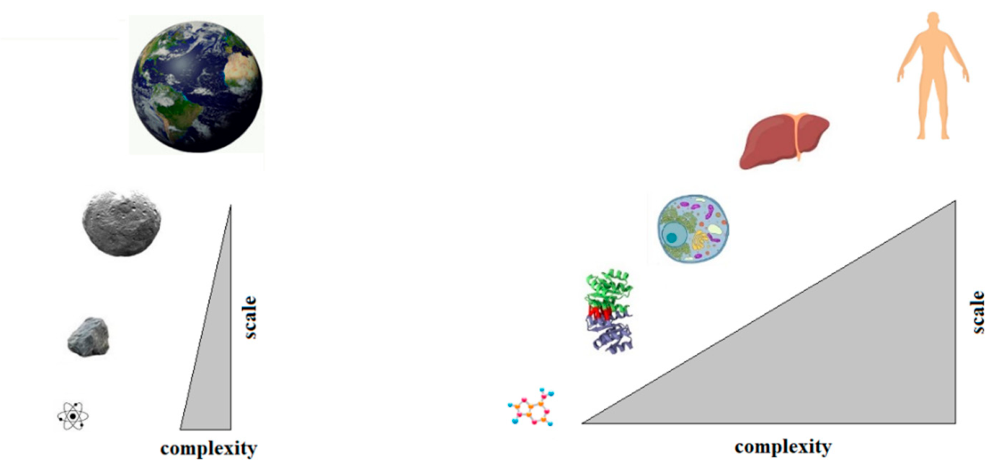
Figure 4.
Entropy of life. (a) Here, the display represents a closed glass container like that in the Miller-Urey experiment. The five panels depict different states of the matter distribution within the container. The volume of matter (the number of black cells) is constant in time but becomes more lumped as if endogenously coarse-grained across spatial scales. After some time, a macroscopic black swan emerges spontaneously on the display. (b) Here, the display represents a phase space. Liouville’s theorem states that a fine-grained probability distribution in phase space behaves like an incompressible fluid whose volume (black domain) remains constant in time. If instead of tracking the exact positions and momenta of individual particles, we coarse-grain the phase space into a grid of discrete cells, we replace the fine-grained probability distribution with a single average probability within each cell. As the system evolves, the flow becomes more convoluted and filamented like an ink drop in water as if occupying a larger volume (grey domain) in phase space. Thus, coarse-graining explains a gap between the time-reversibility of microscopic physics and the time-irreversible growth of entropy at macroscopic scales.
Figure 4.
Entropy of life. (a) Here, the display represents a closed glass container like that in the Miller-Urey experiment. The five panels depict different states of the matter distribution within the container. The volume of matter (the number of black cells) is constant in time but becomes more lumped as if endogenously coarse-grained across spatial scales. After some time, a macroscopic black swan emerges spontaneously on the display. (b) Here, the display represents a phase space. Liouville’s theorem states that a fine-grained probability distribution in phase space behaves like an incompressible fluid whose volume (black domain) remains constant in time. If instead of tracking the exact positions and momenta of individual particles, we coarse-grain the phase space into a grid of discrete cells, we replace the fine-grained probability distribution with a single average probability within each cell. As the system evolves, the flow becomes more convoluted and filamented like an ink drop in water as if occupying a larger volume (grey domain) in phase space. Thus, coarse-graining explains a gap between the time-reversibility of microscopic physics and the time-irreversible growth of entropy at macroscopic scales.
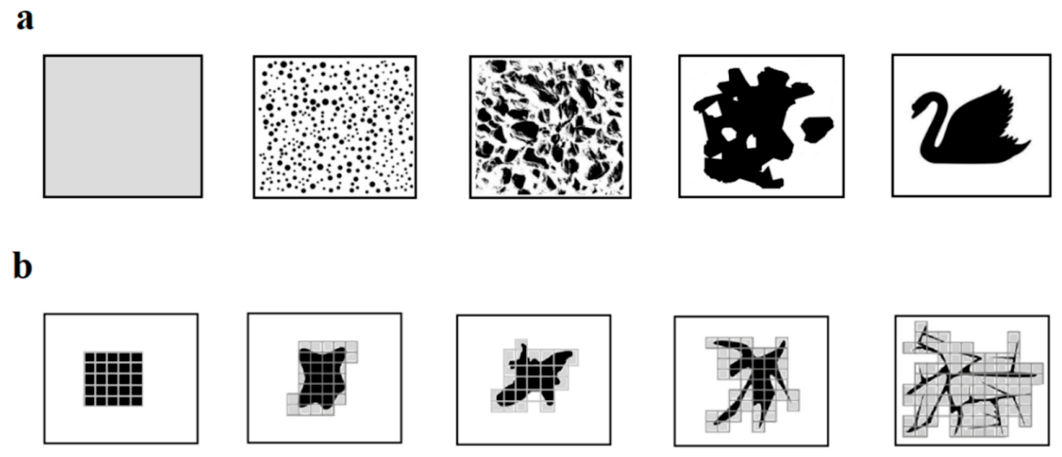
Disclaimer/Publisher’s Note: The statements, opinions and data contained in all publications are solely those of the individual author(s) and contributor(s) and not of MDPI and/or the editor(s). MDPI and/or the editor(s) disclaim responsibility for any injury to people or property resulting from any ideas, methods, instructions or products referred to in the content. |
© 2026 by the authors. Licensee MDPI, Basel, Switzerland. This article is an open access article distributed under the terms and conditions of the Creative Commons Attribution (CC BY) license (http://creativecommons.org/licenses/by/4.0/).
Copyright: This open access article is published under a Creative Commons CC BY 4.0 license, which permit the free download, distribution, and reuse, provided that the author and preprint are cited in any reuse.