

Submitted:
18 August 2026
Posted:
20 August 2026
You are already at the latest version
Abstract
We present a unified cosmological model in which the entire history of the Universe emerges from a single fundamental quantum field — the Group Field Theory (GFT) field — through a sequence of phase transitions. The model is built from three independent sectors that are later linked by a common far‑from‑equilibrium transition: a homogeneous condensate that drives inflation, coherent private‑spacetime lumps that constitute matter, and a decohered gauge‑singlet virtual foam that provides dark energy. We derive an effective condensate evolution equation that captures condensation, inflation, the Coherent–Decoherent Spacetime Transition (CDST), and the post‑CDST decay, all controlled by running GFT couplings. Coupling this equation to the Einstein equations yields a self‑consistent dynamical system that reproduces the full cosmic expansion history: a primordial quasi‑de-Sitter phase, radiation and matter domination, and a late‑time accelerated expansion driven by the foam entropy. The dark‑energy density is obtained from the Bekenstein–Hawking entropy and the dynamical temperature of the apparent cosmological horizon, leading to the master formula \( \Omega_{\mathrm{DE},0} = \alpha_{\mathrm{foam},0}^{\mathrm{eff}} \), with a raw horizon‑puncture activation fraction \( \approx 0.96 \) for the self‑consistent background. A benchmark thawing quintessence yields \( w_0 \simeq -0.90,\; w_a \simeq -0.12\ \). The CDST is genuinely irreversible and provides a microscopic origin for the thermodynamic arrow of time. The model offers a unified ontology in which spacetime, matter, and dark energy are different phases of the same fundamental substance.
Keywords:
quantum gravity
; group field theory
; phase transitions
; emergent spacetime
; dark energy
; horizon entropy
; thawing quintessence
; arrow of time
; decoherence
1. Introduction
Modern cosmology faces two profound puzzles: the nature of dark energy and the origin of the thermodynamic arrow of time.These puzzles point to a deep, yet incompletely understood, connection between thermodynamics, gravity, and quantum theory [1,2,3]. The cosmological constant lacks a natural explanation in quantum field theory, while the standard hot Big Bang model requires an unexplained low-entropy initial state. Group Field Theory (GFT) [4,5], a background-independent approach to quantum gravity in which spacetime and matter emerge from a condensate of pre-geometric tetrahedra, offers a promising framework to address both issues simultaneously.
In this work we propose that the entire cosmic history can be understood as a sequence of phase transitions of a single GFT field. We construct the model by first deriving three independent effective sectors from the same microscopic GFT action:
- 1.
- A homogeneous condensate that generates an emergent FLRW spacetime and, through a large non-minimal coupling, drives primordial inflation (Section 3.6).
- 2.
- Coherent particle lumps — soliton-like bound states of tetrahedra that constitute ordinary and dark matter, each carrying its own private curved geometry (Section 4).
- 3.
- A decohered gauge-singlet virtual foam, produced when the homogeneous condensate fragments, whose horizon-crossing entropy provides the dark energy (Section 5).
These three sectors are then linked by a single far-from-equilibrium event: the Coherent–Decoherent Spacetime Transition (CDST) that ends inflation (Section 6). This transition fragments the homogeneous condensate, giving rise to the particle lumps and the virtual foam simultaneously.
Building on the individual sector actions, we derive a unified effective dynamical system that couples the condensate order parameter to the Einstein equations, thereby determining the expansion history across all cosmic phases (Section 7). The same framework furnishes a natural origin for the thermodynamic arrow of time: the CDST is an irreversible, entropy-producing process that establishes a preferred direction of cosmic evolution (Section 8). The model makes quantitative predictions for the dark-energy equation of state and the growth of structure, which are testable with upcoming surveys.
The paper is organized as follows. Section 2 reviews the GFT framework and the fundamental quanta. Section 3.6– Section 5 derive the three effective sectors. Section 6 describes the CDST as the common origin. Section 7 presents the unified effective dynamics and the resulting expansion history. Section 8 discusses the arrow of time. Section 11 concludes. Appendices provide technical details on the horizon temperature, numerical integration, and the derivation of the condensate evolution equation.
2. The GFT Framework and Fundamental Quanta
The GFT field is a complex function on four copies of the Lorentz group and an internal gauge group, augmented by a massless scalar clock field [4,5]:
with for Lorentzian gravity and for internal gauge interactions. The action is of the standard form
The kinetic kernel contains gravitational and Yang–Mills Casimir operators, a bare mass term, and an operator that generates a non-minimal coupling in the continuum effective action.
2.1. The Fundamental Quanta: Pre-Spacetime Atoms
A single GFT quantum is an excitation of the field characterised by four spins (representations of ) and an intertwiner, together with internal gauge charges. These quanta are pre-geometric: they carry the algebraic data that, upon condensation, give rise to the geometry of spacetime. In this sense, they are quanta of geometry or pre-spacetime atoms.
Each quantum carries two distinct relational seeds:
- Relational time: the clock variable , which is an abstract scalar label that becomes cosmic time after condensation.
- Relational space: the group elements , which encode parallel transports of a gravitational connection. When many quanta condense, these define the holonomies of an emergent spatial geometry.
Space and time are not unified at the fundamental level; their combination into a four-dimensional spacetime continuum is an emergent collective phenomenon of the condensate.
2.2. The GFT Partition Function and the Pre-Geometric Phase
The quantum dynamics of the pre-geometric phase is described by the partition function
summing over all possible tetrahedral configurations. No background spacetime is assumed; the path integral is performed on the abstract group manifold. The interaction vertex glues five quanta into a 4-simplex, generating the combinatorial structure that will eventually become the simplicial building blocks of spacetime.
3. Phases and Phase Transitions
3.1. The Effective Potential and the Order Parameter
The homogeneous mode of the GFT field serves as the order parameter for the condensation transition. Expanding the GFT action around the condensate yields an effective potential whose shape depends on the parameters of the GFT action and on the value of the relational clock via the renormalisation group flow.
The phase structure is governed by :
- Pre-geometric phase: has a unique minimum at . The field has vanishing expectation value; no classical geometry exists.
- Condensate phase: develops a non-trivial minimum at . The field acquires a non-vanishing expectation value, breaking the symmetry and generating an emergent FLRW metric.
The transition occurs when the control parameters cross critical values, which in the cosmological context happens as a function of the relational clock .
3.2. Phase 1: Pre-Geometric Quantum Gravity
In the pre-geometric phase, no classical spacetime exists. The fundamental quanta are in a strongly coupled quantum state, described by the partition function (2). There is no cosmic time; the clock field is present as an abstract label, but its expectation value has not yet acquired a classical meaning. The system is in a symmetric phase with .
3.3. Transition 1: Condensation and the Emergence of Spacetime
The GFT field carries a massless scalar argument which serves as a relational clock [6]. In the pre-geometric phase, is merely an abstract label; the quantum dynamics of the field is governed by the partition function (2) and there is no notion of classical evolution. However, one can deparametrise the GFT dynamics with respect to , obtaining an effective action for the homogeneous mode that depends on the GFT couplings [7].
The key hypothesis — motivated by the asymptotic-safety scenario (Section 3.6) — is that the renormalisation group (RG) scale of the GFT can be identified with the clock variable (or, more precisely, with a function of that becomes the Hubble rate H after condensation). Under this identification, the parameters of the GFT action (masses, couplings) become functions of . Consequently, the effective potential felt by the homogeneous mode acquires an implicit -dependence through the RG flow.
As the RG scale (i.e. ) changes, the shape of can evolve. For sufficiently small , the potential has a unique minimum at , corresponding to the symmetric, pre-geometric phase. At a critical value , a second, non-trivial minimum appears and becomes energetically favoured:
The field then undergoes a spontaneous phase transition: the expectation value jumps to the new minimum, forming a homogeneous, isotropic, gauge-singlet condensate . Simultaneously, the clock field acquires the interpretation of cosmic time t through the expectation value , and an emergent FLRW metric is generated via the effective Friedmann dynamics [6].
This mechanism is the GFT analogue of the Higgs phenomenon or of Bose–Einstein condensation, with the relational clock playing the role of the control parameter. It is a standard ingredient of GFT condensate cosmology [6,7], here extended by the explicit connection to the RG flow of asymptotically safe gravity.
3.4. Inflation: A Transient Regime Within the Condensate Phase
As shown in Appendix D, the effective action for the homogeneous mode includes a non-minimal coupling . During the high-density phase immediately following condensation, collective tadpole diagrams of the GFT vertex drive this coupling to a large positive value , so that the effective gravitational coupling becomes . The positive sign is required for the Starobinsky plateau; it differs from the conventional minus sign used for matter lumps (Section 4), because the two effective couplings are obtained by projecting the microscopic GFT dynamics onto different collective sectors.
With , a conformal transformation to the Einstein frame and canonical normalisation yield a Starobinsky-type potential (see Appendix C). The Universe undergoes a quasi-de Sitter phase, stretching quantum fluctuations to cosmic scales and producing the primordial density perturbations observed in the CMB, with and , in excellent agreement with Planck data [8,9].
Inflation is not a distinct thermodynamic phase; it is a transient metastable regime within the condensate phase, sustained by the large non-minimal coupling. It ends when the condensate amplitude drops and returns to a value of order unity, at which point the homogeneous condensate becomes unstable.
3.5. Transition 2: The Coherent–Decoherent Spacetime Transition (CDST)
The end of inflation triggers the second major phase transition, the CDST. As drops, the effective potential changes shape, causing the homogeneous configuration to become dynamically unstable. Perturbations grow, and the field undergoes a far-from-equilibrium fragmentation.
At the effective-field level, the onset of the CDST corresponds to the appearance of a tachyonic or parametric instability in the fluctuation spectrum around the homogeneous condensate. After canonically rescaling the fluctuation variables, the mode equations become
with the time-dependent frequency
where is the effective mass of the fluctuation, which depends on and on . The CDST begins when for a band of modes (tachyonic instability) or when the time-dependence of drives broad parametric resonance. The rapid drop of at the end of inflation provides precisely the non-adiabatic change that can trigger this instability.
The total GFT field decomposes into three components:
where:
- is the residual homogeneous background, which decays due to infrared scaling and becomes completely negligible at late times (Section 3.6).
- are localised, coherent particle excitations — the private-spacetime lumps (Section 4).
- represents the remaining quantum fluctuations. Its gauge-singlet component decoheres during the CDST and forms the virtual foam responsible for dark energy (Section 5).
The CDST is a genuinely irreversible process: it produces a large amount of entropy (the foam) and stable, localised matter lumps that do not spontaneously reassemble into the original homogeneous condensate. This irreversibility provides a microscopic mechanism for the emergence and amplification of the thermodynamic arrow of time, given a low-entropy pre-CDST state (Section 8).
3.6. Decay of the Homogeneous Background
At the non-Gaussian UV fixed point, the scalar field acquires an anomalous dimension , giving a scaling dimension . In the infrared, the renormalisation group scale is identified with the Hubble rate H, as is standard in asymptotically-safe cosmology [10,11]. This leads to
Assuming the late-time effective mass tracks the infrared scale, , the homogeneous energy density scales as
Today, this is suppressed by for , completely negligible.
3.7. Effective Condensate Dynamics
The macroscopic evolution of the homogeneous condensate is governed by an effective scalar-tensor action derived in detail in Appendix D. In the clock gauge , the relational clock is identified with cosmic time t. The homogeneous effective action is
with
The functions and are the running couplings of the GFT, evaluated along the renormalisation-group flow with the clock variable playing the role of the energy scale; their -dependence is defined even in the pre-geometric phase.
The equations of motion derived in Appendix D include the scalar-tensor Einstein equations and the scalar field equation, whose overdamped (slow-roll) limit, supplemented by the infrared renormalisation-group scaling of the residual background, yields the condensate evolution equation
where the final term is an effective RG drift, not an additional Hubble-friction correction. Equation (7) is an effective first-order closure valid within the combined mean-field, slow-roll, and infrared-scaling approximations; it should not be evolved simultaneously with the full second-order Klein–Gordon equation.
The different regimes of the running couplings and directly correspond to the cosmic phases described above:
- For , and the stable configuration is (pre-geometric phase).
- At , changes sign, triggering condensation (first-order Landau–Ginzburg transition).
- During the high-density condensate, and the curvature term sustains a slow-roll plateau (inflation).
- At the end of inflation, drops rapidly, destabilising the homogeneous configuration through the CDST instability described above.
- After the CDST, the RG drift term dominates, driving the residual background to zero according to the infrared scaling .
The resulting evolution of the order parameter is shown in Figure 1. The condensate evolution equation (7) thus provides a unified effective description of the GFT condensate through all major cosmic phases.
Explanation of the curve.
- 1.
- Pre-geometric quantum phase ().; no classical spacetime.
- 2.
- Condensation (). The effective potential develops a non-trivial minimum; rises sharply, spacetime emerges.
- 3.
- Condensate plateau ( large, ). Inflation occurs as a transient regime.
- 4.
- CDST ( drops). The homogeneous condensate fragments; drops rapidly.
- 5.
- Post-CDST decay (). Residual background decays following .
4. The Matter Sector: Private-Spacetime Lumps
The coherent particle lumps produced in the CDST are soliton-like bound states of a macroscopic number of fundamental tetrahedra. Each lump carries its own local, curved geometry — a private spacetime.
4.1. Geometry of a Single Lump
Let be a timelike world-line representing the effective centre of the lump, with proper time and four-velocity . In the absence of non-gravitational forces the world-line is geodesic. Fermi–Walker transport defines a non-rotating, freely falling orthonormal tetrad along with ; for a geodesic this reduces to parallel transport. Fermi–Walker coordinates are built in a tubular neighbourhood of : for a nearby point one finds the unique such that the spacelike geodesic from to the point is orthogonal to ; expanding its tangent in the spatial tetrad gives coordinates .
In such coordinates the metric near a geodesic world-line has the standard expansion
where the Riemann components are evaluated on in the orthonormal frame. The lump size is far smaller than the background curvature radius, so the curvature terms are negligible. To leading order,
where matches the FLRW scale factor at the boundary and is a self-strain tensor vanishing there. Equation (11) should be understood as a matched local-comoving form rather than a strict Fermi-normal expansion; inside the lump the local Fermi frame is recovered over scales much smaller than the Hubble radius .
The world-line is chosen as the energy-weighted centroid of the lump on each spatial slice. Define the normalised energy density
where is the induced metric on the slice . The energy-weighted Fréchet functional on is
whose unique minimiser defines the centroid . This ensures a centre-of-mass gauge.
4.2. Microscopic Composition
A particle lump is characterised by a reduced Compton wavelength . The number of fundamental tetrahedra making up the lump is
where is the Planck length and is the unreduced Planck mass, to be distinguished from the reduced Planck mass used elsewhere. For ordinary particles is enormous, justifying a continuum description.
4.3. Effective Action for a Particle Excitation
For the purposes of the local lump analysis we use a real scalar prototype , representing the radial amplitude of a more general complex or spinorial excitation. The low-energy effective action is
with . The non-minimal term can be written as part of the effective Planck function, with . The coupling is assumed to approach the conformal value along the relevant infrared RG trajectory [10,12].
Variation yields the coupled field equations
where the stress-energy tensor is
The symbols (used for inflation) and (used here) should not be identified as the same low-energy coupling evaluated in different limits. They are effective coefficients obtained after projecting the microscopic GFT dynamics onto different collective sectors: the homogeneous inflationary condensate and the localised lump sector. Their signs and magnitudes need not coincide.
4.4. Non-Relativistic Limit and Matter Interpretation
In the weak-field, slow-motion regime, the coupled equations reduce to the Schrödinger–Newton system. Decompose the scalar field as
with slowly varying. Expanding the metric in the Newtonian gauge, to leading order in , the Klein–Gordon equation becomes the Schrödinger equation
while the Einstein equation yields and the Poisson equation
Thus each particle lump behaves, in the non-relativistic limit, as a quantum particle moving in its own gravitational potential. The energy-weighted centroid coincides with the standard quantum-mechanical centre of mass, and the proper time is synchronised with the global cosmic time t to .
A gas of such lumps, described by a distribution of masses and velocities, constitutes the matter and dark matter of the Universe. Their collective stress-energy tensor enters the Friedmann equation as and .
4.5. Dark Matter from Gauge-Singlet Lumps
The CDST produces a broad spectrum of lump masses and gauge charges. During the far-from-equilibrium fragmentation, the homogeneous condensate decays into localised excitations with a distribution of energies and intertwiner configurations. The resulting lumps possess different rest masses m and charges under the internal gauge group .
4.5.1. Production of a Lump Mass Spectrum
Let be the characteristic energy scale of the CDST. In a strongly coupled, non-equilibrium process, the number density of lumps per unit mass can be expected to follow a power-law or a peaked distribution,
A phenomenological choice is –3, which yields a finite total mass density and is typical of fragmentation cascades. The lower cutoff is set by the smallest stable bound state of tetrahedra, while the upper cutoff is determined by the energy available in the transition. For the purposes of dark matter, we focus on lumps with masses GeV, which become non-relativistic before matter–radiation equality can act as cold dark matter.
4.5.2. Stability of Gauge-Singlet Lumps
A gauge-singlet lump carries no net charge under . Its stability can arise from a discrete symmetry of the GFT vertex. For instance, the pentic interaction vertex may be invariant under a transformation restricted to the singlet sector, which would protect the lightest singlet excitation from decaying. Alternatively, a topological conservation law associated with the intertwiner structure can render certain combinations of spins stable. In either case, the lightest gauge-singlet lump is absolutely stable, and heavier lumps decay into it.
4.5.3. Relic Abundance from CDST Branching
The present-day dark-matter density parameter [8] can be related to the CDST output. Let be the fraction of the energy density at the CDST that is converted into stable gauge-singlet lumps. The comoving number density of dark-matter lumps is then approximately
where is the energy density at the end of inflation and the corresponding scale factor. Using and typical inflationary scales, one can obtain the correct relic abundance for a broad range of lump masses provided is not extremely small. For example, with GeV, the required branching fraction is , a value not atypical for a non-perturbative phase transition.
4.5.4. Observational Constraints
Gauge-singlet lumps interact only gravitationally, so they are indistinguishable from standard cold dark matter at the background and linear perturbation level. However, if the lumps are very massive (), they could behave as massive compact halo objects (MACHOs) and be subject to microlensing constraints. The private-spacetime geometry of the lumps may mitigate these constraints: each lump is an extended, non-singular soliton with a size of order its Compton wavelength , which for GeV is many orders of magnitude larger than its Schwarzschild radius. Such a low-density object could have a much smaller optical depth for microlensing than a point-like mass. A detailed investigation of this effect is beyond the scope of the present paper; here we merely note that the model is not in obvious conflict with existing limits.
Thus the private-spacetime lump model provides a natural candidate for dark matter: gauge-singlet solitons produced during the CDST, stabilised by a discrete symmetry or topological charge, and populated with an abundance set by the CDST dynamics. While a first-principles calculation of the lump mass spectrum and relic abundance remains an open problem, the qualitative features are consistent with the requirements of cold dark matter and do not introduce additional fundamental fields.
5. The Dark Energy Sector: Virtual Foam
The gauge-singlet part of decoheres during the CDST, forming a gas of virtual quanta — the virtual foam — that permeates the entire horizon volume.
5.1. Horizon Entropy from GFT Boundary States
In loop quantum gravity, a macroscopic horizon is pierced by many spin-network punctures. GFT boundary states reproduce the standard LQG horizon counting under isolated-horizon assumptions, yielding the microcanonical entropy [13]
Fixing the Immirzi parameter to recovers the Bekenstein–Hawking formula
5.2. Active Foam Fraction
Not all horizon microstates are occupied by the foam. We define the active foam fraction
In the spin- dominance picture, the horizon is pierced by punctures, each contributing of entropy.1 After the CDST, of them are decohered, giving .
5.3. Holographic Dark-Energy Scale
For a spatially flat FLRW universe, the apparent horizon has radius and area . The exact dynamical surface gravity introduces a temperature correction (Appendix A):
This assignment can be motivated by the unified first law of horizon thermodynamics [14], which for a dynamic apparent horizon takes the form . Assigning the thermodynamic energy , with , and dividing by the horizon volume , we obtain the foam energy density
Defining the effective active foam fraction
Eq. (25) takes the compact form
At the present epoch, , hence the master formula
With [8] we obtain . For the self-consistent late-time background predicted by the model (, hence ), the dynamical temperature correction factor is . The raw puncture activation fraction is therefore
a perfectly natural order-one number requiring no fine-tuning.
Boltzmann-style interpretation. Writing the horizon entropy in Boltzmann form, , and the active foam entropy as , the master relation (28) takes a highly instructive form:
Here is the total number of microstates of the cosmological horizon, and is the subset actually occupied by the decohered foam (we work in natural units ; restoring explicitly gives .)
5.4. Thawing Quintessence from the Virtual Foam
The master formula (28) fixes the present-day dark-energy density but does not prescribe its time evolution. If were used at all times, the dark energy would behave like matter () and could not drive acceleration. Therefore the holographic relation only determines the normalisation today; the dynamics is provided by an effective scalar field that captures the long-wavelength collective behaviour of the decohered foam.
5.4.1. Effective Action and Potential
The foam sector is modelled by a canonically normalised scalar field minimally coupled to gravity,
with an exponential potential
This form is motivated by three independent considerations: (i) non- perturbative GFT instanton sums in the dilute-gas approximation generate exponential contributions; (ii) the approximate scaling symmetry of the GFT fixed point favours exponentials as technically natural potentials; (iii) a heuristic renormalisation-group (RG) estimate relates the slope to the scaling dimension of the dominant foam operator.
5.4.2. RG Estimate of the Slope
Let the leading foam operator that controls the effective potential have scaling dimension at the GFT fixed point. Its coupling runs as . Identifying the collective field with a dilaton-like RG scale, , yields the effective potential , from which we read off
If is a composite scalar with canonical dimension 2 and an anomalous dimension (typical of melonic tensor models [5]), then and
This is the benchmark value adopted throughout the paper; a first-principles GFT renormalisation-group calculation is required to determine it unambiguously.
5.4.3. Initial Condition and Normalisation
The CDST provides a natural matching condition at the onset of the matter-dominated era:
with the reference value . The normalisation is then fixed by requiring that the numerical solution reproduces the present dark-energy abundance (cf. Eq. (38)). Using the holographic relation and evaluating the potential at gives
5.4.4. Background Equations and Autonomous System
On a spatially flat FLRW background, the Friedmann and Klein–Gordon equations read
For numerical integration we introduce the dimensionless variables
and the autonomous system detailed in Appendix B. The initial conditions are set deep in the radiation era (, ), with the field frozen () and radiation dominating (). The value is determined by shooting so that
5.4.5. Benchmark Numerical Results
A benchmark integration for yields a thawing equation of state: the field is frozen at for most of the cosmic history and begins to roll only when the Hubble rate drops to the scale of the effective mass . A low-redshift CPL parametrisation, , fitted over (), gives
For comparison, the analytic slow-roll estimate yields . The close agreement indicates that the field is in a quasi-slow-roll regime at low redshift. These benchmark values depend on the chosen slope, the normalisation condition (38), and the adopted initial condition (33); they are not universal outputs of the framework.
The exact scalar solution satisfies at all times; the CPL form is only a parametrisation valid inside the fitted range.
5.4.6. Growth of Structure
The linear growth factor obeys
with a prime denoting and initial conditions deep in matter domination . The suppression of structure growth relative to CDM is quantified by
i.e. a mild suppression of about .
5.4.7. Benchmark Figure
Figure 2 displays the benchmark thawing equation of state. The data are provided inline for self-containedness.
5.4.8. Dependence on the Potential Slope
Table 1 collects the benchmark CPL parameters for several values of , obtained from the same semi-analytic thawing approximation.
5.4.9. Microscopic Target Formula for
The foam entropy can be expressed in terms of the CDST occupation numbers . In the Gaussian approximation,
Summing over all gauge-singlet modes with a horizon-crossing window and using the horizon entropy gives the precise microscopic target formula
Here is the comoving apparent-horizon volume, is the Planckian UV cutoff supplied by the GFT discreteness, and the Gaussian window selects modes crossing the horizon. The result depends quantitatively on the choice of the coarse-graining window, but the required invariance is that the integral scales as , i.e. the active foam entropy respects the area law. A direct evaluation of this expression from the CDST dynamics remains an open challenge; the formula itself constitutes the primary microscopic target.
5.4.10. Fifth-Force Sequestering
Linear mixing between the foam collective mode and non-singlet matter modes vanishes by internal-sector orthogonality. Couplings to gauge-invariant matter composites are assumed to be suppressed in the infrared GFT projection, consistent with the generic decoupling of heavy modes in asymptotically safe theories [10] and with the combinatorial properties of melonic tensor models [15]. This provides a microscopic argument for the absence of leading fifth forces, ensuring consistency with solar-system tests.
6. The CDST as a Common Origin
The CDST is the far-from-equilibrium phase transition that ends inflation and fragments the homogeneous condensate. In the unified model, this single event produces both the matter sector and the dark-energy sector from the same fundamental field.
6.1. Coexistence of Lumps and Foam
The field decomposition (3) is not just formal; it reflects the different physical outcomes of the CDST dynamics. During the transition, some regions of the condensate remain coherent but become localised, forming the particle lumps . These are macroscopic bound states with a well-defined particle number and a non-vanishing expectation value of the GFT field. The rest of the field decoheres into a highly populated gauge-singlet gas — the virtual foam — which permeates the entire horizon volume.
The two sectors occupy orthogonal subspaces of the full GFT Hilbert space: the lumps carry non-trivial intertwiner and gauge charges (which give them the properties of matter), while the foam is purely gauge-singlet and carries only geometric excitations. Consequently, the foam entropy is a property of the decohered horizon modes and is not the sum of entropies of the individual lumps. The foam entropy arises from the statistical occupation numbers of the virtual fluctuations, as captured by the Gaussian formula (42).
6.2. Energy Budget and the Coincidence Problem
After the CDST, the total energy density of the Universe is
where is the energy density of the gas of particle lumps (matter and radiation) and is the foam dark-energy density given by Eq. (27). The present-day near-equality is then traced back to the branching ratio between coherent and decohered modes during the CDST. In principle, a complete GFT calculation of the CDST dynamics would predict both and from first principles, thereby turning the cosmic coincidence problem into a quantitative target for quantum gravity.
At a qualitative level, the fact that both sectors are produced by the same far-from-equilibrium transition naturally suggests that their contributions to the energy budget are comparable, without the need for extreme fine-tuning. The observed corresponds to an active foam fraction for our benchmark background, which is a natural order-one efficiency, while the matter fraction is simply the complement.
6.3. Synchronisation of Proper Times
The particle lumps each possess their own private proper time , which is defined along their centroid world-line. In the weak-field limit, the metric inside a lump deviates from the background FLRW metric only by terms of order , so that to high accuracy (cf. Section 4). Thus all lumps are synchronised with the same global cosmic time t that governs the background evolution and the foam dynamics. This ensures that the Friedmann equations with both sectors are well-defined and that the scalar field evolves with respect to the same time coordinate.
6.4. Emergence of the Fundamental Forces from the GFT Phases
The GFT action (1) can be written schematically as
where and denote the quadratic Casimir operators of the gravitational group and the internal gauge group , respectively. The term generates a non-minimal coupling after coarse-graining, and is a bare mass parameter that vanishes at the UV fixed point.
6.4.1. Symmetric Pre-Geometric Phase
When the effective potential has a unique minimum at , the field has vanishing expectation value and the partition function sums over all possible geometric and gauge configurations without distinguishing between gravity and the other forces. No classical notion of geometry or gauge field exists.
6.4.2. Condensation and the Separation of Gravity
At the critical clock value , the potential develops a non-trivial minimum at . The homogeneous, gauge-singlet condensate
breaks the symmetry and generates an emergent FLRW metric through the effective Einstein–Hilbert dynamics coming from the gravitational Casimir . Meanwhile, the gauge sector remains in a symmetric (or weakly broken) phase: the internal Casimir is responsible for the dynamics of gauge bosons, but its expectation value in the singlet condensate vanishes, so the gauge fields initially appear as massless excitations on the emergent geometry.
Thus, condensation separates gravity as the geometry of the condensate from the other forces, which remain described by the Yang–Mills sector of the theory.
6.4.3. CDST and the Origin of Matter and Gauge Charges
The CDST fragments the homogeneous condensate into localised particle lumps and a decohered gauge-singlet foam . Expanding the GFT field around the lumps,
and inserting into the internal Casimir term yields, for each lump, an effective gauge-field action
where denotes the localised scalar field of the lump. The gauge-singlet component of decouples and forms the dark-energy foam; the non-singlet components describe the gauge bosons.
The separation of forces is thus encoded in the intertwiner and representation labels of the GFT quanta: gravitational excitations carry only Lorentz indices, while gauge bosons carry internal charges and arise from the non-singlet part of the field. Matter lumps carry both, unifying the forces in a single object.
6.4.4. Effective Couplings and RG Flow
The effective gauge couplings are determined by the coefficient in front of the internal Casimir and by the RG flow of the GFT. After condensation, the energy scale is set by the Hubble rate H, and the running of the couplings can be studied using the GFT functional renormalisation group. While a quantitative computation of the Standard Model gauge couplings from GFT remains a long-term goal, the framework demonstrates how the unified quantum-gravity origin of all forces is, in principle, achievable within the same phase-transition picture.
Thus, spacetime, matter, dark energy, and the fundamental interactions are all manifestations of the same GFT field in different macroscopic phases.
7. Unified Effective Dynamics and Cosmic Expansion
The homogeneous condensate not only undergoes the phase transitions described in Section 3.6, but also drives the expansion of the emergent spacetime. We now couple the condensate evolution to the Einstein equations derived from the total effective action, and show how the different regimes of the order parameter reproduce the observed cosmic history.
7.1. Total Effective Action and Einstein Equations
The microscopic starting point is the fundamental GFT action (1). In the geometric phase, different macroscopic configurations of the same field define different effective sectors. We work with a single gravitational sector coupled to the various matter components,
where
The coefficient belongs to the homogeneous condensate sector and should not be identified with the low-energy conformal coupling used for the localised lumps. The actions are the sectoral matter, radiation, and dark-energy actions, respectively. The foam scalar is minimally coupled in the Einstein frame, and ordinary matter couples to the same metric .
Varying with respect to the metric gives the standard scalar-tensor field equations,
with . For a spatially flat FLRW metric one obtains the Jordan-frame Friedmann equations
where
No auxiliary effective energy density or pressure for the condensate is required; the non-minimal coupling is fully accounted for by the terms involving F and its derivatives.
7.2. Condensate and Foam Scalar Equations
The homogeneous mode obeys the Klein–Gordon equation from the action (44),
In the slow-roll regime () this reduces to the first-order drift
After the CDST, the residual homogeneous background follows the infrared scaling derived in Section 3.6. The time derivative of that scaling adds an RG-drift term
Combining the slow-roll drift and the RG drift gives the effective first-order condensate evolution equation
where we have used the clock gauge . The foam scalar obeys its minimally coupled equation,
7.3. Closure and Energy Transfer During the CDST
Outside the CDST, the matter and radiation fluids follow the standard conservation laws
and the foam scalar is closed by (54). The system (47)–(53) is then closed once the prescribed functions and are given. During the CDST, energy flows out of the coherent condensate into the matter, radiation, and foam sectors; one must supplement the continuity equations with source terms,
which in turn modify the right-hand sides of (47) and (). We do not specify the here; a first- principles CDST calculation is required to determine them.
7.4. Expansion History Across Cosmic Phases
The different regimes of and drive the system through the cosmic phases (Section 3.6), producing the following expansion history:
- 1.
- Pre-geometric phase. No metric exists; the Friedmann equations are not applicable. The GFT partition function (2) describes the quantum state.
- 2.
- Condensation and inflation. When becomes negative, rises towards its Landau–Ginzburg minimum. The non-minimal coupling is large, , so the effective Planck mass and the scalar potential dominates the right-hand side of (47). The Universe undergoes a quasi-de-Sitter expansion, , driven by the condensate.
- 3.
- CDST and reheating. At the end of inflation, drops rapidly, triggering the tachyonic/parametric instability described in Section 3.6. The coherent condensate fragments into particle lumps and a decohered foam. The energy stored in is transferred to the radiation and matter sectors via the source terms . The Universe enters a radiation-dominated epoch, .
- 4.
- Post-CDST decay and matter domination. The residual homogeneous background obeys the RG drift term in (53), so quickly becomes negligible. The matter lumps dominate the energy budget, giving a matter-dominated expansion, .
- 5.
- Late-time acceleration. Once the homogeneous condensate has decayed, the dark-energy foam scalar takes over. Its energy density freezes at early times and eventually catches up with the matter density. The thawing behaviour derived in Section 5.4 yields an equation of state that approaches in the past and rises to today, driving the observed accelerated expansion.
Thus, the single fundamental GFT field, through its distinct collective sectors, produces the entire sequence of expansion rates observed in the Universe: a primordial quasi-de-Sitter phase, radiation and matter domination, and a late-time accelerating phase. The closed system (47)–(53), together with the fluid evolution and CDST source terms, provides a unified, albeit effective, dynamical framework linking the microscopic GFT parameters to the macroscopic cosmic history.
8. The Arrow of Time from Irreversible Phase Transitions
The sequence of phase transitions in the unified GFT model provides a natural context for the origin of the thermodynamic arrow of time. The model does not claim to solve all aspects of the arrow of time; rather, it identifies a specific, concrete mechanism that generates a large entropy increase and establishes a preferred time direction in cosmic evolution.
8.1. Initial Low-Entropy State
The pre-geometric quantum phase (Section 3) is a fully symmetric state with no classical spacetime and a vanishing expectation value of the GFT field. In statistical terms, this symmetric phase can be regarded as a low-entropy initial condition. The condensation transition breaks this symmetry and produces a highly ordered, coherent homogeneous condensate. The Universe thus begins its classical evolution in a low-entropy configuration.
8.2. Irreversibility of the CDST
The Coherent–Decoherent Spacetime Transition (CDST) is a far-from- equilibrium fragmentation of the homogeneous condensate. It converts the ordered, coherent state into a mixture of localised particle lumps and a decohered virtual foam. This process is genuinely irreversible: the products do not spontaneously reassemble into the original homogeneous condensate. The foam produced in the CDST carries a large entropy, proportional to the horizon area, and this entropy continues to grow as the Universe expands and the dark-energy scalar slowly thaws.
8.3. The Thermodynamic Arrow
In the unified model, the arrow of time is rooted in the succession of phase transitions, with the CDST playing the pivotal role of the primary entropy-producing event. Before the CDST, the Universe is in a low-entropy condensate; after the CDST, entropy is dominated by the foam and increases further with cosmic expansion. The irreversibility of the CDST thus establishes a preferred direction of time in the cosmological evolution of the model.
We emphasise that the full thermodynamic arrow in the real Universe depends also on the choice of initial state and on boundary conditions. The present framework contributes a well-defined, calculable source of entropy that can drive the arrow forward, but it does not claim to be the unique or complete explanation.
9. Epistemic Status of the Model
At this stage the model contains three logically distinct types of input:
- the horizon entropy law , inherited from GFT/LQG boundary-state counting under standard isolated-horizon assumptions;
- the present-day effective active fraction , inferred from the observed dark-energy density;
- the benchmark slope , motivated by a semi-analytic RG estimate at the GFT fixed point.
The predictive content of the model lies in the late-time equation of state and growth history once these inputs are fixed.
The status of all ingredients is summarised in Table 2.
10. Observational Signatures
The unified GFT model yields several quantitative and testable predictions that distinguish it from the standard CDM cosmology and from other dark-energy scenarios.
- Dark energy equation of state and growth of structure.
The thawing quintessence foam field yields a low-redshift equation of state with
for the benchmark slope (Section 5.4). The linear growth factor is suppressed relative to CDM by
i.e. a suppression. These values lie within the projected sensitivity of Stage-IV cosmological surveys (DESI, Euclid, Rubin Observatory), which will measure and with uncertainties – and –, and will constrain the growth factor with comparable precision. A deviation from CDM at this level can thus be confirmed or ruled out in the next decade.
- Stochastic gravitational-wave background from the CDST.
The far-from-equilibrium CDST is expected to produce a stochastic background of gravitational waves through the tachyonic and parametric amplification of tensor fluctuations. Taking a representative energy scale (corresponding to an inflationary scale of a few GeV), the peak frequency today is redshifted to
and the relic energy-density parameter in gravitational waves is
This amplitude is within the reach of future ground-based detectors targeting the high-frequency band (e.g. resonant-mass or microwave- cavity experiments). A detection of such a background with a non-thermal spectrum would provide direct evidence for the quantum- gravity phase transition at the end of inflation.
- Dark-matter small-scale phenomenology.
If dark matter consists of gauge-singlet private-spacetime lumps, each lump is an extended soliton whose size is set by its Compton wavelength . For a typical lump mass GeV, this gives m, far smaller than astrophysical scales; however, if the CDST produces a broader mass spectrum with lighter lumps (e.g. ), the intrinsic extension can be macroscopic and may suppress the dark-matter power spectrum on sub-galactic scales. A quantitative study of the mass spectrum and its effect on structure formation is required before a firm prediction can be made.
- Baryogenesis via the CDST.
The CDST naturally satisfies Sakharov’s conditions for baryogenesis if the GFT vertex contains -violating couplings. In such a scenario, the observed baryon-to-photon ratio would be directly related to the branching ratios of the CDST into particles and antiparticles, providing a new, falsifiable link between quantum gravity and particle physics.
A full exploration of these signatures will be the subject of future work.
11. Conclusion
We have presented a unified cosmological model in which the entire history of the Universe is a sequence of phase transitions of a single GFT field. Starting from the fundamental GFT action, we derived effective actions for three independent sectors — the homogeneous condensate, the particle lumps, and the virtual foam — and then linked them through a common far-from-equilibrium CDST that ends inflation and produces both matter and dark energy.
The central results are:
- 1.
- A condensate evolution equation that captures condensation, inflation, the CDST, and the post-CDST decay, with the critical parameters and emerging from the GFT renormalisation group.
- 2.
- A master formula for the present dark-energy density, , linking the observed acceleration to the fraction of active horizon microstates.
- 3.
- A self-consistent expansion history obtained by coupling the condensate dynamics to the Einstein equations, which reproduces primordial inflation, radiation and matter domination, and late-time acceleration.
- 4.
- An origin of the arrow of time rooted in the irreversibility of the CDST, which provides a microscopic mechanism for entropy production and a forward time direction.
- 5.
- Testable predictions: a thawing dark-energy equation of state with and a mild suppression of structure growth, within reach of Stage-IV surveys.
The model remains semi-microscopic: the exact form of the running couplings and the CDST mode functions await a first-principles GFT calculation. Nevertheless, the framework provides a coherent and mathematically consistent effective description that unifies spacetime, matter, dark energy, and the forces of nature within a single quantum gravity condensate. It turns the dark-energy and coincidence problems into quantitative targets for future GFT simulations. The model provides a concrete realization of the thermodynamic route to spacetime: the cosmic acceleration is a consequence of the horizon entropy, and the arrow of time emerges from the entropy production during the irreversible CDST.
Author Contribution
Salim Yasmineh (the sole author) is responsible for all aspects of the work.
Funding
No funding was received for this work.
Competing Interests
The author declares no competing interests.
Data Availability Statement
All data generated or analysed during this study are included in this published article.
Appendix A. Justification of the Horizon Temperature
Appendix B. Autonomous System and Numerical Integration
With , , , and , the autonomous equations are
The Hubble evolution is . Integration from with and , with shot to give , yields the benchmark CPL parameters.
Appendix C. Inflation from the Coherent Condensate
With a large dynamical non-minimal coupling , the effective Jordan-frame action
is transformed to the Einstein frame, yielding the Starobinsky potential , with , for e-folds [9].
Appendix D. Derivation of the Effective Condensate Dynamics from GFT
We present a rigorous derivation of the effective scalar-tensor action and the condensate evolution equation, starting from the microscopic Group Field Theory (GFT). The derivation proceeds in three logical stages: (i) projection of the GFT action onto a homogeneous condensate to obtain the effective potential and non-minimal coupling; (ii) variation of the resulting scalar-tensor action to obtain the exact field equations; (iii) specialisation to an FLRW background, slow-roll reduction, and the incorporation of the infrared scaling to obtain the effective first-order evolution equation. We also derive the Landau–Ginzburg structure of the condensation transition, the inflationary plateau, and the CDST instability criterion.
Appendix D.1. From the Microscopic GFT to the Effective Scalar-Tensor Action
The GFT field is expanded around a homogeneous, isotropic, gauge-singlet condensate state
where is a normalised wavefunction encoding the isotropic tetrahedral geometry and the gauge-singlet property. Inserting this ansatz into the fundamental GFT action (1) and coarse-graining over the microscopic fluctuations yields an effective action for the order parameter . After wavefunction renormalisation, the kinetic term takes the canonical form, and the effective potential generated by the GFT interaction vertex is
where the coefficients are related to the microscopic couplings by
up to combinatorial and normalisation factors. The geometric part of the kinetic kernel contains an operator that, when projected onto the condensate and matched to the continuum curvature, generates a non-minimal coupling term
Thus, the effective geometric action in the homogeneous sector is
with
In this action, is treated as a prescribed function of the relational clock ; it is not varied with respect to . We work in the clock gauge , so that after condensation coincides with cosmic time t.
Appendix D.2. Exact Field Equations
Varying with respect to the metric gives the scalar-tensor Einstein equation
where the stress-energy tensor of the scalar field is
Varying with respect to yields the scalar field equation
with and .
Appendix D.3. Slow-Roll Reduction and Infrared RG Drift
In the overdamped regime, , the acceleration term in (A15) is negligible and the scalar equation reduces to the first-order drift
After the CDST, the residual homogeneous background follows the infrared scaling derived from the GFT fixed point (Section 3.6),
Taking the logarithmic derivative gives
which motivates an effective RG drift term
Since after inflation, this term drives the decay of the condensate.
Combining the slow-roll drift and the RG drift yields the effective first-order condensate evolution equation used in the main text:
Equation (A22) is an effective closure that replaces the full second-order dynamics in the overdamped regime and incorporates the late-time RG scaling. It should not be evolved simultaneously with the exact equation (A15), and it is valid only within the combined mean-field, slow-roll, and infrared-scaling approximations.
Appendix D.4. Physical Analysis of the Phase Transitions
Appendix D.4.1. Landau–Ginzburg Condensation
When becomes negative at , we write with . Ignoring curvature for a moment, the potential becomes
which has minima at
This is the standard Landau–Ginzburg structure of a second-order phase transition.
Appendix D.4.2. Inflationary Effective Mass and the Starobinsky Plateau
Including the curvature coupling, the effective potential reads
so that the curvature-corrected mass term is
During inflation, and , making strongly negative and sustaining the large-field configuration. In the Einstein frame, the effective Planck function flattens the potential. For a quartic bare potential and , the Einstein-frame potential approaches the constant plateau
Appendix D.4.3. CDST Instability Criterion
Expanding the GFT field around the homogeneous background and introducing the canonically rescaled mode functions , the fluctuation equations become
with the time-dependent frequency
where is the effective mass of the fluctuation, which depends on the background and on . The CDST is triggered when either
- 1.
- for a band of comoving wavenumbers (tachyonic instability), or
- 2.
- the time-dependence of induces broad parametric resonance.
The rapid drop of at the end of inflation provides the non-adiabatic change that can satisfy either condition, converting the coherent condensate into a mixture of particle lumps and a decohered gauge-singlet foam.
References
- Bekenstein, J.D. Black holes and entropy. Phys. Rev. D. 1973, 7, 2333. [Google Scholar] [CrossRef]
- Hawking, S.W. Particle creation by black holes. Commun. Math. Phys. 1975, 43, 199. [Google Scholar] [CrossRef]
- Jacobson, T. Thermodynamics of Spacetime: The Einstein Equation of State. Phys. Rev. Lett. 1995, 75, 1260. [Google Scholar] [CrossRef] [PubMed]
- Oriti, D. The group field theory approach to quantum gravity. In Approaches to Quantum Gravity; Oriti, D., Ed.; Cambridge University Press, 2009. [Google Scholar]
- Freidel, L.; Krasnov, K. A new spin foam model for 4D gravity. Class. Quant. Grav. 2008, 25, 125018. [Google Scholar] [CrossRef]
- Oriti, D.; Pang, X. Phantom-like dark energy from quantum gravity. J. Cosmol. Astropart. Phys. 2021, 12, 040. [Google Scholar] [CrossRef]
- Oriti, D.; Sindoni, L.; Wilson-Ewing, E. Emergent Friedmann dynamics with a quantum bounce from quantum gravity condensates. Class. Quant. Grav. 2016, 33, 224001. [Google Scholar] [CrossRef]
- Planck Collaboration. Planck 2018 results. VI. Cosmological parameters. Astron. Astrophys. 2020, 641, A6. [Google Scholar]
- Marchetti, L.; Ladstätter, F.; Oriti, D. Cosmic Acceleration from Quantum Gravity: Emergent Inflation and Dynamical Dark Energy. arXiv [gr-qc]. 2025, arXiv:2512.11712. [Google Scholar]
- Reuter, M. Nonperturbative evolution equation for quantum gravity. Phys. Rev. D. 1998, 57, 971. [Google Scholar] [CrossRef]
- Bonanno, A.; Saueressig, F. Asymptotically safe cosmology – a status report. Comptes Rendus Phys. 2017, 18, 254. [Google Scholar] [CrossRef]
- Eichhorn, A. Quantum-gravity-induced matter self-interactions in the asymptotic-safety scenario. Phys. Rev. D. 2012, 86, 105021. [Google Scholar] [CrossRef]
- Ashtekar, A.; Lewandowski, J. Background independent quantum gravity: A status report. Class. Quant. Grav. 1997, 14, A55. [Google Scholar]
- Hayward, S.A. Unified first law of black-hole dynamics and relativistic thermodynamics. Class. Quant. Grav. 1998, 15, 3147. [Google Scholar] [CrossRef]
- Gurau, R. The complete 1/N expansion of colored tensor models. Ann. Henri Poincaré 2012, 13, 399. [Google Scholar] [CrossRef]
- Allen, B. Vacuum states in de Sitter space. Phys. Rev. D. 1985, 32, 3136. [Google Scholar] [CrossRef] [PubMed]
- Hollands, S.; Wald, R.M. Local Wick polynomials and time ordered products of quantum fields in curved spacetime. Commun. Math. Phys. 2001, 223, 289. [Google Scholar] [CrossRef]
| 1 | In the condensate phase, each quantum of geometry contributes one Planck area; hence the fundamental GFT quanta can be viewed as Planck-scale spacetime atoms. This intuitive picture is fully compatible with the algebraic formalism used here. |
Figure 1.
Evolution of the order parameter across cosmic history. The five distinct segments correspond to the pre-geometric phase, condensation, inflation, CDST, and post-CDST decay, controlled by the critical parameters (clock) and (non-minimal coupling).
Figure 1.
Evolution of the order parameter across cosmic history. The five distinct segments correspond to the pre-geometric phase, condensation, inflation, CDST, and post-CDST decay, controlled by the critical parameters (clock) and (non-minimal coupling).
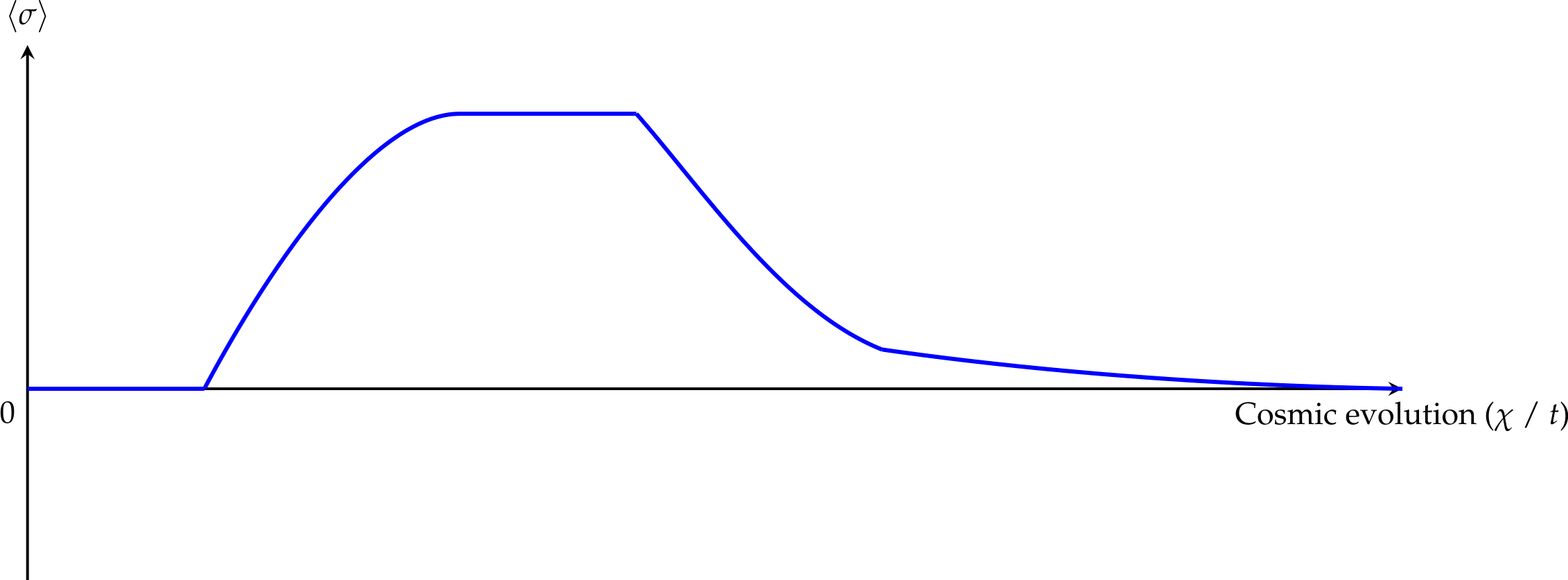
Figure 2.
Benchmark late-time equation of state for the thawing foam field with and normalised to . The black dash-dotted line is CDM (). The dashed line is the CPL parametrisation (39), valid for (). The solid curve is the benchmark thawing profile consistent with and ; a full numerical integration of the autonomous system will refine this curve.
Figure 2.
Benchmark late-time equation of state for the thawing foam field with and normalised to . The black dash-dotted line is CDM (). The dashed line is the CPL parametrisation (39), valid for (). The solid curve is the benchmark thawing profile consistent with and ; a full numerical integration of the autonomous system will refine this curve.
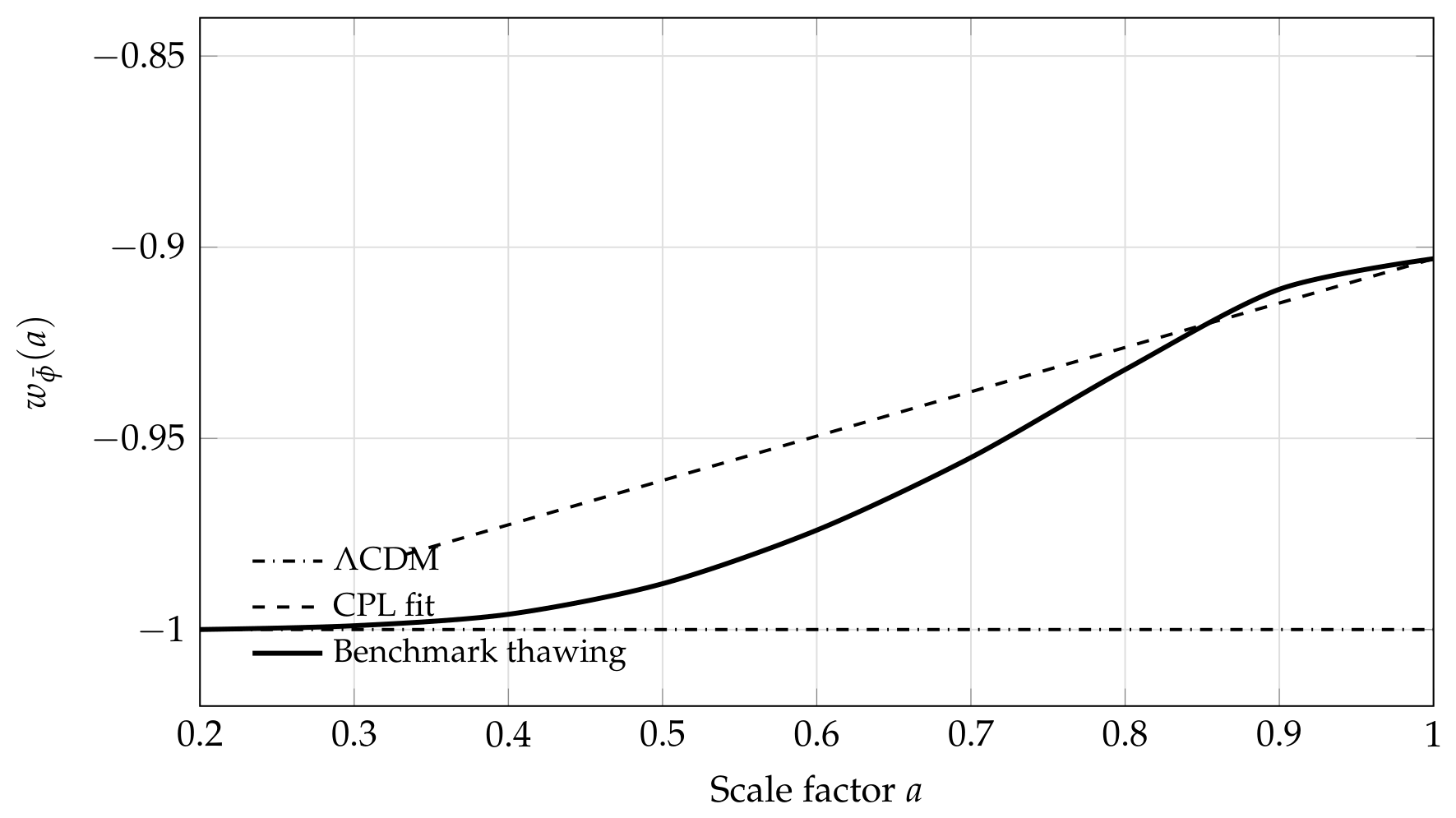

Table 1.
Benchmark late-time parameters for the thawing foam model for different choices of the potential slope . The values are derived from a semi-analytic CPL fit and should be refined by a full numerical integration of the autonomous system.
Table 1.
Benchmark late-time parameters for the thawing foam model for different choices of the potential slope . The values are derived from a semi-analytic CPL fit and should be refined by a full numerical integration of the autonomous system.
| 0.40 | |||
| 0.60 | |||
| 0.65 | |||
| 0.80 |
Table 2.
Summary of the unified model’s main ingredients and their epistemic status.
| Quantity | Nature | Value / Derivation |
|---|---|---|
| Derived (LQG) | GFT/LQG boundary counting, Immirzi matching | |
| Inferred | (from ) | |
| (raw) | Inferred (self-consistent) | |
| Semi-derived (RG) | , benchmark | |
| Normalised | ||
| Benchmark (numerical) | ||
| Fifth force | Sequestering | Orthogonality + EFT sequestering |
| Particle lumps | New (GFT) | Private-spacetime solitons |
Disclaimer/Publisher’s Note: The statements, opinions and data contained in all publications are solely those of the individual author(s) and contributor(s) and not of MDPI and/or the editor(s). MDPI and/or the editor(s) disclaim responsibility for any injury to people or property resulting from any ideas, methods, instructions or products referred to in the content. |
© 2026 by the authors. Licensee MDPI, Basel, Switzerland. This article is an open access article distributed under the terms and conditions of the Creative Commons Attribution (CC BY) license (http://creativecommons.org/licenses/by/4.0/).
Copyright: This open access article is published under a Creative Commons CC BY 4.0 license, which permit the free download, distribution, and reuse, provided that the author and preprint are cited in any reuse.