

Submitted:
19 August 2026
Posted:
20 August 2026
You are already at the latest version
Abstract
Young people transitioning out of foster care may face interconnected challenges involving health, education, employment, housing, income and continuity of support. Yet care leavers also demonstrate agency and positive adaptation when dependable relationships, practical resources and responsive services remain available. This critical narrative review examines how foster-family relationships, individual agency, professional support and material conditions interact during the transition from care. The review draws on social-ecological resilience, relational permanence and the social determinants of health to critique approaches that position successful ageing out primarily as an achievement of individual self-reliance. The literature was synthesised into three integrated themes: (1) relational continuity, belonging and foster-family well-being; (2) supported agency, health and developmental preparation; and (3) coordinated services and enabling material conditions. On this basis, the paper proposes a Relational Continuity and Supported Transition Framework. The framework positions health, well-being and positive adaptation as shared outcomes produced through reciprocal interactions between care leavers, supportive relationships, service systems and structural resources. Implications are presented for foster-family preparation, youth-led transition planning, service coordination, social protection and future research, with particular attention to underrepresented African contexts.
Keywords:
ageing out of foster care
; care leavers
; foster families
; health and well-being
; relational continuity
; resilience
; transition to adulthood
; social determinants of health
1. Introduction
Ageing out of foster care is not a single administrative event. It is a developmental and social transition in which young people are expected to manage education or employment, housing, finances, health care and changing relationships, often with fewer dependable resources than their peers. The transition may coincide with the withdrawal of statutory, financial and professional support, even though emerging adulthood is ordinarily characterised by gradual movement towards independence and continuing family assistance [1,2].
Foster care is internationally recognised as an alternative-care arrangement for children who cannot remain safely with their biological parents. In South Africa, placements are governed by the Children’s Act 38 of 2005, although the nature and duration of support available before and after care vary across jurisdictions [3,4]. Young people leaving care may experience educational disruption, unstable housing, unemployment, limited income, health concerns and the loss or weakening of significant relationships [5,6]. McGrane et al. [7], for example, found a steep decline in subjective well-being after care among a large English sample, with particularly low well-being among some vulnerable groups.
Personal strengths such as determination, future orientation and self-advocacy matter, but they do not operate independently of social conditions. Social-ecological accounts describe resilience as a dynamic process that depends on interactions between individuals and the relational, institutional, cultural and material resources available to them [8,9,10]. South African research similarly shows that diverse combinations of personal, relational, contextual and culturally meaningful resources are associated with more favourable mental-health trajectories [11].
Existing work has identified individual and external factors associated with outcomes after foster care. Nuñez et al. [12], for example, systematically reviewed resilience factors linked to health, education, employment, substance use and criminal-justice involvement. The present paper takes a different approach. It examines how personal agency, foster-family relationships, service systems and structural conditions work together, and it foregrounds relational continuity and foster-family well-being as central components of a supported transition.
This review therefore asks: How do relational, developmental, service-level and material resources interact to shape health and well-being after foster care? Its contribution is to reposition ageing out as a shared relational and public-health responsibility rather than an individual test of independence, and to consolidate the literature into a concise framework for foster families, practitioners, service organisations and policymakers.
Ageing out of foster care should also be understood as a public-health transition. Access to stable housing, adequate income, education, employment, healthcare and dependable relationships shapes exposure to health risks and opportunities for positive adaptation. Examining these conditions together shifts attention from individual readiness alone towards the relational, service-level and structural determinants that promote or constrain health and well-being after care.
2. Approach to the Critical Narrative Review
This paper adopted a critical narrative review approach. Such reviews are suited to broad, complex topics because they integrate evidence from different methodological and disciplinary traditions while allowing interpretation, comparison and conceptual development rather than exhaustive study identification or statistical aggregation [13,14].
MEDLINE, APA PsycINFO, APA PsycArticles and Academic Search Complete were searched, supplemented by Google Scholar searches and reference-list screening. The review primarily considered empirical studies and review articles published between January 2012 and June 2026, although earlier publications were retained when they provided important conceptual or methodological foundations. Sources were assessed for their relevance to care-leaver health and well-being, relational continuity, foster-family well-being, transition preparation, service provision and material conditions. Publications focusing exclusively on experiences during foster care, without addressing transition-related processes or outcomes, were excluded. The final thematic synthesis drew on 28 publications that directly informed the development of the three integrated themes. Additional sources were used to establish the methodological, conceptual, legal and contextual foundations of the review. As the review aimed to provide critical interpretation and conceptual integration rather than exhaustive evidence identification or quantitative effect estimation, no meta-analysis was conducted. Methodological limitations and variations across the evidence base were considered throughout the interpretive process and are reflected in the cautious presentation of the findings and conclusions.
3. Conceptual Orientation
Resilience is understood here as positive adaptation under conditions of significant adversity, shaped over time by developmental stage, culture, risk exposure and access to resources [8,15]. This view shifts attention from whether a young person possesses an inherently resilient personality to whether families, communities and institutions make relevant resources available and accessible. Agency remains important, but its expression is enabled or constrained by relationships, opportunities and material conditions.
Relational permanence refers to enduring, reciprocal and dependable relationships rather than only the legal status or duration of a placement [16,17]. A legally stable placement may not necessarily produce emotional security, whereas a relationship formed in a temporary placement may continue into adulthood. Relational continuity is therefore created through repeated experiences of inclusion, trust, support, boundary negotiation and commitment.
The social determinants of health extend this relational account by locating well-being within access to safe housing, adequate income, education, employment, transport, health care, social protection and freedom from discrimination. Together, these perspectives suggest that positive adaptation is a shared outcome: young people navigate towards resources, while families, organisations and public systems carry responsibility for making those resources dependable, equitable and developmentally appropriate.
4. Thematic Synthesis
The literature was consolidated into three themes. They are analytically distinct but mutually dependent: relational security supports agency; agency is easier to exercise when services are navigable; and formal services are less effective when housing, income or transport remain unstable.
4.1. Relational Continuity, Belonging and Foster-Family Well-Being
Dependable relationships are central to well-being after care. Care leavers describe a need for authentic belonging, acceptance, guidance, emotional availability and practical assistance. Reuben and van Breda’s [18] seven-year South African study showed that young people actively sought relationships of belonging with birth relatives, former caregivers, foster parents, partners, friends and other trusted adults. The value of support depended less on the formal identity of the person than on the authenticity, reliability and quality of the relationship.
Legal permanence, kinship status and placement duration do not automatically produce relational permanence. Kinship care may preserve family history, identity and existing networks, but biological relatedness does not in itself guarantee safety, attachment or adequate support [19,20]. Kinship caregivers may also experience poverty, family conflict and limited service access [21,22]. Non-kinship foster families can likewise become enduring sources of emotional and practical support when young people are included in ordinary family life and relationships continue through difficulty and transition [23].
Placement instability can weaken opportunities to build trust and a sense of permanence. Maguire et al.’s [24] systematic review found that instability was associated with behavioural and mental-health difficulties, although the strength and direction of effects varied and causal interpretation remained limited by study design. The important implication is not that all placement change causes poor outcomes, but that repeated disruption may remove the relational conditions through which young people experience security and repair.
Relational continuity must also respect young people’s agency and safety. Contact with birth or foster families should not be presumed beneficial or required when a relationship is unwanted, unsafe or controlling. Before care ends, social workers should help young people identify the people they value, establish whether those individuals are willing and able to remain involved, and facilitate realistic discussions about contact, boundaries, accommodation, financial assistance and crisis support [16,25].
The well-being of foster families is part of this relational ecology. Caregivers manage children’s developmental and health needs while navigating birth-family contact, professional systems, household finances and the needs of other children. Stress and limited resources can affect caregiver availability and the sustainability of relationships. Foster-family support should therefore include preparation, contextually responsive training, financial and material assistance, professional consultation and planned support during the transition out of care [22,26,27]. Foster parents should be encouraged to remain significant adults where this is mutually desired, but they should not be expected to privately replace services withdrawn by the state.
4.2. Supported Agency, Health and Developmental Preparation
Care leavers are active participants in their transitions. Determination, adaptability, self-advocacy, decision-making and future orientation can support persistence and goal-directed action [28,29,30]. Youth-led planning can strengthen ownership, while encouragement from caregivers, mentors and professionals can sustain educational and employment aspirations during setbacks [31,32].
However, celebrating exceptional self-reliance can individualise resilience. It can imply that young people who struggle lack motivation, while obscuring unequal access to housing, income, education, health care and supportive adults. A supported-agency perspective treats skills and determination as important but insufficient. The question is not only whether a young person can budget, apply for work or manage a household, but whether affordable housing, transport, employment opportunities and trusted guidance are available.
Transition preparation should be gradual and matched to developmental readiness rather than triggered only by legal age. Practical preparation may include managing money and documents, household routines, health-care navigation, education and employment planning, relationship skills and knowledge of available services. Clear expectations and age-appropriate autonomy can strengthen decision-making, but responsibility should be transferred progressively rather than through an abrupt demand for complete independence [31,33].
Health is both an outcome and a condition of successful transition. Histories of maltreatment, placement disruption and victimisation may be associated with mental-health, physical-health, safety and relationship difficulties [5,34]. Care leavers may also face reproductive-health risks and barriers to obtaining consistent care [35]. These associations should not be interpreted as inevitable consequences of foster care; they reflect varied pre-care experiences, care histories and post-care environments. Accessible, confidential and continuous health care is therefore an essential part of transition planning rather than a separate referral made only when problems emerge.
Education and employment can support identity, income and social participation, but aspiration alone cannot overcome disrupted schooling, financial barriers or limited institutional guidance. Caring adults and professionals can help young people navigate admissions, financial aid, employment applications and setbacks. Extended care and targeted educational support may improve participation and completion, particularly when linked to stable housing and continuing relationships [36,37,38].
4.3. Coordinated Services and Enabling Material Conditions
Relationships with social workers and other professionals can provide advocacy, information and access to services. Young people value workers who are dependable, respectful and present at critical moments [39]. Frequent changes in workers, schools, placements or programmes may fragment support and require young people repeatedly to retell their histories. Service continuity is therefore relational as well as administrative.
Transition planning should begin well before care ends and should be collaborative, youth-led and family-inclusive. Plans need to connect goals with named people, organisations, timeframes and contingency arrangements. They should address identification documents, housing, income, transport, education, employment, health care, relationships and emergency support. Independent-living programmes are most useful when practical skills are linked to real opportunities and continuing assistance rather than treated as a final course completed before discharge.
Material stability is a health-promoting resource. Financial insecurity can restrict access to food, transport, education, health care and safe accommodation. Housing instability can interrupt treatment, employment and supportive relationships, while inadequate transport can make formally available services practically inaccessible [40,41]. Housing, income support, transport and extended care should therefore be understood as foundations for participation, not optional rewards for young people who demonstrate readiness.
Service coordination is especially important because needs interact. A housing referral may fail when a young person lacks income or identification; an educational placement may be lost when transport is unaffordable; and health care may be interrupted when accommodation changes. Child-welfare, health, education, housing and employment systems should share responsibility rather than transfer navigation burdens to the young person. Policy should favour graduated support and accessible re-entry routes when difficulties arise [6,42].
Jurisdictional differences remain important. The availability of extended care, grants, housing, health coverage and educational support varies widely, and evidence from one welfare system cannot be applied uncritically to another. In South Africa and other underrepresented African contexts, transition policy must account for poverty, unemployment, uneven service coverage and the role of extended family and community networks. Cross-cutting principles—continuity, participation, material security and coordinated responsibility—should be adapted to local legal and social conditions rather than imposed as a universal programme model.
5. Relational Continuity and Supported Transition Framework
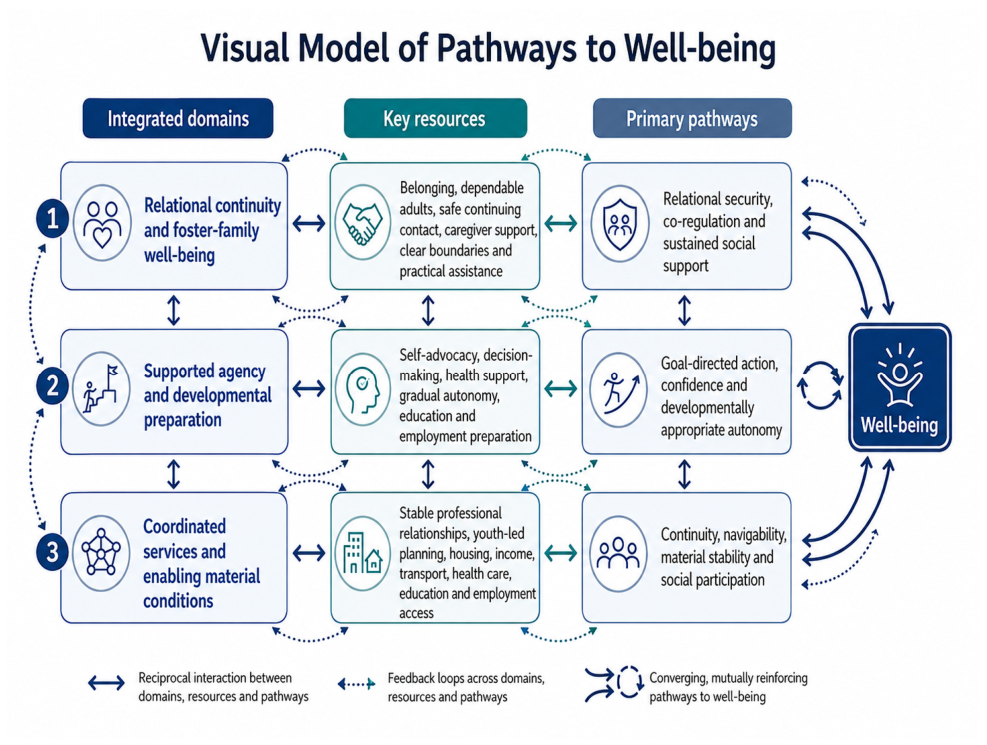
The synthesis suggests that health, well-being and positive adaptation emerge through three reciprocal domains. Relational continuity provides belonging, co-regulation and practical support. Supported agency enables young people to make decisions, pursue goals and use available resources. Coordinated services and enabling material conditions make support accessible and sustainable. Weakness in one domain can undermine the others: skills have limited value without opportunities, services are difficult to use without trusted guidance, and relationships may be strained when families are expected to absorb unmet material needs. The framework therefore rejects a linear model in which preparation produces independence at a fixed age. Instead, transition is viewed as a negotiated process in which support can increase or decrease according to need. The desired outcome is not immediate self-sufficiency, but developmentally appropriate participation, health and growing autonomy within dependable relationships and accessible systems. The relationships between the three integrated domains, their associated resources and the pathways through which they contribute to health and well-being are presented in Figure 1.
6. Implications for Foster Families, Practice and Policy
Foster-family preparation should begin before the final transition period. Young people and caregivers need facilitated conversations about the meaning of leaving care, the future status of the relationship, preferred contact, changing household roles, boundaries and the assistance each person can realistically sustain. Caregivers require support for their own well-being and should not be left to carry post-care responsibilities without professional or material assistance.
Social-work practice should use a youth-led transition plan that identifies both goals and the relational and material resources required to pursue them. Each plan should name at least one dependable adult, clarify service responsibilities, include health-care continuity and provide contingency options for housing, income and crisis support. Consistency of workers should be prioritised, and unavoidable transfers should involve warm handovers rather than administrative closure.
Service organisations should coordinate child-welfare, education, health, housing and employment support. Success should be assessed through continuity, safety, participation and well-being rather than only whether a young person has exited formal care. Follow-up and re-entry pathways are important because transition needs may change during emerging adulthood.
Policy should move away from abrupt withdrawal at a fixed age and towards graduated, developmentally responsive support. Stable housing, income assistance, transport, health care and educational opportunity are not peripheral to resilience; they are the conditions that allow personal strengths and relationships to translate into well-being. Care leavers and foster families should participate in the design and evaluation of transition policies, with responses adapted to national and local welfare systems.
7. Research Priorities and Review Limitations
Future research should examine how continued foster-family contact, supportive adult relationships and family-inclusive transition interventions affect mental health, belonging, housing, education and employment over time. Greater attention is needed to caregiver stress and well-being during and after transition, differences between kinship and non-kinship care, and the experiences of young people shaped by disability, gender, parenthood, poverty, migration and discrimination. Longitudinal and participatory research is particularly important in South Africa and other African settings where care-leaving evidence remains comparatively limited.
This critical narrative review does not claim exhaustive coverage and is shaped by the authors’ purposive selection and interpretation of literature. The evidence base is geographically uneven, with substantial reliance on studies from high-income countries and variation in care systems, definitions and outcomes. The three-theme framework is therefore conceptual rather than a tested causal model. It offers an organising account that requires empirical evaluation and contextual adaptation.
8. Conclusions
Transitioning out of foster care should not be treated as an abrupt movement from dependence to complete self-sufficiency. Care leavers’ health and well-being are shaped by the interaction of relational continuity, supported agency, coordinated services and material security. Foster families can remain important sources of belonging, guidance and practical assistance, but relationships require preparation and should be supported rather than assumed. The Relational Continuity and Supported Transition Framework consolidates these insights into three integrated domains and shifts responsibility from the individual young person alone to the networks and systems that make positive adaptation possible. Its distinctive contribution is to position foster-family well-being and relational continuity alongside youth agency and structural support as interdependent foundations for equitable transitions from care.
Author Contributions
TBM: Search, HM: Reviewed and writing up, TS: Writing up.
Funding
This research received no specific grant from any funding agency in the public, commercial, or not-for-profit sectors. It forms part of a Master’s study at North-West University.
Institutional Review Board Statement
Ethical approval for this study was obtained from the Health Research Ethics Committee of North-West University, South Africa (NWU-00096-22-A1).
Informed Consent Statement
Not applicable. This study did not involve direct contact with human participants.
Data Availability Statement
All data generated or analysed during this study are included in this article. Further details are available from the corresponding author upon reasonable request.
Conflicts of Interest
The authors declare no conflicts of interest.
Permission to Reproduce Material from Other Sources
No previously published material requiring permission for reproduction was used in this manuscript.
References
- Bond, S. Care-leaving in South Africa: An international and social justice perspective. J. Int. Comp. Soc. Policy 2018, 34, 76–90. [Google Scholar] [CrossRef]
- Van Breda, A. D.; Dickens, L. The contribution of resilience to one-year independent living outcomes of care-leavers in South Africa. Child. Youth Serv. Rev. 2017, 83, 264–273. [Google Scholar] [CrossRef]
- Republic of South Africa. Children’s Act 38 of 2005. Government Printer, 2005. [Google Scholar]
- Rochat, T. J.; Mokomane, Z.; Mitchell, J. Public perceptions, beliefs and experiences of fostering and adoption: A national qualitative study in South Africa. Child. Soc. 2016, 30, 120–131. [Google Scholar] [CrossRef] [PubMed]
- Lohr, W. D.; Jones, V. F. Mental health issues in foster care. Pediatr. Ann. 2016, 45, e342–e348. [Google Scholar] [CrossRef] [PubMed]
- Van Breda, A. D. Research review: Ageing out of residential care in South Africa. Child Fam. Soc. Work 2018, 23, 513–521. [Google Scholar] [CrossRef]
- McGrane, J.; Selwyn, J.; Baker, C. The development and psychometric validation of a survey to measure the subjective well-being of care leavers. Child. Youth Serv. Rev. 2024, 158, 107462. [Google Scholar] [CrossRef]
- Masten, A. S. Ordinary magic: Resilience processes in development. Am. Psychol. 2001, 56, 227–238. [Google Scholar] [CrossRef] [PubMed]
- Southwick, S. M.; Bonanno, G. A.; Masten, A. S.; Panter-Brick, C.; Yehuda, R. Resilience definitions, theory, and challenges: Interdisciplinary perspectives. Eur. J. Psychotraumatology 2014, 5, 25338. [Google Scholar] [CrossRef] [PubMed]
- Ungar, M. The social ecology of resilience: Addressing contextual and cultural ambiguity of a nascent construct. Am. J. Orthopsychiatry 2011, 81, 1–17. [Google Scholar] [CrossRef] [PubMed]
- Theron, L.; Höltge, J.; Ungar, M. Multisystemic supports and adolescent resilience to depression over time: A South African mixed methods study. Dev. Psychopathol. 2023, 35, 2365–2383. [Google Scholar] [CrossRef] [PubMed]
- Nuñez, M.; Beal, S. J.; Jacques, F. Resilience factors in youth transitioning out of foster care: A systematic review. Psychol. Trauma Theory Res. Pract. Policy 2022, 14(S1), S72–S81. [Google Scholar] [CrossRef] [PubMed]
- Saunders, M. N. K.; Rojon, C. On the attributes of a critical literature review. Coach. An. Int. J. Theory Res. Pract. 2011, 4, 156–162. [Google Scholar] [CrossRef]
- Sukhera, J. Narrative reviews: Flexible, rigorous, and practical. J. Grad. Med. Educ. 2022, 14, 414–417. [Google Scholar] [CrossRef] [PubMed]
- Masten, A. S.; Powell, J. L. A resilience framework for research, policy, and practice. In Resilience and vulnerability: Adaptation in the context of childhood adversities; Luthar, S. S., Ed.; Cambridge University Press, 2003; pp. 1–26. [Google Scholar] [CrossRef]
- Ball, B.; Sevillano, L.; Faulkner, M.; Belseth, T. Agency, genuine support, and emotional connection: Experiences that promote relational permanency in foster care. Child. Youth Serv. Rev. 2021, 121, 105852. [Google Scholar] [CrossRef]
- McSherry, D.; Fargas Malet, M. The extent of stability and relational permanence achieved for young children in care in Northern Ireland. Child. Aust. 2018, 43, 124–134. [Google Scholar] [CrossRef]
- Reuben, S.; van Breda, A. D. Care-leavers’ efforts to build resilience through relationships of belonging. Soc. Work. Werk. 2024, 60, 339–362. [Google Scholar] [CrossRef]
- Ariyo, E.; Mortelmans, D.; Wouters, E. The African child in kinship care: A systematic review. Child. Youth Serv. Rev. 2019, 98, 178–187. [Google Scholar] [CrossRef]
- Hassall, A.; Janse van Rensburg, E.; Trew, S.; Hawes, D. J.; Pasalich, D. S. Does kinship versus foster care better promote connectedness? A systematic review and meta-analysis. Clin. Child Fam. Psychol. Rev. 2021, 24, 813–832. [Google Scholar] [CrossRef] [PubMed]
- Coleman, K. L.; Wu, Q. Kinship care and service utilization: A review of predisposing, enabling, and need factors. Child. Youth Serv. Rev. 2016, 61, 201–210. [Google Scholar] [CrossRef]
- Nkosi, W.; Mthembu, M.; Ramphabana, L.; Mlotshwa, A. Challenges caregivers experience when transitioning to kinship foster care in low-income families in South Africa. Soc. Work. Werk. 2025, 61. [Google Scholar] [CrossRef]
- Whiting, S. Negotiating permanence for young people in long-term foster care: A process of co-creation between young people and their foster carers. In Child & Family Social Work; 2026; pp. 1–11. [Google Scholar] [CrossRef]
- Maguire, D.; May, K.; McCormack, D.; Fosker, T. A systematic review of the impact of placement instability on emotional and behavioural outcomes among children in foster care. J. Child Adolesc. Trauma 2024, 17, 641–655. [Google Scholar] [CrossRef] [PubMed]
- Van Breda, A. D. The contribution of supportive relationships to care-leaving outcomes: A longitudinal resilience study in South Africa. Child Care Pract. 2024, 30, 400–415. [Google Scholar] [CrossRef]
- Huscroft-D’Angelo, J.; Poling, D.; Trout, A. L. Foster parent perspectives on necessary supports for youth and their families departing foster care. J. Soc. Work 2022, 22, 824–843. [Google Scholar] [CrossRef]
- Leathers, S. J.; Spielfogel, J. E.; Geiger, J.; Barnett, J.; Vande Voort, B. L. Placement disruption in foster care: Children’s behavior, foster parent support, and parenting experiences. Child Abus. Negl. 2019, 91, 147–159. [Google Scholar] [CrossRef] [PubMed]
- Armstrong-Heimsoth, A.; Hahn-Floyd, M.; Williamson, H. J.; Kurka, J. M.; Yoo, W.; Rodríguez De Jesús, S. A. Former foster system youth: Perspectives on transitional supports and programs. J. Behav. Health Serv. Res. 2020, 47, 287–305. [Google Scholar] [CrossRef] [PubMed]
- Blakeslee, J. E.; Best, J. I. Understanding support network capacity during the transition from foster care: Youth-identified barriers, facilitators, and enhancement strategies. Child. Youth Serv. Rev. 2019, 96, 220–230. [Google Scholar] [CrossRef] [PubMed]
- Olson, A.; Scherer, D. G.; Cohen, A. L. Decision-making skills of emerging adults ageing out of foster care. Child. Youth Serv. Rev. 2017, 82, 81–86. [Google Scholar] [CrossRef]
- Anderson, B. L.; Williams, A. L. Defining success: The perspective of emerging adults with foster care experience. J. Soc. Serv. Res. 2018, 44, 643–655. [Google Scholar] [CrossRef]
- Neal, D. Academic resilience and caring adults: The experiences of former foster youth. Child. Youth Serv. Rev. 2017, 79, 242–248. [Google Scholar] [CrossRef]
- Richmond, A.; Borden, L. M. Motivational interviewing: An approach to support youth ageing out of foster care. J. Soc. Work 2021, 21, 970–985. [Google Scholar] [CrossRef]
- Katz, C. C.; Courtney, M. E.; Sapiro, B. Emancipated foster youth and intimate partner violence: An exploration of risk and protective factors. J. Interpers. Violence 2020, 35(23–24), 5469–5499. [Google Scholar] [CrossRef] [PubMed]
- Ahrens, K. R.; McCarty, C.; Simoni, J.; Dworsky, A.; Courtney, M. E. Psychosocial pathways to sexually transmitted infection risk among youth transitioning out of foster care: Evidence from a longitudinal cohort study. J. Adolesc. Health 2013, 53, 478–485. [Google Scholar] [CrossRef] [PubMed]
- Courtney, M. E.; Hook, J. L. The potential educational benefits of extending foster care to young adults: Findings from a natural experiment. Child. Youth Serv. Rev. 2017, 72, 124–132. [Google Scholar] [CrossRef]
- Okpych, N. J.; Courtney, M. E. Who goes to college? Social capital and other predictors of college enrollment for foster-care youth. J. Soc. Soc. Work Res. 2017, 8, 563–593. [Google Scholar] [CrossRef] [PubMed]
- Schelbe, L.; Dworsky, A.; Shpiegel, S.; Eastman, A. L.; Geiger, J. M.; Garrido, M.; Desiderio, G. Promoting postsecondary educational success among young parents in and ageing out of foster care. Child Adolesc. Soc. Work J. 2022, 39, 763–775. [Google Scholar] [CrossRef]
- Augsberger, A.; Swenson, E. “My worker was there when it really mattered”: Foster care youths’ perceptions and experiences of their relationships with child welfare workers. Fam. Soc. 2015, 96, 234–240. [Google Scholar] [CrossRef]
- Prince, D. M.; Vidal, S.; Okpych, N.; Connell, C. M. Effects of individual risk and state housing factors on adverse outcomes in a national sample of youth transitioning out of foster care. J. Adolesc. 2019, 74, 33–44. [Google Scholar] [CrossRef] [PubMed]
- Trejos-Castillo, E.; Davis, G.; Hipps, T. Economic well-being and independent living in foster youth: Paving the road to effective transitioning out of care. Child Welf. 2015, 94, 53–71. [Google Scholar]
- Mendes, P.; McCurdy, S. Policy and practice support for young people transitioning from out-of-home care: An analysis of six recent inquiries in Australia. J. Soc. Work 2020, 20, 599–619. [Google Scholar] [CrossRef]
Figure 1.
Integrated domains, key resources and primary pathways to well-being. Source: Developed by the authors from the critical narrative synthesis.
Figure 1.
Integrated domains, key resources and primary pathways to well-being. Source: Developed by the authors from the critical narrative synthesis.
Disclaimer/Publisher’s Note: The statements, opinions and data contained in all publications are solely those of the individual author(s) and contributor(s) and not of MDPI and/or the editor(s). MDPI and/or the editor(s) disclaim responsibility for any injury to people or property resulting from any ideas, methods, instructions or products referred to in the content. |
© 2026 by the authors. Licensee MDPI, Basel, Switzerland. This article is an open access article distributed under the terms and conditions of the Creative Commons Attribution (CC BY) license (http://creativecommons.org/licenses/by/4.0/).
Copyright: This open access article is published under a Creative Commons CC BY 4.0 license, which permit the free download, distribution, and reuse, provided that the author and preprint are cited in any reuse.