
Submitted:
19 August 2026
Posted:
20 August 2026
You are already at the latest version
Abstract
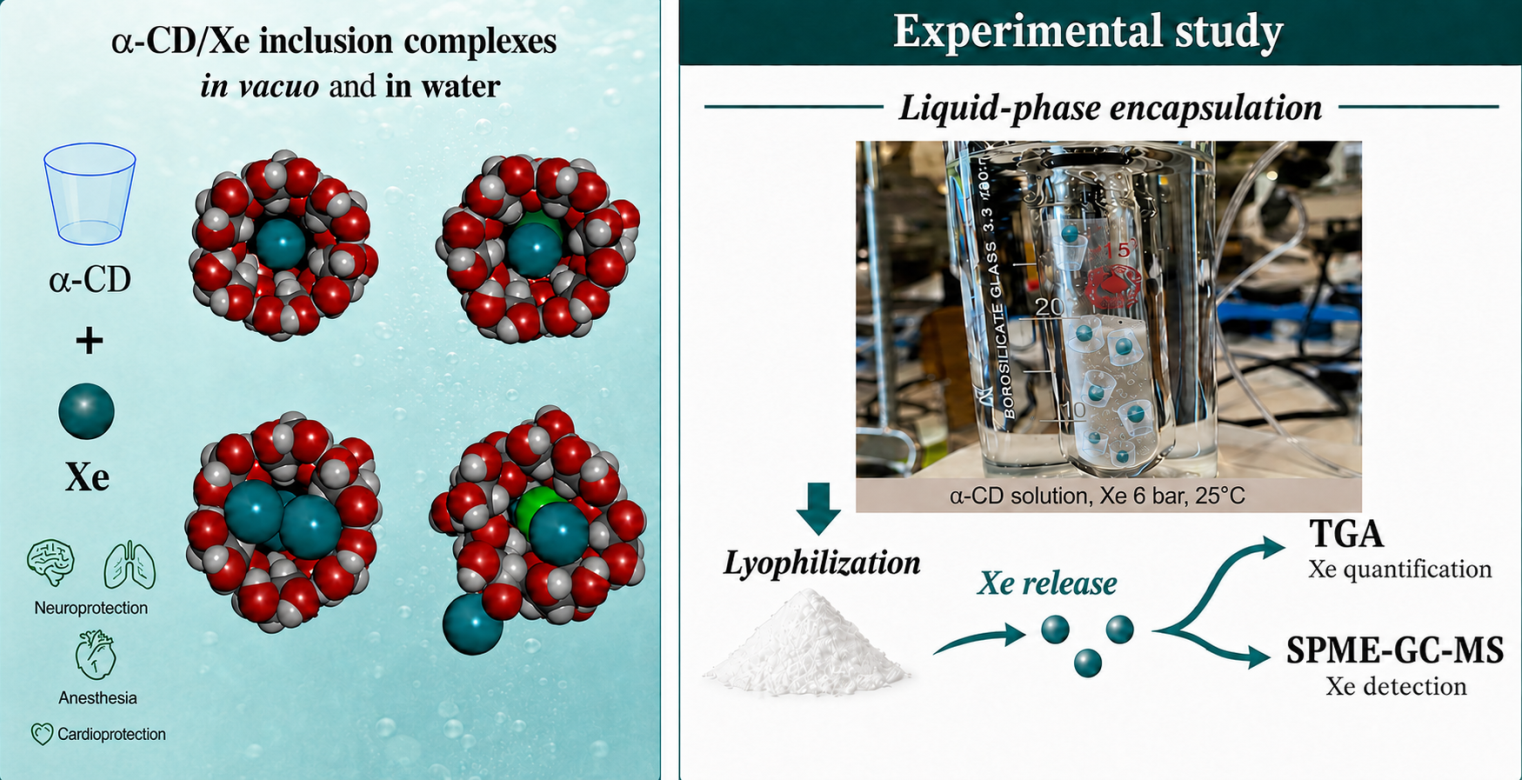
Xenon (Xe) is an inert noble gas receiving increasing attention in medical research due to its anesthetic properties, ability to regulate metabolic processes, and broad organoprotective effects. Due to its low molecular weight and small size, Xe can be encapsulated within α-cyclodextrin (α-CD). In this study, we combine a theoretical study based on molecular mechanics (MM) and molecular dynamics (MD) simulations with the synthesis and characterization of the α-CD/Xe inclusion complex. During the MD simulations, surface interactions and the formation of inclusion complexes, with Xe atoms encapsulated within the α-CD cavity, were observed in aqueous solution. As the Xe concentration in water increased, α-CD/Xe inclusion complexes with 1:1, 1:2, and 1:3 stoichiometries were formed and remained stable over time, suggesting increasingly effective encapsulation at higher pressures. Following this computational investigation, experimental work was conducted to synthesize and characterize the α-CD/Xe inclusion complex using a liquid-phase encapsulation method. The complexes were prepared at pressures of 2 and 4 bar. Thermogravimetric analysis (TGA) revealed weight loss. The effective encapsulation of Xe was also confirmed by solid-phase microextraction coupled with gas chromatography - mass spectrometry (SPME-GC-MS), which detected the characteristic m/z signals of Xe and allowed monitoring of its release over time upon contact with aqueous solution.
Keywords:
xenon
; α-cyclodextrin
; inclusion complexes
; pharmaceutical applications
Copyright: This open access article is published under a Creative Commons CC BY 4.0 license, which permit the free download, distribution, and reuse, provided that the author and preprint are cited in any reuse.