
Submitted:
18 August 2026
Posted:
18 August 2026
You are already at the latest version
Abstract
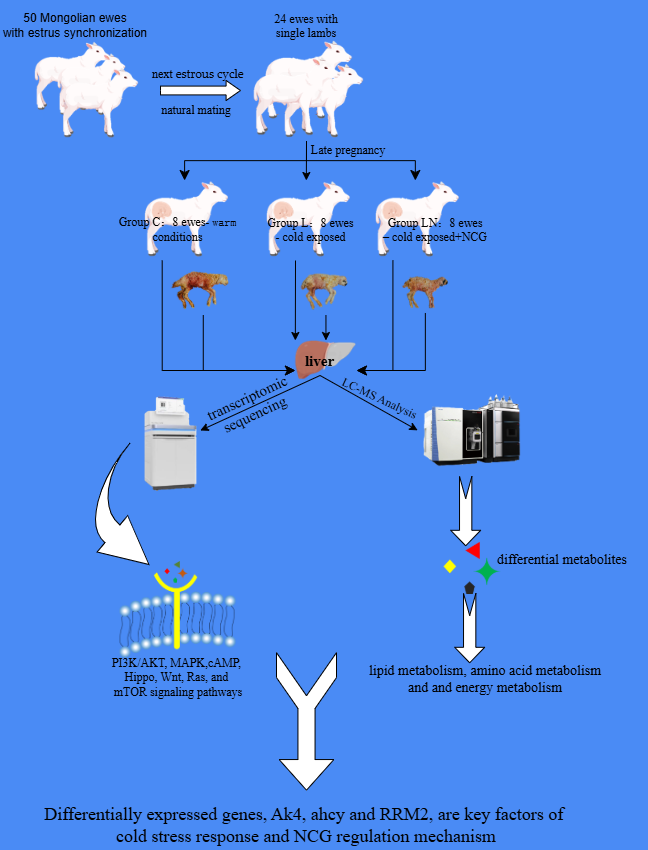
Chronic cold stress impairs hepatic metabolism, antioxidant balance and fetal development of Mongolian sheep in northern pastoral zones, yet systematic research on nutritional mitigation remains limited. N-carbamylglutamate (NCG) boosts endogenous arginine synthesis, but its hepatic regulatory mechanisms against cold stress in pregnant ewes and fetuses remain unclear. This study explored NCG’s protective effects via integrated liver transcriptome and metabolome analysis. Twenty-four late-gestation ewes were divided into warm control, cold stress, and cold stress + daily NCG supplementation groups. Hepatic mRNA, lncRNA, circRNA, miRNA sequencing, untargeted LC-MS metabolomics, multi-omics conjoint analysis and qRT-PCR verification were conducted on ewe and fetuses liver samples. The results showed that, cold stress disturbed mTOR, PI3K/AKT, amino acid and energy metabolic pathways, triggering massive differential RNA and metabolite changes. NCG supplementation reversed cold-induced transcriptional and metabolic disorders, restoring glutathione and cysteine-methionine metabolism. Core hub genes AK4, AHCY and RRM2 linking transcriptomic and metabolic shifts were validated by qPCR, with divergent hepatic NCG responses observed between ewes and fetuses. Maternal NCG alleviates cold-caused liver oxidative damage, remodels energy and amino acid metabolism via mTOR and redox pathways, and confers transgenerational protection to fetuses through the maternal-placental-fetal axis. These findings elucidate NCG’s anti-cold-stress molecular mechanism and provide a basis for nutritional intervention for cold-region sheep farming.
Keywords:
N-carbamylglutamate
; cold-stress
; Mongolia sheep
; metabolism regulation
; late gestation
Copyright: This open access article is published under a Creative Commons CC BY 4.0 license, which permit the free download, distribution, and reuse, provided that the author and preprint are cited in any reuse.