

Submitted:
17 August 2026
Posted:
18 August 2026
You are already at the latest version
Abstract
Antimicrobial resistance surveillance in companion animals requires phenotypic data that preserve bacterial assignment, antimicrobial agent, measured inhibition zone, interpretive category, and host linkage at the isolate level. This study reconstructed and analysed the cultivable oral bacterial fraction recovered from 100 dogs attending urban veterinary clinics in Loja, Ecuador, during April and May 2026. The archived analytical file contained 139 isolates linked to 82 represented dog identifiers. Conventional culture and biochemical testing produced presumptive phenotypic assignments comprising 48 Staphylococcus aureus, 38 Pseudomonas species, 29 Klebsiella species, 11 Enterobacter species, nine Salmonella species, and four Escherichia coli isolates. Antimicrobial susceptibility was evaluated by taxon and agent using the effective tested denominator rather than a common Gram group denominator. The Gram positive panel contained penicillin, oxacillin, ampicillin with sulbactam, and cefoxitin. The Gram negative panel contained ampicillin with sulbactam, ceftriaxone, streptomycin, trimethoprim with sulfamethoxazole, and tetracycline, although evaluability varied among taxon and agent combinations. Presumptive S. aureus showed penicillin resistance in 23 of 48 isolates, while all isolates were recorded as susceptible to oxacillin, cefoxitin, and ampicillin with sulbactam. Enterobacter displayed the broadest accumulation, including resistance proportions of 72.7 percent to tetracycline and 63.6 percent to ampicillin with sulbactam. Among Gram negative isolates, 76 of 91 were resistant to at least one represented class and 40 of 91 to at least two classes after audit. Multidrug resistance was estimable only when at least three broad classes had been tested and was identified in 13 of 61 evaluable Gram negative isolates. A generalized estimating equation model with dog identifier as the clustering unit showed an exploratory association between Enterobacter assignment and resistance to at least two classes relative to Pseudomonas, with an odds ratio of 13.32, a 95 percent confidence interval of 1.32 to 134.56, and a p value of 0.028. Exclusion of records with discordant host descriptors attenuated this estimate to an odds ratio of 8.41 and a p value of 0.052. The study provides a taxon resolved phenotypic baseline and a reproducible framework for companion animal antimicrobial resistance surveillance in settings where culture based diagnostics remain central.
Keywords:
canine oral bacteria
; antimicrobial susceptibility
; resistance accumulation
; companion animals
; One Health
; Ecuador
1. Introduction
Antimicrobial resistance is generated and maintained within connected clinical, ecological, and social systems. Antimicrobial exposure selects bacterial populations, but the phenotype observed at a particular anatomical site also reflects bacterial identity, intrinsic susceptibility, acquired determinants, local microbial interactions, host contact networks, and the architecture of the susceptibility panel. Companion animals occupy a distinctive position within this system because they receive antimicrobial therapy, share built environments with people, and move repeatedly between households and veterinary facilities. These characteristics justify their inclusion in surveillance without presuming that carriage establishes direction of transmission. Recent One Health studies have documented household sharing of resistant Enterobacterales and staphylococci, while reviews emphasize that genomic similarity, temporal information, and exposure data are required before transmission can be inferred [28,32,33,34,35,36].
Dogs are especially relevant to companion animal surveillance because they have frequent physical contact with household members and receive many of the same antimicrobial classes used in human medicine. Clinical isolates from canine urinary, dermatological, otic, ocular, and other specimens show substantial variation by organism, anatomical source, country, laboratory method, clinical population, and calendar period [12,13,14,15,16,17,18,19,20,21,22,23,24,25,26,27,28,29,30,31]. This variation prevents a single resistance proportion from representing the canine bacterial population. It also shows why isolate level data, taxon specific denominators, and explicit interpretive rules are more informative than pooled summaries. A local study can contribute meaningfully when it is designed as a transparent phenotypic baseline rather than as evidence of national prevalence or demonstrated zoonotic transfer.
The canine oral cavity contains spatially structured microbial communities that differ among teeth, gingival niches, mucosal surfaces, periodontal pockets, and clinical states. Sequencing studies demonstrate that the complete oral microbiome is substantially more diverse than the fraction recovered through routine culture [3,4,5,6,7,8,9]. Culture nevertheless remains indispensable when the objective includes antimicrobial susceptibility because a viable isolate provides the substrate for standardized phenotypic testing, confirmatory identification, preservation, and future genomic analysis. Culture based and sequence based approaches answer related but nonidentical questions. Sequencing characterizes community structure and genetic potential, whereas disk diffusion and dilution methods measure expressed growth inhibition under defined laboratory conditions [1,2,3,4,5].
The distinction between a cultivable bacterial fraction and the complete microbiome is central to interpretation. A culture collection is shaped by the sampled anatomical site, transport, atmosphere, media, incubation, colony selection, and biochemical decision pathway. Consequently, the recovered distribution describes the analytical collection rather than the relative abundance of all microorganisms in the mouth. The same principle applies to animal level prevalence. When several colony morphotypes are recovered from one dog, the number of isolates exceeds the number of animals and percentages calculated from isolates cannot be interpreted as percentages of dogs. Preserving the dog identifier is therefore necessary both to describe multiplicity and to account for correlation among isolates from the same host.
Phenotypic taxonomic assignment has an explicit evidentiary level. Conventional colony morphology, Gram staining, catalase, oxidase, coagulase, and biochemical reactions can support genus level and presumptive species level classification, but their resolution differs from matrix assisted laser desorption ionization time of flight mass spectrometry, targeted polymerase chain reaction, 16S ribosomal RNA sequencing, or whole genome sequencing. This distinction is particularly consequential for members of the Staphylococcus intermedius group and for presumptive enteric organisms such as Salmonella. Contemporary studies show that genomic and mass spectrometric confirmation can revise phenotypic assignments and reveal resistance determinants that are not visible in disk diffusion alone [5,11,20,21,22,23,24,25,26,27,28,29]. A defensible phenotypic study therefore retains the value of the observed culture and susceptibility data while calibrating taxonomic wording to the method used.
Antimicrobial susceptibility interpretation requires a second level of precision. The diameter surrounding a disk is an observed measurement. Its translation into susceptible, intermediate, or resistant depends on a valid organism, agent, host, infection site, method, and breakpoint combination. CLSI VET01 describes standardized veterinary disk and dilution procedures, while VET01S provides current veterinary interpretive and quality control tables [1,2]. Breakpoints cannot be transferred automatically across taxa or agents. When an archived dataset contains different panels for Gram positive and Gram negative isolates, the number of opportunities to identify multidrug resistance also differs. Direct comparison then requires restriction to comparable and evaluable combinations rather than assignment of a common denominator to all isolates.
The intermediate category warrants similarly careful treatment. It may indicate uncertain response at standard exposure, potential response with increased exposure, or a technical buffer around a breakpoint, depending on the standard and agent. Combining intermediate with resistant can be useful for an epidemiological non-susceptibility outcome, but that combination should not be described as clinical resistance. Conversely, using resistant results alone provides a more specific phenotype but can underestimate the broader category used in international multidrug resistance definitions. The selected outcome must therefore be stated consistently in methods, tables, and interpretation [1,2,54].
Resistance accumulation offers information beyond a separate percentage for each disk. Counting the number of represented antimicrobial classes with resistance identifies isolates in which phenotypes extend across therapeutic categories. The measure is panel dependent because an isolate cannot accumulate resistance to a class that was not tested. Multidrug resistance should therefore be estimated only for isolates with adequate class coverage. This approach avoids interpreting a narrow single class Gram positive panel as evidence that multidrug resistance was absent. It also separates resistance to at least two classes, which is an accumulation outcome, from multidrug resistance, which conventionally requires at least one non-susceptible result in three or more categories [54].
Host variables can be evaluated when the isolate retains a link to the source dog, but the model must reflect the hierarchical structure. Multiple isolates from one animal are not independent observations. Generalized estimating equations provide population averaged estimates with robust standard errors when clusters are identified and the number of isolates per cluster is modest [55]. The model must also be proportional to the number of outcome events. Small taxonomic categories and sparse combinations produce wide confidence intervals, so effect estimates are most informative as exploratory signals whose stability is evaluated through sensitivity analyses rather than as fixed biological constants.
Ecuador and much of Latin America remain underrepresented in companion animal antimicrobial resistance surveillance. Available evidence is fragmented across clinical laboratories, individual anatomical sites, and nonuniform panels [31,37,38,39,40,41,42,43,44,45,46,47,48,49,50,51,52,53]. In this context, the scientific contribution of a local culture based study lies in the granularity and auditability of its records. A dataset that identifies the dog, isolate, presumptive taxon, agent, disk code, measured zone, category, and resistance burden can be reanalysed when standards evolve and can guide prospective studies that add molecular confirmation and exposure histories.
The present study was rebuilt around the archived isolate level evidence rather than the pooled summaries of the rejected manuscript. The objectives were to characterize the presumptively identified cultivable oral bacterial collection from dogs attending urban veterinary clinics in Loja, describe susceptibility by taxon and agent using effective tested denominators, quantify resistance accumulation within evaluable panels, and examine bacterial and host correlates of resistance to at least two classes using cluster aware modelling. A parallel audit distinguished source recorded categories, recalculated categories based on archived thresholds, non-tested combinations, and records requiring sensitivity analysis. This design treats reproducibility as part of the scientific result and positions the work as baseline phenotypic surveillance rather than as a reconstruction of the complete oral microbiome or direct evidence of interspecies transmission.
2. Materials and Methods
2.1. Study Design and Setting
A cross sectional analytical study was conducted in dogs presented to urban veterinary clinics in Loja, Ecuador, between April and May 2026. The source records described 100 sampled dogs older than six months that attended routine veterinary consultation. The available documents did not preserve the number of participating clinics, the sequence by which animals were approached, or a classification of consultation indications. The analytical framework therefore defines the population as the sampled clinic attending dogs and does not use the data to estimate prevalence for all dogs in Loja or Ecuador.
The isolate level worksheet contained 139 bacterial records linked to 82 represented dog identifiers. Eighteen identifiers from the sequence of 100 sampled dogs were not represented in the isolate file. The archived material did not document whether those dogs had no bacterial growth, no selected colony morphotype, an excluded isolate, or another processing outcome, so no culture status was assigned retrospectively. The analytical population for microbiological results was the collection of 139 archived isolates, while dog descriptors were used only when present and internally coherent.
2.2. Host Assessment and Oral Sampling
Recorded host descriptors comprised age in years, sex, diet category, skull morphology, gingivitis grade, and periodontitis grade. Diet was recorded as balanced, mixed, or homemade. Skull morphology was recorded as dolichocephalic, mesocephalic, or brachycephalic. Gingivitis was coded in three ordered grades and periodontitis in grades zero, one, two, and four. The available records did not retain a separate grading manual or the clinical measurements used to assign each category. The variables were analysed as recorded and were not redefined after data collection.
Oral specimens were collected with sterile rayon swabs from the gingival margin and adjacent oral mucosa under routine clinical conditions. Samples were transported to the Microbiology Laboratory of the Universidad Politécnica Estatal del Carchi and inoculated on selective and nonselective media used for recovery of aerobic and facultatively anaerobic bacteria. Distinct colony morphotypes were purified and processed as separate isolates. The archived materials did not preserve product manufacturer, lot number, standardized sampling duration, exact dental region, time since feeding, or detailed incubation time and temperature. These fields were not inferred during reconstruction. The manuscript reports the procedural elements retained in the source documents and aligns interpretation with that evidentiary level.
2.3. Presumptive Phenotypic Identification
Pure cultures were evaluated through colony morphology, Gram reaction, catalase, oxidase, coagulase, and additional conventional biochemical reactions selected according to the observed phenotype. Tests were reportedly performed in duplicate and independently verified before final assignment. The archived database grouped isolates as Staphylococcus aureus, Pseudomonas species, Klebsiella species, Enterobacter species, Salmonella species, or Escherichia coli. No matrix assisted laser desorption ionization time of flight mass spectrometry, species specific polymerase chain reaction, 16S ribosomal RNA sequencing, serological confirmation, or whole genome sequencing was performed.
All taxonomic results were consequently treated as presumptive culture based phenotypic assignments. The qualifier presumptive was applied consistently to S. aureus, Salmonella, and E. coli in tables and narrative, and the remaining Gram negative organisms were retained at genus level. The analysis does not equate the 48 coagulase compatible staphylococcal isolates with confirmed S. aureus and does not interpret the nine presumptive Salmonella isolates as confirmed zoonotic Salmonella. This terminology preserves the recorded laboratory classification while avoiding taxonomic resolution that the method cannot establish.
2.4. Antimicrobial Susceptibility Testing and Archived Panel
Antimicrobial susceptibility was evaluated by the Kirby Bauer disk diffusion method on Mueller Hinton agar after adjustment of bacterial suspensions to a 0.5 McFarland standard. The source documents referred to CLSI guidance but did not preserve the edition, table, manufacturer, lot, quality control strain results, or exact incubation parameters used during the original laboratory work. Current CLSI veterinary standards identify VET01 as the reference method and VET01S as its interpretive supplement [1,2]. The reconstruction does not retroactively assign a current breakpoint to an archived test when the organism and agent combination was not demonstrably covered by the preserved information.
The disk codes retained in the workbook were used to reconstruct active contents. The Gram positive panel comprised penicillin P10, oxacillin OX5, ampicillin with sulbactam SAM20, and cefoxitin FOX30. The Gram negative panel comprised ampicillin with sulbactam SAM20, ceftriaxone CRO30, streptomycin STR10, trimethoprim with sulfamethoxazole SXT25, and tetracycline TET30. The conventional content represented by these codes was recorded as penicillin 10 units, oxacillin 5 micrograms, ampicillin with sulbactam 10 and 10 micrograms, cefoxitin 30 micrograms, ceftriaxone 30 micrograms, streptomycin 10 micrograms, trimethoprim with sulfamethoxazole 1.25 and 23.75 micrograms, and tetracycline 30 micrograms. These contents describe the archived disk coding and do not substitute for unavailable manufacturer documentation.
The primary descriptive analysis used the source recorded susceptible, intermediate, and resistant category for each taxon and agent combination. A numeric audit compared the recorded category with the measured zone and threshold fields embedded in the workbook. Combinations lacking a measured zone or a defensible recorded interpretation were coded as not evaluated. Three discrepancies were retained in an audit table rather than corrected silently. One presumptive staphylococcal penicillin result recorded as susceptible was intermediate under the embedded thresholds. One Pseudomonas ampicillin with sulbactam record lacked a zone and was reclassified as not evaluated. One Pseudomonas tetracycline result recorded as susceptible was resistant under the embedded thresholds.
2.5. Resistance Outcomes
For each isolate, agent results were mapped to broad antimicrobial categories. Penicillin, oxacillin, ampicillin with sulbactam, cefoxitin, and ceftriaxone were recognized as beta lactam agents for class accumulation. Streptomycin represented aminoglycosides, tetracycline represented tetracyclines, and trimethoprim with sulfamethoxazole represented folate pathway inhibitors. Resistance to at least one class was defined by one or more resistant results in the represented categories. Resistance to at least two classes was defined independently from multidrug resistance and served as the main regression outcome among Gram negative isolates.
Multidrug resistance was defined as resistance to at least one agent in three or more broad categories, consistent with the conceptual structure proposed by Magiorakos and colleagues [54]. Estimation was restricted to isolates tested against at least three categories. The Gram positive panel represented beta lactams only, so multidrug resistance was not estimable in those isolates. Among Gram negative taxa, evaluability depended on actual agent coverage. This restriction prevents panel width from being interpreted as a biological absence of multidrug resistance.
2.6. Data Reconstruction and Quality Assurance
The original tabulation was transformed into a master database with one row per isolate and a long susceptibility table with one row per isolate and antimicrobial agent. Each record retained source dog identifier, isolate code, Gram group, presumptive taxon, host descriptors, measured zone, embedded thresholds, source category, audited category, represented class, and resistance burden variables. Derived tables were generated from the long file so that every percentage could be traced to an explicit numerator and effective denominator.
Quality assurance included checks for duplicate isolate codes, missing identifiers, incompatible host descriptors within the same dog identifier, impossible zone values, category threshold disagreements, class coverage, and denominator consistency. Dog identifiers 33 and 34 contained discordant host descriptors across six isolate rows. These records remained in the primary microbiological summaries because the isolate and susceptibility observations were distinct, but a sensitivity analysis excluded both clusters from host adjusted modelling. This approach separates preservation of laboratory observations from uncertainty in the linked host covariates.
2.7. Statistical Analysis
Categorical variables were summarized as counts and percentages with their denominator stated. Taxon specific susceptibility tables reported susceptible, intermediate, resistant, and not evaluated results separately. Resistance percentages used only numerically interpretable tests for the corresponding taxon and agent. Wilson 95 percent confidence intervals were calculated for resistant proportions because several cells were small and normal approximation intervals perform poorly near zero or one.
The main inferential outcome was resistance to at least two broad classes among the 91 Gram negative isolates. Population averaged logistic regression was fitted with generalized estimating equations, dog identifier as the clustering variable, an exchangeable working correlation, and robust standard errors [55]. Candidate predictors were presumptive bacterial genus, age, sex, diet, gingivitis grade, and advanced periodontitis. Pseudomonas was the taxonomic reference. Model complexity was interpreted in relation to the 40 recalculated events and nine predictor parameters. Odds ratios, robust 95 percent confidence intervals, and two sided p values were reported.
Three analytical views were compared. First, an ordinary logistic model was fitted to reproduce the estimates in the rejected manuscript. Second, the cluster aware model was fitted using source recorded outcomes. Third, the outcome was recalculated after the category audit. Stability was then evaluated by excluding dog identifiers 33 and 34. Discrimination was described with the area under the receiver operating characteristic curve and overall accuracy with the Brier score. Statistical significance was set at 0.05, while emphasis was placed on effect magnitude, interval width, event density, and sensitivity to data decisions.
2.8. Ethical Considerations
The study protocol was approved by the Bioethics Committee for Research Involving Animals of the Universidad Politécnica Estatal del Carchi under approval UPEC CBIEAV 2026 005 M. Oral sampling was performed during routine veterinary consultation using noninvasive procedures. Dog owners provided informed consent before participation. Identifiers in the analytical files were numerical and the reconstructed dataset contained no direct owner identifiers.
3. Results
3.1. Analytical Population and Data Flow
The study records described 100 sampled dogs and the isolate level analytical file contained 139 cultivable bacterial isolates. Eighty two dog identifiers were represented in the database. Forty two represented dogs contributed one isolate, 27 contributed two isolates, nine contributed three isolates, and four contributed four isolates. The maximum cluster size was four in the master database and three among Gram negative isolates used in the regression. The pattern confirms that the isolate was the microbiological unit and the dog was the clustering unit.
The 139 isolates included 91 Gram negative and 48 Gram positive records. Presumptive S. aureus accounted for 48 isolates or 34.5 percent of the collection. Gram negative assignments comprised 38 Pseudomonas isolates or 27.3 percent, 29 Klebsiella isolates or 20.9 percent, 11 Enterobacter isolates or 7.9 percent, nine presumptive Salmonella isolates or 6.5 percent, and four presumptive E. coli isolates or 2.9 percent. These percentages describe the isolate collection and not the proportion of dogs carrying each taxon.
At the isolate row level, ages ranged from one to nine years. Eighty three records were linked to male dogs and 56 to female dogs. Diet was recorded as balanced for 74 isolate rows, mixed for 36, and homemade for 29. Skull morphology was dolichocephalic for 101 rows, mesocephalic for 31, and brachycephalic for seven. Gingivitis grades one, two, and three were represented by 30, 40, and 69 rows, while periodontitis grades zero, one, two, and four were represented by 30, 40, 31, and 38 rows. These counts are isolate linked descriptors and are not independent dog level frequency estimates.

Table 1.
Distribution of presumptively identified cultivable oral bacterial isolates.
| Presumptive phenotypic taxon | Gram group | n | Percent |
| Staphylococcus aureus | Positive | 48 | 34.5 |
| Pseudomonas spp. | Negative | 38 | 27.3 |
| Klebsiella spp. | Negative | 29 | 20.9 |
| Enterobacter spp. | Negative | 11 | 7.9 |
| Salmonella spp. | Negative | 9 | 6.5 |
| Escherichia coli | Negative | 4 | 2.9 |
| Total | 139 | 100.0 |
Note. Assignments are presumptive and percentages use isolates as the denominator.
3.2. Taxon Specific Antimicrobial Susceptibility
The susceptibility database contained 647 isolate and agent records. Five hundred and three had a numerically interpretable result and 144 were not evaluated under the archived panel or lacked a defensible numeric interpretation. Effective denominators therefore differed by taxon and agent. The taxon specific structure is presented in Table 2 and Figure 1. This representation replaces pooled Gram group percentages that assumed all 91 Gram negative isolates had been tested against every agent.
Among the 48 presumptive S. aureus isolates, penicillin produced 24 susceptible, one intermediate, and 23 resistant classifications. The resistant proportion was 47.9 percent with a Wilson 95 percent confidence interval of 34.5 to 61.7 percent. All 48 isolates were recorded as susceptible to oxacillin, ampicillin with sulbactam, and cefoxitin. These disk results do not constitute molecular confirmation of methicillin susceptibility or species identity, but they show that no resistant category was recorded for the oxacillin and cefoxitin tests in this phenotypic collection.
Pseudomonas isolates were evaluable for ampicillin with sulbactam in 37 of 38 records, streptomycin in all 38, and tetracycline in all 38. Resistance occurred in 18 of 37 evaluable ampicillin with sulbactam tests, 16 of 38 streptomycin tests, and 20 of 38 tetracycline tests. Ceftriaxone and trimethoprim with sulfamethoxazole were not treated as interpretable combinations in the reconstructed dataset. The resulting pattern should therefore be read as an archived phenotypic profile rather than as a complete therapeutic panel for Pseudomonas.
Klebsiella isolates were evaluable for ceftriaxone, ampicillin with sulbactam, and trimethoprim with sulfamethoxazole. Resistance was recorded in one of 29 ceftriaxone tests, 16 of 29 ampicillin with sulbactam tests, and 14 of 29 trimethoprim with sulfamethoxazole tests. Streptomycin and tetracycline were not interpreted for this taxon in the reconstructed table. The contrast between low ceftriaxone resistance and higher resistance to the other two represented agents illustrates why taxon and agent resolution is more informative than a pooled Gram negative percentage.
Enterobacter showed the broadest phenotypic resistance across the five represented Gram negative categories. Three of 11 isolates were resistant to ceftriaxone, seven to ampicillin with sulbactam, six to streptomycin, three to trimethoprim with sulfamethoxazole, and eight to tetracycline. The corresponding resistant proportions ranged from 27.3 percent to 72.7 percent. Confidence intervals were broad because the taxon comprised 11 isolates, but the repeated expression of resistance across distinct classes produced a high resistance accumulation outcome.
Among the nine presumptive Salmonella isolates, resistance was recorded in two ceftriaxone tests, four ampicillin with sulbactam tests, three trimethoprim with sulfamethoxazole tests, and two tetracycline tests. Streptomycin was not evaluated. Among the four presumptive E. coli isolates, all four were resistant to ampicillin with sulbactam, one was resistant to streptomycin, two to trimethoprim with sulfamethoxazole, three to tetracycline, and none to ceftriaxone. The small numbers make these distributions descriptive and support retention of exact numerators rather than isolated percentages.
3.3. Resistance Accumulation and Multidrug Resistance
Using the audited resistant categories, 76 of 91 Gram negative isolates or 83.5 percent were resistant to at least one represented class. Forty of 91 or 44.0 percent were resistant to at least two classes. The source recorded classification yielded 39 events for the latter outcome, while the audit changed one Pseudomonas tetracycline result and increased the count to 40. This difference was carried through the sensitivity analysis rather than hidden in a single final value.
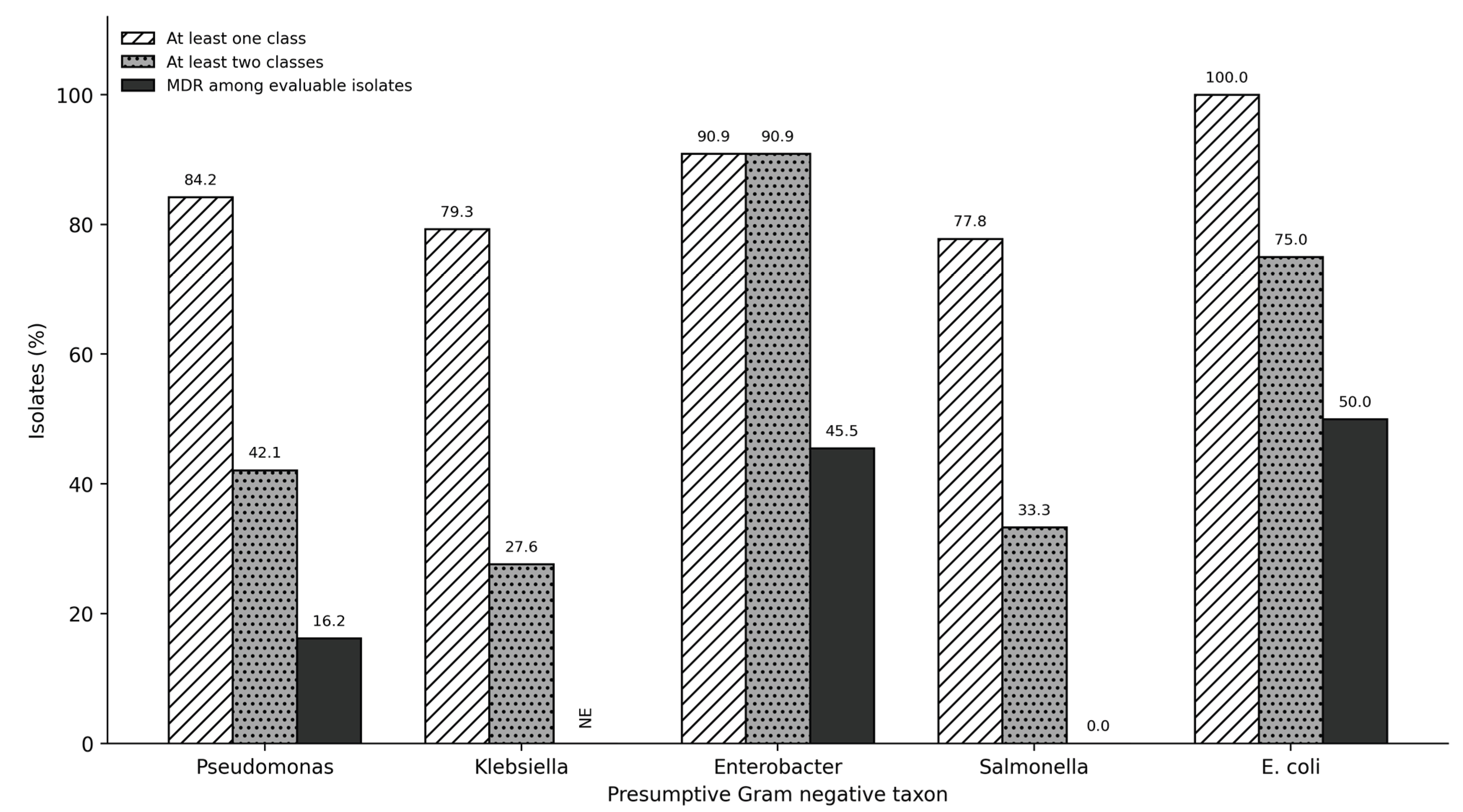
Resistance accumulation differed among taxa. Thirty two of 38 Pseudomonas isolates were resistant to at least one class and 16 were resistant to at least two classes after audit. Twenty three of 29 Klebsiella isolates were resistant to at least one class and eight to at least two classes. Ten of 11 Enterobacter isolates were resistant to at least one class and all ten resistant isolates met the two class accumulation outcome. Seven of nine presumptive Salmonella isolates were resistant to at least one class and three to at least two classes. All four presumptive E. coli isolates were resistant to at least one class and three to at least two classes.
Multidrug resistance could be evaluated in 61 Gram negative isolates with at least three represented classes. Thirteen of these 61 isolates or 21.3 percent met the three class criterion. Taxon specific counts were six of 37 evaluable Pseudomonas isolates, five of 11 Enterobacter isolates, none of nine presumptive Salmonella isolates, and two of four presumptive E. coli isolates. The Klebsiella panel did not provide three broad evaluable classes in the reconstructed dataset. The Gram positive panel represented beta lactams only, so an MDR proportion was not calculated for presumptive S. aureus.
Table 3.
Resistance accumulation by presumptive taxon.
| Presumptive taxon | n | At least one class | At least two classes | MDR among evaluable | Panel interpretation |
| Presumptive S. aureus | 48 | 23 (47.9) | 0 (0.0) | Not estimable | One broad class |
| Pseudomonas spp. | 38 | 32 (84.2) | 16 (42.1) | 6/37 (16.2) | At least three classes for 37 |
| Klebsiella spp. | 29 | 23 (79.3) | 8 (27.6) | Not estimable | Fewer than three interpretable classes |
| Enterobacter spp. | 11 | 10 (90.9) | 10 (90.9) | 5/11 (45.5) | Five represented classes |
| Presumptive Salmonella spp. | 9 | 7 (77.8) | 3 (33.3) | 0/9 (0.0) | Four represented classes |
| Presumptive E. coli | 4 | 4 (100.0) | 3 (75.0) | 2/4 (50.0) | Five represented classes |
Note. MDR required resistance in at least three broad classes and was calculated only in evaluable isolates.
Figure 2.
Resistance accumulation among presumptive Gram negative taxa. MDR uses only isolates with at least three evaluable classes.
Figure 2.
Resistance accumulation among presumptive Gram negative taxa. MDR uses only isolates with at least three evaluable classes.
3.4. Cluster Aware Association Analysis
The ordinary logistic model reproduced the estimates reported in the rejected manuscript, including an Enterobacter odds ratio of 16.30 with a 95 percent confidence interval of 1.69 to 157.15 and a p value of 0.016. Because those estimates were obtained without a clustering correction, the revised analysis used generalized estimating equations with dog identifier as the cluster. The working within dog correlation was low, at 0.029 for the recalculated outcome, but the robust model was retained because multiple isolates from the same dog remained structurally nonindependent.
In the recalculated GEE model, Enterobacter assignment was associated with higher population averaged odds of resistance to at least two classes relative to Pseudomonas, with an odds ratio of 13.32, a 95 percent confidence interval of 1.32 to 134.56, and a p value of 0.028. Klebsiella, presumptive Salmonella, and presumptive E. coli did not show statistically resolved differences from Pseudomonas. Age, sex, diet, gingivitis grade, and advanced periodontitis were also not independently associated with the outcome. The model contained 40 events for nine parameters, equivalent to 4.44 events per parameter, so interval width carries essential information about precision.
Excluding dog identifiers 33 and 34 attenuated the Enterobacter estimate to an odds ratio of 8.41 with a 95 percent confidence interval of 0.98 to 71.81 and a p value of 0.052. This sensitivity result indicates that the taxonomic signal is present across analytical views but its exact magnitude and conventional significance threshold depend on a small number of clusters. The model area under the receiver operating characteristic curve was approximately 0.72 and the Brier score was approximately 0.20, which supports moderate discrimination without implying a clinical prediction tool.
Table 4.
Cluster aware models for resistance to at least two antimicrobial classes.
| Analysis | Contrast | Odds ratio | Robust 95 percent CI | p value |
| Primary source category model | Enterobacter vs Pseudomonas | 16.37 | 1.43 to 187.03 | 0.025 |
| Audited category model | Enterobacter vs Pseudomonas | 13.32 | 1.32 to 134.56 | 0.028 |
| Audited model excluding identifiers 33 and 34 | Enterobacter vs Pseudomonas | 8.41 | 0.98 to 71.81 | 0.052 |
| Audited category model | Age, sex, diet, oral grades | Not resolved | Intervals included 1 | Greater than 0.05 |
4. Discussion
4.1. Scientific Meaning of the Cultivable Oral Bacterial Collection
The revised analysis reframes the study around what the data can establish with high resolution. It characterizes 139 cultivable bacterial isolates obtained from the gingival margin and adjacent oral mucosa of clinic attending dogs, not the complete oral microbiome and not a national dog population. This distinction strengthens rather than diminishes the contribution. The value of a culture based collection lies in the linkage between a viable organism, an observed inhibition zone, and a resistance phenotype. Sequencing studies reveal the broader ecological context, while phenotypic testing identifies how selected cultured organisms behave under antimicrobial exposure [3,4,5,6,7,8,9]. Both approaches are required for a complete surveillance system.
The predominance of Gram negative isolates in this collection should not be interpreted as evidence that Gram negative organisms dominate every canine oral niche. Culture media, atmosphere, sampled surface, colony selection, periodontal condition, and local clinical practices all influence recovery. Studies using next generation sequencing and mass spectrometry have shown that canine oral communities contain diverse anaerobic, facultative, and aerobic taxa whose distribution changes across niches and periodontal states [3,4,5,6,7,8]. The present result is therefore most useful as a description of the cultivable fraction recovered by the applied workflow and as a foundation for future paired phenotypic and genomic work.
The recovery of multiple morphotypes from individual dogs is biologically plausible in a polymicrobial oral environment and statistically consequential. Forty of 82 represented dog identifiers contributed more than one isolate. Treating those isolates as independent would understate uncertainty if host characteristics or shared exposures produced correlated phenotypes. The low estimated working correlation does not remove the hierarchical structure because correlation is a property estimated from this sample and can vary by outcome. Retaining dog identifier in the GEE model provides a defensible population averaged analysis and makes the unit of inference explicit.
The isolate distribution also illustrates why dog positivity cannot be inferred from isolate frequency. Forty eight presumptive staphylococcal isolates constituted 34.5 percent of the collection, but this does not mean that 34.5 percent of dogs were positive. Some dogs contributed multiple isolates and 18 sampled dogs were not represented in the isolate file. Reporting the isolate denominator prevents a common epidemiological error and aligns the manuscript with surveillance practice, where isolate based and animal based indicators answer different questions.
4.2. Taxonomic Resolution and Phenotypic Evidence
The use of presumptive terminology is especially important for the 48 isolates originally labelled S. aureus. Coagulase positive staphylococci from dogs include members of the Staphylococcus intermedius group, particularly S. pseudintermedius, and routine biochemical pathways can misclassify them. Recent canine studies increasingly use matrix assisted laser desorption ionization time of flight mass spectrometry, species specific polymerase chain reaction, or whole genome sequencing to resolve this group and to identify mecA, resistance cassettes, and clonal lineages [20,21,22,23,24,25,26,27,28,29]. The archived isolates were not confirmed by those methods. The revised manuscript therefore reports a coagulase compatible presumptive S. aureus group and does not infer species specific epidemiology from the name alone.
The same calibration applies to presumptive Salmonella. Nine isolates carried a conventional biochemical assignment compatible with Salmonella, but no serology, polymerase chain reaction, or genome sequence was available. Genomic investigations of Salmonella from companion animals demonstrate that serovar assignment, resistance genes, plasmids, and mobile elements materially change the public health interpretation [31]. Here, the observation is retained as a signal that an enteric compatible phenotype was recovered from oral samples. It is not presented as confirmed carriage of a particular serovar or as evidence of zoonotic transmission.
Phenotypic studies retain scientific relevance when molecular confirmation is unavailable. Disk diffusion captures expressed susceptibility under the test conditions, while detection of a resistance gene establishes genetic potential that may or may not translate into the same phenotype. Contemporary surveillance increasingly combines both layers because discrepancies reveal regulatory, expression, methodological, and breakpoint effects [14,18,20,23,26,27,32]. A transparent phenotypic baseline is not a substitute for genomic surveillance, but it is a necessary component of the evidence chain and can identify isolates or taxon agent combinations that merit confirmatory investigation.
The reconstruction demonstrates how archived data can be made more scientifically useful. By separating source taxonomy, phenotypic certainty, measured zone, source category, audited category, and taxon specific denominator, the revised database permits independent review of each conclusion. This structure is preferable to silently replacing the original labels with a modern taxonomy that was not measured. It also permits future researchers to append mass spectrometric or genome results if retained isolates become available, without changing the identity of the original observation.
4.3. Taxon and Agent Specific Susceptibility Patterns
The most consequential change in the revised results is replacement of pooled Gram negative susceptibility percentages with taxon and agent specific denominators. The original pooled values assumed a common denominator of 91 isolates for several agents, yet the reconstructed file showed that ceftriaxone, streptomycin, and trimethoprim with sulfamethoxazole were numerically interpretable for 53 Gram negative isolates, tetracycline for 62, and ampicillin with sulbactam for 90. A pooled percentage that treats non-tested combinations as susceptible or includes them in the denominator can substantially distort the apparent activity of an antimicrobial. The revised table resolves this by showing exactly how many isolates were tested for every combination.
Penicillin resistance in 23 of 48 presumptive staphylococcal isolates was the only substantial resistant category in the Gram positive panel. Beta lactam resistance among canine staphylococci is well documented, but species identity and mecA status strongly influence interpretation [20,21,22,23,24,25,26,27,28,29]. The absence of recorded oxacillin and cefoxitin resistance in this collection is best described as a disk diffusion observation. It does not prove absence of methicillin resistance because confirmatory identification, quality control records, and molecular testing were not available. This wording preserves the laboratory result without transforming it into a clinical or genomic conclusion.
The Gram positive panel also demonstrates why broad claims of homogeneous susceptibility are uninformative. Four disks were applied, but all represented the beta lactam family. Complete susceptibility to three disks does not establish susceptibility across macrolides, lincosamides, tetracyclines, aminoglycosides, fluoroquinolones, or folate pathway inhibitors. Contemporary staphylococcal studies use wider panels because resistance often co-occurs across classes and because inducible clindamycin resistance, tetracycline resistance, and aminoglycoside determinants can influence treatment [20,21,22,23,24,25,26,27,28,29]. The revised paper therefore reports the observed beta lactam profile and does not calculate Gram positive MDR.
Among Pseudomonas isolates, resistance was common in the three combinations retained as interpretable. Pseudomonas has intrinsic and acquired mechanisms that complicate extrapolation from agents not supported by an organism specific interpretive framework. The purpose of the present table is not to recommend ampicillin with sulbactam, tetracycline, or streptomycin for canine oral Pseudomonas. It is to report the archived categories and show their contribution to resistance accumulation. Clinical recommendations would require confirmed species identity, infection rather than colonization, appropriate veterinary breakpoints, pharmacokinetics, anatomical site, and patient context [1,2].
Klebsiella displayed a contrasting profile, with one ceftriaxone resistant isolate but resistance in approximately half of the isolates tested with ampicillin and sulbactam or trimethoprim and sulfamethoxazole. Recent surveillance identifies Klebsiella from companion animals as a taxon of One Health interest because extended spectrum beta lactamases, AmpC enzymes, carbapenemases, virulence determinants, and household sharing can occur [18,31,32,53,56]. The present data do not identify those mechanisms. They provide a local phenotype that justifies prioritizing Klebsiella for confirmatory species identification and resistance gene analysis in prospective surveillance.
Enterobacter showed the most consistent resistance accumulation across the represented panel. Eight of 11 isolates were resistant to tetracycline, seven to ampicillin with sulbactam, six to streptomycin, and three each to ceftriaxone and trimethoprim with sulfamethoxazole. Enterobacter species can combine intrinsic beta lactam resistance, inducible chromosomal AmpC activity, acquired beta lactamases, efflux, target modification, and mobile resistance elements. Because only genus level phenotypic assignment was available, the data cannot separate members of the Enterobacter cloacae complex or identify mechanisms. The repeated resistance phenotype nevertheless explains why this group generated the strongest accumulation signal.
The presumptive E. coli pattern is numerically striking but based on four isolates. All four were resistant to ampicillin with sulbactam, three to tetracycline, two to trimethoprim with sulfamethoxazole, and one to streptomycin, while all were susceptible to ceftriaxone in the archived classification. Larger canine studies show that E. coli resistance varies with clinical source, prior hospitalization, antimicrobial exposure, geography, and selective culture strategy [12,13,14,15,30,31]. Exact numerators are therefore more informative than presenting 100 percent resistance without the denominator. The four isolates identify a hypothesis for future work rather than a population estimate.
4.4. Resistance Accumulation and Panel Architecture
Resistance accumulation is more informative than a sequence of isolated susceptibility percentages because it describes how many antimicrobial categories contribute to the phenotype of each isolate. Its interpretation nevertheless depends on the architecture of the testing panel. An isolate can only satisfy a three class MDR definition when at least three categories have been evaluated with interpretable criteria. This requirement is not merely statistical. It is embedded in the operational definition proposed for acquired resistance and prevents the absence of a test from being interpreted as susceptibility [54]. The revised analysis therefore distinguishes three quantities that answer different questions. Resistance to at least one class identifies any observed resistant phenotype. Resistance to at least two classes describes accumulation within the represented panel. MDR is calculated only when at least three classes were evaluable.
The resulting denominators differ from those in the rejected version. Among the 91 Gram negative isolates, 76 were resistant to at least one class and 40 were resistant to at least two classes after auditing the zone based classifications. Only 61 isolates had three or more evaluable categories and could enter the MDR denominator. Thirteen met the MDR criterion, yielding 21.3 percent among evaluable isolates. Reporting 13 of 139 would combine isolates tested with fundamentally different panels and would imply that all isolates had an equal opportunity to be classified as MDR. The revised denominator preserves the observed information and avoids dilution by structurally non-evaluable records.
The same principle changes the interpretation of the Gram positive results. Penicillin, oxacillin, ampicillin with sulbactam, and cefoxitin represent different agents but do not provide the category breadth required to estimate multidrug resistance. A collection may show susceptibility to several beta lactam disks and still contain resistance to tetracyclines, macrolides, lincosamides, aminoglycosides, or fluoroquinolones that were never tested. The scientifically appropriate result is therefore that MDR was not estimable from the archived Gram positive panel. This is more precise than reporting zero MDR because a zero is an observed absence under an adequate measurement process, whereas non-estimability reflects the structure of the available evidence.
Taxon specific accumulation also provides ecological information. Ten of 11 Enterobacter isolates were resistant to at least two classes, compared with 16 of 38 Pseudomonas, eight of 29 Klebsiella, three of nine presumptive Salmonella, and three of four presumptive E. coli. These exact counts reveal concentration of resistance phenotypes within particular taxonomic groups. They do not establish a causal property of the genus because taxonomic assignment was presumptive and clinical exposure histories were unavailable. They do indicate that a surveillance design based solely on pooled Gram group percentages would obscure the taxa that contributed most strongly to the observed burden.
The panel also determines which biological mechanisms can plausibly be inferred. Resistance to agents from several categories may arise through independent chromosomal mutations, intrinsic permeability properties, efflux systems, enzymatic inactivation, target alteration, or linked determinants carried by plasmids, transposons, integrons, and other mobile genetic structures. A phenotypic panel cannot identify which mechanism is present. It can, however, reveal co-expression patterns that justify targeted molecular investigation. In this collection, the repeated resistance of Enterobacter across beta lactam, aminoglycoside, folate pathway inhibitor, and tetracycline categories identifies a rational priority for future genomic work. The analysis therefore moves from unsupported mechanistic claims to a testable surveillance hypothesis.
The distinction between resistance and non-susceptibility was also retained throughout the reconstruction. Intermediate results were not silently merged with resistant results for the primary resistance accumulation outcome. The sole archived intermediate classification was reported separately in the taxon by agent table. This decision preserves the original categorical information and avoids converting an uncertain or exposure dependent interpretation into confirmed resistance. A secondary non-susceptibility framework can be useful for epidemiological screening, but it must be explicitly labelled and should not be interchanged with clinical resistance. The revised database contains both source and audited categories so that either definition can be reproduced.
The accumulation metric is presented as a phenotype within a defined panel rather than a universal property of the isolate. This wording is essential because adding or removing a single antimicrobial category can change the count. In prospective surveillance, a core panel should be pre-specified for each organism group, selected from veterinary standards and clinical relevance, and applied consistently across sites and time. Such standardization would permit direct comparison of annual trends and would make changes in accumulation attributable to the bacterial population rather than to changes in testing practice. The present study provides the data structure required for that transition by retaining a long format matrix with one row per isolate and antimicrobial combination.
4.5. Bacterial Identity and Host Variables in the Cluster Aware Model
The revised association analysis treats the bacterial isolate as the microbiological observation and the dog as the clustering unit. This distinction follows directly from the sampling structure. A single dog could contribute more than one colony morphotype, and isolates recovered from the same animal may share oral conditions, household exposures, diet, previous healthcare contacts, and antimicrobial selection pressures. Generalized estimating equations estimate population averaged associations while using robust standard errors that account for within cluster dependence [55]. The method is appropriate for the primary question, which concerns the average probability of resistance accumulation among isolates in the clinic attending population rather than dog specific latent effects.
The working correlation was small, but model choice should not be based solely on whether an estimated correlation differs markedly from zero. The sampling hierarchy existed by design, and ignoring it would assume independence that cannot be guaranteed. Robust GEE inference retains the correct unit structure without requiring a detailed distribution for an unobserved random effect. The revised manuscript states the link function, family, clustering variable, reference categories, outcome definition, and sensitivity analyses, thereby making the calculation reproducible from the supplementary isolate matrix.
The strongest model signal was associated with presumptive Enterobacter assignment. In the audited GEE analysis, the odds ratio relative to Pseudomonas was 13.32, but its confidence interval extended from 1.32 to 134.56. The point estimate is therefore less informative than the combined pattern of direction, interval width, and sensitivity. Excluding identifiers 33 and 34 reduced the estimate to 8.41 and moved the upper and lower uncertainty limits to 0.98 and 71.81. The direction remained positive, while conventional statistical resolution weakened. The revised interpretation is that Enterobacter contributed a reproducible taxonomic signal in the available data, although the magnitude was imprecisely estimated and should be tested in a larger, independently collected sample.
This calibrated interpretation is scientifically stronger than either dismissing the association or presenting it as a definitive risk factor. A large odds ratio may arise when almost all observations in a small category have the outcome, as occurred for Enterobacter. Sparse data then produce broad intervals and sensitivity to individual clusters. Reporting the full interval, the taxon sample size, the number of events, and the exclusion analysis allows readers to judge the evidence. It also prevents the p value from becoming the sole basis for interpretation.
Age, sex, diet category, gingivitis grade, and advanced periodontitis were not independently resolved in the multivariable model. These results should be read as absence of a detectable association under the measured design rather than proof of biological irrelevance. Host effects may operate indirectly by changing community composition, treatment history, oral biofilm structure, or the probability of recovering a particular taxon. They may also be smaller than taxon effects and require a larger number of dogs to estimate. The present model contained 40 outcome events for nine parameters, which constrained precision and made parsimonious interpretation necessary.
The lack of a resolved periodontal association deserves particular attention. Periodontal disease changes oxygen tension, inflammation, tissue architecture, nutrient availability, and the relative abundance of oral taxa [4,6,8]. Those ecological changes may affect which organisms are cultured without directly predicting whether a recovered isolate is resistant. A model that includes bacterial genus can therefore absorb part of a pathway through which periodontal status influences the phenotype. The present cross-sectional data cannot decompose direct and mediated effects, but the finding suggests that future studies should separate three analytical questions. These are whether periodontal status predicts taxonomic composition, whether taxonomy predicts resistance, and whether periodontal status retains an association after the taxonomic pathway is represented.
Diet was classified in the archived dataset as balanced or non-balanced, but the available records did not provide a sufficiently detailed nutritional instrument to distinguish commercial formulation, household food, raw feeding, treats, or mixed diets. The variable was retained because it was prospectively recorded, yet it was not expanded beyond its observed categories. Future surveillance could improve this exposure by recording raw animal products, feeding frequency, shared food preparation spaces, and recent diet changes. Such information is relevant because food handling and environmental contact can connect canine, household, and food associated bacterial populations.
Prior antimicrobial use was not contained in the archived data. The revised article therefore does not use host variables as a complete model of selection pressure. Antimicrobial exposure within the preceding months, hospitalization, chronic disease, recurrent dermatological or urinary infection, prior culture results, and household healthcare contact are established candidates for future measurement [10,11,12,13,14,15,16,35,41,42,43,44,45]. Their absence does not invalidate the observed phenotypes. It defines the model as an analysis of recorded host characteristics and taxonomic identity rather than a causal model of antimicrobial resistance acquisition.
The model performance indicators support this interpretation. An area under the curve near 0.72 indicates moderate ranking ability, while a Brier score near 0.20 indicates that probability estimates retain substantial uncertainty. These metrics are included to describe the fitted model, not to claim a diagnostic tool. Clinical prediction would require external validation, pre-specified predictors, calibration analysis in an independent population, and a decision threshold linked to patient benefit. The current model is explanatory and exploratory, with its principal contribution being the identification of taxon level heterogeneity after respecting the clustered data structure.
4.6. One Health Interpretation
The One Health relevance of the study lies in the interface created by close cohabitation, shared surfaces, direct oral contact, veterinary care, and antimicrobial use across human and animal settings. Dogs can carry bacteria and resistance determinants that also occur in people, food animals, and the environment. Household studies have documented shared antimicrobial resistance genes and closely related bacterial lineages between dogs and owners, while genomic surveillance has shown that directionality and frequency vary by organism, household, and exposure [32,33,34,35,36,37,38]. The present study does not test transmission. It contributes a phenotypic baseline that identifies which cultivable oral taxa and resistance profiles should be prioritized in an integrated design.
The oral cavity is relevant within this interface because saliva and oral contact create repeated opportunities for bacterial exchange. Dogs lick their own skin, wounds, household objects, food containers, and people. Oral organisms can also be displaced during dental procedures or periodontal inflammation. These pathways make oral surveillance biologically plausible, but plausibility is not evidence of transfer. Demonstrating transmission would require contemporaneous sampling of dogs, owners, household environments, and veterinary settings, followed by high resolution genomic comparison and exposure analysis. The revised narrative makes this evidentiary boundary explicit while retaining the public health significance of the sampling niche.
The collection contains presumptive Klebsiella, Enterobacter, E. coli, Pseudomonas, Salmonella, and coagulase compatible staphylococci, all of which include species or lineages of clinical relevance. Their presence in oral cultures should not be equated with disease or zoonotic hazard. Colonization, transient contamination, environmental acquisition, and infection are different biological states. The study addresses viable recovery and phenotypic susceptibility only. Its One Health value is therefore surveillance oriented. It shows that organisms with accumulated resistance phenotypes can be cultured from the oral cavity of clinic attending dogs and that these phenotypes are unevenly distributed across presumptive taxa.
Ecuador has limited published companion animal AMR surveillance relative to regions with established national networks. Local evidence is necessary because antimicrobial access, veterinary prescribing, diagnostic capacity, animal movement, household density, and environmental exposures differ among countries. Extrapolating European or North American resistance proportions to Ecuador would ignore those determinants. The present dataset cannot represent the country, but it establishes a reproducible clinic based observation from Loja and provides a template for multi-centre expansion. A future network could use harmonized isolate identifiers, taxon confirmation, raw zone measurements, common antimicrobial panels, veterinary breakpoints, and household exposure variables.
A surveillance system should link phenotypic and genomic information rather than treating them as competing methods. Phenotypic testing identifies expressed resistance and supports patient care when the isolate is clinically relevant. Genome sequencing identifies species, sequence type, resistance genes, virulence determinants, plasmid content, and relatedness. Metagenomics can characterize the resistome and community context, including uncultured organisms [32,36,38]. The most informative design would combine all three layers in a nested strategy. Routine laboratories could collect standardized disk diffusion data, reference laboratories could confirm priority isolates, and genomic analysis could be triggered by unusual phenotypes, MDR, third generation cephalosporin resistance, or suspected household clusters.
The reconstructed database was designed with this surveillance progression in mind. Each isolate has a stable identifier, an associated dog identifier, source taxonomy, Gram group, antimicrobial code, measured zone when available, source classification, audited classification, and resistance count. This architecture supports future linkage with molecular fields without overwriting the original observation. It also permits quality control by making discrepancies visible. Data governance is therefore part of the One Health contribution because interoperable records are required before information from veterinary clinics can be compared with human, food, or environmental surveillance.
The public health interpretation of the presumptive Salmonella isolates illustrates the need for this layered approach. Conventional biochemical compatibility may justify retention of the observation, but serovar, virulence profile, antimicrobial resistance genes, and genomic relatedness determine its epidemiological meaning. The revised manuscript neither removes these isolates nor presents them as confirmed zoonotic strains. It identifies them as priority observations for confirmation in future work. This position preserves scientific transparency and avoids both overstatement and loss of potentially valuable information.
4.7. Antimicrobial Stewardship Implications
Antimicrobial stewardship begins with accurate diagnosis, appropriate sampling, and interpretation of a validated susceptibility test in the context of the patient. The present study was not designed to recommend treatment for oral infections. Many recovered organisms may represent colonization or transient carriage, and several organism and agent combinations lack a clearly documented veterinary interpretive framework in the archived records. The practical implication is therefore procedural rather than prescriptive. Veterinary services in the region would benefit from routine collection of raw inhibition zones, exact disk content, medium, inoculum preparation, incubation conditions, quality control results, and the standard used for every interpretation [1,2].
Raw zones are especially important because categorical breakpoints change over time and can differ by organism, host, body site, and dosing regimen. A category stored without its numeric measurement cannot be reinterpreted when a standard is updated. In contrast, a raw diameter linked to the exact method permits retrospective harmonization and audit. The three discrepancies identified during reconstruction demonstrate the value of preserving both fields. They could be isolated, reviewed, and carried into sensitivity analysis because the diameter and source category were retained independently.
Stewardship also requires separation of surveillance indicators from clinical advice. A high resistant proportion in an oral isolate collection does not mean that the corresponding antimicrobial should never be used. Treatment decisions depend on whether the organism is causing disease, whether the sample represents the infected site, the drug concentration attainable at that site, host safety, dose, formulation, and validated clinical breakpoints. Conversely, an apparently susceptible category should not be treated as a recommendation when organism identity or breakpoint applicability is uncertain. The revised language consistently uses phenotypic classification and avoids claims of therapeutic efficacy.
The taxon specific table can nevertheless guide diagnostic priorities. Accumulated resistance among presumptive Enterobacter and the small presumptive E. coli group suggests that isolates from clinically relevant infections belonging to these groups should receive confirmatory identification and a broader standardized panel. The concentration of penicillin resistance among presumptive staphylococci supports culture and susceptibility testing when beta lactam treatment is contemplated for a compatible infection. These are laboratory stewardship priorities rather than direct drug choices.
At the practice level, future surveillance should record recent antimicrobial exposure, indication, dose, duration, prescriber, adherence, and outcome. It should also distinguish prophylactic use, empirical therapy, and culture directed therapy. Linking these variables to isolate phenotypes would allow evaluation of selection pressure and prescribing quality. Aggregated reports could then provide local antibiograms stratified by organism and clinical source. Such reports would be more useful than combining oral colonizing isolates with pathogens from urine, skin, ears, respiratory samples, and surgical sites because resistance ecology and therapeutic breakpoints differ across those contexts.
The study also supports laboratory stewardship. Presumptive identification by biochemical methods is valuable in resource constrained settings, but the confidence of the taxonomic name should be encoded in the report. Terms such as coagulase positive staphylococcus compatible with a species group or presumptive enteric genus communicate uncertainty more accurately than a definitive species label. Referral criteria can then be established for MALDI TOF, polymerase chain reaction, or sequencing. This tiered system permits broad coverage without requiring every clinic to maintain advanced molecular infrastructure.
4.8. Interpretive Scope and Analytical Safeguards
The revised manuscript integrates methodological scope into the interpretation rather than isolating it in a catalogue of deficiencies. Four safeguards govern every conclusion. First, taxonomic names are described as presumptive phenotypic assignments. Second, frequencies use isolates as the denominator and are not presented as dog prevalence. Third, susceptibility proportions use the number of tested and interpretable isolates for each taxon and agent. Fourth, MDR is reported only where at least three antimicrobial categories were evaluable. These rules align the claims with the actual measurement process.
The study population is defined as dogs attending urban veterinary clinics in Loja during the sampling period. The wording does not imply national representativeness. Clinic based sampling is useful for detecting phenotypes encountered in veterinary care, but it reflects the population that reaches participating services. Community dogs, rural animals, shelter populations, working dogs, and dogs without veterinary access may have different exposures. The contribution is therefore a local baseline with a clearly specified source population and a data model that can be replicated elsewhere.
The cultivable fraction is likewise defined precisely. Culture selects viable organisms able to grow under the applied media and incubation conditions. It does not enumerate total community abundance and cannot recover every anaerobic or fastidious taxon. The term cultivable oral bacterial collection is therefore used throughout. This choice allows direct comparison with culture based susceptibility studies while avoiding substitution of isolate frequency for microbiome composition.
The absence of archived manufacturer, lot, incubation, quality control strain, and original interpretive table information was not repaired by inventing procedural details. The manuscript reports only elements supported by the source files and provides disk contents from the archived coding system. Current CLSI veterinary standards are cited as the methodological framework that should govern prospective work [1,2], but they are not retroactively claimed as the exact documents used when that information was unavailable. This distinction protects reproducibility and prevents a contemporary standard from being falsely attributed to an earlier laboratory process.
The statistical audit also preserves source and revised results. The ordinary logistic model was retained as a reproducibility check because it generated the published odds ratios. The primary revised model then introduced the cluster correction stated in the methods. The analysis does not conceal that the source and audited outcomes differ by one event. Instead, both are shown, followed by an exclusion analysis for identifiers with conflicting host profiles. This sequence permits readers and editors to see how each analytical decision affects the result.
No imputation was applied to absent antimicrobial combinations or missing methodological fields. Non-tested or non-interpretable combinations were coded as NE and excluded from the relevant denominator. This prevents missingness from being converted into susceptibility. Host records were included only when available in the archived table, and conflicting identifiers were examined through sensitivity analysis. The approach prioritizes traceability over artificial completeness.
The use of confidence intervals is central to the presentation. Small taxon groups can produce extreme percentages and odds ratios even when the underlying estimate is unstable. Exact numerators, denominators, and interval widths are therefore reported together. This allows the reader to distinguish a robust pattern, such as the repeated resistance across several agents in Enterobacter, from a precise population estimate, which the present sample does not provide. Statistical significance is treated as one component of evidence rather than a binary proof standard.
Reporting follows the principles of the STROBE statement for observational studies, including explicit design, setting, participant source, variables, statistical methods, and interpretation [59]. The supplementary database supplies the isolate level matrix requested by the reviewers and permits independent recalculation of every percentage. The statistical workbook documents taxon specific denominators, classification discrepancies, resistance burden, model outputs, and sensitivity analyses. Together, these materials convert the revision from a narrative correction into a reproducible research package.
4.9. Research Priorities Generated by the Findings
The most immediate research priority is prospective confirmation of taxonomic assignments. A feasible design would retain conventional culture at participating clinics and send a stratified subset of isolates for MALDI TOF or sequencing. Priority strata should include coagulase positive staphylococci, presumptive Salmonella, third generation cephalosporin resistant enteric organisms, MDR isolates, and repeated isolates from the same household. This approach would quantify the accuracy of routine phenotypic identification while controlling molecular costs.
A second priority is construction of an organism appropriate antimicrobial panel. The panel should be defined before data collection, aligned with veterinary standards, and broad enough to estimate resistance across clinically meaningful categories. Gram positive and Gram negative organisms require different panels, but the number of categories must be adequate for MDR classification within each group. Every disk should be recorded with agent, content, manufacturer, lot, expiry, and storage conditions. The laboratory should retain raw zones, quality control strain results, medium lot, incubation atmosphere, time, temperature, and the exact breakpoint table applied.
A third priority is paired phenotypic and genomic characterization. Whole genome sequencing of priority isolates could resolve species, sequence type, acquired resistance genes, chromosomal mutations, virulence determinants, plasmid replicons, and phylogenetic relatedness. The phenotype would then show whether detected determinants were expressed under standardized conditions. Discordant genotype phenotype pairs would be scientifically valuable because they may identify expression differences, uncommon mechanisms, or interpretive problems. Metagenomic analysis of saliva or subgingival plaque could add the community resistome and identify determinants carried by uncultured taxa [32,36,38].
A fourth priority is household and clinic network sampling. Dogs, owners, household surfaces, food bowls, and veterinary environments should be sampled contemporaneously under an exposure protocol. Genomic similarity alone does not prove direction of transmission, so the study should record timing, antimicrobial use, healthcare contact, feeding practices, travel, animal contact, and environmental conditions. Repeated longitudinal sampling would help distinguish persistent colonization from transient acquisition and would permit temporal ordering of shared strains.
A fifth priority is expansion beyond one city and one clinic attending population. A sentinel network could include urban clinics, rural practices, shelters, breeding facilities, and community campaigns across Ecuador. Standard operating procedures and a common data dictionary would permit regional comparison. Sampling targets should be defined by the surveillance objective. Clinical isolates answer questions about treatment and healthcare associated selection, while healthy population samples describe carriage. Combining them without stratification would obscure both purposes.
A sixth priority is integration with antimicrobial use data. Practice level consumption, prescription indication, dosage, duration, and compliance should be linked to resistance surveillance using privacy preserving identifiers. This would permit evaluation of whether particular prescribing patterns precede changes in resistance. It would also support targeted stewardship interventions and feedback to clinicians. Repeated antibiograms could then measure whether those interventions alter taxon specific resistance over time.
These priorities arise directly from the reconstructed findings rather than from generic calls for more research. The Enterobacter accumulation signal supports targeted genomic confirmation. The presumptive staphylococcal classification supports species resolution. The non-evaluable Gram positive MDR outcome supports panel redesign. Variable taxon and agent denominators support harmonized testing. The missing exposure history supports prospective host data collection. The clinic based population supports sentinel expansion. Each proposed step therefore addresses a specific inference that the current dataset has made visible.
4.10. Breakpoint Governance and the Scientific Value of Raw Measurements
Antimicrobial susceptibility categories are produced by a chain of decisions rather than observed directly. The laboratory measures an inhibition diameter under defined conditions, assigns an organism or organism group, selects a standard and edition, identifies the applicable table, and applies a threshold. An error or unsupported assumption at any stage can alter the category. Breakpoint governance is therefore a core component of data quality. The revised supplementary workbook separates these stages and records the rationale for every audited category.
Veterinary interpretation is particularly complex because standards may be host, infection site, organism, agent, dose, and method specific. Human breakpoints cannot be transferred automatically to canine isolates, and a breakpoint for one member of Enterobacterales may not be appropriate for a non-fermenter. The archived data included combinations for which a defensible taxon specific interpretation could not be established from the available documentation. Those records were not discarded. Their zones and source categories were retained, while the audited field was coded as not evaluable. This preserves the historical measurement without presenting it as a validated clinical classification.
The distinction is visible in the Pseudomonas data. Ceftriaxone and trimethoprim with sulfamethoxazole were not retained as interpretable combinations in the audited table. Presenting them as susceptible would conflict with the known organism specific complexity of these agents, while presenting them as resistant without a documented standard would also exceed the evidence. NE is therefore an active quality designation. It indicates that the measurement may be useful for laboratory review but should not enter resistance proportions or MDR counts.
Raw measurements also permit future reanalysis when standards evolve. A surveillance repository that retains only S, I, and R becomes historically locked to the breakpoint used at the time. A repository with zones, methods, and standard metadata can produce both contemporaneous and harmonized trend estimates. This is essential when comparing years or sites because an apparent change in resistance may arise from a revised threshold rather than biological change. The revised database establishes this principle even though some archived methodological metadata could not be recovered.
A mature surveillance programme should implement version control for interpretive standards. Each category should be linked to the standard name, edition, table, organism grouping, agent, and date of interpretation. Reanalysis should create a new field rather than overwrite the original category. Quality control results should be stored at batch level and linked to all isolates tested in that run. Automated validation can then flag zones outside plausible ranges, missing denominators, incompatible organism agent pairs, and category threshold conflicts before analysis.
The three discrepancies identified in this study demonstrate that such governance is not abstract. One penicillin result was reclassified from susceptible to intermediate, one Pseudomonas ampicillin with sulbactam record lacked a numeric zone and was considered non-evaluable, and one Pseudomonas tetracycline result changed from susceptible to resistant under the audited rule. Only the latter altered the two class accumulation outcome. Because the audit trail was retained, its influence could be quantified rather than obscured. This is the type of transparent correction expected in high quality surveillance research.
4.11. Regional Surveillance Comparability
Comparability across studies requires more than reporting percentages. It requires aligned source populations, sampling sites, taxonomic methods, antimicrobial panels, interpretive standards, and denominators. Companion animal AMR studies differ widely in whether they include healthy carriers or clinical infections, which body sites are sampled, whether repeated isolates are removed, and whether resistance is reported by isolate, animal, episode, or household [12,13,14,15,16,17,18,19,39,40,41,42,43,44,45,46,47,48,49,50]. Direct numerical comparison without accounting for those dimensions can create false geographic contrasts.
The present study therefore uses international literature to contextualize mechanisms and surveillance priorities rather than to claim that a local percentage is higher or lower than every external estimate. An oral isolate collection from clinic attending dogs cannot be directly compared with urinary pathogens, otitis isolates, hospital submissions, or selectively cultured extended spectrum beta lactamase producers. The revised discussion identifies convergent patterns, such as the recurrence of resistant Enterobacterales and staphylococci in companion animal studies, while preserving the distinct sampling frame.
Regional harmonization in Latin America could be advanced through a minimum dataset. Required fields should include animal identifier, sampling date, location, clinical status, body site, recent antimicrobial exposure, taxon identification method, confidence level, raw zone or MIC, disk or dilution details, quality control batch, interpretive standard, categorical result, and antimicrobial class. Household and veterinary contact variables could form an expanded module. This structure would allow local laboratories with different capacities to contribute comparable core data.
Ecuadorian surveillance would also benefit from reference laboratory pathways. Routine clinics could perform standardized culture and disk diffusion, while reference centres confirm selected isolates and maintain a genomic repository. Criteria for referral could include unusual taxonomic assignments, resistance to critically important agents, MDR, treatment failure, outbreaks, and repeated household recovery. Results could feed back to clinicians through organism and source specific reports. Such a network would convert isolated research projects into longitudinal evidence for stewardship.
The current dataset offers a practical starting point because it contains both host and isolate level identifiers and has been reconstructed into analysis ready long format. Its scientific contribution is not a claim of national prevalence. It is a demonstration that local phenotypic data can be audited, structured, and interpreted at a level suitable for integration into broader surveillance. The methods developed here can be applied prospectively with stronger laboratory metadata and molecular confirmation.
5. Conclusions
The revised study characterizes 139 cultivable oral bacterial isolates recovered from dogs attending urban veterinary clinics in Loja and presents their archived phenotypic susceptibility results at taxon and antimicrobial resolution. Presumptive assignments comprised 48 coagulase compatible staphylococcal isolates, 38 Pseudomonas, 29 Klebsiella, 11 Enterobacter, nine presumptive Salmonella, and four presumptive E. coli. Gram negative isolates accounted for 65.5 percent of the collection, but the result is interpreted as the composition of recovered cultivable isolates rather than the complete oral microbiome or dog level prevalence.
Reconstruction of the isolate matrix showed that effective susceptibility denominators differed across taxon and agent combinations. The revised analysis therefore reports S, I, R, and non-evaluable results separately and replaces pooled Gram group percentages with exact tested denominators. Penicillin resistance was recorded in 23 of 48 presumptive staphylococcal isolates. Among Gram negative taxa, accumulated resistance was concentrated in Enterobacter, where ten of 11 isolates were resistant to at least two represented classes. Seventy six of 91 Gram negative isolates were resistant to at least one class and 40 to at least two classes after audit. MDR was identified in 13 of 61 Gram negative isolates with at least three evaluable categories. It was not estimated for the Gram positive panel because the available disks represented one broad antimicrobial family.
Cluster aware GEE analysis retained a positive association between presumptive Enterobacter assignment and resistance to at least two classes relative to Pseudomonas. The audited model produced an odds ratio of 13.32 with a 95 percent confidence interval of 1.32 to 134.56, while exclusion of two identifiers with conflicting host records attenuated the estimate to 8.41 with an interval of 0.98 to 71.81. The combined analyses identify a taxonomic signal that warrants confirmation in a larger prospective collection and demonstrate why interval width and sensitivity are necessary for interpretation.
The study contributes a transparent phenotypic baseline for companion animal AMR surveillance in Ecuador. Its principal advances are the use of presumptive taxonomic language, taxon specific denominators, explicit non-evaluable categories, panel aware MDR estimation, cluster corrected modelling, and an auditable supplementary database. These outputs define concrete priorities for prospective work, including organism appropriate antimicrobial panels, complete laboratory metadata, recent exposure histories, molecular taxonomic confirmation, paired phenotype and genotype analysis, and integrated dog, owner, household, and veterinary environmental sampling.
Author Contributions
David Martínez-Matamoros contributed to investigation, field sampling, microbiological processing, and data curation. Orlando Meneses-Quelal contributed to conceptualization, methodology, statistical reconstruction, validation, visualization, writing, and project supervision. Evelin Rodríguez-Huera contributed to clinical assessment, investigation, interpretation, and manuscript review. All authors reviewed and approved the submitted version.
Funding
The authors report that no external funding specifically directed to this study was received.
Data availability
The isolate level antimicrobial susceptibility matrix and the complete statistical workbook are
supplied as supplementary files. The master database retains source and audited classifications, raw zone
measurements when available, taxon and dog identifiers, resistance class counts, and audit flags. The statistical
workbook contains the taxon by antimicrobial tables, denominator checks, resistance accumulation summaries,
cluster aware models, diagnostic measures, and sensitivity analyses required to reproduce the reported results.
Ethics statement
The study protocol was reviewed and approved by the Bioethics Committee for Research Involving Animals of the Universidad Politécnica Estatal del Carchi under approval UPEC-CBIEAV-2026-005-M. Oral sampling was performed during routine veterinary consultation using non-invasive procedures. Dog owners provided informed consent before participation.
Conflicts of interest
The authors declare no conflicts of interest.
Generative artificial intelligence statement
Generative artificial intelligence tools were used during revision to support language editing, data organization, code development, and document preparation under direct author supervision. All calculations, classifications, references, tables, figures, and scientific statements were reviewed by the authors, who retain full responsibility for the content. No generated image is used as scientific evidence. The figures in the revised manuscript were computed directly from the isolate level data.
References
- Clinical and Laboratory Standards Institute. Performance Standards for Antimicrobial Disk and Dilution Susceptibility Tests for Bacteria Isolated From Animals. CLSI standard VET01. 6th ed. Wayne, PA: CLSI; 2024.
- Clinical and Laboratory Standards Institute. Performance Standards for Antimicrobial Disk and Dilution Susceptibility Tests for Bacteria Isolated From Animals. CLSI supplement VET01S. 7th ed. Wayne, PA: CLSI; 2024.
- Davis EM, Weese JS. Oral Microbiome in Dogs and Cats: Dysbiosis and the Utility of Antimicrobial Therapy in the Treatment of Periodontal Disease. Vet Clin North Am Small Anim Pract. 2022;52(1):107-119. [CrossRef]
- Santibáñez R, Rodríguez-Salas C, Flores-Yáñez C, Garrido D, Thomson P. Assessment of Changes in the Oral Microbiome That Occur in Dogs with Periodontal Disease. Vet Sci. 2021;8(12):291. [CrossRef]
- Portilho FVR, Nóbrega J, de Almeida BO, et al. Microbial Complexity of Oral Cavity of Healthy Dogs Identified by Mass Spectrometry and Next-Generation Sequencing. Animals. 2023;13(15):2467. [CrossRef]
- Martínez-Matamoros D, Sánchez-Vivanco M, Valdivieso-Tituana J, Meneses-Quelal O. Canine Periodontal Disease in an Urban Clinical Setting and Its Relationship with Host Factors and the Subgingival Bacterial Profile in Ecuador. Animals. 2026;16(11):1630. [CrossRef]
- Polkowska I, Tymczyna-Borowicz B, Gołyńska M, Nowicka B. Molecular Microbiological Characteristics of Gingival Pockets in the Periodontal Diseases of Dogs. J Vet Res. 2023;67(1):115-122. [CrossRef]
- Yang SB, Moon JH. Microbial therapeutics for canine periodontal disease: current status and future perspectives. Front Vet Sci. 2026;12:1748968. [CrossRef]
- Šakarnytė L, Šiugždinienė R, Žymantienė J, Ruzauskas M. Comparison of Oral Microbial Composition and Determinants Encoding Antimicrobial Resistance in Dogs and Their Owners. Antibiotics. 2023;12(10):1554. [CrossRef]
- Chunga-Quinde K, More-Montoya M, Elera-Ojeda R, Guerra-Delgado M. Antimicrobial Susceptibility of Subgingival Bacteria in Canines With Periodontal Disease. Vet Med Int. 2026;2026:7268343. [CrossRef]
- Razali K, Nalbone L, Giarratana F. Aerococcus viridans and Public Health: Oral Carriage and Antimicrobial Resistance in Stray Dogs and Cats in Algeria. Microb Drug Resist. 2023;29:576-581. [CrossRef]
- Fernandes MR, et al. Antimicrobial Resistance of Clinical and Commensal Escherichia coli Canine Isolates: Profile Characterization and Comparison of Antimicrobial Susceptibility Results According to Different Guidelines. Vet Sci. 2022;9(6):284. [CrossRef]
- Li Y, Fernández R, Durán I, Molina-López RA, Darwich L. Antimicrobial Resistance in Bacteria Isolated From Cats and Dogs From the Iberian Peninsula. Front Microbiol. 2021;11:621597. [CrossRef]
- Singleton DA, Pongchaikul P, Smith S, et al. Temporal, Spatial, and Genomic Analyses of Enterobacteriaceae Clinical Antimicrobial Resistance in Companion Animals Reveals Phenotypes and Genotypes of One Health Concern. Front Microbiol. 2021;12:700698. [CrossRef]
- Yudhanto S, Hung CC, Maddox CW, Varga C. Antimicrobial Resistance in Bacteria Isolated From Canine Urine Samples Submitted to a Veterinary Diagnostic Laboratory, Illinois, United States. Front Vet Sci. 2022;9:867784. [CrossRef]
- Rosales RS, Ramírez AS, Moya-Gil E, de la Fuente SN, Suárez-Pérez A, Poveda JB. Microbiological Survey and Evaluation of Antimicrobial Susceptibility Patterns of Microorganisms Obtained from Suspect Cases of Canine Otitis Externa in Gran Canaria, Spain. Animals. 2024;14(5):742. [CrossRef]
- Luciani L, Stefanetti V, Rampacci E, et al. Comparison between clinical evaluations and laboratory findings and the impact of biofilm on antimicrobial susceptibility in vitro in canine otitis externa. Vet Dermatol. 2023;34(6):586-596. [CrossRef]
- Tešin N, Stojanović N, Stančić I, et al. Prevalence of the microbiological causes of canine otitis externa and the antibiotic susceptibility of the isolated bacterial strains. Pol J Vet Sci. 2023;26(3):449-459. [CrossRef]
- Pumphrey SA, Wayne AS. Patterns of bacterial culture and antimicrobial susceptibility test results for dogs with retrobulbar abscesses: 133 cases (2002-2019). J Am Vet Med Assoc. 2022;260(8):1-9. [CrossRef]
- Calabro C, Sadhu R, Xu Y, Aprea M, Guarino C, Cazer CL. Longitudinal antimicrobial susceptibility trends of canine Staphylococcus pseudintermedius. Prev Vet Med. 2024;226:106170. [CrossRef]
- Katakweba AAS, Iversen CMI, Tsaxra JB, Muhairwa AP, Moodley A, Olsen JE. Brief communication: Carrier rate, antimicrobial resistance and molecular typing of Staphylococcus aureus and Staphylococcus pseudintermedius in healthy dogs from Morogoro, Tanzania. Vet Dermatol. 2024;35(5):557-562. [CrossRef]
- Naziri Z, Majlesi A. Comparison of the prevalence, antibiotic resistance patterns, and biofilm formation ability of methicillin-resistant Staphylococcus pseudintermedius in healthy dogs and dogs with skin infections. Vet Res Commun. 2023;47(2):713-721. [CrossRef]
- Parasana DK, Kalyani IH, Kachchhi AV, et al. Profiling of antimicrobial resistance genes from Staphylococcus pseudintermedius isolated from dogs with pyoderma using whole genome sequencing. Comp Immunol Microbiol Infect Dis. 2025;116:102288. [CrossRef]
- Popa I, Iancu I, Iorgoni V, et al. Antimicrobial Resistance Profile of Staphylococcus pseudintermedius Isolated from Dogs with Otitis Externa and Healthy Dogs: Veterinary and Zoonotic Implications. Antibiotics. 2025;14(10):1027. [CrossRef]
- Sigudu TT, Oguttu JW, Qekwana DN. Antimicrobial resistance of Staphylococcus spp. isolated from canine specimens submitted to a veterinary diagnostic laboratory in South Africa. Vet World. 2025;18(6):1421-1432. [CrossRef]
- Srednik ME, Perea CA, Giacoboni GI, et al. Genomic Features of Antimicrobial Resistance in Staphylococcus pseudintermedius Isolated from Dogs with Pyoderma in Argentina and the United States: A Comparative Study. Int J Mol Sci. 2023;24(14):11361. [CrossRef]
- Dewulf S, Boyen F, Paepe D, Clercx C, Tilman N, Dewulf J, Boland C. Antimicrobial Resistance Characterization of Methicillin-Resistant Staphylococcus aureus and Staphylococcus pseudintermedius Isolates from Clinical Cases in Dogs and Cats in Belgium. Antibiotics. 2025;14(7):631. [CrossRef]
- Martins CR, de Melo RT, Bastos CM, et al. Genetic connections and antimicrobial resistance in dogs and owners Staphylococcus pseudintermedius isolates. Front Vet Sci. 2025;12:1652593. [CrossRef]
- Tyc J, Jańczak D, Górecki P, Wójtowicz W, Hylińska K, Woźniakowski G. Species distribution and antimicrobial resistance of Staphylococcus spp. isolated from dogs and cats in Poland: a retrospective laboratory-based study. Front Vet Sci. 2026;13:1857011. [CrossRef]
- Yuan Y, Hu Y, Zhang X, et al. Characteristics of MDR E. coli strains isolated from Pet Dogs with clinic diarrhea: A pool of antibiotic resistance genes and virulence-associated genes. PLoS One. 2024;19(2):e0298053. [CrossRef]
- Zelaya CA, Arriagada G, Medina R, Escobar B, Sánchez F, Galarce N, Lapierre L. The Risk Factors Associated with the Carriage to Critical Antimicrobial-Resistant Escherichia coli in Healthy Household Dogs: A One Health Perspective. Animals. 2025;15(10):1357. [CrossRef]
- Menezes J, Frosini SM, Weese S, et al. Transmission dynamics of ESBL/AmpC and carbapenemase-producing Enterobacterales between companion animals and humans. Front Microbiol. 2024;15:1432240. [CrossRef]
- Jin M, Osman M, Green BA, et al. Evidence for the transmission of antimicrobial resistant bacteria between humans and companion animals: A scoping review. One Health. 2023;17:100593. [CrossRef]
- Zhao R, Hao J, Yang J, et al. The co-occurrence of antibiotic resistance genes between dogs and their owners in families. iMeta. 2022;1:e21. [CrossRef]
- Beaulac K, Fellman CL, Wayne AS, McDermott LA, Snydman DR, Doron S. Impact of antimicrobial use in dogs on antimicrobial resistance and shared flora with human owners. Antimicrob Steward Healthc Epidemiol. 2023;3:e1. [CrossRef]
- Tóth AG, Tóth DL, Remport L, et al. A One Health Approach Metagenomic Study on Antimicrobial Resistance Traits of Canine Saliva. Antibiotics. 2025;14(5):433. [CrossRef]
- Monteiro HIG, Silva V, de Sousa T, et al. Antimicrobial Resistance in European Companion Animals Practice: A One Health Approach. Animals. 2025;15(12):1708. [CrossRef]
- Horodyska I, Kasperska P, Michalski K, et al. Natural Microbiota of Dogs and Cats as a Source and Vector of Resistance Genes—Clinical Significance. Int J Mol Sci. 2025;26(16):7717. [CrossRef]
- Caneschi A, Bardhi A, Barbarossa A, Zaghini A. The Use of Antibiotics and Antimicrobial Resistance in Veterinary Medicine, a Complex Phenomenon: A Narrative Review. Antibiotics. 2023;12(3):487. [CrossRef]
- Endale H, Mathewos M, Abdeta D. Potential Causes of Spread of Antimicrobial Resistance and Preventive Measures in One Health Perspective—A Review. Infect Drug Resist. 2023;16:7515-7545. [CrossRef]
- Brodbelt D. Breaking new ground in antimicrobial stewardship in companion animal veterinary practice. Nat Commun. 2021;12:2445. [CrossRef]
- Walker B, Sánchez-Vizcaíno F, Barker EN. Effect of an antimicrobial stewardship intervention on the prescribing behaviours of companion animal veterinarians: A pre-post study. Vet Rec. 2022;190(12):e1485. [CrossRef]
- De Silva LP, Wijayawardhane N, Kalupahana RS, et al. Antimicrobial Prescribing Practices Among Sri Lankan Veterinarians for Common Medical Conditions in Companion Animals. Animals. 2025;15(1):69. [CrossRef]
- Galarce N, Arriagada G, Sánchez F, Venegas V, Cornejo J, Lapierre L. Antimicrobial Use in Companion Animals: Assessing Veterinarians’ Prescription Patterns through the First National Survey in Chile. Animals. 2021;11(2):348. [CrossRef]
- Rocheleau JP, Ferrouillet C, Valdes Donoso P, et al. Efficacy of continuous education and determinants of antimicrobials prescription behavior in companion animal veterinarians from Quebec, Canada. Prev Vet Med. 2025;239:106515. [CrossRef]
- Singleton DA, Rayner A, Brant B, et al. A randomised controlled trial to reduce highest priority critically important antimicrobial prescription in companion animals. Nat Commun. 2021;12:1593. [CrossRef]
- Gunn-Sandell L, Taylor DD, Scallan Walter E. Veterinary support staff knowledge and perceptions of antimicrobial drug use, resistance, and stewardship in the United States. Front Vet Sci. 2024;11:1401290. [CrossRef]
- Gozzer E, Becerra-Chauca N, Abba-Aji M, et al. Antimicrobial resistance interventions in Latin America and the Caribbean: a scoping review of reported interventions between 2018-2024. Antimicrob Resist Infect Control. 2025;14:137. [CrossRef]
- Rached RZ, Pose RA, Caetano ÉLA, Magalhães JG, Grotto D. Veterinary Prescriptions of Antibiotics Approved for Human Use: A Five-Year Analysis of Companion Animal Use and Regulatory Gaps in Brazil. Vet Sci. 2025;12(7):652. [CrossRef]
- Hulme-Moir KL, Watson S, Forsyth S, Meyer J. Antimicrobial susceptibility of bacteria isolated from canine and feline urinary tract samples in New Zealand. N Z Vet J. 2025;73(6):397-406. [CrossRef]
- Casemiro PAF, Andrade AL, Cardozo MV, et al. Prevalence and antibiotic resistance in bacterial isolates of dogs with ulcerative keratitis in São Paulo State, Brazil. Vet Ophthalmol. 2025;28:37-47. [CrossRef]
- Sakauchi VTS, Silva BCT, Haisi A, et al. Multidrug-Resistant Uropathogens in Companion Animals: A Comprehensive Study from Clinical Cases and a Genomic Analysis of a CTX-M-14-Producing Escherichia coli ST354, a Leading Cause of Urinary Tract Infections. Microb Drug Resist. 2025;31(4):123-131. [CrossRef]
- Mihu ML, Nadăş GC, Bouari CM, Fiț NI, Răpuntean S. Klebsiella pneumoniae Infections in Dogs: A One Health Review of Antimicrobial Resistance, Virulence Factors, Zoonotic Risk, and Emerging Alternatives. Microorganisms. 2026;14(1):149. [CrossRef]
- Magiorakos AP, Srinivasan A, Carey RB, et al. Multidrug-resistant, extensively drug-resistant and pandrug-resistant bacteria: an international expert proposal for interim standard definitions for acquired resistance. Clin Microbiol Infect. 2012;18:268-281. [CrossRef]
- Liang KY, Zeger SL. Longitudinal data analysis using generalized linear models. Biometrika. 1986;73:13-22. [CrossRef]
- Scarpellini R, Giunti M, Dondi F, et al. Multilevel surveillance of antimicrobial resistance in Escherichia coli and Klebsiella pneumoniae from companion animals: Evidence from a Veterinary University Hospital before and after EU Regulation 2022/1255. Vet Microbiol. 2026;319:111081. [CrossRef]
- Al-Khalaifah H, Rahman MH, Al-Surrayai T, Al-Dhumair A, Al-Hasan M. A One-Health Perspective of Antimicrobial Resistance (AMR): Human, Animals and Environmental Health. Life. 2025;15(10):1598. [CrossRef]
- Kang S, Chen Y, Liu M. The Role of Companion Animals as ‘Sentinels’ From the One Health Perspective. Vet Med Sci. 2026;12(2):e70814. [CrossRef]
- von Elm E, Altman DG, Egger M, Pocock SJ, Gøtzsche PC, Vandenbroucke JP. The Strengthening the Reporting of Observational Studies in Epidemiology statement: guidelines for reporting observational studies. Lancet. 2007;370:1453-1457. [CrossRef]
Figure 1.
Taxon and antimicrobial resistance matrix generated from the archived isolate level data. Values are percentages resistant among tested isolates. NE identifies combinations not evaluated or not interpretable.
Figure 1.
Taxon and antimicrobial resistance matrix generated from the archived isolate level data. Values are percentages resistant among tested isolates. NE identifies combinations not evaluated or not interpretable.
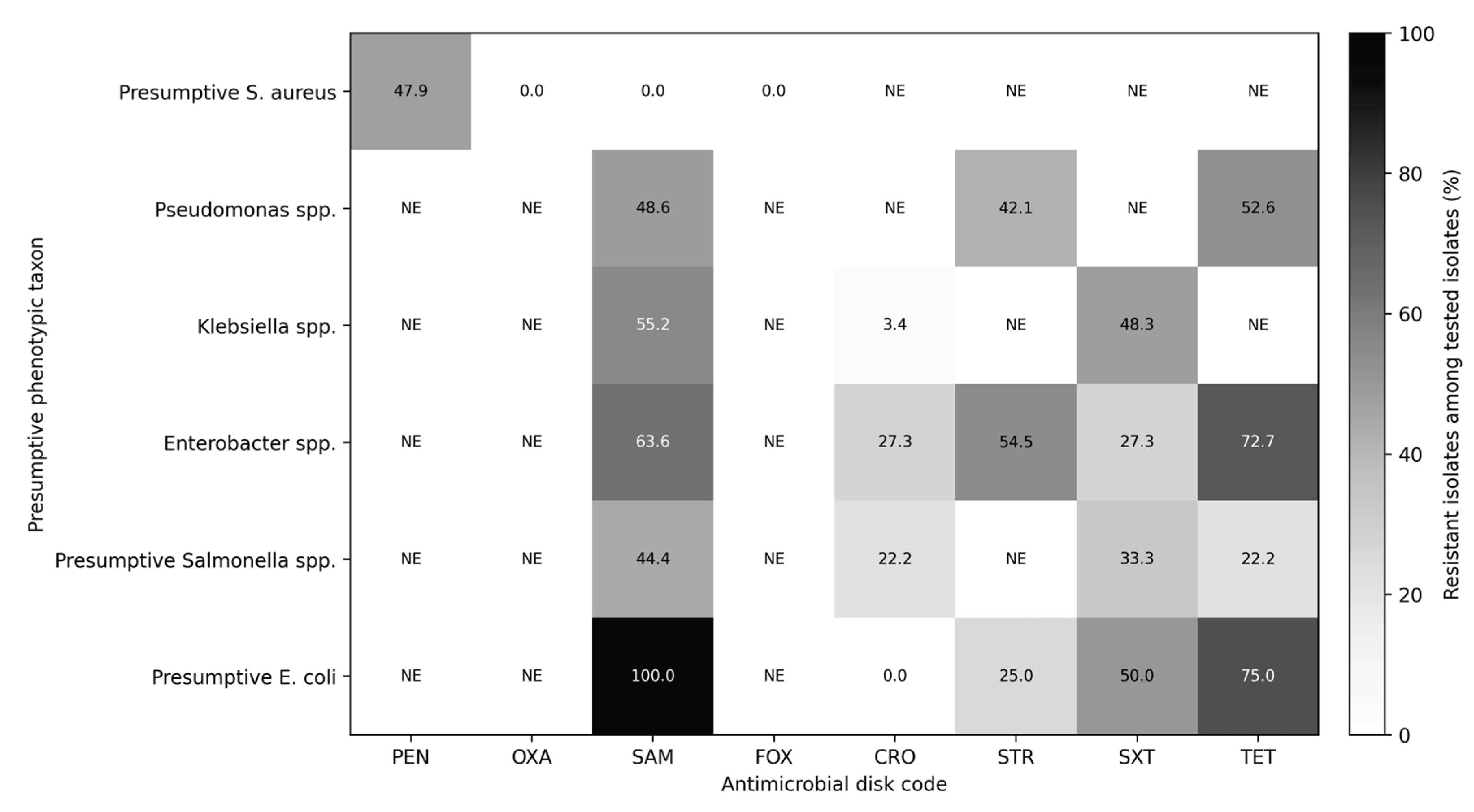
Table 2.
Taxon specific archived disk diffusion classifications.
| Presumptive taxon | Antimicrobial agent | Tested | S | I | R | R percent | NE |
| Presumptive S. aureus | Penicillin | 48 | 24 | 1 | 23 | 47.9 | 0 |
| Presumptive S. aureus | Oxacillin | 48 | 48 | 0 | 0 | 0.0 | 0 |
| Presumptive S. aureus | Ampicillin with sulbactam | 48 | 48 | 0 | 0 | 0.0 | 0 |
| Presumptive S. aureus | Cefoxitin | 48 | 48 | 0 | 0 | 0.0 | 0 |
| Pseudomonas spp. | Ampicillin with sulbactam | 37 | 19 | 0 | 18 | 48.6 | 1 |
| Pseudomonas spp. | Streptomycin | 38 | 22 | 0 | 16 | 42.1 | 0 |
| Pseudomonas spp. | Tetracycline | 38 | 18 | 0 | 20 | 52.6 | 0 |
| Pseudomonas spp. | Ceftriaxone | 0 | 0 | 0 | 0 | NE | 38 |
| Pseudomonas spp. | Trimethoprim with sulfamethoxazole | 0 | 0 | 0 | 0 | NE | 38 |
| Klebsiella spp. | Ceftriaxone | 29 | 28 | 0 | 1 | 3.4 | 0 |
| Klebsiella spp. | Ampicillin with sulbactam | 29 | 13 | 0 | 16 | 55.2 | 0 |
| Klebsiella spp. | Trimethoprim with sulfamethoxazole | 29 | 15 | 0 | 14 | 48.3 | 0 |
| Klebsiella spp. | Streptomycin | 0 | 0 | 0 | 0 | NE | 29 |
| Klebsiella spp. | Tetracycline | 0 | 0 | 0 | 0 | NE | 29 |
| Enterobacter spp. | Ceftriaxone | 11 | 8 | 0 | 3 | 27.3 | 0 |
| Enterobacter spp. | Ampicillin with sulbactam | 11 | 4 | 0 | 7 | 63.6 | 0 |
| Enterobacter spp. | Streptomycin | 11 | 5 | 0 | 6 | 54.5 | 0 |
| Enterobacter spp. | Trimethoprim with sulfamethoxazole | 11 | 8 | 0 | 3 | 27.3 | 0 |
| Enterobacter spp. | Tetracycline | 11 | 3 | 0 | 8 | 72.7 | 0 |
| Presumptive Salmonella spp. | Ceftriaxone | 9 | 7 | 0 | 2 | 22.2 | 0 |
| Presumptive Salmonella spp. | Ampicillin with sulbactam | 9 | 5 | 0 | 4 | 44.4 | 0 |
| Presumptive Salmonella spp. | Trimethoprim with sulfamethoxazole | 9 | 6 | 0 | 3 | 33.3 | 0 |
| Presumptive Salmonella spp. | Tetracycline | 9 | 7 | 0 | 2 | 22.2 | 0 |
| Presumptive Salmonella spp. | Streptomycin | 0 | 0 | 0 | 0 | NE | 9 |
| Presumptive E. coli | Ceftriaxone | 4 | 4 | 0 | 0 | 0.0 | 0 |
| Presumptive E. coli | Ampicillin with sulbactam | 4 | 0 | 0 | 4 | 100.0 | 0 |
| Presumptive E. coli | Streptomycin | 4 | 3 | 0 | 1 | 25.0 | 0 |
| Presumptive E. coli | Trimethoprim with sulfamethoxazole | 4 | 2 | 0 | 2 | 50.0 | 0 |
| Presumptive E. coli | Tetracycline | 4 | 1 | 0 | 3 | 75.0 | 0 |
Note. S susceptible. I intermediate. R resistant. NE not evaluated or not interpretable. Percentages use the tested denominator.
Disclaimer/Publisher’s Note: The statements, opinions and data contained in all publications are solely those of the individual author(s) and contributor(s) and not of MDPI and/or the editor(s). MDPI and/or the editor(s) disclaim responsibility for any injury to people or property resulting from any ideas, methods, instructions or products referred to in the content. |
© 2026 by the authors. Licensee MDPI, Basel, Switzerland. This article is an open access article distributed under the terms and conditions of the Creative Commons Attribution (CC BY) license (http://creativecommons.org/licenses/by/4.0/).
Copyright: This open access article is published under a Creative Commons CC BY 4.0 license, which permit the free download, distribution, and reuse, provided that the author and preprint are cited in any reuse.