

Submitted:
13 August 2026
Posted:
18 August 2026
You are already at the latest version
Abstract
As of late, gold nanoparticles (AuNPs) are gaining recognition as highly versatile nanomaterials with remarkable potential in biomedical applications, owing to their unique physicochemical properties. Aside from their tunable size and shape and well-defined surface chemistry, AuNPs provide strong biocompatibility and distinctive optical behavior, arising from a phenomenon widely known as surface plasmon resonance (SPR) [1,2]. These metal nanoparticles’ ability to be coupled with therapeutic molecules, targeting ligands, and polymeric coatings is suggesting they could serve as encouraging platforms in the development of next-generation cancer treatment strategies, along other metal NPs such as silver nanoparticles (AgNPs). [3–5]. This review focuses on recent advances in the physicochemical design of AuNPs, including the influence of particle size, morphology, and surface chemistry on biological performance and photothermal efficiency. In the context of drug delivery strategies, we discuss the made progress in lipid-encapsulated AuNP systems, combined chemo-photothermal platforms and NIR-responsive systems. At last, current translational challenges related mainly to toxicity, colloidal stability, large-scale synthesis, and clinical implementation are highlighted.
Keywords:
gold nanoparticles
; drug delivery
; photothermal therapy
; cancer treatment
; surface plasmon resonance
; gold nanorods
; laser irradiation
; functionalization
; anticancer
1. Introduction
Despite the rapid pace with which modern medicine is evolving, cancer remains one of the most tremendous diseases with excessive mortality and global prevalence. Conventional treatment approaches, such as surgery, radiotherapy and systemic chemotherapy, although serving as a mainstay, are often associated with severe off-target toxicity, multidrug resistance, limited tumor selectivity and damage to healthy tissues. All of the aforementioned challenges significantly compromise each patient’s quality of life and therapeutic outcome [6]. These limitations have precipitated a research shift toward nanomedicine which conducts precision-engineered materials could provide targeted, controlled, and multimodal cancer intervention [7].
While widening the scope of oncological studies, the diverse array of nanomaterials suggest gold nanoparticles (AuNPs) could play a significant role in unique treatments. Their appeal stems from a conjunction of physicochemical properties: tunable size and morphology, well-defined surface chemistry amenable to bioconjugation and strong biocompatibility. They carry a relative metabolic inertness and most significantly: a pronounced surface plasmon resonance (SPR) which endows them with exceptional optical and photothermal behavior [1,2]. By modulating the aspect ratio of subspecies called gold nanorods (AuNRs), the SPR absorption can be scrupulously shifted into the near-infrared (NIR) region. That is where maximal tissue penetration is examined and simultaneously minimal endogenous chromophore absorption is observed. When gold NPs are being introduced to NIR laser irradiation, the absorbed energy is efficiently converted into localized heat through a process identified as localized surface plasmon resonance (LSPR). This phenomenon allows for selective thermal ablation of malignant tissue that largely preserves surrounding healthy cells and forms the basis of AuNP-mediated PTT [6,8].
Beyond their photothermal properties, AuNPs also serve as highly adaptable drug delivery platforms. Surface functionalization with polyethylene glycol (PEG), antibodies, peptides, aptamers, and therapeutic agents enables prolonged circulation, improved colloidal stability, and enhanced tumor targeting. Furthermore, by implementing AuNPs into lipid-based carriers, such as liposomes and nanoarchaeosomes, simultaneous encapsulation of chemotherapeutic drugs and photothermal agents within a single nanosystem is allowed [6,9]. The described hybrid platforms support externally triggered drug release and combined chemo-photothermal treatment strategies.
Recent studies aim to focus on multifunctional AuNP systems that are capable of integrating drug delivery, PTT, imaging and tumor targeting all at once in a singular platform. Such combined approaches will offer the potential for synergistic therapeutic effect while reducing drug dosage and minimizing systemic toxicity [6,10].
This manuscript summarizes current knowledge and advances in the use of AuNPs as platforms for drug delivery and photothermal therapy, with emphasis on the physiochemical properties governing their biological and optical behavior. Recent developments in lipid-based hybrid nanoplatforms, stimuli-responsive drug release systems, and combined photo-chemotherapeutic approaches are discussed, together with the major challenges associated with clinical translation and future therapeutic applications.
2. Physicochemical Properties of AuNPs Relevant to Therapeutic Applications
The adaptability of AuNPs in biomedical applications comes largely from their physicochemical properties. Unlike conventional therapeutics, whose pharmacological activity is mostly determined by their molecular structure, the optical, electronic, and biological properties of AuNPs can be tuned by changing particle size, shape, and surface chemistry [11,12]. These characteristics are closely interconnected. Particle size and morphology influence localized surface plasmon resonance (LSPR) and determine whether optical absorption falls within the biologically relevant near-infrared (NIR) region. Surface chemistry also affects colloidal stability, biodistribution, immune response, and drug-loading capacity [1,4]. Understanding these physicochemical factors is of great importance when designing AuNP-based systems for drug delivery and photothermal therapy (PTT).
2.1. Sizeand Morphology-Dependent Properties of AuNPs
The therapeutic performance of AuNPs is closely linked to particle size and morphology, since both influence optical properties, biodistribution, cellular uptake, and circulation time [4,12]. In biological systems, particle size affects both nanoparticle clearance and tumor accumulation. Very small AuNPs (< 10 nm) are rapidly cleared through renal filtration, whereas larger particles are more likely to be taken up by the mononuclear phagocyte system (MPS), resulting in shorter circulation times and reduced tumor delivery [4]. AuNPs in the 10-100 nm size range are generally considered more favorable for enhanced permeability and retention (EPR)-mediated tumor accumulation, and efficient cellular internalization, although the clinical predictability of the EPR effect remains highly variable. Table 1 presents how the size of NPs affects pharmacokinetic fate as well as other characteristics in drug delivery and PTT.
Particle morphology also has an important role in plasmonic behavior. Spherical AuNPs typically show LSPR absorption in the visible region, which limits their application in deep-tissue photothermal therapy. By contrast, anisotropic nanostructures possess tunable plasmonic properties that can be shifted into the NIR region, where tissue absorption and scattering are reduced [14,15].
Among anisotropic AuNPs, gold nanorods (AuNRs) are the most commonly studied for photothermal applications, mainly because their longitudinal LSPR can be shifted into the NIR region by adjusting the aspect ratio [16,17]. Upon NIR irradiation, AuNRs are able to convert successfully absorbed light into heat. By that, a localized thermal destruction of tumor tissue is granted, as well as controlled drug release [6,18]. Other AuNP morphologies, including gold nanostars, nanocages, and nanoshells, also exhibit tunable plasmonic properties in the NIR range. Such have been explored for imaging, theranostic applications, and combination treatment strategies [19,20]. For a better understanding of each morphology’s abilities and limitations, Table 2 serves as a brief comparison.
The physicochemical diversity of AuNP morphologies provides substantial flexibility for therapeutic nanoplatform design. However, optimization of particle geometry must also consider factors such as colloidal stability, synthesis reproducibility, biodistribution, and long-term biocompatibility, all of which remain important translational challenges.
2.2. Localized Surface Plasmon Resonance and Photothermal Conversion
LSPR is plausibly the property which is most directly responsible for AuNPs utility in PTT and light-triggered drug release. This phenomenon involves the collective oscillation of conduction-band electrons in response to incident electromagnetic radiation [18,21].
AuNPs exhibit strong optical absorption and scattering when resonance conditions are met. This provides efficient conversion of absorbed light into localized heat.
For biomedical applications, photothermal conversion is particularly important within the near-infrared (NIR) biological window: that is where tissue penetration is maximized and endogenous chromophore absorption is minimized [18]. AuNRs are especially suitable for such purpose, because their longitudinal plasmon mode can be precisely tuned into the NIR-I or NIR-II regions through aspect ratio engineering [15,16]. Upon NIR irradiation, the generated heat induces localized hyperthermia which is capable of damaging tumor tissue. Furthermore, the produced heat enhances membrane permeability, and triggering release from thermosensitive drug carriers.
Photothermal efficiency is affected by a set of physicochemical parameters, such as nanoparticle morphology, surface functionalization, aggregation state, irradiation wavelength, and laser power density [19]. Among the plasmonic nanostructures which are currently undergoing investigation, AuNRs are considered the most efficient for photothermal applications. Their high performance is mainly related to the strong longitudinal plasmon resonance and the concentration of electromagnetic fields at the ends of the NRs. Despite these advantages, a number of challenges still limit their clinical translation. When exposed to intense irradiation, AuNRs may eventually reshape into spherical particles. This transformation leads to a higher stability in terms of termodynamics, and in the meantime: decrease in the NIR absorption which endowses lower photothermal efficiency [19]. Another issue is the cetyltrimethylammonium bromide (CTAB) surfactant commonly used during AuNR synthesis. Further purification or surface modification are required before biomedical applications as CTAB is linked to the causage of significant cytotoxic effects [22]. These factors show that photothermal performance alone is not sufficient, and that stability and biocompatibility must also be carefully considered during nanoparticle design.
2.3. Biocompatibility, Colloidal Stability, and Surface Functionalization
Surface chemistry plays a central role in determining the biological performance of AuNPs, strongly influencing colloidal stability, circulation time, biodistribution, cellular uptake, and therapeutic efficacy [4,15]. Because bare AuNPs readily aggregate under physiological ionic conditions and are susceptible to rapid immune recognition, surface functionalization is essential for biomedical applications.
Polyethylene glycol (PEG) remains the most widely used surface modification strategy, owing to its ability to improve colloidal stability and reduce nonspecific protein adsorption and macrophage uptake [1,22]. PEGylation prolongs systemic circulation and enhances passive tumor accumulation through the enhanced permeability and retention (EPR) effect. In addition, thiol-functionalized PEG coatings provide reactive surface groups that enable conjugation of drugs, antibodies, peptides, aptamers, and fluorescent probes [15].
In order to improve tumor selectivity and intracellular delivery, researchers are employing active targeting strategies. Surface ligands, such as folic acid, RGD peptides, antibodies, and aptamers, promote receptor-mediated uptake by cancer cells overexpressing specific biomarkers [6,23]. Multifunctional surface engineering further enables simultaneous integration of stealth coatings, targeting ligands, imaging agents, and therapeutic payloads within a single nanoplatform.
Despite these advantages, the biological behavior of AuNPs remains highly complex and incompletely predictable. Following systemic administration, nanoparticles rapidly interact with biomolecules to form a dynamic protein corona that alters their physicochemical identity. These interactions affect both biodistribution and targeting efficiency, and cellular uptake [24]. Protein corona formation may partially mask targeting ligands and reduce receptor specificity. Moreover, they enhance clearance by the mononuclear phagocyte system which represents a major challenge for translational nanomedicine.
Nanoparticle toxicity is also strongly dependent on surface chemistry, particle size, and dosage. Residual CTAB, commonly used during AuNR synthesis, is particularly associated with membrane disruption and cytotoxicity [22]. Although PEGylation and alternative biocompatible coatings significantly reduce toxicity, concerns regarding long-term accumulation, chronic inflammatory responses, and incomplete biodegradation remain important limitations for clinical implementation [25,26].
Recent research focuses on biologically adaptive and stimuli-responsive surface engineering strategies, including biomimetic coatings, tumor microenvironment-responsive ligands, and NIR-II-compatible theranostic systems [27,28]. These approaches aim to improve tumor specificity while overcoming the biological barriers that continue to limit the clinical translation of multifunctional AuNP platforms.
3. AuNPs as Drug Delivery Platforms
The unique surface chemistry and structural tunability of AuNPs enable their development as multipurpose drug delivery platforms for cancer therapy. Owing to their high surface-area-to-volume ratio and facile functionalization, AuNPs can simultaneously accommodate therapeutic agents, targeting ligands, imaging probes, and stabilizing coatings within a single nanosystem [3,4]. This multifunctionality supports improved drug solubility, prolonged circulation, enhanced tumor accumulation, and controlled intracellular delivery. Additionally, the ability to engineer surface interactions and carrier architecture has enabled the development of stimuli-responsive and tumor-selective nanoplatforms. Such are intentionally designed to overcome several limitations associated with conventional chemotherapy, including poor biodistribution, systemic toxicity, and multidrug resistance.
3.1. Surface Functionalization and Drug Conjugation Strategies
Efficient therapeutic delivery using AuNPs mainly depends on surface engineering approaches that enable stable drug loading, selective targeting, and controlled release within the tumor microenvironment [3,15]. Owing to the strong affinity between gold surfaces and sulfur-containing ligands, thiol-based chemistry remains one of the most commonly employed strategies in terms of NP functionalization. Thiolated polymers, peptides, antibodies, aptamers, and small-molecule drugs can be readily conjugated to AuNP surfaces, and as a result authorize the construction of multifunctional therapeutic nanoplatforms [1].
Generally, covalent attachment, electrostatic adsorption, hydrophobic interactions, or encapsulation are used to grant successful drug incorporation within hybrid carrier systems. Covalent conjugation strategies provide improved stability and controlled drug retention during systemic circulation, whereas non-covalent interactions may facilitate more rapid intracellular release under physiological or tumor-specific conditions [3]. Utilization of PEG linkers for modification of surfaces improves NP dispersion and provides reactive terminal groups for further ligand conjugation.
Active targeting is commonly used in AuNP-based drug delivery systems to improve both tumor selectivity and nanoparticle uptake by cancer cells. To achieve this, researchers have explored a range of targeting ligands, including folic acid, transferrin, antibodies, RGD peptides, and nucleic acid aptamers, which can recognize receptors that are overexpressed on tumor cells [6,23]. AuNP surfaces can also be modified to carry several components simultaneously, e.g., targeting molecules together with drugs and imaging agents. This ability to combine therapeutic and diagnostic functions within a single platform has made AuNPs particularly attractive for theranostic applications.

Table 3.
Surface engineering strategies used in AuNP-mediated drug delivery systems.
| Functionalization Strategy | Mechanism | Advantages | Limitations | Representative Cargo/Targeting Ligands |
|---|---|---|---|---|
| Thiol-gold conjugation | Covalent Au–S bond formation | Strong surface attachment and high functionalization stability |
Possible steric hindrance at high ligand density |
Peptides, thiolated drugs, PEG |
| Simple | Weak binding | |||
| Electrostatic adsorption |
Surface charge interactions |
prepara- tion and rapid loading | stability under physiological conditions | Doxorubicin, nucleic acids |
| PEG linker systems |
Polymer-based surface coating |
Improved colloidal stability and prolonged circulation |
Possible reduction in cellular uptake (“PEG dilemma”) |
PEGylated drugs, antibodies |
| Antibody conjugation |
Receptor-specific targeting | Powerful targeting specificity and tumor selectivity |
High production cost and possible immuno- genicity |
HER2 antibodies, EGFR antibodies |
| Aptamer functionalization |
Nucleic acid-mediated molecular recognition | Strong binding specificity and low immunogenicity |
Limited in vivo stability without modifica- tion |
AS1411 aptamer, DNA/RNA aptamers |
| Lipid encapsulation | Hybrid lipid-nanoparticle carrier systems | High drugloading capacity and controlled release |
More complex formulation and stability optimization |
Liposomes, nanoarchaeosomes |
More recent studies have explored stimuli-responsive AuNP systems designed to release therapeutic agents under specific set of conditions present in the tumor microenvironment. Drug release can be triggered by factors such as acidic pH, redox gradients, enzymatic activity, or external stimulation [25]. These strategies are intended to increase drug accumulation within tumors while reducing premature release and minimizing systemic side effects.
3.2. Encapsulation in Lipid-Based Nanocarriers: Liposomes and Nanoarchaeosomes
Lipid-based nanocarriers are gaining recognition as highly effective complementary systems for AuNP-mediated drug delivery, owing to their biocompatibility, structural versatility, and capacity to simultaneously encapsulate therapeutic and imaging agents [6,9]. Incorporation of AuNPs into lipid vesicles enables rapid development of multifunctional hybrid nanoplatforms. Such platforms grant exquisite combination of physicochemical favors of plasmonic NPs with membrane-mimicking properties of lipid carriers.
Liposomes are among the most extensively investigated lipid-based delivery systems because of their ability to encapsulate both hydrophilic and hydrophobic therapeutic agents. At the same time, lipid vesicles provide curt decline in systemic toxicity and improve pharmacokinetic behavior [3]. Their phospholipid bilayer supports controlled drug retention and facilitates surface functionalization with polymers, targeting ligands, and responsive moieties. Integration of AuNPs within liposomal systems has enabled the development of hybrid carriers which could be activated and controlled externally. Notably, gold nanostructures enhance significantly intracellular delivery.
Archaeal lipid-derived vesicles, widely recognized as nanoarchaeosomes, have recently appeared in a significant amount of studies due to their higher membrane stability compared with conventional liposomes [9]. Archaeal lipids contain ether-linked hydrocarbon chains and form highly ordered membrane structures, which makes them more resistant to oxidation, hydrolysis, and thermal degradation. These characteristics are particularly useful in applications involving external thermal triggers or prolonged systemic circulation.
Table 4.
Comparison between conventional liposomes and nanoarchaeosomes for AuNP-mediated drug delivery applications.
Table 4.
Comparison between conventional liposomes and nanoarchaeosomes for AuNP-mediated drug delivery applications.
| Feature | Liposomes | Nanoarchaeosomes |
|---|---|---|
| Membrane composition | Phospholipid bilayers | Archaeal ether-linked lipid membranes |
| Thermal stability | Moderate | High |
| Oxidative and hydrolytic resistance | Limited under harsh physiological conditions | Enhanced membrane robustness and chemical stability |
| Drug retention capability | Good encapsulation efficiency; possible premature leakage |
Improved membrane rigidity and prolonged retention |
| Colloidal stability | Moderate; often requires additional stabilization | Generally improved intrinsic stability |
| Suitability for thermally triggered release |
Decent, but temperature-sensitive | High, because of enhanced membrane resilience |
| Formulation complexity | Relatively well-established and scalable | More complex lipid extraction and formulation processes |
Hybrid nanoarchaeosome-AuNP systems also exhibit encouraging results in combined therapeutic approaches. For example, nanoarchaeosome-encapsulated gold NRs (NACis-AuNRs) developed for triple-negative breast cancer therapy demonstrate improved colloidal stability, efficient cisplatin loading, and enhanced cellular uptake. All while preserving strong responsiveness to NIR irradiation [6]. Under prolonged laser emission, the generated localized heat increases membrane permeability and promotes controlled drug release within the tumor. This leads to complementary therapeutic effects and remains true even when minimal drug doses are being introduced.
Despite preceding advantages, lipid-based AuNP systems continue to face several translational challenges. Among them stand contentions as formulation reproducibility, long-term storage stability, premature drug leakage, and large-scale manufacturing complexity [25]. Optimization of membrane composition, encapsulation efficiency, and NP-lipid interactions therefore remains critical for the clinical development of hybrid AuNP delivery platforms.
3.3. Controlled and Stimuli-Responsive Drug Release
One of the major advantages of AuNP-based drug delivery systems is the ability to achieve controlled and stimuli-responsive therapeutic release within the tumor microenvironment [3,15]. Unlike conventional chemotherapy, where systemic drug distribution frequently causes severe off-target toxicity, stimuli-responsive nanoplatforms enable spatiotemporal control over drug release, thereby improving therapeutic selectivity and reducing systemic exposure.
Tumor tissues exhibit several physiological characteristics that can be exploited for selective drug activation, including acidic pH, elevated glutathione concentrations, hypoxia, increased enzymatic activity, and abnormal redox conditions [25]. Consequently, AuNP delivery systems have been engineered with pH-sensitive linkers, redox-cleavable bonds, enzyme-responsive coatings, and thermosensitive lipid membranes designed to release therapeutic cargo preferentially within the tumor environment.
Among externally triggered approaches, NIR-responsive systems are particularly attractive, because of their capacity for non-invasive remote activation and relatively deep tissue penetration [18]. In hybrid AuNP-lipid nanocarriers, localized plasmon-mediated heating can induce transient membrane destabilization or increased bilayer permeability. Following irradiation, the produced heat facilitates rapid release of encapsulated drugs. In comparison with with passive diffusion-based delivery mechanisms, exogenous stimuli controlled systems provide improved temporal precision.
Thermosensitive liposomal and nanoarchaeosomal platforms have evinced promising performance for on-demand therapeutic release. In laser exposed the NA-Cis-AuNRs system, NIR-triggered membrane permeabilization enabled burst release of cisplatin selectively while maintaining relatively stable drug retention under physiological conditions [6]. Similar strategies have been explored using doxorubicin-loaded AuNP systems and temperature-responsive polymer coatings. Such films are capable of undergoing reversible structural changes upon thermal activation [9].
Currently, the spotlight is set on multifunctional responsive systems which may integrate multiple activation mechanisms within a single nanoplatform [27]. Dual-responsive carriers have shown improved specificity and reduced premature leakage in preclinical models. Their architecture was focused on combining pH sensitivity with photothermal activation, whilst maintaining redoxand enzyme-response. Nevertheless, upholding precise release kinetics, reproducible responsiveness, and long-term formulation stability remains challenging and continues to limit large-scale clinical translation.
3.4. Tumor Targeting and EPR Effect
Efficient tumor accumulation remains one of the central challenges in AuNP-mediated drug delivery. Nanoparticle targeting strategies are generally classified into passive and active targeting approaches, both of which aim to improve selective therapeutic delivery while minimizing systemic toxicity [4,15].
Passive targeting primarily relies on the enhanced permeability and retention (EPR) effect, a phenomenon associated with the abnormal vascular architecture and impaired lymphatic drainage commonly observed in solid tumors [26]. These features may facilitate preferential accumulation of nanoscale carriers within tumor tissue compared with healthy organs. Particle size, surface charge, circulation time, and colloidal stability strongly influence the extent of nanoparticle retention and penetration within the tumor microenvironment.
Despite extensive preclinical success, the clinical reliability of the EPR effect remains highly variable [25,26]. Tumor heterogeneity, irregular vascular permeability, elevated interstitial fluid pressure, and rapid clearance by the MPS can substantially limit NP accumulation in vivo. Consequently, passive targeting alone is often insufficient to achieve efficient and homogeneous intratumoral drug distribution.
Beyond vascular transport, the tumor microenvironment itself presents additional barriers to NP delivery. Nanoparticle penetration can be restricted beyond perivascular space, owing to extracellular matrices, elevated interstitial pressure and heterogeneous cellular organization [26,29]. As a result, even when AuNPs successfully accumulate within a tumor, their distribution may remain highly uneven. That alone leaves significant portions of malignant tissue insufficiently exposed to therapeutic agents. Overcoming transport barriers discussed in this section will result in a mindful design of next-generation targeted nanomedicines.
To overcome these limitations, active targeting strategies have been increasingly incorporated into AuNP delivery systems. Surface functionalization with antibodies, peptides, aptamers, folic acid, and other receptor-specific ligands enables selective recognition of overexpressed cancer-associated biomarkers and promotes receptor-mediated cellular uptake [6,23]. Such approaches may enhance intracellular delivery efficiency and improve therapeutic selectivity compared with non-targeted systems.
Recent research increasingly emphasizes the importance of combining passive accumulation mechanisms with active molecular targeting and stimuli-responsive delivery strategies [29]. Multifunctional AuNP platforms capable of integrating prolonged circulation, tumor-selective recognition, and externally controlled activation are considered particularly promising for overcoming biological delivery barriers and improving therapeutic outcomes. Tumor targeting using AuNPs is evolving from reliance on passive EPR-driven accumulation toward increasingly sophisticated, multi-layered targeting systems which combine physicochemical design with biological specificity.
4. AuNPs in Photothermal Therapy (PTT)
The most minimally invasive strategy for cancer treatment at present is PTT. It bids spatiotemporal precision which conventional chemotherapy and radiotherapy cannot yet match [30,31]. PTT is based on localized heat generation following irradiation of photoresponsive nanomaterials [8,23]. Among currently investigated plasmonic nanomaterials, AuNPs are widely used for PTT, because of their tunable optical properties, high photothermal conversion efficiency, and favorable biocompatibility. [7,32]. The ability of AuNP-based systems to combine tumor targeting, controlled drug delivery, imaging capability, and externally triggered therapeutic activation has significantly expanded their potential in precision oncology. That is why rapid developments focus on integrating PTT with complementary treatment modalities, such as chemoand immunotherapy.
4.1. Photothermal Conversion Mechanisms in Gold Nanoparticles
The medicinal efficacy of AuNP-mediated PTT depends on the streamlined conversion of absorbed optical energy into localized heat following irradiation [8,18]. Upon exposure to NIR light, plasmonic excitation within AuNPs generates rapid non-radiative relaxation processes. The last dissipates energy as heat into the surrounding microenvironment and as a result localized thermal increase induces irreversible cellular damage within tumor tissue.
This procedure grants the slightest injury to adjacent healthy structures.
Photothermal heating depends on several factors, including the nanoparticle (NP) shape, how strongly the particles absorb light, the laser wavelength, the irradiation power density, the exposure time, and the NP concentration [23]. Compared with other gold nanoparticle morphologies, anisotropic structures such as gold nanorods and nanostars usually show better photothermal performance. This is mainly due to their strong absorption in the near-infrared (NIR) region and their ability to localize electromagnetic fields more effectively [19]. In addition, NIR-responsive systems operating within the NIR-I and NIR-II biological windows provide improved tissue penetration and reduced interference from endogenous chromophores.
Localized hyperthermia generated by AuNPs may induce numerous sanative effects, depending on treatment conditions. Mild temperature elevations can enhance membrane permeability and improve intracellular drug uptake, whereas higher thermal doses promote protein denaturation, mitochondrial dysfunction, oxidative stress, and irreversible tumor cell death through apoptotic or necrotic pathways [8,23]. The therapeutic outcome therefore depends not only on heat generation efficiency, but also on precise spatial and temporal control of thermal exposure.
Work in this area is steadily focused on improving the precision and selectivity of PTT through design of multifunctional tumor-responsive AuNP systems [25]. Approaches, such as targeted nanoparticle delivery, aggregation-enhanced photothermal conversion, and combined chemo-photothermal nanoplatforms exhibit promising results in preclinical studies. However, achieving uniform heat distribution throughout the tumor, while simultaneously minimizing damage to surrounding healthy tissue remains a major challenge for clinical translation.
4.2. Mechanisms of Photothermally Triggered Drug Release
Controlled drug release is one of the key advantages of AuNP-based nanocarriers in cancer therapy, as it enables drug activation’s occurrence at the tumor site itself, rather than throughout the entire body [25,33]. Unlike conventional chemotherapy, which often causes significant systemic toxicity due to nonspecific drug distribution, photothermal activation allows drug release to be initiated only after localized irradiation, improving spatial control over treatment and reducing unwanted effects on healthy tissues.
The release behavior of these nanocarriers is strongly influenced by both NP design and carrier composition. In lipid-based formulations, localized heating generated by AuNPs can increase membrane fluidity and temporarily disrupt bilayer integrity, which promotes the release of encapsulated drugs [6,34]. Thermoresponsive polymers and heatsensitive linker molecules can also undergo structural or chemical changes under irradiation. That alone enables succeeding detachment of surface-bound cargo or accelerated diffusion of healing agents [35]. These heat-induced responses allow external regulation of drug release with improved temporal precision.
Besides directly affecting the carrier structure, localized heating may also alter the tumor microenvironment in ways that support drug delivery. Moderate hyperthermia has been shown to increase vascular permeability, improve NP penetration into tumor tissue, and enhance transport across cellular membranes. That is why heating eventually promotes higher intracellular drug accumulation [8,36]. In some cases, release of therapeutic cargo into the cytoplasm is induced due to thermal stress which further destabilizes endosomal membranes after NP internalization.
Multipurpose nanoplatforms are being developed to combine photothermal activation with other stimuli-responsive mechanisms, most prominently pH-sensitive and enzymetriggered release strategies [27]. For the headway in oncology, these combined approaches could improve release selectivity within the heterogeneous tumor microenvironment: all while reducing premature drug leakage during circulation. In phase, aggregationresponsive AuNP systems and NIR-II-responsive platforms have demonstrated improved control over release behavior and enhanced responsiveness in deeper tissues during preclinical studies [28].
Although these approaches show considerable potential, achieving reliable and predictable drug release in vivo remains a hard task. Uneven nanoparticle accumulation, differences in tissue optical properties, and inconsistent heat distribution can all influence treatment performance and reproducibility [29]. As a result, current efforts remain set toward designing more precisely responsive carrier systems, suitable for clinical construction.
4.3. Structural Optimization of Gold Nanorods (AuNRs) for Photothermal Therapy
Gold nanorods (AuNRs) remain among the most extensively investigated AuNP morphologies for PTT primarily because of their highly tunable NIR absorption and photothermal performance [16,18]. Their anisotropic geometry supports two distinct plasmon resonance modes, allowing the longitudinal absorption band to be precisely adjusted through aspect ratio engineering. That’s how compatibility with biological optical windows is achieved in the conceptual stage.
An additional consideration in AuNR design is their photothermal stability during laser exposure. Under sufficiently high irradiation intensities, AuNRs may undergo structural reshaping, which results in a gradual loss of anisotropy, simultaneously with a notable corresponding shift in optical properties [18,37]. Such morphological changes lead to limitations in a treatment’s reproducibility. Consequently, improving structural stability under therapeutic irradiation conditions remains an important objective in the development of clinically relevant AuNR platforms.
Balanced photothermal efficiency and tissue penetration are executed through precise evaluation of nanorods’ dimensions which additionally inflicts meliorated biological interactions. Increasing the aspect ratio generally shifts optical absorption toward longer wavelengths and improves photothermal conversion within the NIR region [14]. However, excessively elongated nanorods may exhibit reduced structural stability, altered biodistribution, and increased susceptibility to aggregation under physiological conditions.
Beyond optical tuning, surface modification remains essential for maintaining AuNR’s stability under somatic conditions. Surface coatings obtained during synthesis can strongly affect AuNR behavior, influencing factors such as NP stability, circulation, and cellular uptake [22]. For this reason, additional surface modification is commonly performed before biomedical use. Approaches including PEGylation, lipid encapsulation, and silica coating are applied to improve dispersion stability and reduce unwanted interactions with biological components.
In addition, to all of the data given in this subsection, AuNRs exhibit exceptional extinction coefficients. These factors vary in the order of 108 M-1cm-1, making them superior “nanoheaters” compared to organic chromophores for photothermal applications.
Increasing attention is also being directed toward the relationship between AuNR design and thermal dose delivery. Beyond achieving high local temperatures, effective treatment requires controlled and reproducible heat deposition throughout the tumor volume. Due to that fact, modifications and constant improvements of nanorod properties aim to maximize uniform thermal coverage, while also avoiding excessive heating of surrounding healthy tissues.
Despite substantial progress, several challenges continue to limit the clinical translation of AuNR-mediated PTT, including heterogeneous tumor accumulation, incomplete thermal uniformity, long-term nanoparticle retention, and scalable manufacturing constraints [29]. Future developments will likely focus on biologically adaptive nanorod systems with improved responsiveness, biodegradability, and therapeutic selectivity.
4.4. Preclinical Evaluation of AuNP-Mediated Photothermal Therapy
Preclinical studies continue to demonstrate the potential of AuNP-mediated PTT across a wide range of tumor models, particularly in breast, colorectal, liver, and glioblastoma cancers [25,32]. In-vitro investigations report reduced cancer cell viability following NIR irradiation of AuNP-treated cells, while in vivo experiments show suppressed tumor growth, improved local tumor control, and enhanced therapeutic response (when compared with monotherapy approaches).
The evaluation of AuNP-mediated PTT in preclinical models increasingly extends beyond measurements of tumor volume reduction alone. Recent studies frequently assess treatment-induced changes in survival, tumor recurrence, histopathological damage, and systemic toxicity to obtain a more comprehensive view of therapeutic performance [25,32]. Imaging techniques such as photoacoustic imaging, magnetic resonance imaging, and computed tomography are also being incorporated to monitor nanoparticle distribution and treatment response in real time, providing valuable information for treatment optimization. Combined treatment strategies have attracted particular attention in recent years. AuNP-mediated PTT integrated with chemotherapy, immunotherapy, or radiotherapy is often followed by improved antitumor activity in several preclinical models [27,36]. Such refinement is achieved by simultaneously targeting multiple resistance pathways. Hybrid nanoplatforms on the other hand are also capable of co-delivering chemotherapeutic agents together with photothermal activation. Difficult-to-treat cancers, including triple-negative breast cancer and multidrug-resistant tumors are strongly positively influenced by such therapies [6].
Beyond direct tumor ablation, increasing evidence suggests that photothermal treatment may also influence immune responses within the tumor microenvironment. Localized hyperthermia has been associated with immunogenic cell death, enhanced antigen presentation, and improved infiltration of cytotoxic immune cells [38]. These observations promote growing interest in combining AuNP-mediated PTT with immune checkpoint inhibition.
Preclinical studies on the other hand place emphasis on NP biodistribution and clearance following treatment. Although AuNPs generally demonstrate favorable short-term biocompatibility, concerns remain regarding long-term retention in organs. After systemic administration, monitoring of the liver and spleen is crucial [29,37]. Understanding the fate of residual NPs in the post-therapy stage is therefore considered top priority for safety assessment and regulatory evaluation.
Despite encouraging therapeutic outcomes, most evidence remains limited to smallanimal models, and substantial barriers continue to hinder clinical translation. Variations in tumor structure, heat distribution, and NP accumulation can strongly influence treatment outcomes and may lead to differences between preclinical results and clinical performance in patients [29]. For this reason the need of constant evaluation of irradiation conditions, nanoparticle properties, and long-term toxicity remains vital.
5. Combined Photo-Chemotherapy Platforms
The previous sections demonstrated the effectiveness of AuNPs in both drug delivery and PTT applications. Building on these findings, increasing attention has been directed toward multifunctional AuNP platforms that integrate both therapeutic modalities within a single nanocarrier. In combined photo-chemotherapy approaches, chemotherapeutic agents are delivered together with NIR-triggered photothermal treatment to achieve synergistic anticancer effects and overcome limitations associated with each therapy individually. Chemotherapy is frequently constrained by systemic toxicity and the emergence of drug resistance, whereas PTT alone may be insufficient to completely eradicate large or heterogeneous tumors [39,40]. Consequently, integrating drug delivery with photothermal treatment has shown evident improvement in therapeutic efficacy. Moreover, in preclinical studies it enhances localized tumor destruction and reduces off-target effects.
5.1. Ground for Synergistic Therapy
Justification for the amalgamation of PTT and chemotherapy is given through the joined mechanisms these procedures rely on to eliminate cancer cells. Chemotherapeutic agents tamper with cardinal processes, such as DNA replication for example, while PTT induces localized hyperthermia which precisely damages tumor tissues. If applied simultaneously, these therapies can reinforce one another. This results in greater antitumor efficacy than either method alone, while potentially allowing the use of lower chemotherapy doses.[39,41].
The observed biological response of the tumor tissue to mild hyperthermia is primary contributor to the earlier discussed synergy. Elevated temperatures contribute to the increment of cell membrane’s permeability and with that facilitate intracellular transport. Hence the greater uptake of chemotherapeutic agents by cancerous cells. Hyperthermia is also believed to tentatively improve tumor perfusion which enables more efficient drug distribution via the entity of the tumor mass. These effects are particularly beneficial in poorly vascularized or heterogeneous tumors, where conventional chemotherapy often shows limited penetration. Up-to-the-minute tumor-microenvironment-responsive nanoplatforms unite localized photothermal heating with stimuli-responsive drug release. Such approach significantly enhances both treatment selectivity and therapeutic virtue [40,42].
Tumor cells cannot properly recover from chemotherapeutic injury, due to the heatinduced denaturation, proteins are being introduced to. Furthermore, chemotherapy ensures mitochondrial dysfunction, impairment of DNA dame and oxidative stress to the ill cells. Consequently, combined photo-chemotherapy demonstrates greater induction of apoptosis and reduced tumor recurrence in numerous proof-of-concept investigations, compared with either treatment administered independently [27,41].
The therapeutic benefits of combined photo-chemotherapy are additionally enhanced when both treatments are integrated within a single AuNP platform. Rather than functioning as independent therapies, chemotherapy and PTT can be navigated through a unified nanocarrier, thus enabling more precise control over treatment. Such approach diminishes inessential exposure of healthy tissues. It further allows monitoring of intrinsic functionalities: molecular targeting, multiple stimuli-responsive components and diagnostic imaging [40,41].
5.2. Exemplary AuNP-based Photo-Chemotherapy Systems
AuNP-based nanoplatforms have been widely explored for combined chemotherapy and photothermal therapy across diverse tumor models. These systems vary not only in NP architecture, but also in carrier composition. As such they share a common design rationale: synchronized drug release and localized hyperthermia. The resulting dual action aims to maximize successful treatment outcomes whilst minimizing systemic toxicity [40,41].
Doxorubicin remains one of the most frequently incorporated chemotherapeutic agents, owing to its broad anticancer activity. Multitudinous AuNRand Au nanostar-based platforms have demonstrated enhanced intracellular drug accumulation and increased apoptosis compared with either chemotherapy or PTT alone. Enhanced platforms also provide superior tumor suppression and in numerous cases combination treatment enables effective tumor control using lower drug doses. Accordingly, is reduced the dose-dependent toxicity observed with conventional administration [25,39].
Figure 1.
Examples of chemotherapeutic agents integrated into AuNP-based photo-chemotherapy platforms for different cancer models.
Figure 1.
Examples of chemotherapeutic agents integrated into AuNP-based photo-chemotherapy platforms for different cancer models.
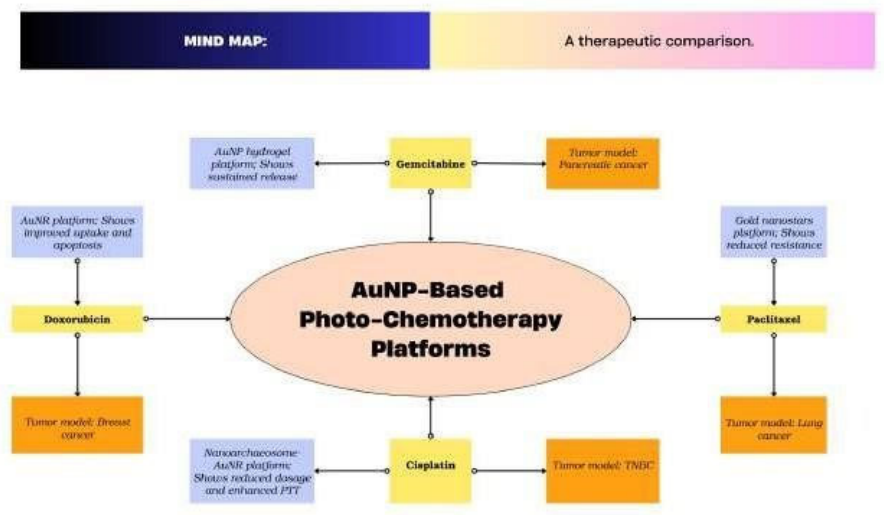
Other cytotoxic agents have also been incorporated into multifunctional AuNP systems with encouraging results. Nanoarchaeosomes co-encapsulating cisplatin and PEGylated AuNRs have demonstrated NIR-triggered cisplatin release and enhanced cytotoxicity against triple-negative breast cancer (TNBC), exploiting the thermal and colloidal stability of archaeal lipid membranes [6]. In pancreatic cancer, injectable thermo-responsive hydrogels co-loaded with gemcitabine and photothermal nanoparticles have achieved localized NIR-triggered ablation alongside sustained drug release, nearly eliminating subcutaneous tumors in murine models [43]. Similarly, AuNR-mesoporous silica nanocomposites have shown pH/NIR dual-responsive drug release and superior cytotoxicity in lung cancer cells compared to either modality alone [41].
Beyond photo-chemotherapy, there is growing interest in nanoplatforms that combine multiple functions within a single system. Researchers have explored designs that pair photothermal therapy with photodynamic therapy, molecular imaging, immune modulation, or tumor-microenvironment-responsive drug release. The goal is not simply to destroy tumors more effectively, but to do so in a way that is image-guided, monitorable in real time, and adaptable to the biological complexity of solid tumors. Most of these systems are still at the preclinical stage. Nevertheless, they reflect a clear trajectory in AuNP-based nanomedicine: toward treatments that are more personalized, more precisely controlled, and better suited to the demands of individual patients [44].
6. Current Challenges and Future Perspectives
Despite the rapid progress of AuNP-based theranostic platforms, several key challenges still limit their clinical translation. One of the major issues highlighted by Rahman et al. is the difficulty of achieving true precision nanomedicine due to tumor heterogeneity and insufficient patient-specific treatment stratification [45]. Although AuNPs enable multifunctional integration of imaging, drug delivery, and PTT, their clinical performance remains highly dependent on individual tumor biology.
From a translational perspective, regulatory approval remains a major bottleneck. As Rahman et al. emphasize, future clinical success will depend on the development of standardized nanoplatforms with predictable pharmacokinetics and reproducible therapeutic outcomes [45].
Hot-spot-enabled AuNPs can synchronize PTT, PDT, and chemotherapy within a single platform, often achieving stronger tumor ablation than any single modality alone. However, practical limitations remain. Tumor penetration is frequently uneven, and heat distribution within the tumor mass is rarely uniform, both of which can compromise treatment outcomes. Structural control over AuNP assemblies: particularly nanostarand nanoaggregate-based architectures will need to improve if localized electromagnetic field enhancement is to be reliably maximized without sacrificing biostability or safe clearance from the body.
Long-term biodistribution profiles for hot-spot architectures remain insufficiently characterized, adding an additional layer of uncertainty specific to these more complex assemblies. Looking ahead, clinical translation is still hindered by precision-engineered hot-spot geometries and AI-assisted structural optimization [46].
The next generation of AuNP-based systems is likely to shift toward NIR-II responsive materials, which offer deeper tissue penetration and reduced phototoxicity. Stimuliresponsive drug release and multimodal combinations, such as PTT paired with photodynamic therapy or immunotherapy, are also expected to gain prominence. Simultaneously, progress in green synthesis and scalable manufacturing will be essential for moving these platforms beyond the laboratory. Clearer regulatory pathways will be equally important. Together, these advances could bring AuNP-based nanomedicine closer to clinical approval and ultimately to patients.
7. Conclusions
AuNPs have established themselves as one of the most versatile platforms in cancer nanomedicine, combining tunable optical properties and the capacity to integrate multiple therapeutic modalities within a single system. Their ability to merge chemotherapy with PTT has consistently demonstrated advantages over monotherapies, including enhanced drug accumulation and improved apoptosis for example. Advances in hot-spot engineering and stimuli-responsive designs have further expanded their multi-modal potential, granting the PTT/PDT/chemotherapy combinations the limelight.
Despite all of the ongoing researches, substantial challenges persist. Inconsistent tumor penetration, the absence of standardized synthesis protocols, and incomplete characterization of immune interactions continue to hinder clinical translation. Bridging the gap between laboratory performance and clinical reliability will require reproducible, biocompatible nanoplatform designs supported by computational and AI-driven optimization. Realizing the full therapeutic promise of AuNP-based nanomedicine will entirely depend on how effectively the field addresses these translational barriers.
Author Contributions
Conceptualization, J.G. and L.S.; methodology, J.G., L.S. and M.L.; validation, J.G., L.S. and M.L.; formal analysis, J.G., L.S., M.L.; investigation, J.G., L.S., M.L.; resources, J.G., L.S., M.L.; data curation, J.G., L.S., M.L..; writing—original draft preparation, M.L.; writing—review and editing, J.G., L.S., M.L.; visualization, J.G., L.S., M.L..; supervision, J.G. and L.S.; project administration, L.S.; funding acquisition, L.S. and J.G. All authors have read and agreed to the published version of the manuscript.
Funding
This research received funding in 2023 via the Bulgarian National Science Fund (KP-06-N78/8 from 14 December 2023).
Data Availability Statement
Additional data are available upon request.
Acknowledgments
In this section you can acknowledge any support given which is not covered by the author contribution or funding sections.
Conflicts of Interest
The authors declare no conflicts of interest.
Abbreviations
The following abbreviations are used in this manuscript:
| AuNPs | Gold Nanoparticles |
| NP(s) | Nanoparticle(s) |
| SPR | Surface Plasmon Resonance |
| NIR | Near-infrared |
| LSPR | Localized Surface Plasmon Resonance |
| PEG | Polyethylene glycol |
| PTT | Photothermal therapy |
| MPS | Mononuclear phagocyte system |
| EPR | Enhanced permeability and retention |
| CTAB | Cetyltrimethylammonium bromide |
| SIRS | Systemic Inflammatory Response Syndrome |
| RGD | Arginylglycylaspartic acid |
| HER2 | Human Epidermal Growth Factor Receptor 2 |
| EGFR | Epidermal Growth Factor Receptor |
| DNA | Deoxyribonucleic Acid |
| RNA | Ribonucleic Acid |
| NA-Cis-AuNRs | Nanoarchaeosome-encapsulated gold nanorods |
| AuNRs | Gold Nanorods |
| TNBS | Triple-negative breast cancer |
| PDT | Photodynamic therapy |
References
- Sarfraz, N.; Khan, I. Plasmonic Gold Nanoparticles (AuNPs): Properties, Synthesis and their Advanced Energy, Environmental and Biomedical Applications. Chem. Asian J. 2021, 16, 720–742.
- Hammami, I.; Alabdallah, N. M.; Jomaa, A. A.; Kamoun, M. Gold nanoparticles: Synthesis properties and applications. J. King Saud Univ. Sci. 2021, 33, 101560.
- Amina, S. J.; Guo, B. A Review on the Synthesis and Functionalization of Gold Nanoparticles as a Drug Delivery Vehicle. Int. J. Nanomed. 2020, 15, 9823–9857.
- Hu, X.; Zhang, Y.; Ding, T.; Liu, J.; Zhao, H. Multifunctional Gold Nanoparticles: A Novel Nanomaterial for Various Medical Applications and Biological Activities. Front. Bioeng. Biotechnol. 2020, 8, 990.
- Menon, S.; Rajeshkumar, S.; Kumar, V. A review on biogenic synthesis of gold nanoparticles, characterization, and its applications. Resour.-Effic. Technol. 2017, 3, 516–527.
- Basha, S. S.; Thomas, S.; Ariraman, S.; Suresh Babu, R.; Santhosh, P. B.; Stoychev, L.; Genova, J.; Daskalova, A.; Bhoir, B.; Selvaraj, V.; Sudhakar, S. Nanoarchaeosomes for Synergistic Photochemotherapy in Triple-Negative Breast Cancer. Sci. Rep. 2025, 15, 29032.
- Santhosh, P. B.; Genova, J.; Chamati, H. Green Synthesis of Gold Nanoparticles: An Eco-Friendly Approach. Chemistry 2022, 4, 345–369.
- Vines, J. B.; Yoon, J. H.; Ryu, N. E.; Lim, D. J.; Park, H. Gold Nanoparticles for Photothermal Cancer Therapy. Front. Chem. 2019, 7, 167.
- Babunagappan, K. V.; Seetharaman, A.; Ariraman, S.; Santhosh, P. B.; Genova, J.; Poklar Ulrih, N.; Sudhakar, S. Doxorubicin Loaded Thermostable Nanoarchaeosomes: A Next-Generation Drug Carrier for Breast Cancer Therapeutics. Nanoscale Adv. 2024, 6, 2026–2037.
- Rezaeian, A.; Amini, S. M.; Najafabadi, M. R. H.; Farsangi, Z. J.; Samadian, H. Plasmonic hyperthermia or radiofrequency electric field hyperthermia of cancerous cells through green-synthesized curcumin-coated gold nanoparticles. Lasers Med. Sci. 2021, 37, 1333–1341.
- Nukaly, H. Y.; Ansari, S. A. An Insight Into the Physicochemical Properties of Gold Nanoparticles in Relation to Their Clinical and Diagnostic Applications. Cureus 2023, 15, e37803.
- Sibuyi, N. R. S.; Moabelo, K. L.; Fadaka, A. O.; Meyer, S.; Onani, M. O.; Madiehe, A. M.; Meyer, M. Multifunctional Gold Nanoparticles for Improved Diagnostic and Therapeutic Applications: A Review. Nanoscale Res. Lett. 2021, 16, 174. 13.
- Zahdeh, M.; Karaman, R. Gold Nanoparticles in Biomedical Applications: Synthesis, Functionalization, and Recent Advances. Molecules 2026, 31, 17.
- Jain, P. K.; Lee, K. S.; El-Sayed, I. H.; El-Sayed, M. A. Calculated Absorption and Scattering Properties of Gold Nanoparticles of Different Size, Shape, and Composition: Applications in Biological Imaging and Biomedicine. J. Phys. Chem. B 2006, 110, 7238–7248.
- Dreaden, E. C.; Alkilany, A. M.; Huang, X.; Murphy, C. J.; El-Sayed, M. A. The Golden Age: Gold Nanoparticles for Biomedicine. Chem. Soc. Rev. 2012, 41, 2740–2779.
- Huang, X.; Jain, P. K.; El-Sayed, I. H.; El-Sayed, M. A. Gold Nanoparticles: Interesting Optical Properties and Recent Applications in Cancer Diagnostics and Therapy. Nanomedicine 2007, 2, 681–693.
- Skrabalak, S. E.; Chen, J.; Au, L.; Lu, X.; Li, X.; Xia, Y. Gold Nanocages for Biomedical Applications. Adv. Mater. 2007, 19, 3177–3184.
- Jaque, D.; Martínez Maestro, L.; del Rosal, B.; Haro-Gonzalez, P.; Benayas, A.; Plaza, J. L.; Martín Rodríguez, E.; García Solé, J. Nanoparticles for Photothermal Therapies. Nanoscale 2014, 6, 9494–9530.
- Espinosa, A.; Silva, A. K. A.; Sánchez-Iglesias, A.; Grzelczak, M.; Péchoux, C.; Desboeufs, K.; Liz-Marzán, L. M.; Wilhelm, C. Cancer Cell Internalization of Gold Nanostars Impacts Their Photothermal Efficiency In Vitro and In Vivo: Toward a Plasmonic Thermal Fingerprint in Tumoral Environment. Adv. Healthc. Mater. 2016, 5, 1040–1048.
- Lal, S.; Clare, S. E.; Halas, N. J. Nanoshell-Enabled Photothermal Cancer Therapy: Impending Clinical Impact. Acc. Chem. Res. 2008, 41, 1842–1851.
- Link, S.; El-Sayed, M. A. Spectral Properties and Relaxation Dynamics of Surface Plasmon Electronic Oscillations in Gold and Silver Nanodots and Nanorods. J. Phys. Chem. B 1999, 103, 8410–8426.
- Alkilany, A. M.; Thompson, L. B.; Boulos, S. P.; Sisco, P. N.; Murphy, C. J. Gold Nanorods: Their Potential for Photothermal Therapeutics and Drug Delivery, Tempered by the Complexity of Their Biological Interactions. Adv. Drug Deliv. Rev. 2012, 64, 190–199.
- Kumar, P. P. P., & Lim, D.-K. (2023). Photothermal effect of gold nanoparticles as a nanomedicine for diagnosis and therapeutics. Pharmaceutics, 15(9), 2349.
- Morbidelli, M.; Papini, E.; Tavano, R. Essential Protocols for Decoding the Composition and the Functional Effects of the Nanoparticle Protein Corona. Front. Nanotechnol. 2024, 6, 1500567.
- Eker, F.; Akdas¸çi, E.; Duman, H.; Bechelany, M.; Karav, S. Gold Nanoparticles in Nanomedicine: Unique Properties and Therapeutic Potential. Nanomaterials 2024, 14, 1854.
- Sodipo, B. K.; Mohammed, Z. K. Advances in Biodistribution of Gold Nanoparticles: The Influence of Size, Surface Charge, and Route of Administration. Biomed. Mater. 2024, 19, 042001.
- Sharma, N.; Mohammad, W.; Le Guével, X.; Shanavas, A. Gold Nanoclusters as High Resolution NIR-II Theranostic Agents. Chem. Biomed. Imaging 2024, 2, 462–480.
- Wu, M.; Xiao, Y.; Wu, R.; Lei, J.; Li, T.; Zheng, Y. Aggregable Gold Nanoparticles for Cancer Photothermal Therapy. J. Mater. Chem. B 2024, 12, 8048–8061.
- Gomes, S. M.; Gaspar, M. M.; Coelho, J. M. P. Targeting Superficial Cancers with Gold Nanoparticles: A Review of Current Research. Nanomedicine 2024, 15, 781–799.
- Huang, X.; El-Sayed, M. A. Gold Nanoparticles: Optical Properties and Implementations in Cancer Diagnosis and Photothermal Therapy. J. Adv. Res. 2010, 1, 13–28.
- Ali, M. R. K.; Wu, Y.; El-Sayed, M. A. Gold Nanoparticle-Assisted Plasmonic Photothermal Therapy Advances Toward Clinical Application. J. Phys. Chem. C 2019, 123, 15375–15393.
- Badir, A., Refki, S., & Sekkat, Z. (2025). Utilizing gold nanoparticles in plasmonic photothermal therapy for cancer treatment. Heliyon, 11(4), e42738. [CrossRef]
- Georgeous, J.; AlSawaftah, N.; Alawadhi, W. H. Review of Gold Nanoparticles: Synthesis, Properties, Shapes, Cellular Uptake, Targeting, Release Mechanisms and Applications in Drug Delivery and Therapy. Pharmaceutics 2024, 16, 1332.
- Consoli, G. M. L.; Maugeri, L.; Forte, G.; Buscarino, G.; Gulino, A.; Lanzanò, L.; Bonacci, P.; Musso, N.; Petralia, S. Red LightTriggerable Nanohybrids of Graphene Oxide, Gold Nanoparticles and Thermo-Responsive Polymers for Combined Photothermia and Drug Release Effects. J. Mater. Chem. B 2024, 12, 952–961.
- Li, Y.; Chen, Q.; Sun, J.; Wang, L. Advances in Stimuli-Responsive Gold Nanorods for Drug-Delivery and Targeted Therapy Systems. Biomed. Pharmacother. 2024, 179, 117493.
- Zhang, Y.; Li, H.; Wang, T.; Chen, X.; Zhao, R. Targeting Tumor Microenvironments with Gold Nanoparticles for Enhanced Photothermal Therapy. Oncologie 2024, 26, 899–912.
- Zhou, R.; Zhang, M.; Xi, J.; Li, J.; Ma, R.; Ren, L.; Bai, Z.; Qi, K.; Li, X. Gold Nanorods-Based Photothermal Therapy: Interactions Between Biostructure, Nanomaterial, and Near-Infrared Irradiation. Nanoscale Res. Lett. 2022, 17, 68.
- Liu, Y.; Crawford, B. M.; Vo-Dinh, T. Gold Nanoparticles-Mediated Photothermal Therapy and Immunotherapy. Immunotherapy 2018, 10, 1175–1188.
- Alqahtani, H. A.; Ghobashy, M. M.; El-damhougy, T. K.; Madani, M. Synergistic Gold Nanorod-Based Chemo-Photothermal Therapy: A Promising Nanoparticle Approach for Refractory Multidrug-Resistant Cancer. ChemBioEng Rev. 2024, 11, e202300046.
- Ramhormozi, G. M.; Khatami, S. R.; Galehdari, H.; Sabaeian, M.; Deinavizadeh, M.; Kiasat, A. Synergistic Chemo-Photothermal Therapy Using Doxorubicin-Loaded Gold Nanorods for Enhanced Apoptosis in Lung Cancer Cells. Sci. Rep. 2025, 16, 250.
- Obalola, A. A.; Abrahamse, H.; Dhilip Kumar, S. S. Recent Advances in Gold Nanoparticle-Based Targeted Photodynamic and Photothermal Cancer Therapy. Nanoscale Adv. 2025, 7, 7440–7458.
- Yang, B.; Li, L.; An, M.; Zhang, B.; Yang, Y.; Lin, A.; Wang, Y.; Niu, J.; Xiao, P.; Shi, Y. A Tumor-Microenvironment-Responsive Nanoplatform for Synergistic Chemo-Photothermal-Photodynamic Therapy of Hepatocellular Carcinoma. Chem. Eng. J. 2025, 507, 160575.
- Wang, N.; Yan, X.; Ji, C.; Hu, J.; Chen, X.; Zhang, C.; Quan, Y.; He, T.; Sun, T.; Yu, Y. In situ thermal-responsive hydrogels for combined photothermal therapy and chemotherapy of pancreatic cancer. Published in PubMed Central (PMC12019213) 2025.
- Fernandes, D. A. Multifunctional Gold Nanoparticles for Cancer Theranostics. 3 Biotech 2024, 14, 267.
- Rahman, M. A.; Jalouli, M.; Al-Zharani, M.; Harrath, A. H. Gold Nanoparticle-Based Precision Medicine Strategies for Glioblastoma: Current Biomedical Applications and Future Outlook. Molecules 2026, 31, 684.
- Tian, M.; Hu, S.; Sun, W.; Hu, Y.; Ma, X. Hot-spot empowered gold nanoparticles for theranostics in breast cancer. Theranostics 2025, 15(18), 9695–9728. [CrossRef]
Table 1.
Effect of nanoparticle size on biological behavior, pharmacokinetic fate, and therapeutic relevance in drug delivery and PTT applications.
Table 1.
Effect of nanoparticle size on biological behavior, pharmacokinetic fate, and therapeutic relevance in drug delivery and PTT applications.
| Size Range | Biological Effect | Main Mechanism | Therapeutic Implication | References |
|---|---|---|---|---|
|
< 8 nm < 10–100 nm 100–200 nm > 200 nm |
Rapid clearance Efficient cellular uptake Tumor accumulation Immune sequestration |
Renal filtration Endocytosis/EPR EPR + reduced clearance 1 via permeable tumor vasculature MPS 2 uptake |
Reduced circulation time Improved tumor penetration Optimal delivery range Reduced bioavailability |
[12,13] [9] [6,9] [12,13] |
1 EPR: Enhanced Permeability and Retention. 2 MPS: Mononuclear Phagocyte System.
Table 2.
Comparison of major gold nanoparticle morphologies used in photothermal therapy and drug delivery applications.
Table 2.
Comparison of major gold nanoparticle morphologies used in photothermal therapy and drug delivery applications.
| Morphology | LSPR Range | Major Advantages | Main Limitations |
Typical Applications |
|---|---|---|---|---|
| Gold nanospheres | Visible | Simple synthesis, high colloidal stability, good biocompatibil- ity |
Limited NIR absorption and relatively low photothermal efficiency |
Imaging, sensing, drug delivery |
| Gold nanorods | NIR-I / NIR-II | High photothermal conversion efficiency, tunable longitudinal LSPR, strong NIR absorption |
CTAB associated toxicity, potential reshaping under laser irradiation |
Photothermal therapy, NIR-triggered drug release |
| Gold nanostars | NIR | Strong electromagnetic field enhancement and high surface area |
Structural instability and complex synthesis reproducibility |
SERS, imaging, photothermal therapy |
| Broadly | Multi-step | |||
| Gold nanoshells |
Tunable visible–NIR | tunable plasmonic response and clinical relevance |
synthesis and relatively large particle size |
Photothermal therapy, theranostics |
| Gold nanocages | Broad NIR | Hollow interior enables high drug-loading capacity and controlled release |
Limited long-term stability data and more demanding synthesis |
Drug delivery, combined chemo- photothermal therapy |
Disclaimer/Publisher’s Note: The statements, opinions and data contained in all publications are solely those of the individual author(s) and contributor(s) and not of MDPI and/or the editor(s). MDPI and/or the editor(s) disclaim responsibility for any injury to people or property resulting from any ideas, methods, instructions or products referred to in the content. |
© 2026 by the authors. Licensee MDPI, Basel, Switzerland. This article is an open access article distributed under the terms and conditions of the Creative Commons Attribution (CC BY) license (http://creativecommons.org/licenses/by/4.0/).
Copyright: This open access article is published under a Creative Commons CC BY 4.0 license, which permit the free download, distribution, and reuse, provided that the author and preprint are cited in any reuse.