
Submitted:
14 August 2026
Posted:
17 August 2026
You are already at the latest version
Abstract
Land fragmentation, particularly in irrigation systems, has emerged as a pervasive global event that profoundly shapes farmers’ decision-making. While land fragmentation has been widely studied, irrigated land fragmentation has received limited scholarly attention. Hence, this study aimed to identify key drivers and assess the level of land fragmentation among smallholder irrigators. Cross-sectional data were collected from 618 randomly selected households. Simpson index and Tobit model were used to assess the level and identify factors linked to land fragmentation, respectively. The Simpson index results show a moderate irrigated land fragmentation level of 38% in the study area. Tobit model results found that; household size, participation in agricultural commercial cluster, farm experience, machinery application, and distance from the nearest market were positively significant, whereas the amount of rented land, land certificate, and soil fertility status were negatively significant drivers of irrigated land fragmentation. Overall, policymakers and development practitioners should focus on these key drivers in designing effective rural development and irrigation policies. To do so would require enhancing family labor productivity; facilitating rental markets and transfer of small parcels; enhancing soil fertility beyond irrigated land; ensuring land certifications; promoting cluster farming initiatives beyond irrigated land; encouraging greater diversity of machinery and technology across different crops; and more robust sharing of experiences among farmers are crucial to keep irrigated land fragmentation at an optimal level.
Keywords:
land fragmentation
; irrigators
; Simpson index
; Tobit model
; rural Ethiopia
1. Introduction
Land fragmentation in general, and irrigated land fragmentation in particular, is a widespread global phenomenon that significantly affects farmers’ decision-making [42,71]. It predominantly refers to a situation where a single farm consists of numerous spatially separated parcels1 [16,21]. Land fragmentation is the division of agricultural land into smaller, scattered plots2, often resulting from inheritance, increasing urbanization, and other socioeconomic factors [12]. For this study, the latter definition was adopted because of its comprehensiveness.
Currently, irrigated land fragmentation is a serious concern in many countries across the globe [4,62]. Scholars recognized that it has become a critical challenge to farmers, particularly where smallholder irrigators were dominant [48]. For instance, in South Asia, especially in India, and Latin America (Mexico and Brazil), land fragmentation acts as an obstacle in irrigated areas through weak adoption of modern irrigation technologies, inefficient irrigation systems, poor water management [48] and a lack of suitable infrastructure and financial support [38,40]. Similarly, in Sub-Saharan African countries, Kenya and Tanzania also experience land fragmentation for their irrigable land [33]. For example, fragmented landholdings hinder the development of efficient irrigation systems, as smallholders often lack the capital necessary to install modern infrastructure [57].
In Ethiopia, irrigated land fragmentation is a relatively recent aspect of fragmentation affecting the effectiveness of irrigation systems and is worthy of further investigation [5]. For example, evidence shows that it reduces water productivity and water use efficiency [3], hinders sustainable land management investments [24], limits economies of scale, hinders modern irrigation technology adoption and productivity-enhancing practices [11], and leads to inefficiencies in input use [66]. On the other hand, irrigated land fragmentation can serve as an opportunity as it may reduce production risks [4], enhance farm profitability [6], and advance food security in some instances [25], through diversification of crops (use fragmentation type) [9] and reduced exposure to crop-specific market fluctuations [13], mitigation of the adverse effects of weather conditions on specific crops or land parcels [18], promotion of soil health, and overall farm resilience through crop rotation
As of 2020, Ethiopia had 6 million hectares of potential land suitable for irrigation [4,30,31]. However, according to the World Bank Group [75] only 0.5% of the total agricultural land in Ethiopia is actually irrigated. This means that out of the entire agricultural land base, a very small portion, approximately 30,000 hectares, is under irrigation. Despite the vast potential for irrigation in Ethiopia, the country still lags behind due to irrigated land fragmentation, which is a significant challenge in expanding irrigation infrastructure [9]. In response to the challenges of land fragmentation, the Ethiopian government has introduce and supported irrigation development projects, such as the DREAM3 project, Small-Scale Irrigation and Watershed Management Project, with an aim to improve water management and reduce land fragmentation through community-based irrigation schemes [30,65]. These programs encourage land consolidation and the development of irrigation infrastructure that can support small and fragmented plots [40,63]. To do so would require identifying the key drivers of land fragmentation, particularly for farmland with irrigation potentials, hence irrigated land fragmentation.
Land fragmentation is driven by both supply and demand-side factors [57]. Supply-side drivers include land inheritance, land shortage, population growth, and government land policies, while demand-side drivers encompass urbanization, market demand, industrialization, and population growth [16]. Those who emphasize supply-side drivers argue that land fragmentation is an exogenous imposition on farmers, meaning that farmers involuntarily accept holding numerous and often dispersed plots of land [40,63]. In contrast, those emphasizing demand-side causes view land fragmentation as a choice that farmers make, largely to mitigate diverse and complex risks associated with crop production [65].
After reviewing the literature regarding drivers of land fragmentation, we have summarized previous studies closely linked with our study. Accordingly, different studies pointed out the implications of land fragmentation rather than irrigated land fragmentation. For example, [7] and [36] demonstrated that land fragmentation can reduce food insecurity by mitigating the effects of low rainfall, overlooking the unique characteristics of irrigated land fragmentation. [25], similarly explored the relationship between yield, farm size, and general land fragmentation in Ethiopia, but their findings failed to explore the key drivers of irrigated land fragmentation. Finally, [18] documented the substantial impact of land fragmentation on yield gaps applying a stochastic frontier panel model to plot-level data. They also overlooked the identification of drivers of irrigated land fragmentation and its extent. Notably, to the best of the researcher’s knowledge, a study which directly addresses the factors affecting irrigated land fragmentation, and its level in the context of rural Ethiopia, is either not clearly studied or not published online. Therefore, our study aimed to address the following research questions: What is the extent of land fragmentation among rural irrigators and what are the key drivers of this irrigated land fragmentation in the study area?
In general, this study provides three-fold contributions to the existing literature. First, this study contributes uniquely by focusing on irrigated land fragmentation rather than general land fragmentation among smallholder farmers. Second, it assess the level of irrigated land fragmentation and identifies key drivers by using comprehensive measures like the Simpson index and the Tobit model. Finally, it uses a large dataset covering four main regions of the country and ensures representativeness for rural irrigators.
The succeeding section of this manuscript was organized into six sections. Section 2 presents the research methodology. Section 3 provides the results and discussion. Conclusion and policy implications are presented in Section 4. Section 5 is devoted to appendices. Finally, references were presented in Section 6.
2. Research Methodology
2.1. Data Description
The study relies on a large dataset collected by the DREAM project from November 2022 to March 2025 on approximately 923 rural households in Ethiopia. Out of 923 sampled households, 618 smallholder irrigators of the mini-grid site were used for this study. This household survey data were collected from 27 kebeles in 9 districts of 4 main regions of Ethiopia, namely, Amhara, Oromia, Sidama, and Southern Nations, Nationalities, and Peoples’ Region of Ethiopia. The target districts included were: Bora, Ejere, Akaki, Boset, Liban-chukala, Zuway-dugda, Wondo-genet, Sheba-dino, and Arba-minch zuria (Figure 1).
2.2. Study Design, Sample Size, and Sampling Procedure
In this study, a cross-sectional study design was employed. This design involves the following key steps: first, the objectives of the study and the target population relevant to the objectives (irrigators) are clearly defined and identified. Second, an appropriate sample of respondents (618 irrigators) was extracted from a large dataset stored on the Ona Data website (Trusted mobile survey software that works offline) of the DREAM project team. The extracted data were imported into STATA version 17 for analysis with descriptive (percentage, mean, standard deviation, and bar chart). Third, the Simpson index was constructed to assess the level of irrigated land fragmentation, and a Tobit model was applied to identify key drivers of land fragmentation among rural irrigators. Finally, the findings were reported and interpreted using ethical standards regarding informed consent and confidentiality.
We relies on the sampling procedure employed by the DREAM project team while collecting these data. Multi-stage sampling technique was used in order to target the right respondents. First, irrigation potential areas across all regions of the country were identified using GPS and Geosatellite investigations. Then, four major regions of the country were selected based on the existing irrigation potential. Similarly, districts and kebeles4 were identified purposively based on their water potential for irrigation. Finally, households were selected randomly and a replacement approach was followed to ensure whether they are irrigators or not. Accordingly, about 927 households with 618 rural irrigators were selected, with a household size of 34-35 households from each kebele (total of 27 kebeles).
2.3. Methods of Data Analysis
In this study, both descriptive and econometric data analysis methods were employed. Descriptive statistics, such as the mean, percentage, standard error, standard deviation, minimum, and maximum, were computed to analyze the socioeconomic, institutional, and biophysical characteristics of the rural irrigators. To measure the level of irrigated land fragmentation, we employed the Simpson index of land fragmentation, and a bar chart was used to visualize the distribution of the index across farm households. The econometric model, namely, the Tobit model, was used to identify the key drivers of irrigated land fragmentation.
2.3.1. Analysis of The Irrigated Land Fragmentation Level
Several indices can be used to measure land fragmentation level, each with distinct methods. Average Plot Size (APS) [35], Simpson index [61], Januszewski index [32], and Simon Fragmentation index [60] are common. In this study, the Simpson index was selected to measure the irrigated land fragmentation level, as it directly measures the concentration and evenness of plot sizes, which are critical for agricultural efficiency, especially in irrigated systems where larger, contiguous plots enhance irrigation performance [61]. Its squared term makes it sensitive to larger plots, capturing the dominant effect of plot size distribution on resource use. It also provides a straightforward, interpretable measure of fragmentation based on area distribution, as validated in agricultural studies [40]. Thus, it is the most appropriate for analyzing the irrigated land fragmentation level and given given as follows:
where i denotes the farm (this is applied to each farm individually), ak is the area of the k-th plot, Ki is the total number of plots on farm I, and Ai is the total area of farm i (sum of all individual plot areas on the farm).
2.3.2. Analysis of the Drivers of Irrigated Land Fragmentation
Several models can analyze a continuous dependent variable bounded between 0 and 1, such as a land fragmentation index. The fractional logit model [42], beta regression model [46], generalized linear models (GLM) with a logit link an extension of linear regression [19], and Tobit model [62]. Unlike Beta regression, which cannot accommodate exact zeros, or fractional logit, which handles endpoints but assumes a different error structure, the Tobit model explicitly accounts for this censoring by estimating a latent variable underlying the observed data [36]. This makes it particularly suitable for contexts where many farms report zero fragmentation, allowing unbiased estimation of drivers while avoiding the loss of information by excluding censored observations [62]. Thus, the Tobit model provides a more comprehensive and statistically appropriate framework for identifying the key drivers of irrigated land fragmentation.
A Tobit (censored) model was specified as follows [69]. The Tobit model can be written as the latent regression model y* = xβ +, with a continuous outcome that is either observed or unobserved. Following Cong (2000), the observed outcome for observation I is defined as
where a is the lower-censoring limit and b is the upper-censoring limit. X’ is the vector of explanatory variables (Gender of household head (Male = 1), household size (number of members), farm experience (years), off/non-farm income (in 1,000 ETB), inheritance (Yes = 1), participation in agricultural commercial clusters (Yes = 1), access to extension services (Yes = 1), access to credit (Yes = 1), cooperative membership (Yes = 1), land certificate ownership (Yes = 1), soil fertility status (Good = 1), distance from nearest market (minutes), rented-in land size (hectares), and machinery application (Yes = 1) and β are the parameters or coefficients to be estimated. The Tobit model assumes that the error term is normally distributed; ∼ N (0, σ2=1), and a censored outcome is denoted whereas the uncensored outcome is .
3. Results and Discussion
3.1. Descriptive Results
3.1.1. Summary of Exogenous Variables
The summary statistics of key explanatory variables (Table 1), including gender of household head, household size, farm experience, off-farm or non-farm income, inheritance, participation in ACC, access to extension services, access to credit services, cooperative membership, land certificate, distance from the nearest market, rented land size, machinery application, and access to irrigation infrastructures, categorized under socio economic, institutional, and biophysical drivers are presented as follows.
Among socioeconomic drivers (Table 1), the gender of household head shows that about 51% of households are male-headed, reflecting a relatively balanced gender distribution. The average household size is about 2.05 members, though the maximum reaches 12, implying heterogeneity in family labor availability. Farmers report moderate experience of 13 years, which may influence land-use decisions through accumulated knowledge or adherence to traditional practices. Off-farm income is highly variable, with a mean of 303,000 ETB and a standard deviation of 379,000 ETB, indicating diverse livelihood strategies. Crucially, inheritance dominates land acquisition with 93%, underscoring its role as a primary driver of land fragmentation among rural irrigators.
Among institutional drivers (Table 1), institutional support is uneven. Participation in collective action groups with 49% and cooperative membership 54% are moderate, indicating some reliance on collective institutions. However, access to extension services (38%) and credit availability (23%) remain limited, restricting farmers’ ability to adopt modern practices that could mitigate fragmentation. The high prevalence of land certification with 82% provides tenure security, yet it may also formalize fragmented holdings rather than encourage consolidation.
Biophysical constraints are pronounced (Table 1). Soil fertility is good for 90% of households, compelling farmers to fragment land to spread risk across plots of varying quality. Market access is highly variable: while the mean distance is 32 minutes, the maximum distance reaches 2,500 minutes, reflecting severe isolation for some households. Land has a mean of 1.93 ha, with a maximum of 26 ha, supplementing holdings but contributing to irregular plot sizes. Finally, machinery use is low with 33%, reinforcing reliance on small, fragmented plots.
3.1.3. Measurement of Irrigated Land Fragmentation
In measuring the irrigated land fragmentation level using the Simpson fragmentation index, the following formula was employed in an Excel sheet.
where I, denotes the farm, ak is the area of the k-th plot, Ki is the total number of plots on farm I, and Ai is the total area of farm i (sum of all individual plot areas on the farm). Presented below (Table 2) is a summary of the Simpson index.
The Simpson index was used to measure the extent of irrigated land fragmentation among sampled households. Referring to Table 2, the mean Simpson index is 0.38 with an SD of 0.31, ranging from 0 (no fragmentation) to 1 (high fragmentation). As a percentage, this indicates that, on average, 38% of irrigated land is fragmented, though variation across households (618) is substantial (0–100%).
The standard deviation of our Simpson Index estimate of 0.31 is substantial relative to the mean of 0.38, yielding a coefficient of variation of approximately 0.82. This high variability indicates that irrigated land fragmentation is not monolithic across rural Ethiopia; rather, it is highly heterogeneous across geographical and institutional contexts, with a significant probability that fragmentation may either increase or decrease depending on local conditions. This finding aligns closely with regional disparities well-documented in the existing literature. For instance, the highland regions of Amhara, Southern Nations, Nationalities, and Peoples’ Region (SNNPR), and Oromia consistently exhibit higher fragmentation, with Simpson Index values frequently exceeding 0.40, a pattern attributed to dense population pressures, steep topographical constraints, and the progressive subdivision of already small family holdings through inheritance [26].
In stark contrast, lowland and Rift Valley areas, such as the Awash Valley and Gambella, demonstrate significantly lower fragmentation, with Simpson Indices falling below 0.30; this is largely driven by the prevalence of larger commercial farms and state-led irrigation schemes that enforce more uniform plot allocation and restrict informal subdivision [68,75]. Between these extremes lie the emerging small-scale irrigation zones, exemplified by schemes at Koga and Ribb, where fragmentation registers as moderate, approximately 0.35 [31]. In these contexts, schemes are initially designed with relatively uniform plot sizes; however, they rapidly undergo informal subdivision through inheritance and intra-family transfers, creating a dynamic equilibrium where fragmentation is neither as severe as in the highlands nor as consolidated as in the lowlands [31,68,75]. The large standard deviation (0.31) reinforces the conclusion that the mean Simpson index of 0.38, while moderate overall, masks considerable local variation. Consequently, policy interventions aimed at addressing land fragmentation must be spatially differentiated, as a one-size-fits-all approach will inevitably fail to account for these pronounced regional differences and the inherent uncertainty in future fragmentation trajectories [49].
Figure 2 below further visualizes the distribution of the Simpson land fragmentation index across households using Bar chart, which was drawn in Excel. The horizontal axis in the bar chart below represents the household ID, while the vertical axis shows the Household Simpson land fragmentation index. The index ranges from zero to one, indicating the variation in land fragmentation across farm households in the study area.
3.2. Econometric Analysis
3.2.1. Tobit Model Diagnosis
Before applying Tobit model, it is essential to conduct several model tests and robustness checks to ensure the validity of the results. In short, these various diagnostics tend to support the model as specified in this analysis; details are provided below.
Key assumptions to evaluate include multicollinearity, which assesses whether the independent variables are highly correlated and can distort estimates. In this study, multicollinearity was checked by using variance inflation factor (VIF) scores. The results of the VIF analysis reveal that all scores are well below 10 , with a mean value of 1.05 (Appendix Figure A1), indicating that the independent variables are not highly correlated, confirming that there were no multicollinearity issues in the regression process. Additionally, it cross-checked with correlation estimation (corr) found that multicollinearity was not exist (Appendix Figure A2). Furthermore, to handle the heteroscedasticity problem, the robust (vce) command was used with Tobit regression estimation.
3.2.2. Determinants of Irrigated Land Fragmentation Level
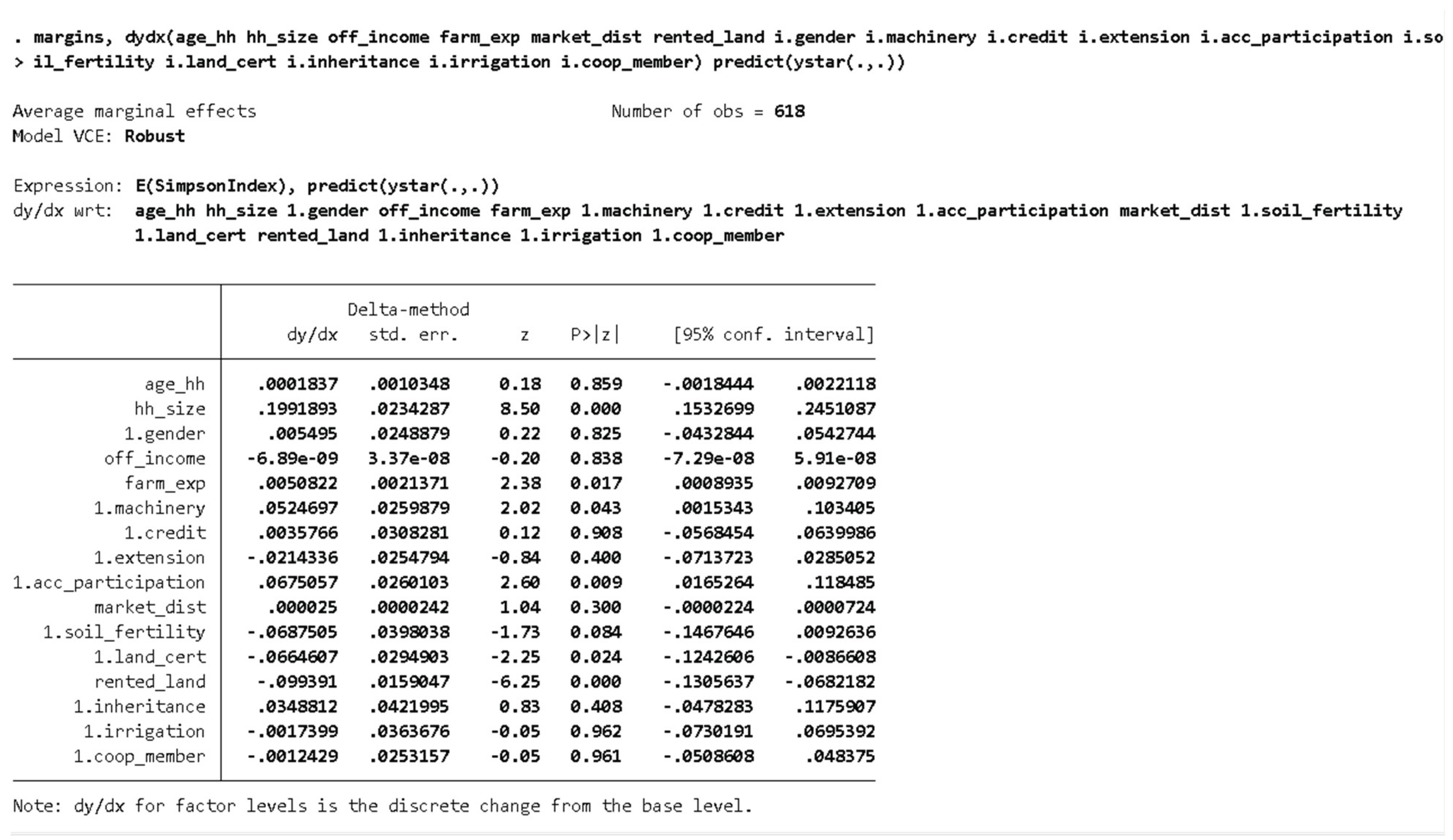
After the model was checked for its main assumptions, the parameters of interest were estimated and presented in the table below (Table 3) or Appendix Figure A3 as a Stata picture. The dy/dx column in Table 3 reports the marginal effects of each independent variable on the Simpson index (Appendix Figure A4). These marginal effects indicate the expected change in the dependent variable for a unit change in the independent variables, holding all others constant.
The Tobit model results indicate that out of fourteen (14) exogenous variables expected to affect irrigated land fragmentation measured by the Simpson index, eight (8) variables were significant at different levels of significance. These were household size, rented-in land size, participation in ACC ,farm experience, off/non-farm income, inheritance, access to extension, access to credit, cooperative membership, land certificate, distance from the nearest market, rented-in land size, and machinery application. The details of their interpretations and implication are discussed in the subsequent sections.
As presented in Table 3 household size, participation in agricultural commercial clusters, and the amount of land rented (rented in land) were highly significant factors at the 1% level of significance. Household size exerts a highly significant and positive influence on the Simpson Index of irrigated land fragmentation. The marginal effect of 0.1991 indicates that each additional household member increases the Simpson Index likely by 19.9%. Participation in agricultural commercial clusters is also positively associated with the Simpson Index. The marginal effect of 0.0675 indicates that households engaged in ACC programs exhibit higher Simpson Index values, likely by 6.75%, implying higher fragmentation of irrigated land. This implies that ACC participation enhances more diversity of land use, likely due to crop diversification and market-oriented production strategies. The Tobit estimates further found that the amount of land rented has a highly significant and negative effect on the Simpson index of irrigated land use. The marginal effect of –0.099 indicates that each additional unit of rented land reduces the Simpson index by approximately 9.9%. In other words, households that expand their operational size through rental markets tend to cultivate less scattered plots, thereby lowering land-use fragmentation.
The Tobit model also identifies four variables that are moderately significant at the 5% level of significance: farm experience, land certificate, machinery application, and distance from the nearest market. The positive and significant marginal effect of 0.005 of farm experience shows that each additional year of experience slightly increases the Simpson index by 0.5%, thereby leading to higher fragmentation. The marginal effect of –0.0664 shows that households with land certificates tend to have lower Simpson index values, implying greater fragmentation. This may be due to the formalization of land rights, which facilitates the rental and transfer of small parcels, thereby increasing fragmentation. While certification enhances tenure security, it can also encourage land market activity that disperses holdings.
Interestingly, the small figures of marginal effect of 0.00001 are positive for the distance between home and the nearest market, indicating less market access, associated with a higher Simpson index, hence higher fragmentation. Machinery application is also positively associated with land fragmentation at the 5% level of significance. The marginal effect of 0.0524 indicated that farmers with machinery application were likely to lead to higher land fragmentation than those who did not. This is due to the application of modern machines, which can label non-farm land and then increase to an increase in farmland (internal fragmentation).
At the 10% significance level, only soil fertility status was significant with a marginal effect of -0.0687. It indicates that households holding farm land with good soil fertility tend to have higher Simpson Index values, implying less fragmentation compared to poorly fertile land. This is because farmers may prefer to cultivate multiple fertile parcels, even if scattered, to maximize productivity. This result reflects the trade-off between soil quality and land consolidation, as households prioritize access to fertile plots over spatial efficiency.
3.3. Discussion of the Key Findings
Predominantly, our study finds that the level of irrigated land fragmentation in rural Ethiopia, measured by the Simpson index, is moderate (0.38), with a high probability of increasing or decreasing, signaled by the standard deviation (Table 2). This finding is not merely aligned with previous studies but, also challenges them due to divergence in terms of metric choice, context, and data employed.
In the Ethiopian context, literature has long highlighted the extreme fragmentation of smallholder land, particularly for rain-fed systems [26]. They reported that the average irrigated plot size was 0.28 ha in the Ethiopian highlands, with over 80% of plots smaller than 0.5 ha. Similarly, a mean of 1.5-2.5 irrigated plots, with a Gini coefficient of plot size distribution exceeding 0.65, was elucidated [27]. These figures are often interpreted as evidence of severe fragmentation that limits technical efficiency, water management, and investment. Although these figures are often interpreted as evidence of severe fragmentation that impedes technical efficiency, water management, and investment, our Simpson index of 0.38 indicates moderate fragmentation [61]. This is mainly attributed to the difference between the natures of metrics employed in measuring fragmentation. For example, the discrepancy arises from the difference between plot-size-based metrics and distribution-based indices, leading to different ways of interpreting the fragmentation level. In our case, the Simpson Index (SI) measures the probability that two randomly selected plots belong to the same farm. Thus, an SI index of 0.38 appears to indicate a moderately concentrated distribution, implying that while plots are small, they are not distributed across an extremely large number of farms in a highly unequal manner. Hence, our result implies that irrigated land, unlike rain-fed land, is somewhat more consolidated. This is likely due to irrigation requiring investment in infrastructure like canals, pumps, and wells [2,22,65].
In the East African context, our findings fall in the moderate range of land fragmentation, particularly measured in the Simpson index. For instance, in Kenya and Tanzania, the same degree of land fragmentation considering irrigated land was consistent with our study. In Kenya, Simpson indices for irrigated land ranging 0.25-0.50 across different irrigation schemes was explored [41,47,48]. Similarly, in Tanzania, the Simpson index for irrigated plots in the Kilimanjaro region was estimated at 0.42 [42], which is very close to our Ethiopian figure. In contrast, in other East African countries like Rwanda and Burundi, the degree of land fragmentation degree was consistently higher, with Simpson fragmentation often exceeding 0.55 for irrigated plots [50,74].This is attributed to extreme land scarcity, densely terraced hillsides, and inheritance driven by subdivision of even the smallest irrigated plots. Our Ethiopian finding of 0.38 is therefore lower than the Rwandan/Burundian extreme but higher than the most consolidated Kenyan schemes.
Considering drivers of this irrigated land fragmentation is undeniably crucial for sustainable irrigation development strategies in rural Ethiopia. Accordingly, in our study, the identified key drivers estimated by the Tobit model (Table 3) are discussed in the subsequent section.
The identified key drivers of irrigated land fragmentation, included: household size, amount of rented land, participation in ACC, machinery application, farm experience, distance from the farmland to home, land certificate, and soil fertility status. Household size, participation in ACC, and rented-in land emerged as the strongest positive drivers of irrigated land fragmentation. Each additional household member increases the fragmentation index by 0.1991 or 19.1% units, a point reinforced by the life-cycle theory of land fragmentation, which predicts that larger households need more land to feed their families. It leads to the acquisition of multiple, non-contiguous plots through inheritance, marriage, or purchase [16]. In irrigated areas, where land is more productive, families may subdivide existing plots among sons or acquire new plots to ensure that each member has access to irrigation water, thereby increasing fragmentation [30,75]. The large marginal effect highlighting that demographic pressure is a primary driver of fragmentation in the study area.
The amount of land rented is a strong negative driver of irrigated land fragmentation. Each unit increase in rented land reduces fragmentation by 0.0335 units. This is consistent with the land rental market consolidation hypothesis [59]. Farmers who rent land typically seek larger, more contiguous plots to achieve economies of scale in irrigation and mechanization [2]. Rental markets allow farmers to bypass the fragmented inheritance patterns of owned land, enabling them to consolidate operations [6,42]. This finding is consistent with evidence from South Asia and Sub-Saharan Africa, where land rental has been shown to reduce fragmentation and enhance productivity [17,28,29].
Participation in an ACC significantly increases irrigated land fragmentation, with a marginal effect of 0.0675. While cooperatives are often associated with consolidation, this counterintuitive result can be explained by the market access hypothesis. ACC members typically have better access to output markets, which incentivizes them to bring more land under irrigation, including scattered plots that were previously fallow or rain fed [14]. Moreover, cooperatives may provide credit or inputs that enable farmers to purchase or rent additional, non-contiguous plots, thereby increasing fragmentation at the farm level even as the cooperative aims to aggregate production [11,12]. This finding is consistent with studies in Ethiopia, where cooperative membership increased plot dispersion due to the expansion of cultivated area [1,53]. The marginally significant positive effect of machinery on irrigated land fragmentation of 0.0524 units is somewhat surprising, as mechanization is typically associated with scale economies and consolidated fields [16,32]. However, in our contexts where irrigation is small-scale, machinery such as pumps and small tractors can be used on scattered plots, allowing farmers to cultivate previously fragmented land that was not feasible with manual labor alone [44]. This implies that machinery adoption may enable fragmentation rather than consolidate it, particularly when it facilitates the irrigation of multiple, distant plots (internal and use fragmentation).
Each additional year of farming experience increases fragmentation by 0.005 units. Experienced farmers often accumulate land over their lifetime through inheritance [51], purchase, and sharecropping, leading to a more fragmented portfolio [29]. This is especially true in irrigated areas where land is a scarce and valuable asset; experienced farmers are more likely to acquire any available plot, regardless of its contiguity, to secure water access [15]. The significant marginal effect of 0.5% reflects the gradual nature of land accumulation. The positive effect of distance, though very small, indicates that farmers with more distant plots tend to have higher fragmentation [17]. This is a classic pattern: as farmers acquire land further from the nearest market, the overall landholding becomes more dispersed [8]. The small marginal effect suggests that distance is a minor but statistically significant contributor, likely because the Simpson Index is more sensitive to the number and size of plots than to their spatial distribution per se.
Households with good soil fertility have 0.0466 units lower irrigated land fragmentation. Fertile soils reduce the need to acquire multiple plots to compensate for poor soil quality, thus lowering fragmentation [51]. Farmers with good soil are more likely to concentrate their irrigated production on fewer, higher-quality plots, rather than seeking additional land to diversify risk or access better soils [18]. Holding a land certificate reduces fragmentation by 0.033 and enhances tenure security, which reduces the incentive to acquire multiple, scattered plots as a risk-coping strategy [20]. Secure tenure also facilitates land consolidation through formal sales or long-term rentals, as landholders feel confident in transferring or consolidating their parcels [52,53,54,55]. This finding supports the view that land certification programs can mitigate fragmentation, especially in irrigated areas where land values are high.
4. Conclusions and Policy Implications
This study recaps important insights into the dynamics of irrigated land fragmentation in rural Ethiopia, elucidating a moderate level of fragmentation measured by a Simpson Index of 0.38, which challenges prevailing narratives in the literature. While previous studies have reported severe fragmentation, particularly in rain-fed systems, our findings implies that irrigated land is characterized by a moderate degree of irrigated land fragmentation. This distinction is critical for developing effective agricultural policies that support sustainable irrigation practices. The identified drivers of irrigated land fragmentation underline several critical socio-economic, biophysical, and institutional factors that shape irrigation systems in the study area. Notably, household size, participation in ACC, and rented land emerged as the most significant drivers of fragmentation. Policymakers or any concerned body should consider strategies to address the multifaceted implications of family size on irrigated land use. Participation decisions of households in ACCs under irrigation systems are also the main concern as the positive association between participation in agricultural cooperatives (ACCs) and land fragmentation presents a paradox that invites further exploration. It should be managed and supported by government initiatives that promote sustainable agricultural practices within the context of larger households rather than strictly focusing on irrigated land.
Interestingly, the findings regarding rented land indicate that rental markets can serve as a mechanism for consolidating operations, a vital insight for policymakers aiming to enhance agricultural productivity. By promoting land rental markets, authorities can mitigate the negative effects of land fragmentation. This aligns with broader land tenure reforms that advocate for secure rights and access to larger, contiguous parcels through rental arrangements, which can ultimately foster agricultural efficiency. Our findings on the significance of land certification in reducing fragmentation emphasize the role of tenure security in promoting stable and consolidated land use. Policymakers should prioritize the implementation and reinforcement of land certification programs, which not only provide security but also encourage landholders to consolidate operations and enhance investment in agricultural development. Finally, soil fertility was found to be a negative driver of fragmentation, implying that enhancing soil health beyond non-irrigated land can reduce the necessity for farmers to seek multiple irrigated lands. Integrative policies that focus on soil conservation practices, access to quality inputs, and agricultural extension services, not merely irrigated land but also the whole farm land, are essential for improving soil fertility and, in turn, mitigating land fragmentation.
In brief, the evidence presented in this study underscores the complexities of irrigated land use in rural Ethiopia, encapsulating the need for integrated policy approaches to address the interlinked challenges of fragmentation, productivity, and land tenure security. By recognizing the unique drivers of irrigated land fragmentation and implementing targeted strategies that bolster consolidation while promoting sustainable agricultural practices, policymakers can contribute to the long-term resilience and productivity of Ethiopia’s agricultural sector.
Author Contributions
Yasin Temam Hajihasen: Writing original draft, writing-review and editing, visualization, methodology, investigation, formal analysis, data curation, and conceptualization. Kassa Tarekegn Erekalo: Writing-review and editing, and conceptualization. Abubaker Shekzeynu Hasen: Writing-review and editing.
Institutional Review Board Statement
Not applicable.
Informed Consent Statement
All the authors read and approved the final version of this paper to be published in this journal.
Data Availability Statement
Data will be made available on request.
Acknowledgments
The authors express their gratitude to the all DREAM project team, Haramaya University and the participants who generously contribute their time. The primary author also expresses gratitude to the Office of Agriculture and Rural Development of the selected districts for enabling his research.
Conflicts of Interest
The authors declare that they have no known competing interests.
Appendix A
Figure A1.
VIF test for multicollinearity.
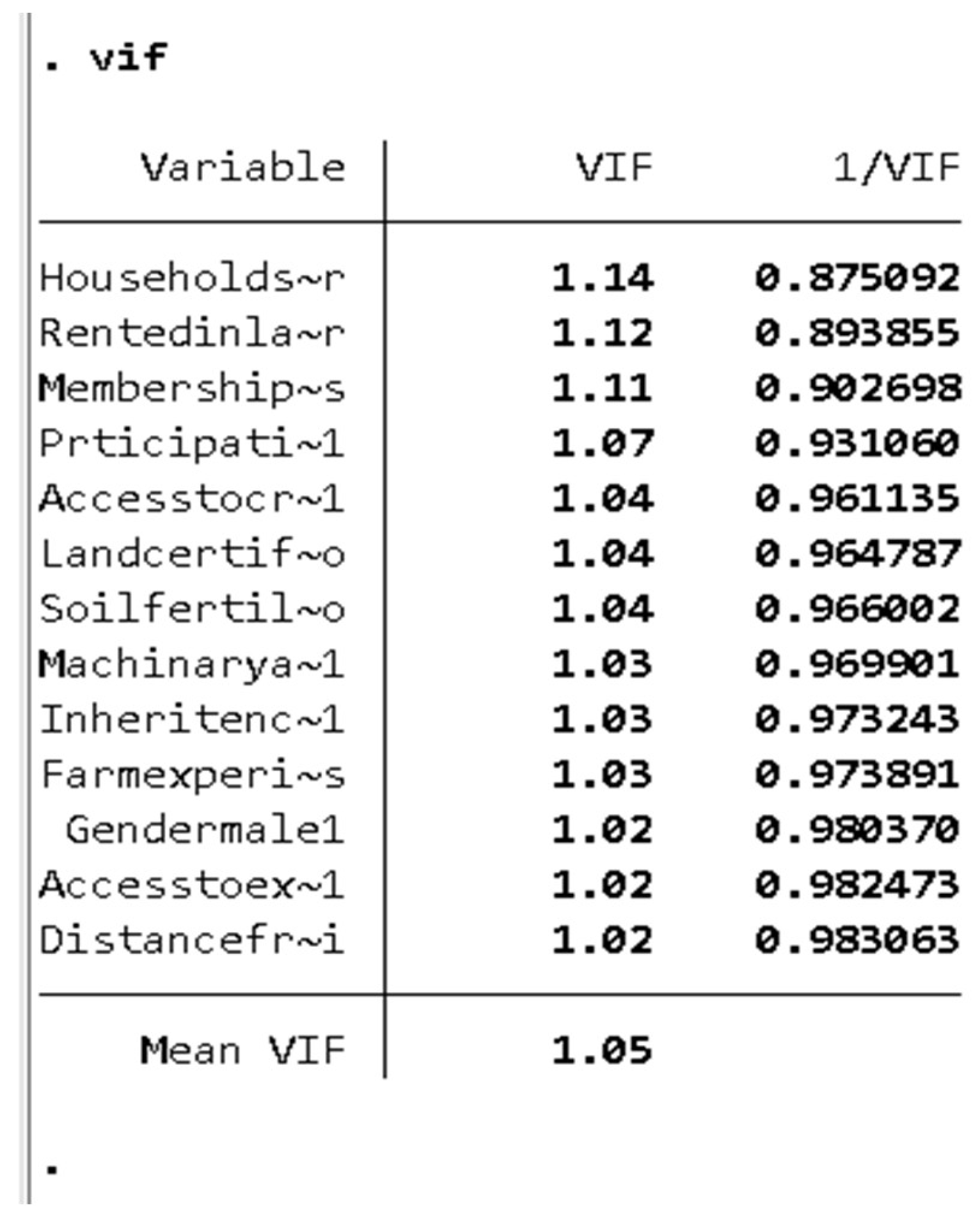
Figure A2.
Correlation test for multicollinearity.
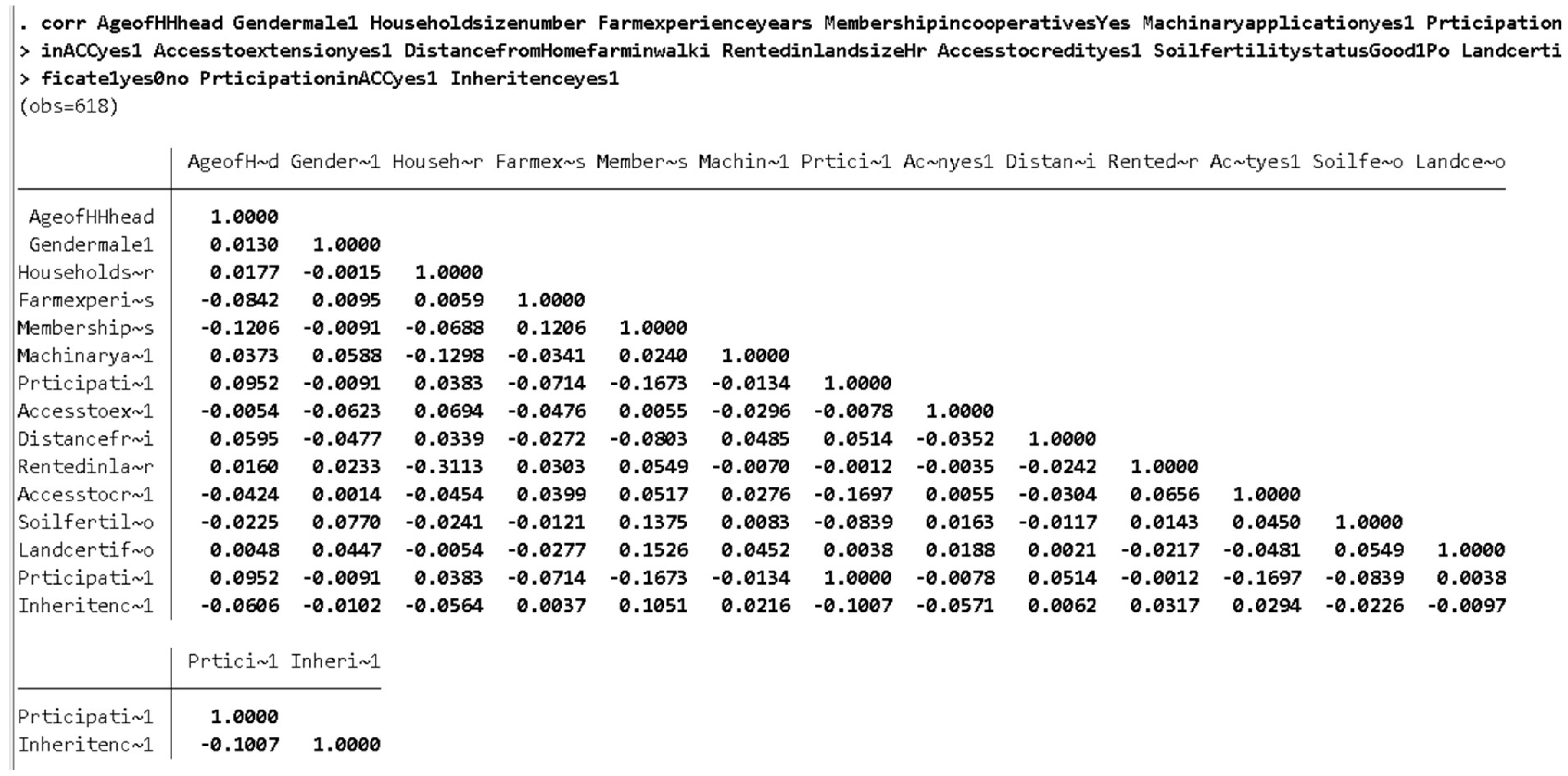
Figure A3.
Tobit model Stata output in picture.
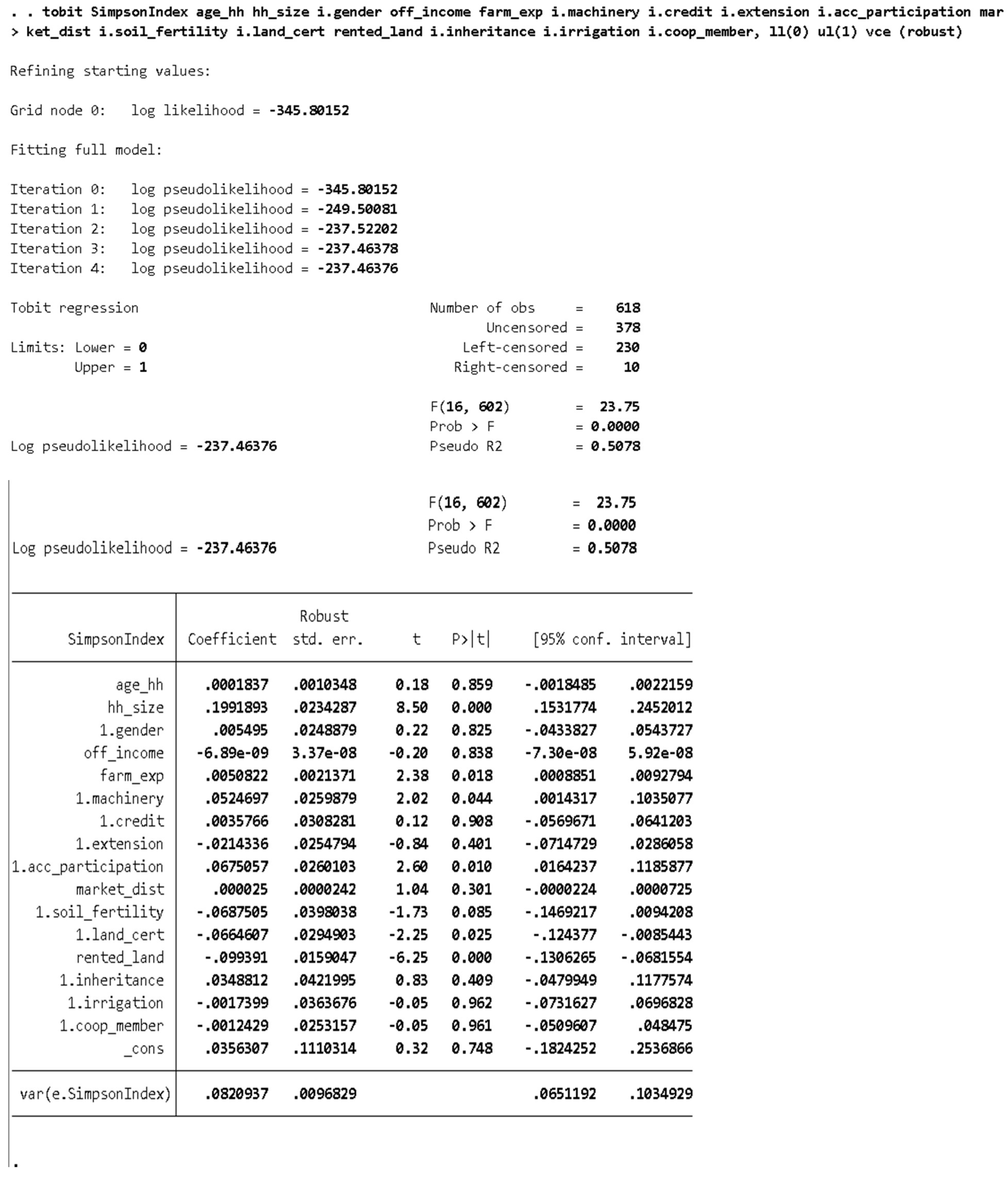
Figure A4.
Marginal effect after Tobit in Stata picture.
| 1 | A piece of continuous land used by a farmer, within which individual plots are located. |
| 2 | A piece of land within a given parcel that is either not contiguous across the entire parcel or segmented. |
| 3 | Stands for Distributed Renewable Energy Agricultural Modalities Project, which aims to transform the agricultural sector in Ethiopia by integrating renewable energy solutions with farming practices. |
| 4 | The lowest level of Ethiopia’s government structure. This term refers to peasant associations and can encompass multiple villages. |
References
- Abebaw, D.; Haile, M. G. The impact of cooperatives on agricultural technology adoption: Empirical evidence from Ethiopia. Food Policy 2013, 38, 82–91. [Google Scholar] [CrossRef]
- Abebe, T.; et al. Irrigation–energy transition nexus and sustainable agricultural productivity: Evidence from panel microdata in Southern Ethiopia. Environ. Chall. 2026, 24, 101535. [Google Scholar] [CrossRef]
- Abou El Hassan, W. H. Irrigation Management Assessment from Land Fragmentation Perspective in the Nile Delta. Irrig. Drain. 2018, 67(3), 354–362. [Google Scholar] [CrossRef]
- Agricultural Water Management. Global inequities in irrigation water distribution: A systematic review and meta-analysis of impacts on cropland productivity and environmental sustainability. Agric. Water Manag. 2026, 329, 110360. [Google Scholar] [CrossRef]
- Aguilar, A. G.; Flores, M. A.; Lara, L. F. Peri-Urbanization and Land Use Fragmentation in Mexico City. Informality Environ. Deterior. Ineffective Urban Policy 2022, 4, 1–19. [Google Scholar] [CrossRef]
- Al-Amin, A. K. M. A.; Rahman, M. S.; Hossain, M. I.; Sayem, S. M. Impact of land fragmentation and Soil Fertility on Rice Producers’ Technical Efficiency: An empirical Study in Bangladesh. Asia-Pac. J. Rural Dev. 2016, 26(2), 1–20. [Google Scholar] [CrossRef]
- Alemu, G. T.; Tsunekawa, A.; Haregeweyn, N.; Nigussie, Z.; Tsubo, M.; Elias, A.; Ayalew, Z.; Berihun, D.; Adgo, E.; Meshesha, D. T.; Molla, D.; Okoyo, E. N.; Zemedu, L. Smallholder farmers’ willingness to pay for sustainable land management practices in the Upper Blue Nile basin, Ethiopia. Environ. Dev. Sustain. 2021, 23(4), 5640–5665. [Google Scholar] [CrossRef]
- Ali, D. A.; Deininger, K.; Harris, T. Using national statistics to increase transparency of land allocation: Evidence from Ethiopia. World Dev. 113 2019, 25–40. [Google Scholar] [CrossRef]
- Aregawi, M. H. The Impact of Small-Scale Irrigation on Rural Household Food Security - The case of Emba Alaje worda Mekele University. 91. 2019.
- Austrich, A.; Mapelli, F. J.; Mora, M. S.; Kittlein, M. J. Landscape change and Associated Increase in Habitat Fragmentation during the Last 30 Years in Coastal Sand Dunes of Buenos Aires Province, Argentina. Estuaries Coasts 2021, 44(3), 643–656. [Google Scholar] [CrossRef]
- Awoke, B. G. Sustainable mechanization options for smallholder farming systems in Ethiopia and Kenya. Doctoral dissertation, University of Hohenheim, 2025. Retrieved from https://opus.uni-hohenheim.de/frontdoor/index/index/docId/2345 (opus.uni-hohenheim.de in Bing). [Google Scholar]
- Balogun, O. L.; Akinyemi, B. E. Land fragmentation effects on technical efficiency of cassava farmers in South-West geopolitical zone, Nigeria. Cogent Soc. Sci. 2017, 3(1), 1413966. [Google Scholar] [CrossRef]
- Balyan, S., Jangir, H., Tripathi, S. N., Tripathi, A., Jhang, T., & Pandey, P. (2024). Seeding a Sustainable Future: Navigating the Digital Horizon of Smart Agriculture. Sustainability, 16(2). Bentley, J. W. (1987). Economic and Ecological Approaches to Land Fragmentation: In Defense of A Much-Maligned Phenomenon. Annual Review of Anthropology, 16, 31–67.
- Bernard, T.; Spielman, D. J. Reaching rural poor through rural producer organizations? A study of agricultural cooperatives in Ethiopia. Food Policy 2009, 34(1), 60–69. [Google Scholar] [CrossRef]
- Bizimana, C. Population pressure and farm fragmentation: Challenges facing agriculture in Rwanda. Rwanda J. 2009, 17(1). [Google Scholar]
- Blarel, B.; Hazell, P.; Place, F.; Quiggin, J. The economics of farm fragmentation: Evidence from Ghana and Rwanda. World Bank. Econ. Rev. 1992, 6(2), 233–254. [Google Scholar] [CrossRef]
- Chen, S.; Restuccia, D.; Santaeulàlia-Llopis, R. The effects of land markets on resource allocation and agricultural productivity. J. Political Econ. 2022, 130(12), 3143–3189. [Google Scholar] [CrossRef]
- Cholo, T.; Chamberlin, J.; Taffesse, A. S. Land fragmentation, cropland abandonment, and yield gaps in Ethiopia. World Dev. 2020, 136, 105070. [Google Scholar] [CrossRef]
- Christensen, R. Log-linear models and logistic regression, 2nd ed.; Springer: New York, 2006. [Google Scholar]
- Deininger, K.; Monchuk, D.; Nagarajan, H. K.; Singh, S. K. Does Land Fragmentation Increase the Cost of Cultivation? Evidence from India. J. Dev. Stud. 2017, 53(1), 82–98. [Google Scholar] [CrossRef]
- Demetriou, D.; Stillwell, J.; See, L. A new methodology for measuring land fragmentation. Comput. Environ. Urban Syst. 2013, 39, 71–80. [Google Scholar] [CrossRef]
- Derib, T. D.; Seyyid, H. Effects of Manning’s roughness coefficient on the hydraulic performance of irrigated farms: A case study of the Shawe Gindiba Gojo irrigation scheme, Ethiopia. Appl. Water Sci. 2026. [Google Scholar] [CrossRef]
- Dogaru, D.; Petrisor, A. I.; Angearu, C. V.; Lupu, L.; Bălteanu, D. Land Governance and Fragmentation Patterns of Agricultural Land Use in Southern Romania during 1990–2020. Land 2024, 13(7). [Google Scholar] [CrossRef]
- Fentahun, G., Amsalu, T., & Birhanie, Z. (2023). Farmers’ perceptions about the influence of land fragmentation and land quality on sustainable land management in the upper lake Tana Basin: Evidence from Dera District. Cogent Economics and Finance, 11(1). He, M. (2014). An analysis of the impact of land fragmentation on agricultural production cost. Land, August. 11, 1.
- Gebremedhin, B.; Jaleta, M. Land fragmentation, farm size, and agricultural productivity in Ethiopia: Implications for rural development. Agric. Econ. 2020, 51(3), 435–448. [Google Scholar]
- Hagos, F.; Makombe, G.; Namara, R. E.; Awulachew, S. B. Importance of irrigated agriculture to the Ethiopian economy: Capturing the direct net benefits of irrigation; IWMI Research Report 128; International Water Management Institute (IWMI): Colombo, Sri Lanka, 2018. [Google Scholar] [CrossRef]
- Hailu, B. K.; Manjur, K.; Mengistu, A. Land fragmentation, agricultural productivity, and implications for food security in Ethiopia. Agric. Food Econ. 2020, 8(1), 1–18. [Google Scholar] [CrossRef] [PubMed]
- Holden, S. T.; Makate, C. Are national agricultural panels fit for purpose? Parcel instability, land rental market measurement, and allocative efficiency in Sub-Saharan Africa. Food Policy 2026, 115, 102567. [Google Scholar]
- Holden, S. T.; Ghebru, H.; Tadesse, F. When contracts interact: Land rental portfolios and farm productivity in Tigray, north Ethiopia. Land Use Policy 2026, 134, 106987. [Google Scholar] [CrossRef]
- International Fund for Agricultural Development (IFAD). Ethiopia Participatory Small-scale Irrigation Development Programme II: Project Completion Report; IFAD: Rome, 2024. [Google Scholar]
- International Water Management Institute (IWMI). Aligned policies and science are pathways for Ethiopia’s smallholder irrigation. IWMI Policy Brief., 2026. [Google Scholar]
- Januszewski, J. Index of land consolidation. Geogr. Pol. Developed the Januszewski Index, applied to assess land consolidation and fragmentation. (Note: The year is 1968, not 2012 — sometimes misattributed in secondary sources). 1968, 14, 291–296. [Google Scholar]
- Kangethe, A. W. The changing dynamics of agricultural land use in Kenya: Legal responses to address the threat of food insecurity from land fragmentation. Zenodo 2024. [Google Scholar] [CrossRef]
- Kawasaki, K. (2010). The costs and benefits of land fragmentation of rice farms in Japan. Australian Journal of Agricultural and Resource Economics, 54(4), 509–526. King, R., & Burton, S. (1982). Land Fragmentation: Notes on a Fundamental Rural Spatial Problem. Progress in Human Geography, 6(4), 475–494. 54, 4) 6(4.
- King, R.; Burton, S. Land fragmentation: Notes on a fundamental rural spatial problem. Prog. Hum. Geogr. 1982, 6(4), 475–494. [Google Scholar] [CrossRef]
- Kleiber, C.; Zeileis, A. Applied econometrics with R; Springer: New York, 2008. [Google Scholar]
- Knippenberg, E.; Jolliffe, D.; Hoddinott, J. Land Fragmentation and Food Insecurity in Ethiopia. Am. J. Agric. Econ. 2020, 102(5), 1557–1577. [Google Scholar] [CrossRef]
- Latruffe, L., & Piet, L. (2014). Does land fragmentation affect farm performance? A case study from Brittany, France. Agricultural Systems, 129. Livelihoods, S. (2021). A Review of Small Farmer Land Use and Deforestation in Tropical Forest Frontiers: Implications for Conservation and Sustainable Livelihoods.
- Liu, Y.; et al. Hydrological complexities in irrigated agro-ecosystems with fragmented land cover types and shallow groundwater: Insights from a distributed hydrological modeling method. Agric. Water Manag. 2019, 213, 868–881. [Google Scholar] [CrossRef]
- Lu, H.; Xie, H.; Yu, Z. Does land fragmentation affect agricultural production? A case study of rice farms in China. Land Use Policy 2018, 74, 20–28. [Google Scholar] [CrossRef]
- Mayele, J. M.; Kolleh, J. B.; Saburi, J. E. The impacts and causes of land fragmentation on farm productivity: Case review of East African countries. Open J. Ecol. 2024, 14(5), 455–482. [Google Scholar] [CrossRef]
- Mdemu, M. V.; et al. Land fragmentation and irrigation performance in smallholder schemes in Tanzania: Evidence from Kilimanjaro region. Agric. Water Manag. 2024, 278, 108120. [Google Scholar]
- Mekki, I.; Bailly, J. S.; Jacob, F.; Chebbi, H.; Ajmi, T.; Blanca, Y.; Zairi, A.; Biarnès, A. Impact of farmland fragmentation on rainfed crop allocation in Mediterranean landscapes: A case study of the Lebna watershed in Cap Bon, Tunisia. Land Use Policy 2018, 75. [Google Scholar] [CrossRef]
- Mengesha, G.; Mulugeta, W.; Chekol, M. Determinants of adoption and intensity of mechanization in Ethiopia: Evidence from Arsi Zone. Afr. J. Sci. Technol. Innov. Dev. Advance online publication. 2025. [Google Scholar] [CrossRef]
- Miguel, E.; Satyanath, S.; Sergenti, E. Advances in modeling fractional outcomes: Applications of beta regression in agricultural and social sciences. J. Appl. Econom. 2023, 38(2), 245–263. [Google Scholar]
- Murteira, M.; Ramalho, J. J. S. Regression analysis of multivariate fractional data. Econom. Rev. 2016, 35(4), 515–552. [Google Scholar] [CrossRef]
- Mutoko, M. C.; Hein, L. Land fragmentation and agricultural productivity in smallholder irrigation schemes in Kenya. Land Use Policy 2024, 132, 106–118. [Google Scholar]
- Mwangi, J. K.; Gathenya, J. M. Assessing land fragmentation and water use efficiency in Kenyan smallholder irrigation systems. Agric. Water Manag. 2025, 280, 108150. [Google Scholar]
- Water, Nature. Irrigation-induced land water depletion aggravated by climate change. Nat. Water 2025. [Google Scholar] [CrossRef]
- Ndayishimiye, P.; Habonimana, C. Irrigation, land fragmentation, and food security in Burundi. Food Secur. 2024, 16(2), 355–370. [Google Scholar]
- Niroula, G. S.; Thapa, G. B. Impacts and causes of land fragmentation, and lessons learned from land consolidation in South Asia. Land Use Policy 2005, 22(4), 358–372. [Google Scholar] [CrossRef]
- Parré, J. L.; Chagas, A. L. S.; Arends-Kuenning, M. P. The effect of farm size and farmland use on agricultural diversification: a spatial analysis of Brazilian municipalities. Agric. Food Econ. 2024, 12(1). [Google Scholar] [CrossRef]
- Paul, M.; wa Gĩthĩnji, M. Small farms, smaller plots: land size, fragmentation, and productivity in Ethiopia. J. Peasant Stud. 2018, 45(4), 757–775. [Google Scholar] [CrossRef]
- Perret, S. R.; Payen, S. Irrigation and the Environmental Tragedy: Pathways towards Sustainability in Agricultural Water Use. Irrig. Drain. 2020, 69(2), 263–271. [Google Scholar] [CrossRef]
- Pijanowski, J. M.; Wałęga, A.; Książek, L.; Strużyński, A.; Goleniowski, K.; Zarzycki, J.; Kowalik, T.; Bogdał, A.; Wyrębek, M.; Szeremeta, K. An Expert Approach to an Assessment of the Needs of Land Consolidation within the Scope of Improving Water Resource Management. Sustainability 2022, 14(24). [Google Scholar] [CrossRef]
- Ren, C.; Liu, S.; van Grinsven, H.; Reis, S.; Jin, S.; Liu, H.; Gu, B. The impact of farm size on agricultural sustainability. J. Clean. Prod. 2019, 220. [Google Scholar] [CrossRef]
- Rosa, I. M. D., Gabriel, C., & Carreiras, J. M. B. (2017). Spatial and temporal dimensions of landscape fragmentation across the Brazilian Amazon. Regional Environmental Change, 17(6), 1687–1699. Samuel, N. N. (2021). Effects of land fragmentation on farm efficiency in three agro-ecological zones of Embu County in Kenya. African Journal of Agricultural Research, 17(2), 283–291.
- Sharofiddinov, H.; et al. How does the number of water users in a land reform matter for water availability in agriculture? Agric. Water Manag. 2024, 293, 108677. [Google Scholar] [CrossRef]
- Shi, H.; Chang, M. Performance of community-based water-saving technology under land fragmentation: evidence from groundwater overexploitation in the North China Plain. Water Policy 2021, 23(6), 1542–1555. [Google Scholar] [CrossRef]
- Simon, H. A. The sciences of the artificial, 3rd ed.; MIT Press: Cambridge, MA, 1999. [Google Scholar]
- Simpson, E. H. Measurement of diversity. Nature 1949, 163(4148), 688. [Google Scholar] [CrossRef]
- Smithson, M.; Merkle, E. C. Generalized linear models for bounded and censored data. Psychol. Methods 2013, 18(4), 429–453. [Google Scholar] [CrossRef]
- Exploring the impact of land fragmentation on the performance of agriculture: A systematic review. Discover Agriculture 2024. [CrossRef]
- Transforming irrigation potential into quantifiable economic returns through integrated performance and investment analysis in Central Ethiopia. Discov. Food 2025. [CrossRef]
- Transforming irrigation potential into quantifiable economic returns through integrated performance and investment analysis in Central Ethiopia. Discover Food 2026. [CrossRef]
- Taye, M. T.; Ebrahim, G. Aligned policies and science are pathways for Ethiopia’s smallholder irrigation. International Water Management Institute (IWMI). 2026.
- Teferi, G. Effect of Drip and Surface Irrigation Methods on Yield and Water Use Efficiency of Onion (Allium Cepa L.) under Semi-Arid Condition of Northern Ethiopia. J. Biol. Agric. Healthc. 2015, 5(14), 88–94. [Google Scholar]
- Tegegne, M.; Mol, J.; van der Velde, M. Modelling the impact of ecosystem fragmentation on ecosystem services in the degraded Ethiopian highlands. Ecol. Inform. 2025, 87, 103100. [Google Scholar] [CrossRef]
- Tobin, J. Estimation of relationships for limited dependent variables. Econometrica 1958, 26(1), 24–36. [Google Scholar] [CrossRef]
- Van Dijk, T. Dealing with Central European land fragmentation: A critical assessment on the use of Western European instruments. Dealing with Central European Land Fragmentation 2003. [Google Scholar]
- Vijulie, I.; Matei, E.; Manea, G.; Cocoş, O.; Cuculici, R. Assessment of agricultural land fragmentation in Romania, a case study: Izvoarele commune, Olt County. Acta Geogr. Slov. 2012, 52(2), 403–430. [Google Scholar] [CrossRef]
- Wang, S.; Li, D.; Li, T.; Liu, C. Land use transitions and farm performance in China: A perspective of land fragmentation. Land 2021. [Google Scholar] [CrossRef]
- Wickramaachchi; Weerahewa, Jeevlka. Land Fragmentation and Land Productivity: Empirical Evidence from Land Distribution Schemes of Sri Lanka. Int. Acad. Res. J. Bus. Manag. 2016, 5(1), 11–21. [Google Scholar]
- wizeyimana, D.; Nkurunziza, J. Land fragmentation and agricultural productivity in Rwanda’s irrigated valleys. Land Use Policy 2025, 135, 106–125. [Google Scholar]
- Wondimu, T.; colleagues. Spatio-temporal dynamics of ecosystem service value functions in response to landscape fragmentation in the Boma-Gambella trans-boundary landscape, Southwest Ethiopia and East South Sudan. Discover Applied Sciences 2024. [Google Scholar] [CrossRef]
- World Bank Group. Ethiopia irrigation potential assessment: Opportunities and constraints; World Bank: Washington, DC, 2020; Available online: https://documents.worldbank.org.
Figure 1.
Map of the study area. Sources: Adopted from DREAM project description.
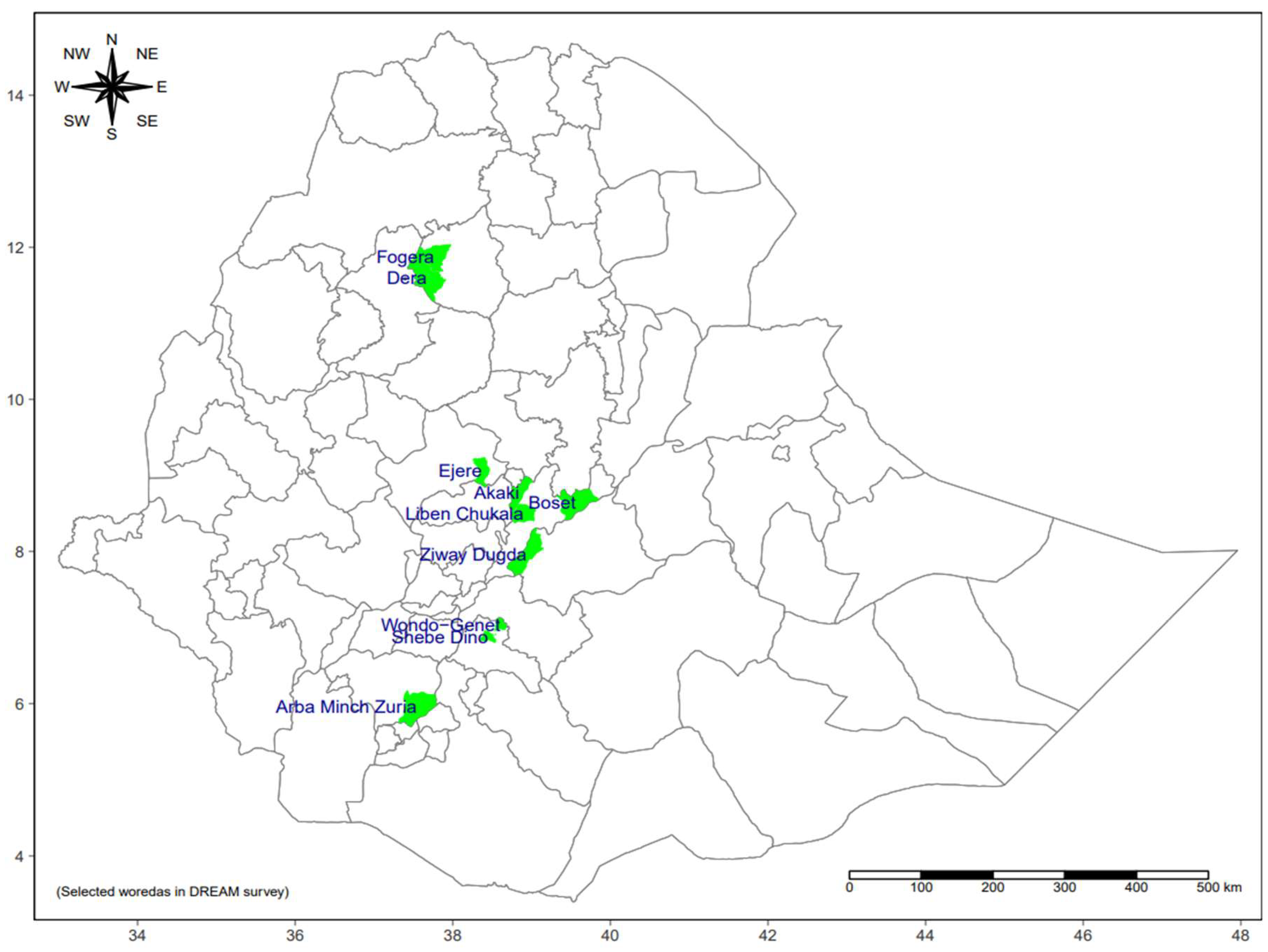
Figure 2.
Simpson index distribution across sample households (Bar graph).
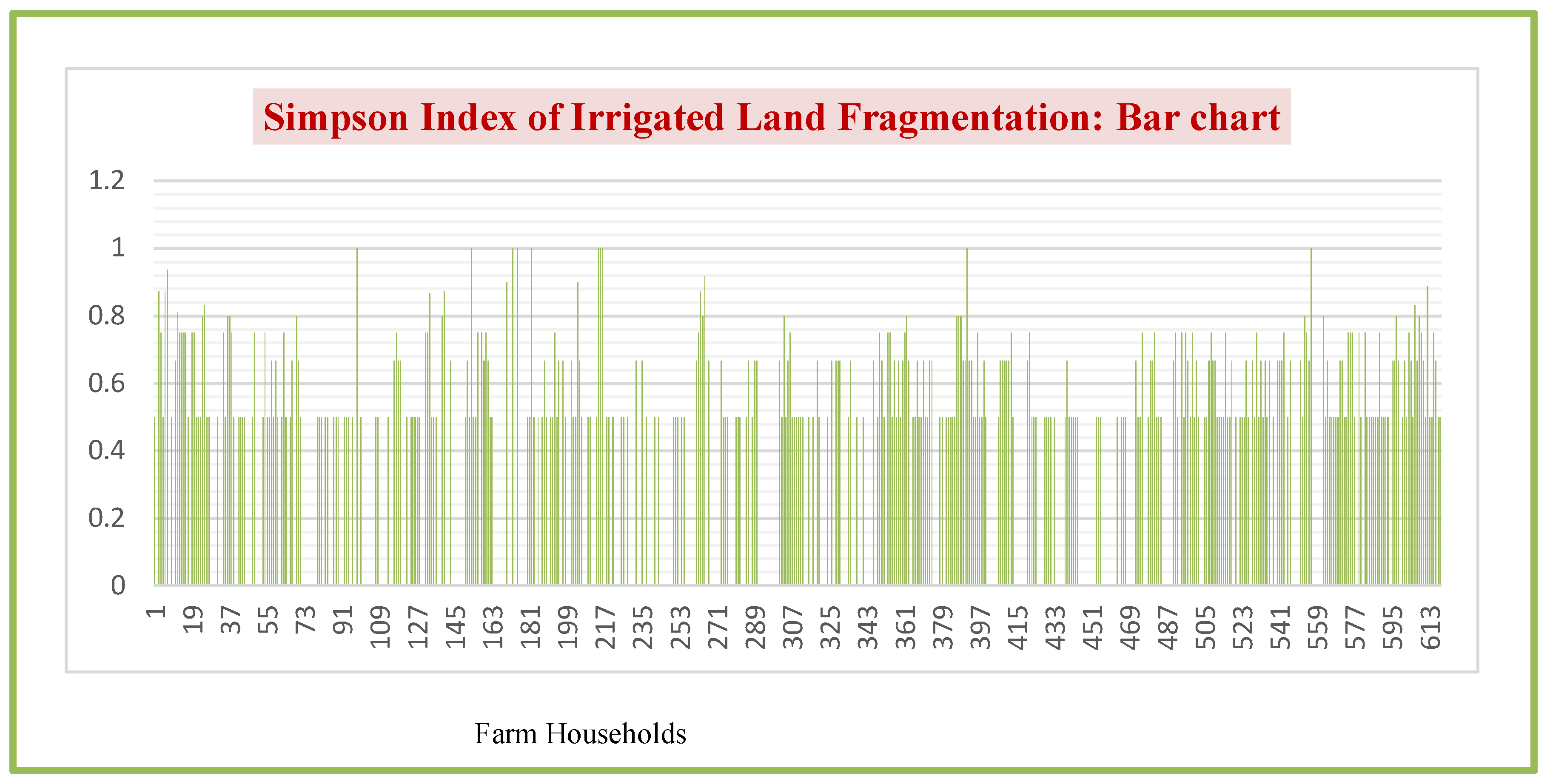

Table 1.
Summary statistics for exogenous variables.
| Type/category | Variable | Mean | SD | Minimum | Maximum | Total |
|---|---|---|---|---|---|---|
| Socioeconomic factors (drivers) | Gender of HH (Male=1) | 0.51 | 0.50 | 0 | 1 | 618 |
| Household Size (in number) | 2.05 | 1.3 | 1 | 12 | 618 | |
| Farm Experience (in years) | 13.01 | 6.07 | 3 | 30 | 618 | |
| Off/non-farm income (1000ETB) | 303.35 | 378.9 | 20.5 | 5120 | 618 | |
| Inheritance (yes=) | 0.93 | 0.25 | 0 | 1 | 618 | |
| Institutional factors (drivers) | Participation in ACCa (yes=1) | 0.49 | 0.50 | 0 | 1 | 618 |
| Access to extension (yes=1) | 0.38 | 0.48 | 0 | 1 | 618 | |
| Access to credit (yes=1) | 0.23 | 0.42 | 0 | 1 | 618 | |
| Cooperative membership (yes=1) | 0.54 | 0.49 | 0 | 1 | 618 | |
| Land Certificate (yes=1) | 0.82 | 0.38 | 0 | 1 | 618 | |
| Biophysical factors (drivers) | Soil fertility status (Good=1) | 0.9 | 0.29 | 0 | 1 | 618 |
| Distance from nearest market (in minutes) | 32.4 | 100 | 2 | 2500 | 618 | |
| Rented in land size (hectare) | 1.93 | 1.73 | 0 | 26 | 618 | |
| Machinery Application (yes=1) | 0.33 | 0.47 | 0 | 1 | 618 |
Source: Computed results from sample data, 2025. SD stands for standard deviation; ACC (a) =agricultural commercial cluster.
Table 2.
Summary of dependent variables (Irrigated land fragmentation in terms of the Simpson index.
Table 2.
Summary of dependent variables (Irrigated land fragmentation in terms of the Simpson index.
| Variable | Observations | Mean | Standard deviation | Minimum | Maximum |
|---|---|---|---|---|---|
| Simpson Index | 618 | 0.38 | 0.31 | 1 | 0 |
| Percentage | 100% | 38% | 31% | 100% | 0% |
Source: Own computation of survey, 2025.
Table 3.
Results of the Tobit model for drivers of irrigated land fragmentation.
| Simpson Index | Coefficient | Robust SE | Marginal effects |
|---|---|---|---|
| Age of the household head (years) | 0.0001 | 0.0010 | 0.0001 |
| Household size in number | 0.1991*** | 0.0234 | 0.1991 |
| Gender of household head (male=1) | 0.0054 | 0.0248 | 0.0054 |
| Off-farm/ non-farm Income | -5.89 | 3.37 | -6.89 |
| Farm experience (years) | 0.0050** | 0.0021 | 0.0050 |
| Machinery application (yes=1) | 0.0524** | 0.0259 | 0.0524 |
| Access to credit (yes=1) | 0.0035 | 0.0308 | 0.0035 |
| Access to extension services (yes=1) | -0.0214 | 0.0254 | -0.0214 |
| Participation in ACC (yes=1) | 0.0675*** | 0.0260 | 0.0675 |
| Distance from the nearest market (min) | 0.00001** | 0.00001 | 0.00001 |
| Soil fertility status (good=1) | -0.0687* | 0.0398 | -0.0687 |
| Land certificate (yes=1) | -0.0664** | 0.0294 | -0.0664 |
| Amount of land rented in | -0.0993*** | 0.0159 | -0.0993 |
| Inheritances (yes=1) | 0.0348 | 0.0421 | 0.0348 |
| Irrigation access | -0.0017 | 0.0363 | -0.0017 |
| Membership in cooperatives (yes=1) | -0.0012 | 0.0253 | -0.0012 |
| Constant | 0.0356 | 0.1110 |
Source: Own computations survey, 2025.
Disclaimer/Publisher’s Note: The statements, opinions and data contained in all publications are solely those of the individual author(s) and contributor(s) and not of MDPI and/or the editor(s). MDPI and/or the editor(s) disclaim responsibility for any injury to people or property resulting from any ideas, methods, instructions or products referred to in the content. |
© 2026 by the authors. Licensee MDPI, Basel, Switzerland. This article is an open access article distributed under the terms and conditions of the Creative Commons Attribution (CC BY) license (http://creativecommons.org/licenses/by/4.0/).
Copyright: This open access article is published under a Creative Commons CC BY 4.0 license, which permit the free download, distribution, and reuse, provided that the author and preprint are cited in any reuse.