

Submitted:
04 August 2026
Posted:
14 August 2026
You are already at the latest version
Abstract
Asymmetric supercapacitors (ASC) achieve an excellent balance of high energy density, high power density, and long cycle life by coupling battery-type and capacitive-type electrodes. Herein, we propose an in-situ oxidation method to grow Cu(OH)₂ nanowires on copper foam (CF) as a conductive backbone, followed by a secondary hydrothermal process to coat Co-LDH nanosheets, constructing a Co-LDH@Cu(OH)₂/CF self-standing electrode with a nano-tree-like structure. The optimized Co₃-LDH@Cu(OH)₂/CF electrode delivers a high specific capacitance of 1200 mF cm-2 at 1 mA cm-2 with excellent rate performance. An ACS assembled with Co₃-LDH@Cu(OH)₂/CF as the positive electrode and activated carbon as the negative electrode operates stably within 0~1.6 V, achieving an areal capacitance of 325.6 mF cm-2 at 5 mA cm-2, a high energy density of 115.8 mWh cm-2, and outstanding cycling durability. In-situ Raman spectroscopy reflects the charge storage state and confirms the good reversible electrochemical response in alkaline electrolyte. And in-situ scanning electrochemical microscopy (SECM) reveals the distribution of active sites and provides kinetic coefficients via approach curves.
Keywords:
hierarchical nano-tree structure
; self-standing electrode
; fast redox reaction
; in-situ electrochemical measurement
; asymmetric supercapacitor
1. Intruduction
The global pressing demand for portable electronic devices, electric vehicles, and grid-scale energy storage systems is driving an urgent search for power sources that can simultaneously achieve high energy density, rapid charge-discharge capability, and excellent cycling stability [1,2,3]. Although lithium-ion batteries dominate the market due to their superior energy density, their power density and cycle life are inherently limited at high rates because of the sluggish kinetics of bulk Faradaic reactions [4,5]. In this context, supercapacitors have emerged as a promising bridging technology, offering high power density (typically exceeding 10 kW kg-1), ultra-long cycle life (hundreds of thousands of cycles), and inherent operational safety [6,7,8]. However, the practical application of supercapacitors is constrained by their relatively low energy density (typically 5~10 Wh kg-1), which arises from their charge storage mechanisms: electrical double-layer capacitance formed by physical ion adsorption on carbon materials [9], or pseudocapacitance originating from fast surface redox reactions [10,11]. Therefore, the key challenge lies in designing electrode architectures that can enhance energy storage without sacrificing the hallmark high power and stability of supercapacitors.
To circumvent the trade-off between energy and power, a promising strategy is to construct asymmetric supercapacitors. By coupling a fast Faradaic reaction positive electrode (providing high capacity) with a capacitive negative electrode (providing high-rate performance and cycling stability), asymmetric supercapacitors can extend the operating voltage window beyond the thermodynamic stability limit of symmetric devices, thereby substantially enhancing the overall energy density (E = 1/2CV2) [12,13,14,15]. In asymmetric supercapacitors, the positive electrode material is of critical importance; it must possess high theoretical capacity, fast redox kinetics, and robust structural integrity during repeated ion intercalation/deintercalation processes[16]. Among various candidate materials, layered double hydroxides [17], particularly cobalt-based LDH (Co-LDH), have attracted extensive interest [17,18]. Their unique hydrotalcite-like structure, consisting of brucite-like host layers with interlayer anions and water molecules, enables tunable composition and abundant electrochemical active sites. Specifically, Co-LDH exhibits exceptional pseudocapacitive behavior through reversible Co²⁺/Co³⁺ redox transitions and possesses high theoretical specific capacitance [19,20]. For instance, Wang et al. synthesized multicomponent nitrogen-doped carbon@Ni-Co LDH composite nanosheet arrays derived from zeolitic imidazolate frameworks via a facile hydrothermal method, constructing three-dimensional open channels at the nanoscale to facilitate sufficient electrolyte permeation [21]. To further enhance the electrochemical performance, Kiani et al. utilized thermal decomposition of biomass combined with oxidative polymerization of aniline to prepare Ni−Co LDH composite electrode materials integrated with biomass-derived carbon and polymers, achieving improved electron and ion transport rates and thus promoting the electrochemical performance of supercapacitors [22]. However, the practical application of Co-LDH is constrained by its inherent low electrical conductivity, severe nanosheet agglomeration, and volume expansion during long-term cycling, leading to rapid capacity decay, a typical manifestation of the "dead volume" phenomenon in powder-based composite electrodes. Meanwhile, the structural design of current collectors and electrode scaffolds also plays a decisive role. The conventional slurry-coating technique, which binds active materials onto metal foams or foils using polymeric binders and conductive additives, inevitably introduces "dead surface" regions, increases contact resistance, and reduces the active material loading efficiency. For instance, Chen et al. synthesized a self-supporting CoFe-LDH electrode via a one-step hydrothermal method, in which the pretreated nickel foam was directly immersed into a metal precursor solution for in-situ growth of CoFe-LDH, and subsequently used it as an asymmetric supercapacitor [23]. To address the bottlenecks of brittleness and insufficient flexibility in conventional self-supporting electrodes, Yan et al. successfully constructed a self-supporting electrode using cellulose acetate as a flexible matrix and MOF-derived LDH as the active component through a combination of electrospinning carbonization and co-precipitation, effectively enhancing the electrochemical performance of flexible supercapacitors [24]. Therefore, the development of self-supporting, binder-free electrodes via in-situ growth of active phases on conductive substrates has become a research trend.
In this work, inspired by the hierarchical structure of natural forests, we introduce the concept of "nano-tree" electrodes. A self-standing electrode with a hierarchical "nano-tree" structure, Co-LDH@Cu(OH)₂/CF, was successfully fabricated via a two-step in-situ growth strategy. The Cu(OH)₂ nanowire arrays serve as rigid trunks, while the Co-LDH nanosheets radially and conformally grow as leaf-like branches. This bioinspired design endows several unique advantages: i) The three-dimensional open architecture maximizes electrolyte accessibility and shortens ion diffusion pathways. ii) The direct in-situ formation of Co-LDH on Cu(OH)₂ eliminates the need for binders, promotes intimate electrical contact, and significantly reduces charge-transfer resistance. iii) The synergistic effect between the two phases induces electron redistribution at the heterojunction, potentially enhancing the intrinsic reactivity of both components. The optimized Co₃-LDH@Cu(OH)₂/CF self-standing electrode, when assembled as the positive electrode in an ASC device, can be normally charged and discharged within a voltage window of 0~1.6 V, delivering an areal capacitance of 325.6 mF cm-2 and an energy density of 115.8 mWh cm-2, while maintaining stable operation over 5000 cycles at a current density of 5 mA cm-2. Furthermore, two in-situ characterization techniques (in-situ Raman spectroscopy and SECM) were employed to jointly confirm, from the perspectives of structural evolution during charge-discharge and local electrochemical activity and kinetics, that the electrode material exhibits reversible charge storage behavior and favorable reaction kinetics in alkaline systems. This work not only enhances the performance of layered double hydroxide-based energy storage devices but also provides a versatile biomimetic framework for designing next-generation self-standing electrodes for advanced electrochemical energy systems.
2. Experimental
2.1. Synthesis of Cu(OH)2/CF
1.0 g of sodium hydroxide and 296 mg of ammonium persulfate were dissolved in 10 mL of deionized water. After vigorous stirring, a clear and transparent solution was obtained. At room temperature, a pretreated 2 × 1 cm copper foam was immersed in this solution for 10 min. After the reaction, a uniformly colored light blue copper foam was obtained. It was washed three times each with ethanol and water, and then placed in a vacuum oven to dry overnight, yielding the Cu(OH)2/CF sample.
2.2. Synthesis of Co-LDH@Cu(OH)2/CF
3 mmol of cobalt nitrate hexahydrate and 45 mmol of urea were separately dissolved in 30 mL of deionized water and stirred for 30 min until completely dissolved, yielding a homogeneous reaction solution. The pre-prepared Cu(OH)2 nanowire substrate on copper foam was gently rinsed with deionized water, then placed into a Teflon-lined stainless-steel autoclave. The above mixed solution was poured into the autoclave, which was then sealed and heated at 90 °C in an oven for 4 h. After the reaction, the autoclave was allowed to cool naturally to room temperature. The copper foam substrate was taken out and rinsed several times with deionized water and absolute ethanol sequentially. Finally, it was dried under vacuum at 60 °C for 12 h to obtain cobalt-based layered double hydroxide on the Cu(OH)2 nanowire surface (Co3-LDH@Cu(OH)2/CF). For comparison, Co6-LDH@Cu(OH)2/CF and Co9-LDH@Cu(OH)2/CF were synthesized as reference samples under the same experimental conditions and with the same amounts of other reagents, except that 6 and 9 mmol of cobalt nitrate hexahydrate were used, respectively.
2.3. Characterizations
The morphologies of the self-supporting electrodes were examined by SUPRA 55 field-emission scanning electron microscopy (SEM). The microstructure of the Co3-LDH@Cu(OH)₂/CF electrode was characterized using transmission electron microscopy (TEM, JEOL JEM-ARM200F). X-ray diffraction (XRD) measurements were carried out on a Bruker D8 Advance diffractometer with Cu Kα radiation (λ = 0.15406 nm) in the 2θ range of 20°~80°. Raman spectroscopy was performed on a Renishaw inVia-Reflex confocal Raman microscope at an excitation wavelength of 532 nm under ambient conditions. X-ray photoelectron spectroscopy (XPS) analysis was conducted using an XSAM800 system (Kratos, UK) to determine the surface elemental composition and chemical states. All binding energies were referenced to the adventitious carbon C 1s peak at 284.8 eV.
2.4. Electrochemical Measurement
The electrochemical performance of the prepared Cu(OH)₂/CF, Co₃-LDH@Cu(OH)₂/CF, Co₆-LDH@Cu(OH)₂/CF, and Co₉-LDH@Cu(OH)₂/CF samples was first evaluated using a three-electrode system on a CHI 760E electrochemical workstation. One end (2 × 1 cm²) of the as-obtained standalone electrodes was immersed into the electrolyte, with a platinum mesh electrode and a Hg/HgO electrode serving as the counter electrode and reference electrode, respectively. Cyclic voltammetry (CV) curves were recorded at different scan rates (5, 10, 30, 40, and 50 mV s-1) within a potential range of 0 to 0.6 V (vs. Hg/HgO). Galvanostatic charge–discharge (GCD) curves were measured at current densities ranging from 1 to 10 mA cm⁻² within the same potential range of 0 to 0.6 V (vs. Hg/HgO). Electrochemical impedance spectroscopy (EIS) was performed at open circuit potential with an amplitude of 5 mV over a frequency range of 0.01 to 100000 Hz [25].
The assembly and testing of the asymmetric supercapacitor were conducted as follows: The standalone electrodes were cut into circular pieces (Φ = 10 mm) using a microtome to serve as the positive electrode. Commercial activated carbon (AC), acetylene black, and polytetrafluoroethylene were mixed in a mass ratio of 8:1:1, and a total of 10 mg of the mixture was loaded onto the current collector as the negative electrode. The two prepared electrodes were separated by an NKK fibrous separator (Φ = 16 mm), and 3 M KOH electrolyte was injected before encapsulating into a coin-type supercapacitor. CV and GCD curves were recorded within a voltage window of 0~1.6 V at different scan rates (5, 10, 20, 30, 40, and 50 mV s-1) and different current densities (5~25 mA cm-2), respectively. Electrochemical impedance spectroscopy (EIS) was performed at open circuit potential with an amplitude of 5 mV over a frequency range of 0.01 to 100000 Hz. The specific capacitance (C, mF cm-2), Coulombic efficiency (%), energy density (E, mWh cm-2), and power density (P, mW cm-2) were calculated according to formulas (1~4) [26,27]:
where, I is the discharge current (A), Δt is the discharge time (s), ΔV is the potential window (V), S is the area of active material (g), td is the discharge time (s), and tc is the charge time (s).
C=I∆t/S∆V
η=td/tc
E=0.5CV2/3.6
P=3600E/t
2.5. SECM measurements
Scanning electrochemical microscopy (SECM) equipped with a four-electrode system (Princeton, USA) was employed to investigate the electrochemical processes in the catalyst microregion. A platinum wire electrode (Φ = 25 μm) sealed in a glass capillary served as the SECM probe electrode, and the catalyst drop-coated on a gold disk electrode (Φ = 6 mm) was used as the substrate working electrode. The substrate working electrode was prepared as follows: the Co₃-LDH@Cu(OH)₂/CF free-standing electrode was immersed in a mixed solution of deionized water, ethanol, and Nafion (5 wt%) with a volume ratio of 49:49:2, followed by ultrasonication for 30 min to obtain a homogeneous suspension. Then, 6.0 µL of the suspension was drop-coated onto the gold disk electrode and dried naturally at room temperature to obtain the substrate working electrode. A carbon rod and a Hg/HgO electrode were used as the counter electrode and reference electrode, respectively. SECM approach curve measurements were performed in feedback mode to determine the distance between the substrate electrode and the probe electrode. The potential of the SECM probe electrode was maintained at 0.8 V vs. Hg/HgO, while the substrate working electrode was kept at open-circuit potential. The probe electrode was moved gradually toward the substrate working electrode along the Z-direction at a rate of 0.1 μm s-1 using a three-dimensional translation stage controlled by a stepper motor, and the distance between the probe and the substrate was determined based on the changes in feedback current. The electrolyte was a mixed solution containing 10 mM Fe(C₅H₅)₂ and 0.1 M KCl. Prior to the approach curve measurements, cyclic voltammetry in the potential range of 0 to 0.8 V was recorded to verify the availability of the probe electrode. In feedback mode, the primary reaction occurring at the probe electrode is shown in Equation (1) [28]:
Fe2⁺ - e⁻ → Fe³⁺
The kinetic coefficient of the substrate electrode was calculated from the approach curves recorded in SECM feedback mode according to Equation (6) [29]:
where k is the kinetic coefficient (cm2 s-1), D is the diffusion coefficient of the redox mediator (6.7 × 10⁻⁶ cm2 s-1), d is the distance between the probe and the substrate (cm), iT is the current when the probe is positioned at the substrate surface, and i∞ is the current when the probe is far away from the substrate.
Two-dimensional SECM images of the substrate working electrode were acquired in feedback mode at a well-defined tip-substrate distance (10 μm). The probe was positioned at a fixed height above the substrate electrode using a three-dimensional translation stage, and the feedback current response was monitored at a constant height, enabling the visualization of the microscopic distribution and electrochemical reactivity of the electrode material over a 500 × 500 μm2 area via a serpentine scanning path. Subsequently, the probe was moved by a stepper motor to three characteristic points within the microregion, namely (100, 100), (200, 200), (300, 300) and (400, 400), where approach curves were recorded to determine the kinetic coefficients at these specific locations.
2.6. In Situ Potential-Dependent Raman Spectra for Charge/Discharge Process
During in situ Raman spectroscopy measurements, the Co3-LDH@Cu(OH)2/CF catalyst was loaded into a custom-designed electrochemical cell, with the potential controlled by a CHI 760E electrochemical workstation (open-circuit potential, charge potentials, and discharge potentials, with a potential interval of 0.1 V). Each measurement required five accumulations and was conducted for 300 s at the specified potential to ensure the accuracy of the results [30].
3. Results and Discussion
The SEM images illustrate the morphological evolution of samples under different cobalt source concentrations and its correlation with electrochemical performance. In Figure 1a, pristine Cu(OH)2/CF exhibits smooth one-dimensional nanowire arrays, serving as a precursor substrate that provides a favorable growth scaffold. In Figure 1b, the Cu(OH)2 nanowires of Co3-LDH@Cu(OH)2/CF are uniformly covered with vertically grown Co-LDH nanosheets, forming an intact three-dimensional porous "nano-tree" hierarchical structure. This ideal core–shell heterostructure combines a large electrochemically active surface area, unobstructed ion diffusion channels, and efficient electron transport pathways between the conductive core and the active shell, thereby promising excellent electrochemical performance. However, when the cobalt concentration is increased to 6 mmol (Co6-LDH@ Cu(OH)2/CF), the LDH nanosheets become thicker and undergo localized stacking, resulting in reduced surface utilization (Figure 1c). Meanwhile, the EDS spectrum and elemental mapping of Co3-LDH@ Cu(OH)2/CF revealed that the proportions of O, Co, and Cu were 38.4%, 34.9%, and 21.5%, respectively, with a uniform distribution (Fig. S1a~f). In Figure 1d, with a further increase in Co concentration to 9 mmol (Co9-LDH@Cu(OH)2/CF), excessive LDH causes the nanowire scaffolds to be buried, and the nanosheets severely aggregate into a dense structure, almost collapsing the three-dimensional hierarchical architecture, which severely impedes electrolyte infiltration and ion/electron transport. Therefore, a cobalt concentration of 3 mmol is critical for achieving optimal growth of LDH on Cu(OH)2 nanowires, where a moderate active material loading maximizes the core–shell synergistic effect, whereas excessive loading undermines the structural advantages and deteriorates electrochemical performance [10].
Transmission electron microscopy (TEM) was employed to thoroughly investigate the microstructure of the as-prepared Co₃-LDH@Cu(OH)₂/CF. In Figure 2a, the low-magnification TEM image reveals that the three-dimensional needle-like and rod-like Co₃-LDH@Cu(OH)₂ composites are tightly integrated, with ultrafine Co-LDH nanowires and Cu(OH)₂ nanorods jointly constructing a three-dimensional architecture. In the high-resolution transmission electron microscopy (HR-TEM) image (Figure 2b), lattice fringes with spacings of 0.28 nm and 0.29 nm are observed, which are assigned to the (100) and (113) crystal planes of Co-LDH, respectively. The phase structure and composition of the materials were characterized using X-ray diffraction (XRD) and Raman spectroscopy. Figure 2c shows the XRD patterns of Cu(OH)2/CF, Co3-LDH@Cu(OH)2/CF, Co6-LDH@Cu(OH)2/CF and Co9-LDH@Cu(OH)2/CF. In the pattern of Cu(OH)₂/CF, the characteristic peaks located at 35.9°, 38.2°, and 61.2° are attributed to the (111), (041) and (152) crystal planes of Cu(OH)2 (JCPDS No. 13-0420), respectively [31,32]. In the patterns of Co3-LDH@Cu(OH)2/CF, Co6-LDH@Cu(OH)2/CF, and Co9-LDH@Cu(OH)2/CF, the characteristic peaks at 33.7°, 36.8°, 39.2°, 47.1°, and 61.5° correspond to the (100), (113), (021), (002), and (300) planes of Co-LDH (JCPDS No. 48-0083), respectively [18,21]. In Figure 2d, the Raman spectra of all the standalone electrodes exhibit a stretching vibration at 524.2 cm-1, which is attributed to the metal-oxygen (M-O) bond. In the Raman spectra of Co3-LDH@Cu(OH)2/CF, Co6-LDH@Cu(OH)2/CF, and Co9-LDH@Cu(OH)2/CF, the bending vibration at 704.7 cm-1 is assigned to Co-OH, which is a typical characteristic peak of Co-containing LDH around 700 cm-1, corresponding to the bending vibration mode between hydroxyl groups and cobalt ions in the layered sheets [28]. The characteristic vibration at 627.8 cm-1 belongs to CuO, which likely originates from the copper foam substrate due to partial oxidation in the alkaline environment, resulting in the formation of a small amount of CuO phase [33].
The survey XPS spectrum in Figure 3a confirms the presence of Cu, Co, O, and trace C in the Co3-LDH@Cu(OH)2/CF nano-tree composite on copper foam, indicating the successful fabrication of the bimetallic hydroxide heterostructure with no significant impurities. The high-resolution O 1s spectrum (Figure 3b) is fitted with three peaks corresponding to lattice metal-O bonds (~530.8 eV), interlayer carbonate C-O bonds (~532.0 eV), and adsorbed C=O species (~533.2 eV), confirming the layered structure and abundant lattice oxygen active sites [34,35]. In Figure 3c, the Co 2p spectrum shows main peaks at ~781 eV (Co 2p3/2) and ~797 eV (Co 2p1/2) with satellite peaks, and can be deconvoluted into Co2+ and Co3+ species. The Co2+/Co3+ redox couple enables reversible valence changes, serving as the main source of pseudocapacitance [10,21,23]. The Cu 2p spectrum (Figure 3d) exhibits strong satellite peaks characteristic of Cu2+, confirming the in-situ growth of Cu(OH)2 nanowire backbones. Additionally, trace Cu⁺ is detected, which facilitates electron transport along the conductive skeleton and reduces interfacial resistance between the substrate and the Co-LDH shell [36,37]. Owing to the synergistic effects of the conductive Cu(OH)2 backbones and the multivalent Co-LDH shells, this hierarchical nano-tree structure is anticipated to deliver excellent pseudocapacitive performance.
Figure 4a shows the CV curves of Co₃-LDH@Cu(OH)₂/CF, Co₆-LDH@Cu(OH)₂/CF, Co₉-LDH@Cu(OH)₂/CF, and pristine Cu(OH)₂/CF at a scan rate of 5 mV s-1. All samples exhibit a pair of well-defined redox characteristic peaks without the quasi-rectangular features typical of standard electric double-layer capacitance, confirming that the energy storage performance of the electrodes primarily originates from pseudocapacitive behavior arising from the reversible valence-state transitions between Cu2+/Cu+ and Co2+/Co3+ metal species [10,21,37]. By comparing the peak currents and enclosed integrated areas of the four curves, it is evident that the anodic and cathodic peak currents of the Co3-LDH@Cu(OH)2/CF free-standing electrode are significantly higher than those of Co6-LDH@Cu(OH)2/CF, Co9-LDH@Cu(OH)2/CF, and pristine Cu(OH)₂/CF. The bare Cu(OH)₂ nanowire sample exhibits the weakest peak currents, indicating that the in-situ incorporation of an appropriate amount of Co-LDH nanosheets introduces abundant cobalt-based redox active sites, greatly enhancing the charge storage capability of the electrode [36]. However, when the cobalt precursor feed amount is increased, the excessively grown Co-LDH nanosheets undergo stacking and agglomeration, blocking the internal pores of the material and hindering sufficient contact between the electrolyte and active sites, ultimately resulting in a pronounced decrease in redox response intensity. In Figure 4b, at a current density of 1 mA cm-2, all electrodes exhibit charge-discharge voltage plateaus that correspond well to the redox potentials observed in the CV curves, further corroborating that the material primarily stores energy through a pseudocapacitive mechanism. Among them, the discharge duration of Co3-LDH@Cu(OH)2/CF approaches 1400 s, which is much longer than that of the other three electrodes, intuitively demonstrating its optimal charge storage capacity. Meanwhile, all samples exhibit good symmetry in their charge-discharge curves, indicating excellent reversibility of the redox reactions within the electrodes. The pristine Cu(OH)2/CF shows a more pronounced voltage drop at the initial stage of discharge, reflecting its higher interfacial charge-transfer resistance, and the ohmic polarization of the electrode is significantly improved after the incorporation of Co-LDH [16,18,32]. In addition, Figure S2~S5 display the CV and GCD curves of all standalone electrodes at different scan rates and different current densities, all of which exhibit pseudocapacitive characteristics. The Coulombic efficiencies of all standalone electrodes calculated from Figure S2~S5 increase with increasing current density, as shown in Figure S6. Figure 4c presents the specific capacitances of the four electrodes at various current densities ranging from 1 to 10 mA cm-2. At a low current density of 1 mA cm-2, the Co3-LDH@Cu(OH)2/CF electrode achieves an ultra-high areal specific capacitance of approximately 1220 mF cm-2, which is more than four times that of the pristine Cu(OH)₂/CF electrode (275.1 mF cm-2). As the test current density gradually increases, all electrodes exhibit some degree of capacitance decay, which is an inherent phenomenon caused by the lag in electrolyte ion diffusion kinetics under high-current conditions. Nevertheless, Co3-LDH@Cu(OH)2/CF retains 68.5% of its initial capacitance (836.4 mF cm-2) at a high current density of 10 mA cm-2, demonstrating excellent rate stability. Figure 4d shows the Nyquist plots of the electrochemical impedance spectra for the four free-standing electrodes. The intercept of the curve with the real axis in the high-frequency region represents the equivalent series resistance (Rs) of the electrode system. The four electrodes exhibit similar intercept values, indicating that the intrinsic resistances arising from the three-dimensional conductive copper foam substrate and the electrolyte remain largely consistent. The semicircle diameter in the high-frequency region corresponds to the charge-transfer resistance (Rct). The diameters rank in the order of Cu(OH)₂/CF > Co9-LDH@Cu(OH)2/CF > Co6-LDH@Cu(OH)2/CF > Co3-LDH@Cu(OH)2/CF. The bare Cu(OH)2 nanowire electrode exhibits the largest semicircle, indicating sluggish interfacial charge-transfer kinetics for its redox reactions. The incorporation of Co-LDH effectively reduces the charge-transfer resistance, with Co₃-LDH@ Cu(OH)2/CF demonstrating the optimal interfacial conductivity. The slope of the line in the low-frequency region reflects the diffusion rate of electrolyte ions within the material. All four electrodes exhibit steep low-frequency lines, demonstrating that their loose and open nano-tree hierarchical structures provide short and unobstructed ion transport channels, allowing the electrolyte to rapidly infiltrate the inner Cu(OH)2 nanowire backbones and fully exploit the energy storage potential of all active materials [38,39,40].
When the composite material was employed as a supercapacitor electrode and subjected to charge-discharge testing in 3.0 M KOH electrolyte, the intensity of the Co-OH bending vibration (at ~704.7 cm-1) exhibited a reversible variation, increasing with rising voltage and decreasing with falling voltage (Figure 5a). This behavior reflects the redox behavior of cobalt-based layered double hydroxide (Co-LDH) during the electrochemical process. During charging, the application of a positive voltage raises the electrode potential, driving the oxidation of Co2+ to Co3+ or higher valence states, accompanied by the intercalation or deintercalation of OH⁻ ions. This alters the polarizability and dipole moment of the Co-OH bonds, increasing the Raman scattering cross-section and consequently enhancing the intensity of the characteristic peak at 704.7 cm-1. Conversely, during discharging, the potential decreases, Co is reduced back to its lower valence state, the vibrational activity of Co–OH weakens, and the peak intensity declines accordingly. This dynamic variation indicates that the hydroxyl groups in Co-LDH participate in the Faradaic redox reactions, and the changes in vibrational intensity can real-time reflect the charge storage state of the electrode material, also demonstrating that the material exhibits good reversible electrochemical response in alkaline electrolyte. High-resolution scanning electrochemical microscopy (SECM) has emerged as a valuable tool for the rapid and sensitive assessment of electrochemical processes in a variety of materials. Thanks to the submicrometer dimensions of the tip electrodes utilized in SECM, it can be positioned very close to the working surface of samples, facilitating the detection of microscopic electrochemical reactions [41]. In recent years, SECM has been employed to investigate the mechanisms of supercapacitors in multiple aspects, including the density of ion adsorption sites at the electrode–electrolyte interface, mass transfer characteristics, morphology, and microscale electrochemical activity. Prior to all measurements, the CV curve of the tip in the redox mediator is a prerequisite for evaluating the tip status. Figure S7 shows that the CV curve of the tip exhibits an "S" shape, indicating the absence of charge adsorption processes on its surface, making it suitable for highly sensitive electrochemical reaction testing. The SECM approach curve shown in Figure 5b reveals that as the tip gradually approaches the Co3-LDH@Cu(OH)2/CF electrode surface, the feedback current exhibits a pronounced upward trend, displaying typical positive feedback characteristics. This indicates that the hierarchical nano-tree structure possesses excellent electrocatalytic regeneration capability toward the redox mediator, demonstrating its high overall electrochemical activity. The three-dimensional electrochemical visualization image in Figure 5c exhibits a uniform current response distribution across a 500 × 500 μm2 scanning area, without significant bright or dark spot variations, reflecting the uniform coating of the active material on the copper foam substrate and highly consistent microregion electrochemical activity, with an intact structure free of obvious defects. In Figure 5d, the approach curves collected at four characteristic points, namely (100,100), (200,200), (300,300), and (400,400), were fitted to obtain kinetic coefficient k values of 1.09 × 10⁻², 1.07 × 10⁻², 1.11 × 10⁻², and 1.12 × 10⁻² cm2 s-1, respectively. The closely matched kinetic coefficient values further quantitatively confirm the good reproducibility and consistency of charge transfer behavior across different microregions on the electrode surface, demonstrating that the Co3-LDH@Cu(OH)2/CF electrode possesses uniform electrochemical activity at the microscale, providing direct kinetic evidence for its excellent pseudocapacitive energy storage performance [13].
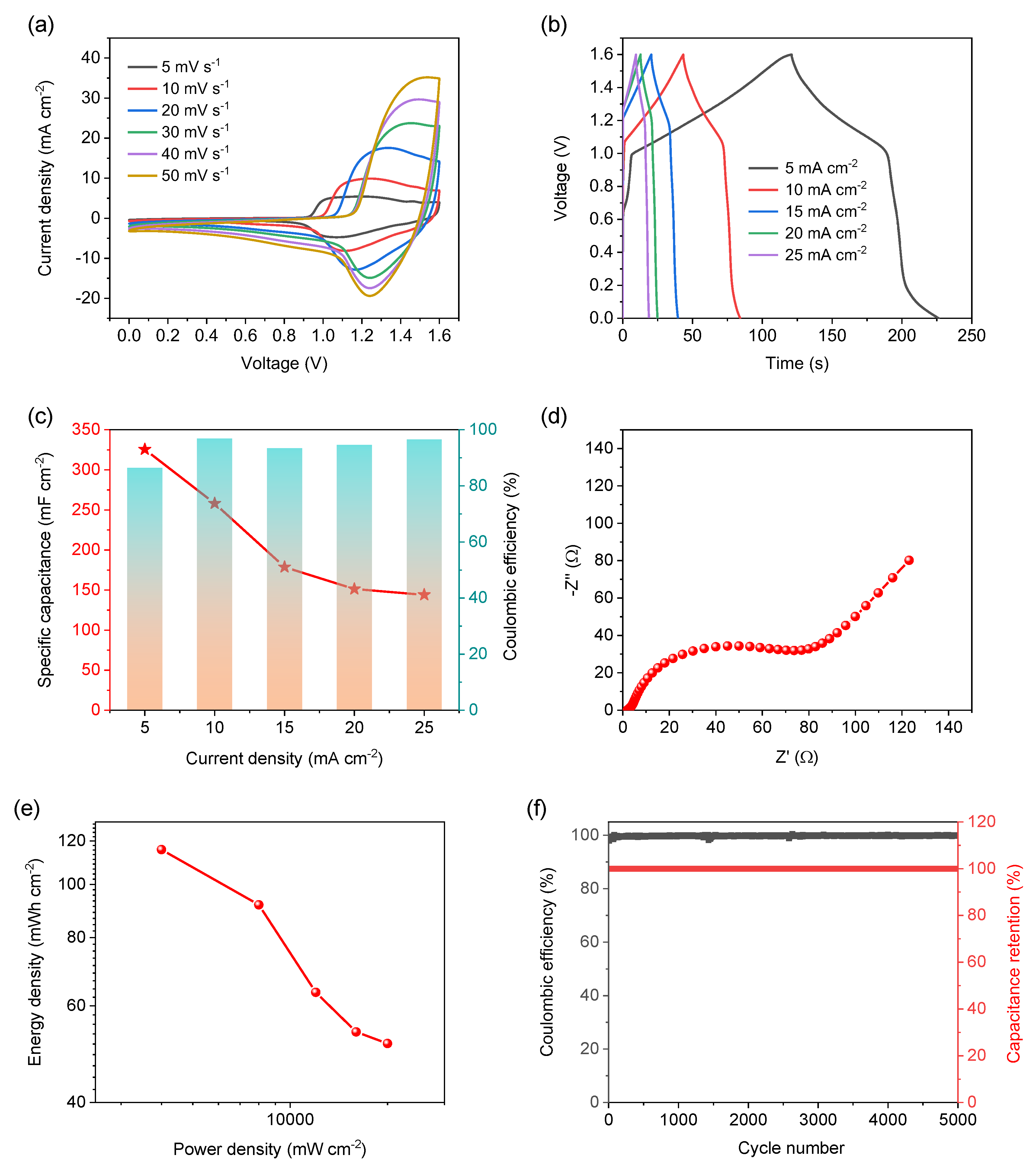
Figure 6a presents the CV curves of the asymmetric device at various scan rates from 5 to 50 mV s-1, with the voltage window extending to 0~1.6 V. All curves exhibit pseudocapacitive redox characteristic peaks at all scan rates, confirming that the energy storage of the device originates from the reversible valence-state conversion pseudocapacitance of the active metal species in the Co₃-LDH@Cu(OH)₂/CF cathode. As the scan rate progressively increases, the curve profiles undergo no significant distortion, and the redox peaks only slightly shift toward higher and lower potentials, indicating favorable ion and charge transport kinetics within the device. Even at high scan rates, the degree of electrode polarization remains within a controllable range, demonstrating excellent positive-negative electrode matching and stable operation within the broad 0~1.6 V voltage window, which substantially enhances the energy output potential compared to the single-electrode test window of 0.6 V. Figure 6b displays the GCD curves of the device at various current densities from 5 to 25 mA cm-2. All charge-discharge curves exhibit both pseudocapacitive voltage plateaus and slightly tilted electric double-layer charge-discharge regions, which correspond well to the energy storage characteristics observed in the CV curves [18,22,351]. At low current densities, the device exhibits longer charge-discharge durations, while the charge-discharge times shorten correspondingly with increasing current density. The overall symmetry of the charge-discharge curves is favorable, confirming the high reversibility of the redox and ion adsorption processes in the device without severe irreversible side reactions. In Figure 6c, the combined bar–line plot of rate performance and Coulombic efficiency demonstrates that the device achieves an areal specific capacitance of 325.6 mF cm⁻² at a low current density of 5 mA cm-2. As the current density is progressively increased to 10, 15, 20 and 25 mA cm-2, the capacitance gradually decreases, yet it still maintains a stable value of approximately 144.1 mF cm-2 at a high current density of 25 mA cm-2, showcasing excellent rate tolerance. The Coulombic efficiency exhibits a gradual decreasing trend with increasing current density, reaching as high as 88% at 5 mA cm-2 and remaining around 97% at 25 mA cm-2. At low currents, charge loss is minimal and reaction reversibility is stronger, whereas at high currents, slight polarization losses caused by ion diffusion lag are the primary reason for the efficiency decline. However, the overall variation trend in Coulombic efficiency is gentle, confirming the practical value of the device's electrochemical reversibility. As shown in Figure 6d, the Nyquist plot of the electrochemical impedance spectrum exhibits an extremely small intercept with the real axis in the high-frequency region, indicating a very low equivalent series resistance (Rs) arising from the combined contributions of the copper foam current collector, electrolyte, and electrode interface. This is attributed to the three-dimensional porous copper foam conductive skeleton and the intimate interfacial bonding with the in-situ grown active materials. The small semicircle diameter in the high-frequency region suggests that the charge-transfer resistance (Rct) at the positive–negative electrode interface is not high, and the open hierarchical nano-tree structure of Co₃-LDH@Cu(OH)₂/CF significantly lowers the kinetic barrier for redox reactions. In the low-frequency region, the curve exhibits a steep upward-sloping line with a slope approaching verticality, demonstrating that electrolyte ions can rapidly diffuse and migrate through the electrode pores without significant ion diffusion hindrance, which kinetically explains the device's excellent rate performance. Figure 6e shows the Ragone plot of areal energy density versus power density for the device. At the lowest power density range, the device achieves a high areal energy density of 116 mWh cm-2. As the output power density continues to increase, the energy density exhibits a gentle decreasing trend, and even under ultra-high power density conditions, the device maintains considerable energy output. Compared with most hydroxide-based asymmetric supercapacitors in the same system, this device combines both high energy density and high-power output capability, fundamentally attributed to the synergistic energy storage mechanism of the 1.6 V wide voltage window and the positive electrode material. The conductive nano-tree positive electrode provides abundant pseudocapacitive active sites while ensuring rapid charge transport. Furthermore, in Figure 6f, the long-term cycling stability test of the device at a current density of 5 mA cm-2 over 5000 cycles shows that the Coulombic efficiency remains consistently above 90% throughout the cycling process without significant fluctuation. After 5000 consecutive charge-discharge cycles, the capacitance retention of the device remains close to 98%, with only negligible capacity decay. This fully demonstrates that the Co₃-LDH@Cu(OH)₂/CF hierarchical nano-tree structure possesses excellent structural stability. The in-situ growth approach firmly anchors the active material onto the surface of the copper foam skeleton, preventing detachment or collapse of the Co-LDH nanosheets during charge-discharge processes. Meanwhile, the positive-negative electrode matching system experiences no severe side reactions or electrode corrosion issues, and the device exhibits outstanding long-term cycling durability, meeting the long-cycle-life requirements for practical supercapacitor applications.In summary, based on all electrochemical testing results, the asymmetric supercapacitor assembled with Co₃-LDH@Cu(OH)₂/CF as the positive electrode and activated carbon as the negative electrode can operate stably within a wide 1.6 V voltage window. Leveraging the abundant pseudocapacitive active sites provided by the positive electrode nano-tree hierarchical structure, unobstructed ion/electron transport channels, and the electric double-layer energy storage advantages of the activated carbon negative electrode, the device achieves high areal specific capacitance, excellent rate capability, fast reaction kinetics, high energy-power densities, and ultra-long cycling stability. It represents a highly promising alkaline aqueous energy storage device with significant application potential.
4. Conclusions
In this work, a hierarchical nano-tree structured Co-LDH@Cu(OH)₂/CF self-standing electrode was successfully fabricated via a two-step in-situ growth strategy. The optimized Co₃-LDH@Cu(OH)₂/CF electrode, with a moderate cobalt loading of 3 mmol, delivers an ultra-high areal specific capacitance of approximately 1220 mF cm-2 at 1 mA cm-2 and retains 68.5% of its initial capacitance at 10 mA cm-2, demonstrating superior rate capability. The excellent electrochemical performance is attributed to the synergistic effect of the conductive Cu(OH)₂ nanowire backbones and the electroactive Co-LDH nanosheets, which together provide abundant redox active sites, rapid ion/electron transport pathways, and robust structural stability. An asymmetric supercapacitor assembled with Co₃-LDH@Cu(OH)₂/CF as the positive electrode and activated carbon as the negative electrode operates stably over a wide voltage window of 0~1.6 V, achieving an areal capacitance of 325.6 mF cm-2 at 5 mA cm-2, a high energy density of 116 mWh cm-2, and outstanding cycling stability with 98% capacitance retention after 5000 cycles. In-situ Raman spectroscopy reveals the reversible evolution of the Co-OH vibrational peak during charge-discharge processes, confirming the participation of hydroxyl groups in Faradaic reactions and the material's good reversibility in alkaline electrolyte. Furthermore, in-situ SECM provides direct kinetic evidence for the uniform microscale electrochemical activity of the electrode, with closely matched kinetic coefficients (≈1.09~1.12 × 10⁻² cm2 s-1) across different microregions, confirming the homogeneity and reproducibility of charge transfer behavior. Overall, this work demonstrates that the rational design of hierarchical core–shell heterostructures with optimized active material loading can effectively enhance the energy storage performance of supercapacitors. The Co₃-LDH@Cu(OH)₂/CF//AC asymmetric device exhibits an excellent balance of high energy density, high power density, and long-term durability, positioning it as a highly promising candidate for next-generation alkaline aqueous energy storage systems.
Supplementary Materials
The following supporting information can be downloaded at the website of this paper posted on Preprints.org.
Conflicts of Interest
The authors declare that they have no known competing financial interests or personal relationships that could have appeared to influence the work reported in this paper.
Acknowledgments
This work was supported by the Anhui Province Higher Education Science Research Project (grant numbers: 2025AHGXZK40616, 2024AH040133, 2025AHGXZK10015, 2025AHGXZK30491); Anhui Province Quality Project (2024cxtd218; 2025jyxm0730); School-level Research Platform of Anhui Vocational Technology College (2024xjpt03); Anhui Provincial Health and Science Technology Project (AHWJ2025Ab40189).; Ministry of Education Committee for Teaching Guidance on the Chinese-style Apprenticeship System in Vocational Colleges (ZJZX002) China Association of Adult Education (2025-0522ZB).
References
- Poudel, M.B.; Kim, A.A.; Lohani, P.C.; Yoo, D.J.; Kim, H.J. Assembling zinc cobalt hydroxide/ternary sulfides heterostructure and iron oxide nanorods on three-dimensional hollow porous carbon nanofiber as high energy density hybrid supercapacitor. J. Energy Storage 2023, 60, 106713. [Google Scholar] [CrossRef]
- Shaheen, I.; Akkinepally, B.; Hussain, I.; Hussain, S.; Rosaiah, P.; Qureshi, A.; Niazi, J.H. Fabrication of MXene/cellulose composite-based flexible supercapacitor: Synthesis, properties, and future perspectives. J. Energy Storage 2024, 87, 111513. [Google Scholar] [CrossRef]
- Gaber, A.; Al-Obaidi, M.M.; Çelik, M.; Sınağ, A. Next-generation flexible and free-standing supercapacitors: Conducting polymers as electrode materials. J. Power Sources 2026, 679, 240168. [Google Scholar] [CrossRef]
- Talebizadehsardari, P.; Hosseinzadeh, K.; Mohammed, H.I.; Maarof, H.A.; Rashid, F.L.; Togun, H.; Biswas, N.; Al Miaari, A.; Ali, H.M.; La Rocca, A.; Sen, S.; Cairns, A. Phase change materials in thermal management of Li-ion batteries: A state-of-the-art review. J. Energy Storage 2026, 145, 119782. [Google Scholar] [CrossRef]
- Scrucca, F.; Presciutti, A.; Baldinelli, G.; Barberio, G.; Postrioti, L.; Karaca, C. Life cycle assessment of Li-ion batteries for electric vehicles: A review focused on the production phase impact. J. Power Sources 2025, 639, 236703. [Google Scholar] [CrossRef]
- Mulik, S.V.; Patil, M.M.; Sadavar, S.P.; Delekar, S.D.; Bordia, R.K.; Panda, D.K. Metal-Organic Framework-Based Supercapacitors: A Comprehensive Review. Chem. Asian J. 2026, 13, e19519. [Google Scholar] [CrossRef] [PubMed]
- Chu, H.; Lu, Z.; Man, M.; Song, S.; Zhang, H.; Cheng, J.; Zhao, X.; Duan, J.; Chen, X.; Zhu, Y. Hard carbon-based electrode boosts the performance of a solid-state symmetric supercapacitor. J. Energy Storage 2024, 76, 109660. [Google Scholar] [CrossRef]
- Gu, J.; Zhang, W.; Wu, S.; Wang, C.; Zhang, Y.; Zhu, J.; Dai, Y. Carbon-cement supercapacitor: A review of mechanism, influencing factors and application. J. Energy Storage 2026, 155, 121391. [Google Scholar] [CrossRef]
- Ansari, S.A.; Parveen, N.; Ansari, M.Z.; Alsulaim, G.M.; Alam, M.W.; Khan, M.Y.; Umar, A.; Hussain, I.; Zhang, K. Exploring recent advances in the versatility and efficiency of carbon materials for next generation supercapacitor applications: A comprehensive review. Prog. Mater. Sci. 2025, 154, 101493. [Google Scholar] [CrossRef]
- Lu, Z.; Cheng, J.; Zhang, L.; Yang, Q.; Pan, H.; Wu, D.; Gao, Y.; Huang, X.; Wang, T.; Chen, X. Free-standing hierarchical Co@CoO/CNFs/Cu-foam composite based on electrochemical deposition as high-performance supercapacitor electrode. J. Alloys Compd. 2021, 856, 158075. [Google Scholar] [CrossRef]
- Shivani; Duddi, R.; Singh, A.K.; Kamboj, N.; Singh, G.; Kumar, S. Progress and outlook of electrochemically deposited metal-oxides based materials for energy storage applications. Coord. Chem. Rev. 2026, 547, 217082. [Google Scholar] [CrossRef]
- Askari, M.B.; Salarizadeh, P.; Tourchi Moghadam, M.T.; Azizi, S.; Ramezan zadeh, M.H. Binary transition metal oxide/carbon compounds-based electrode materials for supercapacitor application: A comprehensive review. J. Alloys Compd. 2025, 1027, 180573. [Google Scholar] [CrossRef]
- Liu, X.; Lu, Z.; Pan, H.; Cheng, J.; Dou, J.; Huang, X.; Chen, X. Investigation of functionalization effect of carbon nanotubes as supercapacitor electrode material on hydrogen evolution side-reaction by scanning electrochemical microscopy. Electrochim. Acta 2022, 429, 141056. [Google Scholar] [CrossRef]
- Yallur, B.C.; Rao, M.P.; Harshitha, M.; Basrur, D.; Umesh, P.H.; Kamat, V.; Prasad, K.D.V.; Venugopala, K.N.; Bhat, R.S. Recent Advances in Graphene-Based Metal Oxide Composites for Supercapacitors: A Comprehensive Review. ChemistryOpen 2025, 9, 2500121. [Google Scholar] [CrossRef]
- Liu, L.; Zhang, X.; Liu, Y.; Gong, X. Electrochemical Energy Storage Devices-Batteries, Supercapacitors, and Battery-Supercapacitor Hybrid Devices. ACS Appl. Electron. Mater. 2025, 7, 2233–2270. [Google Scholar] [CrossRef]
- Bao, E.; Ren, X.; Wang, Y.; Zhang, Z.; Luo, C.; Liu, X.; Xu, C.; Chen, H. Advanced hybrid supercapacitors assembled with CoNi LDH nanoflowers and nanosheets as high-performance cathode materials. J. Energy Storage 2024, 82, 110535. [Google Scholar] [CrossRef]
- Xing, H.; Deng, X.; Wang, X. Alkaline capacity decay induced vacancy-rich LDH for high-performance magnesium ions hybrid supercapacitor. J. Colloid Interface Sci. 2025, 679, 43–53. [Google Scholar] [CrossRef] [PubMed]
- Dighe, P.S.; Redekar, R.S.; Tarwal, N.L.; Sarawade, P.B. Design and development of the high-performance aqueous asymmetric supercapacitor based on the hydrothermally grown binder-less Ni-Co LDH nanosheets. J. Energy Storage 2024, 88, 111467. [Google Scholar] [CrossRef]
- Marje, S.J.; Tyagaraj, H.B.; Ghoreishian, S.M.; Burse, S.R.; Al Ghafari, A.; Al Hajri, E.; Chodankar, N.R.; Huh, Y.S.; Han, Y.K. Progress and prospects of Ni-Co layered double hydroxides for advanced energy storage in rechargeable supercapacitors and batteries. Prog. Mater. Sci. 2026, 161, 101702. [Google Scholar] [CrossRef]
- Zha, C.M.; Muhammad, I.; Veerappan, K.; Lu, L.-M.; Li, Z.; Li, H.-R.; Ren, T.-Z.; Lin, Z.-L. Preparation of dandelion-like nickel-cobalt layered double hydroxide microspheres and evaluation of their electrochemical properties. J. Electroanal. Chem. 2026, 1016, 120214. [Google Scholar] [CrossRef]
- Wang, S.; Jiang, W.; Wu, J.; Huang, Z.; Tu, L.; Xie, L.; Guo, P.; Zhang, X.; Huang, H.; Gu, H.; Hu, Y. Multicomponent nitrogen-doped carbon@Ni-Co LDH nanosheet arrays as advanced electrode materials for supercapacitors. J. Alloys Compd. 2022, 924, 166391. [Google Scholar] [CrossRef]
- Kiani, A.; Ahmadi, E.; Mohamadnia, Z. Coral-like Composite Based on SnO₂@Rice Husk Nanoparticles Modified with Polyaniline Coated on Ni-Co Layered Double Hydroxide as an Innovative Electrode for Superior Supercapacitor Performance. ACS Appl. Energy Mater. 2024, 7, 9892–9901. [Google Scholar] [CrossRef]
- Chen, J.; Sun, Y.; Li, Z.; Yuan, G.; Han, G. Porous CoFe-LDH free-standing electrodes for high-performance asymmetric supercapacitors. New J. Chem. 2025, 49, 9990–9997. [Google Scholar] [CrossRef]
- Yan, C.; Wei, J.; Guan, J.; Shao, Z.; Lv, S. Highly foldable and free-standing supercapacitor based on hierarchical and hollow MOF-anchored cellulose acetate carbon nanofibers. Carbon 2023, 213, 118187. [Google Scholar] [CrossRef]
- Ren, F.; Lu, Z.; Liu, X.; Wang, T.; Huang, X.; Dou, J.; Wu, D.; Yu, J.; Chen, X. Lewis acid-etched MXene self-assembled with reduced graphene oxide for symmetrical supercapacitors with liquid/solid electrolytes. J. Alloys Compd. 2024, 978, 173480. [Google Scholar] [CrossRef]
- Su, Y.; Lu, Z.; Cheng, J.; Zhao, X.; Chen, X.; Gao, L. Insulation board-derived N/O self-doped porous carbon as an electrode material for high-performance symmetric supercapacitors. New J. Chem. 2021, 45, 17503–17512. [Google Scholar] [CrossRef]
- Lu, Z.; Liu, X.; Wang, T.; Huang, X.; Dou, J.; Wu, D.; Yu, J.; Wu, S.; Chen, X. S/N-codoped carbon nanotubes and reduced graphene oxide aerogel based supercapacitors working in a wide temperature range. J. Colloid Interface Sci. 2023, 638, 709–718. [Google Scholar] [CrossRef] [PubMed]
- Sun, H.; Gao, Y.; Fang, X.; Yuan, G.; Pei, R.; Liu, H. F/N Co-Doped rGO Supported Anion-Modified FeCo-LDH for Efficient Energy Management in Oxygen Evolution Reaction. ACS Appl. Nano Mater. 2026, 9, 1511–1521. [Google Scholar] [CrossRef]
- Yao, J.; Gao, Y.; Wu, Y.; Xu, W.; Yang, M.; Yang, M.; Zhang, N.; Chen, S.; Li, H.; Yuan, G.; Pei, R.; Sun, H. FeCoP Nanosheets Synthesized from FeCo Layered Double Hydroxides as Catalysts for the Oxygen Evolution Reaction. ACS Appl. Nano Mater. 2026, 9, 5516–5525. [Google Scholar] [CrossRef]
- Zhang, T.; Lu, Z.; Pan, H.; Tian, L.; Dou, J.; Wang, T.; Wu, D.; Yu, J.; Wang, L.; Chen, X. Coal-based carbon nanosheets contained carbon microfibers modified with grown carbon nanotubes as efficient air electrode material for rechargeable zinc-air batteries. J. Colloid Interface Sci. 2024, 671, 589–600. [Google Scholar] [CrossRef] [PubMed]
- Khalafallah, D.; Zhang, Y.; Zhang, Q. MOF-Derived Core-Shell La(OH)₃@Cu(OH)₂/Co(OH)₂ Heterostructure for Supercapacitors. 2025, 8, e202400497. [Google Scholar] [CrossRef]
- Shakir, I.; Almutairi, Z.; Shar, S.S.; Nafady, A. Fabrication of a flower-like Cu(OH)₂ nanoarchitecture and its composite with CNTs for use as a supercapacitor electrode. 2025, 8, e202400497. [Google Scholar]
- Naikoo, G.A.; Tabook, M.A.S.; Tabook, B.A.M.; Bano, M.; Hassan, I.U.; Dar, R.A.; Saleh, T.A. Electrochemical performance of Co₃O₄/Ag/CuO electrodes for supercapacitor applications. J. Energy Storage 2024, 85, 111047. [Google Scholar] [CrossRef]
- Pan, H.; Wu, D.; Huang, X.; Xie, K.; He, B.; Lu, Z.; Liu, P.; Cheng, J.; Zhao, X.; Masa, J.; Chen, X. Microwave-Assisted Synthesis of Co/CoOx Supported on Earth-Abundant Coal-Derived Carbon for Electrocatalysis of Oxygen Evolution. J. Electrochem. Soc. 2019, 166, F479. [Google Scholar] [CrossRef]
- Han, X.; Wang, T.; Guo, J.; Lu, Z.; Chen, X.; Wu, D. Preparation of ultrahigh surface area carbon microspheres under solvent-free hypersaline environment for zinc-air batteries with high power density. Mater. Chem. Phys. 2022, 291, 126724. [Google Scholar] [CrossRef]
- Shakir, I.; Almutairi, Z.; Shar, S.S.; Nafady, A. Fabrication of a flower-like Cu(OH)₂ nanoarchitecture and its composite with CNTs for use as a supercapacitor electrode. Ceram. Int. 2022, 48, 11278–11285. [Google Scholar] [CrossRef]
- Zhu, D.; Yan, M.; Chen, R.; Liu, Q.; Liu, J.; Yu, J.; Zhang, H.; Zhang, M.; Liu, P.; Li, J.; Wang, J. 3D Cu(OH)₂ nanowires/carbon cloth for flexible supercapacitors with outstanding cycle stability. Chem. Eng. J. 2019, 371, 348–355. [Google Scholar] [CrossRef]
- Cheng, W.; Huang, W.; Zhang, A.; Du, Y.; Cui, L.; Tian, P.; Liu, J. Hierarchical MoO₃-MnNi LDH@Cu(OH)₂ Core-Shell Nanorod Arrays Constructed through In-Situ Oxidation Combined with a Hydrothermal Strategy for High-Performance Energy Storage. ChemElectroChem 2022, 9, e202201051. [Google Scholar] [CrossRef]
- Fu, H.; Zhang, A.; Jin, F.; Guo, H.; Huang, W.; Cheng, W.; Liu, J. Origami and layered-shaped ZnNiFe-LDH synthesized on Cu(OH)₂ nanorods array to enhance the energy storage capability. J. Colloid Interface Sci. 2022, 607, 1269–1279. [Google Scholar] [CrossRef] [PubMed]
- Zhang, A.; Zheng, W.; Yuan, Z.; Tian, J.; Yue, L.; Zheng, R.; Wei, D.; Liu, J. Hierarchical NiMn-layered double core-shell heterostructure in-situ generated on Cu(OH)₂ nanorod arrays for high performance supercapacitors. Chem. Eng. J. 2020, 380, 122486. [Google Scholar] [CrossRef]
- Pan, H.; Zhang, C.; Lu, Z.; Dou, J.; Huang, X.; Yu, J.; Wu, J.; Li, H.; Chen, X. Self-standing electrospun Co/Zn@N-doped carbon nanofiber electrode for highly stable liquid and solid-state rechargeable zinc-air batteries and performance evaluated by scanning electrochemical microscopy at various temperatures. Chem. Eng. J. 2023, 477, 147022. [Google Scholar] [CrossRef]
Figure 1.
SEM images of (a) Cu(OH)2/CF, (b) Co3-LDH@Cu(OH)2/CF, (c) Co6-LDH@Cu(OH)2/CF and (d) Co9-LDH@Cu(OH)2/CF.
Figure 1.
SEM images of (a) Cu(OH)2/CF, (b) Co3-LDH@Cu(OH)2/CF, (c) Co6-LDH@Cu(OH)2/CF and (d) Co9-LDH@Cu(OH)2/CF.
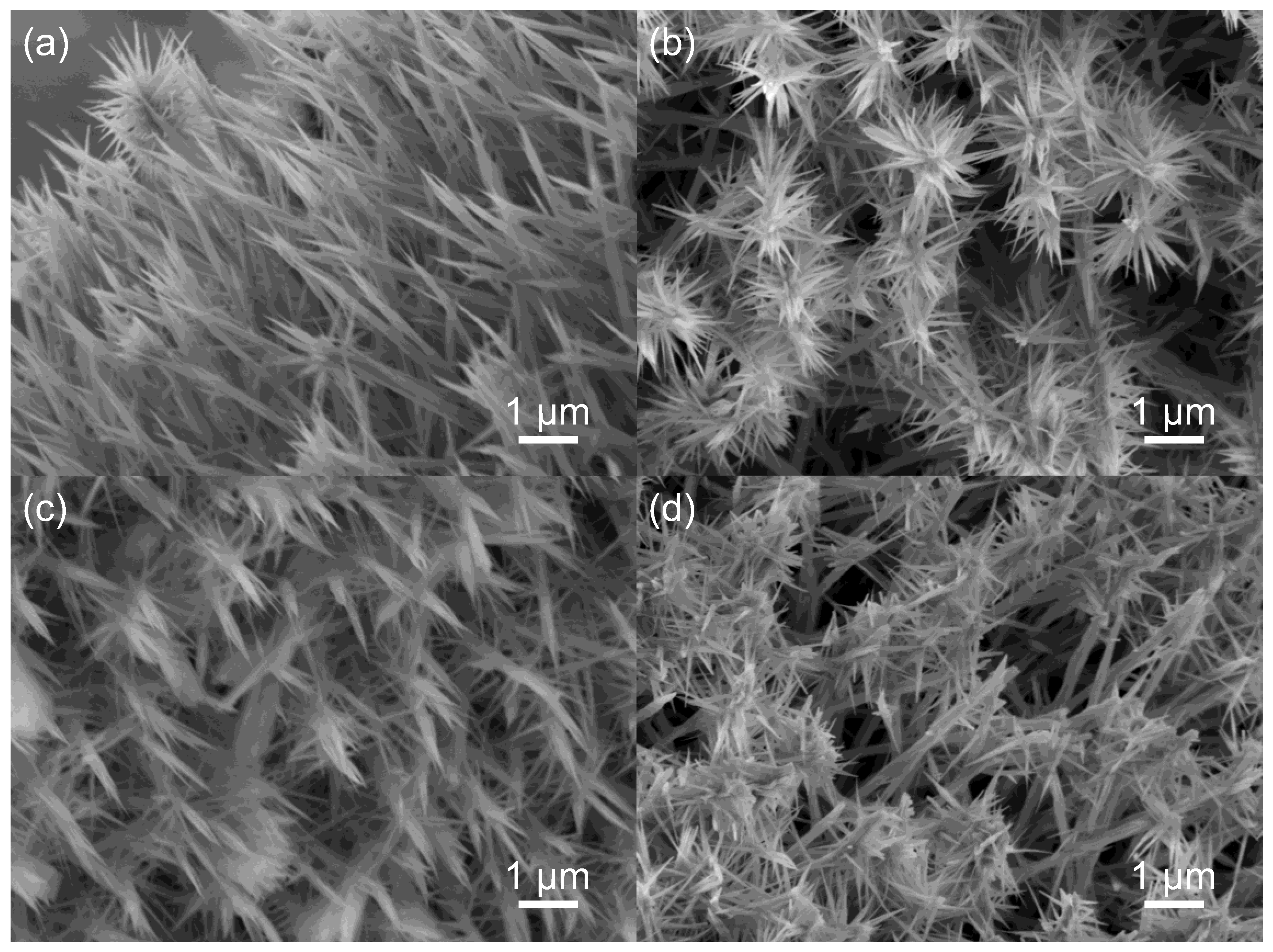
Figure 2.
(a) TEM and (b) HR-TEM images of Co3-LDH@Cu(OH)2/CF; (c) XRD patterns and (d) Raman spectra of Cu(OH)2/CF, Co3-LDH@Cu(OH)2/CF, Co6-LDH@Cu(OH)2/CF and Co9-LDH@Cu(OH)2/CF.
Figure 2.
(a) TEM and (b) HR-TEM images of Co3-LDH@Cu(OH)2/CF; (c) XRD patterns and (d) Raman spectra of Cu(OH)2/CF, Co3-LDH@Cu(OH)2/CF, Co6-LDH@Cu(OH)2/CF and Co9-LDH@Cu(OH)2/CF.
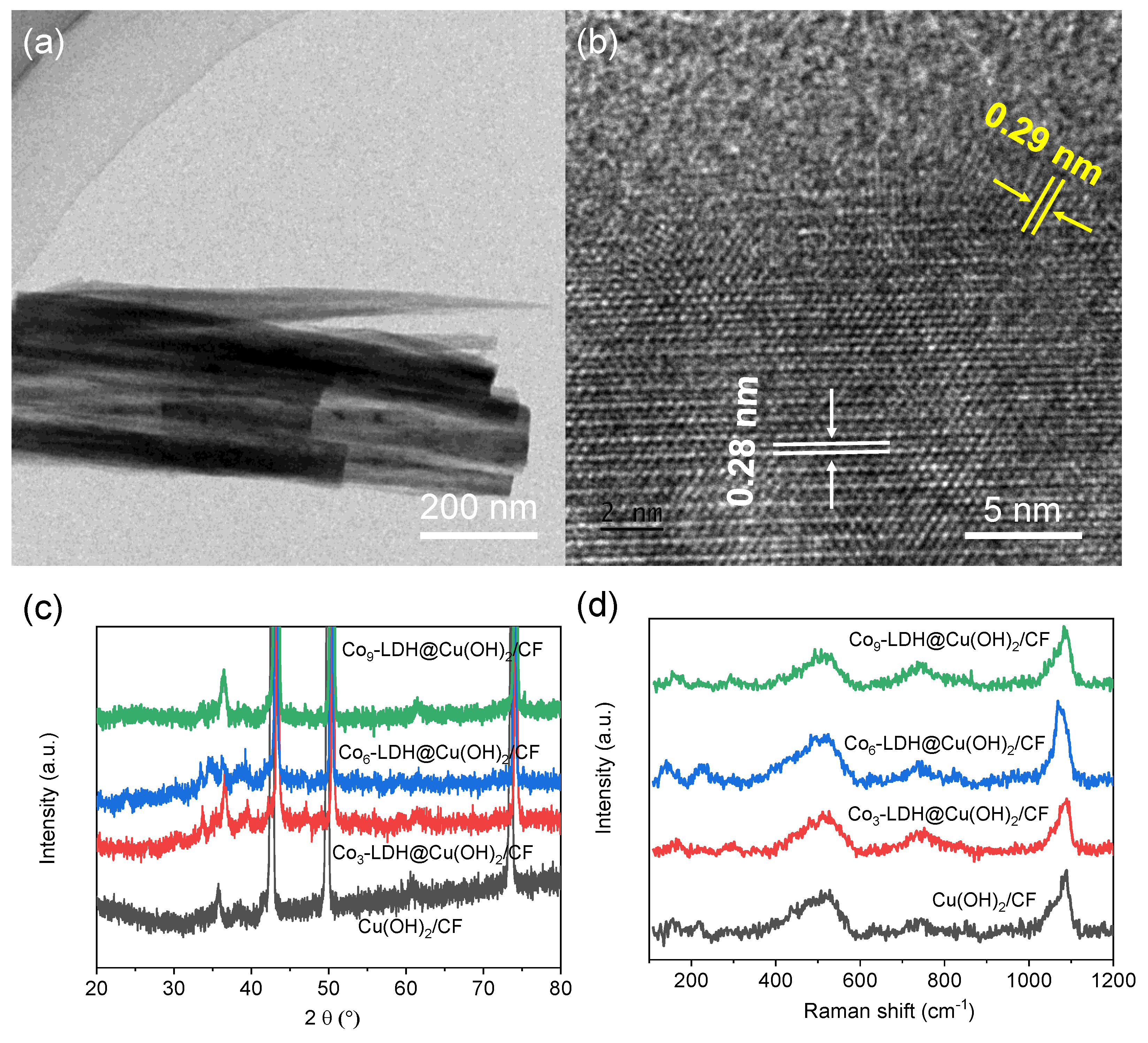
Figure 3.
(a) The survey XPS spectrum, high-resolution (b) O 1s, (c) Co 2p and (d) Cu 2p of Co3-LDH@Cu(OH)2/CF.
Figure 3.
(a) The survey XPS spectrum, high-resolution (b) O 1s, (c) Co 2p and (d) Cu 2p of Co3-LDH@Cu(OH)2/CF.
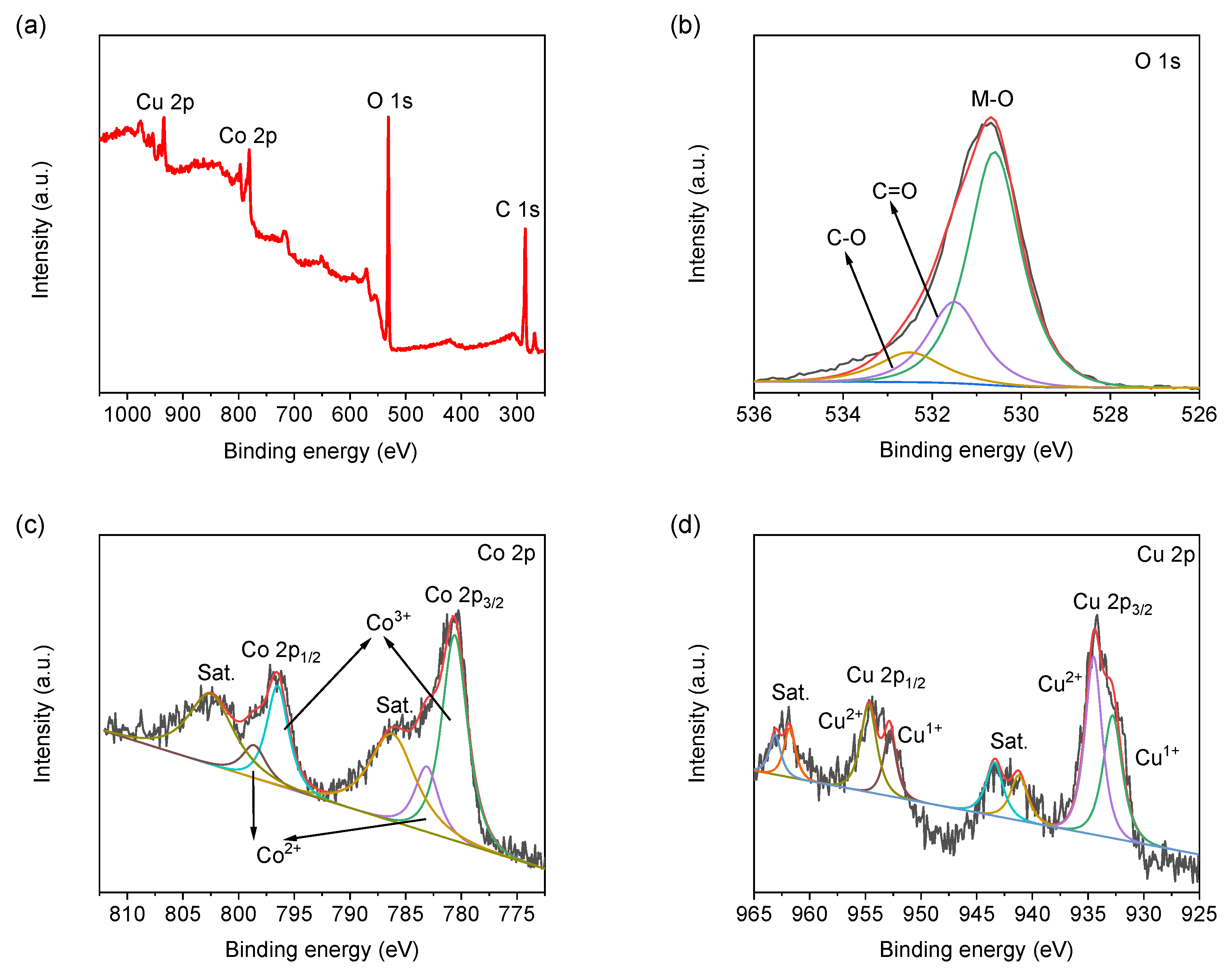
Figure 4.
Electrochemical performance of Cu(OH)2/CF, Co3-LDH@Cu(OH)2/CF, Co6-LDH@Cu(OH)2/CF and Co9-LDH@Cu(OH)2/CF in a three-electrode system with 3 M KOH as the electrolyte. (a) CV curves of 5 mV s-1, (b) GCD curves at a current density of 1 mA cm-2, (c) specific capacitances at different current densities, (d) Nyquist plots.
Figure 4.
Electrochemical performance of Cu(OH)2/CF, Co3-LDH@Cu(OH)2/CF, Co6-LDH@Cu(OH)2/CF and Co9-LDH@Cu(OH)2/CF in a three-electrode system with 3 M KOH as the electrolyte. (a) CV curves of 5 mV s-1, (b) GCD curves at a current density of 1 mA cm-2, (c) specific capacitances at different current densities, (d) Nyquist plots.
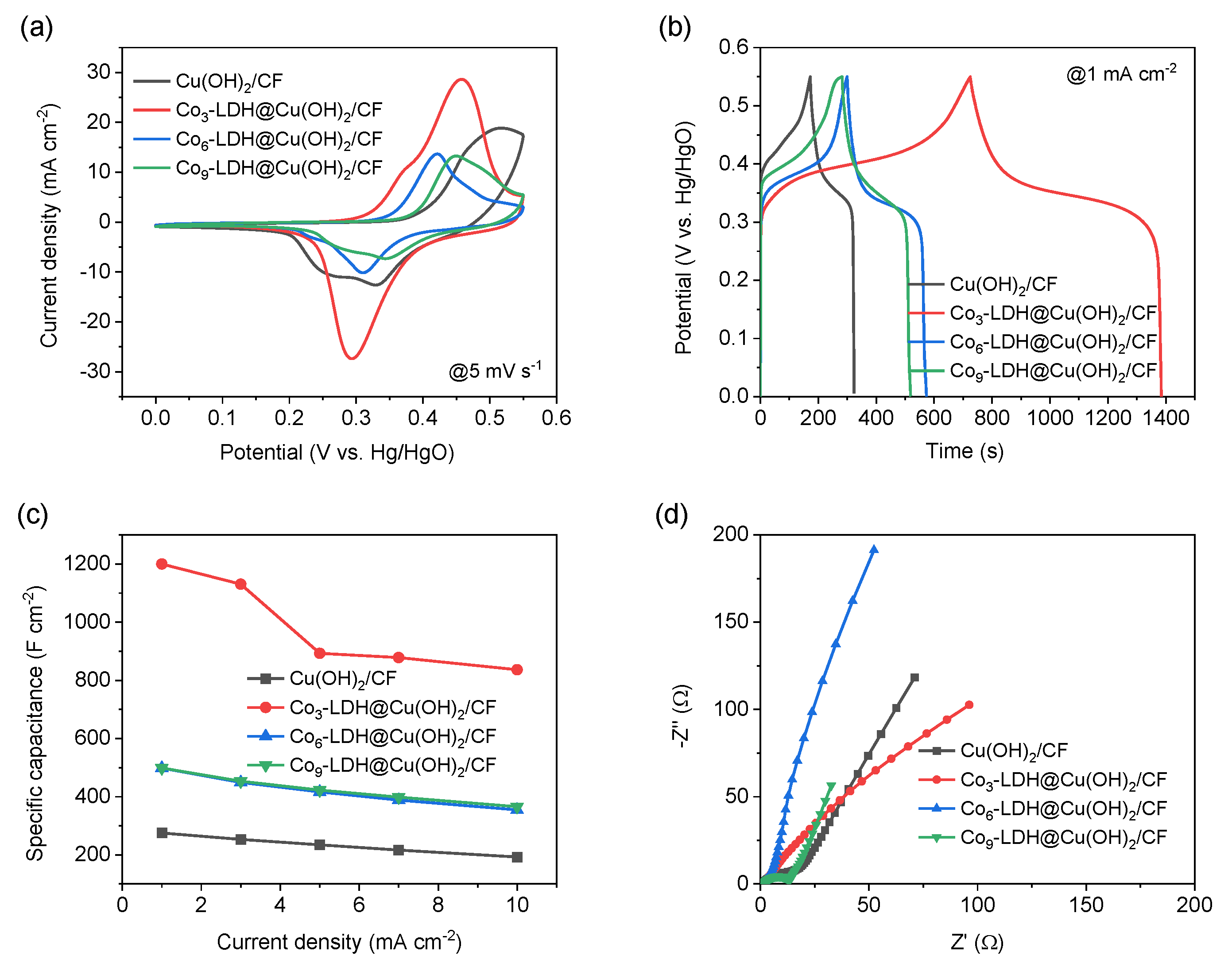
Figure 5.
(a) In-situ Raman spectroscopy of Co3-LDH@Cu(OH)2/CF during charge-discharge processes, (b) SECM tip approach curve, (c) SECM image and (d) SECM tip approach curves at different points of Co3-LDH@Cu(OH)2/CF.
Figure 5.
(a) In-situ Raman spectroscopy of Co3-LDH@Cu(OH)2/CF during charge-discharge processes, (b) SECM tip approach curve, (c) SECM image and (d) SECM tip approach curves at different points of Co3-LDH@Cu(OH)2/CF.
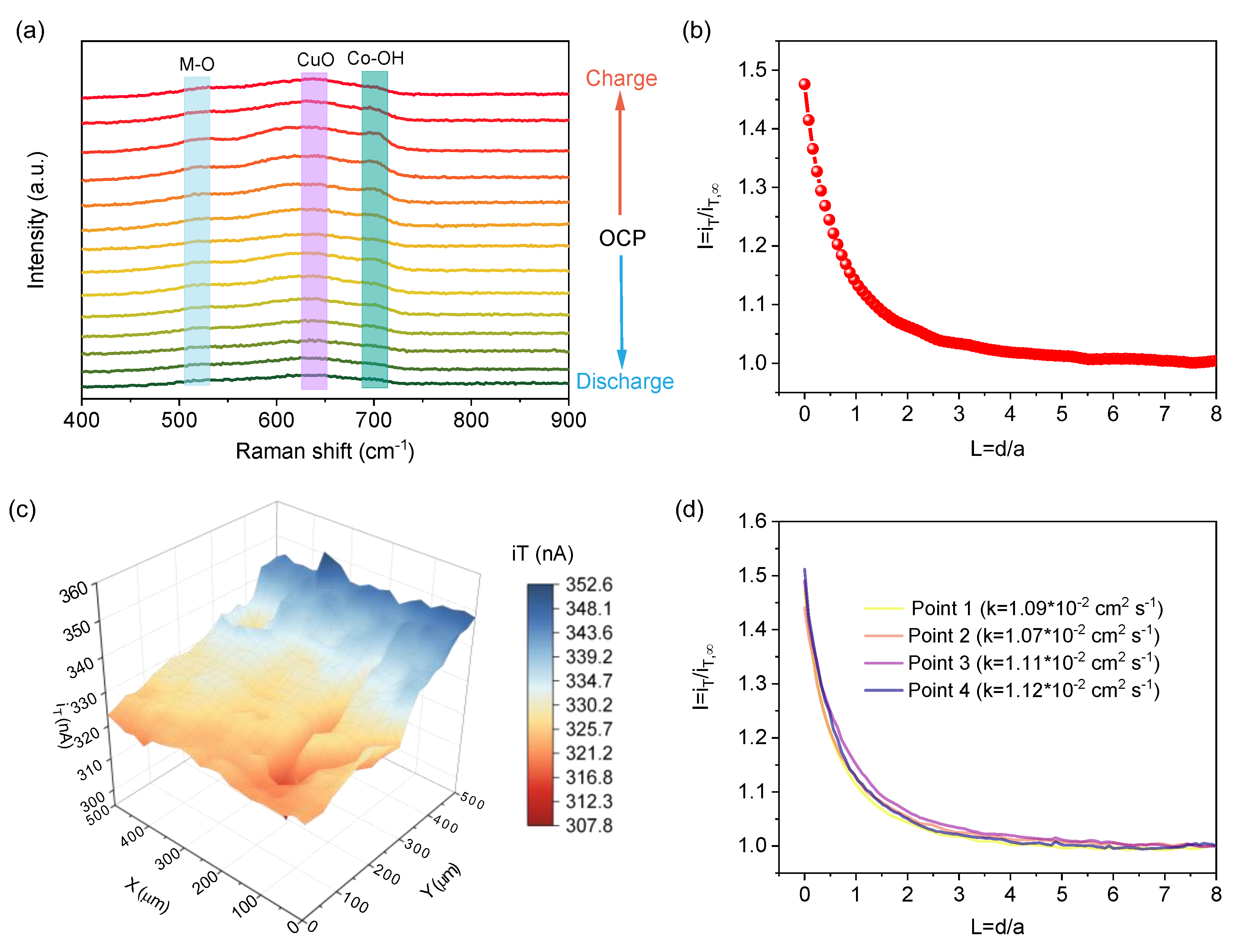
Figure 6.
Electrochemical performance of Co₃-LDH@Cu(OH)₂/CF//AC asymmetric supercapacitor device. (a) CV curves at various scan rates, (b) GCD curves at different current densities, (c) Specific capacitance and Coulombic efficiency calculated from (b), (d) Nyquist plot, (e) Ragone plot and (f) Cyclic performance at 5 mA cm-2.
Figure 6.
Electrochemical performance of Co₃-LDH@Cu(OH)₂/CF//AC asymmetric supercapacitor device. (a) CV curves at various scan rates, (b) GCD curves at different current densities, (c) Specific capacitance and Coulombic efficiency calculated from (b), (d) Nyquist plot, (e) Ragone plot and (f) Cyclic performance at 5 mA cm-2.
Disclaimer/Publisher’s Note: The statements, opinions and data contained in all publications are solely those of the individual author(s) and contributor(s) and not of MDPI and/or the editor(s). MDPI and/or the editor(s) disclaim responsibility for any injury to people or property resulting from any ideas, methods, instructions or products referred to in the content. |
© 2026 by the authors. Licensee MDPI, Basel, Switzerland. This article is an open access article distributed under the terms and conditions of the Creative Commons Attribution (CC BY) license (http://creativecommons.org/licenses/by/4.0/).
Copyright: This open access article is published under a Creative Commons CC BY 4.0 license, which permit the free download, distribution, and reuse, provided that the author and preprint are cited in any reuse.