
Submitted:
13 August 2026
Posted:
14 August 2026
You are already at the latest version
Abstract
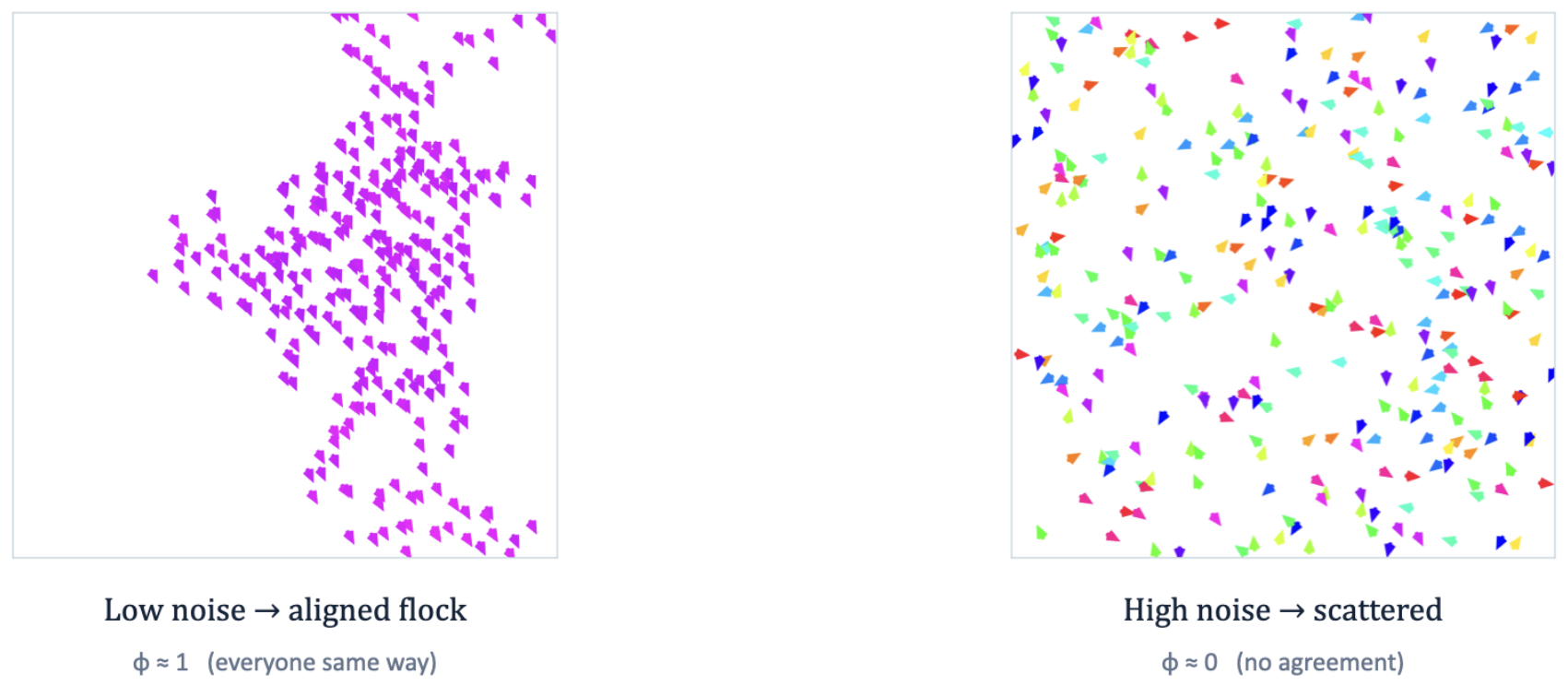
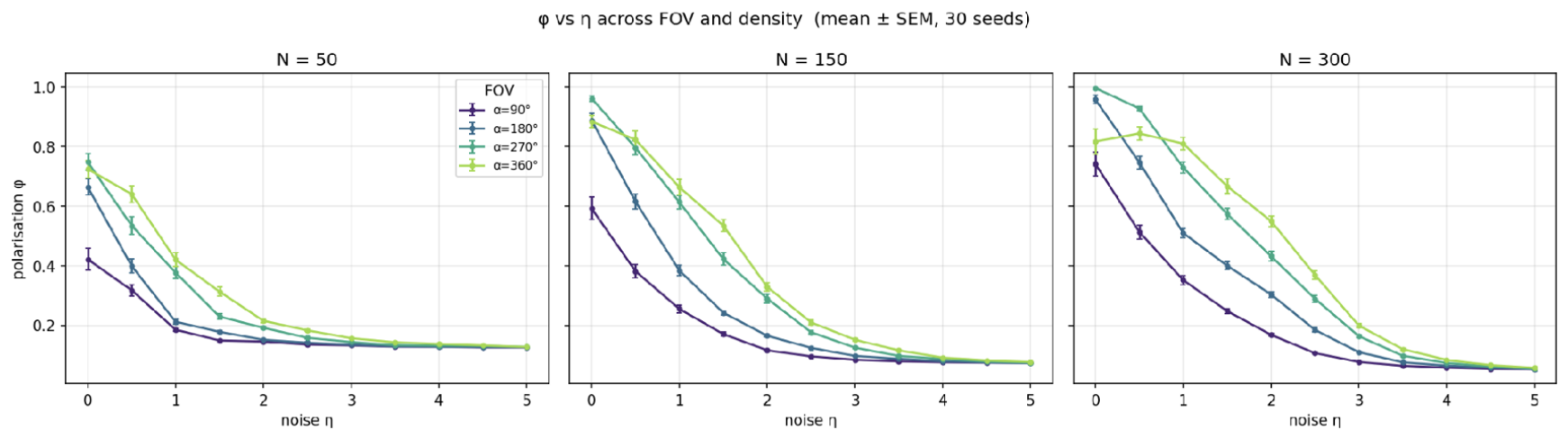
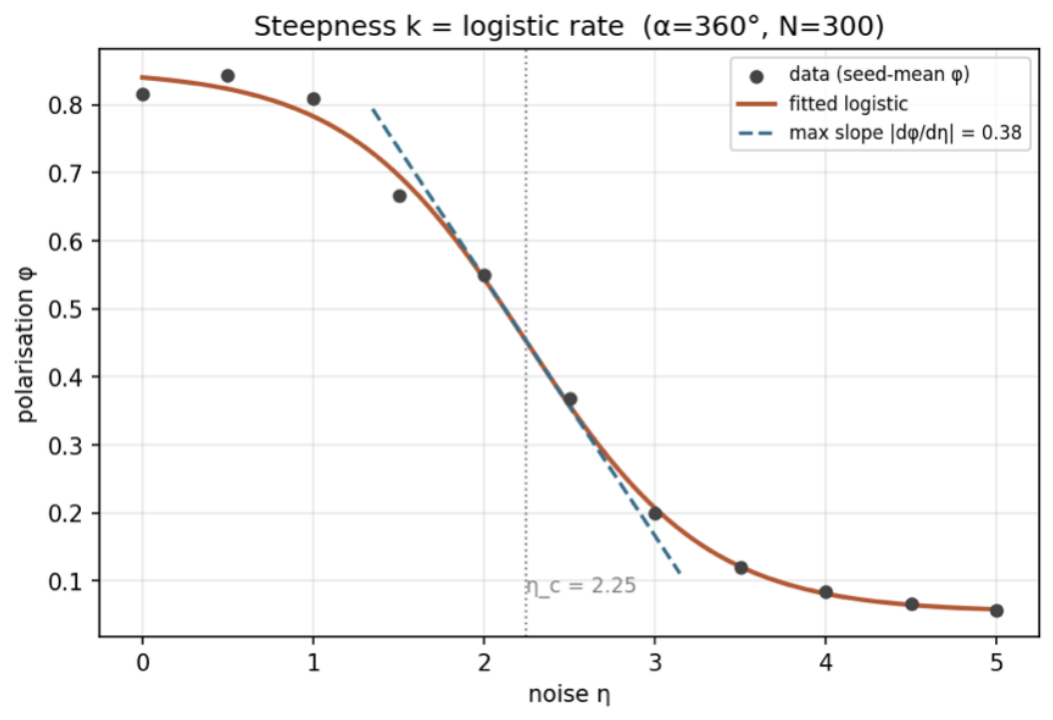
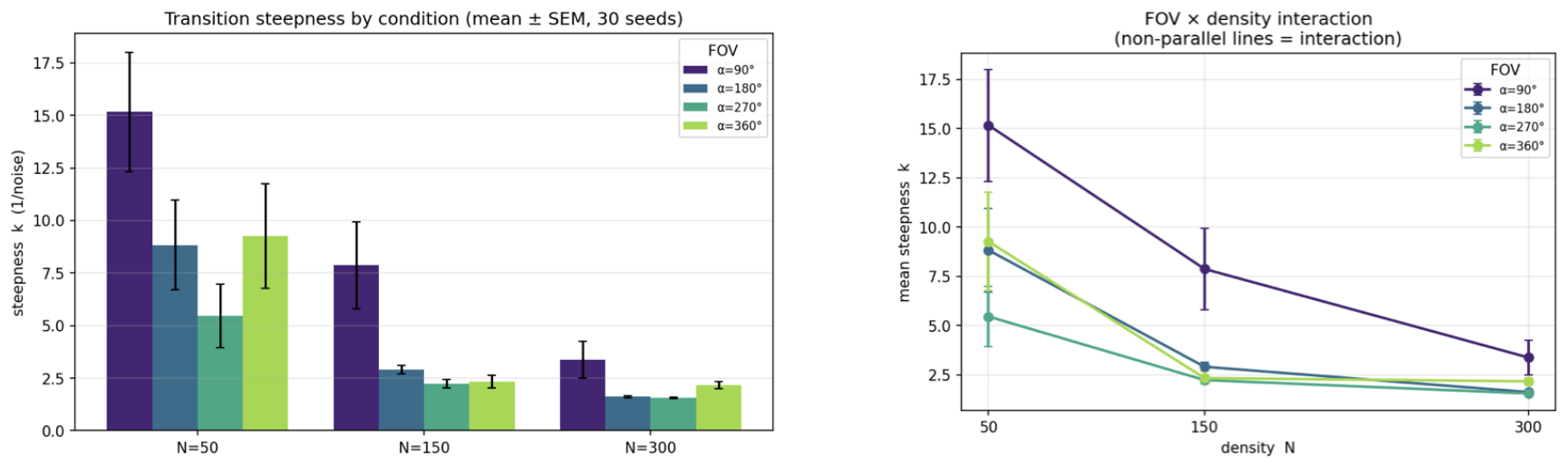
Collective motion happens when many individuals move together using only local rules, with no leader. The Vicsek model captures this through a noise-driven transition from order to disorder, but it usually assumes that agents can see in every direction and that the crowd stays at one fixed density, neither of which is realistic. We ask whether an agent's field of view (\(\alpha\)) and the population density (N) work together to shape the character of this transition, meaning how sharply a flock falls apart rather than only at what noise level it does. We add a forward vision cone to the Vicsek model and run a full sweep of 4 field-of-view angles, 3 densities, and 11 noise levels, with 30 seeds each (3960 runs). For each run we fit a logistic curve to the order parameter as noise rises and read off two numbers: the steepness \(k\) and the break-point \(\eta_c\). A two-way ANOVA shows that field of view and density work together to set where the flock breaks, but not how sharply it breaks; sharpness is shaped by density and field of view separately, with no interaction between them. Our hypothesis predicted an interaction on the sharpness, so it is only partly supported: density does not make up for a narrow field of view the way we expected. The result separates two parts of robustness that are easy to confuse and shows which one sensing range actually affects.
Keywords:
1. Introduction
2. Methodology
3. Experiments
3.1. Experimental Setup
3.2. Results
4. Conclusion
References
- Ballerini, M.; Cabibbo, N.; Candelier, R.; Cavagna, A.; Cisbani, E.; Giardina, I.; Lecomte, V.; Orlandi, A.; Parisi, G.; Procaccini, A.; Viale, M.; Zdravkovic, V. Interaction ruling animal collective behavior depends on topological rather than metric distance: Evidence from a field study. Proc. Natl. Acad. Sci. 2008, 105(4), 1232–1237. [Google Scholar] [CrossRef] [PubMed]
- Chaté, Hugues; Ginelli, Francesco; Grégoire, Guillaume; Raynaud, Franck. Collective motion of self-propelled particles interacting without cohesion. Phys. Rev. E 2008, 77(4), 046113. [Google Scholar] [CrossRef] [PubMed]
- Couzin, Iain D; Krause, Jens; James, Richard; Ruxton, Graeme D; Franks, Nigel R. Collective memory and spatial sorting in animal groups. J. Theor. Biol. 2002, 218(1), 1–11. [Google Scholar] [CrossRef] [PubMed]
- Durve, Mihir; Sayeed, Ahmed. First-order phase transition in a model of self-propelled particles with variable angular range of interaction. Phys. Rev. E 2016, 93(5), 052115. [Google Scholar] [CrossRef] [PubMed]
- Grégoire, Guillaume; Chaté, Hugues. Onset of collective and cohesive motion. Phys. Rev. Lett. 2004, 92(2), 025702. [Google Scholar] [CrossRef] [PubMed]
- Reynolds, Craig W. Flocks, herds and schools: A distributed behavioral model. ACM SIGGRAPH Comput. Graph. 1987, 21(4), 25–34. [Google Scholar] [CrossRef]
- Vicsek, Tamás; Zafeiris, Anna. Collective motion. Phys. Rep. 2012, 517(3–4), 71–140. [Google Scholar] [CrossRef]
- Vicsek, Tamás; Czirók, András; Ben-Jacob, Eshel; Cohen, Inon; Shochet, Ofer. Novel type of phase transition in a system of self-driven particles. Phys. Rev. Lett. 1995, 75(6), 1226–1229. [Google Scholar] [CrossRef] [PubMed]

| Measure | Effect | F | p | |
|---|---|---|---|---|
| Steepness k | FOV () | 8.01 | 3, 342 | |
| Density (N) | 27.74 | 2, 342 | ||
| 1.35 | 6, 342 | |||
| Break-point | FOV () | 133.9 | 3, 342 | |
| Density (N) | 152.0 | 2, 342 | ||
| 11.36 | 6, 342 |
Disclaimer/Publisher’s Note: The statements, opinions and data contained in all publications are solely those of the individual author(s) and contributor(s) and not of MDPI and/or the editor(s). MDPI and/or the editor(s) disclaim responsibility for any injury to people or property resulting from any ideas, methods, instructions or products referred to in the content. |
© 2026 by the authors. Licensee MDPI, Basel, Switzerland. This article is an open access article distributed under the terms and conditions of the Creative Commons Attribution (CC BY) license (http://creativecommons.org/licenses/by/4.0/).