
Submitted:
13 August 2026
Posted:
13 August 2026
You are already at the latest version
Abstract
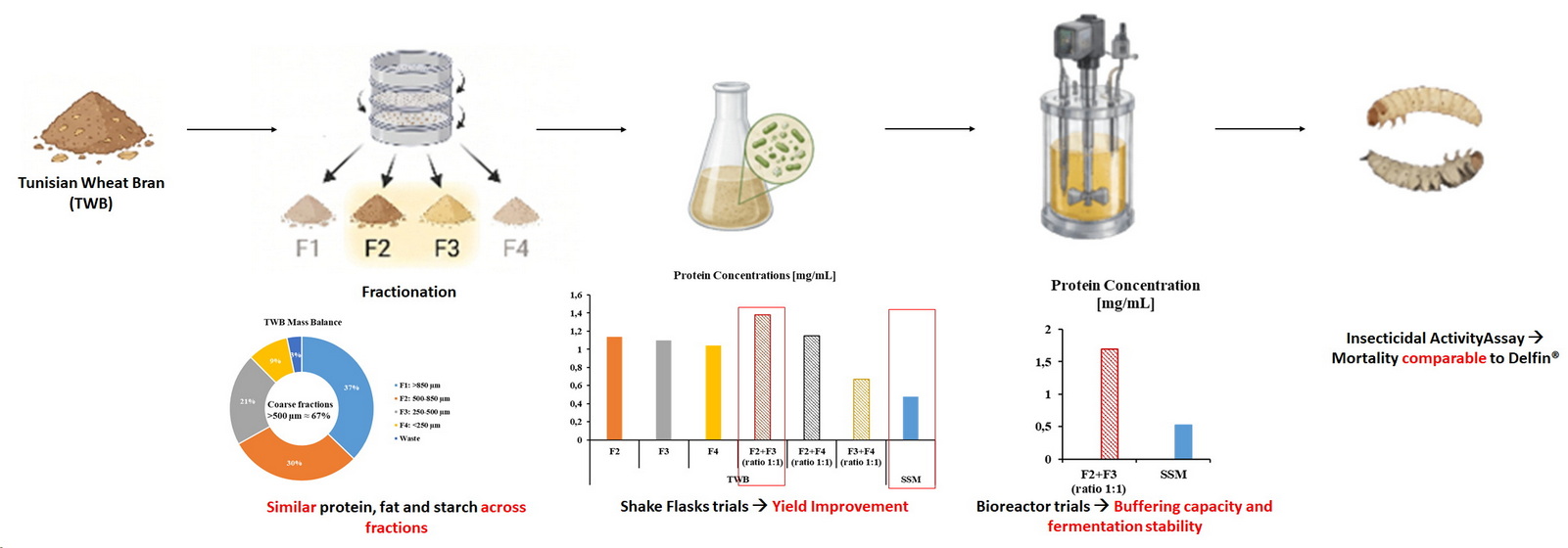
Tunisian wheat bran (TWB), a major milling by-product, was assessed as a substrate for BLB1 biopesticide production. Four fractions (F1-F4) were generated after sieving, with coarse fractions (> 500 µm) dominating at 67% w/w. with comparable protein, fat and starch content. Notably, water retention capacity was the highest in coarse particles (F2), reflecting porosity and buffering potential. When tested as culture medium, the mix F2+F3 (1:1) significantly enhanced BLB1 bioperformances in shake flask level, yielding 2.9 times higher toxin concentrations (1.38 mg.mL-1) and improved spore production, compared to semi-synthetic medium (SSM). This amelioration was suggested to be due to balanced porosity and nutrient accessibility, providing a better oxygen transfer. Indeed, in bioreactor trials, F2+F3 stabilized abiotic parameters (pO₂, pH, and stirring), supported smoother growth transitions, and achieved higher protein concentrations (≈1.7 mg.mL-1) compared to SSM (0.52 mg.mL-1), confirming its buffering capacity. Additionally, the insecticidal potential of the BLB1-based biopesticide produced with the F2+F3 mix was evaluated against Ectomyelois ceratoniae and Ephestia kuehniella, showing mortality rates comparable to those of the commercial Delfin product. These findings highlight TWB, particularly F2+F3 mix, as a cost-effective, sustainable substrate for BLB1 biopesticide production, combining favorable physico-chemical properties, fermentation stability and a high insecticidal activity.
Keywords:
wheat bran
; bioprocess
; Bacillus
; fractionation
Copyright: This open access article is published under a Creative Commons CC BY 4.0 license, which permit the free download, distribution, and reuse, provided that the author and preprint are cited in any reuse.


