
Submitted:
11 August 2026
Posted:
12 August 2026
You are already at the latest version
Abstract
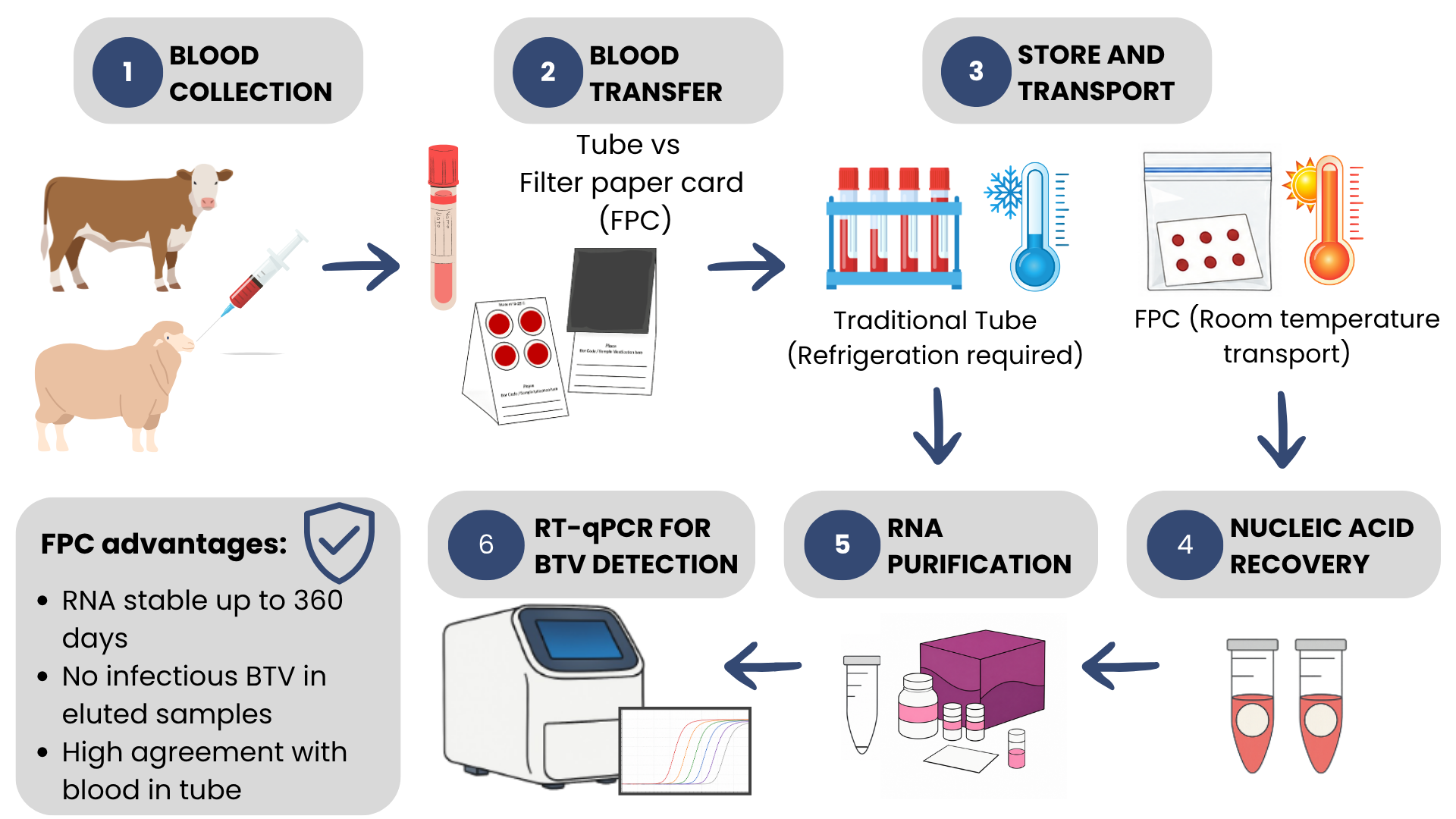
Bluetongue virus diagnosis in Argentina, primarily via RT-qPCR, faces challenges due to the limited number of laboratories, many of which are located in regions where BTV is exotic and far from primary sample collection areas. Consequently, blood samples must be transported over considerable distances for analysis, posing significant logistical challenges due to the specific transport conditions needed. Therefore, the development of methodologies that optimize sample collection, preservation, and safe transport is of vital importance. The objective of this work was to standardize a sampling protocol for BTV using filter paper cards, to achieve adequate preservation and transport of blood samples for subsequent diagnosis. Hydration with TE at 37°C yielded the lowest Cq among tested conditions, with a detection limit of 2.75 102 gc/µL. We evaluated the stability of the sample on the cards by storing them at 25°C, 4°C, -20°C, and -80°C for 1, 7, 30, 60, 120, and 360 days. Stability was verified up to 360 days at all temperatures. Additionally, we confirmed the absence of infectious material in the card eluate. Finally, we conducted a preliminary field evaluation by collecting blood samples from cattle and sheep in tubes and on cards. According to the Cohen´s Kappa index, the agreement between both methods was almost perfect. The standardized methodology represents a significant advance in BTV diagnosis, as it will allow samples to be transported without refrigeration and with adequate biosafety conditions without losing diagnostic capacity.
Keywords:
bluetongue virus
; filter paper cards
; diagnosis
; biosecurity
; sample conservation
Copyright: This open access article is published under a Creative Commons CC BY 4.0 license, which permit the free download, distribution, and reuse, provided that the author and preprint are cited in any reuse.


