

Submitted:
11 August 2026
Posted:
12 August 2026
You are already at the latest version
Abstract
Wild Lentinula edodes is distributed in many provinces of China, and southwestern China has the greatest genetic diversity of L. edodes germplasm. As determined by phylogenetic analyses of internal transcribed spacer (ITS) of ribosomal RNA (rRNA), L. edodes was re-solved into two non-sister lineages, known as Group I and Group V, and also referred to L. edodes and L. aff. edodes. In this study, the ITS fragments of 44 wild L. edodes strains, mainly from Yunnan Province of southwestern China, were cloned, sequenced, and analyzed. It revealed that eight strains contained both Group I and Group V ITS. The protoplast monokaryotization strains (PMSs) and single spore isolates (SSIs) were obtained from YAASM2342, whose mating types and ITS types were analyzed. The results confirmed that two heterokaryons of YAASM2342 contained Group I and Group V ITS, respectively. The strains of both Group I and Group V were present in the SSIs of each mating type at a ratio of ~1:1. Moreover, analyses of the population genomic dataset suggested that the re-covered genetic groups could not correspond to Group I and Group V. These results con-firmed that Group I and Group V of L. edodes belong to the same phylogenetic species.
Keywords:
mushroom
; haplotype
; protoplast
; monokaryotization
; mating-type
1. Introduction
Lentinula edodes, also known as “Shiitake” and “Xianggu”, is an edible and medicinal mushroom species. Wild populations of L. edodes are found in Asia, Australia, and the Americas [1], and have been recorded in 28 provinces and municipalities of China [2]. Moreover, regions of northwestern and southwestern China have the greatest genetic diversity of L. edodes germplasm [3,4]. Before being cultivated via modern techniques starting from the 1930s, L. edodes has been cultivated for more than 800 years, and the cultivated strains have been domesticated so that they have superior quality for human consumption. Since 2018, in Yunnan Province located in southwestern China, some wild strains of L. edodes were directly used for commercial cultivation, and the harvested fruiting bodies were called “small Xianggu”, which is distinguished by a thin-fleshed, smooth pileus and slender stipe, and mild thiol-type odor, and represent a population with conspicuous morphological characteristics. The scale of cultivation of “small Xianggu” is expanding.
Based on the phylogenetic analysis of ITS, L. edodes was divided into two non-sister lineages, which were called Group I and Group V [5], and they were recognized as two potential species-level lineages [6]. Group I was subdivided into Groups Ia and Ib [4,5]. Strains of Group Ia were mainly found in northeastern Asia, and strains of Group Ib were distributed in Pan-mid-southern Asia. Group V is a typical highland-type group whose strains occur in western China, India, and Nepal. Moreover, the strains of Group Ia, Group Ib, and Group V overlap in southwestern China, represented by Yunnan, Guizhou, and Sichuan provinces [4,7].
However, both separate analyses of translation elongation factor (tef1-α) and concatenated analyses of ITS+LSU+tef1-α, Group I and Group V were resolved only one lineage [6]. Population genomic analyses performed by Sierra-Patev et al. [8] revealed that L. edodes sensu lato (s. lat.) contains three lineages that may be identified as species, and Group I and Group V recovered by ITS have been retained as polymorphisms within L. edodes s. lat.. The clades based on genome-wide SNPs did not correspond to Group I and Group V, and this discordance may occur due to the polymorphisms in rRNA genes [6].
Intra-strains of L. edodes exhibit high-level polymorphism in ITS regions [9,10], and direct PCR and sequencing of most strains often yield chromatographs with many heterozygous sites, which introduce inaccuracies into classification. Internal transcribed spacer (ITS) polymorphisms of 88 L. edodes strains were investigated by Song et al. [10]. They divided the ITS1 sequences into a and b types, which contained 26 haplotypes. The ITS2 sequences, including 24 haplotypes, were subdivided into a1, a2, b1, and b2 types.
The primary goal with this study is to clarify the causes of ITS polymorphism within strains of L. edodes and elucidate the phylogenetic relationship between Group I and Group V. The ITS fragments of 44 wild strains of L. edodes, which are mainly from southwestern China and include 10 strains of “small Xianggu”, were cloned, sequenced, and analyzed. The inheritance patterns of divergent ITS sequences were further investigated by examining their distribution among monokaryotic populations from YAASM2342, a heterozygous strain. Moreover, phylogenetic studies based on genome-scale data were performed to assess the status of Group I and Group V of L. edodes.
2. Materials and Methods
2.1. Strains and Cultivation
A total of 44 wild strains of L. edodes from China were used in this study (Table S1). Six strains denoted as ZAASLY were provided by the Horticulture Research Institute, Zhejiang Academy of Agricultural Sciences, and the strain LE0048 was provided by the Soil and Fertilizer Research Institute, Guizhou Academy of Agricultural Sciences. Moreover, 10 strains noted as “small Xianggu” were isolated from different cultivation sites in Yunnan Province. The other strains were collected from remote mountain areas. All strains were stored in the National Collection of Edible Fungi (Yunnan).
An agar disc (5 mm in diameter) containing mycelia was transferred to a Petri dish containing yeast extract peptone dextrose (YPD) medium, and the plate was maintained for 14 days in the dark at 23 ℃. Then, mycelia were scraped, frozen in liquid nitrogen, and used for DNA extraction.
The YAASM2342 strain was cultivated by Yunnan Junsi Biotechnology Co., Ltd. The cultivation substrates contained 2000 g of medium, comprising 80% sawdust, 18% bran, and 2% gypsum. From the harvested offspring, a mature fruiting body was randomly collected to obtain a spore print.
2.2. DNA Extraction, Amplification, Cloning, and Sequencing of ITS Regions
Initially, total DNA was isolated from mycelia using the Fungal gDNA Isolation Kit (BW-GD2416, Beiwo Biotech Co., Ltd, Hangzhou, China). Next, the fungal universal primer pairs ITS1 and ITS4 were used for amplifying the ITS. The PCR reaction mixture (50 µL) contained 25 µL of 2 × PCR Mix (Vazyme Biotech Co., Ltd, Nanjing, China), 1 µL of each 10 mM primer, and 1 µL of 10 ng/µL genomic DNA. The cycling conditions were as follows: denaturation at 95 ℃ for 3 min, followed by 30 cycles at 95 ℃ for 30 s, 57 ℃ for 30 s, and 72 ℃ for 60 s. The final extension was performed at 72 ℃ for 10 min.
After the PCR products were purified using a Trelief® DNA Gel Extraction Kit (Dalin Bio-tek.Inc., China), they were cloned in Escherichia coli DH5 using the pClone007-T versatile Simple Vector Kit (Tsingke Biotech Co., Ltd, Beijing, China). Ten to eleven monoclonal colonies were sequenced for each strain by Beijing Tsingke Biotechnology, while fewer than 10 positive clones were obtained for three strains. For strains YAASM126, YAASM418, YAASM1133, YAASM1518, and YAASM 2342, some ambiguous sequences were detected after analysis, and re-amplification and cloning experiments were repeated, resulting in a total of 22 to 30 clone sequences subjected to subsequent analysis.
2.3. Alignment and Phylogenetic Analyses of ITS Sequences
After manually removing vector sequences at both ends, the ITS sequences were assembled and trimmed using SeqMan Pro in DNASTAR 7.1.0. By aligning with the ITS sequences of L. edodes [10] using ClustalX 1.83, the ITS1, 5.8S, and ITS2 sequences were extracted, and the haplotype of each sequence was determined. In total, 32 ITS sequences of Lentinula were downloaded from the GenBank nucleotide database (Table S2). Based on the Akaike Information Criterion (AIC) [11], the optimal nucleotide substitution model HKY+I was selected using jModelTest 2.1.10 [12,13]. Next, Bayesian Inference (BI) phylogenetic trees were constructed using MrBayes 3.2.7 [14], with L. aff. lateritia designated as the outgroup. The phylogenetic trees were edited using FigTree 1.4.4 and Adobe Illustrator 25.3.1.
2.4. Isolation of Strains of Protoplast Monokaryotization and Single-Spore
Fully grown mycelia from the YAASM2342 strain were inoculated in 25 mL of YPD liquid medium and incubated at 23 ℃. After seven days, the mycelia were collected by filtration through 200-mesh gauze and rinsed three times with 0.6 M mannitol. Then, they were suspended in 0.6 M mannitol containing lytic enzymes (2% lywallzyme (Institute of Microbiology, Guangdong Academy of Sciences, China), 2% cellulase, and 2% snailase (Solarbio Biotech Co., Ltd., Beijing, China), and incubated at 30 ℃ for 2 h. Protoplasts were separated from hyphal debris by filtration through 500-mesh gauze, washed twice with 0.6 M mannitol, and collected by centrifugation at 3000 rpm for 15 min at 4 °C. For regeneration, serially diluted protoplasts were plated on YPD medium containing 0.6 M sucrose and incubated at 23 °C until the formation of new colonies. Viable colonies were transferred to new PDA plates, and protoplast monokaryotization strains (PMSs) without clamp connection were verified under a microscope (DM6 B, Leica Microsystems IR GmbH).
To isolate single-spore strains, spore suspension was prepared by serially diluted, and a 100 µL suspension was spread on PDA plates. Then, the plates were incubated at 23 °C. Growing colonies were observed under a microscope, and single spore isolates (SSIs) without clamp cells were picked up onto new PDA slants.
2.5. Determination of the Mating Type of Monokaryotic Strains
The primer pairs AF/AR for the A mating-type loci and BF/BR for the B mating-type loci were designed based on the primers reported by Zhang et al. [15] (Table S3). Standard PCR analysis was conducted to examine the monokaryotic populations from the YAASM2342 strain, after which the PCR products were sequenced.
Mutiple-sequence alignment analysis of the A and B mating-type loci was performed, respectively, using the software ClustaIX 1.83, and the differences between the mating-type alleles were checked. In this study, one allelic sequence of the A loci was designated as A1, and another allele was designated as A2; accordingly, B1 and B2 of the B loci were confirmed. Next, the allele of each monokaryotic strain was counted, and consequently, the mating type was determined.
Confrontational tests between the monokaryotic strains were conducted to assess the accuracy of the mating types. Next, 2–3 strains were randomly selected from each mating-type group to test mycelial interactions with members within groups and between groups, and mycelia from each side of the pairs were examined for clamp connections. Additionally, phenotypic features of the antagonistic reaction were observed and recorded.
2.6. Genome Re-Sequencing Analysis
Qualified DNA samples were sent to Shanghai Personal Biotechnology Co., Ltd. (Shanghai, China), and the library was prepared following the standard process for building libraries using the TruSeq DNA PCR Free Prep Kit reagent (Illumina, San Diego, CA, USA). The samples were sequenced on the Illumina NovaSeq platform with 150 bp paired-end and a 400-bp insert size, and the raw data were filtered using fastp (v0.20.0) by scanning reads with a sliding window.
All clean reads were aligned to the reference genome (cultivated strain L808 of L. edodes (NCBI accession no. PRJNA627073)) using the BWA software [16] with the default settings. Single nucleotide polymorphisms (SNPs) were identified by GATK [17], and only bi-allelic SNPs with < 20% missing data and a minor allele frequency (MAF) > 0.05 were retained for further analysis.
Principal component analysis (PCA) was conducted using PLINK (v1.9) [18], and a phylogenetic tree was constructed using the fastTree software based on the Maximum likelihood algorithm. To investigate the population structure, the number of genetic clusters present in the genomes of the population was determined using K from 2 to 10 with ADMIXTURE [19]. Then, a cross-validation (CV) procedure in ADMIXTURE was used to estimate the number of ancestral populations (K).
3. Results
3.1. ITS Polymorphism of L. edodes
In total, 518 cloned ITS sequences were obtained from the 44 wild L. edodes strains. The 5.8S region was excluded from haplotype analysis because of high sequence conservation, and the haplotypes of ITS1 and ITS2 were resolved, respectively (Table S1), by aligning with the sequences submitted by Song et al. [10]. Some new haplotypes of ITS1 (Hap27 and Hap28) and ITS2 (Hap25 to Hap32) were identified (Figure S1, Table S4).
Haplotypes of ITS1 and ITS2 were arranged in tandem for each ITS sequence, and 32 haplotype combinations were found in the 44 strains. Based on ITS1 (a/b) and ITS2 (a1/a2/b1/b2) [10], these 32 haplotype combinations could be included in seven ITS types as follows: aa1, aa2, bb1, bb2, ab1, ab2, and ba2, nevertheless, follow-up experiments confirmed that ab1, ab2, and ba2 types represented chimeric artifacts instead of the genuine endogenous sequences of the tested strains. A phylogenetic tree was constructed using ITS sequences extracted from the 32 haplotype combinations (Figure 1). Four subclades were found in Group I lineage. The sequences of the ITS-aa1 type nested in Group Ia included isolates from Japan, Russia, and isolates from northeastern, northwestern, and southwestern provinces of China. The ITS-aa2 sequences were clustered with isolates from the eastern and central provinces of China, and formed Group Ib. The ITS-ba2 and ITS-ab sequences were clustered respectively and identified as two subclades of Group I. The ITS-bb sequences were placed in Group V lineage, which included isolates from Nepal, Vietnam, and China. These results were consistent with those of Song et al. [10] in that the ITS-aa sequences were placed in Group I, with the ITS-aa1 sequences belonging to Group Ia and the ITS-aa2 sequences belonging to Group Ib. The ITS-bb sequences were placed in Group V.
3.2. ITS Heterogeneity Within L. edodes Individuals
There were 34 ITS homogeneous individuals among the 44 strains (Table 1), and the other 10 strains were in a heterozygous state; six strains among them had two types of ITS sequences each. The strains YAASM114 and YAASM734 contained ITS-bb1 and ITS-bb2, and could be classified into Group V. The strains YAASM1515, YAASM7604, and YAASM7607 each had ITS-aa and ITS-bb, i.e., each strain had both Group I and Group V ITS. Similar strains were also reported by Song et al. [10]. Among the L. edodes strains in their study, nine strains were of the ITS-aa and ITS-bb type, while one strain was of the ITS-aa2 and ITS-ba2 type.
Five strains in this study were found with four ITS types each. The strains YAASM126, YAASM1133, and YAASM1518 each contained aa2, bb1, ab1, and ba2 sequences. The strains YAASM418 and YAASM2342 both possessed aa2, bb2, ab2, and ba2 sequences. Lentinula edodes is heterokaryotic, and the two nuclei with different ITS sequences may be the main reason that two types of ITS are present in a strain. However, why a strain has four different types of ITS is not clear.
3.3. ITS Polymorphic Distribution Within Different Mating-Type Monokaryotic Isolates from Strain YAASM2342
The strain YAASM2342 with four ITS types (aa2, bb2, ab2, and ba2) was used to investigate the composition and inheritance patterns of the divergent ITS sequence, and some PMSs and SSIs were obtained. Among 110 regenerated isolates from protoplasts, only 10 isolates were checked for no clamp connection and were therefore monokaryotic isolates. Additionally, 77 SSIs were obtained via gradient dilution. The mating-type of these monokaryotic isolates was determined based on SNP genotyping obtained by using two primer pairs AF/AR and BF/BR. In the obtained A mating-type fragment (about 500 bp), a total of 7 allelic SNP variations were observed (Figure S2). For the B mating-type sequence (about 1100 bp), 12 SNPs and 3 indels (3 bp,1 bp, and 1 bp, respectively) were detected (Figure S3). The allelic genotypes of the A and B mating factors from PMS-45 were designated as A1 and B1, respectively, and the alternative allelic genotypes were correspondingly A2 and B2. Finally, seven PMSs, including PMS-45, were determined as the A1B1 mating-type, and the other three PMSs, including PMS-67, were the A2B2 mating-type. For the 77 SSIs, the numbers for mating-types A1B1, A2B2, A1B2, and A2B1 were 16, 24, 13, and 24, respectively (Table S5).
To assess the accuracy of the mating types based on SNP genotyping, 2–3 monokaryotic isolates were randomly selected from each mating-type group to test their confrontational interactions with members within a group and between groups. Clamp connection was observed between isolates with different A and B factors. When the paired strains had the same A or B factor, typical or atypical barrages formed along the contact zone, and no clamp connection was found (Figure S4, Table S6). The results of the confrontation tests confirmed the correctness of the mating type of the monokaryotic isolates.
The ITS type analyses were conducted among 58 monokaryotic isolates, including 10 PMSs and 12 SSIs for each mating type. All PCR products were sequenced directly, and the chromatograms of the ITS regions did not show double peaks. The sequence alignment analyses revealed that the seven PMSs of mating-type A1B1 possessed ITS-bb2, whereas the other three PMSs of mating-type A2B2 possessed ITS-aa2. Among the 12 SSIs of each mating-type, there were both isolates of ITS-bb2 and ITS-aa2, and the ratio was approximately 1:1 (Figure 2).
3.4. Ambiguous ITS Sequences Arising from PCR Chimeras
Surprisingly, no ITS-ba2 or ITS-ab2 was detected in the monokaryotic isolates of YAASM2342; therefore, the ITS regions of the 10 PMSs were cloned and analyzed again, and 10 positive colonies for each isolate were sequenced. According to the results, no ITS-ba2 or ITS-ab2 were found in these 100 cloned ITS sequences, and the 10 cloned sequences of each PMS were almost identical.
Two templates of heterologous genomic DNA were simulated by mixing equal amounts of DNA from PMS-63 (ITS-bb2) with PMS-67 (ITS-aa2), and from PMS-95 (ITS-bb2) with PMS-97 (ITS-aa2). Among the 20 cloned sequences obtained from each template, one ITS-ab2 sequence and one ITS-ba2 sequence were identified (Figure S5). These findings confirmed that ITS-ab2 and ITS-ba2 from the strain YAASM2342 are chimeric sequences generated during PCR amplification using heterologous DNA templates.
Among the 44 strains in this study, none had only the ITS-ab or ITS-ba sequence. Additionally, the ITS-ab and ITS-ba sequences were present at low abundance among the cloned sequences of each strain (Table S1). Accordingly, ITS-ab2 and ITS-ba2 from the other strains were considered to be chimeric amplicons.
3.5. Genome Re-Sequencing and Diversity
Genome re-sequencing was performed including the 44 wild L. edodes strains and six monokaryotic isolates from YAASM2342 as follows: PMS-45 (ITS-bb2/A1B1), PMS-67 (ITS-aa2/A2B2), SSI-60 (ITS-aa2/A1B1), SSI-144 (ITS-aa2/A1B2), SSI-55 (ITS-bb2/A2B1), and SSI-90 (ITS-bb2/A2B2).
At least 2 Gb of clean DNA reads with Q30 > 94% were obtained for each strain and mapped to the reference genome L808. The mean genome coverage (at least 1X) was 89.5%, and the mean depth was 48.7X. The reads had an average mapping rate of 80.5% (Table S7). Among the SNPs dispersed throughout the genome, 1,436,459 SNPs with a MAF > 0.05 and <20% missing data were selected for analyzing population genomics. A total of 2,441,942 transition mutations (Ts) and 881,715 transversion mutations (Tv) were identified, with a Ts/Tv ratio of 2.90. The Ts frequency was 73.47%, whereas the Tv frequency was 26.53% (Figure S6).
3.6. Population Structure of L. edodes
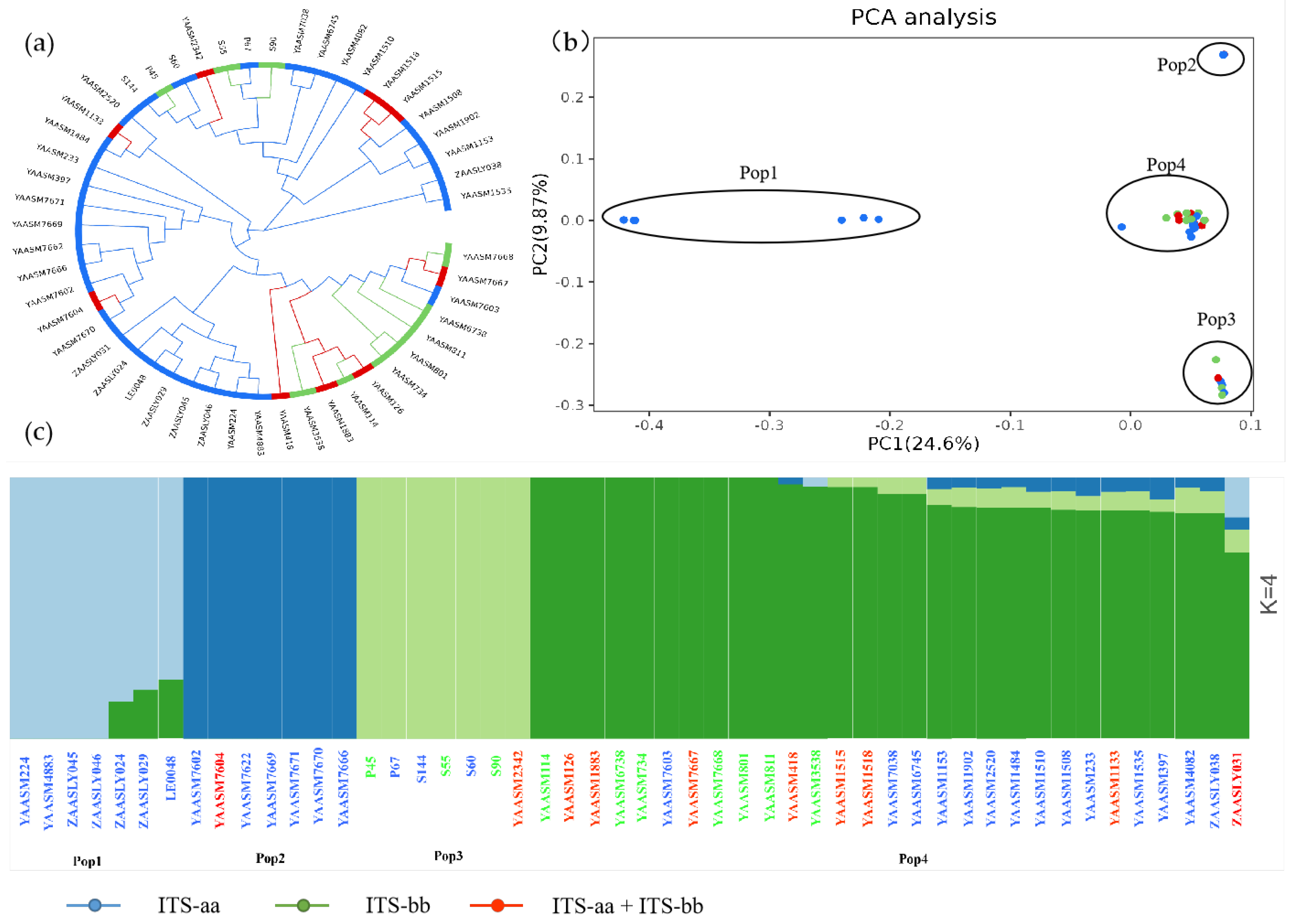
An admixture analysis was conducted for the 50 strains of L. edodes, and four major populations were revealed when the lowest CV error was observed for K = 4 (Figure S7). Population 1 (Pop1) contained seven strains, including two from North China (Jilin Province), two from East China (Zhejiang and Fujian Provinces), and three from Southwest China (Yunnan and Guizhou Provinces). Seven “small Xianggu” strains constituted population 2 (Pop2), while YAASM2342 and its six monokaryotic isolates formed population 3 (Pop3). All strains in these two populations showed an almost 100% single ancestry component. The remaining 29 strains formed population 4 (Pop4), which were from Yunnan Province and contained three “small Xianggu” strains. The PCA results were congruent with the results of the admixture analyses (Fig. 3, Table S8). Pop1 and Pop2 included only strains of ITS-aa type, except for YAASM7604 (ITS-aa + ITS-bb), while Pop3 and Pop4 concentrated on the strains of three ITS types (ITS-aa, ITS-bb, and ITS-aa + ITS-bb).
In the ML tree constructed using SNPs, all wild strains of ITS-bb were clustered together. Four strains of the ITS-aa + ITS-bb type and one strain of the ITS-aa strain were distributed in this group. Except for three monokaryotic isolates of the ITS-bb type included in the branch of the parent YAASM2342 and its progeny strains, the other clades were strains of the ITS-aa and ITS-aa + ITS-bb types.
Figure 3.
Population structure of 50 L. edodes strains. (a) ML phylogenetic tree; (b) PCA; (c) Admixture result at K = 4.
Figure 3.
Population structure of 50 L. edodes strains. (a) ML phylogenetic tree; (b) PCA; (c) Admixture result at K = 4.
4. Discussion
4.1. ITS Barcode Is Problematic for the Phylogenetic Analysis of L. edodes
As ITS serves as a barcode for filamentous fungi, the identity thresholds were 97% to 99% for species and 94% for genus [20], whereas the sequence similarities between different ITS types of L. edodes were 93.6–99%. In the phylogenetic analysis of the ITS data alone, L. edodes strains were resolved into two non-sister lineages, Group I and Group V [5], which were regarded as two phylogenetic species and were denoted as L. edodes and L. aff. edodes [6]. However, some wild strains that contained one Group I nucleus and one Group V nucleus were identified in this study, and they could produce offspring that could be classified as Group I, Group V, and heterozygous Group I + Group V. Therefore, intrastrain variations in the ITS region may obscure phylogenetic relationships.
Double or multiple peaks in chromatograms were frequently detected when ITS products of strains of L. edodes were directly sequenced, and this phenomenon was often ignored. However, clone sequencing in this study revealed that some chimeric sequences may be overrepresented when heterologous genomic DNA serves as the PCR template, which results in an overestimation of diversity. Chimera formation occurs more often in genetically diverse and species-rich samples [21]. By comparing the ITS cloned sequences generated from heterokaryons and homokaryons of Agrocybe aegerita, Qian et al. [22] found that chimeric sequences amplified from heterokaryons accounted for 30–41.67% of all clones, and the SNP and indel variations in these sequences were derived from template switching at specific loci. Therefore, when performing phylogenetic analyses using multi-copy regions, such as ITS, chimeric sequences generated during amplification need to be identified.
4.2. Two Nuclei with Divergent ITS Variations Are the Main Reason for ITS Polymorphisms Within Dikaryotic Strains of L. edodes
Variations in ITS within strains occur in some fungi, such as Ophiocordyceps sinensis [23], Aspergillus nidulans [24], Laetiporus spp. [25], etc., probably because of intragenomic variation (a variation that exists within the haploid genome between multiple copies of the same gene or region) [26], but for dikaryotic basidiomycetes, such variations probably occur due to the divergence between two haploid nuclei [27].
In this study, eight strains harboring Group I and Group V ITS sequences were identified. In total, 10 PMSs and 48 SSIs were detected in YAASM2342, seven PMSs of A1B1 mating-type were detected in Group V ITS, and the other three PMSs of mating-type A2B2 were detected in Group I ITS. Among the 48 SSIs, half exhibited Group V ITS and the other half displayed Group I ITS. These results confirmed that the two nuclei of YAASM2342 harbored Group I and Group V ITS types, respectively.
By analyzing 12 SSIs of each mating-type (A1B1, A2B2, A1B2, and A2B1), we found that both Group I and Group V ITS were present in SSIs of each mating-type, with an approximate ratio of 1:1. This suggested that the A and B mating factors and multiple copies of rDNA represent non-linkage inheritance and undergo independent assortment into daughter spores during meiosis. For the progeny of YAASM2342, the probability of obtaining dikaryotic strains of Group I, Group V, and heterozygote (Group I + Group V)via crossing was equal. In southwestern China, strains of Group I and Group V broadly overlap [4]; this also indicates that a certain number of heterogenetic strains, including Group I and V ITS, must be present in this area.
4.3. Population Genomics Revealed That Strains of Group I and Group V of L. edodes Could Not Be Resolved as Two Distinct Populations
The phylogenetic analysis based solely on the ITS dataset resolved Group I and Group V as two distinct monophyletic clades, in contrast, Group I and Group V clustered into a single monophyletic clade in all other phylogenetic analyses [6]. Genome-wide population analyses on cultivated and wild L. edodes resolved three principal clades, wherein two clades mainly consisted of wild strains, while the other comprised admixed wild and cultivated strains [8,28]. However, Group I and Group V failed to correspond to the three clades identified via population genomic analyses, with their strains scattered across all clades [8].
In this study, population structure analyses showed that all Group V strains, a subset of Group I strains, and Group + Group V strains co-clustered into one cohesive genetic population 4. Moreover, the three monokaryotic isolates of Group V nested in Pop3 with their parent YAASM2342 and another monokaryotic isolates of Group I. No Group V-exclusive discrete population was detected at the whole-genome scale, which contradicts the premise of evolutionary divergence between Group I and Group V. When these 50 strains were classified into three groups (Group I, Group V, and Group I + Group V) based on their ITS types, all pairwise Fst values (0–0.05) (Table S9) revealed low genetic divergence across groups. Therefore, phylogenetic analyses based solely on ITS sequences fail to accurately resolve the true evolutionary relationships among L. edodesstrains, and Group I and Group V belong to the same phylogenetic species.
5. Conclusions
Several strains of L. edodes containing both Group I and Group V ITS types were identified in this study. The study also found that ITS variations within these strains were due to the divergence between two haploid nuclei, and their progeny monosporous strains were homokaryons of either Group V or Group I. Accordingly, strains of Group I, Group V, and Group I + Group V have overlapping distribution in southwestern China. When heterologous genomic DNA serves as a PCR template, some chimeric ITS sequences may be formed, resulting in an overestimation of diversity. Moreover, population genomic data analysis confirmed that strains of Group I and Group V did not resolve into two independent groups. Therefore, the non-sister relationship of Group I and Group V resolved by ITS is a marker-specific phylogenetic artifact, not a reflection of their true evolutionary affinity, and Group I and Group V belong to the same phylogenetic species.
Supplementary Materials
The following supporting information can be downloaded at the website of this paper posted on Preprints.org, Figure S1: ITS2 sequence alignments of the new haplotypes and the core haplotypes; Figure S2: Sequence alignments of the mating A loci from 10 PMSs of YAASM2342; Figure S3: Sequence alignments of the mating B loci from 10 PMSs of YAASM2342; Figure S4: Antagonism test of the monokarytic strains of different mating-type; Figure S5: Sequence alignments of the chimeric amplicons from mix template; Figure S6: Analyses of SNP mutation spectrum; Figure S7: Distribution map of CV error values to different K values; Table S1: Summary of strains and the ITS types; Table S2: ITS sequences of the genus Lentinula were downloaded from the GenBank nucleotide database; Table S3: Primer sequences amplified the mating-type locus; Table S4: The new haplotypes in this study; Table S5: The mating-types and the ITS types of the monokarytic strains from YAASM2342 ; Table S6: Confrontation test of the monokaryotic strains from different mating-type group; Table S7: Statistics of reads for each strain; Table S8: PCA data; Table S9: Fst results statistics among strains with different ITS types.
Author Contributions
Conceptualization, H.M., and P.L.; methodology, L.H., X.R., and J.Q.; software, Y.H.; validation, W.M., and N.T.; formal analysis, H.M.; and Y.H.; investigation, P.L., and W.M.; writing—review and editing, P.L., and H.M.; project administration, H.M. and P.L.; funding acquisition, H.M., and W.M. All authors have read and agreed to the published version of the manuscript.
Funding
This study was supported by the National Collection of Edible Fungi (Yunnan), The project of Hongmei Chai Expert Base Research Station in Deqin County Yuekang Co., Ltd.
Conflicts of Interest
The authors declare no conflict of interest.
Acknowledgments
Yongchang Zhao is thanked for his helpful suggestions.
References
- Hibbett, D.S. Shiitake mushrooms and molecular clocks: historical biogeography of Lentinula. J. Biogeogr. 2001, 28, 231–241. [Google Scholar] [CrossRef]
- Li, W.J.; Yang, R.H.; Guo, T.; Wu, S.J.; Li, Y.; Bao, D.P. A model of the current geographic distribution and predictions of future range shifts of Lentinula edodes in China under multiple climate change scenarios. J. Fungi. 2025, 11, 730. [Google Scholar] [CrossRef] [PubMed]
- Xu, X.F.; Lin, F.X.; Chen, S.M.; Li, A.Z.; Lin, F.C. Genetic diversity of natural germplasm of Lentinula edodes in China inferred from rDNA sequences. Mycostema 2005, 24, 29–35. [Google Scholar]
- Xu, X.F.; Li, A.Z.; Cheng, S.M.; Lin, F.X.; Lin, F.C. Reappraisal of phylogenetic status and genetic diversity analysis of Asian population of Lentinula edodes. Prog.Nat.Sci. 2006, 16, 274–280. [Google Scholar]
- Hibbett, D.S.; Hansen, K.; Donoghue, M.J. Phylogeny and biogeography of Lentinula inferred from an expanded rDNA dataset. Mycol. Res. 1998, 102, 1041–1049. [Google Scholar] [CrossRef]
- Menolli, Jr.N.; Sánchez-Ramírez, S.; Sánchez-García, M.; Wang, C.; Patev, S.; Ishikawa, N.K.; Mata, J.L.; Lenz, A.R.; Vargas-Isla, R.; Liderman, L.; Lamb, M.; Nuhn, M.; Hughes, K.W.; Xiao, Y.; Hibbett, D.S. Global phylogeny of the Shiitake mushroom and related Lentinula species uncovers novel diversity and suggests an origin in the Neotropics. Mol. Phylogenet Evol. 2022, 173, 107494. [Google Scholar] [CrossRef] [PubMed]
- Yang, R.H.; Wu, Y.Y.; Song, C.Y.; Tian, G.T.; Li, C.H.; Tang, L.H.; Tan, Q.; Bao, D.P. Reanalysis of geographical distribution of wild Lentinula edodes in China based on the information from public databases. Mycostema 2018, 37, 335–351. [Google Scholar]
- Sierra-Patev, S.; Min, B.; Naranjo-Ortiz, M.; Looney, B.; Konkel, Z.; Slot, J.; Sakamoto, Y.; Steenwyk, J.; Rokas, A.; Carro, J.; Camarero, S.; Ferreira, P.; Molpeceres, G.; Ruiz-Dueñas, F. J.; Serrano, A.; Henrissat, B.; Drula, E.; Hughes, K.; Mata, J.; Ishikawa, N. K.; Vargas-Isla, R.; Ishijima, S.; Smith, C.; Donoghue, J.; Ahrendt, S.; Andreopoulos, W.; He, G.; LaButti, K.; Lipzen, A.; Ng, V.; Riley, R.; Sandor, L.; Barry, K.; Martinez, A.; Xiao, Y.; Gibbons, J.; Terashima, K.; Grigoriev, I. V.; Hibbett, D. A global phylogenomic analysis of the shiitake genus. Proc. Natl. Acad. Sci. U.S.A. 2023, 120, e2214076120. [Google Scholar] [CrossRef] [PubMed]
- Ren, X.; He, D.; Li, C.X.; Ding, H.S. Incomplete intracellular ITS concerted evolution in Lentinula edodes and its influence on identification and phylogenesis. Guangdong Agr. Sci. 2015, 42, 111–121. [Google Scholar]
- Song, X.X.; Zhao, Y.; Song, C.Y.; Li, C.H.; Song, Y.; Chen, M.J.; Bao, D.P.; Tang, Q. ITS1/5.8S/ITS2, a good marker for Initial classification of shiitake culinary-medicinal Lentinus edodes (Agaricomycetes) strains in China. Int. J. Med. Mush. 2018, 20, 227–242. [Google Scholar] [CrossRef] [PubMed]
- Hurvich, C.M. Bias of the corrected AIC criterion for underfitted regression and time series models. Biometrika 1991, 78, 499–509. [Google Scholar] [CrossRef]
- Guindon, S.; Gascuel, O. A simple, fast, and accurate algorithm to estimate large phylogenies by maximum likelihood. Syst. Biol. 2003, 52, 696–704. [Google Scholar] [CrossRef] [PubMed]
- Darriba, D.; Taboada, G.L.; Doallo, R.; Posada, D. jModelTest 2: More models, new heu-ristics and parallel computing. Nat. Methods 2012, 9, 772. [Google Scholar] [CrossRef] [PubMed]
- Ronquist, F.; Teslenko, M.; van der Mark, P.; Ayres, D.L.; Darling, A.; Höhna, S.; Larget, B.; Liu, L.; Suchard, M.A.; Huelsenbeck, J.P. MrBayes 3.2: Efficient bayesian phylogenetic inference and model choice across a large model space. Syst.Biol. 2012, 61, 539–542. [Google Scholar] [CrossRef] [PubMed]
- Zhang, M.Y.; Song, C.Y.; Yu, H.L.; Tan, Q.; Xu, Z.; Wang, R.J.; Zhang, L.J.; Shan, X.D. Mating-type identification of Lentinula edodes based on SNP genotyping by AS-PCR. J.Ed. Fungi 2019, 26, 1–9. [Google Scholar]
- Li, H.; Durbin, R. Fast and accurate short read alignment with Burrows-Wheeler transform. Bioinformatics 2009, 25, 1754–60. [Google Scholar] [CrossRef] [PubMed]
- McKenna, A.; Hanna, M.; Banks, E.; DePristo, M.A. The Genome Analysis Toolkit: A MapReduce framework for analyzing next-generation DNA sequencing data. Genome Res. 2010, 20, 1297–303. [Google Scholar] [CrossRef] [PubMed]
- Purcell, S.; Neale, B.; Todd-Brown, K.; Thomas, L.; Ferreira, M.A.R.; Bender, D.; Maller, J.; Sklar, P.; Bakker, P.I.W.; Daly, M.J.; Sham, P.C. PLINK: a tool set for whole-genome association and population-based linkage analyses. Am. J. Hum. Genet. 2007, 81, 559–75. [Google Scholar] [CrossRef] [PubMed]
- Alexander, D.H.; Novembre, J.; Lange, K. Fast model-based estimation of ancestry in unrelated individuals. Genome Res. 2009, 19, 1655–64. [Google Scholar] [CrossRef] [PubMed]
- Vu, D.; Groenewald, M.; de Vries, M.; Gehrmann, T.; Stielow, B.; Eberhardt, U.; Al-Hatmi, A.; Groenewald, J.Z.; Cardinali, G.; Houbraken, J.; Boekhout, T.; Crous, P.W.; Robert, V.; Verkley, G.J.M. Large-scale generation and analysis of filamentous fungal DNA barcodes boosts coverage for kingdom fungi and reveals thresholds for fungal species and higher taxon delimitation. Stud. Mycol. 2019, 92, 135–154. [Google Scholar] [CrossRef] [PubMed]
- Stevens, J.L.; Jackson, R.L.; Olson, J.B. Slowing PCR ramp speed reduces chimera formation from environmental samples. J. Microbiol. Methods 2013, 93, 203–205. [Google Scholar] [CrossRef] [PubMed]
- Qian, R.; Chai, H.M.; Zhao, Y.C.; Chen, Y.H.; Chen, W.M. Sequence characterization of intrastrain ITS heterogeneity in cyclocybe aegerita species complex. J. Southwest For. Univ. 2021, 41, 116–125. [Google Scholar]
- Li, Y.; Jiao, L.; Yao, Y.J. Non-concerted ITS evolution in fungi, as revealed from the important medicinal fungus Ophiocordyceps sinensis. Mol. Phylogenet Evol. 2013, 68, 373–379. [Google Scholar] [CrossRef] [PubMed]
- Rooney, A.P.; Ward, T.J. Evolution of a large ribosomal RNA multigene family in filamentous fungi: birth and death of a concerted evolution paradigm. Proc. Natl. Acad. Sci. U. S. A. 2005, 102, 5084e5089. [Google Scholar] [CrossRef] [PubMed]
- Linder, D.L.; Banik, M.T. Intragenomic variation in the ITS rDNA region obscures phylogenetic relationships and inflates estimates of operational taxonomic units in genus Laetiporus. Mycologia 2011, 103, 731–740. [Google Scholar] [CrossRef] [PubMed]
- Paloi, S.; Luangsa-Ard, J. J.; Mhuantong, W.; Stadler, M.; Kobmoo, N. Intragenomic variation in nuclear ribosomal markers and its implication in species delimitation,identification and barcoding in fung. Fungal Biol.Rev. 2022, 42, 1–33. [Google Scholar] [CrossRef]
- He, X.L.; Li, Q.; Peng, W.H.; Zhou, J.; Cao, X.L.; Wang, D.; Huang, Z.Q.; Tan, W.; Li, Y.; Gan, B.C. Intra- and interisolate variation of ribosomal and protein-coding genes in Pleurotus: implications for molecular identification and phylogenyon fungal groups. BMC Microbiol. 2017, 17, 1e9. [Google Scholar] [CrossRef] [PubMed]
- Zhang, J.C.; Shen, N.; Li, C.; Xiang, X.J.; Liu, G.L.; Gui, Y.; Patev, S.; Hibbett, D.S.; Barry, K.; Andreopoulos, W.; Lipzen, A.; Riley, R.; He, G.F.; Yan, M.; Grigoriev, I.V.; Kwan, H.S.; Cheung, M.K.; Bian, Y.B.; Xiao, Y. Population genomics provides insights into the genetic basis of adaptive evolution in the mushroom-forming fungus Lentinula edodes. J. Adv. Res. 2022, 38, 91–106. [Google Scholar] [CrossRef] [PubMed]
Figure 1.
The BI tree was constructed based on ITS sequences of 32 haplotype combinations.
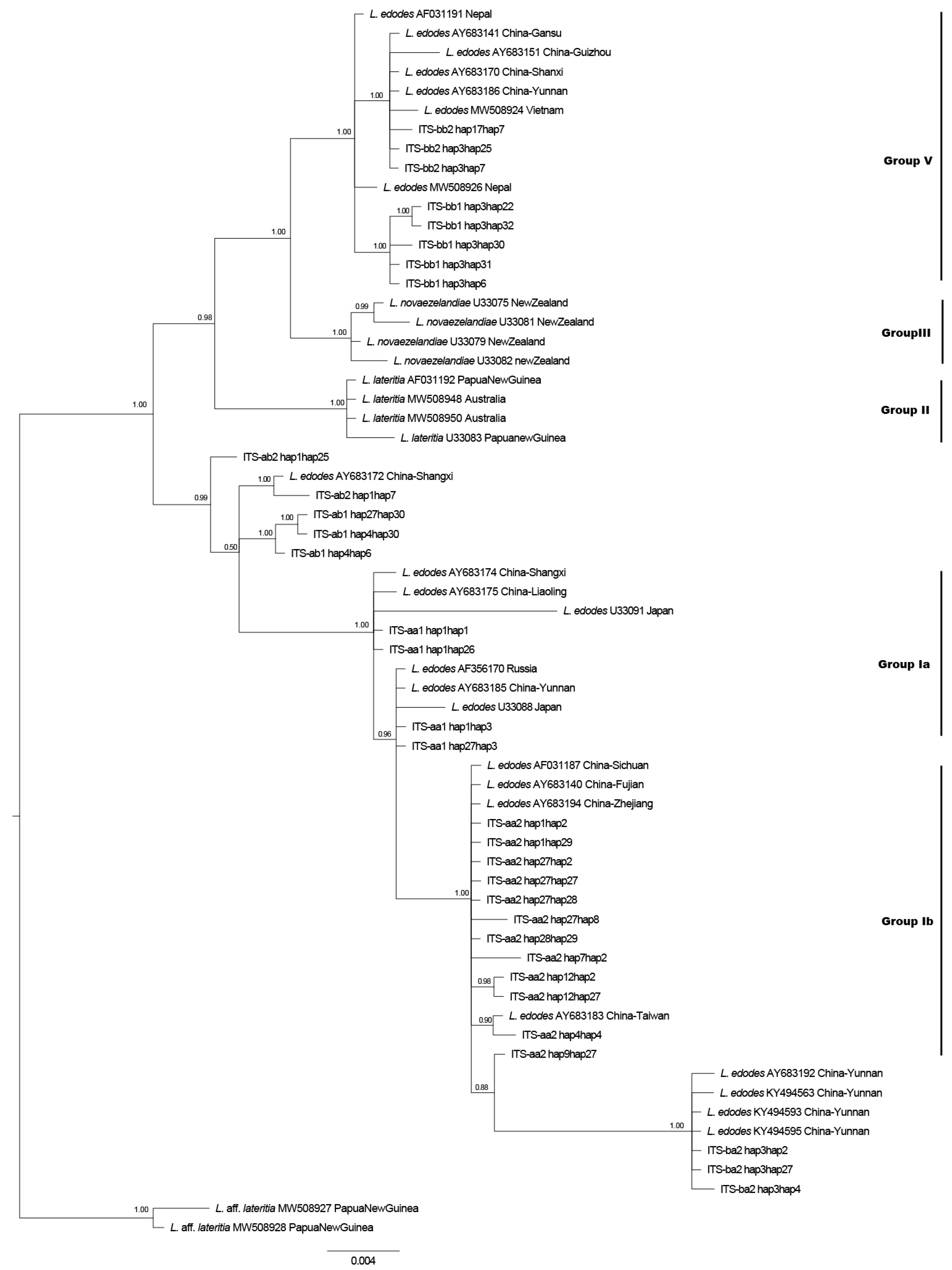
Figure 2.
Schematic illustration of the ITS types and mating-type of monokaryotic population from YAASM2342.
Figure 2.
Schematic illustration of the ITS types and mating-type of monokaryotic population from YAASM2342.
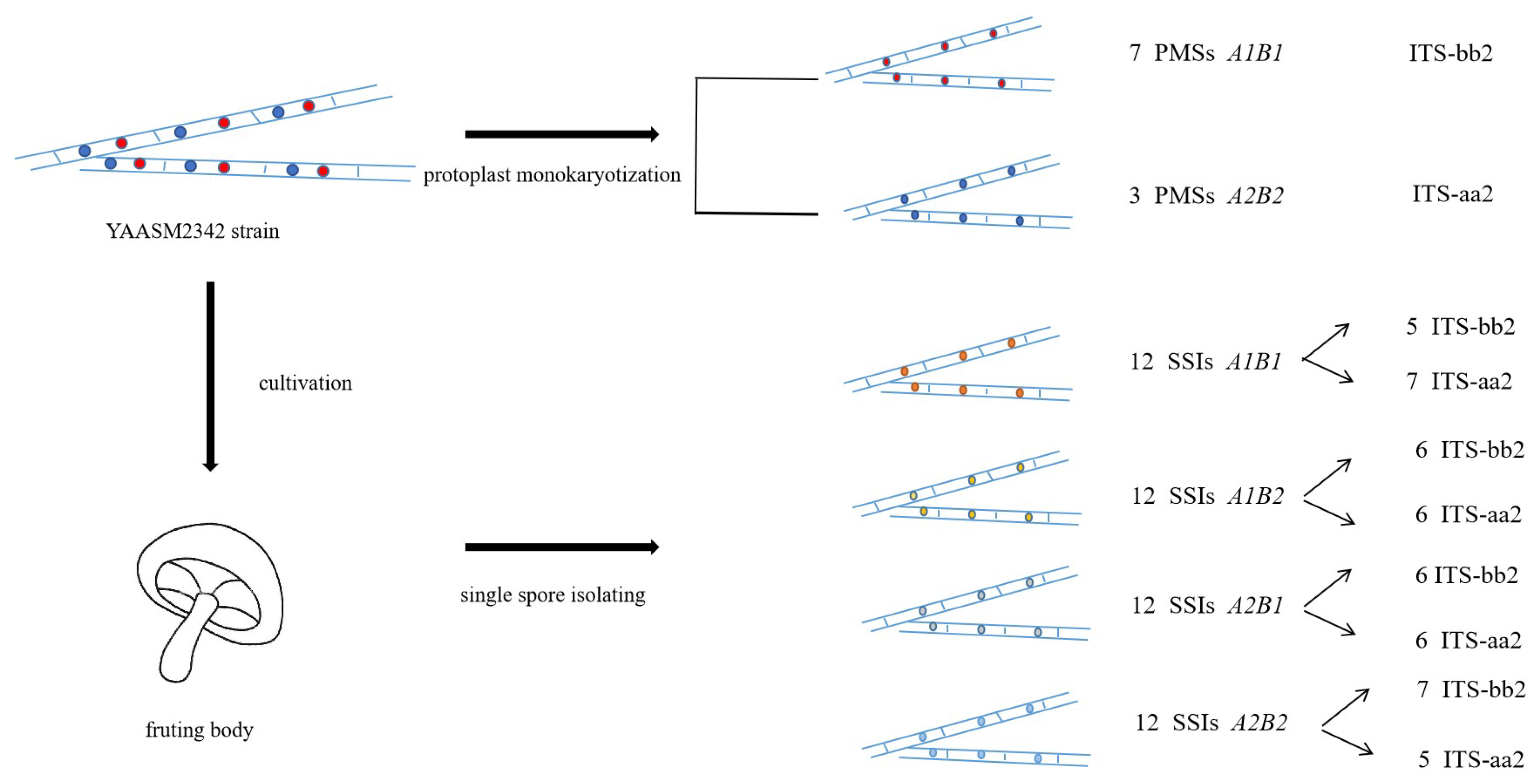

Table 1.
List of the strains with different types of ITS.
| Number | TS types within individual | Strain |
| 1 | aa1 | YAASM224 YAASM4883 YAASM7645 YAASM7646 |
| 2 | aa2 | YAASM233 YAASM397 YAASM1153 YAASM1484 YAASM1508 YAASM1510 YAASM1535 YAASM1902 YAASM2520 YAASM4082 YAASM6745 YAASM7038 YAASM7602 YAASM7603 YAASM7640 YAASM7641 YAASM7642 YAASM7644 YAASM7649 YAASM7662 YAASM7666 YAASM7669 YAASM7670 YAASM7671 |
| 3 | bb1 | YAASM801 YAASM811 YAASM1883 YAASM3538 |
| 4 | bb2 | YAASM6738 YAASM7668 |
| 5 | bb1 + bb2 | YAASM114 YAASM734 |
| 6 | aa2 + bb1 | YAASM1515 |
| 7 | aa2 + bb2 | YAASM7604 YAASM7667 |
| 8 | aa2 + bb1 + ab1 + ba2 | YAASM126 YAASM1133 YAASM1518 |
| 9 | aa2 + bb2 + ab2 + ba2 | YAASM418 YAASM2342 |
Disclaimer/Publisher’s Note: The statements, opinions and data contained in all publications are solely those of the individual author(s) and contributor(s) and not of MDPI and/or the editor(s). MDPI and/or the editor(s) disclaim responsibility for any injury to people or property resulting from any ideas, methods, instructions or products referred to in the content. |
© 2026 by the authors. Licensee MDPI, Basel, Switzerland. This article is an open access article distributed under the terms and conditions of the Creative Commons Attribution (CC BY) license (http://creativecommons.org/licenses/by/4.0/).
Copyright: This open access article is published under a Creative Commons CC BY 4.0 license, which permit the free download, distribution, and reuse, provided that the author and preprint are cited in any reuse.